❌

Reading view

“Chaos” in the air: Five ways voting could be disrupted on Election Day

As Americans head to the polls on Tuesday, voting experts are watching to see how the Trump administration’s unprecedented efforts to assert more federal control over elections will play out.

Since President Donald Trump retook the White House, his administration has tried to force states to turn over their unredacted voter rolls and to restrict mail-in voting. The Department of Homeland Security has used its resources to identify and prosecute noncitizen voters, an effort that has unfolded alongside the agency’s massive crackdown on immigrants.

The president has justified these steps by claiming, without evidence, that American elections are beset by fraud and that illegal voting is tipping the scales in favor of Democrats.

Courts have thwarted most of the administration’s plans to date, but Trump and his top deputies have kept up the pressure. Most recently, they’ve threatened to prosecute election officials who don’t reject ballots from people that the federal government has identified as likely noncitizens.

The administration hasn’t explicitly ruled out sending federal agents to the polls or seizing ballots or voting machines.

Election experts say the cumulative effect has been to ramp up anxiety about the midterms and to erode voters’ trust in the system.

“The administration has been creating a lot of noise, a lot of confusion, a lot of doubt,” said Ben Hovland, whom Trump fired as a commissioner for the bipartisan Election Assistance Commission earlier this year. He said he worries that this will make voters “sit it out” and “throw their hands up.”

In an emailed response to questions, a DHS spokesperson said Immigration and Customs Enforcement “is not planning operations targeting polling locations,” adding that the agency would only arrest people at the polls to address a safety threat as part of “intelligence-driven targeted enforcement.”

The DHS and the Justice Department “are laser focused on identifying, prosecuting and removing aliens who vote and dilute the votes of U.S. citizens,” the spokesperson added. “Our message to aliens who vote in American elections is clear: we will find you, arrest you, and you will face the consequences — including criminal charges and deportation.”

Before and on Election Day, it’s typical for the major political parties to mount poll-watching operations, but both Democrats and Republicans say they’ve expanded these activities in this pressurized midterm.

Republicans will focus on issues such as voter eligibility and voter-roll accuracy, according to Ally Triolo, the Republican National Committee’s election integrity communications director. Democrats will concentrate on voter intimidation and other hurdles to voting, Angelo Fernández Hernández, a Democratic National Committee spokesperson, said.

Here are five issues that voting rights experts say they’re watching as this year’s election unfolds:

1. Will There Be Federal Interference?

An incident in Leon County, in the Florida Panhandle, illustrates the widespread anxiety about law enforcement at the polls.

Mark Earley, the county’s supervisor of elections, told ProPublica he was “furious” when two marked U.S. Customs and Border Protection vehicles parked outside the county’s busiest early voting location last month, after he’d been repeatedly reassured by the administration that agents would not do this.

He reported the sighting to the FBI, then learned that the agents, who were headed out of state, had just stopped by to try to vote themselves. The episode generated a flurry of news coverage.

“Given the negative media coverage regarding federal agents at the polls, it shows pretty bad judgment that they showed up in their official vehicles,” Earley said.

It’s against the law for federal law enforcement to be near polling places.


Start your day with essential news from Salon.
Sign up for our free morning newsletter, Crash Course.


Nick Brown, Washington’s attorney general, leads a group of Democratic state officials and voting rights advocates who have been planning how to respond if, indeed, there is real federal interference. The group has “war-gamed” how to react if government agents attempt to commandeer voting equipment or ballots.

“We’ve seen the tension and chaos that’s in the air,” Brown said. He called the federal government “the biggest challenge to smooth elections right now, which is not the way it’s supposed to be.”

A DOJ spokesperson said “the best preparation for any election official is following federal law.”

It’s routine for DOJ monitors to watch over polling places, and the agency has assured states that, in the midterms, its observers will follow the law and not interfere with voting or election administration. Still, state officials remain concerned. During Wyoming’s primary election, poll workers said they felt uneasy when DOJ monitors asked about their training and to inspect voting systems. The state’s governor criticized these actions as “a bit aggressive” and “irregular.”

2. What Effect Will Noncitizen Voter Challenges Have?

The Trump administration’s multipronged effort targeting alleged noncitizen voters has already led to eligible voters being improperly removed from the rolls. Voting rights groups fear this will block some U.S. citizens from being able to vote when they show up on Tuesday.

Federal officials have made clear they plan to go after anyone they think is committing voter fraud.

On the first day of early voting in Texas, Aaron Reitz, the U.S. attorney for the Southern District of Texas, posted a YouTube video announcing his intentions. “If you violate federal election law,” he warned, “I will hunt you down and prosecute you.”

This threat came days after the DOJ sued California, seeking to block the state from counting mail ballots from more than 20,000 voters it claims are “likely” noncitizens. The administration had obtained the state’s public voter rolls, which the DHS had blended with its own immigration information and third-party data.

In a court filing, California called the claim that there are 20,000 noncitizens on its voter rolls “specious.” Los Angeles County analyzed a sampling of the likely noncitizen voters that the federal government claimed were registered there. Many weren’t registered in the county or had never voted, the analysis showed. Some said on their voter registration forms that they were born in the United States.

Asked about the case, the DOJ told ProPublica, “Federal law prohibits noncitizens from voting in federal elections, and the Department has a duty to enforce it.”

A federal judge has rejected the DOJ’s motion for an emergency order that would have barred California from counting the 20,000 voters’ ballots. (A federal appeals panel later backed that decision.) On Thursday, the administration sent grand jury subpoenas to California officials demanding records about their response to allegations of noncitizens on the state’s rolls. Late Friday, a federal judge issued a restraining order blocking the DOJ’s demands, calling them an “intimidation plan” that would interfere with legal voting.

Last week, the DOJ wrote a letter threatening to sue Washington state if officials there refused to review a list of 400 voters it believes to be noncitizens within 24 hours. U.S. Attorney General Todd Blanche told reporters late last month that the department was considering additional actions, saying there were “a number of states that we’re looking at.”

In a letter responding to the DOJ, Washington Secretary of State Steve Hobbs called the government list of 400 names “not reliable,” saying it included U.S. citizens, people who aren’t registered to vote and duplicate entries. “Time and time again,” Hobbs wrote, “DHS claims about noncitizen voter registration turn out to be greatly exaggerated or false.”

Sam Trepel is Rule of Law program director at States United Democracy Center and a former attorney for the DOJ’s Civil Rights Division. She said the agency’s actions involving California and Washington were a “disturbing use of prosecutorial authority.”

Trepel worries that the DOJ may try to seize ballots cast by voters identified as likely noncitizens, before or after the election, which would “put their votes at risk and undermine trust more broadly.”

Voting rights advocates also worry that the government’s efforts to target noncitizen voters could frighten eligible voters to the point that they won’t show up.

A federal judge recently put limits on a multistate effort by the DHS to go door-to-door in search of suspected noncitizen voters, at least through Election Day, saying it was illegally intimidating legal voters.

“A voter could say, ‘Well, maybe I don’t want to put myself on the target list here, maybe I won’t register, or maybe I won’t vote,’” said David Janovsky, acting director of The Constitution Project at the watchdog group Project on Government Oversight.

3. Will There Be Problems at the Polls?

States often change laws and rules related to voting.

Since 2024, Republican-led states have taken a number of steps that experts say will make it more difficult for some of their residents to cast ballots and have them count.

A North Carolina law, for example, requires voters to provide proof of identification when sending mail-in ballots. Under new rules, ballots now come with two envelopes, both of which must be sealed. Ballot rejections have skyrocketed, Democracy Docket reported, because voters aren’t sealing the inner envelope.

Texas and other states have cut back on the number and location of polling places, especially in areas favoring Democrats. In hotly contested Tarrant County, which includes Fort Worth, the number of polling sites was slashed by almost a third. This could increase the risk of long lines and voter confusion on Election Day.

Voting rights groups such as the Texas Civil Rights Project are tracking two issues involving the state’s voter registration systems. A software error at the Texas Department of Public Safety stopped several hundred thousand new voter registrations from being forwarded to local election officials, preventing them from being added to the rolls. A separate state system for updating registration information wasn’t processing changes for several weeks, leading to more backlogs. Counties say they’ve been able to address these problems.

Every election features some issues with voting equipment.

So far, there have been isolated complaints involving touch-screen voting machines — including one from Dolly Parton’s sister in Tennessee — spawning fears that machines have been “rigged” to switch votes.

ES&S, the company that makes the machines garnering the complaints, told ProPublica that the company hadn’t received widespread reports. Election experts say occasional problems with touch-screen machines don’t signify tampering or manipulation. Any attempt to tamper with programming would surface during testing by election officials and be corrected, they said.

4. How Secure Will the Election Be?

Incidents in the run-up to the midterms have ratcheted up election officials’ concerns about the potential for both cyber and physical attacks.

Last month, officials in several states, including Arizona, received envelopes with an unknown white powder. Arizona eventually deemed the material nontoxic, but Secretary of State Adrian Fontes said “the fear it caused was real.”

In 2024, false bomb threats, thought to be from foreign actors, caused widespread evacuations of vote-counting sites across the country. The disruptions were brief, however, in part because a message board funded by the federal Cybersecurity and Infrastructure Security Agency, or CISA, alerted election officials that the FBI had deemed the threats not credible.

Trump, however, has dismantled CISA since retaking the presidency, leaving states and local election officials to grapple with both physical and cyber threats on their own. Election nonprofits have stepped up to try to fill the gap, and states, with CISA’s help, have enhanced their own cyber defenses.

Derek Tisler, counsel and manager for the elections and government program at the Brennan Center for Justice, said the federal government’s absence has weakened the defenses.

“States acting on their own just do not have the same power,” he said.

5. Where Will Postelection Challenges Come From?

Election lawyers fear that actions by the Trump administration in the run-up to the midterms suggest the government will aggressively pursue postelection challenges if the results are not to the president’s liking.

Late last month, the DOJ sued Alaska, seeking to block the state from certifying the result of its Senate race if the Republican incumbent doesn’t win. A federal judge threw out that lawsuit on Sunday, but the administration is expected to appeal.

Trump has said he personally ordered the lawsuit to be filed. It claims the system is unfairly rigged against Sen. Dan Sullivan, because another Alaska man named Dan Sullivan also qualified for the general election ballot. The New York Times reported last week that campaign aides to Democratic Senate nominee Mary Peltola orchestrated the candidacy of the second Dan Sullivan after a monthslong, statewide search to recruit someone with the same name.

Nonetheless, the DOJ’s case is unusual, both because federal law prohibits the government from interfering with an active election and because challenges typically come after voting is complete. Postelection challenges are most often brought by losing candidates in state courts.

“This is using the federal government to interfere with our election process in a way that I think is pretty troubling on multiple levels,” said Brown, the Washington attorney general.

In response to ProPublica’s questions, the DOJ pointed to Blanche’s statement about the lawsuit on social media, which said the agency “does not seek to stop any ballot from being cast or to stop the certification of Alaska’s election.” (The lawsuit calls it “vital” that the state not certify “any election result that may be impacted by voter confusion” and asks the judge to prevent Alaska from doing this.)

Some election lawyers have suggested that if the GOP suffers significant losses, Trump could try to pressure Republicans in Congress to block new members from being seated. Several lawyers, including Derek Muller, a law professor at the University of Notre Dame, say that the incoming Democratic majority would be able to fend off such an effort; courts, too, are likely to stymie it, though it might cause a short delay, according to Muller.

Brown said he and other attorneys general are also planning how to respond if local election officials or boards refuse to certify election results, based on their own claims of fraud or claims by the administration.

“I worry tremendously about what they might do,” Brown said.

The post “Chaos” in the air: Five ways voting could be disrupted on Election Day appeared first on Salon.com.
  •  

In newly drawn district Black voters may get representative who undermined their interests for years

Not two weeks after the Tennessee legislature carved Memphis into three congressional districts this spring, in a move designed to eliminate Democratic representation, Republican state Sen. Brent Taylor made his electoral expectations clear in a photo posted on social media. 

Taylor and U.S. Rep. Tim Burchett, a fellow Republican, sat side by side on the U.S. Capitol steps. “My friend Tim Burchett showing me the dadgum ropes,” Taylor wrote in a Facebook post.

On May 7, the same day that the new districts were approved, Taylor had announced his bid to represent the redrawn Congressional District 9, which for more than four decades had stood as the state’s sole majority Black district. During that time, it covered mostly the Memphis area; it now stretches across half the state and is majority white.

Taylor, 58, already has a track record with many of the voters he is now seeking to represent in Washington, D. C.: In his nearly four years as a state senator, he has taken steps to strip authority from local officials elected by many of those same voters. With the backing of a Republican supermajority, Taylor, who is white, pushed through half a dozen laws that superseded the power and priorities of local politicians.

Around the country, state legislatures from both parties have used preemption laws to control local governments. That tactic has been embraced by Republican-dominated statehouses in recent years as a way to restrict the ability of Democratic-led cities to enact policies state leaders disagree with, including protections for civil rights, public health and workers. 

Memphis has long struggled with high rates of violent crime that have begun to fall only in the last couple of years. This is where Taylor focused his legislative efforts. He led the charge to prohibit judges from considering a defendant’s ability to pay when making bail decisions. He has tried to oust Steve Mulroy, the first Democrat elected as Shelby County district attorney in 25 years, and pushed through legislation authorizing the state to review every decision made by his office. And he co-sponsored a law that voided the Memphis City Council’s ban on police stops for minor traffic infractions, which had been passed after the 2023 beating death of Black motorist Tyré Nichols.

The question of how to keep communities safe has drawn divergent political approaches in Memphis — from Mulroy’s focus on rehabilitation as part of his effort to lower violent crime, to Taylor’s emphasis on aggressive prosecution and incarceration. Those approaches can mean very different experiences for the people of Memphis, which makes up most of Shelby County. Some elected officials and criminal justice experts warn that the laws Taylor has championed will embolden police to detain drivers without justification and the criminal justice system to lock up more people for longer periods in the already overcrowded county jail, where more than 65 people have died since 2018. 

“I think he’s very dangerous for Shelby County, and he’s going to be very dangerous for the Ninth District if he gets elected,” said former Shelby County General Sessions Court Judge Bill Anderson, referring to how Taylor’s policies could especially harm Black men. Anderson retired in May 2025 after clashing publicly with Taylor over bail reform measures. (Anderson supported them; Taylor opposed them.)

Taylor is favored to win because of redistricting by Tennessee Republicans after a U.S. Supreme Court ruling in April made it harder to challenge gerrymandering that dilutes the Black vote. The Mississippi native, who lives in an antebellum-style mansion in a tiny and heavily white community east of Memphis, has loaned his congressional campaign $1.5 million. The candidate made millions after selling his funeral home businesses to a private equity firm. 

Taylor’s opponent is state Rep. Justin J. Pearson, a 31-year-old Black Democrat who has taken a very different approach to what the district needs. Pearson has called for addressing the root causes of crime by improving schools and economic opportunities instead of a singular focus on incarceration. He first made national headlines for his role in stopping the construction of an oil pipeline in a Black Memphis neighborhood. He is also one of two Democratic legislators expelled by the Republican supermajority after leading a protest calling for gun control following a 2023 school shooting. With deep family roots in southwest Memphis, Pearson has positioned himself as the better fit for the historically Democratic Ninth Congressional District. He has also received support from national Democrats and has outraised Taylor in campaign donations.


Start your day with essential news from Salon.
Sign up for our free morning newsletter, Crash Course.


Taylor, who declined to be interviewed for this story, has said that the laws he has championed prioritize public safety. He did not respond to detailed questions.

But John Pfaff, a professor at Fordham School of Law who has studied how state preemption laws impact prosecutors, said tough-on-crime laws like the ones Taylor helped pass have historically been “a form of social control against disliked minority groups” under the guise of public safety.

Non-urban voters, Pfaff said, “do feel, however incorrectly, sort of victimized by expanding civil rights” that urban voters choose. While these voters cannot cast ballots in city elections, he said, they have another path by which to exert power: “If the suburbs and rural areas control the governor’s mansion and the state legislature, they then can use their power there through preemption laws that finally tell Memphis what they want Memphis to do.”

Prohibiting Limits on Police Traffic Stops

In January 2023, the month Taylor took office, the nation was shaken by video of violent policing in Memphis.

A street surveillance camera and police body cameras captured what happened after undercover Memphis police officers pulled over 29-year-old Nichols just a few blocks from his mother’s home. For three minutes, officers repeatedly punched the unarmed man in the face, hit him with a baton and kicked him as he screamed for his mom. Nichols would die from his injuries in the hospital three days later.

After pressure from Nichols’ family and community organizers, the Memphis City Council unanimously passed an ordinance in April of that year barring police from pulling motorists over for minor traffic violations, such as a broken tail light, as a pretext for investigating an unrelated, more serious crime. Research shows that these stops are disproportionately used to detain Black drivers, undermine the public’s trust in police and create unnecessary police encounters that can turn deadly. 

Taylor, who had been in the state Senate for a few months when the city ordinance passed, said it made the public less safe by limiting the potential for police to investigate more serious crimes. The next year, he and state Rep. John Gillespie, a Shelby County Republican, sponsored legislation that prohibited local government from curbing law enforcement’s ability to conduct traffic stops, effectively undoing Memphis’ ordinance.

Nichols’ mother, RowVaughn Wells, pleaded with lawmakers to drop the bill. Speaking on the Senate floor, Taylor responded, saying that as a funeral home director, he empathized with the Nichols’ family, but “we can’t let that empathy, Mr. Speaker, cloud our judgment in protecting 7 million Tennesseans.”

Taylor’s intervention suggests “that Memphis voters don’t know what their best interests are,” said Martavius Jones, who was chair of the Memphis City Council when the city ordinance passed. “What we were trying to do would not jeopardize the safety of anyone — not even in Memphis, but much less the rest of the population of Tennessee.” 

Tennessee Gov. Bill Lee, a Republican, told reporters before signing the law that no one should limit police in their enforcement methods and officers should be held accountable for their actions.

“I think what’s most important for us to remember is that we can give law enforcement tools,” Lee said, “but we’ve got to hold law enforcement to a standard of using those tools appropriately, where there’s an appropriate interaction with the public.” 

Eight months after Tennessee lawmakers passed Taylor’s preemption bill, the U.S. Department of Justice released its investigation of the Memphis Police Department, finding that its aggressive traffic enforcement had harmed Memphians. The Justice Department recommended that the city limit the use of pretextual stops. Such police activity enabled the “regular use of excessive force with impunity” and unlawfully discriminated against Black residents, the Biden administration’s report said. When President Donald Trump took office in 2025, his Justice Department retracted those findings. 

Over the last year, law enforcement has ramped up the use of such stops, especially in immigration enforcement, as Trump’s Memphis Safe Task Force — a collection of more than two dozen state and federal law enforcement agencies, including the National Guard — descended upon the city. Taylor supported the effort, testifying before the U.S. Senate days before it began that the task force would “succeed in doing the hard work to infiltrate gangs and arrest more routine criminals.”

Unprecedented Scrutiny of a District Attorney

Since his first year in the state Senate, Taylor had also been working to displace the decision-making authority of another locally elected office: district attorneys, especially Mulroy, one of Tennessee’s two Democratic county prosecutors. Taylor called him a “far-left zealot” who “has the potential to make the scourge of violent crime even worse.”  

In 2023, Taylor sponsored a law that transferred the power to review certain death penalty cases from county prosecutors, who are elected, to the state attorney general, who is appointed by the state Supreme Court. While the law applied statewide, it disproportionately impacted Shelby County, where half of the state’s 40 death row prisoners were prosecuted. The law, Mulroy said at the time, “effectively disenfranchises the voters” who chose their district attorney. 

Taylor would go on to further weaken Mulroy’s office following Trump’s 2025 deployment of his crime task force to Memphis. As arrests soared, Taylor worked to place the district attorney’s decisions under unprecedented scrutiny, saying he wanted to ensure that the prosecution of task force cases was as aggressive as the task force itself. 

One new law, co-sponsored by Taylor, authorized the state attorney general to review every case that comes through Mulroy’s office, including those that stem from arrests made by Trump’s task force, “to ensure the proper administration of justice necessary to protect the safety of the community.” The dispositions of each case, along with bail recommendations, would be reported to legislative leaders. 

Republican state Rep. Andrew Farmer, who introduced the bill in the House, noted that it is designed to ensure that “all crimes that deserve to be prosecuted are prosecuted.” 

Mulroy is “just going to have to work harder and ensure that people are continuing to stay safe,” Farmer said on the House floor. “We want Memphis to continue on the path that it’s going —  up.”

The state’s district attorneys general conference, led by Republican former District Attorney Stephen Crump, opposed an early version of the bill, which would have applied to district attorneys across the state, because it could lead prosecutors to second-guess their decisions. He dropped his objections after the bill was narrowed to apply to only Mulroy.

That law has another provision aimed at Mulroy as well: If he declines to prosecute specific categories of crime, the state attorney general can ask the state Supreme Court to intervene by installing a temporary district attorney who would then decide whether to prosecute. Taylor has long sought to limit Mulroy’s authority, and the provision would be a way to do so. Mulroy said the effect would be “an unelected shadow DA operating in parallel to the duly elected DA.” 

“Prosecutorial discretion and prosecutorial independence is a key fundamental part of our criminal justice system,” Mulroy said. “It’s clear under both the text of the Tennessee constitution and Tennessee Supreme Court case law, and this bill does great violence to those principles.”

Taylor co-sponsored a second law, passed in May, that requires Mulroy’s office to report to the state and the U.S. Department of Justice within 10 business days every time it has entered into a plea deal, or dismissed or lowered the charges on a felony offense that resulted from a task force arrest. 

“Memphis residents deserve confidence that the significant investments being made to combat violent crime are matched with accountability at every level of the justice system,” Gillespie, who co-sponsored the bill in the House, said at the time. 

Taylor argued the reporting requirements were necessary to give the federal government an opportunity to prosecute cases Mulroy dismissed. In a post on X and a statement made before the U.S. Senate Judiciary Committee, he called Mulroy “the weak link” in the task force’s efforts. He’s also claimed, without evidence, that Mulroy refuses to prosecute crimes.

In a rebuttal, Mulroy noted that more than 40,000 defendants are prosecuted by his office each year.

Mulroy has sued to stop both laws, claiming they are unconstitutional because they unfairly single out Shelby County and create an administrative burden. The lawsuit is pending in state court. Meanwhile, Mulroy has objected to his staff spending time on the reporting requirements, which he called “pointless busywork.” 

Mulroy’s election in 2022 as the county’s first Democratic district attorney in more than two decades came on the heels of a year with a record number of homicides. But Republicans’ tough-on-crime approach had grown unpopular with voters, and Mulroy vowed to be an alternative. He promised to deprioritize the prosecution of low-level offenses such as marijuana possession and shoplifting; emphasize rehabilitation such as drug treatment, mental health counseling and job training; and establish a unit to examine the validity of convictions.

One of the people who campaigned for him was William Arnold, who had spent nearly seven years in state prison before his conviction was dismissed following examination by a Davidson County conviction review unit. The community organizer said he saw Mulroy’s candidacy as a way to “support someone who could help Memphians in a different way.”

To see Mulroy’s power being muted by Taylor is disheartening, Arnold said. But that is not surprising to him, given how the state legislature has long treated the predominantly Black city, including replacing the Memphis Shelby County Schools’ elected board with a state-appointed one.

Bail Calculator Scrapped

Among the preemptive legislation Taylor has sponsored, a 2023 effort stood out: the dismantling of a bipartisan effort to ensure Shelby County’s bail practices did not discriminate against poor people, who are disproportionately Black.

Under state law, magistrates are to “impose the least onerous conditions” when deciding bail and should set bail “as low as the court determines is necessary” to assure the defendant returns to court.

But in practice, hundreds of people were being detained at the Shelby County Jail simply because they couldn’t afford bail, according to Just City, a Memphis criminal justice reform organization, which along with the American Civil Liberties Union threatened to sue the county in 2021 for violating existing state law. Being jailed while awaiting trial can cause arrestees to lose jobs and child custody, the organizations argued.

In August 2022, the organizations and county officials — including Mulroy’s predecessor, Republican District Attorney Amy Weirich — agreed on a new bail order that included an “ability to pay” calculator. 

That tool quickly drew Taylor’s ire, and by the following January he had co-sponsored a bill to kill it, characterizing the calculator in a Senate Judiciary Committee meeting as a way of “essentially asking defendants how much money they happen to have in their pocket so that they can make bail.”

The bill’s supporters said judges should prioritize public safety when deciding whether to release defendants. “There is blood running in the streets of Memphis today because they’re letting people out,” state Rep. William Lamberth, a Republican, said on the House floor.

State law requires judges, when setting bail, to consider several factors, including a defendant’s financial condition. And Josh Spickler, executive director of Just City, said that’s exactly what the tool helped judges do. 

Under Taylor’s law, however, “the defendant’s ability to pay shall not be considered.”

“That tied our hands as judges,” Anderson, the former Shelby County judge, said in an interview. 

A 2025 University of Memphis study found that the median bail amount increased after Taylor’s law took effect. And the law’s impact falls hardest on Black residents, Anderson said, because they are more likely to be low-income and make up a disproportionate share of Shelby County jail occupants. 

“To those of us in the system, it’s obvious what he’s doing,” said Anderson, who resigned in 2025 with six years left of his eight-year term. “He called them reform acts, but they’re not reform.”

The post In newly drawn district Black voters may get representative who undermined their interests for years appeared first on Salon.com.

  •  

Trump appointees asked federal cybersecurity agency to secretly acquire a voting machine and hack it

A few months into President Donald Trump’s second term, political appointees at the Department of Homeland Security made an unusual request of its agency focused on cybersecurity: Secretly acquire a voting machine and hack it.

The appointees wanted the Cybersecurity and Infrastructure Security Agency to procure the machine, examine it and report back the findings so they could be given to the White House, according to two former administration officials with knowledge of the request. 

The proposition was shocking to CISA’s career staffers, according to one of the former officials. CISA typically worked to thwart hackers. Moreover, the agency had been directed not to alert the voting machine company if it uncovered flaws, contrary to its standard practices. The request made the CISA employees fear they were being asked to take part in political interference.

“My thought was they could keep it in their back pocket to invalidate any [election] results they don’t like,” one of the former officials said. “This goes against everything CISA represents.”

The CISA employees repeatedly told the political appointees that their request was impossible, in part because the agents capable of pulling off such an operation had just been laid off by Elon Musk’s Department of Government Efficiency initiative. The appointees eventually stopped pressing CISA.

Though not acted on, the request shows how the Trump administration has tried to use the agency for its own ends while draining it of resources for one of its critical missions: protecting the nation’s voting systems. 

In Trump’s second term, his administration has laid off or pushed out more than 1,000 CISA employees, shrinking the agency by about one-third. The president’s 2027 budget proposal would reduce funding for the agency by another $700 million, which could necessitate 900 additional layoffs. 

In response, Democratic lawmakers have called for an investigation into CISA’s ability to do its job and demanded answers as to why federal funds are not being used to support election security as directed by Congress.

Since Trump signed the CISA Act in 2018, the agency has worked with state authorities and voting machine vendors to help protect election infrastructure from cyberattacks. During Trump’s second term, though, CISA has abandoned much of this work. Several state election authorities said the agency provided them no assistance — and no explanation for its absence — during the most critical planning stages for the upcoming midterms.

“There is a difference between deprioritizing and being nonexistent,” said Ryan Macias, an election technology and cybersecurity expert who has worked as a consultant for CISA. In 2025 and through mid-September 2026 — when the bulk of preparations for the election typically would have been completed — “they were nonexistent. Literally nonexistent.”

While Trump has repeatedly warned that America’s elections are vulnerable to hacking, in some cases repeating disproven claims, experts said his administration is undermining the federal government’s role in helping secure them.


Start your day with essential news from Salon.
Sign up for our free morning newsletter, Crash Course.


Though CISA re-emerged in September with a last-minute security plan for the election, some state officials told ProPublica they fear that what is left of the agency has been compromised by a conspiracy-obsessed presidential administration. In recent months, in reviving debunked theories about the 2020 election, the Trump administration has declassified troves of records, including sensitive material that state officials provided to CISA. Some state authorities said they no longer trusted the administration enough to share information with CISA, a key to the agency’s success in past elections.

“They’ve violated the entire premise of that information-sharing relationship,” said one former high-ranking federal cybersecurity official who now advises state governments on national security. “There’s no fucking way they’re ever going to give any information to CISA. And it’s unclear if they ever will in the future.” 

A spokesperson for the White House declined an interview request but defended Trump’s handling of election security in an emailed statement. “President Trump has done more than any other President to ensure we have free and fair elections,” said Lauren Bis. 

Bis referred specific questions about CISA’s handling of elections to DHS. DHS and CISA did not respond to interview requests or to a detailed list of questions.

“There’s no fucking way [state governments are] ever going to give any information to CISA. And it’s unclear if they ever will in the future.”

A former federal cybersecurity official who advises state governments

Current and former CISA employees and state election officials describe an agency that has become significantly less equipped to help states fight legitimate cyber threats. State leaders say they have used their own resources to shore up gaps left by CISA, such as paying for sensor technology that can detect unusual activity in election networks. But some services, like intel on foreign actors, can’t be replicated. Some people interviewed said they were worried that Trump and his allies continue to ratchet up rhetoric about voting security, particularly about threats to voting machines. Officials in one large voting jurisdiction said they have met privately with machine vendors to come up with a contingency plan if the federal government seizes their machines or declares them unusable.

“I don’t pay attention to what the president says. I pay attention to what his administration does,” Arizona Secretary of State Adrian Fontes said. “And what they’ve done is basically cut us off and left us on our own.”


Defending elections from hackers wasn’t always part of DHS’s remit.

Throughout the mid-1990s and 2000s, a series of cyberattacks rocked the federal government, demonstrating the emerging threat. In 2007, hackers broke into the Pentagon and stole terabytes of sensitive data. The digital heist, by an unknown foreign adversary, was so damaging that one intelligence leader later described it as an “espionage Pearl Harbor.”

Under George W. Bush, DHS underwent a reorganization to more effectively combat terrorism and respond to disasters like Hurricane Katrina. The department dedicated resources under an office called the National Protection and Programs Directorate to help fortify advanced cyber defense systems and important infrastructure. The office’s work ranged from helping secure events like the Super Bowl to protecting chemical plants to issuing cybersecurity warnings to the private sector and the public. In 2018, Trump signed a bill making the office a stand-alone agency, allowing for more federal funding and transforming it into, essentially, the ultimate tech support desk for anything DHS designated “critical infrastructure.” The bill renamed the agency CISA.

Though Trump helped create CISA, he didn’t much appreciate the work the agency did under its old name to expose the extent of Russia’s meddling in the 2016 presidential election. Russian agents had unleashed a massive disinformation campaign, with a Kremlin-backed troll farm creating thousands of social media accounts posing as Americans and promoting Trump, according to bipartisan reports from the U.S. Senate Select Committee on Intelligence released before the 2020 election. A dozen Russian military agents were indicted for what the Justice Department described as “a sustained effort to hack into the computer networks of the Democratic Congressional Campaign Committee, the Democratic National Committee, and the presidential campaign of Hillary Clinton.”

Trump publicly downplayed this interference, but DHS leadership saw the Russia attack as an escalation. In January 2017, before Trump took office, DHS upgraded America’s elections to the status of critical infrastructure. This placed the polls and all voting technology used in federal elections under the watch of what would soon become CISA. 

To carry out this function, CISA needed help. But states and voting machine vendors were wary about sharing data on weaknesses in voting systems, fearing it could be exploited if certain details were to become public. State officials were also reluctant to cede any role in election preparation to the federal government.

Gradually, though, CISA and state election officials negotiated a fragile trust. At its center was a commitment: The sensitive information states and vendors shared with CISA would be kept confidential.

“It took years and years of building trust, of talking to election officials, of hiring people with elections experience who could be validators for the work that CISA wanted to do, before they finally built strong working relationships,” said Derek Tisler, who specializes in election security as counsel for the nonprofit Brennan Center for Justice, a nonpartisan institute based out of New York University School of Law.

Under Director Chris Krebs, CISA hosted penetration testing in which its agents would try to hack into a state’s system to locate weaknesses that could then be patched, along with tabletop exercises simulating a series of potential catastrophes around elections. CISA also offered regular secret-level briefings to secretaries of state to share federal intelligence. And CISA paid for sensor technology that looked for potential malicious online activity on election networks, notifying officials about emerging threats.

“The staffing was there, the expertise was there, the visibility was there, the funding was there,” Macias said.

The consortium shared data as run of the mill as spambots as well as more serious threats. If Virginia caught unusual activity in its system, it could let other states know to be vigilant. 

While CISA had prepared for attacks from the Chinese and Russian governments, or lone wolf hackers, few there had expected the threat to elections would come from inside the White House. But when Trump refused to concede to Joe Biden in 2020, claiming the vote had been rigged, CISA became a key component of the guardrails that ultimately led to the election results being certified.

The agency, in a statement co-signed by secretaries of state and voting machine vendors, vouched for the election’s integrity, calling it “the most secure in American history.” When Krebs publicly rebutted claims amplified by the White House as “unsubstantiated” or “technically incoherent,” Trump fired him over Twitter.

As Congress prepared to vote on certifying the election results, it was members of CISA, along with the FBI, who convinced then-Attorney General Bill Barr that the conspiracy theories embraced by the president could be explained by human error, not systemic fraud or hacking.

When Trump returned to the White House in January 2025, his administration immediately started to dismantle CISA. The administrative notices were sent out just a couple of weeks after the inauguration and included the team in charge of dispelling disinformation.

For the employees under the DOGE microscope, work became impossible, said one former senior CISA employee. “Those groups couldn’t even order a pizza.” 

DOGE laid off people critical to the agency’s election work, including those who’d worked closely with states. The Trump administration cut funding for the technology that monitored web and election servers, blinding the federal government to breaches it had detected.

When it came time for states to prepare for the 2026 midterms, CISA had disappeared.


On the evening of July 16, in the Black Hills of South Dakota, dozens of election officials and their staffs gathered for a reception near Mount Rushmore. It was the third night of an annual conference for secretaries of state, drawing participants from red and blue states. They’d spent the week discussing state voter roll maintenance and voter ID — issues that at times made for disagreements. 

At about 8 p.m., a wave of discomfort swept through the crowd, visible on attendees’ faces as they glanced frequently at their phones, according to people at the event. Any minute now, Trump was going to address the nation on election security. Some at the reception worried he would declare a national emergency, as his allies had urged him to do months earlier, and use it as a pretext to direct the government to seize voting machines.

Then reports on the speech began rolling in, and the mood shifted. The claims Trump was making were unsubstantiated and outlandish. Many had been examined ad nauseam, including by those at the reception, and roundly debunked. The collective anxiety that was palpable moments earlier melted away, as many saw the speech as another attempt to revive disproved theories unlikely to be taken seriously by most voters. 

“Everyone just sort of guffawed and put their phones away and went to the bar,” recalled Quinn Raymond, co-founder of VoteShield, a nonprofit that works with states to help monitor voter registration data, who was at the event. 

Still, if the speech made little impact, records published by the Trump administration to support the president’s claims damaged the already eroding relationship between CISA and state election officials. The material included raw information states had shared with the agency that was supposed to remain private, such as a log of communications from Election Day 2020 detailing activity being monitored in several states. 

“It betrayed the trust of all partners who were willing to share information at the time,” said Geoff Hale, who worked on CISA’s elections team from the agency’s inception until last year. Now he specializes in election security at the Center for Democracy & Technology, a nonprofit that advocates for digital and civil rights. 

Bis, the White House spokesperson, denied that the Trump administration broke any agreements in releasing the information. “The release of such information is exactly the sort of transparency news organizations should applaud,” she said. Bis also defended Trump’s speech, saying it had been fact-checked “by the agencies whose evidence was released and did not mischaracterize any information.”

Hale and others said the speech was one of several instances demonstrating the Trump administration’s reckless attitude toward sensitive data collected by CISA. Earlier this year, Politico reported that acting CISA Director Madhu Gottumukkala had uploaded records to ChatGPT, even though DHS had barred its employees from using the unsecure program. A CISA spokesperson told Politico that Gottumukkala had been permitted to use the technology for a “short-term and limited” basis.

Last May, an independent journalist named Brian Krebs exposed that CISA published private data, including passwords, cloud keys and other information, on its public GitHub page, in a folder labeled “Private-CISA.” A CISA spokesperson told the journalist there was no indication that sensitive data was compromised. 

Some state election authorities were also alarmed to see the lengths to which the Trump administration went to legitimize the president’s fixation on the 2020 race. 

In fall 2025, Missouri election officials produced a memo stating Andrew McCoy Warner, a Department of Justice official and prominent 2020 election conspiracy theorist, had called several clerks asking for access to voting machines. Tulsi Gabbard, then the director of national intelligence, had also led an operation in Puerto Rico to seize election machines. When the private cybersecurity contractor hired to examine the machines, Mojave Research Inc., failed to find evidence supporting claims about 2020, the federal government became “dissastified” with its services and stopped renewing its contract, its CEO later told reporters.

A spokesperson for the Office of the Director of National Intelligence told reporters in August that Mojave’s work ceased because it had completed its contract. Testifying before Congress in March, Gabbard said the seizing of voting machines came at the request of an assistant U.S. attorney in Puerto Rico.

“What happened in the second Trump administration is from almost day one — I mean, literally the first two months — they took all that was built up by Trump 1 and just decimated it,” said David Becker, founder of the nonpartisan Center for Election Innovation and Research, a nonprofit that works with state election authorities. “Election officials lost trust in the federal government.”

It didn’t help that, in his speech, the president mocked CISA’s defense of the 2020 election, calling the statement about it being the most secure in history a “very pat line” concocted as part of a deep-state cover-up. One former career CISA employee described being crestfallen at the Trump administration’s erosion of all they’d accomplished.

“We worked so hard to build that trusted relationship,” said Caitlin Durkovich, former DHS assistant secretary for infrastructure protection and co-founder of the cybersecurity firm Civira Partners. “I don’t know how you put it back together.”


A few weeks after Trump’s speech, the state election officials gathered once more, this time for a video call with Nick Andersen, who had replaced Gottumukkala as CISA’s acting director.

Though the primaries were already under way, this was the first time many had met Andersen, a former cybersecurity adviser to Trump’s White House who had joined CISA a year earlier. Andersen is also a district representative for the Republican Party in Virginia, according to the party’s website. In March, he gave a speech to the Fairfax GOP chapter titled “Fighting Democrat Redistricting.”

Speaking over video in August, the boyish-faced former Marine Corps engineer announced that DHS was preparing to release a plan on how it would work together with state officials to secure the election, according to five people who were present at the video meeting, some of whom shared notes with ProPublica.

Many on the call were stunned at what they perceived as a lack of understanding of election planning. Early voting for the general election was just around the corner. They had spent over a year preparing for the midterms, and there was no more time for ambitious work.

Some peppered Andersen with questions: Where had CISA been when there was still time to make improvements?

Andersen blamed any lapses or perceived breaches in trust on the federal government shutdown in fall 2025, twirling his pen uncomfortably and sipping from a Monster energy drink.

Fontes, Arizona’s secretary of state, was blunt about his feelings regarding working with Andersen and CISA, according to several of the people on the call.

“I told him I didn’t trust him,” Fontes recalled in an interview. “I did raise my voice a little bit, because I’m frustrated — very frustrated — that they would have the temerity to come in, clear the entire deck of competent professionals, stop supporting the states, eviscerate the coordination efforts that they had and then suddenly come in and say: ‘Oh, we’re from the federal government. We’re here to help.’”

Indeed, one recently departed CISA official said attempting to do the agency’s typical election work now would be futile. In previous years, CISA had finished almost all its preparations with the states by Labor Day. 

“That ship has sailed,” the official said.  

CISA published its security plan for the 2026 election on Sept. 24. The 13-page document describes how, over the past two years, CISA has “recommitted to its statutory mission and remains resolute in strengthening the security of elections.” 

State officials said their planning will ensure a secure election, even without help from CISA. Yet they and cybersecurity experts worry that Trump will say the election was hacked if Republicans don’t win in November.

The security plan calls for “leveraging collaborative partnerships” with states the agency has abandoned since Trump took office. Shenna Bellows, Maine’s secretary of state, said she’d welcome that but was skeptical of the agency’s motivations. 

“For CISA to promise election officials now, at this point in time, that they are going to be a resource for the 2026 election is too little, too late,” she said.

The post Trump appointees asked federal cybersecurity agency to secretly acquire a voting machine and hack it appeared first on Salon.com.

  •  

Ballot rejections soared in rural counties after USPS reduced mail service

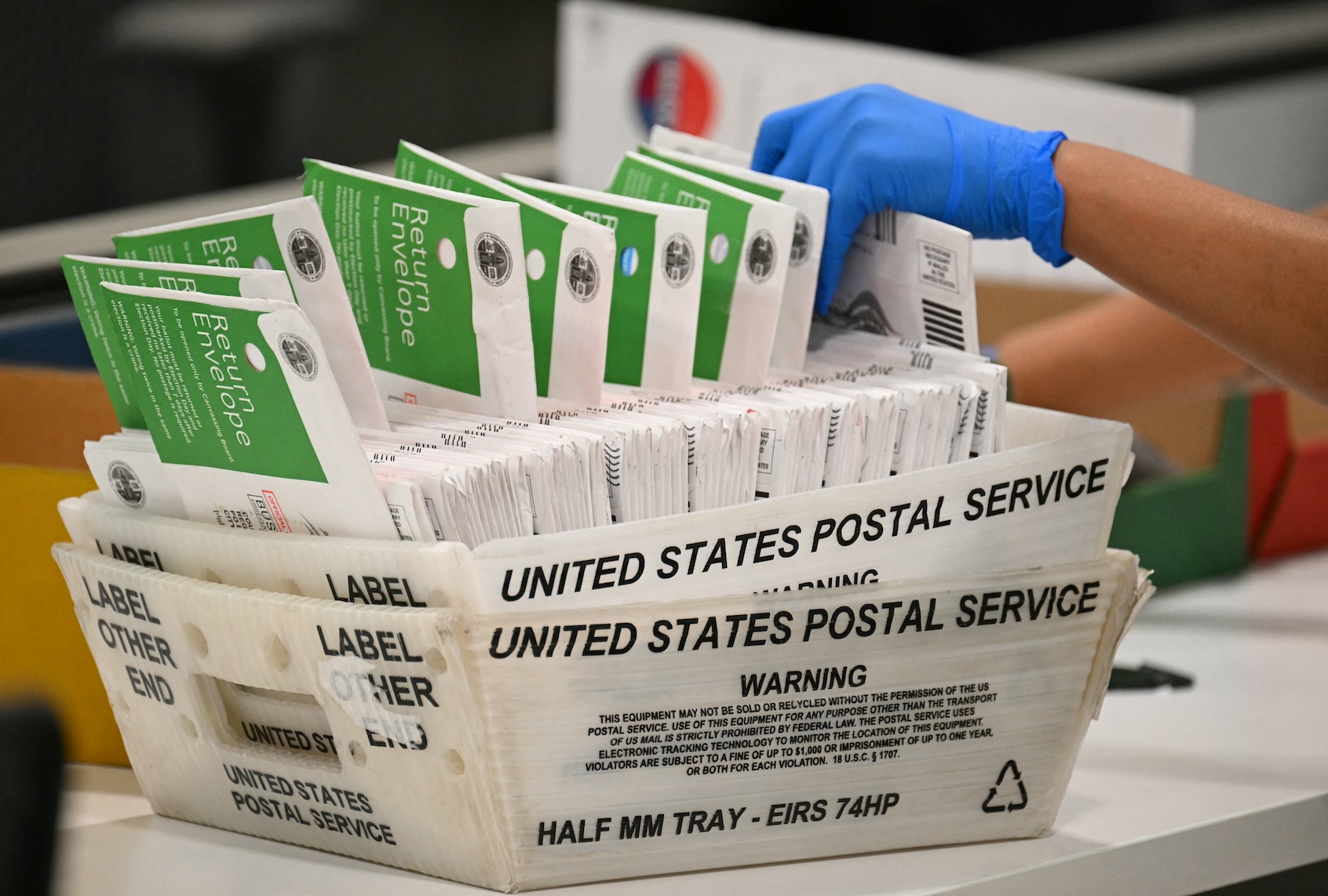
In early August, election workers north of Spokane, Washington, went across the street to the post office to check for late mail-in ballots. It was three days after the primary and they were expecting no more than a few dozen.

Instead, their mailbox was brimming with envelopes — more than 500 of them, each a vote that wouldn’t count. The sight was “jarring,” said Auditor Lori Larsen, a Republican who oversees voting in Stevens County.

Across the region, other election officials were getting similar jolts. In the 11 predominately rural counties in eastern Washington, nearly 2,000 ballots came in late, compared to about 600 in 2022, the previous midterm primary.

In recent weeks, concerns about mail-in voting disruptions have focused almost entirely on President Donald Trump’s now-shelved plan to sharply restrict who can vote by mail. 

But a ProPublica data analysis shows that delays resulting from the U.S. Postal Service’s cost-cutting measures have endangered the validity of ballots cast in rural areas, not only in Washington, but across the country.

Over the past three years, as mail volume continued to plummet and annual deficits ballooned, the Postal Service started consolidating the processing of first-class mail at larger regional plants instead of at smaller hubs closer to local post offices. Then, in a little-noted switch that mostly took effect after the 2024 election, the agency cut the frequency of mail pickups in half at many post offices 50 miles or more from these processing plants, from twice daily to once.

The changes often added a day or more to delivery time and, most importantly for ballots, pushed back postmarking, which doesn’t happen until mail reaches the regional centers. 

In this year’s primary, the effects of the cuts were clearest in five states that make detailed data on mail-in ballots available: Washington, California, Ohio, North Carolina and Oregon. All have or recently had grace periods allowing ballots to count if they come in after Election Day as long as they’re postmarked by the deadline.

In these states, the number of ballots rejected for arriving late soared in counties affected by the service changes compared to 2022, ProPublica’s analysis showed. 

Rejection rates in counties where services were cut doubled or tripled from what they were four years ago, dwarfing any increases in counties where postal pickups remained as they were, our analysis showed. In urban Spokane, for example, the number of ballots rejected for being late actually dropped this year.


Start your day with essential news from Salon.
Sign up for our free morning newsletter, Crash Course.


Across the five states, the delays have had the most substantial effect in areas that voted for Trump in 2024, ProPublica’s analysis shows. In Washington, Secretary of State Steve Hobbs, a Democrat, said he sees the service changes directed by Republican appointees leading the Postal Service as a way to undermine mail-in voting. 

“I don’t think they realized how much it was going to affect their voter base,” he said, adding that Washington has “a lot of rural Republican voters.”

Postal Service leaders say such delays are less likely in the Nov. 3 general election because of “extraordinary measures” the agency puts into place for these votes, when there’s typically far more turnout. They have circulated a memo to the nation’s more than 30,000 post offices saying that for the 10 days before the election, managers should separate completed ballots from other first-class mail and deliver those intended for local election offices the day they come in.

At an Oct. 15 news conference, Postal Service leaders emphasized the agency’s longstanding recommendation that voters mail ballots back at least a week before their states’ deadlines, while defending the agency’s ability to fast-track ballots through the system. 

“We work to identify and address issues quickly,” said Amber McReynolds, chair of the Postal Service board of governors, “so ballots can continue to move swiftly from election offices to voters and from voters back to election offices.”

Election consultants, researchers and former Postal Service officials told ProPublica that the guidance for the upcoming vote gave more detailed directions on how to expedite ballots. They said they hoped the agency’s special measures would limit delays, but some said mistakes were likely. 

“I don’t think we can say with any kind of conviction that there will be no ballots rejected,” said Tammy Patrick, chief programs officer of the National Association of Election Officials. “It isn’t a question of ‘if,’ but a question of ‘how many.’”

A pilot program instituting the delivery changes in 18 regions before the 2024 election ran into problems. An audit by the Postal Service’s inspector general found that agency staff in these areas sometimes didn’t handle ballots correctly, mainly because instructions weren’t clearly communicated. (A Postal Service spokesperson said “learnings from the pilot” have been applied as the program has expanded.)

After this year’s primary, reports by media outlets noted that mail-in ballot rejection rates were higher than in the past, but ProPublica’s analysis shows these increases were directly connected to Postal Service changes. Research published in September by the Brookings Institution also found this connection, projecting that if the pattern held in the general election, tens of thousands of mail-in ballots could be rejected.

At least seven closely contested congressional districts — including Washington’s 3rd, California’s 22nd and North Carolina’s 11th — are in areas that were affected by service changes in the primary, ProPublica found.

Elena Patel, who conducted the Brookings analysis, said service changes may still imperil mail-in votes in the general election.

“I think there remain risks to ballots,” she said, adding that the Postal Service’s plan for the general election “depends on flawless execution.”


Mail-in voting has become more popular over the last decade, with many states broadening access to it during the COVID-19 pandemic. 

Nearly 1 in 3 Americans voted this way in 2022 and 2024. Trump himself frequently votes by mail, and in recent weeks has started to encourage his supporters to do so as well, though he has claimed without evidence that the process is rife with fraud.

The Postal Service has mostly ensured the timely delivery of hundreds of millions of ballots, even as mail volume overall has dropped 50% from its high in 2006. 

When Louis DeJoy was appointed postmaster general in spring 2020, he inherited an $81 billion operating deficit and rapidly took steps such as eliminating overtime to reduce costs, under pressure from Trump and others in his administration. (DeJoy did not respond to questions from ProPublica.)

The NAACP sued that August, alleging the measures could affect mail-in votes in that year’s general election. Courts ordered DeJoy to reverse some of the cuts and the Postal Service agreed to implement special procedures to ensure ballots weren’t delayed. The Postal Service has continued following those procedures since. 

Still, DeJoy went forward with a 10-year restructuring plan designed to save the agency billions. It ended evening pickups from some post offices, often in rural areas. Trucks serving these places travel long distances and at times were mostly empty. This part of the plan — called regional transportation optimization, or RTO — was projected to eventually save the Postal Service $4 billion a year.

The agency announced the national rollout of the RTO plan in 2024, but DeJoy agreed to pause it leading up to that year’s November election, leaving only about 4,000 ZIP codes in the pilot project affected by the service changes.

In January 2025, the Postal Regulatory Commission, which oversees the Postal Service, warned that moving forward with the plan would be disruptive to rural communities and might not save as much money as expected. The Postal Service rolled out the reductions anyway, extending the changes to almost 20,000 ZIP codes to date. Officials said they expect the system to be fully implemented within two years.

This January, the agency put out a statement saying the transportation cuts would mean it took longer for mail, including ballots, to be postmarked and delivered. But the Postal Service didn’t specify which voters would be affected by the slowdowns and which wouldn’t.

Though the delay from RTO is often only a day, mail can be delayed longer if it’s deposited in a mailbox after the daily pickup time, or just before Sunday or a holiday.

A Postal Service spokesperson said the agency told election officials that RTO would change schedules and reemphasized the need for voters to get their ballots in the mail at least a week ahead of time. Election officials in Washington said the Postal Service wasn’t direct enough about the fact that the changes would lead to delays in delivering and postmarking ballots.

“What they said was, ‘We are going to change the way we do postmarks,’” said Hobbs, Washington’s secretary of state. “That was it.”

Patel, the Brookings analyst and a former Postal Regulatory Commission employee, said that more direct communication to voters could have helped change their behavior. “That’s the part that I think has not been super transparent about the whole process,” she said.


Many of the areas that saw a spike in late ballots were in Western states, which were the earliest and most enthusiastic adopters of expanded mail-in voting.

In 2004, Washington became the second state to start conducting all-mail elections, in which every eligible voter automatically receives a mail-in ballot. Most residents vote by putting their ballots in drop boxes. Still, in 2024, about 33% put them in the mail.

In the 30 mostly rural Washington counties most affected by RTO, the percentage of ballots postmarked late more than tripled compared to the 2022 primary, ProPublica found.

In Garfield County, in southeastern Washington, 19 ballots — nearly 1 in 10 cast — had late postmarks this year. In 2022, only a single ballot was postmarked late. In Pend Oreille County, in northeast Washington along the Idaho panhandle, 6% of ballots were rejected for arriving late, compared to 1% in the 2022 primary.

“It was pretty awful telling people we couldn’t count their votes,” said Marianne Nichols, Pend Oreille’s longtime auditor. “They were quite upset because they felt like, ‘Why? This was in the mailbox on election day, the post office picked it up and had it.’ They felt like it should have counted.”

In Stevens County, the percentage of ballots rejected for having a late postmark jumped to 8%, from 1% in 2022.

Steve Hutkins, a retired professor who analyzes the effect of Postal Service changes on Savethepostoffice.com, also found that places in Washington with RTO had more ballot rejections during local elections earlier this year for school board and other measures. The patterns “set off the alarm bells,” he said.

Stuart Holmes, the state’s director of elections, said he reached out to Postal Service officials to find out what had happened, but got few answers and no specifics on delays related to RTO, which were a “total surprise,” he said.

Election officials in California and Oregon also reported thousands more ballots rejected for arriving late during their primaries. Counties affected by RTO, including Kern County, California, had substantially higher rates of ballots rejected for mail-related reasons, ProPublica found.

Kern County’s assistant registrar of voters, Laura Cantu, said election officials are urging rural voters to use drop boxes to cast their ballots in the general election.

The expansion of RTO had a similar effect in North Carolina and Ohio, where the rates of late ballots were about twice as high in counties affected by the restructuring as rates in counties that weren’t. Since 2022, these states have also eliminated grace periods in which ballots postmarked by Election Day could count even if they arrived later. Voters unused to the tighter deadlines also could have contributed to an increase in late ballots.

ProPublica didn’t find any association between RTO and higher rates of late ballots in Wisconsin, even though clerks reported delays involving mail-in ballots cast in its state election, held this spring. (Other Postal Service changes may have contributed to the delays.) 

Wisconsin’s data does not distinguish ballots sent by mail from those cast in drop boxes or in person, making it impossible to definitively measure rejection rates just for ballots returned by mail. Election researchers said Wisconsin’s deadline for mail ballots, which must come into election offices by 8 p.m. on Election Day, also probably had an effect. 

“If you know that you don’t have a grace period, it probably affects voter behavior,” said Patel, the Brookings researcher. 

Recent Postal Service audits have found that RTO-related changes had saved the agency about $2.8 billion by the end of fiscal year 2025 — less money than expected — and are slowing down all first-class mail, not just ballots. Residents of rural areas are waiting longer for everything from prescriptions to bills, a report published in September by the Postal Service’s inspector general said.

A Postal Service spokesperson still defended the plan, both for financial reasons and to adjust to the changing marketplace. “These savings are both significant and necessary,” he said.

In the lead-up to Nov. 3, the agency’s plan is to route ballots meant for local election offices to a nearby postal facility or directly to their destination. They shouldn’t go to regional plants, which the Postal Service says should minimize delays.

Larsen, the Stevens County auditor, is encouraging Washington voters to deposit their ballots in drop boxes rather than relying on the mail. Since the primary, she’s increased the number of red, white and blue drop boxes that sit outside government buildings from seven to 12. Near each box, there’s a large sign encouraging people to take selfies when they vote and send the photos to Larsen. 

In prior years, Larsen said, she avoided telling voters how or when to vote, concerned they might regret choices they made if critical information later emerged about the candidates. That’s no longer uppermost in her mind.

“Now we are more concerned that we get your ballot,” she said.

The post Ballot rejections soared in rural counties after USPS reduced mail service appeared first on Salon.com.

  •  

The secret terms of Trump’s Venezuelan oil deal

In late August, President Donald Trump announced what he called the “biggest oil deal in world history.” Since then, the full text of the accord — which grants the U.S. sweeping access to Venezuela’s oil reserves — has been one of the most sought-after secrets in Washington, D.C. 

ProPublica has reviewed a copy of the 18-page strategic partnership agreement signed for the United States by Secretary of State Marco Rubio and Defense Secretary Pete Hegseth. The document reveals carefully constructed terms that favor U.S. interests at every turn and cements the power of a small group of people handpicked by the Trump administration to govern and profit from the deal. The role of the Venezuelan government and the potential benefits to its people are largely absent from the text.

One of the most criticized aspects of Trump’s announcement has been his choice of a partner: Alejandro Betancourt, a globe-trotting Venezuelan oligarch who has faced money-laundering investigations in three countries. 

The Trump administration is taking a 35% stake in Betancourt’s firm, North American Blue Energy Partners, by acquiring shares in a Barbados-registered parent company. The deal document provides little information about the owners and investors behind the parent company, who could receive enormous wealth from the arrangement. 

The agreement also safeguards Betancourt’s position as chief executive of NABEP and says the U.S. government will work with the parent company to appoint a powerful seven-member board to govern the venture for an initial 15-year term. Those aspects of the deal, according to people with knowledge of how it came together, were designed to prevent future U.S. and Venezuelan leaders from dismantling the enterprise. 

Orlando Alvarado, a name not disclosed by the Trump administration as a party to the accord, signed the agreement on behalf of the parent company, alongside Betancourt, Hegseth and Rubio. Alvarado has held senior roles in multiple Betancourt businesses, including as chief financial officer of an energy firm that became embroiled in scandals a decade ago. According to the Miami Herald, federal prosecutors identified Alvarado as an unindicted co-conspirator in a scheme to embezzle money from Venezuela’s national oil company.

NABEP spokesperson Terry Wade said that “neither Mr. Betancourt nor Mr. Alvarado has ever been charged with any crime in any country, and any claims against them are baseless.” 

Key aspects of the plan differ from the Trump administration’s public pronouncements. Trump has said the deal will secure America’s energy dominance for the next century. But the text indicates that U.S. purchasing rights expire in half that time and that the underlying operating rights appear to run afoul of Venezuelan laws limiting oil concessions to 25 years.

The agreement does ensure the United States a deep discount from fair-market value on 20% of NABEP’s oil, as Trump has said. It does not, however, explicitly guarantee that Betancourt’s company is obligated to pay the estimated $200 billion in royalties and tax payments to Venezuela that the White House has said would benefit the country. 

There are also significant caveats related to Trump’s central selling point to Americans — that the deal will bring a gusher of low-cost oil imports. 

The agreement gives the U.S. the right to purchase 20% of NABEP’s oil at a discounted rate of $30 a barrel, or less than a third of what oil has sold for in recent months, according to one of three supporting documents reviewed by ProPublica. 

But this fee does not account for the cost of getting Venezuela’s oil out of the country. Much of Venezuela’s raw crude is so thick that it won’t flow through pipelines unless it is first blended with 20% or more of oil thinner products. Under the deal, the potentially significant cost of importing millions of barrels of those blending materials is not included in the price.


Start your day with essential news from Salon.
Sign up for our free morning newsletter, Crash Course.


The White House, the State Department, the Pentagon and the energy company NABEP all defended the agreement, saying in statements that their new public-private venture will provide meaningful and lasting economic benefits to both countries that cannot be captured in a legal document. 

“This historic deal marks a major step toward stabilizing Venezuela’s economy after years of hyperinflation and almost no new investment, while more than doubling the United States’ oil reserves,” said White House spokesperson Taylor Rogers.

Wade emphasized that NABEP was chosen because of its track record of expanding oil production in Venezuela in recent years and that the agreement was between the company and the U.S. government, not Venezuela.

“Thanks in large part to the agreement,” Wade said, “there is a surge in confidence about the future of Venezuela’s oil industry and, as a direct result, substantial new investments are flowing into the country.”

He added that much of NABEP’s oil comes from fields that require little or no blending materials and that blending costs would not meaningfully impact the price of production. “Our barrel economics are strong.”

The newly revealed details of the agreement are nonetheless likely to raise more questions about whether the unorthodox marriage of the United States and a foreign energy baron can bring lasting benefits to either country — and which private parties might benefit along the way. Trump’s oil deal is likely to face scrutiny in both the United States and Venezuela, especially if Democrats win one or both chambers in the midterm elections, according to former U.S. diplomats and congressional staff.

“Question number one in a new U.S. Congress will be: Why Betancourt?” said former Ambassador James Story, who served as the top U.S. diplomat in Caracas from 2018 to 2023, in an interview. “Why did he get this deal? And was he involved in criminality? It seems reasonable to have a congressional hearing about those questions.”

“Question number one in a new U.S. Congress will be: Why Betancourt?”

James Story, former U.S. ambassador to Venezuela

In public comments, Delcy Rodríguez, who won the backing of the Trump administration to serve as Venezuela’s interim president, praised the accord as “historic.” She has asserted that Venezuela will retain sovereignty over its natural resources and defended the choice of Betancourt. 

People with knowledge of the Trump administration’s behind-the-scenes decision-making and negotiations with Betancourt spoke to ProPublica on condition of anonymity because they were either not authorized to do so or were fearful of retribution. 

One reason that the precise terms of the deal have remained hidden until now is that the signed agreement is marked as a “sensitive” government document. That classification is commonly used to shield a variety of federal records from public release, including those containing personnel information, details about ongoing law enforcement operations and matters protected by attorney-client privilege. The document also contains a confidentiality clause barring Betancourt’s company from disclosing the “existence and terms” of the U.S. government agreement.

One person familiar with the deliberations said that people close to the Trump administration  seemed keen to partner with Betancourt’s company because of the privacy and flexibility it offered. That appeared to give NABEP an advantage over publicly traded oil companies, which would be obligated to shareholder reporting requirements. 

“For example,” the person said, “Chevron couldn’t give 35% of their shares to the Pentagon.”

The Deal

The oil deal is sensitive partly because of likely resistance in Venezuela, where critics have already described it as a U.S. takeover of the country’s precious natural resources.

A ProPublica analysis shows that its terms favor American interests at nearly every turn and try to enshrine the Trump administration’s imprint indefinitely. 

The document states that a majority of the seven-member board must be U.S. citizens at all times, and the U.S. government can appoint one “non-voting observer” to join the group. Betancourt, who will serve as the chief executive, is the only board member named by the agreement. The initial board will establish the process for choosing new members. 

“Throughout the evolution of the deal, it was clear that the governing structure was intended to ensure maximum control by the people making the deal and to insulate them from future administrations seeking to reverse the agreement or call it into question,” a person familiar with the negotiations said.

There is no requirement for any Venezuelan government participation in the board.

The agreement also offers long-lasting protections for Betancourt and unnamed investors. It requires a supermajority vote of five to oust Betancourt as CEO, change the board composition or execute any transactions with a shareholder that isn’t the U.S. government, an indirect equity holder, director, affiliate or “immediate family members.”

The board will determine compensation for Betancourt in his role as chief executive, the document says. As structured, the deal does not appear to require any public disclosures about pay or distribution of shares to executives.

The agreement does not say which shareholders, affiliates or family members have been approved to transact with Betancourt’s company. Under Barbados corporate law, there is almost nothing that can force those interests to be revealed publicly. 

The agreement does, however, require the company to maintain “anti-money laundering controls,” submit to external audits and inspections of its records by the U.S. government, and provide the U.S. government with an annual budget and quarterly unaudited financial statements. It is unclear if these reports will ever be made public. 

It could be some time before the company produces enough oil to fulfill a significant share of U.S. demand. Betancourt’s company currently produces about 200,000 barrels per day — or about as much over the course of a year as the United States uses in three days. 

NABEP aims to increase its production to 500,000 barrels per day by the end of 2028, according to recent reports.

In addition to securing a discount on 20% of NABEP’s oil, Washington also has “first priority” to purchase all of the company’s remaining oil production for the next 50 years, including an irrevocable right to buy its entire oil supply in the event the U.S. declares a national emergency. 

The U.S. also receives a “most favored nation” status that requires Betancourt’s firm to disclose any other business agreements it signs, and, if they are favorable, to grant Washington matching terms.

One person who reviewed parts of the contract was surprised at the tangible benefits for the U.S. compared with the lack of binding commitments to Venezuela: “I gave you 20% of my production at ‘cost plus,’ fine. I gave you all of my production if there’s a national emergency, OK. … So what do I get in exchange?”

A U.S. official said Rodriguez had granted NABEP 100-year oil concessions to operate there, although this figure is not referenced in the accord and appears to contradict Venezuelan law. 

In the event of a dispute, Venezuela can’t challenge the deal in its own courts. The agreement dictates that any conflict between the company and the United States must be settled under U.S. law, not Venezuela’s. The two sides even spelled out that any civil case or arbitration must be argued before the United States District Court for the Northern District of Texas, where Trump’s Justice Department has turned, time and again, for favorable rulings. 

Where U.S. law does not apply, Texas state law governs, the agreement states. 

A Pentagon office has been tasked with someday executing the financial transaction to capitalize on the U.S. government’s 35% share in the venture. The document shows that the U.S. will pay nothing upfront but plans to acquire its stake in Betancourt’s company by paying $0.01 per warrant share. Those terms are set to expire on the 75th anniversary of the closing date.

In a White House statement last month, Trump touted those shares as potentially worth “hundreds of billions,” plus dividends. But Democrats on the Senate Armed Services Committee said they believe the Pentagon office does not have the legal authority to execute an agreement with a foreign entity operating in a country under U.S. sanctions.

Pentagon press secretary Kingsley Wilson said that the Defense Department conducts “extensive due diligence” before extending capital assistance. Wilson declined to comment on any of the legal considerations or further technical aspects of the deal “to protect the integrity of the process.”

Several other detailed aspects of how the company will operate are currently under negotiation among the Trump administration, Betancourt and the parent company, the partnership documents show. The agreement repeatedly cites a set of “Implementation Documents” that will finalize the U.S. ownership stake and the rights of unnamed investors. 

The full force of the deal will not take effect until both parties have complied with its closing conditions, which the agreement indicates could happen within months.

Last month, Senate Democrats blasted what was known of the oil accord and demanded details in a letter to Rubio, Hegseth and Secretary of Energy Chris Wright.

“It is unclear why the American public should support this attempt to entangle the United States with a relatively unknown foreign oil company that lacks the capacity or credibility to develop oil fields of the magnitude described and whose leadership has faced international criminal investigations,” four ranking senators said in the letter. 

They asserted that most of the “oil fields are nowhere near ready for production” and that it could “take up to a decade before global oil markets are meaningfully impacted and the American people see any tangible benefit.”

A Willing Partner

Almost immediately after U.S. special operations forces seized President Nicolás Maduro in January and airlifted him out of Venezuela, Trump left little doubt that his larger goal was to restore American access to Venezuela’s oil reserves two decades after most U.S. firms had been ejected from the country. 

By early spring, an obscure cast of energy officials, lawyers and lobbyists had started to craft plans to deliver on Trump’s America First energy agenda. One person familiar with the deliberations said that U.S. officials had considered backing an idea for publicly held American oil companies like Chevron, Exxon and Conoco to carve up and rehabilitate Venezuela’s aging oil sector. Another potential route went through Betancourt’s company, which is the second largest private oil firm operating in Venezuela. Working with the Venezuelan state company, Petróleos de Venezuela, SA, was never really an option due to its underlying debt and history of corruption, the person said.

The option of turning to large multinational oil companies quickly stalled. In some cases, oil executives balked at jumping back into the complexity of the Venezuelan market; in others, firms struggled to get more than “lip service” meetings in Washington and Caracas, according to media reports and people familiar with the deal. 

“NABEP was given priority,” one person said. “Exxon, Conoco and the others were treated as second class.” 

Betancourt’s star was rising in the Trump administration. He had served as an interlocutor for Washington with the Maduro government and had ties to some leaders of the Venezuelan opposition, according to current and former U.S. officials. He had also provided information that helped the U.S. forces seize Venezuelan oil tankers and that aided strategy and planning before the capture of Maduro, Reuters reported. 

In addition, Betancourt had developed a good relationship with Rodríguez, whom Trump had backed as the country’s interim president. And Betancourt had done so despite the fact that her influential brother, National Assembly President Jorge Rodríguez, had accused him of corruption in a televised speech in 2020, according to former U.S. officials and press reports.

U.S. officials also saw practical reasons to partner with Betancourt, several people said. He and his then-business partner in the U.S., Harry Sargeant, a Trump supporter, appeared to be a rare success story in a battered industry, operating some of the only active oil fields in the country.

“The main thing I found promising is that the fields are producing in Venezuela,” said a former State Department official who analyzed the company’s activities. “I think it’s particularly important that you buy into fields that are producing. … If your policy goal is to raise production quickly, this makes sense.”  

But partnering with Betancourt posed major challenges. 

For starters, the 46-year-old billionaire was confined to house arrest on his 300-acre Oxfordshire estate in England, fighting off a Swiss extradition request tied to an international money-laundering probe. Betancourt could fly to his $46 million London residence by private helicopter — but his Venezuelan and Italian passports were locked down, and British authorities had barred him from driving on public roads, according to media reports about the special bail arrangement.

Betancourt’s legal problems stemmed from his role in troubled Venezuelan energy projects during the corrupt rule of former President Hugo Chávez. Several of Betancourt’s known or alleged associates were charged or convicted in a major U.S. money-laundering investigation known as Operation Money Flight. Betancourt surfaced as a suspect in the U.S. case and is still under investigation for suspected money laundering by authorities in Spain, according to former U.S. and European officials and press reports. 

The most popular leader of the Venezuelan opposition in exile, María Corina Machado, recently described Betancourt as having been involved in “obscene corruption” that caused great suffering for the Venezuelan people, according to a recent New York Times interview. 

Betancourt has not been charged in any country. His lawyer has maintained his client’s innocence, saying Betancourt has been unfairly maligned because people associate him with a group of wealthy young Venezuelans, some of whom have been accused of wrongdoing, according to press reports.

Many Venezuelans see Betancourt as a “totemic, emblematic, corrupt figure,” said Brian Naranjo, a former senior U.S. diplomat in Venezuela, in an interview.

“He is not really an oil man,” Naranjo said. “The talent he brings is that he’s a new person in a long line of Venezuelan businesspeople who deal in influence. Their big lever is connections and influence. It is know-who, not know-how.”

In a recent interview with Spanish language media, Rubio defended Betancourt, praising his oil company’s work in Venezuela and his support for factions of the Venezuelan opposition in exile.

Rubio downplayed the legal scrutiny Betancourt has faced, saying a review conducted with U.S. law enforcement agencies indicated “there were no investigations of him in our system.”

“The talent he brings is that he’s a new person in a long line of Venezuelan businesspeople who deal in influence. … It is know-who, not know-how.”

Brian Naranjo, former U.S. diplomat

It remains unclear exactly how Betancourt shed the travel restrictions imposed by European authorities. But The Washington Post reported that senior Trump administration officials, including Deputy Secretary of State Christopher Landau, former Attorney General Pam Bondi and then-Deputy Attorney General Todd Blanche, petitioned their foreign counterparts to allow Betancourt to travel freely and to close their investigations into him and his business ventures. 

The Trump administration’s next hurdle to working with Betancourt was figuring out how to legally invest. The government’s $200 billion investment agency, the International Development Finance Corporation, was created to do just that but is currently barred by U.S. law from operating in Venezuela.

At different points through the summer, aides to Office of Management and Budget Director Russell Vought stepped in, pressing Defense and State department officials to consider alternate financing paths, according to one person familiar with the deal’s progression.

By July, the Pentagon’s Office of Strategic Capital, headed by David Lorch, emerged as a potential solution.

Lorch, who had moved to the Pentagon from Deputy Defense Secretary Steve Feinberg’s private equity firm, Cerberus Capital, quickly embraced the idea, according to people familiar with the deal. Lorch and other Pentagon and State Department officials flew to Caracas in the final days of that month and agreed in principle to a deal. The details would be hammered out back in Washington, the people said.

A Pentagon spokesperson said Lorch declined to comment.

On Aug. 5, Betancourt strode into a conference room behind the art deco facade of the old Greyhound Bus Terminal in downtown Washington that houses an auxiliary Pentagon office. The assembled Defense Department officials gave the Venezuelan billionaire the red carpet treatment, lining up to shake his hand, according to people familiar with the meeting. But some in the room were stunned to discover that the U.S. government was preparing to do business with Betancourt, the people familiar with the meeting said. 

Betancourt was accompanied by Jacob Hirshman, the chief executive and co-founder of Erebor Bank, the first new bank chartered after Trump returned to office, according to people familiar with the meeting. The bank, backed by Trump supporters and investors Peter Thiel and Palmer Luckey, has vowed to reconnect Venezuela to the world economy.

Hirshman did not respond to a request for comment.

Lorch told the group, which included dozens of former Wall Street associates he’d hired into the office, that the alliance with Betancourt was a major “opportunity” to fulfill one of the Trump administration’s top goals, securing benefits to the United States and Venezuela for decades to come. 

The meeting touched off a month of around-the-clock calls and video conferences.

People familiar with the deal’s progression said Lorch soon became involved in structuring key aspects of the deal beyond its financing, including how the board would sit for 15 years and choose its successors. One said he put an explicit premium on setting up the venture in a way that it could not be undone by Trump’s successor.

The months of work on the deal burst into public view on Aug. 28 with a Trump announcement on Truth Social.

“The United States of America has just entered into an Agreement with the Country of Venezuela on, THE BIGGEST OIL DEAL IN WORLD HISTORY!” Trump posted on a Friday night.

Two days later, Hegseth, Rubio, Betancourt and Alvarado signed the deal.

The post The secret terms of Trump’s Venezuelan oil deal appeared first on Salon.com.

  •  
❌