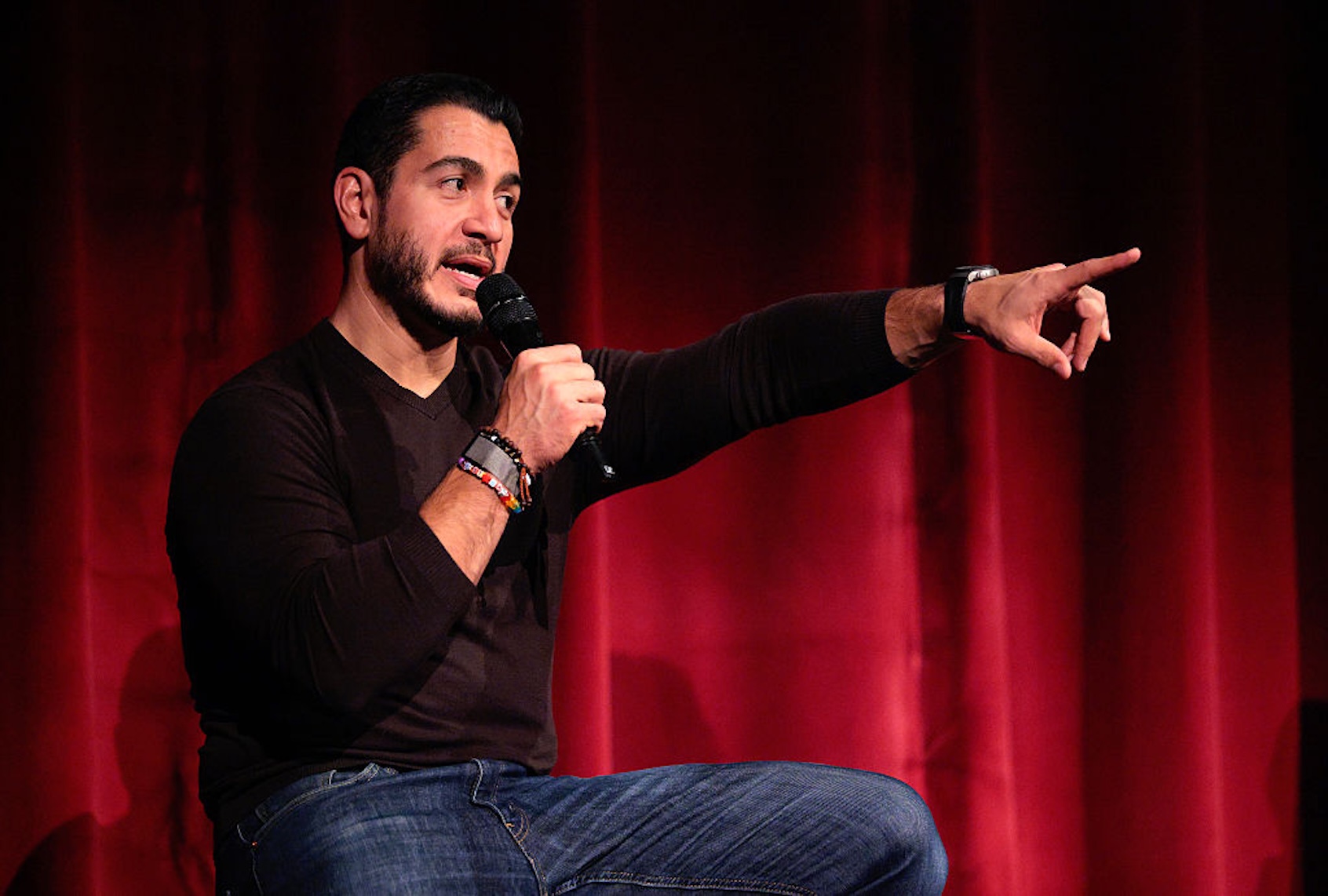
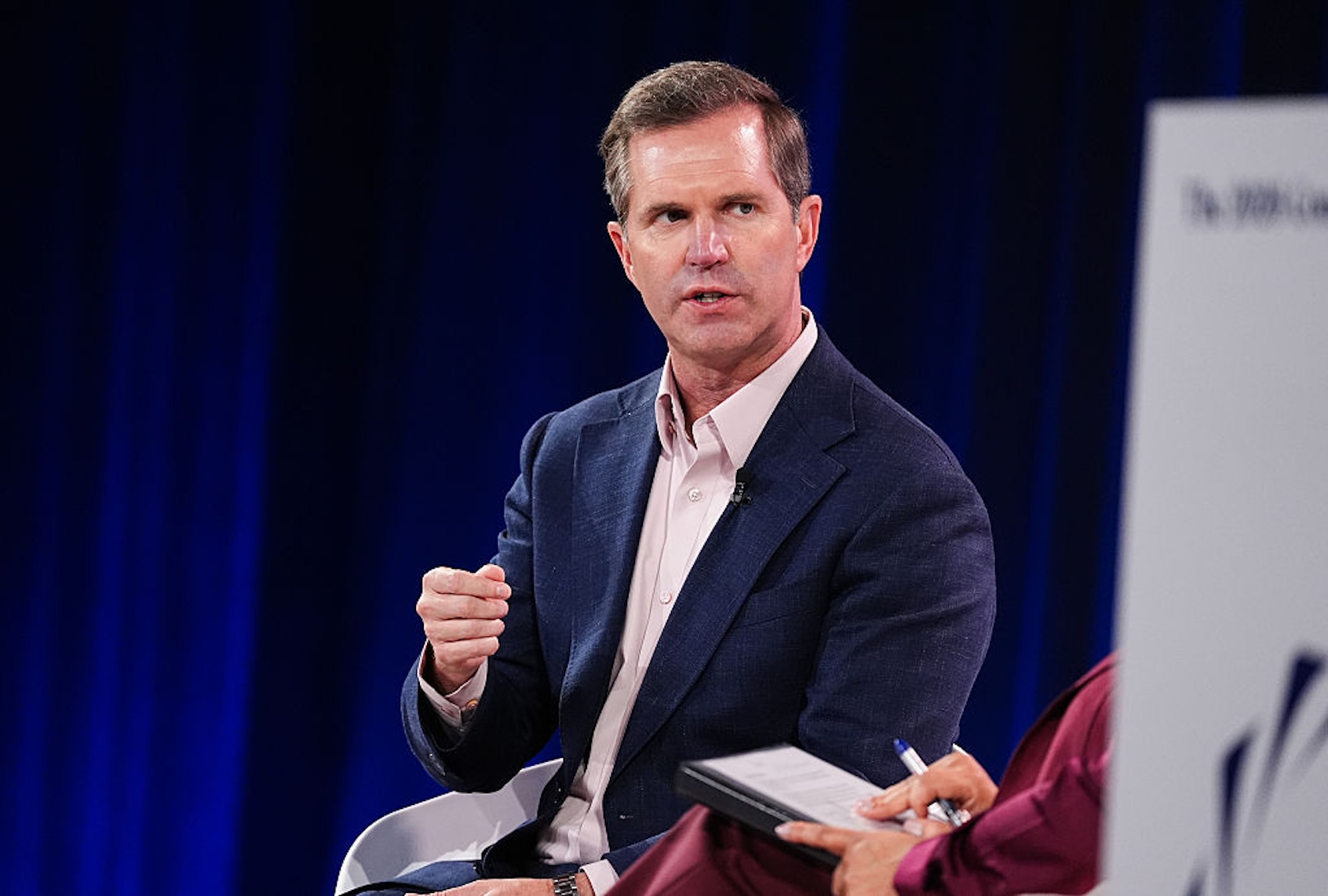
Jesse Watters can’t seem to stop admiring Dr. Abdul El-Sayed. The Fox News host loves to talk about how Michigan’s Democratic nominee for the Senate is “in great shape” and how “Abdul . . . beat the machine” — meaning the party establishment’s candidate, Rep. Haley Stevens — in a hard-fought primary. During an interview in August, Watters clearly enjoyed El-Sayed’s jokes and blunt speech, which included calling his opponent, former Rep. Mike Rogers, a “beta,” and asking the host if he was circumcised when Watters tried to corner him on gender-affirming surgery for minors. The next day, Watters made no bones about El-Sayed’s appeal. “I like him,” he said. “I don’t want to like him. I like him for some stupid reason.”
But the reason was obvious. The doctor-turned-politician has an aggressive bro style that appeals to someone like Watters. Quick-witted with bulldog energy, El-Sayed never backs down from a fight. But despite Watters’ admiration, Fox News has become obsessed with taking El-Sayed down. It’s not because he’s Muslim, though Republicans are ratcheting up the racism in their efforts to derail his campaign. It’s because he is a model for how Democrats can escape their reputations for being weak and feckless.
El-Sayed has a lot going for him. He spent years running public health services in the Detroit area and speaks eloquently and with authority about people’s struggles to afford healthcare, even writing a book about Medicare for All. Most importantly, he’s an excellent communicator who can boil down complex policy ideas into easily digestible concepts without dumbing them down. A video of him explaining to Trump voters why universal healthcare is cheaper than the insurance system went viral for good reason. One can see that, for these voters, it’s likely the first time someone plainly explained how removing executive salaries and profit incentives from healthcare makes it cheaper.
Other politicians, like Sen. Bernie Sanders, I-Vt., or Sen. Elizabeth Warren, D-Mass., are good at explaining progressive policy. But what really seems to scare Republicans about El-Sayed is his political persona as a brawler — and for good reason. Vice President JD Vance learned this last week when he lobbed a strange insult at El-Sayed during a rally in Michigan for Rogers. The Democrat, Vance said, is “a little weasel who should shut his mouth and show a little gratitude.”
This is a common and deeply racist attack from Vance, who portrays non-white progressives as undeserving recipients of white people’s largesse — a caricature that has no relation to reality. El-Sayed left a position as an assistant professor at Columbia University to work in public health, where he won awards for his success in protecting children’s health from environmental pollution. During this same period, Vance worked as a venture capitalist who was close with tech billionaire Peter Thiel.
El-Sayed resisted the temptation to “well, actually” Vance, and instead hit back by calling the vice president and those around him “carnival barkers” who “are small and want to make us small like them.” His response was smooth. “JD Vance called me a little weasel today,” El-Sayed said. “I’m like, ‘No, no, no. What you’re talking about is a Wolverine,'” a reference to the mascot for the University of Michigan, where the Democrat got his undergraduate degree.
As Salon’s Sophia Tesfaye recently wrote, El-Sayed has been courting Fox News viewers by appearing on the channel and running endless ads on it, all without softening his left-leaning message. He clearly hopes his bravado will woo some of the network’s audience, just as it won over Watters.
For his part, President Donald Trump is worried that El-Sayed is right. He’s been openly complaining at rallies and on Truth Social about how charming the candidate is in his Fox appearances. In early October, Axios reported that the White House contacted the network to complain about El-Sayed’s coverage. Trump was especially miffed at the Democrat’s interview with Martha McCallum, during which the host’s efforts to bait him into saying something that could be spun as “radical” failed. Instead, MacCallum embarrassed herself by defending billionaires hoarding wealth, to which El-Sayed said that he’d rather pay for schools than be so “focused on allowing a billionaire to make another billion.”
Since then, it seems that Fox producers got the White House’s message that they have to do something to dirty up El-Sayed. But they’ve learned the hard way that it won’t work to come at him directly, because he ends up dominating interviews and beguiling those who, like Watters, love his commanding and clever style. MacCallum later tried to redeem herself by interviewing progressive activist Corbin Trent and pretending he was a stand-in for El-Sayed.
At first glance, Trent performed as Fox producers no doubt hoped he might. He took MacCallum’s bait by defending the Muslim Brotherhood, something that the host could not get El-Sayed to do. The problem, though, is that Trent has no discernible relationship to the candidate. While he has worked for other progressives, including Sanders, I found no evidence that he has even met El-Sayed, much less is qualified to speak for him.
This attempt to hobble El-Sayed was revealing; it’s clearly all Fox News has. If the network tries to bring El-Sayed on again to ask him the same questions, they know from experience that he’ll probably just win over even more of their viewers. This isn’t idle speculation. MS NOW recently conducted a focus group with regretful Trump voters in Michigan and found that five out of the six are voting for El-Sayed. Republicans should be worried about the young male demographic in particular. Trump won male voters under 30 by a narrow margin in 2024, but they are jumping ship and now strongly favor Democrats.
El-Sayed is a compelling model for a new kind of Democrat. Polling by Strength In Numbers/Verasight shows that even Democratic voters take a negative view of the party, but not because they think their leaders are too progressive. “[T]he single most common complaint about their own party is that it is too weak, too cautious, or not fighting hard enough,” writes G. Elliott Morris in an analysis of the poll.
The Democratic base wants the party to take a more aggressive stance toward their GOP opponents, which will be key to building a more lasting coalition — especially one that includes younger and more male voters. El-Sayed is doing just that, and it has the right scared.
Republicans running for governor across the country are backing away from abortion bans they once endorsed.
U.S. Rep. Tom Tiffany, the Republican candidate for governor in Wisconsin, calls his state’s 20-week abortion limit “settled law.” Just three years ago, he co-sponsored a bill that would have banned abortion six weeks into pregnancy.
Stacy Garrity, the GOP’s candidate in Pennsylvania, has said during her campaign that she would “respect” the state’s current law, which allows abortion until 24 weeks of pregnancy. Four years ago, she called on abortion opponents “to engage and make a difference” in state laws after the fall of Roe v. Wade.
In Kansas, where abortion is legal until 22 weeks, Republican Ty Masterson has demurred when asked if, as governor, he would support a statewide referendum to eliminate the Kansas constitution’s abortion protections. Masterson had previously spoken at protests in opposition to reproductive rights and won the backing of state and national anti-abortion groups.
The candidates’ retreat suggests that, even as reproductive rights fade from the national spotlight and polls show voters are far more likely to prioritize cost-of-living concerns, the political ramifications of pushing for new abortion restrictions remain substantial. The rhetorical distancing also moves political conversations away from an issue that overwhelmingly energizes Democrats.
“That might be their strategy there, to try to demotivate Democratic turnout in the state to take abortion off the table as a voting issue,” said Ashley Kirzinger, a pollster at KFF, a nonpartisan health policy research, polling and journalism organization. That’s especially true in tighter races such as those in Wisconsin and Kansas, she said.
Tiffany’s, Garrity’s and Masterson’s campaigns did not reply to requests for comment. The 19th contacted multiple Republican-aligned pollsters who also did not immediately respond.
About 60 percent of Americans believe that abortion should be legal in most or all cases, including about two-thirds of independents, according to a poll from The 19th and YouGov.
That said, pushing for abortion restrictions has never been broadly popular. Even before Roe v. Wade was overturned in 2022, Republicans seeking general election typically would not campaign overtly on abortion bans, said Molly Murphy, a pollster and president of Impact Research, a Democratically-aligned polling firm.
“It would get discussed in donor meeting hot mics, endorsement questionnaires, etc, but candidates wouldn’t run on the fact that they’d ban abortion,” she wrote in an email.
Wisconsin Republican gubernatorial candidate Tom Tiffany is now calling his state’s 20-week abortion limit “settled law”, when only three years ago he co-sponsored a bill that would have banned abortion six weeks into pregnancy.
(Scott Olson/Getty Images)
Voters largely don’t consider abortion to be “settled law,” said Celinda Lake, a longtime Democratic pollster, noting that the share of voters opposing abortion bans has increased since the fall of Roe. “They feel like, ‘Wait a minute, it can be taken away again.’”
In some races, Democrats and their allies are trying to push abortion rights back under the microscope — a strategy geared toward energizing liberal voters, Kirzinger said.
Wisconsin’s Democratic nominee for governor, David Crowley, has said that, if elected, he would work with the state legislature to enshrine abortion rights into the state constitution — though it’s not clear how expansive that protection would be or whether it might supplant the state’s 20-week cutoff.
Pine Tree State Prosperity, a political action committee associated with the national Democratic Governors Association, is running advertising in Maine that highlights anti-abortion remarks made by Bobby Charles, the state’s Republican pick for governor. The Democratic nominee, Hannah Pingree, has led by double digits in recent polls. Charles’ campaign did not reply to a request for comment.
Planned Parenthood’s super PAC, called Planned Parenthood Votes, has focused its resources in states such as Michigan, where the Republican candidate, U.S. Rep. John James, has said that abortion is “decided.” Four years ago, James said he opposed abortion in all cases, and he has compared the practice to genocide. His campaign did not reply to a request for comment.
James’ running mate, Jay DeBoyer, recently suggested leveraging a state constitutional convention to enact a 12-week abortion ban in Michigan, according to recordings of the remarks reported by The Detroit News and Michigan Advance. DeBoyer has since said publicly that abortion is a “settled” issue in Michigan, where voters in 2022 amended the state constitution to protect abortion before fetal viability.
Some gubernatorial candidates are still pushing for abortion restrictions, albeit far less ambitious ones.
In New Mexico, where Democrats are expected to keep control of the governor’s mansion and already control both legislative chambers, Republican candidate Gregg Hull said he was “fully committed” to working with Texas Gov. Greg Abbott to reduce the number of Texans coming to the neighboring state for abortions.
Hull has repeatedly called himself “pro-life” but also said that he would not change the state’s abortion law, which imposes no time limits on the procedure, without legislative support. His campaign did not respond to a request for comment.
Abortion opponents are trying to revive the issue in a handful of states. SBA Pro-Life America, one of the nation’s leading anti-abortion groups, is pushing ads that characterize Democratic candidates for governor as well as the U.S. Senate and House of Representatives as extreme on the issue, including in Ohio, Wisconsin and Michigan.
But generally, voters are less likely to trust conservatives on abortion, Lake said. And talking about abortion, she added, is more likely to generate enthusiasm among key Democratic voting blocs, particularly young women and college-educated women, who typically support reproductive rights.
“We have in our research people who say, ‘I used to be pro-life, I didn’t support abortion, I would never get one, but I think this is a decision that needs to be made by a woman and her doctor,’” Lake said. “People now feel this is just way too dangerous. This has gone way too far.”
Donald Trump relished delivering two devastating words — “You’re fired” — in his role on the reality show “The Apprentice,” and years later, he repeated them incessantly on the campaign trail, much to the delight of his audiences. But the president has a dirty little secret: He does not like confrontation. In real life, he prefers to delegate the unpleasant task to an underling.
This emerged as a pattern during his first term, when personnel churn was a constant. Trump often had his chiefs of staff — there were several — deliver the bad news, and sometimes he would even fire people on social media rather than confront in person. Rex Tillerson, Trump’s first secretary of state, famously learned of his dismissal from his staff via a printed tweet after returning from a diplomatic trip to Africa. FBI Director James Comey saw the news of his firing on TV news reports. Once the person was gone, Trump often publicly insulted them, portraying them as “lowlifes,” “nutjobs” and worse, never seeming to realize the glaring contradiction — that a man with his alleged business savvy should have had better judgment than to hire such people in the first place. According to a Brookings analysis, the president had a 92% turnover rate among his “A team” during his first administration, the highest of any president in history.
Trump’s second term has been much more stable. Where before Trump had hired qualified people — aside from his daughter Ivanka and son-in-law, Jared Kushner — recommended by experienced Washington hands, this time around he has surrounded himself with nothing but the most loyal sycophants. As a result, there has been much less personnel drama. Still, there have been a few notable departures.
The first was the richest man in the world, Elon Musk. After a bromance budded between the billionaire and Trump during the transition period, when Musk essentially moved into Mar-a-Lago, the president appointed him to head the Department of Government Efficiency and take a chainsaw to the federal government. Then there was a rupture in the relationship and Musk departed, although they seem to have mended fences. Since then, Trump has only fired a few people: Attorney General Pam Bondi, Department of Homeland Security Secretary Kristi Noem, Centers for Disease Control Director Susan Monarez, Labor Secretary Lori Chavez-DeRemer, Director of National Intelligence Tulsi Gabbard and Ambassador to Greece Kimberly Guilfoyle. (The latter three “resigned” under duress.) On Friday afternoon, after only a few days on the job and widespread criticism of her tenure, Trump dismissed White House press secretary Katie Zacharia.
The White House has insisted it’s entirely coincidental that all the firings have been women. But as the New York Times reported on Wednesday, “In many instances, the female officials who departed appeared to have failed some kind of loyalty test to Mr. Trump.” (You know how women are.) The departures of these women isn’t because none of the administration’s men have been implicated in misconduct or corrupt dealings. To the contrary: Some of Trump’s male officials and staffers are stunningly incompetent and dishonest, but their behavior has either been overlooked or rewarded with promotions and transfers.
So when reports surfaced that another high-profile female staffer may be on the chopping block, it would have come as no surprise — if it weren’t for the fact that the woman in question is the single most powerful female in the administration.
Susie Wiles has earned the distinction of being Trump’s longest tenured chief of staff, and with good reason: She has managed to stay on the president’s good side by enabling him and never telling him what he doesn’t want to hear. She has admitted that herself, saying, “These seminal moments where you have to go in and tell the president what he wants to do is unconstitutional or will cost lives. I don’t have that.”
One would certainly think that would guarantee her job security. But ahead of the monumental loss Republicans are expected to endure during the upcoming midterm elections, Trump is reportedly raging — and looking for a scapegoat. Apparently, it’s going to be Wiles. According to recent reports, the president has been calling around to friends to see what they think of his chief of staff — a common precursor to a Trump firing. According to POLITICO, plenty of people have their knives out for Wiles, with one person close to the White House saying, “She’s burned a lot of people.”
Since Wiles, who guided Trump to his historic 2024 comeback, has also been tasked with doing the same in 2026, she is in the presidential crosshairs, even though there is little room to address Trump’s overwhelming unpopularity because he won’t listen to anyone.
This, though, is an occupational hazard for any Trump chief of staff. It’s also not unusual for turnover following a midterm election. But the GOP is facing what looks to be a massive loss, attributed to the president’s historically low approval ratings among the American people. Since Wiles, who guided Trump to his historic 2024 comeback, has also been tasked with doing the same in 2026 — along with her partners James Blair and Chris LaCivita — she is in the presidential crosshairs, even though there is little room to address Trump’s overwhelming unpopularity because he won’t listen to anyone.
The big question now centers on Wiles’ replacement. POLITICO reported there are three likely candidates. One is Bill Pulte, the head of the Federal Housing Finance Agency and chairman of Fannie Mae and Freddie Mac, a fierce Trump loyalist known most recently for spending as much time as possible with the president, feeding him memes and ideas on big white poster boards. Another is Kevin McCarthy, the former House Speaker who once told an aide to fill a jar with only the red Starburst candies for him to give to the president because he had noticed that Trump preferred them, earning him the presidential sobriquet “My Kevin.” Then there is Stephen Miller, the notorious senior adviser of everything.
The choice of Pulte or McCarthy would signal a continuation of current practices, albeit with less discipline and adult behavior in the White House, which may be inevitable no matter who wins the job. Pulte is dramatically unqualified, but since Trump once made him acting director of national intelligence, that distinction is obviously not an impediment.
McCarthy is one of the most incompetent and ignorant leaders in GOP history, but this is likely a plus, since Trump likes people who are just like him. If anyone expects that the president is looking for someone who is stronger than Wiles, the fact that McCarthy is being considered should lay those thoughts to rest.
The most frightening prospect is, of course, Miller, who is already serving as the shadow president and would, as chief of staff, essentially have the full power of the presidency at his fingertips. Trump is obsessed with his legacy projects and making as much money as possible, and the only other thing he cares about is vengeance on his enemies, a desire he shares in equal fervor with Miller. If Miller has the full power of chief of staff, we can assume that he will be ordering and approving the most authoritarian policies the United States has ever seen, and Trump may not even know it’s been done. That is clearly Miller’s mission, and given the power to enact such policies, he will not hesitate.
Being far more ruthless and determined, Miller would no doubt run a tighter ship than Pulte or McCarthy. Trump, though, will still be in charge, and it’s easy to imagine that Miller’s actions would make him even more unpopular than he is now. That could make the legacy-concerned president uncomfortable as he confronts the possibility that he will leave office with a personal reputation far worse than Richard Nixon’s and a record of failure lower than Jimmy Carter’s.
It’s not too early to start blaming Miller for Trump’s unpopularity, and Democrats would be wise to start doing that publicly as soon as possible. If he becomes the chief of staff wielding power with fascist fervor, it may just be too late.
Former Speaker of the House Nancy Pelosi always said that the only way for Democrats to win elections was to focus on the proverbial “kitchen table issues.” As the leader of the caucus for 20 years, she had quite a track record, presiding over quite a few big wins and many small ones, so she knew what she was talking about. According to her way of thinking, people are motivated to vote over concerns about their own material well-being, and in recent years, this has meant healthcare, job security and the cost of living — the basics.
Republicans, by contrast, tend to rely on a broader appeal to security in general. “Law and order” has been their bumper sticker, covering a wide range of free-floating anxieties in American society having to do with cultural changes, race and the loss of status of straight white males. Their answer to economic stress comes down to blaming the bogeyman of the day, whether it’s immigrants or the deficit, and the answer is always tax cuts and more tax cuts.
Democrats have usually been trusted more on the kitchen-table issues, depending on whether they happen to be in office when some kind of economic crisis hits. Jimmy Carter paid a high price, losing his 1980 re-election bid after having inherited crippling stagflation from his GOP predecessors, and was hit with a big recession as a result of the Federal Reserve policies — which he supported — to break it. His successor, Ronald Reagan, reaped the benefit, a common consequence of painful Democratic policies necessarily deployed to clean up a Republican administration’s economic mess.
The GOP enjoyed 12 years in the White House after Carter’s loss, including a big boom which inevitably turned into a recession and helped ensure Bill Clinton’s victory over George H.W. Bush in the 1992 election. Clinton presided over an economic boom that saved his presidency, which was otherwise dogged by scandals largely perpetrated by the GOP’s final evolution from the party of mainline Protestants and main street business owners to one of ruthless street-fighters.
Economics, of course, aren’t the only issue that motivates voters. While more abstract notions of foreign policy and national security are rarely at the top of the agenda, war certainly can be. George W. Bush learned this in 2006, when the American people finally realized the Iraq war was a disaster. But something else was looming on the horizon. Bush had also made the fatal mistake of trying to privatize Social Security, breaking whatever trust people had in Republicans to safeguard their hard-won benefits. The Democrats won the midterm election in a rout.
Two years later, Barack Obama was hit with a double whammy. The war in Iraq was still the top issue, but at the height of his campaign against Arizona Sen. John McCain, the Republican nominee, the bottom fell out of the housing market and the world suffered the worst financial crisis since the Great Depression. At the same time, the healthcare crisis had reached a crescendo, with millions of people going bankrupt, and many suffering and dying due to the high price of insurance. After his win, those kitchen-table issues were front and center in shaping Obama’s presidency. In fact, two years into his first term, as the Great Recession continued to drag on, the American people let out the equivalent of a political primal scream and gave Democrats what Obama famously admitted was a “shellacking” in the 2010 midterms. Perversely, this was largely caused by the passage of the Affordable Care Act, the party’s healthcare plan, underscoring that no good deed goes unpunished.
Then came Donald Trump. When he announced his candidacy for president in 2015, the economy was on the upswing, and just enough people were gulled by his phony reputation as a great businessman and promises to make everyone rich that he eked out an Electoral College win. Once in office, Trump basically just rode the recovery that was already underway and took credit for it. When the Covid-19 pandemic hit and his incompetence fully manifested itself, voters turned against him. If there was ever a kitchen-table issue, the pandemic was it: We were all stuck sitting around the table for months, wondering if the world was ever going to be the same. Trump failed to rise to the occasion.
But he was elected again after Joe Biden presided over the pandemic’s economic recovery, which was painful, ushering in inflation for the first time in decades to a chunk of a population that had never experienced it. The issue did him — and his vice president, Kamala Harris, who replaced him on the ticket — in, returning Trump to the White House on the promise that he would restore the economy to the alleged golden age of his first term. Unfortunately for America and the world, enough people bought into Trump’s chicanery once again, and here we are today in a crisis of chaos, mistrust, incompetence and despair over the radical policies wrought by a second Trump administration.
Kitchen-table issues are still at the top of most voters’ lists. The cost of living remains high and keeps climbing. Housing is out of control, and gas prices are through the roof due to Trump’s war of choice with Iran. His much-ballyhooed tariffs have helped keep inflation high, and there is now little doubt what is driving the polls showing that Republicans are about to take a drubbing in the November midterms.
But the concept of kitchen-table issues has its limits. Not everything in life is actually about money, and people’s perceptions of the economy are often colored by other issues that don’t appear at first glance to be directly related.
But the concept of kitchen-table issues has its limits. Not everything in life is actually about money, and people’s perceptions of the economy are often colored by other issues that don’t appear at first glance to be directly related. Bush’s losses in 2006, for instance, were affected by his mishandling of Hurricane Katrina and the Iraq War, both of which contributed to a sense that the administration suffered from hubris and incompetence. There is little doubt that the backlash against Obama during his first term was also driven by the recoil on the right to his identity as the first Black president. Trump likewise benefited from the fact that misogyny and racism were in play in his victories over the first two women to win the nominations of a major party.
The problem is that Democrats have too often relied solely on the kitchen-table issue agenda and failed to address underlying anxieties that contribute to their distress. And with Donald Trump, they are legion.
The unrelenting pandemonium of his presidency, from his brutal immigration crackdown to the flagrant corruption and degeneration of the president himself, as manifested in his obsession with gold and the building of personal monuments in a time of economic stress, is making the public depressed and angry. The fact that Trump broke one of his fundamental promises to not get the country into a war, as he whines constantly about being denied the Nobel Peace Prize, is maddening. His ongoing disregard of the rule of law and the assault on the democratic process are obvious. The disconnect between what average Americans are feeling and the way their leaders are behaving is a mile wide.
People have been yearning for a holistic explanation for this chaos and confusion — and Democrats have finally found a way to express it. As POLITICO recently noted, Sen. Jon Ossoff of Georgia, along with Senate candidates Dr. Abdul El-Sayed of Michigan and James Talarico of Texas, as different as they are individually, are “leaning hard into anti-corruption messaging in the final weeks of the campaign as new research suggests that linking corruption to Americans’ economic struggles can boost Democrats into the home stretch.”
The corruption argument is compelling. Beyond the hated war in Iran (and its resulting gas prices), Trump’s son-in-law Jared Kushner and old friend Steve Witkoff’s deals in the Middle East have come under scrutiny and outrage, as have the government contracts being handed out to companies in which Trump’s sons are invested. Pardons are being sold to anyone with enough cash, some of them to people convicted of healthcare fraud, even as the Republicans are cutting Medicaid and healthcare subsidies. Contrary to his blarney, Trump’s Louis XIV-style monuments to himself are being largely paid for by the taxpayers. On top of all that, there are the reports that Trump has made $2 billion since returning to the White House, a figure that is excessive, even for him.
The shameless grifting is too obvious for voters to overlook, and the Democrats have finally realized that the critique of Trump and MAGA Republicans must go beyond the kitchen table because it is all connected. The chaos, incompetence, deceit and self-dealing are at the heart of America’s distress, and it’s benefiting Trump and his cronies at the expense of average taxpayers.
Distilling all this into a media-ready indictment, a soundbite, is difficult, but “Washington is rigged to benefit the wealthy at the expense of everyday Americans” is about as good as it gets. Let’s hope Democrats can carry this message of reform past Election Day and actually do something about it.
Donald Trump lies. Telling untruths is not merely second nature to him; it is of the first order, automatic. He lies as naturally as he breathes.
From his claim to being a great businessman and dealmaker to calling himself not the worst president in U.S. history — which he is, by far — but the best, Trump has spewed a firehose of falsehoods to the public. But he has never reserved his lying only for his political opponents.
He has lied to his MAGA followers about, well, everything — bringing grocery prices down, ending this or that war “on day one,” the value of his cryptocurrency offerings, creating any number of “unbelievable” plans to fix our infrastructure, our healthcare, our economy. All those “beautiful” plans that were never plans but so-called concepts of plans. You know, back-of-the-envelope musings on critical national issues while heading off for another taxpayer-funded golf outing.
Suffice it to say: If you can name it, Trump has lied about it.
Journalists often write of Trump’s Big Lie about how the 2020 election was stolen from him, but that is only one of the big lies Republicans tell, and it is not the one that most adversely affects working Americans.
With Trump’s wild mismanagement of the economy, public sentiment is finally changing. More people now trust Democrats on the economy, and for good reason.
The biggest lie is the one Republicans have told for more than half a century — about how they are better than Democrats at managing the economy. A majority of Americans have believed this for my whole lifetime. But with Trump’s wild mismanagement of the economy, public sentiment is finally changing. More people now trust Democrats on the economy, and for good reason.
The idea of telling a lie so massive that not many people would think that it could be made out of whole cloth comes from Adolf Hitler’s 1925 book “Mein Kampf.” The failed artist and future German führer thought that most people would not believe that someone “could have the impudence to distort the truth so infamously.” This theory was later put to use by Joseph Goebbels, the Third Reich’s propaganda minister, to scapegoat and dehumanize Jewish people, and it led directly to the Holocaust — a horrible truth many Nazi-curious conservatives love to deny.
Trump, a fanboy of ruthless dictators, was determined to stay in office after losing the 2020 election decisively in both the Electoral College and the popular vote to Joe Biden, and he naturally turned to Hitler’s technique. (I say “naturally” because, according to his first wife Ivana, he kept a volume of Hitler’s speeches by his bedside. Also, after Trump’s first term, his former White House chief of staff Gen. John Kelly warned Americans that Trump very much admired Hitler.)
The Republican’s lie on the economy is such a whopper — so “colossal,” as Hitler put it — that it has defined American politics for decades. That’s the ruse of the colossal lie, which is not merely the propagandist’s use of repetition (Trump’s main go-to move) but a sort of verbal legerdemain. People are cunningly led to disbelieve what they see with their own eyes and feel in their own pocketbooks.
As we head into the November midterms, and as candidates begin to emerge in the 2028 presidential race, it’s a good time to refresh our memories of how costly the GOP’s colossal lie about trickle-down economics, which began with President Ronald Reagan, has been for Americans.
Running for the presidency, the former Republican California governor and B-list actor said that giving tax breaks to the wealthy and corporations would “trickle down” benefits to the working people of America. This sounded good in theory, but it was “voodoo economics” in practice, as George H. W. Bush, Reagan’s opponent in the 1980 Republican primaries, noted — until he was chosen as the Californian’s running mate).
In his two terms, Reagan’s tax cuts increased the national debt from $1.1 trillion to $2.7 trillion. But that’s nothing compared to Trump. While occupying the White House, the president has increased the national debt by a staggering $11.6 trillion so far, an increase of more than 25%.
As I’ve written before, Democratic presidents have almost always done better — I should say much better — than Republican presidents in managing the U.S. economy. According to a 2016 academic study by Alan S. Blinder and Mark W. Watson, this was true from the Truman administration through the first Obama term across all major macroeconomic measures: job creation, unemployment, national debt, GDP growth, growth in real wages and controlling inflation.
As Blinder and Watson concluded:
[T]here is a systematic and large gap between the U.S. economy’s performance when a Democrat is president of the United States versus when a Republican is. Democrats do better on almost every criterion.
We can tack on Biden’s term as well, which, amid the global inflation spikes caused by the COVID-19 pandemic shutting down supply chains, recovered far better than any other advanced country. As The Economist put it at the time, the quickly recovering economy under Biden was “the envy of the world.” People may not have felt “the vibe,” but things were on the right track by all standard economic measures.
In addition, in 2021, the Biden administration’s $1.2 trillion Infrastructure Investment and Jobs Act was passed with bipartisan support to rebuild or upgrade the nation’s aging transportation, water and broadband systems. The following year, the $280 billion CHIPS and Science Act was enacted and called for microchip manufacturing to be started up in rural areas, mostly Republican-voting districts. Unlike Trump, Biden understood that the president is charged with working on behalf of all Americans, not just those who voted for him.
Since the Republican President Dwight Eisenhower, about 70% of all jobs have been created during Democratic administrations, and in recent decades, the percentage is more than 90%. Of the 11 recessions the country suffered between 1953 and 2020 — when the pandemic began — 10 began while a Republican was in the White House.
What Blinder and Watson studied was independently updated in 2024 with similar findings of a “striking” positive difference on the U.S. economy when a Democrat is in the White House. One doesn’t need academics or economics experts to tell that Republicans never look out for the interests of the working class, or even the middle class. But for those who still like evidence, a series of charts by Steven Rattner and graphic artist Taylor Maggiacomo tell the story of Trump’s promises on the economy and his results so far.
What these charts cannot show is the long-term economic disaster of lost markets for farmers and U.S. manufacturers caused by Trump’s tariffs and his disparagement of our trading partners, or what it will mean to our economy as countries move to de-Americanize their tech — which they must do to protect themselves from Trump.
Democrats are not only better stewards of the economy, but they also want the wealth created by American workers to be shared more equitably and for the social safety net to be made more robust, so Americans can better weather any financial vicissitudes.
Although he had once headed the Screen Actors Guild, Reagan kicked off the GOP’s modern union-busting zeal, treating union members as badly as he did university kids, our infrastructure of the future, as governor of California. This points to another factor that macroeconomic statistics do not tell us: Democrats are not only better stewards of the economy, but they also want the wealth created by American workers to be shared more equitably and for the social safety net to be made more robust, so Americans can better weather any financial vicissitudes.
Democrats also understand that the economy depends on healthy, educated, informed workers, and that the performance of parents in the workforce increases when they have access to affordable quality childcare.
Do I need to point out that Republicans have little to no desire to help workers and those in need, outside of, say, charitable contributions or church work? Indeed, rather than looking out for the poor or loving the stranger — and growing increasingly annoyed by those darned Biblical verses about a camel passing through the eye of a needle — the wealthy and powerful long ago undertook to remake American Christianity.
As Salon’s Amanda Marcotte recently noted, the right’s perversion of the message of Jesus knows no bounds; to justify their greed and avarice, they are taught that it is inconceivable to be Christian and vote other than Republican, which is yet another colossal lie by the GOP.
Public sentiment about which party does best in managing the economy has finally shifted to Democrats in the face of Trump’s gross mismanagement of the recovering Biden economy. Trump’s tax cuts, tariffs, attacks on education and journalists, his disparagement of historical allies and his war of choice with Iran have undermined nearly every aspect of what has made the United States prosperous.
But it is up to journalists to regularly tell this truth to the public in the face of the colossal Republican lie about the economy that began with Reagan, a man who had the sheer audacity to claim that the budget deficit was affected by restaurant servers not declaring their tips.
Today’s Republicans are even more Dickensian, focused as they are on deporting hard-working immigrants who long to be American citizens and taking healthcare and even food stamps away from struggling American families.
Why are Republicans terrible with the economy? Because they do not believe in government — unless it helps them.
On Wednesday in the Oval Office, Donald Trump made clear that he’s not happy with how his political rivals have treated him and stoutly reserved his right for revenge. “They impeached me twice. I certainly — even to this moment I can do whatever I want, if I want.” Trump said, before claiming that only his respect for the office of the president keeps his behavior in check.
If this were a sitcom— and it feels like a bad one — we would now hear a laugh track followed by groans.
Clearly Trump has never understood the foundational concepts of American politics. Political ethics, the art of “half a loaf,” the truism that “all politics are local” and the principles of public service over private enrichment are lost on him. Those are just sayings on trophies Trump has minted for himself since he’ll never get the Nobel Peace Prize.
He certainly doesn’t understand compromise or the importance of local issues. Consider his enthusiastic support for data centers, the only issue currently uniting Americans. He’s too busy feathering his own nest while laughing off any pretense of ethical behavior. While we can certainly criticize Trump for ignoring the foundations of our democracy, the same could also be said of Congress, most state houses and many city councils. And, hey, let’s not talk about the local pool board. That’s where stuff really gets weird. Sometime I’ll tell you about my former neighbor in Gaithersburg who thought “Robert’s Rules of Order” had something to do with sharing spouses.
Recent polls of likely voters in the midterm elections make it clear that a significant majority are extremely tired of the nonsense promulgated by Trump and others. Yeah, those are just polls and they only offer you a vague snapshot in time. That being said, it isn’t just about the polls. Donald Trump is so scared of what’s coming that he’s limited his campaign activities to shoring up support in the deepest red districts of America while threatening Democrats with hellfire and damnation.
No one could be more delighted than the Democratic National Committee, whose pitch to the electorate consists of three words: “We’re not him!” It’s a simple message, if not exactly an inspiring one, made possible by Trump’s overwhelmingly inept corruption. At least for now, the Republicans have lowered the bar so far under a despotic president that even the dysfunctional Democrats might crawl over it.
The Democratic Party’s pitch to the electorate consists of three words: “We’re not him!” It’s a simple message, if not exactly an inspiring one, made possible by Trump’s overwhelmingly inept corruption.
Where I see real hope for change is at the local level. Some of the most promising Democrats have led energetic and engaging campaigns, with more public appearances in front of potential constituents than most Republican incumbents have ever dared to hold. The pitch is reaching disgruntled voters of all stripes, including Latinos, Republican women and independents. Some of them, like retired Army officer Richard Ojeda, the Democratic nominee in North Carolina’s 9th Congressional District, and Fred Wellman, another military vet running in Missouri’s 2nd District, have independently and successfully put themselves within striking distance in traditionally red districts. Trump won Wellman’s Missouri district by eight points in 2024, and won Ojeda’s Tar Heel State district by double digits. With more than three weeks to go, both races are statistical dead heats.Wow. It appears that talking to the electorate and not acting like a bully can have positive effects. Who knew?
Meanwhile Trump still preaches his gospel that the economy is in great shape and people are doing better than ever; “I think we’re going to do very well,” he said recently. “We’re letting people know what the Republicans have done, and it’s incredible. And prices are now coming way down. And oil, as soon as the war is over, which will be soon, will be coming way down.”
While his stump speech wears thin, Republican incumbents are also running against a Democratic Party that has already lost twice to Trump, forcing us to confront what might happen if the Republicans win again. In the first two years of the second Trump administration, he has effectively destroyed the First, Fourth, Fifth, Ninth and 10th amendments. With a continuing GOP majority in Congress, the other five are toast as well.
It’s more interesting to consider what happens if the Democrats, despite their best efforts, actually win control of Congress. Can they make substantive changes? Obviously, Trump will veto any bills the Democrats pass. During the 2011 debt ceiling crisis, House Speaker John Boehner famously remarked that the House had passed a plan, and it was up to Barack Obama to sign it. Will the current crop of Democrats be satisfied to offer that response in 2027?
I doubt it. There’s already talk of impeaching both Defense Secretary Pete Hegseth and Trump himself — at least according to Trump. My bet is on Hegseth. At the very least, that would undermine Trump’s control of the military, which he would eagerly wield to suppress the will of the people. It was an outgoing Republican member of Congress, Thomas Massie of Kentucky, who proposed impeaching the “secretary of fashion,” and it’s widely believed that more Republicans could be persuaded to vote Hegseth out following a big blue wave. Actually removing him from office would require 67 votes in the Senate, always a tall order. But Hegseth is as popular in Congress as a canker sore on a first date. On Thursday, he revived the medieval notion of holding public executions, always a sign of civility, and after a Democratic takeover of both houses, the remaining Republicans will have their own futures to think about. As Brad Pitt said in “Fight Club,” it’s about “survival of the fittest, baby.”
If Hegseth is actually removed, the smart money would have Congress then turning its attention on Trump. Only then, the argument goes, would Trump be weakened enough that it might be possible to impeach and convict him, finally removing him from office. I’d want to whip the votes to make sure you could get a conviction before even starting down that road. But many angry Democrats want to bypass Hegseth and immediately try to impeach the president. Knee-jerk reaction? Thy name is politician.
Of course, it’s also possible the Democrats might opt to do nothing about Trump once they get a majority, which is more or less their national campaign strategy. But with no ability to pass legislation, I suspect they’d focus their energy on investigations, some of which would go nowhere and all of which would further fuel our nation’s bitter divisions. But is there another, better option?
Six weeks before the 2020 election, when Trump’s chances of winning looked bleak, he let us know he’d be willing to sponsor or support an insurrection. He urged us to stop counting the votes. We got the insurrection when we didn’t. So what’s he telling us now? One persistent fear is that he may try to snatch ballot boxes in hotly contested districts and claim victory, while screaming about election fraud. Others are fearful that with the complicity of the Republicans in Congress, he’ll let government funding run out in mid-December and shut down the government again.
Six weeks before the 2020 election, when Trump’s chances of winning looked bleak, he let us know he’d be willing to sponsor an insurrection. So what’s he telling us now?
As he says, he’ll take whatever action he wants. That has included moving B-1 bombers from a base in England because of a supposed terror threat from Iran, a nation he claims is on its knees, along with a suggestion that the Iranians might “take out” Los Angeles and San Diego. Not exactly Trump’s finest hour.
His public pronouncement that he can do whatever he wants to Democratic leaders, combined with implied threats against American cities, proves one more time that this American president is an existential threat to humanity. Anything and everything is transactional to Trump, even the sacrifice of millions of innocent lives, both Democratic and Republican. More horrifying still, his statement was met by extended cheers from his exuberant audience of nearly 6,000 people who showed up in Nebraska on Oct. 5.
The punchline here is this: That was the second time in a week that Trump played before a very small crowd. It looks better, I suppose, to have a thousand people kept from entering a venue than seating them in a spacious arena he can no longer fill. In Ohio, he played to about 5,000 people in a high school gym and later threatened to jail reporters who pointed out that he hadn’t filled that “arena.”
Trump has clearly given up on retaining control of the House and pulled out of the U.S. Senate race in North Carolina. This week he has grown increasingly dark in emails to his MAGA contributors. Tuesday, he told his supporters, “One seat slips, then another, and the gavel changes hands like a throat being cut in silence. The other side does not need a landslide. They need the dark to do their work for them. A tired voter. An empty chair. A man who tells himself the night will pass if he stays indoors.”
No one believes Trump wrote that macabre bit of poetry, evocative of a “Halloween in the Heartland” tale of terror. It stinks of a collaboration between Susie Wiles and Stephen Miller.
At the end of this road, if the Democrats seize a majority in both the House and the Senate, Trump will become a Manhattan sewer rat cornered in a dank alley fighting over a rotting slice of pizza.
Government shutdowns, name-calling, blame-spreading, ballot seizures and even a failure to seat the winning Democrats in Congress are all conceivable between the morning of Nov. 4 and the moment the new Congress is sworn in. But I detect a couple of tells that indicate Trump’s threats are empty. First, his notoriously low popularity likely won’t lead to a more successful result than the Jan. 6 insurrection, although the effort could be more dangerous and desperate.
The second tell is that we’re already hearing talk among Republicans about moving beyond Trump. Rep. Jim Jordan of Ohio will supposedly run for House minority leader and outgoing Speaker Mike Johnson will be shown the door. Jordan has stayed in the shadows since Trump’s return, allowing Johnson to gaslight reporters and the public with his creepy smile. Will Jordan become the new face of the Republicans following Trump’s departure? Will JD Vance, who’s been campaigning in Alaska recently? (I make that suggestion with a straight face.) Then there’s Marco Rubio, the man in the Trump administration who wears all the hats and avoids most of the criticism. They are all jockeying for position in an uncertain future.
The surest sign Trump is faltering is his shrinking crowds — and his desperate efforts to hide that fact.
Trump may stay in office until January of 2029, and he may not. Nature, politics and his unexplained health issues will have a say in that matter.
But as both Republicans and Democrats contemplate a future without him, perhaps even one based on democratic principles, Trump becomes increasingly insignificant while, at the same time, increasingly dangerous. We cannot afford to forget that.
We’ve spent our entire political careers in different camps. One of us was a Democratic governor and chairman of the Democratic National Committee. The other served as a conservative Republican in Congress for over a decade, representing a deep-red district in the Indiana heartland that President Donald Trump won in each of his three presidential elections by over 30 points.
But before we got into politics, we were both physicians in internal medicine and cardiothoracic surgery, respectively. We’ve seen firsthand how crucial it is for the patient-provider relationship to guide and determine the right care. And that’s why we’re so alarmed that nearly half of Americans, according to a recent survey by KFF, the independent health organization, now report that their health insurers have delayed or denied coverage for a doctor-recommended treatment within the past two years.
Corporate insurers should not be at the forefront of patient care. Delays and denials put patients’ health at risk. And they often lead to preventable complications and higher long-term spending.
We both believe reforming the health insurance system is a moral and an economic imperative, as do many of our colleagues on both sides of the aisle. Even in a bitterly divided Congress, we have seen encouraging signs that reform is possible.
In recent months, Democrats and Republicans have worked together to hold insurers accountable — especially when it comes to “prior authorization,” the notorious and widely despised insurer practice of denying certain procedures and treatments unless doctors and patients first obtain permission. In a recent American Medical Association survey, 95% of physicians said they’ve seen prior authorization requirements delay necessary care. Nearly four in five have witnessed patients abandon treatment because of problems with the process.
Leaders in both parties already agree that improvements to the American insurance model are necessary. The bipartisan Improving Seniors’ Timely Access to Care Act would move Medicare Advantage prior authorizations to an electronic system and require quicker response times and greater transparency from insurers. Significantly, over 300 House members and 70 senators have cosponsored the legislation. This summer, it cleared two House committees unanimously.
Lawmakers are also finding common ground on transparency. In July the House Energy and Commerce Committee advanced a bipartisan bill that would require health insurers to publicly report how often they deny claims.
That scrutiny is overdue. Medicare Advantage insurers denied more than four million prior authorization requests in 2024.
When patients and their doctors appealed those denials, insurance companies reversed roughly 80% of their initial decisions. That high reversal rate suggests insurers are denying lots of medically appropriate procedures, tests and treatments — and hoping that doctors and patients will be too busy, sick and frustrated to follow through with an appeal.
That’s often a safe, albeit callous, bet. For too many Americans, fighting insurance companies can feel like a battle they cannot win. It often requires tremendous mental and emotional fortitude at a time when they are simply trying to get well. That is why Congress must take on that fight for them. Families already pay extraordinary sums for health coverage — by some measures, the monthly cost of employer-sponsored family health coverage now rivals the typical monthly mortgage payment. And still, these families face denials, delays and difficulty accessing the care and medicines they need.
As physicians, we know that time matters when someone is sick. As a Democrat and a Republican, we also recognize how rare genuine consensus is in Washington. That’s why we’re cautiously hopeful that after the midterms, Congress will seize the opportunity to make prior authorization and broader insurance marketplace reforms a priority.
The Supreme Court convened on Monday for another exciting round of “how far will they go?” and, as luck would have it, the putative leader of the conservative majority, Justice Samuel Alito, is out on a book tour talking about the philosophy that will guide their decisions.
“So Ordered: An Originalist’s View of the Constitution, the Court, and Our Country” is a collection of essays adapted from speeches he has given since 2007, many with straightforward titles, including “Let Judges Be Judges.” While an associate justice, Alito’s power on the Court shouldn’t be undersold. While all the other conservatives justices — aside from Clarence Thomas — don’t openly identify as originalists, they have shown themselves happy to follow Alito’s lead when it suits their ends. In fact, the so-called Roberts Court, named by tradition after the chief justice, is a misnomer. It’s really the Alito Court, which should send a chill down your spine if you have any concerns about where America is heading.
Alito gave a long interview to CBS News legal correspondent Jan Crawford, addressing a wide range of issues. One wouldn’t call him a charming personality, but he is compelling in his absolute confidence in himself and his ideas. At 76, he seems to be just getting started. He admitted to Crawford that he thinks about retiring, as anyone his age would, but he doesn’t have any intention of doing so at the moment, a fact that must come as a disappointment to both President Donald Trump and congressional Republicans who are struggling to hold on to their majority.
Considering the sad example of the late Justice Ruth Bader Ginsburg, both Alito and Thomas would have done conservatives and Trump a big favor if they had retired during these first two years of Trump domination. Had they done so, they would have been seen as heroes to their fellow right-wing activists.
Trump may think his legacy is in the hideous monuments he’s building to himself, but the Court’s conservative majority will be the lasting mark of his reign. He has already appointed three — Neil Gorsuch, Brett Kavanaugh and Amy Coney Barrett — of the six conservative justices, and if he were able to appoint two more in the vein of Alito and Thomas, but 30 years younger, he would likely seal the nation’s future and benefit his wealthy cronies for generations to come.
Even if the pair had merely hinted they might resign, it would have given the Republicans something to run on in the midterms. Should the Democrats win a majority in the Senate, as they are now increasingly expected to, come January any hopes of appointing a far-right conservative in Alito’s image are dead for at least the next two years. If a vacancy were to happen, presumably the Democrats would invoke the McConnell precedent and keep the seat open until a new president is elected.
“I think I can still make a contribution,” Alito told Crawford. “And it’s hard to give up the opportunity to do something that I think will be good for the Constitution and good for the country as long as I’m able to do it.”
But right now Alito and Thomas are at the height of their power and influence — and they aren’t going anywhere. “I think I can still make a contribution,” Alito told Crawford. “And it’s hard to give up the opportunity to do something that I think will be good for the Constitution and good for the country as long as I’m able to do it.” As Kevin McMahon, a political science professor at Connecticut’s Trinity College, told Reuters, “They have been waiting for a long time to be in the position. So why leave?”
Why leave indeed? Crawford’s analysis of Alito’s power on the Court is that he is now the fulcrum on which its decisions are made. “Alito is especially skilled in bringing together five justices for a majority on some of the Court’s most difficult and contentious issues,” she observes. “The justice often publicly portrayed as unyielding and inflexible is, behind the scenes, the conservative who is uniquely adept at finding common ground on the most divisive issues.”
Alito is certainly having some success with his signature issue, the unitary executive, having been a champion of the right-wing theory since the 1980s, when he worked for Ronald Reagan’s hyper-partisan Attorney General Ed Meese in the Justice Department. As Alito defined it back in 2000, before he was elevated to the high court, the “president has not just some executive powers, but the executive power — the whole thing.” He believes the president has the sole authority over federal agencies and sees presidential power as dominant — well, unless the Supreme Court disagrees and says otherwise.
All this may seem to be in conflict with Alito’s guiding philosophy of originalism, but he explains that away by calling himself a “practical originalist” who believes that the Constitution is a sort of sacred text that must be taken literally as it was understood at the time of its adoption — unless it just doesn’t seem right. Last week, he wrote a Wall Street Journal op-ed headlined “Even Originalists Make Mistakes,” in which he listed legal scholars and practitioners who, in his estimation, aren’t following the one true creed. But Alito admitted that he, too, must sometimes deviate from the path and make a “reasonable judgment call” that may require him to overturn precedents and that “conditions” may “militate against scholarly purity.”
The justice goes to great lengths to deny that he has any partisan interest, but it’s clear throughout the interview and from his other comments over the last few years that he’s highly partisan and influenced by the right-wing hysteria over the “woke” left. Alito expressed grave concern about presidents criticizing the Court for its decisions, saying that Joe Biden was particularly harsh. But when pushed a bit, he admitted that Trump has been harsh too. That false equivalence is so fatuous it’s embarrassing that a Supreme Court justice would have the gall to utter it.
Biden condemned the Court’s decision to overturn Roe v. Wade by calling it a “tragic error” and “an extreme and dangerous path the court is now taking us on.” The 2022 Dobbs v. Jackson decision did, after all, overturn a constitutional right that had been in effect for 50 years, one that numerous conservative justices had told the Senate and country they considered to be settled law. Trump, on the other hand, has said that members of the Court, especially those he appointed, are “very unpatriotic and disloyal to the Constitution,” when they vote against his wishes. But he hasn’t stopped there. They are also, he said, “an embarrassment to their families, if you want to know the truth” and a “disgrace to our nation.” But then Trump loves Alito and says he “wants to make America great again,” so perhaps the justice agrees with him about his brethren. And why not? They are aligned on virtually every issue.
As the Court’s new term begins, Alito is clearly feeling his oats. He wants to have the influence and power to decide the radical cases that are coming before the court as a result of Trump’s unprecedented power grab under the unitary executive theory. The project is his life’s work. So he’s staying.
But that doesn’t mean that Democrats didn’t dodge a bullet when he refused to retire so Trump could name a young replacement. These days it may be hard to imagine anyone worse than Samuel Alito, but just think about who could have been next. How does Justice Todd Blanche or Justice Aileen Cannon sound?
For more than a year, journalists Maggie Haberman and Jonathan Swan had been trying — and largely failing — to raise awareness about the very strange story of Donald Trump and his aide Natalie Harp. Shortly after the 2024 election, the New York Times journalists published a profile of the lithe blonde in her early 30s, complete with photos of her gazing at Trump adoringly, explaining how she left him love letters with language like, “You are all that matters to me.” On Aug. 16, Haberman was still trying to raise the issue during an appearance on MS NOW, describing Harp as Trump’s “human binky.”
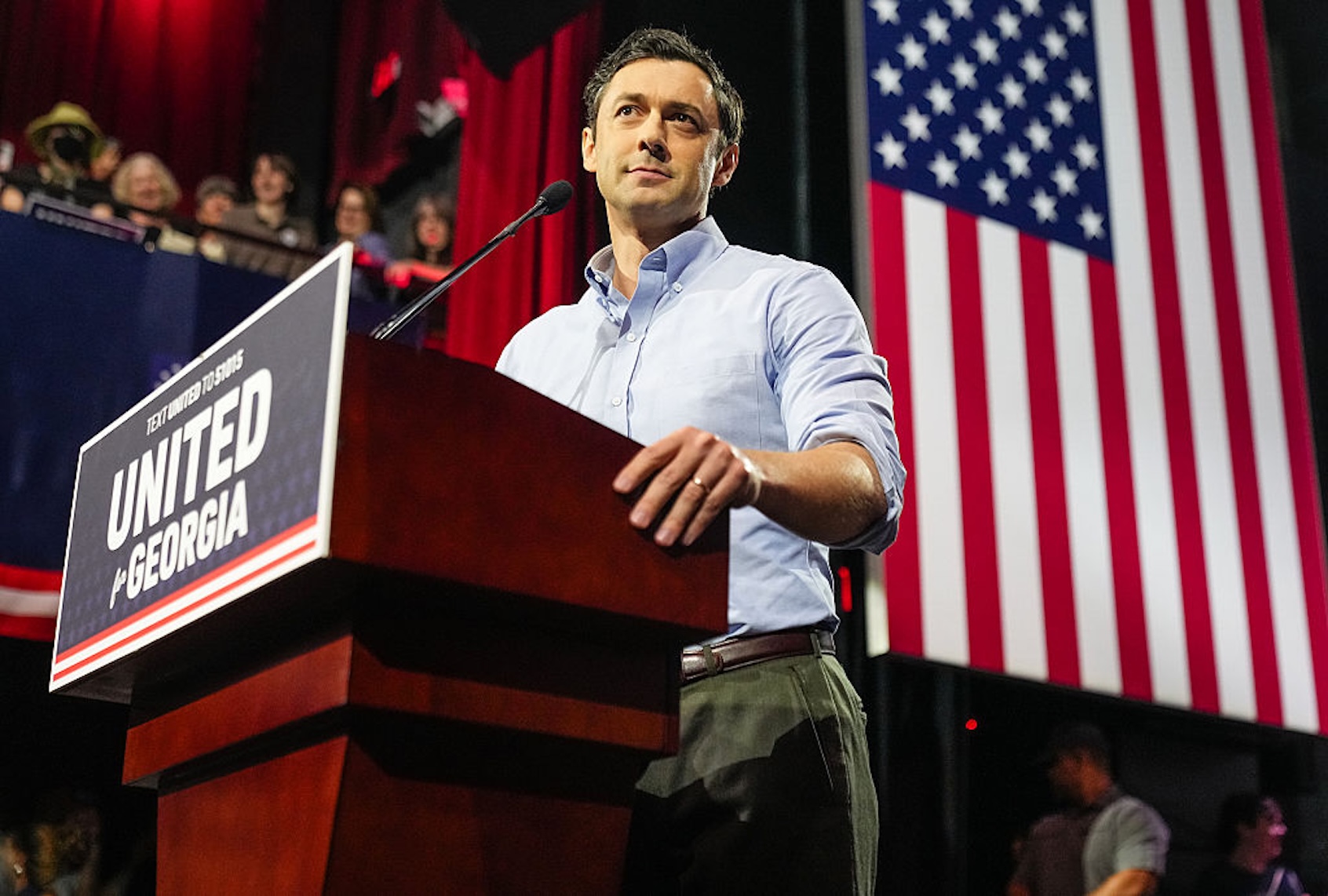
But in the end, it was Sen. Jon Ossoff, D-Ga., who woke up much of the public to this disturbing relationship by mentioning Harp on the campaign trail. “He doesn’t want to do the job,” the senator said of Trump, the sleeves of his blue shirt rolled up. “He wants to build his ballroom and travel with Natalie on their apparently defenseless flying palace gifted by the Emir of Qatar.”
The defensive reaction from the White House was so over-the-top that it backfired, drawing more attention to the relationship.
But a mystery remained. Haberman, Swan and many others had been talking about Harp, but it wasn’t until Ossoff said something that the White House truly lost their minds.
The reaction likely had little to do with Ossoff’s comments, as elegantly as they were constructed. No, this recoil was more about the messenger than the message. At 39, Ossoff isn’t just young. He is strikingly handsome. The boyish good looks of his early career have matured into something closer to the old-fashioned allure of a 1960s-era movie star, such as Gregory Peck or Warren Beatty. Broad-chested, with great hair and a winning smile, Ossoff has a cool demeanor, good sense of humor and moral seriousness in a proportion that’s rare in politics — and that hasn’t really been seen since Barack Obama. Ossoff, in other words, can get it.
I’m talking about votes.
Put another way, Ossoff is everything the 80-year-old president wishes he were, but isn’t. Harp’s presence is a touchy, daily reminder to both Trump and his staff of the president’s thick catalog failings as a human being. Having a young, handsome, talented man mock Trump for his emotional support aide had to have stung with a special precision. No one needs to tell the president or his staff that Ossoff feels just fine about himself — and doesn’t need a full-time emotional support aide to follow him around, praising his every move.
Considering how much the White House communications staff is extremely online, they are also likely to know that Ossoff has become quite the thirst trap, even among young women and gay men who otherwise aren’t especially political on social media. As Grace Panetta of The 19th recently explained, the senator is a reliable, if unwitting, model for light-hearted crush content, much like what creators generate in tribute to movie stars like Timothée Chalamet or Tom Holland.
“Take a scroll through Instagram and TikTok, and you’ll see fan edit-style videos of Ossoff at campaign rallies and in Senate hearings,” Panetta wrote. Women jokingly call out Ossoff’s “slutty Atticus Finch cosplay” or predict that Ossoff will be “a hot president in my lifetime.” It’s reached the point where a reporter from TMZ asked Ossoff if he has “BDE,” which is not short for Big Dictionary Energy, despite the senator very much seeming like he’d be a fan of Oxford’s quintessential publication.
Ossoff’s sex appeal doesn’t just offer a striking contrast with Trump’s oversized suits and comical combover. He’s also very different than men in the Republican ranks who are closer to his own age and, like himself, are widely seen as potential 2028 presidential candidates. At 42, Vice President JD Vance is also the subject a lot of online content. But most of it portrays him in a comically unflattering manner, with tiny dead eyes, oversized cheeks and a maniacal grin. Secretary of State Marco Rubio, 55, isn’t mocked for his looks, but he is often portrayed as a sad sack, a man too slow-witted and spineless to be much use beyond his role as Trump’s patsy. Defense Secretary Pete Hegseth, 46, is blessed with good looks that even three breakfast gin-and-tonics can’t take away. But with the help of Colin Jost on “Saturday Night Live,” he is mostly viewed like an overgrown frat boy crushing beer cans on his forehead. None come even close to the dreamboat treatment Ossoff receives.
This disparate treatment is especially amusing because the MAGA movement has insisted for years that they are bringing back a more virile masculinity — supposedly to cure all the allegedly poisonous feminism inflicted upon America by those WNBA-loving Democrats. No doubt there are some people impressed by all the workout videos posted by MAGA leaders, though that audience probably doesn’t have much crossover with people who get second dates. But what all the chest-thumping and push-up contests of the right really communicates is overcompensation rather than reclaiming some “lost” masculinity.
Beneath the right’s meltdown over Ossoff’s relatively tame comment about Harp was a molten layer of male insecurity. Steven Cheung, the volatile White House communications director, tweeted, “Jon Jackoff has to be the biggest cuck loser in politics.” White House spokesman David Ingle called the senator a “cringeworthy, feminine theatre kid.” Both unwisely lobbed these insults from X accounts featuring photos of themselves. The handy comparison left the observer to contemplate how, with MAGA, it’s typically true that every accusation is itself a confession. Similarly, Trump compared Ossoff to Pee-wee Herman, a reference to a film that is older than the senator and only served to underscore how old and out of touch the president is.
MAGA’s belief that masculinity is on the decline is more a reflection of their personal fears and resentments than an accurate picture of the world. Men who can just act normal continue to do fine, or as much as one can in this economy. As with many of the thirst-trap Democrats that are rising stars, including New York City Mayor Zohran Mamdani and Michigan Senate hopeful Dr. Abdul El-Sayed, a large part of Ossoff’s charm is that he possesses an easy masculinity, one comfortable with women’s equality. MAGA influencers may deny it, but men who actually like and respect women tend to be more attractive to women and gay men.
Being chill with women’s power projects confidence. Insecure men are the ones who demand that women are forced into subservient roles, just so men can feel bigger. It speaks to an internal belief that they can’t win without cheating. That’s loser energy, not the Big Dictionary Energy being given off by Ossoff and this new crop of young, vigorous Democratic men.
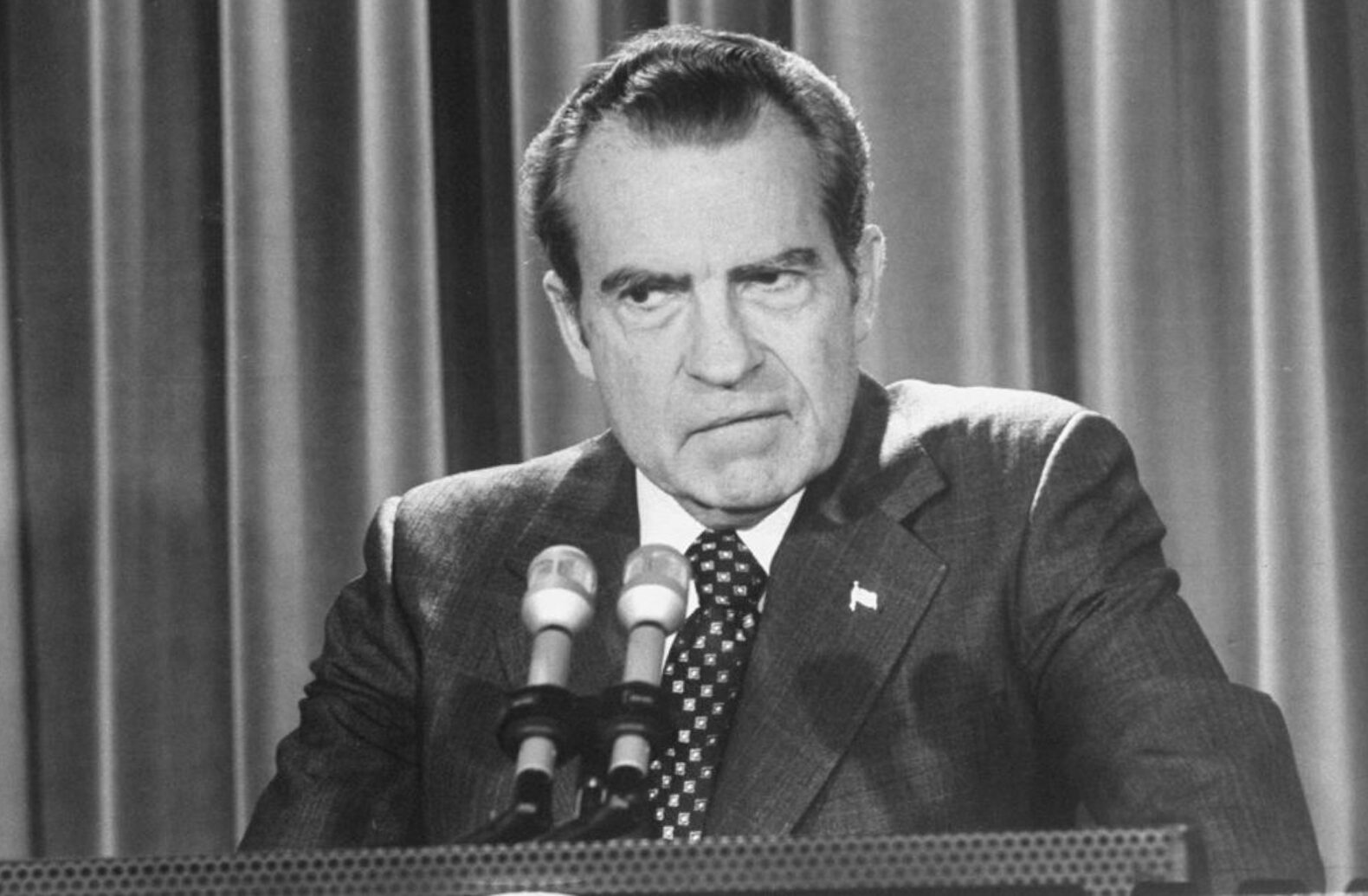
I suppose a Richard Nixon revival was inevitable. After all, the 37th president was the modern model of the corrupt, abusive presidency that is currently being perfected by Donald Trump and his corrupt administration. In fact, much of the legal theory of the unitary executive under which the current administration operates sprang from the bowels of right-wing think tanks smarting from Nixon’s fall from grace.
Many of the norms, rules and laws that governed the executive branch until Trump and his loyalists systematically threw them in the White House dumpster originated in the aftermath of Watergate, so reimagining Nixon as the first victim of the so-called deep state serves as a perfect rationale for what is happening today. For conservatives, the long-awaited historical payback has finally come.
In July, the Wall Street Journal reported that Nixon is suddenly all the rage among young conservatives who are “Nixonmaxxing” all over social media and sporting merch with sayings like “Nixon now, more than ever” and “Pretty girls for Nixon.” One young fan mused, “Is Nixon pulling off the greatest posthumous political comeback in history?”
Maybe so. This new interest among the Gen Z crowd is actually a well-designed public relations campaign by The Nixon Foundation, which used social media in 2018 to celebrate the 50th anniversary of his presidency. Short-form videos featuring Nixon saying “I am not a crook” over gangster rap, along with clips from “Mad Men” showing Jon Hamm-as-Don Draper saying, “Kennedy, I see a silver spoon, Nixon, I see myself,” went viral.
But the fandom is more than just vibes. Podcasters like Joe Rogan and Tucker Carlson have both recently called Watergate a setup, never mind the evidence or admissions by Nixon’s accomplices like H.R. Haldeman in his diary. Even Vice President JD Vance is in on the act, comparing himself to Nixon in June during an event to promote his memoir at the Richard Nixon Presidential Library and Museum: “Young senator, vice president, writes some bestselling books, is hated by the media.” (He’s not wrong.)
“I’ve always liked Richard Nixon,” Vance said, calling him a political genius. The vice president praised Nixon’s foreign policy acumen, giving him props for the opening of China and the Vietnam peace process, while conveniently leaving out the part about bombing Cambodia. Vance also denigrated the Watergate hearings and investigations that eventually brought Nixon down, saying, “If Watergate happened tomorrow, it would be a 12-hour news story. The idea that it would have taken down a presidency is crazy.”
Nixon didn’t have the right-wing media machinery that now excuses Trump’s criminality and spreads conspiracy theories — like the trope that the “deep state” is out to get the president. That alone has managed to keep the MAGA base and Republican officials on board with Trump.
Sadly, he’s probably right. Nixon didn’t have the right-wing media machinery that now excuses Trump’s criminality and spreads conspiracy theories — like the trope that the “deep state” is out to get the president. That alone has managed to keep the MAGA base and Republican officials on board with Trump, which is why he was acquitted in two impeachment trials during his first term. After all, Nixon didn’t resign until he was told that he had lost his base in the Senate and faced certain conviction and removal from office. That wasn’t the case in February 2021, of course, when the Senate refused to convict Trump for “Incitement of Insurrection.”
But there is also evidence that even Nixon had his limits. Yes, he grossly abused the office of the presidency, treating the executive branch like his private fiefdom. He ordered the FBI and the CIA to commit crimes. He bribed, blackmailed and paid off potential witnesses against him. But he didn’t burn the tapes, and he dutifully turned them over when the Supreme Court ordered him to do so. And although there was that infamous “19-minute gap” on one of the tapes that would have sealed his fate, many of the conversations revealed a profane, corrupt president.
But even as Nixon’s overall approval rating sank to 24% during the week before his resignation on Aug. 9, 1974, Republicans — 62% of them — still supported him. These were undoubtedly some of the die-hards who eventually began pushing to roll back the reforms that were enacted in Nixon’s wake.
During a post-presidency with British television presenter David Frost, Nixon famously said, “When the president does it, it’s not illegal.” Those words sounded then — and sound now — like an authoritarian gaffe. But in reality, the idea was based on a very real concept popular among right-wing Republicans, who believed that the president should have unfettered power to enact policies to “protect” the nation.
After that interview, Nixon penned a 2,500-word essay explaining he didn’t believe the president is above the law, but that the nation’s executive must be granted “some faith in his judgment” and given “room for maneuver.”
“His powers are not unlimited,” Nixon wrote. “But neither can be existing law — in a limited way, and at times of special need — and still meet these larger responsibilities.” Apparently, “special need” could be defined as whatever the president says it is, and therein lies the unlimited power.
This notion forms much of the logic of the unitary executive theory that has been growing among thinkers on the right for decades, and with court cases beginning in the early 1980s, the presidency has been granted more and more such power. This, of course, culminated in Trump v. United States, the 2024 Supreme Court ruling that gave the president near total immunity from prosecution for anything done in office. (The president had already been granted immunity from civil liability by the Court in Nixon v. Fitzgerald in 1982.) Now, the idea that presidents are above the law is gaining steam with yet another “investigation of the investigation,” this time into the special prosecutors who scrutinized Nixon back in 1974.
The Wall Street Journal reports that the Trump Justice Department is now officially looking into that case based upon the conspiracy theories promulgated by Geoff Shepard, a former Nixon aide turned historical revisionist and conspiracy theorist who presented “a two-hour presentation at Justice Department headquarters called ‘Watergate As Lawfare,’” making the argument that, you guessed it, the deep state took down Richard Nixon.
There’s a method to all this madness, and it’s best illustrated by the fact that Vance is the one leading the charge. Any ambitious Republican official thinking about the future has to find some way to excuse their complicity in Trump’s corrupt — and likely illegal — behavior. If they have any hope of being elected to national office, their only choice is to try to maintain these MAGA fictions and arcane conspiracy theories after Trump is gone by continuing to deny the reality of what he’s done. One way to do that is to convince people that it was never just about Trump; the deep state has been out to get Republicans ever since Nixon.
If they can’t convince people that their complicity was actually righteous resistance to a secret cabal of bureaucrats and dirty cops fighting to keep Republicans from enacting their righteous agenda, then potential GOP presidential candidates like Vance are likely going to have a hard time overcoming what is likely to be a massive revolt against Trumpism once he is out of office.
We’re seeing the edge of it now — and it’s not just about the price of gas. The air is finally going out of MAGA, and every single Republican politician who took advantage of it will be held accountable by the voters for what they have done. The GOP’s only hope is to find a Republican somewhere who hasn’t been touched by Trump and MAGA.
On Thursday afternoon in Dallas, in what looked like a farewell tour, the president of the United States told his Texas followers to “Hold your nose” and vote for Republican Senate candidate Ken Paxton, a man he also described as a “pain in the ass.”
Donald Trump then sped off in the presidential limo known as the Beast — at nearly 100 mph, according to pool reports — and headed for an event in Oklahoma. Republicans gazed in mock wild wonder, palms outstretched, claiming they have no idea why they’re staring at potentially historic losses in the midterm elections next month.
Afterwards a MAGA supporter told me that Trump’s performance was just “presidential humor.” And fair enough. Donald Trump has spent a lifetime being, in effect, the Wednesday night open-mic comic at a backroom bar in some college town in Missouri.
Neither capable of growth nor understanding, he’s that guy with just one punchline. He’s a one-trick pony: “Sir, she said. Sir.” He’s the most talentless man ever caught in the bright glare of the light he demanded from the world.
But he is persistent. That’s his superpower. The grift? Oh, that part he learned from experience. But he’s naturally persistent, and out of that grew the corruption, fearmongering and boundless anger — all driven by his superpower. He learned to be transactional. Every failure is fuel for the next fiasco.
The first Trump administration was an accident, largely brought about by the split I witnessed firsthand between Hillary Clinton’s and Bernie Sanders’ supporters at the Democratic convention in Philadelphia during the last week of July 2016. What a shock: The Democrats destroyed their chances through infighting. Who knew?
Trump never thought he’d win that election. Some Republicans, who later fled the party, never accepted him as a legitimate heir to the GOP’s legacy when he did. Now, critics and fans alike have pointed out that there’s no doubt he’s the rightful heir to the Republican Party of Richard Nixon, Ronald Reagan and George W. Bush; more corrupt than Nixon, a happy practitioner of Reagan’s economics and more of a mean-spirited-wimp than Hunter S. Thompson ever thought Bush could be.
Trump’s refusal to bust up monopolies while cutting staff to the National Park Service and selling off public lands has removed any illusions that he might be a Teddy Roosevelt Republican. His lack of military service takes him out of the realm of being a Dwight Eisenhower Republican. As for Abraham Lincoln, Trump has tried his best to divide a nation, not unite one.
Since Trump never thought he’d win in 2016, he never really planned anything; he let the Republican establishment run things until he got comfortable sleeping in the big chair in the Oval Office and declaring each week “infrastructure week” while doing nothing about it.
The former East Room of the White House looks like Dresden during postwar reconstruction; the Kennedy Center resembles a Greek ruin; the Reflecting Pool is empty and broken, and for some reason Trump wants to build a triumphal arch and stuff it with weapons.
Then came COVID, and in 2021 Trump found himself out of power after, of course, refusing to concede the election and inciting a failed insurrection. That failure fueled his persistence and led to his 2024 re-election. The failure also fueled his anger. His subsequent 34 felony convictions in New York and the federal investigations into his actions became motives for Trump to seek and destroy all who tried to bring him to justice.
His persistent greed, anger and need for revenge empowered him during his first 100 days back in office in 2025, leading to sweeping, Nazi-esque changes sold to the public by discrediting or co-opting the media.
Meanwhile, the former East Room of the White House looks like Dresden during postwar reconstruction; the Kennedy Center is starting to resemble a Greek ruin; the Lincoln Memorial Reflecting Pool is empty and broken, and for some reason that can only be understood under the influence of hallucinogens and Red Bull, he now wants to build a triumphal arch and stuff it with weapons.
We have no idea why we’re at war with Iran and no idea how to negotiate a peace. Trump’s latest attempt at that answer came in the Oval Office on Wednesday when he said, for what must be the fifth or sixth time, that he could just blow Iran up.
At least 58 people have died after being remanded to ICE facilities. Homeland Security chief Markwayne Mullin shrugs that off and says nothing ICE does is controversial and he’s not running “Holiday Inns — these people broke the law.” His superpower seems to be life-ending, militant ignorance.
Then there’s Russia, Ukraine, China and a host of other scandals. Those include but aren’t limited to spending taxpayer money on political ads, the price of diesel fuel, the slaughter of Palestinians in Gaza, antisemitism, misogyny and the L.A. mayor’s race.
While covering Trump is always a challenge, covering his minions is another story. Sen. Eric Schmitt of Missouri, who made his bones trying to kill the Affordable Care Act and challenging the results of the 2020 election, made a complete fool of himself this week in the Senate while attacking former special counsel Jack Smith.
Schmitt’s superpower is apparently making an ass of himself in public. By misrepresenting nonsensical evidence, he accused Smith of perjury. When called out for his sophomoric display, he then went on right-wing media and lied some more.
Smith, who still reminds me of Coach Beard in “Ted Lasso,” explained that his prosecution wasn’t politically inspired. It was driven by facts. “My service has spanned both Republican and Democratic administrations. I am not a politician, and I have no partisan loyalties,” he said. “My career has been dedicated to serving our country by upholding the rule of law and the core principles on which our country was founded,” Being driven by facts and principles is a pretty decent superpower and should describe most people, including reporters, lawyers, scientists, politicians and clerics.
“The charges against President Trump were the result of the evidence,” Smith said. “Grand juries in two separate districts reached this conclusion based on his actions. Rather than accept his defeat in the 2020 presidential election, President Trump engaged in a criminal scheme to overturn the results and prevent the lawful transfer of power.”
That conclusion shouldn’t come as a surprise to anyone after all this time. Trump told me in the Brady Briefing Room, six weeks before the 2020 election, that “If you stop counting the votes” there wouldn’t need to be a peaceful transfer of power. He’d just stay on indefinitely.
Trump thus teaches us that persistence pays off even if the proposition is criminal and the facts aren’t in your favor. That’s why he currently commands the center ring of the circus.
Meanwhile, down in Texas, we have the aforementioned Sideshow Ken Paxton, one of the most loathsome individuals ever to climb out of the primordial ooze and declare himself a human being. This is a man so vile that even Trump hates him, and so do the Trump-happy Texas Republicans who have been known to embrace faith healers and hunt snakes in shorts and cowboy boots. They tried to rid themselves of Paxton, but he somehow slipped away.
Paxton’s superpower is his lack of spine and his greasy nature. That, combined with Trump’s (ahem) support, is the reason Paxton isn’t in prison.
But time has its way with everyone. After more than a decade of deploying his superpower, Trump is noticeably faltering, even conceding from the Oval Office this week that his party may lose the midterms. The man who has traded on fear, corruption and grift for so long that he looks like a cartoon Tasmanian devil without the charm has now come to resemble Otis, the sleepy town drunk in “The Andy Griffith Show” (look it up, for heaven’s sake).
Waiting in the wings is “Hillbilly Elegy” JD Vance, worming his way through the crowd. That’s his superpower: He’s a bearded human worm. If you don’t like him, you might place a bet on Marco “The Juggler” Rubio. His superpower is handling a variety of tasks without the loud explosive thud of total failure often seen from Trump, Vance and Pete Hegseth, who’s more like the the secretary of fashion than the “secretary of war.” That makes “Li’l Marco” a bright star in Trump’s dark firmament, even if it’s evident nobody likes him.
Hegseth, on the other hand, is among the dimmest. His superpower seems to be the ability to cosplay a vain summer camp counselor in the Adirondacks from a bad Hallmark comedy.
For the comic book fans out there, the Republicans are led by a Yellow Lantern with fading powers, delusional in his beliefs and actions, too fearful to change and faced with the overpowering realization that his time in power is quickly coming to an end.
He even sent an email to supporters Thursday claiming “This could be my final four weeks as president.” Sure, it was another grift, as well as fatalistic and totally disingenuous.
For the comic book fans out there, the Republicans are led by a Yellow Lantern with fading powers, delusional in his beliefs and actions, too fearful to change and faced with the overpowering realization that his time in power is quickly coming to an end.
They may have to pry Trump out of the Oval Office with a crowbar and a handful of sedatives in 2029, if he lasts that long. But next month’s midterm elections, should they go as badly as Trump obviously fears, will mean the effective end of his presidency. What comes after that could be chaos. Don’t expect mature or professional behavior from a party that can’t tell the difference between an NBA game in Atlanta and a women’s college basketball game in Silver Spring. Just realize it’s the same party that wants to punish transgender Americans while rewarding the ultra-rich.
The only question that matters is this; Does Trump have enough juice left in his Yellow Lantern ring for one last fearful victory? At his mini-convention in Dallas he told his followers to “cheat like hell.” At the same time Trump asked everyone to vote as if he were on the ballot; unfortunately for the Republicans, many will do just that. At this point, it’s almost as if Trump is campaigning for the Democrats.
Seems appropriate. Most of the Democrats are counting on winning by simply saying, “I’m not Trump.”
Folks, they’re not putting Vance out in the field for the Donald’s sake. He’s there for the same reason: Because he’s not Trump. Soon enough, JD could graduate from the sideshow to the center ring.
Should Trump and the Republicans suffer the historic midterm blowout everyone sees coming — barring armed confiscation of ballot boxes — the president will play the victim, a martyred hero who will claim the elections were rigged and blame Joe Biden, China, Canada, our NATO allies and Iran. If he somehow finds a miraculous recharge for his ring, he will use his superpower to foment further revenge and retribution. Every failure is fuel for the next fiasco.
I’ve been told that everyone has a superpower. If so, I’ll defer to what my father told me was mine: asking annoying questions. I still have a few for you, Mr. President.
Jane Doe, a former Cornell University student who has filed a civil lawsuit alleging gang rape at the hands of seven Chi Phi fraternity members, has struggled since she first reported the incident to the police in November 2024, a few weeks after night a frat party turned ugly. “Her life has been destroyed,” her attorney Thomas Giuffra told CNN’s Jake Tapper. Unlike most of the alleged assailants, Doe left college after what Giuffra has described as a “horrifying” semester in which she had to attend classes “where she saw these guys on a fairly regular basis.”
She was not from “a wealthy family,” he said. “This was her dream and it was taken away from her at a young age in just a horrific fashion.”
But according to some on the right, Doe has not suffered enough for reporting her alleged assault to the police and then later suing the accused, the university and the fraternity. It’s not enough that she saw no charges filed, or that reportedly only two of the accused were expelled from campus. On top of her existing pain, therefore, many of the MAGA faithful are punishing her further by calling her a liar, implying she’s a slut and even threatening to out her, which would put her personal safety at risk. Whatever their intent, by doing this, they are sending a strong message to any victim of rape who might feel tempted to seek justice: Stay silent, or you’ll be next.
In 2017, the #MeToo movement took the nation by storm. A veritable flood of women, and some men, spoke out about their own experiences with sexual abuse, leading to a slew of firings, lawsuits, arrests and social opprobrium of the accused, especially since so many accusers produced compelling evidence. Despite this, it was barely weeks before the backlash began, with countless articles about how #MeToo had gone “too far,” despite scant evidence that innocent men were getting entangled. That response swelled until it overcame #MeToo, which has largely faded into the background.
Much — if not most — of the time, alleged victims still face far more serious consequences than their accused assailants, and for many people and institutions, it still feels much easier to make the issue go away by suppressing accusations than dealing with these cases which are, admittedly, often complex.
The Cornell case shows, though, that far from going too far, the #MeToo movement didn’t go far enough. Much — if not most — of the time, alleged victims still face far more serious consequences than their accused assailants, and for many people and institutions, it still feels much easier to make the issue go away by suppressing accusations than dealing with these cases which are, admittedly, often complex.
There is no doubt that the Cornell case is messy. By her own account, the victim was initially consenting, though perhaps not enthusiastically, to a threesome with two fraternity members. But the situation apparently took a turn when she took ketamine during the encounter and more fraternity members joined in, even communicating about “free p—y” on Snapchat. She describes hiding and swatting the new men away, but being too incapacitated to fight back.
“I can say with 100% confidence I was raped,” she told police during a November 2024 interview.
It took time for the alleged victim to get to the point where she was ready to file a report, which right-wing pundits have seized on as evidence that she was not really raped. The New York Times, using campus police documents and witness statements, laid out the timeline showing that she initially reacted with confusion and shame. While she didn’t call it “rape,” she was clearly unhappy about what had happened. Over the course of a few weeks, she came around to first texting one of the accused that “90% of what happened that night was not consensual,” and then filing a police report.
“After rape, it’s common that victims don’t realize what happened was rape,” explained Anne DePrince, a psychology professor at the University of Denver and author of “Every 90 Seconds: Our Common Cause Ending Violence Against Women.”
Victims “feel some shame about reporting it,” especially if they initially “liked the boy or they wanted to go to an event,” Sharon Gandarilla-Javier, an assistant professor at the John Jay College of Criminal Justice, told me. She noted that it’s also common for someone to initially consent to one activity that then becomes “totally different than what they expected.”
Journalists and feminist writers have been cautious in addressing this case, making it clear that the claims haven’t been tested in court and that New York’s rape laws may not be enough to secure an indictment, much less a conviction. Tompkins County District Attorney Matthew Van Houten has reopened the case, arguing that this new lawsuit presents evidence he didn’t have when he initially made the decision to not charge the accused. New reporting also shows that Van Houten was given a condensed version of Doe’s report to Cornell police, one that omitted her use of the word “raped.”
But on the right, there appears to be no similar care when lobbing unproven — and unevidenced — accusations that Doe is lying.
“Her account has radically changed,” The Daily Wire’s Ben Shapiro said on Tuesday’s episode of his podcast, insisting “it turned out that the details of the police report did not amount to anything like rape.”
While he may be proven right if prosecutors can’t secure an indictment, this is not the same thing as saying that all Doe reported was “bad things happening with consent,” as Shapiro claimed. She herself said she was “raped,” and as many have pointed out, the very fact that she filed a police report is relevant. Calling the police suggests that a person believes they are reporting a crime.
Matt Walsh, also of the Daily Wire, accused feminists of “rushing into the next Duke lacrosse/UVA-style hoax” and argued on X that the situation was nothing more than “a disgusting drug and alcohol fueled orgy,” where “the drunk men have just as valid a claim to being raped.” This, of course, ignores the fact that the alleged victim did not get on Snapchat to advertise “free p—y” to strangers, as well as her own testimony that she pushed them away and tried to hide.
The story “gets transformed from a night of regrets that the young woman is ashamed of into a night in which she’s a victim,” former Fox News host Megyn Kelly said on her podcast, where she also threatened to release the accuser’s name.
Feminists and journalists are wise to use words like “alleged” and to be clear that the evidence has not been fully evaluated in a court of law, and it is true that there remains much about this case that is unknown. Still, there are the Snapchats and text messages, including one where the alleged victim uses the word “nonconsensual” and another where the accused wrote “I just wanted to apologize for how things went down the other night.” This alone makes it hard to believe the accusations are a “hoax,” as Walsh suggested, even if there are outstanding legal questions about whether a consensual encounter turned into something illegal.
For people who insist on the principle of “innocent until proven guilty,” many on the right have proven themselves quick to make claims about the alleged victim’s motives. It’s worth remembering that E. Jean Carroll won a defamation civil suit against Donald Trump after he accused her of lying when she claimed he sexually assaulted her in the dressing room of a Manhattan department store in the 1990s. There is a demonstrable psychological and reputational toll on alleged victims when they face public accusations that they are lying, especially when they come from high-profile people who also insinuate that the victim is an immoral person because of their sexual history.
In this case, no one is required to have an opinion about the accuser’s character. They don’t know her history or her life or why she was even at the party, beyond her stated desire to have some fun . . . Shutting up is free.
In this case, no one is required to have an opinion about the accuser’s character. They don’t know her history or her life or why she was even at the party, beyond her stated desire to have some fun. They could, like most decent people, consider the allegations and assume that, even if there is not a crime here, what is described should never happen to anyone. Shutting up is free.
But the past decade of Trumpism has largely been built on stirring up male anger at women’s growing equality. Paranoid and unsupported claims that women have immense power to ruin men with false accusations have been the bread-and-butter of a MAGA media industry designed to exploit men’s resentment for profit. Their audiences yearn to hear that Jane Doe is the real bad guy here, and so attacking her without a single shred of real evidence against her is an opportunity that many right-wing pundits can’t seem to pass up.
Despite the hysterical claims of its critics, #MeToo was never about ruining the lives of innocent men. In a very real sense, the movement was about leveling the playing field, which is so dramatically tilted against victims that it makes justice nearly impossible to achieve. No one truly disputes the importance of due process to handle accusations of sexual violence. That’s why Jane Doe is going through the court system. It’s also why it’s good that, in light of new information, the district attorney is re-opening the case.
But due process is endangered if victims can’t report allegations without facing public abuse and threats of being falsely accused themselves that it becomes psychologically impossible to live their lives. As its name suggested, that was the whole point of #MeToo: to create enough solidarity between victims and allies to make it safe for victims to speak out without their lives being destroyed. If the right really believes in the value of due process, then they would let it play out, instead of dogpiling and harassing accusers so that future victims are too scared to report crimes.
President Donald Trump’s war against Iran, which just passed its seven month mark, is deeply unpopular among Americans, new polling continues to suggest. A survey from the Associated Press/NORC Research Center published Thursday reports that 71% of adults disapprove of how Trump is handling the Iran war, started alongside Israel in late February, while 69% say the war has not been worth fighting.
“More than half of adults say the country as a whole, the national economy, and their local economy are worse off since Trump was reelected in 2025,” the survey reports. “Most Americans (73%) say the country is heading in the wrong direction, including 92% of Democrats and 47% of Republicans.”
The president seems to realize this growing frustration could cost Republicans dearly in the midterm elections next month, possibly losing GOP control of the House, Senate or both. “It’s possible,” Trump mused to reporters outside the White House Thursday. But he continues to insist that the Iran war is worth it — ostensibly to prevent the nation from obtaining a nuclear weapon, despite the nuclear stockpiles of both the U.S. and Israel — while doubling down on threats and deploying even more troops to the region.
On Thursday, officials told the Wall Street Journal the Pentagon is sending a third aircraft-carrier strike group and additional Marine Corps ships to the Middle East, expected to arrive at the end of November. It would add around 10,000 more troops to the region, putting further strain on the Navy, which has been under pressure from near-record deployments and supply shortages.
But it does seem like Trump is waiting until after the voting to renew bombing Iran, as the Journal reported in late September. In a sprawling interview with Time published Thursday, the president said as much. “Because by annihilating Iran, we’ve created peace in the world,” he said. “With Iran, I don’t think you could ever have peace.”
Republicans are often very good at converting an event into a scandal, even when there is none to be found. They keenly understand the basic mechanics of a contemporary political media that rewards conflict. The modern conservative machine often operates in unison to manufacture a reality-TV confrontation designed to thrill the GOP base.
First, a Republican makes a dramatic accusation. Then, conservative influencers and right-wing media outlets duly amplify the charge until it becomes a viral “gotcha” moment. GOP politicians and operatives then go on podcasts and Fox News to repeat the accusation. By the time anyone checks the underlying evidence, the original allegation has become canon to conservatives.
That was plainly the ambition behind Missouri Republican Sen. Eric Schmitt’s performance on Tuesday at the Senate Judiciary Committee hearing with former special counsel Jack Smith. It was even there in the hearing’s title: “Oversight of Jack Smith’s Abuse of Authority and the Targeting of Republicans and Related Matters.” Convened by 93-year-old committee chairman Chuck Grassley, R-Iowa, it aimed to recast Smith, the prosecutor who indicted Trump over his efforts to overturn the results of the 2020 election and alleged mishandling of classified documents, as the villain of a weaponized Justice Department. Smith, for his part, stood behind his case, stating emphatically, “Our investigation developed proof beyond a reasonable doubt that President Trump engaged in serious crimes against our nation.”
But with the midterm elections barely a month away, Republican senators made the calculated decision to relitigate Jan. 6 by fishing through Smith’s records in a desperate bid to find something — anything — to excite their base. What they found was confusion about a basketball game.
Before Tuesday’s hearing started, Schmitt looked like a man whose plan was coming together. Earlier that morning, Axios co-founder Jim VandeHei published a flattering bulletin placing Schmitt atop the speculative short list to be Vice President JD Vance’s 2028 running mate, quoting admirers of the senator. “We hear the VP views Schmitt as trustworthy, intelligent, articulate and a deft political operator,” VandeHei wrote. The rollout appeared designed to elevate Schmitt’s national profile just as a splashy televised grilling of MAGA’s public enemy No. 1 was set to unfold. What happened instead was one of the most embarrassing misfires of any recent Senate hearing.
Near the end of his questioning, Schmitt asked Smith whether he had attended an NBA game between the Golden State Warriors and the Atlanta Hawks on Feb. 3, 2024. Smith looked genuinely confused and asked what city that would be in. Atlanta, Schmitt said. No, Smith replied. Schmitt then supplied the innuendo, noting that the day before, Fulton County District Attorney Fani Willis had acknowledged her intimate relationship with special prosecutor Nathan Wade, who was helping lead her Georgia racketeering case against Trump. The unstated suggestion was that Smith had slipped into Georgia under the cover of a basketball game to coordinate with Willis.
Schmitt said he had a series of text messages from Smith’s team placing the prosecutor at the game, then he gave the former special counsel a beat to think it over: “I’ll give you a second to process it so you don’t, you know, perjure yourself.” A staffer hoisted a poster board showing purported texts alongside images of Smith, Willis and Wade and a photo of State Farm Arena, then yanked it back down with remarkable speed. Schmitt declared Smith had probably already perjured himself and blasted him as a “total dirtbag.”
The texts did not mention Atlanta at all. They mentioned a Hawks game. Sen. Amy Klobuchar, D-Minn., circled back later in the hearing and methodically dismantled the exchange. The whole thing collapsed because Schmitt, or someone working for him, apparently never considered the possibility that Smith might have attended a women’s basketball game, and only found one corresponding men’s game for the date in question. The game Smith attended was, in fact, a women’s college basketball game in College Park, Maryland between the Maryland Terrapins and the Iowa Hawkeyes, the team then led by Caitlin Clark. Schmitt’s entire conspiracy theory was built on basic factual incompetence.
It’s tempting to treat this episode as merely humorous. There is something inherently ridiculous about a United States senator arriving at a televised hearing convinced he has caught a former special counsel in perjury, only to learn that the central clue in his conspiracy theory was just a shared bird mascot. The speed with which the poster was yanked down by Schmitt’s staffers told the entire story before the cameras. Realizing in real-time that they had walked straight into a trap, the senator’s team tried to bury the evidence and move on before anyone noticed.
An apparently pre-planned chorus of right-wing influencers had their talking points ready to deploy the second Schmitt’s gotcha dropped. Fox News’ Sean Hannity initially applauded Schmitt before deleting his post on X.
But an apparently pre-planned chorus of right-wing influencers had their talking points ready to deploy the second Schmitt’s gotcha dropped. Fox News’ Sean Hannity initially applauded Schmitt before deleting his post on X. Benny Johnson declared that Schmitt had caught Smith perjuring himself. Other conservative commentators circulated the clip as proof that Smith had been caught in a lie — and then quietly abandoned the claim.
Instead of owning the blunder, Schmitt doubled down. Appearing afterward on “The Charlie Kirk Show,” where the hosts, Andrew Kolvet and Blake Neff, prompted him with the fiction intact, the senator continued to insist that he had been justified in asking the question. When confronted later by TMZ with the fact that Smith had actually been at the Iowa-Maryland game, Schmitt responded: “My job is to ask the question.”
It was an extraordinary accusation to make on the strength of material that was, according to a report by MS NOW, explicitly described by Republican Judiciary Committee staff as “unvetted.” The political editor of KSDK-TV in St. Louis, Schmitt’s home market, mocked him openly for the mistake.
Even within the senator’s own party, the embarrassment was palpable. A video of Sen. Katie Britt, R-Ala., looking on with a mask of utter horror quickly circulated online. “There’s something to be said about the staff work, and verifying before we do something like that publicly,” Iowa Sen. Joni Ernst told Raw Story. One unnamed Republican senator suggested the bad intel came directly from the White House. Reports soon surfaced that Schmitt’s general counsel Ethan Harper, who stood behind him holding the infamous poster, saw his potential White House staff position being placed into immediate jeopardy.
But since many conservatives will never let a thing like the truth get in the way of self-promotion, Schmitt took his victory lap after standing on a rake.
There is a familiar pattern in the refusal to feel shame. When Vance was caught spreading the false claim about immigrants eating pets in Ohio, he argued he would create and repeat fiction in service of a larger truth. Schmitt’s defenders are doing the same, treating a false perjury accusation as acceptable because it aimed at exposing supposed corruption.
Step back, and the strategic picture is bleak for the people who planned this misfire. Senate Republicans chose to relitigate Jan. 6, embarrass themselves on national television and then double down rather than move on. It was propaganda and lawfare generation. The incompetence of the execution does not change the intent.
Before it became reality, the biggest fear around a second Donald Trump administration was an increased level of competence. The candidate and his team displayed shocking measures of discipline and consistent messaging throughout the 2024 race, with much of the credit going to campaign manager Susie Wiles, who became his White House chief of staff. As a result, some feared that the shambling jankiness of his first term would be replaced by an efficient, experienced administration that would carry out a ruthless, quasi-fascist platform with few hiccups.
That hasn’t happened. Once in office, Trump replaced the GOP’s establishment scolds who curtailed his worst impulses in his first term with loyalists who were just as green as him. The result has been constant outrage over blatant graft and executive overreach, as Trump is unable to stop blabbing about his — possibly illegal — dealmaking and unconstitutional policy goals. But look to the Republican Party’s backbenchers: You’ll see what MAGA could do with a figurehead who can keep their trap shut.
A loyal Trump acolyte, Louisiana Gov. Jeff Landry has happily deployed bored-looking National Guard troops to New Orleans and the U.S.-Mexico border for little more reason than pleasing the president. He has successfully pushed a law to require the display of the Ten Commandments in schools, and he rarely shies away from red meat conflicts with his state’s few Democratic strongholds. Little surprise, then, that Landry was hailed as MAGA’s next-generation hero by Rolling Stone in 2024.
Unlike Trump’s premature crowing over his massive ballroom or countless would-be Iran ceasefires, the governor has a tendency to let his work speak for itself.
But when the time comes to pass Republican policies he truly cares about, or to hand out contracts and favors to his preferred businesses, Landry goes eerily quiet. Unlike Trump’s premature crowing over his massive ballroom or countless would-be Iran ceasefires, the governor has a tendency to let his work speak for itself.
When it was published, Landry’s profile in Rolling Stone made hay out of his ability to go dark. Lately, though, when he gets quiet, it’s out of legal necessity. His administration has proven remarkably open to signing non-disclosure agreements while working out public deals with megacorporations.
According to a report from the New Orleans Times-Picayune, the Landry administration has signed nearly 300 NDAs since he took office in 2024. The Gulf States Newsroom uncovered a further 100 NDAs between the governor’s office and its employees, restricting what they can share about their time on the job. Reporter Drew Hawkins, who spoke to employees of former Louisiana gubernatorial administrations, said the broad gag orders on public employees was unprecedented.
“[T]hey’ve never seen anything like this,” Hawkins told New Orleans television station WWL. “They don’t know about anybody else signing them. They never signed them, and then you know one of them reviewed it and went through it point by point and talked about just how wild this would be to enforce.”
The result of all these hush-hush agreements is most noticeable in recent headline deals with SpaceX and Meta. The former was given the OK to build a massive spaceport in coastal Louisiana in between two wildlife refuges. While the under-wraps deal was being worked out, Landry signed laws exempting aerospace operations from property taxes, nuisance liabilities and public records requests. The final deal, approved in a public meeting of a new development board announced just 24 hours before, granted SpaceX more than $24 billion in tax breaks to build a rocket-launching facility no locals had even heard about.
A similarly tight-lipped dealmaking process led to Meta’s announcement of its largest data center to date in rural Northeast Louisiana. The project, dubbed Hyperion, will cover six square miles of Richland Parish. The tax breaks granted to Meta, again without public input, total more than $3 billion.
For his part, Landry kept quiet about the agreements until the last possible moment. But once the ink was dry, he was downright boastful about them. “I have no problem letting the people in the state of Louisiana decide whether what we put together was worth it,” he said, telling the Times-Picayune that he was motivated by pragmatism and a desire to drag his economically underperforming state into the future. “You don’t do these deals in the public,. At some point, you have to give the people elected to lead this state the opportunity to lead.”
Since Louisiana’s have a habit of ending up in prison, some level of backroom chicanery is to be expected in the Bayou State. At the moment, Landry’s NDA-heavy approach is largely a Louisiana phenomenon. But the ethically dubious practice of burying public-private deals under NDAs could be put to use elsewhere.
Landry’s down-low dealmaking offers a blueprint for post-Trump Republicans looking to push through potentially unpopular agreements and policies, including those involving data centers and artificial intelligence. While the president may no longer be able to harness the support he enjoyed by virtue of being loud-mouthed himself, his followers can work quietly to carry on his project under a blanket of keep-quiet agreements — springing them on the public when the deals have already been made.
It was a bit tense watching Jack Smith get grilled before the Senate Judiciary Committee on Tuesday. During his testimony, the former special counsel defended himself against accusations of partisanship in his failed effort to prosecute President Donald Trump two years ago. The chaos of the current era has made the 2024 presidential campaign feel like it was a decade ago, but it’s important to recall that Smith secured indictments on Trump’s role in the Jan. 6 attack on the U.S. Capitol, and the other on his alleged mishandling of government records, including the classified documents he had stored at Mar-a-Lago. Both cases fell apart as Trump was elected to a second term.
Now Republicans, including Trump, are pushing for Smith himself to be prosecuted. This wasn’t the first time he has been dragged before Congress so lawmakers could get the soundbites needed for Fox News hits. But to his credit, Smith doubled down and said he would prosecute the president all over again.
“Our investigation developed proof beyond a reasonable doubt that President Trump engaged in serious crimes against our nation,” Smith said during the hearing, adding, “If asked whether to prosecute a former president today, based on the same facts, I would do so regardless of whether that president was a Republican or a Democrat.”
Republicans took the opportunity to lob insults and accusations at Smith for hours. Texas Sen. Ted Cruz accused him of bringing “the Department of Justice into disrepute,” while Louisiana Sen. John Kennedy was more graphic, telling Smith “You make me want to throw up in my mouth.”
Sen. Eric Schmitt of Missouri claimed Smith “will go down as a total dirtbag” and also attempted to corner the former special prosecutor into possible perjury, accusing him of attending an Atlanta Hawks game in 2024 as a pretext for meeting with Fani Willis, the local district attorney who prosecuted Trump in Georgia. But Schmitt — or some staffers who will soon be looking for employment — apparently confused the Hawks and the Iowa Hawkeyes — which are different teams, as it turns out. Smith had watched the Hawkeyes play in Maryland. (As a non-sports person, I confess I might have made the same mistake, except I check my facts.) Sen. Amy Klobuchar, D-Minn., did Schmitt the favor of pointing out his error, quipping “Perhaps you should have looked at it more carefully.”
This only seemed to further anger Schmitt, who is reportedly angling to be Vice President JD Vance’s running mate in 2028.
The whole bit, including a poster board of Smith’s blown-up text messages, was amazingly lazy, even for this Congress. It seemed as if some aide suffering from conspiracy-brain didn’t bother to check the details, or maybe they asked ChatGPT for help. Still, getting the facts wrong probably won’t hurt Schmitt. He got in the abusive remarks that will earn him MAGA’s seal of approval.
Not surprisingly, Democrats also defended Smith. “The aspersions cast on Mr. Smith nonstop are petty, personal and political,” Illinois Sen. Dick Durbin said. Cory Booker of New Jersey claimed “This is gaslighting of the American people,” telling Smith, “I am so sorry that they’re attempting to put investigators on trial while ignoring the extraordinary conduct that that they are duty bound to really investigate.”
Maybe this all seems like theatrics, more fodder for the cable news spectacle. But the stakes for Smith are real, and this charade could also carry severe consequences for Americans. Since the moment he returned to office, Trump has worked overtime to take down his enemies. That hasn’t been too successful yet — emphasis on yet — but this is about much more than potentially putting Smith behind bars. By playing the victim, the president benefits from controlling the narrative, and perhaps rewriting history, which becomes even more critical as we approach the midterms and he continues promoting the lie he won the 2020 election. So Smith continuing to give the president and his MAGA trolls the proverbial finger isn’t just satisfying — it’s necessary.
I’m not a Smith fanboy, though I certainly admire him for serving as a specialist prosecutor investigating war crimes in the Kosovo War. It feels misguided to turn public figures like Dr. Anthony Fauci or Sen. Jon Ossoff, D-Ga., into heroes or thirst traps just for doing their jobs. Still, it’s worth noticing when someone in the hot seat does more than pay lip service to the idea of a just and accountable society, knowing that the consequences extend much further than their own personal freedom.
Andy Beshear has a favorite song: “Universal Sound” by Tyler Childers, the Grammy-winning country artist with a special place in the Kentucky governor’s heart. That title is something of a metaphor, about connecting to a deep, abiding spirituality accessible to us all. It’s meant to be an ecumenical message — just like the one Beshear hopes to deliver.
“Universal Sound” carried him through a “nasty” reelection campaign in 2023, which ended with a comfortable victory over his GOP opponent, state Attorney General Daniel Cameron, who had been hand-picked for the race by Sen. Mitch McConnell. Amid mounting speculation that Beshear could become a leading contender in the 2028 Democratic presidential primary, “Universal Sound” may well become familiar to more voters.
Beshear’s newly published book, which is de rigueur for potential candidates seeking to raise their political profile and lay out a vision, is also stoking talk of 2028. With its title taken from the biblical parable of the Good Samaritan, “Go and Do Likewise: How We Heal a Broken Country” explores how President Donald Trump and his administration have, in Beshear’s words, “hijacked” Christianity, and how the governor’s brand of inclusive faith underpins his political life, offering readers a blueprint for governing with compassion.
I interviewed Beshear last week on the sidelines of Bourbon & Beyond, the music festival held annually in Louisville, Kentucky. He spoke about a reinvigorated religious left, addressed the tricky question of whether Trump should be considered a Christian, discussed his willingness to take unpopular stands in a red state, hinted at his plans for 2028 and explained why, as a politician often compared to Mr. Rogers, his kindness shouldn’t be mistaken for weakness. (Full disclosure: My husband, the novelist Silas House, served as Kentucky poet laureate under Beshear, and I once briefly assisted the governor on a writing project.)
This conversation, which took place in a backstage trailer vibrating from the country and hip-hop tunes emanating from nearby stages, has been edited for length and clarity.
Governor, thank you for taking the time to talk. “Go and Do Likewise” is centered around the parable of the Good Samaritan from the Bible. What do you think that story has to tell us and teach us today?
Well, it’s a perfect story for a moment of division. So the parable of the Good Samaritan is about a man lying bloodied and naked on the side of the road, and everybody that looks like him and thinks like him and votes like him and prays like him and loves like him goes to the other side of the road, ignores him and walks on. But Jesus chooses someone who’s raised to hate that man on the side of the road — the man on the side of the road was raised to hate the Samaritan — and that’s the person he has come over, not kick the man while he’s down, but lift him up, carry him to safety and, if you read it carefully, pay for his healthcare moving forward.
But the parable of the Good Samaritan is more than just a story to emulate; it’s an instruction, because Jesus then looks at the crowd and says, “Now go and do likewise” . . . This is one of the fundamental — not teachings but instructions of the Bible. It’s for us to be good, especially when it’s hard. For us not to judge people, and at people’s worst moments, to just be good to each other.
Faith is obviously so important to you, and I’ve heard you many times refer to it as your “authentic why.” What do you mean by that?
“In an age of authenticity — when your Instagram video is important and your TikTok video is important — people want to know you, what drives you. They don’t have to agree with what drives you. They just want to see that it drives you to do good. And for me, that is my faith.”
Well, first, I would never impose my faith on anyone. I’m not somebody who thinks that my faith needs to be written directly into law. That’s Christian nationalism, and I’m against that. But I do think in an age of authenticity — when your Instagram video is important and your TikTok video is important — people want to know you, what drives you. They don’t have to agree with what drives you. They just want to see that it drives you to do good. And for me, that is my faith.
It tells me I’m supposed to leave this world a little better than I found it, and that’s one of the reasons I’m still [here]. You know, I thought that two terms as governor would be enough, and they still may be. But I see a world now that’s moving backward and not forward. And doesn’t faith call you to stand up and to speak out at that moment?
What do you think being in that position — I imagine you sitting there in Frankfort at night, weighing this [calculus] — has taught you?
First, I believe in any job that I’ve taken on. I am fully dedicated to the people of Kentucky, and when I fight with the president, it’s not because I’m a Democratic governor and he’s a Republican president. It’s because he’s doing something that hurts the people of Kentucky, and whether it’s popular or not, that was the job I took on to do my very best to move us not right, not left, but forward.
But you know, [the COVID pandemic] taught me a lot of lessons. I did what I thought was the right thing, that might not be the popular thing, the thing that would save the most lives. And you know what I found? As long as you’re willing to respect people enough to explain your why and not just your what, doing the right thing is oftentimes the politically popular thing, even if it wasn’t beforehand. People respect conviction, even if they don’t necessarily agree with it. And when you’re willing to explain why you did something, people can disagree with you but still believe you’re coming from a good place.
One thing I’ve been thinking about as I read your book is that the religious left used to be such a strong force in American politics. You know, Bobby Kennedy, all of his work —
All of the War on Poverty, even if notcouched in those terms —
Yes. Bobby Kennedy’s work for social justice was rooted in his Catholicism. Jimmy Carter, famously a Sunday school teacher, spoke about his faith a lot. Even Hillary Clinton, in her husband’s 1992 presidential campaign and administration, talked about her faith and took a lot of flak from establishment media. What happened to the religious left? Why do you think it declined, or kind of went underground?
Well, what I think we’re seeing now, when you see the James Talaricos of the world, our Kansas Senate candidate [Democrat Adam Hamilton] who’s a Methodist minister and others . . . you know, the media will always try to take something as a tactic. They’re like, “Why are Democrats talking more about faith right now?” instead of “Why are people of faith running as Democrats right now?” And I think it’s because there is such a manipulation and a hijacking of faith going on, in such a transparent manner, that people of faith are saying, “I’ve had enough.”
When you see Donald Trump hold a Bible in a way that you’re pretty sure he’s never held it, much less never read it; when he says he doesn’t think there’s any way he’s going to heaven, he doesn’t seem to be worried about it; when he walks out after Erika Kirk gives voice to the Golden Rule in such a beautiful way, and says, No, no, I believe in the exact opposite; when you see JD Vance using faith to kick people while they’re down instead of lift them up, and to judge as many people as possible — then I think people of real faith want to stand up and take that back. Or at least to provide the counterexample. I think people are tired of seeing faith used for bad in public life instead of for good, and that’s the core of why I wrote the book.
You don’t shy away from going after President Trump. You write that he “makes people feel good about themselves by telling them it’s okay to be the worst version of themselves.” At another point you say, “Trump may occasionally talk about Jesus (or ‘Two Corinthians’), but he has missed the point. Jesus lifted up the very people this Republican administration pushes down . . . Trump throws Gatsby parties with his billionaire friends, while Jesus hung out with the exact opposite. Trump clears the very people out of city parks that Jesus would minister to.”
That’s a powerful indictment. You’re saying that the president doesn’t love his neighbor as himself.
No, he calls his neighbor “the enemy from within.” It is the most stark contrast. I think about “love your neighbor as yourself” versus the president [characterizing] your neighbor as the enemy from within. I also think about Erika Kirk saying, I forgive my enemies, and Donald Trump saying, no, I hate my enemies . . . It’s just the exact opposite of what the Bible is supposed to teach us.
At one point, you question if he even knows the story of the Good Samaritan.
I’m not sure he does.
Christ said, “You will know them by their fruits,” right? Do you think President Trump is a Christian?
I try not to question people’s faith, because I admit that that is judging. But he is not living and he is not governing like a Christian. Now, when you think about the miracle of the fishes and the loaves in each of the four first books of the New Testament, it’s that important. Jesus, in a time of scarcity, makes sure everybody has enough. Donald Trump has repeatedly tried to take food off kids and seniors’ table [and] was willing to use starving Americans as leverage during a government shutdown. That is not living or governing like a Christian, and I doubt they ever run out of food at the White House.
“Jesus, in a time of scarcity, makes sure everybody has enough. Donald Trump has repeatedly tried to take food off kids’ and seniors’ tables [and] was willing to use starving Americans as leverage during a government shutdown. That is not living or governing like a Christian.”
I think about the “Big Ugly Bill,” and it’s causing kids to lose having enough food, but it’s also taking doctors away from the sick. And while I think he was talking about spirituality, the actual words of the Bible — which many people believe is the direct word of God — is that Jesus said a doctor is for the sick. Yet there’s a lot of sick [people] that aren’t going to have a doctor. So Donald Trump certainly isn’t living out faith. And for those that preach that he is a person of faith, my granddad, a lay Baptist minister, always said, you know, faith without action —
Yeah, is “dead.” In the book you call for a “Great American Reset.” What do you mean by that? How would you define that?
I did not live through McCarthyism, but we have read about McCarthyism — about attacking and othering people, throwing them in jail — and Donald Trump’s doing it right now. He’s so desperate, he’s calling people communists. I mean, just blatantly ripping off Joseph McCarthy. But the president himself is doing it. But we reached a point where people said enough, and they took a breath, and we came back together and did not repeat it — at least until now.
I don’t want to leave a broken country to my kids or to anyone else’s. I don’t want to leave this divided of a country to anyone else. I don’t want to leave a country where we are told it’s OK to hate each other and that your neighbor is the enemy. And so while I judge MAGA politicians, I don’t judge MAGA voters — and I don’t even use that phrase. Why? Because I want them to take a breath and to say, “OK, you know, let’s do something better. You know, this went too far. Let’s repair the wounds that we have,” so that we don’t move from retribution from one side to retribution to another side, and back and forth and back and forth, but that we get something more like what we had growing up.
When you were talking, I thought of another scripture — “the repairer of the breach” from the Book of Isaiah, which Bill Clinton used quite a bit. That’s kind of what you’re talking about, bringing people back together, healing divides.
I feel like we’ve done that better in Kentucky than most places. I still don’t always agree with the way people vote, but if you look at where we were with [my predecessor as governor] Matt Bevin, [who was] going after everybody who is different, othering anyone and everyone, judging everyone . . . Look at where we are now. That last [presidential] election, you didn’t see nearly the signs or the flags or anything else. You saw people who, in the very least, wanted to genuinely respect their neighbors.
You talk about that happening here in Kentucky. How do you think that can begin nationally, though, when a lot of MAGA Republicans out there think, as you write in the book, that “Democrats are Satan in the flesh”?
Well, Republicans right now are costing them about $4,500 extra a year in tariffs, about $800 extra a year in gas. If they need diesel, it’s even worse. So they might think that Democrats are Satan in the flesh, but Republicans are bankrupting them. If you want to eat, to be able to afford groceries for yourself or your kid, if you want to be able to see a pediatrician for your child in your own community, you’re going to think about things a little bit different. Democrats have the chance to grab that lane. And we should be. That’s where we should want to be. That’s certainly where I’ve always governed.
Think about a soybean farmer, and you and I both know we got a lot in Kentucky, and I’m not sure if any of them voted for Kamala Harris. But look at what’s happened to them. First, the USAID program’s eliminated. That’s one of their major clients, because if you feed starving nations, people like the United States better. Then [Education Secretary] Linda McMahon comes in, using her wrestling knowledge, to end the farm-to-cafeteria program. Then Donald Trump — and he alone decides on tariffs — throws them on China, and they stop buying our soybeans. They’re the largest purchaser in the world. They move to Brazil and Argentina.
Then he decides to get in a war with Iran that he doesn’t even explain to the American people a couple days before in his State of the Union. And now the price of diesel, which runs all farm equipment, is at an all-time high. If that’s not enough, a third of the world’s fertilizer runs through the Strait of Hormuz. So, a soybean farmer that voted for Donald Trump, who believed that was their guy, is totally betrayed, trying to decide if they’re going to plant crops at all, or if Donald Trump has bankrupted their family farm.
You’re the most popular Democratic governor in the country, according to the polls, and this book is introducing you and your beliefs to a whole other set of people, of potential voters. What are your plans for 2028?
Well, I haven’t made any final decisions, but I will say when I walked off the stage in 2023 . . . I looked at [my wife] Britainy, and I said, “Hoo, I’ll never have to run for anything ever again.” As I’m here today, I’m not sure that’s the case anymore. And I’ll make that decision later.
But I think about two core tenets of my faith. Number one, that I am made by a loving God that calls me to love other people, and that ought to be the baseline. And number two, I ought to leave things better than I found them.
Listen: When you’re governor of a place you love, it’s enough. It’s special. What we’ve done in Kentucky together, all of us, people of all different parties over the last seven years, [has] been transformational, and I couldn’t be more proud — and I was willing to go out on top . . . But I can’t watch a country slide back. I can’t see progress that folks in Selma marched for 60 years ago, undone by a rogue Supreme Court. So I don’t know exactly what my role will be in the future, but I just will not leave a broken country to my kids or anyone else’s. I will not.
I want to ask you sort of a different question. Let’s say that a popular Democratic governor, who has been elected twice to that job in what many see as one of the reddest states in the country, decides to run for president. What would they offer the American people?
Well, a vision of both reviving the American dream, of proving to people [who] believe the economy is broken that it can work again. That if you work hard and play by the rules that you can get ahead — that you can take your kids on the same vacation that you went on, that you can leave your family better off. That we can fix the darn government that people look at as corrupt right now, and we can heal this divide that is such a threat to our future as Americans. And none of us enjoy — none of us wants to be mad at the person that lives across from us. I think we can get back to being, yes, an imperfect nation, but one that’s stable, [where] at least we are moving toward progress each and every day.
“Don’t mistake kindness for weakness. If I’m Kentucky’s ‘Mister Rogers’ — he went up against Trump before Trump. He went up against a Republican incumbent governor that attacked him every day for four years, and the ‘Mister Rogers’ is the one still standing.”
Right now, polls are showing that Democratic voters want fighters, leaders who are unafraid of punching back against corrupt and MAGA politicians. Some Democratic politicians are resorting to using strong language, dropping F-bombs to get their point across. You, by contrast, have built your political identity on leading with kindness. “Kentucky’s Mister Rogers” is how many people see you. One of your book’s chapters is titled “Be the Adult in the Room.” So I wonder if you think there’s room for that kind of politics in the party and America today, coming in the wake of Donald Trump.
Don’t mistake kindness for weakness. If I’m Kentucky’s “Mister Rogers” — he went up against Trump before Trump. He went up against a Republican incumbent governor that attacked him every day for four years, and the “Mister Rogers” is the one still standing. A lot of people can claim they’re fighting in different ways from the bluest of states. How many people have sued [Trump] 30-plus times from the reddest of states? How many people speak out against him when it could negatively impact their approval rating instead of positively impact their approval rating?
You know, every day that I stand up for Kentuckians and Americans, every day that I fight back against this administration, I have more to lose than anybody else. But what’s an approval rating worth if you’re not going to use it for something? So there are different ways to fight, and here’s what I’d say to a lot of people: If somebody’s yelling, and you yell back, then nobody can hear a thing. There’s effective ways to defeat that person to fight and win. But shouldn’t we want one that will actually win in the end? And so I think that when people look at who’s fighting in the hardest of places, they see this governor.
The midterms are about six weeks away. What do you think the Democratic Party is getting right, and where do you think it’s falling short?
“What’s an approval rating worth if you’re not going to use it for something? There are different ways to fight, and here’s what I’d say to a lot of people: If somebody’s yelling, and you yell back, then nobody can hear a thing. There’s effective ways to defeat that person, to fight and win.”
I think that they are getting right how hard the world is on American families right now. I hate to use the “affordability” word, because I believe it’s becoming like a political science term. What it really [means] is that your medical bills cost too much. That’s why we forgave $250 million in medical debt here in Kentucky [via executive order]. It’s that your utility bill is going up. It’s that groceries are too much, and my goodness, gas is through the roof. We need to make sure that we’re communicating in terms that the American people communicate in.
You said something at a recent book event that caught my ear, that the Democrats have gone too far on a few things. I’m wondering what those might be.
We went too far on overregulation. We’ve got to protect our environment, we’ve got to protect our workers. But if we make things so onerous, then it takes a long time to accomplish anything. If you believe we need more housing, and it takes that much longer to build housing, then people lose out. If it takes too long to build a factory, you don’t have those jobs that pay the good wages. So we’ve got to have a sense of urgency . . . Democrats have to design our policies in a way to get results, and if we believe truly in something, even if we’re only 80% right on what the policy looks like, understanding if we get it done faster, it benefits more people.
You come from what many observers would call the party’s more traditional wing. Right now, there’s a lot of energy behind progressives like Dr. Abdul El-Sayed of Michigan, and democratic socialists like Alexandria Ocasio-Cortez and Zohran Mamdani. Do you think there’s room in the party for this wide range of political identities?
I think — and you’re not doing it — but I think that the media tries to put everybody in a box to have a narrative. How many people in a Trump plus-30 state that have vetoed every anti-LGBTQ+ bill that [has reached] their desk would suddenly be lumped in as a moderate? And that’s not to suggest I view myself as a progressive. I just — I don’t view myself as either. I view myself as pragmatic.
My job is to stand up for my people and all their rights, live out my faith and to see everyone as a child of God, but [also] to solve problems. And that’s where Democratic governors are. You know, I think that this debate can play out in the House and in the U.S. Senate, where they might have different caucuses. But governors aren’t one of 50 or one of 24 in a party. You’re one of one, and your job, if you’re doing it right, is to get things done, to actually improve people’s lives. So, I can’t be as ideological as someone who votes on the amendment to the rule, right? My job has to be to figure out how to get the best results for our people on each and every day.
Are you worried that Republican attempts to deploy terms like “communist” across the board will hurt the Democratic brand overall?
Oh, I think what the president’s doing is so hyperbolic and so transparent that people see right through it. There is only one elected official in the entire country actively engaged in socialism, and his name is Donald J. Trump.
The definition of socialism is government ownership of the means of production, and he is the only person negotiating a U.S. government interest in a private company. But, you know, what you do is you call people the name that you’re worrying that you are, and so he’s calling people “communist.” So now that he’s engaged in socialism, which he is, what is the difference between that and communism? It is the people in charge enriching themselves, which he and his family are doing. It’s turning the police and the justice system into your own personal force, which is what he’s doing. You see in each and every one of these that the things that Trump is calling people is what he’s actively engaged in.
Susan Collins is very concerned — and she should be. As a politician who has only run for one office in her life and held the same seat for nearly 30 years, the Maine senator is facing a possible loss in what looks more and more like a big blue wave coming in November’s midterm elections. As the rare GOP senator representing a blue state, she should be the first one caught in that undertow. But Collins is a rare creature: a virtual Houdini who has always managed to fend off defeat during tough elections. Whether she will somehow work her magic again is one of the biggest questions of 2026.
At the start of this election cycle, Democrats had two competing strategies about how to beat her. Senate Minority Leader Chuck Schumer was convinced that because more women than men vote in the state and Collins wins most of them, the answer was to find a Democratic woman that closely matched Collins’ profile. So he persuaded the popular Democratic Gov. Janet Mills, 79, to run for the seat. A progressive faction took the opposite approach, believing that a younger, male populist outsider would provide the contrast Mainers were looking for. So they recruited a oyster farmer, Graham Platner. It soon became clear that Schumer’s bet was the wrong one, and that Platner’s persona and message were more appealing. Mills’ heart wasn’t really in the race, and she dropped out fairly quickly. But then, after Platner was forced to withdraw from the race due to credible allegations of sexual assault, he was replaced with another salt-of-the-earth working man type. Troy Jackson, a fifth-generation logger who once served as president of the Main Senate, was well-known in the state and became something of a compromise candidate. Collins is currently trailing Jackson in most polls, although the revered New York Times/Portland Press/Siena poll, released Thursday, showed her with a small lead.
While no one is counting their chickens, the environment appears to favor Democrats. This is the first election for Collins since the Supreme Court’s Dobbs ruling, which overturned Roe v. Wade and decades of access to abortion. Since the senator had effectively cast the deciding vote to confirm Brett Kavanaugh to the Supreme Court in 2018, vouching for his mainstream credentials and assuring Americans he considered Roe “settled law,” the case also severely damaged her reputation as a moderate among many Maine voters, most of whom — remember — are women. Collins has since claimed she was “misled” by Kavanaugh, but she has refused to repudiate her vote.
What had once been one of the senator’s selling points — her position on choice — is now a liability. But it doesn’t stop there. According to analysis by Planned Parenthood, Collins has subsequently supported 95% of Trump’s judicial nominees — to be fair, that percentage is roughly on par with her votes in previous administrations — including for anti-choice judges. She has also voted against the Equality Act, which would add sexual orientation and gender identity to civil rights laws, legislation she had previously co-sponsored. For some voters who backed her before, this is a deal breaker.
Collins’ other selling point to Mainers of all political stripes has been her dedication to bringing home pork for the state as the chair of the powerful Appropriations Committee. While that power has been somewhat curtailed by both parties in recent years after revelations of such schemes as former GOP Alaska Sen. Ted Stevens’ infamous “bridge to nowhere,” Collins has managed to keep the tradition going, albeit with a more subtle application.
Throughout the campaign, Jackson has portrayed Collins as a tool of the corrupt GOP swamp, tying her to Trump and the party’s overwhelming corruption. While it’s hard to know how much traction Jackson has been getting on that issue, last week he was handed a gift in the form of a Pro Publica story alleging that Collins engaged in suspicious pay-to-play arrangements via a high-powered Washington lobbyist who is close to her and her husband. (Reporting by the New York Times supported the claim.)
In a nutshell, the former CEO of a defense contractor told the FBI that he created a shell company to hide a $150,000 donation to a super PAC supporting Collins in exchange for her help in obtaining millions in contracts, which he received. There is evidence that she not only knew about it, but worked with others to make it happen. After a preliminary FBI investigation in 2023 didn’t lead to any charges, new evidence was apparently leading the bureau to a larger investigation when the Trump Justice Department quashed it as part of their purge of the agents and lawyers who were working political corruption cases.
Collins maintains she was cleared of any wrongdoing, but there is a big cloud over her head at the exact moment voters are increasingly concerned about government corruption writ large. It doesn’t help that she has enabled Trump and his administration all along the way. She might vote with him less than other Republican senators, but that’s not saying much, since many of them are barely sentient rubber stamps. And Collins certainly hasn’t been a crusader against his unconstitutional usurpation of Congress’ power of the purse, which is only going to get worse now that the president is entering his lame duck period. Among her confirmation votes was one in favor of budget director Russell Vought, the main author of Project 2025, who continues to make the case that Trump has the power and right to cancel congressional appropriations he doesn’t like.
Collins’ big pitch to the people of Maine is her perennial favorite — that she has seniority and power, and that she will use it for their benefit. But she has shown little appetite for using any of it to stop the worst consequences for Maine and the country-at-large. In the end, it may come down to whether Mainers care more about Collins’ record of bringing home the bacon or about saving the country from a malignant administration.
UPDATE: This column has been updated to reflect Graham Platner’s job as an oyster farmer.
The big story coming out of the 2024 election was how Donald Trump orchestrated a realignment of American politics, bringing demographic groups that had long eschewed the Republican Party into the tent. Latinos, Black voters and young people, mostly males, had voted for him and the GOP in larger numbers than anyone could remember, and it was seen in some quarters as a sign that the party was embarking on a thousand-year reign. Conventional wisdom held that Trump was something of a magical figure who had defied the odds, defeated the majority of the legal and political efforts to hold him accountable, and triumphantly returned to power.
Many attributed the president’s success to a new political power on the block — the so-called manosphere, consisting of male podcasters with millions of followers who had enthusiastically endorsed Trump. Many pundits said that Kamala Harris lost the race because she didn’t try hard enough to appeal to these influencers, even though many are heavily misogynistic and wouldn’t have been open to her candidacy in any case. Their juvenile humor and oppositional defiance also happened, incidentally, to be perfectly matched to Trump’s sophomoric style.
However, like transgressive boys everywhere, they have a short attention span; Trump has not turned out to be as fun as they thought he would be. Although anecdotal evidence suggests they have been less fervent followers of the president for several months now, The Wall Street Journal analyzed nearly 70,000 hours of podcasts to see if it was true. What they found was revealing: “Mentions of Trump’s name per hour on conservative podcasts have fallen nearly 70% from their peak in the run-up to the 2024 election.” Many are publicly unhappy with the economy and the war, both of which are seen as broken promises and could account for the decline in mentions, but the hosts are mostly spending their time trashing Democrats like James Talarico, the Texas state representative who is running for the Senate and may just win. (Significantly, the king of the manosphere, podcaster Joe Rogan, is actually a fan of Talarico.)
There are some other big names in the podcasting world, like Tucker Carlson and Megyn Kelly, who are now openly antagonistic toward Trump, mostly for opportunistic reasons. The pair are among the early crowd jostling for power within the post-Trump right-wing ecosystem. Kelly has railed against the Trump family’s alleged corruption, while Carlson appears to be positioning himself as a presidential candidate, with his iconoclastic takes on a number of issues and increasing talk of a third-party bid. He recently told NPR that Trump should be removed from office.
But mainstream conservative media is still largely on board the Trump train, although Fox News’ firing of Maria Bartiromo for coordinating with the White House — hilarious as the network’s outrage is, considering the cozy relationships between the president and Fox hosts Sean Hannity and Laura Ingraham — and its decision to stand against Trump in support of CNN, MS NOW and POLITICO has revealed a schism. The Rupert Murdoch-owned Wall Street Journal has also been pulling no punches throughout the second term.
But what of the Republican establishment? Since Trump’s exultant victory in 2024, they have behaved as if he were ordained by God to be America’s reigning monarch, omnipotent and infallible. Republican governors have largely abdicated their own roles as one of the Constitution’s checks and balances, agreeing to give up their own sovereignty to serve his agenda, while the GOP majorities in Congress have proven to be nothing more than trained seals happily signing on to the president’s usurpation of their own power.
Until quite recently, there was no shaking the hold Trump had on the GOP base. They were willing to believe that everything wrong in the country was the fault of former president Joe Biden, and that Trump was left with a massive disaster he had to clean up. The truth, of course, was the opposite.
But you can’t really blame them. Until quite recently, there was no shaking the hold Trump had on the GOP base. They were willing to believe that everything wrong in the country was the fault of former president Joe Biden, and that Trump was left with a massive disaster he had to clean up. The truth, of course, was the opposite. He actually inherited a recovering economy — dubbed “the envy of the world” in 2024 by The Economist — and newfound global respect. If Trump had done nothing and simply continued the policies that were already in place — and then taken credit for them, as he is wont to do — he would be in a different position today. But he surrounded himself with radicals and sycophants, and he believed his own hype. The results have been a disaster.
As Republicans prepare to face the voters in the November midterms, they are finding out that the “magical” Trump mystique was actually luck and hot air. Reality still exists, and it bites. Hard.
As we head into the final month before the election, the polls appear very bad for Republicans. The House majority is almost certainly gone, and the Senate is increasingly in play, something that wasn’t seriously contemplated six months ago. The president’s approval ratings are in the low to mid-30s, and his ratings on the most important issues of the economy and the Iran war are even worse. Gasoline and diesel prices have turned the two big promises Trump made — to lower prices and keep the nation out of wars — into epic failures, and voters are livid.
Suddenly, GOP candidates are running for the hills. Candidates in tight races in battleground and red states — including Mike Rogers, who is running for the Senate in Michigan against Democratic nominee Dr. Abdul El-Sayed in Michigan, and Rep. Ashley Hinson, who faces Josh Turek, a Democrat, in Iowa — are saying the Iran war must end. (As the New York Times pointed out, Hinson was among seven House Republicans who recently supported a resolution calling on the president to stop or seek congressional approval for military action in Iran.) Others are scrubbing or downplaying endorsements by or mentions of the presidents on their campaign websites. According to The Washington Post, Mike Beltran, the Republican nominee running against Rep. Kathy Castor, D-Fla., touted on his website earlier this year how he had “stood with President Trump every step of the way.” That language has now vanished, along with photos of Trump and references to “America First.” At least seven other GOP congressional candidates, reported the Post, are doing the same. One Florida Republican. Rep. Maria Elvira Salazar, has even publicly condemned the president for elements of his radical deportation policy.
Historically, this is common. Midterms are notoriously hard on the party in power, and presidents usually take the blame. Often, the approved strategy is for candidates to go ahead and distance themselves from the president, and try to win their races by portraying themselves as independent thinkers who will not rubber-stamp the unpopular majority’s agenda. Whether it’s Bush in 2006 or Obama in 2014, close midterm races almost always feature some version of that same sales pitch. The only exception in recent years I can think of is 1998, when the GOP’s threats to impeach President Bill Clinton over the findings of the Starr Report with regard to his relationship with Monica Lewinsky blew back on them, costing them seats and resulting in the resignation of the House Speaker Newt Gingrich in disgrace.
But this time it is especially jarring considering the fealty Republicans have been required to show their leader — and have willingly given him — until now. That loyalty ended up not helping Texas Sen. John Cornyn, who lost his primary just a few months ago when Trump endorsed his opponent in retribution after Cornyn waited too long to endorse him in 2024. As the midterm campaign has unfolded, it’s belatedly become clear to many Republicans that standing with Trump may be riskier, even among the party’s base, than standing against him.
But they have a problem. The president won’t shut up. To the chagrin of most of his own party, he is insisting on making the midterms all about him. A narcissist to the core, Trump believes that the only way Republicans win in November is if he is out there bragging and blaming and lying as he always does, because that has been the secret sauce that brings out MAGA voters. He has even released a taxpayer-funded propaganda ad — which is illegal — touting his alleged accomplishments.
No one should mistake the Republican retreat from Trump as a full-scale rebellion. Instead, it’s a tepid, last-minute attempt on the part of some desperate candidates to show independence, knowing they may lose anyway — and that the president will say it’s because they didn’t support him enough anyway. The Republican Senate had a chance to take a stand on one of the biggest issues in the campaign, and the one that’s causing the most pain for average voters: Iran. On Thursday they voted down a resolution to end the war. The tally was 50-49. When it comes to putting their votes where their mouths are, it’s clear they will default to Trump as always. Voters, though, are finally seeing through them.
When MS NOW heads to Arlington, Texas, on Saturday, Sept. 26, for “MS NOW Live: Together in Texas,” host Chris Hayes will be stepping into an environment he finds both familiar and necessary. For Hayes, host of “All In with Chris Hayes” and author of “The Sirens’ Call: How Attention Became the World’s Most Endangered Resource,” gathering face-to-face with his audience isn’t just network promotion — it’s nurturing the one thing he has left in a media environment defined by change.
“I love live events,” he told me in an interview ahead of the event, describing having “a head start” on the live-events model with book tours and podcast live shows. “There’s a great energy that comes from being in a room with people. I think it’s a different energy than anything else, particularly true and truer every day in the increasingly screen-based and mediated world.”
Held at the College Park Center at the University of Texas at Arlington, MS NOW’s day-long fan event brings together 15 of the network’s top anchors — including Rachel Maddow, Lawrence O’Donnell and Jen Psaki — for in-depth conversations with thousands of Texas viewers ahead of the November midterms.
Hayes will arrive in Texas with a deep respect for his viewers, whom he calls “sophisticated and informed” about the issues — from Democratic hopes surrounding state Rep. James Talarico’s Senate campaign to fights over data centers, development and the future of Texas communities. But he will also be bringing a theory of what’s been happening in the Lone Star State over the past several years. Describing the state as, “on its own terms,” perhaps the country’s most successful laboratory for right-wing policy, Hayes said that Texas’ long-running Republican experiment has produced a contradiction: Policies that helped make Texas affordable, fast-growing and attractive to newcomers are also changing the electorate and straining the coalition that built the model in the first place.
Hayes said that Texas’ long-running Republican experiment has produced a contradiction: Policies that helped make Texas affordable, fast-growing and attractive to newcomers are also changing the electorate and straining the coalition that built the model in the first place.
“There [are] certain parts about the Texas model that have genuinely been successful,” Hayes conceded. “Housing is pretty cheap. It’s been pretty fast-growing, and in that cheap housing and fast-growing, it’s a place that’s diversifying, and a lot of immigrants have made a life there.”
But the state’s Republican leadership has to face reality: “If people want to move to Texas, which a lot of people do, then the state’s composition is going to change,” he said. The same in-migration fueling the Texas boom is also, in some measure, quietly padding the GOP’s own coalition. “[The state GOP] have a very ambiguous, ambivalent relationship to that.”
This tension surfaced most recently in the backlash to social-media posts by former Tarrant County GOP Chair Bo French, a candidate for the Texas Railroad Commission, a state agency with a remit that goes beyond its name, regulating oil, gas, alternative fuels, pipeline safety, and surface mining and reclamation. French posted a photo on X after Texas’ upset win over Ohio State showing University of Texas students — many of them South Asian — in the stands, and appeared to condemn a changing, more diverse Texas. Hayes said the response from prominent Texas Republicans, including Sen. John Cornyn and former George W. Bush adviser Karl Rove, was partly about the political consequences of alienating the growing number of South Asian Texans, some of whom may already be conservative or Republican-leaning.
“I wouldn’t be surprised if the people in the photo are Republicans,” Hayes said, referring to the image French criticized. “This is Texas.”
Hayes sees Talarico as a serious test of whether that opening can be exploited into statewide electoral gains for Democrats. “Talarico, I think, is a strong candidate, and I think he’s got a real shot,” he said. Texas Democrats still need “a whole bunch of things to break the right way” to win statewide, he cautioned, calling Texas “the great white whale” of statewide Democratic politics — a state the party hasn’t won in three decades. But this cycle, Hayes argued, offers real structural openings. Ken Paxton, he said, is “a worse candidate” than even Sen. Ted Cruz; he isn’t an incumbent and lacks basic retail political skills. “He’s a real dud on the campaign trail,” Hayes noted, adding that Trump himself may be reassessing his endorsement calculus in real time.
Against that backdrop, Hayes was direct about Republican efforts to turn Talarico’s faith and masculinity into political liabilities. “They are all but calling him a gay slur,” he said of the GOP’s campaign against him, adding that the assault on Talarico’s masculinity “reeks of desperation.”
Hayes did not dismiss the possibility that Paxton and the GOP’s attacks on Talarico could work with some voters, particularly in a polarized environment where campaigns often seek less to persuade than to cement partisan loyalties. “You just need to snap people back to their fundamental, their partisan fundamentals,” he said. A Republican voter who may have doubts about a candidate can still be nudged toward the familiar conclusion: “I don’t really like the Democrat. Those aren’t my people.’”
But Talarico, Hayes suggested, may be better positioned than past Democratic efforts to resist that hyper-partisan reflex. What makes Talarico’s race worth watching this cycle, in Hayes’ framing, is less about the candidate himself than about the structural gap that’s opened up on the other side. He noted that Democrats haven’t come this close in decades: Beto O’Rourke’s 2018 run against Cruz, he noted, came down to roughly “2.3 points” — the modern high-water mark for a statewide Texas Democrat. “Talarico has run a phenomenal race, and he’s a really good candidate.”
While Hayes expects the midterms to dominate the conversation in Arlington this weekend, audience members, he said, often arrive with their own closely held theories about what messages Democrats should use — and what could stop what he called “the desecration of our country” by Donald Trump. He anticipates intense interest in artificial intelligence and the infrastructure behind it, particularly data centers. The issue, Hayes said, has become more salient to his audience in recent weeks as AI tools have visibly improved and communities are increasingly confronting the land, water, power and development demands associated with data center construction.
“The data center issue really gets something deep in people,” he said. “I think Texas is an interesting place for it.”
Along with Georgia and Virginia, the Lone Star State has become central to the national conversation around data centers. It’s become a wedge issue in at least one Texas congressional race — alongside anger over the Trump administration’s attempt, which has been temporarily halted, to build a border wall in Big Bend National Park, and broader frustration with Republican Gov. Greg Abbott. (On Monday, Abbott ordered the state’s environmental regulators to stop approving permits for the construction of new data centers pending an electrical audit.) Hayes compared the reaction to a form of territorial politics. “It’s territorial in a literal physical sense — the ground, your backyard, your community, the park that you love.”
For Hayes, the Texas event is a chance to hear directly from people confronting the physical consequences of the state’s rapid development. The event also offers Hayes an opportunity to put into practice the central concern of his book, “The Sirens’ Call,” which examines how digital platforms commodify attention. MS NOW’s live event asks whether journalism can build something more durable than a click or a fleeting social-media interaction.
“I like people,” Hayes said. “I feel energized by them.” Such direct relationships, he stressed, are the core asset of modern journalism, even as tech platforms continually insert themselves between news outlets and their readers and viewers through algorithm tweaks. “As everything gets kind of disintermediated and chopped and screwed, and the platforms insert themselves between you and the audience,” he said, “what do you have? You have the people that like and respect your work . . . Nurturing that is pretty darn important.”

 Login