❌

Reading view

The Inside Story of How Abdul El-Sayed Pulled It Off

As regular readers of The Breakdown know, I live in Michigan and covered the state’s Senate campaign from literally the beginning. I was able to see the candidates and their advisers in action all over the state, get their impressions from behind the scenes, and then immerse myself in how the voters were reacting to them. The articles I wrote along the way captured some of my impressions and knowledge, but only some: I finished the campaign with notebooks’ worth of material.

That material—plus a fresh round of interviews with most of the key players, including all three Democratic candidates—is the basis for what you are about to read. It’s a magazine-length narrative of how the campaign unfolded, through the many twists and turns, with an eye toward what it all means. Today’s newsletter, is the first of two installments.

If you find value in this kind of in-depth reporting and analysis, I hope you will think about becoming a Bulwark+ member. You’ll not only enjoy the benefits of joining our community—including access to all our locked content—but you’ll be supporting journalism like this at a time it’s never been more necessary.

Join Bulwark+ today

–Jonathan

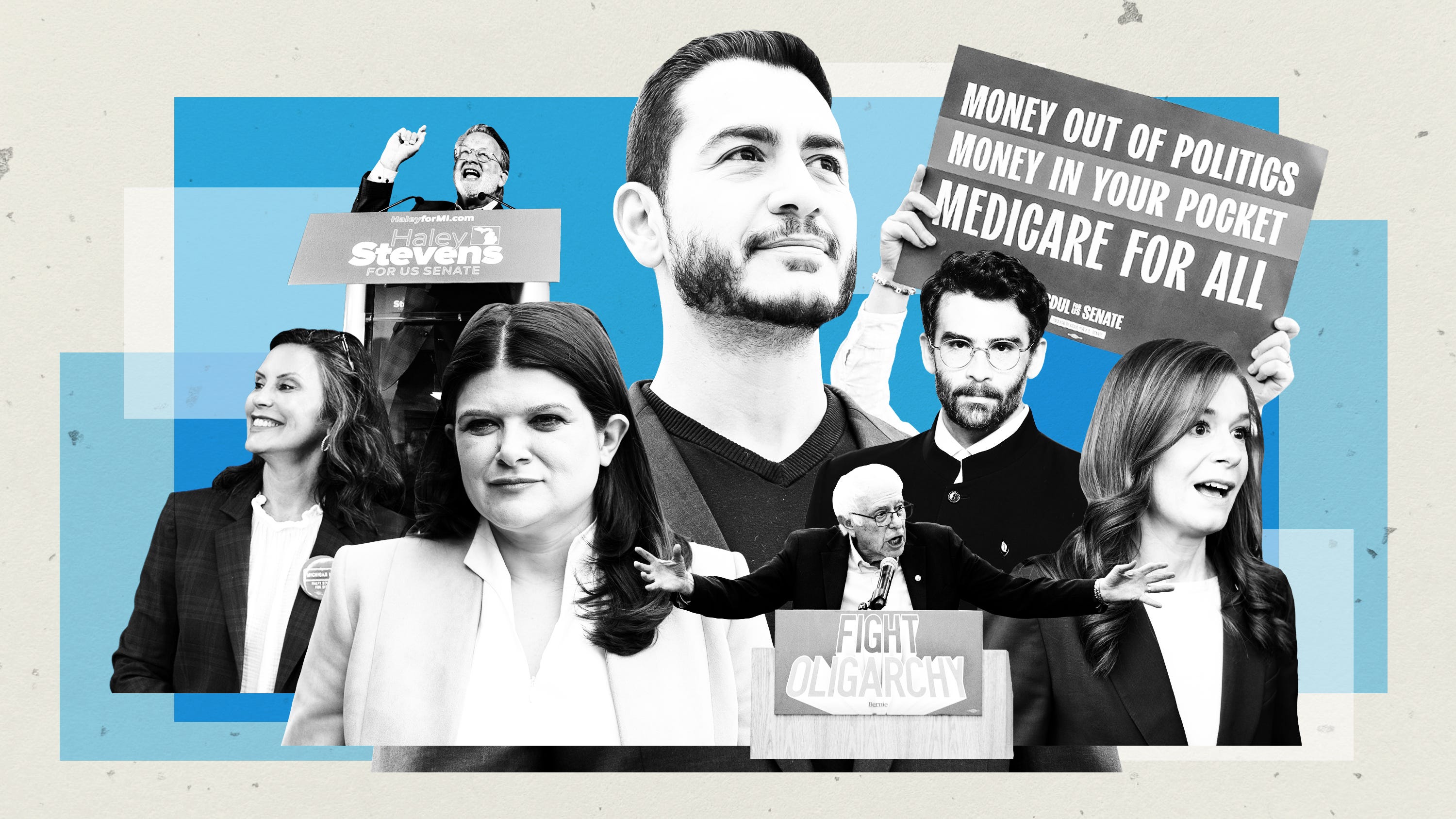
(Photo illustration by Bill Kuchman/The Bulwark | Photos: Getty, AP, Shutterstock)

Detroit, Michigan
ABDUL EL-SAYED WAS DONE. Done with Haley Stevens and her fiancé. Done with the ultimatums and demands for apologies. Done with what he believed were sideshows and distractions throwing him off his preferred messages—like how to make sure people had health care, or how to fight corruption in politics.

It was the last week of October. His had been a grueling, bitter general election contest that had captured the nation’s attention. The polls suggested El-Sayed, the former Detroit-area public health official, was on track to beat Mike Rogers, a former House Republican. If it happened, he’d become the first Muslim elected to the United States Senate.

But it wasn’t clear if his margin was large enough to withstand a polling error or a late swing against him. And frankly, it was still a bit hard to believe a Bernie Sanders–style progressive like El-Sayed could be ahead in a swing state that had twice cast electoral votes for Donald Trump.

Now El-Sayed was dealing with yet another source of pressure. Stevens, the four-term House Democrat he had beaten in the primary, was having second thoughts about backing his campaign. The issue, she said, was the same thing that she’d criticized during the primaries: El-Sayed’s positions on Israel, and the statements (or lack of statements) that she said demonstrated his indifference to the safety of Jewish Americans.

The first hint that something was brewing came when Stevens’s fiancé told the Detroit News he was voting for Rogers. The next warning sign came when Stevens went on CNN to say that while she still backed El-Sayed—and still hoped to campaign with him on the final pre-election weekend, as their teams had discussed—she wanted to hear more forceful disavowals of antisemitism.

By this point, politicians’ phones across Michigan and in Washington were abuzz with chatter about whether Stevens might actually pull her endorsement, and maybe go so far as to back Rogers instead. El-Sayed’s campaign received some of those calls, including from allies wondering whether he should reach out to Stevens or make a nod in her direction to keep her on board.

El-Sayed was having none of it. He told his staff Stevens had become a distraction, marveling at the prospect of somebody threatening to rescind an endorsement after losing a primary. He said he had no interest in backchannel diplomacy, and didn’t believe she was—as she would later say—struggling with what to do.

“I understood exactly what was happening,” El-Sayed told me in a recent interview. “They were trying to create a permission structure for themselves, for her to rescind her endorsement.”

“When I realized where this was headed, I thought the best thing we could do is just accelerate this, because they’re going to get there anyway,” he added. “If your endorsement comes with conditions, I don’t want your endorsement. So at that point, I just said, you know what? I actually would rather you stay away. Don’t come to my event. I don’t want to campaign with you.”

Whatever was or wasn’t going through Stevens’s mind, El-Sayed was right about where things ultimately landed: After days of assuring friends she wouldn’t endorse Rogers, Stevens did just that. Less than forty-eight hours before polls opened on Election Day, she joined Rogers at a black church in Detroit, at a moment when El-Sayed’s ability to win over black voters—whom Stevens had carried in the primary—was very much in doubt.

The next few hours played out like a fever dream: Stevens sitting alongside Rogers in the church pews, then recording an off-angle selfie video from her car announcing she had decided to back the Republican. El-Sayed trying to shush a crush of reporters who had appeared at his own morning event, repeatedly telling them “none of this matters” because the real issue was the well-being of all the Detroiters struggling to get by economically.

Publicly, El-Sayed’s camp expressed confidence the Stevens announcement would not affect the election outcome, even suggesting that the move could backfire as Democrats saw it as Stevens betraying the party. But privately, some of his advisers were anxious.

“My first reaction was a little bit of a wave of terror,” Kenneth Pennington, who ran El-Sayed’s digital operation and fundraising, told me. But Pennington and the rest of the political world quickly realized things would work out fine for El-Sayed. Hunched over his laptop in the back of Detroit campaign events, Pennington watched as a real-time dashboard tracked a surge in donations, in what would become the campaign’s biggest twenty-four-hour haul. Over on his social media feeds, he clocked expressions of support even from Democrats who were big-time Stevens backers.

“In two hours my mood had totally changed, and it was like, ‘Oh my gosh, everybody is supporting him.’”

Two days later, El-Sayed prevailed over Rogers by the exact 7-point margin he had predicted three months before he’d even won the primary. And though the Stevens melodrama ultimately did not prove decisive, it was a revealing moment in a campaign defined by a confident, cocky candidate—one unwilling to deviate from his vision of how a politician should act or what he believed the voters wanted. El-Sayed gambled on himself and his ideas, with control of the Senate potentially at stake. And he won.

But already a new debate is underway: Did El-Sayed win because of the way he ran, or did a good year for Democrats let him get away with it? Answering that requires looking at how ideology, campaign tactics, and technology shape a Senate race in an era when billionaires make multimillion-dollar donations and social media spreads campaign clips at breakneck speed. As Democrats across the country work toward building a majority that can not only win elections but govern as well, they will draw on insights from this campaign to help understand what kinds of candidates to field in battleground races and what kinds of campaigns they should run.

The 2026 Michigan Senate campaign is just one case study for sorting out these issues. But it’s one I can recount from a close-up perspective, because I covered the campaign from literally its first day. Over the past nineteen months, I attended dozens of events, logging thousands of miles crisscrossing the state. I have spoken to political leaders and to residents who barely notice politics at all, and had dozens of lengthy conversations with candidates and their staff—both in the thick of campaigning and after it was all done and they’d had a chance to reflect.

What follows is an account of what I saw and heard, and what it all means—about the future of the Democratic party and American politics, and an incoming senator with potential to shape both.

Share

The Crisis, the Candidate, and the Catchphrase

(Photo illustration by Bill Kuchman/The Bulwark | Photos: AP, Getty, Shutterstock)

EL-SAYED SAYS THE STORY of his campaign starts in late January of last year, after two political bombshells landed one after the other.

The first was a January 27, 2025 memo ordering a freeze on federal grant money, the start of the Trump administration’s ongoing, all-out assault on government. The order created an immediate crisis for local agencies like the Wayne County Health Department, which El-Sayed had led for nearly two years.

El-Sayed told me he was scrambling to figure out how the agency would stretch its threadbare budget to pay vendors—“knee-deep in budget sheets,” he said, “trying to understand what the impact would be” on vital programs for low-income families. Then, one day later, the second bombshell exploded in the form of a push notification from the Detroit News: Senator Gary Peters wasn’t seeking re-election.1

Peters was a mainstay of Michigan’s political scene. Although just 66—a veritable young gun in the current Senate—he said he was stepping away to make way for a new generation. His former colleague Debbie Stabenow had done the same thing two years earlier, in what worked out more or less like a coronation: Stabenow teamed up with Michigan’s political establishment to clear the field for Elissa Slotkin, a brainy former intelligence officer with a record of winning House seats in Republican-leaning districts.

Peters tried to repeat the trick, by approaching three potential contenders: Gretchen Whitmer, the popular but term-limited governor; former Transportation Secretary Pete Buttigieg, who’d moved to Michigan several years ago; and Kristen McDonald Rivet, recent winner of a tough House race in a district covering Flint and Saginaw. None said yes.

El-Sayed, by contrast, was instantly interested. He had mounted an unsuccessful but surprisingly strong bid for the Democratic gubernatorial nomination in 2018, and kept in close contact with former advisers and supporters. Within hours of Peters’s retirement news, El-Sayed’s phone was full of messages urging him to run. A week later, while delivering a guest lecture at Brown University, he reached out to one of his former advisers who had recently relocated to Providence, Rhode Island.

At 23, Roxie Richner was what qualified in El-Sayed’s circles as a seasoned political hand. She had joined El-Sayed’s 2018 gubernatorial campaign as a volunteer while a high school sophomore in Ann Arbor, initially tagging along with college volunteers from the University of Michigan because she was too young to drive. She’d impressed the paid staff, who kept giving her more responsibility, and later worked on political campaigns while an undergraduate at Michigan State University. She had stayed in touch with El-Sayed, occasionally helping him with outreach for public appearances.

Seeking a change from campaigns, Richner had moved to Providence to work for local government. But, listening to El-Sayed make his case at a local coffee shop, she found it hard not to get excited as he detailed the lessons he’d learned since 2018, including the importance of leaving behind his policy-heavy, academic style that may have struck voters as elitist—or simply not worth their time.

“I was only three years removed from being a professor,” El-Sayed told me of that 2018 run, “and I had some really bad instincts. If you write these fifty-page documents and get deep into the policy weeds, you realize that most voters just don’t have time—they’re too busy trying to make ends meet—to read it.”

El-Sayed really was a policy wonk, but one with the trash-talking, bro-y persona typical of a former college lacrosse player. He’d decided that he shouldn’t try to suppress that side of himself. “I think I was trying to cosplay as a politician, thinking this is how a politician acts and this is what a politician does,” El-Sayed told me, as he’d told Richner at their coffee. “This time, I just said, ‘I’m going to be exactly who I am.’”

Share


RICHNER MOVED BACK TO MICHIGAN just in time to cast her family and an old high school teacher as extras in the video accompanying El-Sayed’s official launch on April 17. It was emblematic of a DIY campaign that spent its first few months operating on a tight budget, with Richner serving as communications director of an essentially three-person paid staff.

At this point, El-Sayed’s primary task was to introduce himself to an electorate that either didn’t know him or had at best had dim memories of his 2018 campaign. He sought as much exposure as possible, sometimes reaching out personally to journalists he knew.

“Would love to sit down for something if you’re interested in writing on the race,” he wrote to me in May, after I’d posted on social media about an appearance he made on a Detroit local news show. “How public health folks are pushing back right now is an interesting piece. . . .” My twentysomething son was about to get married, I explained, so the conversation would have to wait. “Mazel!” he responded, promising to put his communications team in touch with me later.

The problem for El-Sayed was that his contacts list was full of wonky health care writers, not campaign correspondents. And by the late spring, it was clear he would be facing two formidable political competitors.

One was Mallory McMorrow, a state senator who had become a cable news regular after a 2022 floor speech she gave on LGBTQ issues went viral. She had declared her candidacy at the beginning of April, a few weeks before El-Sayed. The other was Stevens, who in her six years in Congress had become well-known across Metro Detroit for her work on manufacturing. She had announced her candidacy shortly after El-Sayed launched his.

“It was incredibly hard to get the networks to even consider having him on,” Richner told me.

One of the campaign’s solutions was to find alternative outlets, including those that weren’t explicitly political—which, as it turned out, was useful in a year when voters from the get-go seemed fed up with politicians. Appearances with cooking, fashion, and fitness influencers, like the time he worked out with exercise guru Mike Israetel, showcased El-Sayed “breaking out of the political pundit bubble and reaching people where they’re actually consuming media,” Richner said.

And then there was the media that El-Sayed and his team were determined to generate on their own—which is why Max Glass, a longtime El-Sayed adviser who was a central architect of the 2026 campaign from the beginning, made sure one of the earliest hires was a videographer.

“People thought I was crazy,” Glass told me. Both El-Sayed and he had thought about the ways campaigns had changed in the era of social media, drawing on Chris Hayes’s book on the attention economy before the campaign. “We were going to capture every moment of this campaign and put it online, and we want people to see it.”

But for all of the ways El-Sayed had learned to sound less like a professor—and for all of the ways his campaign was adjusting to an evolving media environment—the most important change may have been in the political landscape.

The 2018 election had taken place in the shadow of Trump’s first election. It was a shock to the political system and Democratic voters responded by quickly rallying around leadership. By 2026, these voters were struggling financially and nearly as angry with the party’s gerontocracy as they were with Trump. They were much more open to unabashed populism, and liked the idea of lawmakers promising to blow up the system rather than work through it.

The only problem was that, even in his less professorial mode, El-Sayed still hadn’t quite perfected the art of making sure voters were paying attention long enough to hear what he had to say. His stump speech would start with a biographical introduction, which he’d use to frame the point that life expectancy in parts of Detroit is worse than it is in his parents’ native Egypt. Then he’d break down his agenda into three parts—ending the influence of special interests, raising living standards for the non-rich, and creating a single-payer health system—by explaining each one in turn before moving on to the next.

The speeches were still running well past twenty minutes. Even the longtime supporters who were showing up to the early events—sometimes by the dozen, sometimes fewer—seemed to lose interest after a while. El-Sayed and his advisers huddled about how to streamline the pitch, hoping to debut a sharper version in August when he’d be joining Bernie Sanders during a Michigan stop on the Vermont senator’s “Fighting Oligarchy” tour.

One of those advisers was Rebecca Katz, a principal in the progressive consulting firm Fight Agency that had advised Zohran Mamdani on his mayoral run.

Mamdani had run an avowedly populist campaign that packaged policy items into simple, repeatable slogans like “Freeze the Rent.” In an SUV on the way to the Sanders event in Kalamazoo, as Katz remembers it, she looked over a printout of the stump speech and circled the three key phrases El-Sayed had been using to describe his agenda. “Money out of politics,” “money in your pocket,” “Medicare for All.” Would these work as a call-and-response? she wondered aloud.

El-Sayed gave it a go, telling attendees that he wanted them to shout out each of the phrases in turn. The instruction took some time, but the crowd picked it up. “People just went crazy for it,” Glass told me. “We had hit on something.”

The triptych became El-Sayed’s slogan, something he would work into every appearance and staff would place on every available inch of signage as the campaign proceeded. It became so familiar to followers that El-Sayed barely had to cue them at events:

“Money out of . . .”

“Money in your . . .”

“Medicare for . . .”

El-Sayed finally had a message and a way to deliver it. Now, the only question was who else would be trying to win over Michigan’s voters.

Join Bulwark+

The Cable Star and the Twitch Streamer
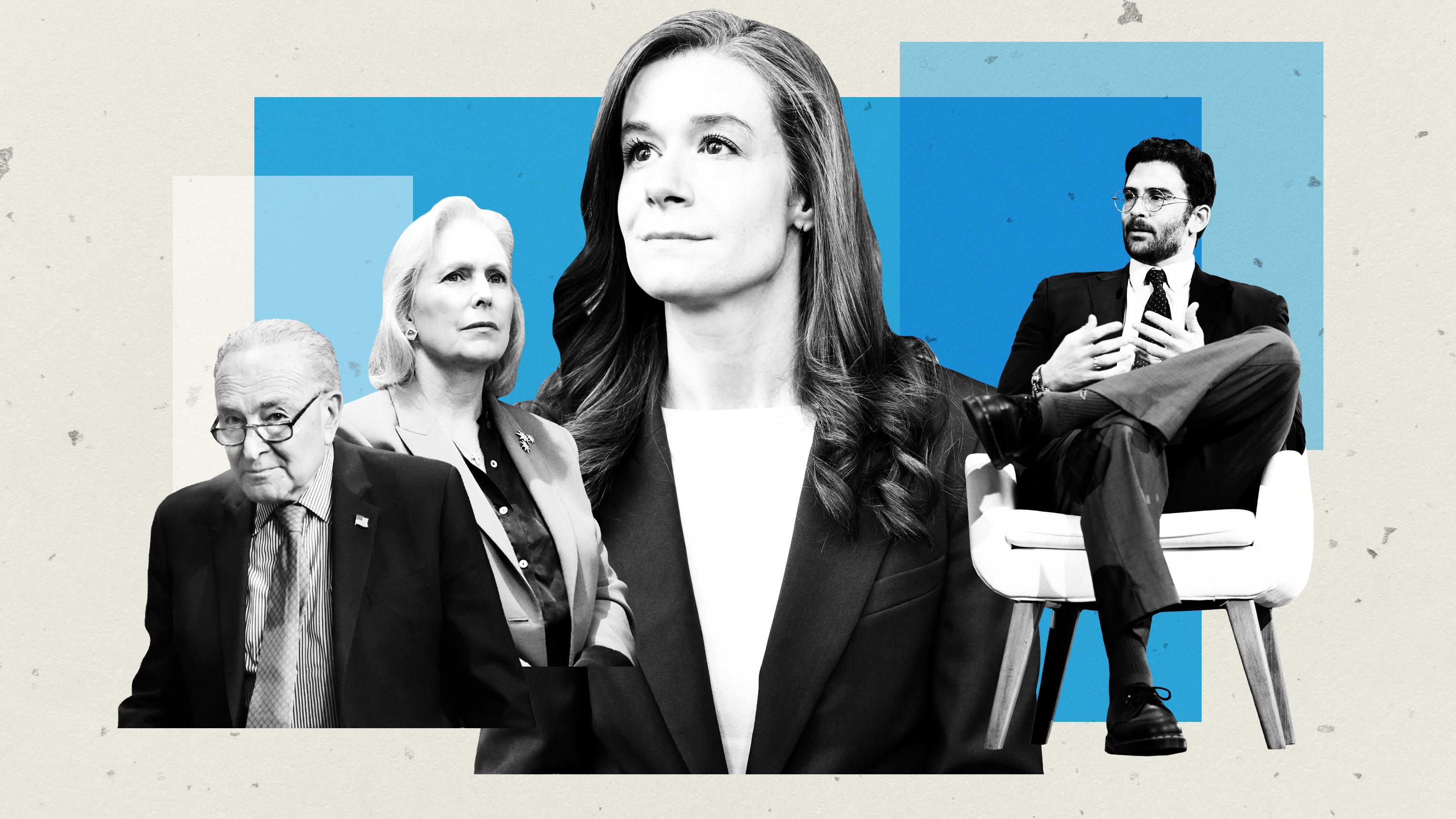
(Photo illustration by Bill Kuchman/The Bulwark | Photos: AP, Getty, Shutterstock)

THE CASE FOR MCMORROW’S BID seemed to have impeccable political logic.

She was finishing up her second state senate term, representing a district of mostly middle- and upper-middle-income suburbs north of Detroit. She had first won election in 2018, part of the same blue wave that propelled Whitmer into the governor’s mansion and Slotkin into Congress. She had a reputation for outspoken opposition to the Trump administration, and a pragmatic streak to go with her generally left-leaning politics.

But what McMorrow really stood out for was her communication skills, whether it was for her ability to stir passions the way she had in that 2022 LGBTQ-rights speech or her capacity to break down complex policy topics in ways non-experts could understand. It helped that she had a background in the business world, where she had worked on industrial design. She was also instantly recognizable, thanks to her red hair and lower-register voice.

McMorrow had previously told political allies that she hoped to succeed Peters upon his retirement, and didn’t hesitate when the opportunity presented itself. On April 2, two weeks before El-Sayed would announce his candidacy, McMorrow launched her campaign with a video touting herself as Michigan’s proven fighter. The main focus was on stopping Trump, though it also included swipes at the Democratic establishment.

“It became pretty clear that the powers that be were cockblocking me.”
–Mallory McMorrow

Her call for new leadership certainly fit the electorate’s mood, and helped explain McMorrow’s impressive fundraising among small donors. But that also put her into conflict with figures like Chuck Schumer, the Senate Democratic leader, and Kirsten Gillibrand, the chair of the Democratic Senatorial Campaign Committee. And once Stevens was officially in the race, they had a candidate more to their liking—somebody they knew personally from Washington, and whose low-profile, more-center-than-left politics fit their idea of what works politically in Michigan.

One high-profile Democratic financier told me Gillibrand spent the summer and early fall of 2025 offering personal assurances to donors that the DSCC would not promote one candidate over the other, backing up public pledges of neutrality. But the DSCC’s deeds didn’t match those words. In late September, Politico reported that the DSCC had invited Stevens to a Napa Valley fundraiser scheduled for the following month. Neither El-Sayed nor McMorrow was extended an invitation.

“In the middle of it, it became pretty clear that the powers that be were cockblocking me,” McMorrow told me in a recent interview. “This got back to us through some donors. We had donors who committed to either hosting fundraisers or to donating to me, who came back later and basically told us they were told not to support us, and that list just kept growing. It got more and more frustrating.” DSCC officials did not respond to my questions about their position and actions in the primaries, except to point out the full support they gave El-Sayed after the primary, including $23 million in direct spending on his behalf.

Of course, McMorrow wasn’t just battling the Democratic establishment. She was also battling their preferred choice, Stevens. The two had been in contact immediately after the Peters announcement, according to multiple Michigan political sources and some text messages that I was able to see. They discussed the open Senate seat, and their respective intentions to run for the office, although exactly who said what—and when—depends a bit on which sources you ask.

McMorrow’s camp believed that Stevens had indicated she was not interested in running, then changed her mind and tried to pressure McMorrow to exit the race. Stevens’s camp believes she expressed her interest in running as soon as McMorrow expressed hers, and was subsequently dismayed to learn McMorrow was proceeding—and telling mutual donors and supporters that Stevens was not interested.

In both versions, Stevens laid out reasons why she thought McMorrow would struggle in the face of a Republican onslaught. “Know that was a tough if not brutal conversation- comes from a place of tough/love,” Stevens texted McMorrow in early February, reflecting on their discussion about the rigors of a campaign (or, as she put it, “a very small taste of what your life would be like for two years”). She added her admiration of McMorrow’s talents, saying “Proud to know you.” Three weeks later, she texted McMorrow again to say “you need to stop calling donors and telling them falsehoods about our conversation.” At this point, she also mentioned that she already had a million dollars she could transfer from her existing federal campaign account, plus she was likely to raise another million.

Stevens did officially get in the race, twenty days after McMorrow and five days after El-Sayed. And the core strategy of her campaign was to focus on eliminating McMorrow, in order to set up a one-on-one with El-Sayed. Personal feelings may have played a role: “She was always more focused on McMorrow than she was on Abdul,” one former Stevens adviser told me. “She’d take attacks from McMorrow much more personally, would get upset about minor things McMorrow would do.” But mostly it was a strategic choice: The expectation was that El-Sayed would lock up a progressive base accounting for about a quarter of the Democratic electorate, but fail to make real inroads with other groups. Or, to put it in the language Stevens’s campaign staff used internally, they believed El-Sayed was a high-floor, low-ceiling candidate while McMorrow was low-floor, high-ceiling.

“[McMorrow] and Haley checked a lot of the same boxes,” one former Stevens aide told me. “Policywise, they weren’t that far off on a lot of stuff. They both represented Oakland County. They were both white women in [or near] their forties. They both came up around the same time in 2018. There was a lot of donor overlap.”

Throughout the campaign, according to sources on McMorrow’s team, she begged the establishment not for support but simply for neutrality. And once El-Sayed started to gain strength—enough to make clear he could easily get more than 25 percent of the primary vote—McMorrow’s campaign shared internal polling data suggesting Stevens’s record on Israel, immigration, and other issues made her toxic to a large swath of the Democratic electorate.

But McMorrow did not get a meeting with Gillibrand until October 2025, after months of her asking, campaign sources told me. And she didn’t meet Schumer until well into 2026.2 Those snubs mattered, because they meant that to be competitive, McMorrow would need even more support from the party’s progressive wing.

That possibility vanished in April 2026 when Hasan Piker entered the scene.

Share


EL-SAYED ADVISERS TOLD ME the decision to reach out to Piker, the controversial popular Twitch streamer, grew out of ongoing discussions about locking in the youth vote. Their internal polling confirmed what was obvious to anybody following public events: El-Sayed’s base was younger voters. But actually winning the primary meant getting them to the polls—and, ideally, getting the most committed of them to volunteer as organizers.

Aides tossed around the idea of inviting guests who would pique interest, especially on campuses; they also thought it would be important to stage events before students dispersed for the summer. Piker was an obvious choice. His millions of followers skewed young, and El-Sayed had already appeared on his show in late July 2025.

Aides I interviewed told me they knew the invitation might attract some controversy, but they said they had no idea it would blow up the way it did. Piker told me the same thing when I reached him by telephone. “I was actually shocked,” he said. Both El-Sayed’s aides and Piker noted the lack of reaction to the influencer’s previous engagements with prominent Democrats, which included streaming with other creators from the Democratic National Convention in 2024 and then appearing on a panel at 2025’s Crooked Con with the hosts of Pod Save America.

But Piker’s coziness with Dems had drawn scrutiny from Third Way, a centrist group that said it objected to Piker’s sometimes inflammatory rhetoric on principle and—no less important—considered him a political liability for Democrats. After Politico reported El-Sayed’s plan to campaign with Piker at two April 2026 events, Third Way sent El-Sayed an open letter warning that the appearances would be a “stain” on El-Sayed’s character. It went on to list controversial excerpts from past Piker streams. The letter included moments when Piker said America “deserved 9/11” and that “Hamas is a thousand times better” than Israel, as well as an instance where he described ultra-Orthodox Jews as “inbred.”

Adding to the controversy, El-Sayed’s appearances with Piker were scheduled to take place less than a month after a terrorist attack in which a Lebanese immigrant had rammed a truck into a suburban Detroit synagogue, Temple Israel, in what investigators determined was a failed attempt to set off a load of explosives. The attacker—who killed himself while exchanging shots with security guards—had family members who had been killed in an Israeli assault, and was, according to Israeli officials, related to a Hezbollah commander. The attack shook the area’s Jewish community, especially because young children had been inside the synagogue for school.

In the aftermath of the attack, Jewish Insider published an article presenting McMorrow’s perspective as part of an interfaith marriage (her husband is Jewish) and the mother of a young child. When asked about Piker, McMorrow described him as “somebody who says extremely offensive things in order to generate clicks and views and followers, which is not entirely different from somebody like Nick Fuentes.”

“I was not trying to make any sort of moves, despite what people think,” McMorrow told me later, looking back. “It was just raw emotion, and I ineloquently compared him to Nick Fuentes. Not in terms of what he believes. I had just wanted to convey that this is somebody whose entire business model is on saying scandalous things for clicks and views—and that business model is at odds with campaigning for somebody to become a senator in a purple battleground state.”

El-Sayed proceeded with Piker anyway, drawing several hundred supporters to an event at Michigan State University and then another at the University of Michigan. At the latter stop, I ran into House Democrat Debbie Dingell, who was sitting in the back, there to observe because the event was in her district. She told me she’d never seen that many young people show up for a Senate primary event before. Afterwards, El-Sayed held court with Piker at a press gaggle, defending his decision to work with the influencer by saying it was important that Democrats reach out to new constituencies like the millions who follow Piker.

“The [Hasan Piker] controversy turned heads, and people tuned in. But once they were watching, they heard about money out of politics, money in your pocket, Medicare for All.”
–Rebecca Katz

He told me the same thing when I returned to the subject during our most recent interview. And when I suggested that inviting Piker to a campaign rally was different from appearing on his Twitch stream, El-Sayed dismissed the distinction.

“I’m sorry, but we don’t live in a West Wing episode,” El-Sayed said, noting that he campaigned with many people with whom he disagrees on some issues—and that, the very same day of the events, he had appeared on Fox News. “In today’s age, everything that you do gets clipped [for social media], and the way that most people interact with it is through those clips. So whether you’re clipping from sitting inside his home studio, or you’re clipping from something he said on a stage, it’s a clip.”

The problem for El-Sayed was that many Democrats did not see things that way. And many were genuinely upset with what Piker had been saying, or what he represented. The appearances would dog El-Sayed from that point onward. But inside the campaign, advisers came to view it as a “productive controversy.”

“The controversy turned heads, and people tuned in,” Katz told me. “But once they were watching, they heard about money out of politics, money in your pocket, Medicare for All.”

Whether the Piker association was beneficial to El-Sayed or not, what quickly became clear was that it was damaging to McMorrow. Plenty of other Michigan Democrats had condemned the Piker appearance, including Stevens. But McMorrow bore the brunt of the reaction online. Many progressives seemed particularly incensed that McMorrow had compared Piker to Fuentes.

They swarmed her on social media channels—attacking not just her statements about Piker but also old tweets (later unearthed by CNN) complaining about Michigan winters and her own shifting rhetoric on whether Israel’s actions in Gaza could be fairly characterized as a “genocide.” Occasionally, progressive critics even confronted her in person.

“For months, we were saying it’s just online, it’s not real life,” McMorrow told me. “But then it started spilling out into real life. People would scream at me at events about things that just weren’t true. But they were from all these content creators that made it feel true to people.”

One last blow to McMorrow’s campaign came from a poll that, it turned out, was not on the level. A June survey showed McMorrow’s support dropping into single digits. No campaign’s internal data showed this result, and the firm, Wedgewood, did not have an established reputation.

Months later, in October, Wedgewood’s leaders would admit they had fabricated data, claiming they were engaged in an “experimental project” to demonstrate flaws in the polling industry. Whether or not that was true, the survey had gotten the attention of key McMorrow allies and donors, who no longer saw much viability for her campaign.

“I would be on the phone with them, and they would say ‘Hey, we love you. We think you’re the best candidate. But maybe this is the time to look where we are actually at,’” she said. “And that situation—along with the hit to morale among our staff and volunteers—was just really hard to recover from.”

On July 5, McMorrow announced she was suspending her campaign, setting up the two-way race between El-Sayed and Stevens that party leaders had wanted all along.

Share

The Workhorse, the Ads, and the Close Call
(Photo illustration by Bill Kuchman/The Bulwark | Photos: Getty, Shutterstock)

UNLIKE EL-SAYED AND MCMORROW, Stevens had stuck mostly to small, invitation-only events, in part because she didn’t really have a field operation. One such event took place on July 11 at a church community meeting room in Ecorse, a city with several large factories just south of Detroit along the river.

The conversation focused on manufacturing, a subject Stevens knew well—and for which she was known—thanks in part to her work on President Barack Obama’s 2009 industry-rescue task force. Several labor and political leaders were in attendance, in a reminder that Stevens was popular not just with the national Democratic establishment but the state’s, as well.

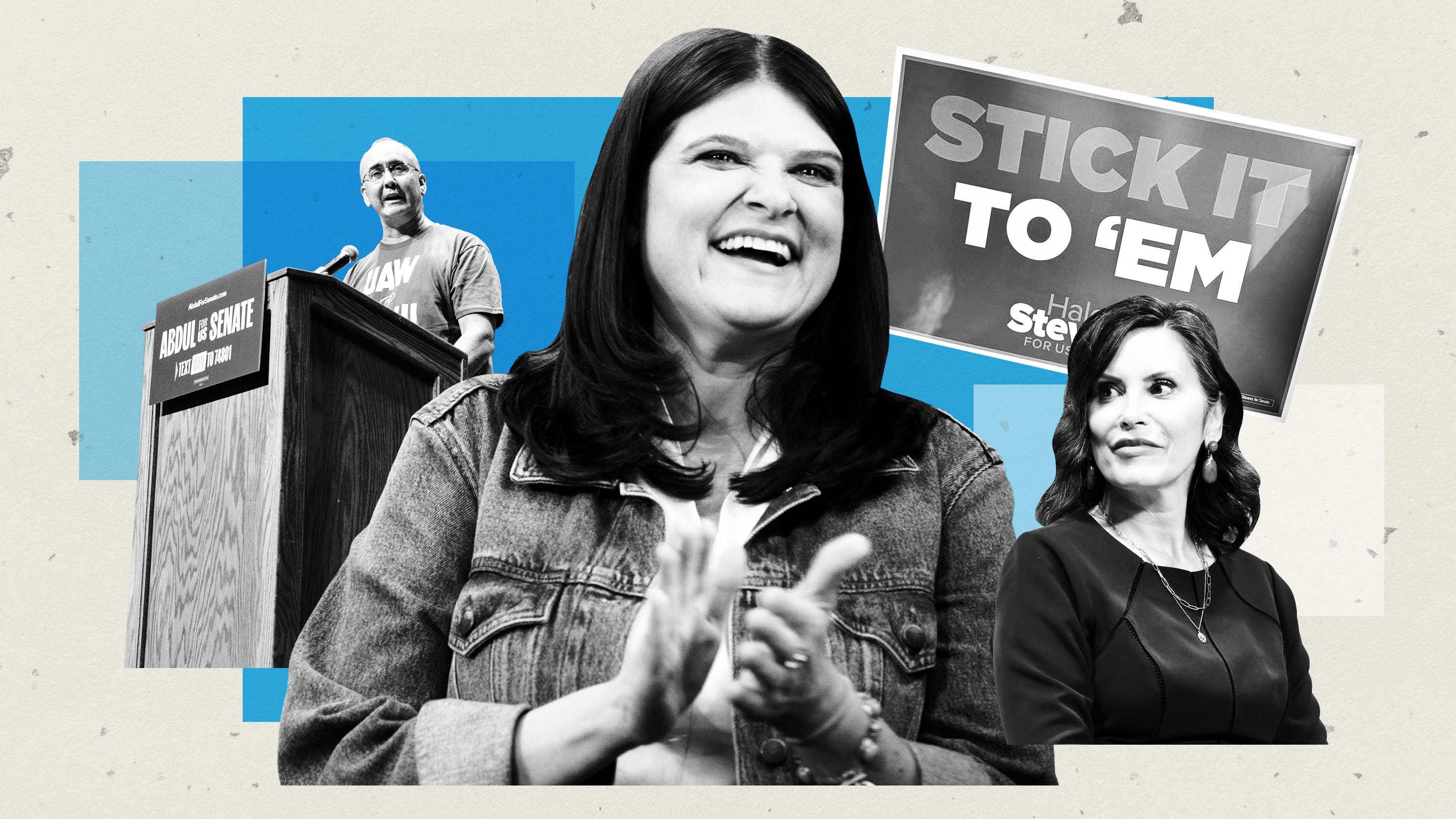
Stevens thanked her backers, then launched into a monologue that jumped from concept to concept before settling on her pitch about how she would be the voice of Michiganders. And not just any old voice, she made clear: “You better believe I’m going to be doing it with a little bit of joy, a little bit of enthusiasm, a little bit of energy, and a little bit of stick it to ’em, because that’s the Michigan Way.”

Stevens announced this in her thick Michigan accent, one so pronounced that online commentators wondered if she might be faking it. During the appearance, she grew more excited as she went, pumping her arms in a cross between a cheerleader’s pom-pom motion and a pantomime of a locomotive train engine. When she got to the “stick it to ’em” line, she pounded her fist into her open hand.

The performance caught the attention of the Republican party’s social media department. They tweeted the clip, with lots of snark. A pile-on of derision followed, some of it from El-Sayed supporters.

But if the video captured Stevens’s awkwardness, it also captured her earnestness, which was what had made her a successful politician in the first place. Unlike Whitmer, McMorrow, and other Democrats who were part of the 2018 blue wave, Stevens rarely made national appearances and focused mostly on unglamorous, narrow pieces of legislation intended to help discrete groups of constituents.3

“It’s not just that the voters are pissed off at Trump. They are pissed off at everything right now.”
–former Stevens staffer

Stevens was good enough at this that the nonpartisan Center for Effective Lawmaking recognized her in 2025 as the most effective Democrat in Michigan’s House delegation to the 118th Congress. On the Senate side it gave that distinction to Peters, which seemed fitting, since Stevens was running as a younger, female version of Peters, a lawmaker whose low-key, frequently bipartisan style won him affection across the state.

But members of the Stevens team came to realize that style of politics was unsuited to an angry Democratic electorate, and took particular notice in March 2026 when Juliana Stratton—a progressive campaigning on Medicare for All, a $25 minimum wage, and abolishing ICE—defeated two veteran House Democrats in the Illinois Senate primary.

“We could really see there was a paradigm shift,” one former Stevens staffer told me. “It’s not just that the voters are pissed off at Trump. They are pissed off at everything right now. And we could see the parallels to our race.”

Those parallels included Stevens being on the wrong side of issues that were emerging as litmus tests for Democratic voters, like supporting the end of ICE (Stevens didn’t) and Medicare for All (Stevens had abandoned her onetime support in favor of pursuing universal coverage through incremental changes).

And then there was her record on Israel, which included using her support of the Jewish state to bludgeon a progressive opponent in a heavily contested 2022 Democratic primary. One year later, during an appearance at a public Hanukkah celebration, Stevens said, “Israel comes to me in my dreams, I see Israel’s future.” That comment came just two months after the October 7, 2023 Hamas attacks. But it quickly turned into a political liability amid a Democratic electorate shifting strongly against Israel.

When the Ecorse video started making the rounds, many Stevens staffers initially were worried that the clip would also hurt her. But soon they came to see it, according to one former staffer, as normal “Haleyism. . . . The internet trolls may not like it. But this is who she is.” Stevens conveyed the same message the next day on their morning conference call, and sure enough, the online reaction took a supportive turn.

All of this was happening at a time when, following McMorrow’s exit, a wave of prominent Democrats who were worried about El-Sayed’s candidacy had started endorsing Stevens. Polls showed she was picking up support. Two even showed her pulling ahead of El-Sayed.

“The internet had hated Haley for so long,” a former staffer told me. “We felt like we were finally gaining ground . . . and maybe there was a wave we could catch for the final weeks.”

Share


EL-SAYED HAD PLENTY of endorsements, too—including from the United Auto Workers, Michigan’s largest and most powerful union. Stevens had hoped for the UAW’s backing, given her long association with the auto industry and its workers. But the union had become more avowedly progressive and had rediscovered the more militant populism of its past, a shift that in many ways matched the transformation of the Democratic primary electorate more broadly.

When the UAW came out in support of El-Sayed, one senior El-Sayed staffer described it to me as a “holy shit” moment—the first time a win seemed genuinely possible.

But even the mighty UAW could do only so much to push back against the onslaught of ads attacking El-Sayed, such as a set of videos and mailers suggesting he had a history of disrespecting women, including Michelle Obama.

The ads took a line out of context from a perfectly respectful opinion article about the former first lady’s healthy-living initiatives.4 But they were still laser-guided propaganda bombs designed specifically to target the Detroit area, where black voters have long distrusted their Arab neighbors (and vice versa), and where raw feelings linger about the voters, disproportionately Muslim, who had been part of the “uncommitted” movement that undermined Kamala Harris in 2024.

The ads were part of a much larger campaign against El-Sayed, much of it waged by a political action committee with ties to AIPAC—although, tellingly, many of the spots said nothing about Israel. By the end of the campaign, Stevens and her supporters were outspending the El-Sayed camp by millions of dollars every week.

El-Sayed repeatedly called out AIPAC’s spending against him, as he had throughout the primary, tapping into Democratic voter fury over both the carnage in Gaza and the power of money in politics. But the ads still had a significant impact, according to longtime Democratic pollster Celinda Lake. Stevens “really had a lot of momentum,” said Lake, who served as El-Sayed’s pollster, “and she was consolidating the black community—more so than we had hoped she would be able to do. That was some real pressure.”

The pressure grew even more intense eleven days before the August 4 primary, when Whitmer—who had remained neutral and seemed likely to stay that way—appeared alongside Stevens in Detroit to announce her endorsement.

Whitmer’s own polling had slumped in recent months, and many Michiganders had already cast mail-in ballots by the time she decided to weigh in. But she was still the state’s most popular politician, somebody whose stamp of approval could matter to precisely the sort of low-information voters who hadn’t made up their minds. Making matters even worse for El-Sayed’s team was that they were going blind right at this critical juncture. The campaign had stopped polling, wagering that it made sense to plow every available dollar into persuading voters rather than studying them.

“It had been ten days since we last polled,” Glass told me. “If you remember those ten days, Haley and AIPAC were just closing like a freight train.”

They were. And almost nobody on the campaigns or nationally realized just how close the train was.

[Part two coming soon. . .]

Share

1

My article doesn’t draw just on my own reporting. It also draws on the reporting of some terrific local journalists, especially those at the Detroit News. Their correspondents consistently provided the kind of insight not available in the national press, including this pre-election article by Craig Mauger, who drove from one side of the state to the other and interviewed voters at multiple stops along the way.

2

Correction (November 29, 2026, 10:30 a.m. EST): As originally published, this paragraph mistakenly stated that McMorrow was never granted a meeting with Gillibrand or Schumer; it has been rewritten to reflect that she eventually was.

3

An example of the sort of legislation Stevens pushed was a bipartisan bill to improve communications security among ships doing scientific research in the Great Lakes. She also played a role in crafting the CHIPS Act that created incentives to build semiconductor plants in the United States.

4

For a more thorough examination of the ad and related claims, see this article by Lauren Gibbons of Bridge Michigan, which provided valuable fact-checking throughout the campaign.
  •  

Newsom’s 2028 Audition, Trump’s Pardon Racket, and A Cruel Thanksgiving in Texas

Happy Saturday! This week, Adrian Carrasquillo takes us inside Thanksgiving at an ICE detention center in Texas. Many of you read his story and gave generously to Each Step Home, which helps families at the Dilley detention center buy food and other essentials. THANK YOU. Scroll on to read Adrian’s essay (linked below) and chip in if you can.

Also this week, Sam Stein and Liz Oyer follow the money in Trump’s pardon racket, and Jill Lawrence sizes up Gavin Newsom’s 2028 audition. Plus, Tim Miller and Jon Lovett compare midterm notes, and Sonny Bunch has something to watch with your leftovers. These stories and more are all linked below.

Overtime is for everyone. If you like today’s issue, send it to a friend. And if you’re a Bulwark+ member, thank you for making this work possible. Join Bulwark+.

Join now


Join Sarah Longwell as she joins Bill Kristol to discuss the many challenges that lie ahead.

Tune in on TheBulwark.com or YouTube Sunday at noon EST.


Join now


Bulwark readers have donated over $150,000 (so far) to Each Step Home.


🚨OVERTIME🚨

Happy Thanksgiving! I hope you had a great meal with family and friends. In case you need any last minute recipes, The Bulwark community has you covered. If you’d like a quaint reminder of our not-too-distant political past, The Daily Show has you covered.

Futbol is life! The Columbus Crew shocked Lionel Messi and reigning champs Inter Miami on a rainy Friday to advance. My team, FC Cincinnati, stole a road win from Nashville on the road last weekend and could advance with a win tonight. Go FC! Do it for Fiona!

Get The Bulwark on your TV! We have a new free, ad-supported streaming channel offered in partnership with SwerveTV. In the U.S. we’re now on Prime Video (on Live TV), FireTV, or Local Now, sort by the news channels and you should find us!

📣COMMUNITY CORNER 📣

December Book Club with Mona Charen… How much does testosterone shape the way we behave? Mona will talk with evolutionary biologist Carole Hooven about her book, T: The Story of Testosterone, live for Bulwark+ members on Thursday, December 17 at 1:30 p.m. ET. A replay will be available on The Mona Charen Show. Get the details and leave a question for Mona and Carole.

Founders Town Hall... Founders and Best Friends, join Sarah Longwell and JVL on Wednesday, December 9 at 8:30 p.m. ET. They’ll share what’s ahead for The Bulwark and answer your questions live. Watch your inbox for joining details. We’ll have a replay if you can’t make it. Save the date and send us a question.

Join now

House Ethics Recommends Holding Former Mike Collins Aide in Contempt… The House committee says the Georgia Republican’s ex-staffer ignored a subpoena (Washington Sun).

The Iowa Lead Detonation Happened. Now the Real Work Begins to Study It… Early results indicate minimal signs of lead in the environment, though it will take days for more rigorous testing (WIRED).

Discussion Prompt: Biggest surprise of the Thanksgiving holiday?

Leave a comment

Tech support questions? Visit our new HELP Center! Questions for me? Respond to this message.

—30—

Editorial photos provided by Getty Images. For full credits, please consult the article.

  •  

If ‘Trumpcare’ Really Became a Thing, It’d Look Like This

(Photo illustration by Bill Kuchman/The Bulwark | Photos: Getty, Shutterstock)

MEDICARE FOR ALL IS HAVING a moment.

Congress is about to get a bunch of new Democrats who say they support the concept. One of them is Abdul El-Sayed, the senator-elect from Michigan who co-wrote a book on the subject and has been suggesting Democrats rebrand it as “Trumpcare” in order to get the president to go along.

The suggestion appeared to be a troll, not a real proposal. But Trump has taken it seriously enough to say that he’ll meet with El-Sayed to discuss health care. Meanwhile, polls have shown Medicare for All gaining in popularity, with roughly two-thirds of Americans favoring the idea according to an October KFF poll.

Behind that surge is growing public frustration with American health care, and decades of argument by the likes of Bernie Sanders that Medicare for All is the solution its core problems—like the fact that so many millions of Americans still have no insurance, or have insurance but can’t get or afford their care, or that the whole system costs more than any other country’s and is putting a strain on everybody in one way or another.

But what is Medicare for All? How would it actually work? What do comparable systems look like in other countries? What would it look like here?

These are all important questions. It’s not clear how many people who support the idea in principle are familiar with the answers.

To provide some clarity, I went to one of Medicare for All’s most knowledgeable and passionate champions: Adam Gaffney.

Adam is a policy expert and an advocate who spent many years as president of Physicians for a National Health Plan. And as you might guess from that organization’s title, Adam is also a practicing physician.

He works in a Boston ICU, where he sees firsthand what happens to patients when they can’t—and don’t—get the health care they need. It’s the starting point for our wide-ranging conversation about Medicare for All, in what I hope will be the first of many such discussions with a variety of advocates and experts.

You can read an edited version of it below.


JONATHAN COHN: Adam, you are a physician, you see patients. I think there’s a lot of people out there who think, ‘Hey, everybody can get healthcare in America. It’s a myth that people who can’t pay their medical bills suffer.’ Is that true?

ADAM GAFFNEY: In my practice, which is as an intensive care unit physician, patients who go without care can present very dramatically. To give a very simple example: Someone’s out of care for lack of insurance, or some other reason, and they have a common chronic condition—let’s say high blood pressure, something a good chunk of all Americans have.

Year after year, that does damage to blood vessels. Year after year, that makes people’s kidneys start to fail. So I’ve seen patients in the intensive care unit with severe complications of what’s a common, chronic illness, hypertension, where they’ve had brain swelling, where they’ve had heart attacks, where they’ve had strokes, where they’ve had kidney insufficiency. That’s just a sort of mundane illness with a very frightening complication that was avoidable.

COHN: Hearing this from you is really striking because you are in Massachusetts. It’s the place that created “Romneycare”—the health reforms signed into law by Governor Mitt Romney that became the template for the Affordable Care Act.1 Most people in Massachusetts have health insurance. So why is this happening to them? Why are they showing up and not getting the care they need?

Read more

  •  

Democrats Can’t Figure Out What to Make of Gavin Newsom

(Photo illustration by Bill Kuchman/The Bulwark | Photos: Getty, Shutterstock)

GAVIN NEWSOM IS AT IT AGAIN, acting like the president of some important country.

Commuting death sentences to life in prison without parole for people on “the largest death row in the Western Hemisphere.” Co-chairing a delegation to the United Nations Climate Change Conference (COP31) in Turkey. Announcing a donation of medical supplies to besieged Ukraine.

And that’s a snapshot of just a few days this month, as the term-limited California governor auditions for the Oval Office.

The prospect appalls some people and confuses others. “Whatever you may think of him . . .” is a phrase that often precedes Newsom’s name. But Democrats—and independents—should brace themselves to figure it out. Because like it or not, like him or not, he’s already out there previewing himself in the role he wants.

Sure, Newsom has said that he won’t run if fellow Californian Kamala Harris runs. But he’s not waiting. By the time she decides, he will have been acting like a national candidate with a national platform for weeks if not months—a fact on the ground that will be hard to reverse. (Remind you of anyone? President Ballroom, perhaps?)

Part of Newsom’s conspicuous ubiquity is inevitable, given the size of his state (nearly 40 million people); its $4.3 trillion economy (fifth-largest in the world and “the tentpole” of the nation); its high-tech industry (which pours $580 billion and 29,000 computer and information science grads a year into the U.S. economy, more than any other state); and its climate ambitions (“Donald Trump’s empty chair won’t stop us from pulling up our own and leading the climate fight”).

But it’s not all a happy accident of size mattering. Newsom picks his spots, and they are not always safe. For instance, he came out against a billionaire tax on the state ballot this month and suggested instead a minimum tax on billionaires nationwide. “Wealth is movable, and it shops for the state with the lowest taxes. The fight belongs at the federal level,” Newsom wrote. He won: The initiative failed.

His announced intent to commute all California death sentences, 548 across the state, came two days after the election and five weeks after Tennessee’s badly botched attempt to execute Christa Pike. California last executed someone in 2006. Newsom, saying he has opposed “state-sanctioned executions” for nearly thirty years as an elected official, formalized the moratorium in 2019 when he became governor.

Join now

The moral-political equation

Trump granted clemency last year to more than 1,500 rioters and insurrectionists charged in connection with the January 6th attack on the U.S. Capitol, including some who beat up cops and some who have since been rearrested. But that didn’t stop him from targeting Newsom in a speech Monday from the Great Hall of the U.S. Justice Department. By giving “clemency and mercy to 548 of the most evil monsters on the face of the Earth,” Trump said, Newsom was committing “one of the most shocking acts of injustice our country has ever seen.” Suffice it to say that attention was paid. To both of them.

Newsom explained his decision this way in his November 5 open letter to Californians: “I know we cannot execute people in our imperfect legal system and remain true to our core values, first among them justice and human decency.” These offenders have caused “indescribable suffering” and harm that “persists across generations,” Newsom acknowledged, but “as governor, I have concluded the state cannot morally kill them.”

There are moral components to many Newsom decisions, right along with political components. It’s complicated.

When Newsom launched a podcast early last year, he annoyed Democrats by hosting conservatives Charlie Kirk, Michael Savage, and Steve Bannon as his first three guests. But Democrats cheered a few months later when he plunged into the redistricting battle.

Trump triggered that fight by telling Republican legislatures to draw new House district maps favoring the GOP. Texas quickly complied, spurring Newsom to become the first and most successful Democrat to counteract the ploy. He won overwhelming voter approval last year for a new congressional map designed to flip five House seats, and this month his party won all five.

The gambit carried a tinge of “moral murkiness,” as the Los Angeles Times described it, because California voters in 2008 had adopted a nonpartisan redistricting commission. The 2025 ballot proposal, trying for a bit less murkiness, gave Democrats their House-seat windfall but also stipulated that nonpartisan map-drawing would resume after the 2030 census.

Newsom’s activities overseas this month had the same mix of principle and political efficacy. And whether intended or not, everything he did was a contrast to Trump.

The president skipped the climate conference but did attend an unprecedented U.S.-Russia-China summit with Vladimir Putin (“my friend,” as Trump greeted him) and Xi Jinping. Ukraine was on the agenda, though its president wasn’t there. This was for masters of the universe only. “We are really making history,” Trump said. Or at least historic photo ops.

Meanwhile, more than 120 state, city, congressional, civic, business, and other leaders, including climate champions Al Gore and John Kerry, participated in the U.N. conference in Antalya, Turkey. Newsom was among three governors (along with Tim Walz of Minnesota and Michelle Lujan Grisham of New Mexico) and the only one to detail his travels with multiple press releases and photos.

Share

An itinerary without golf or dictators

Where did Newsom go and what did he do? In Turkey, he met with leaders from Brazil, Portugal, Ethiopia, and the Netherlands to build and renew climate alliances, and traded ideas on wildfire resilience at a forestry training center. In Warsaw, he signed a new climate partnership. He laid a wreath at the Monument to the Ghetto Heroes. He visited the POLIN Museum of the History of Polish Jews, met its leaders, and signed its commemorative book. He toured a battery-system factory and Poland’s largest video game developer. He had a “fireside chat” at a clean-energy forum. He learned about Palant, a Polish game resembling baseball, and hit a few balls.

He continued on to Lviv, Ukraine, where he announced that California would send “power generators, a 50-bed field medical station, more than 1,300 hospital beds, more than 11 million bandages, and other critical supplies” to “the defenders of freedom.” He “paid tribute at the graves of fallen Ukrainian soldiers, toured a rehabilitation center for people injured because of the war, and visited the defense technology companies and startups helping Ukraine hold the line against the Russian military.”

And then he stopped off in Washington, D.C. where he pushed for wildfire disaster aid, mused about getting rid of the Electoral College, and announced a broad AI policy blueprint for California that he framed as a model for the country.

Too much? It is a lot. Newsom in general is a lot. (“Couldn’t we just have a president with normal hair?” someone joked to me.) On the other hand, maybe Democrats could use a politician who is good not just at doing things but also at making sure everyone knows they are doing things. And who among us, of whatever party, wouldn’t want a leader who respects Ukraine, believes in Ukraine, helps Ukraine, and wants Ukraine to WIN?

Newsom is number 5 in the Washington Sun’s gossipy new presidential “vibes index,” with Georgia Sen. Jon Ossoff number 1 by a mile. And they are tied with three others for first place, at 7 percent apiece, in a recent poll that asked without mentioning any names whom Democrats and leaners would support in 2028. In the RealClearPolitics polling average, the same five prospects have double-digit support and Newsom is fifth there as well. Yet another poll, from Emerson College, has him in third place among that same five—albeit 9 points behind Ossoff.

All or none of the five may actually run. But on the plus side of Newsom’s ledger, a new Politico analysis found that bashing him did not work this year. From Nevada and Kansas to Texas and North Carolina, Republicans tried to tie Democrats to Newsom—and the Democrats won anyway.

When you’re from California, that counts as good news.

Leave a comment

  •  

Emily Wilson, a Translator of Twists and Turns

(Photo illustration by Bill Kuchman/The Bulwark | Photos: Shutterstock)

Crossing the Wine-Dark Sea
Journeys Through Ancient Literature

by Emily Wilson
Liveright, 280 pp., $19.99

EMILY WILSON WAS HAVING a banner year as a literary villain. Last summer, the classical studies professor at the University of Pennsylvania and well-known translator became a drive-by target in overwrought right-wing attacks on Christopher Nolan’s The Odyssey. Supposedly, the director—who had quoted, in one of his interviews, the opening line of Wilson’s 2017 translation, “Tell me about a complicated man”—had based the film on her “woke,” “revisionist,” and insidiously feminist translation of Homer’s epic.1 As a progressive female academic with sleeve tattoos, Wilson was almost a caricature of MAGA’s culture-war enemy and found herself accused of ruining both Homer and the Nolan movie. Critics lumped her translation in with other supposed offenses, including the “DEI” casting of Lupita Nyong’o, who is black, and Elliot Page, who is transgender. Meanwhile, sales of Wilson’s Odyssey translation skyrocketed, so she was, as the saying goes, crying all the way to the bank.

Then, Wilson, a woman of twists and turns, surprised everyone by panning Nolan’s Odyssey in the London Review of Books, calling it a flattened and humorless version of the poem. Ironically, she echoed some of the criticisms made by the right wingers who had been trashing her: that the film imposed a “presentist” moral framework on a nearly 3,000-year-old work by showing an Odysseus tormented by anachronistic war guilt. She even took a snarky jab at Nolan’s mention of her translation, saying she was “humbled to learn that Nolan has read at least the first line.” A lot of people thought her piece was mean-spirited, ungrateful and ungracious. Some anti-woke critics chortled about the left eating its own; others speculated that Wilson’s already woke interpretation was made so much more woke by Nolan that even Wilson had to disavow it.

Predictably, most of the people involved in these ham-fisted polemics had very little familiarity with Wilson’s actual work. (The Daily Wire’s Michael Knowles, one of the right-wing pundits who blamed Wilson for the supposed fiasco of Nolan’s blockbuster, admitted that he hadn’t read her translation but had heard from others that it was terrible: the Soviet-era Russian idiom for this is “haven’t read, but condemn.”)

Now, those who would like to get acquainted with that work—which includes translations of the Iliad and of plays by Euripides and Seneca—can also read her engaging, thoughtful new collection of essays on ancient literature and the pleasures and challenges of reading it, writing about it, and translating it into modern English.


CROSSING THE WINE-DARK SEA confirms what should already have been obvious: the image of Wilson as a militant feminist whose translations of Homer are really backdoor efforts to subvert white male patriarchy has very little basis in reality.

The first essay, “Tongue Breaks”—about the poet Sappho and translations of her work, of which, tragically, only a minuscule portion remains—discusses the challenges of dealing with the poet’s sexuality and mildly criticizes translations that obscure the same-sex nature of the erotic longing expressed in many of Sappho’s poems. (This is not a gender-based problem: the principal culprit she names is a woman.) But Wilson also criticizes feminists who transform the poet into a symbol of patriarchy’s victims. When British writer Jeanette Winterson has Sappho cry out, “WHAT HAVE YOU DONE WITH MY POEMS?,” Wilson offers a gentle correction: The work of ancient male poets, including some who are no less important, has also been lost to history. She also rejects the claim by British scholar Margaret Reynolds that male interpreters of Sappho have “mutilated” her texts and “insert[ed] themselves into her spaces” while women have treated her with sisterly love: “There is no reason to assume in advance,” Wilson writes, “that male poets are always metaphorically raping Sappho, while female poets sing with her.”

Wilson’s palpable affection for the classics—however politically incorrect they may be—further refutes accusations that she is angling to subvert them. Here she is on Catullus, the Roman poet who lived (and died tragically young) in the first century B.C. and, in Wilson’s words, “brought into written Latin the spoken voices of the bedroom and the street”:

His poetic representation of youthful masculinity is defined not only by obsessive, ambivalent lust, often for a woman and sometimes for a man, but also by equally obsessive interest in his friendships and rivalries with other men. . . . Catullus was a hate poet as well as a love poet; his work is macho, self-pitying, cruel, technically masterful and supremely funny.

When Wilson notes that Catullus’s work might have been lost but for a single copy preserved in a monastery, we don’t doubt for a second that the “disturbing” possibility genuinely troubles her. One may debate whether the later development of love poetry owes as much to Catullus as Wilson believes; but there is no question that Catullus is unique, and has a unique voice. Wilson explores how different translations have tried to capture that voice, including one that attempts to approximate the sound of the Latin words while staying close to the textual meaning. (She has inspired me to buy a translation she recommends.)

Wilson’s essay on the comedies of Terence, a foundational Roman playwright brought from Carthage as a slave but granted an education and eventually freedom, likewise pleads for tolerance toward things that jar modern sensibilities—from the routine presence of slaves to romantic comedy with a ‘boy-rapes-girl’ plot twist. In Terence’s The Mother-in-Law, a young man roped into an unwanted marriage eventually falls in love with his wife and breaks up with his courtesan girlfriend—but his marital happiness is threatened when, returning from a trip on family business, he discovers that his wife has just given birth and realizes that she was already pregnant at the time they married. Things look pretty bleak. Then, it’s revealed that the baby is his own—conceived when he raped his wife-to-be on a drunken night out, with neither of them aware of the other’s identity. Cue happy ending, with only some mild embarrassment for our hero.

It’s a glaring double standard, of course: The man is forgiven not only an affair but a rape, whereas being raped is the only acceptable excuse for the woman’s premarital loss of virginity. Yet Wilson finally suggests rolling with the punches: “As with Shakespeare’s bed tricks, it is hard to know how much we are supposed to mind about the rapes in Terence. They are a useful plot device.” She also notes that Terence’s female characters, “including prostitutes and even mothers and mothers-in-law,” are nearly all far more admirable than his feckless males.2 After that, Wilson turns to questions of translation—in this case, letter versus spirit. A version rendered in rhyming couplets may depart drastically from the poetic form and exact wording of the original, but nonetheless capture its “wit and poetic elegance” and manage to elicit laughs, “even in our enlightened day and age.”

Join Bulwark+ today

Another standout essay tackles the dilemma of translating Aristophanes’ exuberant and provocative comedies and all their sexual and scatological humor. Once upon a time, the only Aristophanes English-speakers could read was hilariously bowdlerized. (The English version of his sex-strike comedy Lysistrata that I read as a teenager, a reprint of the 1878 translation by Oxford scholar Benjamin Bickley Rogers, had the heroine telling her fellow women, “We must abstain—each—from the joys of love” until their men agree to end the wars; compare that with: “From now on, no more penises for you” from the wonderful 2003 translation by Sarah Ruden.3)

But Wilson finds that even some fairly recent translations err on the side of politesse, replacing “shit” with “poop” or “manure” and using “vagina” or “twat” instead of more X-rated synonyms. There are benefits to this approach, she acknowledges, but drawbacks too. Other complications ensue when trying to find modern equivalents for Aristophanic sexual insults based on ancient Greek cultural norms in which the stigma against male homosexuality attached only to being sodomized. Thus, a brilliantly obscene riff in The Clouds built around the term euryproktos—which Wilson renders as “gape-arse”—loses much of its zing from the substitution of a modern anti-gay slur.

Wilson also discusses the comedies themselves and their tension between radicalism (both Lysistrata and Women of the Assembly depict female political emancipation; in The Birds, two disgruntled refugees from human society build a utopia in the sky and dethrone the Olympian gods) and a conservative or even reactionary outlook. In The Clouds, Aristophanes skewers Socrates and other philosophers as godless subversives; but this reactionary streak is present even in the more radical plays, which both question and reinforce stereotypes and simultaneously imagine and satirize dramatic social change. Perhaps, as Wilson suggests, conservatism is inherent in comedy itself—a theme echoed in her essay on Terence:

Humor, both in antiquity and in later societies, often seems to grapple with serious social dilemmas in an ostensibly revolutionary spirit—only to land back in the status quo. Perhaps, in the end, it’s all just a laugh.

Wilson’s essays are remarkably wide-ranging, covering the Stoics and the applicability of their philosophy today; representations of Helen of Troy; political oratory in Athenian democracy; War Music, the English poet Christopher Logue’s remarkable (and unfinished) modernized poetic adaptation of the Iliad; and the ancient Romans’ appropriation of the conquered Greek culture and their translation of Greek literature, an unprecedented act in the ancient world. Here Wilson offers this poignant meditation:

It is easy to take history for granted—to assume that what happened must have happened. So it is salutary to remember how easily it could have been otherwise. . . . The same is true of literary history. The Greeks need not have used writing to transform their poetic traditions into “literature.” The Romans need not have translated the Greeks, and need not have created their own literary tradition modeled on that earlier one. From our perspective, literary history has always been there, since long before our own time. Remembering the strange constellation of causes and chances that led to its creation may enable us to turn back to the literature of the past with new eyes, ready to be surprised by what we find.

Wilson herself certainly shows her ability to look “with new eyes,” including her imaginative parallels between Greco-Roman texts and modern popular culture. Roman comedy, she points out, is in some ways “the ancient equivalent of the modern feel-good romantic comedy”—except, given how little presence the female romantic interests have in them, they “are Meg Ryan dramas without Meg Ryan.” Aristophanes is compared to both sitcoms and hip-hop, particularly “WAP” by Cardi B and Megan Thee Stallion with “its innovative abundance of metaphors for the ‘wet-ass pussy’ of its title.” If you think the analogy is “woke DEI,” reread Lysistrata.

Share


WILSON RARELY STRIKES a false note in her essays. One of the few exceptions is her brief foray into contemporary politics when she suggests Socrates’ execution for impiety and corrupting the young “takes on a frightening new resonance in the 2020s” because of right-wing crackdowns on “woke” books and educational programs in the United States. One can deplore the Trump administration’s “antiwoke” crusade and still think of far scarier recent analogies to the fate of Socrates—from the poisoning of Alexei Navalny in Russia to the murder of Charlie Hebdo writers and cartoonists by radical Islamists.

And then there’s the very mixed bag of “Translating the Odyssey”—essentially, Wilson’s brief for her translation and a partial examination of preceding ones.

On the plus side, Wilson compellingly defends her much-debated opening line, “Tell me about a complicated man.” Even some favorable reviews of Wilson’s Odyssey critiqued her phrasing here as “bland,” missing essential elements, or having negative overtones. The Greek epithet polytropos can mean anything from “much-turning” to “much-wandering”; prior translations include “a man of twists and turns,” “a man of many ways,” and “a man skilled in all ways of contending.”

Wilson convincingly makes the case that “complicated” captures the aspect of “twisting and turning” because of its roots in “the folding of layers” in the Latin complicare. She adds that it implies a multidimensional character, finding examples from Thucydides, Plato and Plutarch to show that polytropos appeared in both positive and negative contexts. (The post-Homeric Greeks’ attitude toward Odysseus himself, she rightly notes, was, well . . . complicated: He’s an out-and-out villain in Sophocles’ Philoctetes.)

Far less satisfying, though, is Wilson’s discussion of one of the poem’s most celebrated episodes—the encounter with Polyphemus, the one-eyed giant Odysseus blinds to save himself and his crew from becoming finger food. Homer describes Polyphemus as a “wild man”; Wilson faults some translators’ use of “savage,” a term she sees as “associated with modern European and anglophone racialized stereotypes about other parts of the world.” Such a critique really does smack of progressive word-policing—especially since Polyphemus is a rather dubious representative of colonialism’s indigenous victims. If, as Wilson insists, he is as human as Odysseus and his men, he’s a cannibal—one of the colonial era’s most insidious “racialized stereotypes.” Homer doesn’t skimp on the grisly detail, and neither does Wilson’s translation:

. . . he reached his hands towards my men,
seized two, and knocked them hard against the ground
like puppies, and the floor was wet with brains.
He ripped them limb by limb to make his meal,
then ate them like a lion on the mountains,
devouring flesh, entrails, and marrow bones,
and leaving nothing.

Yet in her essay, Wilson dismisses the man-eating with a jokey concession that Polyphemus “responds poorly to the appearance of uninvited guests, whom he swallows for dinner.” She also skips over her controversial choice to translate Homer’s epithet for the Cyclopes, athemistos, as “mavericks,” evoking plucky nonconformists. Even one generally enthusiastic reviewer, Trinity University’s Corinne Pache, decried the term as not only jarringly cutesy and anachronistic but contrary to the “straightforward” meaning of the Greek text—in which athemistos means “lawless,” with shades of impiety.

Nor does Wilson address an instance in which the generally bogus accusation that she imposes a feminist agenda on Homer’s text seems plausible: her handling of kunopis, or “dogface,” in relation to women. (The Homeric insult seems to be largely gender-neutral: Achilles hurls it at Agamemnon in the Iliad.) In Book 4, Lines 145–6, Helen says, “When, because of me, dog-faced as I am, the Achaeans came to Troy, bent on fierce war.” The term is often translated as “shameless.” Richmond Lattimore’s 1965 Odyssey has “shameless me”; Robert Fagles—whose 1996 translation was praised as feminist in its day—upped that to “shameless whore that I am.” The more literal “bitch,” which has not only gender-specific but misogynistic connotations in modern English, has also cropped up. But here’s what happens in Wilson’s hands:

The day the Greeks marched off to Troy, their minds
fixated on the war and violence.
They made my face the cause that hounded them.

In her 2017 preface, Wilson argues that she “kept the metaphor” (by reassembling pieces of the word into a phrase with an entirely different meaning) while making sure that “my Helen, like that of the original, refrains from blaming herself for what men have done in her name.” But Homer’s Helen does clearly seem to blame herself, even if she also criticizes the Greeks’ war-lust. Wilson’s Helen, by contrast, passes all the blame to the men while casting herself as a victim of male obsession. And, to achieve this effect, the doggedly economical Wilson—who was determined to preserve the poem’s exact number of Homeric lines despite using a shorter verse form—expands the passage from two lines to three.

Interestingly, Wilson made a very different choice in her 2023 translation of the Iliad, where Helen also calls herself a “dogface.” Wilson still criticized earlier uses of words like “slut” and “whore” in that passage; but this time, she opted for “my dog-face self” as the best way to preserve the original’s ambiguities, including possible self-blame. I agree; but surely, it would have been an interesting point to revisit in the new essay. Instead, Wilson ducks4 the subject altogether.

Lastly, the essay revisits the infamous episode in Book 22 in which, having slaughtered Penelope’s predatory “suitors,” Odysseus orders the killing of twelve disloyal slave women, who are hanged by his son Telemachus after being forced to clean up after the massacre. Wilson rightly criticizes some earlier translators for having Telemachus berate the women as “sluts” and “the suitors’ whores”; Homer’s Telemachus says simply that they “lay with the suitors.” But her own claim that Homer does not impute any wrongdoing to these women is at least as shaky as the slut-shaming tirades. Wilson argues that the slave women are condemned simply because their bodily possession by other men dishonors the household and its restored patriarch, even if—as she clearly believes—the sex was coerced. The thuggish suitors are certainly not above forcing themselves on women, as Odysseus accuses them of doing. But Wilson leaves out much evidence that these particular women—some of them, at least—are willing or even enthusiastic, and that their misconduct includes disrespect toward Penelope and other authority figures. (Her translation, at times, also downplays this evidence.)5

Obviously, no one should die for this in any moral framework we would recognize today; even Homer seems sympathetic, describing the women’s deaths as “most pitiful” and concluding with a rather harrowing line: “They gasped, / Feet twitching for a while, but not for long” (Wilson). Wilson is quite correct when she says that “the violence of the Greek passage . . . is presented with understanding and compassion for both the killer and for those he kills.” Odysseus and Telemachus must reclaim their identity as masters of the house; the slave women must pay a gruesome price.6 But her charge that other translations dilute sympathy for the women and blame them for their deaths rests on some uncharitable readings. (Does Robert Fitzgerald’s “Their feet danced for a little, but not long” really turn the women into “party girls” paying for their fun—or does it heighten the horror by invoking a grotesque danse macabre, especially after the previous line which says that they are perishing “most piteously”?) This is disappointingly unlike Wilson’s normally fair-minded and generous discussion of the translations she examines. It reads as if she had already convicted the earlier Odyssey translators, and cherry-picked (and nit-picked) the evidence to fit the charge.

Share


THE DEBATE OVER Wilson’s Odyssey is ongoing: believe it or not, she’s retranslating it from scratch—partly because she has rethought aspects of her approach while working on the Iliad. During that process, she abandoned the goal of matching the exact number of lines while converting dactylic hexameters, with 12 to 17 syllables, to 10-syllable iambic pentameter. Her Odyssey 2.0 will feature “more varied word-length and pacing.” That’s welcome news, since even some impressed by the dynamism, vividness, and fluidity of her translation felt that it was impoverished by the Procrustean bed of the meter and line count. She has also, evidently, rethought some of her word choices; dare we hope among these will be “mavericks” and Helen’s face “hounding” the Greeks?

Whatever criticisms one has of Wilson, the fact that she has undertaken this project surely demonstrates her abiding love for the Odyssey in particular and for Greco-Roman antiquity and literature in general. It shines from every page of Crossing the Wine-Dark Sea.

But, beyond antiquity, Wilson exhibits a true passion for the art of translation—something I, having some experience in that field, relate to very strongly. Some of her observations about translations of ancient texts apply equally to translations of all pre-twentieth-century books. One such point is that it is a mistake to use “old-timey” language like “wed” for “marry” or “maiden” for “girl” unless the language of the original already feels archaic or elevated on its own terms.

In an excellent afterword, Wilson lays out “twenty rules” that apply to any literary translation, and especially to retranslations of already translated classics, ancient or not. Wilson-bashers will be disappointed to learn that not one of her rules is remotely political, and not one references gender. Some, actually, are quite culturally conservative:

If the original uses a traditional poetic verse form (or several such forms), the translation should find a way to honor this feature—for instance by using a traditional meter in the translation. . . . Something important is lost if you try to render the traditional metrical verse of one language into prose or free verse in English.

Also:

If the original makes you laugh, cry, feel excited, get goosebumps, feel puzzled, get bored, be charmed, etc., then the translation should try to create those effects on its readers.

And:

If the original has moral or ideological tensions or complexities, those should be legible in the translation. . . . Translate the ambiguities. Aim for negative capability. Don’t join all the dots.

There’s more: the importance of getting readers to preview your translation; remembering that you can’t please everyone (“If nobody objects to any choice you make, your choices are too timid”); remembering that translation means very intense reading and equally intense writing. Finally, Wilson leaves us with a useful reminder that every translation will ultimately fail, because “it’s impossible to recreate every essential feature of a text . . . in an entirely different language and cultural context.” But, she writes, “the project—of devoting your life to these great texts, of bringing them to life in new ways for new generations—is always worth it.”

Never mind the “woke/antiwoke” battles. With advice like this, Emily Wilson is the cultural hero we need.

Want to comment? Join Bulwark+

1

In fact, he wasn’t even sure which translation it was.

2

Regrettably, Wilson misses a chance to point out that the courtesan in The Mother-in-Law is a sympathetic and dignified figure who generously saves the day by revealing that her ex-lover fessed up to her about the rape and fortuitously gave her the ring he had taken off the victim.

3

In between, Douglass Parker’s 1964 version goes with “Total Abstinence from SEX!,” a choice he justifies in the preface by arguing that “penis” would be too crude for an upper-class lady like Lysistrata.

4

No, not a Homeric metaphor. There don’t seem to be any ducks in Homer, though there are some very interesting moments involving geese.

5

Thus, Wilson’s Odysseus says that the women’s deaths will erase their memory of “the things / the suitors made them do with them in secret, / through Aphrodite.” The Greek text says they will “forget about Aphrodite, of whom they partook beneath the suitors when they secretly lay with them”—“Aphrodite” here meaning (presumed) sexual pleasure.

6

Wilson largely elides the even more grisly execution of a disloyal male slave, the goatherd Melanthius. She does, however, argue that his death, like the women’s, has nothing to do with punishing willful offenses and that he dies simply because he has dishonored the patriarchal householder by feeding his animals to other men. But this is plainly wrong: The swineherd Eumaeus and the cowherd Philoetius, who also bring their best animals to the suitors and serve them in the dining hall but do so under duress while remaining loyal to Odysseus—and aid him after his secret return—are promised rewards. (Melanthius, by contrast, aids the suitors.)

  •  

A Cruel Thanksgiving for the Kids Locked Up in Dilley

(Photo illustration by Bill Kuchman/The Bulwark | Photos: Shutterstock, Getty)

LAST THANKSGIVING THE KIDS at the Dilley detention center experienced a brief moment of excitement. Of hope, even.

As they were ushered into a large room, they saw a table piled high with turkey, sandwiches, pies, and pastries. A holiday feast amid the misery and uncertainty of detention. Their eyes grew wide. For one afternoon, they would be able to enjoy a feast, to be treated like kids.

But the excitement and hope were quickly snuffed out.

“Then the staff covered each tray of food and told the children that the food was for the employees only, and children were left in tears,” said Elora Mukherjee, director of the Immigrants’ Rights Clinic at Columbia Law School, during a Senate Judiciary Democrats forum in March.

The comment didn’t register widely at the time. Perhaps because it came far from Thanksgiving. Perhaps because the appalling situation in Dilley has receded from our consciousness—like an alarm bell that over time people have just learned to tune out.

But the alarm is still ringing. And there are still kids in Dilley, heading into another Thanksgiving with little hope—not even the fleeting variety—in sight.


Dilley is the country’s only ICE facility dedicated to detaining families with children. The Dilley detention camp has been repeatedly criticized for its conditions and for the miserable treatment of the hundreds of detainees locked up there at any one time. The medical care has been poor or nonexistent. The food has been awful. The children incarcerated in Dilley have in some cases been forced to stay more than five times longer than the twenty-day legal maximum.

Dilley is the very definition of a slippery slope: You start off locking up families saying you’re just enforcing a law; pretty soon you’re mistreating children; before long, you’re reveling in the cruelty.


Dilley staff repeated the inhumane feast prank at Christmas, according to Mukherjee.

This time someone came in dressed as Santa. Each child got a bag of treats—something special for kids who have eaten the same thing for weeks. Then they took photos with Santa.

“The kids thought they would get to eat their treats in their little bags,” Mukherjee recalled at the forum, but “then every bag was taken away from every child, leaving them weeping.”

Listening to this, Sen. Richard Blumenthal (D-Conn.) noted that childhood is a formative period, “where this kind of experience can have a lasting impact.”

“They brought an ICE official in a Santa Claus outfit here, but he brought no toys or sweets, and the kids all did not understand why Santa did not bring them anything,” a parent present said in a sworn declaration. “Young children went up to hug Santa, but he would push them away. It was so cruel. They clearly did it as a photo opportunity to use us to pretend they were treating us humanely. It left the kids all upset.”

Another parent described a Christmas event in the gym. Staff showed a Grinch movie for a few minutes, then Santa arrived and staff yelled at the children for approaching him. The parent said Santa gave the children who were sitting bags of chips. After a photo was taken, staff turned the movie on for a few more minutes before it was shut off and the parents and children were told the event was over.

“It was humiliating and frustrating to be treated this way; it was worse than doing nothing actually,” the parent said in a declaration signed in January.1 “To not be able to give your child even one toy because you’re stuck in this prison. It was horrible. My daughter was so sad around Christmas and kept blaming herself that we have been detained here for so long even though she did nothing wrong.”


The declarations quoted here were made to lawyers as part of ongoing litigation related to the Flores Settlement Agreement—a landmark federal court agreement from 1997 that would later be used to establish the twenty-day maximum detention standard for children. The agreement has been regularly flouted by the Trump administration.

Flores was established, in large part, because it was widely concluded that detention for children has long-term adverse effects on them. It’s hard to hear about what is happening in Dilley and not imagine those fears playing out. Food alone is a regular issue there.

“We ask for food that is less spicy and with fewer condiments on it, but the staff say we cannot get a different diet because we don’t have a religious reason,” one parent said in their declaration. “In December [2025], there were worms in the broccoli and chicken. . . . I have seen sand come out of the tap in the water and I have gotten sick from the water.”

“My daughter is a vegetarian—and they would not accept that she should be given a vegetarian meal without a religious reason,” said the parent who described the Christmas event in the gym. “Why are we putting children through something like all of this just for food? When you get here, you are already broken and they try to break you down even more by making it hard even to get food for your child.” At the time of making her declaration, this parent’s daughter said she had fainted twice.

ICE did not respond to a request for comment on the treatment of children and families at Dilley last holiday season or on plans for the holidays this year.2 But it’s fair to say that much of what the Trump administration has done can’t be undone. Many Americans will carry the trauma of Trump-era cruelty for years to come. Dilley may have receded into the background of our political conversation, but the stain is as vivid as ever.


Helping Kids in Dilley This Holiday Season

Casey Revkin of Each Step Home, a nonprofit that raises money for the commissary accounts of families in Dilley, told me these stories lay bare once again that Dilley must be closed and the detention of children by ICE must stop.

“These children were weeping last year, and it seems the only reason [Dilley staff] would create this situation would be to make them cry,” she said. “We need to do everything we can to end ICE detention of children.”

In the meantime, there is something you can do this holiday season.

Each Step Home has been asking donors to fill up commissary accounts for the holidays. Revkin has announced a holiday matching fund, where benefactors have pledged to match every dollar up to $100,000 through December 31.3

She highlighted that the money matters at Dilley because of the highly inflated commissary prices. It costs $30 for a family to have bottled water for a week, and $14 for a medium box of cereal, which Revkin says is sometimes the only thing children want to eat. For $13 a family can buy a twelve-pack of ramen, which goes fast, while $7 gets kids a few sweet treats.

“Snacks are important for kids. As a mother we know we need to have snacks around, because three meals a day does not work for a child,” she said.

This Thanksgiving, can we show the families in Dilley that not all Americans are as cruel as those holding them—by offering them funds to make the best meals they can?

You can donate to Each Step Home here.

Share

1

It is unclear if their family is still in the facility today.

2

When NBC News reported on these kinds of incidents at Dilley back in February, DHS said media outlets were “peddling hoaxes” about the conditions in its detention facilities.

3

In this case, Revkin told me, the benefactors are a husband and wife with two small children—much like many of the families locked up in Dilley.

  •  

Thanksgiving and Nuclear War

(Photo illustration by Sarah Rogers/The Bulwark | Photos Getty)

1. Bullies

Happy Thanksgiving!

We’ll talk about gratitude in a minute, but first I want to go dark. Because last Friday Donald Trump announced his vision for the post-liberal world order and no one seems to have noticed.

Trump said that he, Putin, and Xi will work together to prevent liberal countries from creating their own nuclear deterrents against the three major powers. This is a BFD because it ends the illusion that “America First” is about isolationist foreign policy. The post-liberal order Trump is trying to build is a quest for dominance—not over our autocratic enemies, but over the liberal democracies we used to count as friends.

This is a holy-shit, four-alarm moment. But before we unpack it, we have to start with a seemingly unrelated development from the weekend.

Foreign policy and nuclear war? I know that’s a big ask the day before Thanksgiving. But I hope you’ll take the ride. It’s important.


On Sunday Ukrainian forces sunk the Russian corvette Merkury. This is a notable development, but not as notable as where the Ukrainians sank the ship.

It was in the Mediterranean. Off the cost of Libya. Roughly 1,000 miles from the Ukrainian border.

Think about that for a minute: Ukraine is able to kill Russian warships without having any ships in the same waters. They are able to kill them without using conventional naval forces or fighter-bombers. Without needing permission to fly through airspace that does not belong to them.

This is a new high-water mark for drone warfare and it ought to scare the living shit out of every admiral in the world, because they now need to ask themselves: If Ukrainian sea drones can sink a ship off the Libyan coast, is any warship anywhere really safe?1

What if blue-water navies are now subject to the same merciless forces that have transformed ground warfare?


Navies are one of the things that separate great powers from middle powers. A navy allows a country to project force. Historically, almost all great powers have formidable navies. Suddenly it seems possible that the drone revolution will neutralize naval power, eliminating one of the moats great powers use to hold themselves apart from the rest of the world.

For a minute, let’s assume that drones will make great-power navies much less survivable.

In such a case, what other differentiator could great powers use to separate themselves from middle powers?

The answer is:

Read more

  •  

An Out-of-Control President Tries a Controlled Detonation

Happy Pre-Thanksgiving! No Morning Shots tomorrow or Friday: Your correspondents will be off celebrating the greatest American holiday.

And when we’re back in your inboxes next Monday, it will be with a slightly rejiggered lineup: Andrew’s got a baby on the way any day now, and will be taking a healthy chunk of paternity leave starting next week. (Or is it just a clever ploy to get some quality time alone with Grand Theft Auto VI?) Happy Wednesday.


A sign identifying the Iowa Army Ammunition Plant on November 19, 2026 in Middletown, Iowa. (Photo by Scott Olson/Getty Images)

Lead-ing From Behind

by Andrew Egger

My people in Iowa have been having it rough lately. Donald Trump’s tariffs have hammered the state’s farm economy. That same farm economy now seems linked to the state’s alarmingly rising cancer rate. And as if that wasn’t enough, now they’ve got the lead plume to worry about.

This morning, at the Iowa Army Ammunition Plant in Middletown, the U.S. military will detonate more than 9,000 pounds of the explosive lead azide, sending up a large plume that will be laden with highly toxic lead dust. Barrels of the stuff have been sitting there for decades, slowly degrading and growing more volatile; now, the army considers them too unstable even to attempt to move. Better to blow the whole thing up under controlled conditions, the thinking goes, than risk an uncontrolled detonation happening on its own.

The Army will take measures to contain the plume’s spread, but you leave a lot to the elements when you blast a bunch of dangerous particulate matter into the air. Some nearby residents may be evacuated; others nearby have been warned to stay indoors and keep their windows closed. Meanwhile, experts are warning that the plume could theoretically travel many miles. Eastern Iowans are understandably freaked out. (I should mention that I have family in what was previously considered the hypothetical blast zone, in Iowa City and Muscatine—although the latest meteorological predictions have the plume drifting the opposite direction into northern Missouri instead.)

How blame ought to be apportioned for this debacle—setting aside that the Army should obviously have dealt with it long ago—is a bit unclear. In planning documents for the detonation, the Army said it had ruled out the only other possible plan, chemical neutralization of the explosives, because of an “unacceptable risk to human safety”: They worried that the compound might have become so unstable that the personnel assigned to neutralize the barrels could accidentally set it off themselves.

How should the government weigh a supposedly small risk of lead exposure for a bunch of people1 against a risk of explosive vaporization for a few professionals? That’s certainly beyond my expertise to say. It’s a messy, no-win situation where all available options carry risks and downsides, and people of goodwill can struggle to know the best course of action.

This Thanksgiving, we’re grateful for the pro-democracy community that keeps us sane every day. Join us.

Anyway, that’s my read. Donald Trump has a different one.

Even while the Army was soldiering ahead toward detonation this week, Trump was plainly wincing at the prospect of being held responsible. In a Monday Truth Social post, he first incoherently blamed the mess on the Obama administration, falsely accusing them of “improperly storing a vast number of explosives.” (Lead azide has been stored at Middletown since the 1980s, and concerns about growing volatility due to degradation there have been around since at least 2004.)

Although the planned detonation had been briefly held up in court this week after a lawsuit from environmental groups, the Army said it intended to invoke emergency legal powers to go ahead with the detonation anyway. But Trump blanched at this too, saying that he had “ordered the Military not to do so until such time as the Eighth Circuit agrees that we can go forward.” (The Eighth Circuit did agree, that very night.)

Had Trump suddenly acquired a newfound restraint for emergency powers and respect for the views of the judiciary? Hardly. That much was clear from the second person Trump said he would make his decision “fully subject” to: Iowa’s Democratic governor-elect, Rob Sand.

“If he or the Courts do not agree, we will have no choice but to not proceed with the controlled removal of these hazardous materials,” Trump wrote, “and be forced to hold the incoming Governor responsible for any and all death or destruction caused by this very unfortunate, and longterm, situation.”

This is, of course, as ridiculous as it gets. Iowa’s governor is Republican Kim Reynolds; Sand won’t take office for two months. But Trump is not weighing appropriate spheres of decision-making authority. He’s just sensing political danger and casting around frantically for Democrats onto whom he can shift the blame.

This is no surprise; America has never had a president so nakedly and shamelessly obsessed with avoiding personal responsibility for the outcomes of his own decisions. But it’s hard to imagine a more striking illustration of Trump’s pathological need to pass the buck.

It really isn’t his fault that there’s unstable lead azide moldering dangerously in an Iowa weapons plant, and he might even be correct that blowing it up is the best available course. But he’s too chickenshit to take action unless there’s a break-glass-in-case-of-emergency Democrat on hand he can point to if things go sideways. Trump considers himself a Caesar or a Napoleon. But when the chips are down, he can’t even try for a passable imitation of Harry Truman.


Our Safety and Happiness

by William Kristol

If you feel like doing a bit of reading before, during, or after your feast tomorrow, may I recommend the first presidential Thanksgiving proclamation? It was issued by George Washington on October 3, 1789 and designated Thursday, November 26, 1789 as a national day of public thanksgiving and prayer. Washington issued the proclamation pursuant to a congressional resolution of September 28 of that year asking the president “to recommend to the People of the United States a day of public thanksgiving and prayer to be observed by acknowledging with grateful hearts the many signal favors of Almighty God especially by affording them an opportunity peaceably to establish a form of government for their safety and happiness.”

You can read the full text here of Washington’s proclamation here. It’s short. You could even read it aloud at dinner without provoking too much of a rebellion from the kids.

In Washington’s proclamation, there’s no mention of the Pilgrims or Plymouth Colony, who only became central to the holiday Thanksgiving as a result of some serious (and successful!) mythologizing in the mid-nineteenth century. Washington’s proclamation is—in accord with Congress’s request—civic and liberal (in the broadest sense) in its purpose.

The focus of Washington’s Thanksgiving message is briefly thanking in a carefully non-sectarian way the “beneficent Author of all the good that was, that is, or that will be” for his “kind care and protection of the People of this Country previous to their becoming a Nation,” and for the success of the War of Independence. But Washington focuses especially on gratitude “for the peaceable and rational manner, in which we have been enabled to establish constitutions of government for our safety and happiness, and particularly the national one now lately instituted—for the civil and religious liberty with which we are blessed; and the means we have of acquiring and diffusing useful knowledge.”

And so, Washington continues, we ask “the great Lord and Ruler of Nations” to “render our national government a blessing to all the people, by constantly being a Government of wise, just, and constitutional laws, discreetly and faithfully executed and obeyed.”

Happy Thanksgiving.

Join now


AROUND THE BULWARK


QUICK HITS

A FEW HUNDRED MILLION BETWEEN FRIENDS: Somebody stuck $300 million in Trump’s pet-projects fund, and the White House isn’t saying who. The New York Times reports on a slush fund near and dear to the president’s heart:

Government documents reviewed by The New York Times show that about $300 million in additional money was deposited [in September] into a National Park Service account that has collected funds for the president’s passion projects.

The financial reports do not identify the source of the money, nor the projects it would finance. The Trump administration also declined to answer questions about the money.

The bank account that received the funds was originally set up to collect donations for national parks around the country. But since Mr. Trump returned to office, he has funneled it toward his vision of a much grander, golder Washington—raising money from his political allies and from companies, some of which want something from his government.

Trump has routinely spurned conflict-of-interest norms while in office, openly treating business with his crypto companies and donations to his pet projects as ways to bank good will with him and his administration. And the donation comes at an important time: Trump’s pet projects are unlikely to see much love from Congress once Democrats take over next year. Read the whole thing.


TRUMPCARE WHEN?: In okay, sure, why not news: Donald Trump is now openly entertaining striking a healthcare deal with Sen.-elect Abdul El-Sayed, who has proposed giving Medicare for All a gold-plated “Trumpcare” facelift. Here’s the New York Post:

President Trump will meet with Sen.-elect Abdul El-Sayed to discuss passing the “Medicare for All” plan as “Trumpcare,” he told The Post, saying he and Democrats could do “great things together.”

Trump praised the Michigan Democrat’s branding of his single-payer plan with the Trump name as “very smart” in an Oval Office interview and sounded optimistic they could come to an agreement.

“He’s a smart guy,” Trump said, chuckling when The Post asked him about the golden “Trumpcare” plan the lefty Dem has been promoting during a 45-minute interview in the Oval Office on Tuesday. “He did a good job. He actually did a very good job.”

The possibility of a healthcare deal remains extremely remote, but it just goes to show: There’s apparently no flattery too backhanded for Trump to be flattered by it.

Join now


CHEAP SHOTS

Join now

1

The Army’s internal risk assessment for the detonation claims that “with water misting suppression, optimal atmospheric mixing heights, and strict meteorological go/no-go limits (winds >15 mph, no inversions, no precipitation), impacts will be minor and short-term.” A study the Army commissioned from MIT’s Lincoln Lab to check its work also found that a controlled detonation “is preferable to accepting the risks associated with a potential unplanned detonation.”

  •  

JD Vance Will Hate These Focus Groups

(Photo illustration by Bill Kuchman/The Bulwark | Photos: Getty, HBO, Shutterstock)

LET’S START WITH SOME GOOD NEWS: Vice President JD Vance is reportedly considering not running for president in 2028. This is one sign he has his finger on the pulse of American voters, a great many of whom do not want JD Vance to run for president.

Vance’s best shot at the White House should be two years from now, but he faces some strong headwinds: He’s the proverbial golf caddy to a president who’s rapidly approaching the Bush line1; he’ll have to make the case to the country that he was really, truly one of the adults in all the Iran war planning; and he doesn’t exactly have any of the ‘good businessman’ credibility that Trump has (or at least used to have).

Vance also has the same problem every vice president has: The nature of the job is to be a background character and subordinate to the guy in the big chair. And when your job is to get mogged by your boss, it’s hard to look like a confident, decisive leader.

We have plenty of evidence in our focus groups that Vance suffers from each of these problems. But none of these is his biggest problem. The biggest problem voters have with him—and the reason he may be wise to sit out 2028—is

Read more

  •  

Sneako Would Like You to Give the Taliban a Chance

(Photo illustration by Bill Kuchman/The Bulwark | Photos: X.com, Shutterstock)

MANOSPHERE STAR “SNEAKO” may be best known outside his usual circles for jamming to a pro-Hitler song with white nationalist podcaster Nick Fuentes and accused human-traffickers Andrew and Tristan Tate in a Miami nightclub.

But now, he could be facing legal consequences for hanging out with an even more consequential group of villains: the Taliban.

Last week, Sneako, whose real name is Nicolas Kenn De Balinthazy, visited Afghanistan as part of a tour of central Asia. De Balinthazy, who converted to Islam in 2023, looked to present a more positive image of Taliban-ruled Afghanistan to his large audience—an effort that was undermined when one of his guides assured him while livestreaming that marriage between cousins is extremely popular in Afghanistan, much to De Balinthazy’s chagrin.1

De Balinthazy’s critics on the right, whose ranks have grown over the years in response to his Holocaust denialism and other antisemitic remarks, noticed the cringe-inducing moment. Former Florida gubernatorial candidate James Fishback, for example, said it would be legal for De Balinthazy to be killed in a drone strike.

Anti-Muslim activist Laura Loomer was eager to point out to the Department of Homeland Security that De Balinthazy, an American citizen who lives in Miami, was promoting the Taliban and even posing with guns while in the country.

“Where the hell is Markwayne Mullin?” Loomer complained, suggesting that the homeland security secretary was allowing “Sneako” to run wild.


Wanna send me to Afghanistan? Tough luck. I ain’t going. But the support of our members does make possible Bulwark reporting all over the country. Become a member yourself!

Join now


In the face of pressure from Loomer and other activists, De Balinthazy ended his tour early, flying back to the United States over the weekend. Now the question of whether De Balinthazy could face legal consequences for working with the Taliban—and in particular its Haqqani network wing—has become a hot topic in the restless world of right-wing media.

The federal government does appear to be aware of De Balinthazy’s trip. In a livestream on Sunday after he returned to the United States, De Balinthazy claimed he had been questioned for eight hours on his way back to the country—first in Abu Dhabi and then in New York City. After he landed in Abu Dhabi, De Balinthazy claimed, he spoke to American federal agents who mentioned complaints about him from Loomer specifically—though he said they described her as a “crazy lady.”

Federal agents, either with the FBI or Homeland Security, also seized De Balinthazy’s phone for review, according to the streamer. De Balinthazy claimed he feared federal agents could plant something on his phone, or that agents would text his friends to generate incriminating information.

“If anything out of the ordinary comes out, if something doesn’t make sense, that is why,” he said.

Neither agency responded to my requests for comment.

De Balinthazy said his initial problems after having his phone seized were limited to not being able to order delivery food.

“Do you know how weird it is to not have your phone?” he said on his post-return stream.

But much larger legal issues could loom. As part of his tour, De Balinthazy interviewed Anas Haqqani, a senior leader of the Taliban and the Haqqani network, which the United States considers terrorist organizations.2 That could open De Balinthazy up to potential liability, since the line between where the protections of the First Amendment end and “material support for terrorism” begins is a messy one. If De Balinthazy did any favors for members of the Taliban or the Haqqani network, or if he paid them for anything, he could be in even hotter water.

It’s not clear at this stage what laws, if any, De Balinthazy broke during his trip to Afghanistan. But trips to hostile governments have gotten activists in trouble with Republican law enforcement officials recently. Earlier this month, Florida Attorney General James Uthmeier, a Republican, subpoenaed the Democratic Socialists of America over trips to Cuba that the organization sponsored, including leftist livestreamer Hasan Piker.

De Balinthazy has been open about how his trip was intended to portray Taliban rule in a positive light, claiming among other things that he showed women are better treated in Afghanistan than people in the United States believe.

“I think we shattered an Overton window,” he said on his livestream.

Want to comment? Join Bulwark+

1

De Balinthazy’s guide refers repeatedly in the clip to “Arab cultures” despite Afghanistan’s tiny Arab population.

2

The Taliban and the Haqqani network are both sanctioned by the United States as Specially Designated Global Terrorists. The Haqqani network is also additionally categorized by the United States as a Foreign Terrorist Organization.

  •  

Should We Feel Sorry for Old Man Trump?

Some seismic news this morning: Minutes before we sent this newsletter, Nvidia announced its board had voted unanimously to reinstate Jensen Huang as president and CEO. “In the process of reaching its decision,” Nvidia said in a statement, “the Board received input from senior levels of the United States government, and based on that input, the Board is confident that Mr. Huang’s reinstatement poses no national security risk.”

This is too big a shift to properly analyze in a few words here. Suffice for now to say this is insane. There is a massive heap of concerning evidence about Huang’s entanglement with a suspected Chinese spy and complicity in helping her company skirt U.S. export controls of advanced AI chips to China. And various major players in government—including Treasury Secretary Scott Bessent—have expressed deep concerns about Huang’s “culture of noncompliance” at Nvidia and emphasized the importance of bringing in new management to fix that culture. But Jensen is friends with Donald Trump, and apparently the company is betting that’s still the only ally you need in Washington today. More on this tomorrow. Happy Monday.


President Donald Trump talks to reporters while departing the White House on November 16, 2026. (Photo by Chip Somodevilla/Getty Images)

Kicking Him While He’s Down

by Andrew Egger

It’s gotten weird, being a professional Trump hater these days. Not for lack of opportunity: The president still brings his usual avalanche of bonehead moves, lies, distortions, and cruelties to explain and deplore. I mean that it’s emotionally weird. Something in Trump broke after the midterms this month, and he’s barely even trying to put the pieces back together. Commenting on the president of the United States’s words and actions in November 2026 almost feels . . . mean.

Trump’s Asia trip last week was, by every account, somewhere between a dud and a disaster: He and his government achieved no big policy wins,1 made no diplomatic advances, and in fact did little other than squee all over murderous dictators Xi Jinping and Vladimir Putin before a global audience.

Trump, however, was proud of the trip. On Friday, he held a White House news conference to talk about it. The first thing he wanted to discuss was his new Qatar-supplied Air Force One, which he claimed completed the globe-circling trip a lot faster than the old one could. “New equipment is better than old equipment,” he gushed. “It’s an amazing plane. And China was very impressed, and Russia was very impressed, and I’m very impressed.” Things did not improve from there.

Indulging the better angels of our nature doesn’t have to mean going soft. Join the fight with us by becoming part of our pro-democracy community.

I genuinely mean this: Head over to YouTube, click around in Trump’s ninety-minute press conference at random. Anywhere you land, you’ll see the same combination: Trump mumbling through the most insane claims you ever heard in your life with the least enthusiasm you’ve ever seen him display.

What can you even say about, for instance, Trump’s riff on the economy, when he claimed that his party lost the midterms in part because some shadowy they had been holding crude oil prices high on purpose until after the election? “You remember the vaccine?” he said. “The day after the election, they announced the vaccine. You remember, with COVID? I don’t blame anything for any—I just know the system is, uh, let’s not call it corrupt. Let’s call it very interesting.”

There’s a bunch of things you could say. You could point out that crude oil prices remain far above pre-war levels, or that Trump himself had been in power throughout the creation and development of the COVID vaccine. You could point out that Trump completely contradicted his self-serving narrative here with another self-serving narrative just seconds later: “We’ve created $25 trillion in new wealth since I took office. . . . Now, with that being said, we’ve lost $4 trillion since the election because the world is not happy about the people that did well in the election.” You could note the nonsensical tension here: What, financial elites are both conspiring to hurt him in the midterms and selling like crazy after the midterms because they’re horrified that Democrats won? But it’s hard to put your heart into any of this. It just feels mean.

What can you say about Trump’s riff on new restrictions on American companies building data centers overseas? “We’re not going to allow our companies to build data centers outside of our country,” Trump said. “If they do that, they can, but we’re going to put a tremendous tax on them if they do it. . . . We’re not allowing data centers to go into other countries because China will take all of them.”

You could talk about how this is Trump’s attempt to put his White House’s supposed new eagerness to restrict China’s access to AI chips in a language he himself understands. You could talk about how, in translating this policy into his favorite language of tariffs, he makes the whole thing insane: We’re going to forbid other countries from building any data centers at all? And you could talk about how even this Frankensteined policy gloss causes Trump’s mind to short-circuit, so suddenly he’s bragging that you can tell America is winning the AI race because “President Xi congratulated me on how well we’re doing—in every way, but also with super intelligence. He likes that name too, by the way. He likes it better. He said it’s more accurate.” And of course you would practically scream that trying to prevent China from building data centers is diametrically opposed to pressuring Nvidia into reinstating Jenseng Huang as CEO. But, same problem: It all feels mean.

And what can you say about Trump’s ongoing devotion to his good buddy Vladimir Putin, whose approval he seems to crave more than ever before? Trump admitted he “can’t speak to” whether Putin is a friend to America, but he sure has been a good friend to Trump: “I’ve been dealing with Putin during the fake Russia Russia Russia hoax. And to be honest, he was very nice about it. It was a rigged hoax. It was a hoax that was made up by the Democrats. . . . I have fantastic relationships with Putin. I have fantastic relationships with President Xi. That’s a good thing.”

Once upon a time, you’d talk about Trump’s obvious affinity for dictators—how he craved their absolute authority, their iron fist, their refusal to let themselves be hemmed in by the rules of lesser men. Now, it’s hard to shake the notion that his loyalty to Putin and Xi has become simpler than that. They’re just the only guys who Trump esteems as Great Men who are willing to butter him up as a Great Man in return. Why would enemies of America be willing to admit that Trump was spanking them in the AI race, that they’d never have dared invade other countries if he’d been president, and that he had history’s greatest branding instincts? It just doesn’t make any sense!

I keep saying that Trump could, in theory, pull himself out of this rut that he’s in. I suppose that remains true. But the president is not acting like a guy who’s struggling to right the ship and get back on course. He’s acting like what he is: an old man who, faced with an increasingly unpleasant reality, is determined to bury himself deeper and deeper in nostalgia and distraction until the bad feelings go away. That’s a terrible posture for a president to strike, and a terrible, rudderless situation for the country. Mean or not, I guess we’ve got to keep talking about it.


AROUND THE BULWARK


QUICK HITS

THE SPY WHO SHAGGED ME: Allies of Jensen Huang, campaigning hard to get him his job back, have seized on a specific argument: Who’s really to say that Alice Huang, Jensen Huang’s customer and lover whose company allegedly helped shuttle loads of contraband Nvidia chips into China, was a Chinese spy?

Well, the evidence is stacking higher. The New York Times reports, citing U.S. intelligence reports, that Alice Huang “kept in contact with an official of China’s top spy agency for more than a year” during her affair with the Nvidia CEO:

[Huang] was in touch with an officer of China’s Ministry of State Security from the spring of 2025 until the fall of this year, the people with knowledge of the intelligence said. . . .

U.S. intelligence agencies have also gathered evidence that Ms. Huang’s business partner, Kang Wei, who was often introduced as her husband, worked with the same Chinese spy agency, the people said. . . .

Ms. Huang’s contacts with the Chinese spy agency last year and up through recent months help to flesh out how U.S. officials came to believe that Mr. Huang, who resigned as Nvidia’s chief executive earlier this month, was the target of an intelligence operation.

The Nvidia/Megaspeed story would be a giant scandal even if Alice Huang weren’t really spying: She was still seemingly smuggling sensitive technology into China in contravention of American law but with the apparent blessing of both Jensen Huang and the White House. Still, whether or not she was truly in cahoots with Chinese intelligence obviously matters quite a bit on the margin: You’d rather not have an intimate confidant of the Nvidia chief—himself a good friend of Donald Trump’s—ferrying his every conversation directly to the CCP. Read the whole thing.


WHO NEEDS PEOPLE? Politico reports that Donald Trump seems weirdly content to hand Congress back over to Democrats without trying to push through as many of his nominees as possible first:

Republican senators are pushing to unstick as many of President Donald Trump’s nominees as possible before Democrats take control next year—but say they’re working without much guidance from the White House as the clock ticks. . . .

Nearly 100 of the roughly 300 Senate-confirmed leadership positions across 15 Cabinet departments, from deputy secretaries to agency heads, are vacant—and only 29 of those vacancies have a pending nominee, according to the Partnership for Public Service, a nonpartisan government research group. And that figure will likely grow in the last two years of a lame-duck administration facing substantial—and hostile—Democratic majorities in both chambers.

That would leave a skeleton crew of Trump loyalists to run much of the federal government, placing additional strain on agencies and adding another hurdle for a president already facing a shrinking runway to advance his agenda.

This presidential shrug isn’t entirely new. Despite having a Republican Senate majority, Trump has often seemed this term to view getting nominees confirmed as more trouble than it’s worth, instead leaning heavily on acting officials to impose his will across the federal bureaucracy. But it’s seemingly only gotten worse lately: Trump and his government have never been more on autopilot than they are right now.


TRUMP IN LOVE: President Trump is still, four days later, basking in the afterglow of his Throuple in Shenzhen. At 6:31 this morning, Trump posted on Truth Social a clip originally from TikTok featuring footage from the China Global Television Network, a propaganda operation of the Chinese Communist Party. The clip focuses on how thrilled people in Shenzhen and all over China were for the chance to even glimpse Trump, and the narrator notes approvingly that in Shenzhen “Trump held hands with deal leader Xi Jinping.” It’s the crudest Stalinist-type propaganda, sourced from a TikTok account that churns out pro-Trump AI slop. And Trump’s apparently so thrilled by it that he reposts it.

Trump considers Vladimir Putin a “friend.” But what’s a mere friend compared to the man Trump called at his press conference Friday “a great leader” and “a great man,” the man with whom Trump is clearly infatuated?

Love is a many-splendored thing. But one splendor we could have done without is an American president head-over-heels in love with a Chinese Communist dictator.

–William Kristol


DEFINING DEVIANCY UP: The pop cultural event of the year is Grand Theft Auto VI, a video game ostensibly about committing epic crimes but, in this edition, more like a life simulator. It boasts a true-to-life simulacrum of Miami populated by thousands of uniquely styled and scripted denizens. Players and critics alike have been stunned by the game’s depth as it blasted to $3.8 billion in first day sales.

Naturally, conservatives are complaining about it. But, as Gizmodo reports, the right has split along generational lines: Fox News commentators dusted off talking points about video games encouraging criminality and gamers needing to get off the couch. Meanwhile, chronically online men—a critical part of the right’s coalition—are complaining that the game’s gone woke.

Notoriously, in earlier editions, players could pick up sex workers for illicit backseat passion. GTA VI features no prostitution. Instead, there are both male and female lead characters and, quelle horreur, the early game involves the male character doing nice things for his girlfriend. The mega-streamer Asmongold labeled the game a “cuck simulator” while the alt-right YouTuber Paul Joseph Watson racked up a million views calling it “woke slop,” blaming the involvement of female writers and coders. For some of the right’s most popular voices, committed relationships are out, being a digital john is in.

–Joshua Tait

Join now


CHEAP SHOTS

Join now

1

It tells you something when the president gets back from a major trilateral meeting with Russia and China eager to tell you all about the trade deal he made with the Philippines en route.

  •  

Putin’s Bridge, Hegseth’s Deal, and the New Hunger Games

Happy Saturday! This week in The Bulwark, we have Mark Hertling on Hegseth’s surprise deal in Venezuela, Adrian Carrasquillo on the immigration proposal that set off a firestorm, and Cathy Young on the Russian newsroom Putin finally silenced. Plus, Tim Miller talks with Sen. Chris Van Hollen and Michael Weiss about the fight for Senate leadership and Ukraine’s strike on Putin’s prized bridge.

Oh, and the Bulwark cookbook is ready for Thanksgiving.

If you’d like to join, there’s no better time to subscribe to Bulwark+. And if you like today’s issue, send it to someone who might enjoy it, too.

Share


Join now


Join now


🚨OVERTIME🚨

It was a bittersweet week in the Queen City… Our soccer team, FC Cincinnati, defeated Orlando in a win-or-go-home match, and Fiona the hippo passed away.

Join now

The 2026 Thanksgiving Cookbook is here updated! Even if you have your menu locked down, see what others in The Bulwark community and their families are cooking this holiday in this year’s version of the cookbook.

🦃 You can view the 2026 version of the cookbook here. 🦃

There are a few easter eggs in there, as well as some great new recipes, like the Perticone Family Braciole. If you haven’t submitted a recipe yet, use the form in the cookbook and I’ll be glad to add yours!

📣COMMUNITY CORNER 📣

The Bulwark on Sunday… Bob Kagan will join Bill Kristol tomorrow at Noon Eastern! Tune in on The Bulwark’s Substack or YouTube.

December Book Club with Mona Charen… How much does testosterone shape the way we behave? Mona will talk with evolutionary biologist Carole Hooven about her book, T: The Story of Testosterone, live for Bulwark+ members on Thursday, December 17 at 1:30 p.m. ET. A replay will be available on The Mona Charen Show. Get the details and leave a question for Mona and Carole.

Founders Town Hall... Founders and Best Friends, join Sarah Longwell and JVL on Wednesday, December 9 at 8:30 p.m. ET. They’ll share what’s ahead for The Bulwark and answer your questions live. Watch your inbox for joining details. We’ll have a replay if you can’t make it. Save the date and send us a question.

Life’s greatest delicacy comes to Florida. Elected officials warned before the vote that Amendment 3 could mean cuts to local services. Now cities are weighing fire fees, service cuts, and layoffs. Republican voters can’t believe it, but perhaps in the next few cycles this will be a surprise tool for Dems.

An AI content mill put a real musician through copyright hell. Samantha Shokin recorded a cover of a Bulgarian folk song. Then a company running hundreds of YouTube channels claimed the rights to her recording, reports Matthew Gault at 404 Media.

The Koosmans Next Door… Jerry Koosman spent his career in Tom Seaver’s shadow. A 1980s sitcom managed to put him there all over again. Check out (and subscribe) to Rookie Central.

Discussion Prompt: A little over two weeks after the Blue Tsunami, what stands out to you now that you didn’t see on election night?

Leave a comment

Tech support questions? Visit our new HELP Center! Questions for me? Respond to this message.

—30—

Editorial photos provided by Getty Images. For full credits, please consult the article.

  •  

Trump Scrambles to Put Arsonist in Charge of Fire Investigations

(Photo illustration by Sarah Rogers/The Bulwark | Photos: Getty, Shutterstock)

IF DONALD TRUMP HAS HIS WAY, investigations into whether he broke budget law will soon be led by a guy who probably helped him do it.

Right now there’s an opening for the top job at the Government Accountability Office, a century-old, independent, nonpartisan agency that serves as Congress’s investigative and auditing arm—sort of like an inspector general for the entire federal government. GAO and its staff of 3,200 are tasked with examining how well tax dollars are spent (or, in the case at issue now, not spent) and with rooting out waste, fraud, and abuse throughout the federal government. As its name suggests, GAO is the primary tool lawmakers have to hold the executive branch accountable when it disobeys Congress.1 It is also the only entity with clear authority to sue the president on Congress’s behalf.

Of course, to Trump, these are bugs, not features. Which is why he has asked the Republican Senate majority to do him a solid on its way out the door: shield him from accountability, and constitutionally castrate the entire legislative branch, by confirming a Trump lackey, Eric Ueland, to run the GAO.

I realize that fretting about this kind of good-government stuff may sound quaint, particularly as our president literally bear-hugs dictators. (Please, will no one think of the auditors???) So let me explain why this confirmation would be a serious threat to our constitutional separation of powers—and a ticket for more corruption and white-collar criming throughout not just the executive branch but parts of the private sector, too.

Read more

  •  

The MAGA Crackup Around the Corner

Hey, look: The Senate passed the Bipartisan American Affordability and Jobs Act last night, a badly needed piece of energy-infrastructure permitting reform. We’ll see how it does in the House, but the affordability agenda is off to a good start. Happy Friday.


(Photo illustration by Sarah Rogers/The Bulwark | Photos: Getty, Shutterstock)

The Worst Is Yet to Come

by Andrew Egger

When Trump first swept into office last year, bringing a rogues’ gallery of wacky and alarming nominees with him, the Republican Senate barely put up a fight. Pete Hegseth, Kash Patel, Kristi Noem, Tulsi Gabbard, Pam Bondi, Robert F. Kennedy Jr.: Yeah, sure, fine, okay, whatever, if you insist.

But today, a Trump nominee is liable to flame out without warning. This week, the Senate effectively killed the nomination of administration lawyer T. Elliott Gaiser to a judgeship in Texas thanks to opposition from outgoing Texas Sen. John Cornyn, who seemed upset that Trump hadn’t nominated a Texas prosecutor he would have preferred.1 And last night, Politico reported that outgoing North Carolina Sen. Thom Tillis will block Tump’s nomination of White House staffer Eric Ueland to lead the Government Accountability Office.

With just weeks left of the Republican trifecta, any nominee who goes down now is unlikely to see a replacement before the lame-duck Congress leaves office—which means each failure hands more future confirmation power to incoming Senate Democrats. It’s a powerful illustration of how the various tensions and cracks in the GOP are already costing the party real power.

And these coalition splinters are only going to get worse.

Earlier this week, we briefly mentioned Dr. Heidi Overton, whom Trump nominated for commissioner of the Food and Drug Administration back in August. Trump withdrew Overton’s nomination this week, acknowledging that there was seemingly no path to confirming her and apparently resigning himself to finishing his second term without a Senate-confirmed appointee in the crucial position.

Trump will eventually go, but our troubles will remain. Join our pro-democracy community, because we’re not going anywhere.

Last year, it was rare to see a figure like Overton go down without even a vote. Her MAGA credentials are strong: She’s a longtime Trump health-policy official who worked on health care issues at the America First Policy Institute during the president’s interregnum and has spent the last two years in a key role on the White House Domestic Policy Council. As tensions between MAGA and MAHA grew over the last year, Overton was as much of an internal peacemaker as any—crucial in mediating fights between HHS Secretary Robert F. Kennedy Jr. and Agriculture Secretary Brooke Rollins, the Atlantic reported over the summer.

If Trump’s coalition were still basically holding together, someone like Overton—with one foot on both sides of a key internal divide—would be well positioned to thrive. But as fault lines broaden, trying to straddle them becomes more dangerous. In the end, rather than uniting warring constituencies, Overton was pulled apart by them: The MAHA faithful mistrusted her as “controlled opposition” who would work to neuter RFK Jr.’s agenda from the inside, while MAHA skeptics like Sen. Bill Cassidy worried she would work to further Kennedy’s plans to disrupt childhood vaccines.

And Overton was also caught up in another serious internal divide that hasn’t been talked about much—but which is liable to explode into yet another coalition-shaking controversy for Trump in 2027: how the FDA will handle a crucial decision on abortion policy.

During his first term, Trump saw anti-abortion activists as a key political constituency and worked hard to earn their support, appointing the judges who would overturn Roe v. Wade and embracing the label of “the most pro-life president in history.” Since his 2024 campaign, however, Trump has swerved hard to the center on the issue. He outflanked Ron DeSantis to the left during the 2024 primary, attacking Florida’s abortion laws as too restrictive. And he has pursued an essentially abortion-agnostic policy program since retaking office.

Pro-lifers have grudgingly put up with this for a few reasons. In part it’s because they remain grateful to Trump for bringing about the end of Roe. In part it’s because they recognize that the hard, broad turn of public opinion in favor of abortion access has weakened their position in the GOP coalition. And in part it’s because they are waiting to see what Trump’s FDA will do about the sale of the abortion drug mifepristone by mail, which has become one of the most salient policy issues within the larger abortion battle over the last few years. This would not require legislation: Trump’s FDA could dramatically reduce American women’s access to telehealth mifepristone by a change in regulations alone.

Back in 2024, Trump told Time Magazine it was “very unlikely” he would move to restrict the abortion drug. But as president, he’s tried to maintain a posture of maximum ambiguity, with his administration insisting it can’t rule one way or the other until the FDA completes an ongoing safety reassessment of mifepristone. Now the act is getting old. Pro-lifers are tired of waiting: Cassidy suggested that pro-life senators had been holding out on Overton’s nomination because they are demanding assurances that the next FDA commissioner will move forward quickly on this issue.

Whichever way the FDA rules spells further danger for Trump and his coalition. After two cycles where abortion politics proved highly favorable for Democrats, the issue all but dropped out of voters’ minds in 2026. But a crackdown on mifepristone would bring it back into the spotlight—while a failure to crack down could prove the final straw for a diminished but highly loyal faction of single-issue Trump voters. Overton lost her nomination fight in part because of this undodgeable dilemma. She won’t be its last casualty.


AROUND THE BULWARK

QUICK HITS

ADMITTING DEFEAT: While Donald Trump keeps impotently whining about the supposedly rigged election, the official 2026 Stop the Steal effort is dying a speedy death. Yesterday, the Trump administration dropped its legal attempt to block Democrat Mary Peltola’s victory in the Alaska Senate race, which had been predicated on the presence of two men named “Dan Sullivan” on the ballot: one the incumbent Republican senator, the other a man whom Peltola’s campaign reportedly helped recruit to siphon votes away from the other.

Administration attorneys had asked a federal court in Alaska to segregate out the sliver of ballots cast for Fake Dan during the counting process—presumably so they could be matched to voters who could then be asked whether they had intended to vote for their current senator. The court denied this request, and counting proceeded as normal. Later, the court threw out the suit altogether for lack of standing. In a filing yesterday, the administration argued that it thus had become impossible to determine whether voters had been confused enough to affect the outcome of the election, and that a higher judge should thus rule the case moot.

It had become moot for another reason too: Peltola ended up with an absolute majority of the four-candidate vote, meaning that even taking Fake Dan’s entire reservoir of votes and depositing it in Real Dan’s account wouldn’t have been enough to carry the incumbent to victory. Because the real objective for Trump was always to stop Peltola’s victory rather than to bring to light some nefarious corruption, the lawsuit became meaningless at that juncture.


GET USED TO IT: Why is all our tech suddenly going offline? Politico dives into what’s looking unfortunately like our “new normal”:

Artificial intelligence is making it easier to find software flaws that leave critical systems exposed—leading security experts to warn that mass outages will soon become standard.

“We are just at the beginning of this moment,” said Helmut Reisinger, European chief executive of cybersecurity company Palo Alto Networks, referring to the accelerating pace of vulnerability discoveries and the resulting outages as the “new norm.”

The good news is that we haven’t seen any face-meltingly awful security breaches amid this maelstrom of update chaos, at least not yet. Still, plenty of systems are still limping along below full capacity—the National Security Agency, for instance, is still staggering arrival times at its Maryland headquarters to reduce the strain on its classified communications networks—and we’re still only at the dawn of this insane new era.


MONEY MONEY MONEY: The best thing to be in today’s economy is the president’s son, but being his former body man isn’t a half-bad way to make a living either. The Washington Post reports that longtime Trump aide Jason Miller made a remarkable $15 million in fiscal year 2026: “In that time, Miller was a registered foreign agent for the governments of India and Romania and was in talks to join Trump’s White House as an unpaid adviser and began appearing there regularly this summer.”

Even more remarkably, none of that money ever appeared in public disclosures. We know about it only because Miller’s finances were subpoenaed in a child-support fight with another former Trump aide, A.J. Delgado, with whom he had an affair in 2017.

Since Trump retook office, WaPo reports, Miller has inhabited a very lucrative halfway space in the administration:

Had Miller become a special government employee, he would have been exempt from federal limits on outside income and employment that apply to most White House staff, according to the Office of Government Ethics. But conflict-of-interest law would have barred him from working on government matters affecting his own financial interests or those of his clients, unless he received a waiver, said Kathleen Clark, a law professor at Washington University in St. Louis who studies government ethics.

She said his lack of official status meant he could operate without committing to follow rules. “What you are describing is someone who has not sworn allegiance to this country, who doesn’t even purport to act in the interest in the public and is allowed to go running roughshod around the White House,” she said.

Read the whole thing.

Join now


CHEAP SHOTS

Join now

1

In a remarkable shouting match with Sen. Ted Cruz on the Senate floor yesterday, loud enough to be partially overheard by reporters half a room away, Cornyn added that “I’m mad at you” and at someone else—presumably Trump—“for ending my career.”

  •  

A Military Deal With Venezuela Is the Easy Part

Defense Secretary Pete Hegseth giving a press conference at the U.S. embassy in Caracas on November 18, 2026. (Photo by Juan Barreto / AFP via Getty Images)

WHAT SHOULD WE MAKE of Pete Hegseth’s surprise visit to Venezuela on Wednesday?

The U.S. defense secretary traveled to Caracas, stood next to interim President Delcy Rodríguez on Venezuelan state television, and announced the two countries had signed an agreement to strengthen military training, increase intelligence sharing, begin military equipment and technology transfer, and improve border security. This in a country where just ten months ago American special operations forces had ravaged the Venezuelan high command, captured Nicolás Maduro, and transported him and his wife to the United States to face criminal charges. (A country that, also on Wednesday, President Donald Trump disturbingly referred to as an “acquisition” of the United States.)

During his remarks, Hegseth celebrated the transformed relationship and proclaimed that Venezuela “has gone from our most aggressive regional threat to a compliant security partner.” That statement is especially striking given that much of Venezuela’s political and military establishment from before Maduro’s capture remains in place.

Listening to Hegseth, it’s hard to avoid concluding that he’s declaring victory at the starting line.

Let’s take a step back. Military cooperation with other nations is a critical part of American national security strategy; it helps form partnerships and, eventually, alliances. During my time commanding U.S. Army Europe, one of our primary missions was theater security cooperation: the resource-intensive work of developing and maintaining military-to-military relationships with countries throughout a given region. This includes exercises, training events, exchanges in professional military education courses, officer exchanges, and agreements regarding shared security concerns. (In the case of Venezuela, that certainly means improved border security and intelligence sharing to fight drug smuggling.)

The kind of general framework we had in Europe with the forty-nine countries on the continent also exists in other combatant command areas of operation. U.S. Southern Command does similar work across Central and South America. One of the biggest success stories in that region has been “Plan Colombia,” a security-cooperation partnership launched in 2000 to strengthen Colombia’s army and help the government in Bogotá regain control of territory held by insurgents and criminal drug cartels.

Building up a strong, lasting relationship that advances American interests requires years of work from multiple officials from both governments. On the U.S. side, the combatant commander, the American ambassador, and State Department officials all play important roles. And, it should be noted, there is nothing especially untoward in a defense secretary like Hegseth taking the lead in working out agreements.

But it takes time.

Join Bulwark+ today

I got a firsthand glimpse of how far apart our two countries were in 2001, shortly after I was promoted to brigadier general. As part of a ten-person senior leadership course called CAPSTONE—designed to familiarize newly promoted generals with strategic issues and American military relationships around the world—we traveled aboard an Air Force C-17 to Panama, Brazil, Colombia, Guatemala, and Venezuela to meet senior government and military officials in each country. Most of our visits provided valuable insights into the political and military challenges facing those countries.

But our visit to Venezuela was different. When we landed in Caracas, Fidel Castro was arriving for what we understood to be a birthday celebration hosted by then-President Hugo Chávez. Chávez was distancing himself from the United States and establishing closer ties with Cuba—and in the coming years would develop increasingly close relationships with Russia, China, and Iran. Our aircraft was held on the runway for approximately four hours; we never disembarked.

My point in sharing that story is just that that kind of cold relationship, which lasted for over two decades, may make it difficult for a fresh restart with a country where most of the political and military infrastructure and emotions are still in place.

Restoring a relationship after decades of estrangement is complicated. Venezuela is used to decades of an authoritarian political system, and its security forces are rife with corruption, narcotics trafficking, and human rights abuses. American military training and exercise assistance will, I believe, be difficult to stand up. Given that much of the previous government’s institutional structure remains intact, any agreement that tries to strengthen Venezuela’s military without addressing its relationship to civilian authority and democratic institutions will be tough.1

Hegseth’s description of Venezuela as a “compliant security partner” is a bold assertion. Long-term military partnerships are built on mutual trust and shared responsibilities. Those relationships take years to develop, particularly when the two countries have spent decades viewing one another with suspicion and even hatred, and our attack on their country in January was terribly intense and likely hasn’t been forgotten.

Don’t get me wrong: There is real potential value in this agreement. Re-establishing military cooperation with Venezuela is a critical step toward improved regional security and advancing American interests. But success depends on the difficult diplomatic and military work that follows Wednesday’s announcement. Announcing a partnership is easy; building one is the real challenge.

Want to comment? Join Bulwark+

1

Think of it this way: There were certainly some countries in Europe that were (and a few that still are) tainted by their time under Soviet rule. Likewise Venezuela is not suddenly a new country just because Maduro is out of the picture.

  •  

Beating Trump’s Marxism Will Take FDR-Style Populism

Outlook is down! iCloud is down! Chase banking is down! United Airlines is down! The software outages are piling up this week, and AI is to blame—but not necessarily for the reason you’d think. As AI tools keep rapidly improving, they’re getting way better both at exploiting software vulnerabilities and at patching them. Most of the outages we’re seeing today do not appear to be the result of hostile acts—they’re likely the result of companies rolling out a whole host of AI-powered updates to defend against possible future hostile acts, with sometimes unpredictable results. We assume that’s better? Happy Wednesday.


(Photo illustration by Sarah Rogers/The Bulwark | Photos: Getty, Shutterstock)

A New New Deal

by William Kristol

Last night, the Associated Press called the final Senate race of the 2026 cycle. In Alaska, the dog sleds have apparently finished delivering all the ballots, and the Democratic challenger, Mary Peltola, has defeated the two-term Republican incumbent, Dan Sullivan, by about four percentage points. This means that Democrats have won nine of the twenty-two Republican senate seats that were up in 2026. Seven of those victories were in states Trump won by more than ten points two years ago.

One of those states is Alaska. And as you’d expect of a winning Democrat there, Peltola ran as a moderate who would work across the aisle. Yet in her statement last night after the race was called, Peltola struck a combative tone, saying: “As our next United States Senator, I will stand up to anyone to take on the rigged system in D.C. and deliver results for Alaska’s working families.” In a social media post, she expressed her determination to “take on corporate greed.”

When an electoral wave produces moderate Democrats who say they’re coming to Washington focused on fixing a rigged system and taking on corporate greed, we’re in for a governing wave of economic populism.

As we should be. Economic populism will be and should be an important part of the Democrats’ governing agenda in the years to come.

The simple fact is that the maldistribution of wealth and power has gotten so out of hand that it needs to be fixed. Saving democratic capitalism will require a healthy dose of economic populism. It should be an intelligent and enlightened form of economic populism, to be sure. But it will end up being more populist in tone and in policy than some Democratic donors and centrists would like.

And if its tone gets a bit harsh and militant—well, I’m tempted to say to those donors and centrists: too bad. What can you expect when you look at the behavior of so many of our wealthiest and most powerful capitalists?

Consider the amazing spectacle of his fellow tech titans rallying to the defense of the disgraced former head of Nvidia, Jensen Huang. As the New York Times reported, the reaction of “Huang’s billionaire peers” to his removal from his position was to attack Nvidia’s board of directors for doing its job in accord with their fiduciary responsibilities. Indeed, their response to the China Chips scandal was to decry the very idea that there should be any effectual oversight of our tech overlords at all. Pavel Durov, the chief executive of the messaging app Telegram, said in a social media post on Friday, that “Jensen made a rookie mistake, ‘Founders: Don’t have a board. Be the board.’”

I’ll add that many of those who rushed to defend Huang last week had also rushed to embrace Donald Trump over the last two years. They weren’t interested in defending liberal democracy and the rule of law against a fellow plutocrat who promised them even greater riches and power than they already enjoyed.

Yikes! In writing this have I fallen under the spell . . . of Karl Marx? If so, I shouldn’t be surprised. Our secretary of state, Marco Rubio, warned about precisely this last weekend: “The spirit of Marx . . . lives on.”

But no, I haven’t—after all these years of being an anti-Communist—succumbed to Karl Marx’s spell. If the spirit of Marx lives on in America, it lives on in the person of Donald Trump, who has wildly expanded the role of government in the private sector, and who will be sitting down tomorrow to revel in the company of a Marxist dictator, Xi Jinping, and a former Marxist secret police officer, Vladimir Putin. It’s not the Democrats who love foreign Marxist dictators. It is our president who, if he had his druthers, would be joined at the summit by yet another Marxist, Kim Jong-un.

As for the Democrats, if they are looking for a model for their actions, they should glance to an all-American one, to someone who was elected to the presidency four times, Franklin D. Roosevelt. They’ll recall that it was Roosevelt who observed in his 1936 re-election campaign that “In 1776 we sought freedom from the tyranny of a political autocracy—from the eighteenth-century royalists who held special privileges from the crown.” But, FDR explained, we now face the need to curb the power of a different kind of royalist, “economic royalists” who think of our government “a mere appendage to their own affairs.” FDR noted that “We know now that Government by organized money is just as dangerous as Government by organized mob.” And he concluded that “our allegiance to American institutions requires the overthrow of this kind of power.”

Almost a century later, allegiance to American institutions once again requires the overthrow of this kind of power. Mary Peltola and the other Democrats coming to Washington won’t be acting in the spirit of Karl Marx. They’ll be acting in the spirit of Franklin Roosevelt. They’ll be acting in the spirit of America.

Get into the spirit of things by signing up for a free or paid Bulwark subscription.


AROUND THE BULWARK

  • Trump’s Tough-on-China Talk Was Always Just an Act... From TikTok to Nvidia, he always comes back to the same question: What’s in it for him? MONA CHAREN investigates.

  • Putin and the Two Stooges’ Fake Negotiations… While Trump’s envoys flatter the Russian dictator, Ukraine’s successes reveal his weakness, writes CATHY YOUNG.

  • Sonny Went Undercover at a White Nationalist Conference… It was worse than he expected, and he explained why to TIM MILLER on Bulwark Takes.

  • The Reporter and the Aspiring Majority Leader… SENATOR CHRIS VAN HOLLEN and MICHAEL WEISS join TIM MILLER on The Bulwark Daily.

  • Putin’s Asymmetric War on Europe… The recent spate of bomb threats remains unattributed—but Russia’s history of sabotage helps us understand the danger, observes MARK HERTLING.

  • The First Fight of the New Senate Is Already Here… Dem senators agree the Iran war should end. The December spending deadline is forcing them to decide how far they’ll go to end it, reports JOE PERTICONE in Press Pass.


QUICK HITS

OVERTON’S WINDOW CLOSES: If Donald Trump wants to ram a few more executive-branch confirmations through before Democrats recapture the Senate next year, he’s not off to a very good start. Last night, the White House withdrew the nomination of Dr. Heidi Overton, whom Trump had tapped to serve as F.D.A. commissioner, saying that she did not have the Republican support to pass on a party-line vote. The last F.D.A. commissioner, Dr. Marty Makary, resigned earlier this year over the administration’s unwillingness to crack down on flavored vapes.

The nomination of Overton, a White House policy adviser who formerly worked for the America First Policy Institute, had put a spotlight on some of MAGA’s broadening coalitional cracks. MAHA influencers distrusted Overton because they saw her as a key internal player in neutering parts of Robert F. Kennedy Jr.’s policy agenda; meanwhile, key Senate voices like Sen. Bill Cassidy saw her as too close to Kennedy’s dangerous views on vaccines.

But according to Cassidy, none of that had proven insurmountable. In fact, he claimed in a post last night that Overton had a “viable confirmation path,” with one catch: “The last issue was that pro-life Senators sought final assurances from the Administration regarding the Administration’s commitment to life issues. The Administration withdrew Dr. Overton rather than make such commitments.”


HERE COME THE INVESTIGATIONS: Democrats don’t control Congress quite yet, but House members like incoming Oversight Committee chair Robert Garcia and future Judiciary Committee chair Jamie Raskin are already gearing up for a whole host of White House investigations. The New York Times reports that Garcia “sent a dozen notices on Wednesday morning to members of Mr. Trump’s family, Vice President JD Vance and current and former administration officials asking them to preserve documents on a host of investigative targets.” More:

In a separate letter on Tuesday, top Democrats on the Judiciary and Foreign Affairs committees demanded that Cantor Fitzgerald, the financial firm formerly run by Mr. Lutnick, preserve records connected to Nvidia and its business in Asia.

In their letter, Representatives Jamie Raskin of Maryland, Gregory W. Meeks of New York and Sydney Kamlager-Dove of California said they planned to investigate whether Mr. Lutnick may have influenced the Trump administration’s rules on advanced A.I. chips and data centers to benefit Cantor Fitzgerald, which is now run by his sons, and its clients.

Taken together, the actions suggest that Democrats are casting a wide net as they push forward with plans to investigate the Trump administration, undeterred by White House threats to criminally prosecute members of Congress for carrying out their oversight responsibilities.

Should be an interesting few years. Read the whole thing.


WE’RE STILL NOT GOING BACK: Two weeks on from his midterm shellacking, Donald Trump’s grip on the Republican base appears to be weakening. The latest survey from GOP pollster Echelon Insights found that 56 percent of Republicans and Republican-leaning voters identified more as supporters of the Republican party itself than as supporters of Trump. It’s a major reversal from the aftermath of Trump’s 2024 win.

What comes next? Probably not a return to the old forms of Reagan Republicanism or compassionate conservatism. Those drifting from Trump aren’t doing so because they oppose masked federal agents shooting Americans in the streets: Among these party-first Republicans, 83 percent approve of the way Trump is handling immigration—compared to 88 percent among those who identify more with Trump than the party.

A majority of party-first Republicans also approve of the president’s handling of foreign policy (59 percent) and tariffs (56 percent). Those aren’t spectacular numbers for a party leader. And yet, seven in ten still hold favorable views of Trump. What they don’t like is his approach: 60 percent said the party needs to move beyond that and try something different in 2028.

Looking ahead to the 2028 Republican primary, MAGA still reigns supreme. Among party-first Republicans, 37 percent would back JD Vance, 29 percent would support Marco Rubio, and 13 percent would vote for Ron DeSantis. For the remaining fifth of party-first Republicans, there’s as much appetite, if not more, for a “Real America First has never been tried” type of candidate as one who wants to return to a forgotten form of conservatism. Although the differences are not statistically significant, Tucker Carlson (2 percent), Marjorie Taylor Greene (2 percent), and RFK Jr. (3 percent) draw more support than Ted Cruz (1 percent) and Glenn Youngkin (1 percent).

—Brendan Hartnett

Join now


CHEAP SHOTS

Join now

  •  

Putin and the Two Stooges’ Fake Negotiations

(Photo illustration by Bill Kuchman/The Bulwark | Photos: Getty, Shutterstock)

THIS WEEK’S TRILATERAL SUMMIT among Donald Trump, Vladimir Putin, and Xi Jinping in Shenzhen, China on the sidelines of the Asia-Pacific Economic Cooperation leaders meeting will likely be too short to allow for a substantive exchange. But I don’t expect the three men will pass up the opportunity to play Masters of the Universe for the cameras.

For Putin, the event holds a special appeal. As expatriate Russian political analyst Alexandra Filipenko pointed out in an interview on Tuesday, the Russian president believes the summit shows he deserves a place “at the big boys’ table,” where he might join in deciding matters of global security. There’s one small problem with that framing: Just two days before the event, the world got a demonstration of Putin’s inability to ensure the security of even a dearly prized geopolitical possession: the Kerch Bridge. Built after the 2014 annexation of Crimea to connect the peninsula to the Russian mainland, the 12-mile bridge stands as a symbol of the Russian claim on the stolen peninsula. Now, a part of it stands no more. Following weeks of attacks on Russian air defenses that left a gap in protective coverage over the structure, a combined drone and missile attack by Ukraine caused a large part of the span that supports a four-lane roadway to collapse.

While the partial destruction of the bridge will likely cause logistical problems for Russian operations in Ukraine, Ukrainian reactions to the news have centered on Putin’s humiliation. “Ukraine today has essentially publicly castrated Russian Tsar Vladimir Putin,” journalist Ivan Yakovina declared on his YouTube stream. Television host and YouTuber Olena Kurbanova, visibly beaming, showed an undated clip of a middle-aged Russian woman defiantly declaring, perhaps after one of Ukraine’s earlier, far smaller strikes targeting the bridge, “The Crimea bridge still stands and will stand. Just like Vladimir Vladimirovich [Putin], it is forever steadfast.” Oops.

Kremlin spokesman Dmitry Peskov jauntily assured Izvestia that “there is no doubt that the bridge will be restored and will be even better than before.” But even hawkish Russian “warbloggers” were unconvinced.

As Yakovina noted, this wasn’t even the Kremlin’s only bad news on Tuesday: The Ukrainian military also struck the Salavat petrochemical factory in Bashkortostan, a major oil-processing facility run by the state-controlled Gazprom. The extent of the damage is not yet known.


Understanding what’s happening in Ukraine, Russia, and across Europe takes more than following the headlines. At The Bulwark, we’re committed to serious reporting, informed analysis, and clear-eyed arguments about war, diplomacy, military power, and the future of European security.

Join our Bulwark+ community today and help us keep asking the hard questions and making sense of a dangerous and changing world together.

Join Bulwark+ today


ALL THIS COMES on the heels of yet another round in the so-called U.S.-Russia-Ukraine negotiations pushed by the Trump administration and its Two Stooges, Trump real estate pal Steve Witkoff and clown prince Jared Kushner. At those talks in Abu Dhabi last week, the Russian team, led by Putin court historian Vladimir Medinsky, turned the conversation to Europe’s overall “security infrastructure” and advanced a set of demands so bold, one might think Russian troops had already steamrolled over Kyiv and Warsaw and were powering their way toward Berlin.1 In addition to a drastic downsizing of the Ukrainian military and a categorical prohibition on foreign military aid to Ukraine going forward, the Russians also demanded an end to all NATO presence in countries that joined the alliance after 1997, a transformation of the country of Moldova intended to prevent its integration with the EU and keep it within Russia’s “sphere of influence,” and a curtailment of the U.K.-France nuclear protection for other European countries, intended to partly replace weakened security guarantees from the United States.

For people familiar with twentieth-century Russian classics, this wish list evokes the 1928 satirical novel The Twelve Chairs—specifically, a catchphrase from its con-artist antihero: “Would you also like the keys to the apartment where the money is stashed?”

It’s possible that these bizarre Kremlin demands are simply a dramatic opening position meant to be negotiated down. Or maybe Putin and his henchmen are genuinely delusional, suggests Tufts University international politics professor Daniel Drezner—and perhaps the delusions are being cultivated by Trump’s dumb-and-dumber envoys, who have sought to appease the Russians from the start. Exiled Russian writer and astute commentator Dmitry Bykov has a similar idea: Noting parallels to Nabokov’s play The Waltz Invention, Bykov suggests that the people around Putin have “started humoring him, and as a result he’s started going crazy. . . . The horrible part is that he quite seriously believes that his conditions will be met.”

Or else the Russian dictator is simply stalling for time, believing that by next spring his strategy of causing blackouts in Ukrainian cities during the cold months will finally break Ukraine’s resistance. In the meantime, U.S. negotiators are reportedly proposing brilliant ideas like redrawing the borders of the Donetsk and Luhansk provinces—which Russia claimed to annex in 2022 and listed in its constitution in 2022 as Russian territory—to match the extent of Russia’s occupied holdings, which would in turn make it possible for Putin to claim his forces had achieved full control over them. (The Ukrainians refused the suggestion.) Obviously, none of this is serious; Trump might as well, as one witty Russian speaker suggested in a YouTube comment, offer to rename Alaska “the Donetsk province” and give it to Putin to make him happy.

Join now

After the talks in Abu Dhabi concluded on November 11, the Two Stooges flew to Moscow for another sitdown with Putin himself. Reports that they received matching puffer jackets with “Russia” insignia as a gift from Putin adviser Kirill Dmitriev have been disputed. What we do know, from Kremlin-released footage, is that they listened politely while Putin rambled through a Soviet-era joke about a crook and an investigator—the apparent purpose of which, ironically, was to illustrate the concept of a conversation going in pointless circles. This embarrassing moment was made even more uncomfortable by the interpreter’s long and painful struggles to translate Putin’s wit for the table.

Putin did propose something ostensibly practical: a five-day ceasefire in the town of Kostyantynivka to allow the evacuation of an unknown number of remaining residents, similar to the one recently arranged in Oleshky, a town near Kherson. (While the administration has touted Melania Trump’s role in brokering the truce, it was mostly coordinated by Russian and Ukrainian human rights commissioners.) A key difference between the two towns, however, is that Oleshky has been under actual Russian occupation for almost five years. Kostyantynivka, despite repeated claims by the Russian military to have taken the town, is a complicated patchwork of Russian and Ukrainian posts and drone-controlled “kill zones.” Not only would a truce be virtually unenforceable; analysts believe that the proposal is most likely a Trojan-horse ploy to allow Russian forces to reinforce their positions in Kostyantynivka, or even expand their control over the town with a view to completing its capture after nearly a year of very costly fighting—and this in turn would make it possible for Russian forces to launch new attacks against other nearby fortified Ukrainian cities.

Just like Putin’s tedious joke, these negotiations aren’t going anywhere. The basic features of the situation remain the same: Russia’s delusional intransigence, Ukraine’s staunch resistance, the American president’s pathetic excuse-making for Putin, and Trump administration officials’ disgraceful criticisms of Ukraine’s strikes against targets deep within Russian territory. What happens next depends on whether Ukraine will be able to get the weapons—and, crucially, the air defense interceptors—it needs. The new Congress must act to provide more aid, prevent any further interruptions in satellite communications and intelligence-sharing, and do what it can to make Trump irrelevant.

Trump goes to Shenzhen as humiliated by the GOP’s collapse in the midterms as Putin is by the Kerch Bridge collapse under Ukrainian fire. The degradation of those two strongmen—Lilliputians playing giants, in the caustic words of exiled veteran TV journalist Alexander Nevzorov—opens new opportunities for Ukraine and its supporters.

Leave a comment

1

In reality, Russian forces are currently bogged down trying to take what’s left of Mala Tokmachka, a hamlet with a prewar population of 3,005.

  •  

The First Fight of the New Senate Is Already Here

(Photo illustration by Bill Kuchman/The Bulwark | Photos: Getty, Shutterstock)

War games

Government funding runs only through December 11, meaning much of the lame-duck period between now and the convening of the 120th Congress in January will be dedicated to arguments about whether and how to keep the lights on under the Capitol dome. Fresh off their party’s historic midterm victories, some Senate Democrats are eager to turn the funding fight into an opportunity to force an end to the Iran war.

Their plan involves withholding Democratic votes from the waning Republican majority’s spending legislation until money supporting the war effort is stripped out. Only then would the government be funded. With their current 53-vote majority, Senate Republicans would need votes from seven Democrats (or a combination of Democrats and independents) to get a spending bill on Trump’s desk before the next Congress is seated. We can probably assume that number is six given Sen. Jon Fetterman’s (D-Pa.) voting history. Still, the arithmetic gives the current Dem senators unusual leverage to extract concessions: If Republicans refuse to entertain the Democrats’ offer at all and instead allow the government to shut down, and that shutdown lasts through the new year, the budget would soon fall out of congressional Republicans’ hands entirely. But many Democrats have yet to declare themselves for or against the gambit, and disagreements over the approach have already led to a minor dustup over what to do with the mandate they believe voters gave their party through their commanding midterm results.

Senate Democrats who spoke with me before the vote series late afternoon on Monday dodged the question of whether they endorsed the budget hardball strategy, choosing instead to keep their options open.

Get Press Pass in your inbox every Tuesday and Thursday

“I’m very, very, very opposed to the Iran war,” said Sen. Ron Wyden (D-Ore.). “I think this was a colossal mistake from the beginning.”

When I pressed further, Wyden avoided making any kind of comment on whether government funding could provide a mechanism for bringing the war to an end. Instead, he reiterated, “This is a huge mistake that we’re gonna end as soon as possible.”

Sen. Andy Kim (D-N.J.) told me, “I do think [ending the war] needs to be at the top of the agenda for what we’re pushing to make sure that we’re delivering on lowering costs for American families and just stopping this unconstitutional war.”

Asked whether a government shutdown could provide a pathway to ending American involvement in the conflict, Kim didn’t foreclose the possibility.

“Look, I have to check in with [Senate Appropriations ranking member Patty Murray (D-Wash.)] just in terms of what the latest is,” he said. “You know, she’s running those negotiations, so I don’t wanna step out of turn here. She’s been doing a great job to try to make sure we’re managing that. But certainly from my end, I don’t wanna see us funding this war.”

“Our goal is to end the war,” said Sen. Peter Welch (D-Vt.). “Figuring out how to do it is the challenge.”

“I do not want a shutdown,” Welch added. (Of course, this statement does not necessarily mean he opposes using a shutdown.)

Sen. Jack Reed (D-R.I.), the ranking Democrat on the Armed Services Committee, echoed his colleagues’ desire to end the war “as quickly as possible.” When asked if that means a shutdown could be in the offing, Reed said, “I hope not.”

Meanwhile, I want to provide a bit of clarity on an issue that people have been kicking around online: If a government shutdown extends into the new congressional term in January, it will have no effect on the seating of new lawmakers. The House and Senate will convene ordinarily and swear in new members as scheduled. So don’t fret—it’s not a super-secret trump card for House Republicans to pull from their sleeve.

Share

Squabbling, wheeling, dealing, scrambling, and fighting over government funding is all fairly routine on Capitol Hill. But Senate Democrats’ tense debate over who should lead the chamber in the new year has added another layer to the normal drama.

Sen. Chris Van Hollen (D-Md.) is challenging Senate Minority Leader Chuck Schumer for the top spot in the new Congress. Van Hollen told reporters he is “not planning to vote for anything that provides any funding to fuel the war in Iran,” including a continuing resolution to keep the lights on in government.

Sen. Cory Booker (D-N.J.) provided a lengthy football metaphor for how he views the leadership race.

I will tell you, Chuck Schumer was our quarterback and helped us to win the Super Bowl. And it’s very hard to beat Montana.1 But I’m much more focused on the team and the fact that we need to make sure that we have all these extraordinary all-stars, all-pro athletes on this team. And I wanna make sure that all of them have roles, and we’re leading in a way that just includes our strengths.

Booker did not publicly back either Schumer or Van Hollen and said he intends to keep his vote secret.

The leadership election is slated for December 1. But the direction of the upper chamber will be decided through legislative action. And the funding fight has become the first major test for newly ascendant Democrats, even before their majority is seated in January.

Share

Glory

Earlier this fall, I traveled across Iowa to find out whether the state’s voters were concerned that the 93-year-old Sen. Chuck Grassley (R-Iowa) might die in office. Given that he acknowledged the possibility himself, it’s not a particularly unreasonable concern to have.

Now that the elections are over and Democrat Rob Sand is set to move into Terrace Hill, the governor’s mansion in Des Moines, I wanted to check in with Grassley about whether he is considering resigning his seat two years early during the lame duck, which would make it possible for the outgoing Republican governor to appoint a like-minded replacement, or if he’s instead planning to serve out his full term and potentially even run for re-election in 2028.

Grassley gave me an unequivocal answer: “If you’re asking me if I’m going to resign, the answer is no.”

He didn’t have a ready response to my followup about whether he intends to run to keep his seat. (If he won in 2028, he would be 101 years old at the end of his next term.) Grassley said he is putting off that decision until the new year.

“I’ll make that announcement in the next year,” Grassley said. “So the answer is no, I haven’t decided.”

Grassley has been warming the same Senate seat for forty-five years. His political career dates back to the Eisenhower administration. It could still continue for quite a bit longer. If that’s the case, we can look forward to his extraordinary tweets continuing well into the next decade.

Leave a comment

No hard feelings

This morning on the House side of the U.S. Capitol, incoming freshman lawmakers conducted a lottery to determine the order they got to pick their offices in the Capitol complex.

While most of the offices are built on the same plan, some of them are quite far from the chamber where members are expected to vote every week. The first-choice pick went to Rep.-elect Shannon Taylor (D-Va.), who was also celebrating her birthday. Her colleagues sang for her when the news was announced.

The last pick went to Rep.-elect Mark Teixeira (R-Texas). The former New York Yankees first baseman is likely to get the farthest and smallest office.

Obviously, this is the best way the freshman office lottery could’ve gone.

1

Surely a nod to Joe Cool.

  •  

Putin’s Asymmetric War on Europe

(Photo illustration by Bill Kuchman/The Bulwark | Photos: Getty, Shutterstock)

NOVELIST DANIEL SILVA HAS SPENT decades writing international thrillers about intelligence operations, sabotage, and shadow wars unfolding across Europe. His recent number-one bestseller, Ransom, features asymmetric drone attacks that will seem eerily familiar to readers following security news from Europe, where headlines this month told of myriad bomb threats to commercial aircraft, forcing flight diversions, emergency landings, and even the scrambling of NATO fighter aircraft. Operations at airports across Europe have been disrupted, prompting the mobilization of emergency services.1 News organizations in Ireland, the U.K., and Bulgaria have also received threats, including emails saying, “A Message to the West.” An individual identifying himself as “Mikhail Andropov” claimed responsibility for the threats and promised more to come.

According to a November 6 analysis by the Institute for the Study of War (ISW), more than fifty threats against European aviation were reported in just the first few days of the month, and eighteen media organizations were targeted on November 6 alone. By the following week, the messages had begun threatening thousands of schools in Italy, leading to hundreds of evacuations. (Similar threats were directed at schools in Scotland, Northern Ireland, and the Republic of Ireland.) And more threats came this week, with over a hundred Italian schools on Monday receiving emails with the initials “M.A.” warning of the presence of bombs and now something new: poison in the school cafeteria food.

In its analysis, ISW did not blame Russia directly, but instead noted that the threats, which seem to be intended to “disrupt European society and impose economic costs,” were “consistent with Russian approaches.” To understand why requires some insight into the Russian psyche—and specifically into how Russian strategists view conflict and intimidation.

Join now


WHILE THE METHODS HAVE CHANGED over the decades, the use of intimidation to test Western resolve is familiar. I saw it play out in various ways across my own career. My first assignment to Europe was in 1975, during the Cold War. NATO had fifteen member nations at that time (up from the founding twelve in 1949). The alliance’s resources and energies were focused on the threat of conventional forces clashing in places like the Fulda and Meiningen Gaps. But even then, the Soviets conducted a variety of sanctioned reconnaissance, surveillance, and intelligence actions—activities usually kept covert—under the guise of the Soviet Military Liaison Mission (SMLM, or “smell-em,” as we American soldiers called them). Soviet intelligence officials would drive around West Germany in Ladas with unique but approved license plates, making note of NATO maneuvers, plotting base locations, and even recording the actions of soldiers and their families during off-duty hours.

During my next tour in 1988–91, things began to change: overt Russian threats diminished dramatically after the fall of the Berlin Wall. Then, after the Soviet Union’s collapse, NATO stopped focusing on Soviet armored formations. The alliance experimented with new kinds of cooperation: As over 150,000 U.S. forces were deployed from Europe to the Middle East for Desert Storm, several NATO nations joined the effort in what the alliance termed “out-of-area operations.”

Also, during the ’90s, several newly independent and former Warsaw Pact nations—Estonia, Latvia, Lithuania, Romania, Bulgaria, and others—felt threatened by a potentially resurgent and increasingly belligerent Russia, or by regional instability, ethnic conflict, and territorial disputes. (The Baltic States and Poland fell into the first category; the Balkans and the former Yugoslavia fell into the latter.) Several of these joined the alliance; by 1999, NATO reached nineteen members.

Share

Meanwhile, though, after decades of the Cold War, the West’s relationship with Russia began to warm during the late 1990s and early 2000s. Russian forces participated alongside NATO forces during operations in Bosnia (1996) and Kosovo (1999), and they were also cooperating then, as now, with Serbia.2 And military-to-military engagements increased; Russia joined many exercises with NATO forces. (For example, Exercise Torgau, started in 2004, was a yearly military training exercise named for the village where Soviet and U.S. forces linked up at the end of WWII.) I was asked to join a five-person delegation participating in an initiative called “Partnership for Peace” that traveled to Russia to share military information and look for future opportunities between our two countries and within the region. When I returned to Europe after being deployed to Iraq in 2003–04, we began offering multinational training opportunities to our NATO Allies and European partners at the U.S. Grafenwoehr Training Center, where I commanded. Russia asked to participate in several of these, though they always included political officers with the soldiers when they came, even when they sent one group of soldiers to our Non-Commissioned Officer (NCO) training school.

As a new brigadier general commanding a critical training facility, I began receiving daily European intelligence updates in 2004. I remember a distinct uptick in what the intelligence community calls “reflections” about the actions of Vladimir Putin, who had ascended to the presidency of Russia four years earlier. One of my intel reads described the Beslan school siege in detail, suggesting that Putin used that September 2004 crisis to end popular elections for regional governors and further centralize his political authority. Russia’s political institutions were becoming significantly more entrenched, and we began to see fewer engagements and more fomenting of covert operations coming from our Russian friends.

Over the next several years, as I stayed in Europe and moved to other jobs, Russian actions made up a good portion of the intelligence bulletins. Most intelligence analysts at the time began to see that Russia was relying more on unconventional methods to intimidate its European neighbors. The November 2006 assassination of Alexander Litvinenko—an FSB officer who had defected to Britain—by radioactive polonium-210 poisoning, the extensive Estonian cyberattacks in April and May 2007, and the massive amount of information operations that preceded the eventual conventional incursion into Georgia’s South Ossetia and Abkhazia regions in 2008 were some of the more overt Russian ops.

If you find value in this kind of history of Russian malfeasance from someone who has seen it up close, consider joining The Bulwark.

I left Europe in 2009 but returned in 2011 to command U.S. Army forces. The initial intelligence briefing provided by the staff, with input from various agencies, included a growing stream of reports describing Russian intimidation and activities that were increasing in scope, sophistication, and frequency across the continent. Though I traveled to Russia several times, and the two Russian Ground Forces commanders I engaged with (Col-Gen. Aleksandr Postnikov-Streltsov and Col-Gen. Vladimir Chirkin) visited our headquarters, there was little effective cooperation or coordination, and there was always a requirement to ensure that Russian active collection—being targeted by intelligence agencies—did not succeed against us when we went to Moscow or they came to Heidelberg. But I can state that they tried.

Conversations I had with my successors after I retired suggested that those trends expanded. From 2014 to 2024, European security services investigated and confirmed over a dozen major Russian sabotage attacks targeting ammunition facilities in the Czech Republic; assassination attempts or plots in Bulgaria, the U.K., and Germany; close-access cyberattacks in the Netherlands, Poland, and the Baltics; and the hacking of presidential campaigns in France, Moldova, and, of course, the United States, as well as cyberattacks targeting the European Parliament. And then, over the summer, came the brazen incident at Leipzig/Halle Airport, a major European cargo hub supporting Ukraine, in which German authorities discovered an explosives-laden drone near a Ukrainian cargo aircraft. The device was defused before it could detonate, and in early September the German government formally attributed the attack to Russia.

Evidence from these attacks over the last decade varies from incident to incident, and not every disruption has been officially linked to Moscow. But together they show the range of threats European governments face.


OVER THE LAST FIFTY YEARS—from the Cold War to the democratic interregnum through the decades of Putin’s reign—Russia has employed both military and nonmilitary instruments, overt and covert actions, and ever-increasing psychological pressure to disrupt institutions and achieve its strategic objectives without provoking a military response. Its intelligence services have used operatives, criminal intermediaries, and even sympathetic individuals from within NATO nations. And of course, in some cases—Georgia in 2008, Ukraine’s Donbas in 2014, and Ukraine writ large in 2022—Russia has shifted from covert action to conventional military assaults against sovereign territory.

Which brings us up to the present, and the context for the extensive bomb threats across Europe. Washington is attempting to negotiate an end to the war in Ukraine. In early November, about the same time as the bomb threats began across the continent, Trump emissary and son-in-law Jared Kushner described productive discussions in Brussels with Ukrainian, NATO, and European representatives. He outlined five objectives, which may at first sound reasonable because of the emphasis on all parties’ security concerns.3 There was just one problem: Kushner’s comments echoed the recurring Russian claim that Moscow’s security requires changes to Europe’s existing defense arrangements.

Russia has repeatedly demanded that NATO return to its 1997 posture, effectively reversing decades of alliance enlargement and limiting the military presence available to defend newer members.4 Many of those nations sought NATO membership precisely because of their past experiences with the Soviet Union and their concerns about their future with Russia as a neighbor.

Russia’s invasion of Ukraine, its demands on NATO, and its documented use of sabotage and intimidation should inform every discussion of Europe’s future by our negotiators. An aggressor’s security concerns cannot be accorded the same legitimacy as the sovereign rights of countries threatened by that aggression, especially when that aggressor has repeatedly shown itself as not being amenable to the security of those on its borders.

Join now

1

Disrupted sites include airports in Prague, Vienna, Sofia, Bucharest, Rome, and Warsaw. At least one military air base, France’s Évreux-Fauville Air Base, has also been affected, insofar as a civilian flight was diverted there following a threat.

2

Which isn’t to say that coordination between Russian and NATO forces was always cooperative during this period—but that’s a story for another time.

3

“We are exploring five principal goals,” Kushner tweeted, identifying them as “permanent security consultations, reliable crisis communications, greater military transparency, reciprocal measures to reduce escalation risks, and an enduring framework for long-term European security and stability.”

4

NATO today has thirty-two member states; in 1997 it had half that number. Russia’s demands would restrict allied military deployments in the sixteen countries admitted since 1997.

  •  

The Axis of Evil Got an Upgrade

(Photo illustration by Sarah Rogers/The Bulwark | Photos: Getty)

1. Trade Deadlines

The OG “Axis of Evil” was a rhetorical concept pioneered by George W. Bush in 2002. It grouped three rogue states—Iran, Iraq, and North Korea—as part of an argument for American interventionism. The key idea being that, historically, illiberal powers in every era find each other and eventually conspire against the liberal world.

In its specifics, Bush’s Axis of Evil didn’t make a ton of sense. Iran and Iraq were mortal enemies, not confederates. The North Koreans were happy to help anyone—Iran, Iraq, Pakistan—who paid. In January 2002, these were evil, illiberal regimes, but they hadn’t really formed any sort of axis.

But as a general matter, Bush’s point was correct: Illiberal regimes do usually find each other. And they do often band together to oppose and harry the liberal world because the existence of liberalism anywhere is an existential threat to illiberals everywhere.

By 2012 it was clear that a real axis had formed among Vladimir Putin’s Russia, Xi Jinping’s China,1 and the Islamic Republic of Iran. For a decade, these three illiberal states solidified relationships and partnerships meant to deter the liberal powers.

And then something extraordinary happened. Russia managed not to defeat the most powerful liberal country in the world but to flip it. On Thursday the Axis of Evil meets in Shenzhen, with Putin and Xi having traded their third member—Iran—for Donald Trump’s America.

It’s the most stunning geopolitical coup . . . ever?

And Putin and Xi’s achievement is even more impressive when you consider that they managed to recruit Trump’s America into their Axis of Evil without giving up their relationship with Iran.

Even though America is at war with Iran.

Putin and Xi get to have their cake and eat it, too. They support Iran in its war with America and get America’s idiot president to take their side against the free world.

How extraordinary.2

Share


2. Both Sides

For the last couple of weeks, two groups of people have been coming for The Bulwark in general and Sarah in particular. I’d like to talk a bit about that.

The two groups in question are

Read more

  •  
❌