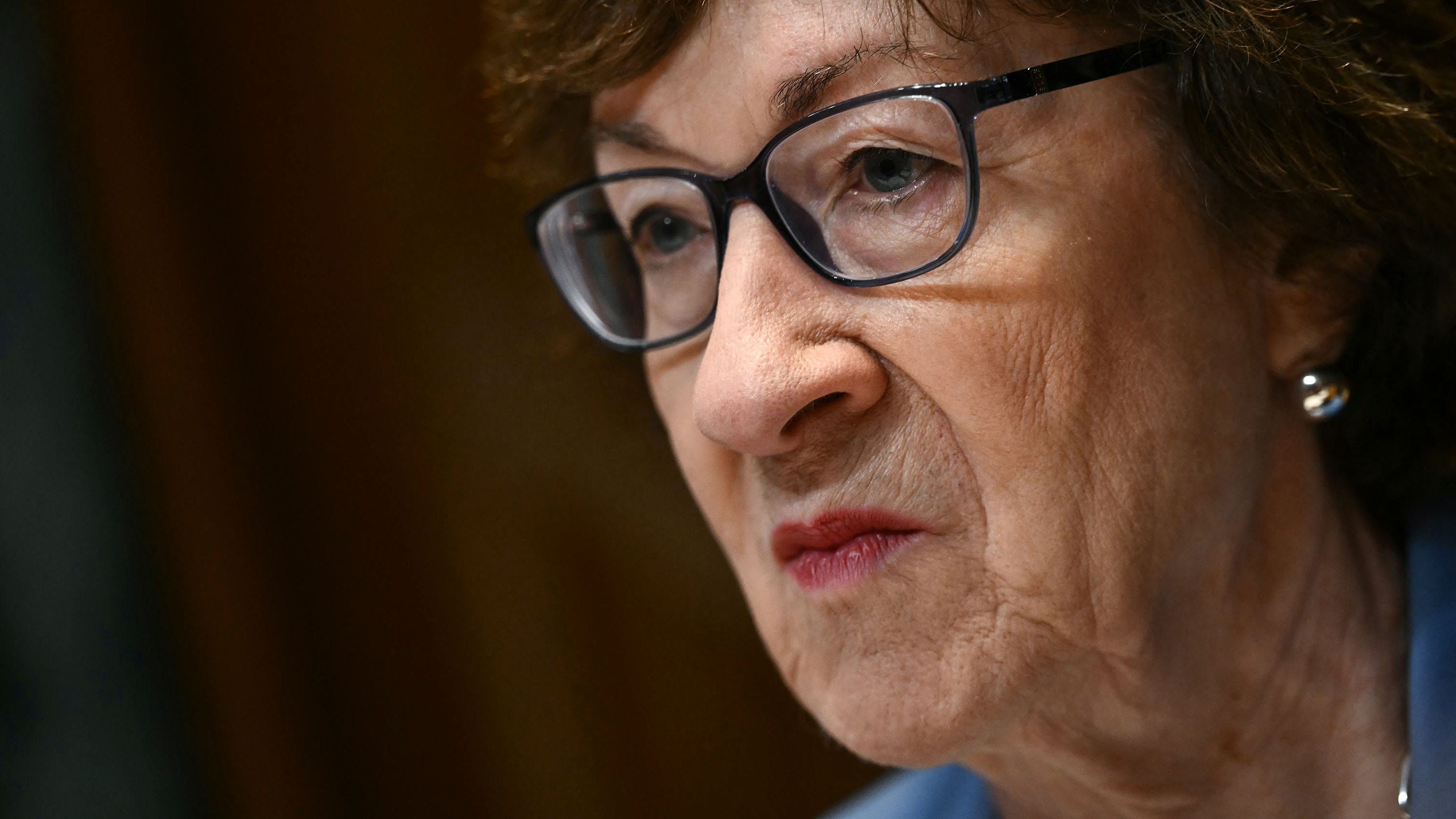
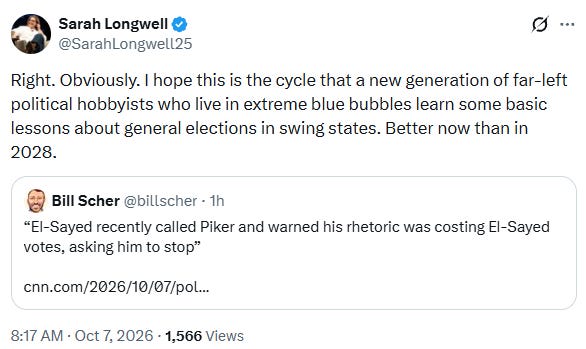
Florida's Democratic nominee for the Senate says average Americans right now are livinginthe dreams of oligarchs and the super-rich, and it's time for regular people to live their own dreams. The progressive maverick promises to fight to help all Floridians—regardless of party—to be healthy, prosperous, and safe. And while Republicans like to point out Nixon's DSA affiliation, the Trump administration itself is acting socialist, while also sending immigrants back to countries like Cuba and Venezuela. Plus: Nixon weighs in on Vance's racist dog whistle, and Tim praises Troy Jackson's debate performance against Susan Collins—who seemed out of touch and was forced to play defense over Trump, the war, and the stupid tariffs.
As always: Watch, listen, hit the like button or leave a comment. We want to hear from you.
Ad-free editions of The Bulwark Daily are available exclusively for Bulwark+ members.
Tim Miller’s Bulwark Daily is available wherever you get podcasts and on YouTube. New shows drop each weekday afternoon. If you like the show, leave a comment and ⭐⭐⭐⭐⭐ wherever you listen.
A quick note: This is exactly why we want Bulwark reporters out in the field: not just watching the Senate map change from Washington, but talking to the candidates and voters who are changing it. If you value that kind of on-the-ground reporting, you’re in luck: Bulwark+ memberships are 30% for a limited time!
Lauren Egan travels to Kansas to report on one of the most surprising Senate races of the 2026 midterms, where Democrat Adam Hamilton is running neck-and-neck with Republican incumbent Roger Marshall. A new New York Times poll shows the race in a dead heat, and Republicans are now pouring millions of dollars into Kansas as they scramble to defend a seat they once considered safe.
Hamilton, a former pastor, makes the case that rising costs, health care concerns, tariffs and the war in Iran are pushing some Kansas voters away from Republicans. He also argues that Democrats can win back voters in the heartland by moving toward the center and focusing on affordability, dignity and bipartisan problem-solving.
Lauren talks with Hamilton supporters about why they think Kansas could finally be ready to elect a Democrat to the Senate for the first time in nearly a century, and asks Hamilton how he plans to win over Republicans and voters who remain skeptical of the Democratic Party.
Democrats are boat-racing the Republican in Georgia. North Carolina is a lock. Texas might get a Democratic senator. Kansas—Kansas—is in play.
And Susan Collins has a coin-flip chance to hold on in Maine.
W. T. F.
I don’t know about you, but if I could pick just one Republican to lose this cycle—the one loss that would give me the most psychic, intellectual, moral satisfaction—it would be Collins.
Because she is the living worst.
At the debate last night, Troy Jackson attacked her for voting for Trump’s “Big Beautiful Bill” in a procedural vote, noting that it cost Maine $3 billion in addition to cutting SNAP and heating benefits.1
Here was Collins’s response:
It’s so disappointing to hear Troy so misrepresent the facts. He knows that I voted against President Trump’s signature legislative accomplishment, the One Big Beautiful Bill. I voted against it because it did cut the Medicaid program. But if I had not allowed the bill to go to the floor, I would never have been able to author the $50 billion fund to help rural health care. That is so important to the state of Maine. There are other provisions of that bill that keep taxes lower for middle-income taxpayers, and that is important as well. And he knows very well that I proposed paying for the rural health care fund by increasing the costs on everyone who — taxes for people making over $250,000 a year.
She voted to proceed with the BBB, knowing that it was bad legislation, because she knew that she could still vote against it in the final vote, since Republicans would have enough votes to pass it.
That is the last decade of Collins’s career, in miniature. She does what Trump needs her to do to enact his agenda, and sometimes casts a protest vote—but only if she can prearrange it to be meaningless.
She is a snake disguised as a muppet.
I will give Collins credit for one thing:
(Don’t worry—I’m being sarcastic. We’re here to bury the old bat.)
The October Surprise? You’re going to want The Bulwark.
The midterms are coming. The surprises are inevitable. Get the reporting, analysis, and conversations you won’t get anywhere else.
• Unlock everything: Every Bulwark story + exclusive newsletters, including Sarah Longwell’s new Focus Group newsletter.
• Hear what others don’t: Member-only pods like The Secret Podcast with Sarah Longwell and JVL.
Lt. Gen. Mark Hertling (Ret.) and Ben Parker discuss the U.S. decision to pull B-1 bombers out of the United Kingdom over concerns about Iranian drone attacks, and what the move reveals about the changing nature of modern warfare. They examine the growing vulnerability of U.S. military bases, the risks to American forces at home and abroad, and what the…
(Photo illustration by Bill Kuchman/The Bulwark | Photos: Getty, Shutterstock, submitted)
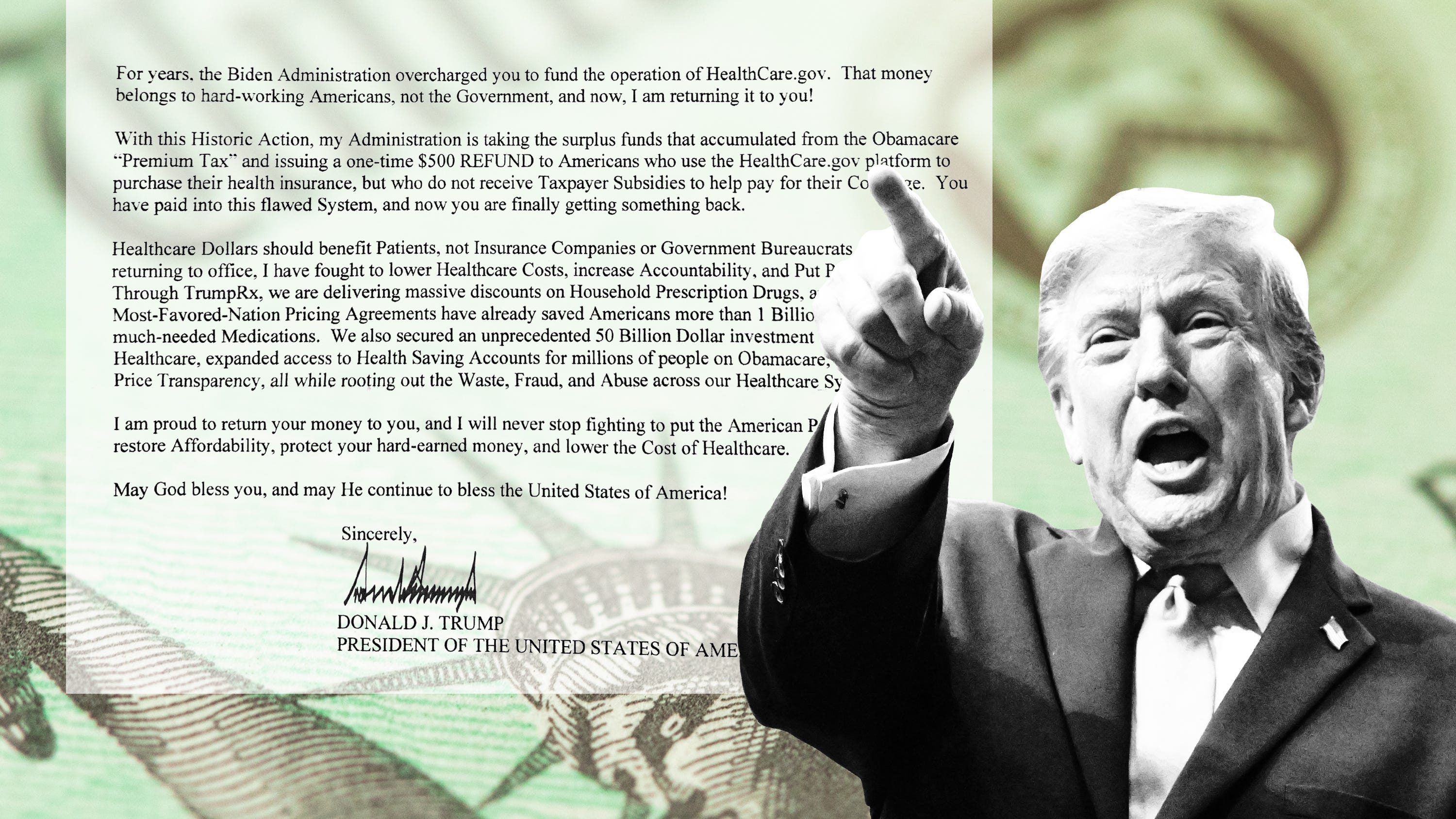
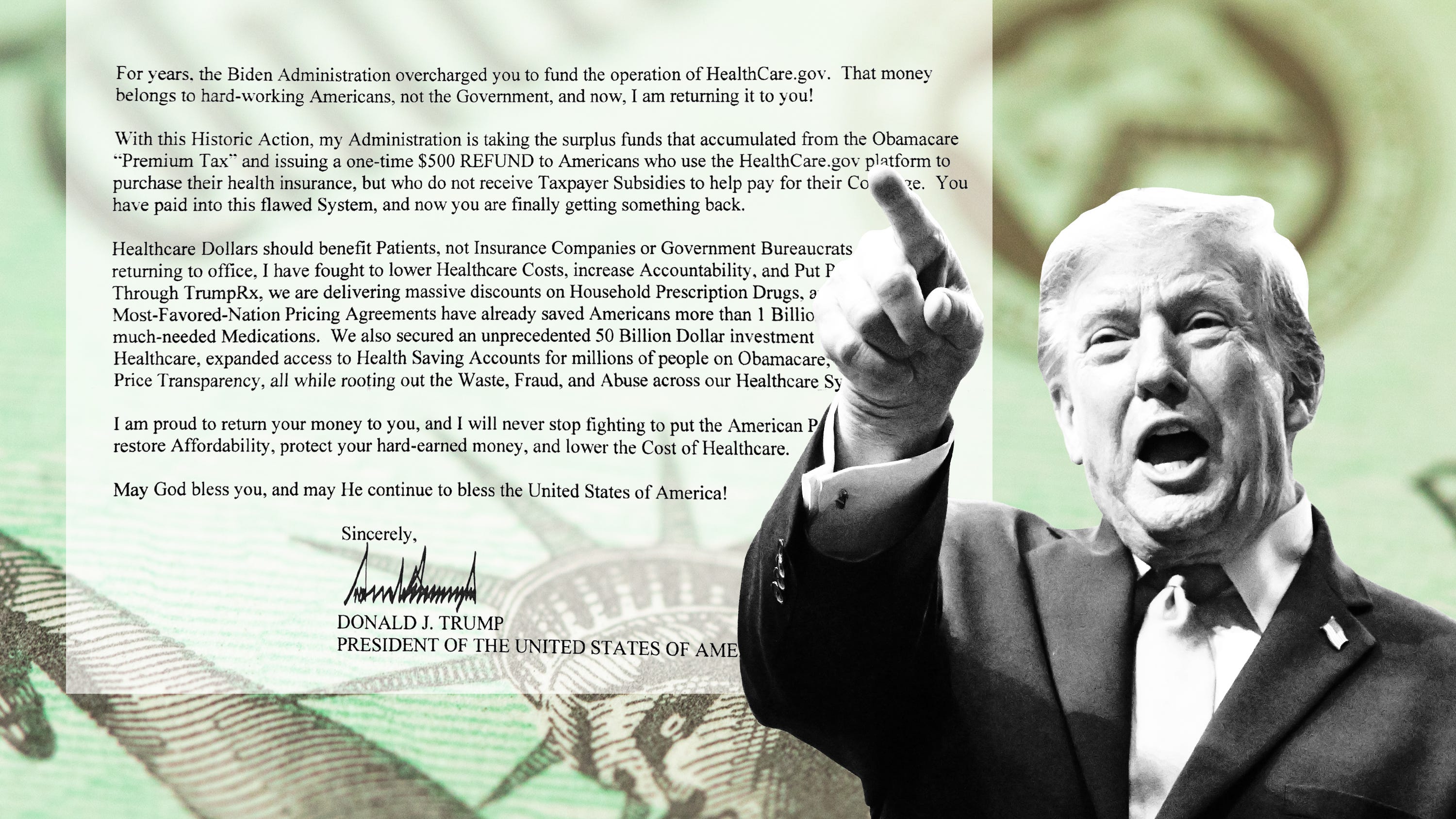
DONALD TRUMP IS HAVING the federal government send checks to millions of Americans, evidently in hopes they forget all the ways he and the Republicans have made health care harder to obtain and harder to afford.
Or, to put it more bluntly, Trump is using public money to buy votes.
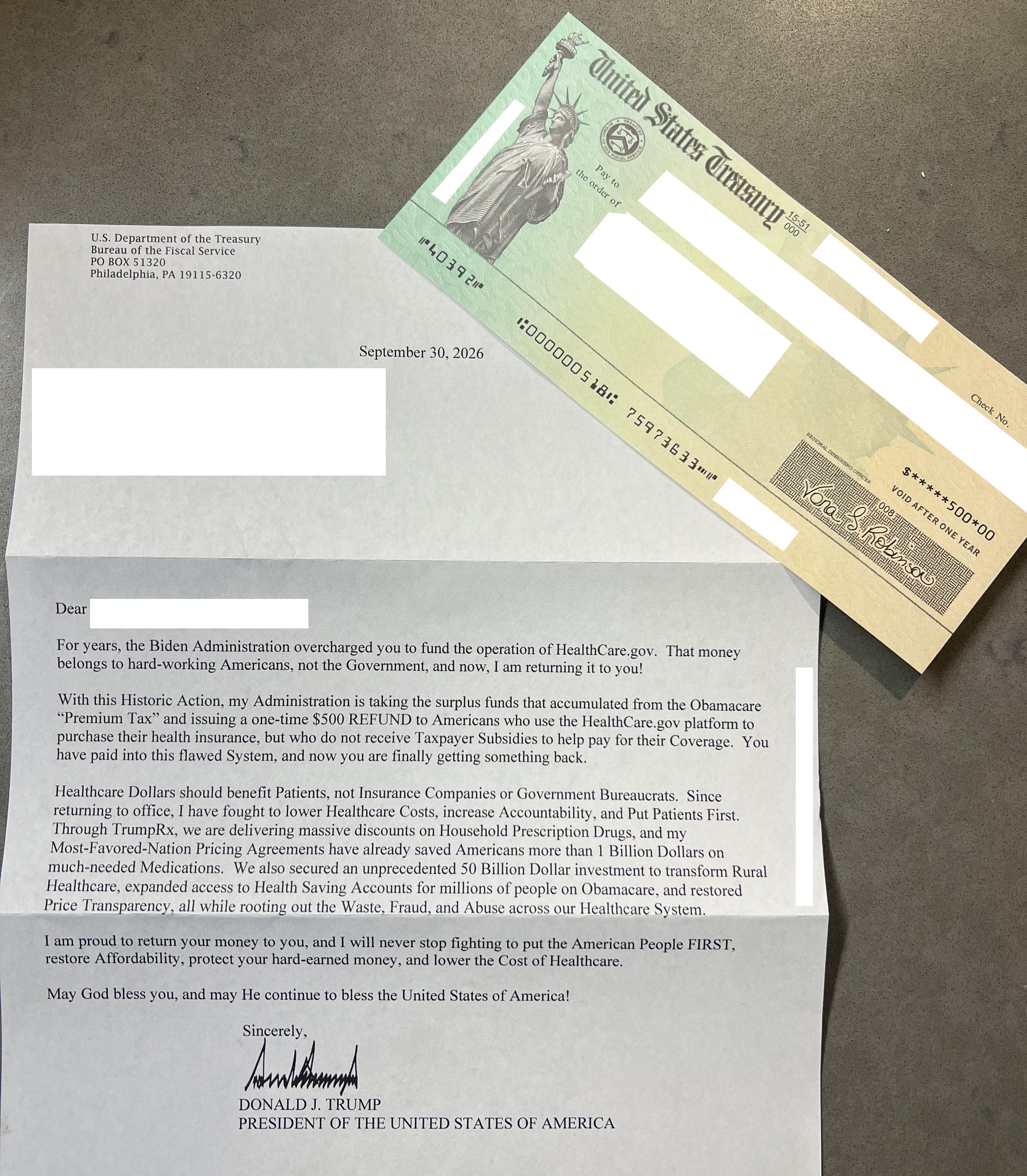
Over the past month, the administration has announced two sets of payments. One of them—$500 per person—is going to about a million people who bought health insurance through HealthCare.gov, the online marketplace that is part of the Affordable Care Act. The other payments, $90 each, are going to about 20 million seniors and people with disabilities who have Medicare Part B, the portion of the program that pays for doctor visits and other outpatient services.
The official rationale for the $500 checks is that they are a “refund” going to people “overcharged” by the Biden administration for HealthCare.gov coverage. A letter accompanying the checks and sent with Trump’s signature says so, before listing off what Trump claims are his many accomplishments on health care, like the agreements he reached with major pharmaceutical companies.
“I am proud to return your money to you,” the letter states, “and I will never stop fighting to put the American People FIRST, restore Affordability, protect your hard-earned money, and lower the Cost of Healthcare.”
But just as those drug company agreements haven’treallyproduced huge savings, so these new $500 checks to HealthCare.gov buyers aren’t actually a refund for supposed overcharges. In reality, the money comes from
The October Surprise? You’re going to want The Bulwark.
The midterms are coming. The surprises are inevitable. Get the reporting, analysis, and conversations you won’t get anywhere else.
• Unlock everything: Every Bulwark story + exclusive newsletters, including Sarah Longwell’s new Focus Group newsletter.
• Hear what others don’t: Member-only pods like The Secret Podcast with Sarah Longwell and JVL.
Donald Trump is a friendly boss; he lets his top aides freelance. Two of those aides, James Blair and Chris LaCivita, are spending most of their time spearheading midterms spending for Trump’s PAC. But last week, they both managed to find time for a quick trip to the Balkans, where—the New York Times reports—they have each been paid hundreds of thousands of dollars to consult on behalf of the pro-Russian sub-national government in Bosnia and Herzegovina. Seems fine. Happy Wednesday.
Join Mark Hertling and Ben Parker for Command Post live today at 10:30 a.m. EDT on Substack and YouTube.
(Photo illustration by Sarah Rogers/The Bulwark | Photos Getty, Shutterstock)
The Blue Wave. The Rocky Shore.
by William Kristol
It could be the best of elections. So it makes sense to be hopeful. But it’s surely the worst of administrations. So it makes sense to be alarmed.
On the hopeful side: The blue wave shows no sign of abating. Democrats are doing a decent job of getting out of their own way. Meanwhile Donald Trump is traveling around the country and doing his best to make the election about himself.
Which is good.
According to the polling aggregator FiftyPlusOne, President Trump’s job disapproval stands at 61.9 percent, compared to 35 percent approval. The Democratic advantage on FiftyPlusOne’s average of the generic congressional polling is a still impressive but less overwhelming 51.1 percent to 43.4 percent.
There’s a simple lesson here: The more this election is about Trump, the better. The more the generic ballot numbers move towards the presidential approval numbers, the better. The more Trump visits competitive states for rallies that are all about himself, the better. The more ads we see that feature Trump, the better.
We’re not here to tell you what you want to hear or to rage-bait you. We tell you what we really think. Join our community.
Yesterday morning, stung by media reports that his rallies aren’t what they once were, Trump posted:
My Rally crowds and enthusiasm are unbelievable! Nobody has ever seen anything like it. We are flipping races all over the place. . . . It’s all happening! The Dumocrats [sic, needless to say] never counted on this. Watch for the “Midterm Surprise!”
MY RALLIES ARE SAVING THE REPUBLICAN PARTY, AGAIN!!!
Lots of Republicans would beg to differ with the leader of their party. Texas Gov. Greg Abbott, for example, apparently has decided not to join Trump’s rally tonight in San Antonio. After all, as Abbott explained, “Because of my schedule, where I go to multiple cities a day doing events like this, I already have events like this scheduled that day and will not be able to make it.”
It will be amusing to see what important event Abbott’s attending that couldn’t have been rescheduled to make room for the president. And it will be interesting to see if Trump takes offense at the slight. A little intra-Republican squabbling in these closing weeks couldn’t hurt Democrats’ chances, either.
So much for Trump and the GOP.
As for the Democrats, they’re doing a pretty good job of riding the wave of voter discontent. They’re keeping the focus on the Trump administration’s failures and corruption, and on the Republican Congress’s complicity in them. They don’t even seem to be over-thinking things and tying themselves in knots nearly as much as they normally do.
Their biggest problem may be that many of their big donors and key operatives don’t seem to realize what a historic moment this year could be. They’re being cautious when their party has a golden opportunity to win senate seats and governorships that have long appeared to be out of reach. Democrats have a chance to turn a shrinking map into an expanding one.
The implications of a Democratic senate majority of fifty-four seats would be very different from getting to fifty-one. And as for governorships, six of the ten most-populous states now have Democratic governors, and Democrats seem unlikely to lose any of them this November. But in the other four of the ten most-populous states—Texas, Florida, Ohio, and Georgia—the gubernatorial races are competitive. If Democrats win, say, two of the four, they’d govern eight of the ten largest states, and twelve of the largest fifteen. This would affect the character of our politics going into 2028 and beyond.
So there’s reason to be hopeful.
But there are reasons to remain alarmed.
The main reason is obvious: Trump and his loyalists will control the levers of executive power over the next two years. You’d have to be crazy not to be alarmed by what they can do during this time—to our nation’s well-being at home and to its standing abroad, to our civil liberties and civil service, to any remaining guardrails against corruption and lawlessness. So Donald Trump and JD Vance, Todd Blanche and Pete Hegseth, Stephen Miller and Russell Vought in positions of great power remain a clear and present danger to our constitutional republic.
As do their collaborators outside the government. The public has moved pretty decisively in the right direction over the past two years. Our elites have not. Some are eagerly taking advantage of the benefits of crony capitalism. Others, intimidated, are cowering or cutting deals. Few are standing up to autocracy.
And all of this is to say nothing of the threat to free and fair elections in 2028. Trump and his cabinet officials, and all the loyalists they’ve stuffed into government agencies, really do not want to lose power in 2028. They don’t want a new administration to come in and turn over the rocks to uncover their corruption and lawlessness. The threat of election interference in 2026 has been worrisome. But the threats in 2028 will be of a whole different order of magnitude. And the stronger the popular opposition to Trump and Trumpism becomes, the more determined Trump and his authoritarians will be to subvert the democratic process.
So be hopeful and alarmed. And organize, persuade, and vote. It’s our country, after all, either to nobly save or meanly lose.
The October Surprise? You’re going to want The Bulwark.
The midterms are coming. The surprises are inevitable. Get the reporting, analysis, and conversations you won’t get anywhere else.
• Unlock everything: Every Bulwark story + exclusive newsletters, including Sarah Longwell’s new Focus Group newsletter.
• Hear what others don’t: Member-only pods like The Secret Podcast with Sarah Longwell and JVL.
Massive Cash Infusion Coming to Dems, Courtesy of Gun-Control Group… New ads are set to run in key battleground House districts, reports JOE PERTICONE in Press Pass.
Quick Hits
NOW WE JUST FEEL BAD FOR HIM: At this point, Ken Paxton may never open his mouth in a private fundraiser again. First it was the New York Times reporting that Paxton had privately admitted Trump’s midterm convention hurt him. Then it was Politico releasing audio in which Paxton complained that “I’ve never been in a race where I felt less control over the campaign” because “it’s all coming from D.C.” And this morning, Axios released even more audio of Paxton lamenting that the Iran war and gas and diesel prices were “dragging” on his campaign.
“So many factors in this federal race are uncontrollable,” Paxton said in the audio. “I don’t make the decisions, and I don’t . . . know what’s behind some of the decisions.”
All of the leaked audio in question is sourced from the same small fundraiser last month, which suggests Paxton was unlucky enough to let a very determined hater into the room: Not only was the leaker eager to release damaging audio, but he or she has been drip-feeding it into the news—different days, different outlets—to keep the story hanging around and maximize the damage against Paxton. I tell you what, it couldn’t have happened to a nicer guy.
STILL REFUSING TO LOSE: All this time later, Ukraine is still holding tough. The New York Times reports on Ukraine’s fruitful counteroffensive in the Donbas:
A monthslong Ukrainian counteroffensive in the northern part of the Donbas has thwarted Russian efforts to encircle the remaining Ukrainian-controlled cities in the region. Russia, Western analysts say, has lost dozens of square miles of territory during the Ukrainian campaign, which Kyiv is calling Operation Vivaldi.
In the southern Donbas, Russia continues to mount furious assaults to break through Ukrainian lines. But Kyiv has reorganized its defense there and has so far kept the Russian military from pressing farther in its efforts to surround the major Donbas cities.
More broadly, Russian gains across Ukraine have slowed markedly in 2026 from their already glacial pace of last year. September was the worst month in net territorial gains for Russia inside Ukraine since June 2023, according to the Finland-based research firm Black Bird Group.
MAINE DEBATE: Sen. Susan Collins has been a unicorn in politics: a GOP senator who has enjoyed consistent success in her blue state of Maine no matter how bad the national environment. But she’s never faced a wave environment quite like this one, and she’s working hard to pull one more rabbit out of her hat.
Yesterday, Collins and Democratic challenger Troy Jackson had a televised debate—their first of four over the next ten days. Unsurprisingly, Jackson’s main strategy was to do everything he could to tie Collins to Trump. He castigated her vote for Supreme Court Justice Brett Kavanaugh, said that Mainers shouldn’t trust her to pick the next justice who comes up for confirmation, and scoffed at her track record of voting for Trump’s priorities while using her leverage only to get certain kickbacks and carveouts for Maine. “Sen. Collins is like an arsonist who set the fire and then she wants credit for bringing a cup of water to put it out,” Jackson said.
Read other takeaways from the debate from the New York Times here.
Memberships are 30% off for our October sale, a discount so large that JVL and Sarah would like it known they personally object to it. Please take advantage of this terrible business decision while you can.
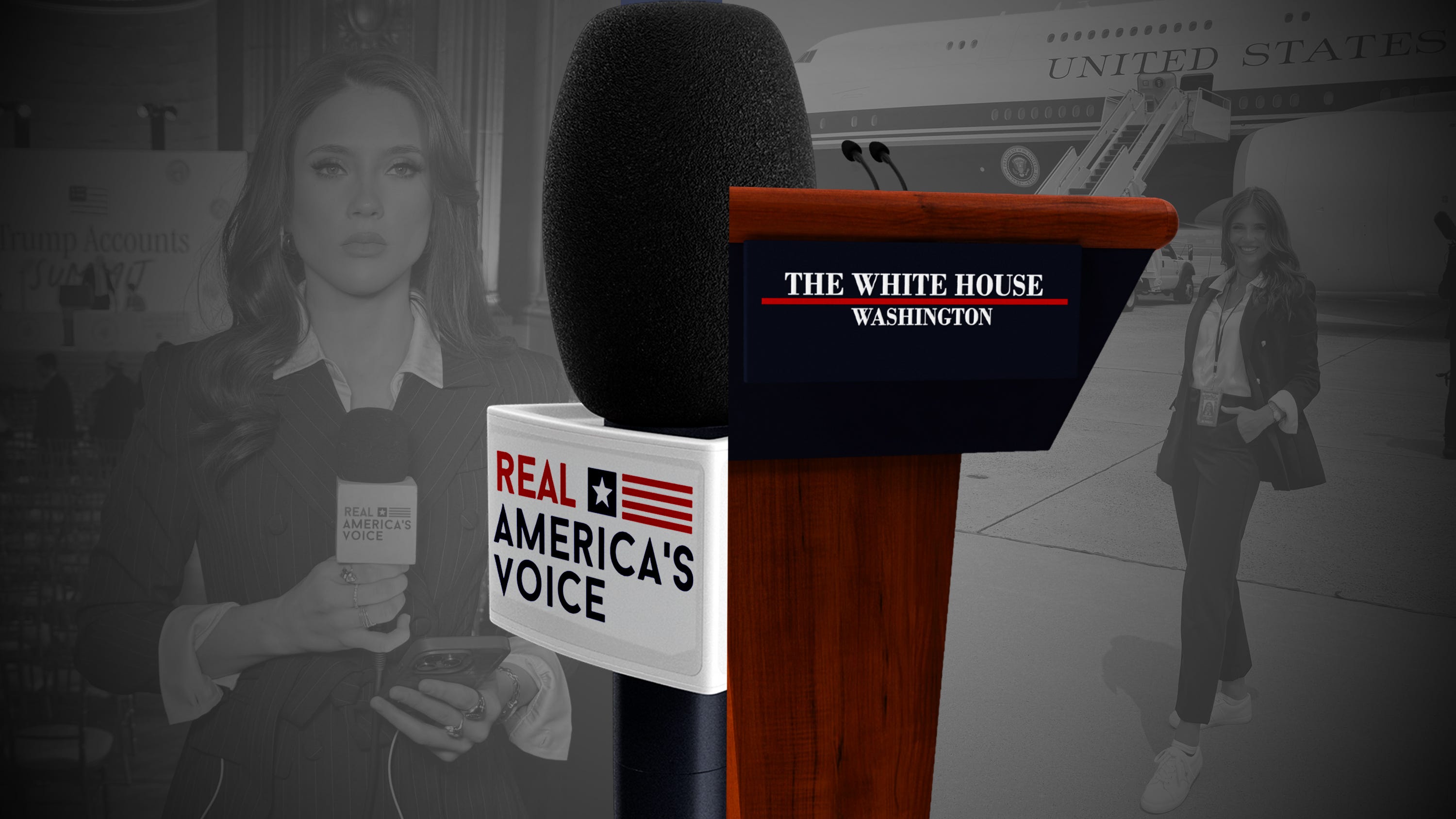
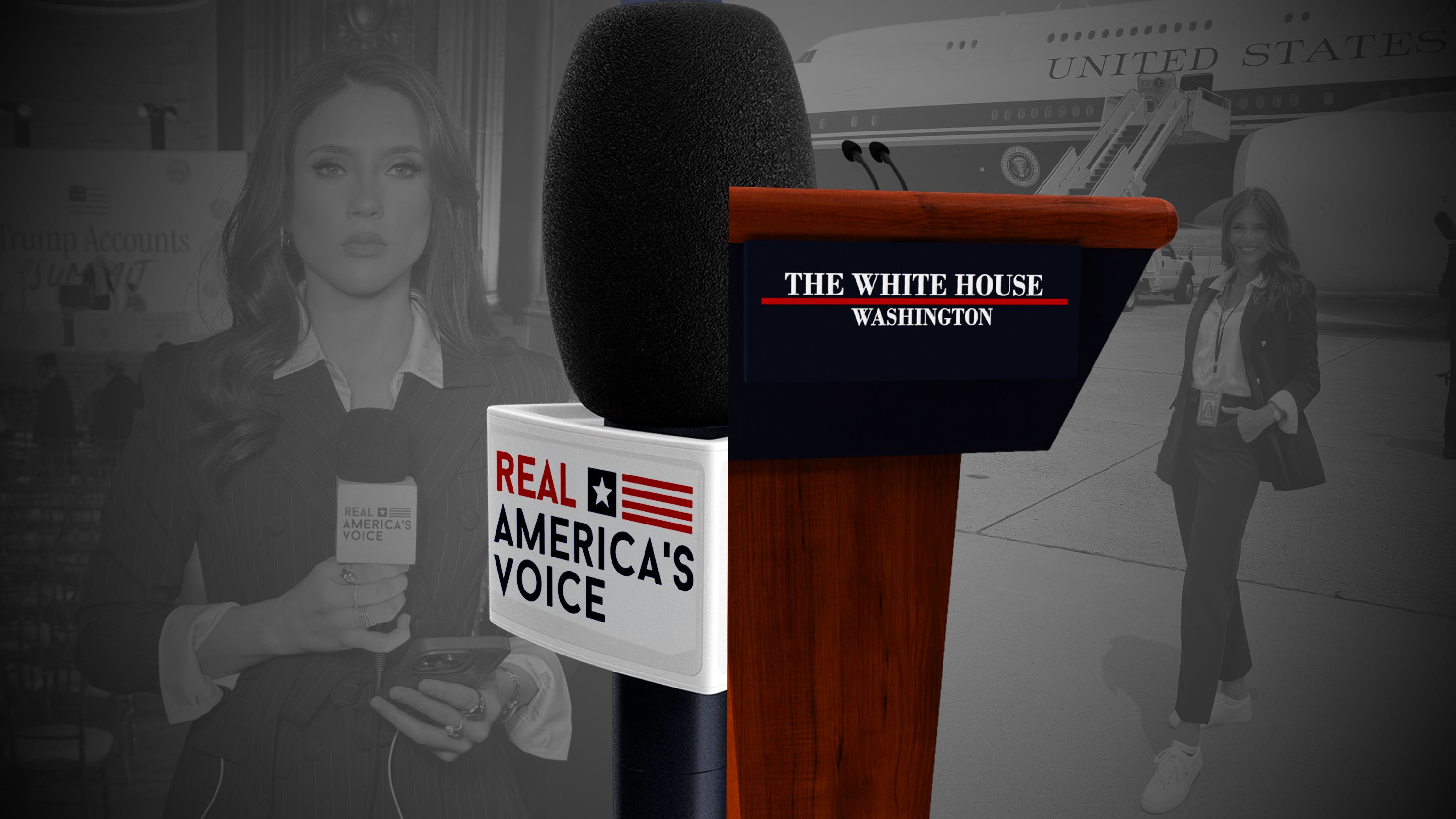
The gang congratulates Kash Patel on his engagement, discuss JVL's Triad on the White House reporter-turned-press staffer from Real America's Voice. Then: Megyn Kelly's ghoulish rant against Cornell's Jane Doe, and whether we're happy to see John Roberts experiencing public shame. Finally: Two VERY weird campaign ads, one filled with weird innuendo, and the other featuring Angela Paxton announcing her vote for her cheating ex-husband. They wrap up by discussing a long New Yorker article about the Heritage Foundation's groypery turn.
Reporter Michael Weiss and former CIA officer Marc Polymeropoulos break down a staggering spy scandal involving the former head of German intelligence, an alleged Iranian plot targeting U.S. bombers in Britain, and the increasingly strange questions surrounding Kimberly Guilfoyle in Greece. Plus: why Russian intelligence operatives are suspected of leaving a particularly vile calling card in politicians’ homes.
A quick note: Michael and Marc bring really rare expertise to stories like these: investigative reporting, knowledge of the intelligence world, and Marc’s firsthand experience in the CIA. If you value having people like this go deep on happening behind the headlines, join Bulwark+ and help us keep making content like this possible.
And if you do want to join, you’re in luck—we’re running 30% sale right now!
(Photo illustration by Bill Kuchman/The Bulwark | Photos: Getty, Shutterstock)
Hi everyone, I think you’re going to love the new episode of my Receiptspodcast. Sam Stein and I decided to dissect Treasury Secretary Scott Bessent’s very odd interview with Axios. Among other things, Bessent declared he was totes in the right for declaring “I am the house now” in his failed bond-market interventions, before determining that, eh, sometimes the house loses. (Former failed-casino owner Donald Trump can relate.)
We also talked about Bessent’s record with the ladies (according to Bessent, Trump’s female friends are disappointed to learn that the secretary is into men), and whether a comparison to the nation’s first treasury secretary, Alexander Hamilton, proves entirely favorable.
I also spoke with Mateo Kehler, the CEO and cofounder of Jasper Hill Farm in northern Vermont. Kehler is a dairy farmer who makes delicious, rich, award-winning cheeses, and is supposed to be exactly the kind of person Trump’s trade war with Canada is helping. Instead, the president has obliterated Kehler’s export business. We spoke about why Trump’s trade wars and hot war are hurting dairy farmers on both sides of the border, despite Trump’s specific callouts promising to rescue U.S. dairy farmers. Trump’s cheese wreckage was the subject of my recent Receiptsnewsletter, as well:
IN HIS OTHERWISE INEXPLICABLE trade war with Canada, U.S. dairy was supposed to be the one industry President Donald Trump was actually helping.
He frequently namechecks the sector in his social media posts and interviews about Canada, citing it as evidence that our polite northern neighbors are really a bunch of dirty cheats. Sometimes, Trump complains that Canadian dairy tariffs on the United States are 250 percent; sometimes, according to Trump, they’re 400 percent.
And look, it’s true that dairy trade has been a source of friction between the two countries over the years. Trump’s response to that friction, however, has been to tariff, bully, and ban his way to prosperity. To which American dairy farmers are now saying: Please, stop helping.
Thanks for all your terrifically cheesy cheese puns, by the way! Very hallouminating. I’ll see you back here Thursday for the next edition of Receipts.
(Photo illustration by Bill Kuchman/The Bulwark | Photos: Getty, YouTube, Shutterstock)
Red Heat
Giffords PAC, the pro–gun control organization founded by former Rep. Gabby Giffords (D-Ariz.), released two new ads as part of a $10 million campaign in battleground House races ahead of the November elections, The Bulwark can exclusively report. The campaign—an unusually large intervention from an independent PAC—targets districts at the edges of Democrats’ hopes for how far a blue wave this November might carry them.
In a $1 million campaign in Michigan’s 10th Congressional District, the PAC’s ad elevates Christina Hines, the Democratic nominee.
“I investigated cold cases that Christina Hines prosecuted: gun traffickers, domestic abusers, and murderers. I was always relieved when prosecutor Christina Hines was assigned to a case,” a retired Michigan state trooper says in the ad. “She not only listened to me, she heard me. Christina Hines is a great partner to law enforcement. She’s tough, she’s honest, and I trust her.”
Get Press Pass in your inbox
In Florida’s 13th district, where Rep. Anna Paulina Luna (R-Fla.) is fighting for re-election against Democrat Leela Gray, the PAC’s $800,000 campaign about Luna’s connections to the gun lobby will soon fill the airwaves.
“The corporate gun lobby loves Anna Paulina Luna. And why shouldn’t they?” says the ad’s narrator.
They give her thousands of dollars, then she votes their way. Luna voted to weaken gun laws, making it easier for criminals and domestic abusers to get access to guns. She even voted to cut millions from law enforcement—putting our police and families at risk. The gun lobby can always count on Anna Paulina Luna. But Florida families can’t.
In a recent interview with Roger Stone, Luna complained about Giffords’s previous ads in her district and insinuated that school shootings are a consequence less of free access to firearms than of free access to anxiety and depression medications.
“I think that the attack is pretty egregious,” Luna said. “School shootings, no one wants to talk about the fact that a lot of these shooters—and a lot of the trans shooters also, too—are on SSRIs.” She then said the fact that the pharmaceutical companies that manufacture SSRIs are not “held liable for what happens after the fact . . . has to change.”
These two races are interesting targets for Giffords because they aren’t the obvious high-profile races that other Democrats typically designate as most crucial for retaking the House majority. The seat in Michigan’s 10th district, now an open race, has been held by a Republican in recent years while Luna’s seat is rated as “lean Republican” according to the Cook Political Report, indicating Giffords PAC is sending its resources to places national Democrats have been too thinly stretched to meaningfully contest in recent election cycles.
We recently published a leaked audio recording of Rep. Stephanie Bice (R-Okla.) stressing over low Republican enthusiasm heading into the midterms and President Donald Trump’s drag on GOP candidates. Today, we have another example of a Republican incumbent acknowledging that the president is creating problems for lawmakers in his party seeking re-election.
In a radio interview Friday with RadioPlusAudio in Fond du Lac, Rep. Glenn Grothman (R-Wis.) said Trump’s unpresidential actions are prompting Republicans to stay home, while independent voters seek to punish Republican incumbents at the ballot box.
When the host asked Grothman if Republican voters have expressed concern to him about Trump, the Wisconsin Republican said absolutely, counting himself in the lot.
“Oh, yeah, I’m a Republican who’s concerned,” Grothman said.
I mean, we have a situation in which I think a lot of the figures are good. But I think President Trump, who has wonderful people around him, but I think sometimes he says things that aren’t very presidential, and that hurts the Republican brand. I’m not for, you know, renaming Lake Ontario “Lake America,” for example, I think that sort of thing. Or when he tried to change the name of the Kennedy Center. That sort of thing, I think, gets him in trouble. I think sometimes he brags a little bit more than he should. You know, I think he’d do better if he came across a little bit more humble.
The host also noted a recent Marquette University poll that showed Trump’s approval rating at 38 percent, with a 60 percent disapproval. When asked whether that’s going to hurt Republicans in state and national races, Grothman said it would.
“Oh, no question. It’s a big problem,” Grothman said. “I consider myself kind of an independent person. I am not afraid to disagree with President Trump1 and therefore, hopefully that won’t hurt me as much as some Republicans.”
“But yeah, it unquestionably is a problem,” Grothman added. “Because if people don’t like Trump and want to make a statement, they may make that statement by voting against me.”
Grothman’s comments differ from the expressions of Trump-related frustration I’m used to hearing from Republicans on Capitol Hill. More often than not, Grothman’s colleagues will shift the blame from Trump to his advisers. Grothman says the opposite: Trump’s inner circle is trying to do good work in spite of the Don’s efforts to drag it all down.
Grothman himself enjoys comfortable odds for re-election. He won his race in 2024 by more than 22 points. But Bice, who had the hot mic in August, is also sitting in a district with a considerable GOP advantage. The fact that virtually sinecured lawmakers like her and Grothman are expressing panic, privately and publicly, and criticizing the president for having trivial and ego-driven priorities suggests that many of their House colleagues in closer races are in for a rough Election Day.
As their political movement builds momentum following years in the wilderness, young conservatives in Spain are drawing from the conservative American dress codes of the twentieth century to lend themselves a bit of sartorial cachet.
Jason Horowitz reports in the New York Times:
Hundreds of Spanish teenage boys—many wearing loafers, fitted cropped white pants, quilted vests or Barbour hunting jackets—erupted in cheers when a boy band in similar outfits introduced their hit song from the stage.
“This song is self-explanatory, it explains our origins,” one of the singers said to the packed courtyard of an exclusive Catholic prep school on a rainy night in Madrid. “This is who we are and we’re not going to change!”
With that, the group, Avenida, struck the driving opening chords of their hit song “Cayetano,” a term often used to describe young Spanish conservatives with a fondness for preppy clothes. When they reached the chorus, the audience sang “All my friends are named Cayetano” in gleeful unison.
Subcultures tend to adopt uniform standards of dress as they come into their own. It’s why bikers wear leather moto jackets, Republican Capitol Hill staffers wear red satin ties and Air Journos (my nickname for the hybrid sneaker-soled dress shoes), skateboarders dress like skateboarders, and libertarians dress like magicians. When young Spanish conservatives attempt to mimic the preppy stylings of William F. Buckley and Ronald Reagan, they create public signs by which they can identify each other and convey a common cause.
To render a proper homage, though, their pants should be less slim. But I suppose that’s the Old Country for you. For some reason, they love a tight fit over there.
Grothman’s claim that he’s independent of the Trump administration is more than a stretch. His voting record tells a very different story: He maintained a perfect score of voting in line with the president’s priorities, according to a 2025 vote tracker published by the Center for American Progress.
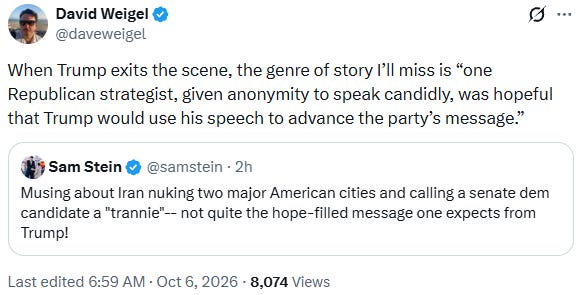
Destroying trust in the government is one of Trump's key sources of power, but Michael reports from the front lines of the deep state that there still are good employees serving the public interest. In his new book, Michael celebrates some of the heroes who either managed to survive DOGE—or were stupidly pushed out despite the vital roles they filled. And the absolute failures of DOGE raise serious questions about how Elon could be trusted to run any enterprise. Plus: Trump sure sounded like he was inviting Iran to bomb two big blue cities, and Republicans are rushing money to South Carolina and a very GOP district in Kentucky. Seems like Tim and Bill were onto something with their long-shot midterms picks on Monday.
As always: Watch, listen, hit the like button or leave a comment. We want to hear from you.
Ad-free editions of The Bulwark Daily are available exclusively for Bulwark+ members.
Tim Miller’s Bulwark Daily is available wherever you get podcasts and on YouTube. New shows drop each weekday afternoon. If you like the show, leave a comment and ⭐⭐⭐⭐⭐ wherever you listen.
Catherine Rampell and Sam Stein discuss Scott Bessent’s strange interview, from his “I am the house” bravado and boasts about Melania’s friends to his temper and possible political ambitions. They also react to Trump’s latest pitch for $5,000 checks and his remarkable claim that he knows more about basically everything than anyone.
Then Jasper Hill Farm’s Mateo Kehler joins to explains how Trump’s trade war with Canada wiped out the cheese company’s fastest-growing export market and why policies sold as a lifeline for American dairy farmers are instead driving up costs and squeezing businesses.
A quick note: One of the things we want Receipts to do is give conversations like this the room they deserve: go deep with people who know their industries inside and out, and trace government policy all the way from Washington to its effects on businesses, workers, and communities. Your support for the Bulwark gives us the freedom to make more of that kind of work.
And if you do want to join, you’re in luck—we’re running 30% sale right now!
(Photo illustration by Sarah Rogers/The Bulwark | Photos Shutterstock, Instagram)
1. The bIAsEd MEdiA
In mid-September, the Trump administration bestowed press pool status on reporter—sorry, “reporter”—Beni Rae Harmony as she traveled to Ireland to cover the president.
Then, on September 26, the 24-year-old(!) Harmony, who worked for the network Real America’s Voice, took CNN’s spot on the presidential plane after Trump refused to let the network onboard.
Last Friday, Harmony switched sides, going from covering the White House as a member of the press to serving Trump as his newest assistant press secretary.
There are so many questions here, but let’s start with the most obvious one: Do you think she’ll get back pay?
Every once in a while a “journalist” will jump from the press side into a comms role in a presidential administration. Tony Snow did it. Jay Carney did it. I find such shifts distasteful, but whatever. Not everyone is a priss like me.
What has never happened before (so far as I can tell) is a supposedly straight news reporter working as a pool representative covering the president on behalf of the full American media blob one week then becoming a paid shill for that president a few days later.
How bad was it? OMG. Whatever it is you’re imagining, the reality is worse.
Ben Parker and Bill Kristol discuss Donald Trump’s increasingly frantic attacks as Republicans face a surprisingly competitive Senate race in South Carolina, including Trump’s use of an anti-trans slur against Democratic candidate Annie Andrews. They examine what the race says about the Republican Party’s standing heading into the midterms and whether D…
(Photo illustration by Bill Kuchman/The Bulwark | Photos: Getty, Shutterstock)
OF ALL THE STATES THAT COULD give us an indication of how big the blue wave will be this cycle, Iowa is one of the most intriguing.
Donald Trump never came within 8 points of losing the state. But of the ten polls of this race since September 1 in the New York Times polling aggregator, the Democrat leads in four, the Republican leads in five, and one was a tie.1
The state is a petri dish for Trump’s toxicity: diesel prices, corruption, and concerns about AI and data centers all have particular relevance in Iowa. It also will be a strong case study in what types of Democratic candidates can play in states that have drifted right over the Trump years. The Democratic nominee for Senate, Josh Turek, is likeable, admirable, and has run a non-stupid campaign.
And yet, if the focus groups I conducted in the state last week are telling me anything, one of the deciding factors in the race will be
The October Surprise? You’re going to want The Bulwark.
The midterms are coming. The surprises are inevitable. Get the reporting, analysis, and conversations you won’t get anywhere else.
• Unlock everything: Every Bulwark story + exclusive newsletters, including this one—Sarah Longwell’s Focus Group.
• Hear what others don’t: Member-only pods like The Secret Podcast with Sarah Longwell and JVL.
The hot-mic moments just keep coming for Texas GOP Senate hopeful Ken Paxton. Last week, it was leaked audio of Paxton admitting that Trump’s ballyhooed midterm convention had actually hurt his numbers. This week, it’s audio of Paxton complaining about how little control he has over his own campaign strategy—since most of the money behind him is super PAC money from Trump. “I’ve never been in a race where I felt less control over the campaign and, like, what issues are going to matter,” Paxton told a small fundraiser room, “because it’s all coming—you know—from D.C.” Happy Tuesday.
Join Bill and Ben Parker for Morning Shots Live today at 10:00 a.m. EDT on Substack and YouTube.
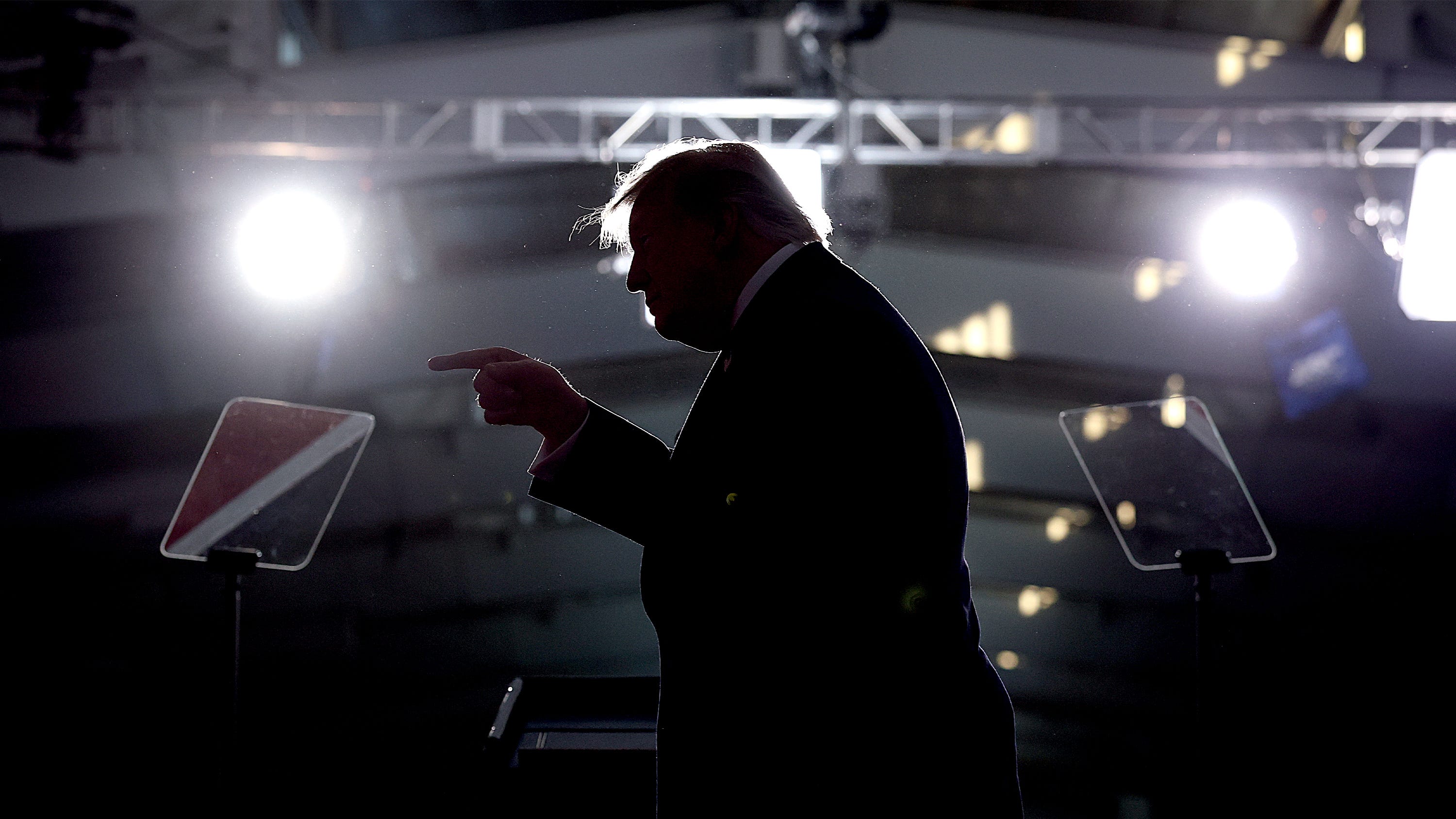
President Donald Trump speaks during a campaign rally at Pinnacle Bank Expo Center on the Nebraska State Fairgrounds on October 5, 2026 in Grand Island, Nebraska. ( Photo by Win McNamee/Getty Images)
The President’s Palmetto Preoccupation
by William Kristol
The nineteenth-century American writer Henry David Thoreau famously claimed that “The mass of men lead lives of quiet desperation.” I’ve always thought this assertion unfair, even untrue. But it’s neither unfair nor untrue to observe that one man, Donald J. Trump, is today exhibiting clear signs of not-at-all-quiet desperation.
Yesterday afternoon, for example, Trump was engaged in a typical flurry of posts alternately attacking the media and promising $5,000 to Americans if they re-elect Republican majorities in Congress. And then out of the blue came an attack on the Democratic senate nominee in South Carolina:
Annie “Trannie” Andrews is running against our wonderful Darline Graham for the Senate in South Carolina. . . . Darline is a High Quality person, maybe the Highest, and Annie Trannie is not, in particular, as it pertains to representing the Values of the Great People of South Carolina—She is in favor of Transgender for Everyone, Open Borders, Defunding the Police, High Taxes, a Weak Military, and will absolutely fight to take your guns away—In other words, she is against our Great Second Amendment! Trannie is not for South Carolina, and South Carolina must show, in the upcoming Election, that it is not for her. VOTE FOR DARLINE GRAHAM—SHE HAS MY COMPLETE AND TOTAL ENDORSEMENT, AND WILL NOT LET YOU DOWN! President DONALD J. TRUMP
Before going on to explain Trump’s sudden interest in the South Carolina contest, I do want to note that his bigotry is of course revolting. In a civilized era, it would be shocking to see it coming from a president of the United States. But we do not live in a civilized era. In a non-cowardly era, the slur would be denounced by Republicans as well as Democrats. But we do not live in a non-cowardly era. In a better era, Andrews’s Republican opponent, Sen. Darline Graham, would step up to criticize a supporter for using the term. But we do not live in a better era.
If we want better politics, we have to make it ourselves. That’s what The Bulwark is all about. Join us—and take 30 percent off the first year.
Why, though, this sudden attack on Dr. Annie Andrews, of all people? She’s running for a supposedly safe Republican seat. And since she knows that she needs to win Trump voters over to have a path to victory, she’s actually been sparing in her own attacks on Trump. Consider her response to Trump’s post yesterday:
As a mom and a pediatrician, I’m in this race to fight for my patients, my three kids, and South Carolina. And I’m going to work with anyone to put South Carolina first, because lowering costs and making life better for families across our state is going to take all of us working together. If you care more about your bills than the politics in Washington, this campaign is for you.
So why was Andrews on Trump’s mind? He hasn’t been to South Carolina recently, and isn’t scheduled to go soon. When Natalie Harp (presumably) sent the post on his behalf at 5:23 p.m. yesterday, she and her boss were on Air Force One, heading to Nebraska, where Trump was going to campaign for that state’s endangered Republican, Sen. Pete Ricketts.
So why the rhetorical detour to South Carolina? I’d like to think that it was because yesterday, on Tim Miller’s podcast, I went out on a limb and suggested that Andrews had a real chance to win. Could it be that Trump was watching the most recent Bulwark Daily podcast on Air Force One?
Who knows? Only Natalie, I suppose. But. I suspect the explanation is simple: In recent political updates from staff, Trump has been told that South Carolina looked surprisingly competitive.
And it is. The two most recent public polls on the South Carolina race, one of them from a decidedly Republican-friendly firm, have Graham leading by only one point. A news story over the weekend noted that “Republicans, for their part, said they expected Ms. Graham to need a financial boost to secure a win in the end,” and that there were “conversations about getting more help for Darline.” And then, just this morning, Axios reported that the main Republican Senate super PAC is shifting $5 million to South Carolina to help Graham.
It seems President Trump and I are not the only ones who reached the conclusion that South Carolina is in play. And with a wave of the sort we’re seeing, why shouldn’t it be? After all, Trump won Nebraska in 2024 by a wider margin than South Carolina, and he was in Nebraska last night trying to help save that Republican incumbent. And last weekend’s New York Times/Siena polls had Democratic senate candidates up by seven and six points in Alaska and Texas, and South Carolina was only about five points more Republican in 2024 than those two states.
So with a wave this real, and this big, and probably still getting bigger, even South Carolina could be swept away. And so Trump is living a life of noisy desperation.
Thoreau remarks later on in Walden that “It is a characteristic of wisdom not to do desperate things.” Trump is not a man of wisdom. He will say and do desperate things over the next four weeks, and over the next two years. So while enjoying the change in circumstances that is making Trump desperate, we should also prepare for the dangers we’ll face from a desperate and unhinged megalomaniac in control of the executive branch of the federal government of the United States.
Sen. Annie Andrews—along with her colleagues—will have her work cut out for her over the next couple of years.
The October Surprise? You’re going to want The Bulwark.
The midterms are coming. The surprises are inevitable. Get the reporting, analysis, and conversations you won’t get anywhere else.
• Unlock everything: Every Bulwark story + exclusive newsletters, including Sarah Longwell’s new Focus Group newsletter.
• Hear what others don’t: Member-only pods like The Secret Podcast with Sarah Longwell and JVL.
EXCLUSIVE: Recordings show Stacy Garrity claiming Trump’s data center plan as her own
by Brendan Hartnett
As Andrew wrote in Morning Shots in August, politicians are suddenly noticing that everybody hates data centers. The data center backlash is moving so quickly that politicians are scrambling to keep up—sometimes contradicting themselves in the process. Pennsylvania Treasurer Stacy Garrity publicly supported data centers in the summer of 2025. Then, according to audio obtained exclusively by The Bulwark, she voiced the same opinion at a December 2025 Greene County Republicans event, saying that while people hold “mixed views” of data centers, they are a “nice opportunity for rural PA, where we have a lot of space where it wouldn’t be so intrusive.” Two months later, at an Elk County meet-and-greet, Garrity dismissed voters’ concerns about the noise generated by data centers and their impact on energy prices on the grounds that “there’s some misinformation out there,” according to the audio recordings.
Garrity insisted she hadn’t switched at all. In July she stated that her “position has not changed: It’s up to the communities.”
More recently, however, she’s mirrored Trump’s position. Last month, according to the recordings shared with The Bulwark, she told a voter at a campaign event in Westmoreland County that her policy was the same as President Trump’s “Ratepayer Protection Pledge”—a voluntary pledge without enforcement mechanisms that asks hyperscalers and tech companies to provide their own electricity to avoid raising rates on locals—“except mine was before the president.” She continued, “I agree with Trump, I’m glad he put it out.”
We reached out to Garrity’s campaign asking if her views on data centers have changed. A spokesperson pointed us to Garrity’s January 2026 remarks at the Pennsylvania Press Club when she said, “There are a lot of areas where you could put data centers where communities would welcome them, but you have to engage with them, you have to talk to them, you just can’t jam it down their throat.” The spokesperson noted that this is “the same answer to a question that the Governor has sliced and diced for his advertising purposes where he leaves out the second part of her statement,” and pointed to “Josh Shapiro’s position and ‘evolution’ on the issue,” accusing him of “selling out the people of Pennsylvania for his own political gain.”
As Garrity’s campaign has pointed out, and The Bulwark previously reported, incumbent Gov. Josh Shapiro has in fact changed his position on the issue. Shapiro started out with a mission to make Pennsylvania an AI haven before signing an order with new restrictions on data center development statewide. The difference is that while Shapiro has held two different positions, he at least admits it.
In Retrospect, the ‘Access Hollywood’ Tape Marked the End of the Gender Politics Debate… Once America decided openly talking about sexual assault was bearable, it was over, argues ILYSE HOGUE.
Florida MAGA Candidate Was Against Jan. 6th Before He Was For It… Casey Askar deleted his tweets that called into question his pro-Trump, pro-MAHA credentials, reports BRENDAN HARTNETT.
A Small Montana Town Tells Ben Shapiro to F*ck Off… The Daily Wire wanted a backdrop to film an Antifa siege. The filmmakers got a revolt over their own behavior, reports WILL SOMMER in False Flag.
VIBE CHECK ALASKA: Just how far can the vibes shift ahead of next month’s midterms? When the 2026 cycle began, the political handicappers at Sabato’s Crystal Ball rated Alaska’s Senate contest as “safe Republican.” They then re-rated it as a toss-up. And today, Sabato moved the same contest between GOP Sen. Dan Sullivan and Democratic challenger Rep. Mary Peltola to “leans Democratic.” Sabato’s article lays out the data:
A recent New York Times/Siena University survey conducted among likely voters has Peltola leading Sen. Dan Sullivan 50%-43%, while a September AARP poll from the bipartisan firms Fabrizio Ward (R) and Impact Research (D) had her ahead 46%-41% on the initial ballot and 53%-47% after accounting for ranked-choice-voting. The NYT poll found Sullivan leading 47%-45% when they looked at the race in June.
MR. MONEYBAGS: Republicans, by and large, have been losing the national conversation to Democrats. But they do still have one major advantage: A reservoir of campaign cash that far outstrips their opponents’. If, that is, they can convince Donald Trump—whose affiliated super PACs are the biggest thing in Republican fundraising—to shell out for the home stretch. Politico reports:
The word on John Thune’s mind these days is “resources.”
“I think the president is sincerely interested in trying to do whatever he can to help the team,” Thune said about his midterm conversations with the president and his advisers. “I also share with him, too, the importance of just the resources in some of these states. You know, some of the states have gotten very expensive.”
As Trump focuses on turning out his own voters—a message the president is taking into his own hands in a series of preelection rallies—Thune is making sure he also has money on his mind: “I . . . just conveyed to him the importance of ensuring that our candidates are well-resourced.”
(Photo illustration by Bill Kuchman/The Bulwark | Photos: Getty, Shutterstock)
THE FIRST WEEK OF OCTOBER 2016 was still the Before Times.
Most political professionals behaved as though Donald Trump’s bid for the presidency was a joke: an elaborate ruse to set up a new reality show. The internecine wars that viciously pitted Hillary Clinton and Bernie Sanders supporters against each other were largely in the rearview mirror, and Democrats were busy measuring Oval Office drapes and donning “I’m With Her” t-shirts. Most people got dressed every day—even from the waist down—and went to an office. And we could only imagine a violent coup on U.S. soil in a summer blockbuster starring Harrison Ford.
So when the Washington Post broke the Access Hollywood story on the afternoon of October 7—ten years ago this week—the immediate reaction in the D.C. corridors of power was disgust mixed with faux shock commingled with barely contained glee. The three-minute clip played to all of the priors of the Democratic establishment, which had remained convinced America would never elect this con man, now confirmed as a raging misogynist. Uttering “grab ’em by the pussy” to Access Hollywood host Billy Bush was surely the final nail in Trump’s coffin.
What unfolded next was nothing short of a slow-motion car crash, where all the self-anointed leaders were seemingly incapable of averting disaster. The final implosion happened at the Javits Center in New York on a particularly brutal and unforgettable election night supposed to mark Hillary’s final ascent through the glass ceiling.
Feminist leaders, including yours truly, sat in tears on the floor, projecting the worst. We were sure this was the end of Roe. We were correct. We were afraid that overt sexism would be mainstreamed. Cue the manosphere. We feared a Predator-in-Chief would embolden his supporters to feel freer to be overtly sexist and horrible to women.
But women spoke up too. Within a year, millions were telling their own stories under #MeToo, and in 2017 the share of rapes and sexual assaults reported to police nearly doubled. The Access Hollywood tape may have made sexism easier to say out loud. It also made women less willing to stay quiet.
The post-2016 election autopsies blamed a bad candidate, a bad campaign, and a media more focused on entertainment than substance. But those were all symptoms of the lurking cancer that gave us Donald Trump. By the time of his first election, most Americans had withdrawn their support for the implied social contract that had governed American democracy for the last hundred years. In a progressive culture consumed with conversations about consent, we failed to notice that the public had withdrawn theirs to be governed by a system deemed unworthy of their trust. Trump exploited that vacuum; we ignored it. In retrospect, the Access Hollywood tape was the test of whether that contract still held. That he survived that moment was the answer.
FOR MUCH OF THE LAST HUNDRED YEARS, American politics ran on an implied agreement. Leaders of both parties offered decorum. That decorum signaled that they were bound by norms. Those norms translated into rules that kept the system stable enough for families to stake their futures on it: a job that paid, a fair shot for their kids, and a growing freedom to live as we chose. In return, citizens offered trust. Institutions—political parties among them—were trusted to police their own, and the press was trusted to tell us when they didn’t.
The October Surprise? You’re going to want The Bulwark.
The midterms are coming. The surprises are inevitable. Get the reporting, analysis, and conversations you won’t get anywhere else.
• Unlock everything: Every Bulwark story + exclusive newsletters, including Sarah Longwell’s new Focus Group newsletter.
• Hear what others don’t: Member-only pods like The Secret Podcast with Sarah Longwell and JVL.
Four decades before the Access Hollywood tape, a different set of tapes showed the contract in action. In June 1972, burglars were caught breaking into the Democratic National Committee’s offices at the Watergate hotel, an operation that was traced to President Richard Nixon’s re-election campaign. When voters handed him a 49-state re-election landslide anyway, Congress kept pursuing the case well into his second term. Bipartisan hearings, covered by a press most Americans still trusted, slowly brought the public along. The Supreme Court unanimously forced Nixon to release recordings he’d been making of Oval Office meetings. They proved he had ordered the Watergate coverup, and he resigned in August 1974.
Members of Congress back then showed that they saw themselves as guardians of their institution before they saw themselves as partisan actors. The American constitutional framework for the separation of powers worked as designed; it led to the accountability that a functioning democracy depends on.1
By 2016, the country was in a radically different place—but the political elites barely noticed. A well-known pundit told me she was sitting in a makeup chair at a major network the day after the Access Hollywood tape dropped. As she rehearsed her lines about how the disclosure would surely sink Trump, she overheard the stylists, all women, joking that if they had a penny for every guest who had said something like that to them, they might finally be able to make rent. Their collective shrug at the news didn’t mean they tolerated sexism. It was more like triage. For them, and many other women, a crude man was nothing new; that they could handle. A broken promise about a job that paid, by contrast, was something they couldn’t.
It wasn’t just that pundit who was caught off guard. Even the Republicans still assumed the old rules about decorum applied. Within a day of the tape’s release, party stalwarts from John McCain to Condoleezza Rice condemned the remarks and abandoned Trump. Rep. Jason Chaffetz of Utah pulled his endorsement with a terse “I’m out.” Two days later, House Speaker Paul Ryan said he would no longer defend or campaign for the top of the ticket, and several senators called on Trump to step aside and let Mike Pence take his place.
Trump didn’t blink and, after he put out a perfunctory apology video, the base rose to his defense in defiance of the gatekeepers. Within weeks, most of those gatekeepers had come back onside. Chaffetz announced he would vote for Trump after all, because Clinton was “that bad.” The country’s most prominent evangelical leaders circled the wagons as well, and, by November, it was clear that institutional Republicans had lost their nerve. Democrats lost the argument, and the feminist movement—my movement—lost the room.
So what had changed?
Not one thing but many.
Trump’s unlikely ascent was the culmination of grievance politics built up over time. It flowed from Monica Lewinsky becoming a household name and the feminist movement being torn between defending a president and defending the intern who worked for him. It came from the false claims about weapons of mass destruction that resulted in our kids being sent to fight an endless war in Iraq. It was accelerated by the Wall Street crash that wiped out families’ savings. It grew when almost none of the bankers responsible for that crash went to prison under a president elected on the promise of hope and change. Eventually, the wave of unkept promises got so large that it started to crest: Childcare and paid leave never materialized; women who had been told they could have it all discovered they had to do it all; and families striving for the middle class found it out of reach.
Into our politics stepped a figure whose personal resentments seemed to align with those of the nation. Many of his own promises were little more than expressions of populist anger, and by building his campaign on them, he gave the wave of grievance an actual direction.
But Trumpism was also aided by the mistakes of his opponents. The feminist groups had made a bet that as the Republican party moved steadily away from protecting women’s fundamental freedoms—abortion chief among them—and as pro-choice Republicans all but disappeared from Congress, their surest path to power ran through one party. We endorsed, fundraised, and mobilized almost exclusively for Democrats, and we came to measure our success by theirs.
What we didn’t reckon with was the true cost of that choice. On that fateful day when the Access Hollywood tape dropped, we raised every alarm we had. But by then, we had become part of the Democratic coalition rather than an independent voice that could hold either party to account. We discovered that you can’t call balls and strikes when you’re wearing one team’s jersey.
TRUMP’S ELECTION A MONTH after the Access Hollywood tape proved that the decorum that had seemed like such a foundational part of American political life was merely a cover—at best for complacency, and at worst for self-dealing. Voters hadn’t simply abandoned their standards; they’d become aggrieved parties renegotiating a contract. And they had no problem negotiating it with a candidate who lacked decency because, to them, he seemed to be hiding nothing.
Trump never claimed to be clean. When Clinton suggested he had paid no federal income tax, he said, “That makes me smart.” When the tape dropped, he downplayed it as mere “locker room banter.” He then brought Bill Clinton’s accusers to the second debate and told the country, “Mine are words, and his was action.” When women subsequently came forward to let the public know about his own past “action,” Trump called them liars. The press covering the story became enemies of the people. Every politician before Trump tried to survive scandal by insisting they were still fit to be trusted. Trump survived by insisting no one was, and that his unabashed cynicism made him the only honest man in the room.
Under the renegotiated terms of the public’s contract, his crudeness read as sincerity—a willingness to level with voters, which they craved. The contrast with the other side was stark. For a month after the Access Hollywood tape dropped, WikiLeaks doled out John Podesta’s emails a batch at a time. In one, Clinton said politicians sometimes need “both a public and a private position.” She was discussing Abraham Lincoln’s backroom dealmaking during the push to end slavery—it’s hard to imagine a more unimpeachable example of good ends being pursued through the means of realpolitik—but to voters who already distrusted the system she came out of, this gave her no shield against Trump’s attacks. He didn’t need to win the argument about the Access Hollywood tape. He only needed to reinforce doubts that his opponents had the standing to judge it, or him. And as he put it: Clinton was no “Honest Abe.”
The argument worked on three kinds of voters.
Negative partisans, who had long since stopped loving their own party but feared the other one, and needed only to believe the other side was worse;
Voters who disliked both candidates and just needed to know who was the bigger liar; and2
Voters exhausted from watching both parties fail to deliver. To them, a man who seemed answerable to no one looked less like a danger than like a vehicle for overturning a system that did not work for them.
That was the whole pitch, and it was enough.
BUT, AS IT TURNS OUT, the new contract didn’t work. Voters who were trading decorum for vulgar candor did not get the honesty they craved, and a leader who openly admits to gaming the system is not the sort of person who can reasonably be expected to make it less gameable. The people who made that trade, who were willing to overlook the misogyny and crassness on that tape, weren’t fools. They just gambled on someone whose definition of success—as many have since discovered—never included them.
And yet, ten years later, even as Democrats see electoral opportunity in these midterms, we must acknowledge that the underlying conditions haven’t changed all that much. The Trump playbook of 2016 now belongs to everyone. Insurgents on the left and right run against a rigged system, and some of the loudest, like Tucker Carlson’s wing of MAGA, now run against their own side. The voters who rewarded Trump’s candor aren’t loyal to him; they’re loyal to the posture. Whoever holds power becomes the system, and whoever attacks the system most compellingly inherits the support of those motivated primarily by populist anger. Escalation becomes constant.
Outside of the voting booth, the deeper cultural shifts that the Access Hollywood tape made visible haven’t settled. #MeToo exacted consequences from powerful men that would have been unthinkable a decade earlier. But its excesses fed a backlash. Without the agreed-upon underlying public contract and a system for enforcing its norms, accountability for bad behavior has been achieved inconsistently at best. Courts can still work, slowly and unevenly: Harvey Weinstein, whose downfall helped propel #MeToo into a global movement, has now been through four trials in New York and California, with six guilty verdicts—two later overturned—and five acquittals, and three hung juries.
And when the courts fail, the court of public opinion convenes. News has been dominated recently by the “Cornell 7” lawsuit, in which a Jane Doe college student detailed grotesque allegations of sexual assault by fraternity brothers. The public outrage pushed prosecutors to reopen an investigation. That’s a win for survivors.
But outrage is not a justice system. And its verdicts aren’t evenly applied. Graham Platner is no longer a Senate candidate after allegations of sexual assault he denies, while Brett Kavanaugh—confirmed two years almost to the day after the Access Hollywood tape broke—sits on the Supreme Court despite allegations against him. If only one party remains willing to subject itself to the rules, the rules stop protecting the people and charges of sexual assault become just another weapon to be deployed against political enemies.
There are two outcomes that result from this. When no one is trusted to judge conduct, power flows either to a strongman who answers to no one or to a crowd that answers only to its own anger. The first path brings us to leaders beyond accountability. The second path leads to accountability without due process. Trump showed us the first. The Cornell case shows the promise of the second. But unconstrained public outrage can just as easily produce the “justice” of the mob.
The only effective defense against these eventualities is a public and leaders willing to hold themselves to the standard Congress met in 1974: Americans first, partisans second. That doesn’t mean caring less about who wins. It means caring more about whether the rules still hold when it’s your own side breaking them.
That can be oddly difficult to process. I don’t regret campaigning hard for Hillary. She would have been a far better president than Donald Trump, one committed to the rule of law and the democracy that depends on it. But that conviction lives alongside a harder truth: we misread the country, and we’re still misreading it. If we keep refusing to engage in good faith with the voters who walked away from the old contract, we won’t just lose another election. We’ll lose the democracy we were trying to protect.
That’s why the new contract has to protect two things at once: the democratic processes that decide guilt fairly, and the people those processes have too often failed. It can’t be a return to the old decorum; we can’t replace a screen voters have already (rightly) seen through. Our new public contract has to guarantee accountability in exchange for trust. On the individual level, it starts with admitting failure instead of claiming to be clean. Both parties have to earn trust back not just by delivering value to the voters but by demanding fealty to constitutional rules. And the feminist movement can earn back its standing only by acting as a referee again—on values rather than for a team.
Ten years ago, we heard the most damning recording in modern politics, and then quickly discovered that “damning” no longer meant “disqualifying.” Six years after the tape, speaking under oath during a deposition related to E. Jean Carroll’s lawsuit, Trump defended what he said: “Historically, that’s true with stars. Unfortunately or fortunately.” The matter had been litigated in the campaign, he added, and “as you probably heard, I won.” And he was right. He did win.
But elections decide who governs. They were never meant to decide what’s true and right, and a country that forgets the difference won’t stay a democracy for long.
Meanwhile, in a very on-brand move just last week, Trump’s Department of Justice opened the question of whether Nixon was, in fact, the victim of a deep state conspiracy.
October Surprise: 30% OFF Bulwark+ for a year.Upgrade now.
(Photo illustration by Bill Kuchman/The Bulwark | Photos: YouTube, Getty, Shutterstock)
CASEY ASKAR IS A MILLIONAIRE BUSINESSMAN running as a MAGA Republican in one of this cycle’s newest tossup House races. Campaigning in Florida’s 22nd Congressional District, he has presented himself as “a true Trump conservative” who supports the president unconditionally and backs the MAHA—Make America Healthy Again—agenda associated with Robert F. Kennedy Jr.
It’s a profile that Askar hopes can win him enough MAGA voters to secure victory in a newly redrawn district stretching from Naples to western Broward County. Trump won the district by 10.5 points in 2024, but polling and ratings agencies suggest this race is now a tossup.1
But is Askar as redpilled as he claims?
A series of deleted tweets, originally posted in 2021, paints a wildly different picture of Askar: someone who once found Trump’s conduct repugnant and was even drawn to the woke politics of the Biden era.
The October Surprise? You’re going to want The Bulwark.
The midterms are coming. The surprises are inevitable. Get the reporting, analysis, and conversations you won’t get anywhere else.
• Unlock everything: Every Bulwark story + exclusive newsletters, including Sarah Longwell’s new Focus Group newsletter.
• Hear what others don’t: Member-only pods like The Secret Podcast with Sarah Longwell and JVL.
Tim Miller gives his take on the Democrats who are already arguing against investigating Donald Trump’s corporate allies, warning that accountability cannot be sacrificed in the name of avoiding political “retribution.” He argues that companies and executives who participated in or benefited from Trump’s corruption should face scrutiny, and that Democratic oversight in 2027 will be critical to uncovering what actually happened.
If Democrats want to restore the rule of law, he argues, they need to make clear that corruption has consequences, including for the powerful people and companies that helped enable Trump.
(Photo illustration by Bill Kuchman/The Bulwark | Photos: Getty, Shutterstock)
[Update(October 6, 2026, 9:40 a.m. EDT):The Livingston City Commission unanimously agreed to reinstate the Daily Wire’s film permit Monday night, after producers argued that they had faced real security issues with protesters opposed to the film.
A lawyer for the producers and the Daily Wire also sent the commission a letter threatening legal action if the filming wasn’t allowed to continue, arguing that it would amount to discrimination against their First Amendment-protected views. The letter also listed security threats the production claims it has faced, including threats against the film crew and a protester who drove through the set. Filming is set to finish on October 10.]
CONSERVATIVE MEDIA MOGUL Ben Shapiro’s latest foray into moviemaking has big-name actors like Harvey Keitel and Danny Trejo. But just a few weeks into production, the pro-ICE film tentatively titled Pawn Shop has hit a serious roadblock.
On Saturday, two days after I reported on Pawn Shop’s recreation of the ICE killing of Renée Good, town commissioners in Livingston, Montana voted to “immediately temporarily suspend” the Daily Wire’s filming permit.
“I am absolutely infuriated with the either malfeasance or lack of competence by the people that are operating a movie production event in our town,” commissioner and vice chair James Willich said in the Saturday meeting.
While the commission will meet again Monday evening to discuss the pulled permit, things aren’t looking good for ol’ Ben Shapiro. For one thing, no one from the film showed up at the Saturday hearing to defend the production.
For another, commissioners vowed at the weekend meeting not just to put an end to the production but to reform the town’s lax film-permitting rules, which appear to have allowed the Daily Wire’s film crew to essentially take over several streets with little oversight, in exchange for a mere $5,000 fee—a pittance compared to what Livingston city manager Grant Gager described as a $1.5 million budget for the movie.
Shapiro will no doubt cite this town in deep-red Montana as an example of wokeness run amok. But having watched four hours of the Saturday hearing, I can firmly say it paints a different picture. Because even though Pawn Shop’s controversial subject matter has attracted protesters, few people at the hearing brought up the film’s content as a reason to pull the permit.
Instead, commissioners, business owners, and members of the public all complained that Shapiro’s Hollywood dreams have brought mayhem to the town’s population of roughly 9,000 people, with a list of misdeeds that includes

 Login
Login