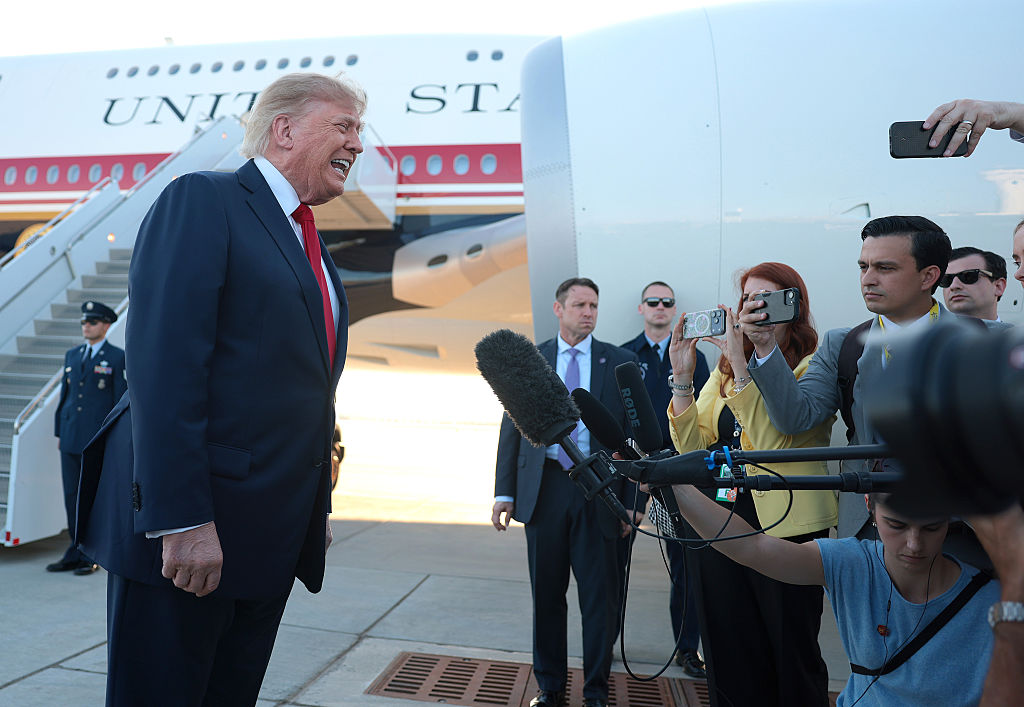
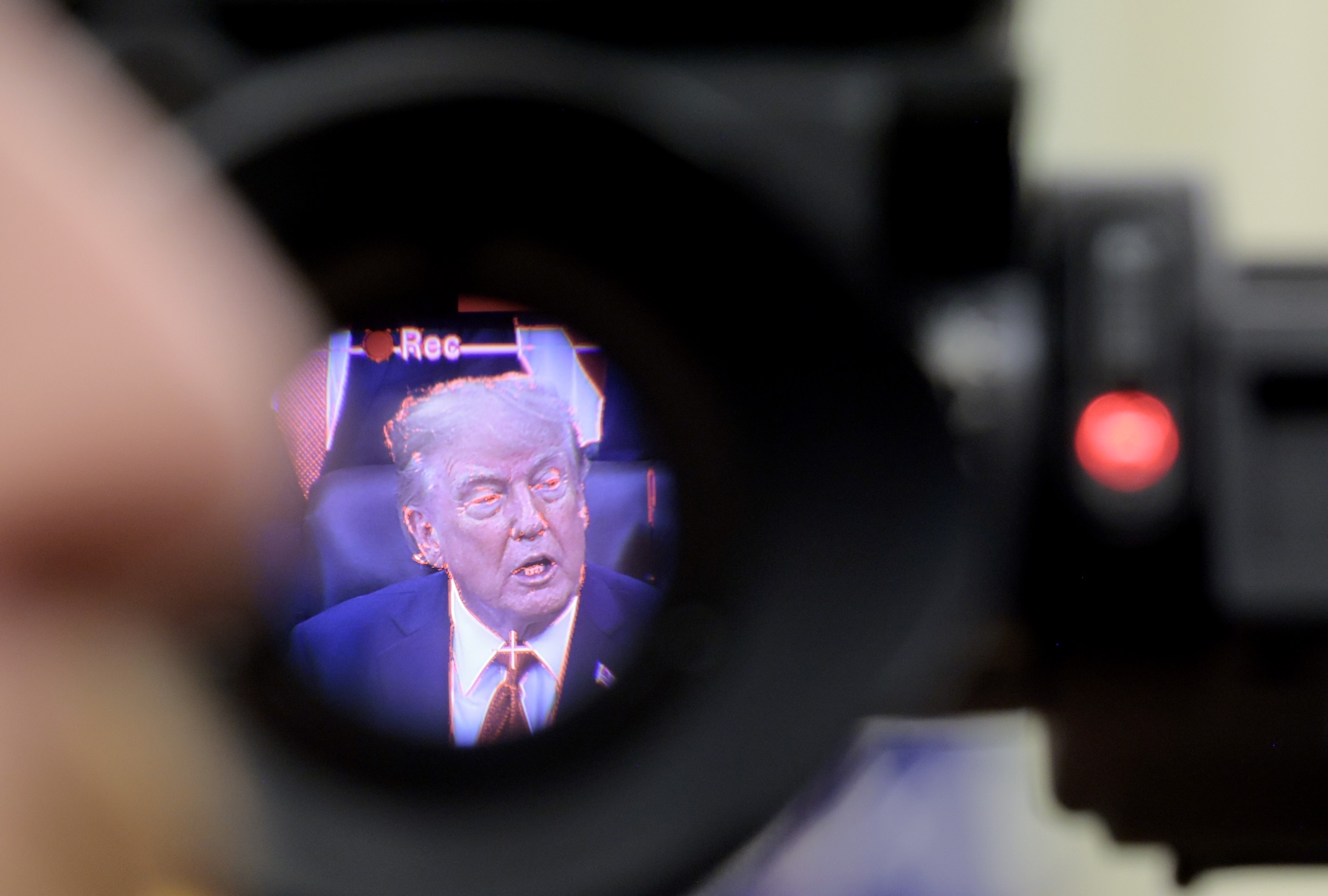
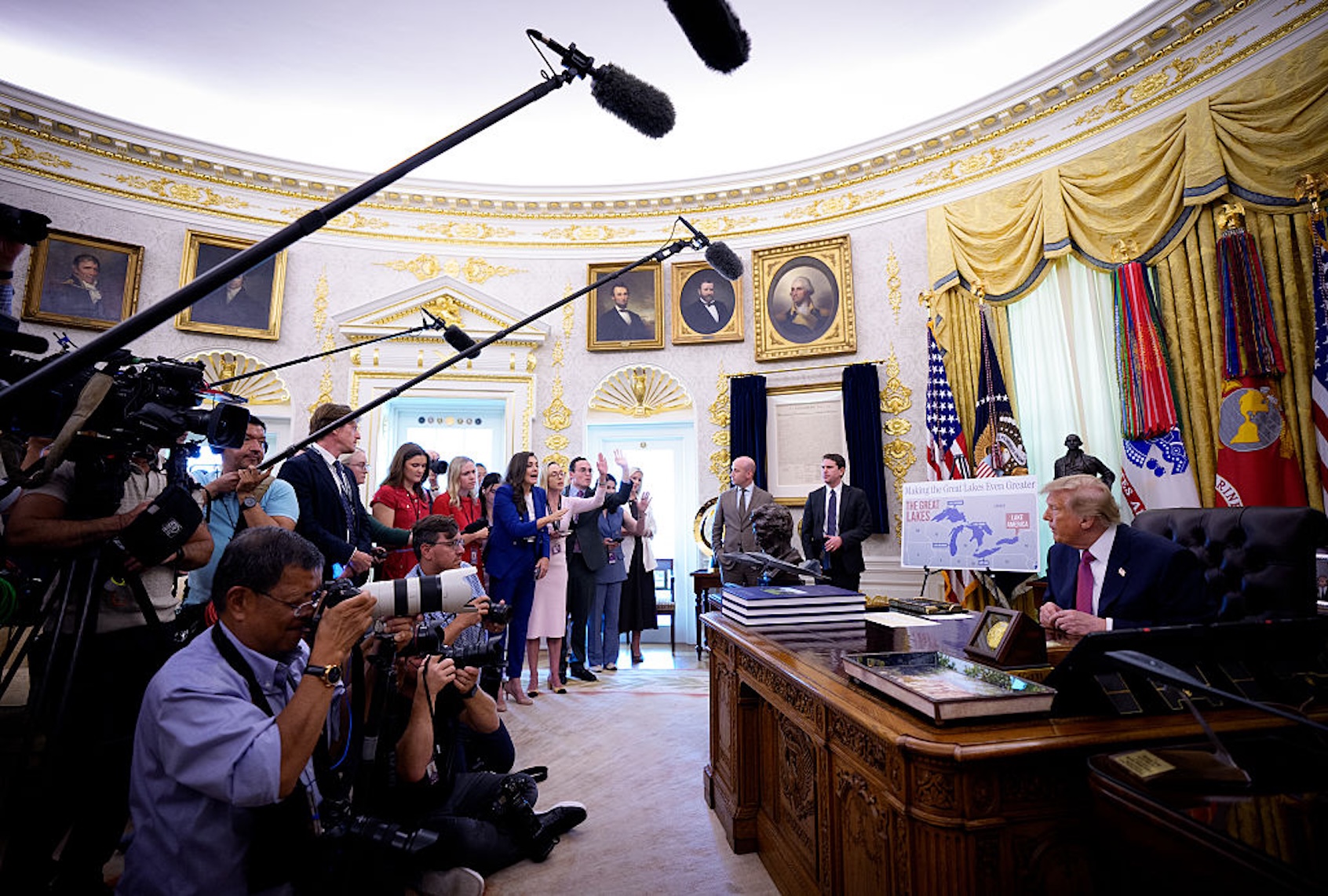
President Donald Trump’s administration barred CNN from traveling aboard Air Force One on Saturday, just two days after a federal judge ordered the White House to restore the network’s access.
CNN had been scheduled to serve as the television pool for Trump’s trip to Knoxville, Tennessee, where he was set to attend a college football game between the University of Tennessee and the University of Texas. Instead, White House guidance listed conservative network Real America’s Voice News for the trip.
Real America’s Voice is not a member of the five-network television pool, which rotates responsibility for recording presidential events and sharing the footage with other news organizations.
The latest restriction came less than 48 hours after U.S. District Judge Timothy Kelly temporarily blocked Trump’s ban on CNN, MS NOW and Politico from White House grounds. Kelly, whom Trump appointed during his first term, found that the administration had failed to provide the outlets with due process before revoking their access.
Reporters from all three organizations returned to the White House following the ruling.
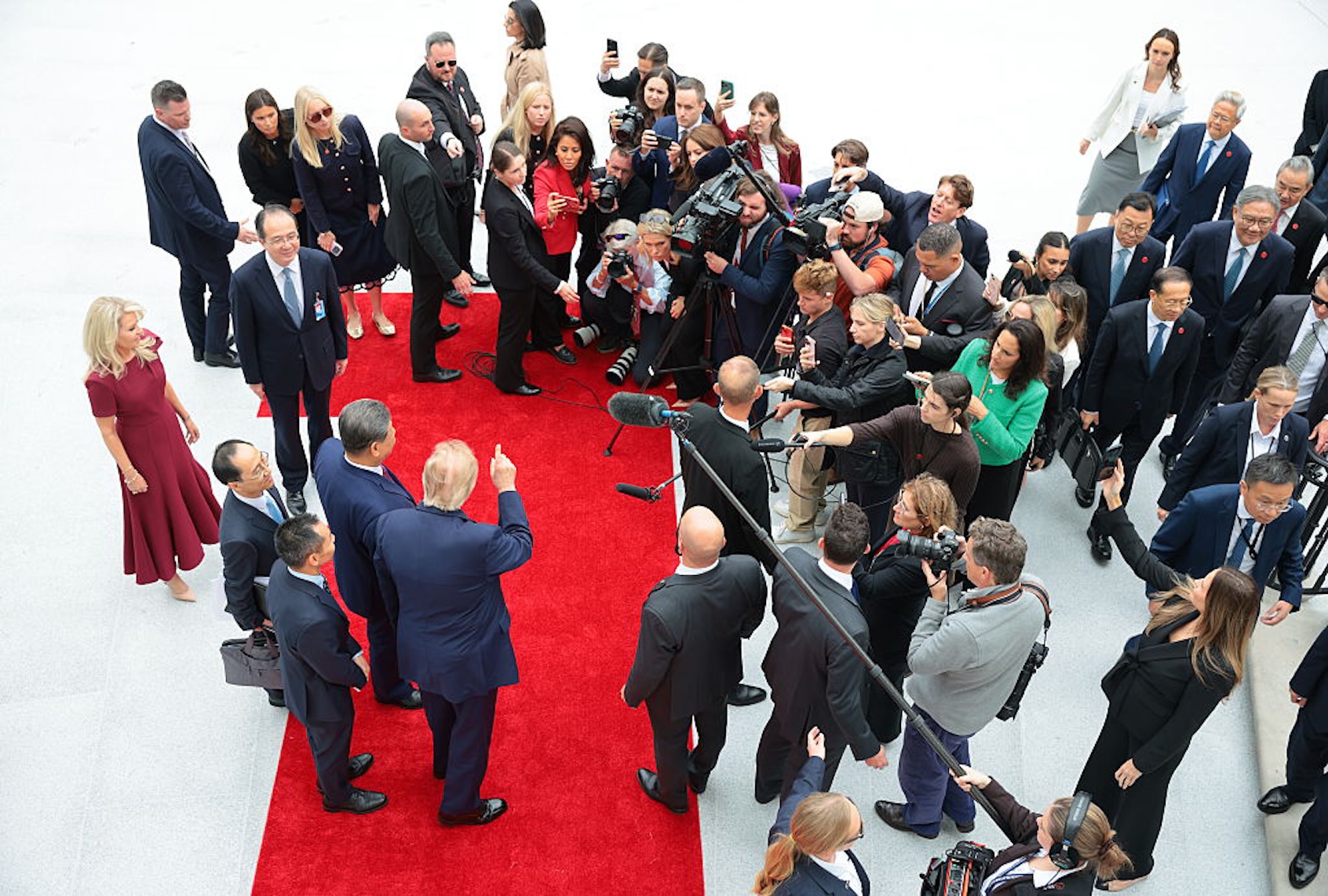
CNN also resumed its role in the television pool Friday, providing coverage as Trump and Chinese President Xi Jinping visited the National Archives. The other four television pool members had refused to participate after CNN was barred last week, leaving several presidential events without the usual network video coverage.
Kelly’s temporary order specifically addressed the outlets’ White House “hard passes” and did not directly address Air Force One or pool assignments. The news organizations have argued that the court’s ruling should apply to their pool access as well.
Trump, meanwhile, renewed his attacks on CNN Saturday morning.
“Why should perpetrators of FAKE NEWS, like CNN and MSDNC, be allowed access to a very sacred place, the White House?” Trump wrote on Truth Social.
The president also complained about negative coverage of his administration, days after criticizing CNN for supposedly failing to cover his events during the media standoff.
CNN correspondent Kaitlan Collins disputed that claim after Trump confronted her during the United Nations General Assembly in New York, where the White House had no authority over her credentials.
“We never said we were never going to cover the president,” Collins said.
Trump announced last week that CNN, MS NOW and Politico would no longer be permitted at the White House, accusing the organizations of spreading “fiction and lies.” The three outlets sued, alleging the ban violated their First and Fifth Amendment rights.
The dispute also disrupted the White House television pool. ABC, CBS, NBC and Fox News declined to provide substitute crews after CNN was removed from its scheduled assignments, temporarily leaving the administration without the network equipment normally used to distribute video and audio of the president.
Normal pool operations had only resumed Friday. And as of Saturday morning, CNN was off the rotation again.
There is a striking development buried inside the administration’s escalating confrontation with the press that’s turned a familiar Donald Trump-versus-the-media fight into a potentially consequential rupture inside the right-wing media ecosystem. By banning CNN, MS NOW and POLITICO, the president tried to extract a cost for challenging coverage. The move backfired. Instead, it united competitors behind a press-freedom principle, prompting Fox News — the biggest booster of Trump’s political ascent — to participate in an unprecedented pool-coverage stoppage.
Fox’s own Washington bureau chief, Bryan Boughton, who happened to be chairing the pool this week, sent the note announcing the shutdown. Now Peter Navarro, one of the president’s most loyal foot soldiers, is on a crusade against “the back-stabbing Fox News Corporation” and pushing the White House toward a punitive boycott of the outlet.
Navarro, the president’s senior counselor for trade and manufacturing, is actively orchestrating a campaign to persuade the White House to formally cut ties with Fox News and isolate the network, thereby dismantling its status as the supreme arbiter of conservative media. Calling it “CNN with better lighting, a fake slogan and a flag graphic,” he has accused the network of “helping the other side undermine the president.” In recent days Navarro has argued that Trump’s Cabinet secretaries and senior officials should stop appearing on Fox News and Fox Business. Not only has he attacked network executives, but he has also celebrated Real America’s Voice as a potential replacement for MAGA’s loyalties.
The proximate cause of Navarro’s rage is Maria Bartiromo, the Fox Business and Fox News anchor whose sudden firing earlier this month is key to understanding everyone’s motives in this fight. The longtime business host had been preparing to interview Navarro following Trump’s July 16 primetime speech in which the president made unsubstantiated claims about foreign interference in the 2020, 2022 and 2024 elections. After a Fox executive subsequently instructed her not to cover Trump’s claims, Bartiromo canceled Navarro’s appearance and shared the executive’s message with him. He then passed the communication up the White House chain of command. Fox treated the disclosure as a fireable offense, cutting Bartiromo loose after over 12 years, isolating her from her own staff in her final weeks and firing her executive producer alongside her. Trump himself seemed blindsided, posting that he “can’t believe” Bartiromo no longer has her shows.
Navarro has treated Bartiromo’s exit as proof of a wider “muzzling” of MAGA. He has spent the following weeks constructing an increasingly elaborate theory of Fox as captured territory, run by executives who he claims are secretly sabotaging the president. Writing in the Washington Times and The Daily Caller, he has laid out a rap sheet: Fox News Media CEO Suzanne Scott is, by his account, “the same executive responsible for the decapitation of three of the network’s most intelligent talk heads”: Lou Dobbs in 2021, Tucker Carlson in 2023 and now Bartiromo, all pro-Trump voices who were pushed out while “useful RINO idiots like Karl Rove” enjoy free rein to criticize Trump’s tariffs. Navarro accused Fox of joining the entire White House television pool — which consists of ABC, CBS, CNN, NBC and Fox — to form a “Five Network Cartel” exercising illegitimate “veto power” over what Americans see of their own president. In Navarro’s view, the only acceptable resolution would be a primetime apology from the network to Trump and its viewership.
Before he ran for office, Trump built his national political relevance through cable television, especially with Fox appearances during his birther campaign against President Barack Obama. Fox has been the top-rated network in total day and primetime cable news viewership every year since January 2002, a 24-year winning streak built precisely on the grievance-driven conservative audience that provided Trump with his political foundation. He, in turn, drove up the ratings even more.
Fox did not build Trump alone, and Trump did not cultivate Fox’s audience alone. But their feedback loop mattered enormously: Each gave the other cultural authority with conservative voters. Members of the president’s Cabinet — from Defense Secretary Pete Hegseth, a former “Fox & Friends Weekend” host, to U.S. Attorney for the District of Columbia Jeanine Pirro — were recruited directly from the network’s anchor desks.
Yet as Trump’s second administration reaches a critical turning point, that historic alliance has devolved into open, bitter warfare. The president’s own personal frustration with Fox predates even Navarro’s critique, though it often manifests in petty grievances and public score-settling. On Truth Social, the president has repeatedly vented his annoyance with the network, publicly berating anchor Shannon Bream — and misspelling the insult as “Milktoast” — for using outdated visual graphics of White House ballroom construction and for challenging Attorney General Todd Blanche on legal impartiality. Trump has similarly attacked Bret Baier and the network’s polling unit for displaying “Fake Polls” that reflect his declining national approval ratings.
Trump’s anger at Fox highlights a fundamental vulnerability for both himself and the network. Fox finds itself caught in an unsustainable commercial position; the network’s historically dominant ratings are showing signs of erosion as Trump’s poll numbers decline.
Trump’s anger at Fox highlights a fundamental vulnerability for both himself and the network. Fox finds itself caught in an unsustainable commercial position; the network’s historically dominant ratings are showing signs of erosion as Trump’s poll numbers decline. When Fox hosts attempt to reflect the changing mood of the public or question controversial policies, they face immediate backlash from both the White House and their core audience.
This friction has become acutely visible in recent months as prominent Fox personalities have openly broken with the administration on his war of choice in Iran. Anchors who are generally supportive of the president, including Laura Ingraham and Jesse Watters, have repeatedly questioned Trump’s handling of the ongoing war. The conflict has drawn strong disapproval from a large segment of Trump’s populist base, who are feeling economic pain at the fuel pumps and growing skeptical of the president’s repeated claims that the military engagement is drawing to a close. Former Fox stars like Tucker Carlson and Megyn Kelly have amplified this backlash from the outside, creating an unprecedented wave of right-wing dissent against the administration’s foreign policy.
Domestic economic policy has produced similar ideological fractures on air. Host Will Cain expressed visible frustration over Trump’s recent outreach to New York’s socialist mayor, Zohran Mamdani. Pointing to lip-reading analysis of off-mic exchanges where Trump invited Mamdani to the White House and offered to look after his interests, Cain warned that MAGA and democratic socialism were beginning to blur, citing data showing that over half of young conservatives support government-run grocery stores and more than 40% would welcome a Democratic socialist presidency.
A week after his Oval Office temper tantrum, Trump’s press crackdown has succeeded only in exposing deep ideological fractures within the conservative movement and uniting historically fierce media competitors against his overreach. (On Thursday, a Trump-appointed judge issued a temporary order restoring access of the outlets to the White House for 14 days, while the legal challenge is ongoing.)
The president’s crackdown assumed Fox would play the compliant beneficiary, scooping up airtime and access that CNN and MS NOW no longer had. Instead Fox recognized, correctly, that a press pool that can be selectively gutted by presidential fiat today is also one that offers no institutional protection to others tomorrow, including Fox itself. In fact, after pool coverage resumed on Friday, the White House barred CNN from traveling with Trump on Air Force One.
Instead of establishing Trump’s control over the media, the White House’s attempt at press suppression showed the limits of that control and, in the process, placed Fox News in the crosshairs of the very movement it helped build.
We’ve been afflicted with the Donald Trump show for far too long. For more than a decade, American public life has been suffocated by a relentless, 24/7 reality television nightmare centered on his insatiable ego. The entire political existence of the self-described “king of ratings” has depended on a toxic, symbiotic relationship with the press that consists of bombastic press conferences and constant visual dominance designed to suck all the air out of the room. But when a clown’s only trick is shouting into a live microphone, the absolute worst thing that can happen is for the cameras to simply turn off. It’s clear by this week’s spectacle that Trump cannot survive the possibility that America has finally changed the channel.
On Friday, in a fit of authoritarian pique, Trump banned CNN, POLITICO and MS NOW from the White House press pool. It was a classic bully move. Yet, in a rare and long-overdue display of institutional solidarity, the rest of the press corps refused to play along. Major networks including NBC, ABC, CBS and even Fox News suspended their pool coverage of the president. Photographers from major wire services and news organizations like The New York Times and The Washington Post stopped publishing new images of the octogenarian chief executive.
The immediate result was an unadulterated farce. Stripped of his apparatus, Trump stepped onto the White House lawn to host a ribbon-cutting ceremony for his prized new helipad. He preened, grabbed his oversized scissors and opened his mouth to boast, but no one could hear a single word over the deafening roar of Marine One’s idling engines. The White House’s own official feed lacked the audio equipment that network pool crews typically provide. Viewers were left watching a silent movie of a shrinking figure gesticulating wildly into the wind. Even anchors on right-wing channels like Newsmax were forced to admit on air that the media ban was backfiring.
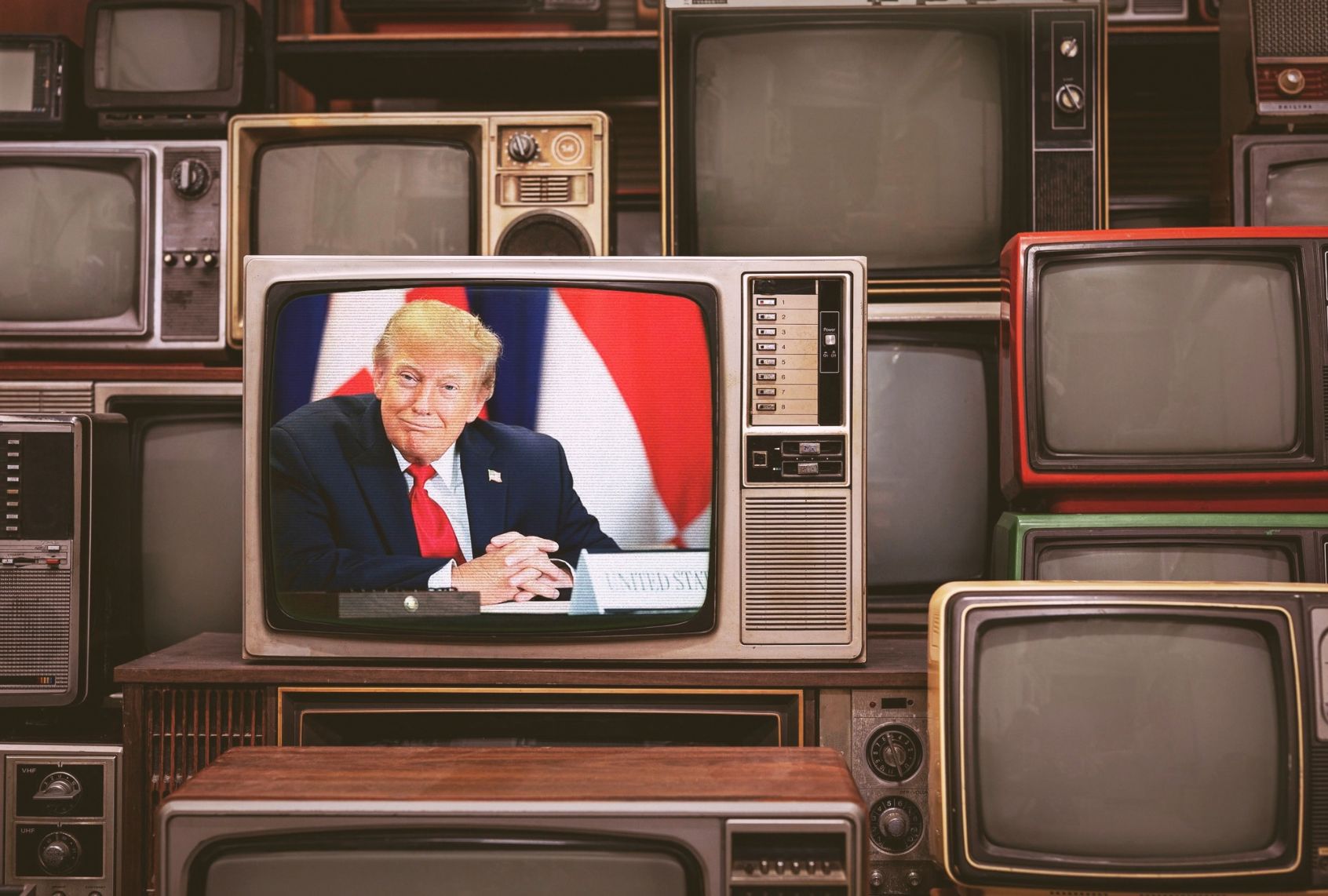
Trump got the closest thing to a full media blackout that modern television has ever handed a sitting president and his answer, apparently workshopped over a single weekend, was to build his own tiny replacement network out of recycled clips and call it a triumph. On Monday, the White House rolled out “Trump TV: The Essentials Station,” a 24-hour YouTube livestream on the official White House channel. The promotional hype promised an unedited, nonstop look at the administration’s “greatest hits” to circumvent the supposed censorship of the mainstream media. What they delivered instead was a glorified, automated graveyard of old clips. Viewers who tuned in expecting cutting-edge propaganda were greeted by a two-month-old Trump speech from Mount Rushmore, followed hours later by a rerun of a months-old address regarding creative uses for artificial intelligence and, eventually, a year-old broadcast of a dinner with Britain’s King Charles III. On Tuesday morning, while Trump was actually delivering a live address to the United Nations General Assembly, his own channel was airing his remarks from a prayer breakfast held at the White House in February.
The numbers tell the story. “Trump TV: The Essentials Station” went live on the White House YouTube channel Monday at 7 p.m. Roughly 8,000 people tuned in for the premiere. Ninety minutes later that number had been reduced by half. By the next morning, as the cable news shows Trump was supposedly trying to render obsolete came on the air, his own channel had cratered to a little over 1,000 viewers, out of more than three million subscribers to the White House’s YouTube account. The viewership figures were a brutal reality check for a man whose self-worth is entirely tied to Nielsen points.
Trump has spent a lifetime mistaking attention for affection and ratings for legitimacy. Reporting and testimony from Trumpworld have long suggested that his 2016 campaign began at least partly as a vehicle for attention, leverage and perhaps a Trump-branded media enterprise. He was reportedly shocked by his victory over former Secretary of State Hillary Clinton. But once he discovered that the presidency provided a permanent camera crew, a global stage and an endless supply of people forced to listen, he developed an addiction that makes the rest of his behavior easier to understand. Stripped of the drama generated by actual journalists asking tough questions, however, Trump’s unfiltered echo chamber is excruciatingly boring.
Trump TV’s desperate launch fits a decades-long pattern of grandiose vanity projects that inevitably collapse under the weight of their own cheapness.
Trump TV’s desperate launch fits a decades-long pattern of grandiose vanity projects that inevitably collapse under the weight of their own cheapness. Before he became president, he was a brand in search of a platform. The list of failed enterprises bearing his family moniker is as long as it is embarrassing. There were the frozen steaks, the fraudulent university, the ill-fated airline shuttle, the bankrupt Atlantic City casinos and a short-lived dating show spun off from “The Apprentice” that was canceled after two seasons. There was the failed search engine, the closed charity, the cheap furniture line and the mortgage company launched right before the housing bubble burst. Trump TV is merely the latest entry in a long line of hollow grifts.
Unable to command the airwaves from the Oval Office this week, Trump was forced to decamp to New York City to find a camera. In an ironic twist, the self-proclaimed media titan had to rely on a joint appearance with New York Mayor Zohran Mamdani — that reportedly angered some Republicans — to get his face back on television screen feeds. Standing at Gracie Mansion in the heart of liberal America, the president squeaked to reporters about how he had somehow beaten the boycott, boasting about the crowd of journalists while visibly shrinking in stature. Mamdani gracefully reminded the audience of the critical importance of a free press, while Trump predictably rambled about himself.
Later, at the United Nations, the president threw a visible tantrum when he spotted CNN reporter Kaitlan Collins in the briefing room, whining that she should not be allowed to cover him because of the network’s stance. Collins calmly noted that her credentials were issued by the U.N., not the West Wing, and proceeded to press him on national security concerns surrounding his unsanctioned military maneuvers in Iran.
It’s becoming clearer every day that the country is already moving past the Trump show. Beyond the broadcast networks, the wider media ecosystem is tuning him out. An analysis of nearly 70,000 hours of political podcasts conducted by The Wall Street Journal revealed that mentions of Trump’s name on conservative platforms have plummeted by nearly 70% from their 2024 pre-election peaks. His audience is exhausted.
None of this is merely embarrassing. It is also very possibly illegal — and not in some abstract, symbolic sense.
For 75 years Congress has barred federal agencies from spending appropriated money on publicity or propaganda that lawmakers haven’t explicitly authorized, a restriction currently codified as Section 718 of the Financial Services and General Government Appropriations Act. Any government resource used to produce partisan content that glorifies an official or an administration runs straight into that wall, and there is no minimum dollar threshold that makes a violation too small to count. Under the Antideficiency Act, federal employees who knowingly commit the government to spending beyond its appropriations for such content face fines up to $5,000, up to two years in prison or both, with a five-year statute of limitations that will still be running long after this administration leaves office. Slapping the Trump name on the Kennedy Center, hanging his portrait on federal buildings and, now, producing a taxpayer-funded YouTube channel that exists to replay his own speeches with no disclosed staff and no editorial standard — all of it likely clears that bar. Nobody expects this Justice Department, led by Trump’s former personal attorney Todd Blanche, to prosecute itself. But somebody is eventually going to have to answer for how the funds behind Trump TV were spent and justified.
The legal fight over the press ban itself is proceeding on a parallel and even more consequential track. CNN, POLITICO and MS NOW sued the administration Monday, arguing that stripping their credentials without notice or a chance to respond violates due process and the First Amendment. Their case leans on Sherrill v. Knight, the 1977 D.C. Circuit ruling that grew out of a reporter’s fight over a revoked White House press pass and established that access, once granted to bona fide journalists, cannot be pulled arbitrarily or because officials dislike what someone writes. The judge assigned to the case is Timothy Kelly, a Trump appointee who, in an earlier chapter of this same fight, ordered the White House to restore then-CNN correspondent Jim Acosta’s credentials back in 2018, citing that very precedent.
In its response this week, the Justice Department didn’t just defend the specific ban. It asked the courts to overturn Sherrill entirely, arguing that access to the White House is a privilege rather than a right, and that the president should have the same discretion over the whole complex that he has over more sensitive spaces like the Oval Office. The filing is not a defense of one bad decision. It is a request for permission to make the president’s media ban permanent, to convert selective access into a standing tool for punishing unfriendly coverage every single day this administration remains in office, regardless of how this particular ban is ultimately resolved.
The cruelest, most effective thing the press could do right now is exactly what it is already doing: nothing. Keep the boycott going. Let the Trump TV feed play to a couch of true believers and stray insomniacs. Trump has spent his entire adult life treating attention as oxygen, and for the first time in a decade, the room has actually gone quiet around him.
Blame Natalie Harp. On Friday, seemingly out of nowhere, Donald Trump banned CNN, POLITICO and MS NOW from the White House after whining for the umpteenth time about “Fake News,” his decade-long catchphrase to demonize accurate but unflattering press coverage. (It remains unclear if the president, whose paternal grandfather was from Germany, knows the term is an English translation of the infamous Nazi term “lügenpresse.”) Trump has been complaining about the media’s insufficient reverence for him throughout his entire political career, but there seems to be no precipitating cause for this particular tantrum. To the contrary, POLITICO reported that “senior staff were surprised by the directive, which happened while chief of staff Susie Wiles was out of town.”
“You get sick of it,” was all Trump would offer in the way of explanation for his media ban.
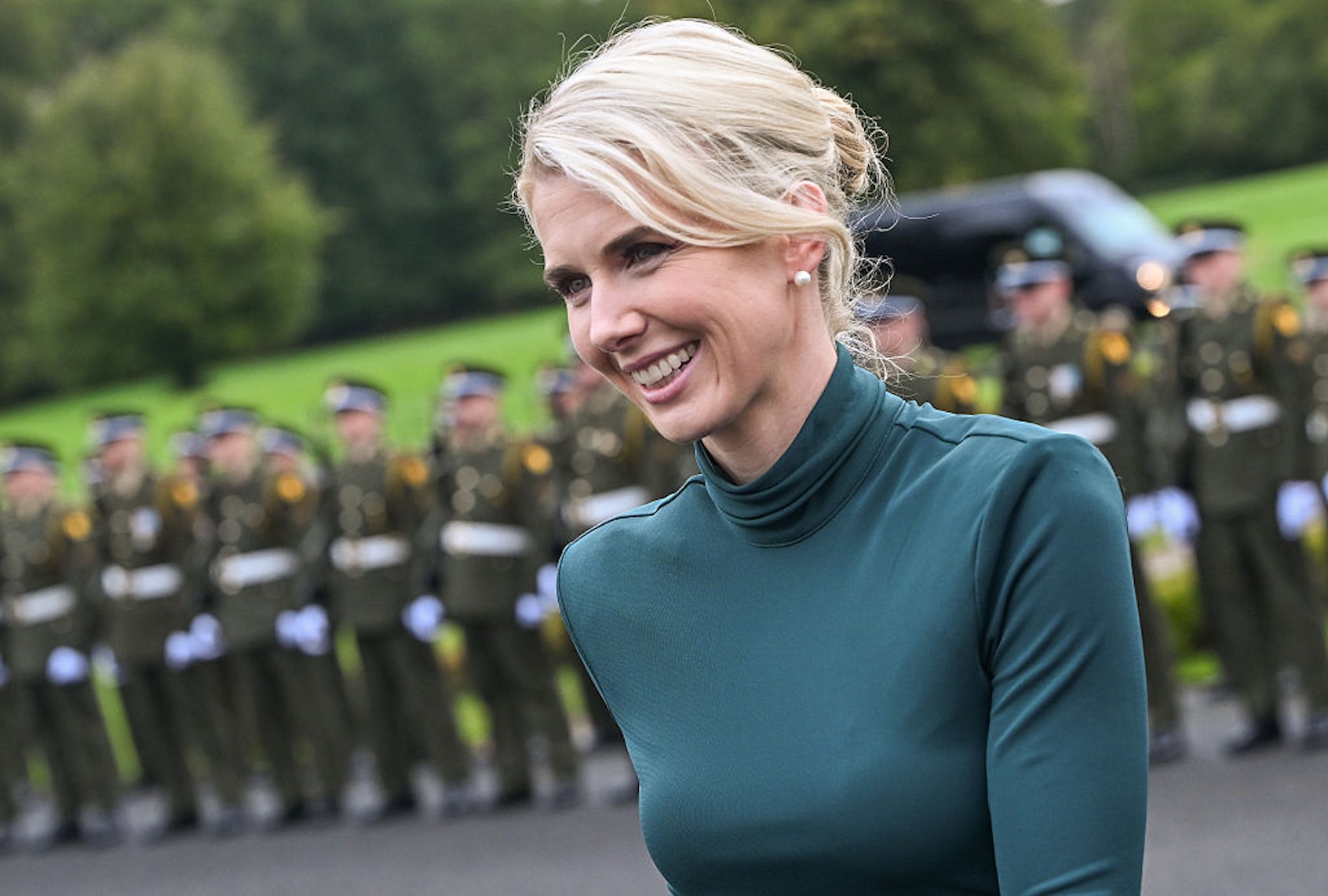
Soon, though, reports showed that it was likely a response to provocations from Trump’s aide, Natalie Harp. “Aide” is probably too generous a word for Harp’s job, which is reportedly to follow the president around and attempt to soothe him with an endless barrage of flattery from herself and with print-outs of his followers saying nice things about him online. Even though she recently wrote “I never want to bring you anything but joy” to the man she she calls her “Guardian and Protector,” it appears Harp is actually quite comfortable showing Trump materials guaranteed to hurt his notoriously fragile ego.
The Wall Street Journal reported that Harp “showed him clips of anchors on the cable network MS NOW criticizing his administration” on Friday, which sent the agitated president into “a fever pitch.” CNN followed up with a report that she also provided him with clips from CNN and POLITICO, resulting in a rage from Trump that led to an impulsive ban of the three outlets.
Harp became famous earlier this summer, when Sen. Jon Ossoff, D-Ga., mentioned in a campaign speech that Trump would rather “travel with Natalie” on the new Air Force One than do his job as president. The White House responded with a five-alarm overreaction, a move that only served to draw more attention to his relationship with a woman that New York Times journalist Maggie Haberman has described as Trump’s “human binky.” At first, the relationship was mostly the source of mockery that someone of the his stature apparently needs a full-time ego masseuse who often totes around enormous bags, which have generated speculation about their contents. (Some have connected them, with no concrete evidence, to the strange shape of the president’s prominent posterior.)
This new wrinkle in the Harp story, though, suggests that she’s not just a human Band-Aid for Trump’s insecurities — she is actively dangerous. It’s unclear why she apparently showed the president clips that were guaranteed to anger him, but the result is that he launched the most serious assault in his ongoing war on the free press and the First Amendment. The episode shows that Harp isn’t just there to flatter and soothe Trump; she is also willing to get him worked up so that his terrible decision-making skills deteriorate even further.
This move works out very nicely for Harp; it will almost certainly make Trump more dependent on her. She’s setting up a contrast for the praise-hungry Trump, between the “nasty” media that says stuff that offends his ego and what she has on offer as a lithe blonde exalting his magnificence. Plus, having had his feelings hurt by the press coverage, he’ll be even more eager for her services as a professional ego-fluffer.
As his press ban shows, Trump’s sense of entitlement and demands for adulation are getting worse, making him more prone to lash out at those he feels show insufficient deference.
The situation is potentially dangerous for the country. As his press ban shows, Trump’s sense of entitlement and demands for adulation are getting worse, making him more prone to lash out at those he feels show insufficient deference. He also seems to feel less constrained by the law in exerting his power to punish those who aren’t sufficiently compliant, an attitude that goes beyond his outrage at the media. For months, Trump has been illegally withholding federal funds to states that didn’t vote for him.
The president’s addiction to flattery has always made him vulnerable to manipulation by bad actors. But this appears to have increased during his second term. Nowhere is this more obvious than with his war in Iran. Israeli Prime Minister Benjamin Netanyahu and hawkish Republicans, led by the late South Carolina Sen. Lindsey Graham, spent years trying to lure the U.S. into a war with the Islamic Republic. They were unsuccessful, never quite able to persuade past presidents, including Trump in his first term, to ignore the military experts warning against taking action. But in February, Graham finally managed to get Trump over the line, appealing to his vanity by shamelessly comparing him to Franklin D. Roosevelt.
This time, Trump’s demand for nothing but fawning coverage backfired. The major networks that comprise the White House press pool, including Fox News, responded to the media ban with a boycott. “Mr. Trump, for whom television is better than any narcotic, finds himself for the first time at least partially deprived of the major networks that have covered nearly every movement and utterance he has made for more than a decade,” wrote Peter Baker of the New York Times.
Deprived of his attention fix, the president visited New York City Mayor Zohran Mamdani at Gracie Mansion on Monday, crowing, “They never boycott me” and “Look at all that press,” ignoring the fact that they were there at the invitation of the popular Mamdani and not himself. In reality, the boycott has already resulted in one major humiliation for Trump. The president’s comments were inaudible during a ribbon-cutting ceremony for his vaunted South Lawn helipad because his streaming team couldn’t get the sound working in the absence of CNN.
Now the White House is attempting to salve the president’s wounded ego by launching “Trump TV,” which appears to be nothing more than a hasty rebranding of the existing in-house video team that livestreams events on social media. This is unlikely to quell Trump’s angst over losing the media coverage he himself banned, especially since the White House livestreams have already given his team headaches in the person of Aaron Rupar, the independent journalist who seizes opportunities to grab unflattering shots of the presidential backside.
Trump very obviously craves the validation that can only come from getting attention from major media outlets. While he may have a professional enabler in Harp, nothing can beat the narcissistic fix of national cable news coverage. Even she probably can’t keep him from soon rescinding the ban and recovering his access to those sweet, sweet cameras.
Read more
from Amanda Marcotte about the Trump administration
On Monday, President Donald Trump launched what is ostensibly state-run media, dubbed “Trump TV,” while decrying the “fake news” media. Late last week, Trump abruptly banned CNN, MS Now and Politico from the White House. In response, the outlets sued on First Amendment grounds as major television networks — including ABC, CBS, NBC and even Fox News — boycott the White House press pool in solidarity. During one press conference Monday, Trump was completely inaudible while C-SPAN said it would not show the president’s White House helipad ribbon-cutting because it relies on the pool for its feed.
So now Trump is launching his own news service, which is mostly just a live feed on the White House app and YouTube channel. “The press, in some cases, reported inaccurately or not at all on the Administration’s many record breaking accomplishments on behalf of all Americans,” Kaelan Dorr, the White House head of digital strategy, claimed on social media. “Trump TV is a 24/7 livestream of the Administration’s greatest hits, unfiltered.”
Such greatest hits include, according to Variety, “Trump’s July 3, 2026, speech at Mount Rushmore, in which he dubbed his political rivals ‘godless’ and ‘evil’ communists.” Yet Trump TV is attracting comparisons to state-run TV in actual communist countries like China and North Korea, though with presumably much less viewership. “At its launch Monday night, Trump TV peaked at 8,000 viewers, dipping to around 4,000,” the Independent reported.
“It’s official, we live in North Korea,” commentator Dean Withers said, while Trump’s former White House Press Secretary during his first term, Stephanie Grisham, said “Trump TV” is similar to what U.S. adversaries use. “You know who else does this? Russia, China, and Iran to name a few…”
“This is truly autocratic behavior from a failed President,” California Gov. Gavin Newsom, a Democrat, said on X.
One of the largest media mergers in history has been given the green light after California and 11 other states settled lawsuits Monday. For most of the year, Paramount Skydance has tried to purchase Warner Bros Discovery for a reported $110 billion, but those efforts were stalled over the summer.
Paramount and the states agreed to certain concessions to complete the deal, California’s attorney general Rob Bonta said at a news conference. Bonta led the coalition of states, plus a Hollywood writers union, that sued in July to stop the merger.
“This settlement is not a vote of support for this merger. It is not a blessing of the broader merger,” Bonta said Monday. “Broadly speaking, we believe further consolidation of markets that are central to American economic life doesn’t serve the American economy.”
The Block the Merger Coalition released a statement saying “This is a bad deal for the future of film, entertainment, independent journalism and a strong democracy in this country. We are disappointed and angry that the interests of average Americans have been trampled to benefit oligarch billionaires.”
“A completion of the blockbuster deal would create one of the largest entertainment companies in the world,” the New York Times reported. “It would pair Paramount’s movie studio with Warner Bros., which has made films like ‘Superman,’ ‘A Minecraft Movie’ and ‘Sinners.’ The combined company would also own two major streaming services, Paramount+ and HBO Max, and control both CNN and CBS News.”
Additionally, CNN reported, it will be “financed with the help of sovereign wealth funds from Saudi Arabia, Qatar and Abu Dhabi that will indirectly own just under a 50-percent equity stake in the merged Paramount–WBD.”
The clear winner in the deal is David Ellison, Paramount’s CEO and son of billionaire Larry Ellison, co-founder of the tech company Oracle. Both Ellisons are allies of President Donald Trump, whose Federal Communications Commission on Thursday approved Paramount’s petition to allow 49.5% of its equity to be held by foreign entities. There is normally a 25-percent cap on foreign broadcast ownership.
Last week, Fox News seemed to be trying to give Donald Trump what he wanted. Network personalities went on air and recited, with all the enthusiasm of a sixth grader reading a book report he skimmed on the bus, the rosiest possible version of Trump’s economy. Will Cain stood in front of a big board and tried to force-feed viewers praise for an economy that much of the public sees as failing them and their families. Greg Gutfeld, in the familiar performance of a man discovering empathy only when the numbers flatter his side, acted surprised to care about falling poverty statistics. It all had the feel of a network reading from the same set of talking points, dispatched from somewhere on the C-suite level, hurrying to convince viewers that Trump’s economy is thriving.
But that synchronized propaganda blitz flopped.
Whatever the assignment was supposed to accomplish, it did not appease the man it was designed to flatter. By the end of the week, the president who had just been handed hours of favorable spin by the most watched cable network in the nation let out a tantrum so large it swallowed three unrelated newsrooms. Facing a failing presidency, crashing poll numbers, the prospect of a Democratic wave in November’s midterms and zero sense of a second-term agenda, Trump just up and banned CNN, Politico and MS NOW from the White House for seemingly no reason. On Monday, they announced they were suing to reinstate their access.
Trump did not identify a specific false report or allege a security breach to justify his radical action. Instead, his stated offense was simply that these outlets had produced too many negative stories over too much time.
“On Friday the press shop was blindsided,” Politico reported, as the directive happened while chief of staff Susie Wiles was out of town. Still, the latest retaliatory purge was as pathetic as it was predictable. Trump did not identify a specific false report or allege a security breach to justify his radical action. Instead, his stated offense was simply that these outlets had produced too many negative stories over too much time. By Saturday morning, reporters from all three outlets were turned away at the White House gates.
Fox News barely let out a peep. And the rest of the White House press corps — the reporters who share vans and pool feeds and holiday parties with the people just banished — did what they have done for a decade now. Mostly nothing.
That appears to have changed Monday morning. Late Sunday night, the administration announced it was banning CNN from serving in its previously scheduled slot as the television pool representative for the White House press corps — a marked escalation of the situation. In response, major networks including ABC, CBS, NBC and, notably, Fox News — agreed to suspend their pool coverage of Trump in solidarity with CNN. In a joint statement, the four networks, along with CNN, said, “The public has a vital interest in receiving accurate, independent information about its government. No administration should restrict a news organization because it objects to its reporting.”
New York Times reporter Peter Baker pointed out the historic nature of this event: “For the first time in my 30 years of covering the White House, the president will not have a network TV camera covering his everyday official actions and travels.”
At least until this point, Trump knew the press corps’ dirty little secret: It was far too late for symbolic outrage to substitute for collective action. The press has spent years teaching Trump that it is possible to divide journalists from one another. He recognized that much of the Washington press corps will deplore his conduct in a statement, and then show up for the next photo-op, fight for the next pool slot and keep treating access to an increasingly authoritarian White House as a professional prize. He believed, with good reason, that outlets like Fox News will even frame the exclusion of their peers as a partisan squabble in an effort to appear balanced.
In 2009, when Barack Obama’s White House tried to marginalize Fox News by excluding the network from an interview with Treasury official Kenneth Feinberg, the other television networks pushed back. The attempt was temporary — exclusion from one specific interview, not an announced and potentially expanding ban on multiple major outlets from White House grounds because their reporting offended the president. But the other four major television networks — ABC, CBS, NBC and CNN — refused to participate if Fox was excluded.
The Washington bureau chiefs delivered a clear ultimatum that either Fox News is allowed in the room, or nobody goes in. Jake Tapper, then at ABC, confronted White House press secretary Robert Gibbs in the briefing room and asked him directly why it was appropriate for the government to declare a news organization illegitimate. (Fox lawyers later argued in court that hosts like Tucker Carlson cannot reasonably be considered legitimate sources of news.) Facing a unified front from a press corps that put constitutional principles ahead of commercial rivalries, the Obama administration backed down immediately.
That moment demonstrated the power of absolute press solidarity. The networks did not defend Fox News because they agreed with its right-wing bias, but because they understood the precedent that would be set if a president were permitted to ban a critic from the room. Once the government establishes press facilities and admits credentialed journalists to gather news, it cannot hand access out according to ideological loyalty.
But that solidarity fractured in the years that followed. With Trump’s rise and his infamously leaky first term, White House reporters have seemingly surrendered to access journalism. When he descended his golden escalator at Trump Tower in 2015, major television networks traded journalistic rigor for spectacle. They broadcast his rallies uninterrupted, handing him billions of dollars in free airtime to normalize his attacks on democratic norms. In 2018, the administration pulled CNN White House correspondent Jim Acosta’s press credentials after he refused to hand back a microphone during a heated exchange. CNN sued, other outlets filed friend of the court briefs, and the administration eventually folded and restored his pass. Although imperfect, this response demonstrated that the old model still worked.
In 2025, Trump tried it again, this time against the Associated Press, after the wire service declined to rename the Gulf of Mexico on his say so. The AP sued. Fox News, NBC, the New York Times and the Washington Post all filed amicus briefs on the AP’s behalf, and a Trump appointed district court judge, Trevor McFadden, ordered the ban lifted from the broader White House grounds, even as an appeals court let Trump keep the AP out of the Oval Office, Air Force One and Mar-a-Lago while the case proceeds. All the while, the president held press avails in which he continued to attack the press.
Trump understands how to exploit every weakness the media has cultivated, like its addiction to spectacle. He insults a reporter, and the clip runs all day. He threatens a network, and the network gets a bump in attention.
Trump understands how to exploit every weakness the media has cultivated, like its addiction to spectacle. He insults a reporter, and the clip runs all day. He threatens a network, and the network gets a bump in attention. He calls the press “the enemy of the people,” then calls individual reporters when he wants to plant a story or manipulate a news cycle. He denounces the New York Times as “fake news,” then sits for lengthy interviews with its reporters when they are writing books he hopes will immortalize his preferred version of events. At this year’s White House Correspondents’ Dinner, Trump turned CNN’s Kaitlan Collins into a target of misogynistic ridicule while the assembled press corps remained seated.
This breakdown of solidarity among the press corps has allowed Republicans to build a false narrative around media access. After Trump announced his ban on CNN, Politico and MS NOW, the conservative political machine rallied to defend the blatantly unconstitutional act with a familiar bait and switch. Trump allies like Arkansas Gov. Sarah Huckabee Sanders, Centers for Medicare and Medicaid Services administrator Dr. Mehmet Oz and House Majority Leader Steve Scalise, R-La., absurdly claimed no president has been more open to the press than Trump and mocked the idea that press access requires actual access. Scalise repeatedly parroted the debunked claim that Joe Biden revoked the credentials of 400 reporters, a distortion fact-checked by ABC’s Jonathan Karl, who noted that only one reporter was ever denied a credential under Biden. The rest simply hadn’t reapplied and were let in anyway. United Nations Ambassador Mike Waltz told CNN’s own Dana Bash that he backs banning her network. Fox News contributor Joey Jones, whose colleague Jacqui Heinrich is the current White House Correspondents’ Association president, casually remarked that he would not “shed a tear” over the banned journalists. Heinrich, Fox’s White House correspondent, rightly condemned the ban as an unequivocal violation of the First Amendment.
Fox’s opinion side has spent a decade building an audience that treats CNN’s misfortune as content. In that time, Fox News paid $787.5 million to settle Dominion Voting Systems’ defamation lawsuit after internal communications revealed how Trump’s false election claims were knowingly aired and promoted.
But Monday morning’s news that at least some of the past solidarity has returned is heartening — and it stands as a rebuke to an out-of-control president and administration that thinks they can bulldoze the media into submission. Still, the damage has been done. While a legal victory for CNN, Politico and MS NOW is probable, it will in all likelihood come months from now, after the outlets have been shut out of covering the president during the most consequential midterm season in a generation. That is not the same as winning.
Executive power cannot be checked by the courts alone; it must be checked by real-time resistance from reporters. Monday’s collective action is a meaningful first step. Now there should be another: while the lawyers argue the case in federal court, the rest of the White House press corps should make sure the chairs in the briefing room are empty.
UPDATE: This story has been updated to reflect Monday morning’s news that ABC, CBS, Fox News and NBC are suspending pool coverage in solidarity with CNN, and that CNN, Politico and MS NOW are filing suit to regain access to the White House.

 Login
Login