The EU’s antifraud watchdog said it has passed on to prosecutors allegations of potential corruption at the European Economic and Social Committee, a Brussels-based body that advises the EU on proposed legislation and policy.
OLAF, the antifraud office, received a report from whistleblowers earlier this year saying there was a conflict of interest in the management of funds at the EESC, which is financed by the EU. It has now passed the case to the European Public Prosecutor’s Office.
OLAF’s press office told POLITICO it had sent the case to EPPO but added that it could not comment further.
The EPPO did not immediately respond to a request for comment.
“The EESC was informed by OLAF yesterday that this case has been transmitted to the EPPO,” an EESC spokesperson told POLITICO.
“Under these circumstances, the EESC cannot comment further except to re-confirm that when these matters first arose, the EESC president immediately and proactively referred the allegations to OLAF. The EESC will continue to respect fully the independence of this process.” Séamus Boland of Ireland was elected president in October 2025.
“The EESC and its senior leadership take this matter very seriously and remain fully committed to integrity, transparency and accountability,” the spokesperson added.
The EPPO has significantly stronger enforcement powers than OLAF. Whereas OLAF conducts administrative investigations, the EPPO investigates crimes against the financial interests of the EU, and can search private homes or seize evidence.
OLAF has also been investigating a report that EESC executives tried to smoke out a staff whistleblower who raised the alarm about the funding concerns, the EU Ombudsman told POLITICO.
Anonymous letters, seen by POLITICO, say that IT workers at the EESC were asked by senior managers to identify which staffers had connected to the OLAF website in previous weeks.
The EESC said those anonymous letters contained “serious personal threats” and added that they were not made through the EESC’s “robust formal whistleblower process.”
La volonté de la Commission européenne de rendre les milliards de l’UE plus réactifs aux crises à venir pourrait aussi les rendre plus exposés aux risques d’abus, avertit la Cour des comptes européenne.
Son président Tony Murphy alerte que les principaux piliers de la réforme du budget à long terme de l’UE, élaborée par la Commission, risquent de brouiller la vision des agents chargés de veiller à ce que les fonds publics soient dépensés comme prévu.
“Il nous est plus difficile de suivre l’argent”, a-t-il souligné. “On dit à l’Etat membre : ‘Voici une somme considérable, et vous faites en sorte que tout est en ordre.’ C’est en quelque sorte d’autocontrôle.”
Cet avertissement intervient alors que l’épineux débat du montant du budget 2028-2034 de l’UE est au menu du sommet des dirigeants européens à Bruxelles cette semaine, et que la Cour a constaté une augmentation des irrégularités dans l’utilisation des fonds publics.
Outre le montant total des moyens, se pose la question de leur répartition. Après un cycle budgétaire marqué par la pandémie, les guerres et les conséquences du changement climatique, la Commission souhaite rendre le prochain budget plus agile. Pour ce faire, elle prévoit d’en affecter environ la moitié — soit près de 1 000 milliards d’euros sur sept ans — à une enveloppe unique dans laquelle les pays pourront puiser pour remplir leurs objectifs dans des domaines comme l’immigration, l’agriculture ou le développement régional.
Ces fonds destinés à l’agriculture et au développement régional — souvent octroyés sous forme de subventions aux exploitations agricoles et aux projets locaux — sont depuis longtemps exposés à la fraude et aux détournements.
Selon Tony Murphy, accorder aux gouvernements nationaux une plus grande marge de manœuvre pour réorienter leurs dépenses rendrait le suivi de ces dernières encore plus difficile.
“Il y aura une certaine flexibilité, mais à quel prix ?”, a-t-il soulevé lors d’une interview. Une grande partie du contrôle dépendra des mesures de surveillance que chaque pays a déjà mises en place.
D’autant que les irrégularités dans l’utilisation des fonds du budget de l’UE sont en hausse. Les erreurs de versement se sont élevées à 5 milliards d’euros l’année dernière, selon le dernier rapport de la Cour des comptes européenne.
Dans le prochain budget de l’UE, il pourrait même s’avérer impossible d’estimer ce chiffre, a prévenu Tony Murphy, car les auditeurs de chaque pays ont des rôles et des méthodes de travail différents. “Année après année, nous avons constaté que le travail de ces autorités d’audit n’est pas entièrement fiable”, a renchéri son chef de cabinet, Wolfgang Stolz, lors de l’entretien.
Dans un communiqué, la Commission a défendu sa proposition, soulignant que les “principes fondamentaux” du système de contrôle actuel resteraient en vigueur. Les autorités nationales “fonctionnent bien”, a-t-elle affirmé, tout en précisant qu’elle se réservait le droit de demander aux Etats membres de “modifier le plan ou de mettre en place des mécanismes de correction si nécessaire”.
Des fonds mélangés aux budgets nationaux
L’une des innovations proposées par la Commission consiste à intégrer la politique agricole commune (PAC) — qui constituait jusqu’à présent une ligne budgétaire à part entière — dans un fonds gigantesque appelé plan de partenariat national et régional.
Tony Murphy a souligné qu’il ne prônait pas un modèle plutôt qu’un autre. Mais à mesure que les fonds européens s’intègrent de plus en plus aux budgets nationaux, il sera plus difficile pour Bruxelles de contrôler où va réellement son argent. La PAC est plus facile à contrôler lorsqu’“elle n’est pas mélangée à ce méli-mélo”, a estimé le président de la Cour des comptes européenne.
Les articles de presse sur des subventions agricoles versées pour de faux pâturages en Grèce ou sur des fonds destinés à soutenir le tourisme rural en Slovaquie qui financent de luxueuses villas pour les riches illustrent de manière frappante la difficulté de contrôler ces versements dans le cadre du système actuel.
Et le modèle sur lequel repose le nouveau système de dépenses — le fonds de relance post-Covid de l’UE — n’est pas de bon augure, a pointé Tony Murphy. Si les pays ont désormais plus de facilité à affecter les fonds là où ils sont nécessaires, les dépenses sont également devenues plus opaques. Les nouveaux plans nationaux ont été élaborés selon le même modèle.
Dans le cadre du système budgétaire actuel, la Cour des comptes européenne peut se rendre physiquement sur place dans une exploitation agricole bénéficiant de fonds européens. En revanche, dans le cadre du fonds de relance post-Covid, l’UE ne publie chaque année que la liste des 100 principaux bénéficiaires.
“Ce n’est pas très transparent. Je veux dire, où va réellement l’argent de l’UE ? C’est ça qui compte”, a insisté Tony Murphy. “On a un fonds qui regroupe différentes politiques publiques, avec des objectifs et des échéances complètement différents, des mécanismes de mise en œuvre différents et moins de prévisibilité.”
Cet article a d’abord été publié par POLITICO en anglais, puis a été édité en français par Jean-Christophe Catalon.
TIRANA — The College of Europe’s Tirana office was among the latest casualties of escalating student protests gripping the Albanian capital.
The office for the school, which serves as a training ground for future EU civil servants, was broken into, looted and set on fire on Wednesday evening.
“Until yesterday, this was the office of the College of Europe,” Albanian Prime Minister Edi Rama said in an Instagram video delivered from the burned-out shell of the office. Rama’s own workplace is a stone’s throw from the Pyramid complex housing the College of Europe.
Rama said he did not believe the damage was down to the students. “Students are the future, they are the ones who look ahead, who want to go further and faster,” he said.
Instead, he accused his political opponents of being behind the destruction, claiming that they were attempting to undermine Albania’s progress. The opposition parties deny any wrongdoing.
The College of Europe in Tirana refused to comment.
Protests in Albania have been ongoing since late May against the proposed development of a luxury resort linked to U.S. President Donald Trump’s son-in-law, Jared Kushner, and alleged government corruption. But the situation escalated on Tuesday and Wednesday as students from around the country clashed with police, set fire to government buildings and businesses linked to powerful businessmen, and damaged traffic lights, bus stops, and the city’s roads.
Alice Taylor/POLITICO
The Delegation of the European Union to Albania released a statement Thursday morning, condemning the destruction of private and public property and asking protesters to exercise restraint. “Violence has no place in democracies,” they wrote.`
Large swathes of the city were damaged during over 14 hours of protests Wednesday. The Ministry of Justice, Ministry of Education and Ministry of Finance, as well as a number of government institutions, banks, and private businesses, were broken into and set on fire. In centrally located Skanderbeg Square, protesters torched a large under-construction tower block, with flames reaching several floors.
With the destruction came many reports of police brutality, including against regular citizens and journalists. Several media workers were prevented from filming or had their equipment confiscated. On Tuesday, a young man required emergency surgery for a severely broken leg following an altercation with police.
At least 89 people required hospital treatment, including about 51 police officers, while many more protesters have reported minor injuries.
On Thursday, protests began again at 8 a.m., as students across Tirana boycotted lessons and marched toward the Ministry of Education. Police immediately dispersed demonstrators with tear gas and water cannons, while the unrest continued to spread to other parts of the capital, particularly near government institutions and the headquarters of Rama’s Socialist Party.
A parliamentary session for Thursday was canceled after students said they would not allow any deputies to access the assembly.
Protests also spread to other parts of Albania. Masked protesters clashed with police in multiple cities, with damage, fires, and violence reported across the country.
Many businesses throughout the capital were shuttered for the day, with owners putting up signs saying “we are with you, please don’t burn our businesses.”
The students and the so-called “Flamingo Revolution” protestors are demanding the resignation of Rama and the entire government, and a new start for Albania — including economic, educational, government, electoral and legal reform.
Rama told Reuters on Thursday that he has no intention of resigning.
Former Speaker of the House Nancy Pelosi always said that the only way for Democrats to win elections was to focus on the proverbial “kitchen table issues.” As the leader of the caucus for 20 years, she had quite a track record, presiding over quite a few big wins and many small ones, so she knew what she was talking about. According to her way of thinking, people are motivated to vote over concerns about their own material well-being, and in recent years, this has meant healthcare, job security and the cost of living — the basics.
Republicans, by contrast, tend to rely on a broader appeal to security in general. “Law and order” has been their bumper sticker, covering a wide range of free-floating anxieties in American society having to do with cultural changes, race and the loss of status of straight white males. Their answer to economic stress comes down to blaming the bogeyman of the day, whether it’s immigrants or the deficit, and the answer is always tax cuts and more tax cuts.
Democrats have usually been trusted more on the kitchen-table issues, depending on whether they happen to be in office when some kind of economic crisis hits. Jimmy Carter paid a high price, losing his 1980 re-election bid after having inherited crippling stagflation from his GOP predecessors, and was hit with a big recession as a result of the Federal Reserve policies — which he supported — to break it. His successor, Ronald Reagan, reaped the benefit, a common consequence of painful Democratic policies necessarily deployed to clean up a Republican administration’s economic mess.
The GOP enjoyed 12 years in the White House after Carter’s loss, including a big boom which inevitably turned into a recession and helped ensure Bill Clinton’s victory over George H.W. Bush in the 1992 election. Clinton presided over an economic boom that saved his presidency, which was otherwise dogged by scandals largely perpetrated by the GOP’s final evolution from the party of mainline Protestants and main street business owners to one of ruthless street-fighters.
Economics, of course, aren’t the only issue that motivates voters. While more abstract notions of foreign policy and national security are rarely at the top of the agenda, war certainly can be. George W. Bush learned this in 2006, when the American people finally realized the Iraq war was a disaster. But something else was looming on the horizon. Bush had also made the fatal mistake of trying to privatize Social Security, breaking whatever trust people had in Republicans to safeguard their hard-won benefits. The Democrats won the midterm election in a rout.
Two years later, Barack Obama was hit with a double whammy. The war in Iraq was still the top issue, but at the height of his campaign against Arizona Sen. John McCain, the Republican nominee, the bottom fell out of the housing market and the world suffered the worst financial crisis since the Great Depression. At the same time, the healthcare crisis had reached a crescendo, with millions of people going bankrupt, and many suffering and dying due to the high price of insurance. After his win, those kitchen-table issues were front and center in shaping Obama’s presidency. In fact, two years into his first term, as the Great Recession continued to drag on, the American people let out the equivalent of a political primal scream and gave Democrats what Obama famously admitted was a “shellacking” in the 2010 midterms. Perversely, this was largely caused by the passage of the Affordable Care Act, the party’s healthcare plan, underscoring that no good deed goes unpunished.
Then came Donald Trump. When he announced his candidacy for president in 2015, the economy was on the upswing, and just enough people were gulled by his phony reputation as a great businessman and promises to make everyone rich that he eked out an Electoral College win. Once in office, Trump basically just rode the recovery that was already underway and took credit for it. When the Covid-19 pandemic hit and his incompetence fully manifested itself, voters turned against him. If there was ever a kitchen-table issue, the pandemic was it: We were all stuck sitting around the table for months, wondering if the world was ever going to be the same. Trump failed to rise to the occasion.
But he was elected again after Joe Biden presided over the pandemic’s economic recovery, which was painful, ushering in inflation for the first time in decades to a chunk of a population that had never experienced it. The issue did him — and his vice president, Kamala Harris, who replaced him on the ticket — in, returning Trump to the White House on the promise that he would restore the economy to the alleged golden age of his first term. Unfortunately for America and the world, enough people bought into Trump’s chicanery once again, and here we are today in a crisis of chaos, mistrust, incompetence and despair over the radical policies wrought by a second Trump administration.
Kitchen-table issues are still at the top of most voters’ lists. The cost of living remains high and keeps climbing. Housing is out of control, and gas prices are through the roof due to Trump’s war of choice with Iran. His much-ballyhooed tariffs have helped keep inflation high, and there is now little doubt what is driving the polls showing that Republicans are about to take a drubbing in the November midterms.
But the concept of kitchen-table issues has its limits. Not everything in life is actually about money, and people’s perceptions of the economy are often colored by other issues that don’t appear at first glance to be directly related.
But the concept of kitchen-table issues has its limits. Not everything in life is actually about money, and people’s perceptions of the economy are often colored by other issues that don’t appear at first glance to be directly related. Bush’s losses in 2006, for instance, were affected by his mishandling of Hurricane Katrina and the Iraq War, both of which contributed to a sense that the administration suffered from hubris and incompetence. There is little doubt that the backlash against Obama during his first term was also driven by the recoil on the right to his identity as the first Black president. Trump likewise benefited from the fact that misogyny and racism were in play in his victories over the first two women to win the nominations of a major party.
The problem is that Democrats have too often relied solely on the kitchen-table issue agenda and failed to address underlying anxieties that contribute to their distress. And with Donald Trump, they are legion.
The unrelenting pandemonium of his presidency, from his brutal immigration crackdown to the flagrant corruption and degeneration of the president himself, as manifested in his obsession with gold and the building of personal monuments in a time of economic stress, is making the public depressed and angry. The fact that Trump broke one of his fundamental promises to not get the country into a war, as he whines constantly about being denied the Nobel Peace Prize, is maddening. His ongoing disregard of the rule of law and the assault on the democratic process are obvious. The disconnect between what average Americans are feeling and the way their leaders are behaving is a mile wide.
People have been yearning for a holistic explanation for this chaos and confusion — and Democrats have finally found a way to express it. As POLITICO recently noted, Sen. Jon Ossoff of Georgia, along with Senate candidates Dr. Abdul El-Sayed of Michigan and James Talarico of Texas, as different as they are individually, are “leaning hard into anti-corruption messaging in the final weeks of the campaign as new research suggests that linking corruption to Americans’ economic struggles can boost Democrats into the home stretch.”
The corruption argument is compelling. Beyond the hated war in Iran (and its resulting gas prices), Trump’s son-in-law Jared Kushner and old friend Steve Witkoff’s deals in the Middle East have come under scrutiny and outrage, as have the government contracts being handed out to companies in which Trump’s sons are invested. Pardons are being sold to anyone with enough cash, some of them to people convicted of healthcare fraud, even as the Republicans are cutting Medicaid and healthcare subsidies. Contrary to his blarney, Trump’s Louis XIV-style monuments to himself are being largely paid for by the taxpayers. On top of all that, there are the reports that Trump has made $2 billion since returning to the White House, a figure that is excessive, even for him.
The shameless grifting is too obvious for voters to overlook, and the Democrats have finally realized that the critique of Trump and MAGA Republicans must go beyond the kitchen table because it is all connected. The chaos, incompetence, deceit and self-dealing are at the heart of America’s distress, and it’s benefiting Trump and his cronies at the expense of average taxpayers.
Distilling all this into a media-ready indictment, a soundbite, is difficult, but “Washington is rigged to benefit the wealthy at the expense of everyday Americans” is about as good as it gets. Let’s hope Democrats can carry this message of reform past Election Day and actually do something about it.
LYMPNE, England — A Reform UK government would take a “keen look” at Britain’s support to Ukraine, the populist right-wing party’s leader Nigel Farage said Monday.
Farage said Ukraine is “one of the most corrupt countries on earth” and that he is “very worried” about where some of Britain’s money has ended up — while also acknowledging the threat from Russian President Vladimir Putin is now the greatest it has ever been.
The Reform leader added: “I’ve never said we shouldn’t support Ukraine — ever. But I have said I would like to have a keen look to make sure British taxpayers’ money is not being swallowed up in corruption.”
The Ukrainian embassy in London declined to comment.
The U.K. has committed £25 billion to Ukraine since Russia’s full-scale invasion, according to government figures published in July 2026. That includes £16 billion of military support, up to £5.6 billion in non-military support and a £3.5 billion cover limit for export finance.
Farage was answering questions at a press conference after Donald Trump deepened the gulf between Washington D.C. and Kyiv by saying he would suspend sanctions on Russian diesel exports. After Ukrainian President Volodymyr Zelenskyy criticized the deal, Trump said Saturday: “It’s time for Ukraine to get a new president.”
Farage, an old ally of Trump who previously spoke at his campaign rallies, said he did not agree with the U.S. president’s decision to buy diesel from Russia, but criticized EU nations for “buying vast amounts of Russian petrochemicals” during the course of the war.
Farage also declined to agree with Trump’s call for regime change, saying: “I understand that Trump and Zelenskyy have a somewhat tempestuous relationship, so it’s not any particular surprise. At some point, Ukraine needs an election. That’s true if it is to be a country that aspires to have Western-style values. As to when that election comes, we’ll have to see. After all, we did have an election during World War Two.”
Asked if there is a limit to his support for Ukraine, Farage added: “No one’s support for Ukraine is limitless, is it? Is [U.K. Prime Minister] Andy Burnham’s support for Ukraine limitless? No, it’s not. But do we need to go on supporting Ukraine?
“Look, this is one of the most corrupt countries on earth. We know that. I’ve been very, very worried about where some of our money has gone. And goodness me, Zelenskyy’s administration has been rocked by corruption claims, which perhaps makes at some point a general election there an important thing to do.
“But I am in no doubt at all that Putin now poses a greater threat than he’s posed at any point.”
Farage accused his critics of a “willful attempt to misconstrue” comments he made in 2024, when he said the eastward expansion of NATO and the EU gave Putin “reason to his Russian people” to justify the war. Farage said at the time: “We provoked this war. Of course it’s his fault — he’s used what we’ve done as an excuse.”
Farage said Monday that he believes NATO has been a “huge success over many, many years” and Britain’s role in the alliance is “a vital one, as a bridge between Europe and America, and keeping America on side with NATO.”
Right-wing rifts
Reform’s opinion poll lead ended in the summer and the party now trails four points behind Burnham’s center-left ruling Labour Party in POLITICO’s Poll of Polls. Polls currently predict that the right-wing vote would be split between Reform and the Conservative Party in a general election, due by 2029.
While Conservative Leader Kemi Badenoch said last week that she would sooner force a second general election than form a governing pact with Reform, Farage said he “would work with anybody from any party” after an election to see his plans through.
Farage was speaking at an industrial estate in Kent to pledge a series of hardline reforms to the migration system, including halting all asylum claims for five years and deporting anyone left on the waiting list for a decision.
Reform officials previously said that Farage planned to meet France’s National Rally Leader Marine Le Pen in late October, around the time the party holds its conference, and that he was examining a possible visit to Ukraine.
Farage avoided saying, when asked by POLITICO, if he would travel to meet leaders of the far-right Alternative for Germany (AfD) party. Instead he appeared to suggest that Reform was a more moderate alternative to far-right politics rising up in parts of Europe.
“I have friends in the AfD. I have some of the AfD I’m less certain about,” he said. “But it is quite ironic when people attack Reform and say Reform is extreme. I’ll tell you what. There is a politics now developing in Europe directly as a failure of migration policy that would make most people in Reform blush. And this is why our fighting the next general election and winning it is so important — because it might just be the last chance to re-establish trust and faith in the electoral system.”
BRUSSELS — It was meant to be Europe’s escape from the web of Chinese critical mineral supremacy.
But two years after it took effect, the EU’s Critical Raw Materials Act is not on schedule. Just one in four critical mineral projects granted special status under the law is on track to be ready on time, according to new analysis shared with POLITICO.
On Friday, EU industry chief Stéphane Séjourné will unveil a new list of critical mineral projects that will receive privileged access to funding, accelerated permitting and help from Brussels to find buyers.
The idea is to make Europe a major producer of materials essential to clean energy, tech, and defense manufacturing. It’s currently a heavy importer.
But progress on the first round of 47 projects, announced early last year, offers little hope for the bloc’s ambitions.
“At least one in three mining and processing strategic projects is either late, stalled, at risk, or no longer exists, and only about a quarter are clearly on track,” said Diego Marin, policy officer for raw materials at the European Environmental Bureau, citing publicly available sources. The findings will be published in a report later this month.
Financial, regulatory, and political hurdles are blocking European mining projects, the industry says, despite the Critical Raw Materials Act’s aim to speed up the time it takes to get the shovels in the ground.
The EEB’s findings were echoed in an industry call in August, where 23 projects named in the first round claimed some were facing “immediate jeopardy,” in a letter sent to the Commission and obtained by POLITICO.
Those same companies also believe that announcing more strategic projects will create more problems. However, a Commission official dismissed that claim, saying that some of those projects had received direct funding from the Commission, and claiming the companies believe new projects would “dilute their status.”
The EU unveiled 47 projects in March 2025, covering 14 of the bloc’s 17 designated strategic raw materials—from lithium, nickel, cobalt and graphite for electric vehicle batteries and rare earths for magnets used in wind turbines, to tungsten for military equipment and gallium for semiconductors. It also includes 13 projects from outside the bloc.
These were designed to deliver the EU’s raw materials targets: by 2030, the bloc aims to mine at least 10 percent, process 40 percent and recycle 25 percent of its own needs, while sourcing no more than 65 percent of any one material at any processing stage from a single non-EU country.
Breaking Europe’s dependence on China for key metals is at the heart of the policy, a goal European Commission President Ursula von der Leyen highlighted in her State of the Union speech last month. “We are more than 80% dependent on China for many critical raw materials [and] 90% for some rare earths,” she lamented.
Outgoing Euromines president and former CEO of Swedish miner LKAB Jan Moström, who says Europe is a long way from meeting its targtets, in an interview at the 2025 European Industry Summit in Antwerp. | John Thys/AFP via Getty Images
A Commission official said that if all goes to plan, the EU will meet its 2030 goals for lithium, cobalt and rare earths, but results for other materials are mixed, with shortfalls in nickel processing and recycling and across the manganese supply chain. They did not give hard figures, though.
Industry skeptical
“Unless something happens that is absolutely not foreseen today, we will be far, far away from reaching the targets, even if they are quite low,” said Jan Moström, former CEO of Swedish mining giant LKAB and outgoing president of Euromines. He said better access to financing and faster permitting was key.
The EU is under additional time pressure as a pause on China’s export controls on rare earth minerals is due to expire in January.
Global think tank ODI found in June that “out of 60 projects, 14 are unlikely to contribute by 2030 because their estimated start of production falls between 2029 and 2031,” and that “three out of four are either behind their expected schedule or impossible to verify using up-to-date public evidence” — backing up the EEB’s numbers.
A European Court of Auditors report this year also revealed that “many projects will struggle to secure supply for the EU by 2030” and that there was “no proper tracking of results.”
The European Commission questioned the current validity of the ECA’s findings, saying it “audited a period of policy that does not cover everything we’ve done since this mandate. So the Court of Auditors had very relevant points that we took into account in our policy, but should absolutely not be seen as a fair assessment of the work we’ve done with the von der Leyen Commission number two,” said a Commission official.
Desperate times
Since adopting the Critical Raw Materials Act in 2024, Brussels has rolled out a flurry of initiatives to get projects moving. They include a proposed critical raw materials center, for which Parliament is seeking €2 billion; the “RESourceEU” plan that’s mobilized more than €2 billion; a mechanism to identify suppliers; and plans to revise water rules and speed up environmental impact assessments.
But industry leaders say the EU is moving too slowly.
“I’m still to be convinced that it makes any difference,” Michael Staffas, CEO of Swedish miner Boliden, told POLITICO when asked about the benefits of being designated as a strategic project. Boliden’s subsidiary Somincor was granted strategic status for a copper and zinc mine in Portugal.
The “strategic project” label promised faster permitting and help securing public and private finance, with permitting deadlines of 27 months for mines and 15 months for processing and recycling projects.
“In Sweden you have different authorities that can basically object to a permit process and that in itself creates way longer time than 27 months, just the legislation,” said LKAB CEO Johan Menckel, whose company currently has three strategic projects.
One is the Per Geijer deposit, home to Europe’s largest rare-earth deposits, which the local indigenous Sámi community opposes, arguing it would harm their reindeer-herding tradition.
A 2023 view from the highest point of the Covas de Barroso complex in Portugal, the site of Europe’s largest lithium deposit. | Henrique Campos/Hans Lucas/AFP via Getty Images
Karin K Niia, a Sámi reindeer herder, said in comments that the EU will be complicit in cultural genocide if the project goes ahead.
Europe’s lithium hope
Europe’s biggest bet to escape China’s foothold in battery metal supply chains is the Barroso lithium mine in Portugal, run by UK-based mining company Savannah Resources. The company says the mine could supply enough lithium for around half a million electric-vehicle batteries a year.
“I don’t think the strategic project stamp and the [Critical Raw Materials Act] have been absolutely essential, but it wasn’t also supposed to be. It was supposed to, in my understanding, be important to set a framework under which Europe can do the right thing faster, better, and for the better benefit of the next generation of Europe,” Savannah’s CEO Emanuel Proença said, calling it just another piece of a very big puzzle.
Europe’s lithium-refining ambitions are also faltering: France’s Viridian Lithium went bankrupt after failing to secure funding, while Portugal’s José de Mello Group was unable to finance its planned €492 million refinery — despite both projects winning strategic status in the EU’s first round.
Viridian Lithium spokesperson Luc Pez said the strategic project label was a ‘curse.’
Rio Tinto’s Jadar project in Serbia, one of the non-EU projects to gain strategic-project status, was meant to provide double Barroso’s lithium capacity and cater to up to 25 percent of Europe’s demand. That, however, was suspended because of permitting issues and became a widely protested project amid allegations of corruption and environmental concerns.
That reflected the simple fact that people don’t like mines in their backyard — an obstacle for mining projects worldwide, but especially in Europe, which is densely populated and has strong civil society.
“These projects had strategic status, EU money and fast-track permits, and it still wasn’t enough,” said EEB’s Marin. “If the supply push can’t deliver even under those conditions, the EU has to take demand reduction and sufficiency seriously. We can’t permit our way out of a market problem.”
Romanian President Nicușor Dan faces demands from allies and adversaries alike to call a snap election, the first in the country’s modern history, if his latest attempt to end five months of political paralysis fails.
The key NATO and EU member has lacked a fully functioning government since the coalition collapsed in May, and lawmakers have rejected a succession of Dan’s prime ministerial nominees.
Political parties are now weighing up whether to support Dan’s latest prime ministerial candidate, the diplomat Luca Niculescu, who must win a confidence vote in parliament within the next nine days to be confirmed in the role.
In an interview, Dan’s arch-rival on Romania’s hard right, George Simion, warned that no stable government can form without an election and accused the president of mounting a “blockade” against democracy because he is “afraid of us coming to power.”
Speaking separately to POLITICO, Dan’s most recently defeated candidate for prime minister, Member of the European Parliament Siegfried Mureșan, warned the country was already paying an economic price, with investment decisions being delayed. “Postponing early elections and staying in this stalemate situation would, at some point, also have economic negative consequences,” he said.
Bordering Ukraine, Romania has the sixth-largest population in the EU and plays a critical role in NATO’s defense of the region as home to a major military base and a U.S. missile shield site. The country has been plagued by political instability, corruption and a ballooning budget deficit in recent years, conditions that have fueled a surge in support for hard-right nationalist politics.
Since the coalition fell apart amid infighting over budget cuts in the spring, Romania’s deadlocked parliament has been unable to agree on a new government.
Alliance for the Union of Romanians (AUR) leader Simion, a staunch euroskeptic who has called for a halt to aid for Ukraine, told POLITICO the president must face his duty and give voters a chance to end the stalemate with a fresh election, or face being ousted. His party has been leading Romania’s opinion polls for almost two years.
Simion has been building support in parliament to censure the president, which he believes will gain momentum if Niculescu fails and Dan again refuses to call fresh elections.
“Everybody says, ‘OK, if this won’t pass, we will go to snap elections,’ but they do not know Nicușor Dan as I do,” Simion said. The president is “very stubborn” and could defy calls for elections even if all parties want them, he said. “In that case we will have the numbers of signatures and votes to suspend him at least, if not sack him.”
Dan has refused to contemplate handing AUR a role in government. He defeated Simion for the presidency last year and regards his rival’s politics as a threat to Romania’s pro-Western, pro-European direction. The president says he opposes a snap election because the campaign period would delay budget reforms and healthcare funding.
‘A new Greece’
The Romanian leu has weakened against the euro in the months since the crisis blew up. Simion urged international investors to remain patient and sought to reassure them that AUR would be fiscally responsible if it won power. “Nobody wants a new Greece,” he said. “We will do everything it takes to respect our commitments to our international partners and for them to recover the debts.”
The call for an early election is gaining traction in Bucharest.
So far, the leader of Dan’s former party, the Save Romania Union, has joined politicians from the National Liberal Party, and the leader of the Social Democratic Party and AUR, in suggesting an unprecedented emergency election could be required.
George Simion has been building support in parliament to censure the president. | Robert Ghement/EPA
Dan’s latest plan still has time to work, but political feuding between parties remains a problem. The Liberals say they could support Niculescu as prime minister if the Social Democrats do not get too much influence, while the Social Democrats say they want the PM-designate to take the country in a new direction — away from the austerity policies of the outgoing Liberal premier, Ilie Bolojan.
Mureșan, a pro-EU Liberal and European People’s Party vice-president, said the economic risks of prolonging the crisis were real. He told POLITICO a snap election could be inevitable, though this is not his “preferred” option. “The political uncertainty which exists now in the country can easily transform into economic uncertainty,” Mureșan warned. “We are already now seeing investors holding back on their investments, waiting with major investment decisions before they have more certainty.”
While Mureșan said he wants Dan to succeed, he criticized the delays in resolving the longest-running crisis since the fall of communism in 1989. “Had the president moved fast in appointing a prime minister in May and not delayed the nominations, we might even have had early elections [by] now, and we would be in a situation with a new parliament, and with a stable government with the four-year agenda,” he said.
“So, clearly, the options are narrowing down and are not getting better, following the prolongation of the political crisis.”
TIRANA, Albania — Tirana Mayor Erion Veliaj has caused a stir with a video pledge of free school lunches for all the capital’s children. There’s one problem: Veliaj is currently in prison, and the blue-suited figure making the heartfelt announcement is AI-generated.
In an Instagram post on his official profile labeled as AI-generated, the video likeness of the 46-year-old appears in front of the Albanian and municipal flags, listing his achievements in office while reiterating his promise of free school lunches for the city’s kids.
“I made another commitment that I will never forget: food in schools,” says the Veliaj clone. “I will keep this promise even from this cell where they have locked me up.”
Veliaj has been in prison in the coastal city of Durres since early 2025 amid investigations over allegations of corruption and financial crimes. He denies any wrongdoing.
“My hostage situation has been going on for 20 months, and I can only greet you with artificial intelligence,” his avatar says. “I will continue to work even from the cell … I hug you with longing, you and your wonderful children.”
After his arrest and imprisonment, snap elections for Tirana were scheduled last November, but were canceled at the last minute after a Constitutional Court ruling found he could not be dismissed outside of normal democratic processes. Veliaj has delegated duties to several deputy mayors while he is incarcerated, but remains the official mayor of the city until municipal elections take place in the first half of 2027.
This isn’t the first time imprisoned politicians have used AI to communicate with the public. In 2023, Pakistan’s jailed former leader Imran Khan used an AI deepfake to urge citizens to vote for his Tehreek-e-Insaf party during elections.
Then in July, an AI-generated avatar of former Brazilian president Jair Bolsonaro appeared at the launch of his son Flavio’s presidential campaign. Bolsonaro is under house arrest and barred from participating in election-related discourse or events.
This is also not the first time Albanian officials have been provocative with AI. In autumn 2025, Albanian Prime Minister Edi Rama introduced the country to Diella, the world’s first AI-powered virtual minister, who was officially appointed to the government cabinet and tasked with rooting out corruption in tender and procurement processes.
A few months after the appointment, Diella came under fire when the woman whose likeness was used for her face and voice objected to the use of her image for a ministerial position.
Sen. Thom Tillis (R-NC) has a book to promote. In it, he revealed this week, he delves into his greatest regret: voting to confirm Defense Secretary Pete Hegseth.
“The president referred to Pete Hegseth as right out of Central Casting — and I agree with that: He’s an actor. He’s not a manager,” Tillis told MS NOW’s Morning Joe.
This confession comes with a hint of déjà vu. An outgoing senator with a brand as a moderate — at least within the spectrum of today’s Republican Party — regrets a pivotal confirmation vote. Perhaps it brings to mind Sen. Bill Cassidy (R-LA), the doctor-turned-legislator who, despite his reservations, confirmed Robert F. Kennedy Jr. to lead Health and Human Services. Kennedy then immediately broke promises Cassidy said he had made to him, and began acting on his life’s work to undercut the vaccine regimen in America. Who could have seen it coming?
Emine Yücel has a piece out at TPM this morning about another potential member of the “Oops” Caucus in the making: Sen. Susan Collins (R-ME) who, now that she is locked in a tight reelection fight, is outspokenly critical of White House Office of Management and Budget Director Russ Vought. Vought’s manifold creative ways to impound congressionally appropriated funds — seen by many experts as indicative of a veritable constitutional crisis — is, of course, a slap in the face of the Senate Appropriations Committee Chair, Collins.
But Collins voted to confirm Vought. Vought was confirmed by all 53 Republican senators. All Democrats voted against him.
As Emine details, Vought’s views, at the time of that vote, were clear. During Trump’s 2024 campaign, Vought, now famously, was caught on tape saying of government agencies, “we want their funding to be shut down.” “We want the bureaucrats to be traumatically affected,” he said.
He did not hide these views during his confirmation hearing, during which he said he believed the 1974 Impoundment Control Act, passed to rein in the Nixon administration’s refusal to spend congressionally appropriated funds, was unconstitutional. Collins voted for him after all this was public. Collins’ office did not answer Emine when asked whether the senator regrets her vote.
These “Oops” Caucus stories share a few factors: a senator viewed by much of the media as more reasonable or centrist than their colleagues, and a Trump administration figure taking actions that are exactly in line with who they were publicly known to be. Is it believable that Kennedy, America’s leading vaccine skeptic, would choose not to act on those beliefs once in government? Is it believable that Vought, who declared his intent to starve the government of funds, would then not do so once confirmed? Is it reasonable to believe that a weekend Fox News host, known for his extreme Christian views and lack of personal control, would undergo a total transformation once given authority over the most powerful military in the world?
Tillis’ support for Hegseth was particularly egregious given that he initially urged key witnesses to come forward against the nominee, suggesting that, if they did, the nomination would fail. As the Wall Street Journal reported in January 2025:
Tillis personally assured Danielle Hegseth in a call on Jan. 19, witnessed by two other people, that if she signed the statement testifying that she believed her former brother-in-law Pete Hegseth has an alcohol-abuse problem and was abusive to his second wife, it would carry weight, and potentially move three votes—his own, along with the votes of Sens. Susan Collins (R., Maine) and Lisa Murkowski (R., Alaska), those people said.
Danielle Hegseth did as Tillis asked. Tillis nonetheless cast the deciding vote to confirm Hegseth.
It takes 51 votes to confirm a member of the administration in the Senate, and in many cases, a two-thirds majority — 67 votes — to remove one. Once these people are in, they are in. The time to examine their records closely is before they are confirmed, not after. The “Oops” Caucus is made up of veterans of the Senate who know how this works. Keep that in mind when assessing their second thoughts.
To his (limited) credit, Tillis goes some way toward capturing the situation in his book, confessing that his and similar senators’ failure to do the job they were elected to do came from the fear of losing it.
“I know for a fact that there are others like me,” he writes, “Republicans who agreed to go along with the early demands of the Trump team no matter how ridiculous they were, believing that failing to do so would mean the end of their political career, and who now see that things have gone way too far.”
Trump Says He’ll Pay for Those ‘Government-Funded’ Campaign Ads After All
A rare climb-down from the commander in chief.
The news came in a Truth Social post: “The Radical Left is upset with the fact that I am taking Ads, which I consider to be a positive promotion for our Great U.S.A., and paying for them with U.S.A. money.” He claimed (falsely) that this is “a rather standard thing to do” but said he would now “pay for them myself, and with money I raised for MAGA, Inc.,” a Super PAC.
The U.S. government has spent more than $10 million on these ads, the New York Times reports. The money came from funding appropriated for the Department of Homeland Security.
The ads appear to violate a provision of the 2026 appropriations law saying money can’t be used for “propaganda.” The new arrangement likely violates the law as well: The Campaign Legal Center, a good government group, has filed a complaint with the FEC over Trump’s claims to control MAGA Inc.’s money — Super PACs are supposed to be independent of the politicians they support. But the FEC is nonfunctional, with four of six commissioner seats vacant, and nothing is likely to happen.
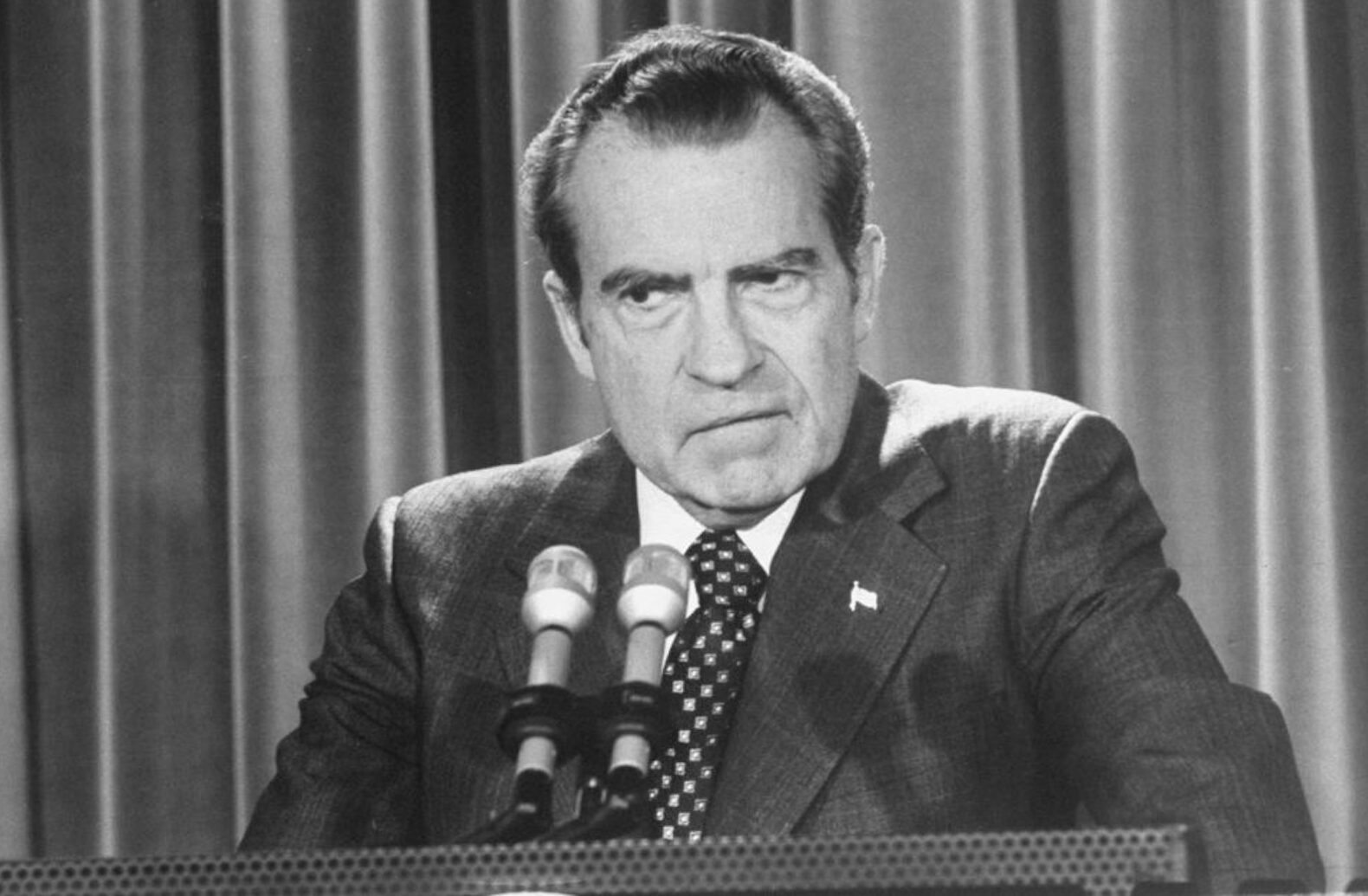
I suppose a Richard Nixon revival was inevitable. After all, the 37th president was the modern model of the corrupt, abusive presidency that is currently being perfected by Donald Trump and his corrupt administration. In fact, much of the legal theory of the unitary executive under which the current administration operates sprang from the bowels of right-wing think tanks smarting from Nixon’s fall from grace.
Many of the norms, rules and laws that governed the executive branch until Trump and his loyalists systematically threw them in the White House dumpster originated in the aftermath of Watergate, so reimagining Nixon as the first victim of the so-called deep state serves as a perfect rationale for what is happening today. For conservatives, the long-awaited historical payback has finally come.
In July, the Wall Street Journal reported that Nixon is suddenly all the rage among young conservatives who are “Nixonmaxxing” all over social media and sporting merch with sayings like “Nixon now, more than ever” and “Pretty girls for Nixon.” One young fan mused, “Is Nixon pulling off the greatest posthumous political comeback in history?”
Maybe so. This new interest among the Gen Z crowd is actually a well-designed public relations campaign by The Nixon Foundation, which used social media in 2018 to celebrate the 50th anniversary of his presidency. Short-form videos featuring Nixon saying “I am not a crook” over gangster rap, along with clips from “Mad Men” showing Jon Hamm-as-Don Draper saying, “Kennedy, I see a silver spoon, Nixon, I see myself,” went viral.
But the fandom is more than just vibes. Podcasters like Joe Rogan and Tucker Carlson have both recently called Watergate a setup, never mind the evidence or admissions by Nixon’s accomplices like H.R. Haldeman in his diary. Even Vice President JD Vance is in on the act, comparing himself to Nixon in June during an event to promote his memoir at the Richard Nixon Presidential Library and Museum: “Young senator, vice president, writes some bestselling books, is hated by the media.” (He’s not wrong.)
“I’ve always liked Richard Nixon,” Vance said, calling him a political genius. The vice president praised Nixon’s foreign policy acumen, giving him props for the opening of China and the Vietnam peace process, while conveniently leaving out the part about bombing Cambodia. Vance also denigrated the Watergate hearings and investigations that eventually brought Nixon down, saying, “If Watergate happened tomorrow, it would be a 12-hour news story. The idea that it would have taken down a presidency is crazy.”
Nixon didn’t have the right-wing media machinery that now excuses Trump’s criminality and spreads conspiracy theories — like the trope that the “deep state” is out to get the president. That alone has managed to keep the MAGA base and Republican officials on board with Trump.
Sadly, he’s probably right. Nixon didn’t have the right-wing media machinery that now excuses Trump’s criminality and spreads conspiracy theories — like the trope that the “deep state” is out to get the president. That alone has managed to keep the MAGA base and Republican officials on board with Trump, which is why he was acquitted in two impeachment trials during his first term. After all, Nixon didn’t resign until he was told that he had lost his base in the Senate and faced certain conviction and removal from office. That wasn’t the case in February 2021, of course, when the Senate refused to convict Trump for “Incitement of Insurrection.”
But there is also evidence that even Nixon had his limits. Yes, he grossly abused the office of the presidency, treating the executive branch like his private fiefdom. He ordered the FBI and the CIA to commit crimes. He bribed, blackmailed and paid off potential witnesses against him. But he didn’t burn the tapes, and he dutifully turned them over when the Supreme Court ordered him to do so. And although there was that infamous “19-minute gap” on one of the tapes that would have sealed his fate, many of the conversations revealed a profane, corrupt president.
But even as Nixon’s overall approval rating sank to 24% during the week before his resignation on Aug. 9, 1974, Republicans — 62% of them — still supported him. These were undoubtedly some of the die-hards who eventually began pushing to roll back the reforms that were enacted in Nixon’s wake.
During a post-presidency with British television presenter David Frost, Nixon famously said, “When the president does it, it’s not illegal.” Those words sounded then — and sound now — like an authoritarian gaffe. But in reality, the idea was based on a very real concept popular among right-wing Republicans, who believed that the president should have unfettered power to enact policies to “protect” the nation.
After that interview, Nixon penned a 2,500-word essay explaining he didn’t believe the president is above the law, but that the nation’s executive must be granted “some faith in his judgment” and given “room for maneuver.”
“His powers are not unlimited,” Nixon wrote. “But neither can be existing law — in a limited way, and at times of special need — and still meet these larger responsibilities.” Apparently, “special need” could be defined as whatever the president says it is, and therein lies the unlimited power.
This notion forms much of the logic of the unitary executive theory that has been growing among thinkers on the right for decades, and with court cases beginning in the early 1980s, the presidency has been granted more and more such power. This, of course, culminated in Trump v. United States, the 2024 Supreme Court ruling that gave the president near total immunity from prosecution for anything done in office. (The president had already been granted immunity from civil liability by the Court in Nixon v. Fitzgerald in 1982.) Now, the idea that presidents are above the law is gaining steam with yet another “investigation of the investigation,” this time into the special prosecutors who scrutinized Nixon back in 1974.
The Wall Street Journal reports that the Trump Justice Department is now officially looking into that case based upon the conspiracy theories promulgated by Geoff Shepard, a former Nixon aide turned historical revisionist and conspiracy theorist who presented “a two-hour presentation at Justice Department headquarters called ‘Watergate As Lawfare,’” making the argument that, you guessed it, the deep state took down Richard Nixon.
There’s a method to all this madness, and it’s best illustrated by the fact that Vance is the one leading the charge. Any ambitious Republican official thinking about the future has to find some way to excuse their complicity in Trump’s corrupt — and likely illegal — behavior. If they have any hope of being elected to national office, their only choice is to try to maintain these MAGA fictions and arcane conspiracy theories after Trump is gone by continuing to deny the reality of what he’s done. One way to do that is to convince people that it was never just about Trump; the deep state has been out to get Republicans ever since Nixon.
If they can’t convince people that their complicity was actually righteous resistance to a secret cabal of bureaucrats and dirty cops fighting to keep Republicans from enacting their righteous agenda, then potential GOP presidential candidates like Vance are likely going to have a hard time overcoming what is likely to be a massive revolt against Trumpism once he is out of office.
We’re seeing the edge of it now — and it’s not just about the price of gas. The air is finally going out of MAGA, and every single Republican politician who took advantage of it will be held accountable by the voters for what they have done. The GOP’s only hope is to find a Republican somewhere who hasn’t been touched by Trump and MAGA.
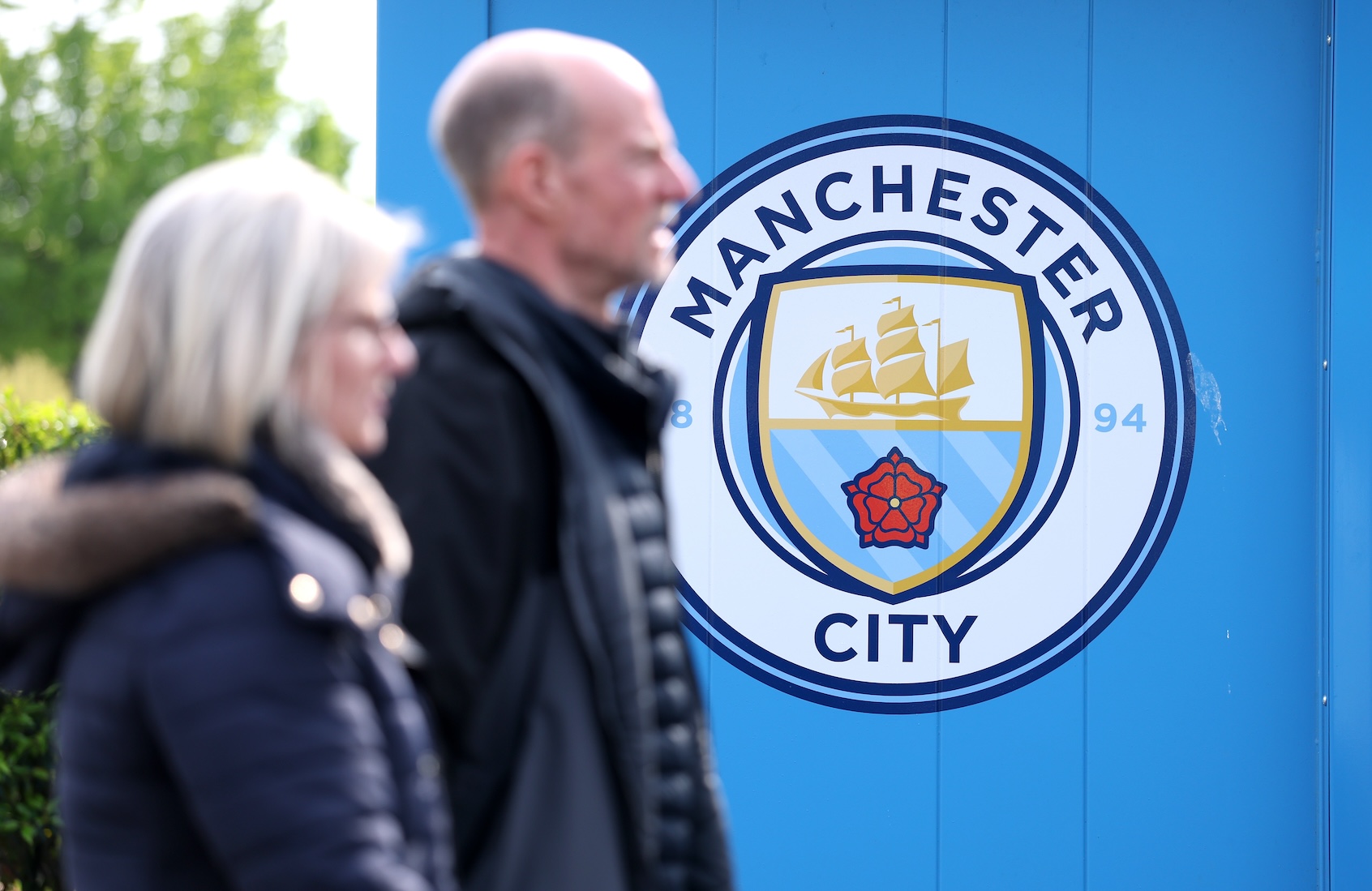
The biggest scandal in the modern history of professional sports broke wide open across the Atlantic this past week. How much that reflects larger social, cultural and economic pathologies and whether it affects regular people’s lives in any meaningful way is a complicated question. At the very least, I would suggest that the Manchester City scandal, which has driven the already-overheated British media to new heights of hysteria, isn’t really about soccer or sports.
Man City (often simply called “City”) is by far the most successful team in the English Premier League over the last 15 years and one of the four or five biggest soccer franchises in the world. Last week an independent legal panel delivered a long-anticipated verdict, finding the club guilty on 114 counts of systematic financial fraud, amounting to more than a billion dollars in fake revenues and sham commercial sponsorships. This scathing judgment only covers the years from 2009 to 2018, but no one thinks the actual or alleged fraud suddenly stopped after that.
Effectively, the verdict amounts to a finding that City cheated their way to the top of world football through a dizzying but blatant series of scams and shell games, allowing the team’s petro-state owners to illegally outspend competitors and pump hundreds of millions into inflated salaries for star players like Norwegian thirst-trap Erling Haaland (he of the formerly golden locks), Kevin De Bruyne and Sergio Agüero, and illustrious coaches, first and foremost among them the Catalan genius Pep Guardiola.
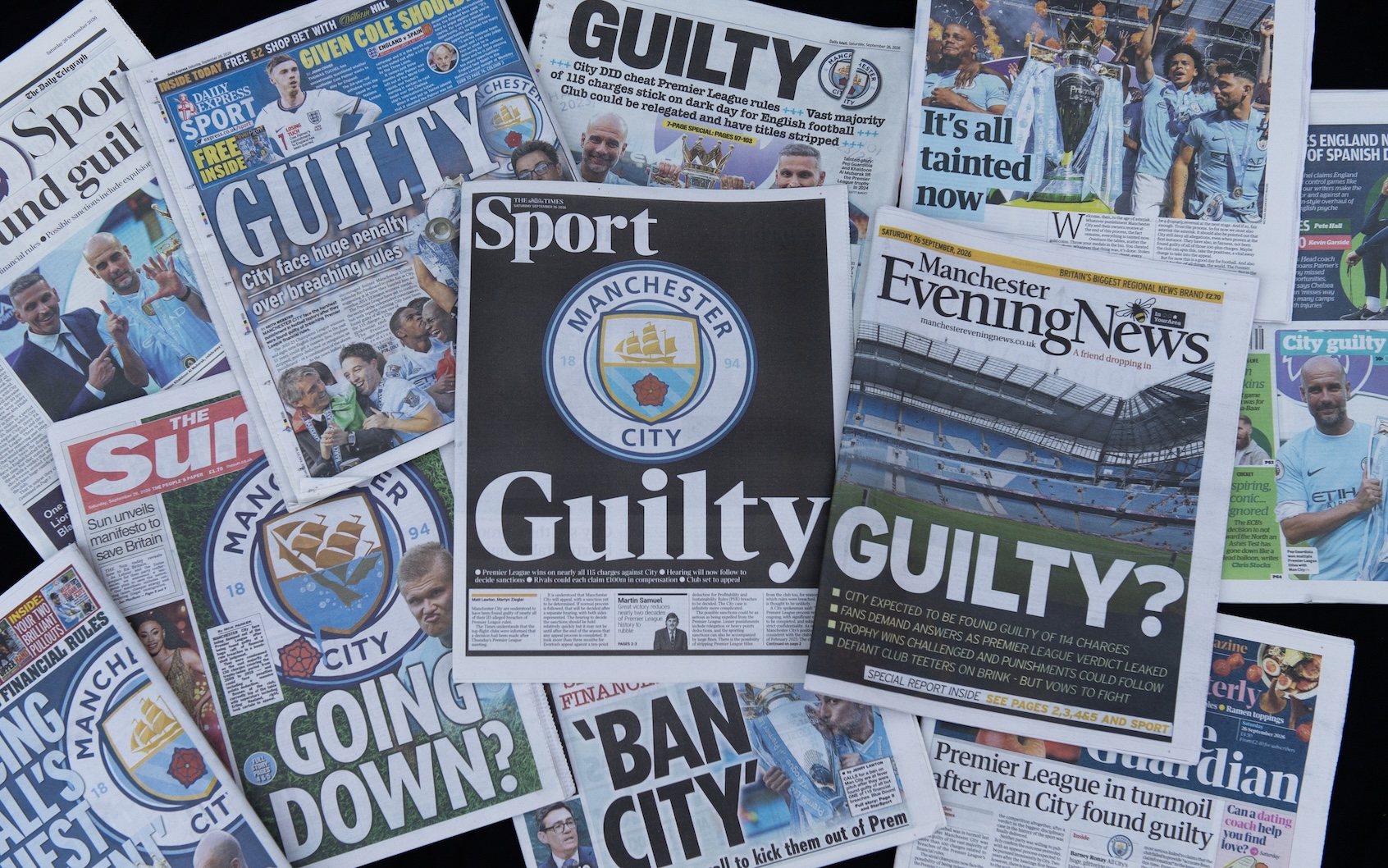
(Visionhaus/Getty Images) British newspaper headlines after Manchester City found guilty of breaches of Premier League financial rules, Sept. 26, 2026.
Along with winning numerous championships and tournaments, Man City changed the nature of the world’s favorite sport and transformed the EPL from a medium-size U.K.-based enterprise plagued by hooliganism, erratic attendance and crumbling stadiums into a global merchandising and marketing empire whose broadcasts, “kits” and online fan clubs extend from Indonesia to Arkansas.
If you belong to the large proportion of humanity inclined to a shrug-emoji reaction — billionaire oligarchs, overpaid athletes, incalculable sums of dirty money; who cares? — the first thing to say is that you’re absolutely right and that’s the only healthy response. But the salient fact that pushes the Man City narrative beyond a sports-business scandal and toward more cultural, political and even philosophical terrain is that virtually everyone who followed soccer and the EPL understood what was happening all along. That sort of willful blindness or collective cynicism is by no means limited to sports or celebrity culture — and it has become a widespread corrosive force in our society.
At any rate, everyone who was paying attention rapidly perceived the pattern after 2008, when Manchester City — a historically mediocre team with a modest fan base, sad-sack local rivals to Manchester United, who dominated the sport in the 1990s — was acquired by the Abu Dhabi United Group, a private equity firm closely aligned, shall we say, with the royal family of a Persian Gulf autocratic state. (Exactly how closely, and whether ADUG can be considered a separate entity from the Abu Dhabi government, is one of the issues at stake in the byzantine Man City case, now heading into an appeal process that could take years.)
It’s worth noting here that City Football Group, the ADUG subsidiary that has poured all that money into Man City, also owns or operates football/soccer clubs and related real estate projects around the world, including New York City FC in Major League Soccer, which at this moment is constructing an expensive new stadium in Queens, to be named — like everything else in the CFG universe — for Etihad Airways, Abu Dhabi’s state-owned carrier.
Here we find the central conundrum of the Man City scandal: Abu Dhabi’s petrodollars are deeply embedded in the economies of many Western nations, and any effort to punish or exile the emirate’s big sporting property could have far-reaching ripple effects.
Here lies the central conundrum of the Man City scandal, which is, like so much else about this story, a dirty secret that is no secret at all. Abu Dhabi’s petrodollars are deeply embedded in the economies of many Western nations, and any serious effort to punish or exile ADUG’s prize sporting property could have far-reaching ripple effects. That goes a long way toward explaining why U.K. Prime Minister Andy Burnham, who has struck such a forceful posture toward Donald Trump and Benjamin Netanyahu, has issued only vague blandishments about this explosive case on his own home turf, and clearly hopes the whole thing will simply go away.
In his excellent summary of the City scandal, Alex Shephard of the New Republic observes that the “massive accounting sham” behind the team’s spectacular rise under the Abu Dhabi ownership was concealed only in threadbare fashion, and was widely tolerated for a range of interlocking reasons:
Manchester City committed fraud on a massive scale primarily as a soft power project for an authoritarian nation because it was allowed to do so. The Premier League chose to look away. The team was good and the money was flowing. Questions about its finances — let alone about its ownership — were swept under the rug. As Manchester City became the best team in the Premier League, the Premier League became the most powerful league in Europe and, by extension, the world.
It isn’t easy to translate this tangled affair into American terms, and in any case I’m here to argue that the real significance of the Man City story is not about big-money skulduggery in professional sports. But let’s imagine that the Los Angeles Dodgers or the New York Knicks were found to have broken the rules of their respective leagues to such an extraordinary degree that observers seriously suggested that their recent championships should be stricken from the record books and that the teams themselves should be banished from Major League Baseball and the NBA for years to come, if not forever. (Such outcomes are on the table in the City case; so is a slap on the wrist and a large payoff, or a negotiated compromise somewhere in between.)
Let’s further imagine that we had collectively decided that the Dodgers or Knicks were so entertaining to watch that we’d pretend not to notice that they were owned by Kim Jong-un’s first cousin or Vladimir Putin’s niece. (Which if anything is understating the case: ADUG’s proprietor, Sheikh Mansour bin Zayed, is the brother of Abu Dhabi’s absolute ruler and his regime’s vice president.) Then we’d pretend we were surprised to learn that their entire operation was shamelessly corrupt, when the only genuinely surprising part was that the leagues involved had decided to risk their own survival by exposing the financial misdeeds after all those years of looking the other way.
My point here is that while I’m surprised to find myself writing yetanotherarticle in 2026 about soccer — if you presume that betrays some personal interest, you would be correct — this one isn’t really about soccer at all. Whatever ultimate judgment befalls Manchester City after years of legal wrangling is beside the point, although there’s some grim amusement to be found in comments sections on The Athletic, as fans try to “well, actually” or DYOR a verdict that will certainly tarnish the team’s reputation in perpetuity.
This is partly a story, as Shephard says, about sportswashing and the immense soft-power reach of authoritarian regimes like the UAE, Qatar and Saudi Arabia, all of which are heavily invested in professional soccer and other global sporting ventures. (Paris Saint-Germain, the biggest team in France and current European champions, was once owned by its fans but is now a property of the Qatari state.) Beyond that, it’s a story about questions almost too large to describe clearly.
It’s a story about a world that pretends to value democracy but is increasingly defined by massive inequality, oligarchy and, for that matter, monarchy. It’s about a world where the billionaire ex-president of the United States had to run for re-election in order to stay out of prison — and it worked. A world where the two most respected organizations in American broadcast journalism, CNN and CBS News, could come under the control of one man, who transparently aims to turn them into propaganda outlets supporting one faction of one political party.
This is partly a story about sportswashing and the immense soft-power reach of authoritarian regimes like the UAE, Qatar and Saudi Arabia. And also a story about a world that pretends to value democracy but is increasingly defined by massive inequality, oligarchy and, for that matter, monarchy.
It’s a story, in other words, about how much we will put up with. Or rather about how much we have convinced ourselves we must accept, given the unimaginable imbalance between the tech billionaires and fossil-fuel despots on one side and the other 99.9% of us on the other, whose only feasible role is to be their servants, their worker drones or their captive audience, or else to be deemed expendable.
It would be ridiculous to cast the English Premier League as a hero in that larger narrative, as if its current stance had anything to do with standing up against autocratic sportswashing or defending democracy and the rule of law. Man City may even have a point, on the level of libertarian economic theory, that the EPL’s financial rules were unfairly structured to prevent upstart teams from competing with long-established franchises like Liverpool, Arsenal and Manchester United, and that owners should be allowed to spend as much as they want to put a competitive team on the field. (That is, in fact, exactly how Major League Baseball operates, although its moment of reckoning is right around the corner.)
But there may also be a crude lesson under this dunderheaded clash of the titans that pertains to democracy, and can be seen reflected in the verdict on the Trump regime that we all see coming in this year’s American midterm elections, or in the surge of popular opposition to data centers and to the unrestricted development of AI. To paraphrase the maxim falsely attributed to Lincoln, you can fool a whole bunch of the people for a hell of a long time, but you can’t fool all of them forever.
Ultimately, the Premier League must have concluded that the reputational and economic damage of prosecuting its most successful team for obvious financial crimes — which is likely to be considerable — was preferable to the damage of not doing so. EPL leadership stuck a finger in the wind of public opinion, so to speak, and decided their best chance of not killing the golden goose lay in manning up for the principles they had visibly abandoned, or at least pretending to.
You definitely shouldn’t care what becomes of the EPL or Manchester City; I’d be better off if I didn’t either. Erling Haaland and his teammates will be fine, as will the Abu Dhabi royals, although whatever remains of the club’s pre-2008 Mancunian fanbase is likely to suffer bitterly. But you might care about finding the outer limits of the corrosive social and cultural corruption and cynicism to which we have all been subjected — and in which we have all been complicit — and then finding the courage and resolution to resist.
Will I watch Manchester City’s first post-verdict match on Oct. 11, against their archrivals Liverpool? Um, yeah. It’s a news event! I’m doing my job, or that’s what I’ll tell myself. But I won’t pretend my hands are clean.
‘Nearly Every Claim Uttered in These Ads Is False’
Rep. Jamie Raskin (D-MD), the top Democrat on the House Judiciary Committee, has joined other Democrats this week in demanding answers about President Trump’s midterms campaign ads — which promote nothing but himself — and the apparent use of taxpayer dollars to finance them.
I wrote earlier this week about the top Democratic appropriators in Congress calling for investigations into the ads and confirming reports that the White House moved some $20 million in taxpayer funds out of the Department of Homeland Security to bankroll the vanity project. Raskin and Rep. George Whitesides (D-CA) sent a letter to the Government Accountability Office (GAO) and the U.S. Office of Special Counsel (OSC) on Tuesday to look into the reported shuffling of funds.
“Accordingly, we are writing to formally request that the GAO investigate the source, accounts, and total amount of taxpayer funds used by the Executive Office of the President to produce and distribute this advertisement across major television markets and official White House social media channels,” Raskin and Whitesides wrote in the letter to acting Comptroller General Orice Brown and special counsel Charles Baldis.
The two are asking for a formal investigation into how much the advertisements cost, how they have been paid for and whether any federal laws were broken in either the creation of the ads or the use of tax dollars to fund them. Raskin and Whitesides asked both agencies to look into whether the ads are a violation of the Hatch Act, the Anti-Deficiency Act, the Consolidated Appropriations Act or other federal criminal statutes.
“The Trump Administration knows what they are doing is unlawful, as evidenced by their halfhearted attempts to defend their actions. An anonymous White House spokesperson called the ads ‘educational,’ and suggested that they are ‘clearly not political’ because the ‘president is not on the ballot,’” the lawmakers wrote. “Yet just a few short weeks ago, at his poorly-rated Republican National Convention, President Trump pleaded for his rapidly dwindling ranks of supporters to vote, begging them to ‘pretend, please, that I’m on the ballot.’ The White House can’t have it both ways.”
The lawmakers also, amusingly, fact check many of the claims Trump makes in the ads to argue that they could not possibly serve as “public service announcements” — like those made during the COVID-19 pandemic — as the White House has claimed.
Screenshot: Raskin and Whitesides letter to GAO, OSC Sept. 30, 2026.
“President Trump is obviously desperate for the American people to ‘love’ him, a problem that goes beyond your jurisdiction,” they wrote. “But stealing taxpayer dollars to pay for Mr. Trump’s narcissistic ego trips is plainly illegal. Your agencies have an important responsibility to hold accountable members of his Administration who violate the laws and policies under your purview.”
Raskin and Whitesides join their colleagues Reps. Rosa DeLauro (D-CT) and Henry Cuellar (D-TX) as well as Sens. Patty Murray (D-WA) and Chris Murphy (D-CT) in asking questions about what exactly is going on with the egregious shuffling of funds for the ad campaign, seemingly designed to help Republicans win races next month (even though many vulnerable Republicans are trying to put a 10 foot pole between themselves and Trump’s political toxicity at the moment). The top Democratic appropriators are concerned about this because it appears as though the money was moved and used for something outside of its congressionally appropriated purpose — taxpayer dollars that were allocated for Customs and Border Protection in Republicans’ “Big Beautiful Bill” last year.
The ads have run on major airwaves in recent weeks including Fox, Newsmax, MS NOW, and CBS, and also during NFL games over the weekend.
Obviously, Democrats are concerned about the corruption and violation of federal law. But this trend of Trump inserting himself into the midterms because he’s worried Republicans are going to lose a chamber of Congress simply because he is not on the ballot — and Republican stumbling as they alternately embrace the administration’s failing policies and distance themselves dramatically from the unpopular president — has been a rare moment of levity in our current hellscape.
Donald Trump has never been one for subtlety, so it follows that his taxpayer-funded “public service announcement” instructing Americans to love him would literally feature a gospel choir singing the words “Love Me.” Along with many of his closest allies, the president is a fan of pseudo-science, so perhaps he believes the repetition will have a hypnotic effect on viewers, reversing through pop psychology trickery the free-fall that has beset his approval ratings.
This is just one of three separate ads, totaling $1.5 million so far, that feel less like a sincere effort to persuade voters and more like an expensive effort by the White House to soothe the temperamental 80-year-old. Either way, what’s indisputable is that Trump is becoming increasingly frustrated that the chicanery he has used throughout his life no longer seems to be working.
The president has perhaps the most staggering track record of defrauding Americans of any hustler in the country’s 250-year history. His glib assertions of being the greatest genius who knows more than any other person about any subject under the sun have served him well for decades, and his 34 felony fraud convictions and civil fraud cases paint a picture of a man who always seems to find marks who will believe his transparent, self-aggrandizing lies.
Before he won the White House in 2016, “The Apprentice” managed to convince millions of viewers that a man who managed to lose nearly a billion dollars was some great businessman. Even when Trump argued that he, unlike medical experts, understood the salutary effects of household cleaners to treat Covid-19 patients, his followers stayed by his side, some of them putting their trust in MAGA quackery over science-based healthcare like vaccines. The cult of personality built around his persona of presidential greatness remains a puzzling swindle.
But on Monday in the Oval Office, Trump did what he usually does these days when presented with a microphone: He whined at length at how he isn’t getting the love he believes he deserves.
“Nobody talks about all the incredible things,” the president complained, saying America has “the best economy we’ve ever had.” He added, laughably, that people are “twice as wealthy” as they were as two years ago under the Biden administration. Then he repeated his false promise that, if Republicans win the November midterms, the government would issue a “dividend” check of $5,000 to every adult American.
Polls, however, suggest that Americans are finally waking up. A recent Reuters/Ipsos poll found his approval rating at a dismal 32% — hitting, in other words, the very bedrock of his MAGA base.
It may be easy to laugh at this stuff, but it’s worth taking a moment to remember that Trump has always been this way. Polls, however, suggest that Americans are finally waking up. A recent Reuters/Ipsos poll found his approval rating at a dismal 32% — hitting, in other words, the very bedrock of his MAGA base. Worse for him, only 13% of Americans, according to an analysis by G. Elliott Morris, are willing to tell a pollster they buy the president’s $5,000 check lie, showing that even people who claim to approve of him can’t be bothered to trust him any longer.
People could be learning from experience. As Catherine Rampell of the Bulwark detailed, the $5,000 check promise is only the latest in a long list of false second-term promises that Americans would be receiving fat checks from the government. Her “partial list” includes these examples:
$5,000 stimulus checks via a “DOGE dividend” (February 2025)
$2,000 stimulus checks via a “rebate” or tariff “dividend” (July 2025, August 2025, November 2025, December 2025, February 2026)
Checks of indeterminate value that would redirect money that would have been spent on Affordable Care Act subsidies (November 2025)
$500 Obamacare “rebate” checks (September 2026)
$5,000 “dividend” if Republicans win the midterms (yesterday)
Thankfully, there now appears to be a limit to the number of times a fraudster can promise the check is in mail before even some MAGA voters start to wonder if they’re being had. Most clung to two big reasons to justify their vote in 2024: the president’s promises to lower prices and end foreign wars. Trump broke both in a dramatic fashion, starting a war with Iran and a trade war with, well, much of the world, both of which have escalated inflation, particularly of fuel prices. Even his most ardent followers are reminded of his lies every time they buy groceries or gas. Running ads that repeat his failed promises only serve to remind people of the broken trust.
Beyond bigger propaganda, Trump has no other ideas for how to change the situation. On top of the ads, last week the White House launched “Trump TV,” which was billed as an alternative to cable news but mostly runs pro-Trump content so poorly produced that it makes AI slop seem compelling. As Salon’s Sophia Tesfaye chronicled, the viewership started at a paltry 8,000 people and, by the next day, had faded to fewer than 1,000. It would have likely been even lower if it weren’t for journalists watching it to report on the emptiness of the enterprise.
Perhaps the surest sign that these efforts are more about placating Trump than persuading voters is the his travel schedule. The president is avoiding visiting states with close congressional races, where he risks being shunned by Republican candidates trying to distance themselves from his unpopularity. Instead, he is mostly sticking to deep red states like Alabama and Oklahoma, where they can still scare up enough MAGA diehards to fill stadiums and, crucially, give Trump hours of reassurance that he’s still got fans. On Tuesday, he spoke at an event heralding our era as a “golden age” due to AI. As a political maneuver, his words were baffling, as most Americans deplore the economy and loathe AI. But being surrounded by billionaires while applauding himself with gold-related talk is Trump’s happy zone, and keeping the president there appears to be all that matters to his West Wing staff.
For the worrywarts of the left, there remains plenty to be concerned about. Ahead of the midterms, Democrats are facing intense gerrymandering and voter suppression, which could blunt the wins currently projected by the polls. Even if the party were to take both the Senate and the House, Trump will still occupy the Oval Office for two more years. Armed with the criminal immunity granted him by the Supreme Court, he has no reason to stop blatantly flouting the law in a myriad of ways, ranging from his attacks on the Kennedy Center and prosecuting the Iran war without congressional approval to his own mysterious swelling wealth.
Still, even though it’s almost certainly illegal, there is an upside to Trump using taxpayer money for ego-gratifying TV ads and propaganda. The more time he spends on his futile efforts to restore the glory days when only half of Americans opposed him, the less energy he has for the work of actually governing. Everything he’s done in that arena has been an unmitigated disaster. Keeping Trump distracted from making serious decisions is a good thing for us all.
Cocaine worth more than $10m was stored as evidence at a courthouse in Fiji, but at some point in the long-running drug trial was replaced by flour. Authorities admit that about 87 pounds of cocaine is "effectively missing;" ABC News in Australia describes it as "yet another apparent example of internal corruption that has plagued Fiji's authorities." — Read the rest
A Republican member of the Senate broke party ranks on Monday in a letter to the chair and ranking members of the Senate Judiciary Committee, asking that the panel subpoena Donald Trump Jr. and gather more facts about his “active promotion of family-backed cryptocurrency ventures, his continued pursuit of international real estate deals involving direct meetings with foreign heads of state, and his reported investments in defense contracting.”
In his letter, Sen. John Curtis (R-UT) argued that his colleagues were being hypocritical in their singular focus on President Biden’s son Hunter Biden throughout the former president’s entire term while turning a blind eye to Don Jr. and the “questions” that have “arisen about the relationships of President Trump’s eldest son, Donald Trump Jr., with foreign business figures and the acceptance of significant gifts. These include a lavish wedding afterparty, on a private island, provided by Russian oligarch Umar Kremlev, who reportedly traveled to China as part of a delegation accompanying Vladimir Putin shortly before giving the gift.”
“A toaster is a wedding gift. A private-island party paid for by a Putin-connected oligarch is something else,” Curtis continued. “Republicans nearly wore out the subpoena machine investigating Hunter Biden’s foreign relationships. We should not unplug it now.”
In his letter to Sens. Chuck Grassley (R-IA) and Dick Durbin (R-IL), the chair and ranking member of the Senate Judiciary Committee, respectively, Curtis also argued that Hunter Biden should be dragged back before the panel as well, and urged the committee to “launch an investigation into the use of presidential family relationships for private financial benefit, preferential treatment, or access by domestic and foreign interests.”
“The country should not have to accept one standard for the family of a Republican president and another for the family of a Democratic president. Nor should congressional oversight begin and end when control of the White House changes hands,” Curtis wrote.
Curtis is not up for reelection until 2030, so he does not fit neatly within the (minor) trend of Republicans gently bucking the president ahead of what polls say could be a dismal midterm election for the GOP. A handful of Republican members of Congress up for reelection have called out Trump on his immigration policies or the war in Iran or on data centers — an issue that is becoming a major flashpoint for Republicans this cycle, even in red states, as Trump refuses to allow for any nuanced position on the matter (due to his whole being in bed with Big Tech thing).
Curtis had previously described reports of Don Jr.’s lavish wedding gift from a Russian oligarch as “corruption.” ProPublica uncovered the cartoonishly venal episode, which involved Russian oligarch Umar Kremlev funding the post-wedding festivities for Don Jr. and his new wife on exclusive islands in the Bahamas. Kremlev has close ties to President Vladimir Putin. President Trump has claimed that his son paid Kremlev back for the extravagant vacation. Don Jr.’s wife is, apparently, still confused about what the issue is.
Grassley has not yet responded to the letter from Curtis, but Durbin posted a statement on Tuesday. He mildly countered Curtis’ claims about Hunter Biden, arguing the former president’s son has “already given Congress a sworn deposition on this issue” but said he supports Curtis’ request for transparency.
“Corruption must never be tolerated. @SenJohnCurtis has made a good faith request that the Senate Judiciary Committee investigate the lavish gift of a Russian oligarch to President Trump’s son as well as any wrongdoing by the son of former President Biden,” Durbin wrote in a post on X. “In fairness, Hunter Biden has already given Congress a sworn deposition on this issue. Donald Trump Jr. has not. To ignore this is to run the risk of being complicit. I will join in supporting Senator Curtis’ request of the Judiciary Committee.”
Corruption must never be tolerated. @SenJohnCurtis has made a good faith request that the Senate Judiciary Committee investigate the lavish gift of a Russian oligarch to President Trump’s son as well as any wrongdoing by the son of former President Biden.
This story was originally published by ProPublica, a nonprofit newsroom that investigates abuses of power. Sign up to receive their biggest stories as soon as they’re published.
In the final weeks of 2019, a top fundraiser for Sen. Susan Collins walked into a perilous meeting at a Corner Bakery in Washington, D.C.
For the first time in her two-decade Senate career, the Republican lawmaker from Maine was in danger of losing her seat. President Donald Trump’s dismal approval ratings were dragging her down in the polls, and she was falling behind her likely 2020 Democratic challenger in fundraising.
Scott Reed, head of the Collins super PAC, was on a mission to close that gap. Reed was meeting that day with three executives from a Hawaiian defense contractor, Navatek. A year earlier, Collins had helped their company land a multimillion-dollar Navy research contract in Maine. Now, seated at a coffee shop not far from the U.S. Capitol, Reed asked them for a $500,000 donation.

 Login
Login