❌

Reading view

41 Years Ago, ‘Garfield’s Halloween Adventure’ Traumatized an Entire Generation of Kids

When people think about Halloween-themed animated specials, the first that comes to mind is usually It’s the Great Pumpkin, Charlie Brown. However, there’s a lesser-known special that’s actually quite scary. Featuring everyone’s favorite fat orange tabby cat, Garfield’s Halloween Adventure aired on Oct. 30, 1985.

At the 1986 Emmys ceremony, it won the Emmy for Outstanding Animated Program. So if you don’t believe us, listen to the critics on this one.

‘Garfield’s Halloween Adventure’ Has No Right to Be This Creepy

Originally titled Garfield in Disguise, the special opens with Garfield waking only to realize it’s Halloween. He convinces Odie to dress up as pirates so they can go trick-or-treating. As they hope to fill their buckets and bellies with candy, ghost pirates soon loot them. They stumble onto an abandoned mansion and meet an old man who warns them of an urban legend that pirates would return 100 years later to reclaim their treasure. As the 24-minute special goes on, the tone grows darker and more sinister, which creator Jim Davis was hoping for. “I wanted to go somewhere that would at least scare 4-year-olds,” he told A.V. Club in 2014.

Not only that, as family-friendly as it may seem today, Davis admitted they toed the line of what Standards and Practices allowed for scares in the ‘80s. “…It hard to grasp because they said, ‘scaring kids.’ [Laughs.] ‘Too scary.’ We could have the ghosts, but we couldn’t have anyone touch anyone else in a threatening way. It couldn’t be anything that appeared to be physical harm.”

They find themselves stuck on the deserted island, and when the clock strikes midnight, the ghost ship returns as promised. They get chased by the terrifying-looking ghosts (that are, in fact, nightmare-inducing to this day). Eventually, though, they make it home safe and sound.

The post 41 Years Ago, ‘Garfield’s Halloween Adventure’ Traumatized an Entire Generation of Kids appeared first on VICE.

💾

Garfield's 1985 Halloween special featured ghost pirates, genuine scares, and a surprisingly dark story that still holds up today.
  •  

4 Halloween Episodes From Your Favorite Childhood Sitcoms That Still Hold Up Today

There’s certainly no shortage of gory horror films to watch during October. For those looking for something much more lighthearted and nostalgic but not necessarily a family-friendly Disney Channel Original Movie, there are plenty of hilarious Halloween-themed ‘90s sitcoms episodes ripe for picking. Whether background noise during trick-or-treat or a cozy night in, we’ve got you covered.

Keep reading for four of our favorite episodes to rewatch before October is over.

ABC

1. Sabrina The Teenage Witch

Sabrina the Teenage Witch is perfect rewatch material for the fall and Halloween season, and unsurprisingly, it has plenty of Halloween-themed episodes. As for which episode makes this list, Season 2, Episode 6, “A River of Candy Corn Runs Through It” takes the cake. Hilda is waiting for their new furniture to be delivered, even though they can just…zap it out of thin air. Witches, they’re just like us! The only problem? The furniture is infested with talking termites.

Annoyed that Libby is hosting a Halloween party Valerie and Sabrina weren’t invited to, Valerie blurts out that she and Sabrina are hosting their own party at Sabrina’s. Sabrina ends up having to conjure up things to distract her classmates, and they believe it’s all just a “special effect” for Halloween.

ABC

2. Boy Meets World

Funnily enough, the Boy Meets World Halloween episode didn’t even air in October. It premiered in February of 1998, but it spoofed the slashers of the time like Scream and I Know What You Did Last Summer. The episode’s tone was much darker than viewers were used to. It throws out everything people know about sitcoms as they film with a single handheld camera. It’s really genius. With the inclusion of scream queen Jennifer Love Hewitt as well as the nod to Agatha Christie’s And Then There Were None, it’s clear that the crew were fans of the genre.

FOX

3. That ’70s Show

That ’70s Show has a few Halloween-themed episodes, but the most creative is the Alfred Hitchcock-themed episode, Season 3, Episode 4, “Too Old to Trick or Treat, Too Young to Die.”

The group watches Hitchcock films, joking about how funny it would be if they were in a Hitchcock film and didn’t know it. The rest of the episode is spent spoofing various Hitchcock films. Instead of providing the spooks, it gives the giggles.

FOX

4. The SIMPSONS: Treehouse of Horror

Every year The Simpsons air their Halloween special, “Treehouse of Horror.” Beginning in 1990, the non-canon episode features spoofs of horror, sci-fi, and supernatural stories. It’s become something that die-hard fans of The Simpsons look forward to, and with 36 years’ worth of episodes, there’s no shortage of entertainment.

“Treehouse of Horror V” (Season 6, Episode 6) is widely considered the best, and it’s easy to see why it tops everyone’s list once you watch the segments. It spoofs The Shining and includes a crime-and-punishment-themed segment in which Homer breaks a toaster, sending him through different timelines.

The post 4 Halloween Episodes From Your Favorite Childhood Sitcoms That Still Hold Up Today appeared first on VICE.

  •  

26 Years Ago, ‘That ’70s Show’ Delivered One of TV’s Best Halloween Horror Parodies Ever

Halloween parodies have been around for decades, with Hollywood putting their spin on everything from Boy Meets World, The Simpsons, and Happy Endings to sitcom favorite That ’70s Show. While the holiday has inspired plenty of memorable television moments, few episodes have managed to blend classic horror with sitcom comedy quite like the Fox series’ Alfred Hitchcock-themed Halloween special.

“Too Old to Trick or Treat, Too Young to Die,” the fourth episode of That ’70s Show’s third season premiered on October 31, 2000. More than two decades later, it remains one of the sitcom’s most creative holiday episodes, transforming the familiar antics of the friend group into a hilarious tribute to one of the most influential filmmakers of all time.

How That ’70s Show Turned Alfred Hitchcock Movies Into Sitcom Comedy

The episode begins with the gang watching an Alfred Hitchcock movie marathon, which gives Kelso an idea. What if they were living in a Hitchcock movie without realizing it?

They play it off as a joke; however, his suggestion sets the stage for an episode packed with references to five of Hitchcock’s most recognizable films: Psycho, The Birds, Vertigo, Rear Window, and North by Northwest.

Rather than recreating the movies scene for scene, the sitcom takes the most recognizable moments and gives them the kind of twists that could only happen on That ’70s Show.

The result is a Halloween episode that rewards Hitchcock fans without alienating viewers who have never watched one of his films.

The Psycho Shower Scene Gets a That ’70s Show Twist

FOX

One of Hitchcock’s most famous films gets a particularly memorable nod when Kelso finds himself in a situation reminiscent of Psycho.

The 1960 thriller, starring Anthony Perkins and Janet Leigh, is best remembered for its infamous shower scene where Marion Crane is attacked at the Bates Motel. The sequence became one of the most influential moments in horror history, helping establish the level of suspense and shock imitated today.

Kelso gets beaten up by a child and finds his way into the Forman house to take a shower. At the same time, Laurie Forman is returning home covered in bird poop (a nod to Hitchcock’s The Birds). Instead of attacking him with a knife, she attacks him with a scrub brush. She then makes the water temperature even hotter, making him shriek.

The creatives behind the episode turned a scene associated with one of film’s most notorious murders into something considerably less threatening and sexually awkward.

Kitty Forman Learns the Hard Way That The Birds Wasn’t Just a Movie

Fox

While Hitchcock’s Psycho is known for its shower scene, The Birds gave audiences a different reason to fear ordinary things.

Released in 1963, the film follows a California community terrorized by seemingly inexplicable attacks from birds. Hitchcock transforms creatures that people encounter every day into an unpredictable threat.

That ’70s Show puts its own spin on the premise through Kitty Forman who discovers that feeding a neighbor’s birds isn’t as harmless as she initially thought.

It’s a particularly fitting reference for Kitty, whose maternal instincts and determination to keep everything under control often put her in situations that are anything but peaceful.

Fez and Hyde Become the Stars of a Rear Window Mystery

Fox

Perhaps the episode’s most entertaining Hitchcock reference involves Fez and Steven Hyde.

After Fez injures his leg, he spends more time observing the world around him. Like L.B. Jefferies, the photographer played by James Stewart in Hitchcock’s Rear Window, Fez becomes convinced that something sinister is happening inside a neighbor’s home.

The 1954 Hitchcock thriller follows a wheelchair-bound photographer who suspects that a man across the courtyard has murdered his wife. Unable to investigate it himself, Jefferies attempts to piece together the truth from what he can see through his apartment window.

In the sitcom’s version, Fez and Hyde spy on their neighbors, Bob and Midge Pinciotti, after becoming convinced that Bob killed his wife.

The supposed murder investigation is exactly the sort of overblown conspiracy that could emerge when two bored teenagers have too much time on their hands. It’s absolutely ridiculous but that’s what makes it so great.

Eric Forman’s Fear of Heights References Vertigo

Fox

Eric Forman gets his own Hitchcock-inspired storyline when an incident involving a fall leaves him afraid of heights.

The plot references Vertigo, Hitchcock’s 1958 psychological thriller starring James Stewart and Kim Novak. The film follows a former police detective whose fear of heights becomes entangled in an increasingly disturbing mystery involving obsession, deception, and identity.

In That ’70s Show, Eric’s experience is considerably less glamorous. His fear becomes another obstacle for the perpetually anxious teenager, whose tendency to overthink everything makes him an ideal character for a parody of Hitchcock’s psychological suspense.

Where Hitchcock used vertigo to explore the darker corners of the human mind, the sitcom uses it to create another opportunity for Eric to embarrass himself.

Kelso Gets His Own North by Northwest Moment

The episode also references North by Northwest, Hitchcock’s 1959 thriller starring Cary Grant as an advertising executive who becomes caught up in a case of mistaken identity and is pursued across the country.

The film’s most famous sequence involves Grant’s character being chased through an open field by a crop-dusting plane.

Kelso’s storyline draws on the film’s mistaken-identity premise, with a paperboy pursuing him over a debt Red Forman forgot to pay. It’s a ridiculous misunderstanding, but the reference is unmistakable for anyone familiar with Hitchcock’s work.

The joke also feels right for Kelso, whose mix of confidence and questionable intelligence often lands him in situations he doesn’t fully understand.

Why That ’70s Show’s Halloween Episode Still Works

What makes “Too Old to Trick or Treat, Too Young to Die” so memorable isn’t the number of Hitchcock references crammed into the 22-minute runtime. It’s how naturally the crew weaves those references into the characters’ everyday problems.

The episode doesn’t abandon the sitcom’s established personalities. Instead, it uses the films as a guide for stories that feel entirely at home in Point Place.

The episode also arrived at a time when Halloween specials were an established television tradition, with sitcoms regularly using the holiday to experiment with different genres and storytelling styles. By combining a classic horror homage with its own brand of irreverent humor, That ’70s Show managed to create something that felt both nostalgic and distinctly its own.

Unlike some television parodies that rely entirely on viewers recognizing the original material, the episode remains entertaining even if you’ve never seen a Hitchcock movie.

After all, the gang might be too old to trick-or-treat and too young to die, but they’re never too young (or old) to find themselves in the middle of a Hitchcock film!

The post 26 Years Ago, ‘That ’70s Show’ Delivered One of TV’s Best Halloween Horror Parodies Ever appeared first on VICE.

💾

On Halloween 2000, That '70s Show transformed five Alfred Hitchcock classics into one of its funniest holiday episodes.
  •  

It’s scary how watchable these stories are

I’ve never been great at the whole Halloween thing. By the time I remember it’s happening, all the good sweets are gone from grocery store shelves, so any visiting trick-or-treaters get butterscotch suckers, breath mints or candy corn. I don’t do costume parties. I never got the point of carving pumpkins.

But movie and TV marathons? Sign me up – along with a lot of other homebodies. The horror genre is bigger than ever, according to a San Francisco Chronicle report that says this year’s domestic box office reached nearly $1.3 billion as of the start of October.

Horror’s surge has also yielded more films designed to play with our perception as opposed to the “Saw”-style torture porn dominating years past. Think “Obsession” or “Backrooms,” both of which are among the 10 highest-earning movies of 2026 thus far. That’s good news for anyone who isn’t partial to splatter flicks or slashers but still enjoys a creep show that makes you think, especially ones that are more thoughtful than scary. If that’s your speed, the following options may be perfect for your reclusive Samhain.


(Manuela Hidalgo)

“Black Zombie”

I will bet good money the first bong-ripping undergrad to declare that all horror is metaphor cited George Romero’s “Night of the Living Dead” as a prime example. That’s not wrong; Romero’s 1968 benchmark established the modern cinematic zombie as a stand-in for mindless capitalist consumption. But “Black Zombie” rewinds to the monster’s Haitian roots to examine an even darker origin tied to that country’s shared history with ours.

You may be wondering why I’d recommend a documentary in a horror roundup, let alone one that explains how the modern movie flesh gobbler began as a manifestation of white fear. The answer is that Maya Annik Bedward’s film doubles as an impressive cinematic syllabus.

By braiding America’s media history with its national history, Bedward and her assemblage of academics, creatives, authors and Vodou practitioners invite us to think differently about the prejudices driving movies like, say, Victor Halperin’s 1932 effort “White Zombie,” or 1943’s “I Walked with a Zombie.”

“Black Zombie” opens with a truth that has long escaped those fascinated by the shambling undead. To some, they’re simply mindless hunters. But Haitians understand the horror of zombies to be one of dispossession, a curse enacted by enslavers that binds victims to mindless servitude, denying them liberation in the afterlife. But long after Romero transformed them from blank-eyed puppets to ravenous murder machines, Bedward’s film demonstrates how Hollywood’s version of the zombie impacts America’s perception of Vodou, Haitians and immigration.

“Black Zombie” not only asks us to think differently about an overexposed subgenre, but also thoughtfully examines Vodou’s central role in the revolution that drove out French colonizers, and France’s imposition of debt to punish Haitians for winning their freedom.

All of this informs the zombie’s continued proliferation across popular culture, in films like “World War Z” and shows such as “The Last of Us” and “The Walking Dead.” They’re terrific entertainment, certainly. But each is, in its own way, built upon decades’ worth of misrepresenting Haiti’s syncretic faith to the detriment and demonization of a people. At the same time, “Black Zombie” recognizes this subgenre’s cultural resilience, arguing that recognizing the zombie’s true roots broadens its narrative possibilities.

Proving that point, one of Bedward’s subjects, a Vodou priest, says he grew up loving Wes Craven’s “The Serpent and the Rainbow,” despite its message that visitors to his country risk having their nuts nailed to a chair.  “It’s a fantastical world to scare children,” he says, before adding that his main problem is its inaccurate messaging about his faith. “We say, ‘Wow – Haitians are devils.’ That’s what we’re taught.”

I’d nearly forgotten about that movie. Now I might rewatch it for the first time in decades and expect to be horrified for entirely different reasons.

Available to rent on Prime Video, Apple TV, and Fandango.


(© Amazon Content Services LLC)

“Carrie”

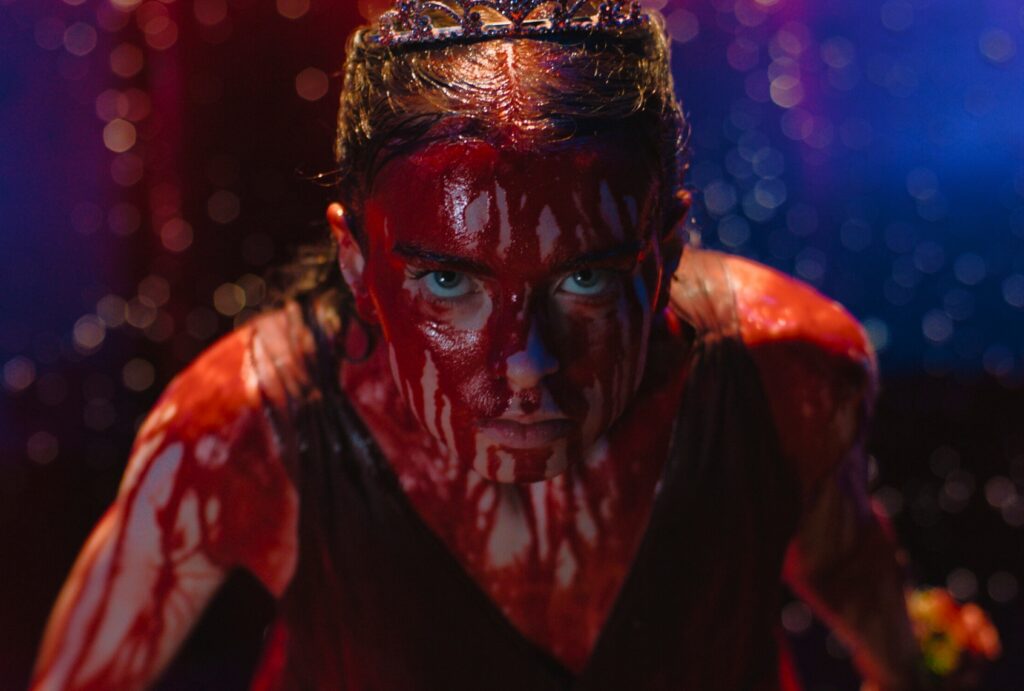
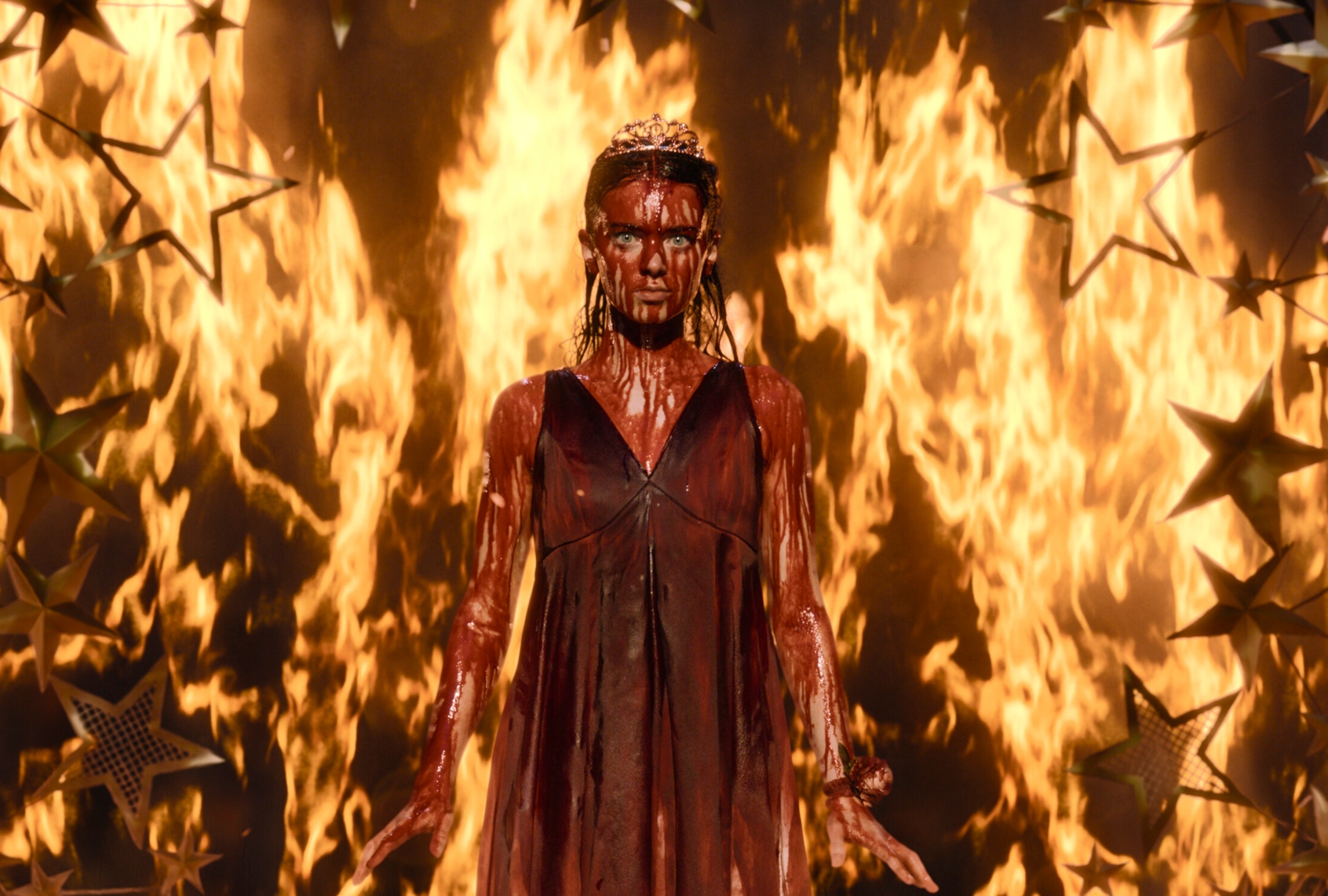
Stephen King’s classic may be more than half a century old and has undergone multiple adaptations, but it endures because its central moral that high school is hell never ages. Still, Mike Flanagan’s interpretation has divided the audience. Some, including King, appreciate Flanagan’s kinder portrait of Carrie White (Summer H. Howell) as an innocent unjustly sequestered from the world by fundamentalist parents who repudiate her extraordinary power. Others disagree with Flanagan’s alteration to the story’s climactic scene, which shifts culpability for the prom massacre from Carrie to a character created expressly for the series.

Pretty much everyone questions the season finale, which hints at taking an “X-Men”-style turn for its recently greenlit second season.

As someone who accepts nothing is sacrosanct now, not to mention a fan of the creator’s other adaptations, including “The Fall of the House of Usher,” I appreciated Flanagan using Carrie’s story to critique ignorance, knowledge suppression, and the dehumanizing effect of social media.

Besides, nearly all the key elements of “Carrie” remain. The bullies are still awful, and the famous “plug it up” shower scene in Brian DePalma’s 1976 standard-setter is worsened by her tormentors posting Carrie’s frightened sobs on social media.


Some changes retain the spirit of past performances. Carrie’s mother Margaret (Samantha Sloyan) is still an abusive religious zealot fond of locking her daughter in a prayer closet, for instance. But after the law forces her homeschooled girl to join the festering sin den that is their local public school, Margaret throws herself into advocating for parents’ rights, entirely disregarding her teen’s desire for a “normal” adolescence.

Part of the additional fun Flanagan has with this marquee property is strewing cultural Easter Eggs throughout. Some nod to what’s happening in America, such as when Carrie discovers the school library and gravitates straight to books that have been banned from classrooms and community libraries across the country. Another winks at “Army of Darkness” fans; look for the logo on Margaret’s work uniform.

By the time we reach Carrie’s bloodbath, we may be left to question whether she’s simply a bullied victim pushed beyond her limit or some version of a Final Girl empowered to vanquish tormentors who earn their reckoning. Even if you don’t ultimately see Howell’s Carrie that way, it’s a fine dance with one of horror’s oldest friends.

“Carrie” is streaming on Prime Video.

(Crave and Christopher Lawrence)

“Yaga”

For adults, Halloween is an excuse to mingle sensuality with morbid themes. Why cosplay as a grizzled cop when you can be a flirty detective? Why settle for pretending to be a humpbacked wiccan when you can troll for hookups as a sexy witch?

“Yaga” has it all ways, resplendent with softcore interludes dangled between clue-finding excursions and unexpected chicken violence. The latest infatuation bait from Crave, the Canadian streamer that brought us “Heated Rivalry,” also gives us a new view of Hudson Williams and his naked hindquarters.

Only now, they’re humping away in a mystery taking place in a verdant seaside community called Whittock. There, dirtbag P.I. Charlie Rapp (Noah Reid) is drawn into a tense partnership with Carson (Clark Backo), a no-nonsense cop fatigued with her colleagues’ disrespect.

At first, Carson is repulsed by Rapp’s slimy overstepping, but she slowly learns not to loathe him. Implied in this, perhaps, is that a spell has ensnared the two as they probe the disappearance of rich playboy Henry Park (Williams). This pursuit leads them to encounter free-range poultry in odd places, along with strange symbols, a variety of nubile temptresses and a roommate, Logan (also Williams), who resembles Henry to an unsettling degree.

The show’s title has nothing to do with John Wick. It refers to the mythical Slavic crone, Baba Yaga, who either gives heroes a boon or lures wayward children to a forest hut that moves around on bird legs. Playwright Kat Chandler’s interpretation leaves open the question of whether our impressions of its witch are unwarranted or dead right, further muddling our judgment with the introduction of Carrie-Anne Moss’ university professor, Katherine Hargrove.


Want more from culture than just the latest trend? The Swell highlights art made to last.
Sign up here


Katherine announces herself by cozying up to Rapp over the manuscript for her new book titled “Sexy Bones,” thrilling him with her mature lady erotic energy. As she flirts with and antagonizes the private dick, along with other townies, it grows increasingly baffling as whether she’s friend or foe. Much like our titular enchantress.

This adaptation of Chandler’s play looks like a cop drama tangled with witchy murder, but from a longer TV perspective it’s really a haunting by the ghosts of erotic TV shows past. Remember “Red Shoe Diaries” and its moaning sax riffs? Like that anthology once did, “Yaga” banks on the power of smut to compel you. It’s a cheap indulgence, but what Halloween candy isn’t?

“Yaga” is streaming in the U.S. on AMC+.


The post It’s scary how watchable these stories are appeared first on Salon.com.

  •  

Patrick Stewart taught us what good men do with power

Patrick Stewart as Captain Jean-Luc Picard. | CBS via Getty Images

When Patrick Stewart, who died on Wednesday, first stepped onto the bridge of the Enterprise in 1987 in his defining role as Captain Jean-Luc Picard, the Berlin Wall still stood. The Soviet Union would not fall until the fourth season of that show, Star Trek: The Next Generation, had already begun. Yet Picard’s generation of Star Trek franchise anticipated both events, portraying a post-Cold War world just as the Cold War was ending. It was the quintessential show for an age of American hegemony.

For those unfamiliar with the franchise, Star Trek is primarily a story about Starfleet, which serves as both the military arm and as a kind of diplomatic corps for the United Federation of Planets, a benevolent, democratic union of more than a hundred worlds. In Star Trek’s Original Series, the 1960s episodes featuring Kirk and Spock, the Federation stands in the same shoes as the Cold War United States — vast and powerful, but also harried by other galactic superpowers like the Klingon Empire.

Picard’s Federation, by contrast, is the sole dominant power in Earth’s quadrant of the galaxy. The Evil Empire is now an ally. The Original Series’s writers conceived of the Klingons as thinly veiled stand-ins for the Soviet Union, but on Picard’s Enterprise there was a Klingon, Lieutenant Worf, serving directly behind Picard on the Enterprise’s bridge.

Yet, while the Federation was a metaphor for an American empire victorious after the Cold War, it was also an idealized vision of the United States. The Enterprise spent far more time rescuing people from environmental catastrophes or shuttling ambassadors to peace negotiations than it did battling aliens in space. Picard flew around the galaxy in a ship packed with enough armaments to destroy entire planets. But he more often used that ship to distribute vaccines.

In its best moments, The Next Generation was a meditation on the just use of power. And Picard, as Enterprise’s captain, was the voice of 1990s liberalism — known as much for his eloquent soliloquies in defense of universal rights as for his tactical prowess as commander of the Federation’s most advanced weapon.

Looking back, it’s easy to see Picard’s liberalism as a vestige of a lost era. The Next Generation showcased a just and highly capable Federation that bears no resemblance whatsoever to the current United States government. But, while America has fallen far short of Star Trek’s Clinton-era aspirations, it would be a mistake to abandon those aspirations today.

The children of nearly four decades ago watched Stewart’s portrayal of Picard and saw a role model for how the most powerful people in society should behave. Those lessons are just as relevant today as they were then.

The institutionalist liberalism of Jean-Luc Picard

The decision to cast Stewart, one of the preeminent Shakespearean actors of his generation, as the Enterprise’s captain was an inspired choice. Though the show often burdened its actors with heavy-handed dialogue, Stewart delivered his lines with the same aplomb and gravitas he would bring if he were playing Macbeth.

Consider, for example, Stewart’s performance in The Measure of a Man, an early episode focused on the legal status of Lieutenant Commander Data, an android who serves as one of the Enterprise’s senior officers. In it, Data is ordered to report to an expert on artificial life forms who wishes to dismantle and study him in order to learn how to construct more, similar androids, and Picard is tasked with defending Data’s right to refuse this order before a judge that he personally loathes.

The turning point in the episode comes when Picard realizes that he is arguing, not just to save one android’s life, but to prevent the creation of an entire class of people with no more rights than a toaster. “A single Data,” Picard says in the trial that will determine the android officer’s future, “is a curiosity, a wonder even. But thousands of Datas, isn’t that becoming a race?”

“Are you prepared to condemn him and all who come after him to servitude and slavery?” Picard asks the judge in his closing argument.

When this episode first aired in 1989, democracy was ascendant. The Berlin Wall would stand for only a few more months. And the United States had emerged from the 1960s and even escaped the Reagan administration with its commitment to civil rights intact. Just a few years earlier, American liberals outmaneuvered opponents of the landmark Voting Rights Act of 1965 — the law that probably did more than any other to dismantle Jim Crow — and persuaded President Ronald Reagan to sign legislation expanding its scope. 

And so the conclusion of The Measure of a Man mirrors this optimistic reality. At the end of Picard’s courtroom defense of his android officer, the judge concludes that Data has the “freedom to choose” not to be dismantled and studied. In the liberal universe imagined by The Next Generation’s writers, institutions are trustworthy and responsive to reasoned argument.

Indeed, for a show about naval officers tasked with securing a hegemonic power, Star Trek spends a surprising amount of time on courtroom drama. In another episode, The Drumhead, Picard battles an admiral who is pulled out of retirement to investigate allegations of sabotage aboard the Enterprise — and who eventually leads a witch hunt into a largely innocent crewman whose only crime is hiding his Romulan ancestry (the Romulans, like the Original Series’s Klingons, are a longtime enemy of the Federation). 

Like the trial of Commander Data, The Drumhead is best known for Picard’s speech in favor of universal rights. “When the first link of the chain is forged,” Picard tells the admiral, “the first speech censored, the first thought forbidden, the first freedom denied, it chains us all irrevocably.”

And, in keeping with Star Trek’s belief that institutions can be forces of good, the episode ends with Starfleet’s head of security storming out of the admiral’s inquisition and putting an end to it.

There have been several attempts to revive Star Trek during the Trump era, and they’ve often fallen flat in an age when US institutions can no longer be trusted to defend universal rights and freedoms. Star Trek: Discovery, which launched during Trump’s first year in office and aired for five seasons, featured sinister captains with hidden agendas, and culminated in two seasons about a collapsed, distrusted Federation struggling to rebuild itself.

Indeed, when Stewart revisited his breakout role in Star Trek: Picard, an uneven series that opens with its titular character as a retired admiral, Picard is less a crusader for justice than a relic of a more enlightened age. In the series’s first episode, a reporter asks why he decided to resign from the Federation’s corps of warrior diplomats, and an angry Picard responds, “because it was no longer Starfleet!” He then denounces the Federation’s descent into prejudice against artificial life forms like Data, the very lives he fought to protect in The Measure of a Man.

Picard might as well have been speaking about the United States. In 2020, when this episode first aired, the institutionalist liberalism that defined The Next Generation was hard to defend. Donald Trump, a man who launched his campaign by labeling Mexican immigrants rapists, was president of the United States. He’d already transformed the US Supreme Court into a rubber stamp for his own biases. And the world was about to be plunged into a global pandemic that showcased the US government’s incompetence.

With its focus on artificial life forms as a potential new enemy, moreover, Star Trek: Picard anticipated the techno-pessimism that now defines an age of addictive social media platforms and artificial intelligence models that may take all of our jobs — or worse. 

The Next Generation imagined a utopia, but it was a utopia built on military might, advanced technology, and institutions capable of eradicating hundreds of billions of lives. The heroes of Star Trek embrace hierarchy — most of the important characters literally wore their rank on their collars — and they held no illusions about what hegemons must sometimes do in order to maintain peace and prosperity.

In one of the franchise’s greatest episodes, In the Pale Moonlight, a Starfleet captain spends 45 minutes confessing to a murder he committed in order to trick the Romulans into joining a war against an enemy that threatens to eradicate the Federation.

And yet, Star Trek’s message has always been that power can be wielded justly, even by superpowers. And that people who do so, like Picard, are the only ones who can build utopia.

Star Trek is right

One of the hardest parts of living in Trump’s America is that the man never gives us time to grieve. Every day can bring a new executive order that thousands of people must mobilize to fight. Institutions, like the federal judiciary, that exist to uphold universal rights are rapidly being corrupted into tools of the regime. A pandemic is overshadowed by a crisis of democracy. Even Trump’s defeat in the 2020 election could only pause the parade of outrages. We are constantly being shuffled from one crisis to the next, without any time to pause and reflect on what we have lost.

And so, as we mourn Patrick Stewart, we must also grieve the optimism that his portrayal of Jean-Luc Picard embodied. What if the United Federation of Planets was always a fantasy, and Trump’s America is inevitable?

Yet, while the United States may never become the utopia imagined by The Next Generation, Star Trek is not wrong about the role benevolent institutions must play in building a just and prosperous society. In their magisterial book Why Nations Fail: The Origins of Power, Prosperity, and Poverty, the Nobel Prize-winning economists Daron Acemoglu and James Robinson argue that successful nations share two traits. One is “inclusive economic institutions” that “encourage participation by the great mass of people in economic activities that make best use of their talents.”

These nations, the two economists write, feature secure property rights, an unbiased legal system, and public services such as universal education that prepare citizens for economic success. 

But it is not enough, according to Acemoglu and Robinson, for a nation to simply aspire to inclusion. It must also centralize power in a strong government that can enforce the rule of law and even, when necessary, use force to prevent the mighty from trampling on the weak. As the economists write, without a monopoly on the legitimate use of force “and the degree of centralization that it entails, the state cannot play its role as enforcer of law and order, let alone provide public services” that require taxation, or “regulate economic activity” by wealthy businesses.

Without a strong federal government, humanitarian US institutions like Medicare or Social Security cannot exist. America owes its prosperity to police forces that protect individuals from theft and assault, and to a military that, like Starfleet, secures us against external adversaries.

Star Trek’s core insight is that there will always be powerful institutions, just as there will always be militaries capable of exterminating human life. Anarcho-communist notions of a world without hierarchy or state-sponsored violence are nothing more than fantasies. There are only institutions, which can be led by good or evil individuals.

Which is why it is important for American children to grow up with fictional role models like Jean-Luc Picard — or perhaps like Atticus Finch, the model of white rectitude taught to so many American schoolchildren — who teach people who are destined to wield power to do so inclusively and justly. 

In Trump’s America, such role models have become unfashionable for two reasons. The first, as I’ve already laid out, is that it is hard to tell a hero’s story about good men achieving justice by working within noble institutions when this story is so much at odds with how institutions function in the real world. A closely related reason is that, even before the rise of Trump, there were myriad examples of powerful, well-meaning individuals fostering death in the name of democracy. The Iraq War, and the broader neoconservative foreign policy project, was a failed effort to spread liberal democracy through warfare.

Given these failures of American institutions, it is easy to dismiss fictional heroes of liberalism — like Picard or Finch — as white saviors whose idealism cannot work in the real world, and to conclude that efforts to emulate them will only lead to an Iraq-style disaster. And it certainly is naive to think that evil can always be defeated by reason and good intentions. The world of To Kill a Mockingbird, where Finch ultimately fails to save an innocent man from conviction and death, often bears far more resemblance to the actual world than The Measure of a Man.

But even if just institutions are not inevitable, they are still the only way forward. As Acemoglu and Robinson show, the only thing that has ever built a sustainably prosperous and egalitarian society are strong governments that empower individuals to share their talents with their countries.

And so we should teach children to emulate characters like Jean-Luc Picard, because someday many of those children will wield unimaginable power — and because they can, by wielding that power justly, sustain the closest thing humanity has ever known to utopia.

  •  

Patrick Stewart, the “Star Trek” captain who elevated television

Before the prestige drama era, people rarely associated nobility with the small screen. In old Hollywood’s thinking, television was cinema’s inferior cousin. Syndication ranked even lower. And syndicated science fiction shows? Total jokes.

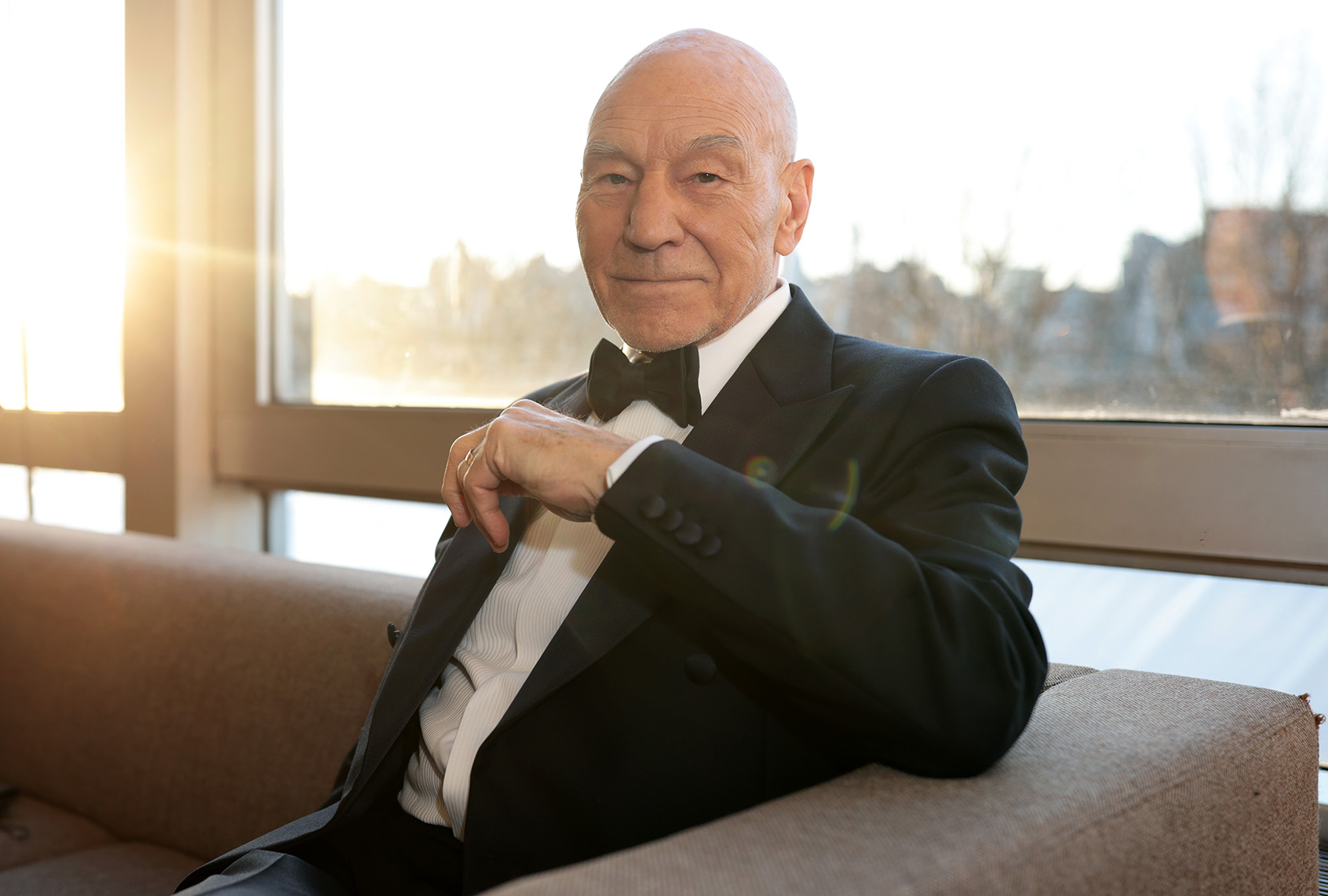
Sir Patrick Stewart, who died Wednesday in Los Angeles at 86, changed these impressions when he accepted the seven-year mission of “Star Trek: The Next Generation.” As Jean-Luc Picard, the captain who inherited the helm of USS Enterprise from William Shatner’s James T. Kirk, Stewart embodied franchise founder Gene Roddenberry’s humanist outlook.

Picard, the actor’s greatest TV legacy, is a paragon of grace: empathetic, dedicated to a mission of understanding and devoted to preserving what is best about Starfleet.  And Stewart’s shaping of the character ennobled television in ways cosmic and small.

By treating his Starfleet commander as if he were a Shakespearean protagonist, Stewart transformed a franchise at a crossroads into a fresh, thoughtful look at human possibility. This guiding principle traveled through “The Next Generation” and subsequent movies, along with the recent Paramount+ “Star Trek” spinoff, “Star Trek: Picard.”

By the time Stewart’s final voyage with “Star Trek” debuted in 2020, Picard was less of a Starfleet hero than a wise man exhausted by politics and cruelty. And “Picard” was as much a response to Trumpian callousness as “The Next Generation” was to our culture’s fatigue with materialism by 1987, when it premiered.

“If the ‘Trek’ universe presented a leader like Picard, it may be because back then, we all thought we were just shy of getting to a better place with regard to how we treat each other,” I recalled in 2018. “Of thinking beyond ourselves, our immediate desires and thirst for gratification, and embracing our differences as strengths. It was a lovely illusion.”

When Stewart joined the Trek universe, he was largely unknown to Americans – save for the eagle-eyed nerds who recognized him, perhaps, from John Boorman’s “Excalibur” or David Lynch’s “Dune.”  His Starfleet captain eschewed Captain Kirk’s swagger, though that didn’t mean he was all business. Picard is a man given to philosophical debates and genteel pursuits like horseback riding and fencing. He isn’t infallible, but he constantly demonstrates all the ways people could be better, not than others, but than we ourselves once were.

This is the essential definition of nobility, expanded upon over 178 episodes of “Star Trek: The Next Generation.”

Many factors contributed to that syndicated series’ success and Stewart’s resultant popularity as the man behind one of TV’s most beloved characters. “The Next Generation” ensemble featured some of TV’s most adored talent, including Jonathan Frakes and LeVar Burton, on a crew steered behind the scenes by Roddenberry himself. It went on to win 17 Emmys and a Peabody.

But Stewart’s gravitas, honed over many years of British stage performance, made Picard the show’s gravitational center, and he was proud of that. Long after TV catchphrases became associated with hackneyed scripting, Picard unironically claimed a few of the best, including “make it so” and “engage,” delivering them each time with an air of aristocratic confidence.

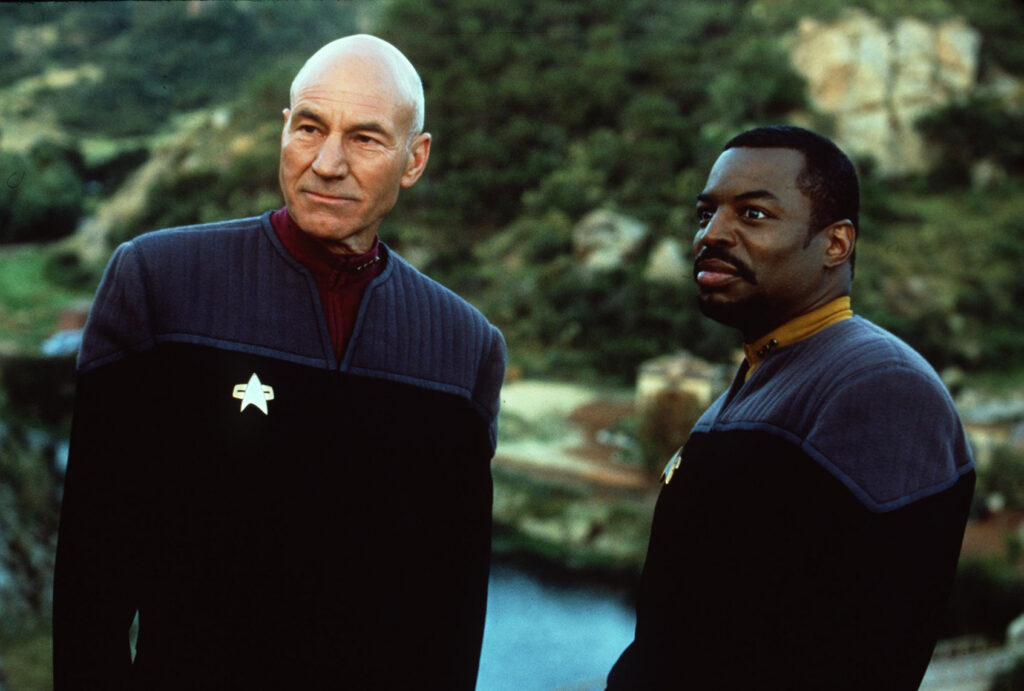
Patrick Stewart and LeVar Burton, wearing dark “Star Trek” uniforms with red and gold collars, stand outdoors on a green hillside.

(Paramount Pictures/Getty Images) Patrick Stewart, left, and LeVar Burton in the 1998 film “Star Trek: Insurrection.”

Stewart came from humble origins, however: He was born on July 13, 1940, in a West Yorkshire industrial town, and raised in a house lacking an indoor toilet or running hot water.

“What identifies an individual as a king is how other people behave towards him,” says a quote attributed to the actor. “All authority is assumed, and if other people don’t accept your authority then you don’t have it. Perhaps the critical thing to being a convincing figure of authority is actually not to try too hard.”

That understanding gives fresh insight into the passion he brought to his greatest starring roles and the smallest.

The authoritative voice we associate with Picard ordering his tea “Earl Grey, hot,” was fine-tuned over a career that began with training at the Bristol Old Vic Theatre School, where he enrolled in 1957. Shedding his working-class Yorkshire accent during his studies, Stewart’s regal elocution won him his stage debut in 1959 in an adaptation of “Treasure Island.” From there, his career was largely defined by his 16 years with the Royal Shakespeare Company, where he started in 1966, before joining the Royal National Theatre in 1984.

As The Independent cited in a 2003 story, when a reporter once implied the two-time Laurence Olivier Award winner was slumming it by linking himself to the Trek universe, Stewart replied, “Sitting in the Captain’s chair of the Enterprise is rather like sitting on the throne of England, though marginally more important.”

The Crown didn’t take offense; Queen Elizabeth II conferred Stewart’s knighthood in 2010.

We can credit the actor’s innate emotional agility for his commitment to every part, or a versatility earned over decades of playing many major heroes and villains the Bard scribbled onto parchment. Whatever it was, Stewart’s charm was in his refusal to let snobbery dictate his life or career path. While most of his career was spent onstage, you’ll find his name in the credits of many films and shows and hear his baritone in a slew of video games and animated work.

Although his association with “Star Trek” and Picard came to define how people perceived him, Stewart’s merry attitude about his claim to fame let us appreciate his range. While his casting as the mutant telepath Professor Xavier in the “X-Men” cinematic franchise resulted from his time in the starship captain’s chair, his multiple collaborations with “Family Guy” creator Seth MacFarlane showcased his playful side.


Want more from culture than just the latest trend? The Swell highlights art made to last.
Sign up here


People who have never watched a single “Star Trek” episode can easily pick out his voice from every other guest on “Family Guy” or know him as Stan Smith’s self-important CIA boss Avery Bullock on “American Dad!” The sheer joy of watching Stewart’s comic turns in shows like “Extras” or hearing his voice in ludicrous contexts was magnified by the majesty he lent to his dramatic work. He owned his portrayal of Gurney Halleck in “Dune” so completely that nobody blinked when he dashed into a battle scene bellowing mightily while clutching a pug, of all things.

But it was Picard—who retired as an admiral— that forever landed Stewart in our minds and hearts. He never minded that fact.

“Halfway through season 3 of ‘Next Generation,’ I no longer knew where Jean-Luc started and Patrick Stewart left off,” he told reporters at a Television Critics Association press conference in 2020. “We became melded, and he has never left me . . . He has always been there, and it’s a relationship that I am happy to continue with.” Thanks to his prolific presence in movies, shows and on screens large and small, we can keep that relationship alive too.


The post Patrick Stewart, the “Star Trek” captain who elevated television appeared first on Salon.com.

  •  

Scary mommies are everywhere, but this time with more nuance

In the opening sequence of “Other Mommy,” Ursula (Jessica Chastain) is making lunch for her daughter, Bela (Arabella Olivia Clark), when she asks if the girl would like to “come into her heart.”

It’s an odd request, but that’s because this version of Ursula is not actually Ursula. She is an entity that Bela calls Other Mommy — who looks exactly like her real mother, except that Other Mommy can contort her body into freaky spider-like shapes that scare the hell out of Bela and her stay-at-home father, Russ (Jay Duplass). Also, Other Mommy seems to want to kill or otherwise possess Bela, which is not exactly maternal. Other Mommy promises to nurture Bela, but clearly she represents the worst type of matriarch imaginable: one who is frightening, controlling and dangerous.

The scary mommy has been an archetype in storytelling for as long as stories have existed. We’ve seen it in fairy tales, animated films produced by studios ranging from Disney to Laika (in a way, “Other Mommy” is just “Coraline” in live-action form), multiple seasons of Ryan Murphy shows, and, of course, everywhere in the horror genre, from “Psycho” to  “Hereditary.” But the scary mommy is really having a moment this spooky season.

In addition to “Other Mommy,” Hulu is streaming a new series called “Phony” that has a similar premise: a kid — this time a teenage boy played by Sam Nivola — believes his mother (Connie Britton) has been replaced by an imposter who looks like the real thing but has sinister intentions. Two other streaming series, “Crystal Lake” on Peacock and “Carrie” on Prime Video, place two of the horror genre’s most famous scary mothers in new contexts. Even real life has given us a scary mommy for the ages: Donna Arthur. The estranged mother of Democratic Ohio gubernatorial candidate Amy Acton remained married to Cledith Arthur, who was charged with raping Acton as a child. Donna Arthur later criticized her daughter in a recent attack ad produced by Acton’s Republican opponent, Vivek Ramaswamy. It should be no surprise that there has been intense backlash to that ad. Society and pop culture, not to mention basic decency, have taught us, over and over, to be horrified by a vicious mother.  

What’s notable about the latest batch of scary mommy releases is that, for the most part, they offer more nuance in their depictions of motherhood than previous examples of the trope often allow. The moms in these movies and shows are, generally, not entirely demonized even if they sometimes do monstrous things.

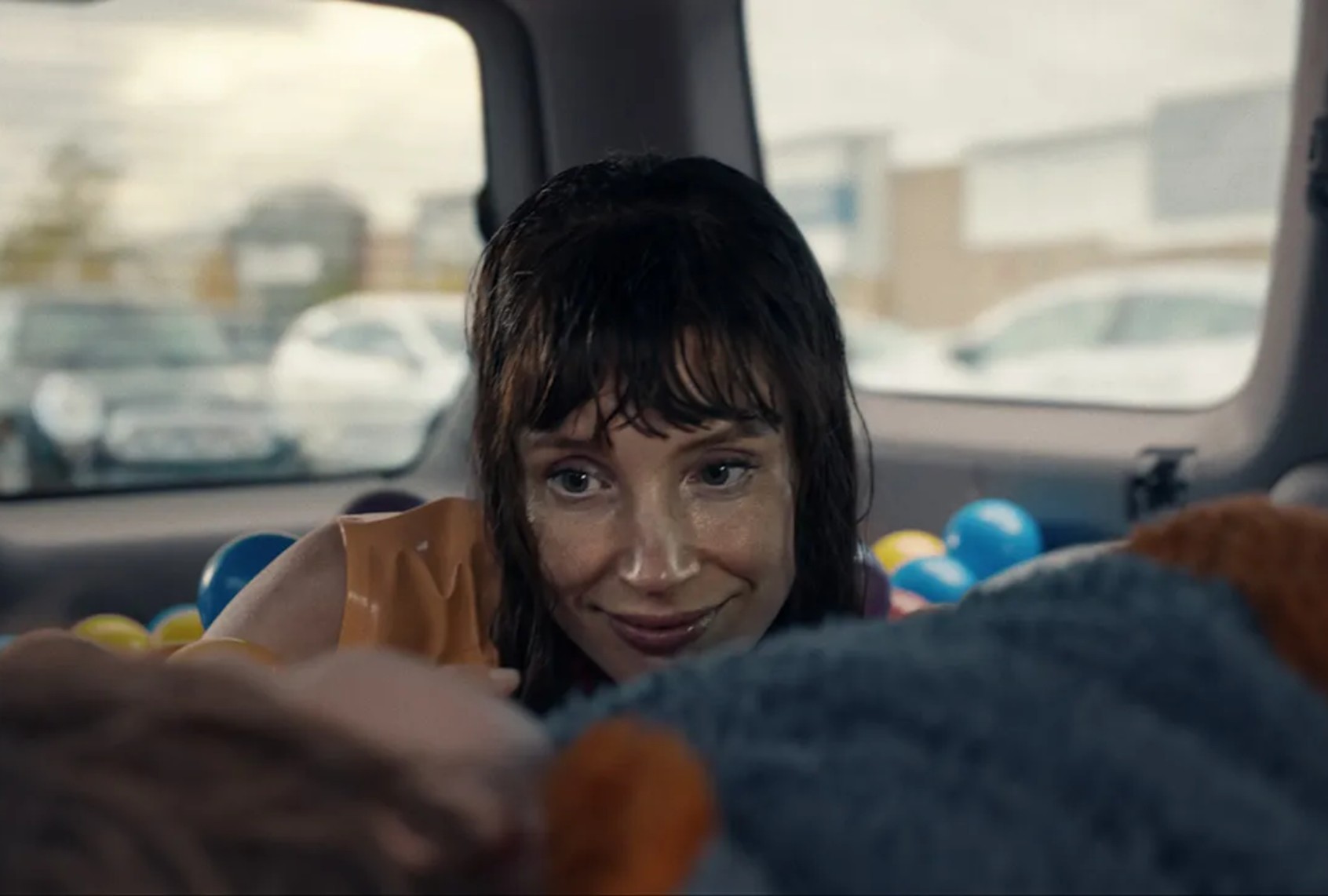
(Universal Pictures) Jessica Chastain in “Other Mommy”

Society and pop culture, not to mention basic decency, have taught us, over and over, to be horrified by a vicious mother.  

“Other Mommy” comes closest to outright blaming its central maternal figure for all the bad things that happen in her home. (Spoilers ahead.) The powers held by the bad version of Ursula seem to grow the more that Bela feels neglected by real-life Ursula, who works constantly and often gets home late. While she loves her daughter, Ursula ultimately admits that she hadn’t initially wanted kids. “I’m sorry for not being the kind of mother that you deserve,” she tells Bela in one of the film’s key moments.

Director Rob Savage and screenwriter Nathan Elston do not solely blame Ursula for the problems within her family unit. Her husband is a bit of a slacker who gets high in the middle of the day, and the Other Mommy, a shapeshifter, assumes other forms aside from that of Ursula, including Bela’s babysitter. But the movie strongly suggests that Other Mommy would not have shown up at all if Ursula had simply given her daughter more attention, which is more of a tradwife-adjacent take than I expected walking into the theater. Oddly enough, “Verity,” released in theaters a week before “Other Mommy,” has a lot more fun slyly toying with and ultimately negating the idea that a professionally successful mother (Anne Hathaway’s best-selling author Verity Crawford) must secretly resent her children.


Want more from culture than just the latest trend? The Swell highlights art made to last.
Sign up here


The three aforementioned scary mommy streaming series go much farther out of their way to depict their respective parents as flawed individuals who do care about their kids. In much of the first season of “Phony,” Connie Britton’s Ellen comes across as a totally caring and attentive mom to her boy Sonny. His suspicions about her arise after he’s injured in a car accident and becomes convinced that she looks slightly different post-crash. (CGI alters Britton’s features just enough to make her appear noticeably off.) But she has a very close relationship with him and, even after her supposed heel turn, makes a sincere effort to get him treatment when he begins to struggle emotionally. Her biggest sin is perhaps being too protective of him and overly involved in his life. The only reason she is scary is that Sonny thinks she might be and we’re not sure whether to believe him.

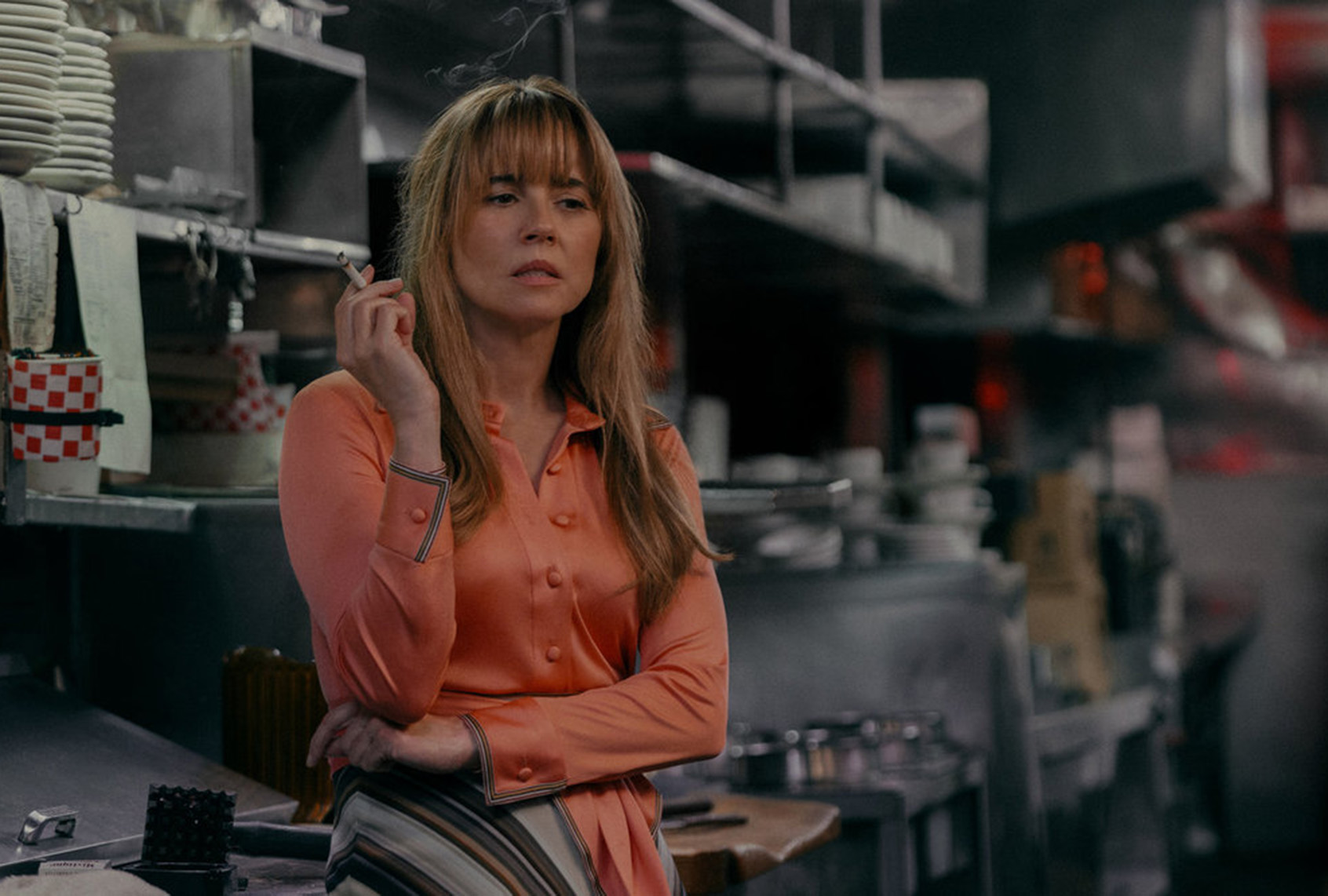
“Crystal Lake” and “Carrie” have the unenviable task of taking scary mommies we already know and helping us understand their motivations in new contexts. “Crystal Lake,” an eight-episode prequel to the original “Friday the 13th,” delves into much — perhaps too much? — more detail about how and why Pamela Voorhees (Linda Cardellini in this version) descended into grief and homicidal madness following the drowning death of her son, Jason, at Camp Crystal Lake. In the 1980 “Friday the 13th” the identity of the murderer of all those horny young counselors isn’t revealed until late in the movie, when we realize Pamela, bitter that the camp has reopened, is the perpetrator. Reminder: the homicidal, goalie-masked version of Jason Voorhees doesn’t appear onscreen until “Friday the 13th Part III.” So even though we all think of Jason as the villain of the franchise, one could reasonably argue that the OG baddie is Pamela, the person responsible for most of the kills in the first film and, arguably, for influencing Jason to keep on killing. Jason Voorhees is, according to previous lore, a literal son of a bit*h.

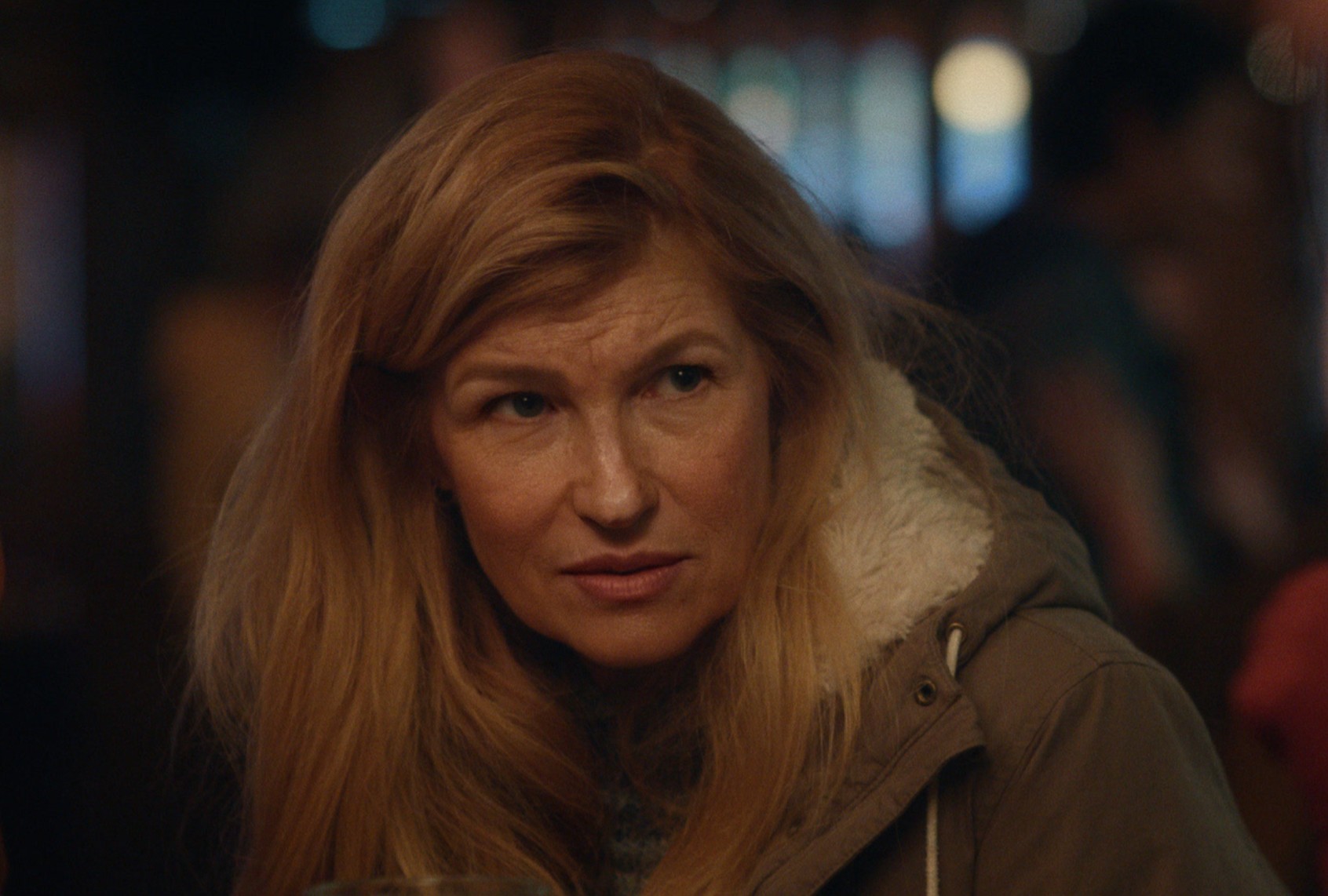
(Disney) Connie Britton in “Phony”

In “Crystal Lake,” the Linda Cardellini version of Pamela Voorhees still slaughters numerous people, but she’s more than just a one-dimensional crazy bit*h. She’s complicated and more capable of selflessness than the first movie takes the time to suggest when it’s not busy knifing poor Kevin Bacon in the chest. The series, by contrast, invites us to feel empathy toward her, or at least acknowledge the suffering she endured in her life even before losing her son.

“Carrie,” developed by Mike Flanagan, the streaming world’s master of horror, attempts something similar but even more extreme. It moves the familiar story about a bullied, sheltered teenage girl to the present. The plot points that are key in Stephen King’s novel and its subsequent adaptations remain. Carrie (Summer H. Howell) is still taunted in the girls’ locker room after she panics over getting her period, and she still loses it in a way that turns the senior prom into a massive, telekinetically-generated disaster. But all of this happens in a world where social media exists, and some of the mean girls at Carrie’s high school wield it like a bucket of pig’s blood that can be dropped on anyone, at any time. The bullying is both more insidious and more soberingly recognizable.

What’s notable about the latest batch of scary mommy releases is that, for the most part, they offer more nuance in their depictions of motherhood than previous examples of the trope often allow.

As in the original, Carrie’s mother, Margaret, is a conservative Christian who wants to shelter her daughter from the outside world as much as possible. But unlike the most well-known version of that character, portrayed by Piper Laurie in Brian DePalma’s 1976 adaptation, Margaret is not a melodramatic, over-the-top, completely irrational zealot. 

As portrayed by an excellent Samantha Sloyan, Margaret still punishes Carrie by frequently shoving her into a prayer closet, but she’s also more grounded in her humanity. She’s conservative in a more modern sense: she’s driven by conspiracy theories, overly protective of her daughter, mistrustful of the government, and deeply Christian even though she does not always act like it. There are also times when Margaret’s opinions are actually correct, as in the first episode when Carrie starts going to public school and must participate in a shooter drill for the first time. Margaret confronts the principal and tells him that Carrie was rattled by the drill and that the whole exercise is traumatizing to students. I never thought I would watch any adaptation of “Carrie” and say to myself, “You know, Margaret White makes a good point.” But there I was, saying exactly that.

(Robert Falconer/Prime) Samantha Sloyan as Margaret White in “Carrie”

Not every element in these films and shows works, nor do any of them completely whitewash their characters’ more deplorable tendencies. But as a collective, they signal that it’s important to look beyond our culture’s tendency to demonize mothers and women in general. Simply being a good mom or a terrible one (within, you know, non-murderous reason) is not the only thing that defines a woman. Weirdly, this fact is also made clear in the most talked-about film of the moment, “You Can See Everything,” in which Elizabeth Holmes, who genuinely seems to love her children, also uses them as a shield in the documentary.

In the very first scene, we see and hear her partner, Billy Evans, talking on the phone about his hopes that directors Nathan Fielder and Lance Oppenheim will show a more relatable, likable side of Holmes and prove she is not a monster. As the camera pans out, we eventually see that Holmes is sitting in the room with him. She is holding a baby, the youngest of her two kids, and gently snuggling with the child.

“Look at this nice mom taking care of an infant; surely she’s a nice lady who would never defraud anyone or even tell a single, small lie,” the image desperately wants to tell us. But in the end, even being a good mom isn’t enough, on its own, to persuade most rational viewers that Elizabeth Holmes is completely innocent of everything of which she’s been accused. Because just as a scary mommy may have some valid reasons that explain some of her behavior, a seemingly caring mommy can also be kind of scary.

The post Scary mommies are everywhere, but this time with more nuance appeared first on Salon.com.

  •  

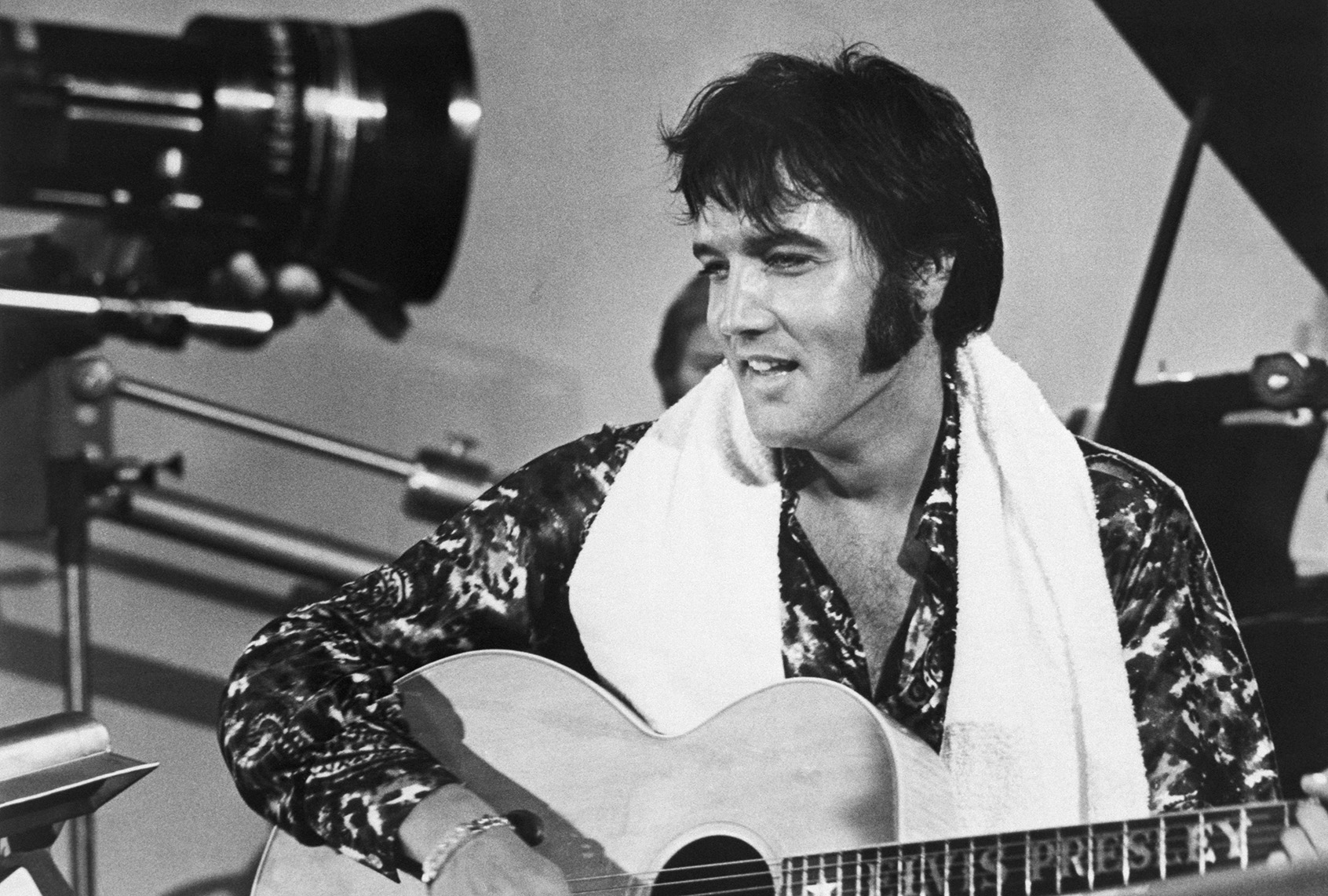
Elvis borrowed from Black artists. Now his songs’ owners are suing AI

Depending on who you talk to, Elvis Presley was either the king of rock ‘n’ roll or a no-good thief.

The legendary singer’s legacy has gone through about as many re-evaluations as Presley himself had jumpsuits. His long-held status as an originator of rock music was obviously not quite the whole story. A minute of research, or just an honest accounting that nearly all his early rockabilly hits were cover songs, puts the lie to the idea that Elvis was a drawling bolt from the blue.  

He took the genre to new heights of popularity, with a hip-swinging style and a (white) babyface, but the music that Elvis sold so well predated him by decades. The prehistory of rock ‘n’ roll  is full of names who might have become stars if they were gifted with his baby blues or discovered by a relentless schemer on the level Col. Tom Parker. 

Then, as something of a corrective to the idea that Elvis was the end-all, be-all of early rock music, the revisionist idea that he was nothing more than a Pat Boone-type, a watered-down middling talent whose success only came on the backs of better Black originators took hold in the sort of circles that like to argue about music history. That was, of course, just as false. Presley was a remarkable performer with a magnificent voice and an ear for hits. His reliance on songwriters was not unusual for its time, with the idea of performers also being their own primary songwriters only arising by way of the rock bands like the Beatles who emerged in Elvis’ wake. 

That conception of Elvis has also faded in recent years, in no small part thanks to Baz Luhrmann’s glitzy, campy 2022 biopic. But you could forgive some people for rolling their eyes when they saw the news that the companies that own the rights to Presley’s music and likeness were suing Anthropic, accusing the AI company’s chatbots of lifting scraping hundreds of Elvis’ songs  in service of creating AI-generated pseudo-music. How could the owners of this catalog, of all people, object to well-funded operations cranking out simulations?

The lawsuit, filed earlier this month in a San Francisco federal court, accuses Anthropic of engaging in “copyright infringement at a scale never seen before.” The owners of Elvis’ catalog claim that Anthropic used their songs as training data without permission or payment. They make the point that Presley’s music isn’t unique in this regard, alleging that Anthropic has done pretty much the same thing with all manner of recorded music, in blatant defiance of copyright law. Anthropic software could never have created songs that sound so similar to Presley’s out of whole cloth, the plaintiffs say, and instead relied on ill-gotten data.

Anthropic software could never have created songs that sound so similar to Presley’s out of whole cloth, the lawsuit claims, and must have relied instead on ill-gotten data.

“Anthropic has essentially put to the test the adage of whether monkeys and typewriters could, provided enough time, recreate Hamlet,” the lawsuit states. “Anthropic found a workaround. Rather than training its monkeys (the AI models) from first principles, Anthropic found mimicry (i.e. copyright infringement) to be the much easier pursuit.”

The plaintiffs say they tested Claude, asking it to crank out modern updates to Presley hits. The results were “very close to the originals: same structure, same hooks reused with light rewording, and full sets of verses/choruses/bridges.”

“That’s edging past ‘inspired by’ into reproducing the copyrighted song, even when the words are swapped out,” they wrote. 

The proprietors of Presley’s material are demanding more than $41 million in damages. Anthropic has denied any wrongdoing.

“We disagree with the claims and intend to defend this case fully,” Anthropic said in a statement.

Given the AI industry’s hostility toward intellectual property rights, it’s not a stretch to imagine that a major player may have trained its models on some of the most famous songs in recorded music history. It’s also not hard to imagine the estates of Big Mama Thornton and Arthur Crudup — should any such entities exist — scoffing at those headlines.

But even if we concede that Elvis was elevated to stardom in large part because  a racist public was unwilling to buy the same songs from Black artists, and even if we picture the late king as a conniving tyrant extracting unconscionable wealth from an underclass of geniuses who remained unrecognized, the rights holders are right to cry foul. That’s because stealing, begging or borrowing material in service of an artistic creation made by real people is enormously different from some corporation doing it to build a better Mechanical Turk. 


Want more from culture than just the latest trend? The Swell highlights art made to last.
Sign up here


Presley was a lot of things: a hick from Tupelo who loved R&B and gospel in equal measure, a white performer of Black music who undoubtedly benefited from the segregated pop charts, a tragic figure whose opioid addiction and poor health led to an early death. But he was also a man, flesh and blood. Anything he could create by virtue of his expelling air through his vocal chords carries more intrinsic value than a billion Claude prompts (which is doubly true true once you know that all of these AI companies operate at a loss).  If you need convincing, just look at his 1977 performance of “Unchained Melody.” 

The song itself is no great feat. Its creation was a purely commercial affair, written for the soundtrack of a ‘50s prison movie that no one remembers. A weepy ballad about longing for a lost love while behind bars, it had been recorded many times over by the time an ailing Elvis brought it out during a concert in Grand Rapids, Michigan. Overweight and profusely sweating, the visibly failing superstar belts the Righteous Brothers’ version of the song while seated at the piano, with a band member holding the microphone. Barely two months before his death, Presley gives everything he’s got left to the song’s central question: “Are you still mine?” 

Even from this distance, nearly a half-century later, it’s still capable of raising the hair on your arms. That moment, a brief section of a borrowed song from a washed-up and dying man, carries more weight than even the most faithful AI recreation or iteration. That moment is exactly why rights holders have a duty to push back against any attempts for AI companies to pretend their chatbots are included in the old chestnut that “great artists steal.”

The post Elvis borrowed from Black artists. Now his songs’ owners are suing AI appeared first on Salon.com.

  •  

Patrick Stewart, “Star Trek” and “X-Men” star, dies at 86

English actor Patrick Stewart, who became world-famous as the star of “Star Trek: The Next Generation” and the “X-Men” movies, died on Wednesday at his home in Los Angeles. He was 86. Kelly Bush Novak, his longtime spokesperson, announced that he died from Alzheimer’s disease and Lewy body dementia, which is marked by features of Parkinson’s disease.

“He has been held in the warm embrace of family and friends, surrounded by live music, prayer, tears, laughter and the kind of profound emotion that only he could inspire after a lifetime of devotion to us all,” Bush Novak wrote. “We will forever cherish the peaceful ease and reflection on his face, an enduring reminder of his invincible grace.”

Stewart’s distinctive baritone voice and striking bald head made him one of the most familiar actors to American audiences, but until the late 1980s, he was virtually unknown in the U.S. Before his casting as Capt. Jean-Luc Picard on “Star Trek: The Next Generation,” he had spent decades as a classical theater performer in Britain, especially in the works of Shakespeare. He joined the Royal Shakespeare Company in 1966, where he met fellow actor Ian McKellen, who would become a longtime friend and collaborator.

Over the course of his career, he received four Emmy nominations for his television work, as well as two Laurence Olivier Awards and a Tony nomination for his role in “Macbeth.” In 1996, he won a Grammy for best spoken word album for children for “Prokofiev: Peter and the Wolf.” He was knighted by Queen Elizabeth II in 2010.


Later in his career, Stewart reprised his role as Picard in various “Star Trek” films and a recent spinoff series. His role as professor Charles Xavier in the “X-Men” film series from 2000 to 2017 helped propel his career to new heights and usher in a new era of superhero films. He is set to appear as Xavier in “Avengers: Doomsday,” which will be his final on-screen film appearance.

“I think I’ve been in denial about my life for a very long time,” Stewart told The Guardian in 2023. “I never really took on board how successful I had become. Even today I sometimes think, ‘You’re a lucky son of a b**ch, Patrick,’ when something unexpected or good happens to me.”

Stewart was born on July 13, 1940, in Mirfield, England, a small town in West Yorkshire. He is survived by his wife Sunny Ozell, an American singer, whom he married in 2013; his son, Daniel, also an actor; and his daughter, Sophie.

The post Patrick Stewart, “Star Trek” and “X-Men” star, dies at 86 appeared first on Salon.com.

  •  

Bankrupting scammers is surprisingly easy

hacker dude

It feels like AI is coming for everybody's jobs, but especially for phone scammers. Thanks to the availability of consumer AI, anyone in any call center anywhere can throw up a decently convincing-sounding AI agent to fleece people out of their money with no effort required. — Read the rest

The post Bankrupting scammers is surprisingly easy appeared first on Boing Boing.

  •  

“Public Access Afterworld” is a novel for the terminally online

There was a time when the internet was cool. One could be forgiven if memories of the cool-internet era have grown fuzzier over the years, now that the web has become a self-regulating machine in an indomitable surveillance system and all. But I know it was true, because I was there. “Information superhighway” was a fitting nickname for a system that could blast the average user through a vast network of art and intelligence. (“Blast” being a relative description of how fast dial-up and early WiFi felt at the time.) 

Most of my adult music taste can be traced back to those early days, watching hyper-pixelated videos of the “Numa Numa” guy dancing to Romanian boy-band hits, or animated aliens piloting their spaceship to the thumping Europop of Eiffel 65’s “Blue (Da Ba Dee).” Archaic video hosting sites were a cultural gateway. Laggy Adobe Flash games commandeered afternoons. It was heaven, until it wasn’t. 

But paradise can’t be lost if it was never really paradise to begin with. The internet’s dark underbelly was always there, lurking slightly out of frame behind the firewall. If something that once seemed magical could be turned into something so corrupt in a comparably short time, its malevolent potential was a feature from the beginning, not a bug.

“Public Access Afterworld” is less of an artistic pivot than a confirmation that Schoenbrun’s worldbuilding skill is well beyond their peers, cinematic or literary.

Few people navigate the internet’s light-to-dark spectrum as well as writer-director Jane Schoenbrun, whose films play like dispatches beamed out from the depths of online black holes. Their work remixes the thrill of early internet exploration into colorful abstraction, cracking open an esoteric feeling to analyze its contents and origin — to varying effect. Schoenbrun’s three feature films, 2021’s “We’re All Going to the World’s Fair,” 2024’s “I Saw the TV Glow” and last summer’s “Teenage Sex and Death at Camp Miasma,” are as unwieldy as their verbose titles suggest. It’s impossible to watch one, let alone all three, without realizing that Schoenbrun has a lot on their mind, sometimes too much for a single film to bear. Schoenbrun’s talent for image-making, however, ends up shouldering much of that weight, letting intricate ideas about identity and personal relationships to digital media sit gracefully atop beautifully rendered cinematography. 

But what happens when someone so known for their visual flair abandons alluring imagery altogether and lets their writing do all the work? 

In Schoenbrun’s debut novel, “Public Access Afterworld,” the filmmaker takes a sizable risk, stripping away the meticulously crafted onscreen worlds to assert the dexterity of their prose. At 592 pages, this book could easily feel like a smug kiss-off to all those — present company included — who have criticized Schoenbrun’s reluctance to pare down their concepts into less dense works. But while the novel is imposing from sheer size alone, the shift in medium lends their elaborate, occasionally exhausting storytelling a curious new potency.

Schoenbrun confidently guides readers down winding, interconnected roads, bouncing between online cults and peculiar digital ephemera to weave a gripping search for truth in a time when the internet has made everything fiction. “Public Access Afterworld” is less of an artistic pivot than a confirmation that Schoenbrun’s worldbuilding skill is well beyond their peers, cinematic or literary. 

Like the rest of their work, Schoenbrun’s novel is deeply concerned with the internet and its seedy electronic underbelly, using traditional media as a portal to the web’s sleaziest, scariest parts. “Public Access Afterworld” is divided into episodes, not chapters — although each episode has eight individual components, like a TV show divided by ad blocks. This unique structure serves the story, following the zealots of the titular analog realm that lurks beyond the television static through the action. 

We begin in 2009, just after television signals convert to digital transmission, when high school best friends David Sawyer and Erin Morrison see something strange in the fuzzy image filling their old cathode-ray television screen: a broadcast from an unknown entity called Public Access Afterworld. Their lives soon become consumed by the quest to find the source, turning to proto-internet message boards and video hosting sites in their search. Before long, dead ends give way to a digital abyss, pulling them both into something that will alter their perception of reality and the lives of hundreds of others called to follow them. 

This audacious mystery makes an ideal premise for a novel, where Schoenbrun can toy with reader expectations without the added task of ensuring that the final image reflects their objective. As it turns out, Schoenbrun’s writing is stronger when it’s devoid of visual images. Description and style can take hold without restraint. And while their prose is sometimes redundant, even the excess flows without struggle. 

A screenplay may be a different monster from a novel, but both depend on a writer’s foresight. An image has to exist in the mind before it makes it onto the page. But whether that image translates to the viewer in its final context is another matter.

“Public Access Afterworld” is a page-turner in the tradition of supermarket paperbacks from Stephen King and Clive Barker, both of whom know cinema well. But Schoenbrun’s innate familiarity with the internet — its legendary Creepypasta stories and disconcerting YouTube videos that seem to spring from the void — sets their story apart from the classics. This is a contemporary novel through and through, and Schoenbrun writes with practiced conviction, subtly differentiating the different characters’ perspectives without dropping the pace.

Having three movies under their belt helps there, too. A screenplay may be a different monster from a novel, but both depend on a writer’s foresight. An image has to exist in the mind before it makes it onto the page. But whether that image translates to the viewer in its final context is another matter. In their filmmaking, Schoenbrun sometimes struggles to apply broader themes within a minute-to-minute narrative, creating pacing issues that reveal a dissonance between intention and execution. 

For example, there’s a sizable gap between the one-shot montage sequences in “TV Glow” and “Camp Miasma.” The former brilliantly evokes wistful teenage dreaming as a character walks through their high school, adorned by a yearning Caroline Polachek song and light-pink diary scribblings. It’s a clever riff on teenage social politics and the hormone-ridden adolescence that so often define both our identities and our future. The “Camp Miasma” montage, on the other hand, toils under three layers of metafiction, as an ’80s slasher-film murderer stalks and kills at summer camp set to a Counting Crows tune, haphazardly interrogating the viewer’s relationship to nostalgia. With Schoenbrun, I often find it’s hit or miss.

But in the current media landscape, consistency is overrated. I’m always more drawn to big ideas that have the potential for colossal failure. There are certain things you can draw from a Schoenbrun film that you could never get from, say, a Martin Scorsese movie, no matter how hard you try — and I’m not just talking about the trans subtext in all of Schoenbrun’s work. For an artist as formidable as Scorsese, a flop means nothing. But for someone like Schoenbrun, defeat defines their future. Every decision is a risk. And art without risk is just a product.

While I’m hesitant to claim that Schoenbrun’s primary strength is as a novelist rather than a filmmaker,  “Public Access Afterworld” goes some distance toward making that case. It’s not that Schoenbrun is bad at making movies, but their mind seems to operate like a story map, with hundreds of red strings pinned between plot points. Too many overlapping yarns in a movie make for a convoluted final product, a big clump of colorful material that’s too dense to pry apart to see the substance lurking below. But at least in this novel, the yarns overlap without tangling. A clear view suits Schoenbrun’s cerebral nature. We can admire the blue sky before the clouds cover the sun.

The post “Public Access Afterworld” is a novel for the terminally online appeared first on Salon.com.

  •  

I Gave My Blood to the AI Death Clock

Death Clock promises to predict when you’re going to die and help you extend your time on Earth. After a month, I felt like it was sucking the life out of me.

  •  

“You Can See Everything” leads 2026’s documentary revolution

“You Can See Everything” is not your standard documentary. Nathan Fielder and Lance Oppenheim’s film isn’t the first nonfictional chronicle of Elizabeth Holmes’ enigmatic psyche, but it is the most revealing. Any director pointing their camera at Holmes — before or after she was convicted of fraud for her bogus Theranos blood-testing device — won’t capture the whole truth. That’s what happens when a subject is obscured by layers of semi-permeable barriers of their own making: Eventually, the image distorts. Fielder, the film’s ringmaster, has no choice but to forgo conventional documentary tactics and seek detours. Perhaps if he takes his own unorthodox approach, the two will cancel each other out, leaving something substantial behind.

But, then again, what is a “standard” documentary? In recent years, streaming’s popularity has significantly impacted the genre and how audiences perceive it. Once executives realized there was an endless cash cow to milk in true crime and tawdry scandal, a deluge of rushed, ineffective documentaries and docuseries hit the top platforms like a string of hydrogen bombs, leveling their audience’s standards and turning their taste to ash. 

Everything was and is fair game. Murder victims, abuse survivors, pyramid and multilevel marketing schemes, unsavory business practices, music festival scams, campus life, cult leaders; you name it, you can probably find a documentary on it. The sad thing is, this boom produced legitimately compelling offerings and important stories, told well, too. But that doesn’t matter when the market’s not only crowded, but recycling its wares every week. In this era, powerful, complex stories of the intrepid human spirit sit next to ephemeral tales of cheaply made, mildew-ridden leggings. And guess which option the algorithm favors?

Once executives realized there was an endless cash cow to milk in true crime and tawdry scandal, a deluge of rushed, ineffective documentaries and docuseries hit the top platforms like a string of hydrogen bombs, leveling their audience’s standards and turning their taste to ash.

In just shy of three weeks, “You Can See Everything” has taken a sledgehammer to this era of cobbled-together documentaries. The film is on track to become the most successful theatrically released documentary ever, staring down two Michaels (Jackson and Moore) and two nature docs (“March of the Penguins” and “Earth”) as it climbs the ranks before its international release. 

More importantly, the film has ignited endless conversation thanks to its capricious subject and equally unpredictable experimentation with form, garnering chatter about whether it may be the first documentary nominated for best picture at next year’s Oscars. As another taxing year nears its end, the popularity of “You Can See Everything” reflects audiences’ desire to go deeper than the surface level most streaming documentaries are content to skim. But the film is also testing those who see the genre as one specific thing, made one specific way. 

Fielder’s film is one of many from this year reconfiguring the wider idea of what documentaries can and should look like, away from the style monopolizing the genre of late and toward something more varied and essential. Considered alongside an excellent lineup of contemporaries, “You Can See Everything” stresses that the genre isn’t about uncovering truths, but playing with our subjective relationship to them.

That notion isn’t always easy to remember when, to many, “documentary” remains somewhat of a cinematic pejorative. Whether by a diet of snoozy docs shown in history class on a wheeled-in television from the AV room, or the genre’s reputation for being innately less thrilling than narrative filmmaking because it contends with reality over fiction, documentaries simply don’t have the best rap. Their audience generally skews older, and for some, an older crowd’s curiosities skew boring. This is partly why those ripped-from-the-headlines streaming documentaries are so popular: They reflect stories that are buzzy but fleeting, perfect for those whose attention spans are already shot.

But the idea that a documentary that isn’t detailing some recent or mysterious event is inherently tedious is a gross misconception. Documentaries are about life, and as such, their relevance is evergreen. The past informs both the present and the future. And dismissing the past as unimportant in the face of, let’s say, some hot new documentary about a man who stole $10,000 worth of orange juice from a local supermarket last Tuesday means we won’t have a present worth loving or a future worth living. The hypothetical orange juice documentary sounds interesting, but it has no value unless it can do more than regurgitate a Wikipedia article or a news story with a few worthless talking heads thrown in. Documentaries can take many forms; being an arm of journalism is just one, and often it’s not very compelling.


Want more from culture than just the latest trend? The Swell highlights art made to last.
Sign up here


Occasionally, I’ve come across friends, family and acquaintances who don’t have a strong relationship to the genre, but are curious about how to forge one. In response, I like to give two pieces of advice. The first comes from Carolyn Strachan, a filmmaker and professor who taught an ethnographic films course I took in college, and changed my relationship to the genre with one simple sentence: “The only rule of a documentary is to press record.” The second comes from me, many years later: every best-of-the-year film list should include one documentary, if not more. Once someone remembers to consider docs alongside their narrative companions, that attention reshapes their connection to the genre.

Institutions also play a role in fostering that love, too. That a documentary has never been nominated for the best picture Oscar is cuckoo bananas, pure and simple. How can such a premier establishment as the Academy claim to revere filmmaking if they’re unwilling to prop up all forms of the art? There are dozens off the top of my head, released this decade alone, that should’ve been in contention — documentaries as important and memorable, if not more, than the narrative movies nominated in the category. The double standard is why “You Can See Everything” having legitimate chances at multiple top awards next year is so exciting. This could be a watershed moment. We might witness history being made in real time, like we did when “Parasite” became the first non-English film to win the top Oscar in 2020. While such an accolade might not reroute the dire timeline we’ve lived in since then, it could open countless doors and even more minds, and deservingly so, for a film as mercurial and labyrinthine as Fielder and Oppenheim’s.

A filmmaker and professor who taught an ethnographic films course I took in college changed my relationship to the genre with one simple sentence: “The only rule of a documentary is to press record.”

But “You Can See Everything” is far from the only doc that should be in contention, either for best picture or your own best-of list. This year has been decent for film as a whole, but fantastic for documentaries, which have surpassed 2026’s mainstream narrative films in many ways. Right now, “Once Upon a Time in Harlem,” a new-old film from the great American icon William Greaves, is expanding into more theaters. It’s both an account of the past, peering into an intimate gathering of Black luminaries during the Harlem Renaissance, and a tale for right now — funny, moving and pertinent, even if it was originally filmed in 1972. Just as applicable to the present is “NAZA,” the harrowing film uncovering the extent of Israeli surveillance and war crimes, which stands to dictate which way the world will spin.


Historical events a little reminiscent of stereotypical docs? Want something guaranteed to cheer you up? First, don’t be so quick to dismiss. But also, try John Wilson’s “The History of Concrete” or “Paralyzed by Hope: The Maria Bamford Story,” two very different films helmed by two very funny people, that have as much to do with how we operate as people as they do with zany subject matter. Or, let’s say “You Can See Everything” has opened your eyes to all of the different, strange and unwieldy forms a documentary can take. 

Maybe you’re craving another doc that will turn itself inside-out, revealing an underbelly of broken mirrors. Brace yourself for “Remake,” Ross McElwee’s magnificent story of fatherhood and filmmaking forced askew. It’s my personal favorite of the year, sitting just above “You Can See Everything.” Make it a double feature if you so wish, but you might need to lie on the floor and stare at the ceiling after.

But if you want facts, plain and simple, you won’t find them in any of those films. You will, however, find truths, and many of them. That’s the wonderful thing about documentaries: They might deal in reality, but the genre uses nonfictional perspective to highlight the difference between fact and truth. Reality exists in the middle, somewhere in the opaque. The thrill comes from the squint — the desperate, reflexive need to make out something in the haze. What’s laid before the viewer will never be the whole picture. Any documentary that tells you otherwise has more in common with narrative filmmaking. As it turns out, truth is indeed stranger than fiction.

The post “You Can See Everything” leads 2026’s documentary revolution appeared first on Salon.com.

  •  

Billionaires shatter spending record to fight California wealth tax

SAN FRANCISCO — Billionaire opponents of California’s proposed wealth tax have spent more fighting it than they ever have on a political cause in the state, according to a POLITICO analysis.

A record $612 million from more than 70 current and former California billionaires is flooding this year’s state elections, nearly half of it for groups working to defeat Proposition 40, the wealth tax initiative on Tuesday’s ballot, POLITICO found.

The fight over Prop 40 has brought California’s wealthiest residents — many from its native tech industry — together in an unprecedented show of political coordination, the new data reveals. Tech leaders say the wealth tax has accelerated plans for broader political engagement this cycle, building networks that could be the foundation for future campaigns.

It’s a particularly striking display of unity from Silicon Valley’s notoriously hard-to-organize donor class. Google co-founder Sergey Brin is by far the well-funded opposition’s biggest benefactor, with former Google CEO Eric Schmidt, venture capitalist John Doerr, Stripe CEO Patrick Collison and crypto executive Chris Larsen also among those who have contributed the most dollars in trying to stop the billionaire tax.

The possibility of a tax on their assets has drawn more than $293 million from at least 30 California billionaires, the majority of whom made their fortunes in tech but otherwise span industries, from agriculture to real estate — as well as the political spectrum, from established Democratic megadonors to some Republican allies and first-time donors.

infographic

Frank Slootman, the billionaire board chair and former CEO of cloud data company Snowflake, said he only had a “moderate” interest in politics despite giving $5 million to an anti-Prop 40 group, arguing that the measure erodes private property rights and the state’s economic dynamism.

“This upends the most basic assumptions we have about being a taxpayer and a resident of a state,” said Slootman, who has no prior record of California campaign contributions. “I vote in most elections, that’s about it. This is not about politics for me — it is far more important than that.”

The other half of billionaires’ spending this year came largely from Tom Steyer, a rare billionaire endorser of Prop 40 who bankrolled his own failed gubernatorial bid — the most expensive primary campaign in state history.

infographic

Even longtime strategists who have worked for statewide candidates and California’s costly ballot battles struggled to find a historical parallel for the coordination or scale of billionaire spending against Prop 40.

Rob Stutzman, a Sacramento political consultant whose past campaigns have involved a billionaire gubernatorial candidate and record-breaking ballot spending over sports betting, said that Silicon Valley leaders see Prop 40 as an “existential threat to tech in California” and the innovation that has taken root in the region for decades.

“Having to defend against a direct assault is a more unifying principle,” Stutzman told POLITICO. “They’re known for their pet issues that are harder to organize their peers around, but you can circle the wagons to protect yourselves. There is nothing that focuses similar-situated people.”

Proponents of Prop 40 contend the measure is necessary to backfill federal health care cuts.

The last year billionaires in California came closest to spending at this level was 2010, when they dropped $147 million on state races and measures, according to POLITICO’s analysis — a total that’s just over half of what the current wealth tax proposal mobilized. Most of it was the result of billionaire Meg Whitman, a former CEO of eBay and Hewlett-Packard, self-funding her unsuccessful Republican campaign for governor.

Scott Ellis, a millionaire and Prop 40 supporter who formerly served as a senior director at HP, described the magnitude of billionaire spending to fend off the measure as “a completely different animal” than past examples of “a lot of money spent by a rich person to get themselves elected.”

“People with wealth and extreme wealth are getting much more brazen than they used to be,” Ellis told POLITICO. “These people have tremendous resources. They have an incredible range of choices to make, including choosing to oppose this kind of ballot measure.”

Representatives for several billionaire opponents of Prop 40, including Schmidt, Larsen and agricultural titan Stewart Resnick, declined to comment on POLITICO’s findings.

Others, like Doerr, referred POLITICO to Building a Better California, a new Brin-led political operation that has become the primary vehicle for billionaire money against Prop 40.

The group defended the importance of its cause, arguing the measure would “permanently devastate” the state tax base and budget while undermining the health care funding it’s intended to patch.

“We are fortunate to be supported by entrepreneurs and business leaders who have built their businesses and created hundreds of thousands of jobs here, and who share a deep commitment to advancing policies that will improve quality of life for all and protect the state’s economic, jobs, and innovation engine for generations to come,” Building a Better California spokesperson Abby Lunardini said in a statement.

Debru Carthan, vice president of the SEIU-United Healthcare Workers West union behind the billionaire tax, responded to the contributions, saying, “no amount of billionaire spending is going to intimidate us or turn us back.”

A reawakening

Tech leaders have told POLITICO that the wealth tax awakened a sleeping giant in California politics: their previously disengaged industry peers, who months ago suddenly started spending across the ballot to steer California in a more moderate, business-friendly direction. The threat injected the wider political organizing, some of which preceded the measure’s introduction, with a new sense of urgency.

“The tech community has wanted to become a bigger player in California politics,” said veteran Democratic strategist Steven Maviglio.

“They’re building an infrastructure, I think, for the long term because they’ve become a dominant player in our economy, and they now, after literally a decade of being hands-off, want to be very involved because they see the consequences,” Maviglio, who is working on a separate housing and environment-related ballot fight where Schmidt’s wife, Wendy Schmidt, has given $10 million, told POLITICO.

Earlier efforts to unify faltered amid strategic disagreements and overinflated fundraising promises. That was especially apparent in the push to rally Silicon Valley around San Jose Mayor Matt Mahan, a business-friendly candidate with a background in startups, during the California gubernatorial primary.

Although Building a Better California wasn’t spared its share of donor turmoil, an initial patchwork of opposition efforts eventually consolidated resources under the Brin operation’s strategy, devised with the help of veteran ballot-measure consultant Ned Wigglesworth.

The group also brought on fundraisers associated with California Gov. Gavin Newsom’s inner circle. Newsom has publicly opposed imposing a billionaire tax at the state level.

In addition to funding Prop 40 attacks, several billionaires claimed to have fled the state to avoid the tax. Brin, for example, registered to vote in Nevada. Because the one-time, 5% tax on assets would apply to billionaires who lived in the state as of Jan. 1, 2026, POLITICO’s analysis covers billionaires with recent California ties, based on information from Forbes, the progressive nonprofit Americans for Tax Fairness and news reports.

Some of those billionaires made their moves quietly, highlighting a split over how they should respond to the possibility of the tax passing.

“This has been a point of friction between me and some of my other billionaire friends,” Palmer Luckey, the billionaire founder of defense tech giant Anduril, said on a call with reporters this week. “They’ve said things like, ‘Palmer, you have to have solidarity for us. You can’t enable these really bad policies. If you stay and if you don’t leave, it’s going to show them that there’s no consequences.’”

Luckey, a vocal critic of the tax who hasn’t donated to the opposition campaign, added, “I’m planning on staying in California. I’m going to keep fighting it. I’m hoping that this doesn’t pass.”

Meta revealed a plan last week incentivizing CEO Mark Zuckerberg to stay near the company’s Silicon Valley headquarters after the longtime California resident told a special committee of his board he was considering leaving over the tax. He also hasn’t challenged Prop 40 through political contributions.

DoorDash CEO Tony Xu, who poured almost $3.5 million into trying to prevent the wealth tax, was one of three members on the special committee negotiating with Zuckerberg.

Behind the money

Brin is single-handedly putting $102 million behind Building a Better California as it campaigns to sink Prop 40. This year, he’s also backed unsuccessful runs by Republican Chad Bianco and the moderate Mahan in the gubernatorial primary, plus Republican Steve Hilton’s campaign for governor. Federally, he’s given close to $450,000 to the Republican National Committee.

But before this cycle, Brin had been a sporadic donor, gone dark for many years. His last disclosed political donation in California was in 2010 — for $200,000 to join other Silicon Valley leaders in opposing an ultimately defeated ballot measure that would’ve suspended a state climate law.

Some of the billionaire donors — Slootman, Roblox CEO David Baszucki, Robinhood co-founders Baiju Bhatt and Vlad Tenev, Figma CEO Dylan Field, fintech executive Max Levchin and software founder Andrew Karam — have no history of spending on California politics before this year, according to state campaign records.

Tenev said in a statement that he donated to Building a Better California to support one of two other measures the group has advanced, which is designed to invalidate Prop 40 and would prohibit new taxes on various forms of personal savings.

“Special taxes on retirement and unrealized investment gains run contrary to the intent of the investment vehicles that have helped millions of Americans build wealth for the long term,” the Robinhood chief executive said. “History shows us that taxes aimed at a few have often been extended permanently to include more taxpayers over time.”

Another Building a Better California donor, Doerr, on the other hand, was a pioneer in shaping how Silicon Valley engaged with politics and Washington. He co-founded TechNet in 1997, which launched a political action committee as a key part of its strategy. Today, the influential industry trade association manages both federal and state-level PACs on top of a vast bipartisan lobbying network, with Google, Stripe and Kleiner Perkins among its many corporate members.

The wealth tax has also brought former Sequoia venture capitalists, Michael Moritz and Doug Leone, onto the same side after they previously diverged on California’s partisan redistricting fight at the ballot last year. They spent $7.5 million and $100,000, respectively, on groups fighting Prop 40.

Leone is a prolific Republican donor who re-endorsed President Donald Trump in 2024, while Moritz has consistently criticized Trump and chided his supporters in Silicon Valley for making a mistake.

No less than a dozen of the billionaires spending on groups that oppose Prop 40 are current CEOs — including DoorDash’s Xu, Roblox’s Baszucki, Robinhood’s Tenev, Stripe’s Collison, Affirm’s Levchin, Schmidt of rocketmaker Relativity Space, Hemant Taneja of top venture capital firm General Catalyst, Field of design platform Figma and Parker Conrad of HR software provider Rippling.

Collectively, they’ve plowed at least $88 million into their cause.

Several more of the billionaires in POLITICO’s analysis chair influential companies and firms. The opposition effort has received $40 million from Doerr, the Kleiner Perkins venture capitalist; $17.5 million from Larsen at the crypto company Ripple; and $2 million from George Marcus at the Bay Area real estate titan Marcus & Millichap — to name a few.

Will they come together again?

Whether the campaign infrastructure built by billionaires and the tech industry for the midterms will endure is still an open question.

Other new tech-funded groups this cycle have promised to play the long game and framed their plans around at least a decadelong horizon. Building a Better California itself has also committed to sticking around for the foreseeable future.

California political observers point to the size of the Brin-backed operation, as well as its decision to focus on additional environmental and housing measures, in predicting it won’t stop after the election.

Still, the unprecedented nature of their mobilization raises questions about what cause would be able to activate so many of these individuals again. Donors and advisers to Building a Better California previously clashed over whether spending on non-wealth-tax issues, such as environmental policy, could jeopardize the group’s success.

In the past, “if you look at those big dollar campaigns, ballot measure campaigns, those were funded in general by an industry,” said Jim Ross, a Bay Area-based Democratic consultant. “Wherein this, it’s a bunch of individuals, very wealthy individuals, but they don’t necessarily have any commonality other than they don’t want to be taxed.”

“When you have a group of wealthy people all putting money into this, a lot of the challenge is going to always be: How do you manage that coalition? How do you keep everybody moving in the same direction?” he added.

One ready answer is a revived wealth tax effort.

Last week, Rippling CEO Conrad said in a social media exchange with Silicon Valley Rep. Ro Khanna, whose early support for the wealth tax alienated some of his original tech backers, that he “absolutely cannot afford to stay” in California — reasoning the measure may soon be followed by another one-time tax in the next election.

Slootman made a similar calculation.

“In a one-party state with super majorities in both chambers, we are at risk for everything we own,” he said. “We are hunted animals in this state. They will be at it again in two years.”

Rosmery Izaguirre contributed to this report.

About this analysis

POLITICO’s analysis compiled records from the California secretary of state for 142 California billionaires that have contributed to state campaign committees, including 30 who had given to the following committees opposing Proposition 40: Building a Better California, Californians Against Tax Increases and Golden State Promise. Reporters reviewed donation records to verify names and employers matched with the billionaires who live in the state, as well as contacted each donor. Donations are as of Oct. 26.

Forbes estimated the wealth of the persons included in this analysis. Because billionaires often own properties in multiple states, we relied on Forbes to identify each person’s residence and supplemented with further data provided by the progressive nonprofit Americans for Tax Fairness. We included people who have recently left the state, including cases when they said they were leaving to avoid the potential wealth tax.

  •  

TikTok is going after Yelp and Google Maps with an in-app restaurant guide

TikTok’s Must Eat feature, with restaurant reviews and maps of local favorites.

TikTok is launching an in-app restaurant guide in a challenge to other platforms like Yelp and even Google Maps.
The company on Wednesday announced the launch of Must Eat, a new section of the TikTok app built on 40 million posts, reviews, and comments about dining on the platform. The new feature uses videos and discussions of buzzy local businesses to create restaurant recommendation guides. Users can leave reviews of restaurants, call and make reservations, and search for nearby businesses on a map.

At a launch event this week, TikTok US CEO Adam Presser called Must Eat "the compilation of all of the conversation that's happening on the …

Read the full story at The Verge.

  •  

Eurovision confirms candidates for 2027 — but 2 EU countries are still on the fence

Spain and Slovenia are still undecided about whether to compete in next year’s Eurovision Song Contest, after they boycotted this year’s edition over Israel’s participation.

The European Broadcasting Union, which organizes Eurovision, announced Wednesday that national broadcasters from 36 countries would take part in next May’s contest, which will take place in Burgas in eastern Bulgaria.

Five countries staged an unprecedented boycott of the 2026 contest due to Israel’s war in Gaza — sparked by the Oct. 7, 2023 Hamas attack on Israel — and the resulting humanitarian crisis it triggered.

Ireland, the Netherlands and Iceland are again boycotting the 2027 competition but Spain and Slovenia “have not yet decided” whether they will compete, the EBU said. The Union has given both broadcasters until December to confirm their participation “in recognition of the complexity of the matter.”

The song contest has been embroiled in controversy in recent years over Israel’s participation. The EBU changed its rules earlier this year to block countries involved in armed conflict or any other “sensitive geopolitical situation” from hosting the annual competition, after Israel almost won in 2025 and 2026. The winning country typically hosts the following year’s event.

Canada is a new addition to the contest for 2027, while North Macedonia will return after a four-year absence. Czechia will not take part in next year’s contest for financial reasons.

  •  
❌