Login
Login
What Cornell says about universities’ MAGA complicity
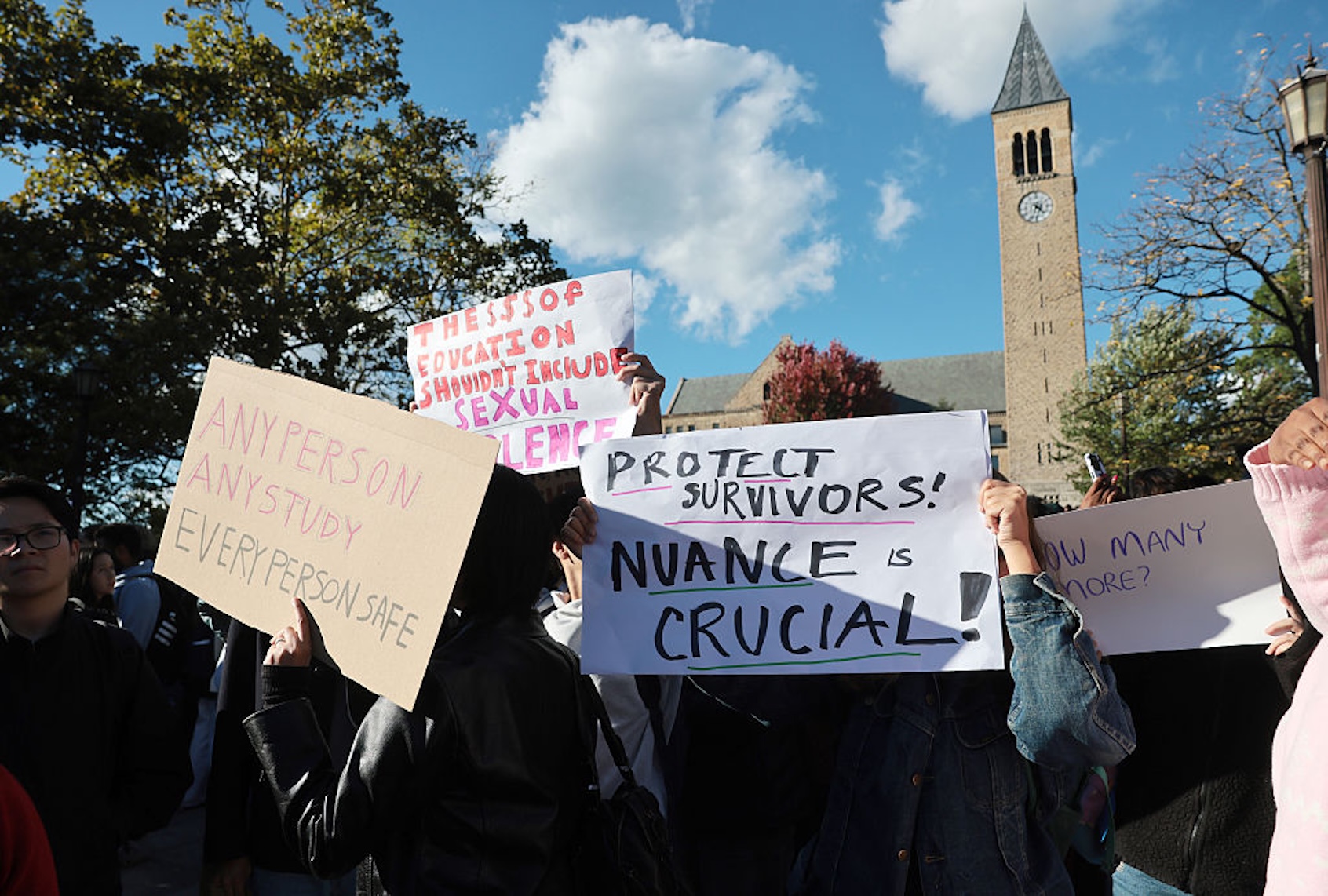
In the wake of a national story of an alleged gang rape at the Chi Phi fraternity house at Cornell University in October 2024, both students and faculty are turning their ire on the Ivy League school’s administration. On Monday, thousands of students and faculty members marched on the office of Michael Kotlikoff, who became the university’s president a few months before the alleged rape, with chants of “Resign!” The night before, graffiti appeared on his office building reading, “At Cornell, rapists are protected, protesters are expelled,” a reference to students who were suspended for protesting Israel’s war on Gaza. The university’s faculty senate is preparing a vote of no confidence on the administration’s leadership over claims that the school mishandled the rape allegations after the alleged victim, called Jane Doe, made a report to the campus police.
The whole debacle has refreshed interest in the previous big controversy of Kotikoff’s brief but eventful presidential tenure: Cornell’s $60 million settlement with Donald Trump’s administration, which was announced in November 2025. The agreement was widely lambasted as a capitulation to the White House’s all-out war on diversity, equity and inclusion programs. Not only did the university implicitly concede that programs meant to help women and minorities are discriminatory against white men, they agreed to hand over data on race in admissions to the Trump administration and impose anti-DEI materials, provided by the White House, on faculty and staff.
After the settlement was announced, the American Association of University Professors said in a statement that the agreement would “threaten some of the most vulnerable students on campus and invite ongoing federal government supervision to reduce the diversity of Cornell’s student body.” In July, the organization published an extensive report comparing the administration’s war on DEI to the Red Scare of the 1950s and called on university leadership to resist the Trump administration’s efforts to destroy racial diversity and gender equity efforts on campus.
As the AAUP report shows, Cornell was far from the only university to cave to Trump; the norm for colleges and universities was rapid compliance. Diversity offices were shut down. Progressive student protesters were bullied and punished. Title IX protections, including rules protecting students from sexual harassment and abuse, were scaled back. Anecdotes have spread from faculty and students about a new chill descending over college campuses — a fear of retaliation for acknowledging the ongoing realities of racism, sexism and homophobia on campuses and in larger society.
The fallout from the Cornell assault accusations, however, suggests that it may have been more than fear that was compelling this swift bending of the knee by many universities to Trump. There is also a degree of complicity. Progressive reforms to make campuses more welcoming to women and minority students are often a hassle for university administrators, even those ideologically who are aligned with the left. It means conflicts with board members, donors and alumni with more conservative leanings. It means having to handle student complaints of harassment, discrimination and even sexual abuse that would be easier to sweep under the rug. It means having to confront institutions — like fraternities — that reinscribe racism and sexism but are often simultaneously protected by the most elite and wealthy people connected to the universities. Giving into the Trump administration on DEI means being able to revert to older, easier ways of doing things — even if it comes at the expense of student freedom and safety.
Want more Amanda Marcotte on politics? Sign up for her free newsletter, Standing Room Only, now also on YouTube or wherever you get your podcasts.
It’s worth remembering that Jane Doe filed her complaint before Trump was president. Her case has all the hallmarks of an institution that tried to make her go away. Cornell police excluded relevant language — including the unambiguous phrase “I was raped” — from their report to the district attorney on Doe’s statement. Her lawyer claims that the university made her believe that the authorities were pursuing a criminal investigation, even though her case had already been closed. As Cornell philosophy professor Kate Manne noted in an essay for New York magazine, the university’s student code of conduct has a stricter definition of rape-by-intoxication than New York State’s, which would seem to cover the situation alleged here, where a woman is as high and drunk as Doe admits she was. And yet only five of the seven men accused were expelled from school, even as she was forced to drop out due to the subsequent stress and anxiety.
Kotlikoff has a public record of flirting with “anti-woke” backlash. Last year, he wrote an op-ed for the New York Times that framed “free speech” as a conservative concern and censorship as a leftist phenomenon, bragging about how his school had invited Ann Coulter and other right-wing speakers to campus, despite student protests. But as reader Michael Handelman wisely pointed out in a letter to the editor, “I was troubled by what he didn’t say. Right now, the greatest threat to academic freedom is the Trump administration.” Kotlikoff’s omission was telling, and left the reader with the impression that a few student protesters are a bigger threat to free speech than the heavy boot of the federal government stomping on academic freedom, which the administration was doing by suing Cornell in the first place.
If Cornell is guilty of abandoning Jane Doe, it has no reason to fear consequences from the federal government for failure to enforce Title IX protections against sexual abuse on campus.
Earlier this year, Kotlikoff made news by bumping student protesters with his car, claiming he was the victim of “harassment and intimidation, with the direct motive of silencing speech” — an odd statement, as student protest is a form of protected speech. In this case, the students were asking Kotlikoff about the suspensions of pro-Palestinian protesters, which also put them on the “pro” side of the free speech issue the Cornell president claims to hold so dear. The board of trustees cleared Kotlikoff in its investigation and blamed the students, but the student protesters accused the board of bias.
If Cornell is guilty of abandoning Jane Doe, it has no reason to fear consequences from the federal government for failure to enforce Title IX protections against sexual abuse on campus. As the New York Times reported this week, the Trump administration barely enforced the law during his first term. In his second term, enforcement is basically nonexistent. According to analysis by the Washington Post, Cornell’s track record is already alarming. From 2018 to 2024, there were 1,216 reports of sexual assault, domestic and dating violence, and stalking on campus. Only 51 people were ever found responsible, and of those, fewer than half faced serious consequences.
Jane Doe reported her alleged rape a few days after Trump got elected. With that history in mind, Cornell police and administrators could have had every reason to believe there would be no federal repercussions if they failed to reach a just outcome in her case.
We need your help to stay independent.
Jane Doe’s lawyer, Thomas Giuffra, told CNN that his client “was not somebody who was a legacy [student], from a wealthy family” and “came from a small town.” Fraternities, in stark contrast, enjoy immense protections from exactly those wealthy people from legacy families. As historian Nick Syrett, author of “The Company He Keeps: A History of White College Fraternities,” told Time, former fraternity members are “a base of alumni that universities don’t want to upset because they’re generous and they’re powerful.” Whatever an administrator’s personal feelings, in a situation like this, it is objectively easier to cut loose an alleged victim rather than take on alleged assailants who are well-connected to powerful elites.
From a purely self-interested point of view, the Trump administration’s demands that schools give up policies and programs to help women and minority students is a win-win for administrators. It allows school leaders to give up a miserable, uphill battle against elite forces, while handing them a way to deflect blame onto the White House for forcing them into it.
We can’t peer into the hearts of administrators and know the exact mix of complicity and fear that drove these capitulations. But the Cornell case is a stark illustration of why the prospect of letting Trump have what he wants has a dark allure.
Read more
from Amanda Marcotte
The post What Cornell says about universities’ MAGA complicity appeared first on Salon.com.