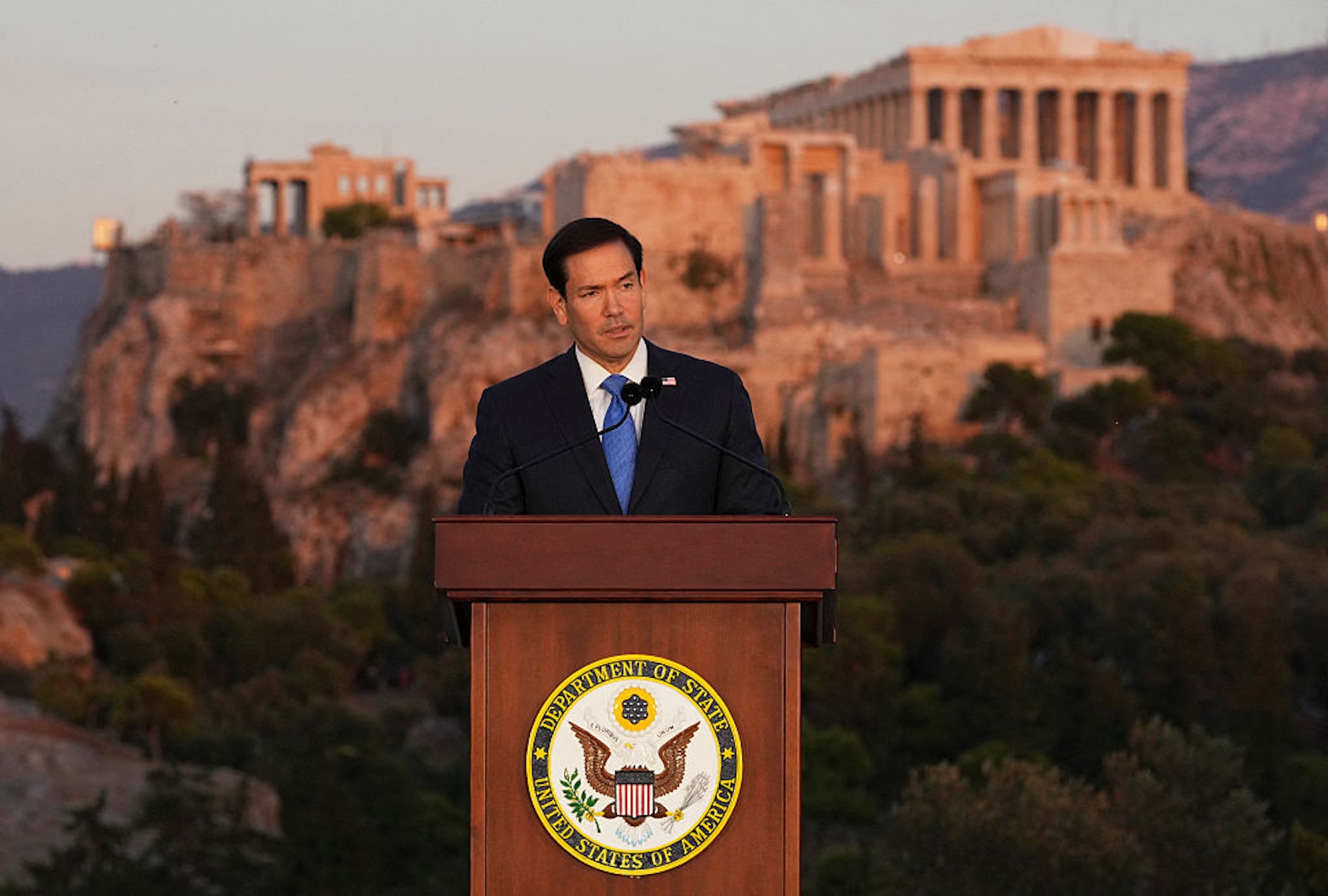
To read the full Q&A with Laura Codruța Kövesi, click here.
ATHENS — Ursula von der Leyen has not yet provided an in-person statement to the European Public Prosecutor’s Office for its investigation into the procurement of coronavirus vaccines, according to an individual involved in the effort who was granted anonymity to speak freely.
In 2024, EPPO took over the Belgian-led probe into alleged criminal wrongdoing in connection with vaccine negotiations between the European Commission chief and Pfizer CEO Albert Bourla. Prosecutors have been investigating von der Leyen for “interference in public functions, destruction of SMS, corruption and conflict of interest,” according to legal documents seen by POLITICO.
Asked to respond to the assertion that von der Leyen has failed to provide a statement on the so-called Pfizergate affair, Commission spokesperson Thomas Regnier said: “The Commission has demonstrably cooperated extensively with EPPO to clarify facts and assess events.”
“This was always done on behalf of and with the full support of the President. The President has always been, and continues to be, very cooperative in answering to any open questions — within the limits of her duties and her availability as President of the Commission.”
In an interview with POLITICO, EPPO chief prosecutor Laura Codruța Kövesi, who wraps up her seven-year tenure on Friday, said she has on multiple occasions dealt with EU officials who refused to answer summons from her office. “Some politicians think that they are above the law,” she said. “If you are called in for a statement, you have to come.”
She added: “I will not be shy to tell you that especially when important people are involved in the investigation — be it high-profile politicians or rich people who are connected to the political class, we have difficulties in exercising our competence.”
When asked whether von der Leyen was one of the officials in question, Kövesi said she wouldn’t comment on specific investigations.
Killing EPPO softly
EPPO, set up in 2017 and operational since 2021, is tasked with rooting out crimes involving EU funds. As head of the organization, Kövesi said she has faced repeated attacks and attempts to undermine the institution and its work.
“As I leave my office, I think of this famous Danish TV show, Borgen. There is a very famous saying there: ‘In Brussels, no one can hear you scream,’ and unfortunately, this is true,” she said, in a nod to the Ridley Scott blockbuster Alien. “I am concerned that the EPPO is going to be killed softly because it’s doing its job.”
Kövesi cited three main factors undermining the institution’s work: chronic underfunding, delays in the revision of the organization’s legal framework and the complexity of its bureaucratic architecture, which she said leads to “endless discussion about how to complicate the life of the prosecutors.”
Asked what she would do differently if she could start over again, the chief prosecutor said she “would do the same things, but maybe the others should change their behavior,” adding that the biggest challenge her successor, German prosecutor Andrés Ritter, will face is keeping EPPO “independent and credible.”
Greece’s ‘blatant’ intimidation
Kövesi said that during her tenure, “the most blatant attempt” to intimidate EPPO prosecutors was in Greece, which was hit by a farm funding scandal last year — leading to the resignation of ministers and deputy ministers. The cases of four MPs from the ruling New Democracy party are currently being heard in court. They all plead innocent.
Last May, EPPO sent a formal complaint to the Commission regarding moves by the Greek government to block EU prosecutors from investigating Greek lawmakers. It also complained about the Greek Supreme Judicial Council’s refusal to renew the mandate of European-delegated prosecutors for five years at EPPO’s request. Kövesi warned that this could result in EU funding cuts for Greece under Article 16 of the EPPO Regulation.
The cooperation between EPPO and the Greek government has been difficult, with Prime Minister Kyriakos Mitsotakis hinting at a political agenda by EPPO by complaining of “selective leaks.”
“All the noise was created to blame EPPO that we play politics instead of discussing what happened in reality,” said Kövesi. “Some politicians speak about an independent and efficient judiciary, until you touch them and until you go close to their inner circle. In that moment, the prosecutors are abusive, they have a political agenda, they are not needed.”
Some Greek government officials have suggested that Greece could simply opt out of the EU institution, but Kövesi said this is “almost impossible.”
The chief prosecutor also raised concerns about the impact of budgetary restrictions on EPPO’s work elsewhere in the bloc. The organization is currently setting up its operations in Hungary, which officially became a participating member of EPPO in August 2026 — but Kövesi is skeptical about how successful it will be.
“We explained exactly what we need to do our job, but the Commission proposed half of [the budget] we need,” she said, adding that EPPO’s “credibility is at stake” in countries like Poland, where “expectations were huge” but the organization has not been able to deliver on its promises.
EPPO is also investigating the alleged misuse of more than €4 million by the Identity and Democracy group, a defunct political grouping in the European Parliament whose debts Patriots for Europe could be forced to repay. The latter group includes France’s far-right National Rally, led by Marine Le Pen, the frontrunner ahead of France’s 2027 presidential elections.
“If you ask EPPO to abstain and to not do anything because there are elections in Europe, we will not work at all,” said Kövesi.
The opposition Student List’s landslide victory on Sunday ended Aleksandar Vučić’s 12-year run as the EU’s key interlocutor in Serbia. For more than a decade, every step of the candidate country’s accession process and trade negotiations had to pass through him.
“Aleksandar Vučić acted like the go-to person for everything while ignoring all the laws in the country, including the constitution,” Jugoslav Gašić, an assistant professor in medicine at several universities and soon-to-be MP, said in an interview.
When POLITICO reached him, Gašić was in the middle of grading student papers — a fitting snapshot of a new parliamentary majority made up largely of professors, doctors and other political novices.
The Student List won an outright parliamentary majority at the weekend: a stunning result for a leaderless movement born out of protests.
The party’s first order of business will be undoing much the legacy of Vučić and his Serbian Progressive Party (SNS), starting with reversing years of rule-of-law rollbacks. But it will also reset Serbia’s relationship with Brussels, which the Student List argues the former leader managed more as a transactional tool than a genuine path to EU membership.
“Ultimately, [Vučić] always represented his own interests and not the interests of Serbia,” said Gašić.
Representatives for the SNS didn’t immediately respond to a request for comment.
Even among Serbia’s most committed pro-Europeans, Brussels’ willingness to route all progress through Vučić personally has left a bitter aftertaste.
“The key lesson that should be drawn from the case of Serbia is that the EU can very easily lose credibility and integrity if it ignores the causes of democratic backsliding in a country,” said Srdjan Majstorović, chairman of the governing board of the European Policy Center (CEP), a think tank.
According to CEP data published earlier this year, as many 41.6% of citizens believe the EU is more interested in pursuing its own political and economic interests in the region than improving the state of democracy and the rule of law in the country.
For years, anytime non-governmental organizations, journalists or activists argued that Brussels should try to include other voices in the EU negotiation process, they were told “that there was no alternative to the regime in Serbia,” Majstorović continued.
Ilija Srdanovic, the first person on the Student’s List, celebrates at the Student’s List headquarters in Belgrade after Aleksandar Vučić conceded the elections. | Andrej Ivanov/Getty Images
The Student List’s election program casts the EU as Serbia’s most important economic partner and pledged to deepen Belgrade’s existing strategic partnerships with EU members such as Greece, Italy, Hungary and France, while seeking closer bilateral ties with other European capitals.
It does not, however, explicitly name EU membership as an immediate goal.
Gašić wouldn’t be drawn on concrete aims for the Serbia-EU relationship, but said: “We don’t want to be cut off by Europe. We don’t want to be an isolated island.”
“I respect how well-ordered they are, the rule of law and democratic principles,” he added. “Yet I think we need to reset our priorities with the EU, where we consider Serbia’s interests first. A one-sided approach doesn’t foster long-term cooperation.”
The Student List grew out of a mass protest movement sparked by a 2024 railway station roof collapse that killed 16 people. Students blamed the deaths on corruption in state construction contracts and began blockading universities, and within months the protests had swelled into the largest Serbia had seen in decades.
Brussels’ response was muted as students marched across the country, with EU officials largely avoided criticizing Vučić directly. EU flags were conspicuously absent from the demonstrations.
The European Commission didn’t respond to a request for comment for this article.
“The Commission must first restore its long-lost credibility after years of propping up Vučić,” said Djordje Bojović, a foreign policy advisor for Greens in the European Parliament.
He said that Serbia has long been demonized and struggled to reinvent its image since the 1990s, an image “only further cemented by Vučić’s repressive authoritarianism.”
Despite those concerns, Serbia’s economic ties with Europe flourished during Vučić’s time in power, with the country becoming one of the region’s leading destinations for foreign investment.
Under Vučić, Serbia went from about €750 million in foreign direct investment in 2012 to more than €30 billion over the following decade, more than the rest of the Western Balkans combined.
In Brussels, figures such as Bojović and representatives of the opposition parties would plead with institutions such as the Parliament and the Commission to meet with them or take their concerns seriously.
“Vučić had convinced all of them that the opposition is not worth talking to and that they’re not credible,” Bojović said.
Now, with SNS firmly relegated to the opposition, Brussels will need to rethink how it works with Serbia. To many Serbians, the EU has 12 years of looking the other way to answer for first.
A specter is haunting Europe, and plenty of other places too. Nobody knows quite what to call it. It isn’t the specter of communism this time around, or at least not under that name — although something approaching class warfare, redefined in 21st-century terms, is on the agenda for the first time in decades.
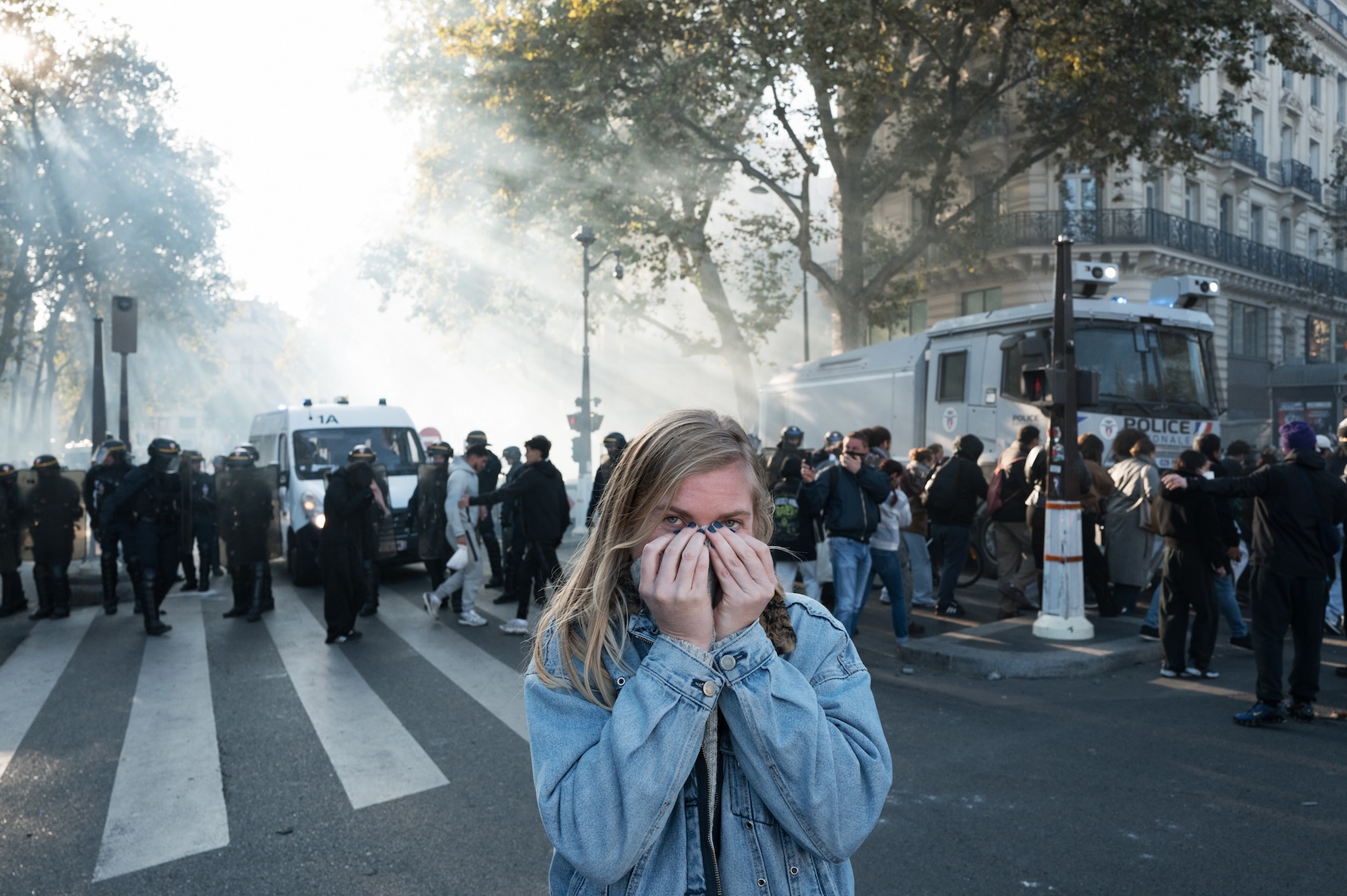
Student protests that began at secondary schools in the northern suburbs of Paris about a month ago have sparked a wave of demonstrations and street battles— occasionally tipping over into rioting, looting, and organized property destruction — that has now spread to at least six or seven countries, with new outbreaks happening nearly every day. But there is no single unifying issue that has brought students, labor unions, left-wing activists, anarchist rebels and hundreds of thousands of ordinary people into the streets of Paris, Lisbon, Madrid, Brussels, Milan, Belgrade, Athens and Tirana, among many other cities.
While the protests in Belgium and Italy are direct outgrowths of the French student movement, the proximate causes of unrest are local and distinct in every case. Protests in Spain and Portugal reflect years of simmering discontent over the soaring cost of living, especially a housing crisis made worse by the explosion of Airbnb-style tourist rentals. In Greece the protests were initially about workplace safety and public sector wages. In Albania and Serbia, where protest movements were well underway before the French students made headlines, the main issues involve deeply entrenched government corruption.
Thousands of miles away in the world’s largest self-described democracy, India’s youth-driven Cockroach Janta Party (“Voice of the Lazy & Unemployed”) isn’t connected to the French protests at all, except by the kind of historical coincidence that isn’t really a coincidence. The CJP was launched earlier this year, about halfway between political satire and social media experiment, and by midsummer became a mass movement that has shaken the autocratic Hindu nationalist government of Prime Minister Narendra Modi to its foundations.
Given this diversity and the tangential connections between all these events, it’s almost easier to say what the protest wave of 2026 is not about than to define it precisely. No dramatic world-historical event has catalyzed all this, and for the most part these protests are happening in relatively prosperous, relatively peaceful and nominally democratic nations. We’re not on the cusp of global financial or economic crisis, at least not yet, although there are troubling warning signs. There is no immediate threat of military conflict or civil warfare in any of these countries, although Russia’s war in Ukraine, Israel’s murderous war in Gaza and the spectacularly mismanaged U.S. war with Iran have all fueled the rising sense of collective outrage.
To use one of this decade’s most overused words, the outrage seems existential. It’s about everything everywhere all at once or, to more cynical observers, about nothing in particular. It’s about underfunded schools, crumbling infrastructure and soaring rents, and also about Gaza, climate change and the enforced spread of AI, data centers and government surveillance.
To use one of this decade’s most overused words, the outrage seems existential. It’s about everything everywhere all at once: underfunded schools, crumbling infrastructure and soaring rents; also Gaza, climate change, data centers and government surveillance.
Ironically enough given its origins, the outrage is also being driven by a highly literate and globally connected generation, one that is sufficiently well educated to perceive the underlying conditions that have made those things happen. They see paralyzed centrist governments held captive by bankers and tech billionaires; they see an economy built on worsening inequality, systematic insecurity and what sociologists call “elite overproduction” (e.g., university graduates working as baristas); they see the climate crisis addressed only with bland rhetoric or regulatory fiddling as one deadly heat wave follows another.
What the protests of 2026 are not about, to any measurable degree, is skin color or religion. Donald Trump, Elon Musk, Benjamin Netanyahu and far too many of their fellow travelers have seized on the disorder in Europe as evidence of the pernicious effects of “open borders” and Islamic immigration. It’s a losing proposition to quote stuff that the president of the United States says on social media and then feign outrage, as if we were actually surprised. But we are where we are: France is being “conquered, looted and burned to the ground by migrants, jihadists and communists who hate Christianity,” Trump informed us via Truth Social last week.
That fantastical framing tells us a lot more about him and his supporters, needless to say, than about the remarkably diverse crowds in the streets of Europe’s major cities. But the tempting prospect of blaming immigrants for the protests or the acts of violence — maybe not as the primary cause and way below the Trump level, in an effort to fend off critics on the right — has created a kind of acid test or moral hazard for political leaders and media commentators. The pass/fail ratio is both depressing and mildly surprising.
Embattled German Chancellor Friedrich Merz and the newly-installed Hungarian Prime Minister Péter Magyar, for instance, have failed the test, both suggesting that “high rates of migration and a failure to integrate the foreign-born are partly behind the sudden, violent upheaval,” to quote this week’s leading editorial in the Economist. So did New York Times opinion columnist Frank Bruni, an alleged liberal who began his breezy Oct. 22 discussion with right-winger Bret Stephens by stating the unquestioned premise that “a velocity of religious, racial and ethnic diversification over the past quarter century that has exceeded what many longtime residents could easily make sense of and comfortably adapt to” had somehow led to angry high school students and window-smashing anarchists in French cities.
As for French President Emmanuel Macron, bête noire of the protest movement, perhaps he has decided to go down fighting in the last six months of his largely disastrous decade in power. For all his arrogance and hubris, Macron is no racist and has decried the “stupid comments” by foreign leaders he declines to name, who claim that France has been “invaded by hordes of migrants and Islamists, which is completely false.”
But the most forceful rejection of current racist narratives about the European protests, and perhaps the best single summary of why they are happening in the first place, comes, improbably enough, in the above-quoted leading editorial in the Economist:
Even if some young protesters in France wear Algerian football shirts or chant pro-Palestinian slogans, the upheaval in Europe today is not about race or religion. Over 500,000 people marched in France on Saturday [Oct. 17] and they were largely unmasked and white. They were fired up, as in other countries, by the cost of living and poor public services. They want more fuel subsidies, more spending on schools, more handouts.
Leaving aside the buzzword “handouts,” which is meant to signal the innate laziness of the non-wealthy, that’s some straight-up gospel preaching. As the editorial confesses, once upon a time the Economist enthusiastically backed Macron as the golden boy of neoliberal reform, but now he and other “head-in-the-sand centrists” seem to be “out of ideas.” Strikingly, the editorial has no new ideas to offer.
In a Foreign Policy essay last week, former Estonian president Kersti Kaljulaid defines the central problem in Europe, plausibly but rather too vaguely, as “intergenerational hopelessness” and a downward spiral of economic expectation. Once again, the Economist — which can fairly be described as the house organ of global capital — goes at the issue far more directly. Demonstrators on Europe’s streets, its editorial proposes, are “consumed by rage”:
Rage at the failure of the state and against the floundering centrist politicians who govern. Rage at high prices and economic dysfunction. And for some, rage against the idea of centrist politics at all.
Go on with your bad self! It’s not irrelevant or accidental that the call, as they say in horror movies, is coming from inside the house. No one can credibly accuse the Economist of being soft on Marxism or unfaithful to free-market dogma (that same editorial mocks leftist French presidential candidate Jean-Luc Mélenchon, not inaccurately, as an “aging rabble-rouser and onetime Trotskyist”). That gives it the freedom to state plain facts that so-called moderates like Merz and Bruni would rather avoid: Yes, “centrist politics” have visibly failed, not just in France but across the Western democracies. Indeed the entire system or basket of principles known as “liberal democracy” is in big trouble, and on the verge of systemic failure.
Yes, “centrist politics” have visibly failed, not just in France but across the Western democracies. Indeed, the entire system or basket of principles known as “liberal democracy” is on the verge of systemic failure.
“Liberalism” in that context is not an ideological label in the contemporary American sense but a term from old-school political economy, used to describe the forced marriage in Western nations between market capitalism, parliamentary democracy, and a varying list of civil rights and civil liberties. Liberalism in that sense has dominated most of the world since the Cold War, and until recently it encompassed both major political parties in the U.S. I hardly need to convince you that is no longer the case, or that proudly illiberal parties and leaders have emerged and spread throughout the Western-style democracies, like an unpleasant but unkillable fungus. (As this article was published, it appears that Luiz Inácio Lula da Silva, Brazil’s leftist president, has defeated Flávio Bolsonaro — the son of imprisoned former president Jair Bolsonaro — ending a string of six consecutive right-wing victories across Latin America. True to form, Bolsonaro called for the results to be annulled.)
Liberal democracy was a roaring economic success for most of the 20th century, at least in broad strokes and with some well-known caveats. Oddly enough, those bygone glory days are pretty much what Trump keeps promising to bring back, to no visible effect. But the current crisis of liberalism is nothing new. It began to unfold decades ago, well before Francis Fukuyama proclaimed the “end of history.” Today’s enraged French students — and their parents, teachers and neighbors, for that matter — have inherited a world of false promises and diminished expectations.
Real wages have steadily declined in most Western countries (including our own) since the 1970s, allowing for a brief uptick during the technology boom of the 1990s. Across the liberal democratic zone, social services have been slashed in one “austerity” budget after another while government debt has soared. Rapidly aging population has made large-scale immigration a necessity, while right-wing demagogues have seized on the new arrivals as the main cause of the economic problems that immigrants can ameliorate. The result almost everywhere has been an accelerating vicious cycle of political dysfunction and public disillusionment, fueling the rise of what the Economist calls “charismatic figures from the extremes,” meaning Mélenchon and Marine Le Pen in France, and no doubt Zohran Mamdani and You Know Who over here.
As a leading Marxist scholar told me decades ago, every radical who confidently predicts the collapse of capitalism is always wrong. If and when that ever happens, no one will have expected it. The same is likely true of liberal democracy today, which has survived worse crises than this and still retains broader popular legitimacy than is visible at this moment. Students in Milan and Marseille and Mumbai may well return to school and be reconciled to their lives, at least for now. But they have shown us something: There are dark passages ahead and enormous changes coming, and none of us can accurately identify the specter who blocks the path forward.
BERLIN — As she was climbing the ranks of far-right Alternative for Germany (AfD) a decade ago, Alice Weidel privately denounced one of her party’s most influential figures for using racist arguments and Nazi-era language, and sought to have him expelled.
Years later, she praised his leadership, said a bid to ban him from the party was “exaggerated” and that he was suitable for a federal cabinet position.
That striking reversal emerges from a massive leak of internal AfD communications, including emails in which Weidel condemned Björn Höcke, the party’s leader in the eastern state of Thuringia, and warned that extremists were driving away mainstream conservative voters.
The revelations come from more than 420,000 emails and roughly 48,000 documents released by hackers this week, providing a rare glimpse inside Germany’s largest far-right party. An anonymous spokesperson for the hackers told Die Zeit the attack was not “politically” motivated “in the sense that [they] support another party,” but that they published the allegedly stolen material to promote “transparency and public accountability.”
The AfD confirmed the breach, saying hackers had attacked a hosting provider in late September. It condemned the leak as “an attack on the German party system and therefore on democracy itself.”
WELT, which, like POLITICO, is part of the Axel Springer Global Reporters Network, examined emails from one of Weidel’s accounts between 2015 and 2017, when she was a relatively junior figure in the party’s leadership.
Asked by WELT to explain the contrast between her warnings at the time and her present position, Weidel declined to comment through a spokesperson.
A spokesperson for Höcke did not respond to a request for comment sent by POLITICO on Saturday.
‘Deeply problematic’
The messages seen by WELT show a politician deeply alarmed by the growing influence of Höcke, who championed an ethnically defined German nationalism drawing on ideas associated with the Nazi era.
In October 2015, Weidel warned colleagues that the party’s proximity to Pegida, an anti-Islam street movement, and the neo-Nazi National Democratic Party (now known as The Homeland) was alienating the conservative voters it needed to attract.
“In the west we are losing the mainstream conservative electorate completely through our proximity to Pegida, and to the NPD in the east,” she wrote.
Weidel also strongly pushed back on a speech from Höcke that same year, where he contrasted a “life-affirming African expansionary type” with a “self-negating European placeholder type,”
Weidel speaks at an AfD congress in Riesa, Germany on Jan. 11, 2025. | Sean Gallup/Getty Images
“This is deeply problematic, because the reasoning here is racial. It is fundamentally wrong,” she wrote to the AfD’s federal executive board. “And please, spare me the usual ‘that’s-not-how-it-was-meant.’ I can’t hear it any more.”
In another message, she warned that extremists were deliberately blurring the boundary between the AfD and neo-Nazi politics, driving mainstream conservatives away “in horror.”
She also feared that Höcke’s rhetoric could bring the party under scrutiny by Germany’s Federal Office for the Protection of the Constitution, its domestic intelligence service monitoring threats to the constitutional order.
“Höcke’s statements alone, and the use of the term Volksgemeinschaft” — the Nazi-era concept of an ethnic national community — “are enough to land the AfD in that report,” she wrote, referring to the intelligence service’s annual assessment. “Some in our party seem in a hurry to drive the AfD, deliberately or not, into oblivion.”
In May 2025, the agency classified the AfD as a “confirmed right-wing extremist organisation”, citing, among other things, an exclusionary concept of the German nation. The classification, which grants authorities broader surveillance powers, was provisionally suspended by a court in Cologne last February.
‘Wake up, for once’
The leak also features emails about a speech Höcke gave in January 2017 to the AfD’s youth wing, attacking Germany’s culture of Holocaust remembrance.
Höcke described Berlin’s Holocaust memorial as a “memorial of shame,” criticized the country’s efforts to confront its Nazi past and demanded a “180-degree turn in the politics of memory.”
Weidel herself brought a motion to expel him from the AfD.
The motion, obtained by WELT, accused Höcke of using “vocabulary from Adolf Hitler” and endorsing the “Führerprinzip” — the Nazi doctrine of absolute leadership authority. It described him as displaying an “affinity in essence with National Socialism.”
In an internal message, Weidel urged colleagues to recognize the implications of Höcke’s language. “Wake up, for once,” she wrote, warning of the “explosive force of the double meanings” in his speech.
As Weidel prepared to seek the party’s nomination as lead candidate for the 2017 federal election, the leaked correspondence shows that she blocked the recording of her own motion against Höcke in the minutes of a party leadership meeting, arguing that further controversy would damage the party.
Höcke subsequently acknowledged that his speech had been a mistake and asked the leadership to withdraw the move against him.
Höcke addresses AfD supporters after elections in Saxony-Anhalt, in Magdeburg, Germany on Sept. 6, 2026. | Ronny Hartmann/AFP via Getty Images
Weidel publicly welcomed his letter as a “positive signal” and called for an end to the infighting.
Within weeks, she had secured her nomination as the AfD’s lead candidate. Asked whether she would campaign alongside Höcke, she replied: “Yes, of course. We are two parts of one party.”
Indeed, the emails suggest that Weidel’s private misgivings had not entirely disappeared. In May 2017, she condemned an AfD election poster featuring a pregnant woman and the slogan “‘New Germans?’ We’ll make our own” as “an NPD poster,” in a reference to the neo-Nazi party.
Today, Weidel no longer publicly criticizes Höcke. She has praised his leadership in Thuringia and even suggested him for a federal cabinet position.
“We get along very well and we got to know each other over the years,” she told BILD in a 2025 interview. When she was asked whether Höcke was suitable for a federal cabinet position, she simply replied: “Yes.”
When asked in February 2025 about the 2017 expulsion proceedings against him that were backed by Weidel, Höcke called it “old news.”
“We got to know each other and came to appreciate each other. Alice Weidel was the right lead candidate and did a top job,” Höcke told WELT at the time.
The Axel Springer Global Reporters Network harnesses the resources of the company’s newsrooms to publish ambitious scoops, investigations, interviews, opinion pieces and analysis. It allows journalists — including those from POLITICO, The Telegraph, Business Insider, WELT, BILD, Onet and Fakt — to collaborate on major stories for an international audience of hundreds of millions across platforms: online, print, TV and audio.
Jamie Dettmer is associate editor and a foreign affairs columnist for POLITICO.
The war in Gaza hasn’t figured much in campaigning for Israel’s upcoming election — despite the likelihood that Israel’s Arab minority, Palestinian by heritage, might well decide who gets to be prime minister.
Israel’s Arabs make up around 20% of the electorate that will be casting ballots in the Oct. 27 parliamentary election. And thanks to complex coalition math, Arab parties might well be the ones to crown Prime Minister Benjamin Netanyahu’s main rival, former military chief Gadi Eisenkot, who leads a center-right opposition bloc.
But campaigns by both the Arab parties and Jewish politicians have avoided talking about what the outcome might actually mean for Jewish-Arab relations in the region, for the possibility of a two-state solution and even for U.S. President Donald Trump’s vision for a comprehensive peace-through-prosperity deal between Israelis and the Palestinians.
“The election campaign has been bizarre,” said Michael Milshtein, a retired Israeli army colonel and former head of Palestinian affairs in Israel’s military intelligence agency. “The campaign has been focused on domestic and personal issues, and on Netanyahu.”
That means it hasn’t included “the very deep complicated issue of the critical relations between us and the Palestinians, and what kind of scenarios or solutions are left after the Oct. 7 Hamas attack and the Gaza War — for any kind of political settlement,” Milshtein said.
But outside of Israel there’s alarm — especially among Arab leaders — over the absence of any serious debate about how to end the multi-front conflicts Israel is engaged in and what that might foretell, said HA Hellyer, a geopolitical scholar specializing in the region.
“Netanyahu, or not, the Israelis are on a particular trajectory when it comes to foreign and security policies,”Hellyer told POLITICO.
“Opposition politicians blame Netanyahu for Israel’s increasing diplomatic isolation and loss of support in parts of Europe and North America. But when you look at what they’re actually saying, they’re not arguing with the policies when it comes to Gaza. They support the overall settlement project in the West Bank. They support the incursion in Southern Lebanon. Their proposition is that they could have done things in a better way,” said Hellyer, who’s a fellow at Britain’s Royal United Services Institute.
Mentions of the Gaza conflict in election campaigns have been largely limited to clashes over who was to blame for failing to prevent the Hamas attack on southern Israel, which killed more than 1,200 people.The Eisenkot-led Change bloc has focused on Netanyahu’s role in the lead-up to the Oct. 7, 2023 massacre, pointing to the failures of his government and arguing he ignored warnings of a likely big Hamas attack. But the bloc has done little to flesh out its governing policy platform.
Meanwhile, Netanyahu’s campaign has sought to frame Eisenkot as an appeaser and puppet of Arab party leaders — such as Mansour Abbas, leader of the Islamist Ra’am party, and Ahmad Tibi, leader of Ta’al party — arguing he would compromise on core security issues to persuade them to join or vote with his coalition bloc after the election to give him a Knesset majority.
“The lack of real content is a major problem for such a crucial election,” the Jerusalem Post lamented in an editorial this week.
Few see any chance of a negotiated peace or a two-state solution any time soon. Israelis largely view international condemnation as biased, and say critics of Israel’s conduct in Gaza fail to understand what the country has to do to survive.
People walk past election campaign banners in Jerusalem on Oct. 22, 2026. | John Wessels/AFP via Getty Images
But at some stage or another, Israelis will have to have conversations about peace, and delaying them isn’t going to help the country reduce its deepening isolation or help repair strained ties with traditional allies, including Europeans, who are starting to impose sanctions and considering arms embargoes.
Former Israeli Prime Minister Ehud Olmert, a fierce Netanyahu critic, said that while there has been election debate about how successful the Gaza war has been in degrading Hamas, “it’s true that the main issue of our future with the Palestinians has been ignored.” He added: “Had I been running, I would have talked about it the whole time.”
So why hasn’t peace been on the agenda?
As Olmert sees it, the root lies in “the huge trauma of Oct. 7, along with the perception that public opinion, the mainstream, has shifted from where it was before the massacre and moved further rightward politically.” That isn’t uncommon: When Israel suffers a severe psychological blow, the political center-of-gravity habitually moves sharply to the right, favoring hawkish and nationalist positions and marginalizing more conciliatory perspectives.
“Nonetheless, the perception is that general public opinion has shifted and, therefore, all of the other parties are hesitant to talk about any political process with the Palestinians or about negotiations or about a two-state solution, and so on and so forth, because they worry they’ll lose support,” Olmert said.
Sven Burgsdorff, a former EU representative and ambassador to the West Bank, doesn’t subscribe to Olmert’s view, instead arguing there’s not much difference between Netanyahu and the leaders of the center-right Change bloc when it comes to Gaza or a two-state solution — something Netanyahu dismisses out of hand regularly, saying that Palestinian sovereignty is incompatible with Israel’s security.
“Even if the right-wing Netanyahu coalition were to be replaced by the current opposition, none of its main leaders — Eisenkot, Naftali Bennett, Yair Lapid and Avigdor Lieberman — question the IDF’s conduct [in] the war on Gaza, nor are they supportive of the idea of Palestinian self-determination. Only Yair Golan of the Democrats and the coalition of Arab parties are in favor of that,” he said in an interview.
Opposition leaders don’t criticize Netanyahu for the conduct of the Gaza war, Burgsdorff continued. Their issue with him is whether he was at fault for not protecting Israel from the 2023 attack. They also accuse him of being set on dismantling Israel’s democratic system and for having no exit strategy for his forays into broader regional conflicts.
Netanyahu has made a long political career out of leveraging external crises to keep his grip on power. And even now, it would take a brave commentator to write him off and suggest that Bibi the Magician, to use one of his nicknames, has lost the magic touch. The Israeli leader has pulled off stunning turnarounds in his long political career, including in the 1990s when he beat Shimon Peres in elections held just months after the assassination of then-Prime Minister Yitzhak Rabin.
Olmert still hopes for a Netanyahu defeat and says if Eisenkot is installed, he might make conciliatory moves like meeting with Mahmoud Abbas, the president of Palestinian National Authority.
“He won’t be able to do anything big or quickly with Bennett and Lieberman in his cabinet. Both of them are completely opposed to the idea of Palestinian sovereignty. They keep saying it all the time. ‘There will never be a Palestinian state,’” he said. “So the political space will be very limited.”
But without some serious movement toward a two-state solution, Israel could risk alienating more of its traditional allies in Europe and the U.S.
Czech President Petr Pavel says a ceasefire between Russia and Ukraine was “quite close” – until President Donald Trump lifted sanctions on Russian diesel.
In an interview conducted on Tuesday with the Axel Springer Global Reporters Network, which includes POLITICO, Pavel said coordinated U.S.-European sanctions on Russian oil, oligarchs, and other industries were putting Russia “under strain.” But the deal Trump announced earlier this month, in which Russia would supply hundreds of thousands of tons of diesel to the U.S., gave Russia “time to breathe.”
“It will be much harder now,” said Pavel. “Russia uses this momentum to get out of pressure, and it’s kind of a moral boost for them.”
The White House on Wednesday said Trump “successfully negotiated” the deal in order to supply the global market with “massive amounts of diesel and bring prices down.”
Meanwhile, Ukrainian President Volodymyr Zelenskyy said in a post to social media that the deal “plays into Russia’s hands” and allows Russia “to kill more, wage war for longer, have even less respect for America, and inflict even greater losses and damage on the world.” He accused Trump of using peace talks in Florida as a “smokescreen” as the administration pursued its deal with Russia.
Zelenskyy’s criticism was the latest indicator of rising tensions between Kyiv and Washington. Trump has repeatedly expressed frustrations with Zelenskyy, accusing him of elongating the war. By contrast, of late he has spoken warmly of Putin and said this week that “Russia frankly has been fine on Ukraine.”
But Pavel offered the Ukrainian president words of support on Wednesday.
“I believe that President Zelensky and the whole of Ukraine is a victim of a conflict,” said Pavel. “So, I would be probably the last to blame Ukraine for being guilty of the conflict. It was not Ukraine who attacked Russia. It was not Ukraine who was threatening Russia.”
He added that Trump shows a more open approach to Russia than any European leader.
“To some extent, he may be attracted by Vladimir Putin as a leader with authority, but I don’t think that … President Trump sees it from a position of a struggle between democracy and autocracies because he’s looking at it simply from the point of view of economic prosperity for the United States,” Pavel added.
Though Pavel indicated concerns about the diesel deal, he declined to say the U.S. had betrayed Ukraine or other European partners.
“I don’t know yet if we can call it betrayal, but I would call it a mistake,” he said. “Because … it’s now giving Russia a new hope: New hope that they can disregard Europe, they can disregard Ukraine, they can focus on making a deal with the United States, potentially with China, and arranging all things up to their priorities and strategies. I believe that it’s clearly against our interest in Europe.”
Pavel also didn’t rule out a future in which European countries would buy Russian oil, but added that it “will take time” before that happens.
“If one day Russia is a country respecting other countries’ sovereignty and borders, why not have regular business with such a country? But Russia is not there yet,” he said.
The Axel Springer Global Reporters Network harnesses the resources of the company’s newsrooms to publish ambitious scoops, investigations, interviews, opinion pieces and analysis. It allows journalists — including those from POLITICO, Business Insider, WELT, BILD, The Telegraph, Onet and Fakt — to collaborate on major stories for an international audience of hundreds of millions across platforms: online, print, TV and audio.
Liechtenstein’s Hereditary Prince Alois vetoed a bill on Tuesday that would have legalized abortion during the first 12 weeks of a woman’s pregnancy, blocking a citizens’ initiative co-signed by a quarter of voters and passed in the micro-state’s parliament.
Performing an abortion is currently illegal in the principality, unless the pregnancy presents a severe risk to the pregnant woman’s health or if it is the result of a sexual assault. Women seeking an abortion usually travel to clinics in neighboring Austria or Switzerland, which campaigners say adds uncertainty and an unnecessary financial hurdle to the process.
The bill was introduced by the Fristenlösung citizens’ initiative, which collected almost 5,000 signatures — about a quarter of the state’s registered voters. It proposed decriminalizing abortion up to 12 weeks’ gestation, and to lift a ban on providing information about abortion.
The bill “is not suitable for adequately protecting unborn life as a central legal interest,” a statement from the princely house reads. Alois had already indicated in June he would veto the proposal on these grounds.
“We’re disappointed, but not really surprised,” Tatjana As’Ad, a campaigner for the initiative and a co-managing director for the Free List, Liechtenstein’s progressive opposition party, told POLITICO. “It was clear his decision was fixed in June and that there was no way we would change it.” She added campaigners met Alois on Tuesday morning, but that there was no indication he would announce his veto shortly after.
“We are frustrated because it feels like everything we did since June was decorative,” As’Ad said.
Liechtenstein, a small Alpine principality of about 40,000 people, has an atypical political system associating referendum-led direct democracy with a monarchy where the reigning prince retains extensive executive powers. Alois’s absolute veto right was itself confirmed by a 2012 referendum. He used it for the first time to block the abortion bill.
“The promise of dualism” between democracy and the monarchy “that the Liechtensteiners are trusting has got some cracks,” As’Ad said.
She added that the parliament’s decision to vote through the bill and send it directly to Alois for assent, instead of calling for a referendum, “spared” the hereditary prince from a “conflict” with his people.
She said her campaign’s biggest win was a clarification from Liechtenstein’s government that the ban on “information” about abortion was in effect a ban on “advertising” the practice.
“In the end, everything is going to be the same,” she said. “Women affected are still here. There is a majority in favor and it’s still here. Abortions are still going to happen, and [Alois] just decided where they would be going to happen.”
Liechtenstein’s princely house did not immediately respond to a request for comment.
Donald Trump started his second term in office with a plan: Project 2025.
The document — a detailed policy blueprint put together by the right-wing Heritage Foundation — outlined not just a hardline policy agenda, but a novel theory of how to wield power to get it done. Its chapters showed how a conservative president could aggressively use executive authority to strengthen the parts of the government he liked, like immigration enforcement, and smash the parts he didn’t, like foreign aid and the civil service.
During his presidential campaign, Democrats attacked Project 2025 as a nightmarish glimpse into what Trump would do if reelected, while Trump dismissed it as an outside plan irrelevant to his presidency. We now know Democrats had it right: Trump embraced Project 2025 for real. After winning, he appointed Russell Vought — the intellectual force behind Project 2025 — to lead his Office of Management and Budget (OMB) and put its ideas into practice.
Key takeaways
Democrats are developing their own equivalent to the GOP’s Project 2025 — a radical new vision for remaking the US government if they take power in 2028.
Their ideas would do two things: boost the government’s ability to deliver services efficiently, and constrain the anti-democratic abuses of the Trump era.
The goal isn’t just to rebuild the systems that Trump broke, but to use his destruction to rebuild the federal government into something new and more modern.
A lot remains to be worked out. The vision is emerging from different groups, only loosely connected. And there’s a built-in tension between empowering government and keeping a tighter leash on the White House.
By now, its slash-and-burn tactics have fundamentally broken many parts of the federal government. The administration has managed to fire or push out hundreds of thousands of its employees and tear up the procedures that govern policymaking and implementation. It has also demolished the guardrails that protect democracy from power: bulling through constraints on executive authority, usurping Congress’s core responsibilities, and attacking the civil rights and electoral rules that underpin American democracy.
As a result, the next president will not just inherit whatever policy messes Trump leaves behind. They will also be leading a government that may be structurally incapable of enacting appropriate fixes to those problems.
Democrats have bemoaned the results, but it’s long been unclear if they actually understood the real lesson here. Project 2025 showed that wielding power now requires not just policy vision, but also a theory of government — a plan to manipulate and reshape the very structure of the state to make sure new laws can be more than just words on paper.
With the Trump administration collapsing in popularity, and Democrats surging in the polls, we may see a test as soon as 2029. If they indeed win the next presidential election, will Democrats have anything as potent as Project 2025 in store?
The most prominent Democratic response to Project 2025 — an effort from a leading think tank, officially called “Project 2029” — seems undersized. A grab-bag series of conventional policy proposals, addressing issues like kids’ online safety and “the annoyance economy,” it does not even seek to grapple with the fundamental problem of a broken government.
But after months of reporting, I’ve learned that there is a quieter effort underway to build a true equivalent to Project 2025: a set of ideas for remaking the government just as sharply as Trump and Vought did — and perhaps more permanently.
The real Project 2029, as I’ve taken to calling it, isn’t yet a public document. But its broad agenda has become a point of consensus across the Democratic Party’s major factions. And importantly, its core ideas have real buy-in among both congressional Democrats and the top 2028 presidential hopefuls.
Unlike with Project 2025, no one organization is leading the charge. Rather, the real Project 2029 has been emerging from collaboration between loose groupings of NGOs, ex-Obama and Biden officials, and academics. Unlike the official Project 2029, they have no interest in developing campaign-trail-ready proposals on issues like childcare. Instead, they are laser-focused on responding to the Trump-Vought assault on democracy and the state.
“If you’re focused on the outcomes, you’re missing the real work that’s going on,” a top Democratic policy mind involved in these efforts told me.
The brain trust involved does not see its goal as simply restoring the pre-Trump status quo. Quite the opposite: Their central premise is that the government was broken before Trump’s second term. The hope now is to use Trump’s demolition derby as an opportunity to (ahem) build back better: to take the federal government, at once a tangled mess and an authoritarian menace, and turn it into a 21st-century democracy.
Where Project 2025 was dedicated to breaking the administrative state — firing bureaucrats and destroying entire agencies — the Democratic counterstrategy aims to create a government that can implement duly enacted policies with speed and competence. And where Project 2025 aimed to demolish democratic guardrails, Project 2029 aims to right-size the presidency and put in new barriers to prevent abuse of power.
This renovated federal government would be simultaneously more efficient and more constrained: capable of reacting to economic crises and delivering benefits at lightning speed, while simultaneously incapable of prosecuting the president’s political enemies or wielding ICE against peaceful protesters.
These general goals are increasingly being sharpened into concrete proposals. While there isn’t an authoritative policy document at Project 2025’s level of specificity, some key ideas include:
Eliminating barriers that block policies at the front end, like the Paperwork Reduction Act, while creating new judicial remedies for federal abuses — like permitting citizens to personally sue government officials who violate their rights;
Rewriting the basic structures of US government by blowing up the filibuster; Washington, DC, and Puerto Rico statehood; and overhauling the Supreme Court — though these remain far more contentious than the others.
While most of these ideas sound hyper-wonky, so did much of Project 2025. And experts on federal policymaking say that changes like these could have a transformative effect. Moreover, the degree to which Democrats are prioritizing government overhaul in their planning process is unprecedented — with clear evidence suggesting their interest extends across factional divides and up to its top leaders.
“These are themes that are motivating people, that people genuinely care about [and] are putting time, energy, and money behind,” Don Moynihan, a political scientist at the University of Michigan, told me. “They see the stakes as paramount — we have to do this or our democracy is imperiled.”
Policy advocates who have been toiling away on these issues, for their part, believe that there’s a unique window for their ideas to become reality. “It feels like there has been a turning point,” said Jen Pahlka, a former Obama official who has become one of the leading lights of the government reform movement. “I think people see, in their own lives…the way that [government] is just breaking down.”
This new Democratic approach is beset by internal contradictions. There are some difficult trade-offs between efficiency and restraining power, a tension the movement is only beginning to grapple with. And there’s a major question of whether Congress, even when dominated by Democrats, is capable of passing reforms on this level of ambition.
But if these problems can be worked out, and its ideas turned into practical legislation and executive orders, the next Democratic administration could accomplish far more than anyone might expect.
What the real Project 2029 is
If one person embodies the real Project 2029’s vision, it would be K. Sabeel Rahman.
Rahman, who has a PhD in political theory, with a focus on the relationship between democracy and capitalism, emerged as a leading Democratic thinker in the mid-2010s — ascending to the leadership of Demos, a think tank associated with the party’s progressive wing. After Joe Biden won the presidency, he tapped Rahman to help lead the Office of Information and Regulatory Affairs (OIRA), an obscure but exceptionally important White House bureau governing policy implementation.
Today, Rahman is a professor at Cornell Law School and, though he modestly suggests otherwise, one of the central figures in the Democratic project to reconceive American government. His forthcoming book, Remaking the State, will be an unofficial debut for many of its ideas.
This effort functions very differently from its conservative predecessor. While Heritage’s Project 2025 was a specific, dedicated group that produced a big blueprint document, the Democrats’ equivalent is more diffuse: a thinly connected network of people at think tanks, advocacy groups, and universities. Some involved organizations, like the Roosevelt Institute, are already prominent groups with a seat at the Washington table; others are obscure even by think tank standards.
“There is no one plan — this is the biggest thing I want to convey,” Rahman said. “We desperately keep wanting a central planner, and we keep not having one. So instead, let’s stop trying to have one.”
Rahman and a handful of others have been trying to direct a process that can be — like a lot of Democratic Party processes — a little scattered and out of public view. He describes people coming together at conferences and convenings; collaborating on writing projects and sharing ideas through group chats and email chains.
“Efforts…have been happening below the water line, so to speak, with a lot of overlapping but often slightly distinct casts of characters,” said Alexander Hertel-Fernandez, a political scientist at Columbia University and former Biden official who held high-level positions in OIRA and the Department of Labor.
A core task for this effort has been unifying ideas from two somewhat separate prongs of the Democratic brain trust. The first group focuses on restoring the power of the government to do useful things, quickly. The second aims to make democracy itself stronger, so future would-be autocrats can’t seize the reins the way Trump is trying to.
Both of those groups are responding to the Project 2025 agenda of blowing up the federal bureaucracy while empowering Trump. But they arise from different parts of the Democratic policy universe — and in some ways, the biggest challenge is making them cohere.
The focus on building a more effective federal government has its roots in a set of ideas often called “state capacity,” a major intellectual influence on the abundance movement. Its leading thinkers, like Pahlka, believe that the US government has been unable to function properly for decades due to bureaucratic hurdles — strict rules on data sharing, extensive multiagency review processes, and a glacially cumbersome hiring-and-firing process that protects incompetent workers and deters talented ones from going into public service. This bureaucratic mess, they argue, is the common thread underpinning liberal governance failures, from the healthcare.gov rollout debacle under Barack Obama to the disastrously slow and partial implementation of Biden’s Inflation Reduction Act.
Like many conservatives, this group is very interested in cutting red tape and adopting a more corporate level of efficiency. But they staunchly oppose Vought-style demolition of the administrative state. Instead, their ultimate aim is creating a more empowered government, one that is more nimble so it can deliver services and enforce regulation quickly and effectively.
The ideas for constraining executive power, by contrast, come from what might be termed the pro-democracy movement. Originating largely in response to widespread alarm about Trump’s rise a decade ago, this movement thinks about government reform from the broadly opposite lens from the state capacity types. Looking at cases of democratic collapse abroad, they see an overly empowered executive branch as one of the chief threats to the republic’s survival — and have spent the past decade developing ways to constrain it.
Until very recently, the two groups’ work has almost exclusively operated on separate tracks. State capacity people often work in different think tanks, activist organizations, and academic fields than pro-democracy types. Their visions for policy reform have mostly proceeded independently, with virtually nobody trying to combine them.
The catalyst for change was the second Trump term — or, more specifically, Russell Vought and Elon Musk.
The twinned assaults on the structure of government from Vought’s OMB and Musk’s DOGE, their mass firings, and blatant power grabs, tore apart the policymaking basics Democrats had long taken for granted. Both the brokenness of the federal government and the health of democracy suddenly became immediately urgent concerns for the American left — and money and energy began pouring into developing a bold response.
Since then, the movements have begun to build out their respective policy visions. In October 2025, the Roosevelt Institute — the leading think tank for the party’s economic progressives — released a report essentially aligning itself with much of the state capacity movement’s vision of government repair. In January 2026, the center-left Searchlight Institute announced a new project involving Obama vet Mikey Dickerson, called Tech Viaduct, aimed at coming up with actionable reforms in this area. The Vanderbilt Policy Accelerator, an academic project led by longtime Elizabeth Warren adviser Ganesh Sitaraman, published a paper on civil service reform in February that made the Trump-driven subtext of this new energy explicit.
On the democracy side, the Brennan Center for Justice — a longstanding voting rights group — debuted a comprehensive plan for democracy reform, including multiple specific reforms for topics ranging from restoring congressional authority to reining in executive branch corruption. In October 2025, Vanita Gupta, an associate attorney general under Biden, became the director of a new center at NYU aimed at developing “blueprints” for rebuilding “institutions that have been so core to our democracy.”
While most of the people and institutions involved still focus primarily on their policy silo, government efficiency or democratic guardrails, Rahman and others have worked to develop a consensus that pulls these ideas into one big agenda — not by issuing a single document but by getting people with compatible ideas on how to fix the problem into the same (literal and digital) rooms.
Hertel-Fernandez, for example, focuses on the democracy side of the question — leading something called the Empowering Democracy Initiative (EDI) that develops ideas for changing the distribution of political power in American society. But he’s in close contact with other progressive outfits, like Roosevelt, that focus much more on state capacity.
“There is a lot more alignment on the overall vision,” Hertel-Fernandez said. “We see ourselves as working on different parts of this broader effort.”
The real Project 2029’s vision
Project 2025 was, from the outset, a very public undertaking. Think tank ideas don’t accidentally become major issues in a presidential election: Heritage wanted its ideas out there, using publicity to claim its role as the defining voice in the GOP’s future.
Project 2029’s key leaders, for the most part, have a different theory. Topics of vital importance to them, like restoring the independence of inspectors general and reforming interagency review processes, are not liable to capture most people’s attention. Instead, they aim primarily to build elite consensus in private conversations. Key figures in the effort insisted on speaking with me anonymously or off the record to avoid attracting unwanted attention.
That being said, there are a few venues where you can see their ideas breaking containment. Multiple sources pointed to The Reconstruction Papers, an essay collection published by the magazine Liberal Currents, as a place containing specific policy proposals that people in 2029 circles are taking seriously. EDI has also published a series of relevant policy papers.
But perhaps the single best publicly available guide to Project 2029 thinking is a recent series of policy papers published on the website Just Security called the “Reinvention Blueprints,” edited jointly by Rahman and Sam Berger (another Biden OIRA vet, who also works with Hertel-Fernandez at EDI).
In their inaugural essay in the series, Rahman and Berger explicitly synthesize the work of both the government efficiency reformers and the pro-democracy advocates into a coherent and unified agenda. They claim that the efforts of these two camps are not opposed, as they might seem, but actually two sides of the same coin.
Drawing on an influential article by law professors Emily Chertoff and Jessica Bulman-Pozen, Rahman and Berger argue the federal government is actually two “faces” rolled into one. There’s a civil state, which delivers benefits and promulgates regulations, and a coercive state, which arrests, prosecutes, and makes war. While the civil state is bogged down by endlessly procedural hoops, the coercive state can move at lightning speed — using broadly worded emergency and national security powers to sidestep any checks designed to safeguard democracy and human rights. Vought has done much to break or politicize the civil state liberals prize, while further empowering its coercive sibling.
“The levers of state power most unrestrained,” they write, “are the ones most prone to abuse.”
In this view, there’s also a crucial difference between government efficiency and executive discretion. On paper, Congress is supposed to set policy, and the president is supposed to implement it. In practice, however, the president has usurped a lot of policymaking authority. It’s possible to give some of that back to Congress by (for example) limiting presidential emergency powers, while simultaneously eliminating barriers to swift implementation of duly passed laws.
An emerging goal of the real Project 2029 is to turn these theoretical syntheses into policy: to build a plan for speeding up “good” government and slowing down “bad” government at the same time.
Berger and Rahman believe this could create a virtuous feedback loop between government efficiency and democratic health. Part of the reason that the Biden administration failed in its central purpose — preventing Trump from returning to power — is because its attempts to provide benefits to the American public were hamstrung by the government’s inability to implement policy swiftly and effectively. A state that works better is also one that (in theory) should enjoy greater support from the public — and thus be less vulnerable to anti-system demagoguery.
So how do you fix all this in practice? Here, the answer is a bit murkier. Without a central hub that can authoritatively say “this is the agenda,” it takes a long time to translate political principles into consensus policy proposals. It’s also somewhat early: Project 2025’s final document wasn’t released till after the April after Biden’s midterm elections. But some concrete ideas are nonetheless gaining traction.
As part of the Reinvention Blueprint series, two former high-level Biden officials working on personnel — Loren DeJonge Schulman and Rob Shriver — published a detailed proposal for fixing the civil service. This is one of the clearest areas where the efficiency and democracy concerns intersect. It is both the case that the slow and hidebound federal bureaucracy is a key reason that policy implementation fails, and that political interference with the civil service has been one of Trump’s most effective tools for enacting unlawful and authoritarian policies.
Their piece is thus focused on recommending efficiency reforms that do not create dangerous room for executive interference. They call for reform of Title 5, the provision governing civil service hiring, to cut through the thicket of contradictory rules governing personnel onboarding — shortening hiring processes that currently take months or years. They call for a new merit-based assessment of civil service performance. And they call for a reform of the federal pay scale, increasing the top-level salaries of civil servants to allow the government to compete with the private sector for top talent. All of this, in their view, can be done without creating more avenues for political interference with the bureaucracy — so long as there are clear safeguards written in to insulate civil service decisions from presidential dictates.
This proposal shows how the two theoretically contradictory approaches to fixing government can, with a little policy creativity, be accomplished at the same time — and even as part of the same legislative reform package or executive order.
You can see similar thinking at work in the EDI papers. Collectively, they focus on proposals for “power-shifting” — which means, among other things, using public policy to build up constituencies like organized labor that can check abuses of state (and corporate) power. But they also are deeply interested in power-shifting as a way to provide better services; one paper, by Biden Department of Labor vet Rajesh Nayak, focuses explicitly on how strengthening certain civil society groups could improve state capacity.
And there are plenty of other ways, often implicitly stated in the existing literature, in which the two areas of concern overlap. Democrats could, in a single bill, eliminate widely hated barriers to swift implementation — like the ironically named Paperwork Reduction Act, which mostly increased bureaucratic hurdles to policy implementation — while also curtailing executive discretion over declaring emergencies. They could reform the Privacy Act of 1974, the key act governing data-sharing inside the federal government, to get rid of months-long holdups for key information (like database access passwords) while empowering citizens to sue if their rights were violated.
Most of the prior ideas require legislation, which obviously makes them harder to implement, but also ensures they would persist. While many have been awed by the blitz of unilateral executive action during the Trump administration, his many reversals of Biden’s executive actions have also demonstrated the long-term fragility of this approach. Indeed, much of what seems like Trump’s legacy today could be just as swiftly undone the next time Democrats take the White House.
Understanding this dynamic, as well as the legal limits on the presidency, the most impactful Democratic ideas for transforming government are designed as new legislation. The danger of this approach is veto points: the Senate filibuster and a Supreme Court override. As such, many of the people I’ve spoken to are — following the new consensus among congressional Democrats — open to ideas for radically changing the balance of political power. Ideas here include filibuster abolition, Washington, DC, and Puerto Rico statehood, expanding the size of the House, and various ideas for Supreme Court reform ranging from court-packing to jurisdiction-stripping.
“To do the things we all want to do, you just need to pass massive sweeping legislation,” Adam Jentleson, president of the Searchlight Institute, told me. “You’re going to need a lot of Senate seats to do it. And you’re also going to need to shift the balance of the courts.”
Not everyone involved is on board with steps this radical. The emerging consensus, inasmuch as it exists, is on executive branch reform. Ideas beyond that remain deeply contentious.
Its ideas, despite their shaggy structure, have penetrated nearly every corner of the party — and even brought people together across entrenched factional lines.
But the need for aggressive procedural moves was a major point of conversation at a conference I attended at Cornell in May, where I heard core elements of the Project 2029 vision floated for the first time. The event, titled “Rebuilding Democracy After Backsliding,” was held under Chatham House rules, meaning I can’t report the names of individuals attending nor attribute any remarks to specific individuals.
But it was clear to most of the attendees that the Senate and Supreme Court would be the biggest barriers to any kind of reform agenda — and that if Democrats win in 2028, they should be ready with ideas for muscling past veto points.
“A confrontation with the Court is coming,” one conferencegoer, a key figure in the Project 2029 conversations, said during their panel.
How this could happen for real
Given how loose this Democratic policy apparatus’ organizational structure is, it’s easy to be skeptical about its actual, real-world influence. What does it matter what a bunch of people are writing in obscure white papers or chatting about at conferences when none of them are going to be in Congress (let alone the next president)?
But what’s remarkable about the real Project 2029 is that its ideas, despite their shaggy structure, have penetrated nearly every corner of the party — and even brought people together across entrenched factional lines. They are widely popular among the people who will staff any future administration; in fact, they are already showing up in the rhetoric of party leaders and top 2028 candidates.
There is, in short, every sign that Democrats are actually serious about making dual-track government reform a central part of their next president.
Elizabeth Wilkins, president of the Roosevelt Institute, is the person who helped me appreciate this point most fully. An attorney and former Supreme Court clerk, she served in two senior roles in the Biden administration — first with Chief of Staff Ron Klain, and then with Federal Trade Commission chair Lina Khan. She joined Roosevelt shortly after the 2024 election, putting her in charge of what is arguably the most influential policy shop on the Democrats’ left flank.
On paper, Wilkins looks like she should be a factional knife fighter. Khan’s FTC was the nerve center of the neo-Brandeisian movement, a subfaction of the progressive movement (in)famous for assailing intra-party rivals as corporate shills. Neo-Brandesians have a special hatred for the abundance and state capacity types — the Pahlkas of the world — and have spent much of the past year trying to paint them as neoliberal sellouts whose efficiency agenda is really Republican-style deregulation in drag.
Yet under Wilkins’ leadership, Roosevelt has embraced many state capacity ideas. In the past year, they have formally partnered with both Searchlight and the Niskanen Center, a centrist think tank that serves as a hub for state capacity thinking, on events designed to build a shared left-center vision for fixing government.
“There is, at least in some corners, a useful consensus to be had about some of these reforms,” Wilkins said. “If you’re anywhere on the center-left to left-spectrum, there’s an opening to talk about what it looks like to [better] design and implement policy.”
Making government work should, in her view, quite obviously be a left-wing priority. She points to New York City Mayor Zohran Mamdani, who has made cutting red tape central to his democratic socialist mayoralty, as proof of the left’s seriousness here.
“Mamdani is probably the most abundance-pilled mayor we have in America,” she said. “He’s got this idea that if you want the state to have a major role in public life, you should be most laser-focused on making government work.”
If state capacity reforms seem controversial but quietly aren’t, pro-democracy reform is universally and loudly agreed upon by virtually everyone. Obama, Kamala Harris, and nearly every top congressional leader have called for new policy changes designed to rein in the power of the presidency and restore Congress’s power. The Democratic congressional delegation has proposed detailed legislation on multiple different related fronts, ranging from protecting civil service independence to imposing restrictions on ICE activity.
The flag-carriers may be running for president
It’s tempting to see support for this whole program as wide but shallow — something Democrats talk about, but won’t actually care about acting on once they regain power. Yet the top-polling 2028 candidates have demonstrated real personal interest in some aspects of this, and some have gone even further.
Former Transportation Secretary Pete Buttigieg has gone the furthest in embracing the Project 2029 worldview, making institutional reform pretty much his central pitch in interviews and public appearances. While his specific policy ideas tend to focus on some broader structural reforms — like expanding the Supreme Court and ending partisan gerrymandering — his general diagnosis is strikingly similar to the Project 2029 synthesis of state capacity and executive branch limitations (building on related ideas in his 2020 presidential run).
In one interview, he defined “the foundational issue” in American politics as figuring out “what it’s going to take for our democracy to function properly.” Proper functioning, in his mind, consists of two things: “a government that can provide basic services, and that can protect you from anyone who would make you unfree, including itself.” In another, he echoed the democracy reformers in putting executive branch overreach at the center of America’s problems: “If you have an executive branch that has shredded any institutions — even in the private sector — that could hold it accountable, you’re going to get really bad outcomes in your day-to-day life.”
When I spoke with him in May, he told me that the abundance and state capacity crowd “identified a bunch of things that are inarguably part of the [problem] with trying to build anything.” He also agreed with the basic view of his fellow Biden vets involved in Project 2029 — that their experience proved more radical reform to governing structures is the only path forward.
“If return to normal could be done, and could succeed, the last administration would have done it,” Buttigieg said.
This institutional message has become so central to his political identity that he’s turned it into a stump speech applause line. “I have come to believe that the kitchen table cannot be improved unless we are also reforming the institutional and political floor on which that kitchen table sits,” he said in an August address at a Black church in South Carolina.
There is, in short, both wide and deep investment in Project 2029-style ideas across the Democratic Party — which gives good reason to think that they will make up a pretty significant part of the next Democratic president’s agenda.
Will it really work?
The notion that Democrats are united around a set of policies that would, in a stroke, address the central pathologies of both the Biden and second Trump administrations almost sounds too good to be true. Alex Mechanick worries that it might be.
A professor at Johns Hopkins and a senior fellow at the Niskanen Institute, where he has become one of the leading voices in the state capacity movement, Mechanick has thought deeply about the interplay between these issues and constraining authoritarian power, and earlier this year he published the first academic paper to address the relationship in real depth. When we spoke, he expressed concern that much of the thinking in Project 2029 circles might be skating over some pretty significant conflicts.
Start with the premise, articulated by Rahman and Berger, that you can draw a useful distinction between authoritarian and beneficial forms of state capacity. Mechanick points out that many of the most worrying abuses of the Trump administration — like its use of the Federal Communications Commission and antitrust law to attack the free press, or its use of tariff exemptions to make corporations dependent on the president’s personal goodwill — all involve traditional areas of economic policymaking that liberal state capacity types want to make more efficient. Liberating the civic state to deliver better policy, he worries, could just as easily turn it into a more effective tool for political repression.
“If you go down the line of the things the government ordinarily does, and you cross-reference them against abuses of power, I’m not sure that you get a clean separation,” he told me.
Nor does he think this problem can be solved merely by empowering Congress and constraining executive discretion. Even a well-functioning legislature cannot write self-executing laws. You also need the executive branch to have real latitude to decide how Congress’s general guidance applies in specific cases. In fact, he argues, doing Congress’s will almost requires a strong executive branch to carry it out. “You cannot run an effective state demanding constant legislative micromanagement,” he said.
If he’s right on both counts, then there is a real problem for the Project 2029 thinkers: They are minimizing the degree to which their two objectives — a more effective government and a constrained White House — are competing objectives.
“The frustrating reality is that there probably isn’t a solution that is going to eliminate all trade-offs,” Moynihan, the Michigan professor, tells me.
To see this in specific, look at debates over an issue that fascinates wonks on both sides of the project: the data-sharing provisions of the Privacy Act of 1974. It was initially passed to protect against the misuse of government data in Richard Nixon’s era. The law creates barriers to agencies cross-referencing information on citizens, like Social Security records being shared with the White House to facilitate political attacks on the opposing party.
Clearly, the regulation of government data use has become more important rather than less. But should it be made stricter — or looser?
When democracy reformers talk, as in the third essay in the Reinvention Blueprints series, they tend to call for a strengthening of data-sharing rules — treating them as necessary to prevent rogue actors like DOGE and ICE from building data-powered tools for corruption or repression. But when state capacity thinkers like Pahlka talk about the law, they see it primarily as a barrier to good government — adding friction to efforts to swiftly implement policy in the internet-and-AI age.
These kinds of specific tensions could pull apart the broad Project 2029 alignment.
“It’s a mistake to think that guardrails that will make it harder for us to deliver benefits will somehow stop an authoritarian,” Jentleson of Searchlight Institute said. “If I was faced with a trade-off [between efficiency and guardrails], I would generally — probably almost always — opt for the version that made it easier to deliver benefits.”
Mechanick’s paper suggests some thoughtful solutions to dilemmas like this, most notably empowering courts to respond more aggressively to executive aggrandizement. But many of the other 2029 thinkers I’ve spoken with have been pretty hostile to judicial power, seeing a system ultimately controlled by a 6-3 conservative majority as more of a danger to their vision than a potential ally.
Which raises another question: Is everyone a little too sanguine about the politics here?
It’s easy to say today that Democrats will pass whatever legislation they want come 2029. But it’s hardly guaranteed that Democrats win a trifecta in the 2028 election. And even if they do, their Senate majority may depend on the type of moderates who are unwilling to abolish the filibuster — let alone admit new states or expand the Supreme Court. There is a chance, maybe even a big chance, that the optimism about getting the real Project 2029 agenda passed is wishful thinking.
Bipartisan legislation isn’t out of the question here. Some, like Mechanick and Pahlka, think this might actually be more viable than a party-line push. Republicans have historically been quite willing to cut red tape; on the democracy side, they might be more amenable to new laws constraining the executive with a Democrat in the White House. This isn’t just conjecture: In 2022, Democrats and Republicans worked together to pass the Electoral Count Reform Act, a bill explicitly designed to cut off the avenues Trump used to try and overturn the 2020 election.
The problem is that this route might require untenable amounts of compromise. Already, the current policy package needs to bring together the center-left and left — leading them to skate over areas of reform, like the influence of public sector unions, that divide the Democratic coalition. Try to bring in Republicans, and it’s possible the entire thing becomes too unwieldy to get across the finish line.
That both key policy and political strategy issues remain so unsettled illustrates just how far the real Project 2029 has to go before it’s ready for prime time.
Yet it is only 2026. Democrats have two and a half years, at the earliest, before they’d be able to retake power and win the White House. And the amount of intellectual firepower being brought to bear on these questions, along with major institutional backing and high-level political interest, shows that they are serious about finding answers — and implementing them once they retake power.
“When you have a next president in, there will be a set of plans for how we actually try and fix things,” a senior policy adviser involved in these efforts tells me. “Not just fix things, but make them better.”
Correction, October 15, 12:45 pm ET: A previous version of this post misstated Alex Mechanick’s job title.
It’s really hard to take Secretary of State Marco Rubio seriously. He’s a child of immigrants who has cynically sold his political soul to the most anti-immigrant administration in modern American history, one headed by the man from whom Rubio endured humiliating verbal abuse during his failed bid for the Republican presidential nomination in 2016. But Rubio is all-in for Donald Trump and his MAGA movement. Last week he was on the world stage in Athens, Greece, for the sixth U.S.-Greece Strategic Dialogue, trying to put a good spin on what he called the Trump administration’s “unapologetic pursuit of national power.”
The hollowness and hypocrisy of this boasting is plain to see: When Rubio warns that such pursuit of power is justified because “there is war again,” it’s impossible not to think of the administration’s needless war of choice against Iran and its catastrophic impact on the global economy. Same with his attempt at celebrating Trump’s investment in the “new frontier” of “super intelligence,” the president’s favored term for the deeply unpopular products of the environmentally and economically disastrous artificial intelligence industry. The lengths to which Rubio has to go to try to praise this administration’s unpopular policies would be laughable if they hadn’t all been so harmful on a global scale.
There’s a time-honored and finely tuned template for trying to make the ideas that define the administration’s worldview seem respectable, natural and desirable: Linking those ideas to a period of history you believe most of your audience has been taught to admire and take seriously.
Where does a high-ranking representative of a failed administration turn when they’re in an impossible rhetorical situation like Rubio’s? As I argued in “The White Pedestal: How White Nationalists Use Ancient Greece and Rome to Justify Hate,”there’s a time-honored and finely tuned template for trying to make the ideas that define the administration’s worldview seem respectable, natural and desirable: Linking those ideas to a period of history you believe most of your audience has been taught to admire and take seriously. A speech at the Pnyx, where Athenians once gathered for popular assemblies that birthed democracy, provided a perfect opportunity to link America First to ancient Greek statecraft. Framed against the Acropolis, Rubio trotted out a whole raft of old slogans about how lofty ideals like “heroism,” “honor,” “duty,” “virtue” and “courage” characterize both the culture of “the West” and, by extension, the Trump administration’s supposed reclamation of those “not just for our country, but for the whole of our civilization.”
But scratch the surface of the history Rubio cited, and those ideals look about as worthy of celebration as a new data center being built in your hometown or having to pay $6 a gallon for diesel.
The secretary’s examples of Western heroism were the Spartans at Thermopylae and the philosopher Socrates, both of whom, he said, illustrate the “Western” willingness to “pay any cost for a cause worthy of his loyalty.” But the Spartan militarism that Rubio so admires came to define the city state’s culture only because they had no choice but to devote all state resources to maintaining an army sufficient to suppress the revolts of the massive number of enslaved fellow Greeks upon whom the Spartan economy depended. And the most plausible explanation for why Socrates was executed is that he had been an intellectual mentor to several of the men who ruled Athens as a violent, dictatorial junta in the aftermath of the Peloponnesian war; it was Socrates’ student Plato, who devoted his talent to sanitizing the political reputation of his teacher by painting him as a courageous free-thinker.
Rubio mentioned the influence of Plato as a key link between ancient Greece and the founding of the United States. But Plato’s influence upon the framers of the U.S. Constitution consisted primarily in legitimizing their conception of the new nation as an inegalitarian state in which only those whom they deemed worthy would have access to political power.
Yes, Socrates taught and Plato wrote, as Rubio said, in the Parthenon’s shadow. But when ancient Greeks looked at that temple they saw a monument not to democracy but to the wealth and power Athens had amassed for itself by its coercive, imperial treatment of their fellow Greeks. The construction of the Parthenon was funded by income from the lopsided, extortionate alliances into which Athens bullied other city-states on the pretext of providing protection against the defeated Persians coming back to impose slavery upon the Greeks. It almost seems that Rubio knows this, because his warning to Europe sounds a lot like that ancient Athenian propaganda: “The course we take will determine whether the West . . . resigns itself to a future of atrophy and servitude and decline.”
Oppression and exploitation of marginalized groups, promotion of authoritarian rule, imperial domination and wealth extraction; these aren’t aspects of “Western Civilization” that anyone should be proud of. But Rubio is, or said he is, because these are the aspects of that heritage that correspond most closely to the Trump administration’s view of the world.
In fact, the secretary’s speech was pretty direct about this. When Rubio decried how, before Trump, “we tore down our monuments; we condemned our own history,” he can only be referring to the removal of Confederate statues that served to celebrate white supremacy. His grandiose description of America before European colonization as “an open and wild land” that “became the site of a great revival of Western imagination and ambition” erased the role of genocide and displacement of Native Americans people in this process.
But why should anyone be surprised to hear something so egregiously shameful from a Trump administration official? This is the very history that Trump has worked to suppress in museums, including the Smithsonian, and national parks nationwide.
You can sense the desperation for legitimacy in Rubio’s choice to give this speech in Athens, where he hoped the ruins of the parthenon would lend prestige to his claims. You can sense it in the fulsomeness of his praise of “Western Civilization,” as if just repeating “virtue” or “honor” enough times will paper over the corruption scandal surrounding U.S. Ambassador to Greece Kimberly Guilfoyle. These visual and rhetorical clichés are intended to make Trump’s policies look respectable, but all they do here is reveal the profound weakness of the administration. They can’t point to any genuinely positive accomplishments. Going into the midterm elections Trump and his party have nothing to run on. So instead we get a speech like this — a ham-fisted appeal to the die-hard MAGA base, the kind of people who actually want to live in a dictatorial, corrupt police state and to delude themselves about history.
But polls show that group is growing smaller every day. Americans aren’t falling for it anymore.
As Americans prepared to celebrate the nation’s 250th birthday on the morning of July 4, sobering images flashed across their phones and TV screens. Hundreds of masked men marched the streets of Washington carrying flags and chanting “Reclaim America!” It soon became clear from the logos on their identical baseball caps that the marchers were members of Patriot Front, a white nationalist group.
The march ended without incident. Still, it joined the 2017 “Unite the Right” rally in Charlottesville, Virginia, and the Jan. 6, 2021, attack on the U.S. Capitol – both of which culminated in deadly violence – as recent mass demonstrations with participants who openly embrace white nationalism. Members of a loosely organized movement that usually operates out of public view, white nationalists hold that shifting demographics pose an existential threat to the white race, which they view as culturally superior and deserving of power over other groups in the U.S.
Combined with the spread of white nationalist ideology from obscure corners of the internet into mainstream politics, these events have led many Americans to wonder: How extensive is white nationalism’s appeal among the broader public, and who is drawn to this extremist ideology?
We are political scientists who study political behavior, identity and social media. In recently published research in the scientific journal Nature, we offer some answers to these questions using national surveys we conducted with nearly 8,000 non-Hispanic white Americans from 2021 to 2025.
Asking Americans about white nationalism
We expected many Americans would be unfamiliar with the term “white nationalism,” so we defined it for survey respondents with a brief statement covering the movement’s major tenets: the purported need to maintain a white majority in the U.S., claims about the superiority of white culture, and calls for white people to hold more political and economic power than other groups. We measured endorsement of the movement’s ideology, not participation in the movement itself or approval of its tactics.
We randomly varied whether respondents saw the description before or after we asked whether they supported the white nationalist movement. Overall, nearly 5% of white adults – about 1 in 20 – said they did.
Those asked the question before seeing the description were less likely to express support at first, but their reported support rose after they read it. Along with several tests for possible response bias, this suggests that 5% is a reasonable lower-bound estimate of the true level of support.
Whether 1 in 20 white adults is a high or low number is a matter of interpretation. For context, it’s roughly the same as the share of American adults who identify as vegetarian or vegan.
Young white men
A number that jumped out to us was the share of white men under age 30 who support white nationalism: just over 13%, or about 1 in 7. This was more than twice the level of support for white nationalism among women in this age group: 6%. Endorsement of white nationalism among men significantly declined by age: Only 2% of white men age 65 and over registered support.
Our discovery that white men born before the passage of the Civil Rights Act were more likely to reject white nationalism than those coming of age today may come as a surprise, as younger white Americans typically hold more tolerant views on racial matters than their elders. But young men have long been overrepresented in extremist groups, and white nationalism’s grievance narrative may resonate for young white men today as they fall behind previous generations of men on key indicators like finishing college, starting careers and forming families, as well as on their overall health.
Online life
Another key predictor of support: online social life that crowds out offline relationships. We asked respondents to call to mind their three best friends and then to tell us whether each friend was known only offline, only online or both.
We found that the more best friends known only online, the stronger one’s support for white nationalism. The internet and particularly social media are channels through which people may be exposed to white nationalist content. They are also places where alienated people may turn for the human connections they lack offline.
Interestingly, we did not find a general relationship between more social media use and more support for white nationalism. So while online life appears to be related to support for white nationalism, what matters in our findings is not how much people use social media, but whether their closest friends are known only online.
Individual and social strain
Strain, whether defined as undergoing personal difficulties or being exposed to wider social distress, is also a strong predictor of support for white nationalism. We asked respondents whether they had suffered from specific hardships over the past year, including the death of a loved one, losing a job, being the victim of a crime or getting divorced. Respondents experiencing more of these adversities were more likely to endorse white nationalism.
Social strain in the counties where respondents live – such as poverty, unemployment and population loss – emerged as another strong predictor of support for white nationalism, as did countywide rates of “deaths of despair,” which include suicide and deaths associated with drug and alcohol use. In other words, support for white nationalism was higher among people living in more distressed or economically depressed places.
We found in our research that white Democrats and liberals are significantly less likely to endorse white nationalism than white Republicans and conservatives. However, we also found high levels of support among those who were unsure of their ideology or partisanship, suggesting a potential untapped reservoir of political support for white nationalist ideas.
In our view, those who seek to understand and address this critical development in American public life must reckon with the broad structural shifts that have reshaped Americans’ identities, social relations and sense of economic security and that undergird white nationalism’s appeal to the broader public.

 Login