
❌

Reading view

How to Heat Treat MagnaMax Steel

Wide Release Date for MagnaMax for Small Knifemakers

MagnaMax will be on sale May 1st, 2026 at 9am on Niagara Specialty Metals’ online store: https://nsm-ny.com/shop/

You can create an account beforehand so that you are ready to buy once the steel goes live. We made the following commercial to get pumped for the release:

Intro

I wrote an article (and created a video) about MagnaMax properties a few months ago. So I won’t be rehashing all of the properties here. Basically, MagnaMax is designed to have enhanced wear resistance and edge retention vs MagnaCut with similar corrosion resistance and hardness potential.
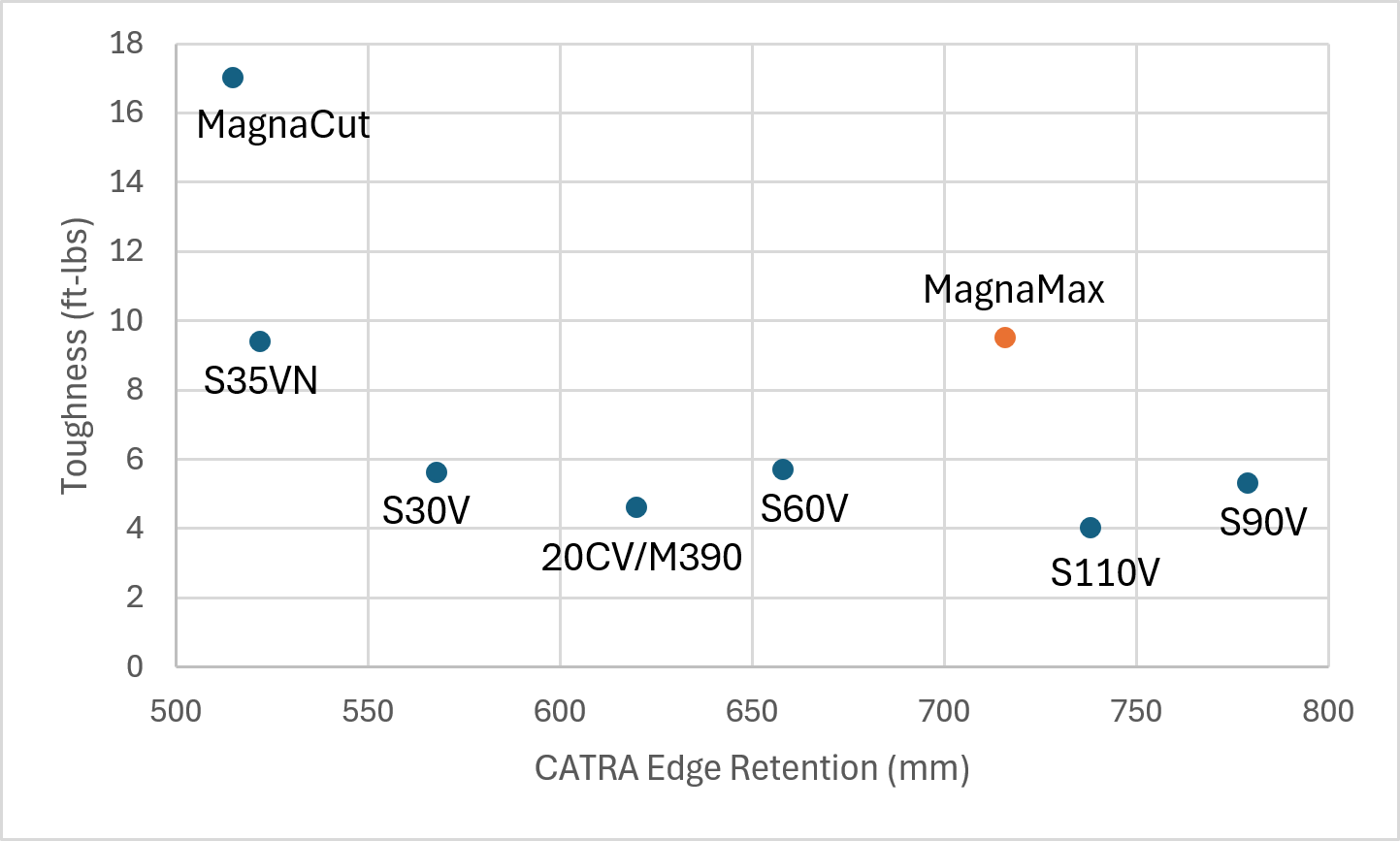
You will also see in the chart above that MagnaMax offers superior toughness and edge retention to the popular M390 and 20CV. It is very difficult to improve both of these properties at the same time, so this is a big improvement. It also maintains similar toughness to grades CPM-154, S35VN, and Vanax, which were formerly the toughest PM stainless steels prior to MagnaCut. So it offers a significant edge retention improvement to those grades, which have had a reputation for good properties in the past.

That property summary article did not have specific heat treatment recommendations because I was waiting on the final material. The initial heat of steel had carbon on the low end of the specification, so it wasn’t as representative of the average material as I wanted. No change was made to the target composition or the specification, it just landed at the lower end for carbon. So now that I have received and tested material closer to the midpoint of the specification I performed a more comprehensive set of tests. Knifemaker Matthew Gregory helped to make the majority of the toughness coupons.

High Level Heat Treatment Summary

Before we get into all of the details I can give a simple summary so you don’t get lost.

With Cryo:

Austenitize 2100-2250°F (1150-1230°C). The baseline temperature for good properties is 2150°F (1175°C).

Plate quench for faster cooling and slightly higher hardness.

After cooling to approximately room temperature, place immediately in liquid nitrogen. The amount of time it sits in the liquid nitrogen doesn’t matter that much, it just needs to reach the temperature. An hour is fine. What does matter is not wasting time before putting it in the liquid nitrogen. You don’t need to check the hardness beforehand.

Temper 300-450°F (150-230°C) twice for two hours each time. 350°F (175°C) is a baseline temperature for good properties.

Without Cryo:

Use your household freezer. It is a myth that it doesn’t have any effect. There is no reason to do no cold treatment. Everybody has or can get a freezer. Dry ice is even better, but despite being about 100°F colder than a freezer often behaves closer to a freezer than to liquid nitrogen.

Austenitize 2050-2100°F (1120-1150°C). 2100°F (1150°C) is a good temperature. It might be possible to go somewhat higher but I worry about excess retained austenite.

Plate quench for faster cooling and slightly higher hardness.

After cooling to approximately room temperature, place immediately in the freezer or dry ice. The amount of time it sits in the freezer doesn’t matter that much, it just needs to reach the temperature. An hour is fine. What does matter is not wasting time before putting it in the freezer. You don’t need to check the hardness beforehand.

Temper 300-450°F (150-230°C) twice for two hours each time. 350°F (175°C) is a baseline temperature for good properties.

Austenitizing hold times:

The required hold time changes with temperature. This is the soak time required after the piece reaches the temperature. It rarely hurts to add extra minutes, it is more common to have an issue with undersoaking.

2050°F (1120°C): 20 minutes

2100°F (1150°C): 15 minutes

2150°F (1175°C): 10 minutes

2200°F (1205°C): 5 minutes

2250°F (1230°C): 5 minutes

Hardness and Cryo

I first made a series of coupons to test the hardening response, including with the addition of a freezer or liquid nitrogen treatment after quenching. I used the soak times in the section above.
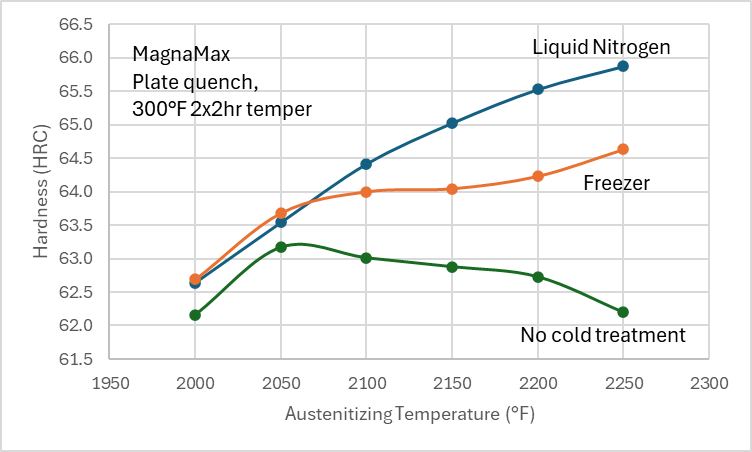
You can see that with no cold treatment the peak hardness was 2050°F (1120°C) after tempering at 300°F (150°C). Hardness drops with higher temperatures from excess retained austenite. Hardness rose when using liquid nitrogen all the way to 2250°F (1230°C). It would be unlikely to keep rising much beyond this temperature and the possibility of melting grain boundaries starts to become more of a danger. The freezer also rose all the way up to 2250°F but to a lesser extent. Because the increase was small beyond 2100°F (1150°C) this is why I limited my recommendation for the freezer to that temperature. That makes me think both the retained austenite and hardness of the martensite were increasing beyond that temperature, leading to relatively flat behavior. Excess retained austenite can lead to worse sharpening behavior when deburring. Overall this hardening response is not radically different than MagnaCut.
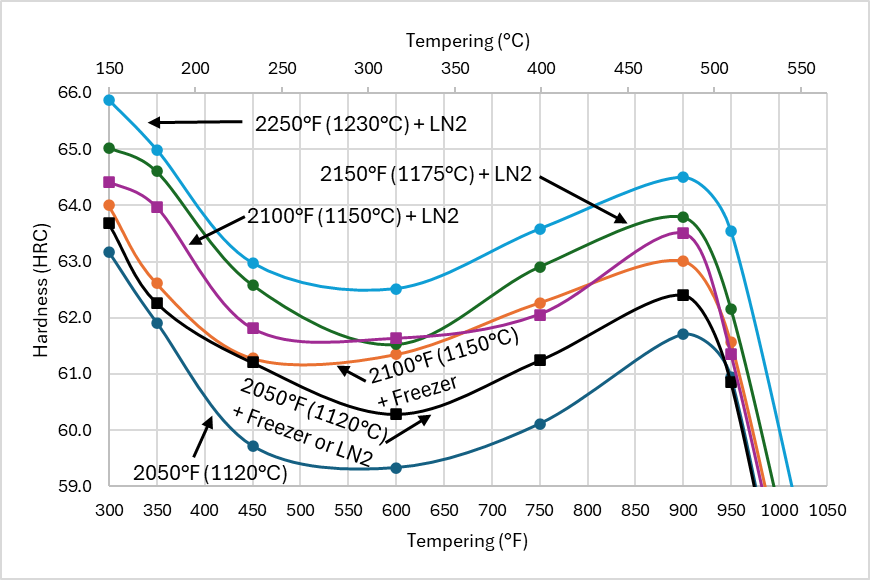
Nothing too crazy showed up in the tempering. You can see that a cold treatment leads to less hardness loss in tempering. Compare 2050°F with and without a cold treatment, or 2100°F with liquid nitrogen vs the freezer. Note that I have a single curve for both freezer or liquid nitrogen from 2050°F, and this was because the two were sufficiently similar to have a single line. Plus don’t want to make the chart too busy.

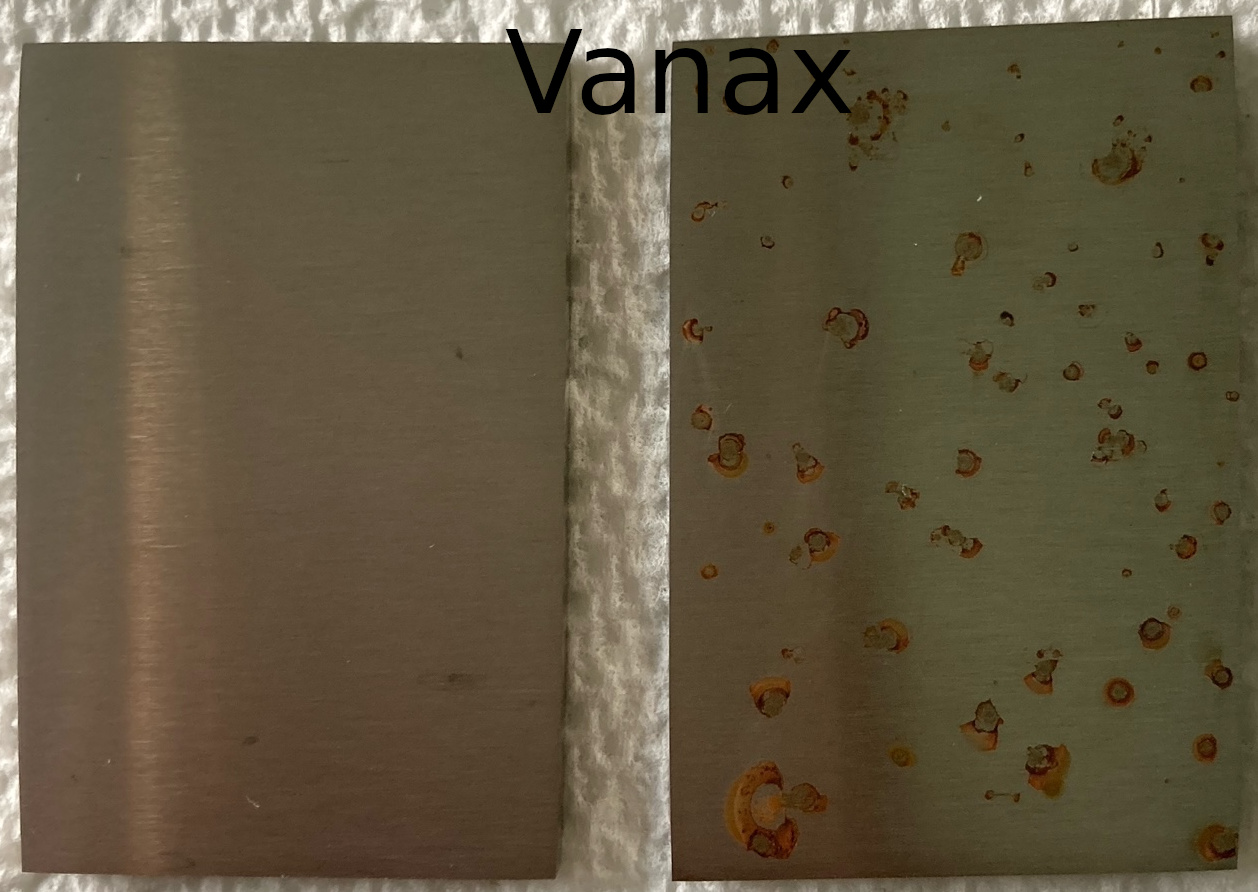
You will also notice that the hardness reaches an initial minimum at 600°F (315°C) and then rose to a secondary peak around 900°F (480°C). This is known as “secondary hardening.” I don’t recommend tempering in that range, especially with stainless steels, because it reduces corrosion resistance. For example see two Vanax coupons below, both sprayed with 1% saltwater. The one of the left was tempered at 400°F (200°C) and the one on the right was tempered at 1000°F (540°C).
Toughness

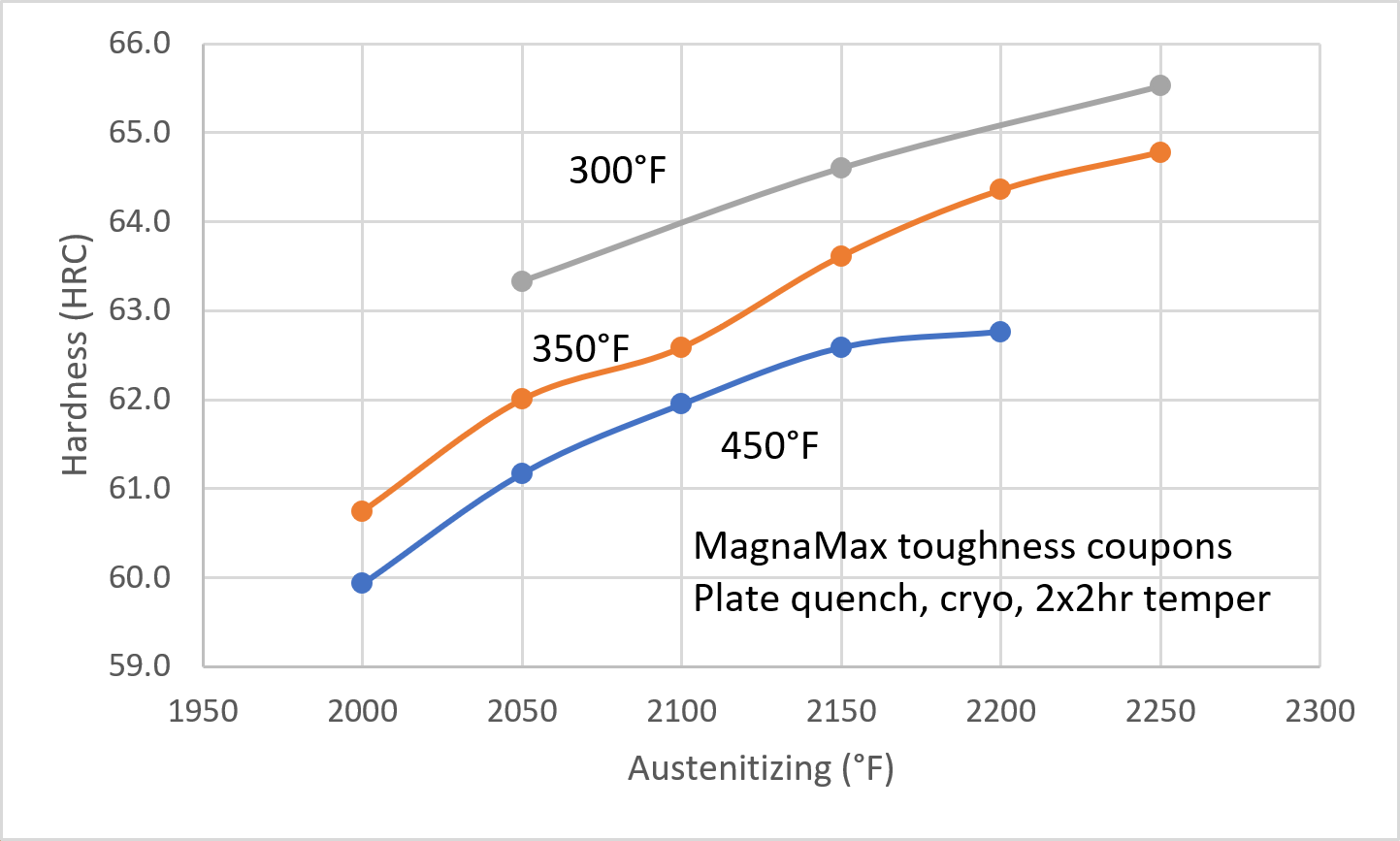
We also tested a series of charpy toughness coupons for this heat of MagnaMax. I used my standard coupon which is quarter size (2.5 x 10 mm) and unnotched. Three coupons were tested for each condition. We used liquid nitrogen in the heat treatment of all of these coupons directly after the quench. We used austenitizing temperatures of 2000-2250°F (1095-1230°C) and tempering temperatures of 300, 350, and 450°F (150, 175, 230°C).

The hardness was slightly lower than the small hardness coupons I showed results from before:
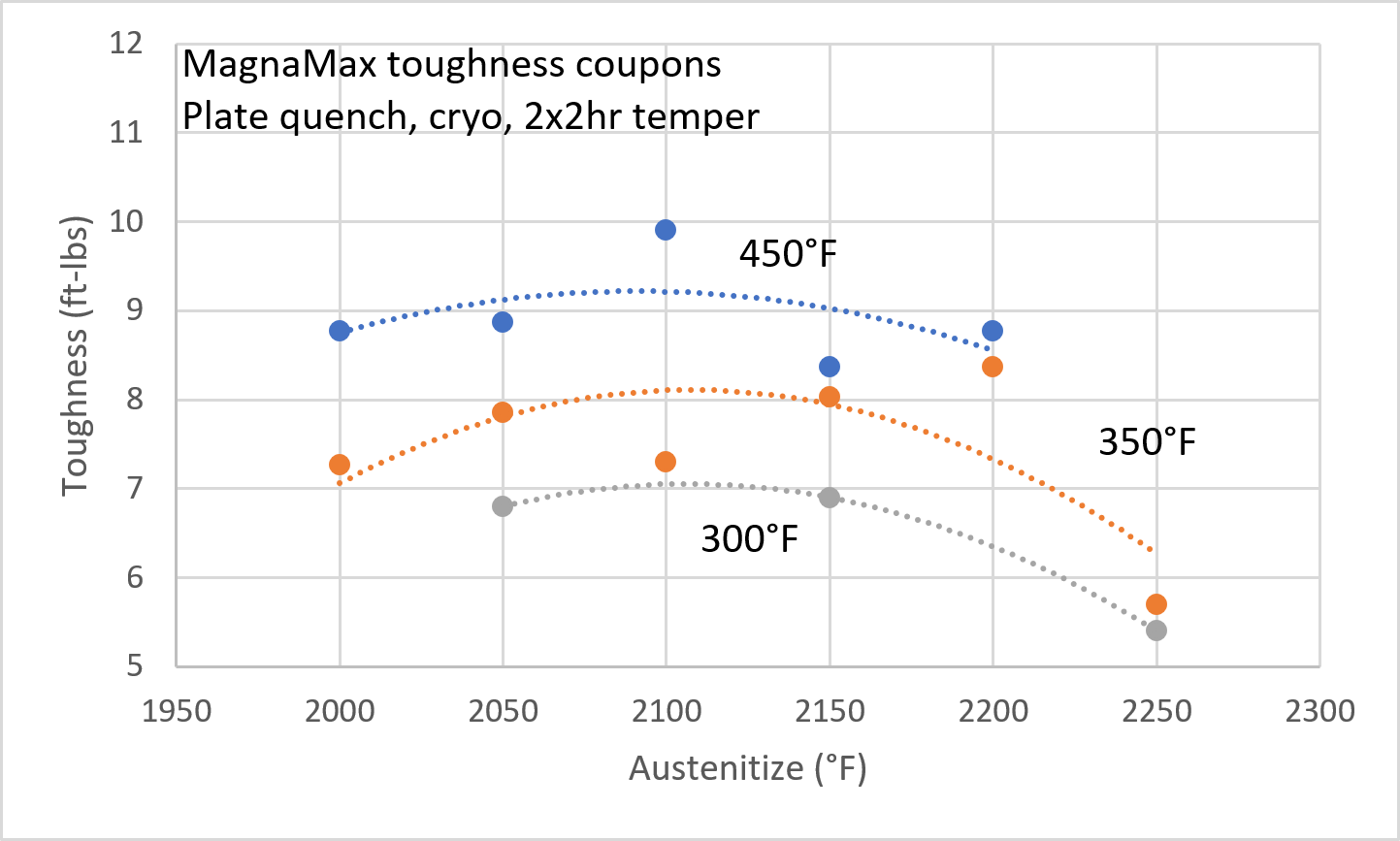
Looking at the resulting toughness, it rose from 2000 to 2050°F (1095 to 1120°C), was relatively flat up to 2200°F (1205°C), and then dropped somewhat up to 2250°F (1230°C). This is why I recommended a baseline austenitizing temperature of 2150°F (1175°C) as this appears to be roughly the peak hardness-toughness, though an argument could also be made for 2200°F (1205°C), in part due to a couple of the 2150°F results being on the low end and a couple of the 2200°F being on the high end. This is likely due to statistical variability of testing.
You can also see that toughness increases with tempering temperature as we would expect, which also corresponds to a hardness decrease. Lower hardness generally correlates with higher toughness.
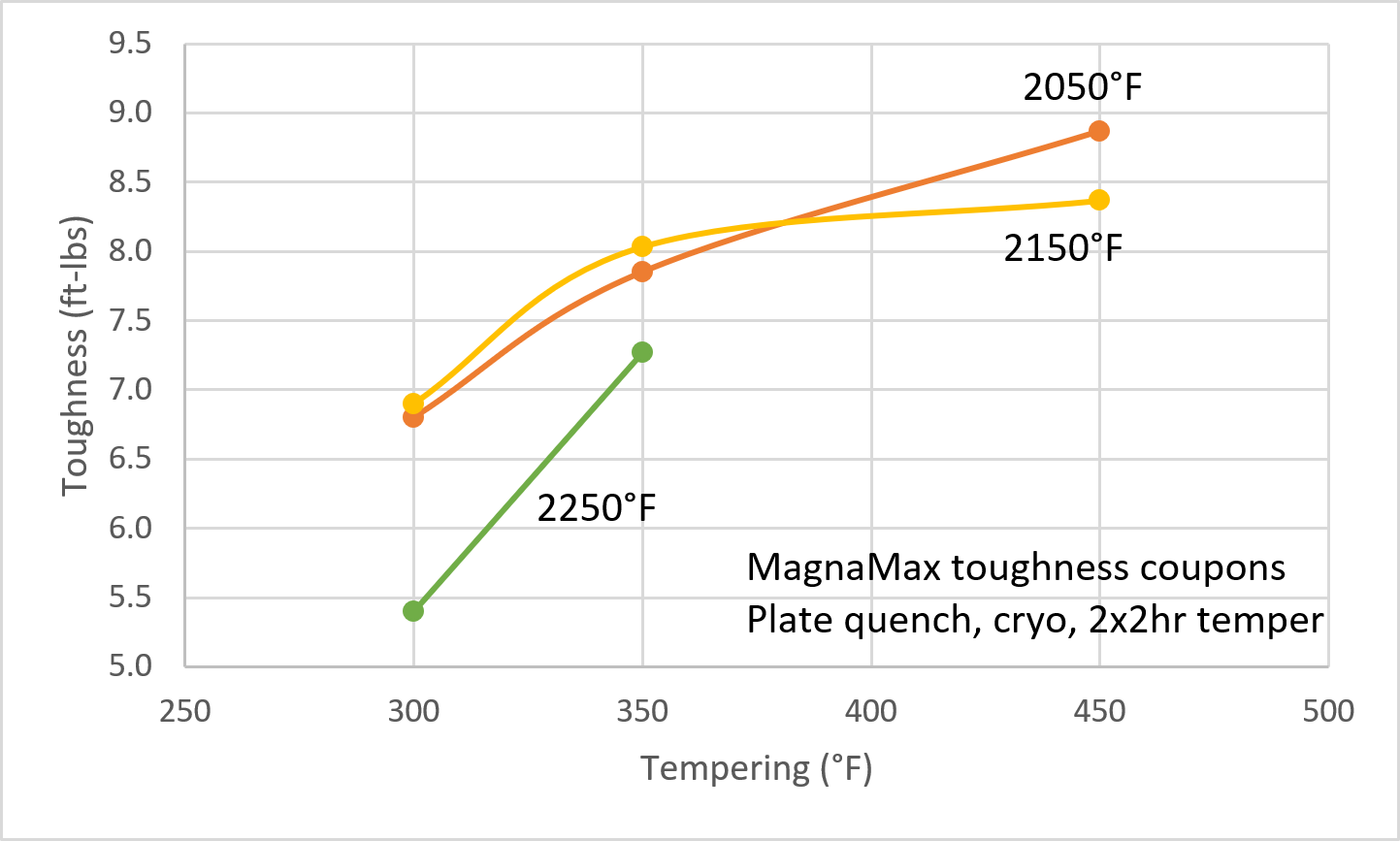
There was a greater increase in toughness between 300 and 350°F (150-175°C) than between 350 and 450°F (175-230°C), which is why I recommended 350°F (175°C) as the baseline tempering temperature.

Hardness-Toughness Balance

But what we would like to maximize is the highest toughness for a given hardness. So I plotted hardness vs toughness below.
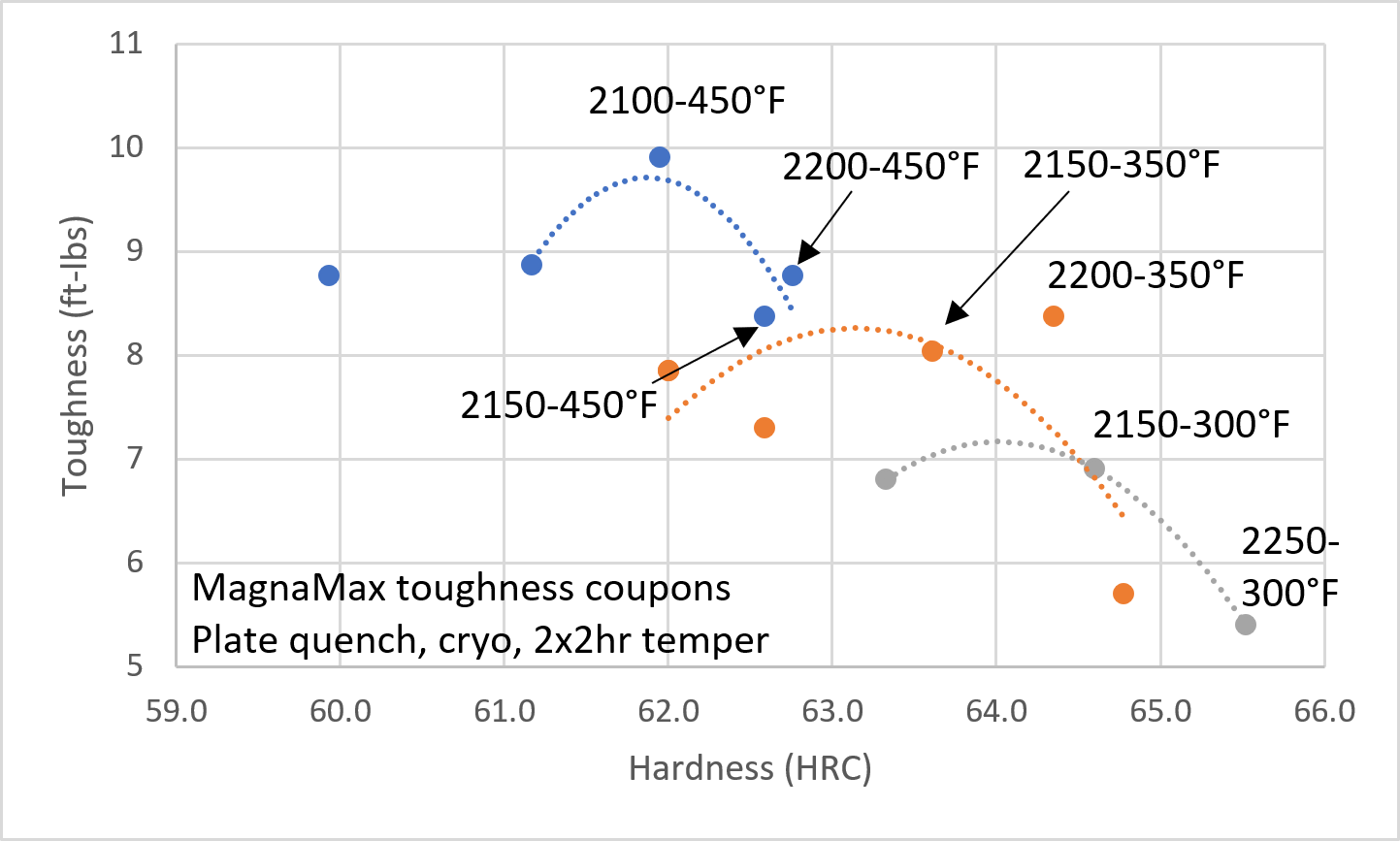
You will notice that the maximum hardness-toughness combinations were generally 2150-2200°F (1175-1230°C) and tempering at 350-450°F (175-230°C). The exceptions include: 1) 2100°F (1150°C) with 450°F (230°C) because that combination gave the best properties for lower hardness. And 2) For maximum hardness you need 2150-2250°F (1175-1230°C) in combination with the minimum tempering temperature of 300°F (150°C). I next overlaid those best heat treatment conditions on top of the similar non-stainless steels K390, Vanadis 8, and CPM-10V:
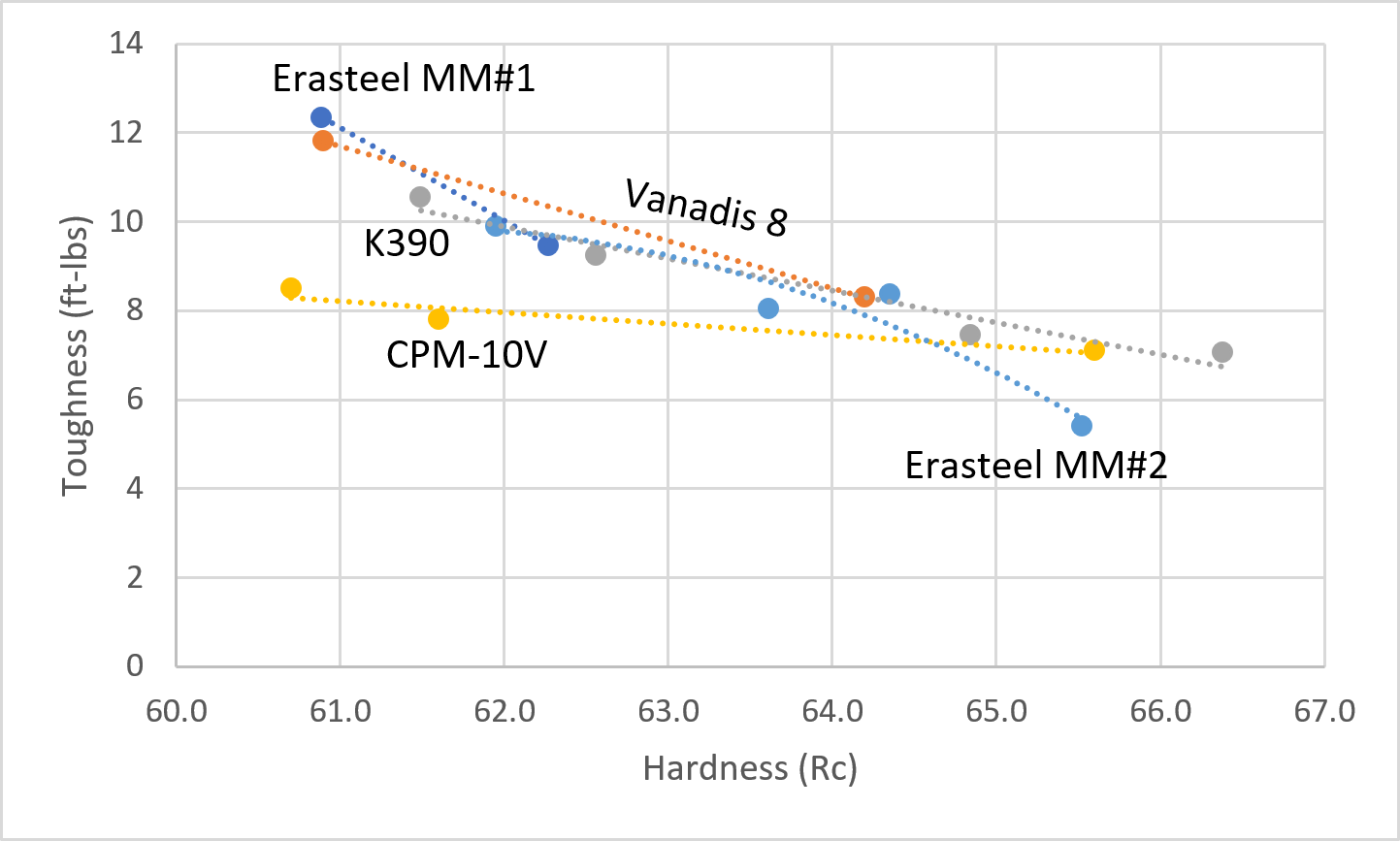
Erasteel MM#1 is the first heat that was shown in the prior article about MagnaMax properties, and Erasteel MM#2 is the final tested material above. You can see that both have a similar hardness-toughness balance, though the new one is skewed to somewhat higher hardness, as expected from more carbon. You will also see that the toughness is very similar to K390 and Vanadis 8, an excellent result given that MagnaMax is a stainless steel with similar wear resistance. So we greatly improved corrosion resistance over those steels while maintaining their other properties. I next plotted those hardness-toughness values vs other stainless powder metallurgy steels:
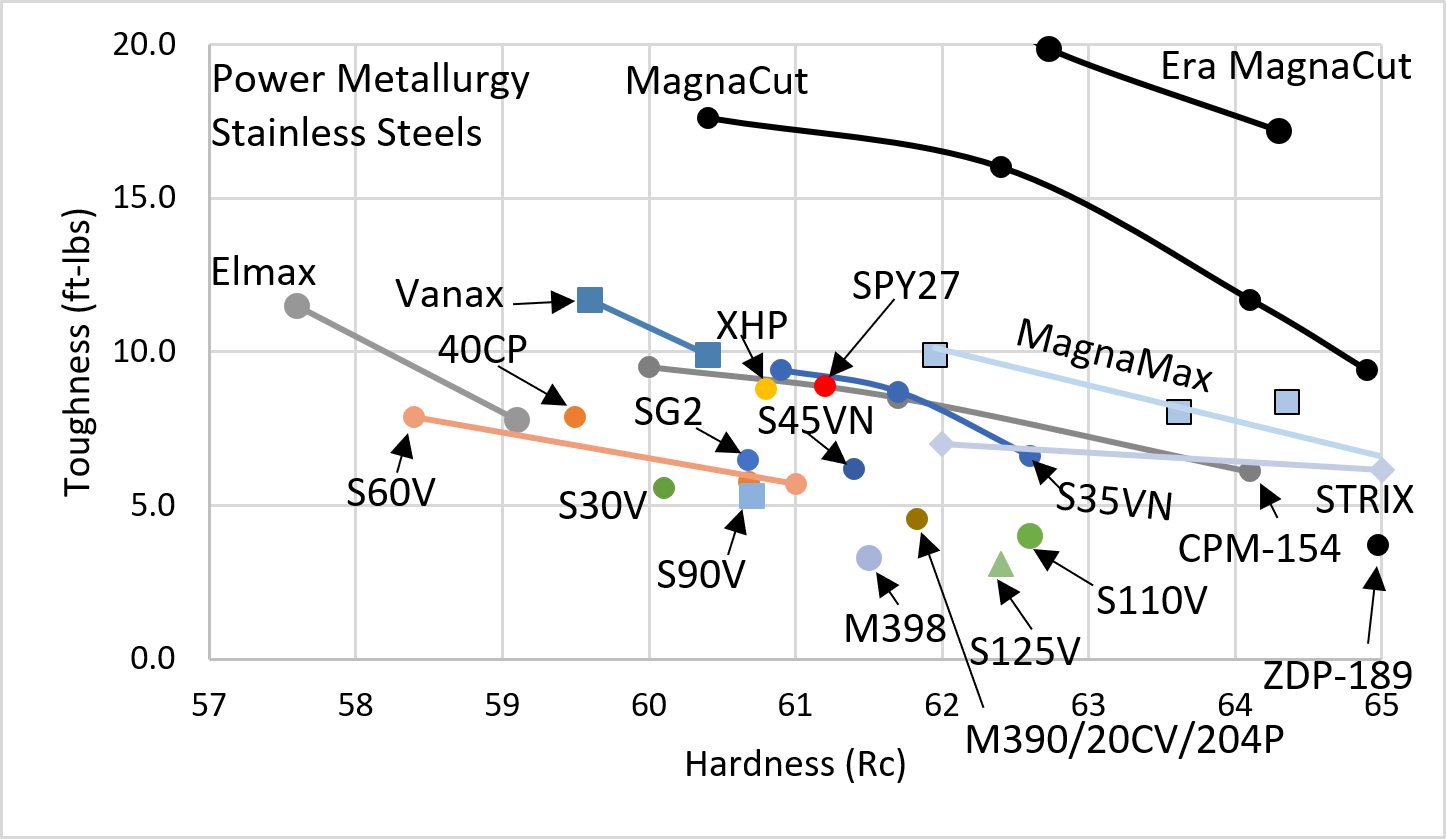
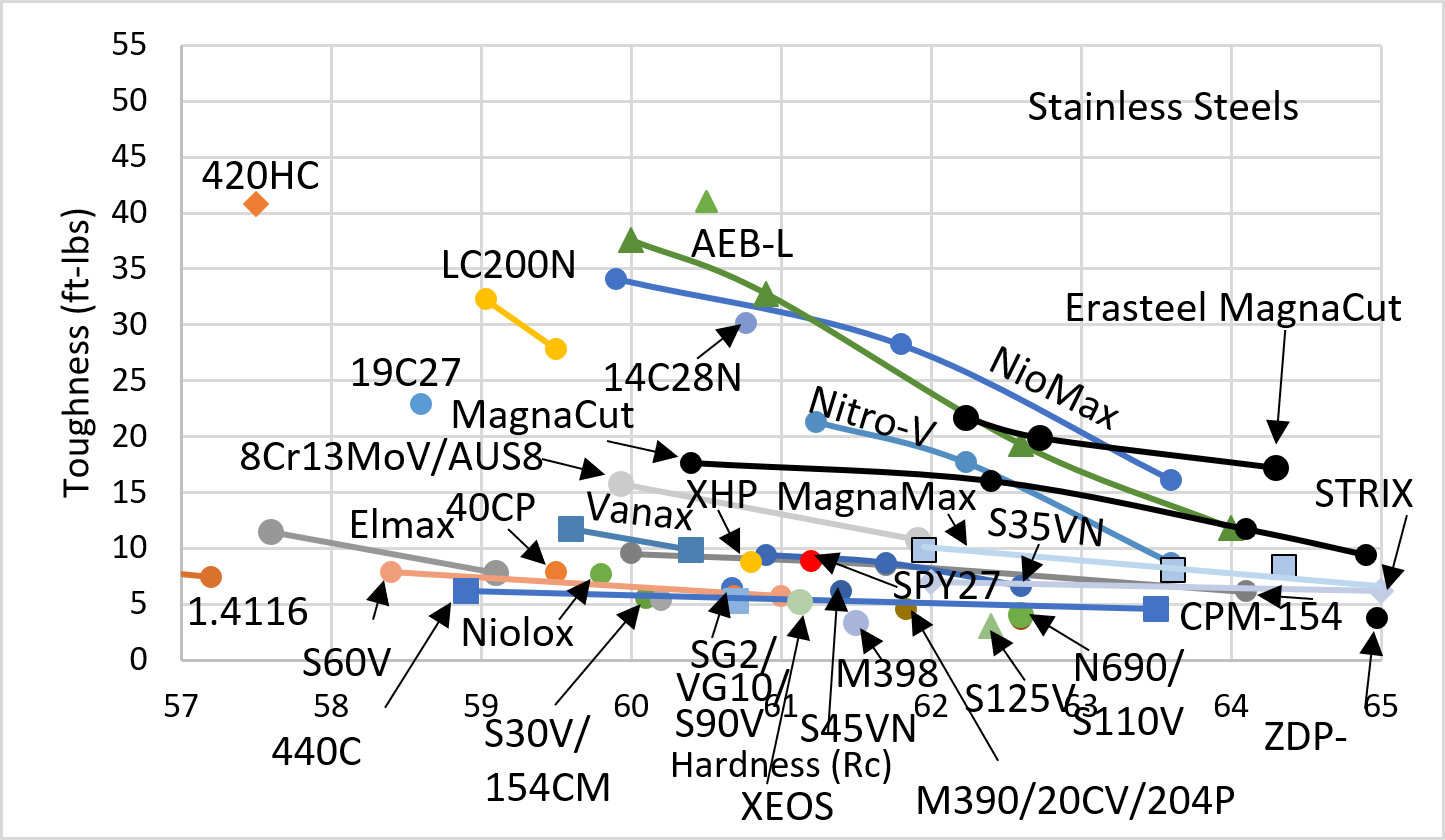
You can see that MagnaMax has superior hardness-toughness than virtually all of the powder metallurgy stainless steels apart from MagnaCut. This includes steels with a good reputation for toughness including Vanax, XHP, S35VN, and CPM-154. And below I have the more complete graph of stainless steels which is a bit busy:
Corrosion Resistance

I compared the final higher carbon version of corrosion resistance to the earlier and both passed the 1% saltwater corrosion test. Showing a picture of two clean samples isn’t very interesting, so here is the earlier image of MagnaMax vs other steels:
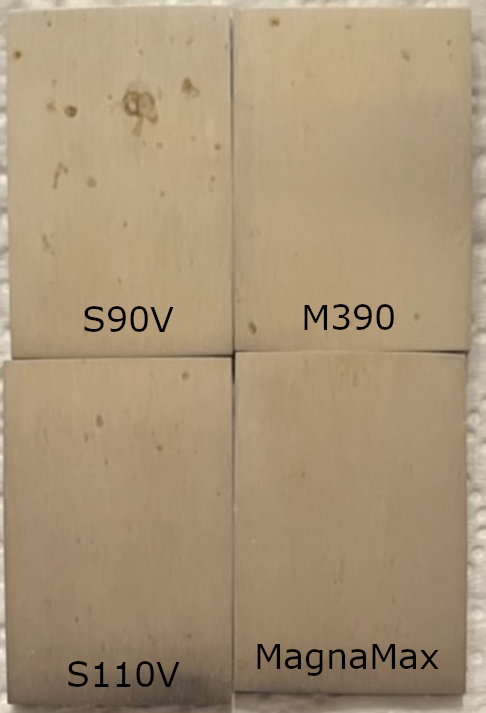
Each of those was austenitized from 2150°F (1175°C). MagnaMax (and MagnaCut) were designed for all of the chromium carbides to be dissolved around 2050°F (1120°C). After the chromium carbides are dissolved the corrosion resistance doesn’t appreciably change with even higher temperatures. This is different than most other stainless steels which have chromium carbides all the way up to the melting temperature. But using even higher than 2050°F does provide some factor of safety, better ensuring the chromium carbides are fully dissolved.

The other main factors for corrosion resistance are quench rate and tempering temperature. I mentioned in the tempering section that tempering above about 750°F (400°C) leads to a reduction in corrosion resistance and I showed a test with Vanax to illustrate that. Quenching isn’t an issue unless it is very slow, which leads to carbides precipitating on the grain boundaries which can reduce corrosion resistance.

Edge Retention

The primary factors for edge wear resistance are carbide volume, carbide hardness (controlled by type), and steel hardness. While the carbides are very important when comparing different steels, there is less of an impact within a given steel. It is true that austenitizing higher dissolves a bit more carbide but this effect is generally drowned out by the increase in hardness. So in general, achieving a higher hardness results in greater edge retention, and there isn’t much point in worrying about the exact austenitizing and tempering temperatures that were used to get there. I have the graph below of CATRA results I tested previously to show where MagnaMax lands and the effect of hardness on the results:
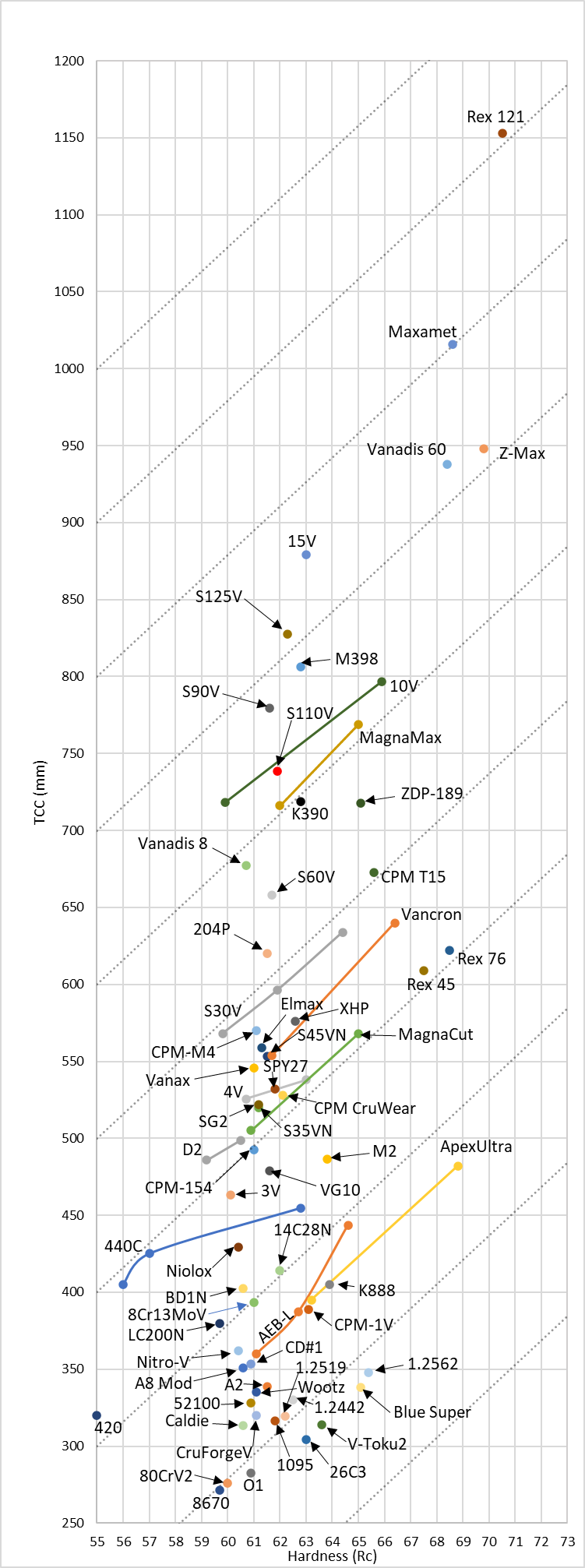
Summary and Conclusions

So I have shown the majority of the heat treatment data that I generated and my reasoning for the different recommendations. I am overall happy with how the heat treatment response ended up. If you want to see the simplified heat treatment recommendations, scroll back near the top where it said “High Level Heat Treatment Summary.” Hopefully that is simple enough for everyone. If not then ask questions in the comments. MagnaMax will be on sale May 1st, 2026 at 9am on Niagara Specialty Metals’ online store: https://nsm-ny.com/shop/

The post How to Heat Treat MagnaMax Steel appeared first on Knife Steel Nerds.

  •  

Testing Chinese Knife Steel 8Cr13MoV/8Cr14MoV

Thank you Patreon Supporters!

Thank you to my Patreon supporters who help make these studies happen. Patreon funds were used for purchasing two ultimately useless knives, and some steel. Patreon supporter Marcus Ho even sent me some steel all the way from China which also ended up not working out. And I used Patreon funds to pay Shawn Houston (also a Patreon supporter) to do microscopy and grind two CATRA knives for me. So when I say that Patreon makes the study happen I don’t mean in an abstract sense. If you want to help fund more knife steel research please come join us on Patreon where you can get articles and videos early. Or if you sign up for the highest tier you can even get a sweet Knife Steel Nerds mug.

Video

Video version of the following information:

History of 8Cr13MoV/8Cr14MoV

To cover the history of 8Cr13MoV we have to go back to Japan, or even further back to Europe. Hitachi in Japan came out with their own stainless tool steels called “Gingami” meaning “silver paper” with three different designations. All three of these steels were copies, or nearly so, of stainless steels available in Europe. They were released somewhere in the 1933-1951 time period. In 1960 Fukami Steel Company was founded in Japan and they introduced AUS-4 and AUS-6 in 1968. AUS-4 was a 420/420HC type steel and AUS-6 was similar but with higher carbon and a small molybdenum and vanadium addition. AUS-6 was very similar to Gingami 2, and also other European steels such as Sandvik’s 12C27. AUS-8 was introduced in the 1970s which was AUS-6 with increased carbon up to ~0.8%. AUS-6 and AUS-8 became very common in Japanese factory knives, such as Kershaw’s imported knives introduced in the late 1970s. You can read more about all of this history (including citations) in my book The Story of Knife Steel.

8Cr13MoV, also called 8Cr14MoV, is a generic Chinese designation for AUS-8. They have identical composition. The naming scheme is pretty self-explanatory, I think, but maybe it makes sense to describe it explicitly. The first number designates the carbon content, so “8” refers to ~0.8% carbon, Cr13 means 13% chromium, Mo means a small molybdenum addition, and V means a small vanadium addition. So 7Cr17 means 0.7% carbon and 17% chromium, 9Cr18 means 0.9% carbon and 18% chromium, and 9Cr18MoV is the same with molybdenum and vanadium. Another steel that seems to be building in popularity is 10Cr15CoMoV which is 1% carbon, 15% Cr, plus cobalt, molybdenum, and vanadium; a copy of Takefu’s VG-10. I have heard these designations sometimes referred to in a derogatory way as “Chinese alphabet soup” though I think it should be known that these designations are a slight modification of an earlier European designation system. For example, 9Cr18MoV has existed for a long time in Europe as X90CrMoV18, also referred to by another European designation system as 1.4112. This is the European version of 440B which has some small differences with the American AISI 440B, such as higher chromium (18 vs 17%) and molybdenum (1-1.3% vs <0.75%). 7Cr17 is the same as AISI 440A. To the average consumer I’m sure all of the numbers are somewhat mystifying and steel names tend to be more memorable.

I don’t know when 8Cr13MoV was first used, but it was first advertised in knives by Spyderco in 2005 with their new “byrd” line of knives produced in China. Spyderco had requested their new knives be produced in 440C and tests of the knives were positive. However, Sal Glesser requested they check the composition of the steel and found it to be identical to AUS-8, not 440C as the factory told them. They learned the steel was designated as 8Cr13MoV in China and advertised the knives as such [1]. There is no distinction between 8Cr13MoV and 8Cr14MoV, all published compositions I have been able to find are the same, apart from Spyderco’s composition table which lists the chromium content only as 13.0%, rather than other published ranges I have found which show 13-14.5% chromium.

My History with 8Cr13MoV/8Cr14MoV

Because of how common AUS-8 and 8Cr13MoV knives are, I was interested in testing the steel for some time. However, despite how common it is in factory knives, obtaining individual bars of it was actually pretty difficult. Japanese and Chinese steels are pretty difficult to obtain in the USA to begin with, as most of it is sold directly to knife companies in their respective companies. Furthermore, because they are known as “budget” or even “low end” steels custom knifemakers in the USA are not exactly clamoring for it so the knife steel supply companies were not trying to get any.

My first solution was to purchase two “Schrade Leroy” choppers made in 8Cr13MoV which have large flat areas. This would allow me to anneal (soften back to the steel factory state) the steel and then heat treat it how I want. The flat areas mean I could make steel coupons for testing such as toughness coupons and potentially CATRA knives. That gives me control over the heat treating and geometry of the steel so I am not limited to available knives.

The knife had easily removable handles so I annealed one of them and posted to my Patreon that I would soon be testing the steel. One of my Patreon supporters, Marcus Ho, contacted me and offered to purchase some 8Cr13MoV bar stock so I wouldn’t have to use my more complicated method for obtaining the steel. Marcus is a knifemaker in Hong Kong so he had experience with sourcing steel in China. You can follow him on instagram under his company name HK.Knifeworks. He sent me a bar of steel along with a very official composition certification.

So I set the Schrade knife aside and started working with the new bar of steel. I started with developing hardness curves with different temperatures, which looked about where I expected them to be. But then I tested the toughness and it was worse than I expected, being more in line with 1% carbon stainless steels like 154CM or 440C. I then looked at the microstructure and it had too much carbide in it, looking again like 154CM or 440C. So I tested the composition of the bar and it was indeed 440C. This was an ironic reversal of the situation that Spyderco saw with their byrd knives. I was so disgusted with this whole debacle and all of the time I had wasted on a bar of 440C that I stopped working on the steel altogether.

More recently I learned that Aus Maker Supplies in Australia had obtained some 8Cr14MoV to sell to knifemakers and I asked if they could send me some. This time I actually got a bar of real 8Cr13MoV/8Cr14MoV and I am happy to report that I have actually tested the real thing.

Hardness

I tested the heat treatment of 8Cr14MoV with a range of austenitizing temperatures after soaking for 15 minutes, plate quenched, and tempered at 300 or 350°F. For half of them I used a cryo step in liquid nitrogen after the quench but before the temper. I didn’t find any published information on heat treating the steel, but Aichi has a recommendation for AUS-8 of 1050°C austenitize and 180°C temper (1925°F/350°F).

As with any steel, cryo led to higher hardness, and a higher austenitizing temperature from which peak hardness was obtained. Without cryo peak hardness was from 1950°F, so the recommendation for AUS-8 of 1925°F is good I think. It is dangerous to heat treat close to the peak hardness, because austenitizing above the peak means that there is excess “retained austenite” dropping the hardness which leads to worse performance. These are small coupons so in an industrial environment with slower quenching speeds the hardness may be somewhat lower. 61 Rc with the 1925-350 heat treatment is pretty good. Also the steel can achieve relatively high hardness, up to 64.5 Rc with a low 300°F temper. A more conservative 350°F you can still get into the 62.5-63.5 Rc range.

Microstructure

8Cr13MoV has a generally fine carbide structure but has many larger carbides mixed in. Sandvik and Uddeholm razor steels 13C26, 14C28N, and AEB-L seem to have about the limit in terms of carbon and chromium content before large carbides become unavoidable without more expensive manufacturing such as powder metallurgy. I have AEB-L below as a comparison to see what I am talking about, along with the higher carbon 440C and VG10 which have even larger carbides.

8Cr13MoV 1925°F-350°F Area 1

8Cr13MoV 1925°F-350°F Area 2

8Cr13MoV 1950°F-350°F Area 1

8Cr13MoV 1950°F-350°F Area 2

AEB-L

440C

VG10

In terms of grain size we also did an etch to reveal prior austenite grain boundaries. It is notoriously difficult to reveal grain boundaries so they are somewhat difficult to see. However, it is apparent that there was some grain growth with 1950°F when compared with 1925°F.

8Cr13MoV 1925°F-350°F

8Cr13MoV 1950°F-350°F

We also observed broader “segregation” and carbide stringers on a macro scale, especially in the 1925°F CATRA knife, which is shown below with two different angles. We also had a surface defect from the carbide stringers, which is seen as a shadow in the darker of the two. This happens when a carbide stringer is big enough that it breaks out during grinding. Segregation and carbide stringers are not unique to 8Cr13MoV, they are relatively common with ingot cast steels (as opposed to powder metallurgy). This is especially the case with higher carbon conventional steels like 440C and 154CM. The carbide stringers are parallel to the edge, perpendicular to the “grind lines.”

Toughness

For toughness tests I heat treated two conditions: 1925-350°F without cryo (roughly matching factory knife heat treatments), and 1950-350°F with cryo (higher hardness and closer to a custom heat treatment). These resulted in about 60 Rc and 62 Rc, respectively.

As expected based on the presence of some larger carbides, the toughness of 8Cr13MoV is significantly lower than AEB-L, 14C28N, LC200N, and Nitro-V. However, the toughness of 8Cr13MoV is still better than most other conventional high carbon stainless steels like 440C, VG10, and 154CM. It is also better toughness than most powder metallurgy stainless steels, even Vanax, XHP, and S35VN (though not MagnaCut). So overall 8Cr13MoV/8Cr14MoV has pretty good toughness despite its reputation as a low end steel. AUS-8 would also be similar.

CATRA Edge Retention

For CATRA edge retention coupons I used the same heat treatments, though they both came out slightly harder at about 61 and 62.5 Rc. However, one interesting thing is that the 1925-350°F heat treatment, the softer of the two, measured higher for edge retention, with an average after four tests of 395 mm of cardstock cut in the CATRA test. The 1950-350°F instead measured 376 mm. The 1950 coupon tested very consistently with values of 370, 382, and 377 mm. The 1925, however, seemed to do better the more I retested it with 357, 399, 389, and 429 mm. After puzzling over this I think the reason is that we had more carbide stringers near the edge with the 1925-350°F CATRA coupon, as discussed in the microstructure section. So perhaps what happened is that I was sharpening into a more carbide-rich region leading to the higher values. This is part of the inconsistency of conventionally cast steels, leading to more variable microstructure and therefore properties. Powder metallurgy steels are typically more consistent. To be kind to 8Cr13MoV I plotted only the higher 1925 coupon on the chart below:

The steel tested about where it was expected to fall, a bit above the lower carbon AEB-L and Nitro-V, but below higher carbon steels like 440C, VG10, and 154CM. When compensating for hardness it did very similar to LC200N and 14C28N. Both of those steels (LC200N and 14C28N) tested a bit better than I expected based on their composition, as I expected them to be closer to AEB-L and Nitro-V. So I am curious if I were to test three knives if they would still end up where they did (as opposed to resharpening the same knife), or if there are other features of those steels that cause them to test a bit higher. But we are talking relatively small differences, it’s not as if the steels were competing with S30V.

Comparison with My Original Ratings

I had been running Knife Steel Nerds for a few years before I finally did my ratings of knife steels. I wanted to have experimental results before rating them. One of the few steels I gave a rating for without testing it was 8Cr13MoV/AUS-8, in part because it is so common and many people asked me to rate it. So I gave my best guess in the table which I reproduced below:

I guessed that the toughness would be a “6,” in between 5’s like Vanax and S35VN and the 7 of MagnaCut. And indeed the steel ended up in between those. The edge retention I gave a “3,” the same as AEB-L, LC200N, and 14C28N, and it tested similarly to those steels. So I pointed all that out to pat myself on the back for my predictive abilities based on educated guesses and everything I’ve learned about steels over the years. It’s fun to brag sometimes. I didn’t test corrosion resistance of the steel, it gets a 7 because it is largely a carbon-chromium steel (with a little Mo and V), and so should fall in line with other steels of similar carbon-chromium ratio. If everyone is really clamoring for corrosion resistance tests of these types of steels I will think about doing another round of salt spray tests.

Summary and Conclusions

8Cr13MoV started as a copy of the Japanese steel AUS-8. I told the complicated and boring story of why I have had such a hard time getting this steel so I could actually test it. I think the obtainable hardness of the steel is pretty good, it can be heat treated up to 64 Rc or so, and is very easy to heat treat into the 60-61 region without cryo and 62-63 Rc region with cryo. The 1925-350°F (1050-180°C) heat treatment recommended by Aichi for AUS-8 is a good starting point for a cryo-free heat treatment. With cryo you can austenitize up to the 1975-2025°F range for high hardness if desired. 300°F is as low as I typically recommend tempering, though 350°F gives more balanced properties. The microstructure is disappointing if you are comparing to AEB-L and 14C28N though looks pretty good when compared with higher carbon conventional steels like 440C, VG10, and 154CM. The toughness was better than those 1% carbon steels but not as good as the fine AEB-L and 14C28N, but quite respectable either way. The edge retention wasn’t much better than AEB-L for the toughness deficit, but with the good hardness 8Cr13MoV can have it isn’t too bad. Luckily for me I didn’t have to modify the ratings I had already given the steel in each category because my predictions were pretty good. If you are in Australia 8Cr14MoV/8Cr13MoV is a good low cost steel to purchase from Aus Maker Supplies. And if you are buying knives in the steel you don’t need to worry about the steel itself being “junk,” there are a lot worse choices. Of course that assumes the knife company is heat treating it properly.


[1] https://forum.spyderco.com/viewtopic.php?f=2&t=14579&p=140419

The post Testing Chinese Knife Steel 8Cr13MoV/8Cr14MoV appeared first on Knife Steel Nerds.

  •  
❌