This story was originally published by ProPublica, a nonprofit newsroom that investigates abuses of power. Sign up for Dispatches, a newsletter that spotlights wrongdoing around the country, to receive their stories in your inbox every week.
Some 86 years ago, Missouri voters enshrined a system for selecting top judges that would remove political influence from the courts. And almost immediately, it came under attack.
Under what has come to be known as the Missouri Plan, lawyers help choose a slate of three candidates from which the governor must make an appointment for the state Supreme Court, appeals courts and, in some populous areas, the circuit courts.
In the first years after adoption, it faced pushback from party bosses who had historically used judicial seats for political patronage. They said it gave too much power to the lawyers. Voters, though, decisively defeated a repeal measure in 1942.
More recently, the conservative activist Leonard Leo, who viewed Missouri as a crucial battleground, tried in 2007 to persuade Republican Gov. Matt Blunt to reject a slate of Supreme Court candidates — part of a broader effort to weaken a judicial selection system that had become a model for some two dozen states around the country.
Blunt resisted and picked one of the three judges from the approved slate.
Then, in 2012, GOP lawmakers put a proposed overhaul before voters that, if approved, would have given the governor more control. Voters, by a 3-to-1 margin, turned back the plan.
Now the attacks are back, driven by a new grievance.
GLADSTONE, Missouri — The right to an abortion in Missouri is on the verge of disappearing, again.
It’s a threat that loomed over Tiffany early on a recent September morning, when she drove into Gladstone, just north of Kansas City, for her abortion.
The 26-year-old mother of three made the two-day trip to reach the clinic just a couple of weeks after finding out she was pregnant. Despite living in Springfield, a city of about 170,000 near the Arkansas border, she couldn’t find an appointment for an abortion at her local clinic until late October, near the end of her first trimester.
Instead of waiting, she decided to spend the night at a friend’s house halfway between her home and the Planned Parenthood in Gladstone — the first clinic that could take her — hours away. After her appointment, she planned to drive back home in time to meet her children when the bus dropped them off.
“I love kids so much,” she said, sitting on an exam table, waiting to see the doctor. This abortion, she explained, “has everything to do with loving my own children, that I already chose to have.”
But in November, the rights of Missourians including Tiffany to get such care — which has been slowly becoming more available across the state after a 2024 vote to enshrine abortion rights in the state constitution — may come screeching to a halt.
A proposal known as Amendment 3 would reverse that vote and ban abortion in the state constitution, allowing the procedure only in rare cases: when pregnancy constitutes a medical emergency, upon the discovery of a fetal anomaly or before 12 weeks in cases of rape or incest. It would also ban gender-affirming care for transgender minors, even though such care is already illegal in Missouri.
Pay No Attention to That Man Inside the White House
Florida gubernatorial candidate Byron Donalds, the Miami Herald noticed yesterday, scrubbed his campaign website of almost any mention of Trump’s name. He is, of course, not the first. Mike Beltran, running in Florida for a U.S. House seat, changed his website so that rather than stating he “felt inspired by President Trump’s 2016 victory,” it now explains he felt “called to public service.” Joe Mitchell, running in Iowa, once described himself as a “trusted voice in the MAGA movement” who would “always fight for the hard-working Iowans who have made their support for President Trump loud and clear.” Now, the Washington Post noticed, he promises to “clean up Washington and put working families first.”
The lack of enthusiasm among 2026 candidates for the Trump-headlined Dallas midterm convention was perhaps the canary in the coal mine. Now, amid dismal poll numbers, Republicans candidates are scrambling to put distance between themselves and the president in ways large and small — though the president is quite hard to ignore.
Some have taken a stand against the Iran War, with Ohio Senate candidate Jon Husted calling for it to “come to an end as quickly as possible so that we can lower gas prices.” Just before the House left for recess until November, seven Republicans joined with Democrats to vote to end the war.
My favorite example in this is Rep. Tom Tiffany, running for governor in Wisconsin. At TPM, we’ve highlighted the extent to which his defining characteristic is his election denial and the lengths he went following the 2020 election to keep Trump in office. As recently as May, he was encouraging the FBI to probe how his state conducted the 2020 election, and would not say who won it.
State Department Office With White Supremacist Name Does White Supremacist Things
White House Deputy Chief of Staff Stephen Miller takes part in a meeting of the Shield of the Americas on the sidelines of the United Nations General Assembly in New York on September 22, 2026. (Photo by Brendan SMIALOWSKI / AFP via Getty Images)
A Washington Post investigation earlier this week provided the most extensive detail yet of the Trump State Department’s new Office of Remigration. The office, which takes its name from a European neo-Nazi concept of ethnic cleansing, has been behind the third country removals that have ramped up throughout the Trump administration, depositing immigrants to the U.S. in countries to which they have no connection.
The Post obtained documents that detail the deals behind these removals, showing payments of $81 million to 13 foreign governments, many of which are authoritarian regimes.
The Trump administration has deported a whopping 25,000 people in this way to at least 28 countries, per the Post.
Many of these migrants have described, to the Post and numerous other outlets, inhumane conditions imposed by both the ICE agents who carry out the deportations and the third countries that ultimately receive the deported, including beatings and a lack of access to medical care.
I was particularly interested in the details of why and how the term remigration — which comes from the darkest corners of the European right — was given to this office. (I know at this point in the Trump administration this kind of thing can fail to shock, but I really would encourage you to read TPM reporter Chris Mathias’ backgrounder on the term to understand how extreme its origins are, and what the administration is winking at here.) The Post documents how career staffers at the office — which, prior to its Trump administration repurposing, was dedicated to helping refugees — questioned State Department leadership about the name and mission change. “The message we got was that was the exact terminology they wanted,” one staffer told the Post.
The office’s work is the brainchild of Stephen Miller and his closest administration allies, the Post reports.
Top appropriators in Congress responded yesterday to White House OMB Director Russ Vought’s latest attempt to install political appointees as the final arbiters of congressionally appropriated grant money for scientific research.
“Republicans need to join us to put a stop to any effort by this administration to politicize what groundbreaking new treatments and cures we decide as a country to invest in,” Sen. Patty Murray (D-WA), the top Democratic appropriator, said.
“The Office of Management and Budget (OMB) should not be involved in agency decisions on the awards of grants,” Sen. Susan Collins (R-ME), the Republican chair of the appropriations committee, said.
The most recent scheme, as I wrote yesterday, involves an executive order — which is, reportedly, currently being drafted, to give political appointees control over spending on research by the National Institutes of Health. Vought, per the Washington Post, contends that NIH’s work remains too “woke.” Trump and Vought are both also annoyed, per Politico and the New York Times, that funding continues to flow from the agency to Harvard.
TPM’s interest in this story isn’t only about the fact that a politicization of NIH grants would be an authoritarian disaster — though it would be. It’s also that it is the latest chapter in a theme that has defined the Trump administration: expanding executive branch power, and marginalizing Congress — a campaign by Trump and his advisors to which the Republican-controlled legislature has largely acquiesced.
While Democrats denounced Vought’s power grab, the senator who really matters here is Collins, the top Republican on the appropriations committee. Collins, of course, is fighting for reelection in Maine, and her statement was relatively strong.
“Any attempt to politicize grantmaking at the National Institutes of Health (NIH), or any other agency, by another means — whether an Executive Order or guidance — is contrary to congressional intent,” she said.
“The Continuing Resolution — which passed the Senate, House, and was signed into law on September 2 – blocks OMB’s proposed rule or any substantially similar one,” she also noted.
Words, however, are cheap. As I wrote yesterday, the continuing resolution to fund the government, passed earlier this month, blocks the Trump administration from installing Trump’s political appointees to oversee research, but only does so until after the midterms. Republicans, Murray said last month, rejected a permanent block on the White House injecting itself into grantmaking.
This question will surface again after the midterms — and, likely, sooner, if this executive order sees the light of day, posing a direct challenge to Collins. We’ll see then if she, and Congress more generally, are willing to reassert their power of the purse in a lasting way.
Missouri Map Heads Back to the Supreme Court Yet Again
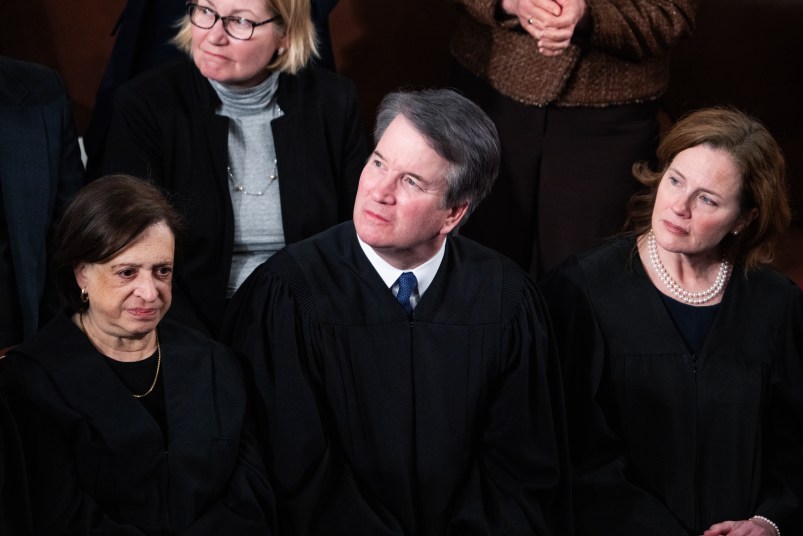
UNITED STATES – FEBRUARY 24: From left, Supreme Justices Elena Kagan, Brett Kavanaugh, and Amy Coney Barrett, attend President Donald Trump’s State of the Union address in the House Chamber of the U.S. Capitol on Tuesday, February 24, 2026. (Tom Williams/CQ-Roll Call, Inc via Getty Images)
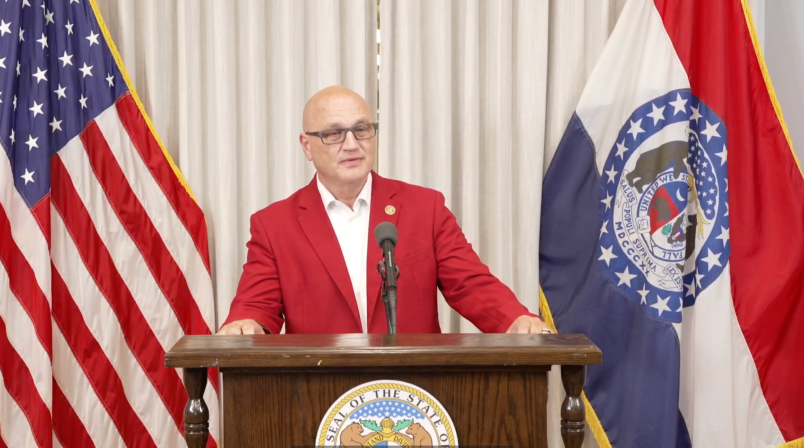
The Supreme Court has already twice weighed in on a fight that has been playing out in recent weeks in Missouri, after the state’s secretary of state, Denny Hoskins, chose the route of chaos by effectively ignoring a petition by voters to choose which map the state votes under. At issue are two maps — a 2022 one and a deeply gerrymandered one the state legislature passed in 2025 at Trump’s urging.
The Supreme Court has twice effectively required the midterm elections to go forward under the 2022 map, and the state Supreme Court blocked the 2025 map. Many experts believed the issue was settled, at least until after the election.
But an appeals court Monday night ruled that the state must use the 2025 map, opening a new chapter of this chaotic story. The state, Democracy Docket notes, has already distributed ballots.
The appeals court reasoned that requiring voters to cast ballots in different maps in the primary and general elections — the outcome of Hoskins’ scheme to plow forward with primaries under the new map, despite the voter challenge to it — would violate the Constitution.
An activist group that has been fighting the 2025 map for a year, People Not Politicians, is seeking emergency review from the Supreme Court.
Big picture, the fight is over one congressional seat, focused on Kansas City, and the shape of others in the state. The 2025 map would likely flip that Kansas City seat, currently held by Rep. Emmanuel Cleaver, from Democratic to Republican.
Tabs
Speaking of Susan Collins … an FBI probe of a defense contractor bribery scheme was on the cusp of investigating politicians of both parties who had accepted donations from the company in question — including, prominently, Susan Collins, ProPublica reports. Then Trump returned to the White House, and ended nearly all public corruption work at the DOJ.
Trump and New York Mayor Zohran Mamdani met yesterday and emerged before reporters with almost nothing but praise for each other, Politico reports.
Man of the Hour
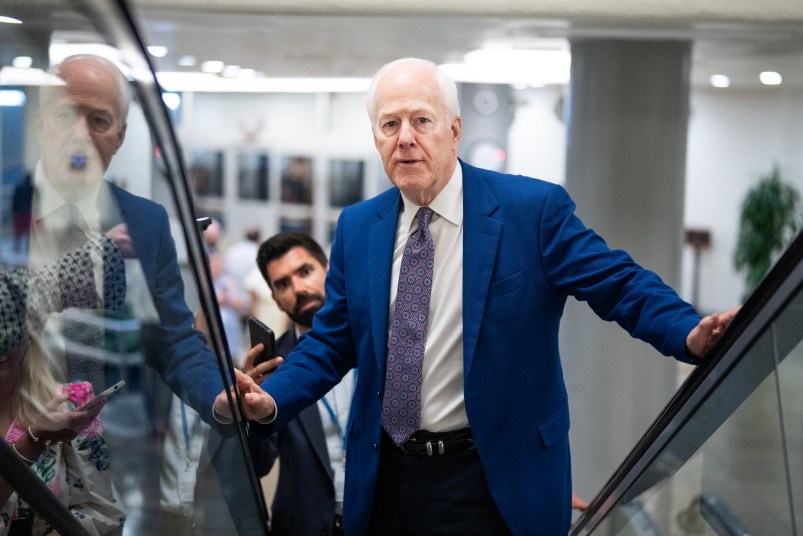
UNITED STATES – AUGUST 6: Sen. John Cornyn, R-Texas, is seen in the U.S. Capitol on Thursday, August 6, 2026. (Tom Williams/CQ-Roll Call, Inc via Getty Images)
It’s Sen. John Cornyn, who continues to create some drama — now by headlining a fundraiser in Dallas that will raise money for Republican Senate candidates in Maine, Ohio, Alaska, Iowa, Michigan, New Hampshire and Minnesota. But not Texas, the state where Cornyn and his co-headliner, George W. Bush, are from, and where the fundraiser is being held. The Senate candidate there is Ken Paxton who — of course — beat Cornyn in the primary.
Are We at War?
Just as the Trump administration is trying to quiet the Iran war down before the midterms, Iran, per an MS NOW report, is trying to do the opposite: ramp it up, and drive oil prices as high as possible.
U.S. District Judge Stephen Clark denied Missouri Secretary of State Denny Hoskins’ (R) request that he stop the Missouri Supreme Court from holding him in contempt.
Election experts are examining the new U.S. Postal Service rules for mailed ballots, and finding that under them, getting ballots in the mail could take weeks — or even years — rendering the program unworkable for an actual election.
“If it took one minute to verify each piece in the mailing, it would take about 4.9 years of continuous scanning to verify the whole mailing,” wrote Tammy Patrick, Chief Programs Officer of the National Association of Election Officials and a former elections official for Maricopa County, in a declaration as part of one of the legal challenges to the rule.
“If it only took only a second to scan each mailpiece, it would take 30 days,” she continued. “Even if it took only one tenth of a second to scan each mailpiece, it would take a little over 72 hours.”
Maricopa County, Patrick said, will send out 2.6 million ballots on the first day of early voting. Patrick wrote that under the new USPS rules, a single error could lead to the entire batch being rejected.
That squares with what a whistleblower from inside USPS alleged: a single error — which, the whistleblower underscored, could be human or technical — could lead to the entire batch of 10,000 ballots being sent back to election officials to be resubmitted.
Ann Jacobs, a former chair of the Wisconsin Election Commission, wrote on X that getting Milwaukee’s 33,567 primary election mailed ballots out could take more than two months. “At a minute each, that’s 559.45 hours or 69.94 work days,” she wrote. “At 30 seconds each, that’s 279.73 hours or 34.97 work days. A month of days of someone standing at a post office, watching a scanner. Heck, at 10 seconds each, it’s 93.25 hrs.”
“Not to put too fine a point on it, but ballots go out 9/17/26 in Wisconsin – we don’t have 35 work days,” she continued. “This is true across the nation.”
The Trump administration asked the Supreme Court yesterday to immediately allow it to implement the USPS rule, despite a lower court injunction on it that is still working its way up to the Supreme Court.
Hat tip to NOTUS for flagging some of these former election officials’ comments.
Missouri Secretary of State’s Games Lead to Republican Gerrymander Being Blocked (at Least for Now)
It’s a (late-breaking) loss for Republicans’ efforts to gerrymander Democrats out of political power after the Supreme Court knocked down a significant portion of the Voting Rights Act last spring.
This President Donald Trump-backed map redrew a district in the Kansas City area, attempting to flip one of Missouri’s two Democratic congressional districts.
The state Supreme Court held yesterday evening that some procedural hijinks meant November’s elections must be held under the old map, and that voters must be given a chance to vote on the new maps on the November ballot.
The hijinks include a wild maneuver by Missouri Secretary of State Denny Hoskins: Opponents of the new map submitted hundreds of thousands of petition signatures, more than enough to put the maps on the November ballot. Missouri law says that voters can hold a referendum on any act of the state legislature.
But Hoskins waited until voting in the primary election — under the new maps — was underway to reject the petition, concluding that the state constitution did not empower voters to challenge redistricting.
The state Supreme Court rejected that interpretation, and his broader gambit, finding redistricting was indeed an act of the state legislature.
This all will likely end up before the U.S. Supreme Court.
Tabs
Layla A. Jones has a fantastic piece for TPM probing how a baseless, right-wing freakout about an obscure data privacy technique used by the Census Bureau has culminated in claims that bureaucrats used the survey to steal congressional seats for Democrats. This fringe contention is now shaping Census Bureau policy.
The Wall Street Journal paints a rough portrait of John Fetterman, concluding from an investigation that “the first-term senator shows little interest in doing the job beyond cultivating relationships with conservative media figures and advocating for Israel, according to interviews with more than a dozen former staffers and lawmakers, as well as text messages and other internal records.”
Woman of the Hour
WASHINGTON, DC – JUNE 09: Anchor Maria Bartiromo during FOX Business Network’s “Mornings with Maria” at Fox Business Studios on June 09, 2026 in Washington, DC. (Photo by Paul Morigi/Getty Images)
It’s conspiracy theorizing television host Maria Bartiromo, ousted from her job at Fox Business for mysterious reasons. One report claims that she shared with the White House internal guidance about Fox’s decision to limit coverage of Trump’s July speech that attempted, again, to sow doubt in the 2020 election.
Are We at War?
JD Vance tackled the White House press briefing yesterday. “I wouldn’t call it a war. Right now, there is no active shooting,” the vice president said, before acknowledging “Iranians are shooting at commercial shipping.” The remarks, however, did not openly acknowledge the United States’ retaliation for what Vance described as “flare ups.”

 Login
Login