BRUSSELS — NATO allies will hold a crisis meeting to discuss how to respond to a series of drone strikes on cargo shipping in the Black Sea, Romania’s President Nicușor Dan said.
Two chemical tankers were hit by air drones in the past 24 hours in or near Romania’s territorial waters, but it is “too early” to say for sure whether Russia was behind the attacks, Dan added.
Dan was speaking on the sidelines of the European Council summit in Brussels, where he spoke to Bulgarian Prime Minister Rumen Radev and NATO Secretary-General Mark Rutte about the latest incidents.
“The secretary general expressed the solidarity of the alliance and there will be a NAC [North Atlantic Council] meeting at which the whole situation with the Black Sea will be discussed,” Dan told POLITICO. “Of course the conclusion is that all the hybrid attacks are trying to decrease our support for Ukraine. We will continue to support,” he said.
Dan said invoking NATO’s collective defense clause, Article 5, was “not now” being discussed as an option for responding to the attacks. Nor has Romania asked for Article 4 — the emergency clause that sets consultations in motion over military matters when a member’s security has been threatened — to be triggered, he said.
Rescuers are searching for seven missing crew members after two chemical tankers were hit by aerial drones in or near Romanian territorial waters. Over the past 10 days, drones have hit at least five more cargo ships close to Romania and Bulgaria — both NATO members — killing at least 23 sailors.
Investigation teams from Romania’s army and intelligence services are trying to establish what led to the most recent drones strikes on the ships, Dan said.
Romania asked NATO for equipment including specialized radars and requested the delivery to be accelerated after a Russian drone crashed into an apartment building near the border with Ukraine in May.
Dan suggested Romania was likely to seek further assistance with equipment from allies this time. “On the operational level, we are in the same situation where we have been … on the Danube border with Ukraine,” Dan said. “What we did at that moment, we came here to NATO and some of our allies — United States, France, Spain, Italy, Slovakia, Portugal — gave us some equipment. And now we are in the same situation, but on the other border, with the Black Sea.”
After the meeting with Dan and Radev, NATO’s Rutte said the alliance had already increased “counter-drone capabilities” along its eastern flank. “NATO will continue to work closely with our allies in the Black Sea, adjusting our deterrence and defence posture as needed,” he posted on X.
This story has been updated. Victor Jack contributed to the report.
The Ukraine war’s spillover into the Black Sea is creating a growing European security and commercial risk: Drones are hitting ships and killing sailors, grain routes are under strain, and insurers and investors are weighing the cost of operating through Ukraine’s ports.
Five commercial vessels have been hit in Bulgarian and Romanian waters over the past week alone, leaving at least four people dead, several sailors missing and others injured. In response, Black Sea countries Bulgaria, Romania and Turkey have raised the issue at NATO, asking for more focus toward the region and joint support, according to two alliance diplomats.
“The attack within Bulgaria’s exclusive economic zone is absolutely unacceptable. It constitutes a serious breach of maritime and international law and will further jeopardise safe navigation in the Black Sea,” Bulgarian Prime Minister Rumen Radev said on X after the attacks last week.
Russia has been attacking Ukrainian ports and cities in the area since the start of its full-scale invasion. But the recent strikes have brought the spillover into NATO territory. If they continue, EU leaders will face pressure to protect Black Sea shipping and keep Ukrainian trade moving.
Those questions will be top of mind at Thursday’s European Council summit. According to draft conclusions obtained by POLITICO, leaders are expected to discuss the “immediate restoration of safe passage for grain cargo ships.”
A wider problem
Russia is not the only country using naval drones in the Black Sea. Ukraine has also used them against Russian-linked shipping. In June, a Ukrainian sea drone exploded in Romania’s Constanța port after Kyiv said it had veered off course because of Russian electronic interference.
“The Black Sea situation is quite dangerous because attacks are coming from both [sides],” said an EU shipping representative, who was granted anonymity to speak freely. “You have to worry about both.”
Attribution can also be difficult. Bulgarian Prime Minister Rumen Radev said Wednesday that investigators still have not proven that Russia is behind the strikes — although some have attributed his reticence to his broadly softer approach toward the Kremlin.
Drone operations by both Russia and Ukraine are likely to continue as long as each has the money and production capacity to sustain them, said Cristian Vlas, assistant research manager for Eastern Europe at the think tank ACLED.
Oleksii Goncharenko, a Ukrainian lawmaker and founder of the Black Sea Security Forum, told POLITICO that a “serious diplomatic initiative” was needed, bringing together Ukraine, Russia and a third-party guarantor, such as Turkey, “to restore freedom of navigation in the Black Sea.”
Grain routes under pressure
The security risk is disrupting routes that carry Ukraine’s harvest to market, with consequences for EU transport links. Black Sea ports are Ukraine’s main export gateway, handling around 95 percent of the country’s grain exports, as well as significant volumes of iron ore. Shipping traffic has fallen as the security risk has grown.
Some cargo is being rerouted to the River Danube, but capacity there has been stretched in recent months as drought pushes water levels to record lows. Operators are trying to add rail capacity, but that risks moving the bottleneck westward to Romania.
Moving more Ukrainian grain overland also risks reviving tensions with farmers in neighboring EU countries, Vlas said. Romanian farmers have worried that Ukrainian produce meant only to transit could stay on the domestic market, he added, while transport operators are already juggling competing demands for capacity.
Ukraine’s Agriculture Minister Taras Vysotskyi has warned that millions of tons of unsold grain is piling up, and that farmers who can’t sell won’t be able to afford to resow all their land.
Bulgaria is working with Romania and Turkey on a joint initiative to protect freedom of navigation in the Black Sea, which Radev plans to bring to EU leaders on Thursday.
Following the Black Sea countries’ request at NATO, military officials are likely to look into possible options such as shifting counter-drone systems to the region, the two alliance diplomats said. Radev said Sofia will convene his counterparts in Ankara and Bucharest to examine further proposals, while a senior Bulgarian official called for new joint anti-drone systems with Romania, partly financed by the EU.
Investment at risk
The attacks also threaten what had started to look like a renewed bet on Ukraine’s ports. MSC, the world’s largest container line, was among the biggest and newest investors, reportedly acquiring a majority stake in a container terminal at a port near Odesa in May.
Ukraine has also been offering investors a long-term concession at the Chornomorsk terminal near Odesa. This terminal is one of Ukraine’s largest planned port public-private partnerships and part of what is expected to be a multibillion-euro reconstruction effort involving European companies.
But people who work in Ukraine’s ports say the case for rebuilding is collapsing.
“No one is ready to invest and rebuild, since you know that tomorrow there will be another missile, another pack of drones,” Oleg Grygoriuk, chairman of Ukraine’s Marine Transport Workers’ Trade Union, said.
KYIV — Russia’s Vladimir Putin is preparing for a broader confrontation with Europe amid an uptick in the Kremlin’s hybrid attacks on the continent, Ukraine’s former Foreign Minister Dmytro Kuleba has warned.
In an interview with the Axel Springer Global Reporters Network, Kuleba, who was Ukraine’s foreign policy chief from 2020 to 2024, said that Russia’s continued war preparations and anti-European propaganda are signs that Putin is planning attacks on other European countries.
“Anti-European hysteria is being fueled in Russia, which I interpret as the preparation for a broader conflict with the rest of Europe,” said Kuleba, before adding: “We [Ukrainians] don’t have to drag you — Putin will drag you into the war.”
European officials say Moscow has upped its hybrid campaign across the continent in recent months, using cyberattacks, sabotage and disinformation to disrupt critical infrastructure and weaken support for Ukraine.
Kuleba said the failed drone attack on the Leipzig airport in Germany in August was a sign of “growing preparation” for an offensive on the continent. “They see how your intelligence operates. They see how your security forces operate. They see how you react and they draw conclusions,” he added.
In the aftermath of the incident, the German government concluded that Moscow was responsible for the attack, and ordered a review of security around sensitive locations.
However, Kuleba, who stood down as Ukraine’s foreign policy chief in September 2024, does not think Russia is preparing a full-scale offensive beyond Ukraine. In his view, Moscow is more likely to launch an attack on NATO countries involving drones targeting key infrastructure that would test the alliance’s unity and preparedness.
“The truth is that Russia does not need 400,000 more people to wage that war. It needs five drones,” he said, adding that in the event of an attack, “[Europeans] can call for NATO consultations… can call for restraint. But this will only encourage Putin to make the next step … He will always have enough drone and missile capabilities.”
Kuleba no longer believes Putin can be persuaded to end the war through negotiations. “He’s not looking for a solution, for a pause, and there will be no moment when he will start looking for it,” he said, concluding: “Putin is a guarantee of war: anyone after Putin is a chance for peace.”
According to Kuleba, any attempts at negotiating with Putin, or pushing for peace, are a waste of time. “The sooner we come to terms with reality, the better policies we can develop to address it,” he said.
He noted that while Europe’s political culture is based on “a win-win approach” in which both sides can benefit, Putin’s outlook is very different: “For him, a solution that benefits both sides is not the best option. For him, the world works on the principle of victory and defeat. One side has to win and the other has to lose,” said Kuleba.
The former foreign minister also warned that Ukraine would face its worst ever winter as Moscow ups its attacks against civilians in a bid to break their spirit.
In recent months, Russian strikes have hit Ukraine’s energy infrastructure and transport links, including bridges over the Dnipro river, as well as homes and civilian sites such as bus stops, schools, postal depots and internet providers. The attacks have disrupted power, transport and daily life as winter approaches.
On Thursday, at least 33 people were killed in a Russian attack on two buses in Kramatorsk in Ukraine’s Donbas region.
Kuleba explained why he believed Moscow has now sharply escalated its airstrikes: “The bombing of cities is a direct consequence of Russia’s failure to defeat Ukraine on the battlefield.” He continued: “The main target of Russian drones and missiles is the Ukrainians’ will to resist — but also the will of Ukraine’s friends abroad to keep supporting it.”
He added:“They don’t just want to turn out the lights in Ukraine. They want to paralyze the country.”
Kuleba described the worst-case scenario in Ukraine as “the collapse of the systems that make life in a big city possible,” such as electricity, water and drainage services.
Could Russia succeed? “I believe Ukraine is too large, too mobile and too adaptable. That’s why I think we’ll get through this winter,” said Kuleba.
“The price will be much higher than last year’s.”
The Axel Springer Global Reporters Network harnesses the resources of the company’s newsrooms to publish ambitious scoops, investigations, interviews, opinion pieces and analysis. It allows journalists — including those from POLITICO, Business Insider, WELT, BILD, Onet, The Telegraph, and Fakt — to collaborate on major stories for an international audience of hundreds of millions across platforms: online, print, TV and audio.
BRUSSELS — It was meant to be Europe’s escape from the web of Chinese critical mineral supremacy.
But two years after it took effect, the EU’s Critical Raw Materials Act is not on schedule. Just one in four critical mineral projects granted special status under the law is on track to be ready on time, according to new analysis shared with POLITICO.
On Friday, EU industry chief Stéphane Séjourné will unveil a new list of critical mineral projects that will receive privileged access to funding, accelerated permitting and help from Brussels to find buyers.
The idea is to make Europe a major producer of materials essential to clean energy, tech, and defense manufacturing. It’s currently a heavy importer.
But progress on the first round of 47 projects, announced early last year, offers little hope for the bloc’s ambitions.
“At least one in three mining and processing strategic projects is either late, stalled, at risk, or no longer exists, and only about a quarter are clearly on track,” said Diego Marin, policy officer for raw materials at the European Environmental Bureau, citing publicly available sources. The findings will be published in a report later this month.
Financial, regulatory, and political hurdles are blocking European mining projects, the industry says, despite the Critical Raw Materials Act’s aim to speed up the time it takes to get the shovels in the ground.
The EEB’s findings were echoed in an industry call in August, where 23 projects named in the first round claimed some were facing “immediate jeopardy,” in a letter sent to the Commission and obtained by POLITICO.
Those same companies also believe that announcing more strategic projects will create more problems. However, a Commission official dismissed that claim, saying that some of those projects had received direct funding from the Commission, and claiming the companies believe new projects would “dilute their status.”
The EU unveiled 47 projects in March 2025, covering 14 of the bloc’s 17 designated strategic raw materials—from lithium, nickel, cobalt and graphite for electric vehicle batteries and rare earths for magnets used in wind turbines, to tungsten for military equipment and gallium for semiconductors. It also includes 13 projects from outside the bloc.
These were designed to deliver the EU’s raw materials targets: by 2030, the bloc aims to mine at least 10 percent, process 40 percent and recycle 25 percent of its own needs, while sourcing no more than 65 percent of any one material at any processing stage from a single non-EU country.
Breaking Europe’s dependence on China for key metals is at the heart of the policy, a goal European Commission President Ursula von der Leyen highlighted in her State of the Union speech last month. “We are more than 80% dependent on China for many critical raw materials [and] 90% for some rare earths,” she lamented.
Outgoing Euromines president and former CEO of Swedish miner LKAB Jan Moström, who says Europe is a long way from meeting its targtets, in an interview at the 2025 European Industry Summit in Antwerp. | John Thys/AFP via Getty Images
A Commission official said that if all goes to plan, the EU will meet its 2030 goals for lithium, cobalt and rare earths, but results for other materials are mixed, with shortfalls in nickel processing and recycling and across the manganese supply chain. They did not give hard figures, though.
Industry skeptical
“Unless something happens that is absolutely not foreseen today, we will be far, far away from reaching the targets, even if they are quite low,” said Jan Moström, former CEO of Swedish mining giant LKAB and outgoing president of Euromines. He said better access to financing and faster permitting was key.
The EU is under additional time pressure as a pause on China’s export controls on rare earth minerals is due to expire in January.
Global think tank ODI found in June that “out of 60 projects, 14 are unlikely to contribute by 2030 because their estimated start of production falls between 2029 and 2031,” and that “three out of four are either behind their expected schedule or impossible to verify using up-to-date public evidence” — backing up the EEB’s numbers.
A European Court of Auditors report this year also revealed that “many projects will struggle to secure supply for the EU by 2030” and that there was “no proper tracking of results.”
The European Commission questioned the current validity of the ECA’s findings, saying it “audited a period of policy that does not cover everything we’ve done since this mandate. So the Court of Auditors had very relevant points that we took into account in our policy, but should absolutely not be seen as a fair assessment of the work we’ve done with the von der Leyen Commission number two,” said a Commission official.
Desperate times
Since adopting the Critical Raw Materials Act in 2024, Brussels has rolled out a flurry of initiatives to get projects moving. They include a proposed critical raw materials center, for which Parliament is seeking €2 billion; the “RESourceEU” plan that’s mobilized more than €2 billion; a mechanism to identify suppliers; and plans to revise water rules and speed up environmental impact assessments.
But industry leaders say the EU is moving too slowly.
“I’m still to be convinced that it makes any difference,” Michael Staffas, CEO of Swedish miner Boliden, told POLITICO when asked about the benefits of being designated as a strategic project. Boliden’s subsidiary Somincor was granted strategic status for a copper and zinc mine in Portugal.
The “strategic project” label promised faster permitting and help securing public and private finance, with permitting deadlines of 27 months for mines and 15 months for processing and recycling projects.
“In Sweden you have different authorities that can basically object to a permit process and that in itself creates way longer time than 27 months, just the legislation,” said LKAB CEO Johan Menckel, whose company currently has three strategic projects.
One is the Per Geijer deposit, home to Europe’s largest rare-earth deposits, which the local indigenous Sámi community opposes, arguing it would harm their reindeer-herding tradition.
A 2023 view from the highest point of the Covas de Barroso complex in Portugal, the site of Europe’s largest lithium deposit. | Henrique Campos/Hans Lucas/AFP via Getty Images
Karin K Niia, a Sámi reindeer herder, said in comments that the EU will be complicit in cultural genocide if the project goes ahead.
Europe’s lithium hope
Europe’s biggest bet to escape China’s foothold in battery metal supply chains is the Barroso lithium mine in Portugal, run by UK-based mining company Savannah Resources. The company says the mine could supply enough lithium for around half a million electric-vehicle batteries a year.
“I don’t think the strategic project stamp and the [Critical Raw Materials Act] have been absolutely essential, but it wasn’t also supposed to be. It was supposed to, in my understanding, be important to set a framework under which Europe can do the right thing faster, better, and for the better benefit of the next generation of Europe,” Savannah’s CEO Emanuel Proença said, calling it just another piece of a very big puzzle.
Europe’s lithium-refining ambitions are also faltering: France’s Viridian Lithium went bankrupt after failing to secure funding, while Portugal’s José de Mello Group was unable to finance its planned €492 million refinery — despite both projects winning strategic status in the EU’s first round.
Viridian Lithium spokesperson Luc Pez said the strategic project label was a ‘curse.’
Rio Tinto’s Jadar project in Serbia, one of the non-EU projects to gain strategic-project status, was meant to provide double Barroso’s lithium capacity and cater to up to 25 percent of Europe’s demand. That, however, was suspended because of permitting issues and became a widely protested project amid allegations of corruption and environmental concerns.
That reflected the simple fact that people don’t like mines in their backyard — an obstacle for mining projects worldwide, but especially in Europe, which is densely populated and has strong civil society.
“These projects had strategic status, EU money and fast-track permits, and it still wasn’t enough,” said EEB’s Marin. “If the supply push can’t deliver even under those conditions, the EU has to take demand reduction and sufficiency seriously. We can’t permit our way out of a market problem.”
Recently I started reaching for my bottle of Vermouth Blanc more and more. I had opened it to make an El Presidente cocktail, but during an interview on my IG Live channel with Pierre-Olivier Rousseaux, owner of Dolin distillery in France, he remarked that their Chambéryzette apéritif, made in the French alps, could be made at home, anywhere, with fresh strawberries and white vermouth. So I took the plunge and made a batch myself.
It’s very easy to make. Just slice or quarter a few fresh strawberries and within 24 hours, you can be enjoying your very own batch of strawberry apéritif!
White vermouth (vermouth blanc) is different than dry vermouth. For one thing, the botanicals used are different. Dry vermouth leans into its bitterness with wormwood, quinine, or other flavorings that keep it decidedly dry. White vermouth celebrates its sparkling-clear color with floral aromas, which can include elderflowers and citrus. While you could make this with dry vermouth, I do prefer it with the white vermouth, which in Italy is referred to as vermouth bianco.
When I took a sip of the strawberry-infused vermouth the next day, it seemed like it’d be a perfect candidate for a summery Spritz. So I mixed it with a splash of tonic water, and found it was just perfect as-is, with a handful of ice and some berries and maybe a slice of citrus in it. If you want to go full-on summer, you could replace the citrus with a slice of peach or nectarine, or maybe a few other types of berries.
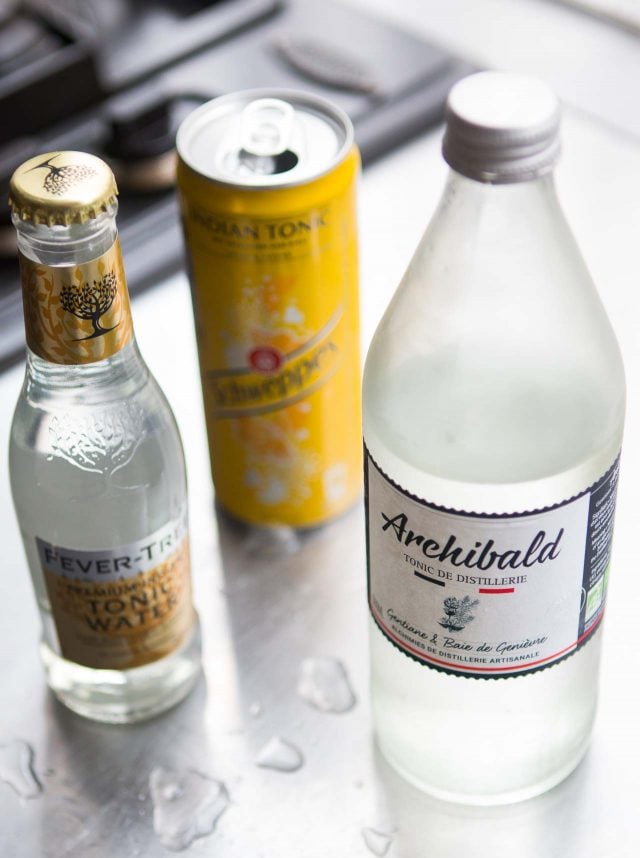
Tonic water has become more of a topic of conversation lately. Brands like Schweppes are popular and readily available (and you can make your own tonic water, too), but some like to fine-tune their cocktails and apéritifs with a premium brand of tonic water. Fever-Tree, Q, and Fentimen’s are popular, but I kept mine French using Archibald, which uses gentian in place of quinine, to keep it resolutely Made in France. (Quinine doesn’t grow in France, but gentian does.) As far as I know, it’s not available outside of the country but feel free to find your own favorite where you live, and use that.
For this spritz, I use white vermouth to infuse the strawberries which is more aromatic, and more floral than dry vermouth. In French, it's called vermouth blanc and in Italy, it's referred to as bianc. If you buy a bottle, you can also use it to make yourself an El Presidente cocktail. You can toggle the flavors of this lively spritz in a different direction by using a flavored tonic water, such as one aromatized with pink grapefruit, pink peppercorn, or elderflowers.
Course Drinks
Keyword cocktail, spritz,
Servings 1drink
Ingredients
For the strawberry-infused vermouth
1 1/2cups (375ml)vermouth blanc or dry vermouth
8medium-sizedstrawberriessliced or quartered
For the strawberry spritz
2ouncesstrawberry-infused vermouth
2ounces tonic water
quartered or sliced strawberriesfor garnish
slice of orange, lemon, lime wheel, or slices of nectarines or peachesfor garnish
Instructions
To make the strawberry-infused vermouth, pour the vermouth in a clean jar. Add the strawberries, cover, and shake gently to encourage the strawberries to lend their flavor to the vermouth. Let stand 24 hours at room temperature out of direct sunlight, giving it a shake every so often.
To make the spritz, measure the infused-vermouth and tonic water into a footed goblet. Add a handful of ice and stir gently. Garnish with berries and citrus.
Notes
Storage: The strawberry-infused vermouth will keep for a few days at room temperature. After you can store it in the refrigerator where it'll keep for a few weeks. I left the strawberries in since I used mine within a few days, but if planning on storing it longer, you can remove them. (They're delicious to eat!)

 Login
Login



 It’s very easy to make. Just slice or quarter a few fresh strawberries and within 24 hours, you can be enjoying your very own batch of strawberry apéritif!