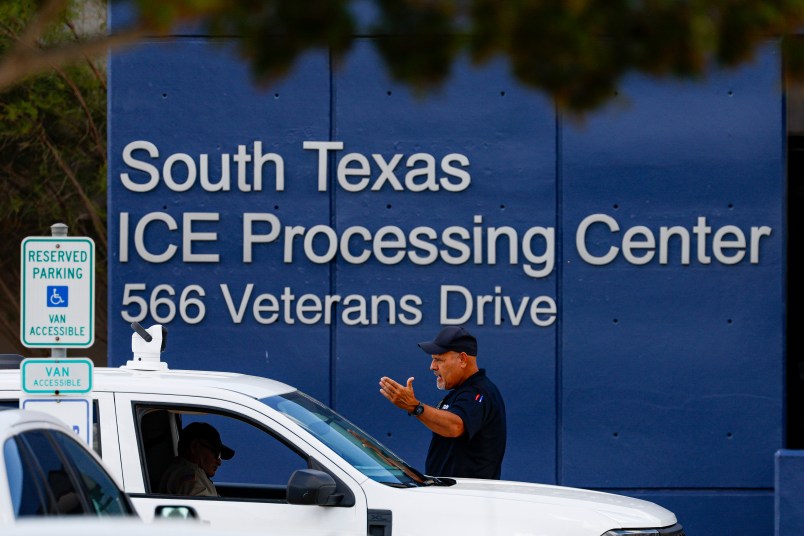
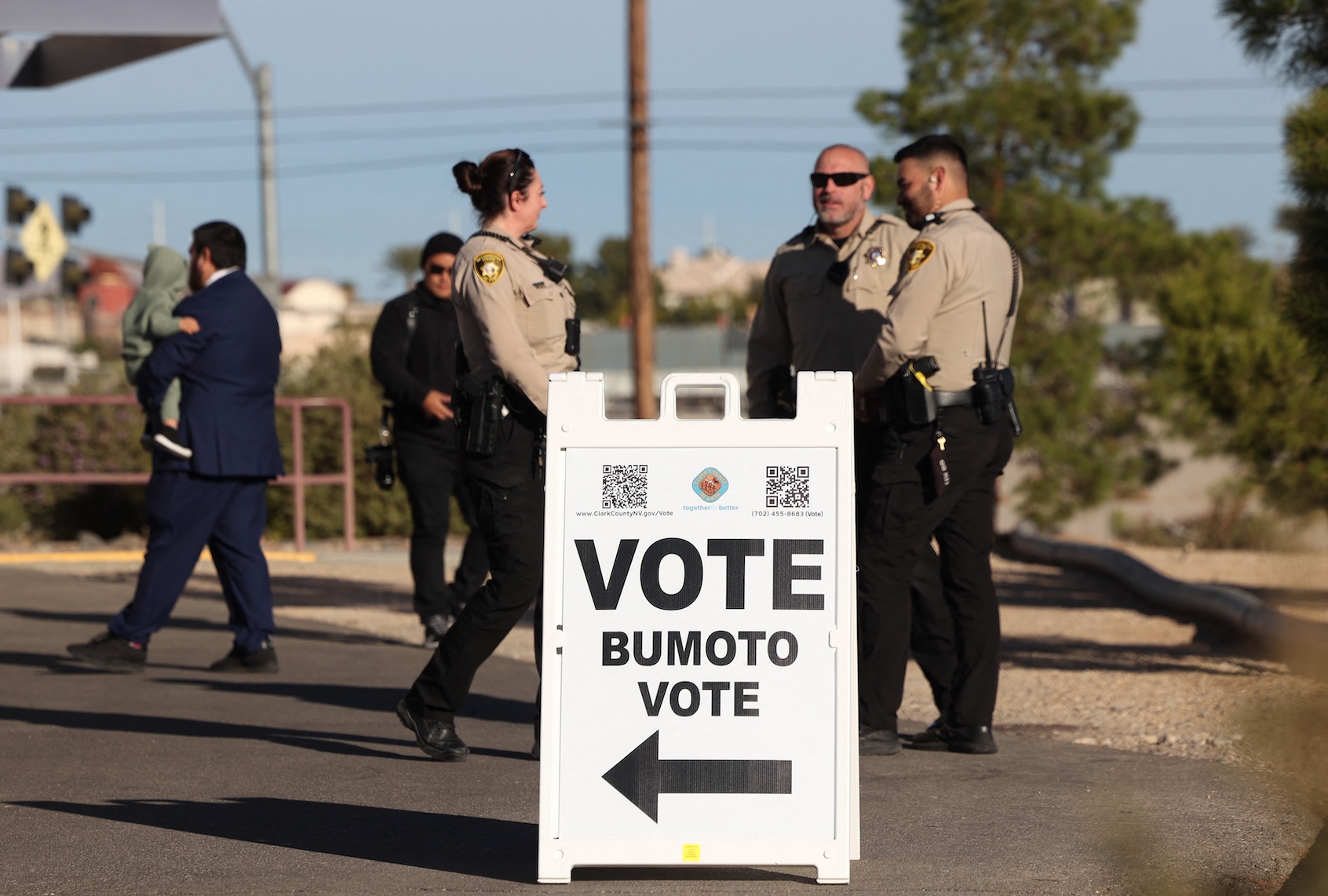
The famed Tejano singer is trying his hand at politics in his home state of Texas, which is a crucial part of Democrats’ pathway to a potential House majority in Washington. And the blue wave that has made those lofty ambitions more and more realistic has been partially fueled by Latino voters’ shift away from President Donald Trump amid mounting anger with ICE and his mass deportation agenda.
For a sizable chunk of its existence, the United States has been remarkably effective at manufacturing death at scale. In the years since World War II, as steel production slowed and agriculture became one big subsidy, untimely ends became one of the few things you could still expect the U.S. to make itself.
The business of bomb-dropping boomed through economic downturns and outsourcing pushes. NAFTA and the Great Recession couldn’t put a dent in America’s output of explosive ordinance. The lack of a military draft or a requirement to declare war kicked the death factory into overdrive, with defense budgets growing every year. The death toll in Iraq reached one million in the same year that Lehman Brothers collapsed. As the U.S. economy teetered on the brink, President Barack Obama was sending multi-million dollar drones to strike Yemeni weddings. Outside of a few million protestors that no one felt the need to listen to, most Americans were fine with the whole business, but with one caveat: They didn’t want to see it.
Decades after the televised spectacle of the Vietnam War, after which the Pentagon restricted what media outlets could cover, multiple wars in the Middle East were presented as a bloodless spectacle on cable, with shock-and-awe filmed and broadcast on CNN from a safe remove. In the rare instances where Americans were forced to see the deaths of Iraqi civilians up close — such as the infamous 39-minute “Collateral Murder” footage which was released by Wikileaks in 2010 — it turned public opinion against the wars permanently. That revulsion was one small part of the establishment backlash that put Donald Trump in the White House.
The same president who decried “American carnage” in his first inaugural address has inspired an unusual bloodlust in his MAGA base, offering up real-world violence in lieu of a prosperous economy or lower gas prices.
But something has shifted in the ensuing years. The same president who decried “American carnage” in his first inaugural address has inspired an unusual bloodlust in his MAGA base, offering up real-world violence in lieu of a prosperous economy or lower gas prices. Whenever his public approval ratings have flagged, most notably when voters rejected his 2020 re-election bid, Trump has stoked his base with calls to violence.
He eventually won that second term four years later, a sign from the universe that there would be no real consequences for reveling in violence. Since then, Trump has shown an extreme lack of care for the brutal — and sometimes deadly — effects of his policies. Worse still, many of his supporters seem to hunger for more bloodshed, celebrating each new instance of a Trump policy ending in death.
Some of this was to be expected. Americans are remarkably skilled at compartmentalizing the bureaucratic ways U.S. actions lead to deaths globally. When Elon Musk’s inartful Department of Government Efficiency cuts to government funding and the Trump administration’s attacks on the U.S. Agency for International Development started racking up a body count, the mood within the MAGA coalition was more indifferent than celebratory. But Trump and his messengers have a tendency to make everything more crude and less abstract.
That’s why it shouldn’t have come as a surprise when administration officials shared footage of extrajudicial killings in the Caribbean. Where previous administrations were content to project strength around the globe through quasi-legal military actions for a small audience composed of other world leaders, Trump may as well have projected the operation on the side of one of his resorts.
Given the appetites he has built up among his supporters, it shouldn’t have shocked us to see them cheer the strikes on alleged drug runners. Former conservative fighters against government overreach — the sort who once lamented the deaths of militant separatists like LaVoy Finicum and Vicki Weaver — praised Immigration and Customs Enforcement agents when they killed protesting citizens. Republicans who warned about government tyranny for years celebrated scenes of people being snatched off the street and into unmarked cars. Third-party deportations, intentionally cruel detentions and partnerships with black-box prisons, like the notorious CECOT in El Salvador, created the conditions where deportees will inevitably die.
The only consistent thread in these examples is a desire to see people they don’t like get hurt or killed.
But it’s not enough for the MAGA movement to witness death in the real world. The growing conservative media market is filled with examples of people — mostly non-white or non-Christian — meeting grisly ends. “Citizen: Vigilante,” a film starring Armie Hammer that was boosted by Elon Musk, follows a landlord who kills his way through an unnamed European city after migrants attack a young girl. The Daily Wire’s bloody “Run Hide Fight: Infidels” is set on the campus of a similarly anonymous liberal arts college, and it luxuriates in bloodlust. Blue-haired liberals get their throats slashed while gay men are thrown from buildings.
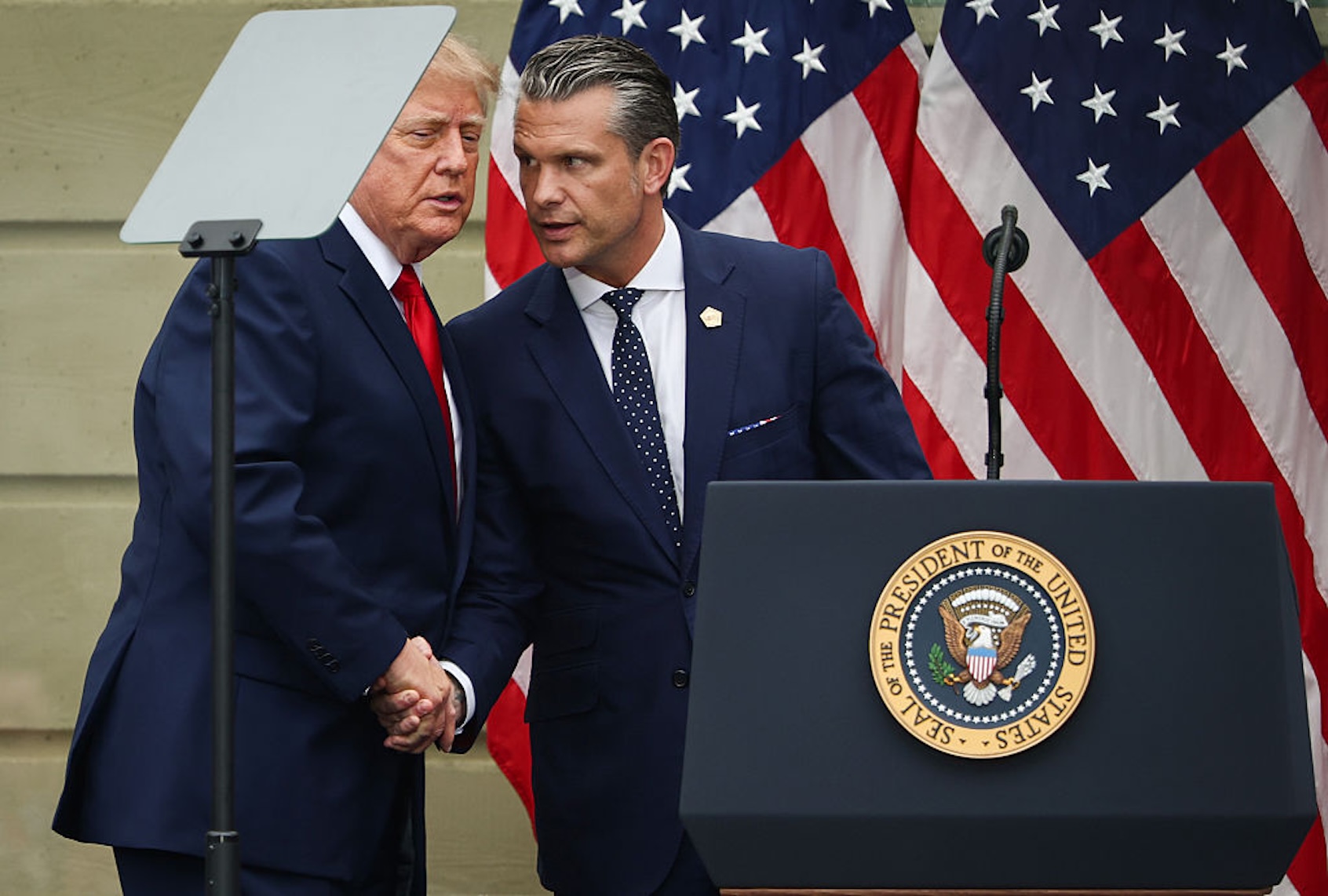
In that context, Pete Hegseth’s recent call for a public execution is hardly strange. The defense secretary floated the idea of broadcasting the death by firing squad of Nidal Hasan, a former major in the Army, who was convicted in 2013 of killing 13 people in a mass shooting at Fort Hood, Texas, four years before. In his court-martial proceedings, Hasan said he carried out the attack in response to U.S. killings in Afghanistan. He is scheduled to be executed on Dec. 3.
“We’ll make sure that people are able to . . . watch it, that it’s public,” Hegseth told Real America’s Voice, “because people need to understand that … there’s serious consequences for these types of things.”
Hegseth’s plan to livestream Hasan’s execution was initially supported by Trump. But on Thursday, following widespread outcry that spanned the globe, the president announced on Truth Social that he was calling off the broadcast. Still, he still half-supported the aborted snuff film, saying that it “might have been a strong deterrent for the World to witness how America deals with Terrorists and SCUM.”
Trump’s supporters didn’t need to wonder if he was drawing a line at broadcasting a grisly death. Earlier this week, the president shared footage featuring the last moments of a man who was killed by a tiger in a U.K. zoo. He followed that up with an AI-generated video that struck a celebratory tone, showing Trump chasing away a tiger while remaining unharmed.
On the other side of a computer screen, his MAGA base must have been laughing along.
If there’s one thing a busy person doesn’t need, it’s more information. More emails, more notifications, more infinite feeds — the steady drip of data spells doom for the overstimulated American. And if you’re a busy parent, like me, sometimes it feels like a flood: school emails, doctor’s appointments, so many little things to buy.
Even things that used to be simple are harder. I recently listed an item on Facebook Marketplace, which quickly meant I was replying to offers and getting ghosted for the better part of a weekend before finding someone who, after a detailed back-and-forth about the most likely place to find a parking spot in my neighborhood, finally took my old baby swing away.
If only I’d had Muse. You’ve probably seen the ads on Instagram promising “AI that gets it done for you.” The new personal AI agent app from Meta can not only automate your Facebook Marketplace tasks, but also sort your emails, manage your calendar, and buy your groceries. And it’s free — unless you’re using it most of the day or you want access to Meta’s most powerful models, at which point it costs $20 or $100 a month. It all sounds, in a word, magical.
Muse is probably the personal AI agent you’ve heard of — and it’s currently the market leader with more than 8 million downloads in its first month, according to one estimate — but there’s now a small army of these bots: OpenAI recently announced Dots, X has Grok Bot, and there’s Instinct, which is currently invite-only and operates entirely in iMessage or WhatsApp. They all offer the same promise: to remove friction from your busy life.
For the last two weeks, I’ve been handing over more and more of my life to AI agents in pursuit of making my life a little simpler. What I found is that AI is unpredictable, and so are AI agents. When I first began using Muse, it started doing things I didn’t ask it to do. It offered to help with random email threads and created dossiers on people in my work meetings. It generated a detailed report on nearby apple-picking destinations based on a calendar invite from my wife. To me, an AI agent doing these things without prompting isn’t helpful. It’s unnerving.
But ultimately, I came away believing that AI agents can make your life easier.
That might mean giving an AI agent more access than you’re comfortable with — handing over lots of login credentials and possibly even your credit card. The more you rely on an AI agent, the more you risk outsourcing your decision-making. This raises real questions about how much agency we want to hold onto in our lives — even the tedious parts.
The leap of faith
Let’s get one thing out of the way first: To make an agent work for you, you’ll have to sacrifice a tremendous amount of privacy and grant it permission to access a lot of personal information.
Muse and its competitors can do the classic generative AI tricks, like draft emails or make you a fitness plan. If you’d like the agent to send one of those emails, however, you’ll have to grant it permission to access pretty much everything in your Gmail account. If you want it to schedule workouts, it will need access to your calendar. If you want the agent to buy anything on your behalf, it will need your credit card. If you want it to book your doctor’s appointments, it will need the credentials to log into your healthcare portal. The more permission you grant it, the more the agent can do for you, but that also opens up more opportunities for the agent to misunderstand you or your instructions (more on this in a moment).
This process of sharing your digital life with an AI agent means you’re giving an untold amount of personal information to tech companies, who don’talwaysbehaveethically, and who sell user data for profit. For now, Meta says that it does not share Muse data or conversations with its ad systems, although privacy experts warn that doesn’t really matter since those systems monitor what Muse does on your behalf. Nevertheless, Muse’s early days were filled with security and privacy blunders.
But without all of this info and access, the AI agents aren’t very useful. So if you’re not comfortable letting a bot into all of your accounts, an AI agent is probably never going to be the solution to your digital administrative exhaustion. But even if you are willing to hand that over, there are still other barriers to an agent’s efficiency and effectiveness.
The blank slate problem
AI agents, like a lot of new software tools (including chatbots), suffer from the blank slate problem. The blank slate problem essentially means that people don’t know how to get started. This might be because you don’t know about the tool’s capabilities, or because you simply don’t know what would be helpful. There might be some trust issues, too.
As with AI in general, we don’t exactly know how AI agents work. That means we don’t know exactly what they can do or how they’ll do it, according to Pattie Maes, a professor of media technology at MIT — so it’s necessary to do a lot of babysitting. “I feel like I’m not gaining a lot of time because I can’t completely trust the system,” Maes told me about her experience with Muse, “and I can’t predict how it will behave and what it will do.”
Some advice I heard from early adopters of these tools, however, is to start small. “In the beginning, it’s very hard to trust that it’s going to just magically do a really big thing,” Julie Zhuo, founder of the AI company Sundial and an early Facebook employee, told me about her experience using personal agents. “So you give it smaller tasks, and once you see it succeed, then I feel like you develop more trust that it can tackle bigger things.”
This is surely why Meta decided that Muse needed an Ideas tab full of small tasks the AI agent can do. Muse will also send you a lot of push notifications to prompt you to do stuff, like reply to specific emails or prepare for a meeting. That detailed report on apple-picking destinations? That was a notification about something I didn’t ask Muse to do. Muse also sent me a notification about a show hosted by a podcast I don’t listen to and another one with details about a Halloween party I wasn’t invited to, as well as several evening digests that included lists of things it had already bugged me about that day. Notifications are either helpful nudges or time-consuming attention thieves, depending on your worldview. However, if you fall into the latter category and turn off the notifications from your always-on personal agent, you’re inevitably forfeiting some friction reduction opportunities.
This gets to the heart of one of the big questions I have about AI agents: How helpful are they, really, if it’s this difficult to know what to do with them?
These agents worked much better when I drove the conversation. While wondering what to do with my new agents, literally staring at the blank slate, cost me some time, I found myself thrilled at how easy basic productivity tasks became. Adding events to my calendar, making to-do lists and then being held accountable for stuff not getting done, being reminded to reply to an email — it was these kinds of simple, administrative chores where I saw personal AI agents really start to save me time.
Other tech journalists seemed to have similar experiences. Eli Tan at the New York Times raved about Muse handling a call to his insurance company. Nicole Nguyen saved time by enlisting Dots for help canceling unwanted subscriptions. Allison Johnson at The Verge had Muse do a whole list of “pebble-in-your-shoe annoyances” she’d been putting off, and among other things, the agent succeeded in helping her buy an entire camping kitchen. Still, she wrote something that stuck with me: “the dirty secret of productivity hacks is that doing more stuff often doesn’t feel like things are being removed from your plate; somehow it just invites more tasks.”
This gets to the heart of one of the big questions I have about AI agents: How helpful are they, really, if it’s this difficult to know what to do with them? There’s a learning curve, sure, where succeeding at one thing gives you an idea to try something else and have some certainty about how well the AI agent will handle the task. But as the notifications roll in, and you spend more and more time texting with a piece of software, how much time are you really freeing up by using these tools? At a point, enlisting an agent with its own computer to do your chores still amounts to using one app to save yourself from using a different app.
The ironies of automation
Even when they have access to a lot of your information, and you’ve come up with some things for them to do, AI agents can be unpredictable. Because despite reading every email in your inbox or scanning every purchase on your latest bank statement, AI agents still can’t read your mind, and you can’t necessarily guess how they’ll interpret your commands. They can misunderstand you and, armed with the keys to your digital life, do some real damage.
Some people are already learning about the unpredictability of AI agents the hard way. One early adopter, Matt Robb, gave Muse the keys to his Facebook Marketplace account and was surprised when buyers started showing up at his front door ready to pick up their purchase. Muse, without asking Robb, had told them where to go. It turns out, without realizing it, Robb had given the agent permission to do so, and the agent had simply decided that the most efficient way to get buyers to Robb’s door was to give them his home address.
This dilemma is an example of a decades-old set of concepts known as the “ironies of automation.” Identified by psychologist Lisanne Bainbridge in a paper published in 1983, the ironies of automation help explain why things go wrong when humans give a machine too much control. As Vera Liao, an electrical engineering and computer science professor at the University of Michigan who studies human–AI interaction, explained to me: More advanced automation leads to more consequential errors, and the more humans rely on automation, the worse we get at catching those errors. “Even in simple tasks like judging whether AI output is wrong, people consistently accept wrong AI outputs even if they could have gotten it right on their own,” Liao said.
In some cases, like the time Muse read a journalist’s private messages, things go wrong as a result of poorly designed software, but more often than not, it’s the fault of the user who gives instructions that are too vague, giving the agent space to get creative, which isn’t always a good thing.
I had my own misunderstanding with Instinct. In a text message, the agent reminded me about a couple of emails I’d received and prompted me to follow up. When I replied to the text, I asked Instinct to show me possible replies to these emails. The AI agent instead just sent the responses it wrote. I audibly gasped.
Looking back at our chat history, I could see why Instinct interpreted my instructions that way. I effectively gave the machine too much control and then failed to manage the automation properly.
Leaning on AI to do your thinking is an example of what psychologists call cognitive offloading, where you employ an external tool to reduce your effort to complete a task. It makes completing the task easier, sure, but you also open yourself to mistakes. In this case, an AI agent took my instructions too literally, and I failed to catch the error. I can only imagine how a small oversight could turn into a cascade of catastrophes that need cleaning up. All it takes is one poorly worded email sent to the wrong person, and you might have hours of explaining to do — all because you were trying to save yourself 30 seconds of writing.
The real world slop
While I was testing all these agents, I talked to a mix of experts and early adopters. Their opinions were decidedly split about whether these tools were useful out of the box, without a ton of oversight and training by the user. The experts, who had all studied AI in academic settings, all brought up the ironies of the automation problem, where AI makes errors that humans can’t catch. And Maes, the MIT professor, pointed at another consequence: By outsourcing so many tasks to agents, we’re actually creating more work for everyone, including the human service workers who have to interact with this technology instead of us.
“There’s just more and more slop,” Maes told me. “We risk, in a world where agents do all the tasks for us, becoming so dependent on them that the world also isn’t created for us to interact with anymore, but it’s only created for our agents to interact with others, with services.” (We’re already seeing versions of how dominant tech platforms can fundamentally reshape real-world spaces: Think of how Starbucks no longer looks like a coffee shop where you can hang out all day, and is instead built and staffed around mobile order pick-up.)
The early adopters were decidedly more optimistic. Matt Van Horn, an entrepreneur who co-founded the ridesharing service that became Lyft, has been tinkering with agents since the craze started late last year. He’s currently telling his friends and family to use Instinct, which he described to me as “the most ambitious and aggressive” AI agent.
“I’ve been pushy with my mom and my wife,” Van Horn told me, “and saying, ‘Hey, you should sign up for this. It’s magical.’”
“My wife does not care about living in the future, but we have four kids,” Van Horn continued. She recently took a picture of a parking ticket and sent it to Instinct, no description, no instructions. Instinct, which had her credit card, just paid the ticket.
At the same time, outsourcing certain chores to AI agents causes real-world problems. Some of these AI agents can make phone calls, for instance, which can lead to some confusion when a human is on the other end of the line. Van Horn told me about the unfortunate time he enlisted an AI agent to reserve a room at a karaoke bar. “The karaoke place said, ‘Are you an AI?’” Van Horn said. “‘I don’t want to talk to an AI. Please connect me to Matt, the person.’ And so Muse had failed to book that for me.” Van Horn, undeterred, found something called Fo, an AI agent that will bring in human help to complete a task. Fo succeeded at making the reservation, although the entire ordeal surely took longer than if Van Horn had picked up the phone himself and talked to the karaoke bar himself.
At best, the times these tools worked and actually saved me time were rather mundane. I made a doctor’s appointment online using Instinct. Zhuo, the early Facebook employee, planned a party for her college reunion — everything from tracking down everyone’s emails to sending out invitations via Paperless Post. But she’s also said these kinds of applications of agentic AI “read more like vitamins than painkillers.” In the startup world, “vitamins” refers to a product that offers a vague benefit, and “painkillers” solve a big, immediate problem. If you’re a startup, you want to sell painkillers.
If you’re ready to give an agent a go, be prepared for the bot to make mistakes, and assume you won’t catch all of them. As Liao, the University of Michigan professor, put it, “Choose to use agents for tasks that you can tolerate the consequences of errors.”
In an effort not to create more emails or alerts or feeds to sift through, I’ve stopped using Muse. Like any new tool, it will get better and more useful as more people use it, so maybe I’ll revisit it in the future. I still have a text thread going with Instinct, however. It messages me from time to time, flagging an email or offering to help with an upcoming event. When there’s a clear payoff to giving the agent the go-ahead, I reply. Otherwise, I leave it on read.
Of Course a 2020 Fake Elector Is Involved in This Saga
As key members of the Trump administration refuse to give straight answers about whether they intend to send armed federal agents to polling places in a few weeks — which is against federal law — Wisconsin election officials are grappling with the vacuum that that ambiguity has created.
For more than a year, we’ve been covering the wishy-washy responses from Trump administration officials like Department of Homeland Security Secretary Markwayne Mullin, FBI Director Kash Patel and Defense Secretary Pete Hegseth to serious questions about the matter. President Trump has remained vague on the issue as well. The reason executive branch officials are facing questions about whether this is something they’re considering is twofold. The Trump administration has made it clear it has every intention of pulling out all the stops to interfere in states’ rights to administer their own elections, and Trump’s election denying allies outside the administration (e.g. Steve Bannon) are agitating around the idea. Trump himself has also expressed profound regret about not enlisting members of the military to seize voting equipment in 2020.
Hegseth has creatively dodged on the matter repeatedly in public, telling the Senate Armed Services Committee back in April that he has “never been ordered to do anything illegal, and I won’t” when questioned about deploying service members to voting sites. Patel and Mullin have been a bit less slimy about it by essentially admitting its something they’ve thought about doing. Patel recently told the Senate Judiciary Committee that he plans to have agents and intelligence analysts stationed at FBI field offices during the election in case there are any election security-related issues that need to be investigated. And Mullin has walked a similar line that leaves the door open for armed officers at polling places in particular (if far-fetched) circumstances.
“The only reason why we would be at polling places is if there is a threat to that polling place or we’re serving a warrant on someone that we have been actively tracking down,” he said last month.
Election officials are now being forced to step in and address the potential for disruption should the administration concoct some sort of emergency justification for sending armed federal officers to key precincts. Federal law prevents the government from sending any armed troops, agents or officers to polling place unless it is to “repel armed enemies of the United States.”
Members of the bipartisan Wisconsin Elections Commission voted on Thursday to sign off on guidance that will be sent to local election officials to help them navigate such a situation. Here’s what the guidance says, according to the Associated Press:
The memo tells Wisconsin’s roughly 1,800 clerks who administer elections what to do if U.S. Immigration and Customs Enforcement officers, Department of Homeland Security officials, FBI agents or local law enforcement shows up at the polls.
If officers arrive, the guidance says the head of the polling site should inform the municipal clerk, who should then tell the county clerk and the state elections commission. If the agents are there to observe, they must check in like any other observer and be subject to rules governing them, the guidance says.
Only one member of the board, a Republican, reportedly voted against sending out the guidance, in comments that actively diminished the threat and potential for major disenfranchisement in key parts of the country.
“I personally think this guidance is unnecessary because we have not seemed to need it the past 201 years,” Republican Commissioner Bob Spindell said, per the AP.
On the first day of his second term, President Donald Trump issued an executive order requiring the Bureau of Prisons to “ensure that no Federal funds are expended for any medical procedure, treatment, or drug for the purpose of conforming an inmate’s appearance to that of the opposite sex.” Issued alongside a record 26 other orders that day, it was an unsurprising development, because Trump had made this issue one of the centerpieces of his 2024 campaign.
The fate of that executive order, as well as the US Bureau of Prisons’ (“BOP”) memoranda implementing the order, is now before the Supreme Court in a case called Trump v. Kingdom. And, while this case obviously has high stakes for incarcerated transgender people specifically, the Court’s resolution of this case could potentially have far greater reach — cutting off many cis and transgender people’s access to healthcare while they are incarcerated.
That’s because one of the central questions in Kingdom — though this issue is not yet before the justices — is when the Constitution requires prisons to provide medical care to incarcerated people.In Estelle v. Gamble(1976), the Supreme Court held that the Eighth Amendment’s ban on “cruel and unusual punishments” imposes on the government an “obligation to provide medical care for those whom it is punishing by incarceration.” People in prison, after all, cannot simply drive themselves to the hospital if they get sick. If the prison does not give them adequate medical care, they will suffer untreated and potentially die.
For procedural reasons, the Court is unlikely to opine on whether Estelle requires prisons to provide gender-affirming care to trans people right away. But the question of when the Eighth Amendment requires prisons to provide medical care to incarcerated people is front and center in the Kingdom case, which means the Court could potentially use Kingdom to limit all imprisoned people’s access to healthcare — or even to undercut the Constitution’s protections against cruel and unusual punishments more broadly.
Ironically, this case also arises out of a famous political blunder by pro-trans advocates. In 2019, when then-Sen. Kamala Harris was seeking her party’s 2020 presidential nomination, the ACLU circulated a questionnaire to candidates that asked if they would use presidential authority “to ensure that transgender and nonbinary people who rely on the state for medical care — including those in prison and immigration detention — will have access to comprehensive treatment associated with gender transition, including all necessary surgical care?”
Harris responded that she would, and also said that she “pushed the California Department of Corrections and Rehabilitation to provide gender transition surgery to state inmates” while she was state attorney general.
Years later, during his 2024 debate with Harris, Trump claimed that the then-vice president “wants to do transgender operations on illegal aliens that are in prison.” And not long after, his opposition to gender-affirming care for trans people in prison became a keypart of his campaign.
It’s unclear why the ACLU thought it was a good idea to shine a light on this issue in 2019 because, at the time, the BOP provided gender-affirming care to people in federal prison. The ACLU — which represents the pro-trans side in the Kingdom case — now argues that transgender people in federal prison have had access to at least some forms of gender-affirming care “since at least 1992.”
Indeed, Trump’s own administration concluded in a 2018 memo that the Bureau of Prisons’ “statutory mandate to provide basic medical and mental health care” to incarcerated people obligated it to provide “pharmaceutical interventions (e.g., cross-gender hormone therapy), hair removal and surgery (if individualized assessment indicates surgical intervention is applicable)” to transgender people in prison if their doctors determined that these interventions are “medically necessary care.”
In any event, regardless of why Trump fixated on cutting off trans healthcare for people in federal prison, Kingdom is now before the Court. That means that the fate of trans people in prison — and, if the Eighth Amendment issue eventually reaches the Court, all incarcerated people — is now in the hands of a Republican Court that is oftenhostile to trans litigants, and that has, at times, signaled that it wants to drastically roll back the scope of the Eighth Amendment.
What are the legal issues in the Kingdom case?
At least since Estelle, the Court has held that people who are incarcerated are not also sentenced to live and die without medical care. As the Court said in Brown v. Plata (2011), “a prison that deprives prisoners of basic sustenance, including adequate medical care, is incompatible with the concept of human dignity and has no place in civilized society.”
Under Estelle and Brown, transgender people often have a right to gender-affirming care during their incarceration. As the US Court of Appeals for the Ninth Circuit held in Edmo v. Corizon (2019), such a person must show that they have a “serious medical need” for such care — typically by demonstrating that the care was prescribed to them by their health provider. But the Constitution does not permit prisons to deny medically necessary care to incarcerated people.
In Kingdom, the ACLU raised this Eighth Amendment argument in the lower courts, but those lower courts ruled in favor of transgender people in prison on different, much more technical legal grounds.
Both the ACLU and the lower courts that heard Kingdom argue that the Trump administration did not comply with this obligation when it cut off care for trans people in prison.
Among other things, the district court that heard this case determined that the administration cited “zero evidence from its own medical or mental health care professionals to support its conclusions” against providing transgender healthcare. While the Trump administration argues that providing gender-affirming care makes prisons less safe, the district court also noted that “the government has not cited a single instance of gender-affirming care giving rise to safety concerns despite having provided such care for many years.”
Is this a persuasive legal argument against the Trump administration’s new policy? I think it is. And so did three federal judges that previously heard the Kingdom case. But the fate of trans people in prison is now in the hands of a Supreme Court that rarely rules in favor of transgender litigants, and that has a history of handing down legally incoherent opinions that are inconsistent with the Court’s own precedents, and that also deny legal rights to trans people.
The current Court’s uncertain commitment to the Eighth Amendment
Because the lower courts that heard Kingdom did not rule on the Eighth Amendment question, Kingdom should not currently give the justices an opportunity to roll back Estelle. But, in the likely event that this Court rejects the ACLU’s argument that the Trump administration did not adequately explain its new policy, the case will return to the lower courts and the Eighth Amendment issue will be fully litigated — teeing up the Eighth Amendment question for the justices to decide in the near future.
This issue could arise, moreover, at the exact moment that some justices are pushing for sweeping changes to how their Court understands the term “cruel and unusual punishments.” Indeed,at least some of the Supreme Court’s recent Eighth Amendment precedents suggest that the Republican justices want a wholesale rewrite of the Court’s previous precedents laying out what constitutes cruel and unusual punishment.
Since the mid-to-late twentieth century, the Court has held that, in Chief Justice Earl Warren’s words, the Eighth Amendment “must draw its meaning from the evolving standards of decency that mark the progress of a maturing society.” Thus, as certain forms of punishment grow more uncommon, they become more constitutionally dubious.
This “evolving standards of decency” framework is front and center in nearly every major Supreme Court decision interpreting the Eighth Amendment for the last five or six decades, including Estelle.
In Bucklew v. Precythe (2019), however, the Court’s Republican majority seemed to abandon this framework. Although decades worth of pre-Bucklew decisions established that a punishment is unconstitutional if it is considered cruel and unusual today, Bucklew suggested that a method of punishment is unconstitutional only if it“had fallen out of use” at “the time of the founding.”
Thus, if taken seriously, Bucklew’s new approach to Eighth Amendment cases would dramatically expand the government’s power to impose harsh punishments. The late Justice Antonin Scalia, for example, argued that a Bucklew-like approach to the Eighth Amendment does not prohibit the government from executing most intellectually disabled offenders, and that it does not limit the government’s ability to impose excessive punishments for minor crimes.
In fairness, some of the Court’s post-Bucklew decisions are inconsistent with the framework the Court laid out in that case. So at least some of the justices who joined Bucklew may have since decided that it’s a bad idea to toss out the Court’s entire framework for Eighth Amendment cases. But Bucklew was one hell of a warning shot over the bow of the Eighth Amendment. And the mere fact that the Bucklew decision exists means that advocates for humane punishments must hold their breath any time this Court is asked whether a particular punishment is cruel and unusual.
In the worst-case scenario for people in prison, a case like Kingdom could inspire the Republican justices to overrule — or, at least, drastically limit — decisions like Estelle and Brown. That would mean that all incarcerated people, regardless of their gender identity, could lose access to medically necessary care unless the government decides to give it to them as an act of grace.
The execution chamber in the Texas State Penitentiary at Huntsville in 1984. | Jerry Cabluck/Sygma via Getty Images
Late last month, the state of Tennessee attempted to execute Christa Pike, a woman who has been on death row for decades after killing a classmate as a teenager.
The execution failed: Pike survived two doses of the lethal injection drug pentobarbital, making her the first person ever to do so.
The botched execution comes at a strange moment for capital punishment in America. Support for the death penalty has been declining for decades. And for a long time, the number of executions was falling, too. But since 2021, executions have been increasing again. The recent surge has been driven largely by one state: Florida.
According to Pamela Colloff, who covers the criminal justice system for ProPublica and wrote about Florida’s use of the death penalty for New York Times Magazine this summer, 40 percent of the executions conducted in the US last year were in Florida.
“There are so many things that make the administration of the death penalty interesting and unique in Florida,” Colloff explained on a recent episode of Vox’s The Gray Area podcast. “Among active death penalty states right now, Florida is unique in that one person determines, from the hundreds of men on death row, who will receive an execution date, and what that execution date is.”
I spoke with Colloff earlier this month following Pike’s failed execution about what happened in Tennessee, what’s driving Florida’s recent zeal for executions, and why victims’ families are often unsatisfied by the death penalty process.
Below is an excerpt of our conversation, edited for length and clarity. There’s much more in the full podcast, so listen to The Gray Area wherever you get podcasts, including Apple Podcasts, Pandora, and Spotify. (This interview also appeared more recently on Vox’s Today, Explained podcast.)
We’re taping shortly after news came out that a woman in Tennessee who was on death row, authorities attempted to put her to death. They gave her two doses of lethal injection medication, and she survived.
How much of the decline in the use of the death penalty has to do with, in your estimation, people feeling like there’s no way to do it that’s humane?
This is the second botched execution in Tennessee this year, just to give you a sense of things. This is more common there than in other states. They’ve changed their drug protocols and we don’t know a lot about what went wrong with Christa Pike. In May, it was an issue with accessing veins, which can be an issue with lethal injection.
I think it’s also important for people to remember that we had the electric chair as the method of execution through the ’80s and into the ’90s in some places. While [lethal injection] is considered a far more humane, quote-unquote, way to do this, we can see that nothing is perfect.
I will say that while the issues of botched executions are very important, and I think there are some other ones coming up to be concerned about, I am more interested in how it is that other errors are made, that other people end up with the ultimate punishment when that perhaps was not the right punishment for what occurred.
You’ve also written that death penalty convictions are just expensive, right? And on top of that, DNA evidence has made it clear that many of the people who were being convicted were not guilty, or there wasn’t strong enough evidence to convict them. How do you think about that mix of factors?
Florida, which I’ve spent a lot of time writing about, is the leading place in America by a mile in terms of the number of executions, and has a very large death row. Florida’s also the leader in wrongful death row convictions. Just to give you a sense of things, Florida holds the distinction of 30 death row exonerations.
What that means is in the modern era — the past roughly 50 years — there have been 30 men who were given dates of execution who now walk free. And for anyone who pays any attention to how the criminal justice system works and how incredibly difficult it is to overturn a wrongful conviction, if we have 30 people in Florida who have that distinction, we know that there are many more.
What’s going on in Florida? When did you realize that something was different there?
It really ramped up last year. Last year, Florida executed 40 percent of the people who were executed in the US in the last calendar year. In this year, there have been 16 men who’ve been executed in Florida so far.
Just to give you a comparison, Texas is the next state with the highest number of executions, and they’ve executed six men in that time. We already have outlier states, primarily southern states, and then we have Florida being the ultimate outlier.
There are so many things that make the administration of the death penalty interesting and unique in Florida. The thing that fascinated me the most is, among active death penalty states right now, Florida is unique in that one person determines, from the hundreds of men on death row, who will receive an execution date, and what that execution date is.
Who is it?
Gov. Ron DeSantis. I went back and looked at what were the patterns here, what were the things guiding Gov. DeSantis’s thinking in setting these dates, and was fascinated to see and very troubled to see that there are a number of men who’ve been there so long.
They’ve been there since the 1970s. These are men who were convicted when Gerald Ford was president, just to make this real to people. But the dates are not being set among the men who are what are called death-eligible, meaning that they’ve gone through all their appeals. They aren’t being done chronologically.
There’s no rhyme or reason to the process. And so there’s this speculation game among victims’ families, prisoners, their advocates about who will be next. And men can sit there on death row for decades with that hanging over them, and that is a Florida phenomenon.
You wrote about Florida’s death row turning from something like a purgatory where people stay for a long time into something closer to an assembly line, right?
I was so struck by the fact that in Florida, in order to have this pace of executions, there were people who were receiving their dates 30 days, sometimes fewer, from their execution dates.
Just to give people a sense of why that is unusual, there are so many things that kick into gear when a death warrant is written. There are numerous legal maneuvers and next steps that happen in the courts. To give you a quick example, there was one defendant in Florida this spring who, five days before he was scheduled to be executed, was finally granted the ability to test DNA evidence in his case that had gone untested.
He had great lawyers who didn’t sleep to make that happen, but that it came as close as five days to his execution date. I think that should give us all pause about how fast this is moving.
You have multiple people in the queue at the same time. There’s a place — a different unit than Florida’s death row — that you’re taken to once you get your date, called death watch.
Tell me about death watch. What does it look like and what does it feel like?
Death watch is roughly 30 feet from the execution chamber. There are three cells. When you receive your date, you are taken from death row to death watch where you’re put — I don’t want to say solitary because if there are one or two other men who are held there — but you’re in a far different situation than you would be on death row where there are guards and other people you know.
From that point forward, there are roughly 30 days where you are held within steps of where this will take place. To me, it was chilling that when I was doing my reporting in the spring on the story that I published this summer, all three cells were filled, and as soon as one person was executed, the pattern was that often the next day a new death warrant would be signed, and there would be a new person in place.
Why do they do that? Why do they put these people next to the place where they’ll die?
That’s one of the many questions I had about that. We talk about not wanting to have cruel and unusual punishment. Our Constitution does not uphold that. But it’s such a unique kind of mental torture, I think, to be 30 feet from where you’ll be put to death.
The other thing I was struck by was the waiting aspect. If you’re on death row, again, you always have this hanging over you. I talked about the way in which, when you’re in that kind of sensory deprivation, you become highly attuned to sounds and smells and things like that.
I interviewed someone who’s not on death row anymore, whose sentence was commuted, who talked to me about recognizing that jangle of keys and the steps that this group of people who come to deliver the death warrant take, and knowing that someone is about to be served with a death warrant, but not knowing, “Is it me? Is it the guy next to me? Is it someone down the hall?”
I just want to say, I understand that there’s a counterargument to all of this, which is that these are people who most often committed terrible crimes. Their victims did not know when they were going to be killed.
I do think, however, as a state that administers this thing, there has to be a rhyme or reason to this. Otherwise, you have total chaos, including for victims’ families, who never know. Are they going to wait one month? Are they going to wait 15 years? They don’t know.
A federal judge excoriated the Trump administration Monday after hundreds of trees were cut down at a historic Washington, D.C., golf course over the holiday weekend, accusing government lawyers of ignoring her warnings and destroying their credibility with the court.
“I am thoroughly unamused right now,” U.S. District Judge Ana Reyes said during an emergency hearing over the removal of trees at East Potomac Golf Links, a public course President Donald Trump wants to transform into a championship-level venue.
Government lawyers acknowledged that approximately 430 trees had been removed Saturday, with another 299 slated for removal.
Reyes had repeatedly instructed the government to notify the court and preservationists before undertaking significant work at the course. Instead, officials filed notice at 4:55 p.m. Friday, shortly before the holiday weekend, and began cutting trees early Saturday.
“I trusted you all not to do precisely what you have done,” Reyes told government lawyers. “On what universe did anyone in your offices think that that was acceptable?”
When Justice Department attorney Marissa Piropato said government lawyers had done their best to provide notice, Reyes fired back: “You did your absolute worst.”
The judge temporarily halted further tree removal until at least Tuesday afternoon, warning that violating her order could trigger contempt proceedings.
The National Park Service maintained that the work was part of a restoration plan dating to 2019, before Trump’s proposed redevelopment. Officials said the project would restore the course’s original landscape and improve safety.
But a Park Service official testified Monday that none of the trees removed Saturday had been identified as hazardous. Two officials also acknowledged there was no urgency to the work, according to the Post.
Preservationists suing the administration argue that the tree removal is part of a larger effort to remake the century-old public course without completing required environmental and historic-preservation reviews.
Reyes said she would reconvene the hearing Tuesday to question additional Interior Department officials about why the work proceeded over the holiday weekend.
“I have no faith that the government isn’t going to cut them down unless there’s an order in place not to do so,” she said.
Hi readers! Shayla Love here, science journalist and longtime fan of Your Mileage May Vary. I’m honored to be subbing for Sigal Samuel while she’s out on parental leave. I’m diving into your questions as a way to help understand human nature and our choices through multiple lenses: philosophical, psychological, and beyond. Please send in any emotional, body/brain, sociological, perceptual, or other kind of life quandaries you might have.
My child, age 9, has decided she’s vegan. Neither of her parents are even vegetarian — we’re “free range chicken/grass fed beef” types. She has learned about veganism from friends at school, and seems to have come to her position more or less on her own. I want to encourage her ethical choices, but her mother and I agree that children should be introduced to new foods and flavors at this age. She has no allergies or intolerances that we know of. I worry that making accommodations for her dietary restriction may lead to a lifetime of picky eating, even if hers is a reasonable and ethical approach. She seems to be uncomfortable when her mother or I cook meat for meals we share, even if we make her another option. What should I do to support my daughter?
Dear Hold the Beef,
When I was around your daughter’s age, I went to Hawaii with my parents. One night, we ate dinner on the beach, and we watched as a pig was dug up from an underground steam oven. I was horrified to see its face and nose; most of the meat I had eaten so far in my life didn’t resemble the animal it came from. A few years later, I became a vegetarian, and then in my 20s, a vegan.
Have a question you want answered in the next Your Mileage May Vary column?
Fill out this anonymous form! Newsletter subscribers will get my column before anyone else does and their questions will be prioritized for future editions. Sign up here!
I share this story to reveal my slight bias in answering your question, but also my understanding of the ethical awakening your daughter might be experiencing. As you figure out how to talk to your child about what she decides to eat, we can at least table discussing the pros and cons of veganism itself. Instead, you should think about what amount of autonomy your child should have, and whether the moral decision-making she wants to engage in matches with her current stage of development.
People don’t turn 18 and then suddenly start engaging morally with the world. As we grow up, we try to understand right and wrong in fits and spurts. Lawrence Kohlberg, a 20th-century American psychologist, is best known for attempting to track a person’s moral development throughout their life.
Kohlberg presented people with hypothetical dilemmas in order to come up with six moral stages. In one example, he asked people of different ages about a dying woman who could be cured by a drug that was cheap to make, but that a manufacturer was charging an exorbitant fee for. The woman’s husband ends up stealing the drug. Is that right or wrong?
Kohlberg observed that in answering questions like this, young children have what he called a “preconventional morality”: Their notions of right and wrong are dictated by what their parents think, and the avoidance of punishment when breaking those rules. For instance, the main reason not to throw your dinner on the ground or hit your brother was to avoid consequences from parents, not a feeling that there’s something wrong about that action.
Kohlberg thought this stage lasted until around age 9, and in the next period, children began to understand that there isn’t just one correct action, but that people could have different moral ideas based on their social context. To sum up the rest of the stages quickly, each one progresses to encompass more views — like the moral agreements necessary to make a society function — and more complexity — like the realization that a seemingly immoral action can ultimately be moral, like stealing medicine for one’s wife.
It’s useful to pinpoint where your daughter finds herself on Kohlberg’s timeline. It sounds like she’s in the shift from the first stage and into the later ones. What you’ve decided — that it’s okay to eat meat if it’s free-range or grass-fed — is no longer sufficient for your daughter in terms of guiding her own actions. That can be a jarring moment for a parent, but at least, according to Kohlberg, it’s a sign of maturation. Your child should, at this age, start to consider her friends, as well as the experiences she’s had without you, when making an ethical choice.
But I’m her parent, you may protest. That doesn’t necessarily mean that your job is to exclusively provide black-and-white directives.
Alison Gopnik, a psychologist and philosopher at the University of California Berkeley, has written about the unique perspective and personhood of children (including babies). In her book The Gardener and the Carpenter, she questions how people have come to define the act of parenting as having specific goals in mind for their children. This approach is like being a carpenter, she writes, who follows instructions to assemble a predetermined piece of furniture. She argues that parenting is more like gardening: You cultivate the soil and the environment and realize that you could produce any number of different flowers, fruits, or vegetables. Growth is the point, not a by-the-book final product.
I see Gopnik in alignment with Jean-Jacques Rousseau, the 18th-century philosopher whose novel Émile, or On Education surprised its readers by advocating for a freer and child-centered approach to teaching. Émile, a young wealthy boy, is tutored — in high contrast to the expectations of the day — without strict rules. Rousseau thought you couldn’t make a child turn into an adult any faster, and it was foolish to try. He also thought that children had to learn by having their own experiences out in the world, and learning from those, rather than just overly didactic lessons.
As your daughter dips her toe into the morality of eating meat, Rousseau would also remind you not to expect her to have the most mature ideas about veganism or her meal plan. She is still young, and may just have come across an idea that feels ethically important to her. Your role as her parent is to help her develop her nuanced morality, a process Kohlberg suggests will continue, and not steer her towards one way of eating over another. Be Gopnik’s dietary gardener, not carpenter.
Of course, parents do have rights over their children, and an obligation to keep them safe. When we’re young, we’re not always equipped to make the right choice (some would argue this continues into adulthood, too). If your daughter decided to take up smoking cigarettes, for instance, you would step in because her choice would negatively affect her health. As her parent, you should still guide her to build healthy habits.
You say you’re worried about your daughter becoming too picky, or not being exposed to enough foods if she becomes a vegan. But rather than push back on the choice itself, you can explain what else her choice entails. You can do so in an age-appropriate way. Talk about the nutrients that she might be missing out on if she stops eating meat, dairy, and eggs, and find books or videos about what foods might be a good substitute.
For me, becoming vegan actually exposed me to all kinds of foods that I might not have eaten otherwise: from Asian and Indian cuisines that are very veggie-friendly to many other protein- and iron-rich plant-based foods. You could collaborate with your daughter to cook vegan meals for the whole family; no challenge sparks a budding home cook more than making delectable tofu.
I should add that I’m no longer a vegan. I learned a lot from committing to a diet that wasn’t always convenient or tasty, in support of my values. Then, after more than a decade, I incorporated eggs and fish back into my diet. It’s likely that your daughter will continue to change the choices she makes as she tries to align her actions with her maturing moral views about the world.
Whether or not she eats grass-fed beef with you in her teens, you should be glad that she seems to care about what impact she’s having in the world. It means you’re raising a person whose ethics are developing strongly, even as what’s on your dinner plate may change while she figures it all out.
Bonus: What I’m reading
Speaking of tofu, I revisited an essay that George Stiffman (a self-proclaimed “tofu guy”) wrote for Asterisk Magazine about how soybean curds are prepared in China. Warning: This article will make you hungry! He dives into all the creative culinary preparations of tofu that are tragically absent in the West.
Several years ago, I bought a plant-based cooking book especially for children, The Vegan Cookbook for Kids: Easy Plant-Based Recipes for Young Chefs. It was a present for a non-vegan family, but the kid in question was interested in learning how to cook, and when kids cook vegan, parents don’t have to worry about them handling raw meat! Looking over these snacks and meals again, I see several tasty things that I wouldn’t mind making for myself, even as a non-vegan, and non-child.
When I was a vegan in New York City in the 2010s, I wasn’t constrained to sad tofu and sprout sandwiches. It seemed like every week a brand-new vegan restaurant opened up, covering every cuisine, and with star chefs at the helm. But lately, all my favorite vegan restaurants have been closing. Turns out I’m not imagining it, as Vox’s Marina Bolotnikova wrote in her article: “Where did all the vegan restaurants go?” She investigates why these establishments have become rarer, and what we’ll miss out on if they completely disappear.
Newly released NYPD body-camera footage showing the aftermath of an immigration enforcement shooting in New York City has intensified scrutiny of federal agents who shot a man with his 5-year-old son in the car.
The footage shows officers arriving Thursday in Marble Hill to find Oscar Belgal, 28, wounded, handcuffed and seated on the ground. NYPD officers rendered aid and rushed him to a hospital. Police later located his unharmed son with a family member.
Mayor Zohran Mamdani condemned the shooting in an initial social media post, saying Immigration and Customs Enforcement agents had shot a New Yorker while his child was in the vehicle.
This afternoon in Marble Hill, a New Yorker was shot by an ICE agent in a residential neighborhood. Early reports indicate agents surrounded him and a 5-year-old child in his car before firing multiple rounds. We believe the child was physically unharmed.
This is an unconscionable and incredibly serious situation. I have called the President; when we speak I will demand that he ends all ICE enforcement actions in our city. I will not stand by while ICE agents terrorize our communities.
Our thoughts are with the injured New Yorker and his family tonight. We are praying for his recovery.
Get ICE out of our neighborhoods. Get ICE out of our hospitals. Get ICE off our streets. Get ICE away from our children.
ICE defended the operation, alleging that Belgal, a Dominican national with a criminal record, accelerated his vehicle toward federal agents who feared for their lives. The agency also accused him of gang involvement.
On October 8, at approximately 4:00 PM ET, ICE officers were conducting a targeted enforcement operation in the Bronx, New York, to arrest a criminal illegal alien from the Dominican Republic with a prior criminal conviction for grand larceny, and multiple prior arrests for assault, robbery, possession of drugs, and weapons possession. He has associations to the Trinitarios gang, the same gang who brutally shot a CBP officer last year.
This criminal illegal alien was arrested by the NYPD on December 7, 2023, but was released into the community a few days later by reckless Democrat sanctuary policies that put American lives at risk.
During the incident, an ICE officer discharged his weapon and the criminal illegal alien was injured.
ICE officers immediately rendered aid. The individual is alive and at a local hospital. The FBI and HSI are on the scene. The incident remains under investigation. More information will be shared as it becomes available.
When dangerous illegal aliens are released back onto the streets by radical sanctuary politicians, our officers are forced to make arrests at large in the community in unpredictable and dangerous environments. Our officers should not have to risk their lives, and innocent Americans should not have to face unnecessary danger, because sanctuary politicians refuse to cooperate with federal law enforcement.
— U.S. Immigration and Customs Enforcement (@ICEgov) October 9, 2026
NYPD Commissioner Jessica Tisch said at least one federal agent fired seven rounds, striking Belgal in the neck. Surveillance footage shows armed, plainclothes officers approaching his vehicle but does not capture the shooting itself.
The incident sparked demonstrations across the city, including a Friday march from Foley Square to federal immigration offices in Manhattan.
Belgal’s attorneys said he was transferred to New Jersey after the shooting before being returned to federal detention in Brooklyn. A judge has restricted his transfer and temporarily blocked his deportation while his legal challenge proceeds.
New York Attorney General Letitia Jamescalled for a “full and transparent investigation conducted without fear or favor.”
The Bronx district attorney’s office is investigating. ICE has not publicly released its own body-camera footage of the shooting.
In the run-up to the November election, federal officials have sent conflicting signals about whether law enforcement agents could show up at polling places.
FBI Director Kash Patel declined to rule out deploying FBI agents to voting sites. The Department of Homeland Security has said ICE does not plan to patrol polling places, while leaving open the possibility that agents could respond to threats or serve warrants nearby. The Justice Department, meanwhile, has said it will continue sending federal personnel to polling locations as part of its election-monitoring efforts.
The mixed messages are already shaping preparations around the country: In Wisconsin, election officials are being trained on how to respond if armed federal agents appear at polling places, while in Michigan, the attorney general’s office has prepared agents, state police officials and legal filings to respond quickly to election-related incidents.
The uncertainty has left election officials preparing for scenarios they may never face and voters unsure what federal presence, if any, to expect in November.
A recent University of San Diego poll found that 40% of Americans said they think it’s likely that ICE agents will show up at the polls, and a third said their presence would reduce their trust in elections.
Federal law sharply restricts the deployment of armed federal agents at polling places, and experts say election officials have tools to respond if agents show up in violation of those restrictions.
Federal law prohibits U.S. officials from sending or keeping “troops or armed men at any place where a general or special election is held,” with only narrow exceptions for when those people are voting or if their presence is necessary “to repel armed enemies of the United States.”
Another federal law prohibits voter intimidation, with up to a yearlong prison sentence for anybody who intimidates, threatens, or coerces somebody else with the purpose of interfering with another person’s right to vote.
“It’s low likelihood, and it’s certainly impossible that any sort of federal presence could be there at every polling site in America,” said Aaron Blacksberg, federal policy counsel at the Institute for Responsive Government. “But without knowing for certain, people are concerned.”
Blacksberg said that voters especially worried about the possibility of federal law enforcement at the polls could vote by mail, drop their ballot at a drop box or or use another alternative voting option available in their jurisdiction.
The prohibition on deploying armed federal personnel to polling places is a criminal statute, said Jonathan Diaz, director of voting advocacy and partnerships for the Campaign Legal Center. “The person who orders the agents or officers to the polls also would face criminal liability for doing that,” he said.
In most jurisdictions, Diaz added, election officials are empowered to remove people from the polls if they’re causing a disruption or violating polling place rules, and they can work with local law enforcement to enforce those rules. If a voter sees federal agents at polling places in a manner that may be illegal, Diaz said, they should alert their local election officials.
Federal agents could also end up near a polling place for reasons unrelated to the election.
That happened in May, when a traffic stop led to a car being pulled over near a polling place, and ICE agents showed up to question the driver. Local law enforcement quickly showed up to tell the federal agents to leave the premises. County officials said voters weren’t questioned and polling places ran normally despite the brief ICE presence nearby.
Courts have confronted voter intimidation before
There’s little precedent for the possibility of federal agents at the polls, but courts have addressed other efforts involving law-enforcement personnel at polling places.
For example, in 1981 the Democratic National Committee took the Republican National Committee to court for allegedly seeking to revoke the registrations of minority voters in New Jersey and enlisting off-duty officers to intimidate voters by standing at the polls in heavily Black and Latino precincts. The Republican Party entered a consent decree that lasted over three decades, heavily restricting its planned election security efforts.
The decree is no longer in effect, but it could be cited in future cases “if something really grotesque were to happen in the area of voter intimidation by people looking like law enforcement” said Lorraine Minnite, a Rutgers University political science professor who served as an expert witness in the case.
She also said voters should feel confident that election officials are prepared to respond to federal interference.
Recent Votebeat reporting illustrates that around the country, top state prosecutors, secretaries of state and local election officials are preparing for scenarios like ICE showing up at the polls and preparing legal filings in advance. Some have rehearsed how to respond if federal agents seek access to polling places, ballots or voting equipment, while others are lining up attorneys and law enforcement who could act quickly.
The prospect of federal agents at polling places is already being litigated.
In September, nine groups filed a federal lawsuit against the U.S. Department of Homeland Security and several other agencies and officials over statements the groups say amount to threats to deploy federal agents to polling places. The groups argue such a deployment would violate federal law, including a section of the Voting Rights Act that bans voter intimidation. They are seeking an injunction blocking federal agents from being used in ways that unlawfully intimidate voters.
The Justice Department, which is named as a defendant in the lawsuit, has rejected its premise, arguing that federal officials have never said they would send law enforcement to polling locations. The Department of Homeland Security has said ICE is not planning operations targeting polling places. The case is still in its preliminary stages.
Local police have a different role at polling places.
Unlike federal law enforcement, local police routinely coordinate with election officials around polling place security.
In many cases, Diaz said, local law enforcement are at the polls at the request of election officials, who have received extensive harassment and threats since the 2020 election. Law enforcement often coordinates with election officials to keep officials and voters safe without their presence intimidating voters, he said.
“It’s far more normal for a county official or a state official from a law enforcement agency to be at or near the polls because usually they’re working with election officials, versus federal law enforcement, who have no role in the election process,” he said.
But even a lawful local police presence “can raise concerns about voter intimidation.”
In August, the Sheboygan County Sheriff’s Department in Wisconsin said they would be sending some deputies to polling locations to ensure a safe and secure election. That drew criticism from the ACLU of Wisconsin and other groups. The sheriff responded that deputies had conducted brief and routine polling place visits for years.
A few days later, legal groups sent the sheriff a letter saying that while local law enforcement can play a helpful role in elections, their presence can intimidate voters — and that intimidation may violate state and federal law.
Even when local law enforcement is working with election officials, officers are subject to the same voter intimidation restrictions as anybody else, Diaz said.
“It’s important for them to behave responsibly and transparently with election officials and with the public to reassure voters that they’ll be able to vote safely,” he said, adding that officers should carefully avoid inadvertently creating an intimidating presence for voters.
Alexander Shur is a reporter for Votebeat based in Wisconsin. Contact Alexander at ashur@votebeat.org.
Votebeat is a nonprofit news organization covering local election integrity and voting access. Sign up for their newsletters here.
CIA officer David Rush, who worked on highly sensitive intelligence programs, reached a plea deal with U.S. prosecutors after he was caught siphoning money and gold with a fake government contract.
 Login
Login




%20102026%20top%20art%20SOURCE%20Amazon-Skylight.jpg)

%20102026%20top%20art%20SOURCE%20Govee.jpg)