❌

Reading view

Stephen Miller Is Anchoring the Trump Administration’s Nightmare Blunt Rotation

[Essay]

The Devil’s Advocates

There’s a scene in the classic 1997 horror film “The Devil’s Advocate” where Charlize Theron finds herself in a changing room with the other wives at the high-powered law firm that just hired her husband. A darkness lurks behind all of the luxury and hospitality since the founding partner of the company is actually Satan in the form of Al Pacino. As the women try on couture and sip champagne, they reveal themselves as demon hellspawn when their faces begin to morph and twist into distorted grimaces. 

It’s truly a fantastic movie, and I have thought of the shopping scene many times over the years when attending various Trumpworld parties in Washington and New York. There is, of course, a darkness lurking among the very ‘90s rococo, dated, black tie fetes popular with President Donald Trump and his cronies. It is beyond disturbing to find yourself clinking glasses and sharing hors d’oeuvres with the people who are dropping bombs, disappearing families, persecuting their political enemies, and looting the public coffers on a daily basis. The prevalence of “Mar-a-Lago face” and garish pancake makeup among the women (and men) at these ghastly events only makes the resemblance to Pacino’s demonic hordes hit harder. 

In today’s Washington, these types of hellish scenes seem to be playing out at one of the capital’s most terrifying places: the home of White House Deputy Chief of Staff Stephen Miller and his wife, Katie. 

Earlier this month, Vanity Fair published a fascinating look into how Katie is “becoming MAGA DC’s premier hostess” at the couple’s home. The story noted their parties have featured Cabinet secretaries, law enforcement officers, and other White House staffers. Recent bashes included a celebration of the confirmation of ethically challenged Attorney General Todd Blanche and a birthday-slash-farewell party for outgoing White House Press Secretary Karoline Leavitt before she dipped out through the administration’s revolving door into Fox News. Leavitt’s grand goodbye at the Miller manse featured cookies decorated in icing that spelled out MAGAworld’s aversion to transparency, reading “No More Questions.” 

Katie Miller has refashioned herself as a podcast momfluencer after stints working for Trump’s Department of Homeland Security — which oversees ICE — and for race-obsessed billionaire Elon Musk. She has also seemingly used her party-planning cachet to land guests and distribution for her show despite its middling traffic numbers. The spectacle of all the dealmaking and schmoozing against the backdrop of rampant corruption and cruelty that has defined Trump’s second term is made all the more grotesque since the Millers are two of the most extreme figures in the president’s orbit. 

Stephen Miller has long been known as the mastermind of many of the sickest aspects of Trump’s mass deportation agenda. He is also one of the White House advisers who most frequently and openly engages in borderline white nationalist rhetoric with bromides about the supposed cultural supremacy of native-born Americans. Just this week on X, Miller posted that low school test scores in the Golden State were due to children who were not “California kids.” That type of comment suggesting there is some population inside America that is inferior and un-American is something of a MAGA and Miller specialty. It is almost certainly an attack on minorities and immigrants that’s stated just indirectly enough to offer the thinnest degree of plausible deniability. 

Since stepping into her new role as an influencer, Katie Miller has  gotten far more explicitly racist. Along with dabbling in the debunked New Age conspiracies that have become a staple of the MAHA wing of the Trumpian right (Vanity Fair pointed out the Millers’ parties have featured chefs that cater to the pro-raw milk and anti-seed oil preferences of the RFK Jr. set), Katie has used her platform to espouse blatantly white supremacist “Great Replacement Theory” rhetoric.

“In America, foreign-born women … they’re having 25% of the births in the United States. Foreign born have more children than that of native born,” Miller said in one appearance this week where she railed against the “rape of Europe” and “unfettered migration” both here and abroad. 

“That is what happens when you have this replacement of civilization,” Miller added. “For societies to grow and societies to flourish and for there to be bonds to be between you and I … it has to have this common culture and, unfortunately we’ve lost that.”

The accounts of the festivities at the Millers’ home shows how common and accepted these racist views are  in the upper echelons of the Trump administration. 

To add to the dystopian vibe, Vanity Fair noted the Millers are among the Trump officials who have taken to living on military bases around Washington, D.C. These moves have been made to avoid public anger, protests, and the threats that come along with them. As a result, all of the crudites, Hibachi chefs and pizza trucks being enjoyed at Katie and Stephen’s parties are being shared behind barbed wire. 

In the article about the scene, Vanity Fair noted Trumpworld has operated under a sense of victimization and siege mentality, particularly in the diverse and largely liberal confines of Washington. These are people who see one of their own being turned away at a fancy restaurant as an outrage far worse than inhumane immigration detention camps. 

“It’s hard for anyone in the Trump administration,” Leavitt somehow told the magazine with a straight face. “So why not just create our own parties with our own friends?”

This article exposed the sick world of extremist parties taking place under high security in America’s center of power. Even some of the old elite seem turned off by the scene. Whenever there is a discussion of Washington society, reporters tend to seek out a quote from the quintessential Georgetown doyenne Sally Quinn. In this story, the famed hostess once again espoused the perhaps mythical idea of a bygone bipartisan party scene in the city. 

“When the five o’clock bell rang on the Hill, in the old days, that’s when they’d get out the bottles of bourbon and start drinking together,” Quinn said. 

Even Quinn, whose desire to paint the ancient political class as a bastion of civility has always seemed out of touch, recognizes things have changed now. 

“When Trump got elected the first time, that’s when the whole thing fell apart,” Quinn told Vanity Fair. “That’s when people stopped talking to each other.”

Things are different at the Miller home. It’s spooky season. The people sipping champagne are demons. Their faces are morphing and distorting before our eyes. 

Link Copied

By Hunter Walker

[Essay]

The Rise of Rationalist Media

The day after federal agents raided Ilhan Omar’s D.C. residence, I received an email from the prediction market Polymarket with the subject line: “World War Eleven.” If your brain hasn’t been fizzled by X fumes, “World War Eleven” is a reference to Omar’s misreading of the roman numeral in World War II while promoting the “Neighbors Not Enemies Act.” Naturally, it became a right-wing meme and then, of course, the Trump admin’s nickname for its operation targeting Omar’s immigration status. That Polymarket would use provocative right-wing framing for its daily newsletter was hardly surprising. The previous day, their newsletter’s subject line was: “The Texas Flu” — a reference to the MAGA conspiracy that Texas Senate Candidate James Talarico had been absent from the campaign trail because he was in a mental hospital in Ohio after a nervous breakdown (in fact, he had the flu). The body of the email featured a post from a user named Gaetan Dugas (not even going to attempt to unpack that one) who claims to be a top 1% trader on the prediction market Kalshi and whose tweet jokingly promoted the mental hospital conspiracy. To the extent that Polymarket editorialized the issue, it was to explain that regardless of whether Talarico had the flu or had suffered a mental breakdown, the big news was that a few points had been shaved off his lead in the Texas Senate race.

For months now I have been receiving Polymarket’s newsletter, Polygraph, and the examples above are far from outliers. Likewise, on X, Polymarket has been semi-secretly running accounts like NewsWire which often features headlines designed to excite a right-leaning audience. While it’s tempting to dismiss Polymarket as part of the online right’s milieu of gambling apps, crypto schemes, conspiracy culture, and try-hard transgressive politics, it might not be that simple.

As with gambling and crypto, prediction markets depend on a certain amount of what writer Max Read calls “suckerification,” where young men who hang out in right-wing spaces like X aren’t just the target audience, but the mark. What makes prediction markets, and particularly Polymarket, different from gambling and crypto is that they appear to have an objective beyond merely separating (primarily) young men from their money. As many before me have noted, and Katie Knibbs reported recently in Wired, Polymarket has clear ambitions to expand into a media company. And although they regularly post right-coded headlines to drive engagement to their markets, the push into media isn’t about promoting right-wing ideology, but rather the new ideological bogeyman on the block: rationalism.

By now you’re probably tired of hearing about the rationalists — the Silicon Valley pseudo cult best known for its embrace of polyamory, furry conventions, and believing that AI is a sentient God that may end humanity yet spending billions of dollars to be the first to build it anyway. That much of the recent discourse has focused on their weirdness (an understandable impulse when a group of people keep telling you they are building a doomsday machine) unfortunately misses the more salient point that a large and growing part of the population has already adopted the rationalists’ core concept of making decisions based on probabilities. While few of us are likely to think that software could have a soul or that effective altruism is the best way to deliver live-saving aid, many of us are comfortable making choices probabilistically. This may seem natural, and in some cases, it is. Statistical analysis has obvious social benefits, and plenty of industries and services couldn’t function without it. But we also need to draw a line between acting instinctively or according to internal values and/or judgement and opting to outsource our decisions to applied mathematics. Rationalists want us to keep blurring that line, and that’s where the prediction markets come in. 

It’s not a coincidence that prediction markets align with rationalists’ values. While the rationalists didn’t invent them, they’ve played a central role in building and popularizing modern iterations. Each year, the rationalists hold the Manifest conference at their Lighthaven headquarters in Berkeley, where they discuss the state of prediction markets and debate things like whether sports should have any place in them. Polymarket CEO Shayne Coplan has deep ties to the rationalist community and describes the prediction market as a “truth machine” that uses a wisdom-of-the-crowd mentality to overcome personal or media biases (a big no-no among rationalists). He has also cited as inspiration the rationalist-endorsed concept of “futarchy,” in which the government essentially operates on the precepts of prediction markets. But in order for prediction markets to be useful at the scale necessary to run something as big as the government, you need considerable engagement from the populace.  

One way the prediction markets looked to drive engagement was to take a page out of the gambling industry’s capture of sports media and partner with legacy news outlets desperate for new funding to replace the ad revenue gobbled up by the tech industry. This may have worked to mainstream the prediction markets, but the portion of the population most likely to speculate on essentially a new form of gambling has mostly tuned out traditional news media. To reach this demographic, as John Herrman at New York mag explained, prediction markets filled the news and information vacuum created when traditional media left X. Using provocative right-coded headlines to garner attention, Polymarket then pushed the idea that prediction markets were a method of news consumption where you could have “skin in the game.” In practice, this meant that you could bet money on the outcome of a news event like whether the Strait of Hormuz would open by the end of the year. At a deeper level, it appealed to a desire prominent among young, alienated men on the internet not to be a passive observer or non-player character (NPC) in events they mostly engage with by scrolling on their phone. The darkest interpretation is that it teaches people to only care about news that can be understood, and bet on, through probabilities. And while consumers of traditional news media dwindle, adoption of prediction markets is increasing rapidly. 

As with most things coming out of the rationalist community, it’s hard to know how much true belief there is in the promise of prediction markets and how much is motivated by good old-fashioned profit motive. But considering that the primary obsession of the rationalists is aligning AI with human interests, it’s not crazy to think that if the rationalists can’t figure out a way to make the machines think like humans, they might try to get humans to think like the machines instead.

Link Copied

By Derick Dirmaier

[Good Posts]

Kacey, 1. Kristi, 0.

I don’t think you have a dog in this fight but if you did you would have shot it. https://t.co/bI50bahJZu

— K A C E Y (@KaceyMusgraves) October 12, 2026
Link Copied

By

[TPM Trivia]

How Much of This Week’s News Do You Remember?

  1. Which Trump ambassador was forced to resign this week after a series of damning reports in the Wall Street Journal?
  2. How many days did White House Press Secretary Katie Zacharia last? a) 5 b) 4 c) 3
  3. Which single individual has spent the most money on the 2026 midterms elections, and how much has this person spent?

Answers below

Link Copied

By

[TPM in the Wild]

We’re Begging You to Stop Mainstreaming Christopher Rufo

From Haitian immigrants eating people’s pets to the Great Replacement theory, there’s hardly a far-right anti-immigrant talking point that conservative operative Christopher Rufo won’t contemplate. Yet he’s welcomed on New York Times podcasts and given Big Serious Profiles as a conservative thinker — someone whose ideas should be given real consideration. 

TPM’s Chris Mathias doesn’t see it that way. In an appearance on On the Media, Chris said, “I don’t believe that you can do a polite sitdown interview with someone like Rufo without him really advancing his agenda, and I would argue that that agenda is a white nationalist agenda — and that he is someone who deserves, I think, a lot more of our disdain and scorn than he does our respectability.” 

Listen to the full interview below and check out Chris’ recent coverage of Rufo’s fretting over the so-called “Indian question,” i.e. whether Indians can ever really assimilate to American society.

Link Copied

By

[Galaxy Brain]

Beware the Witches of TikTok

I guess he’s hoping no one watches the clip. Ty Masterson, president of the Kansas State Senate and Republican nominee for Kansas governor, accused his Democratic opponent of engaging in “witchcraft” in her bid to win the election. “They’re doing witchcraft spells on TikTok so she can win the governorship,” Masterson said of Sen. Cindy Holscher (D) at an event at Praise Chapel Wichita. “It’s like demonic stuff that they’re doing. Just in your face that way.” 

He was apparently referring to a TikTok video in which Holscher’s smiling 21-year-old daughter waves her hands around to a trending audio clip talking about “brujas” while her mom looks on indulgently. The text on the screen reads “Summoning a spell so my mom wins the governorship.” According to Masterson, this is evidence that the race is a “spiritual battle” in which “evil is maturing.” Think he’s onto something.

Link Copied

By

[This Effing Guy]

When Even Trump Thinks You’ve Gone Too Far

It’s hard to stand out as particularly ghoulish in the second Trump administration, but Pete Hegseth is doing his damndest. The defense secretary championed the idea of livestreaming the execution of the Army officer convicted for the 2009 Fort Hood shootings. “People need to understand that there’s serious consequences for these types of things,” Hegseth said in an interview promoting the broadcast of Maj. Nadal Halik Hasan’s execution. The proposal was met with bipartisan disgust, and even vice president JD Vance expressed skepticism. President Trump eventually intervened to cancel Hegseth’s gruesome Pentagon ceremony, saying, “Many very good and well meaning people would rather not watch him die, through streaming, or through any other visual device. He will die, as scheduled, by firing squad, but this event will not be streamed.”

Link Copied

By

[In the Cafe]

A Hideous Precedent

Donald Trump’s ability to jail millions of people without even a bond hearing depends on what the Supreme Court thinks about one man’s case. TPM alum Matt Shuham returns to explain the Trump admin’s ghoulish mass detention policy, and how it goes beyond even the Japanese internment camps and 19th-century law requiring hard labor from Chinese immigrants found to be in the U.S. illegally.

Link Copied

By

[No Words]

Caption This…

Now that is quite a photo.(Credit: Doug Mills / New York Times)

— Matt Novak (@paleofuture.bsky.social) 2026-10-14T16:25:20.230Z

This category is called No Words, but c’mon…what a rich visual! Weekender readers, send us your best caption ideas.

Link Copied

By

Trivia answers: 1) Kimberly Guilfoyle, ambassador to Greece 2) a. 5 days 3) Elon Musk, of course. He’s shelled out some $366 million so far.

Link Copied

By

  •  

The media’s Ilhan Omar blind spot handed Trump an opening

The pre-dawn search of Rep. Ilhan Omar’s Washington, D.C., home on Monday should have prompted a searching national outcry about presidential power and the weaponization of federal law enforcement for political purposes. Federal agents seized her phone and passport and searched her residence as part of an investigation into allegations dating back to her childhood. Authorities have also issued more than a dozen grand jury subpoenas, including to her relatives. But instead of treating this escalation as a major test of American democracy, the mainstream media’s editorial response to the breaking news has been sorely lacking. Rather than interrogating the fascistic implications of a president weaponizing federal immigration agencies to threaten political opponents with deportation, major media outlets platformed the administration’s narrative that something fishy must be occurring.

This is not how the American press normally reacts when armed agents of the federal government knock on the door of a prominent political figure. As media watchdog Adam Johnson noted at the Intercept, the very day of the FBI raid against former national security adviser John Bolton brought scathing editorials from the New York Times, The Washington Post and The Wall Street Journal. Over the next week, each newspaper published opinion pieces opposing the raid and leveling outrage at the obvious power grab. The raid was explicitly condemned in POLITICO, The New Yorker and The Atlantic, which published four different indignant columns. 

The asymmetry in the mainstream media’s response to the Omar raid is the story. It is not simply the search itself but the absence of a sustained institutional response to the right’s yearslong campaign targeting the congresswoman that made it possible.

The asymmetry in the mainstream media’s response to the Omar raid is the story. It is not simply the search itself but the absence of a sustained institutional response to the right’s yearslong campaign targeting the congresswoman that made it possible. For years, the press treated each escalation against Omar as a discrete political controversy rather than examining how the attacks were clearly building toward a confrontation with the federal government. The allegations appeared on right-wing television, circulated through MAGA podcasts and were repeated by administration officials. The investigation was discussed publicly before the search took place. By the time agents arrived at Omar’s home, the political narrative had been prepared. Yet the national conversation too often focused on whether there might be something suspicious about Omar rather than on how the administration had transformed longstanding partisan allegations into a federal investigation.

Right-wing media had agitated for this result for months, as Media Matters’ Matt Gertz has documented. In July, Fox News host Sean Hannity told a caller on his radio show that an investigation into Omar was underway. “I can tell you this: There is an investigation going on. I don’t know why it’s being slow-walked,” he said. In September, right-wing podcaster Benny Johnson said he had been hearing “rumblings” about Omar and that Vice President JD Vance had told him on the record that something was about to happen.

The administration was not subtle about what it wanted. In March, Vance said on Johnson’s podcast that “we think Ilhan Omar definitely committed immigration fraud against the United States of America,” and then described the project in plain terms: “That’s the thing that we’re trying to figure out is what are the legal remedies now that we know that she’s committed immigration fraud — how do you go after her, how do you investigate her, how do you actually do the thing, how do you build a case necessary to get some justice for the American people?” In September, Homeland Security Secretary Markwayne Mullin told Johnson there was an “ongoing investigation” into Omar and raised the possibility of deportation, declaring that “something’s going to happen” while stating as fact that Omar “married her brother to try to bring him to the United States.”

But not everyone in the MAGA coalition was satisfied. Laura Loomer, the conspiracy theorist and internet personality who once traveled to Minneapolis in her own fruitless attempt to prove that Omar had married her brother, fumed after the Mullin interview that the congresswoman was somehow being protected from deportation. Fox host Tomi Lahren was angrier still, devoting much of her Sept. 12 show to accusing Mullin of using Omar’s case as a sideshow to distract from the lack of larger-scale deportations. “If they want to do an investigation, do an investigation,” Lahren said, while also noting that whether Omar married her brother wouldn’t “get people out to vote.” What would, she said, was “promises made, promises kept” — mass deportations.

After Monday’s search, the celebration became even more explicit. Johnson opened his show by asking his audience whether they were excited to send Omar “back to her indigenous peoples” before announcing, “We were right. Forgive us. We’re going to gloat just a bit today.” He called the developments his “crowning achievement for life” and presented the investigation as a victory for his program. Katie Miller, the wife of White House deputy chief of staff Stephen Miller, reportedly posted “promises made, promises kept” above an article about the search before deleting the post. Even CNN anchor Jake Tapper’s questioning why Omar’s didn’t seek to make a deal with the Biden Justice Department was celebrated by MAGA influencers and right-wing outlets such as Breitbart as evidence that mainstream journalists shared their suspicions. 

The federal inquiry apparently reaches back to 1995, when Omar arrived in the United States as a Somali refugee, and to her naturalization in 2000. The warrant reportedly lists conspiracy, false statements on immigration paperwork and immigration fraud. Officials are examining allegations concerning Omar’s age and her late father’s records. Mullin has also discussed a possible racketeering case, suggesting that a conspiracy theory could connect alleged conduct across different periods. Jeanine Pirro, the U.S. Attorney for the District of Columbia, has said that several investigations involving Omar are underway, including one concerning her financial disclosures.


Want more sharp takes on politics? Sign up for our free newsletter, Standing Room Only, written by Amanda Marcotte, now also a weekly show on YouTube or wherever you get your podcasts.


The scope of these inquiries makes independent scrutiny essential. A congressional watchdog previously cleared Omar of wrongdoing in connection with financial disclosures that are now reportedly under examination. The Washington Post has also reported that immigration officials scrutinized similar allegations during Trump’s first term and did not find citizenship-related issues. The administration has not publicly demonstrated why the earlier review was insufficient or what new evidence now justifies the extraordinary escalation. These are precisely the questions that a serious press corps should pursue relentlessly.

This pattern extends beyond Omar. Former FBI Director James Comey and New York Attorney General Letitia James faced indictments after Trump publicly pressured his attorney general to prosecute them. Both indictments were later dismissed because of a defect involving the appointment of the prosecutor, although the Justice Department subsequently pursued a new indictment against Comey. Former Federal Reserve Chair Jerome Powell and Fed governor Lisa Cook have faced investigations or other government actions following sustained attacks by Trump. Their cases differ in important respects, but together they raise questions about the relationship between presidential hostility and the exercise of state power.

The consequences of this dynamic extend beyond Omar. When an administration can repeatedly identify enemies, encourage public speculation about their criminality and then launch investigations without facing sustained institutional scrutiny, the boundary between law enforcement and political retaliation becomes harder for the public to discern. The next target may be a different member of Congress, a public official or a naturalized citizen without Omar’s visibility or resources. The danger lies in normalizing a method of governance in which the president’s adversaries are continually placed under suspicion while the administration’s motives receive comparatively little examination.

The press cannot determine the outcome of Omar’s investigation, and it should not prejudge the evidence. But it can insist on transparency where legally possible, investigate the history of the allegations and examine whether officials are adhering to the standards that protect prosecutorial independence. It can also refuse to let the story disappear once the initial spectacle has passed.

Trump’s advantage lies in his ability to make extraordinary actions feel routine. Each failure to examine the cumulative pattern makes the next escalation easier to present as ordinary government business. That is how a media blind spot becomes a political opening. If the media can summon immediate outrage when federal power threatens one political figure but offer only procedural coverage when it threatens another, it risks helping normalize the very abuse it is supposed to expose.

The post The media’s Ilhan Omar blind spot handed Trump an opening appeared first on Salon.com.

  •  

White Nationalist Attempted Mass Shooting at Hindu Temple While Indian-American Congressman Was Inside

‘We Were Very Fortunate That Something Much, Much Worse Did Not Happen’

For years, but with increasing ferocity lately, the far-right has been directing its hatred toward Indian Americans and other immigrants of South Asian descent. Some Republican candidates have seized on this strain of bigotry, perhaps hoping a panic over demographic change will fuel voter turnout.

This week, this dark, very American story advanced to its inevitable next chapter, as a young man who police have described as unstable targeted a Hindu temple west of Chicago for a mass shooting.

However, when 19-year-old Alexandros Paporakis showed up at the temple in Aurora, Illinois, his gun jammed, police say.

He texted a colleague at Taco Bell, where he worked, about what he was up to. The colleague called the authorities.

“I think we were very fortunate that something much, much worse did not happen,” Palatine, Illinois’ police chief, Bill Nord, told press. “The seriousness of this alleged threat cannot be overstated,” he said later.

Police found tactical gear and hundreds of rounds of ammunition at the 19-year-old suspect’s home, as well as white nationalist material. They also found a manifesto titled “Why I Fought: A.K.A.: (Aurora Shooter’s Manifesto).” The manifesto targeted South Asian, Jewish and Black people, per local reports.

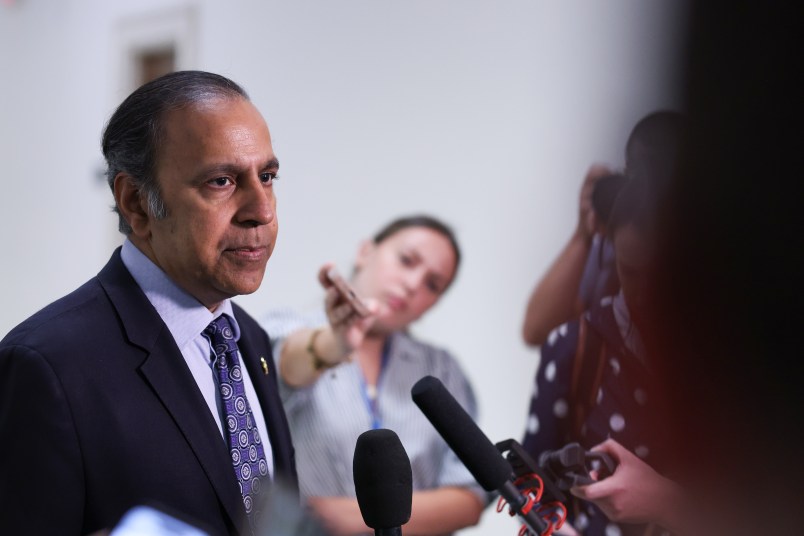
Rep. Raja Krishnamoorthi (D-IL) was at the temple on Sunday when Paporakis turned up, he said, and on Thursday called on the feds to get involved.

“We know this type of hate is coursing thorough social media online, it’s exploded,” Krishnamoorthi told a local news station. “We can’t rely on luck, that’s why we have to condemn the hatred. We can’t stay silent, or worse, condone it or fan the flames.”

“Secondly,” he continued, “we have to redirect the FBI’s focus to domestic violent extremism and trying to uncover these plots.”

The FBI, under Trump, has largely abandoned efforts to track neo-Nazi extremists, in some cases repositioning resources toward targeting the president’s critics and political enemies.

Trump’s Long-Brewing Effort to Oust Ilhan Omar From America

WASHINGTON, DC December 10: U.S. Rep. Ilhan Omar (D-MN) poses for a portrait in her office on Capitol Hill on Wednesday December 10, 2025. (Photo by Demetrius Freeman/The Washington Post via Getty Images)

The Trump administration effort to eject Muslim representative Ilhan Omar (D-MN) from the country is the culmination of a years-long fixation.

  • Way back in 2019, TPM reporter Christopher Mathias noted this week, attendees at Trump rallies were chanting “send her back” when the president mentioned Omar.
  • That year, the Washington Post reported yesterday, a “political appointee in the first Trump administration” demanded that DHS scrub Omar’s immigration records for any indication of fraud. It ultimately did not find what it needed to to move forward with a case.
  • In its second term, the Trump administration is increasingly attempting to make use of denaturalization, an extremely difficult outcome to achieve legally. That, however, is the goal with its latest investigation of Omar, per the Wall Street Journal.
  • To successfully denaturalize someone, “the government needs to show that there was an omission or falsehood on the naturalization paperwork of such magnitude that it would have prevented the person from getting citizenship had the truth been shared with immigration authorities,” writes TPM’s Josh Kovensky, who has been covering the administration’s denaturalization efforts for us since 2024.
  • The administration appears to specifically be looking into whether Omar’s father filed immigration paperwork claiming she was 17 when she was actually 18, a theory that has been pushed on the right for years, most prominently by a QAnon-supporting candidate who once challenged Omar in a primary campaign, Josh reports. A 17-year-old minor naturalizes with their parent when their parent obtains citizenship, while an 18-year-old adult must apply for citizenship independently.
  • “I think her citizenship is solid and there wasn’t any fraud there,” one former official involved in the 2019 investigation told the Washington Post.

Tabs

  • The White House is denying that Trump himself gave the order to restrict Ukraine’s access to Starlink, Bloomberg reports. But the order came “from inside the White House,” Reuters reports. “The officials said ‌leaders at the Defense Department received a message that the SpaceX Starshield service for the Ukrainian military needed to be slowed,” the Reuters report says.
  • Meanwhile, Ukraine has run out of patriot missiles, CNN reports. The U.S. seems to be withholding them as Trump punishes the country’s leader, Volodymyr Zelensky, for criticizing his pre-midterms diesel deal with Russia. Patriot missiles, which are used as interceptors, are in extremely short supply more generally thanks in part to the war with Iran. As a result, Russian missiles are more easily striking Ukrainian targets.
  • Hunter Walker profiles Bobby Pulido, the Tejano singer who, thanks in part to a GOP Texas gerrymandering effort that appears increasingly to have been misguided, stands a real chance of flipping his district from red to blue.

Man of the Hour

WASHINGTON, DC – MARCH 17: Paolo Zampolli (C), who was appointed by U.S. President Donald Trump to the board of the John F. Kennedy Center for the Performing Arts stands on the stage of the Opera Hall with fellow board members following a meeting on March 17, 2025 in Washington, DC. (Photo by Chip Somodevilla/Getty Images)

It’s longtime Trump friend and now-former State Department Special Envoy for Arts and Culture Paolo Zampolli, who, Politico recently reported, has been in a bizarre, long-running, sprawling feud with his boss, cc-ing a dozen-plus people as they snap at each other over email. Among other issues, Zampolli blamed said boss, Deputy Secretary of State Christopher Landau, for, he thought, being the source of a New York Times article that said Zampolli got his longtime girlfriend deported by ICE as part of a custody battle over their son. (Yes, it’s messy.) The girlfriend, in turn, threatened to reveal details she said she knew about Trump, Melania, and Jeffrey Epstein. (Messy.) Anyway, Trump — who, as Josh Marshall observes, suddenly seems to have no taste for drama — canned Zampolli yesterday

Are We at War?

No, says Rep. Rob Wittman (R-VA).

“Right now we are defending U.S. assets there, so there is no war as we speak,” Wittman told HuffPost Thursday.

  •  

The real reason MAGA fears Ilhan Omar

Donald Trump and his MAGA followers are obsessed with Somali-Americans. The president frequently rants about immigrants from the easternmost African country and their children, using racist rhetoric that would not be out of place at a Ku Klux Klan rally. At a campaign event Monday in Ohio, ostensibly to boost Sen. Jon Husted’s campaign against Democratic challenger Sherrod Brown, Trump fixated at length on Somali-Americans. They “don’t have pants to wear,” he claimed, but then he also expressed anger that they drive “Mercedes Benz and BMWs.” He accused them of being “low IQ” and alleged that they “plundered, ransacked and destroyed” Minnesota, a state with a large Somali immigrant population.

The president’s remarks followed past comments in which he called Somali immigrants “garbage” and said they “aren’t people that work.” Last week, Trump demanded on Truth Social that Minnesotans “fight back,” saying, “Somalians should not be allowed to get away with what they are doing.” Just in case his violent implications weren’t clear enough, Trump promised “the Federal Government will come to your rescue” should anyone follow his instructions. 

It’s worth remembering Trump’s history of condoning violence. In January 2025, on his first day back in office, the president pardoned people convicted of violent crimes during the Jan. 6 riot at the Capitol. A year later, his administration took pains to shield officers responsible for the shooting deaths of pro-immigrant protesters Renee Good and Alex Pretti in Minneapolis. 

So it wasn’t too big a surprise when Homeland Security officials raided the home of perhaps the most famous Somali-American in the country, Rep. Ilhan Omar, D-Minn., on Monday. The action is part of an all-hands-on-deck effort to prove a conspiracy theory that has been percolating on the right for years now, accusing Omar and her family of falsifying her documents to become a U.S. citizen when she was 17. The administration hopes it can denaturalize and deport the progressive lawmaker, whom Trump has deemed “deranged and sick,” repeatedly calling for her to be ejected from the country. 

Odds are that the Trump administration has no case at all against Omar — as is true of thousands of other cases it has lost against immigrants so far. Instead, the raid on the Minnesota congresswoman’s home must be understood more as a campaign stunt by a president desperate to distract from his economic failures and the disastrous war in Iran. Omar herself called the raid “pointless” and “the weaponization of federal law enforcement to target political enemies.” This isn’t even the first time Trump’s goons have gone hunting for evidence that Omar’s citizenship is illegitimate. On Thursday, the Washington Post reported that, during his first term, Trump made the same demand of immigration officials, but they found “insufficient evidence of wrongdoing” and “eventually abandoned” the search. 

No matter how many insults or threats Trump flings Omar’s way, he cannot hide that the congresswoman is exactly the opposite of the racist stereotypes he traffics in. She is smart, beautiful and hard-working. Unlike Trump, who grew up a spoiled rich kid in Queens, Omar has overcome steep odds to be where she is. At only eight, she fled war-torn Somalia with her family after gunmen attacked their home and lived in a refugee camp in Kenya for four years. Whatever one’s views of her politics, there can be no denying that everything Omar has attained, from her education to her career, has been earned against high odds.

Trump’s accusations against Omar and Somali-Americans in general have more than a whiff of psychological projection to them.

Trump’s accusations against Omar and Somali-Americans in general have more than a whiff of psychological projection to them. He calls her “crooked” and “terrible,” but in reality it’s Trump who was convicted of defrauding New York State to the tune of half a billion dollars. It’s Trump who tried to steal the 2020 election, and it’s Trump who is using gerrymandering and frivolous lawsuits to try to cheat his way out of Republicans losing the midterms. It’s Trump who has amassed over a billion dollars in shadily sourced wealth as president through cryptocurrency schemes. He even regularly cheats at golf because he’s so incapable of playing fair. 

But that all underscores the greater truth about the administration’s attacks on Omar and her fellow Somali-Americans. The success of the congresswoman and her fellow immigrants handily disproves the claim that non-white people are inferior, and instead proves that progressives are right — that the U.S. is better off for allowing people from around the world to live here. For MAGA, the fear of immigration is not about feeling contaminated, but being shown up and exposed as mediocrities in comparison to industrious newcomers. 

Trump’s attack on Omar is reminiscent of his previous accusations that Barack Obama was not a real U.S. citizen. In 2011, Trump, who was then a host on NBC’s “The Apprentice,” started a noisy public campaign demanding the then-president produce his Hawaiian birth certificate, implying that Obama, whose father was Kenyan, could not be a legitimate citizen. Obama eventually did release his birth certificate, but that ultimately didn’t matter to Trump and others who promoted and believed the birther lie, because this was never about the legal definition of “citizen.” It was about the way that the erudite, charismatic Obama revealed the insecurities of the people who, only a few years later, would call themselves “MAGA” by disproving their hopes that whiteness confers an excellence that they, on their own merits, could never produce.


Want more Amanda Marcotte on politics? Sign up for her free newsletter, Standing Room Only, now also on YouTube or wherever you get your podcasts.


Trump made this especially clear by also trying to prove Obama secretly had bad grades in college. The president’s psychological projection isn’t subtle. Unsurprisingly, he has not been keen on releasing his own grades and test scores, but he is quick to assure us he’s a super-genius because he was able to tell the difference between a man and a woman on a medical exam to diagnose dementia. 

Another pointed reminder of MAGA’s true fears came recently when Bo French, the Republican nominee for Texas Railroad Commissioner, tweeted a photo of non-white students celebrating a University of Texas football win and complained, “The problem is now obviously far worse than anyone imagined.” He later whined about the university accepting foreign students, though he had no evidence these young people in the photo were born outside the country and neglected to offer any rational arguments for why the school should discriminate against worthy students from overseas. 

French’s outburst kicked off a debate among right-wing commentators about what they crudely called “the Indian question,” an apparent nod to a Nazi euphemism for antisemitic ideas that eventually led to the Holocaust. This revealed an unbelievably noxious racism, and also served as a tacit admission that concern about immigration is not, despite all the “garbage” talk, about immigrants dragging down the country. The MAGA coalition’s fear is that immigrants will make it a lot harder for mediocre white people to compete for plum jobs and school admissions. While decades of right-wing blather about meritocracy was always a lie, now conservatives are basically admitting it: Racism is a protection racket to shield white D-level students from the consequences of their own laziness.

This understanding exposes why Trump and MAGA have it in for Somali-Americans. Like any group of people, the Somali immigrant community contains good and bad people in it, but on the whole, their very existence is a testament to human tenacity. Like so many waves of refugees before and after, these are people who took huge risks to survive, and many of them, like Omar, are thriving. Even though the community suffers from extensive poverty due in part to discrimination and the few resources refugees from a war-torn country are able to marshal, it has also produced a large number of entrepreneurs. Somali-Americans have higher than average rates of labor participation and contribute an estimated $8 billion a year to Minnesota’s economy alone. Like many immigrant communities, such as Irish and Italians in the early 20th century, the second generation is doing much better economically than their parents. 

In other words, Somali-Americans are living the industrious values that a lot of MAGA types valorize but at which many, especially rich boys like Trump, fall short. This, too, would be fine, if only conservatives could just relax. Part of the American dream is being able to move beyond working that 60-hour week that so many recent immigrants have to put in to survive. There is nothing wrong with being a C student — as long as you don’t take your insecurities out on the A students who just so happen to have darker skin. That’s what makes this racism so baffling. It’s not just that it’s immoral. It’s also a waste of a one precious life to be so angry that someone who looks a little different might be better at some stuff.

The post The real reason MAGA fears Ilhan Omar appeared first on Salon.com.

  •  

Trump’s plan to deport a member of Congress

Rep. Ilhan Omar, wearing a white and red head covering and a black top, stands near an American flag at a press conference.
Rep. Ilhan Omar (D-MN) during a news conference at the US Capitol on February 24, 2026. | Daniel Heuer/Bloomberg via Getty Images

This story appeared in The Logoff, a daily newsletter that helps you stay informed about the Trump administration without letting political news take over your life. Subscribe here.

Welcome to The Logoff: Donald Trump wants to deport a member of Congress. 

What’s happening? On Monday, Homeland Security officers raided the Washington, DC, home of US Rep. Ilhan Omar (D-MN) in an investigation reportedly tied to immigration paperwork filled out by her father when she was a minor.

That was, at the time, more than enough cause for alarm. Trump’s animosity toward Omar, who is Somali-American and an outspoken critic of the administration, is well-known, and the raid is an extraordinary violation of the Justice Department’s usual rule to avoid taking visible action around politically sensitive cases within 60 days of an election. 

On Wednesday evening, however, we learned more about the raid from the Wall Street Journal. The Omar investigation, the Journal reported, is explicitly aimed at stripping Omar of her citizenship — and thus her ability to hold office — and deporting her. 

How would they do that? Omar came to the US as a refugee when she was 12 and became a US citizen when she was 17. The Trump administration’s investigation is said to focus on whether she or her family misrecorded her age in order to more easily gain citizenship. 

The government cannot unilaterally denaturalize a citizen, however; it would have to ask a court to do so.

What’s the context? Historically, it’s rare for the US to strip citizenship from naturalized US citizens. But doing so at volume has been a major, if less visible, priority for the second Trump administration. 

As of earlier this year, NBC News reported, DOJ was targeting hundreds of people for possible denaturalization, and has reportedly hoped to put forward hundreds of new cases per month (though successfully stripping them of citizenship is another matter).

Why does this matter? Trump’s campaign to bend the traditionally nonpartisan DOJ into a tool to punish and harass his enemies has been one of the major stories of his second term. 

Even if it never advances beyond Monday’s raid, an investigation targeting Omar’s citizenship with the eventual goal of deporting her from the US represents a new and even more dangerous evolution of that effort — and it threatens to move the US to a far darker place, where citizenship and the rights it guarantees are predicated on the president’s goodwill.

And with that, it’s time to log off…

Hi readers — if you’ll allow me to depart a little from my normal approach to this section, I have a story about politics to share. It’s not, however, about the politics we’re currently dealing with, but about what could be: Democrats’ plan for a quietly ambitious “Project 2029” should they win the White House in 2028. You can read it with a gift link here.

Alternatively, if you’d prefer to just log off, here’s an adorable snow leopard cub with massive paws. Thanks for reading, have a great evening, and we’ll see you tomorrow!

  •  

Frontex suspends reintegration program after blowing through its budget 

BRUSSELS — The EU border agency Frontex is suspending a support program for deported migrants after its budget for the year ran out earlier than anticipated, emails seen by POLITICO show. 

The border agency paused new applications for reintegration support under its program on Oct. 2 after estimating that costs had “reached a level that does no longer ensure full financial coverage,” according to an email sent by Executive Director Hans Leijtens to staff on that date.

The program, which has operated since 2022, offers financial assistance, healthcare, vocational training and counseling to people who are returned to their home countries after being refused the right to stay in the EU. Reintegration support forms part of the EU’s plan to boost returns of unsuccessful asylum-seekers.

The suspension comes as the EU seeks to step up deportations from the bloc — a leading pillar of EU migration policy, and the object of new legislation adopted earlier this month — and weeks before the European Commission is expected to propose expanding the mandate of the border agency, including its role in returns and reintegration.

Frontex cannot resume the program without additional cash. The agency asked the Commission for more funds, but is waiting for clarity on the EU budget for 2027, and the next seven-year budget starting in 2028, the emails said.

“There is no point in talking about a more ambitious European return policy without also talking about the resources needed to deliver it,” Frontex spokesperson Chris Borowski told POLITICO. “Ambition and funding have to go hand in hand.”

Borowski confirmed that the agency had suspended new cases, but stressed that individuals already been accepted into the program wouldn’t be affected and that Frontex would also continue to offer EU countries “other forms of assistance” on returns, such as operational and technical support.

“Returns do not end when a plane lands. Helping people rebuild their lives after returning to their home countries is an important part of making migration management work. It takes planning, people and money,” he said.

With 2,368 new cases per month on average, the agency took on significantly more migrants seeking reintegration support than it expected. Cases in September were 63% higher than Frontex’s target, according to Leijtens’ email to staff. In the first half of this year, the agency took on around 75% more cases than it did in the same period last year.

In previous years, Frontex was able to assign additional funds from other parts of its budget, the email says — signaling the agency has had to search to find the cash to keep the program running in the past.

“Frontex does not have the necessary appropriations to cover the needs further as MFF allocations did not consider that Frontex would be expected to take over EURP funding at the scale we have seen today,” Leijtens wrote, referring to Multiannual Financial Framework, the EU’s seven-year budget.

The agency has raised the issue with the Commission but “no further commitments could be made onwards,” according to the email.

The program’s suspension raises questions about the future of the bloc’s migration approach. Reintegration is “the key ingredient” to making the EU’s returns strategy work, Lukas Gehrke, the director of the U.N.’s migration organization’s global office in Brussels, told POLITICO.

Forced returns are expensive and come with a higher risk of human rights infringements, whereas reintegration support boosts voluntary returns, reduces people’s propensity to attempt to reach the EU again, and tends to ease cooperation with the country to which they return, he argued.

“That means every euro spent on return with reintegration is a euro spent in a more sustainable way,” Gehrke said.

‘Do not argue or defend the EU policy’

In emailed guidance on how to communicate the suspension to migrants who applied for support, seen by POLITICO, staff were told to “acknowledge the institutional problem” with reintegration program funding “so the returnee does not feel personally targeted or punished.”

Counselors should be transparent, validate migrants’ disappointment, wait for their emotions to pass and shift the conversation to what they could still do upon their return, the guidance read, advising: “Do not argue or defend the EU policy.”

Migrants wait to return to the temporary camp El Guano in Spain’s north African enclave of Ceuta on Oct. 10, 2026. | Thomas Coex/AFP via Getty Images

Potential returnees “may feel deceived, leading to anger, despondency, or complete withdrawal from the return process,” it also warned.

Expanding the agency’s Frontex mandate featured in the Commission’s five-point plan to address sudden mass movements of people, in the aftermath of migration crisis in the Spanish exclave of Ceuta. Besides stepping up the agency’s role in returns and reintegration, the plan also noted an intention to charge Frontex with monitoring the bloc’s external borders and add capacity to quickly deploy forces in the event of an emergency.

“The Commission will propose that Frontex becomes a genuinely European capability with the scale, tools and agility to support Member States wherever and whenever needed,” Commission President Ursula von der Leyen wrote in a letter to EU leaders ahead of a summit on Thursday and Friday, where migration is likely to be a flashpoint.

The plans have already raised concerns that the border agency’s mandate is being expanded more quickly than its resources.

Strengthening the border agency’s emergency response capacities, for example, comes with a tradeoff as staff that can be deployed on a moment’s notice cannot be deployed elsewhere, Leijtens, Frontex’s executive director, said at an event earlier this month.  “If they’re in Narva in Estonia, you can’t use them in Italy right now.”

Zoya Sheftalovich contributed to this report.

  •  

UK’s Burnham says rejecting closer EU ties a ‘dereliction of duty’

LONDON — Andy Burnham said Monday it would be a “dereliction of duty” for Britain not to seek closer ties with the EU.

In a House of Commons statement reopening Britain’s highly-charged Brexit debate, the prime minister said the vast majority of the public would back a closer relationship with the EU if it helps to control immigration and boost economic growth.

Announcing a long-anticipated U.K.-EU summit will take place on Nov. 20., he said: “Sticking with the status quo is not good enough for Britain. Worse, it would be a major dereliction of duty to turn away. We need to take a calm, clear-eyed, rational look at the world as it is today to consider what is best for our country.”

At Labour’s annual conference last month, Burnham said Britain’s departure from the bloc had done more harm than good.

In subsequent interviews he said it’s possible a future Labour manifesto could include a pledge to hold an “in-out” referendum on rejoining the EU.

The U.K. prime minister addressed MPs after telling the Rest is Politics podcast in an interview aired over the weekend that it is “clear” Russia interfered in the 2016 Brexit referendum.

“I asked the question coming to Downing Street: ‘Was there interference in the 2016 referendum from Russia?’ And I’ve had the clear answer that yes, there was,” Burnham said.

But his spokesperson told reporters Monday:  “We do believe the referendum result to be legitimate.”

Reform UK Leader Nigel Farage, one of the most high profile campaigners for Brexit in 2016, said Burnham’s Russian interference claim was “outrageous” and accused the prime minister of being a “liar.”

At a press conference in Kent, he acknowledged Brexit had led to more inconvenience for some businesses, like the haulage firm where he was giving the speech, but said: “When you have borders to protect your country, there is some level of inconvenience.”

Dan Bloom contributed reporting.

This story has been updated to include comments from Nigel Farage.

  •  

NYPD footage fuels scrutiny of ICE shooting

Newly released NYPD body-camera footage showing the aftermath of an immigration enforcement shooting in New York City has intensified scrutiny of federal agents who shot a man with his 5-year-old son in the car.

The footage shows officers arriving Thursday in Marble Hill to find Oscar Belgal, 28, wounded, handcuffed and seated on the ground. NYPD officers rendered aid and rushed him to a hospital. Police later located his unharmed son with a family member.

Mayor Zohran Mamdani condemned the shooting in an initial social media post, saying Immigration and Customs Enforcement agents had shot a New Yorker while his child was in the vehicle.

This afternoon in Marble Hill, a New Yorker was shot by an ICE agent in a residential neighborhood. Early reports indicate agents surrounded him and a 5-year-old child in his car before firing multiple rounds. We believe the child was physically unharmed.

This is an unconscionable and incredibly serious situation. I have called the President; when we speak I will demand that he ends all ICE enforcement actions in our city. I will not stand by while ICE agents terrorize our communities.

Our thoughts are with the injured New Yorker and his family tonight. We are praying for his recovery.

Get ICE out of our neighborhoods. Get ICE out of our hospitals. Get ICE off our streets. Get ICE away from our children.

Abolish ICE.

— Mayor Zohran Kwame Mamdani (@NYCMayor) October 8, 2026

ICE defended the operation, alleging that Belgal, a Dominican national with a criminal record, accelerated his vehicle toward federal agents who feared for their lives. The agency also accused him of gang involvement.

On October 8, at approximately 4:00 PM ET, ICE officers were conducting a targeted enforcement operation in the Bronx, New York, to arrest a criminal illegal alien from the Dominican Republic with a prior criminal conviction for grand larceny, and multiple prior arrests for assault, robbery, possession of drugs, and weapons possession. He has associations to the Trinitarios gang, the same gang who brutally shot a CBP officer last year.

This criminal illegal alien was arrested by the NYPD on December 7, 2023, but was released into the community a few days later by reckless Democrat sanctuary policies that put American lives at risk.

During the incident, an ICE officer discharged his weapon and the criminal illegal alien was injured.

ICE officers immediately rendered aid. The individual is alive and at a local hospital. The FBI and HSI are on the scene. The incident remains under investigation. More information will be shared as it becomes available.

When dangerous illegal aliens are released back onto the streets by radical sanctuary politicians, our officers are forced to make arrests at large in the community in unpredictable and dangerous environments. Our officers should not have to risk their lives, and innocent Americans should not have to face unnecessary danger, because sanctuary politicians refuse to cooperate with federal law enforcement.

— U.S. Immigration and Customs Enforcement (@ICEgov) October 9, 2026

NYPD Commissioner Jessica Tisch said at least one federal agent fired seven rounds, striking Belgal in the neck. Surveillance footage shows armed, plainclothes officers approaching his vehicle but does not capture the shooting itself.

The incident sparked demonstrations across the city, including a Friday march from Foley Square to federal immigration offices in Manhattan.

Mamdani said he unsuccessfully appealed to President Donald Trump and Homeland Security Secretary Markwayne Mullin to release Belgal. He subsequently called for ICE’s abolition.


Start your day with essential news from Salon.
Sign up for our free morning newsletter, Crash Course.


Belgal’s attorneys said he was transferred to New Jersey after the shooting before being returned to federal detention in Brooklyn. A judge has restricted his transfer and temporarily blocked his deportation while his legal challenge proceeds.

New York Attorney General Letitia James called for a “full and transparent investigation conducted without fear or favor.”

The Bronx district attorney’s office is investigating. ICE has not publicly released its own body-camera footage of the shooting.

The post NYPD footage fuels scrutiny of ICE shooting appeared first on Salon.com.

  •  

Far-right Vox sees election as its big chance to reshape Spain

MADRID — Spanish Prime Minister Pedro Sánchez has finally done something the far right approves of — calling a snap election on Nov. 29 that the anti-immigrant Vox party is hailing as “Spain’s last chance to be Spain again.”

Polling third in the race, Vox is Spain’s leading nationalist, euroskeptic force and it sees next month’s contest as its prime opportunity to remold the country after eight years of Sánchez’s socialist premiership by getting its people into top ministerial jobs.

Party leader Santiago Abascal greeted Monday’s election announcement as “excellent news.” His delight is hardly surprising given that polls suggest Vox is on track to make the biggest gains of any major party.

While the center-right People’s Party is expected to come first — with about 33% of the vote, according to POLITICO’s Poll of Polls — it will almost certainly have to team up with Vox, which commands support of about 18%, to build a stable coalition.

Abascal will then be able to demand the inclusion of key elements of Vox’s agenda as its price for that partnership. Its goals include deportations of undocumented migrants, a benefits preference for Spaniards over foreign nationals, slashing EU health and safety rules in the farming sector and rolling back support for gender equality and the LGBTQ+ community.

Vox secured 33 of the 350 seats in Congress in 2023, but is now set to double that. Under the PP’s coalition leadership, it should be able to form part of a comfortable majority.

SPAIN NATIONAL PARLIAMENT POLL OF POLLS

For more polling data from across Europe visit POLITICO Poll of Polls.

“This time round, Vox is much stronger,” José Antonio Fúster, spokesperson for the party and a member of the Madrid regional parliament, said. “We are going into a very important election, not so much for us, as for Spaniards … This is the last hope for Spain to be Spain again.”

Fúster would not be drawn on which ministries his party has set its sights on, warning against “selling the bearskin before it has been hunted.”

Pointing to talks with the PP in recent months in four regions where the two parties now govern in coalition, he said the shaping of policy was being prioritized ahead of institutional power. “That is the last thing we negotiate because it is the least important,” he said.

Pet portfolios

In August, Vox MEP Jorge Buxadé told POLITICO that forming part of the government was not the only option open to his party, but that in a hypothetical coalition with the PP, his party would seek a number of ministries “in proportion to our vote share.”

That would amount to a significant percentage. If current polls translate into results in November, Vox would be in a position to claim about a third of ministerial posts.

Analysts expect Vox to press for portfolios that focus on its pet policies, such as agriculture, domestic policy, immigration and industry. The culture and education portfolios could also be of interest to the party, given their relevance in the hard right’s campaign against so-called wokeism.

The regions where the PP and Vox currently govern together — Andalusia, Aragón, Castile and León, and Extremadura — offer clues: The government departments that Vox controls are mainly linked to agriculture, welfare benefits and the family.

The party is heading into the election campaign espousing three main ideas: the concept of “national priority” — ensuring that Spaniards have access to public services and benefits ahead of foreign nationals — a clampdown on immigration and broad deregulation.

Although Vox’s rise to prominence was driven by its fierce stance against Catalan nationalism nearly a decade ago, that debate has faded from the political arena. Now, its focus is, like its European far-right counterparts, more firmly on immigration-related matters.

“Before, Vox talked about immigration, but it wasn’t the nuclear issue it has become,” said Guillermo Fernández Vázquez, a political scientist at Carlos III University and author of a book about the European far right. “Now, when Vox talks about social security payments, it talks about immigration; when it talks about the economy, it talks about immigration. Immigration is the issue that dictates everything.”

Vox also subscribes to the “remigration” policy being touted by many far-right parties, under which undocumented migrants and those who commit crimes would be deported. The PP has appeared to respond to Vox’s hard line by toughening its own stance, calling for the expulsion of foreign criminals and opposing a government migrant legalization program.

In each of the regions where the two parties are in coalition, Vox has ensured that its senior partner agreed to formally include the national priority principle in their governing agreement.

Alberto Núñez Feijóo speaks at the People’s Party congress in Madrid on June 5, 2026. | Thomas Coex/AFP via Getty Images

“But when it comes to national priority, the PP has added the caveat that it has to be implemented in line with the law,” said Miguel González, a journalist at the El País daily newspaper and author of a book about Vox. Legislation prevents discrimination against foreign nationals when it comes to accessing public benefits and services, meaning the policy is currently little more than symbolic in those regions. 

“In reality, in order to implement this properly, you’d have to change the immigration law,” González added.

Vox is eyeing an overhaul of that legislation to make it a workable policy.

“It’s very possible to change laws that are bad for Spaniards, so we have to roll them back and introduce new laws, making sure that Spaniards are not last in line,” Fúster said.

Deregulation nation

Deregulation also offers a platform from which to attack EU health-and-safety norms that are reviled by the farming sector, one of Vox’s main voter bases.

Fúster accepted that this could lead to clashes with the European Commission, but insisted that pressure from what he described as a rising tide of European parties sharing Vox’s values would “make sure that Brussels returns to the path of common sense.”

PP leader Alberto Núñez Feijóo has criticized phytosanitary restrictions on farmers but has shown little appetite for conflict with European institutions.

In social policy, González said Vox might use the broader notion of deregulation to dismantle funding for gender equality and LGBTQ+ departments and projects, as it has done on a local level. Fúster was reluctant to be drawn on this: “We believe in the equality of Spaniards,” he said. “We don’t believe that anyone should have privileges above others.”

Fernández Vázquez of Carlos III University said that the origins of Vox suggest a bumpy ride for the PP. Vox would be the first far-right party to enter government in half a century since the death of Francisco Franco in 1975 — and there would likely be clashes.

The far-right party formed in 2013 as a breakaway from the conservatives in frustration at what its founders saw as the pusillanimity of the PP in the face of Catalan separatism. 

“I think the relationship between Vox and PP [in government] will be a bad one,” the researcher said. “Abascal and his colleagues are going to enjoy showing up Feijóo whenever they can, portraying him as lukewarm and weak.”

Fúster accepted “it could be a difficult relationship,” adding that the PP “don’t see things the way we do and we don’t share their vision.”

“We’re not willing to make concessions, we’re willing to have a frank, open and reasonable negotiation.”

But for now, the priority is simply to remove the Socialists. In his traditionally combative style, Abascal insisted the election was a chance to hold on to “the peace, prosperity and freedom that a mafioso government wants to snatch from us forever.”

Max Griera contributed to this article.

  •  

Chris Rufo — Known For ‘DEI’ and ‘CRT’ Panics — Tries to Make ‘the Indian Question’ a Thing

To the degree that a “respectable” or “moderate” right exists today in America, Christopher Rufo is considered part of it. He is a senior fellow at the Manhattan Institute, the tony midtown think tank that holds black-tie galas; he recently enjoyed a polite sit-down interview with Ezra Klein on Klein’s massively popular New York Times podcast; and he has over 120,000 subscribers on Substack, a publishing platform whose owners have celebrated Rufo as one of their “best” political writers who readers can “trust.” 

  •  

The Democrats who bet wrong on ICE

A red sign that says ICE is not welcome

Welcome to The Midterms, Actually. Every week I’ll be writing about two things: one big idea or trend I see forming across the 2026 primaries, and one thing I’m hearing from a voice on the ground. You can sign up here to get it in your inbox every week. Let’s get into it.

One big idea: Democrats’ Laken Riley vote is aging badly

Two things happened this week that reveal how quickly the politics of immigration enforcement are shifting.

First, Republican Sen. Jim Justice of West Virginia, a staunch ally of President Donald Trump, urged the administration to dial back its enforcement push. “Before you know it, you get people that get carried away in their job and whatever it may be, and all of a sudden, then you’re dragging people away that have lived on your street corner for 15 years,” Justice told Politico this week. “I don’t know that we need to be doing that stuff.” And he’s not the only red-state Republican who’s been pushing back on ICE lately, including some facing voters in tough races next month.

The second thing flew under the radar: Sen. Jon Ossoff, the Georgia Democrat running for reelection who has also been floated as a 2028 presidential candidate, struggled to explain himself when a reporter confronted him on camera about his vote for the Laken Riley Act in January 2025. Passed within days of Trump’s inauguration and signed nine days into his second term, the law requires ICE to detain undocumented immigrants who are merely arrested for or charged with theft-related crimes, before any conviction.

In the exchange with a reporter from Drop Site News, Ossoff talked about his Senate work investigating alleged ICE abuses, but didn’t directly address his vote after being asked if he regretted it. “Laken Riley was my constituent and what happened to her should happen to no American, to no person in this world,” Ossoff said. “I think that immigration enforcement should be focused on those who are convicted or charged with serious crimes.” He excused himself to walk into a meeting as the reporter pressed him on whether the law undermined due process. 

In both cases, you see changing winds of electoral politics. Back in 2025, when Ossoff and 11 other Senate Democrats joined Republicans in supporting Trump’s immigration bill, they implicitly validated Trump’s premise on immigration enforcement: that not only was the border out of control, but that there also needed to be new efforts to step up interior enforcement through expanding agencies like ICE. In the year-plus since that vote, Trump has hired more ICE officers, launched sweeping raids in cities like Minneapolis, Chicago, and Los Angeles, and fueled a cauldron of chaos that’s led to shootings across the country. Politically, it has now put Democrats like Ossoff in a pickle, one that will matter more the closer we get to 2028.

How do you explain giving more immigration powers to a Stephen Miller-led White House? How can one argue you couldn’t have seen this coming?

In some ways, you can understand the political logic of the time. Ossoff, who is running in a state Trump carried, and many of the congressional Democrats who supported the Laken Riley law were in competitive races, and Democrats left the 2024 election thinking they had misread the electorate on the issue, particularly after Latino voters swung hard toward the right. But given what’s happened since, it’s clear many congressional Democrats made a familiar mistake: prioritizing political triangulation over standing on their values of protecting marginalized communities.

Take a look at some of the Democrats who have already had to walk back their votes. In the Democratic primary for Minnesota’s open Senate seat, Lt. Gov. Peggy Flanagan made US Rep. Angie Craig’s vote for the law a key focus of her campaign, calling it “disqualifying.” The attacks were so effective that Craig eventually expressed remorse, saying, “I wanted to be honest with the people of Minnesota. I will tell you when I get it wrong, and I got that one wrong.” Craig lost the August 11 primary to Flanagan.

Maryland’s April McClain Delaney, another congressional Democrat, also said she regretted her vote: “I will say that this was in the beginning of my term. And I never thought that ICE immigration and the horror of what has happened would happen.” (She survived her primary, defeating David Trone by 6 points.)

It’s easy to see where the buyer’s remorse is emanating from. Trump’s ICE is broadly unpopular. And as we’ve talked about on this Substack and in our reporting on America, Actually, Trump is doing worse and worse with Latino voters, with both prices and immigration enforcement driving the slide. A Hart Research poll for TelevisaUnivision of 1,500 Latino registered voters in battleground House districts (August 6–17) found 63 percent disapprove of Trump’s job performance and 62 percent disapprove of his handling of immigration enforcement and deportations. Sixty-four percent view ICE unfavorably. 

When I recently talked to Stephanie Valencia of Equis Research, she said this: 

The people who feel most regretful who voted for Trump in 2024 are most regretful because of immigration. They feel like there was a broken promise there. Like, they were told he was gonna focus on the border, which everybody agreed was chaos, and he was gonna focus on violent criminals and serious threats, and at the end of the day, he has not complied with that.

But while the shift in public opinion helps explain the elected officials’ political logic, it doesn’t change the material harm of their votes. Just this week, ICE announced plans to hire 5,000 more employees, most of them deportation officers, by the end of the year as enforcement continues to ramp up.

And these raids have a lasting effect on targeted communities, like in Maine, the Chicago area, and Texas. It’s the No. 1 issue that has come up in my conversations with local reporters. The chief architect of this chaos is the president, but make no mistake: Trump had help from shortsighted Democrats.

One thing I’m hearing 

Maya Miller is a Report for America corps member covering democracy and government for the Gulf States Newsroom, a public radio collaboration that includes Louisiana’s WWNO and WRKF. She’s been reporting on Mississippi’s redistricting fight and what residents are saying about their representation and the upcoming midterms.

You’ve been reporting from redistricting hearings in Mississippi. What are residents most concerned about, and is there a conversation or moment that captures the mood?

Residents are most concerned about their representation. In Mississippi in particular, race and party are strongly intertwined, and Black residents worry that by being drawn into new districts, voters may elect a Republican candidate. There was a bit of secrecy around redistricting earlier this summer, with Gov. Tate Reeves, a Republican, canceling a special session to redraw judicial lines. So advocates created the People’s Hearings, a series of meetings held across the state to voice concerns and create a public record of testimonies from Mississippians. Quickly after, lawmakers decided to host their own public hearings, and at these hearings, hundreds of residents showed up, mostly to urge them not to redistrict.

“It seems to me that the threat of losing representation has made people more aware of the moving parts.”

At one hearing, I spoke to Joyce Arceneaux-Mathis, president of the Natchez NAACP. She’s frustrated that the state is going to spend millions on new maps when people are struggling with day to day expenses. And Ramona Sanders of Meridian, Mississippi, has a lot of concerns on whether mid-decade redistricting is illegal. While it’s not, she says that lawmakers are opening themselves up to legal action. I haven’t heard anything from voter advocacy groups that points to future lawsuits, but only time will tell, if and when lawmakers redraw the maps, if these maps are constitutional or not.

Redistricting is often covered as a fight over which party wins more seats. What would these changes mean for the communities you cover and their ability to have a voice in Congress?

One change that could happen is that residents who are Democrats might lose the state’s only Democrat leader. Out of four congressmen, there’s only one Democrat, Bennie Thompson, who represents District 2. His district spans much of the west, from the capital city of Jackson to most of the Mississippi Delta and southwest Mississippi. It’s a heavily Black district, somewhere around 63 percent Black. He’s held this seat for 33 years and has brought millions to the district for health care, infrastructure, and agriculture. 

So residents are worried that Republicans are trying to edge him out and replace him with a more conservative leader who may not have the same concerns as the community. 

How are these fights affecting people’s interest in the midterms? Are you hearing more determination to vote, more doubt that voting matters, or something else?

People are fired up. They’re incredibly engaged. I’m hearing from a lot of people who are more determined to vote in November than when I covered redistricting in Alabama in 2024. It seems to me that the threat of losing representation has made people more aware of the moving parts. So they’re attending hearings, participating in rallies, registering to vote and checking their registration, phoning a friend and making plans to be at the polls on November 3.

What is the national conversation about redistricting missing that becomes clear when you spend time in these communities?

I think the national conversation is missing the voice of the community. It’s one thing to report on the politics of redistricting, but there’s a layer of real concern from residents that shouldn’t be ignored. They’re worried about hospitals closing. They’re worried about public schools losing funding. They’re worried about the rising cost of groceries and gas. I find that talking to and listening to residents helps me understand a community more than calling up a lawmaker and asking them their thoughts. There’s a place for that side of the conversation, of course, but I’ve always tried to center people who will be most impacted in my reporting, and I feel that leads to a better story for our listeners.

  •  

New IRS Citizenship Question Could Make It Easier for Census Bureau to Shift Political Power

A proposed change to a key tax form could help the Trump administration achieve new anti-immigrant policy objectives, including preventing undocumented immigrants from receiving federal tax benefits. But it could also be used to accomplish a more sweeping objective: Shifting the balance of power in Congress by excluding many classes of immigrants from apportionment, the process through which power in the House of Representatives is allocated.

  •  

Federal Judge Blasts ‘Inhumane and Unconstitutional’ Conditions in NYC ICE Detention

A federal judge decried the “cruelty” detainees experienced inside Manhattan’s infamous ICE detention center in a court ruling filed on Thursday. 

Federal Judge Lewis Kaplan offered graphic depictions of “overcrowding, sleep deprivation, insufficient food and water, inadequate medical care, and restrictions on access to counsel” at 26 Federal Plaza in his ruling, which permanently limited the number of detainees that can be held at the facility going forward. The scathing assessment and court ordered changes were the conclusion of a class action suit filed against Immigration and Customs Enforcement that originated with a man who had been held in the building. 

Along with detailing holding cells that he described as “anything but sanitary,” Kaplan recounted multiple instances where ICE personnel were found to be “lying” about the conditions inside the building.

“By detaining far more persons in the hold rooms than ever was intended and for far longer than ever was intended, ICE objectively deprived detainees of sleep, sanitary living conditions, basic personal hygiene needs, sufficient food and water, and adequate medical care. ICE prevented detainees from accessing counsel, who might have stood in the way of what it was doing,” Kaplan wrote, adding, “Some of these deprivations impacted detainees immediately; others only after longer periods. ICE knew, or should have known, that how it was treating detainees was wrong, yet it continued to do it anyway. It did so to inflict punishment on detainees and induce them to self-deport.”

The judge’s ruling provided a window inside 26 Federal Plaza, which has been ground zero in New York City for the unprecedented wave of immigration deportations and detentions that have taken place during President Donald Trump’s second term. TPM has previously reported from the halls of the building where migrants have been taken by masked ICE agents as they showed up for court appearances in ongoing immigration legal proceedings. Our prior coverage has noted how activists and members of Congress have previously raised alarms about the conditions inside the facility and the legality of these detentions, many of which were ultimately reversed by court order. The Department of Homeland Security, which oversees ICE, responded to this reporting from TPM and other news organizations by denying the existence of a “detention center” in the building and insisting migrants were only there for “processing.” 

However, in his ruling Kaplan detailed brutal circumstances in which migrants were held inside the floors occupied by ICE at 26 Federal Plaza. He noted the agency’s space in the building is not supposed to be a detention facility and only has “so-called ‘hold rooms’ that were intended and designed only for very short-term custody – twelve hours or less – of arrested persons pending their transfer to other facilities.” According to the judge, these rooms “have no showers, no beds, no cots, no windows, and lack many other things found in prisons and detention facilities.” In response to Trump’s “mass deportation” agenda, Kaplan said ICE was “misusing” 26 Federal Plaza.

“It has overcrowded severely the 26 Fed hold rooms, subjecting detainees for extended periods to inhumane conditions that violate the Constitution, not to mention any decent concern for the Golden Rule or the demands of humanity,” Kaplan wrote.

TPM reached out to ICE and DHS for a response to the judge’s ruling. Without providing any evidence, an unnamed DHS spokesperson gave TPM  a statement that, essentially, denied many of the judge’s conclusions. 

“DHS complies with all lawful court orders. 26 Federal Plaza is not a long-term detention facility; it is a short term-holding facility. Detainees are only at 26 Federal Plaza for a short period while they are being processed and awaiting transfer,” the spokesperson said. “Ensuring the safety, security, and well-being of individuals in ICE custody remains a top priority.”

The DHS spokesperson further argued that detainees place themselves in this situation by not leaving the country on their own.

“Being in detention is a choice. We encourage all illegal aliens to take control of their departure with the CBP Home App. The United States is offering illegal aliens $3,000 and a free flight to self-deport now,” the spokesperson said, adding, “We encourage every person here illegally to take advantage of this offer and reserve the chance to come back to the U.S. the right legal way to live the American dream.”

While self deporting is indeed an option, many of the people who have been placed in immigration detention centers during the second Trump administration are legally requesting asylum and have claimed they would be endangered in their home countries. Others have spent years lawfully living in the United States and have families here. 

Kaplan specifically focused on conditions at the facility last summer, as his ruling came in response to a class action lawsuit that originated in August 2025 with Sergio Alberto Barco Mercado, an immigrant who says he was detained at 26 Federal Plaza while trying to attend his court hearings in conjunction with seeking legal asylum. Mercado’s class action lawsuit included other detainees held at the facility as plaintiffs. Throughout legal proceedings surrounding the case, Kaplan previously ordered changes at the facility, including placing limits on the amount of people who could be  put in “hold rooms” and expanding access to attorneys for detainees. In his final ruling, Kaplan accused ICE of not complying with the court. 

“The facts show that ICE repeatedly has violated this Court’s orders either by intentionally flouting them or by employing so-called ‘best’ efforts that simply have not been good enough,” Kaplan wrote. 

Kaplan’s ruling included images showing just how cramped the hold rooms were inside 26 Federal Plaza. The pictures, which show detainees had no ability to lie down, are eerily reminiscent of similar documentation of slave ships.

Screenshot

Along with sheer overcrowding, Kaplan’s report documented unhealthy conditions, including lack of water, food, medical care, clean clothes and bathroom facilities. He noted that ICE officials attempted to dispute this, however, the judge rejected their denials. In multiple instances, Kaplan referred to statements made by Nancy Zanello, who was the field office’s assistant director between July and October of 2025 as “not credible” based on the evidence.

“While Zanello refused to admit that the hold rooms ever smelled bad, that denial is belied by the fact that she at one point felt that a group of detainees’ complaints regarding the lack of showers had such merit that she personally went out and bought empty water bottles and baby shampoo, filled the bottles with warm tap water, and allowed those detainees to wash themselves one-by-one in an empty hold room,” Kaplan wrote. 

Text messages from Zanello and other officials that were previously exposed during the case revealed they were aware of infectious diseases, including tuberculosis, running rampant inside 26 Federal Plaza. 

Along with the physical conditions inside the building, Kaplan decried the lack of access to attorneys given to detainees at 26 Federal Plaza. The judge said the facility “essentially was a black site prior to his initial court orders. He claimed ICE engaged in various tactics including “lying,” “erecting procedural roadblocks,” and failing to update databases with information about detainees’ locations to prevent them from contacting attorneys. And Kaplan said these issues persisted following his initial interventions.

“Even after that point, ICE continued to prevent detainees from making confidential legal calls,” Kaplan wrote, adding, “No legitimate governmental interests could justify so depriving detainees of the ability to obtain timely legal advice, particularly when there are feasible alternatives that would minimize the burden on detainees’ First and Fifth Amendment rights.” 

Kaplan’s ruling includes witness testimony from detainees, including one who said “one guard . . . would sometimes hold a bottle of water up and people would wait to have him squirt some into our mouths, like we were animals and not people” and another who said people “had to drink water from the sinks next to the toilets.” Kaplan said “several” detainees recounted “ICE staff and contractors beating” people held at 26 Federal Plaza. Others claimed food was essentially “slop” that was provided only rarely. Multiple detainees described losing large amounts of weight while being held in the facility. Meanwhile, another witness quoted by the judge said “guards would eat their own food …  like pizza and hamburgers” in front of the detainees as though they were “jeering.”

These accounts from 26 Federal Plaza echo allegations that have surfaced about the conditions inside other ICE facilities around the country. Senate Democratic Whip Dick Durbin (D-IL) and his staff on the Judiciary Committee have previously published reports detailing alarming conditions at ICE detention centers in Texas, Florida and Louisiana. 

“And 26 Fed is not unique,” Kaplan wrote in his ruling. “Comparable litigation has been brought in several other locations with respect to several other ICE detention and holding facilities.” 

Kaplan specifically referred to another federal judge who described a situation that “shocks the conscience” involving “chillingly brutal conditions of confinement” inside ICE holding rooms at a courthouse in Central Islip on New York’s Long Island. 

At multiple points in his ruling, Kaplan rejected arguments made by attorneys representing the government, including their attempts to claim the suit was “overbroad” and should not cover present and future detainees in the building regardless of how long they are being held. Along with mandating permanent improvements at 26 Federal Plaza including sufficient space for each detainee, lights being dimmed during overnight hours, sleeping materials, and three meals daily, Kaplan certified the class action suit to cover all present and future detainees. As he did so, Kaplan made clear that, despite all of the serious concerns and allegations, with the mass deportation wave ongoing, the detention facility at 26 Federal Plaza is expected to remain in operation. 

“ICE has detained thousands of individuals at 26 Fed,” Kaplan wrote. “There is little doubt that it will continue to detain thousands more.” 

  •  

How Latinos became America’s biggest swing vote

A man wearing a "Latinos for America" t-shirt
A man wearing a "Latinos for America" t-shirt attends a Republican campaign event on October 10, 2022 at the University Drafthouse in Mcallen, Texas. (Photo by ALLISON DINNER/AFP via Getty Images) | Allison Dinner/AFP via Getty Images

Welcome to The Midterms, Actually. Every week I’ll be writing about two things: one big idea or trend I see forming across the 2026 primaries, and one thing I’m hearing from a voice on the ground. Let’s get into it. You can sign up here to get it in your inbox every week. Let’s get into it.

One big idea: Latinos didn’t come home. They’re just in motion.

In the last presidential election, President Donald Trump’s strong support with Latino voters ended up one of the biggest stories of the night. After years of Democrats telling themselves that the growing number of Hispanic Americans would help lead to a permanent liberal majority, their dreams were first dashed in 2016 (when many of those voters stayed home) and then buried in 2024 (when they, and other nonwhite voters, swung toward Trump).

But just as Democrats have at times been too confident that minority voters would fall in line, it now seems Republicans have replicated their mistake. Poll after poll shows a historic reversal among Latino voters in Trump’s second term, and these days even Republican members of Congress are beginning to call Trump out on his deportation efforts. 

Why? It comes back to the numbers.

As Nate Cohn observed in the New York Times this week, Democrats now lead Republicans among Hispanic likely voters by 35 percentage points on the generic congressional ballot, 64-29 — a 28-point swing from 2024, when Kamala Harris carried Hispanic voters by just 7 points. The shift is a big reason the polling has Democrats in “blue wave” territory this November.

Last week on America, Actually I explored this shift in detail — by talking to Stephanie Valencia, co-founder and president of Equis, the research firm that has spent a decade digging into the Latino electorate. And the first thing she wanted us all to know: Get rid of the idea that Latinos will ever be permanently Democratic or permanently Republican. Part of the electoral power is that a larger section of the electorate defines itself more independently.

“Latinos often get given the title, the sleeping giant, which I just want to rid that out of everybody’s vocabulary. We should be called the swinging giant based on how much shift we have seen election to election. A third of Latinos consider themselves kind of independent or apolitical nonpartisan, and that’s that swinging middle that really is deciding every single election.”

Here are three more trends Valencia pointed out, which help explain why this all-important voting group has done such a drastic 180 on Trump in his second term.

1. It’s the economy (again)

As with all things in Trump’s second term, it starts with the fundamental problem of his second term: He has not delivered on lower prices. Equis found that Trump’s net approval with Latinos on cost of living sits at -52 — and his number on the economy (-45) is worse than his overall approval with the group (-31). Both are dramatically worse than where he sits with non-Latinos, who put him at -39 on cost of living and -25 on the economy. Among Latino men 18 to 39, cost of living hits a stunning -63.

Here’s what Valencia said:

“Latinos make up more of the wage workforce than any other racial subgroup. And so what that means is when wages are down and inflation is high, Latinos feel it more. We have less savings. We have less rates of home ownership. So the kind of safety nets that other people might have, we just don’t have.”

She also pointed this out:

“In Trump 1.0, his approval on the economy and the cost of living was actually better than his everyday approval… And he has been underwater with Latinos almost this entire term so far on the cost of living and the economy. It’s almost been a complete and total reversal.”

One of the arguments Trump made to Hispanic communities (and other groups also) was that he’d economically empower them, and that this was more important than prioritizing social causes that didn’t have a material benefit. That’s also been his fundamental flaw. From tariffs to rising gas prices, he has not only not delivered — people also feel worse off than before.

2. The immigration backlash

Valencia’s data was undeniable: More and more Latinos turned on Trump as he broadened his deportation efforts, which were broadly unpopular. But what I didn’t understand is why it took until Trump’s second term for people to realize those threats were legitimate, considering they were so front and center during his campaign. (They held up “Mass Deportation Now!” signs at the Republican National Convention!)

Here’s what Valencia said:

“I think this is really important for us as avid news consumers to understand what it is that the average voter, and especially that voter who’s coming in and out of elections, the kind of news they’re consuming. What they were seeing on mainstream media, perhaps even Fox News at the time, was a focus on Trump surrogates who said he’s gonna focus on serious criminals, securing the border, and violent criminals. And so that’s what people bought.”

“Fast-forward to 2026, the people who feel most regretful who voted for Trump in 2024 are most regretful because of immigration. They feel like there was a broken promise there. Like, they were told he was gonna focus on the border, which everybody agreed was chaos, and he was gonna focus on violent criminals and serious threats, and at the end of the day, he has not complied with that.”

There’s also an element of disbelief. When Trump said he would deport “bad people,” a lot of people thought he was only talking about people in other communities — or immigrants with criminal legal histories — not the more far-reaching immigration sweeps we’ve seen since he’s been in office. A striking ad from Rep. María Elvira Salazar (R-FL) this week where she directly criticizes Trump’s immigration policy explicitly made this distinction. 

The Equis numbers track that shift almost perfectly. In December 2024, 65 percent of Latino Trump voters believed he would target only criminals and recent arrivals. Today, 62 percent of Latinos overall say he’s going after undocumented immigrants broadly — and among his own Latino voters, the share who say that has jumped from 26 percent to 37 percent. That perception is the whole ballgame: Latino Trump voters who still believe he’s targeting only criminals give him +84 net approval. Among those who’ve concluded he’s targeting everyone, it collapses to +31.

The backlash isn’t about the border. It’s about what’s happening in the interior — the raids, the family separations, the citizens and legal residents swept up. 

Equis finds 68 percent of Latinos say Republicans promised to deport criminals and deported hardworking people instead — and 67 percent say Democrats promise immigration reform and never deliver. Forty-two percent say both parties broke their promises.

“I think it is a huge mistake for Democrats to assume or to rest on their laurels and think that because of what people are feeling around Trump and Republicans and the sense of disappointment and broken promises, that that is automatically going to translate to them as a party and as a brand. Right now, the Democratic brand has suffered a repeated set of blows among Latino voters. 20 years of comprehensive immigration reform that hasn’t been delivered. It’s a thing that comes up in almost every focus group.”

3. Meeting voters where they are

The third trend isn’t about persuasion at all. It’s about the fact that a lot of campaigns are still bad at the mechanics of reaching this electorate — and Valencia’s examples were almost comically basic.

Their testing found that more than 70 percent of Latinos who see an ad in Spanish come away thinking that candidate or party cares more about Latinos. That’s not a persuasion effect. That’s a respect effect, and it’s enormous for the price of one ad buy.

So how do campaigns blow it? Some examples, according to Valencia: translating English ads directly into Spanish, rather than tailoring them to the language and culture; and assuming English speakers and Spanish speakers are separate categories when voters often shift between media in both languages. 

The deeper error is the monolith problem — the group is still treated as a voting bloc that moves in unison, rather than a diverse set of people from varying countries of origin and contexts. And the fastest-moving division isn’t the country of origin at all. It’s age — an electorate replenishing itself faster than either party’s model of it.

“There are a million Latinos who turn 18 every single year, and an 18-year-old who turns 18 this year and will vote in this year’s election was born the year Barack Obama was elected president. … The era of politics for an 18-year-old today is chaos, Covid, and corruption. They do not remember the hopium of Obama and the beautiful coalition that we built. That is all ancient history to them.”

A million new voters a year, completely up for grabs. Nobody is inheriting these voters. Neither party owns them. Because as Valencia put it: Demographics have proven not to be destiny — effort and intention matter more.

What I’m hearing

This week I called Matthew Eadie, a reporter at Evanston Now, who has been covering an ICE stop in Evanston, Illinois that has since attracted national attention. On the morning of Sunday, September 20, federal agents stopped a man walking on Howard Street. He turned out to be a US citizen, and not the person they were looking for. Agents reportedly left him on the ground with injuries to his head, neck, and teeth. DHS says he “refused to identify himself. Now the community is demanding answers.”

What’s the community reaction been?

People are really furious. If you remember the fall here — Operation Midway Blitz, the heightened Border Patrol enforcement across the Chicago area, Gregory Bovino parading around the streets with camera crews, the protests at the Broadview processing center — people here were very aware of how impactful it was. It was also happening around the elections, so it was prominent news everywhere and everybody was talking about it.

Over the summer it really died down, and I don’t think people have paid much attention since. ICE has been around all year, but they haven’t been as flashy about it, which has been talked about nationally too. This was a flare-up, and it’s a reminder that it’s still going on even after Bovino left. There have been protests at Broadview this week unrelated to the Evanston incident. So either people are starting to pay more attention as the election gets closer, or the incidents are actually picking up again.

What are the unanswered questions you’re still chasing?

Who were they looking for? Were they actually looking for somebody? That’s been their story — a specific individual — and a lot of people I’ve talked to are really skeptical that’s the case. One witness at the scene told me he felt like they just picked him and drove up on him. Essentially what’s been called a “Kavanaugh stop” — if they’re suspicious of you, they can pretty much find a reason to detain you. And then they dropped it once they realized either that he was a US citizen, which he says he is, or that there were too many people around taking videos for it to be worth their time.

So: What happened in the lead-up, and who specifically were they looking for? 

Afterward, the agents talked to Evanston police — that’s an Evanston police policy; they’re supposed to try to get information from ICE officers. I’ve FOIAed all the body cam footage. I want to see what those conversations were like, and what exactly the agents told police officers when they talked privately.

Part of what we’re trying to do is see the issues that play out from the bottom up rather than the way they get framed nationally. Beyond immigration, is there anything in your coverage that’s shaping local politics more than the national conversation reflects?

The national issues matter to everybody, but they hit communities in completely different ways. Evanston is affluent — college town, Northwestern, wealthier than most suburbs. Affordability is a buzzword that comes up everywhere, but people here talk about it differently.

This is an overwhelmingly progressive Democratic city. Some people in Evanston certainly need it to be more affordable for themselves. But you also have progressive voters saying we want to make Evanston more affordable and more inclusive for other people. Sometimes the affordability conversation gets framed as “life is too expensive for me and we need to make it cheaper for me,” which is true in a lot of places. In somewhere like Evanston, where there are a lot of affluent people who are also very progressive voters, it’s more: If we actually want to say we’re a progressive community, we have to show it. And showing it maybe means building affordable housing.

It’s also a city that passed reparations, which the federal government is challenging right now. That’s going to be a federal court case through the end of this year and probably into next year — the feds challenging the city’s reparations program. That’s something the city prides itself on. Those are big issues here that come out of the national conversation but sound different than how we hear them in national media.

  •  

Brett Kavanaugh’s Imaginary Immigration Stops Opinion Gets More Embarrassing Every Day

This article is part of TPM Cafe, TPM’s home for opinion and news analysis. It was originally published at Balls and Strikes.

On the morning of Sunday, September 20, police officers in the Chicago suburb of Evanston responded to a 911 call about a confrontation in the street. When the officers arrived, they found a man on the ground who reported injuries to his head, neck, and teeth. Soon, the officers learned that the injured man was a U.S. citizen, and his assailants were federal immigration agents.

The Department of Homeland Security put out a statement on Tuesday claiming that the beaten man “resembled the target” of an immigration enforcement operation, and that he was “not cooperative” with agents’ investigation. “Once the individual finally identified himself,” said DHS, immigration officers “left the scene without further incident.” 

  •  

Missouri Dismisses Hail-Mary Lawsuit to Gain More Political Power, Confident Trump Admin Will Do What it Wants

The state of Missouri early this year sued the Department of Commerce to force something that would have once been considered radical: That the federal government exclude certain immigrants from the population count when apportioning political power and distributing federal funds. 

Less than a year after the lawsuit was filed, however, the Census Bureau has proposed to do just that. 

On Tuesday, a judge granted Missouri’s request to dismiss the case.

A senior judge for the Eastern District of Missouri ordered the case dismissed without prejudice, meaning plaintiffs can renew their suit against the government, on Tuesday afternoon.

Missouri’s notice of dismissal came only after the Census Bureau published its controversial new rule which takes the first steps to exclude millions of immigrants from the census count by changing how the Bureau defines a person’s usual residence and by pitching a future immigration status question. But the rule is far from finalized. It must first undergo a 30-day public comment period which is sure to yield strong opposition to the rule, feedback which federal agencies have previously considered prior to finalizing a new policy. 

Nevertheless, it appears the unfinished Census Bureau rule has satisfied Missouri’s dubious legal argument that undocumented and other classifications of immigrants should not count toward a state’s population to be used for congressional apportionment or for the distribution of federal funds. The rule cites and incorporates legal arguments from Missouri’s suit.

In a statement provided to the St. Louis Post-Dispatch, Missouri Attorney General Catherine Hanaway’s office said it dismissed the case in light of the Census Bureau proposed rule.

“The proposed rule agrees with our understanding of the law and even cites our complaint,” Hanaway’s office told the publication in a statement. “Going forward, we will focus on assisting the Trump Administration defend what we anticipate will soon be a final rule. We will continue fighting to ensure citizens’ voices are never diluted in favor of illegal immigrant trespassers.”

In July and September, the Department of Commerce filed a motion to stay court proceedings in the case, suggesting its then-impending rule would address the plaintiff’s issues.

The Census Bureau’s latest moves represent an evolution of President Donald Trump’s unsuccessful first-term attempt to include a citizenship question on the census. Back then, the court found the administration lied about its reasons for wanting to include a citizenship question. The Trump administration maintained at that time that the question would be used to better enforce aspects of the Voting Rights Act.

This time, the mask is off. The Census Bureau in its new residence rule wrote that it found “merit in” legal argument that all immigrants except lawful permanent residents “should not be included in the apportionment count.” 

The rule would also dispense with recording race, ethnicity, and certain gender attributes. Race has been included on every census since 1790. 

Missouri filed its case in January to force the Department of Commerce and the Census Bureau to exclude undocumented immigrants and people with temporary visas from the census population count taken every 10 years. Including certain immigrants in that count, the suit argued, gave blue states with higher immigrant populations more seats in Congress and more Electoral College votes, and took away one congressional seat and an Electoral College vote Missouri would’ve otherwise received in 2020. The same harm, the suit alleged, would be perpetuated in 2030 unless the Census Bureau dramatically altered the way it counts U.S. residents by excluding a large swath of immigrants for the first time in history.

Missouri’s suit blames a 1980 policy by President Jimmy Carter which merely affirmed the historic practice of counting all residents of the country regardless of immigration status. The 1980 census sought to mitigate an undercount of these groups through intentional outreach, but not through the adjustment of any legal standard regarding the counting of all persons, as required by the 14th Amendment.

In moving to dismiss its suit even prior to the finalization of the Census Bureau’s embattled rule, attorneys for Missouri appear to expect that the rule will move forward in time for the 2030 Census.

The Missouri Attorney General’s Office did not immediately respond to TPM requests for comment. The Commerce Department, Census Bureau, and White House also did not immediately respond to TPM requests for comment.

  •  

Homan Stumps for Georgia GOPers by Promoting ICE Brutality in Speech to Evangelicals

In Church, Merch, and State, Sarah Posner writes about the intersection of religion and politics in the United States. This column is part of Cafe, TPM’s home for opinion and news analysis.

President Donald Trump’s “border czar” Tom Homan delivered a no-holds-barred defense of Trump’s mass deportation regime at the Georgia Faith and Freedom Coalition’s Victory Dinner in Duluth, Georgia, last week in an event that appeared designed to bolster the campaigns of two major Republican candidates running for U.S. Senate and governor in the state. 

Homan’s speech signaled that an unabashed defense of the administration’s immigration brutality is a key part of its midterm strategy to mobilize right-wing evangelical and Catholic voters to back Republicans. In a surprisingly profanity-laced speech that castigated critics of Immigration and Customs Enforcement (ICE), including Democrats and federal judges, Homan became another administration official to inject himself into midterms campaigning this cycle, this time to lend a Christian imprimatur to Trump’s racist and violent assault on immigrants.

  •  
❌