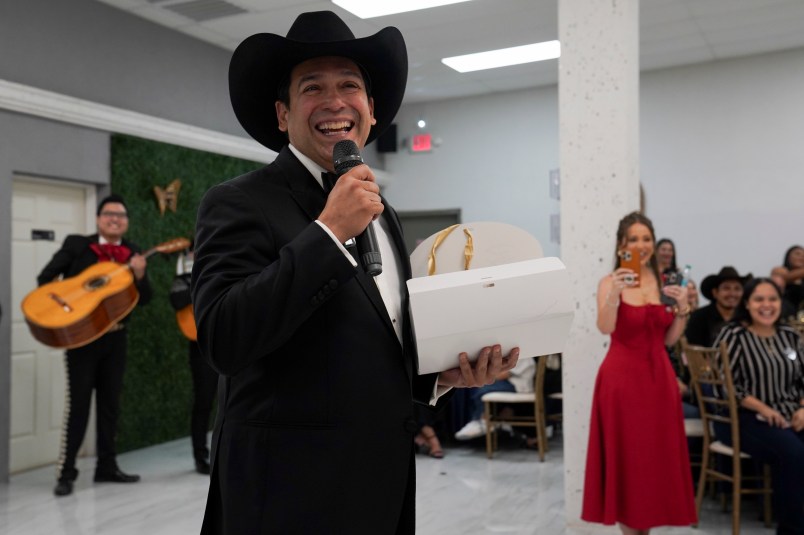
The famed Tejano singer is trying his hand at politics in his home state of Texas, which is a crucial part of Democrats’ pathway to a potential House majority in Washington. And the blue wave that has made those lofty ambitions more and more realistic has been partially fueled by Latino voters’ shift away from President Donald Trump amid mounting anger with ICE and his mass deportation agenda.
For the past month, Texas state Rep. James Talarico and Attorney General Ken Paxton had been competing on roughly equal footing in public attention. The two candidates in what is perhaps the country’s marquee Senate race were being searched for at about the same clip, which is what you would expect of a competitive contest in a state that has not elected a Democrat statewide in decades. Then right-wing influencers invented a story that Talarico had secretly checked into an Ohio psychiatric facility, and the search traffic around the Democrat exploded. The lie collapsed with almost embarrassing speed, and the people who spread it now face potential legal exposure.
But its political purpose was achieved anyway. By the time the story fell apart, the damage had already been done: A candidate’s health had become a national political spectacle, a social media feeding frenzy had swallowed the news cycle and a Republican politician facing serious questions about his own conduct had been handed a convenient distraction.
The Talarico hoax shows exactly how MAGA media governs the information war. While we watched a fake scandal implode, a very real one centering on Paxton slipped by.
This is what Talarico calls the “rage economy.” At a CNN town hall on Wednesday, he described a system in which conspiracy theorists collect clicks, social media platform owners collect profits and the public gets angrier without becoming any better equipped to solve the country’s problems. The Talarico hoax shows exactly how MAGA media governs the information war. While we watched a fake scandal implode, a very real one centering on Paxton slipped by.
The episode began when Talarico spent nine days off the campaign trail recovering from a bout of the flu. There was never any genuine mystery about his whereabouts. He had appeared virtually at an event in early October to inform attendees that he had come down with the illness. But Paxton saw an opening and used it. The attorney general demanded “proof of life” and set up a tip line for information about his opponent’s whereabouts. He led a “Where is James Talarico?” chant at a rally. President Donald Trump posted on Truth Social that “James TalaFREAKo” was “MISSING IN ACTION.”
MAGA influencers filled in the innuendo with the cruelest narrative. Former Los Angeles mayoral candidate Spencer Pratt claimed to have sources who said Talarico was in a psychiatric facility. By Sunday afternoon, the rumor had acquired its supposed smoking gun. Nick Sortor, a conservative influencer known for filming scuffles outside an Immigration and Customs Enforcement facility, and Rhein Amacher, a self-described “right-wing provocateur,” claimed that an employee at the Lindner Center of Hope in Mason, Ohio, had confirmed that Talarico was discharged that evening. Sortor posted a short audio clip, and Elon Musk amplified the claim repeatedly from his account. Within hours, the story had spread across X with millions of views. According to the reporting cited in Talarico’s own account of the episode, 50 accounts pushed the claim within 20 minutes and those posts accumulated 9.3 million views. One account posted the same text 83 times in under two hours.
The problem was that the “proof” was not proof. The full recording, obtained by The Bulwark, revealed that the person on the phone repeatedly denied that anyone named James Talarico was in the hospital system. The candidate said he had never even been to Ohio. The timeline was equally impossible: Amacher said he made the calls on Saturday evening, but Talarico had already appeared at the Austin City Limits Music Festival on Friday and attended a Kacey Musgraves concert the next day. He could not have been discharged from an Ohio psychiatric facility on Saturday because he was visibly back in Texas. By Sunday evening, the hospital itself issued a flat public denial that Talarico had never been a patient.
Naturally, the self-correcting mechanism of truth did not immediately penetrate the right-wing ecosystem. Musk had already supercharged the claim. The falsehood had been viewed millions of times before the correction arrived. Right-wing media figures like Megyn Kelly continued demanding answers even after the hospital issued its official rebuttal, and White House deputy chief of staff Stephen Miller kept conspiracy-posting long after The New York Times reviewed and reported on time-stamped security images proving Talarico was safely at his home in Austin during the disputed window of time.
The initial burst also illustrates how a relatively small number of high-profile accounts can set the agenda for a much larger audience. This is the difference between an information ecosystem that rewards accuracy and one that rewards attention. In the former, a claim becomes more credible as evidence accumulates. In the latter, a claim can become more influential simply because more people have seen it. The only people who benefit from a manufactured outrage are the people selling it and the politicians who can hide behind it.
And hide is precisely what Paxton needed to do. On Monday the Wall Street Journal reported that only days after being indicted for embezzlement, a fugitive donated $25,000 to the attorney general. The paper also reported that Paxton rang in 2025 at a New Year’s party in Dubai attended by two men federal prosecutors had indicted for allegedly embezzling millions from an Illinois hospital. One of those men was Anosh Ahmed, who according to records from the Texas Ethics Commission, gave Paxton $190,000 between 2022 and 2024.
These are the kinds of facts that, in a normal campaign, would dominate the week. A sitting state attorney general taking money from people accused of looting a hospital is a story about who he works for — a man accused of being a criminal or the people of Texas. Instead, it was buried under a fabricated tale about his opponent’s mental health.
To be clear, I am not suggesting that Paxton personally scripted the Ohio hoax. I am saying something that does not require a conspiracy at all. The right has built an incentive structure in which the people with the biggest megaphones are rewarded for flinging dirt and are never penalized when it turns out to be false. Paxton’s own conduct fits that structure like a glove. He fueled the “Talarico is missing” narrative from the stage and through his tip line. He benefited when the fog rolled in. The MAGA influencer ecosystem did the rest. Nobody had to give an order.
Consider also the broader pattern of the attacks on Talarico. A pro-Paxton super PAC ran an ad that placed the Democrat’s face on a cutout in a dress. Allies of Trump have spent months insinuating that Talarico is somehow insufficiently masculine, that he is “beta,” that he is unmarried and that questions about his sexuality are fair game. At a Wednesday rally for Paxton in Tyler, Texas, Vice President JD Vance openly suggested that Talarico is gay. Republicans have even attempted to other him through food, calling him a vegan. (He is not.) Taken together, the mental hospital hoax belongs to the same family of attacks. It is an attempt to make a candidate seem strange and unfit through innuendo because the substance of his message is hard to rebut. A candidate who talks about food and gas prices and community is difficult to caricature as a threat. So MAGA media built a caricature — Talafreako — instead.
Some of it deserves laughter. A man tricking a hospital receptionist is not exactly a criminal mastermind. But the stupidity is the tell, not the excuse. MAGA media do not need smart lies anymore. They need fast ones, repeated at volume across a captured platform and timed to drown out real reporting about real corruption.
Earlier fiascos like Missouri Sen. Eric Schmitt’s Jack Smith flop should have taught them caution. Instead the right has learned from Trump that there is no penalty for being wrong in public — as long as you are wrong at scale and never look back.
In the annals of Texas political mythology is the tale of a young Lyndon B. Johnson, so worried he was going to lose an election that he decided to start a rumor that his opponent enjoyed sexual relations with pigs.
His campaign manager was outraged, telling Johnson no one would believe such a bald-faced lie.
“I know,” Johnson replied, according to legend. “But let’s make the sonofabitch deny it.”
Some six decades later, Republican activists returned to Johnson’s old bag of tricks in an effort to undermine Democratic Senate nominee James Talarico, by falsely telling millions of people he was being treated at a mental health facility in Ohio.
Despite a generation of Republican dominance in Texas, Talarico is running ahead of Ken Paxton, the scandal-plagued attorney general who is costing the party millions to hold a once-safe seat. Polls show Talarico, a Presbyterian pastor and Austin state representative, has so far proven impervious to Paxton’s attacks on his progressive record.
So while Talarico was off the campaign trail recovering from the flu, Paxton and his allies seized an opportunity and sowed a scandal. Paxton alleged that Talarico was having a mental breakdown, and right-wing influencers piled on, linking together unrelated non-events to deduce that he was being treated out of state. The story, largely based on speculation and red string, was echoed by White House officials and shared online millions of times.
Michelle Smith, a senior adviser to Paxton, said on social media Sunday that she was told by a friend that a doctor confirmed Talarico “has definitely been admitted to a mental institution.”
Paxton’s campaign did not respond to a request for comment about his or Smith’s claims.
Talarico was forced to deny that he’d been in mental health treatment — or had ever been to Ohio at all. The health care center confirmed he’d never been a patient. With the story still gaining traction, Talarico provided home security footage to the New York Times to further prove his whereabouts.
Competitive elections are known to get nasty. But the speed at which this conspiracy took hold and was laundered into the mainstream shows the power of social media influencers to shape political discourse through misinformation, especially when empowered by candidates themselves.
“We’ve entered into a time in politics where truth and reality don’t really seem to matter,” said Samuel Woolley, a University of Pittsburgh professor who studies social media disinformation campaigns.
“Tala-freak-out”
The facts everyone agrees on: Talarico attended a campaign event near Dallas on Sept. 26 and fundraisers in New York City on Sept. 28 and 29. The next day, he made a virtual appearance at the U.S. Hispanic Business Council, saying he was too sick with the flu to attend in person.
“I guess I’ve been shaking too many hands on the campaign trail, and so I want to keep everybody safe,” he said at the virtual event. “If I was passing on this illness to somebody and got someone’s grandmother or someone’s baby sick, I couldn’t live with myself.”
But the longer Talarico stayed off the campaign trail, the more those shared facts began to fray.
On Oct. 7, Paxton released an ad saying Talarico had been missing for 11 days. (It had been seven days since the Hispanic Business Council event.) At a rally put on by President Donald Trump that night, Paxton started a chant of “Where is James Talarico?”
“Where do you think they hid that little socialist?” he asked the crowd.
An extended absence from the campaign trail in the home stretch is unusual, said Kirby Goidel, a political scientist at Texas A&M.
“It opens the door to speculation, and the world we live in means you can speculate in a very public way without a lot of friction,” he said. “You can spread misinformation pretty quickly and easily, especially among people who really want to believe it.”
The story Paxton and his supporters landed on was that Talarico was having a mental breakdown from the pressure of the campaign.
Paxton released multiple ads saying Talarico was “mentally fragile,” and posted on social media that he was “having a full-blown mental Tala-freak-out on the national stage.” Paxton set up a “Tala-Freak-Out Tip Line” for people to report on his whereabouts.
Sara Gonzales, a Blaze TV host and conservative social media influencer, posted that she had “unverified information on James Talarico’s whereabouts. If true, it will END his campaign.” Another influencer, who goes by the handle TickleTexts, said Talarico was “in a mental health facility after breaking down.” Spencer Pratt, the former reality television star and former candidate for Los Angeles mayor, said “sources are telling me Talarico is in a mental health facility.”
On Oct. 9, the erstwhile candidate reappeared at the Austin City Limits music festival, seemingly of sound mind and body. That could have been the end of it, a tidy Friday afternoon bow on a week of rank speculation.
But it was not.
“Whether it’s true or not”
Saturday morning, Caroline Wren, a prominent GOP fundraiser, posted about a private plane she claimed flew from Austin to Ohio and back the same day Talarico showed up at ACL. Ohio, she noted, was where Harris County Judge Lina Hidalgo sought mental health treatment for seven weeks in 2023.
“So many coincidences!” she wrote on the post which has almost two million views.
Saturday night, a right-wing influencer named Rhein Amacher said he called the Lindner Center, identifying himself as Tim and purporting to be Talarico’s cousin. Amacher has said on social media that he was initially turned away because he didn’t have a patient identification code, but when he made up four numbers, the facility began confirming patient details.
In the 46-second audio clip, the woman on the other end of the line says that someone named James Talarico was “just discharged this evening.”
How could Talarico have been discharged from a hospital in Ohio Saturday evening and also be at ACL Friday afternoon? Why would an employee at a medical facility violate state and federal privacy laws to give out patient information? Those questions were left in the rearview mirror as some conservatives rushed to amplify the story.
Former Texas GOP chair Abraham George reposted the audio, saying it was “time for Talarico to step aside and focus on his mental health.” White House Deputy Chief of Staff Stephen Miller posted about this over a dozen times in four days, saying in one post that “a Senate candidate with a history of disturbing behavior who suddenly disappears for two weeks has a lot of explaining to do.” Elon Musk claimed the “Talarico campaign is not being honest about what’s happening,” and reposted another user’s post of the audio clip.
Talarico’s campaign repeatedly denied that he had any connection to this mental health facility. Sunday evening, the Lindner Center confirmed on social media that Talarico had never been treated at their facility.
Paxton himself never shared the audio, but Smith, his campaign adviser, amplified the false reports.
Mainstream Texas Republicans didn’t engage; Gov. Greg Abbott, Lt. Gov. Dan Patrick and House Speaker Dustin Burrows ignored it entirely. The handful of state representatives who did jump into the conversation came from the same far-right, extremely online corner of the party. Most reposted vague commentary or made general digs at Talarico’s mental health.
“If you’re a Texas voter who’s just now learning that James Talarico is a mentally unstable liar, you need to reevaluate your trusted news sources. And read your Bible,” State Rep. Brent Money, R-Greenville, posted on Sunday. “Even if Talarico has not been hiding in an in-patient mental health institution for almost 2 weeks, his public statements over his entire political career are evidence of his depravity.”
Money told The Texas Tribune he had no information about Talarico’s whereabouts, but that his “depraved mind is on full display when he fights [to] sterilize children and when he can name his favorite drag queen without a second’s hesitation.”
Goidel said he’s not surprised to see elected officials and prominent leaders amplifying unverified claims like these. There’s “virtually no penalty” to being wrong in politics these days, he said. But the cost to the rest of us is significant.
“It’s one thing to have political disagreement, but you don’t want a campaign decided on misinformation,” he said. “Not if you care about democracy, at least.”
During a discussion on X Sunday, Grant Cardone, a popular finance influencer, congratulated Amacher for surfacing the since-debunked story.
“Whether it’s true or not, people deserve to know the potential of this,” he said.
Disclosure: The New York Times has been a major financial supporter of The Texas Tribune. The Texas Tribune is a nonprofit, nonpartisan news organization that is funded in part by donations from members, foundations and corporate sponsors. Financial supporters play no role in our journalism. Find a complete list of them and more information about our financial and disclosure policies here.
The Wall Street Journal reports that Texas Attorney General and US Senate candidate Ken Paxton faces yet another major scandal. This time it's his partying with fugitives from the DOJ who also happen to be large donors to him.
Greg Abbott is worried. After three terms as Texas governor, the Republican had every reason to believe the office was his as long as he wanted it. But Abbott is now seeing his Democratic opponent, state Rep. Gina Hinojosa, get uncomfortably close to him in the polls. Suddenly, the governor has to be mindful of negative press, something he’s lost practice at in the decade-plus he’s been in office. Abbott avoided a recent campaign stop from Donald Trump, lest he be seen in the vicinity of the unpopular president or Ken Paxton, the Texas attorney general who appears to be facing an uphill battle in his own Senate race against state Rep. James Talarico. The governor is so concerned about his re-election prospects that he recently reversed his position on data centers, which have grown increasingly unpopular, and is now calling for moratoriums and restrictions on their construction. But one issue Abbott hasn’t budged on is his all-out war on public education.
Schools in Texas are wildly underfunded, with hundreds having to reduce students to four days a week. This is very much by Abbott’s design. As Jessica Grose of the New York Times explained on Oct. 7, the governor signed into law a voucher program whose entire purpose is paying parents to take kids out of school and put them into unregulated “alternatives” — such as private schools or homeschooling — that have no real requirements to offer children an actual education. Since local school funding is tied to student head count, this has created a backdoor way to funnel money out of already-struggling public schools.
Watching the governor concoct elaborate schemes to siphon money from beloved local institutions into unregulated religious programs and homeschooling is enraging people, so much so that some lifelong Republican leaders are announcing they will be voting for a Democrat for the first time ever.
Even in deeply conservative rural and suburban areas, Abbott’s policy is unpopular; a June 2026 University of Texas/Texas Politics Project poll found that only 33% of Texans approve of his performance on education. As Grose notes, public schools are the heart of many Texas communities, especially when it comes to high school football. (As a native Texan, I can attest that the “Friday Night Lights” lifestyle is real.) Watching the governor concoct elaborate schemes to siphon money from beloved local institutions into unregulated religious programs and homeschooling is enraging people, so much so that some lifelong Republican leaders are announcing they will be voting for a Democrat for the first time ever. It helps that Hinojosa, whose entrance into holding office was being on the Austin school board, has made saving Texas schools the centerpiece of her campaign.
Considering education is the issue that could sink Abbott, it raises the question: Why not back down? After all, he shifted gears on data centers. But when it comes to this policy, which is undermining and could even start closing beloved local schools, the governor will not budge. To the contrary, he has burned a lot of bridges within the GOP in his war on public schools, backing primary opponents of anti-voucher Republicans in the legislature until he’d tilted the scales to get this done.
Money is the likeliest answer. As Grose notes, Abbott’s war on education is backed by three powerful Texas billionaires — and major conservative donors — Tim Dunn and a pair of brothers, Farris and Dan Wilks. The trio made their fortunes in oil. But their single-minded hatred of public schools is rooted in evangelical Christianity.
“If you ever wonder why state laws and policies are more radical than most Texans would prefer, the answer has a lot to do with Dunn and his checkbook,” Russell Gold wrote in Texas Monthly in 2024. The same is true of the Filks brothers, who share Dunn’s dream of turning Texas into a far-right Christian theocracy.
When not throwing money at Republican politicians willing to back their Christian nationalist agenda, both Dunn and Farris Wilks preach from the pulpit, pushing religious views that are far right of even most evangelicals. Wilks led the Assembly of Yahweh 7th Day Church in Eastland County for 31 years, a congregation where women are apparently forbidden to speak in church. In 2010, he delivered a sermon where he said “our country died” when Barack Obama was elected. “I do believe we live in a nation that will start to vomit some of its people out,” he said of LGBTQ people the following year. Wilks has also preached that all gay people live a “predatorial lifestyle” and “want your children.”
Dunn has backed efforts to rewrite the Constitution to make it more amendable to his Christian nationalist views, which reportedly includes the belief that only conservative Christians should be eligible to hold office. Like Wilks, he has zeroed in on public schools as the great enemy that must be destroyed. Their main weapon has been funding primary opponents against any Republican who opposes them, which has created a state of fear within the party. Few dare cross them — including Abbott.
Through his Midland Bible Church, Dunn founded Midland Classical Academy, which offers a glimpse of his preferred curriculum: anti-science Biblical literalism that will leave kids unprepared for living and working as adults in the real world. The school teaches “the authority of God over every area of life” and structure education along a historical timeline “from the garden to Mesopotamia, from Greece and Rome to the Reformation and beyond.” The intense parental involvement required by the academy sounds incompatible with allowing mothers to have jobs outside of the home.
Abbott’s war on education isn’t just financial or limited to K-12. Republicans “have established strict state controls on what can be taught, researched, and even discussed” in universities, reports The Atlantic’s Adam Serwer. The University of Texas at Austin has been strong-armed into eliminating majors in “Africana studies, Mexican American and Latino studies, women’s and gender studies, and race and migration studies.” Political science professors have been forbidden from discussing the history of racism or the struggle for queer rights. The censorship has grown so severe that one philosophy professor was told to remove Plato’s “the Republic” because the ancient Greek philosopher mentions homosexuality.
Abbott himself doesn’t read as a Christian fundamentalist like Dunn or Wilks. While the governor hits his minimum Republican allotment of God talk, he has also managed to evade a reputation as a rabid evangelical, despite his support for abortion bans and for forcing the Ten Commandments into classrooms. Part of it is his affect, which feels more old-school Republican than Bible-waving preacher. As a Catholic, Abbott has also managed to keep a discrete distance from the evangelicals who are the backbone of the Christian nationalist movement.
But whatever his personal beliefs, Abbott has emerged as one of the GOP’s most loyal soldiers in a movement to turn America into a far-right Christian nation. His benefactors have singled out public education as the biggest obstacle to an illiberal theocratic agenda — and with good reason. Education is power. It’s not just that kids who learn to read and think critically often leave conservative religions, though that is a big fear driving the war on public schools. It’s also that education empowers the majority of Americans who don’t subscribe to fundamentalist Christianity.
If Wilks, Dunn and other far-right billionaires can break public schools, leaving the only options as religious education or none at all, they will turn America into a hellscape. Modern people need education to hold down decent-paying jobs, and civic participation depends on the ability to read, write and reason. A population without the benefits offered by public education would largely be left intellectually, financially and spiritually impoverished — and easier to control.
The Texas Senate race is already off the rails. The Republicans are desperately trying to discourage folks from voting for James Talarico, without reminding them that the candidate they would be voting for is Ken Paxton.
It is great to see Talarico has a sense of humor and understands what it takes to win in the US these days. — Read the rest
President Donald Trump’s motorcade approached 100 mph on wet highways Thursday after bad weather grounded his aircraft — and the president boasted about the high-speed trip in real time.
Trump was traveling from a campaign event at a Peterbilt Motors plant in Denton, Texas, to a rally roughly 90 miles away in Durant, Oklahoma, when stormy weather disrupted his travel plans. The president would typically make the trip by air, but conditions prevented planes and helicopters from landing in Oklahoma.
Rather than postpone the rally, Trump opted for the presidential motorcade.
“The Beast is going faster than it has ever gone before,” Trump wrote on Truth Social, referring to the heavily armored presidential limousine.
Reporters traveling with the president confirmed the unusually speedy trip. A White House press van reached 98 mph at one point as the motorcade traveled north toward Oklahoma, according to Reuters and CBS News.
A little more than 20 minutes after his first post, Trump offered another update.
“I’m almost there Oklahoma — 10 minutes!” he wrote.
Trump ultimately arrived in Durant nearly two hours behind schedule. Once onstage, he gave supporters his own account of the decision to make the drive.
Trump said aides had warned him that the weather was too bad to take either a helicopter or plane and suggested canceling the Oklahoma appearance. He instead asked how fast his presidential limousine could travel.
“We could go close to 100 miles per hour,” Trump recalled being told.
“Get your asses in that car,” Trump said he responded. “We’re going to Oklahoma.”
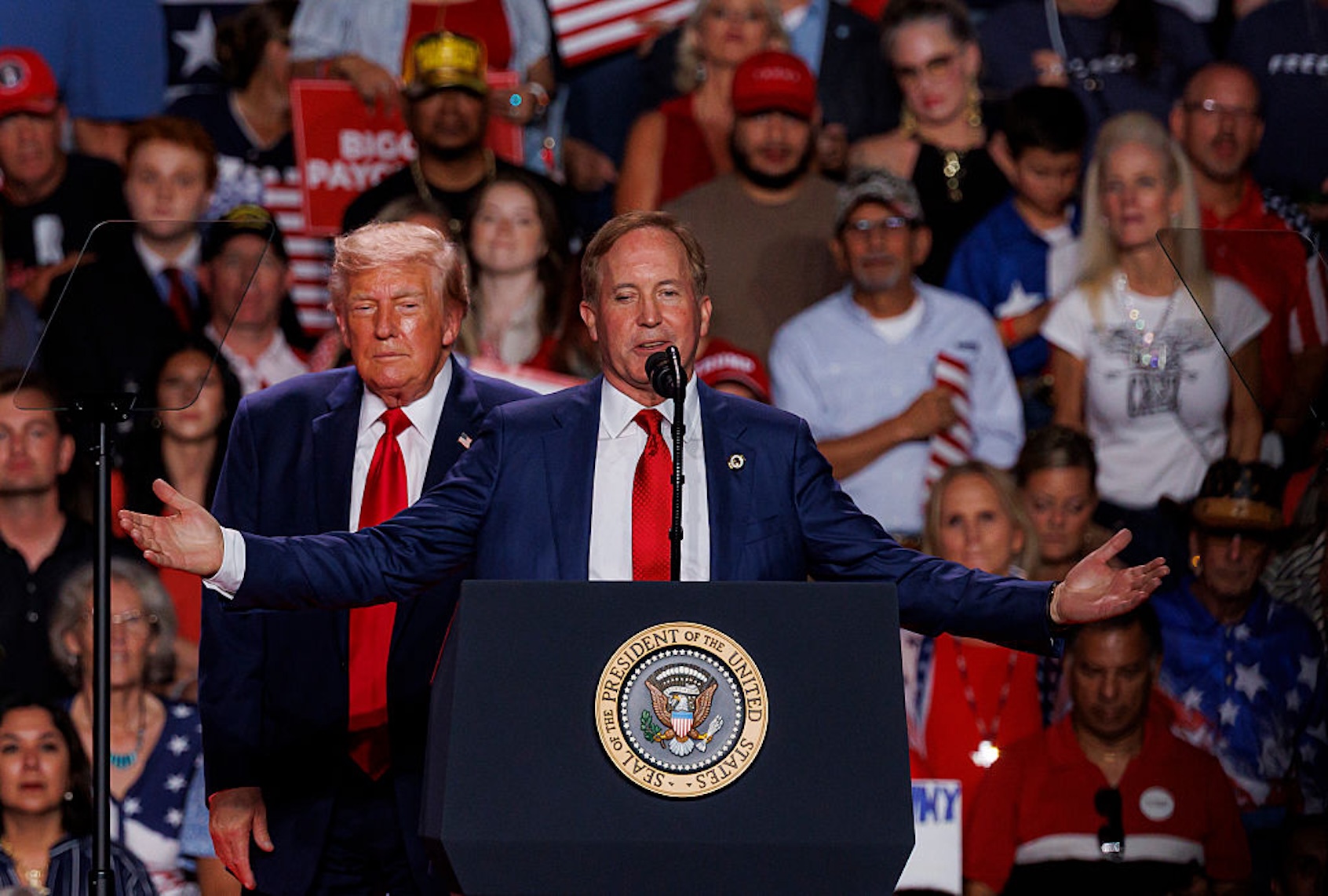
The president was in Oklahoma as part of a 32-day campaign blitz ahead of the Nov. 3 midterm elections, campaigning in Durant for Republican gubernatorial candidate Mike Mazzei and U.S. Senate candidate Kevin Hern after appearing with Republican Senate candidate Ken Paxton in Texas.
Trump said he refused to skip Oklahoma in part because of his electoral history in the state, telling the crowd that he had won all 77 counties in each of his three presidential campaigns.
No injuries were reported during the high-speed motorcade. Trump did not provide a measured speed for the Beast itself. The speed limits on the roads between the two cities range from 45 mph to 75 mph depending on the stretch of road.
In an attempt to shame the Texas senatorial candidate, who is not accused of bribery or securities fraud, Dementia Donnie keeps calling the omnivorous James Talarico a "vagan."
The number one way we know James Talarico isn't a "vagan" is because he isn't constantly telling us how ethical he is for being one. — Read the rest
MCALLEN, Texas — Vanessa Ovalle has a “frontline view” of Texas schools as a single mom and a speech pathologist at a local school in McAllen, a city in the Rio Grande Valley bordering Mexico. Ovalle described the state’s education system as “completely disappointing.”
In nearby Welasco, Catalina Ozuna said her daughter is working in an understaffed kindergarten classroom for little pay while being weighed down by the cost of daycare for her own child.
Meredith Keller, who for over a decade presided over a local school board south of Austin, calls a new voucher program that allows parents to use public dollars for private school “a slap in the face to everyone who went to public school.”
These Texas voters all have two things in common: They have backed Republican Gov. Greg Abbott in the past and are now throwing their support behind Democrat Gina Hinojosa in the November election, driven by concerns about the state of public education.
In this Republican bastion, angst over the state’s public education system has helped fuel Hinojosa’s campaign, giving voters here one of the most competitive governor’s races they’ve seen in decades.
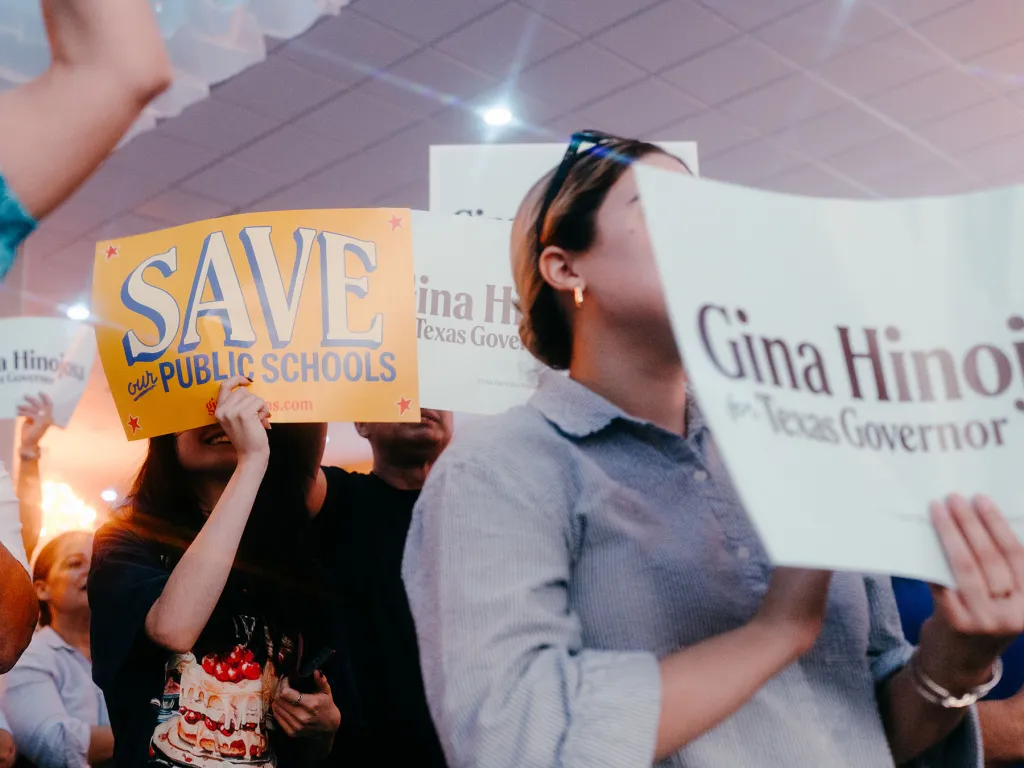
That a Democrat has a chance is a welcome surprise for voters like Maria Colmenero, 32, who stood at the back of an Hinojosa rally this month in Brownsville, a town along the Mexican border, holding one of the campaign’s school-bus-yellow “Save Our Schools” placards.
Colmenero said the main issue driving her support for Hinojosa is the state of public schools in Texas. She said she’s homeschooling her three daughters because the local public school options just “weren’t up to par.”
“That’s the major thing for us, and I truly believe that if you pay the teachers more, if you have a better education curriculum, that it could be so much better for the kids and for everybody,” Colmenero said.
“We told them that if she wins, ‘Y’all can actually go back to school, a public school,’ and they’re excited. They want her to win. We all want her to win.”
In Texas, the rollout of a $1 billion school voucher program allowing parents to use public school dollars to cover some of the cost of private schools led to backlash as neighborhood public schools closed or shifted to four-day schedules, while others struggled with persistent teacher shortages. Hinojosa has promised to end the voucher program, increase teacher pay and “DOGE” the state’s education agency by ending no-bid contracts to education vendors and curbing the size of the agency. Hinojosa has also promised to stop state takeovers of local school districts and has criticized the use of artificial intelligence in the classroom.
Hinojosa got her start in politics by fighting the closure of her son’s local public school. She ran on the success of that fight to become a member of her local school board in Austin. She now represents a central Austin district in the Texas House, where she’s worked on a wide set of education issues, from directing more tax dollars to neighborhood public schools to curbing standardized testing.
Democratic candidate for Texas Governor Gina Hinojosa in Brownsville, Texas on September 15, 2026.
(Brenda Bazán for The 19th)
“I was told at the beginning, ‘You talk too much about education,’” Hinojosa told The 19th. “Well, I’m going to talk about it some more. I’m a mom, and I have a son who is 21 and I have a son who is 14, and I have seen the deterioration of our public schools in that time. And I know, I know that the parents and the teachers are just trying to hold it together.”
Toward the end of her younger son’s time in elementary school, Hinojosa said, during Abbott’s second term as governor, administrators simply couldn’t find a teacher for his class. They ended up splitting the class and assigning more students to other teachers, she said. “That’s how bad it was.”
In a campaign swing through the Rio Grande Valley, a heavily Latino part of the state, Hinojosa worked to shore up support among Latino voters preoccupied with the state of public education. All of the counties that make up the Valley swung for President Donald Trump in 2024 by double-digit margins, but polling shows that collapsing support for the GOP among Latinos could reverse that trend.
Ovalle, the speech pathologist, said she previously supported Abbott and typically stands “closely toward the right” politically. But at Hinojosa’s rally in McAllen this month, Ovalle was nodding along with the Democratic candidate, recording clips of her stump speech. Asked which part of Hinojosa’s message resonated the most, Ovalle said it was her comments on education.
“I work at the school setting … I see what our educators go through, and it is completely disappointing to see how hard they work and how they are being failed by the system,” she said. “I’m not only fighting for myself, but fighting for them as a whole.”
Ozuna came to see Hinojosa at a breakfast with Tejano Democrats this month — a standing-room-only event inside an Hidalgo County restaurant where voters got to meet the candidate over tacos locos and huevos a la mexicana. Republicans won over a majority of voters in Hidalgo in 2024 with a 20-point swing for the GOP. Ozuna said that her daughter, the kindergarten teacher, holds a college degree and is working toward becoming a certified teacher but has struggled to get through a series of financial hoops. She had to take on a three-month unpaid internship in a classroom and several thousand dollars in fees for her certification. That’s on top of a high daycare bill.
Watching her daughter’s journey next to headlines about chronic teacher shortages made her pay more attention to Hinojosa, who has promised to boost teacher pay and direct more dollars to public education. Ozuna has supported Abbott in the past, but not this cycle. “We know that she’s not going to let anybody control her, and that’s what we need,” Ozuna said.
Hinojosa isn’t the only Democrat who has worked to define the issue of public education, avoiding the GOP’s framing of it as a culture war battle. Last fall, Virginia Democrat Abigail Spanberger flipped control of the governor’s mansion by promising to make the state’s schools “the best public schools in the nation,” while criticizing Republicans for “eroding faith in our public schools” and opposing Republican efforts to bring vouchers to her state. Their playbook could help Democrats chart a path forward on the issue ahead of the 2028 election.
By tapping into frustration with the state’s education system, Hinojosa said, she has been able to attract voters in a state where political loyalties run deep. Keller, the former school board member, said she has long been dissatisfied with the way Republicans have run the state’s public education system. She’s been speaking at campaign events with Hinojosa, hoping to create a permission structure for other Republicans to back the Democrat.
“I was silent about my choice for a very long time, just because people are so ugly, and then I realized I needed to say it out loud. I needed to tell everybody: ‘I did vote for Greg Abbott, and that was a mistake. This time I am voting for Gina Hinojosa,’” Keller said.
Hinojosa made clear that the coalition she’s building around her education agenda isn’t about turning Republicans into Democrats.
Democratic candidate for Texas Governor Gina Hinojosa in Brownsville, Texas on September 15, 2026. (Brenda Bazán for The 19th)
“I think we are coming into a time when people have been disappointed by both parties, and it creates space and opportunity for people just to vote for the candidate. And I have built credibility on the issue of public education,” Hinojosa said.
One of those voters is Lynn Davenport, 55, who described herself as a “staunch conservative” in a new campaign ad for Hinojosa that began airing over the weekend across the state. Davenport’s journey from being a Trump supporter who attended his January 6 rally to protest the results of the 2020 election to becoming an Hinojosa voter is a long one, but she made clear that the issue that moved her to the left on this particular race is education.
Davenport first met Hinojosa when she started advocating in the state legislature to fight back against the sudden expansion of standardized testing in her kids’ schools and other legislation that she says “privatizes” public education by giving contracts to outside organizations for education services. A stay-at-home mom to three kids in Dallas at the time, she grew worried watching her youngest son come home crying after testing, and watching the climate of the school change. Years later, she said the same dynamics have yielded a system of vouchers and charter schools that “divert money from public schools to private hands” and robs parents of their choice school being their neighborhood school.
Education isn’t the only issue on voters’ minds. The high cost of living, data centers, Trump’s unpopularity and the GOP’s struggles with Latinos have all helped create openings for Democrats here. Recent polling shows Democratic U.S. Senate candidate James Talarico pulling ahead of scandal-plagued Republican Attorney General Ken Paxton. The tight race will be one of a handful that will decide control of the U.S. Senate, which could help lift up Hinojosa.
Davenport isn’t planning to switch parties, and she’s not supporting Talarico in November. (That’s in part due to his comments about giving religions “equal time,” in Texas’ school curriculum when the GOP was working to insert more Christianity.)
For Davenport, it’s about education, and Hinojosa herself. In the legislature, she said, Hinojosa was among the Democrats who “would listen to the moms and the parents.”
“I know she more aligns with the Democrat Party, obviously, so we don’t agree on everything,” Davenport said of Hinojosa. “But on this subject, we do.”
The big story coming out of the 2024 election was how Donald Trump orchestrated a realignment of American politics, bringing demographic groups that had long eschewed the Republican Party into the tent. Latinos, Black voters and young people, mostly males, had voted for him and the GOP in larger numbers than anyone could remember, and it was seen in some quarters as a sign that the party was embarking on a thousand-year reign. Conventional wisdom held that Trump was something of a magical figure who had defied the odds, defeated the majority of the legal and political efforts to hold him accountable, and triumphantly returned to power.
Many attributed the president’s success to a new political power on the block — the so-called manosphere, consisting of male podcasters with millions of followers who had enthusiastically endorsed Trump. Many pundits said that Kamala Harris lost the race because she didn’t try hard enough to appeal to these influencers, even though many are heavily misogynistic and wouldn’t have been open to her candidacy in any case. Their juvenile humor and oppositional defiance also happened, incidentally, to be perfectly matched to Trump’s sophomoric style.
However, like transgressive boys everywhere, they have a short attention span; Trump has not turned out to be as fun as they thought he would be. Although anecdotal evidence suggests they have been less fervent followers of the president for several months now, The Wall Street Journal analyzed nearly 70,000 hours of podcasts to see if it was true. What they found was revealing: “Mentions of Trump’s name per hour on conservative podcasts have fallen nearly 70% from their peak in the run-up to the 2024 election.” Many are publicly unhappy with the economy and the war, both of which are seen as broken promises and could account for the decline in mentions, but the hosts are mostly spending their time trashing Democrats like James Talarico, the Texas state representative who is running for the Senate and may just win. (Significantly, the king of the manosphere, podcaster Joe Rogan, is actually a fan of Talarico.)
There are some other big names in the podcasting world, like Tucker Carlson and Megyn Kelly, who are now openly antagonistic toward Trump, mostly for opportunistic reasons. The pair are among the early crowd jostling for power within the post-Trump right-wing ecosystem. Kelly has railed against the Trump family’s alleged corruption, while Carlson appears to be positioning himself as a presidential candidate, with his iconoclastic takes on a number of issues and increasing talk of a third-party bid. He recently told NPR that Trump should be removed from office.
But mainstream conservative media is still largely on board the Trump train, although Fox News’ firing of Maria Bartiromo for coordinating with the White House — hilarious as the network’s outrage is, considering the cozy relationships between the president and Fox hosts Sean Hannity and Laura Ingraham — and its decision to stand against Trump in support of CNN, MS NOW and POLITICO has revealed a schism. The Rupert Murdoch-owned Wall Street Journal has also been pulling no punches throughout the second term.
But what of the Republican establishment? Since Trump’s exultant victory in 2024, they have behaved as if he were ordained by God to be America’s reigning monarch, omnipotent and infallible. Republican governors have largely abdicated their own roles as one of the Constitution’s checks and balances, agreeing to give up their own sovereignty to serve his agenda, while the GOP majorities in Congress have proven to be nothing more than trained seals happily signing on to the president’s usurpation of their own power.
Until quite recently, there was no shaking the hold Trump had on the GOP base. They were willing to believe that everything wrong in the country was the fault of former president Joe Biden, and that Trump was left with a massive disaster he had to clean up. The truth, of course, was the opposite.
But you can’t really blame them. Until quite recently, there was no shaking the hold Trump had on the GOP base. They were willing to believe that everything wrong in the country was the fault of former president Joe Biden, and that Trump was left with a massive disaster he had to clean up. The truth, of course, was the opposite. He actually inherited a recovering economy — dubbed “the envy of the world” in 2024 by The Economist — and newfound global respect. If Trump had done nothing and simply continued the policies that were already in place — and then taken credit for them, as he is wont to do — he would be in a different position today. But he surrounded himself with radicals and sycophants, and he believed his own hype. The results have been a disaster.
As Republicans prepare to face the voters in the November midterms, they are finding out that the “magical” Trump mystique was actually luck and hot air. Reality still exists, and it bites. Hard.
As we head into the final month before the election, the polls appear very bad for Republicans. The House majority is almost certainly gone, and the Senate is increasingly in play, something that wasn’t seriously contemplated six months ago. The president’s approval ratings are in the low to mid-30s, and his ratings on the most important issues of the economy and the Iran war are even worse. Gasoline and diesel prices have turned the two big promises Trump made — to lower prices and keep the nation out of wars — into epic failures, and voters are livid.
Suddenly, GOP candidates are running for the hills. Candidates in tight races in battleground and red states — including Mike Rogers, who is running for the Senate in Michigan against Democratic nominee Dr. Abdul El-Sayed in Michigan, and Rep. Ashley Hinson, who faces Josh Turek, a Democrat, in Iowa — are saying the Iran war must end. (As the New York Times pointed out, Hinson was among seven House Republicans who recently supported a resolution calling on the president to stop or seek congressional approval for military action in Iran.) Others are scrubbing or downplaying endorsements by or mentions of the presidents on their campaign websites. According to The Washington Post, Mike Beltran, the Republican nominee running against Rep. Kathy Castor, D-Fla., touted on his website earlier this year how he had “stood with President Trump every step of the way.” That language has now vanished, along with photos of Trump and references to “America First.” At least seven other GOP congressional candidates, reported the Post, are doing the same. One Florida Republican. Rep. Maria Elvira Salazar, has even publicly condemned the president for elements of his radical deportation policy.
Historically, this is common. Midterms are notoriously hard on the party in power, and presidents usually take the blame. Often, the approved strategy is for candidates to go ahead and distance themselves from the president, and try to win their races by portraying themselves as independent thinkers who will not rubber-stamp the unpopular majority’s agenda. Whether it’s Bush in 2006 or Obama in 2014, close midterm races almost always feature some version of that same sales pitch. The only exception in recent years I can think of is 1998, when the GOP’s threats to impeach President Bill Clinton over the findings of the Starr Report with regard to his relationship with Monica Lewinsky blew back on them, costing them seats and resulting in the resignation of the House Speaker Newt Gingrich in disgrace.
But this time it is especially jarring considering the fealty Republicans have been required to show their leader — and have willingly given him — until now. That loyalty ended up not helping Texas Sen. John Cornyn, who lost his primary just a few months ago when Trump endorsed his opponent in retribution after Cornyn waited too long to endorse him in 2024. As the midterm campaign has unfolded, it’s belatedly become clear to many Republicans that standing with Trump may be riskier, even among the party’s base, than standing against him.
But they have a problem. The president won’t shut up. To the chagrin of most of his own party, he is insisting on making the midterms all about him. A narcissist to the core, Trump believes that the only way Republicans win in November is if he is out there bragging and blaming and lying as he always does, because that has been the secret sauce that brings out MAGA voters. He has even released a taxpayer-funded propaganda ad — which is illegal — touting his alleged accomplishments.
No one should mistake the Republican retreat from Trump as a full-scale rebellion. Instead, it’s a tepid, last-minute attempt on the part of some desperate candidates to show independence, knowing they may lose anyway — and that the president will say it’s because they didn’t support him enough anyway. The Republican Senate had a chance to take a stand on one of the biggest issues in the campaign, and the one that’s causing the most pain for average voters: Iran. On Thursday they voted down a resolution to end the war. The tally was 50-49. When it comes to putting their votes where their mouths are, it’s clear they will default to Trump as always. Voters, though, are finally seeing through them.
A daycare in Fort Worth, Texas, is being sued after a substitute teacher allegedly encouraged 4-year-olds to fight one another, and herself injured one of them. Surveillance video from the Arka Montessori Academy shows the incident clearly, and KDFW News reports that the state "confirmed the child suffered physical injuries and emotional distress" and cited the daycare 16 times since it opened in 2024. — Read the rest
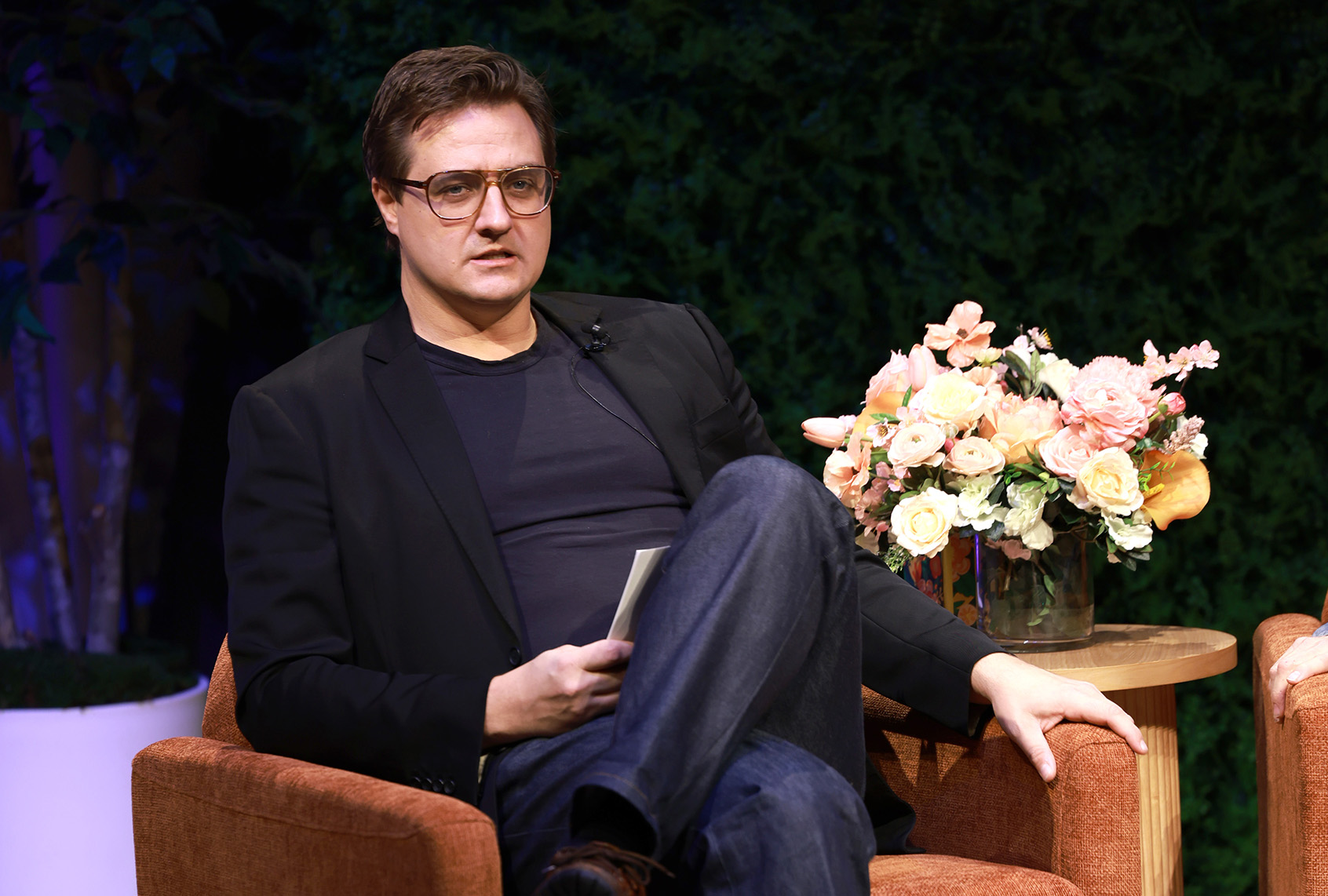
When MS NOW heads to Arlington, Texas, on Saturday, Sept. 26, for “MS NOW Live: Together in Texas,” host Chris Hayes will be stepping into an environment he finds both familiar and necessary. For Hayes, host of “All In with Chris Hayes” and author of “The Sirens’ Call: How Attention Became the World’s Most Endangered Resource,” gathering face-to-face with his audience isn’t just network promotion — it’s nurturing the one thing he has left in a media environment defined by change.
“I love live events,” he told me in an interview ahead of the event, describing having “a head start” on the live-events model with book tours and podcast live shows. “There’s a great energy that comes from being in a room with people. I think it’s a different energy than anything else, particularly true and truer every day in the increasingly screen-based and mediated world.”
Held at the College Park Center at the University of Texas at Arlington, MS NOW’s day-long fan event brings together 15 of the network’s top anchors — including Rachel Maddow, Lawrence O’Donnell and Jen Psaki — for in-depth conversations with thousands of Texas viewers ahead of the November midterms.
Hayes will arrive in Texas with a deep respect for his viewers, whom he calls “sophisticated and informed” about the issues — from Democratic hopes surrounding state Rep. James Talarico’s Senate campaign to fights over data centers, development and the future of Texas communities. But he will also be bringing a theory of what’s been happening in the Lone Star State over the past several years. Describing the state as, “on its own terms,” perhaps the country’s most successful laboratory for right-wing policy, Hayes said that Texas’ long-running Republican experiment has produced a contradiction: Policies that helped make Texas affordable, fast-growing and attractive to newcomers are also changing the electorate and straining the coalition that built the model in the first place.
Hayes said that Texas’ long-running Republican experiment has produced a contradiction: Policies that helped make Texas affordable, fast-growing and attractive to newcomers are also changing the electorate and straining the coalition that built the model in the first place.
“There [are] certain parts about the Texas model that have genuinely been successful,” Hayes conceded. “Housing is pretty cheap. It’s been pretty fast-growing, and in that cheap housing and fast-growing, it’s a place that’s diversifying, and a lot of immigrants have made a life there.”
But the state’s Republican leadership has to face reality: “If people want to move to Texas, which a lot of people do, then the state’s composition is going to change,” he said. The same in-migration fueling the Texas boom is also, in some measure, quietly padding the GOP’s own coalition. “[The state GOP] have a very ambiguous, ambivalent relationship to that.”
This tension surfaced most recently in the backlash to social-media posts by former Tarrant County GOP Chair Bo French, a candidate for the Texas Railroad Commission, a state agency with a remit that goes beyond its name, regulating oil, gas, alternative fuels, pipeline safety, and surface mining and reclamation. French posted a photo on X after Texas’ upset win over Ohio State showing University of Texas students — many of them South Asian — in the stands, and appeared to condemn a changing, more diverse Texas. Hayes said the response from prominent Texas Republicans, including Sen. John Cornyn and former George W. Bush adviser Karl Rove, was partly about the political consequences of alienating the growing number of South Asian Texans, some of whom may already be conservative or Republican-leaning.
“I wouldn’t be surprised if the people in the photo are Republicans,” Hayes said, referring to the image French criticized. “This is Texas.”
Hayes sees Talarico as a serious test of whether that opening can be exploited into statewide electoral gains for Democrats. “Talarico, I think, is a strong candidate, and I think he’s got a real shot,” he said. Texas Democrats still need “a whole bunch of things to break the right way” to win statewide, he cautioned, calling Texas “the great white whale” of statewide Democratic politics — a state the party hasn’t won in three decades. But this cycle, Hayes argued, offers real structural openings. Ken Paxton, he said, is “a worse candidate” than even Sen. Ted Cruz; he isn’t an incumbent and lacks basic retail political skills. “He’s a real dud on the campaign trail,” Hayes noted, adding that Trump himself may be reassessing his endorsement calculus in real time.
Against that backdrop, Hayes was direct about Republican efforts to turn Talarico’s faith and masculinity into political liabilities. “They are all but calling him a gay slur,” he said of the GOP’s campaign against him, adding that the assault on Talarico’s masculinity “reeks of desperation.”
Hayes did not dismiss the possibility that Paxton and the GOP’s attacks on Talarico could work with some voters, particularly in a polarized environment where campaigns often seek less to persuade than to cement partisan loyalties. “You just need to snap people back to their fundamental, their partisan fundamentals,” he said. A Republican voter who may have doubts about a candidate can still be nudged toward the familiar conclusion: “I don’t really like the Democrat. Those aren’t my people.’”
But Talarico, Hayes suggested, may be better positioned than past Democratic efforts to resist that hyper-partisan reflex. What makes Talarico’s race worth watching this cycle, in Hayes’ framing, is less about the candidate himself than about the structural gap that’s opened up on the other side. He noted that Democrats haven’t come this close in decades: Beto O’Rourke’s 2018 run against Cruz, he noted, came down to roughly “2.3 points” — the modern high-water mark for a statewide Texas Democrat. “Talarico has run a phenomenal race, and he’s a really good candidate.”
While Hayes expects the midterms to dominate the conversation in Arlington this weekend, audience members, he said, often arrive with their own closely held theories about what messages Democrats should use — and what could stop what he called “the desecration of our country” by Donald Trump. He anticipates intense interest in artificial intelligence and the infrastructure behind it, particularly data centers. The issue, Hayes said, has become more salient to his audience in recent weeks as AI tools have visibly improved and communities are increasingly confronting the land, water, power and development demands associated with data center construction.
“The data center issue really gets something deep in people,” he said. “I think Texas is an interesting place for it.”
Along with Georgia and Virginia, the Lone Star State has become central to the national conversation around data centers. It’s become a wedge issue in at least one Texas congressional race — alongside anger over the Trump administration’s attempt, which has been temporarily halted, to build a border wall in Big Bend National Park, and broader frustration with Republican Gov. Greg Abbott. (On Monday, Abbott ordered the state’s environmental regulators to stop approving permits for the construction of new data centers pending an electrical audit.) Hayes compared the reaction to a form of territorial politics. “It’s territorial in a literal physical sense — the ground, your backyard, your community, the park that you love.”
For Hayes, the Texas event is a chance to hear directly from people confronting the physical consequences of the state’s rapid development. The event also offers Hayes an opportunity to put into practice the central concern of his book, “The Sirens’ Call,” which examines how digital platforms commodify attention. MS NOW’s live event asks whether journalism can build something more durable than a click or a fleeting social-media interaction.
“I like people,” Hayes said. “I feel energized by them.” Such direct relationships, he stressed, are the core asset of modern journalism, even as tech platforms continually insert themselves between news outlets and their readers and viewers through algorithm tweaks. “As everything gets kind of disintermediated and chopped and screwed, and the platforms insert themselves between you and the audience,” he said, “what do you have? You have the people that like and respect your work . . . Nurturing that is pretty darn important.”
All politics are identity politics. Republicans have long mocked this notion, treating the very concept of “identity politics” as a left-wing fixation. In reality, the GOP’s success is entirely due to the cheapest form of identity politics: For decades, but especially now, they have worked to distract voters from the party’s ruinous policies with appeals to their identity as white, provincial and, most importantly, Christian. This campaign has been enormously successful. White evangelicals have been the backbone of the GOP for decades not because they love tax cuts for the rich and environmental degradation, but because they have been told, repeatedly, that Democrats are demonic and there is no such thing as a liberal Christian.
This is why there’s a growing panic in the Republican ranks over the campaign of James Talarico, the Democratic nominee for the U.S. Senate in Texas, and it’s not just fear that he could beat Ken Paxton, the state’s Republican attorney general. Win or lose, Talarico — a seminary student-turned-politician — embodies an existential threat to the right’s long-standing myth that to be Christian must necessarily mean voting Republican.
“As a young evangelical we were taught repeatedly and clearly: It is not possible to be a Christian and a Democrat,” Brad Onishi, a research associate at the University of California, Berkeley and co-host of the “Straight White American Jesus” podcast, told me. “But candidates like Talarico are changing that. His theological acumen and keen ability to use the language of the New Testament to disarm bad-faith religious attacks is showing a new way forward.”
Most white evangelicals believe “you cannot ever vote for a Democrat because they hate you,” explained April Ajoy, a former Christian nationalist turned liberal Christian, on her YouTube channel Wednesday. Part of her deconstruction journey, she said, meant rejecting the belief that “Christians cannot vote Democrat.”
As Ajoy pointed out, if one looks past the tribalist loyalties, Democrats should be a better fit for people who claim allegiance to Jesus Christ, who called on followers to feed the hungry and welcome the stranger. But tribalist identity politics are what really matters. White evangelical leaders keep their flocks voting for Republicans by implying that they are somehow abandoning the identity of “Christian” if they choose to vote for Democrats. The fact that many Democratic politicians are also Christian doesn’t register because they usually don’t foreground their religious identity in the same way as Republicans, who wave Bibles and pray loudly.
For white evangelicals experiencing doubts about MAGA politics, Talarico is a role model for how to be a liberal without giving up their faith, or even a conservative aesthetic.
Talarico, though, has centered his Christian identity in his campaign. It’s not just that he regularly quotes scripture or speaks openly of his faith. His biography reads far more like that of a right-wing evangelical than the liberal Democrat he is. He studied theology at Austin Presbyterian Theological Seminary and is the grandson of a Baptist preacher. He gives off Boy Scout vibes with his earnest tones and short haircut. He even grew up in Round Rock, a suburb of Austin that has shifted left in recent years, but that used to be infamous for its right-wing politics. For white evangelicals experiencing doubts about MAGA politics, Talarico is a role model for how to be a liberal without giving up their faith, or even a conservative aesthetic.
Many Christian right leaders understand that, even if Talarico can’t pull off a miracle win in Texas, his campaign and fame is a long-term threat to their cause. The reaction from white evangelical influencers to him isn’t just about disagreeing with him politically. They are actively trying to discredit his identity as a Christian.
“They are people who are walking into churches and walking into the lives of Christians with the demonic specific intent to deceive Christians and advance evil and destroy their faith,” said Josh Howerton, a popular podcaster who serves as senior pastor of the Dallas-based Lakepointe Church. He went on to mock Talarico’s “reverend vibe,” calling him a “false teacher.”
In April, Trump-loving evangelical podcaster Eric Metaxas insisted that Talarico’s faith is a left-wing hoax. “They don’t they don’t openly say we worship Satan and we hate your savior,” he said. “No, they pretend to be more Christian.”
“[Talarico] is not a Christian man,” his guest Megan Basham, a self-declared “unabashed church lady,” agreed. She noted that “Satan” can say Christian-sounding things, but that “doesn’t make him Christian.”
But the headline of an episode of evangelical podcaster Allie Beth Stuckey’s show was perhaps the most inflammatory: “James Talarico is More Demonic Than You Think.” Stuckey, who has attacked empathy as “toxic,” warned viewers and listeners that “Satan disguises himself as an angel of light. Satan looks good. He sounds good.” Talarico, she said, is “evil disguised as goodness.”
If this were just about the outcome of a single Senate race — one in which Talarico is still an underdog, despite strong poll numbers — there would be no need for this extreme rhetoric equating him to Satan, calling him demonic and denying that he’s a real Christian. The GOP’s panicked reaction is about much more than one election. As Howerton declared, there are only “two types” of Christians, “Christian conservatives and conservative Christians.” They do not want their followers peeking behind door number three.
The religious right has good reason to worry that some of their followers could be tempted by Talarico’s message that liberal Christians are a real thing. Already, churches are losing power because their fidelity to the GOP over Christ’s message of love and compassion. A recent study from the Billy Graham Center Research Institute at the evangelical Wheaton College shows that nearly half of Gen Z respondents agreed with the statement “Christians’ support of Trump has made me less likely to go to church.”
Many people have left religion altogether rather than try to deal with the dissonance between Trump’s hateful message and the Christian call to love. Others have struggled, not wanting to abandon their faith or community over political disagreements. As Ajoy and Onishi explained, they instead squelch their doubts and fall in line. This is why Talarico is such a potent threat, far beyond November. Even if he loses his election, he’s made it much harder for the right to convince their followers that being a Christian means voting Republican.
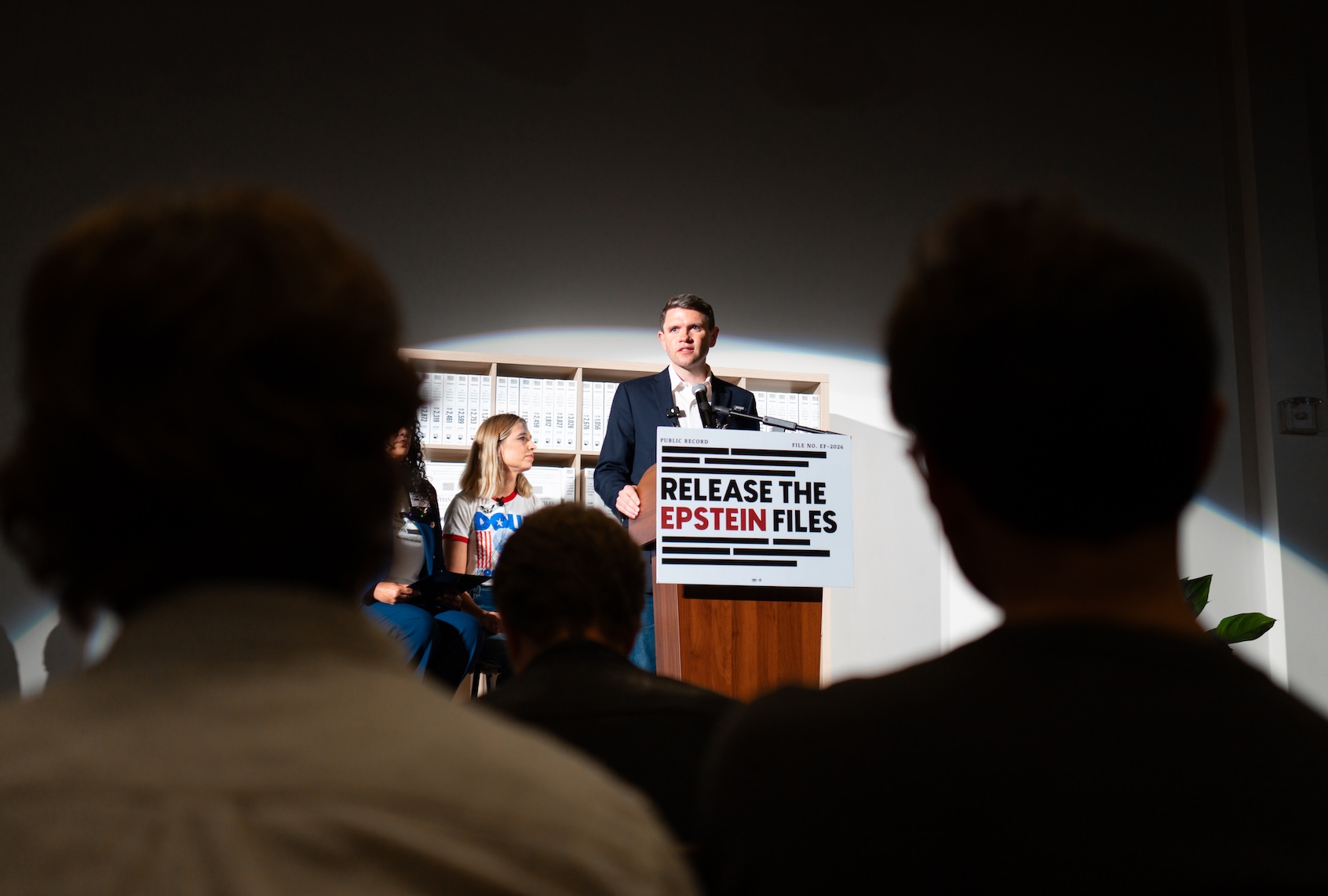
As Republicans gathered in Dallas, Texas for their pre-midterm convention last week, Democratic Senate nominee James Talarico focused on survivors of Jeffrey Epstein.
Talarico got a tour of the Reading Room, a traveling exhibit of the nearly 3 million files that the Department of Justice released from its investigation into the late disgraced financier and convicted sex offender — the result of a hard-fought battle by survivors of Epstein’s abuse who are still seeking justice and transparency from a government they say repeatedly failed them.
Speaking alongside Epstein survivors Annie Farmer and Sharlene Rochard, Talarico praised them for their courage in coming forward and attacked his Republican opponent, Texas Attorney General Ken Paxton, for not meeting with the survivors and what he said was “a history of covering up abuse.” Talarico called on Paxton to use his authority to sue the Justice Department over its handling of the release of the files connected to Epstein, who died in prison in 2019 while awaiting trial for federal sex trafficking charges.
“When did pedophilia become a partisan issue? When did holding sexual abusers accountable become controversial? When did Ken Paxton decide it was OK to ignore these survivors?” Talarico said.
“I am tired of seeing powerful people cover up abuse. I think we’re all tired of it — Democrats, Republicans and independents alike,” he added.
Republicans currently enjoy an advantage as the party voters trust more on crime — 45 percent of voters said they trusted the GOP the most on the issue in a 2025 Pew Research Center survey, up from 40 percent in 2023. It’s typically been GOP candidates who have run attack ads hitting their opponents as being “soft” on crime. But the dynamics around crime messaging have shifted with the national spotlight on the Epstein files and the bipartisan push for more accountability for Epstein’s crimes — an issue that Democratic strategists and pollsters say has rare, high levels of crossover support.
And Democrats in races from Arizona to North Carolina are attacking their Republican opponents for their votes not just on the Epstein files, but on their ties to other sex offenders and their records on cases of sexual abuse.
In Texas’ Senate race, Talarico has also slammed Paxton for his office offering what he called an “Epstein-style” plea deal to a defendant, Waco attorney Adam Hoffman, who was charged with sexually abusing a minor. After Hoffman’s trial ended in a hung jury, the prosecution offered a deal that would have allowed him to serve just one day in jail, which sparked public outrage and was rejected by the judge in the case. Hoffman eventually pleaded guilty to misdemeanor charges and was sentenced to 60 days in jail but was not required to register as a sex offender.
In a letter to a Republican state lawmaker earlier this year, the career prosecutors who tried the case said the outcome was in the best interest of the child victim, who did not wish to voluntarily testify in a second trial.
The day after the GOP convention last week, Talarico’s campaign debuted a new television ad attacking Paxton over the plea deal.
“Ken Paxton’s corruption endangers our kids,” the ad says. “We don’t need any more pedophile protectors in Washington.”
Paxton’s campaign responded by highlighting a pro-Talarico super PAC taking $11.5 million in donations from Reid Hoffman, a venture capitalist, tech founder and Democratic megadonor who crossed paths with Epstein through his work with the MIT Media Lab in the 2010s, after Epstein became a convicted sex offender. Hoffman apologized in 2019 for associating with Epstein.
“James Talarico continues to lie to Texans about his radical record with the help of Epstein money. It’s disgusting that the man claiming to run a campaign against billionaires is bought and paid for by Epstein’s billionaire buddy,” Paxton campaign spokesperson Madison Cercy said in a statement to The 19th.
President Donald Trump, who spoke both nights at the Dallas convention and has backed Paxton, also had ties to Epstein, but he says they stopped associating well before Epstein became a convicted sex offender. Trump himself in 2024 was found guilty of falsifying business records, and in 2023 was found liable for sexual abuse in a case over accusations from the 1990s.
Also last week, the North Carolina Democratic Party aired digital ads on conservative media platforms hitting the state’s Republican U.S. Senate nominee, Michael Whatley, for his ties to Harvey West Jr., a GOP donor and convicted sex offender whom Whatley repeatedly elevated to top posts within the state Republican Party.
Whatley, an ex-Republican National Committee chair endorsed by Trump, is running against former Democratic Gov. Roy Cooper for the seat opened up by retiring Republican Sen. Thom Tillis.
Democrats and Republicans alike have scrutinized Whatley for his ties to West, a former police officer who was charged with the statutory rape of three minor girls. West pleaded guilty to lesser charges of taking indecent liberties with minors in 2000, serving six years in prison and registering as a sex offender. Earlier this summer, a national Democratic super PAC unveiled $2.3 million in digital ads attacking Whatley over the matter.
“If this is who Whatley hires for a job, why would we ever hire Whatley for the Senate?” said the ad from the WinSenate PAC.
Whatley’s campaign has dismissed the criticisms over his elevation of West as a “distraction” and a “smear.” Whatley has also made attacking Cooper on crime and public safety central to his campaign message, including by criticizing the early release of some incarcerated people during the COVID-19 pandemic. Cooper has called the attacks misleading.
“Michael Whatley spent his career appointing a convicted child sex predator who served six years in prison and spent over a decade as a registered sex offender to a top role within the North Carolina Republican Party – North Carolinians deserve better,” a Cooper campaign spokesperson said in a statement to The 19th.
And another convicted sex offender who served time in prison for crimes against children recently delivered the opening prayer at a rally in support of Whatley’s campaign, the Associated Press reported Friday. Whatley’s campaign told the outlet it did not organize the rally or choose any of the speakers.
In Arizona, both Democratic Gov. Katie Hobbs and Republicans have criticized the GOP gubernatorial nominee, U.S. Rep. Andy Biggs, for his handling of legislation aimed at addressing law enforcement corruption in enabling the abuse of women and children within the Fundamentalist Church of Jesus Christ of Latter-Day Saints. The polygamist religious cult led by Warren Jeffs, who is currently serving a life sentence for child sex assault, had a stronghold in the small Arizona town of Colorado City, including over local law enforcement.
In 2013, a bill that would have given the state the ability to take over the Colorado City marshals overwhelmingly passed in the state House. But Biggs, then a state senator and president of the upper chamber, didn’t bring it to a vote in the Senate, drawing ire from lawmakers in both parties. Hobbs’ campaign and its allies have hit Biggs over the issue with a website and a documentary-style video.
Biggs has defended his handling of the matter, pointing to his background as a prosecutor and his past votes to decertify the Colorado City Police Department.
“First of all, that particular bill was so poorly crafted that the Fraternal Order of Police and the Arizona Association of Police opposed it,” he added. “Second of all, I have a record of protecting women and children that’s unparalleled.”
Two Democrats running to flip competitive House seats, Christina Hines in Michigan and Shannon Taylor in Virginia, are running on their records prosecuting crimes against women and children and holding the powerful to account.
Taylor, a local prosecutor running against U.S. Rep. Rob Wittman in Virginia’s 1st District, has made her record on public safety and fighting corruption central to her campaign.
Last week, she released a television ad highlighting her willingness to go after members of her own party. The ad points to the prosecution of former Democratic state lawmaker Joe Morrissey, who entered an Alford plea to a misdemeanor charge of contributing to the delinquency of a minor in 2014 after being charged with multiple felonies stemming from a sexual relationship with his then-teenage receptionist. He denied wrongdoing and was pardoned in 2022.
“As Henrico’s top prosecutor, I didn’t care that he was a Democrat, or the pressure I got to make it go away, so I called for a special prosecutor,” she said, referring to her post as the commonwealth attorney for Henrico County. “I’m Shannon Taylor, and I approve this message because doing what’s right matters more than politics.”
Hines, who has a background as a sex crimes prosecutor, is running against Mike Bouchard Jr. for an open seat in Michigan’s 10th District in the Detroit suburbs.
“In my stump speech, I always talk about how Congress actually needs a sexual assault prosecutor right now more than ever,” Hines told The 19th in an interview in July before going out to knock on doors.
Not a week of her campaign goes by, she said, without someone sharing their own story of abuse with her.
“This is a rampant issue in our society, and I end up talking to people all over the place that that is a top issue for them in their life,” Hines added. “And they might not tell everybody else, but it matters to them that I have that background.”
The family of a woman who died after she could not get an abortion in Texas is suing doctors and state officials including Attorney General Ken Paxton. It is the first lawsuit over a death linked to an abortion ban.

 Login
Login