❌

Reading view

The real reason MAGA fears Ilhan Omar

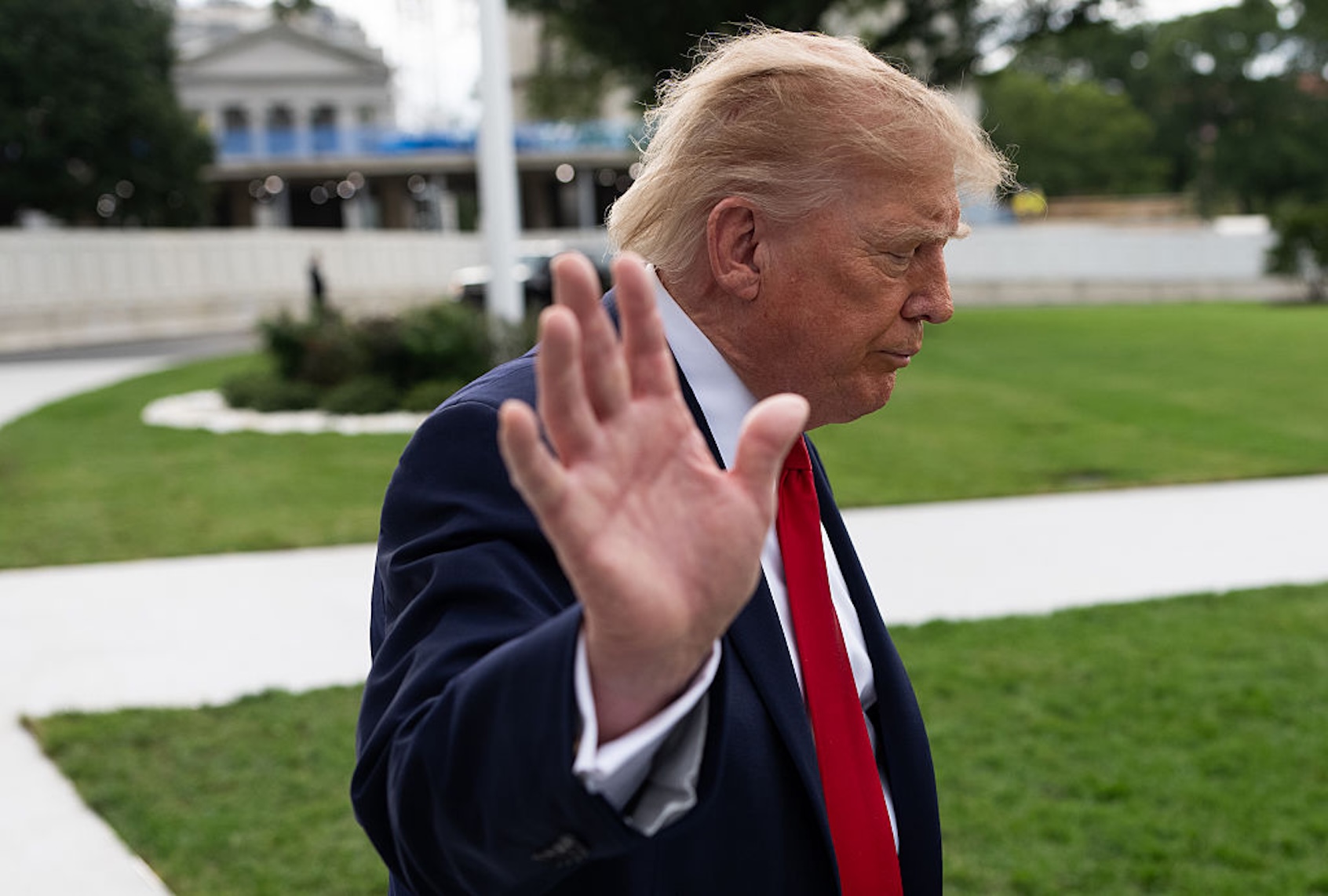
Donald Trump and his MAGA followers are obsessed with Somali-Americans. The president frequently rants about immigrants from the easternmost African country and their children, using racist rhetoric that would not be out of place at a Ku Klux Klan rally. At a campaign event Monday in Ohio, ostensibly to boost Sen. Jon Husted’s campaign against Democratic challenger Sherrod Brown, Trump fixated at length on Somali-Americans. They “don’t have pants to wear,” he claimed, but then he also expressed anger that they drive “Mercedes Benz and BMWs.” He accused them of being “low IQ” and alleged that they “plundered, ransacked and destroyed” Minnesota, a state with a large Somali immigrant population.

The president’s remarks followed past comments in which he called Somali immigrants “garbage” and said they “aren’t people that work.” Last week, Trump demanded on Truth Social that Minnesotans “fight back,” saying, “Somalians should not be allowed to get away with what they are doing.” Just in case his violent implications weren’t clear enough, Trump promised “the Federal Government will come to your rescue” should anyone follow his instructions. 

It’s worth remembering Trump’s history of condoning violence. In January 2025, on his first day back in office, the president pardoned people convicted of violent crimes during the Jan. 6 riot at the Capitol. A year later, his administration took pains to shield officers responsible for the shooting deaths of pro-immigrant protesters Renee Good and Alex Pretti in Minneapolis. 

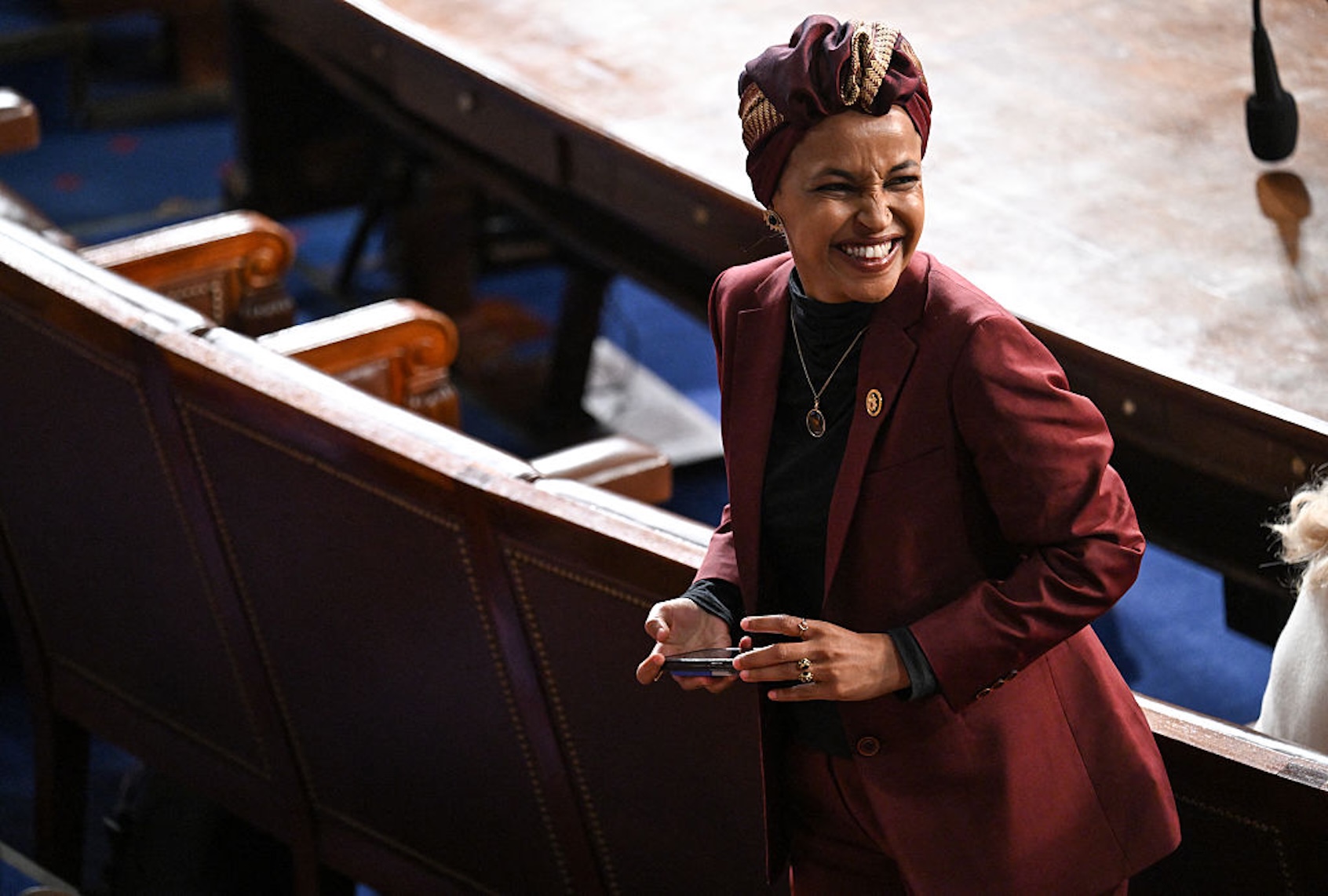
So it wasn’t too big a surprise when Homeland Security officials raided the home of perhaps the most famous Somali-American in the country, Rep. Ilhan Omar, D-Minn., on Monday. The action is part of an all-hands-on-deck effort to prove a conspiracy theory that has been percolating on the right for years now, accusing Omar and her family of falsifying her documents to become a U.S. citizen when she was 17. The administration hopes it can denaturalize and deport the progressive lawmaker, whom Trump has deemed “deranged and sick,” repeatedly calling for her to be ejected from the country. 

Odds are that the Trump administration has no case at all against Omar — as is true of thousands of other cases it has lost against immigrants so far. Instead, the raid on the Minnesota congresswoman’s home must be understood more as a campaign stunt by a president desperate to distract from his economic failures and the disastrous war in Iran. Omar herself called the raid “pointless” and “the weaponization of federal law enforcement to target political enemies.” This isn’t even the first time Trump’s goons have gone hunting for evidence that Omar’s citizenship is illegitimate. On Thursday, the Washington Post reported that, during his first term, Trump made the same demand of immigration officials, but they found “insufficient evidence of wrongdoing” and “eventually abandoned” the search. 

No matter how many insults or threats Trump flings Omar’s way, he cannot hide that the congresswoman is exactly the opposite of the racist stereotypes he traffics in. She is smart, beautiful and hard-working. Unlike Trump, who grew up a spoiled rich kid in Queens, Omar has overcome steep odds to be where she is. At only eight, she fled war-torn Somalia with her family after gunmen attacked their home and lived in a refugee camp in Kenya for four years. Whatever one’s views of her politics, there can be no denying that everything Omar has attained, from her education to her career, has been earned against high odds.

Trump’s accusations against Omar and Somali-Americans in general have more than a whiff of psychological projection to them.

Trump’s accusations against Omar and Somali-Americans in general have more than a whiff of psychological projection to them. He calls her “crooked” and “terrible,” but in reality it’s Trump who was convicted of defrauding New York State to the tune of half a billion dollars. It’s Trump who tried to steal the 2020 election, and it’s Trump who is using gerrymandering and frivolous lawsuits to try to cheat his way out of Republicans losing the midterms. It’s Trump who has amassed over a billion dollars in shadily sourced wealth as president through cryptocurrency schemes. He even regularly cheats at golf because he’s so incapable of playing fair. 

But that all underscores the greater truth about the administration’s attacks on Omar and her fellow Somali-Americans. The success of the congresswoman and her fellow immigrants handily disproves the claim that non-white people are inferior, and instead proves that progressives are right — that the U.S. is better off for allowing people from around the world to live here. For MAGA, the fear of immigration is not about feeling contaminated, but being shown up and exposed as mediocrities in comparison to industrious newcomers. 

Trump’s attack on Omar is reminiscent of his previous accusations that Barack Obama was not a real U.S. citizen. In 2011, Trump, who was then a host on NBC’s “The Apprentice,” started a noisy public campaign demanding the then-president produce his Hawaiian birth certificate, implying that Obama, whose father was Kenyan, could not be a legitimate citizen. Obama eventually did release his birth certificate, but that ultimately didn’t matter to Trump and others who promoted and believed the birther lie, because this was never about the legal definition of “citizen.” It was about the way that the erudite, charismatic Obama revealed the insecurities of the people who, only a few years later, would call themselves “MAGA” by disproving their hopes that whiteness confers an excellence that they, on their own merits, could never produce.


Want more Amanda Marcotte on politics? Sign up for her free newsletter, Standing Room Only, now also on YouTube or wherever you get your podcasts.


Trump made this especially clear by also trying to prove Obama secretly had bad grades in college. The president’s psychological projection isn’t subtle. Unsurprisingly, he has not been keen on releasing his own grades and test scores, but he is quick to assure us he’s a super-genius because he was able to tell the difference between a man and a woman on a medical exam to diagnose dementia. 

Another pointed reminder of MAGA’s true fears came recently when Bo French, the Republican nominee for Texas Railroad Commissioner, tweeted a photo of non-white students celebrating a University of Texas football win and complained, “The problem is now obviously far worse than anyone imagined.” He later whined about the university accepting foreign students, though he had no evidence these young people in the photo were born outside the country and neglected to offer any rational arguments for why the school should discriminate against worthy students from overseas. 

French’s outburst kicked off a debate among right-wing commentators about what they crudely called “the Indian question,” an apparent nod to a Nazi euphemism for antisemitic ideas that eventually led to the Holocaust. This revealed an unbelievably noxious racism, and also served as a tacit admission that concern about immigration is not, despite all the “garbage” talk, about immigrants dragging down the country. The MAGA coalition’s fear is that immigrants will make it a lot harder for mediocre white people to compete for plum jobs and school admissions. While decades of right-wing blather about meritocracy was always a lie, now conservatives are basically admitting it: Racism is a protection racket to shield white D-level students from the consequences of their own laziness.

This understanding exposes why Trump and MAGA have it in for Somali-Americans. Like any group of people, the Somali immigrant community contains good and bad people in it, but on the whole, their very existence is a testament to human tenacity. Like so many waves of refugees before and after, these are people who took huge risks to survive, and many of them, like Omar, are thriving. Even though the community suffers from extensive poverty due in part to discrimination and the few resources refugees from a war-torn country are able to marshal, it has also produced a large number of entrepreneurs. Somali-Americans have higher than average rates of labor participation and contribute an estimated $8 billion a year to Minnesota’s economy alone. Like many immigrant communities, such as Irish and Italians in the early 20th century, the second generation is doing much better economically than their parents. 

In other words, Somali-Americans are living the industrious values that a lot of MAGA types valorize but at which many, especially rich boys like Trump, fall short. This, too, would be fine, if only conservatives could just relax. Part of the American dream is being able to move beyond working that 60-hour week that so many recent immigrants have to put in to survive. There is nothing wrong with being a C student — as long as you don’t take your insecurities out on the A students who just so happen to have darker skin. That’s what makes this racism so baffling. It’s not just that it’s immoral. It’s also a waste of a one precious life to be so angry that someone who looks a little different might be better at some stuff.

The post The real reason MAGA fears Ilhan Omar appeared first on Salon.com.
  •  

Trump’s new QAnon press secretary exposes his desperation

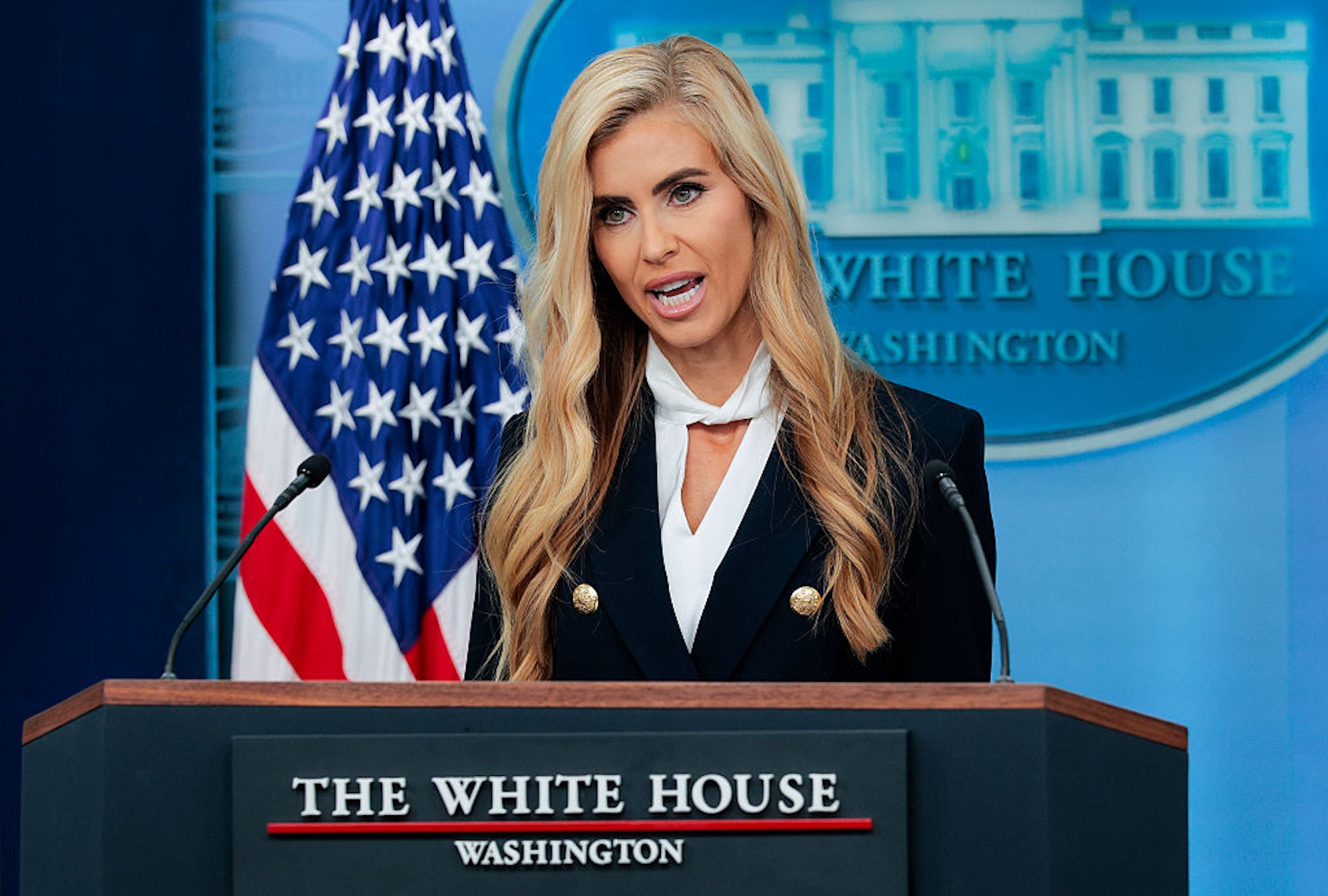
Even by first-day-on-the-job standards, Donald Trump‘s new press secretary is shockingly incompetent. Katie Zacharia has some media experience as a cable news pundit, albeit mostly on far-right channels like Newsmax and One America News. She’s even had a communications job before, when she replaced the infamous Tricia McLaughlin as the spokesperson for the Department of Homeland Security. But her stint there last only six weeks, which in retrospect should have been the first sign of trouble. 

At her first White House briefing on Tuesday, Zacharia kicked things off by haltingly reading a lengthy statement about how she hopes to “only build on, only amplify, and only multiply, to the extent possible, all of the wins” of Trump’s second term.

The situation only grew worse. Zacharia took questions from just three reporters. Even though they were from friendly media outlets — Fox News, Breitbart and the Daily Mail — she still seemed overwhelmed. Her response to a softball question about her family was painful to watch; she said “my president” before correcting herself and saying “my husband.” After about seven minutes of questions, Zacharia threw in the towel, directing reporters to the tarmac where Trump would be boarding Marine One. “You can ask him all of the questions there!” she announced.

Reviews of her performance were brutal.

“Trump managed to find a press secretary who can barely read,” independent journalist Aaron Rupar posted. 

Former Biden press secretary Jen Psaki called it “basically an SNL skit.”

Nikki McCann Ramirez, a political reporter for Rolling Stone, dubbed it a “Chat-GPT-ass first speech from the new press secretary.”

But Zacharia found a defender in the only audience that ultimately matters. “I thought she was very good,” Trump shouted minutes later over the roar of Marine One’s engines while Zacharia, taking a spot usually held by presidential aide Natalie Harp, stood smiling over his shoulder. 

Of course the president thinks she’s great. Zacharia has the only traits that matter to Trump: She’s blonde, skinny and she appears to worship him passionately. Harp had better watch out; she’s got real competition for the role of most fervent Trump devotee. The president confirmed this by praising Zacharia not for any special skills but for being a “devoted fan” with “an unblemished record of support” for himself. 

But taking a step back, Zacharia’s hiring is revealing — and encouraging. It’s yet another sign that the president is putting his own cravings for adulation over political considerations.

But taking a step back, Zacharia’s hiring is revealing — and encouraging. It’s yet another sign that the president is putting his own cravings for adulation over political considerations like winning the upcoming midterms for his party. 

“When stressed, Donald Trump retreats to his comfort zone,” investigative journalist Lindsay Beyerstein told me. Beyerstein, who is working on a book about conspiracy theorists called “Angry Minds,” noted that “Zacharia has a long history of pushing QAnon.”

The term “QAnon” may seem like a blast from the past, and for good reason. According to a February 2022 report from PRRI, tens of millions of Americans — including 25% of Republican voters — affirmed the QAnon conspiracy theory that Democrats sexually abuse and kill children to drink their blood. In the haze of the Covid-19 pandemic and the disaster of Jan. 6, millions of Trump supporters turned to the myth that Trump was God’s emissary sent to earth to destroy this Satanic cabal of child-killers. After Trump blocked the release of Justice Department files on his long-time friend, convicted sex offender Jeffrey Epstein, the fantasy that the former reality TV host is a holy warrior against pedophilia lost a lot of public appeal. 

But as far as Trump is concerned, QAnon is forever. Even as many of his voters quietly pretend the whole QAnon thing never happened, the White House was trying to revive the conspiracy cult over the summer. As The Bulwark’s Will Sommer reported in June, “The Trump administration launched a bizarre QAnon-themed social media campaign,” with various departments tweeting QAnon slogans. Sommer followed up his report by telling CNN that even “as the president faces persistently low approval rating,” the White House is trying to tell his voters something else: “[R]emember when you thought Trump was going to save the world?”

As a political move, it’s a bad idea. Trump’s apparent narcissism and corruption were easier for voters to laugh off when the economy was doing well. But now that he’s goosed inflation with tariffs and the war on Iran, his methods are not so funny anymore. For his part, Trump seems increasingly less concerned with political realities and more worried about saving face and fluffing his own ego, even if that means pulling deeper into a bubble where he’s only surrounded by people who flatter him all day with pleasing lies about his greatness. 

“He’s reliving QAnon because it represents the bygone days when his supporters worshipped him like a god,” Beyerstein said. “Trump may not realized how played out QAnon has become because he doesn’t live in the real world.”

Zacharia’s QAnon history is deep and troubling. As Popular Information’s Judd Legum reported, “Zacharia repeatedly used Truth Social to promote Pizzagate and other fringe conspiracy theories.” (Pizzagate is the original QAnon conspiracy theory — that Democrats sexually abuse and cannibalize children.) She repeatedly accused John Podesta, who headed Hillary Clinton’s 2016 presidential campaign, of being a “pedophile,” posting in 2022, “The radical left Hollywood elitists are sick pedo cannibals.” Zacharia also reposted the false claims of another Trump sycophant, Ali Alexander, who wrote, “Democrats want to mask and rape your children. That’s their satanic platform.”


Want more Amanda Marcotte on politics? Sign up for her free newsletter, Standing Room Only, now also on YouTube or wherever you get your podcasts.


Popular Information also looked into Zacharia’s claims that she was a lawyer and found “there is no evidence that [she] ever passed a bar exam.” The press secretary is not a member of the bar association in any state where she’s worked. In fact, according to Legum and his team, there is no whiff of documentation that she’s licensed to practice law anywhere.

When she was standing next to Trump after her disastrous briefing, a reporter asked, “Where did she pass the bar exam?”

The president looked quizzically at Zacharia, who replied, “When I moved to China.” Sharp readers will notice that China has no authority to grant law licenses anywhere in the United States. 

Such a clumsy diversion would never have happened under Karoline Leavitt, Zacharia’s predecessor who was, if nothing else, good at her job. A smooth character and fast talker, Leavitt deployed cartoonish Christian piety and a non-stop act of aggrieved victimhood to keep reporters too discombobulated to hold her feet to the fire about the administration’s various failures. There was little sense that she legitimately worshipped Trump; instead, she appeared to see him as a stepping stone for her own ambitions. This theory got another shot in the arm when Leavitt left the White House, implying she was going to be a housewife, only to walk right into a cushy job as a Fox News commentator. 

Trump reportedly floated Harp as Leavitt’s replacement, a move that was spun as a “joke” — even though “jokes” are not about humor for the president but instead a way to test boundaries. While press secretaries have long been spin doctors, under Trump the job morphed into one where blatant lies and gaslighting are readily employed to create over-the-top praise for the president. But clearly, this outward-facing propaganda was not enough for the president. 

Being Trump’s press secretary isn’t as much about distorting press coverage or bamboozling the public anymore. The position has been refocused on the task of giving the president more of the hardcore Natalie Harp treatment. Even as the midterms grow closer, Trump is abandoning the task of winning the public over, choosing instead to retreat deeper into a fantasy world.

There, everyone loves him most of all.

The post Trump’s new QAnon press secretary exposes his desperation appeared first on Salon.com.

  •  

Who really controls Greg Abbott?

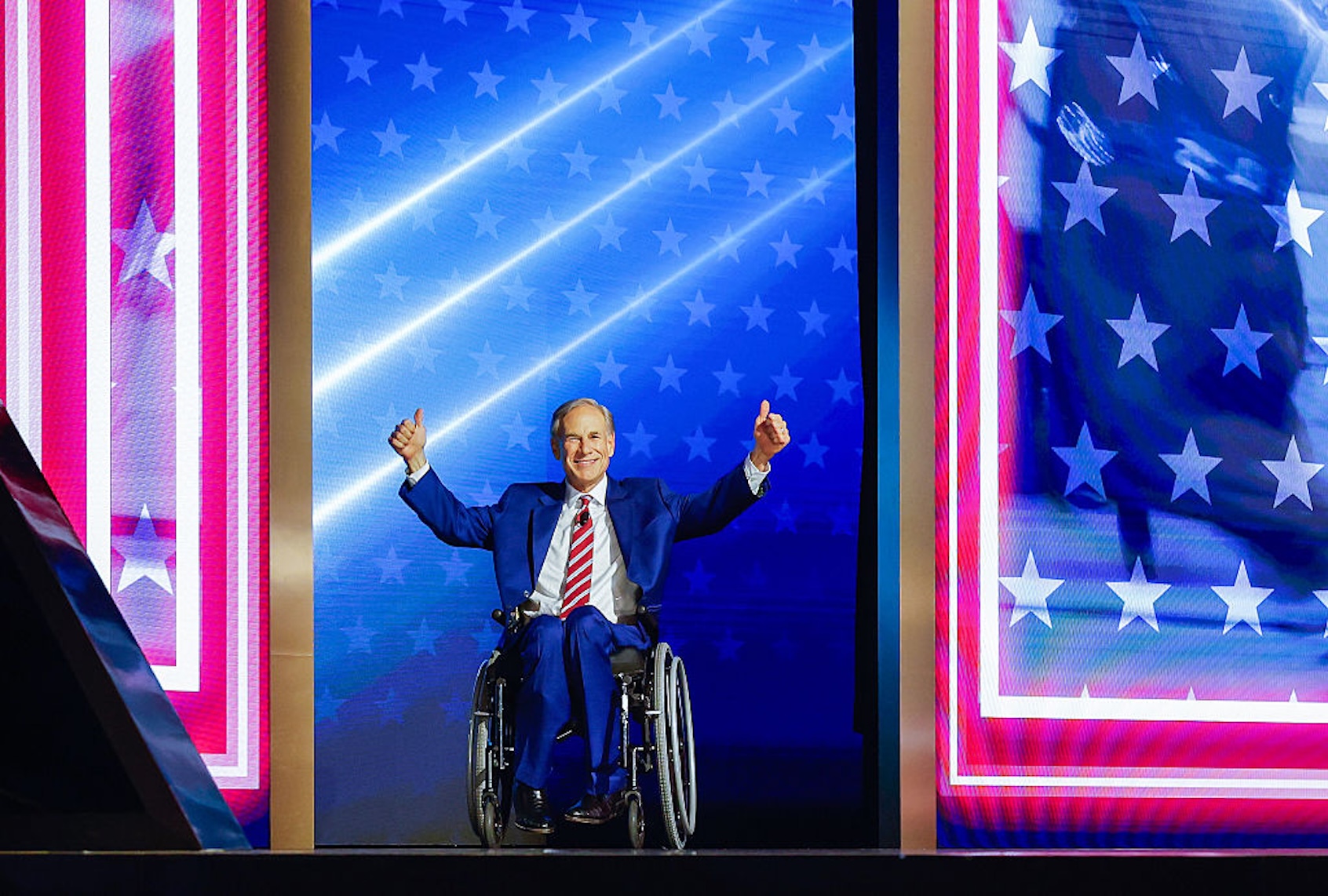
Greg Abbott is worried. After three terms as Texas governor, the Republican had every reason to believe the office was his as long as he wanted it. But Abbott is now seeing his Democratic opponent, state Rep. Gina Hinojosa, get uncomfortably close to him in the polls. Suddenly, the governor has to be mindful of negative press, something he’s lost practice at in the decade-plus he’s been in office. Abbott avoided a recent campaign stop from Donald Trump, lest he be seen in the vicinity of the unpopular president or Ken Paxton, the Texas attorney general who appears to be facing an uphill battle in his own Senate race against state Rep. James Talarico. The governor is so concerned about his re-election prospects that he recently reversed his position on data centers, which have grown increasingly unpopular, and is now calling for moratoriums and restrictions on their construction. But one issue Abbott hasn’t budged on is his all-out war on public education.

Schools in Texas are wildly underfunded, with hundreds having to reduce students to four days a week. This is very much by Abbott’s design. As Jessica Grose of the New York Times explained on Oct. 7, the governor signed into law a voucher program whose entire purpose is paying parents to take kids out of school and put them into unregulated “alternatives” — such as private schools or homeschooling — that have no real requirements to offer children an actual education. Since local school funding is tied to student head count, this has created a backdoor way to funnel money out of already-struggling public schools. 

Watching the governor concoct elaborate schemes to siphon money from beloved local institutions into unregulated religious programs and homeschooling is enraging people, so much so that some lifelong Republican leaders are announcing they will be voting for a Democrat for the first time ever.

Even in deeply conservative rural and suburban areas, Abbott’s policy is unpopular; a June 2026 University of Texas/Texas Politics Project poll found that only 33% of Texans approve of his performance on education. As Grose notes, public schools are the heart of many Texas communities, especially when it comes to high school football. (As a native Texan, I can attest that the “Friday Night Lights” lifestyle is real.) Watching the governor concoct elaborate schemes to siphon money from beloved local institutions into unregulated religious programs and homeschooling is enraging people, so much so that some lifelong Republican leaders are announcing they will be voting for a Democrat for the first time ever. It helps that Hinojosa, whose entrance into holding office was being on the Austin school board, has made saving Texas schools the centerpiece of her campaign. 

Considering education is the issue that could sink Abbott, it raises the question: Why not back down? After all, he shifted gears on data centers. But when it comes to this policy, which is undermining and could even start closing beloved local schools, the governor will not budge. To the contrary, he has burned a lot of bridges within the GOP in his war on public schools, backing primary opponents of anti-voucher Republicans in the legislature until he’d tilted the scales to get this done. 

Money is the likeliest answer. As Grose notes, Abbott’s war on education is backed by three powerful Texas billionaires — and major conservative donors — Tim Dunn and a pair of brothers, Farris and Dan Wilks. The trio made their fortunes in oil. But their single-minded hatred of public schools is rooted in evangelical Christianity.

“If you ever wonder why state laws and policies are more radical than most Texans would prefer, the answer has a lot to do with Dunn and his checkbook,” Russell Gold wrote in Texas Monthly in 2024. The same is true of the Filks brothers, who share Dunn’s dream of turning Texas into a far-right Christian theocracy.

When not throwing money at Republican politicians willing to back their Christian nationalist agenda, both Dunn and Farris Wilks preach from the pulpit, pushing religious views that are far right of even most evangelicals. Wilks led the Assembly of Yahweh 7th Day Church in Eastland County for 31 years, a congregation where women are apparently forbidden to speak in church. In 2010, he delivered a sermon where he said “our country died” when Barack Obama was elected. “I do believe we live in a nation that will start to vomit some of its people out,” he said of LGBTQ people the following year. Wilks has also preached that all gay people live a “predatorial lifestyle” and “want your children.” 

Dunn has backed efforts to rewrite the Constitution to make it more amendable to his Christian nationalist views, which reportedly includes the belief that only conservative Christians should be eligible to hold office. Like Wilks, he has zeroed in on public schools as the great enemy that must be destroyed. Their main weapon has been funding primary opponents against any Republican who opposes them, which has created a state of fear within the party. Few dare cross them — including Abbott. 


Want more Amanda Marcotte on politics?  Sign up for her free newsletter, Standing Room Only, now also on YouTube or wherever you get your podcasts.


Through his Midland Bible Church, Dunn founded Midland Classical Academy, which offers a glimpse of his preferred curriculum: anti-science Biblical literalism that will leave kids unprepared for living and working as adults in the real world. The school teaches “the authority of God over every area of life” and structure education along a historical timeline “from the garden to Mesopotamia, from Greece and Rome to the Reformation and beyond.” The intense parental involvement required by the academy sounds incompatible with allowing mothers to have jobs outside of the home. 

Abbott’s war on education isn’t just financial or limited to K-12. Republicans “have established strict state controls on what can be taught, researched, and even discussed” in universities, reports The Atlantic’s Adam Serwer. The University of Texas at Austin has been strong-armed into eliminating majors in “Africana studies, Mexican American and Latino studies, women’s and gender studies, and race and migration studies.” Political science professors have been forbidden from discussing the history of racism or the struggle for queer rights. The censorship has grown so severe that one philosophy professor was told to remove Plato’s “the Republic” because the ancient Greek philosopher mentions homosexuality. 

Abbott himself doesn’t read as a Christian fundamentalist like Dunn or Wilks. While the governor hits his minimum Republican allotment of God talk, he has also managed to evade a reputation as a rabid evangelical, despite his support for abortion bans and for forcing the Ten Commandments into classrooms. Part of it is his affect, which feels more old-school Republican than Bible-waving preacher. As a Catholic, Abbott has also managed to keep a discrete distance from the evangelicals who are the backbone of the Christian nationalist movement.

But whatever his personal beliefs, Abbott has emerged as one of the GOP’s most loyal soldiers in a movement to turn America into a far-right Christian nation. His benefactors have singled out public education as the biggest obstacle to an illiberal theocratic agenda — and with good reason. Education is power. It’s not just that kids who learn to read and think critically often leave conservative religions, though that is a big fear driving the war on public schools. It’s also that education empowers the majority of Americans who don’t subscribe to fundamentalist Christianity. 

If Wilks, Dunn and other far-right billionaires can break public schools, leaving the only options as religious education or none at all, they will turn America into a hellscape. Modern people need education to hold down decent-paying jobs, and civic participation depends on the ability to read, write and reason. A population without the benefits offered by public education would largely be left intellectually, financially and spiritually impoverished — and easier to control.

The post Who really controls Greg Abbott? appeared first on Salon.com.

  •  

What Cornell says about universities’ MAGA complicity

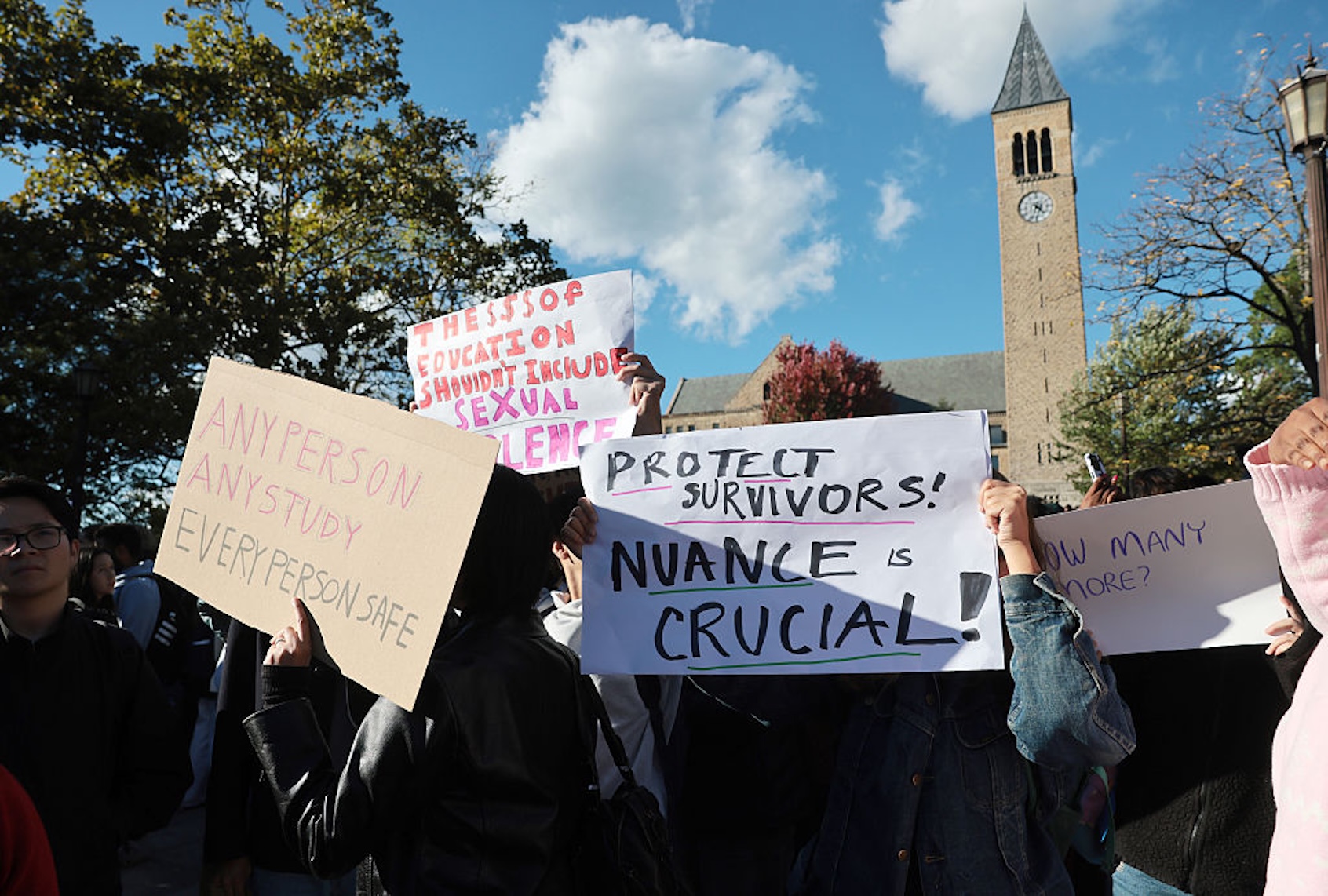
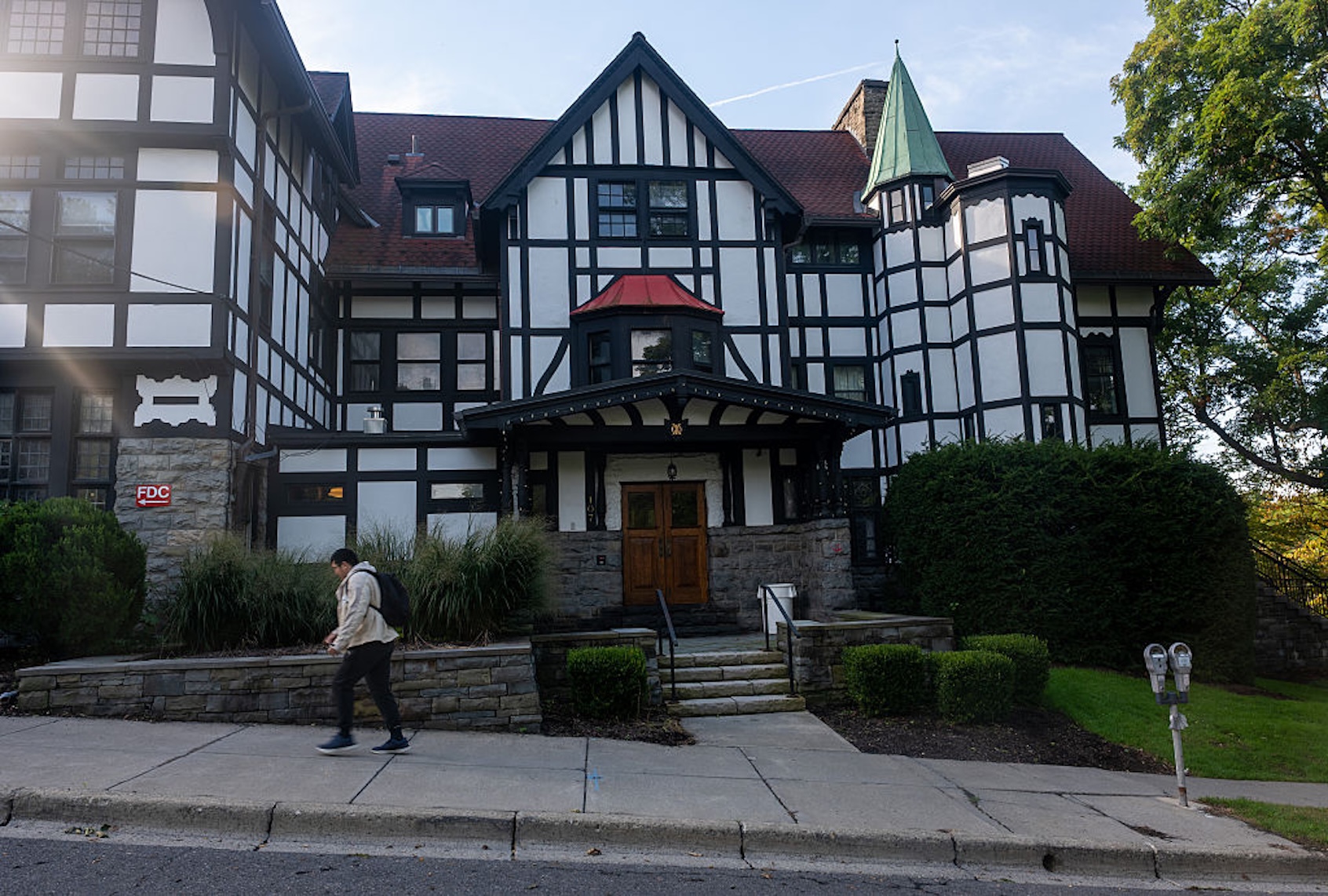
In the wake of a national story of an alleged gang rape at the Chi Phi fraternity house at Cornell University in October 2024, both students and faculty are turning their ire on the Ivy League school’s administration. On Monday, thousands of students and faculty members marched on the office of Michael Kotlikoff, who became the university’s president a few months before the alleged rape, with chants of “Resign!” The night before, graffiti appeared on his office building reading, “At Cornell, rapists are protected, protesters are expelled,” a reference to students who were suspended for protesting Israel’s war on Gaza. The university’s faculty senate is preparing a vote of no confidence on the administration’s leadership over claims that the school mishandled the rape allegations after the alleged victim, called Jane Doe, made a report to the campus police. 

The whole debacle has refreshed interest in the previous big controversy of Kotikoff’s brief but eventful presidential tenure: Cornell’s $60 million settlement with Donald Trump’s administration, which was announced in November 2025. The agreement was widely lambasted as a capitulation to the White House’s all-out war on diversity, equity and inclusion programs. Not only did the university implicitly concede that programs meant to help women and minorities are discriminatory against white men, they agreed to hand over data on race in admissions to the Trump administration and impose anti-DEI materials, provided by the White House, on faculty and staff. 

After the settlement was announced, the American Association of University Professors said in a statement that the agreement would “threaten some of the most vulnerable students on campus and invite ongoing federal government supervision to reduce the diversity of Cornell’s student body.” In July, the organization published an extensive report comparing the administration’s war on DEI to the Red Scare of the 1950s and called on university leadership to resist the Trump administration’s efforts to destroy racial diversity and gender equity efforts on campus. 

As the AAUP report shows, Cornell was far from the only university to cave to Trump; the norm for colleges and universities was rapid compliance. Diversity offices were shut down. Progressive student protesters were bullied and punished. Title IX protections, including rules protecting students from sexual harassment and abuse, were scaled back. Anecdotes have spread from faculty and students about a new chill descending over college campuses — a fear of retaliation for acknowledging the ongoing realities of racism, sexism and homophobia on campuses and in larger society. 

The fallout from the Cornell assault accusations, however, suggests that it may have been more than fear that was compelling this swift bending of the knee by many universities to Trump. There is also a degree of complicity. Progressive reforms to make campuses more welcoming to women and minority students are often a hassle for university administrators, even those ideologically who are aligned with the left. It means conflicts with board members, donors and alumni with more conservative leanings. It means having to handle student complaints of harassment, discrimination and even sexual abuse that would be easier to sweep under the rug. It means having to confront institutions — like fraternities — that reinscribe racism and sexism but are often simultaneously protected by the most elite and wealthy people connected to the universities. Giving into the Trump administration on DEI means being able to revert to older, easier ways of doing things — even if it comes at the expense of student freedom and safety. 


Want more Amanda Marcotte on politics?  Sign up for her free newsletter, Standing Room Only, now also on YouTube or wherever you get your podcasts.


It’s worth remembering that Jane Doe filed her complaint before Trump was president. Her case has all the hallmarks of an institution that tried to make her go away. Cornell police excluded relevant language — including the unambiguous phrase “I was raped” — from their report to the district attorney on Doe’s statement. Her lawyer claims that the university made her believe that the authorities were pursuing a criminal investigation, even though her case had already been closed. As Cornell philosophy professor Kate Manne noted in an essay for New York magazine, the university’s student code of conduct has a stricter definition of rape-by-intoxication than New York State’s, which would seem to cover the situation alleged here, where a woman is as high and drunk as Doe admits she was. And yet only five of the seven men accused were expelled from school, even as she was forced to drop out due to the subsequent stress and anxiety. 

Kotlikoff has a public record of flirting with “anti-woke” backlash. Last year, he wrote an op-ed for the New York Times that framed “free speech” as a conservative concern and censorship as a leftist phenomenon, bragging about how his school had invited Ann Coulter and other right-wing speakers to campus, despite student protests. But as reader Michael Handelman wisely pointed out in a letter to the editor, “I was troubled by what he didn’t say. Right now, the greatest threat to academic freedom is the Trump administration.” Kotlikoff’s omission was telling, and left the reader with the impression that a few student protesters are a bigger threat to free speech than the heavy boot of the federal government stomping on academic freedom, which the administration was doing by suing Cornell in the first place. 

If Cornell is guilty of abandoning Jane Doe, it has no reason to fear consequences from the federal government for failure to enforce Title IX protections against sexual abuse on campus.


Earlier this year, Kotlikoff made news by bumping student protesters with his car, claiming he was the victim of “harassment and intimidation, with the direct motive of silencing speech” — an odd statement, as student protest is a form of protected speech. In this case, the students were asking Kotlikoff about the suspensions of pro-Palestinian protesters, which also put them on the “pro” side of the free speech issue the Cornell president claims to hold so dear. The board of trustees cleared Kotlikoff in its investigation and blamed the students, but the student protesters accused the board of bias. 

If Cornell is guilty of abandoning Jane Doe, it has no reason to fear consequences from the federal government for failure to enforce Title IX protections against sexual abuse on campus. As the New York Times reported this week, the Trump administration barely enforced the law during his first term. In his second term, enforcement is basically nonexistent. According to analysis by the Washington Post, Cornell’s track record is already alarming. From 2018 to 2024, there were 1,216 reports of sexual assault, domestic and dating violence, and stalking on campus. Only 51 people were ever found responsible, and of those, fewer than half faced serious consequences.

Jane Doe reported her alleged rape a few days after Trump got elected. With that history in mind, Cornell police and administrators could have had every reason to believe there would be no federal repercussions if they failed to reach a just outcome in her case.

Jane Doe’s lawyer, Thomas Giuffra, told CNN that his client “was not somebody who was a legacy [student], from a wealthy family” and “came from a small town.” Fraternities, in stark contrast, enjoy immense protections from exactly those wealthy people from legacy families. As historian Nick Syrett, author of “The Company He Keeps: A History of White College Fraternities,” told Time, former fraternity members are “a base of alumni that universities don’t want to upset because they’re generous and they’re powerful.” Whatever an administrator’s personal feelings, in a situation like this, it is objectively easier to cut loose an alleged victim rather than take on alleged assailants who are well-connected to powerful elites.

From a purely self-interested point of view, the Trump administration’s demands that schools give up policies and programs to help women and minority students is a win-win for administrators. It allows school leaders to give up a miserable, uphill battle against elite forces, while handing them a way to deflect blame onto the White House for forcing them into it.

We can’t peer into the hearts of administrators and know the exact mix of complicity and fear that drove these capitulations. But the Cornell case is a stark illustration of why the prospect of letting Trump have what he wants has a dark allure. 

The post What Cornell says about universities’ MAGA complicity appeared first on Salon.com.

  •  

Pete Hegseth’s holy war on “weirdos” targets most Americans

Pete Hegseth is odd. This isn’t just a personal opinion, though there’s no doubt that he gets widely mocked for his carefully cultivated public persona, which is a mix of megachurch preacher, gym rat and Robert Duvall’s napalm-huffing character in “Apocalypse Now.” The fact that the defense secretary is different is simply a statistical reality.

It’s not just that he’s a white evangelical Christian, a group that, according to PRRI, makes up only 13% of the population. Hegseth’s church, the Communion of Reformed Evangelical Churches, is extreme even for the right, with a leader who argues against women’s suffrage and teaches that slavery was the height of “mutual intimacy and harmony” between the races. Even within MAGA, those remain fringe positions, despite great efforts by some Christian nationalists to reignite “debate” on such long-resolved issues. 

All this means it’s hard not to laugh when Hegseth pontificates about his hatred of “weirdos.” Although he has a war to fight in Iran, somehow he finds time to focus his attention on what he clearly sees as the greater battle: remaking the military according to the demands of his very white, very male, very right-wing vision.

“No fatties, no t******s, no beardos, no weirdos, no wimps, no radicals,” Hegseth said during a Sept. 30 speech at the U.S. Marine Corps Base Quantico in Virginia. He didn’t explicitly say “no women,” but his kicker — “with testosterone testing on top” — made the implication plain. The “no beardos” demand may seem strange, but as Jamelle Bouie of the New York Times explained, it’s coded racism. Hegseth ended medical exemptions that allowed beards for people, mostly Black men, with certain skin conditions. This may explain why he has no problem when white men have beards, as seen on his church leader, Doug Wilson, or the many celebrities the defense secretary likes to take photos with. (Hegseth himself sported a beard in 2018.) 

“Wimps,” “radicals” and “weirdos” are more ambiguous pejoratives, but Hegseth’s recent actions suggest his definitions are expansive enough to cover the vast majority of Americans. He’s been on a firing spree, demanding a 20% cut of the Pentagon’s top brass in an apparent effort to expunge those he deems “woke.” The move comes after nearly two years of blocking promotions for and pushing out Black and female military leaders. Hegseth also rewrote the list of religions recognized by the Pentagon, narrowing from over 200 faith categorizations to a mere 31 — 22 of which are Christian. He claims this is to simplify the bureaucracy, but his motives are likely more disturbing: to stigmatize non-Christians and restrict the definition of “Christian.” The Air Force is already forcing service members to register their religious beliefs under the truncated list, drawing criticism from atheists and others whose belief systems are not included as options. 

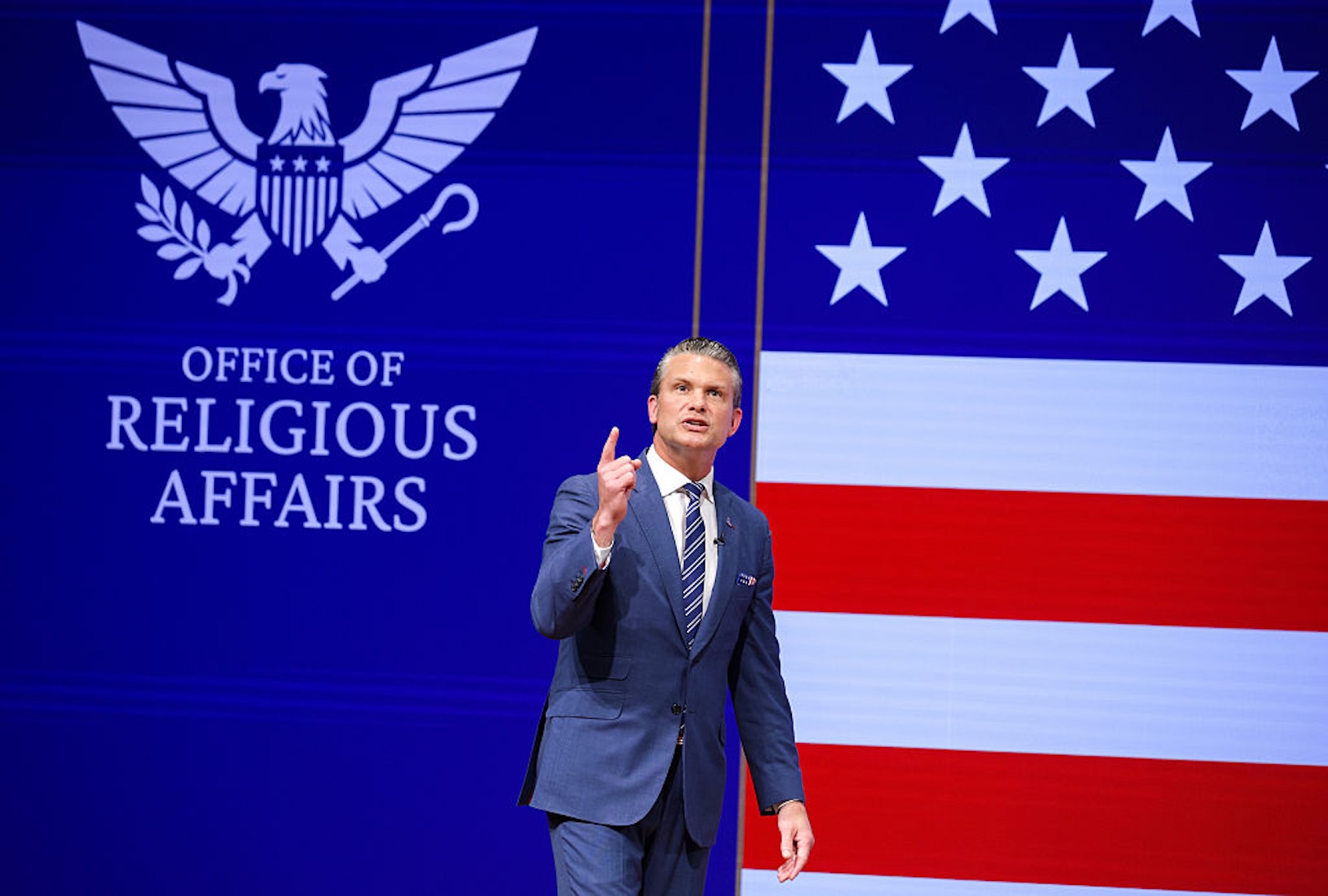
Last week, Hegseth upped the ante by announcing the formation of the Office of Religious Affairs “to strengthen the moral, ethical and spiritual readiness of our warfighters.” Despite boilerplate claims that this action will not “compel religious participation” or “diminish the free exercise rights” of service members, both the policies and pomp surrounding the announcement made it clear that the goal is to promote Hegseth’s version of Christianity — and shame anyone who does not adhere to it. The office will be run by the defense secretary himself and, in ominous language, promises to fund “research, technology, and analytical tools to support and assess spiritual fitness,” which sounds like a data-gathering operation to ensure troops meet Hegseth’s esoteric views on proper religious practice. 

“Our department is, you might say, putting on the full armor of God,” Hegseth said in his announcement, using language from the Book of Ephesians that will be sure to resonate with Christian evangelicals. 

Taken together, this purge helps clarify what Hegseth means when he’s talking about “weirdos” and “wimps,” as well as other slurs like “t******s.” He’s hostile to women, the LGBTQ+ community, people of color and anyone who doesn’t adhere to his vision of conservative Christianity — although it’s worth noting that with his message of peace and love, Jesus Christ himself would not be accepted by Hegseth as a Christian.

The secretary may have gone to Princeton University, but he hasn’t yet grasped the concept of irony. The people he deems “weirdos” far outnumber those in his narrow category, presumably of non-weirdos, many times over. 


Want more sharp takes on politics? Sign up for our free newsletter, Standing Room Only, written by Amanda Marcotte, now also a weekly show on YouTube or wherever you get your podcasts.


Hegseth has tried to justify his position and rhetoric by arguing that a proper military should only contain “the real 1%” of supposedly superior people. But as Eliot Cohen of The Atlantic notes, this claim is ignorant of history. You need large numbers to win wars, which inherently means that armies can’t be elitist institutions.

Hegseth has a real math problem on his hands. His “real 1%” of alleged non-weirdos is just not enough people to staff a modern military, especially in times of war. His solution appears to be to hit the road, trying to recruit more mini-Hegseths to enlist. On Sept. 19 he embarked on the Send Me Tour in an effort to reach out to people in white evangelical-heavy parts of the country with a Bible-heavy pitch about how Jesus wants them to fight for their country. Both the tour’s name and the secretary’s stump speech rely heavily on Isaiah 6:8; Hegseth equates God’s call to the prophet to be faithful with his own plea for evangelicals to join the military.

In a response video, Sen. Raphael Warnock, the Democrat from Georgia who is also an ordained minister with multiple theology degrees, didn’t mince his words. “Pete Hegseth is busy twisting the scriptures yet again . . . When Isaiah answers that call, it is not a call to go into battle.” Instead, Warnock said, “Isaiah challenges corruption” and “those who would crush the poor.”

Those objectives, of course, are not remotely Hegseth’s. His creation of a hierarchy that places white, straight men at the top and relegates everyone else into an underclass of “weirdos” and “wimps” ignores the Bible’s historical context — and actual meaning. Anyone who doubts that can simply examine his behavior in office and his monomaniacal focus on sorting America’s service members into a worthy-unworthy dichotomy, based solely on how much they adhere to his own self-serving ideals of what a soldier should look like.

The post Pete Hegseth’s holy war on “weirdos” targets most Americans appeared first on Salon.com.

  •  

Jon Ossoff’s not-so-secret weapon against JD Vance and Marco Rubio

For more than a year, journalists Maggie Haberman and Jonathan Swan had been trying — and largely failing — to raise awareness about the very strange story of Donald Trump and his aide Natalie Harp. Shortly after the 2024 election, the New York Times journalists published a profile of the lithe blonde in her early 30s, complete with photos of her gazing at Trump adoringly, explaining how she left him love letters with language like, “You are all that matters to me.” On Aug. 16, Haberman was still trying to raise the issue during an appearance on MS NOW, describing Harp as Trump’s “human binky.”

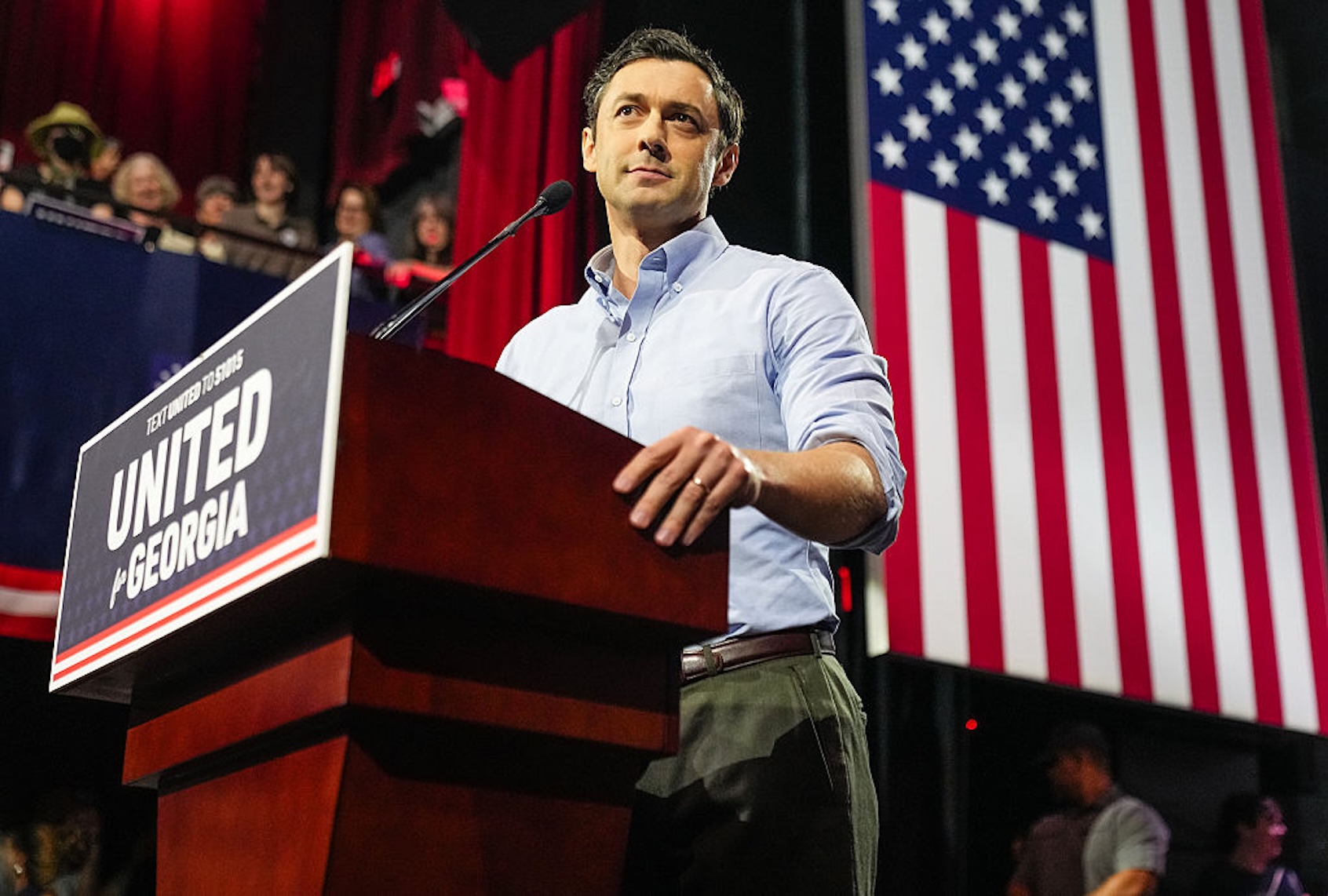
But in the end, it was Sen. Jon Ossoff, D-Ga., who woke up much of the public to this disturbing relationship by mentioning Harp on the campaign trail. “He doesn’t want to do the job,” the senator said of Trump, the sleeves of his blue shirt rolled up. “He wants to build his ballroom and travel with Natalie on their apparently defenseless flying palace gifted by the Emir of Qatar.”

The defensive reaction from the White House was so over-the-top that it backfired, drawing more attention to the relationship. 

But a mystery remained. Haberman, Swan and many others had been talking about Harp, but it wasn’t until Ossoff said something that the White House truly lost their minds. 

The reaction likely had little to do with Ossoff’s comments, as elegantly as they were constructed. No, this recoil was more about the messenger than the message. At 39, Ossoff isn’t just young. He is strikingly handsome. The boyish good looks of his early career have matured into something closer to the old-fashioned allure of a 1960s-era movie star, such as Gregory Peck or Warren Beatty. Broad-chested, with great hair and a winning smile, Ossoff has a cool demeanor, good sense of humor and moral seriousness in a proportion that’s rare in politics — and that hasn’t really been seen since Barack Obama. Ossoff, in other words, can get it.

I’m talking about votes. 

Put another way, Ossoff is everything the 80-year-old president wishes he were, but isn’t. Harp’s presence is a touchy, daily reminder to both Trump and his staff of the president’s thick catalog failings as a human being. Having a young, handsome, talented man mock Trump for his emotional support aide had to have stung with a special precision. No one needs to tell the president or his staff that Ossoff feels just fine about himself — and doesn’t need a full-time emotional support aide to follow him around, praising his every move.

Considering how much the White House communications staff is extremely online, they are also likely to know that Ossoff has become quite the thirst trap, even among young women and gay men who otherwise aren’t especially political on social media. As Grace Panetta of The 19th recently explained, the senator is a reliable, if unwitting, model for light-hearted crush content, much like what creators generate in tribute to movie stars like Timothée Chalamet or Tom Holland.  

“Take a scroll through Instagram and TikTok, and you’ll see fan edit-style videos of Ossoff at campaign rallies and in Senate hearings,” Panetta wrote. Women jokingly call out Ossoff’s “slutty Atticus Finch cosplay” or predict that Ossoff will be “a hot president in my lifetime.” It’s reached the point where a reporter from TMZ asked Ossoff if he has “BDE,” which is not short for Big Dictionary Energy, despite the senator very much seeming like he’d be a fan of Oxford’s quintessential publication. 

Ossoff’s sex appeal doesn’t just offer a striking contrast with Trump’s oversized suits and comical combover. He’s also very different than men in the Republican ranks who are closer to his own age and, like himself, are widely seen as potential 2028 presidential candidates. At 42, Vice President JD Vance is also the subject a lot of online content. But most of it portrays him in a comically unflattering manner, with tiny dead eyes, oversized cheeks and a maniacal grin. Secretary of State Marco Rubio, 55, isn’t mocked for his looks, but he is often portrayed as a sad sack, a man too slow-witted and spineless to be much use beyond his role as Trump’s patsy. Defense Secretary Pete Hegseth, 46, is blessed with good looks that even three breakfast gin-and-tonics can’t take away. But with the help of Colin Jost on “Saturday Night Live,” he is mostly viewed like an overgrown frat boy crushing beer cans on his forehead. None come even close to the dreamboat treatment Ossoff receives. 


Want more Amanda Marcotte on politics? Sign up for her free newsletter, Standing Room Only, now also on YouTube or wherever you get your podcasts.


This disparate treatment is especially amusing because the MAGA movement has insisted for years that they are bringing back a more virile masculinity — supposedly to cure all the allegedly poisonous feminism inflicted upon America by those WNBA-loving Democrats. No doubt there are some people impressed by all the workout videos posted by MAGA leaders, though that audience probably doesn’t have much crossover with people who get second dates. But what all the chest-thumping and push-up contests of the right really communicates is overcompensation rather than reclaiming some “lost” masculinity.

Beneath the right’s meltdown over Ossoff’s relatively tame comment about Harp was a molten layer of male insecurity. Steven Cheung, the volatile White House communications director, tweeted, “Jon Jackoff has to be the biggest cuck loser in politics.” White House spokesman David Ingle called the senator a “cringeworthy, feminine theatre kid.” Both unwisely lobbed these insults from X accounts featuring photos of themselves. The handy comparison left the observer to contemplate how, with MAGA, it’s typically true that every accusation is itself a confession. Similarly, Trump compared Ossoff to Pee-wee Herman, a reference to a film that is older than the senator and only served to underscore how old and out of touch the president is. 

MAGA’s belief that masculinity is on the decline is more a reflection of their personal fears and resentments than an accurate picture of the world. Men who can just act normal continue to do fine, or as much as one can in this economy. As with many of the thirst-trap Democrats that are rising stars, including New York City Mayor Zohran Mamdani and Michigan Senate hopeful Dr. Abdul El-Sayed, a large part of Ossoff’s charm is that he possesses an easy masculinity, one comfortable with women’s equality. MAGA influencers may deny it, but men who actually like and respect women tend to be more attractive to women and gay men.

Being chill with women’s power projects confidence. Insecure men are the ones who demand that women are forced into subservient roles, just so men can feel bigger. It speaks to an internal belief that they can’t win without cheating. That’s loser energy, not the Big Dictionary Energy being given off by Ossoff and this new crop of young, vigorous Democratic men. 

The post Jon Ossoff’s not-so-secret weapon against JD Vance and Marco Rubio appeared first on Salon.com.

  •  

Cornell assault case shows #MeToo didn’t go far enough

Jane Doe, a former Cornell University student who has filed a civil lawsuit alleging gang rape at the hands of seven Chi Phi fraternity members, has struggled since she first reported the incident to the police in November 2024, a few weeks after night a frat party turned ugly. “Her life has been destroyed,” her attorney Thomas Giuffra told CNN’s Jake Tapper. Unlike most of the alleged assailants, Doe left college after what Giuffra has described as a “horrifying” semester in which she had to attend classes “where she saw these guys on a fairly regular basis.” 

She was not from “a wealthy family,” he said. “This was her dream and it was taken away from her at a young age in just a horrific fashion.”

But according to some on the right, Doe has not suffered enough for reporting her alleged assault to the police and then later suing the accused, the university and the fraternity. It’s not enough that she saw no charges filed, or that reportedly only two of the accused were expelled from campus. On top of her existing pain, therefore, many of the MAGA faithful are punishing her further by calling her a liar, implying she’s a slut and even threatening to out her, which would put her personal safety at risk. Whatever their intent, by doing this, they are sending a strong message to any victim of rape who might feel tempted to seek justice: Stay silent, or you’ll be next. 

In 2017, the #MeToo movement took the nation by storm. A veritable flood of women, and some men, spoke out about their own experiences with sexual abuse, leading to a slew of firings, lawsuits, arrests and social opprobrium of the accused, especially since so many accusers produced compelling evidence. Despite this, it was barely weeks before the backlash began, with countless articles about how #MeToo had gone “too far,” despite scant evidence that innocent men were getting entangled. That response swelled until it overcame #MeToo, which has largely faded into the background. 

Much — if not most — of the time, alleged victims still face far more serious consequences than their accused assailants, and for many people and institutions, it still feels much easier to make the issue go away by suppressing accusations than dealing with these cases which are, admittedly, often complex. 


The Cornell case shows, though, that far from going too far, the #MeToo movement didn’t go far enough. Much — if not most — of the time, alleged victims still face far more serious consequences than their accused assailants, and for many people and institutions, it still feels much easier to make the issue go away by suppressing accusations than dealing with these cases which are, admittedly, often complex. 

There is no doubt that the Cornell case is messy. By her own account, the victim was initially consenting, though perhaps not enthusiastically, to a threesome with two fraternity members. But the situation apparently took a turn when she took ketamine during the encounter and more fraternity members joined in, even communicating about “free p—y” on Snapchat. She describes hiding and swatting the new men away, but being too incapacitated to fight back.

“I can say with 100% confidence I was raped,” she told police during a November 2024 interview. 

It took time for the alleged victim to get to the point where she was ready to file a report, which right-wing pundits have seized on as evidence that she was not really raped. The New York Times, using campus police documents and witness statements, laid out the timeline showing that she initially reacted with confusion and shame. While she didn’t call it “rape,” she was clearly unhappy about what had happened. Over the course of a few weeks, she came around to first texting one of the accused that “90% of what happened that night was not consensual,” and then filing a police report. 

“After rape, it’s common that victims don’t realize what happened was rape,” explained Anne DePrince, a psychology professor at the University of Denver and author of “Every 90 Seconds: Our Common Cause Ending Violence Against Women.” 

Victims “feel some shame about reporting it,” especially if they initially “liked the boy or they wanted to go to an event,” Sharon Gandarilla-Javier, an assistant professor at the John Jay College of Criminal Justice, told me. She noted that it’s also common for someone to initially consent to one activity that then becomes “totally different than what they expected.” 

Journalists and feminist writers have been cautious in addressing this case, making it clear that the claims haven’t been tested in court and that New York’s rape laws may not be enough to secure an indictment, much less a conviction. Tompkins County District Attorney Matthew Van Houten has reopened the case, arguing that this new lawsuit presents evidence he didn’t have when he initially made the decision to not charge the accused. New reporting also shows that Van Houten was given a condensed version of Doe’s report to Cornell police, one that omitted her use of the word “raped.” 

But on the right, there appears to be no similar care when lobbing unproven — and unevidenced — accusations that Doe is lying. 

“Her account has radically changed,” The Daily Wire’s Ben Shapiro said on Tuesday’s episode of his podcast, insisting “it turned out that the details of the police report did not amount to anything like rape.”

While he may be proven right if prosecutors can’t secure an indictment, this is not the same thing as saying that all Doe reported was “bad things happening with consent,” as Shapiro claimed. She herself said she was “raped,” and as many have pointed out, the very fact that she filed a police report is relevant. Calling the police suggests that a person believes they are reporting a crime. 

Matt Walsh, also of the Daily Wire, accused feminists of “rushing into the next Duke lacrosse/UVA-style hoax” and argued on X that the situation was nothing more than “a disgusting drug and alcohol fueled orgy,” where “the drunk men have just as valid a claim to being raped.” This, of course, ignores the fact that the alleged victim did not get on Snapchat to advertise “free p—y” to strangers, as well as her own testimony that she pushed them away and tried to hide.

The story “gets transformed from a night of regrets that the young woman is ashamed of into a night in which she’s a victim,” former Fox News host Megyn Kelly said on her podcast, where she also threatened to release the accuser’s name.


Want more Amanda Marcotte on politics?  Sign up for her free newsletter, Standing Room Only, now also on YouTube or wherever you get your podcasts.


Feminists and journalists are wise to use words like “alleged” and to be clear that the evidence has not been fully evaluated in a court of law, and it is true that there remains much about this case that is unknown. Still, there are the Snapchats and text messages, including one where the alleged victim uses the word “nonconsensual” and another where the accused wrote “I just wanted to apologize for how things went down the other night.” This alone makes it hard to believe the accusations are a “hoax,” as Walsh suggested, even if there are outstanding legal questions about whether a consensual encounter turned into something illegal. 

For people who insist on the principle of “innocent until proven guilty,” many on the right have proven themselves quick to make claims about the alleged victim’s motives. It’s worth remembering that E. Jean Carroll won a defamation civil suit against Donald Trump after he accused her of lying when she claimed he sexually assaulted her in the dressing room of a Manhattan department store in the 1990s. There is a demonstrable psychological and reputational toll on alleged victims when they face public accusations that they are lying, especially when they come from high-profile people who also insinuate that the victim is an immoral person because of their sexual history.

In this case, no one is required to have an opinion about the accuser’s character. They don’t know her history or her life or why she was even at the party, beyond her stated desire to have some fun . . . Shutting up is free.

In this case, no one is required to have an opinion about the accuser’s character. They don’t know her history or her life or why she was even at the party, beyond her stated desire to have some fun. They could, like most decent people, consider the allegations and assume that, even if there is not a crime here, what is described should never happen to anyone. Shutting up is free.

But the past decade of Trumpism has largely been built on stirring up male anger at women’s growing equality. Paranoid and unsupported claims that women have immense power to ruin men with false accusations have been the bread-and-butter of a MAGA media industry designed to exploit men’s resentment for profit. Their audiences yearn to hear that Jane Doe is the real bad guy here, and so attacking her without a single shred of real evidence against her is an opportunity that many right-wing pundits can’t seem to pass up. 

Despite the hysterical claims of its critics, #MeToo was never about ruining the lives of innocent men. In a very real sense, the movement was about leveling the playing field, which is so dramatically tilted against victims that it makes justice nearly impossible to achieve. No one truly disputes the importance of due process to handle accusations of sexual violence. That’s why Jane Doe is going through the court system. It’s also why it’s good that, in light of new information, the district attorney is re-opening the case. 

But due process is endangered if victims can’t report allegations without facing  public abuse and threats of being falsely accused themselves that it becomes psychologically impossible to live their lives. As its name suggested, that was the whole point of #MeToo: to create enough solidarity between victims and allies to make it safe for victims to speak out without their lives being destroyed. If the right really believes in the value of due process, then they would let it play out, instead of dogpiling and harassing accusers so that future victims are too scared to report crimes. 

The post Cornell assault case shows #MeToo didn’t go far enough appeared first on Salon.com.

  •  

Trump can’t trick Americans into loving him

Donald Trump has never been one for subtlety, so it follows that his taxpayer-funded “public service announcement” instructing Americans to love him would literally feature a gospel choir singing the words “Love Me.” Along with many of his closest allies, the president is a fan of pseudo-science, so perhaps he believes the repetition will have a hypnotic effect on viewers, reversing through pop psychology trickery the free-fall that has beset his approval ratings.

This is just one of three separate ads, totaling $1.5 million so far, that feel less like a sincere effort to persuade voters and more like an expensive effort by the White House to soothe the temperamental 80-year-old. Either way, what’s indisputable is that Trump is becoming increasingly frustrated that the chicanery he has used throughout his life no longer seems to be working.

The president has perhaps the most staggering track record of defrauding Americans of any hustler in the country’s 250-year history. His glib assertions of being the greatest genius who knows more than any other person about any subject under the sun have served him well for decades, and his 34 felony fraud convictions and civil fraud cases paint a picture of a man who always seems to find marks who will believe his transparent, self-aggrandizing lies.

Before he won the White House in 2016, “The Apprentice” managed to convince millions of viewers that a man who managed to lose nearly a billion dollars was some great businessman. Even when Trump argued that he, unlike medical experts, understood the salutary effects of household cleaners to treat Covid-19 patients, his followers stayed by his side, some of them putting their trust in MAGA quackery over science-based healthcare like vaccines. The cult of personality built around his persona of presidential greatness remains a puzzling swindle. 

But on Monday in the Oval Office, Trump did what he usually does these days when presented with a microphone: He whined at length at how he isn’t getting the love he believes he deserves. 

“Nobody talks about all the incredible things,” the president complained, saying America has “the best economy we’ve ever had.” He added, laughably, that people are “twice as wealthy” as they were as two years ago under the Biden administration. Then he repeated his false promise that, if Republicans win the November midterms, the government would issue a “dividend” check of $5,000 to every adult American. 

Polls, however, suggest that Americans are finally waking up. A recent Reuters/Ipsos poll found his approval rating at a dismal 32% — hitting, in other words, the very bedrock of his MAGA base.

It may be easy to laugh at this stuff, but it’s worth taking a moment to remember that Trump has always been this way. Polls, however, suggest that Americans are finally waking up. A recent Reuters/Ipsos poll found his approval rating at a dismal 32% — hitting, in other words, the very bedrock of his MAGA base. Worse for him, only 13% of Americans, according to an analysis by G. Elliott Morris, are willing to tell a pollster they buy the president’s $5,000 check lie, showing that even people who claim to approve of him can’t be bothered to trust him any longer. 

People could be learning from experience. As Catherine Rampell of the Bulwark detailed, the $5,000 check promise is only the latest in a long list of false second-term promises that Americans would be receiving fat checks from the government. Her “partial list” includes these examples:

  • $5,000 stimulus checks via a “DOGE dividend” (February 2025)
  • $2,000 stimulus checks via a “rebate” or tariff “dividend” (July 2025, August 2025, November 2025, December 2025, February 2026)
  • Checks of indeterminate value that would redirect money that would have been spent on Affordable Care Act subsidies (November 2025)
  • $500 Obamacare “rebate” checks (September 2026)
  • $5,000 “dividend” if Republicans win the midterms (yesterday) 

Thankfully, there now appears to be a limit to the number of times a fraudster can promise the check is in mail before even some MAGA voters start to wonder if they’re being had. Most clung to two big reasons to justify their vote in 2024: the president’s promises to lower prices and end foreign wars. Trump broke both in a dramatic fashion, starting a war with Iran and a trade war with, well, much of the world, both of which have escalated inflation, particularly of fuel prices. Even his most ardent followers are reminded of his lies every time they buy groceries or gas. Running ads that repeat his failed promises only serve to remind people of the broken trust. 


Want more Amanda Marcotte on politics?  Sign up for her free newsletter, Standing Room Only, now also on YouTube or wherever you get your podcasts.


Beyond bigger propaganda, Trump has no other ideas for how to change the situation. On top of the ads, last week the White House launched “Trump TV,” which was billed as an alternative to cable news but mostly runs pro-Trump content so poorly produced that it makes AI slop seem compelling. As Salon’s Sophia Tesfaye chronicled, the viewership started at a paltry 8,000 people and, by the next day, had faded to fewer than 1,000. It would have likely been even lower if it weren’t for journalists watching it to report on the emptiness of the enterprise. 

Perhaps the surest sign that these efforts are more about placating Trump than persuading voters is the his travel schedule. The president is avoiding visiting states with close congressional races, where he risks being shunned by Republican candidates trying to distance themselves from his unpopularity. Instead, he is mostly sticking to deep red states like Alabama and Oklahoma, where they can still scare up enough MAGA diehards to fill stadiums and, crucially, give Trump hours of reassurance that he’s still got fans. On Tuesday, he spoke at an event heralding our era as a “golden age” due to AI. As a political maneuver, his words were baffling, as most Americans deplore the economy and loathe AI. But being surrounded by billionaires while applauding himself with gold-related talk is Trump’s happy zone, and keeping the president there appears to be all that matters to his West Wing staff. 

For the worrywarts of the left, there remains plenty to be concerned about. Ahead of the midterms, Democrats are facing intense gerrymandering and voter suppression, which could blunt the wins currently projected by the polls. Even if the party were to take both the Senate and the House, Trump will still occupy the Oval Office for two more years. Armed with the criminal immunity granted him by the Supreme Court, he has no reason to stop blatantly flouting the law in a myriad of ways, ranging from his attacks on the Kennedy Center and prosecuting the Iran war without congressional approval to his own mysterious swelling wealth. 

Still, even though it’s almost certainly illegal, there is an upside to Trump using taxpayer money for ego-gratifying TV ads and propaganda. The more time he spends on his futile efforts to restore the glory days when only half of Americans opposed him, the less energy he has for the work of actually governing. Everything he’s done in that arena has been an unmitigated disaster. Keeping Trump distracted from making serious decisions is a good thing for us all.

The post Trump can’t trick Americans into loving him appeared first on Salon.com.

  •  

Wife school can’t fix MAGA husbands

How hard is it to enjoy your husband’s company? According to content made for Christian conservative women, the heaviest cross they may bear is learning to feel affection for their spouses — or at least fake it well enough to buy some peace at home. That’s what I learned perusing the growing field of influencers offering would-be tradwives advice on how to make MAGA marriages work. 

“Normalize liking your husband,” reads a T-shirt sold by Savanna Stone, a 21-year-old self-proclaimed marriage expert who has been selling content preaching marital submission with the backing of shady far-right funders. At first blush, that may seem like a trifling concept. But, as Stone makes clear in her video content, her definition of liking or even loving a husband is both laborious and ascetic to an extreme. 

“Submission isn’t earned, it is given through the covenant of marriage,” Stone argued in one video. If a husband makes bad decisions, she said, it’s his wife’s fault because she isn’t submitting enough to give him the “confidence” to “take on the masculine role.” At her speech at the 2026 Turning Point USA Women’s Leadership Conference, Stone encouraged women to marry young, as she did at 18. If they don’t, the risk is that they will “build their own life,” which she defined as “the death of marriage” because “two separate lives do not easily merge.”

Stone attracts a lot of attention for her tender age and lavishly produced content. But she’s just one of a burgeoning group of Christian influencers, most of them fairly young, who hold themselves out as experts on marriage. Some dress in fashionable and sexy clothes, like Stone, while others favor prairie-style dresses. Some are podcasters or video hosts; others offer online courses with names like “Wife School” or “Wife Academy.” But the message remains the same: They’re all speaking to the deep disappointment and frustration that many Christian women apparently feel in their husbands. The solution, though, only ever seems to be that wives must suck it up and submit even more to their men. 

Recently, Alex Clark, the host of TPUSA’s “Culture Apothecary” podcast, married another Christian influencer after what appears to have been a whirlwind engagement of only a few months. (As recently as May, she was lamenting her lack of viable marital prospects.) In the run-up to her nuptials, Clark presented her own “wife school” series that made marriage sound so miserable that a reasonable viewer’s only conclusion was to avoid being a wife altogether. 

Her first guest, Tilly Dillehay, got right down to business by scolding women who are “picky” because they want something from a husband beyond just a man who is “active in his faith” and makes enough money to “support a family.” Dillehay held herself out as an example of a woman who failed; she said she had dated men who were “flippant,” which appears to be her code word for fun. Instead, while she was “not immediately attracted” to her husband and he was not attracted to her, Dillehay married him anyway because he is a “steady man,” “serious” and not prone like she is to “joke around.” 

If that sounds like a formula for a miserable sex life, well, Dillehay didn’t seem to be concerned. “God has commanded you to participate” in sex with your husband, she said. An added incentive is that it’s “a way that you protect each other from infidelity.” 

“Half of the time,” she said, “it’s only in getting started that you even start to be in the mood.” What happens the other half of the time, she didn’t say. 

“Remember that there are a lot of women out there whose husbands are at the bar tonight and they’re not coming home,” Dillehay said. “There are a lot of women whose husbands are not going to work today.” It should be “enough,” she added, to have a husband who works and goes to church. 

Dillehay’s view is especially chilling in light of a recent Netflix documentary “The Death of the Pastor’s Wife,” which chronicled the suicide of Mica Miller, who spent years of trying to please the ever-escalating sexual demands of her minister husband. This expectation doesn’t appear to be the exception. As Dillehay showed in her interview with Clark, the view of sex as a wife’s duty is deeply ingrained in conservative Christian culture.

Stone has drawn attention by saying consent isn’t part of marriage. “Because when you say, ‘I do,’ you are committing to a lifetime of sex,” she explained in an interview earlier this year. “‘You didn’t fold your laundry. I’m not going to have sex with you. You didn’t unload the dishwasher. I’m not going to have sex with you.'” In citing these scenarios, Stone mocked women who withdraw from husbands sexually, calling it “manipulation,” or even a “sin,” to feel this way. 

Still, there’s clearly a lot of resentment among some Christian conservative women about husbands who don’t do chores. Trying to stifle anger over this may be the single most common topic in Christian marital advice content.

Feminists might argue it’s hard to get in the mood with someone who doesn’t respect you. That opinion, though, carries no weight in MAGA circles. Still, there’s clearly a lot of resentment among some Christian conservative women about husbands who don’t do chores. Trying to stifle anger over this may be the single most common topic in Christian marital advice content.

In her “wife school” series, Clark interviewed her new sister-in-law, Katie Voetberg, a prairie dress-clad podcast host and mother of six, about how to avoid being a “nagging wife” and a “constant dripping faucet.” Voetberg’s heartwarming advice? Abandon all hope of having a responsible husband. If your husband forgets to pay the electric bill, she said, don’t remind him or hold him accountable. Instead, “light a candle” and hope that he learns from the “embarrassment” of his failure. Presumably, wives in these relationships don’t control the money, or they could pay it themselves. In cases where women do have a little more power, Voetberg recommended simply doing every chore a husband can’t be bothered with.

“He hates going to the dentist” or the doctor, she explained, so “I just put it on my to-do list” to make his appointment. Even when a husband won’t do “the stereotypical husband duties,” like mowing the lawn or taking out the trash, she continued, the wife should handle it and say, “it’s never going to hit [the husband’s] radar.”


Want more sharp takes on politics? Sign up for our free newsletter, Standing Room Only, written by Amanda Marcotte, now also a weekly show on YouTube or wherever you get your podcasts.


Other influencers agree. Millicent Sedra, a rising Christian-right influencer who serves as pastor at Echo Church in Sydney, Australia, recently preached that wives should “[s]top complaining about having to help your husband when our God-given role is to do exactly that.” Another of her sermons centered on Proverbs 21:9, which reads, “Better to live on a corner of the roof than share a house with a nagging wife.” 

Laura Zachary, the creator of “Wife Academy,” which is billed as “a program that allows women to rebuild their marriages from the inside out, explained in a video why all household chores should fall to wives: “Women were created for a man. So a woman without a man to take care of, she becomes very empty, very soulless, very bitter.” But Zachary’s logic is flawed: If scrubbing toilets and washing dishes while their husbands kicked back on the couch was, in fact, women’s natural inclination, then she wouldn’t be able to charge women thousands of dollars for courses that reportedly teach them how to love a life of submission.

Often, these lessons in denial are framed for Christian women as a rebuttal to feminists. As a marketing ploy, that’s smart, but it’s not entirely honest. Feminists aren’t listening to this content, and even if they were to stumble across it, they would simply move on. It is not sparking “debate.” 

The real audience for these messages are Christian women, a fact that is itself telling. That these classes exist in the first place shows that, despite being told it’s their “natural” role, Christian women do not actually enjoy submitting to their husbands. If women were eager to have sex in their conservative Christian marriages, they wouldn’t need to be told it’s their duty to have it, like it or not. Clearly, many Christian women resent domestic inequality, or else they wouldn’t have to be told to suck it up.

Why is there “wife school” but no apparent equivalent “husband school”? Men in this situation are perfectly fine; they are benefitting from a system set up to serve them at a woman’s expense. As long as that’s true, it’s inevitable that women will feel frustrated and resentful. “Wife school” can’t actually make women happier, since it reinforces the very male dominance that is causing their pain. But it sure can make men’s lives easier, if the teachers are successful at getting women to stop complaining and learn instead to serve their husband-masters in silence. 

The post Wife school can’t fix MAGA husbands appeared first on Salon.com.

  •  

Clavicular’s charges shows the real danger of MAGA manhood

It wasn’t long after Braden Peters, better known as “Clavicular,” was arrested on suspicion of raping a 17-year-old girl at his family’s home in Massachusetts that his fellow MAGA influencers started complaining that he was the real victim. 

“Now we live in a climate where a 19-year-old can’t even sleep with a 16-year-old with a little alcohol involved. Absolutely insane,” said Nick Fuentes, the popular white nationalist podcaster, ignoring the fact that it has long been considered rape to have sex with someone unconscious and unable to consent, as alleged by the criminal complaint against Peters.  

Others floated conspiracy theories accusing the mysterious “they” of trying to “control” Clavicular, or claiming he is besieged with “women trying to ruin his life with rumors.” Brian Atlas of the “Whatever” podcast posted a video of the alleged victim drinking with Peters, as if it were exonerating evidence instead of bolstering the criminal case against him. Clavicular himself has been accusing the girl of fabricating her claims to get revenge for being rejected by him, an accusation echoed online by many of his fans. Right-wing commentator Richard Hanania, whose claims of reforming his racist views have drawn laudatory profiles in Vox and The Atlantic, struck out against the accuser, apparently because she didn’t cut off immediate contact with Peters after the alleged rape. (Research shows that victims often maintain contact with their assailants, especially if they’re still in denial or processing the trauma.) 

MAGA hysteria over “cancel culture” has long provided an excuse to recast bigots as free speech martyrs on the specious grounds that being criticized for saying ugly things is a violation of their First Amendment rights.

Such reactions are entirely predictable. MAGA hysteria over “cancel culture” has long provided an excuse to recast bigots as free speech martyrs on the specious grounds that being criticized for saying ugly things is a violation of their First Amendment rights. This was always pretzel logic, but the halos granted to the canceled by right-wingers has expanded beyond those who are mad because people yelled at them on social media. Actual crimes, especially violence against women, are now being excused and justified by redefining perpetrators as victims of cancel culture. As long as what you do makes progressives and feminists angry, it appears, there is no limit to how some on the right will protect and even canonize you. 

“MAGA and the right-wing have really lost the thread when it comes to their anger at cancel culture and are now just angrily fighting on the side of anyone who does like a crime,” Cody Johnston of “Some More News” noted in a recent episode. “Especially, it seems a crime against women.”

The Daily Wire, a right-wing production company founded by Ben Shapiro, openly brags how it hires actors and other talent shunned by mainstream Hollywood studios. “Thank you to the purple hairs. Please ‘cancel’ more creative geniuses,” a representative for the company said in a May 2025 press release that touted the hiring of former “Jeopardy!” producer Mike Richards as the new CEO. Richards had been slated to take over as host of “Jeopardy!” in 2021 — until The Ringer published an exposé containing accusations that he had been abusive toward female employees and “repeatedly used offensive language and disparaged women’s bodies” on his short-lived podcast. His hiring by The Daily Wire followed other prominent contracts between the outlet and canceled actors such as Gina Carano, who was fired from Disney after she equated liberals mocking her right-wing views to Nazis murdering Jews. 

The Daily Wire’s glorification of the canceled quickly expanded beyond those who had experienced consequences for hate speech, however. After coming aboard, Richards soon hired Jonathan Majors, who had been fired from the Marvel franchise years earlier, to star in an action film called “Run Hide Fight: Infidels,” a movie reportedly so terrible that even critics struggled to take its vicious Islamophobia seriously. Unlike previous high-profile hires of canceled celebrities, though, Majors wasn’t just guilty of saying terrible things. He was convicted of domestic violence in 2024. 

As Johnston notes, MAGA leaders like Tesla CEO Elon Musk have also been championing “Citizen Vigilante,” an independently produced and intensely racist film starring Armie Hammer as a former Army officer on a killing spree against immigrants. Hammer has been accused by multiple women of sexual and emotional abuse, with at least one woman claiming he raped her. Although he has consistently denied the charges, he did admit in an interview with Air Mail in 2023 to having “used people.”

“They could have been happy to just be with me and would have said yes to things that maybe they wouldn’t have said yes to on their own,” he said. Hammer was dropped by his agency and lost acting jobs, and he now contends he had no idea “Citizen Vigilante” would be so “disgusting.”


Want more Amanda Marcotte on politics?  Sign up for her free newsletter, Standing Room Only, now also on YouTube or wherever you get your podcasts.


Even the right-wing influencer Andrew Tate, who has twice been arrested on charges of rape and sex trafficking, has long benefited from the glow-up one gets in MAGA circles after claiming status as a victim of cancel culture. The laundry list of allegations against him grew so long that the Trump administration, after seeming to help him escape justice in Romania, finally acceded to the United Kingdom’s request to extradite him and his brother Tristan. Still, it took years before powerful people on the right finally started to inch away from the Tates. Their close relationship with MAGA influencers — and with Trump’s son Barron — have reportedly left the brothers with hope that the administration will intervene on their behalf. 

In retrospect, the shift from exalting those canceled for words to championing those canceled for alleged criminal behavior was inevitable. The First Amendment prevents government censorship, but one reason there are social penalties, including criticism, shunning and firing for hateful rhetoric, is that it is not, in fact, harmless. The discourse around so-called cancel culture has itself been warped, coming to imply that the problem is not bigoted language but liberal reactions to it. The insinuation is that such statements are “just words,” and to have any strong reaction to them is hysterical and overblown.

In fact, there is a direct line between misogynist rhetoric and violence against women. Men who listen to and repeat the idea that women exist to serve them — and should be punished if they reject that duty — are often likely to attempt to enforce that belief with violence. Degrading language aimed at women online often becomes the justification for vile behavior toward them in the real world. Creating social accountability for men who say misogynist things isn’t about feminists being overly sensitive; it’s about preventing those words from turning to action.

Clavicular’s arrest is a perfect example of this issue. He rose to fame as a “looksmaxxer,” which is a spin-off of the larger incel community. Incels believe that men are entitled to women’s sexual attention, and that feminism is an aberration because it allows women to live independently of men, instead of having to trade sex for survival. Looksmaxxers like Clavicular take it a step further, trying to game out strategies to reassert sexual dominance over women. Like Andrew Tate, a lot of the looksmaxxer discourse skirts the law by focusing on manipulating and tricking women into sex. But the implication of overt coercion is always bubbling beneath the surface. After all, if you feel that you are owed sex by women, rape becomes less like a crime and more like recompense. 

To be fair, conservatives aren’t the only ones who have fueled years of panic over “cancel culture.” The hysteria has normalized and promoted by centrist pundits in publications like The Atlantic and The New York Times, helping to obscure what should have been obvious: that bad words lead to bad actions.

Bigoted chatter online isn’t just trolling or trying to get a rise out of liberals. It’s dehumanizing actual people, and it makes violence against them easier to justify. By all accounts, Clavicular was enjoying his rising fame, engaging in laudatory interviews in popular venues like Barstool Sports and the “All In” podcast, outlet that treated his misogyny as mere theatrics. The rape charges against him should be a reminder to us all: Sometimes people actually act on their beliefs. 

The post Clavicular’s charges shows the real danger of MAGA manhood appeared first on Salon.com.

  •  

Natalie Harp isn’t a joke — she is Trump’s dangerous enabler

Blame Natalie Harp. On Friday, seemingly out of nowhere, Donald Trump banned CNN, POLITICO and MS NOW from the White House after whining for the umpteenth time about “Fake News,” his decade-long catchphrase to demonize accurate but unflattering press coverage. (It remains unclear if the president, whose paternal grandfather was from Germany, knows the term is an English translation of the infamous Nazi term “lügenpresse.”) Trump has been complaining about the media’s insufficient reverence for him throughout his entire political career, but there seems to be no precipitating cause for this particular tantrum. To the contrary, POLITICO reported that “senior staff were surprised by the directive, which happened while chief of staff Susie Wiles was out of town.”

“You get sick of it,” was all Trump would offer in the way of explanation for his media ban. 

Soon, though, reports showed that it was likely a response to provocations from Trump’s aide, Natalie Harp. “Aide” is probably too generous a word for Harp’s job, which is reportedly to follow the president around and attempt to soothe him with an endless barrage of flattery from herself and with print-outs of his followers saying nice things about him online. Even though she recently wrote “I never want to bring you anything but joy” to the man she she calls her “Guardian and Protector,” it appears Harp is actually quite comfortable showing Trump materials guaranteed to hurt his notoriously fragile ego.

The Wall Street Journal reported that Harp “showed him clips of anchors on the cable network MS NOW criticizing his administration” on Friday, which sent the agitated president into “a fever pitch.” CNN followed up with a report that she also provided him with clips from CNN and POLITICO, resulting in a rage from Trump that led to an impulsive ban of the three outlets. 

Harp became famous earlier this summer, when Sen. Jon Ossoff, D-Ga., mentioned in a campaign speech that Trump would rather “travel with Natalie” on the new Air Force One than do his job as president. The White House responded with a five-alarm overreaction, a move that only served to draw more attention to his relationship with a woman that New York Times journalist Maggie Haberman has described as Trump’s “human binky.” At first, the relationship was mostly the source of mockery that someone of the his stature apparently needs a full-time ego masseuse who often totes around enormous bags, which have generated speculation about their contents. (Some have connected them, with no concrete evidence, to the strange shape of the president’s prominent posterior.) 


Want more Amanda Marcotte on politics? Sign up for her free newsletter, Standing Room Only, now also on YouTube or wherever you get your podcasts.


This new wrinkle in the Harp story, though, suggests that she’s not just a human Band-Aid for Trump’s insecurities — she is actively dangerous. It’s unclear why she apparently showed the president clips that were guaranteed to anger him, but the result is that he launched the most serious assault in his ongoing war on the free press and the First Amendment. The episode shows that Harp isn’t just there to flatter and soothe Trump; she is also willing to get him worked up so that his terrible decision-making skills deteriorate even further. 

This move works out very nicely for Harp; it will almost certainly make Trump more dependent on her. She’s setting up a contrast for the praise-hungry Trump, between the “nasty” media that says stuff that offends his ego and what she has on offer as a lithe blonde exalting his magnificence. Plus, having had his feelings hurt by the press coverage, he’ll be even more eager for her services as a professional ego-fluffer. 

As his press ban shows, Trump’s sense of entitlement and demands for adulation are getting worse, making him more prone to lash out at those he feels show insufficient deference.

The situation is potentially dangerous for the country. As his press ban shows, Trump’s sense of entitlement and demands for adulation are getting worse, making him more prone to lash out at those he feels show insufficient deference. He also seems to feel less constrained by the law in exerting his power to punish those who aren’t sufficiently compliant, an attitude that goes beyond his outrage at the media. For months, Trump has been illegally withholding federal funds to states that didn’t vote for him. 

The president’s addiction to flattery has always made him vulnerable to manipulation by bad actors. But this appears to have increased during his second term. Nowhere is this more obvious than with his war in Iran. Israeli Prime Minister Benjamin Netanyahu and hawkish Republicans, led by the late South Carolina Sen. Lindsey Graham, spent years trying to lure the U.S. into a war with the Islamic Republic. They were unsuccessful, never quite able to persuade past presidents, including Trump in  his first term, to ignore the military experts warning against taking action. But in February, Graham finally managed to get Trump over the line, appealing to his vanity by shamelessly comparing him to Franklin D. Roosevelt. 

This time, Trump’s demand for nothing but fawning coverage backfired. The major networks that comprise the White House press pool, including Fox News, responded to the media ban with a boycott. “Mr. Trump, for whom television is better than any narcotic, finds himself for the first time at least partially deprived of the major networks that have covered nearly every movement and utterance he has made for more than a decade,” wrote Peter Baker of the New York Times.

Deprived of his attention fix, the president visited New York City Mayor Zohran Mamdani at Gracie Mansion on Monday, crowing, “They never boycott me” and “Look at all that press,” ignoring the fact that they were there at the invitation of the popular Mamdani and not himself. In reality, the boycott has already resulted in one major humiliation for Trump. The president’s comments were inaudible during a ribbon-cutting ceremony for his vaunted South Lawn helipad because his streaming team couldn’t get the sound working in the absence of CNN. 

Now the White House is attempting to salve the president’s wounded ego by launching “Trump TV,” which appears to be nothing more than a hasty rebranding of the existing in-house video team that livestreams events on social media. This is unlikely to quell Trump’s angst over losing the media coverage he himself banned, especially since the White House livestreams have already given his team headaches in the person of Aaron Rupar, the independent journalist who seizes opportunities to grab unflattering shots of the presidential backside.

Trump very obviously craves the validation that can only come from getting attention from major media outlets. While he may have a professional enabler in Harp, nothing can beat the narcissistic fix of national cable news coverage. Even she probably can’t keep him from soon rescinding the ban and recovering his access to those sweet, sweet cameras. 

The post Natalie Harp isn’t a joke — she is Trump’s dangerous enabler appeared first on Salon.com.
  •  

James Talarico’s campaign could do lasting damage to the GOP

All politics are identity politics. Republicans have long mocked this notion, treating the very concept of “identity politics” as a left-wing fixation. In reality, the GOP’s success is entirely due to the cheapest form of identity politics: For decades, but especially now, they have worked to distract voters from the party’s ruinous policies with appeals to their identity as white, provincial and, most importantly, Christian. This campaign has been enormously successful. White evangelicals have been the backbone of the GOP for decades not because they love tax cuts for the rich and environmental degradation, but because they have been told, repeatedly, that Democrats are demonic and there is no such thing as a liberal Christian. 

This is why there’s a growing panic in the Republican ranks over the campaign of James Talarico, the Democratic nominee for the U.S. Senate in Texas, and it’s not just fear that he could beat Ken Paxton, the state’s Republican attorney general. Win or lose, Talarico — a seminary student-turned-politician — embodies an existential threat to the right’s long-standing myth that to be Christian must necessarily mean voting Republican. 

“As a young evangelical we were taught repeatedly and clearly: It is not possible to be a Christian and a Democrat,” Brad Onishi, a research associate at the University of California, Berkeley and co-host of the “Straight White American Jesus” podcast, told me. “But candidates like Talarico are changing that. His theological acumen and keen ability to use the language of the New Testament to disarm bad-faith religious attacks is showing a new way forward.”

Most white evangelicals believe “you cannot ever vote for a Democrat because they hate you,” explained April Ajoy, a former Christian nationalist turned liberal Christian, on her YouTube channel Wednesday. Part of her deconstruction journey, she said, meant rejecting the belief that “Christians cannot vote Democrat.”

As Ajoy pointed out, if one looks past the tribalist loyalties, Democrats should be a better fit for people who claim allegiance to Jesus Christ, who called on followers to feed the hungry and welcome the stranger. But tribalist identity politics are what really matters. White evangelical leaders keep their flocks voting for Republicans by implying that they are somehow abandoning the identity of “Christian” if they choose to vote for Democrats. The fact that many Democratic politicians are also Christian doesn’t register because they usually don’t foreground their religious identity in the same way as Republicans, who wave Bibles and pray loudly. 

For white evangelicals experiencing doubts about MAGA politics, Talarico is a role model for how to be a liberal without giving up their faith, or even a conservative aesthetic.

Talarico, though, has centered his Christian identity in his campaign. It’s not just that he regularly quotes scripture or speaks openly of his faith. His biography reads far more like that of a right-wing evangelical than the liberal Democrat he is. He studied theology at Austin Presbyterian Theological Seminary and is the grandson of a Baptist preacher. He gives off Boy Scout vibes with his earnest tones and short haircut. He even grew up in Round Rock, a suburb of Austin that has shifted left in recent years, but that used to be infamous for its right-wing politics. For white evangelicals experiencing doubts about MAGA politics, Talarico is a role model for how to be a liberal without giving up their faith, or even a conservative aesthetic.

Many Christian right leaders understand that, even if Talarico can’t pull off a miracle win in Texas, his campaign and fame is a long-term threat to their cause. The reaction from white evangelical influencers to him isn’t just about disagreeing with him politically. They are actively trying to discredit his identity as a Christian. 

“They are people who are walking into churches and walking into the lives of Christians with the demonic specific intent to deceive Christians and advance evil and destroy their faith,” said Josh Howerton, a popular podcaster who serves as senior pastor of the Dallas-based Lakepointe Church. He went on to mock Talarico’s “reverend vibe,” calling him a “false teacher.”

In April, Trump-loving evangelical podcaster Eric Metaxas insisted that Talarico’s faith is a left-wing hoax. “They don’t they don’t openly say we worship Satan and we hate your savior,” he said. “No, they pretend to be more Christian.”


Want more Amanda Marcotte on politics? Sign up for her free newsletter, Standing Room Only, now also on YouTube or wherever you get your podcasts.


“[Talarico] is not a Christian man,” his guest Megan Basham, a self-declared “unabashed church lady,” agreed. She noted that “Satan” can say Christian-sounding things, but that “doesn’t make him Christian.”

But the headline of an episode of evangelical podcaster Allie Beth Stuckey’s show was perhaps the most inflammatory: “James Talarico is More Demonic Than You Think.” Stuckey, who has attacked empathy as “toxic,” warned viewers and listeners that “Satan disguises himself as an angel of light. Satan looks good. He sounds good.” Talarico, she said, is “evil disguised as goodness.”

If this were just about the outcome of a single Senate race — one in which Talarico is still an underdog, despite strong poll numbers — there would be no need for this extreme rhetoric equating him to Satan, calling him demonic and denying that he’s a real Christian. The GOP’s panicked reaction is about much more than one election. As Howerton declared, there are only “two types” of Christians, “Christian conservatives and conservative Christians.” They do not want their followers peeking behind door number three.

The religious right has good reason to worry that some of their followers could be tempted by Talarico’s message that liberal Christians are a real thing. Already, churches are losing power because their fidelity to the GOP over Christ’s message of love and compassion. A recent study from the Billy Graham Center Research Institute at the evangelical Wheaton College shows that nearly half of Gen Z respondents agreed with the statement “Christians’ support of Trump has made me less likely to go to church.” 

Many people have left religion altogether rather than try to deal with the dissonance between Trump’s hateful message and the Christian call to love. Others have struggled, not wanting to abandon their faith or community over political disagreements. As Ajoy and Onishi explained, they instead squelch their doubts and fall in line. This is why Talarico is such a potent threat, far beyond November. Even if he loses his election, he’s made it much harder for the right to convince their followers that being a Christian means voting Republican. 

The post James Talarico’s campaign could do lasting damage to the GOP appeared first on Salon.com.
  •  
❌