The Green Party is supposed to be a left-wing alternative to Democrats. So why are Republican-connected candidates showing up on Green Party ballots in competitive races? Andrew Egger and Brendan Hartnett walk through Brendan’s reporting on a series of suspicious Green Party candidates in Michigan, Arizona, and Pennsylvania—including one Michigan candidate who showed up to the party’s nominating convention on Zoom, never turned on his camera, spoke for 33 minutes, and walked away with the nomination. In some of these races, a third-party candidate could siphon off just enough votes to help a Republican win.
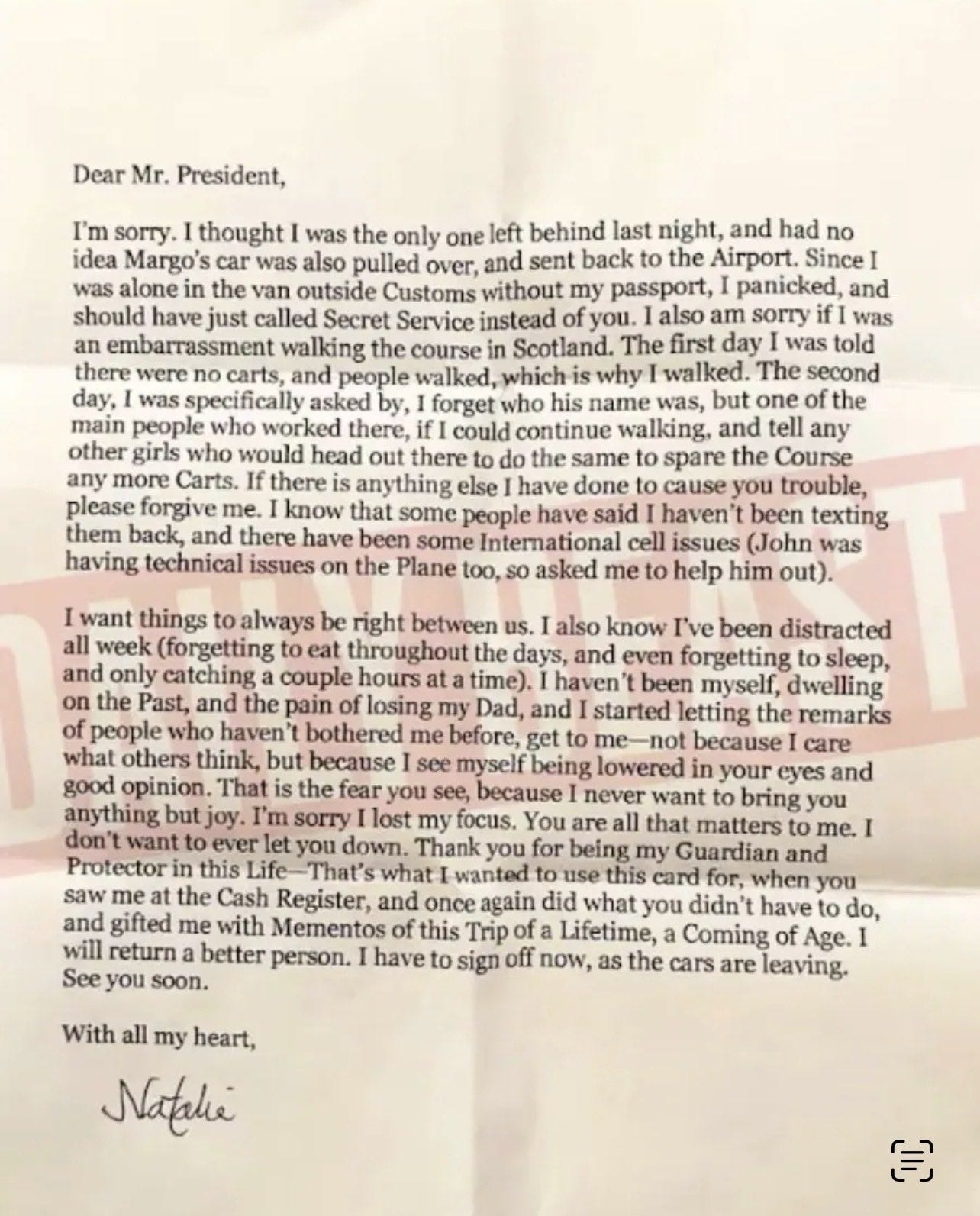
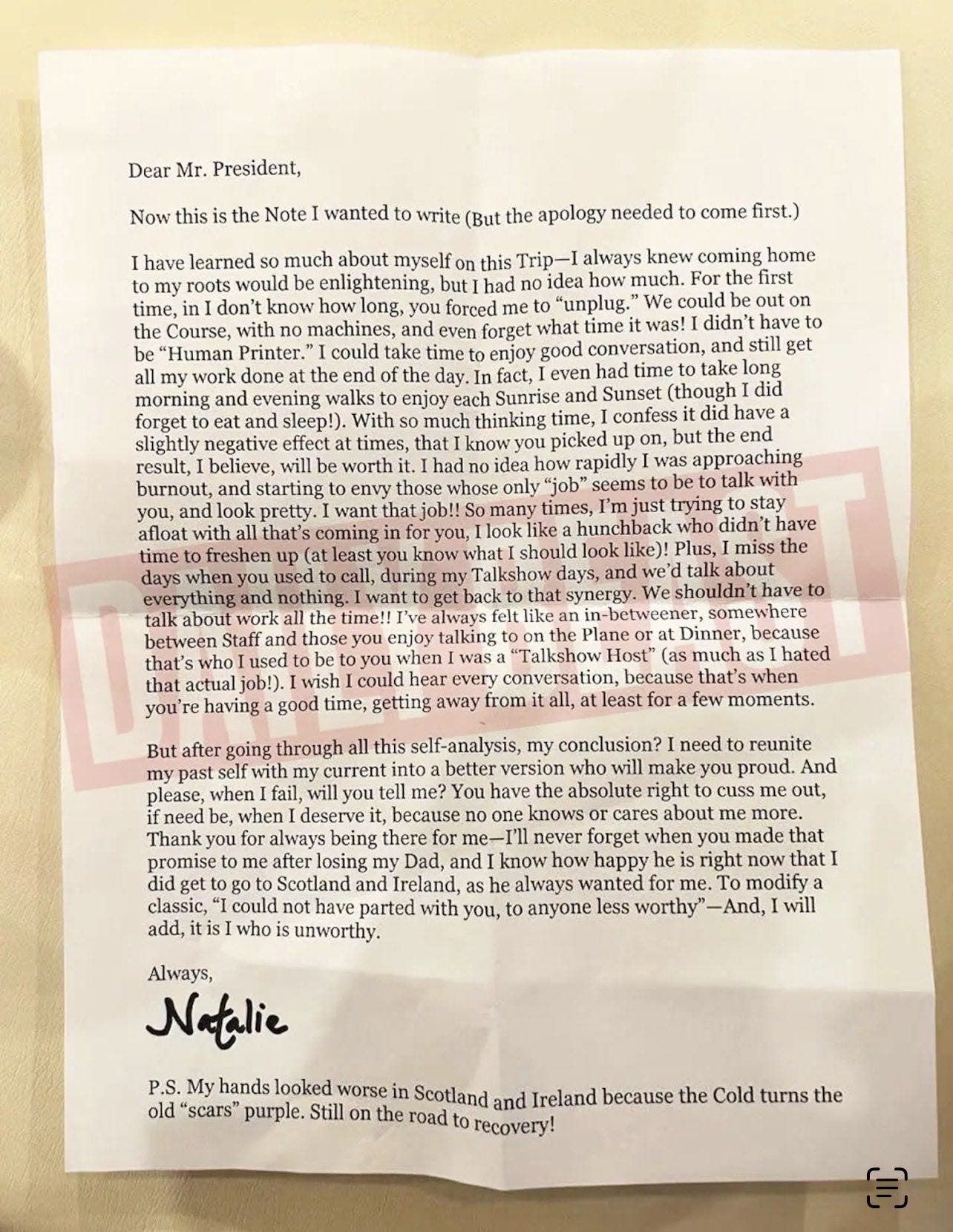
There’s been lots of reporting lately about the breathlessly fawning personal letters Natalie Harp habitually writes to her boss. Last night, the Daily Beast released two of them in full—and they’re so, so much creepier than advertised. We don’t want you to click away, so we’ll stick them down in the Cheap Shots—and we are relying on the honor system that you won’t simply skip ahead. All we’ll say up here is: Yikes. Happy Friday.
Join Catherine Rampell and JVL for Receipts Livetoday at 12:30 p.m. EDT today on Substack and YouTube.
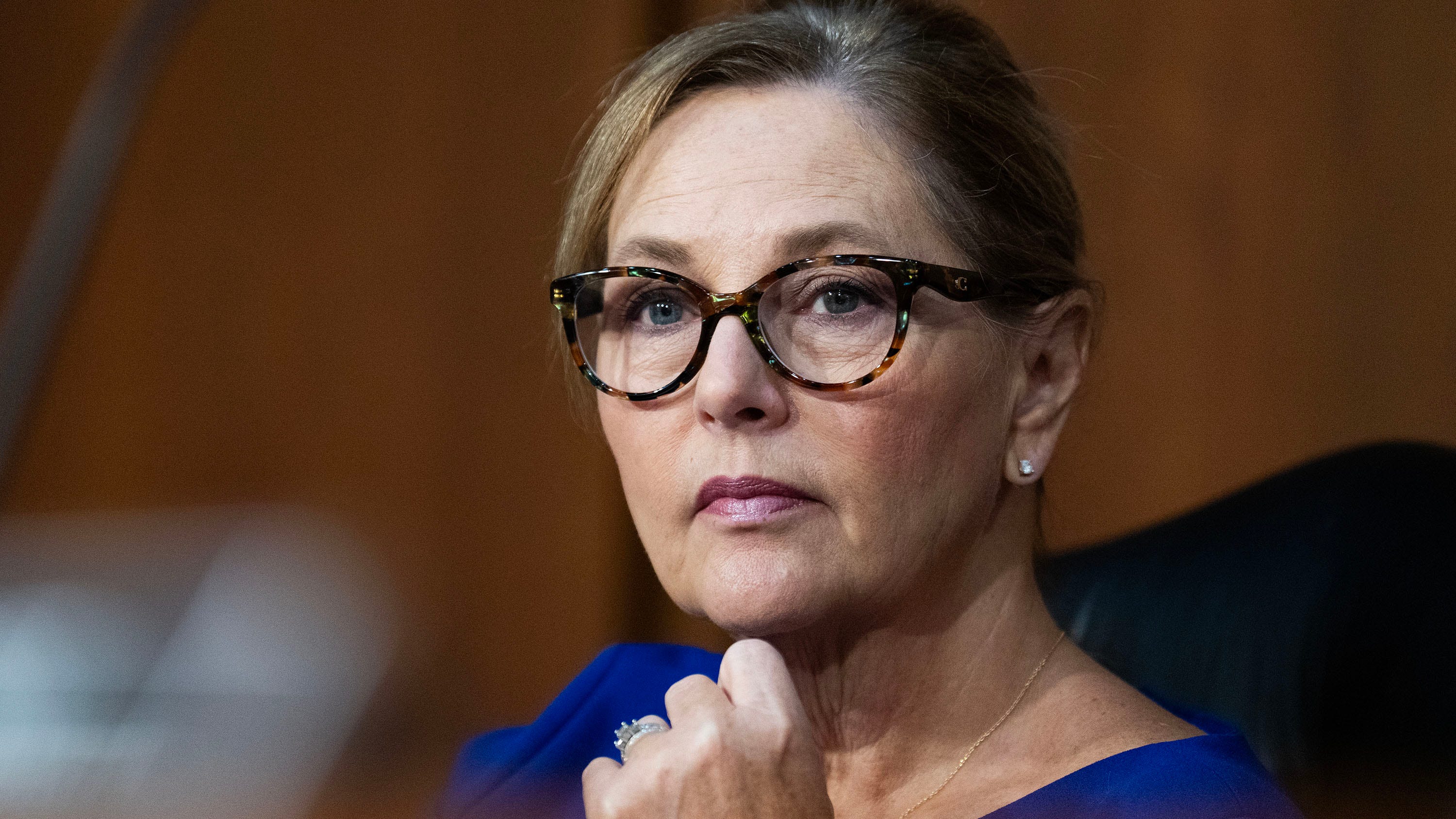
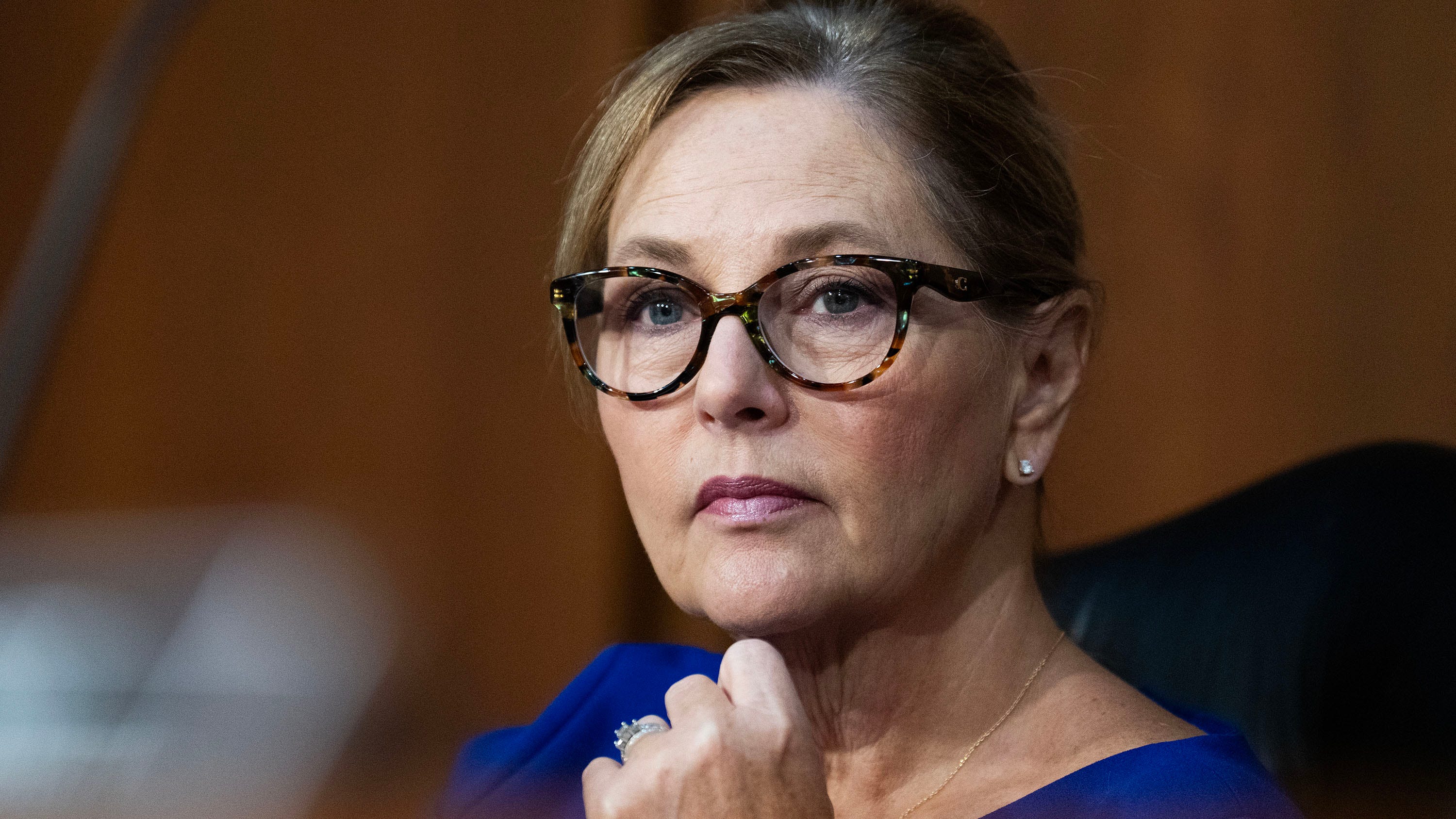
Sen. Darline Graham, R-S.C., attends the Senate Judiciary Committee mark up on the nomination of Todd Blanche to be attorney general, in Hart building on Tuesday, August 4, 2026. (Tom Williams/CQ-Roll Call, Inc via Getty Images)
Leave Darline Alone
by Andrew Egger
Darline Graham’s Taiwan gaffe couldn’t have come at a worse time. The South Carolina senator—sister and successor of the late Lindsey Graham—had hoped her Tuesday debate against Rep. Ralph Norman would quiet Republican whispers that she wasn’t ready for primetime ahead of next week’s runoff. Instead, she tripped headfirst over a question about America’s posture toward Taiwan and the South China Sea, managing only to say that foreign policy isn’t her area of expertise and she supports the military.
The moment was particularly painful because Lindsey Graham was one of the Senate’s biggest Taiwan boosters and China hawks. Darline Graham’s entire case is that she’s carrying on her brother’s legacy. And yet there she was in a damage-control appearance on Sean Hannity the next night, insisting that her voters are “concerned about a lot of things other than Taiwan,” like the Save America Act and men in women’s sports.
It’s all been very embarrassing for Darline. But I keep wondering: What if she’s right?
Here are two ways of thinking about the work of being a senator. One is as an awesome responsibility: One of just a hundred members of America’s upper legislature, the Greatest Deliberative Body On Earth™, setting down laws and policy for the most powerful country in the world. If that’s the job, then it’s hard to dispute that being informed on national security and foreign policy is crucial.
The other is as a fun D.C. social club and media platform. Nothing real ever happens in the ossified, deadlocked Senate, to whose legislating and foreign-policy-setting powers President Trump has helped himself in ever greater amounts. The job of a GOP senator is to say nice things about the president, vote down Democratic efforts to rein him in, and give him whatever he asks for in a massive reconciliation bill once or twice a year. (Pretending you might occasionally do something else is an optional extracurricular.)
I would like to live in a world where every senator believes in Option A. Is that the world we live in?
Keeping China constrained in the South China Sea is a longtime U.S. policy goal. It seems important that senators should know the issue back to front, and it’s a good thing that we have such a robust class of China hawks in the Senate GOP.
What has that class of China hawks been up to lately, by the way? Because I seem to remember that, earlier this week, President Donald Trump took a sledgehammer to our Pacific China posture in one of his most insane statements in recent memory. Fuming that South Korea was not sufficiently respecting his bromance with North Korean dictator Kim Jong Un and that it had not joined his war with Iran, Trump abruptly ordered longstanding joint exercises with South Korea’s military cut short—a dramatic blow to our alliance, which relies in large part on American guarantees of protection against South Korea’s lunatic nuclear neighbor. America doesn’t provide these guarantees out of the goodness of its heart. South Korea would be a crucial regional ally, providing military support and key bases, not just in the event of a future conflict against North Korea, but against China as well.
Not everyone distinguishes between how they want things to be and how they are. We do. If you value this kind of journalism, join Bulwark+.
What did the Senate’s GOP China hawks make of this senseless provocation, so damaging to our regional interests? They’re harder to find than usual at the moment, since the Senate is currently on recess.
But yesterday, I reached out to eleven of them: Jim Risch, Tom Cotton, Josh Hawley, Pete Ricketts, Dan Sullivan, Todd Young, Bill Hagerty, Marsha Blackburn, Rick Scott, John Cornyn, and Ted Cruz. Did any of them, I wondered, have anything at all to say on the topic? Not a single one of their offices—not one—sent back a substantive reply.
The foreign policy titans of the Senate GOP have had their hands full not noticing things like this lately. They’ve sat by as Pete Hegseth’s Defense Department blows through our missile inventory pummeling a truculent Iran, despite growing concerns that this short-sighted action jeopardizes our future ability to defend Taiwan. They’ve repeatedly tied their own hands on the Iran conflict in other ways as well, shrugging at Trump’s brazen defiance of their warmaking authorities and routinely voting down War Powers resolutions that would force him to seek their permission to keep the Iran conflict going.
It’s Darline Graham’s contention that GOP voters don’t care about any of this. What they want their senators to be doing, she argues, is chasing a bunch of right-wing culture-war shibboleths: beating their heads against the wall of the DOA Save America Act, rabble-rousing about the elevenish male trans athletes a year who want to play in girls’ and women’s athletics. The Serious Men of the Senate flatter themselves that their job is more serious and important than this. But I suspect Darline might know what time it is better than they do.
AROUND THE BULWARK
Trump Is Finally Losing Ground Among Republicans… Focus groups show they’re mad about Iran. They’re mad about grocery prices. And they’re starting to wonder what on earth the president is doing, writes SARAH LONGWELL.
End of the Endless Summer… The Eve Babitz revival offered an intoxicating escape from our modern literary anxieties. Her final, briefly wonderful book of letters brings us back down to earth, writes HENRY BEGLER.
The Politics of AI Are Shifting in Real Time… Mark the summer of 2026 as the moment when an unlikely supermajority of Americans came together on one issue: their opposition to data centers. DAVID WALLACE-WELLS joins TIM MILLER on The Bulwark Daily.
SPEAKING OF DRONES: Gen. Randy George was a well-respected infantry officer and something of a reformer—a rarity at the top of rigid conservative hierarchies like the U.S. military. The defining effort of his tenure as chief of staff of the Army was the Army Transformation Initiative, which sought to catch the service up to the technologies of the modern battlefield, like drones and directed-energy weapons.
Then Secretary of Defense Pete Hegseth fired him in April, on suspicion of leaking internal disputes to the press. George’s acting successor is Gen. Christopher LaNeve, who was confirmed as vice chief of staff in January after a stint as a senior military assistant to Hegseth.
LaNeve recently ordered an experimental drone unit George had pioneered shuttered, reports the Wall Street Journal. An Army spokesman told the Journal that “Ultimately, these aerial systems are enablers that support our soldiers.” Sure, fine—but how is kind of an important question, as anyone who’s been paying attention to the wars in Ukraine, Gaza, and Nagorno Karabakh over the past six years would realize.
The Journal reported that “The elimination of a futuristic drone battalion is part of a broader ‘back-to-basics’ approach ordered up by . . . LaNeve.” Did America’s enemies get that memo, too?
BAIT-AND-SWITCH: If you’re an American healthcare company, you probably rely in some form or other on immigrants. If you’re an unscrupulous American healthcare company, you might lure people here with the promise of work and a better life, only to pay them poorly, and if they try to quit, threaten to charge them $10,000 or more for the privilege—oh, and maybe also call ICE.
That’s exactly what a group of nurses accused Avant Healthcare Professionals of doing in a lawsuit. At first, the firm fought the suit—but then it signed a $3 million settlement. Avant Healthcare Professionals, it turns out, is part of Jackson Healthcare, as in Rick Jackson, who just days before the settlement won the Georgia Republican gubernatorial primary.
If this news had come out before the primary, it’s hard to tell how Jackson would have fared. Maybe Republican primary voters would have punished him because his company lured people here from abroad. Or maybe they would have rewarded him because it subsequently mistreated them.
INVESTIGATION INCEPTION: The government is investigating the government for investigating the guy in charge of the government for crimes against the government. Did you get that? Reuters spells it out in more detail:
The U.S. Justice Department has requested to interview FBI officials who were involved in the 2022 search of Donald Trump’s Mar-a-Lago resort in Florida as part of a wide-ranging probe examining past investigations of the president, four sources familiar with the matter said on Thursday.
The requests came from investigators working with Joe diGenova, a Trump ally who began overseeing the Florida-based investigation earlier this year. The investigation has been seeking to establish that Trump was the victim of a criminal conspiracy against his rights.
A refresher: The FBI searched Mar-a-Lago because Trump had illegally stashed troves of extremely highly classified documents there, including some related to nuclear secrets. At various points, he discussed some of these documents with people who had no business knowing about them in places where discussions about such things had no place being held. When the government asked for the documents back, Trump went to extreme lengths to lie, hide the documents, and avoid returning them. The only reason he’s not in Florence, Colorado is because Judge Aileen Cannon’s sycophancy toward him was second only to Natalie Harp’s.
Can’t wait for the next administration, when the FBI gets to investigate Justice Department officials for investigating FBI officials for investigating Trump.
Fresh off freezing up on a question on Taiwan at a primary debate this week, Sen. Darline Graham hustled to Sean Hannity’s Fox News show last night for a little damage control. “I don’t speak politician,” she said by way of explanation. “I think people in South Carolina are more worried about making ends meet. They’re concerned about boys in girls’ sports. One lady talked to me extensively about that today. They’re concerned about the Second Amendment, they’re concerned about the Save America Act, illegal immigration. So they’re concerned about a lot of other things other than Taiwan.” She doesn’t speak politician yet, but she’s trying to learn. Happy Thursday.
(Photo illustration by Sarah Rogers/The Bulwark | Photos: Getty)
A Data Center? In This Economy?
by Andrew Egger
A few months ago, I went to an after-work D.C. event for folks in the AI space. The drinks were flowing and the vibe was cheery, mostly young would-be tech tycoons talking their book with chipper GOP policy staffers. But at one point, I talked to a different sort of character—a rumpled older guy who turned out to be an academic researching public attitudes toward AI development. How was that going, I asked. He looked at me with haunted eyes. It is so, so much worse out there, he said, than anybody even realizes.
What a difference a few months can make. Across the country, politicians are waking up to a simple fact: Voters hate AI and are gearing up to punish elected officials who seem to like it. Mostly, their ire has come to land on data centers—the factory-size banks of chips that power the cloud-based internet and are its most visible real-world incarnation.
Everywhere you look, politicians are suddenly sprinting away from data centers. Texas Gov. Greg Abbott, who had formerly rolled out the red carpet for the AI buildout, signed a moratorium on new data centers this month pending a state “audit” on their energy use. Just last night, Abbott bragged about having “halted up to 1,800 data center projects.” Pennsylvania Gov. Josh Shapiro followed Abbott’s lead this week, inking an order heaping up red tape on new proposed data centers. He, too, was until recently a fan.
Don’t follow the crowd; make up your own mind. We tell you what we really think. Join Bulwark+ to leave a comment telling us what you think.
This week, the National Republican Senatorial Committee raised the alarm explicitly in a memo about the Ohio Senate race, where Republican Sen. Jon Husted is trying to stave off a challenge from Democratic former Sen. Sherrod Brown. “Ohio is one of the leaders in building these AI factories,” reads the memo, which was first reported by Axios:
Brown has made his opposition to them the centerpiece of his campaign against Husted. Brown is using it because it works. More than any other thing in this race, data centers are the anchor hanging around Husted’s neck. If he loses and data centers get the blame, politicians across the country will take notice.
But it’s not only Democrats making use of this attack. In Wisconsin’s Democratic gubernatorial primary, Francesca Hong ran hard against data centers, while her opponent David Crowley took a more centrist approach: Not to ban them, but to require they be powered by green energy and built by union workers. Now that Crowley is through to the general, however, Republican Tom Tiffany is hitting him hard on the issue, describing him as “Data Center David Crowley” in ads: “Crowley’s campaign is funded by the people building them. Big Tech wins. Wisconsin pays.”
If you’ve been paying attention, it’s been clear for a while that we were heading here. Back in March, I wrote about the massive latent political energy surrounding AI, noting that neither party had yet won voters’ trust on the issue. “The party that can win the argument over AI is set up for a political windfall,” I wrote, “and then will be tasked with shepherding the country through massive disruption toward a prosperous rather than a dystopian AI-integrated future, if possible.”
The problem is that public hysteria over data centers has reached the point that there’s essentially no debate happening at all. Politicians are simply turning the phrase into low-calorie ragebait: If my opponent won’t pledge to stop letting companies plug in a bunch of chips in a warehouse, that’s because they’re owned by Big Data Center.
AI has remarkable potential for good: The tech’s capabilities just keep growing, and it is already paying major dividends in fields like medical research. And of course, AI has incredible potential for harm—it could eventually kill us all, or enslave us, or just feed us slop until it turns all our brains into soup. It’s a pretty big range of possible outcomes!
But while there are certainly good reasons to be anxious about AI development, concerns about data centers’ local effects are often wildly overblown. There’s something bleak about seeing the policy debate over how we ought to shape and regulate this massive, unbelievable, titanic technology collapse down into what’s essentially a NIMBY squabble over where to park the chips that power it.
Michigan’s Green Ghost
by Brendan Hartnett
As The Bulwark first reported, the Green Party of Michigan may have nominated a Republican plant to run on its ballot line in Michigan’s competitive 7th Congressional District. Our investigation uncovered that 25-year-old Shane Dedrick was chosen as the party’s nominee after joining the Green Party of Michigan’s April nominating convention on Zoom—during which he kept his camera off, seemed to know little about the party platform, and went through practically no vetting. Dedrick is not active on social media, does not have a campaign website, and has yet to register with the FEC.
Despite multiple attempts, The Bulwark was unable to get in contact with Dedrick. We’re not alone.
Following our story, Michigan’s WLNS reached out to Dedrick unsuccessfully and even visited his residence, but no one came to the door. Douglas Marsh, communications director for the Michigan Greens, told WLNS, “To my knowledge, no one has heard from him since April 25,” when Dedrick first introduced himself to the party, never showed his face, and left 33 minutes later as the party’s nominee. Marsh told The Bulwark that he has still not been able to contact Dedrick.
On Wednesday, the party even posted a quote from its secretary of state nominee, Eric Borregard: “If I lived in the 7th District, my own personal choice would probably be the grassroots candidate Felix Thibodeau of the Working Class Party now.”
Asked if this meant the Michigan Green Party was withdrawing its support for Dedrick and endorsing Thibodeau, Marsh told The Bulwark, “The party has opted not to formally endorse any candidates not in the party this cycle, but the longer Dedrick remains MIA, the more difficult it is to extend him the benefit of the doubt.”
The post about Thibodeau has since been deleted from the post.1But a comment from the party account expresses largely the same sentiment:
No, unfortunately it’s passed the point of no return for that one. The party did make a mistake in the Dedrick nomination. It’s up [to] the voters now to make up their own minds which one of four candidates is best for them in the end. Maybe the Republicans would rather vote for a handsome young MAGA mystery candidate than an old warmonging [sic], crazed budget busting lunatic like [incumbent Rep.] Tom Barrett.
Marsh told The Bulwark, “I remain agnostic about Dedrick’s intentions in seeking and accepting our nomination. He signed a sworn and notarized affidavit in 2026 indicating his wish to affiliate with an ecosocialist organization. If it was fraudulent, we will explore options, but so far all we have to work with is silence and unanswered questions.”
Postliberalism Is Not About Economic Transformation… Disregard the empty allegations of ‘socialism.’ The real problem with postliberalism is its underlying authoritarian vision, writes MATT McMANUS.
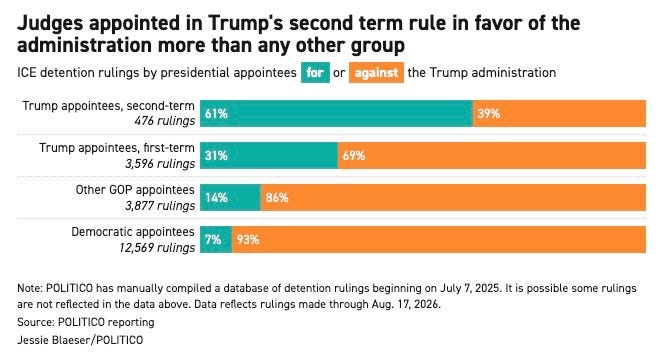
DIFFERENCES OF JUDICIAL OPINION: During his first term, Donald Trump was mostly happy to nominate federal judges from the existing conservative legal movement. Then he noticed something: Sometimes, when he wanted to do a thing—steal the 2020 election, for example—his own judges wouldn’t let him. Judases! Benedict Arnolds! When Trump got back in office, he decided he’d target a different kind of judge.
The strategy is paying off. Yesterday, Politico took a look through the towering pile of lawsuits—more than 20,000 of them—that have been filed over the past year over ICE’s policy of locking up people facing deportation proceedings without bond. In the vast majority of cases, judges have ruled against these detainments. But there’s one single group of judges who have tended to side with the president: The judges he nominated since returning to office.
Seems pretty bad—but then, there are some silver linings. One, Trump is way off the pace of his first term in filling federal court vacancies, in part because there are many fewer vacancies for him to fill. And two, he hasn’t gotten any new cracks at another SCOTUS vacancy yet—and God willing he never will.
NOW HERE’S A PUZZLER: “President Trump’s half-built White House ballroom is a 90,000-square-foot embodiment of a recurring legal conundrum,” reports the Wall Street Journal. “What happens when a boundary-pushing president moves faster than courts can keep up?”
Construction of the “concrete-and-steel superstructure,” [the Trump administration says], has already advanced so far that it would be “practically impossible” to stop now, let alone tear down what has already been built.
Two lower courts have ruled that the ballroom project is probably illegal because Congress never approved it. But Trump has been allowed to build while the litigation proceeded. He has taken full advantage of that dispensation, leaving the Supreme Court in a pickle as the grace period is set to expire this week. [Emphasis added.]
The solution seems pretty simple: The president shouldn’t be allowed to continue to do something that’s probably illegal. That’s more or less what the word “illegal” means—you’re not allowed to do it.
Frustrated sarcasm aside, the Journal article is really about how the administration is rushing, in a whole bunch of areas, to create facts on the ground before the courts can intervene. It’s an important subject worthy of attention.
It’s also why the Supreme Court should block further construction immediately and indefinitely, and why the next Congress and/or president should demolish Trump’s construction—as a demonstration of the supremacy of the law and the government’s fealty to it.
Besides, if the Reflecting Pool saga is any indication of Trump’s preference for contractors, that ballroom won’t be safe to stand in.
According to Marsh, Borregard was “posting in his own capacity” on the party’s official Facebook account. “We advised him that the party is not endorsing any independent candidates or candidates from other parties for this cycle and he edited that post accordingly.”
Andrew Egger and Lauren Egan break down Florida’s Democratic primaries—and what Angie Nixon’s surprise Senate win means for Democrats in a state they’ve struggled to compete in. They discuss Nixon’s uphill battle against Republican Ashley Moody, David Jolly’s path for governor, and the awkward dynamic of having a self-described democratic socialist and a centrist Democrat at the top of the ticket. Plus, Cory Mills loses his primary despite Donald Trump’s endorsement.
On a certain level, you’ve got to feel for Sen. Darline Graham (R-S.C.). If her brother Lindsey hadn’t died unexpectedly this year, she wouldn’t be in the Senate at all—much less running in her own right. And man, has the learning curve been brutal. In last night’s GOP primary debate, she was asked whether Taiwan and the South China Sea are national security issues for the United States.
“I’m just going to be honest here. I’m not on national security that—I’m not that informed on national security,” Graham replied haltingly. “So—but I do support the military. . . . I’m not a polished politician up here, national security is not my thing, not my area of expertise, but I do support the military.” Happy Wednesday.
Join Mark Hertling and Ben Parker for Command Post live on Substack and YouTube at 10:30 a.m. EDT today.
(Photo Illustration by Sarah Rogers/The Bulwark | Photos Getty, Shutterstock)
This Aggression Will Not Stand, Man
by Sonny Bunch
One of the more depressing responses to Trump 2.0 has been the cowardly way some in the media have responded to the president’s relentlessly bullying legal tactics. They’ve often chosen to settle rather than fight the president on cases that could easily be won, just to avoid regulatory hassles for the parent conglomerates of these media companies.
But even some of the quislings seem to have had enough.
The most egregious of those early cases, of course, was Paramount’s decision to settle with Donald Trump over claims that 60 Minutes deceptively edited an interview with Kamala Harris to make her sound more intelligent than she actually was. The case was, on its face, absurd: Virtually every interview that isn’t live is edited in some form or fashion for reasons of time, continuity, coherence, etc. This is just standard practice; everyone who has ever done an interview understands that some things are likely to be trimmed. CBS itself stated repeatedly that the lawsuit was meritless. I don’t think you’ll find a single reputable scholar who thinks Trump could have won on the merits.
And yet, CBS’s parent company, Paramount, caved because it was in the process of being absorbed by Skydance, a company owned and operated by David Ellison, who bought it with the backing of his Trump-donor father, Oracle’s Larry Ellison. What’s a $16 million settlement in the face of an $8 billion purchase?
Meanwhile, ABC agreed to cover $1 million in legal fees and sent another $15 million to the “nonprofit” building Trump’s presidential library/hotel following George Stephanopoulos’s repeated insistence that Trump had been convicted of “rape”—rather than the more strictly accurate statement that he had been held liable for sexual abuse—in the E. Jean Carroll case. Truth be told, this was a trickier case than the farcical 60 Minutes suit—technically, Donald Trump has not been convicted of rape despite repeatedly being accused of sexual assault and instructing a confidante that, as a star, he can “do anything . . . grab them by the pussy”—but it’s hard to imagine Disney/ABC settling for that amount of money with someone who did not vindictively wield regulatory power.
It’s more important than ever to have independent media. We don’t have partisan loyalties or parent conglomerates. But we do have a community we’d love for you to join.
Caving to Trump didn’t win ABC any favors from the administration. As I discussed with Robert Corn-Revere on last week’s episode of The Bulwark Goes to Hollywood, Trump and his hand-picked FCC bulldog Brendan Carr have gone after Disney and ABC relentlessly, pressuring the network to suspend Jimmy Kimmel following a crass joke he made about Charlie Kirk in the wake of the young pundit’s assassination. After Disney suspended Kimmel, Carr took a victory lap, which in turn provoked a counter-outrage, and Kimmel was quickly reinstated. When Carr and Trump again turned their eyes on Kimmel following a crack about Melania Trump glowing like “an expectant widow,” there were renewed calls to punish Kimmel—calls that were, ultimately, ignored.
Carr then escalated the attacks by announcing that ABC’s broadcast licenses would be put up for renewal earlier than expected. The network vowed to fight the action and on Tuesday filed suit against the administration on First Amendment grounds. Here’s the crux of ABC’s argument:
The day after the President objected to additional on-air comments by Mr. Kimmel, the Commission issued an unprecedented order requiring the Stations to file early applications to renew their licenses—years before any of their licenses would have come up for renewal in the ordinary course and allowing only thirty days to file applications which ordinarily take months to prepare. Until the day before that order issued, the Commission had not called for a renewal application ahead of schedule in more than half a century. Nor had it ever demanded simultaneous early renewal applications from a group of stations commonly owned with a single broadcast network.
ABC’s entire complaint is worth reading. It’s a chilling catalogue of governmental efforts to restrict speech at the behest of the president and a reminder why Trump has such a healthy friendship with dictators like Vladimir Putin and Kim Jong Un: Like them, he does not believe in freedom of speech. He believes only in obeisance and obedience.
What makes the actions of CBS’s and ABC’s first settlement so disappointing—as well as similar capitulations by the law firms that settled with Trump and social media companies that had justifiably banned Trump following the January 6th riots—is that Trump’s suits almost always crumble when challenged. The courts have dismissed Trump’s cases against the Wall Street Journal for their reporting on the president’s intimate friendship with child-sex-trafficking kingpin Jeffrey Epstein and CNN for its use of the phrase “The Big Lie” to describe Donald Trump’s big lies about winning the 2020 election.
Bulwark LIVE: THE GOOD FIGHT TOUR with Tim, Sarah, Sam, and JVL is coming to the Southeast in October. Tickets go on sale August 21. Bulwark+ members get early access now. Click here for details and to get your tickets.
The Real Danger of Russia’s Fake Elections… The anti-war, anti-government sentiment was apparently more than Putin bargained for, observes CATHY YOUNG.
MIDTERMS VIBE CHECK: Florida, Alaska, and Wyoming all held their primaries yesterday, with many of the most interesting results coming out of the Sunshine State. A sampling:
Cory Mills lost. The Trump-endorsed congressman, who has faced a blizzard of sexual-misconduct and campaign-finance accusations, was defeated by former local-TV anchor Ryan Elijah, who had campaigned hard on Mills’s personal baggage risking losing the seat to Democrats. Elijah will face former NASA Chief of Staff Bale Dalton in November.
Byron Donalds won—but not as overwhelmingly as he’d hoped. The three-term congressman had hoped his strong name ID, Freedom Caucus credentials, and Trump endorsement would clear the field in his race to succeed Gov. Ron DeSantis. But he ultimately took only 48 percent of the primary vote, with 25 percent of voters pulling the lever for current Lt. Gov. Jay Collins, 10.5 percent supporting groyper shock jock James Fishback, and 8.5 percent voting for anti–data center campaigner Paul Renner. Donalds has some work to do to unite Florida Republicans ahead of his matchup with the Democratic nominee, former Republican David Jolly.
Democratic establishmentarians and iconoclasts traded blows. Rep. Jared Moskowitz fended off a progressive challenger in his newly drawn 25th District, as did former DNC Chair Rep. Debbie Wasserman Schultz in the 20th. But the biggest prize went to DSA candidate Angie Nixon, who knocked off a far better funded moderate contender in Alex Vindman to capture Florida Democrats’ Senate nomination. Nixon now heads to a showdown with Republican Sen. Ashley Moody in a contest to close out the last two years of former Sen. Marco Rubio’s term.1
BLUE WAVE VIBE CHECK: Are you a Democrat looking for a jolt of hopium? Feast your eyes on the last special general election until November, a sleepy Pennsylvania state House race in the 12th District, which a Republican won in 2024 by 30 points—and in which Democrat Brandon Dukes may have just pulled out a stunning upset over Republican Scott Timko. Carolyn Fiddler reports on her Substack This Week in Statehouse Action:
As of this writing, Dukes has pulled out a shocking win—he leads Timko 50.26-49.74%, which comes down to 88 votes.
Provisional ballots and some overseas ballots likely won’t be counted until next week, so this number may yet shift.
But even if Timko makes up that deficit, the safe R nature of this seat makes this outcome a huge L for his party.
And it’s a final upward-trending data point in terms of the dramatic Democratic overperformances that have characterized the vast majority of special elections this cycle. . . . Across 109 contested special elections over the past 21 months, Democrats have improved on Kamala Harris’ performance in these same seats by an average of 12.5%.
NO EXCUSE FOR CENSORSHIP: The terrible story of Jason Arday, the British academic and author who died in an apparent suicide shortly after resigning his Cambridge University professorship under scrutiny for offenses ranging from plagiarism to extensive fabulism about his life story, has produced dramatically polarized narratives. Many progressives see a talented black scholar hounded to death by racist detractors and media vultures. Many conservatives and centrists see fraud enabled by a diversity-fixated academic institution. Perhaps the most provocative essay, by Substack blogger Sam Kriss, argues that Arday’s self-invention should have been treated as a work of genius far above conventional academic toil.
The complications of the story, though, haven’t stopped some people from going absolutely bonkers. There’s a Change.org petition for a UK law limiting “the number of news articles published about a single individual within a defined time frame” to minimize “mental anguish.” Obviously, anyone can start an online petition. But dozens of British academics and other public figures, including members of Parliament, have signed an open letter to the British government urging a public inquiry into the media’s supposed racist harassment of Arday and declaring that “self-regulation of the press has comprehensively failed.”
British law, especially on libel, already allows far more suppression of speech than American law. And before the scandal broke, Arday actually used threats of litigation to squash journalistic inquiries into his record. Thankfully, in the United States, the First Amendment largely prevents such abuses. But some left-wing American commentators such as Ibram X. Kendi are now joining the media-bashing chorus with accusations of a “lynching.”
This would be disturbing in any circumstances. At a time when a right-wing administration would love nothing more than to gut the First Amendment, progressive sympathy for censorship is not only wrong but grotesquely self-sabotaging.
Andrew Egger and Ben Parker went live to cover the Republican election deniers in 2020 now running for office, the company that put out a bogus poll on purpose, Trump’s latest threats against an American ally, and the White House response to a question about Natalie Harp.
It’s a tough year to run for governor of a swing state as a Republican. The folks elected this year will supervise their state’s elections in 2028, and many voters reasonably wonder: What did you do last time Donald Trump tried to steal an election? If he tries to do it again, will you stand in his way?
At least some candidates are plainly feeling the pressure. In 2020, Wisconsin Rep. Tom Tiffany, now Republican nominee for governor, strongly supported Trump’s efforts, backing a lawsuit to overturn the election results and voting against certifying them on January 6th. Last year, he said he supported the Trump FBI’s muckraking efforts into finding “improprieties” in the 2020 election; earlier this year, he refused to answer the question of if Biden had won in 2020.
Now, though, Tiffany’s had an apparent change of heart. “Joe Biden won,” he told CNN in a statement. “I’ll cooperate with law enforcement on investigations because Wisconsinites deserve full transparency and the ability to see the facts. . . . In 2028, I’ll certify whoever wins the most votes in Wisconsin.” In 2026, admitting Trump lost and insisting you’ll do your job if elected is apparently how you pivot to the general. Happy Tuesday.
Busy morning here at Bulwark HQ. Our Bulwark+ presale for members for The Good Fight Tour stops in Columbia, Charlotte, and Atlanta opens at 10 a.m. in the East. Head to TheBulwark.com/Events to get early access to tickets. General admission sales open on Friday.
Morning Shots Live: Andrew Egger and Ben Parker will be live on Substack and YouTube starting at 10:00 a.m. EDT. A replay will be posted on the site and the Bulwark Takes feed.
(Photo illustration by Sarah Rogers/The Bulwark | Photos: Shutterstock)
Who Would Want to Be Friends with America Now?
by Mark Hertling
Over the weekend, President Trump made a point of complimenting our enemy, North Korea, and antagonizing our ally, South Korea. Continuing the pattern, yesterday he threatened to bomb another longtime American security partner, Oman.
Asked about Oman’s talks with Iran concerning the Strait of Hormuz, which borders both countries, President Trump reportedly told Fox News reporter Trey Yingst, “If Oman gets in the way, we’ll bomb the shit out of them.” He seemed to double down on the threat later yesterday in the Oval Office.
The president is threatening to bomb a country that for nearly half a century has quietly provided the United States with military access, logistical support, diplomatic assistance, and something increasingly rare in the Middle East: the ability to communicate with friends as well as enemies. For decades, Oman hasn’t been in the way, it has often been the way.
The modern Omani–American military relationship dates to 1980, when Oman became the first Persian Gulf state to sign a formal agreement allowing American forces access to its military facilities. That access was particularly valuable during the “Tanker War” of the 1980s. When the Reagan administration launched Operation Earnest Will in 1987 to protect reflagged Kuwaiti tankers from Iranian attack, Oman was one of the few Gulf countries with agreements already in place for military access and prepositioning.
That cooperation continued through Desert Storm, Afghanistan, and Iraq. In 2019, Washington and Muscat expanded the relationship again, giving American forces access to the ports at Salalah and Duqm. The latter is especially important in the Gulf: Duqm is a deep-water port capable of handling large American warships and sits outside the Strait of Hormuz.
That close cooperation in no way means that Oman is an American puppet. Oman is friendly with the United States while maintaining relations with Iran. That balancing act sometimes frustrates Washington and Oman’s Arab neighbors, but it has also made Muscat a useful intermediary when Americans and Iranians cannot—or will not—talk to one another.
Being independent means we get to say what we think is true, no matter what. To support our work, become a Bulwark+ member.
Oman helped establish the secret channel between Washington and Tehran during the negotiations that produced the 2015 Iran nuclear agreement, and it has helped secure the release of Americans held hostage by Iran. When Washington and Tehran needed an intermediary during the current crisis, Oman stepped forward again.
Which makes Trump’s threat especially bizarre. Just one day earlier, Trump ordered the Pentagon to substantially reduce the Ulchi Freedom Shield exercises with South Korea, criticizing Seoul for failing to support his Iran policy while again emphasizing his relationship with North Korean dictator Kim Jong Un. Meanwhile, NATO countries in Europe have been confronting increasingly brazen drone activity and suspected Russian provocations, without any kind of presidential threat directed toward Moscow. An emerging pattern is taking shape, and America’s friends are certainly noticing it.
Japan, the Philippines, Australia, and other Indo-Pacific partners will watch what happens to South Korea and wonder what it says about America’s commitments to them. So will leaders in Riyadh, Abu Dhabi, Doha, Manama, and Kuwait City. Those governments have spent decades building relationships with Washington, have cooperated with American administrations of both parties, and all understand that partnerships sometimes involve disagreements. But alliances and partnerships depend on something more fundamental than agreement. They depend on predictability and trust.
No nation expects the United States to agree with it on everything. What nations must be able to expect is that a disagreement with Washington will remain a disagreement—not suddenly become the dissolution of an alliance or even a threat of military attack.
A larger lesson here is about American leadership. Alliances are relationships built over years, administrations, wars, crises, and disagreements. Presidents inherit them from their predecessors, sustain them for their successors, and occasionally strengthen them through careful diplomacy.
But presidents can also destroy them. That destruction rarely occurs with a formal announcement. More often, trust corrodes incrementally. An exercise is canceled. An ally is publicly berated. An adversary is praised. A partner wonders whether Washington will respond to help during a crisis. Another begins looking elsewhere for security or diplomatic support.
And America loses a partner, an ally, or a friend.
AROUND THE BULWARK
How Baseball Marks the Time… The seasons change. Children grow up. Years fly by. Yet somehow you can still remember exactly where you were when the ball cleared the wall, writes MARK HERTLING.
THE REAL FAKE POLLS: Political polling is in dire straits for a bunch of reasons. Nobody can figure out how to get surveys in front of representative samples of voters now that people don’t pick up cold calls from unknown numbers anymore. And with reliable results seeming out of reach, fewer and fewer outfits are even trying to run high-quality polls—which leaves narrative gaps for poorer and more partisan polls to influence public perceptions of a race.
Or even downright frauds. A group calling themselves Median Polling supposedly conducted a couple polls this month, including one in Wisconsin supposedly showing Francesca Hong up 20-plus points on David Crowley and another in the L.A. mayoral race showing incumbent Karen Bass leading challenger Nithya Raman by double digits. But with skeptical reporters digging into them, the group admitted yesterday that the polls were fakes.
“All previously published polling releases have been withdrawn and should not be cited or treated as genuine polling data,” it said in a statement. “Median Strategies was created as a short-term social experiment examining how purported polling information could enter and spread through the political information ecosystem without independent verification.”
In fact, Median’s “experiment” had raised red flags from the start, at least among polling experts. But their hoaxed information did make it into broader ecosystem here and there: Bass shared Median’s bogus poll showing her comfortably in the lead on social media, even whipping up an infographic to help it pop. “Doing the work, showing up, and gaining momentum,” Bass tweeted. “Let’s do this, LA!”
NATALIE IN THE SPOTLIGHT: Donald Trump’s personal aide Natalie Harp has always been a strange figure in Trump’s orbit—a worshipful assistant dubbed the “human printer” who seems to serve as the president’s security blanket, keeping him well-supplied with printouts of flattering tweets and news clippings as well as personal letters left around his quarters. On Sunday, Sen. Jon Ossoff took a shot at the pair’s relationship, saying in one of his now-routine campaign speeches that Trump, instead of doing his job, “wants to build his ballroom and travel with Natalie on their apparently defenseless flying palace gifted by the Emir of Qatar.”
Republicans fumed that Ossoff was smearing a young aide with baseless insinuations. And the White House went berserk. After CNN’s Kristen Holmes asked Trump if he wanted to respond to Ossoff’s comments yesterday, Trump’s “Rapid Response 47” account called her a “disgraceful, humiliating embarrassment to her alleged procession.”
“Someday, your children will come across your disgusting and inhumane question,” the account spluttered. “They will be sickened and embarrassed to have a parent be so callous and vindictive.”
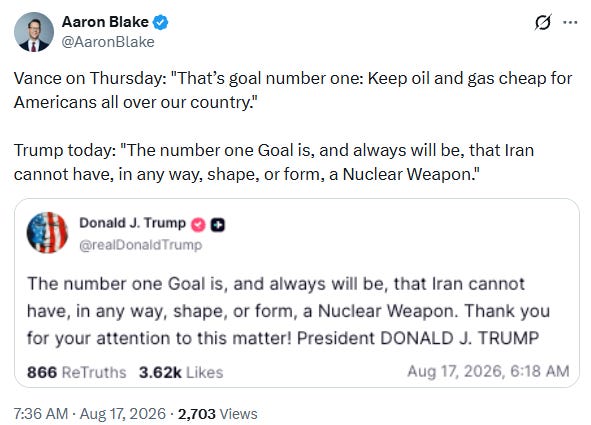
Today marks the end of the sixty-day negotiating period set forth in the memorandum of understanding the Trump administration signed with Iran. By now, we were supposed to have agreements on the status of the Strait of Hormuz and Iran’s nuclear program. And we do! We can all agree that the Trump administration doesn’t know what to do about either problem. Happy Monday.
Join Mark Hertling and Ben Parker for Command Post today at 10:30 a.m. EDT on Substack and YouTube.
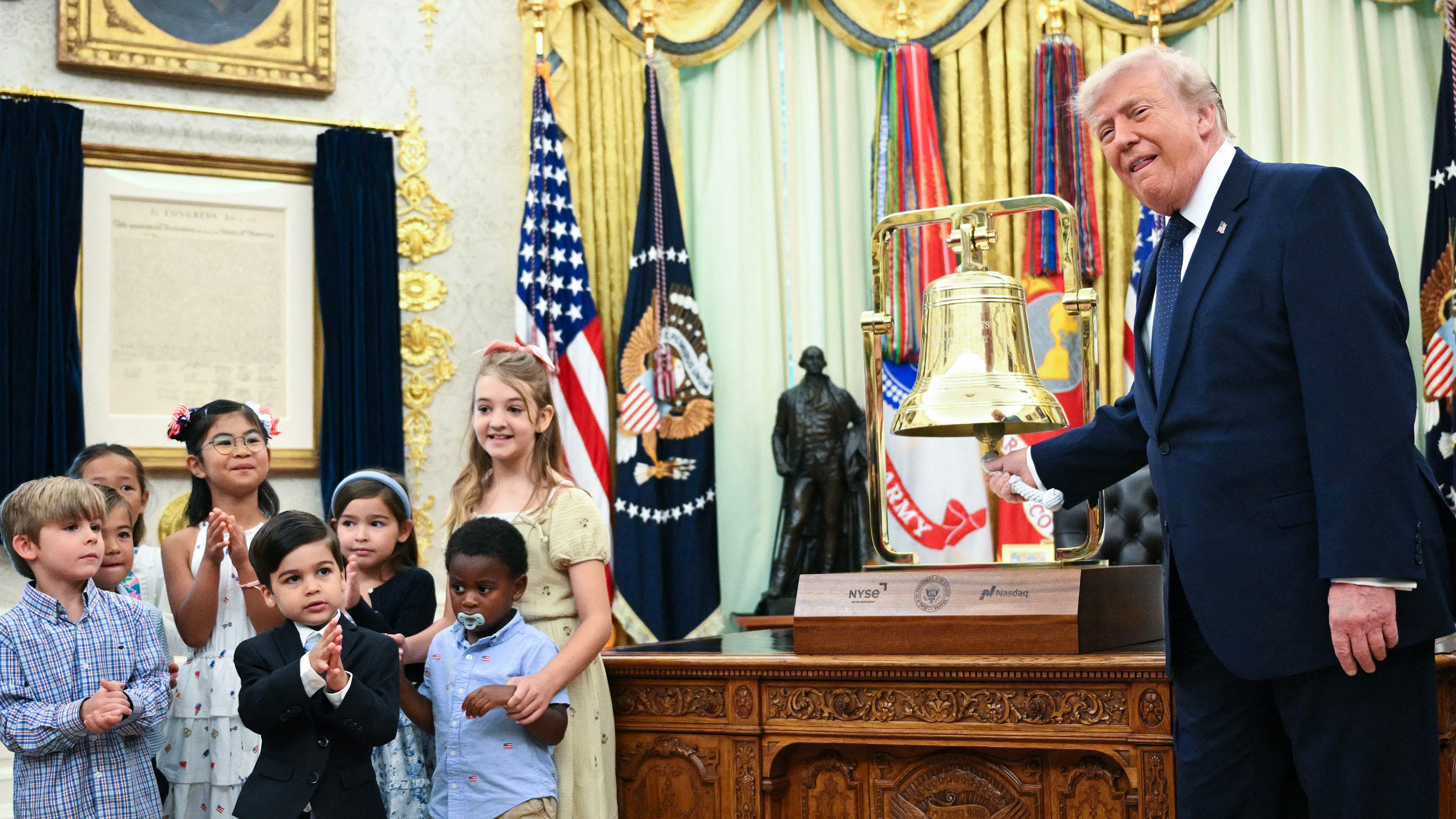
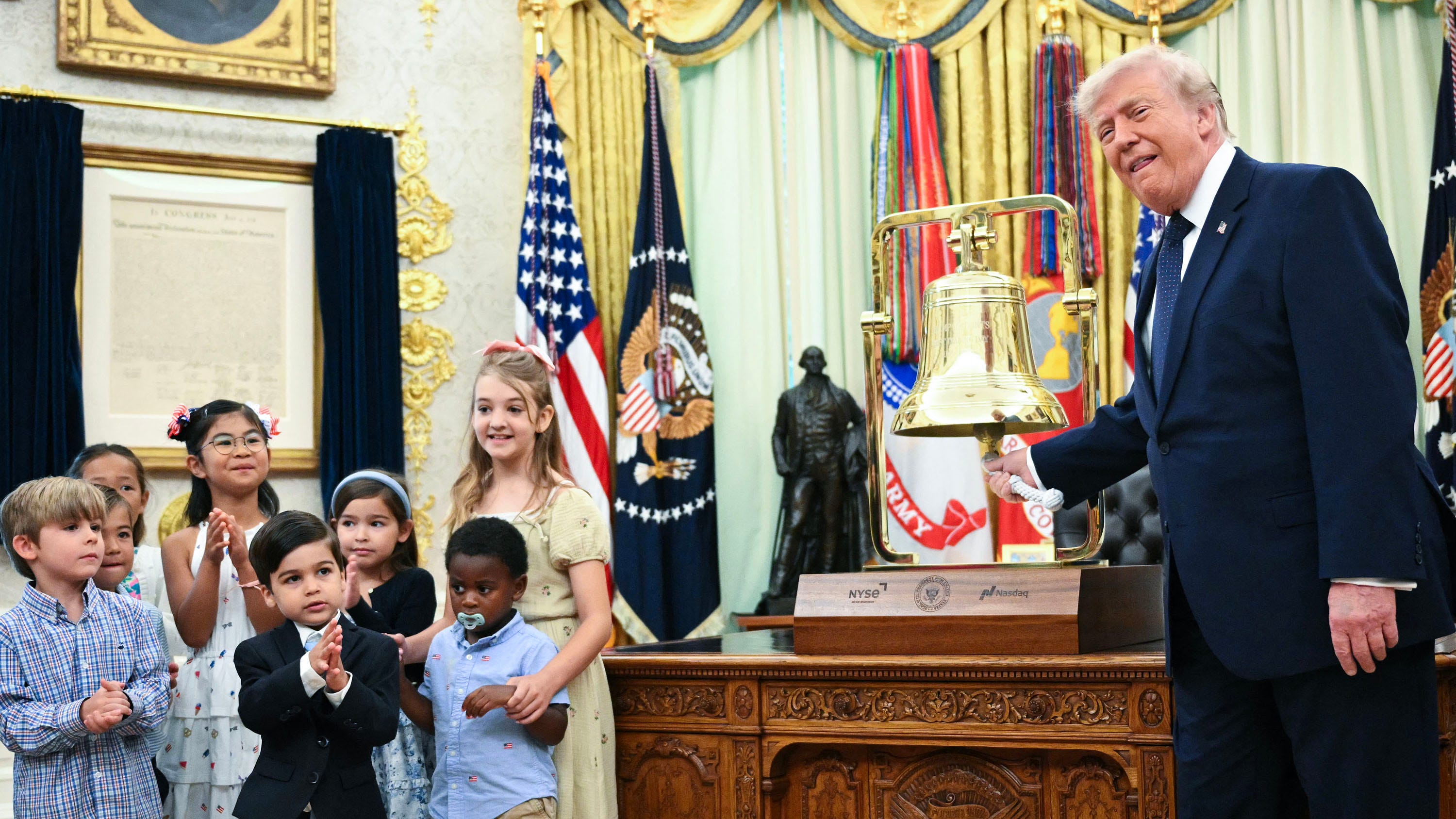
President Donald Trump rings the opening bell for the New York Stock Exchange (NYSE) and Nasdaq during the launch of Trump investment accounts in the Oval Office of the White House in Washington, D.C., on July 6, 2026. (Photo by Mandel NGAN / AFP via Getty Images)
The Other War We Aren’t Winning
by Andrew Egger
I am not, as a rule, a big-time media critic. Journalism’s a tough job in a dying industry, and writing about writing can get a little navel-gazy—life’s too short!
Still, sometimes in life our principles are tested. So it was this weekend, when I found myself unable to stop thinking about a remarkable new Politico article: “TACO No More: How Trump Won On Tariffs.”
The headline alone was fascinating. Until I read it, I personally had been unaware not only how Trump had won on tariffs, but that he had won on them at all. I had been laboring under the delusion that Trump’s tariffs were actually treating us pretty badly: slowing economic growth, pushing up prices, annihilating small businesses, failing to deliver the resurgence of manufacturing that Trump promised. Plus they’ve been losing in court: The Supreme Court crushed his “Liberation Day” tariffs as unconstitutional this year, forcing Trump both to refund billions in collected tariffs and to scramble to reconstitute his tariff regime on other statutory pretexts.
I’d even been harboring suspicions that the tariffs were a major political loser: Only 33 percent of Americans approve of Trump’s trade and tariff policies, with nearly 59 percent disapproving, per the Silver Bulletin polling average on the question. Americans have soured on tariffs so much that even the most tariff-friendly Democrats are starting to run against them: A recent ad for Ohio’s Sherrod Brown quotes a local farmer saying that Sen. Jon Husted “supports the tariffs which have driven the prices down which we can sell our crops.”
In what sense, then, does Politico argue that Trump “won” on tariffs? Simple: Last year, many worried that his tariffs would actually crash the global economy, and so far, they haven’t:
After all, for all his swerves and concessions, the president has not abandoned a global trade war that has fueled inflation or a stalemated conflict with Iran that has rattled oil markets.
And financial markets have become pretty zen about all of it. . . . tariffs, which have upended supply chains, raised costs for businesses and fueled tension with foreign allies and adversaries alike? These days, they mostly just warrant a shrug from investors.
Trump often gets graded on a curve, but this is just grade inflation. What other president has been lucky enough to find their major economic policies graded on a scale of “if it didn’t spark a once-in-a-century depression, it’s a win”?
There are two major reasons why Trump’s tariffs have “merely” resulted in slow-motion economic damage rather than spectacular market disaster. One is simple: Trump himself backed away from the most self-evidently insane ones. In April 2025, we were staring down the barrel of tariffs on China that would have forced a total decoupling between the two economies. The resulting bond-market panic spooked Trump into reversal and gave us the concept of the TACO trade; he hasn’t dared reach for anything like the same level of tariffs since. To call his remaining tariffs a “win” simply because they weren’t as disastrous as the ones originally proposed is ridiculous—why should we praise someone for hitting us in the face with a hammer just because it feels better when he stops?
The other major factor is that the effects of Trump’s trade wars have been partially obscured by the bigger economic story of the past two years: the economic sugar rush of our artificial intelligence boom and the corresponding mammoth data center buildout. Ironically, as Bloomberg News noted this month, that buildout has been taking place on a different trade-policy planet than the rest of the economy: “The deep-pocketed tech firms racing to build data centers have largely gotten a pass” from Trump’s tariffs while importing hundreds of billions of dollars worth of AI infrastructure. “In effect, they’ve been protected from Trump’s protectionism.”
And at the same time, Trump’s other economic calamity—the Iran war—has been so self-evidently counterproductive that it distracts attention from his other economic blunders.
If Trump’s trade philosophy worked, then allowing giant economic drivers like AI manufacturing to short-circuit his tariffs would be a policy disaster. Instead, Trump has quietly let this status quo continue, both as a favor to the tech megadonors in his political coalition and to avoid interfering with the only thing driving the stock market into the stratosphere.
In Trump’s gimmicky, art-of-the-deal-addled mind, all this might add up to a “win.” Apparently, there’s even a Politico writer out there who’d agree. Fortunately, convincing the public will be a much taller order.
We tell you the stakes, not just the odds. We call it like we see it. We tell you what we really think. Join us.
‘Negotiations’ Aren’t the Answer in Iran or Ukraine... “Gentlemen may cry, ‘Peace, peace!’ But there is no peace”, writes BRYNN TANNEHILL.
Trump’s New AG Just Made a Stunning Admission on Meet the Press… WILL SALETAN takes on Kristen Welker’s Meet the Press interview with Todd Blanche, arguing that Blanche’s evasions on Justice Department independence, Trump’s influence over prosecutions, January 6th pardons, and a proposed compensation fund expose him as a loyalist ready to do the president’s bidding.
The Bulwark’s GOOD FIGHT TOUR with Tim, Sarah, Sam, and JVL is coming to the Southeast in October. Tickets go on sale August 21. Bulwark+ members get early access via our presale starting August 18. Watch your inbox for details. Head to TheBulwark.com/Events for details and to get your tickets.
Quick Hits
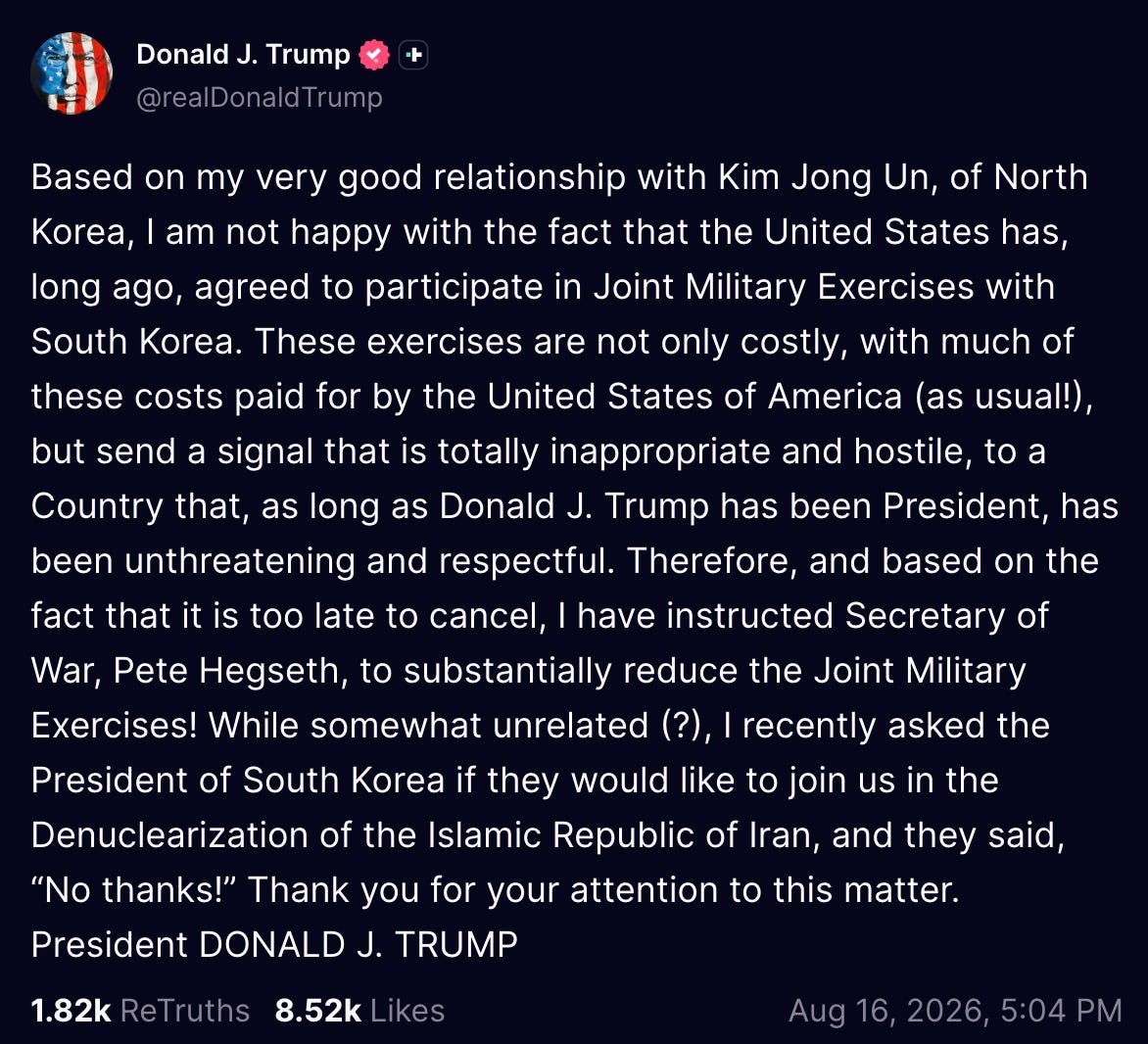
KIM JONG UN-BELIEVABLE: The president posted this yesterday:
There are so many things that are stupid or wrong about this post—let’s see if we can find them all:
Trump habitually fails to distinguish between his own personal interests and those of the country, and maybe he doesn’t feel like North Korea is a threat to him. But just last year, then-director of the Defense Intelligence Agency Jeffrey Kruse told Congress that “North Korea is in its strongest strategic position in decades, possessing the military means to hold at risk U.S. forces and U.S. allies in Northeast Asia, while continuing to improve its capability to threaten the U.S. Homeland.” (Maybe that ballistic missile test they fired off a couple weeks ago was “unthreatening and respectful”?)
Trump is complaining about the costs of exercising our own forces, who are scheduled to train with about 18,000 South Korean troops.
Did last year’s version of the same exercise send a “totally inappropriate and hostile signal”?
Trump’s narration of the timeline is excellent. “I’ve hated these exercises forever, but I forgot to get them canceled and now of course it’s too late.”
“Somewhat unrelated”? Yeah, right.
ARE YOU REASSURED?: Finally, someone is paying some attention to the fate of the USS Lincoln besides the sailors onboard and their worried families back home. Central Command Commander Adm. Brad Cooper visited the ship, which has been at sea since November and is facing a morale and mental health crisis so extreme that at least one sailor has jumped overboard. Adm. Cooper urged perspective: “Of the U.S. Navy’s 11 active aircraft carriers, the Lincoln currently has among the lowest number of cases related to mental health.”
So, the others are worse?
I HAVE THE WORST F—ING ATTORNEYS: Todd Blanche, upon being sworn in as attorney general, promised that under his leadership, the Justice Department would not be independent of the president. On Meet the Press yesterday, he said: “Will I take the president of the United States’ view on something into consideration? Yes, of course.”
Trump would be better off if he hired better lawyers. As Paul Rosenzweig wrote in The Bulwark in December 2024,
Lavrenty Beria, the head of the Soviet secret police is (perhaps apocryphally) remembered for saying, “Show me the man and I’ll show you the crime.” That chilling phrase is the very definition of what, in American law, we call a vindictive prosecution—the claim that a prosecution is being brought as retribution against a person for acts that are unrelated to the crime being charged.
So now any federal defendant whom Trump has insulted, feuded with, denounced, demeaned, declared an enemy of the people, or even so much as looked at sideways can add to their defense the claim that they’re not being prosecuted because the government believes they committed a crime, but because they’re a personal or political enemy of the president. Here’s the history of Donald Trump disliking me, your honor, and here’s the attorney general promising to consider Trump’s views. The argument will be stronger in some cases than in others—but even still, it’s a freebie that no competent prosecutor would want to hand a defendant.
Andrew Egger and Catherine Rampell discuss Sen. Bill Cassidy’s criticism of vaccine policy after his vote to confirm RFK Jr., questions surrounding Mitch McConnell’s prolonged absence, growing support for price controls in the GOP, the political fallout from Trump’s tariffs, and the Navy’s potential multibillion-dollar warship redesign to suit the president’s aesthetic preferences.
Andrew Egger and Sonny Bunch take on Trump’s latest attempt to get his name back on the Kennedy Center, his refusal to let go of fights he’s already lost, and what his obsession with credit, legacy, and scapegoats says about a president who increasingly seems stuck doing the same thing over and over and over and over and over and over and over...
Sam Stein and Andrew Egger went live to cover the GOP’s misleading furor with Tony Fauci’s text messages, Trump appearing to sleep as he peddles vaccine misinformation, the elaborate plan that had Trump stowed away in a catering truck amid a threat from Iran, and the new memo from the White House that shows Trump is scared about about Democrats taking b…
If there were any hopes left for a prompt deal to end the Iran war and reopen the Strait of Hormuz, they’re on life support now. Donald Trump and Iran spent Monday making a series of escalatory tit-for-tat demands about war reparations, oil futures jumped about five percent on the day, and this morning U.S. forces fired on and disabled a Panama-flagged ship that had attempted to run America’s blockade of Iranian ports. Happy Tuesday.
Join Sam Stein and Andrew Egger for Morning Shots Live at 10:00 a.m. EDT today on Substack and YouTube.
(Photo illustration by Sarah Rogers/The Bulwark | Photos: Getty, Shutterstock)
Shots, Shots, Shots
by Andrew Egger
God knows we’ve had plenty of recent contenders, but yesterday may have been the greatest policy day in history for America’s antivax cranks. There were two triumphs.
First, Donald Trump signed, with great fanfare, a long-awaited executive order to upend America’s pediatric-vaccine schedule. American kids, the president insisted, are simply taking far too many shots. It’s too much liquid going into the kids, in his view. All that liquid, you’re bound to run into trouble.
“I’ve seen proof of where they have a vaccination thing that looks like the size of a bottle of soda and pour it into a little child’s body,” the president said, describing a real vaccine process that definitely, actually, totally happens.
In the best-case scenario, this change will lead to nothing but still more vaccine hesitancy from people who take the president and his antivax-kook advisers at their medical word. At worst, it will lead to unnecessary policy changes that force parents to make many more trips to the pediatrician to get the same amount of vaccine coverage. Either way: lower vaccine uptake, fewer immunized kids, more sickness.
Interested in something scientifically proven to give you better sanity and health? Join Bulwark+. It’s what the doctor ordered.
Even this remarkable policy shift, however, wasn’t yesterday’s talk of the antivax town. Trump’s action was quickly overshadowed by revelations from Sens. Ron Johnson and Rand Paul purporting to show the greatest vaccine villainy yet from certified COVID villain Anthony Fauci.
Johnson and Paul breathlessly accused Fauci of knowing that pregnant women who got the COVID vaccine exposed themselves to enormous miscarriage risk—and of squelching this information to cheerlead publicly for the vaccines. The senators pointed to a text message Fauci sent to a pair of CDC bigwigs in January 2021: “Since many people have significant cytokines storm and fever after the 2nd dose, this theoretically could be associated with miscarriage in the 1st trimester.”
This stood in sinister contrast, the senators alleged, with an answer Fauci gave during a public Q&A a few days later: Initial FDA surveillance data had “found thus far—and we’ve got to be careful—but thus far, no red flags about that, about pregnant women.”
And it got worse. Fauci, in the senators’ telling, would go on to cover up data showing that pregnant women who received an mRNA COVID shot would miscarry at rates of over 80 percent. “It was effectively an ABORTION SHOT,” a MAGA influencer tweeted in a post shared by Sen. Paul. “This is MURDER.”
These allegations went off like a bomb on social media, with MAGA influencers and politicians outdoing themselves to denounce Fauci in tweets that racked up millions upon millions of views. Fauci was a villain, a monster, a demon. Fauci belonged in jail for life. “For Fauci and other Marxists,” Sen. Mike Lee mused, “was the likelihood of widespread fetal demise a feature or a bug?”
But it was all pure weapons-grade horseshit—every bit of it, layer on miserable layer.
The one real thing was the text. Fauci, in January 2021, did in fact muse to some colleagues that vaccine-induced fever could theoretically create a pathway to miscarriage. As the vaccine data rolled in, this would be something for data surveillance to watch out for.
Even at this moment, however, signs were encouraging. This was what Fauci would go on to say a few days later in that livestreamed Q&A: As far as the FDA could tell, they were witnessing no spike in miscarriages among the first pregnant women to receive the vaccine.
At that early date, it’s important to emphasize, scientists knew very little about possible COVID-shot side effects for pregnant women. This was for a simple reason: Pregnant women had been excluded, as is extremely common, from the earliest safety tests. While some had received the shots in later, bigger tests, the data for pregnant women still necessarily lagged a few months behind. As a result of this gap, public-health officials proceeded cautiously. Even as mass vaccine rollouts began to the public in early 2021, the CDC remained agnostic on whether pregnant women ought to take them: Not until April did the body endorse the shot for women in their third trimester, and not until August did they back shots for women at earlier stages of pregnancy. They did this because of a growing body of evidence from across the country and the world: The surveillance data was rolling in, and happily, Fauci’s caveat had proven ungrounded. No link existed between the COVID shots and miscarriage risk.
The information laid out by the senators, then, actually shows the opposite of what they claim. It shows Fauci and his coworkers working with exactly the care and concern their detractors accuse them of lacking. They moved slowly and cautiously, examining all possible theoretical risks, including risks to pregnant women. They updated their guidance slowly and cautiously, too, only enthusiastically backing the shot for pregnant women once they had hard data to suggest it was safe to do so.
For his pains, Fauci is now smeared as a baby killer and one of history’s greatest monsters, and threatened with prison or worse.
Incredibly, some of the allegations against America’s onetime top epidemiologist are stupider still. That 80 percent miscarriage rate claim is a hallucinated number that results from a misreading of one early pregnancy-risk study. We now have a cornucopia of data to assure us that—as Trump’s own CDC states clearly on its website—“COVID-19 vaccination during pregnancy has not been linked to increased health risks for pregnant women or babies.” More than that, it’s simply preposterous on its face. Millions of American women got the shots while in the early days of a pregnancy. These senators, and their boosters in the woolly world of MAGA infotainment, apparently expect us to believe that these millions of women took the inadvertent equivalent of an abortion pill—without ever registering a bump in miscarriage rates or a dip in births.
Here’s another interesting thing: That 80 percent number isn’t new. This particular bit of innumeracy had already been floating around the internet for five years before Sens. Paul and Johnson saw fit yesterday to introduce it to new audiences. In their press release on the matter, the senators sourced it to an open letter written in 2022 by an obvious crank MD whose concerns about the shot goes far beyond its supposed risks to pregnant women: “There must be an immediate moratorium on the use of all COVID-19 vaccines,” the doctor writes. “This product is NOT safe for human use.”
This sort of pure conspiracy-brain gibberish has been big on the right for years. Once upon a time, however, one could console oneself that it was just the domain of the lunatic fringe. After all, the COVID shots were in no small part the work of the Trump administration, and Trump was still eager to take credit.
If that ship hadn’t sailed before yesterday, it sure has now. For Republicans, spreading the looniest antivax gibberish imaginable is now a whole-of-government initiative.
Rod Dreher Thought JD Vance Would Save Conservatism. Oops. The writer thought his friend would stand up to the antisemitic right. His criticism of the vice president is too little, too late, writes MATT JOHNSON.
REPUBLICANS RE-EMBRACE MILLER: Earlier this month, as public scrutiny of the abuse allegations against Rep. Max Miller (R-Ohio) grew and more Republicans called for him to drop out ahead of a ballot deadline, Donald Trump remained evasive, telling reporters only that he felt bad for Miller. But behind the scenes, it turns out, Trump got much more involved. Politico reports that Trump’s political team was instrumental in convincing the GOP to drop the pressure campaign to get Miller off the ballot:
Their engagement, according to three people granted anonymity to share direct knowledge of private conversations, came as Miller insists he has no plans to withdraw despite serious allegations of domestic abuse, which he denies. Before that, some White House officials and Republicans had urged Miller to drop out of his race for reelection.
Miller’s determination to remain in the race would render efforts to oust him moot, administration officials reasoned in calls with party leaders and other Republicans in the state over the past week. It would complicate messaging, the officials argued, when those same leaders would likely later have to defend Miller’s candidacy against a Democratic challenger.
“They basically told us to back off,” said one Ohio Republican involved in the conversations, “and let the voters decide.”
Meanwhile, the rest of the party is now either meekly falling in line behind Miller or deciding to keep their concerns to themselves. RNC Chair Joe Gruters told Politicothat they still plan to spend in support of Miller’s re-election, although “everybody has to prove that they are capable of winning.” Even Miller’s former father-in-law, Sen. Bernie Moreno, whose extraordinary denunciations of Miller’s behavior and temperament made repeated massive headlines, is resuming radio silence: “I’ve said all I’m going to say,” he told Scripps News yesterday.
DECOY DRAMA: Last month, as President Trump was preparing to leave a NATO summit in Turkey, his team carried out a remarkable bait-and-switch. An Iranian assassination threat had led them to believe Air Force One could be targeted with a missile en route back home. So they surreptitiously swapped him to a different flight, so secretly that his traveling press pool and even some White House staff on Air Force One didn’t know Trump wasn’t aboard. WaPo has the extraordinary scoop:
The administration has claimed that Trump departed Turkey on July 8 on the former Air Force One. Trump announced on social media that he would use the “former Air Force One” rather than the plane that flew him there, a newer Boeing 747-8 gifted to the United States by Qatar. The security of the Qatar-provided aircraft has been called into question, and Trump said last month after the trip that it would undergo additional upgrades.
In Ankara, Trump boarded the old Air Force One jumbo jet in view of television cameras. He was secretly shuttled minutes later to a smaller plane—an Air Force C-32A—via an airport catering truck typically used to load meals and other supplies preflight, according to the U.S. official and corroborating material reviewed by The Post. That made Air Force One a “decoy” with media and some White House staff aboard, the official said.
This seems like a wise and prudent response to a troubling threat; it’s good to know the systems we have in place to protect the president at all times are working well. The mental image of Trump bouncing around in the back of a catering truck is just a nice bonus.
BROMANCE ALERT: As the months go by and Sen. John Fetterman (D-Pa.) continues his long streak of entering the public eye only to extol Israel and castigate the Democratic party, the speculation that he might jump ship for the GOP after this year’s midterm elections continues to grow. Now NBC News reports on one factor driving Fetterman’s transformation: His relationship with his state’s junior senator, Republican Dave McCormick:
As the relationship between Fetterman and McCormick reaches new heights amid a series of recent developments, it is perplexing members of both parties. Most notably, a joint fundraising committee the duo established triggered a wave of Democratic criticism of Fetterman, who has toyed with the possibility of leaving the party. . . .
McCormick’s allies say the two have developed a genuine friendship and that their spouses have helped foster it. But increasingly, Democrats who have soured on Fetterman—including former staffers—have accused him of boosting Republican priorities at McCormick’s request without delivering wins for his own party or state.
One former top Fetterman aide, speaking on condition of anonymity to discuss the relationship, said the senator has referred to McCormick as “his mentor” and seeks his approval. They said the pair would often text one another and have dinner back in Pennsylvania. Both live in the Pittsburgh area.
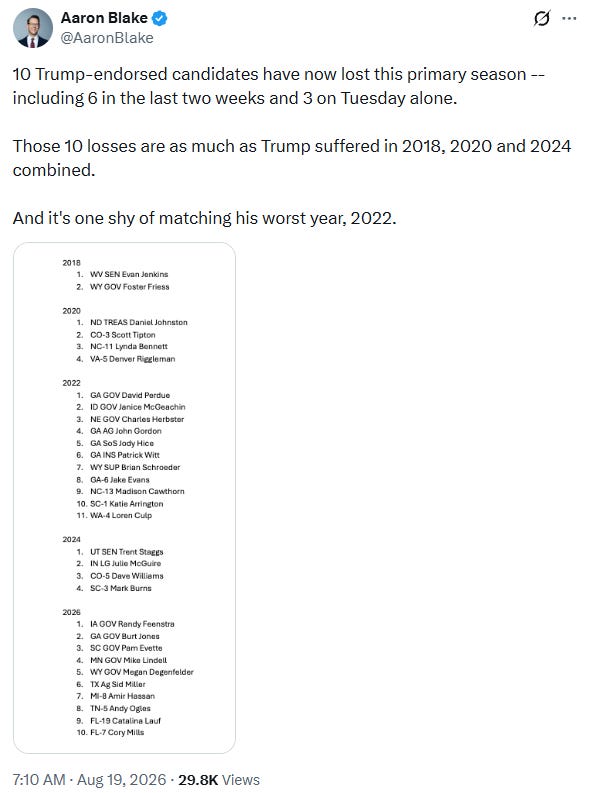
We got lots of important elections stories this week, but none stranger than the outcome in the Republican primary for Michigan’s swingy 8th district, where Trump’s endorsed candidate, Navy veteran Amir Hassan, endured a shocking loss to a man named Tom Smith—who wasn’t even running anymore, having dropped out of the race last month. Smith carried the primary 50 percent to 33 percent, and was as surprised as anyone. Appearing at a GOP unity lunch yesterday, he had this to say: “I’m Tom Smith. I’m running for the 8th congressional district to unseat communist Comrade Rivet, and I’ll need your help to do it.” Those were his full remarks.
For most GOP candidates, Trump’s endorsement is a golden ticket to the lizard-brain love of the GOP base. Sometimes, however, it’s apparently not enough to overcome a different kind of lizard-brain difficulty: running against a man named Tom Smith when your name is Amir Hassan. Happy Thursday.
(Photo by Saul Loeb / AFP via Getty Images)
Trump’s Midterms Spitball
by Andrew Egger
Nobody can say with much certainty what will happen in the November midterms. After all, polling is broken and the world is crazy.
But with Election Day just three months away, we can start to hazard a few confident guesses. Donald Trump is less popular than ever, having squandered his second year back in office on a fruitless, expensive war, an elections bill that has been DOA for months, and a cornucopia of vanity projects and self-enrichment schemes. If Trump loses the Republican trifecta this November, he will close out the most favorable years of his second term with few durable victories. It’s amazing, given his Napoleonic aspirations, his total contempt for laws and norms, and his desperate thirst to punish enemies high and low. But when it comes to actual points on the board, the first half of Trump 2.0 is shaping up a lot like the first half of Trump 1.0: Fewer border crossings, one big tax-cuts bill, and… that’s it.
The big difference, of course, has been in the amount of damage inflicted. Trump has dragged America from crisis to crisis, rattling the global economy, our international alliances, the rule of law, and our norms against political and personal corruption. And there’s one area where Trump could still do immense harm before next year—in the administration of the coming elections.
In March, Trump issued an executive order that was a naked attempt to clamp down on mail-in voting. It ordered the U.S. Postal Service to draft new rules refusing to deliver ballots to voters not on federally approved citizen lists—and not to deliver ballots at all in states that refuse to hand over their voter rolls.
That order has been stayed for months, although there have been legal wrinkles. Although one court ruled that the White House doesn’t have this sort of controlling power over elections, full stop, another ruled that because the USPS hasn’t finalized its rules, those rules are not yet eligible for legal challenge. Last month, the administration asked the Supreme Court to lift the stay, arguing that until the rules are in place, states can’t prove they’d be harmed by them. And this week, the litigants—23 states and the District of Columbia—asked the court to leave the stay in place, arguing that lifting it “would allow the federal government to rush out an unprecedented, legally indefensible voter-verification and ballot-interception program that would, among other things, give the U.S. Postal Service far-reaching new powers and responsibilities.”
That outcome is, of course, exactly what the federal government hopes to achieve. Its explicit argument is that the court shouldn’t just rule in their favor, but should do so with haste—since how else will they be able to get the new voting regime up and running in time for the midterms? “Absent a stay,” Solicitor General John Sauer argued in his petition to the court last month, “there will not be sufficient time to obtain appellate relief before the November election.”
If the justices were to agree, it would be a recipe for instant election chaos. Democratic states would immediately be presented with a terrible dilemma: Do they submit to a partial federal takeover of their elections—handing over their voter rolls to Stephen Miller and co. for God-knows-what federal purpose, allowing the White House final administrative say over who gets a ballot mailed to them and who doesn’t? Or do they resign themselves to carrying out their elections in November without the assistance of the Postal Service—essentially giving themselves over to the “no mail in ballots” world that Trump has actually wanted all along?
It’s a grim prospect, and yet one that people seem to be sleeping on. “I think everyone agrees that it’s not going to be implemented for 2026,” Notre Dame Law School professor and elections expert Derek Muller told VoteBeat this week. “The logistics are so horrific.”
I would love to find these sentiments reassuring. But I also wonder whether some of these cheerful assumptions have been overtaken by events. In a normal world, with normal people in charge, the “there’s no non-insane way to try to do this” line of reasoning would make me pretty confident the federal government wouldn’t try. But the administration keeps insisting they want to try, and I’m not sure there’s anything in their track record to suggest that “if you do this, there will be total chaos” is a significant deterrent. In fact, it’s an encouragement.
To be clear, I’m not saying this crisis is very likely. If I were a betting man, I would expect the Supreme Court to take a safe line here, abstaining from taking any action that might throw election administration into chaos right as people start voting.1
But it’s not exactly difficult to construct a counterfactual possibility—one where the Court, in its law-nerd wisdom, rules in Trump’s favor on the narrow procedural question of standing and hands the administration broad ambiguous discretion in how to move forward with implementation. If they do decide that the legal challenges against the president’s order are not yet ripe, we may all suddenly be waking up to a world where Trump has broad leeway to cause election chaos in blue states and the only question left is: Well, would he do it?
The Supreme Court could put the whole thing to bed tomorrow. Even if they allow the executive order to go forward on procedural grounds, the states could quickly sue again after the USPS begins implementation and a lower court could move to freeze the administration once more.
Would it affect the outcome of the midterms? Perhaps not. Mass confusion and chaos could end up harming Republicans more than Democrats, who remain more motivated to vote by any means possible. But we don’t really know how it would bounce in terms of actual results.
Is it all still enough to keep me up nights until this whole thing is resolved? I’m afraid so. It’s amazing how thin the guardrails are everywhere you look with folks like this in charge.
We’re going into the future with our eyeballs taped open. Send Morning Shots to someone who could use the same treatment.
Ukrainian drones are still methodically taking out online retail warehouses and oil refineries across Russia. But on Saturday night, it was an upscale Italian restaurant in Moscow that was the target. The dramatic strike was timed for a birthday bash being held for a member of Russia’s top brass. A woman entering with a gift box was stopped by a security guard; when he tried to inspect the box, it set off a massive explosion. General Alexander Chaiko, 55, who was also celebrating his recent appointment as commander-in-chief of Russia’s Aerospace Forces, survived the explosion and may be unhurt. But five people are dead—reportedly including another unnamed Russian general—and nineteen are injured.
Ukraine has neither confirmed nor denied responsibility; but it had very good reasons to hunt Chaiko, whom it considers a war criminal. At the start of the Russian invasion in early 2022, he was in command of troops advancing on Kyiv. That operation included the nearly month-long occupation of Bucha and other nearby towns, with its well-documented horrors. Chaiko was likely on the ground when these atrocities were committed. There’s also an intercepted audio in which he apparently gives orders to bomb a village and “wipe it off the face of the earth.”
Yet the method chosen to target him made civilian casualties inevitable—prompting some normally pro-Ukraine exiled Russian commentators, such as TV-RAIN host Mikhail Fishman, to call the bombing a terrorist attack. Others such as military analyst Yuri Fedorov strongly disagreed, arguing that the killing of a combatant can never be described as terrorism regardless of collateral damage.
There are troubling ethical issues beyond that. The courier, who died instantly, almost certainly thought she was delivering an ordinary gift box. Was she an innocent victim? Yes. But defenders of Ukraine’s actions in this case have responded that Russia is taking innocent lives in Ukraine every day. Just yesterday, a barrage of Russian ballistic missiles hit Kyiv before dawn, taking advantage of Ukraine’s severe shortage of interceptors and leaving at least 17 people dead and dozens injured.
Curiously, while the Russian government condemned the Moscow restaurant attack (and, preposterously, tried to claim it was meant to intimidate Italians living in Russia), its reaction has been fairly low-key. State television has barely mentioned it. Maybe that’s because, while the bombing makes Ukraine look morally gray, it also makes Russia look weak—unable to protect its generals or keep downtown Moscow safe from explosions. And while Russians may blame Ukrainians, many of them also know that it was Vladimir Putin who brought them this war.
The Self-Inflicted Decline of American Leadership… Team Trump is inadvertently convincing America’s allies that they need one another more than they need us, argues MATT GURNEY.
The Summer of ICE… ADRIAN CARRASQUILLO takes your questions today at 3 p.m. EDT in the r/politics subreddit. Ask him about his reporting on the recent fatal ICE shootings and the broader political and policy implications surrounding immigration enforcement in the Trump era.
The Supreme Court’s Archaeology of Authority… While the Roberts Court’s favorite new legal test promises objective facts, what it actually delivers is unchecked judicial power, writes ERIC SCARFFE.
Capital One Just Dropped an Atomic Bomb on Trump… On The Illegal News, ANDREW WEISSMANN joins SAM STEIN to discuss the Justice Department’s dismissal of charges over damage to the Lincoln Memorial Reflecting Pool, the potential recourse for former Olympian David Hearn—who was accused of vandalism—and Trump’s response.
Pod Save Michigan… The polling was way off, but suburban Dem voters in Michigan nonetheless showed that they’re sick of the party establishment and enraged by Trump, the war, the lies, and the corruption. JANE COASTON joins TIM MILLER on The Bulwark Daily.
Quick Hits
THE OTHER GUY: Rep. Max Miller’s re-election campaign may be dying a death of a thousand self-inflicted cuts, but there’s one guy who’s surprisingly uninterested in twisting the knife: his Democratic opponent, ironworker Brian Poindexter.
Poindexter piled on Miller’s uncomfortable Sunday livestream, tweeting that “no one credibly accused” of the sorts of allegations Miller faces “belongs in the halls of power.” Now, however, Poindexter seems eager to turn the page. “I’m not necessarily running against Max Miller. I’m running for working families,” he told Politicoin an interview yesterday. “We’re continuing to build bridges with people who have abandoned the Democratic Party. . . . Our message stays the same.”
For months now, Democrats have been caught in an electoral Catch-22: Desperate to win back young, white American men, they’re working hard to shed their image as a party of HR ladies and lanyard dorks. But the difficulty is that the active effort to do this is itself pretty lame—there’s nothing less cool than a guy (or party) who’s obviously extremely concerned about flaunting his masculinity. (See, we can be manly! Watch me chug a beer and split a log!) Until now, some of the coverage around Poindexter—through no fault of his own—has reflected this awkward status quo. An Atlantic profile of him last month ran under the headline “The Return of the Democratic Manly Man.”
But Miller’s scandal makes the conversation around “manliness” feel very different in Ohio-7: Voters will be choosing between a guy who works with his hands and a guy who allegedly hits women with them.
BURYING THE HATCHET: Abdul El-Sayed’s efforts to successfully run a progressive campaign in a purplish Michigan will come down, in large part, to his ability to unify the Democratic party.
That’s because of the extraordinarily bitter slugfest that broke out between him and moderate Rep. Haley Stevens during the primary—the sort of contest that can result in the losers’ voters nursing hurt feelings all the way to the general election. But El-Sayed and Stevens wasted no time burying the hatchet yesterday.
“I love Michigan and am so proud to have put up my hand to serve,” Stevens tweeted. “I spoke with Abdul a few moments ago to offer him my full support as we work to defeat Mike Rogers this November.” El-Sayed quickly responded, thanking Stevens for running a good race: “Putting up your hand to participate in democracy is no easy thing. . . . What unites us is so much bigger than what divides us.”
Good stuff, although not everybody felt quite the same way. As El-Sayed and Stevens were having their lovefest, a viral clip from the night before of leftist streamer and El-Sayed surrogate Hasan Piker was also bouncing around social media: “You are all unbelievably Islamophobic pieces of shit,” Piker said of Stevens supporters. “You literally called the dude a fucking terrorist for months on end and called him a sexist, misogynist, terrorist, bad candidate, fake doctor when he has two fucking degrees. And now you’re going to sit there and be like, ‘You really gotta come to me now.’ What are you talking about? Do you wanna win or not? Lock the fuck in.”
Hours later, El-Sayed kinda-sorta threw Piker overboard. “He’s a streamer. I’m focused on trying to win a race,” he said.
As election-rules challenges have come thick and fast in recent decades, the court has tended to stick to a “let the people vote, then we’ll talk” rule of thumb known as the Purcell principle—although this has been somewhat selectively applied.
Lt. Gen. Mark Hertling (Ret.) and Andrew Egger (filling in for Ben Parker) went live to cover reports that the U.S. missile supplies are dwindling, the Russian missile attack on Ukraine, the cyberattacks across several U.S. states, and Oman’s role in a potential deal with Iran.
Andrew Egger and Bill Kristol went live to cover the DOJ dropping more Reflecting Pool cases, Senate Republicans advancing Todd Blanche’s vote out of committee, Max Miller defiantly staying in for bid for re-election, and Oman and Iran potentially coming to a deal over the Strait of Hormuz.
Donald Trump’s legal apparatchiks at the Justice Department have insisted for months that the criminal indictment against former FBI Director James Comey—one of the personal enemies Trump most longs to see punished—goes beyond the “86 47” Instagram post they ludicrously insist constituted an imminent threat on the president’s life.
“Rest assured that it’s not just the Instagram post that leads somebody to get indicted,” Acting Attorney General Todd Blanche said on Meet the Press in May. There had been a full investigation by “the career FBI agents, the career Secret Service agents,” and who knows what damning evidence they might have found?
Now, thanks to a series of court filings last night from Comey’s lawyers, we finally know what that investigation entailed: a ludicrous snipe hunt in which federal officials sought high and low to find people who would testify that “86” is an old mob threat, interviewing old mobsters and Comey associates to prove he should have known as much—because after all, hadn’t he prosecuted organized crime? They’ve got him on the ropes now! Happy Wednesday.
Join Mark Hertling and Ben Parker—with special guest Rear Adm. John Kirby—for Command Post at 10:00 a.m. EDT today. Watch on Substack or YouTube.
Morning Shots is free—as is most of what The Bulwark publishes. Because you can’t save democracy from behind a paywall. Our work depends on the support of Bulwark+ members. Join today to help us grow—and get two weeks free as an expression of our thanks.
(Photo Illustration by Sarah Rogers/The Bulwark | Photos Getty, Shutterstock, Truth Social)
Bomb, Rinse, Repeat
by Andrew Egger
Yesterday morning, after Donald Trump called in to Fox & Friends to show off his latest peacenik turn—insisting implausibly that the late Sen. Lindsey Graham’s dying wish was a peace deal with Iran, grousing at Israeli Prime Minister Benjamin Netanyahu for stating publicly that Iran seemed ready to start rebuilding its nuclear facilities—I messaged the Morning Shots editors that I had a headline for today’s newsletter: “Trump, Iran, and the Definition of Insanity.”
Ben Parker wrote back, confused: Hadn’t we used that exact phrase before? And yeah, pretty much:
Such is life for the poor put-upon newsletter grinder in the dog days of Donald Trump’s endless Iran war. While Iran presents a steady, ironclad negotiating front—your sanctions must go, your troops must go, your nuclear demands must go, and we get the Strait of Hormuz—Trump finds himself trapped in an endless reboot loop, orbiting hopelessly around two demonstrably failed positions: If we bomb the hell out of them, they’ll give us what we want. If we stop bombing them, they’ll give us what we want. And we find ourselves scrabbling for something new to say about the same old grotesque status quo of America’s slow-motion pantsing on the world stage.
This morning, the New York Times wrote up a short history of Trump’s “Whiplash War” in Iran, laying out in stark data-viz form just how erratically Trump has toggled between his two strategic modes. In late March, just weeks after the war began, he was already threatening to blow up Iranian power plants. By early April, he was threatening genocide. Those threats gave way to a two-week ceasefire—which fell apart nearly at once after Iran continued to fire on ships in the Strait of Hormuz, leading Trump to declare an economic blockade of his own.
After a May marked by periodic bursts of attacks, June brought the vague “Memorandum of Understanding” that led Trump to declare the mission accomplished: “The Deal with the Islamic Republic of Iran is now complete. Congratulations to all!” he exulted on June 14. “Ships of the World, start your engines. Let the oil flow!”
Days later, missiles were flying again. The ceasefire was momentarily resumed on June 28—before Trump declared it truly dead July 8, leading to the heaviest period of bombardment since the opening days of the war. Then came the brief respite beginning this past weekend, which now appears to be over after Iran launched missiles at a U.S. base last night: “We are going to beat the fucking shit out of them,” Trump told Fox News this morning. “We’ll be hitting them hard. They’re going to get a beating.”
The definition of insanity, per the bumper sticker, is supposed to be doing the same thing over and over and expecting a different outcome. But I’m worried that watching Trump do the same thing over and over, fully aware the outcome will be no different, is a recipe for insanity, too.
“I could knock out the power plants within one day,” Trump said yesterday, reiterating a threat he first made on March 21, more than four months ago. “All of their power plants would be gone. And I let ‘em know that, you know, with negotiations. . . . So I think we have a very strong position right now. They know I’m going to do that if they don’t make a deal.”
I challenge anyone to spend so many months submerged in this sort of suspended reality without feeling like they’re losing their mind.
Alone, we go crazy. That’s why we started a new kind of pro-democracy community. Join us.
The basic problem is that while Trump’s approach to the war is cyclical, its damage is cumulative. Petroleum reserves, missile stockpiles, global trust in the U.S.-led world order—these are finite resources that are all being spent down at alarming rates.
More happily, American confidence in this utterly incompetent con artist turns out to be a finite resource too. Trump continues to plumb new depths in his popularity at home. And as Republicans grimly pivot their political messaging from fantasies about a Trump GOLDEN AGE to trite rabble-rousing about the threat of Democratic communism, it’s plain they too are losing hope that Trump will pull off some unexpected miracle to win the war—much less restore Americans’ confidence in his leadership.
Somehow, someday, I believe that the war will come to some sort of end. It’s all but guaranteed to be a bad end for America, but at least we can look forward to getting off the interminable psychic treadmill. It is extremely unlikely, I keep telling myself, that—as I keep suffering in dreams—I will wind down my last days on this earth decades hence hearing regular updates on President Barron Trump’s insistence that the Sixty Years’ War will be over any day now—because, after all, Iran knows we could just knock out their power plants. Forever wars only happen to stupid presidents.
BUCKS COUNTY, Pa.—Before Pennsylvania Gov. Josh Shapiro can run for president, he must win re-election against Republican Stacy Garrity, the current state treasurer who claimed Trump won the 2020 election and even pushed the Big Lie at a January 5, 2021 rally in Harrisburg.
Garrity is almost certainly headed toward an electoral calamity. Recentpolling shows her getting trounced by double digits. She raised only $1 million in the first quarter of 2025, leaving her with just $1.5 million cash on hand. Shapiro has $50 million.
To see what the energy around the doomed campaign was like I went to a Veterans for Garrity campaign event here on Monday. An older crowd of about fifty was greeted in a humid firehouse by speeches from local party leaders and a playlist of the most popular songs played at Trump rallies.
Garrity herself was not an impressive orator, but she knew her audience. Her speech lasted about fifteen minutes and focused primarily on veterans’ issues. She only attacked her opponent once—possibly a tacit acknowledgment of the futility of trying to drive down Shapiro’s high favorability ratings.
Trump clearly values his endorsements highly as a political weapon—and he likes to keep it sharp by not wasting it on sure losers. I won’t be too shocked if he finds a reason to un-endorse Garrity between now and November.
—Brendan Hartnett is a rapid response editor at The Bulwark.
Trump Is Making Government Worse on Purpose Instead of seeking to simplify and improve citizens’ lives, this administration keeps creating new obstacles and burdens, JILL LAWRENCE writes.
NO DISASTER AID FOR YOU: Unequal treatment of red and blue states has been a consistent story of Donald Trump’s second term; just yesterday, we noted how the government had admitted to canceling more than $8 billion in clean energy grants last year based solely on the fact that those grants were headed to states that voted for Kamala Harris. This hasn’t stopped. Just this month, Trump blocked petitions to FEMA for disaster aid from four blue states: New York, New Jersey, Massachusetts, and Rhode Island. In at least three of these cases, the denials came despite FEMA determining the states should qualify for aid under law. Here’s Politico, which broke the story:
Trump’s rejections came after regional offices of the Federal Emergency Management Agency and NOAA determined that the states met government thresholds for receiving aid following a record-breaking snowstorm in February. . . .
Presidents since George W. Bush approved all 69 state requests for snow assistance that met FEMA standards except for a 2016 request from New Mexico, which was being investigated for mishandling FEMA funds, according to a POLITICO analysis of agency records. . . .
“If the federal government is paying for regular operations like snow removal, what next? Garbage removal?” a FEMA spokesperson said in a statement about the recent denials. “The federal government’s role is not to fund routine functions.”
UGLY NUMBERS: The polling clunkers just keep piling up for Donald Trump. Although the long Spring slide of his approval numbers had stabilized somewhat in recent weeks, he’s back to finding new depths as Americans come to terms with the disastrous effects of his Iran war. This week’s Economist/YouGov poll put his net approval rating at an astonishing -28 percent—a record low for either Trump term. Only 34 percent of Americans either strongly or somewhat approve of the president’s second-term performance.
Here’s an equally astonishing way to slice the numbers: In the past two weeks of YouGov polling, Trump has recorded his lowest-ever approval ratings from his core demographic: white Americans without college degrees. Last week, the poll found him at -10 among this group; this week, he was at -9.
Andrew Egger and Bill Kristol went live to cover Trump’s claim that the late Lindsey Graham wanted him to make a deal with Iran, the Republican holdouts who could derail Todd Blanche’s confirmation to be AG, and why Trump is now pushing RFK Jr. to find a connection between autism and vaccines.

 Login
Login