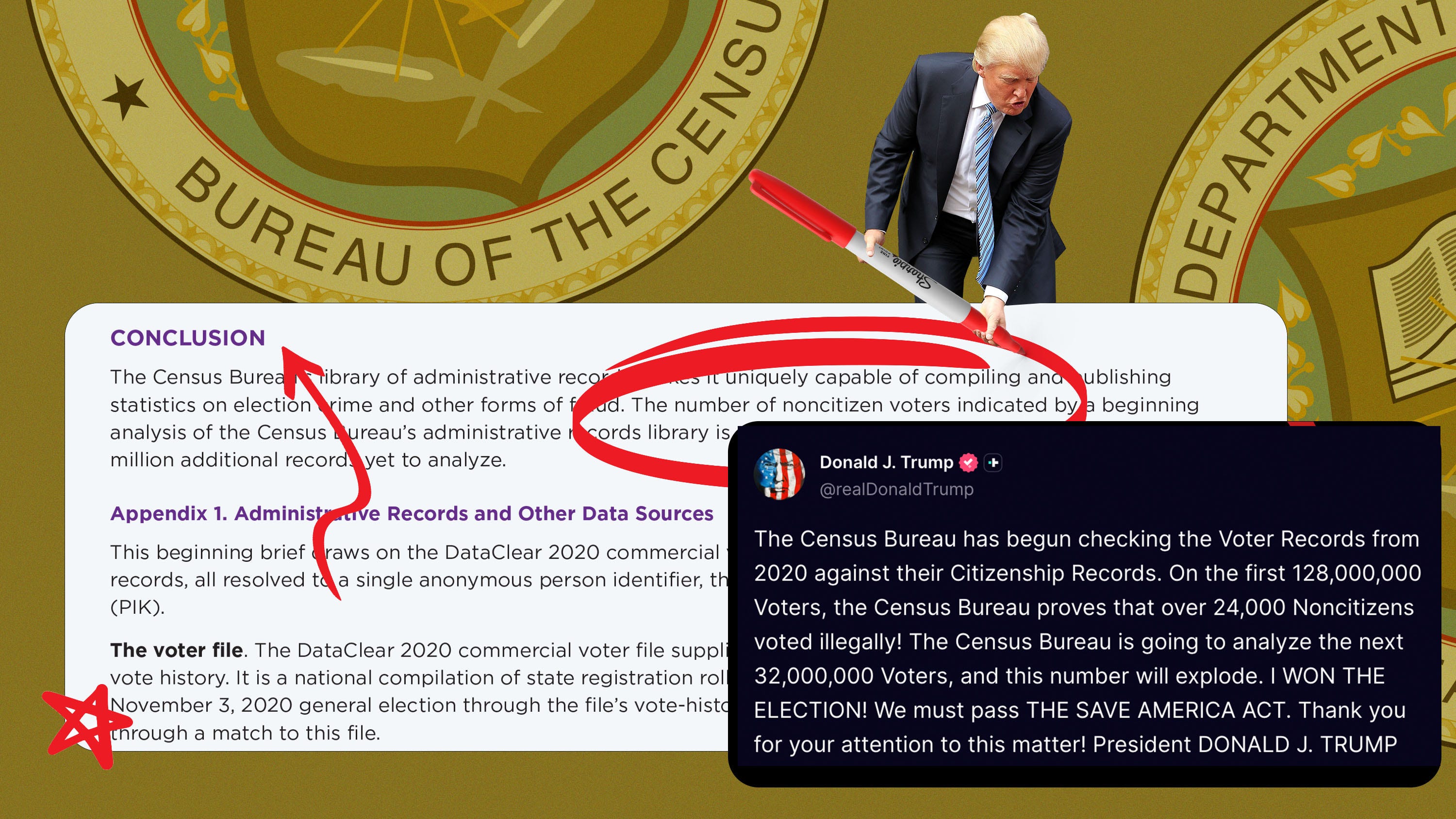
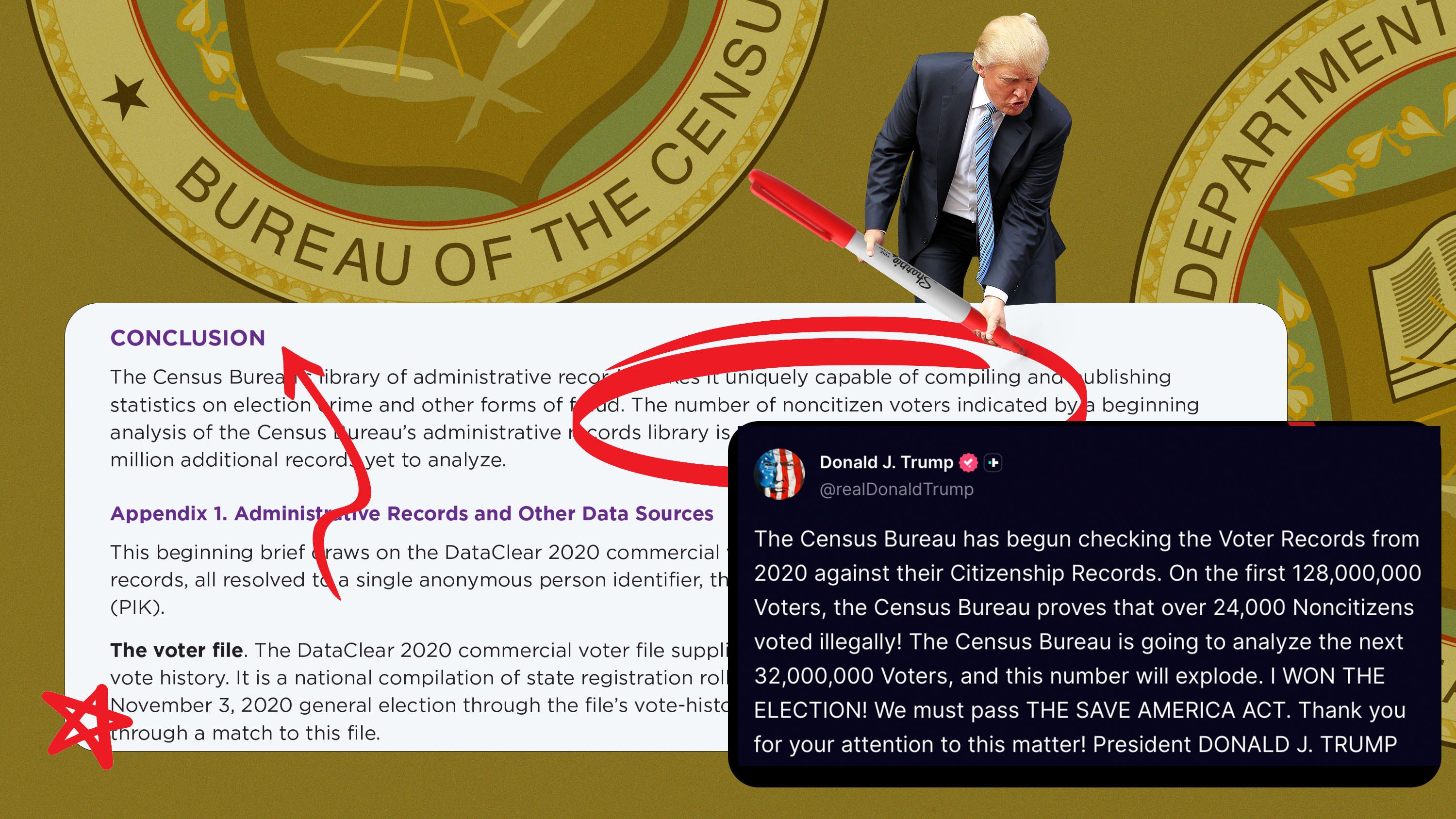
Catherine Rampell and JVL went live to cover Scott Bessent flailing as he intervenes in the bond market and Catherine's reporting on how Trump's political appointees hijacked the U.S. Census Bureau, numbers that we're supposed to trust. Plus, for more than a decade, Trump promised to pay down the national debt. This week, it grew to $40 trillion.
(Photo illustration by Sarah Rogers/The Bulwark | Photos: Getty, Shutterstock, Truth Social, Census.gov)
SOMEONE ASKS ME AT LEAST ONCE A WEEK whether they should still trust the federal government’s data releases. When we hear official announcements about things like unemployment or inflation, can we rely on those figures to accurately reflect reality, and to be based on proven models? Up until now, I have always said yes.
Sure, the numbers coming out of the White House may be bull.1 But the numbers from independent statistical agencies (the Census Bureau, the Bureau of Labor Statistics, the Bureau of Economic Analysis, etc.) have remained solid and trustworthy, I usually explain.
After all, these stats agencies employ armies of dedicated, fastidious civil servants who collect the underlying data and conduct careful statistical analysis. Their work is firewalled from political interference. I’ve been covering these data releases long enough2 to know that if Trump were cooking the books, it would be obvious—not least because those career civil servants would be screaming bloody murder and quitting en masse.
Unfortunately, I can no longer vouch for any of that. Now my answer is: No, you should not default to trusting the government data. There’s clear evidence the Trump administration is cooking at least some of the books.
That’s because (to switch metaphors) this week we crossed the Rubicon: The granddaddy of all statistical agencies—the U.S. Census Bureau, which has existed in some fashion since 17903—was infiltrated by
This is one of those ominous stories you’ll want to read to the end. Good news: You can hop right over this paywall by signing up for a membership.
Come join the side you’re already on. Come join Bulwark+.
(Photo illustration by Bill Kuchman/The Bulwark | Photos: Getty, Shutterstock)
DONALD TRUMP PROMISED Americans a new golden age. Unfortunately, it turns out to be a golden age for diarrhea and white-collar crime.
Biological, social, and financial parasites are all flourishing, because the Trump administration has destroyed the institutional capacity necessary to detect and eradicate them.
In the latest (non-GI-related) development, the Department of the Treasury announced this week that it would destroy the government’s registry of shell-company ownership. This is an anti-corruption database that Treasury is by law required to maintain, so that law enforcement can more easily “follow the money” when investigating crimes.
Even worse, the Trump administration will also destroy all the data it has already collected, so that no future presidential administration or local police department can use it, either.
“It’s like Trump ordering the deletion of the FBI’s entire fingerprint database,” former congressman Tom Malinowski (D-N.J.), a champion of the 2021 law that created the corporate registry, told The Bulwark.
They’re effectively salting the earth, so that sex traffickers, scam artists, drug lords, money-launderers, and tax cheats can roam free not only through the end of Trump’s time in office but long after he’s out, too.
We are clearly in desperate need of more accountability. Luckily, that’s our mission. Become a Bulwark+ member.
“Shell companies” are companies that exist only on paper to hold other assets or businesses. Their existence is entirely legal and they are usually used for legitimate business activity. But ownership structures of these entities are often opaque, with shell companies buried within other shell companies within other shell companies, like a Russian nesting doll. The opportunities for complexity, subterfuge, and misdirection can make them useful in obscuring the identities of those engaging in illegal activity.
Massive data leaks such as the Panama Papers and the Paradise Papers have helped shed light on how some of these front companies work and what they were hiding—and the blind spots in U.S. law that allowed international criminal organizations to thrive.
“It became clear that the U.S. was actually a key node in the global money-laundering network,” Malinowski said. “We thought we were clean, that it was just Swiss banks and Virgin Islands and places like that. But actually the U.S. had some of the most lax laws in the world when it comes to registering companies.”
The result was that Russian oligarchs trying to hide their assets, or drug and human-trafficking cartels trying to shield their identities, or terrorists trying to funnel money to cells, could create an anonymous shell company in, say, Delaware. The Delaware company might in turn have twenty shell-company subsidiaries in tax havens around the world, making the funds flowing through them virtually untraceable—and thus harder for investigators to intercept.
So Malinowski and his colleagues introduced the Corporate Transparency Act, which mandated that shell companies report basic information about the names and contact info of their owners to a bureau within the Treasury Department.1 This information is kept confidential—it is not available to the public in any form—but could be used by law enforcement agencies around the country.
The bill became law in the very last days of Trump’s first term as part of a defense funding bill, which passed over Trump’s veto.2 It had broad bipartisan support. Besides Malinowski, one of the law’s cosponsors and greatest champions was Marco Rubio, then a Republican senator from Florida. Rubio, now Trump’s secretary of state, touted it at the time as “the most significant anti-corruption & money laundering law in decades.”
Give the gift of Receipts: Pop this newsletter into a friend’s inbox or post it to social media:
Then Trump got re-elected. Suddenly cracking down on corruption and money-laundering was no longer so appealing to the federal government.
One of Trump’s earliest actions upon returning to office last year, for instance, was to pause enforcement of the Foreign Corrupt Practices Act. He claimed that punishing companies for bribing foreign officials put U.S. firms at a competitive disadvantage.
Which could well be true; if nothing else, this president probably has a decent understanding of how helpful palm-greasing might be for real-estate developers in, say, Azerbaijan.
He also understands how annoying it is to have a corporate account flagged for possible money laundering, given recent statements from Capital One about why it “de-banked” him.
And he has extensive experience dealing with shell companies, including for some lessthansavory purposes.
In addition to pausing the FCPA and pardoning lots of white-collar criminals, Trump also suspended most data collection required under that Corporate Transparency Act. He exempted roughly 99 percent of companies that had been required to disclose their ownership, according to a recent U.S. Government Accountability Office report. The new rule announced this week then made that suspension permanent, while also pledging to destroy any existing data.
Treasury says it still mandates disclosure of ownership of foreign shell companies. This may be technically true as a matter of following the letter of the law, but the administration crafted loopholes big enough to drive a cocaine-packed Mack truck through.
Or, perhaps, a cocaine-carrying private jet: A recent investigative series from the Amsterdam-based Organized Crime and Corruption Reporting Project found that international drug cartels have been buying aircraft by using shell companies that appear likely to avoid disclosure under Trump’s new rollback.
“One of the things we found in that corporate aircraft story is that cartels are using trusts and shell companies that made them look like U.S. citizens,” said OCCRP’s North America editor Kevin G. Hall. “We’re blowing boats up in the Caribbean Sea while letting cartels buy aircraft anytime they want.”
Ostensibly this is about reducing small businesses’ regulatory burden, according to Treasury Secretary Scott Bessent and GOP allies in the House. Malinowski acknowledged that the 2021 law probably dragged in some people or entities that Congress wasn’t interested in collecting information from—voluntary board members of condo associations and the like. But he said that could have easily been addressed with a technical fix.
Instead Trump has declared he will, for all intents and purposes, ignore the law and delete any data collected while the law was still being enforced under his predecessor.
The result, financial experts say, is that law enforcement officials will have fewer leads available when tracking down fraudsters and cartels.
“Before today, bad actors probably thought that there was still a chance of being caught by the reporting,” said Richard Berner, codirector of New York University’s Volatility and Risk Institute and former director of Treasury’s Office of Financial Research. “Now there’s zero chance.”
These developments should be seen as part of the Trump administration’s broader effort to misuse or destroy government data.
In the grand scheme of Trump transgressions, this may sound like a nerdy, low-stakes thing to track,3 but it has enormous consequences. By hollowing out our statistical and scientific agencies, purging government records, and illegally seizing or sharing confidential records, the administration is making it harder for voters to objectively assess policy outcomes and hold elected officials to account.
The administration is also making it harder to enforce the laws that keep Americans safe, whether from pathogens or pump-and-dump scammers. The government needs rigorous, secure data collection to track supply chains for tainted lettuce, just as it needs rigorous, secure data collection to trace the spread of measles or the manipulation of markets or the nodes of a fentanyl-trafficking network. As the saying goes: You can’t manage what you don’t measure.
Of course that aphorism assumes that managing societal or biological ills is an actual objective of this administration. At best, Trump officials often seem indifferent to this aim; at worst, they are colluding in its subversion.
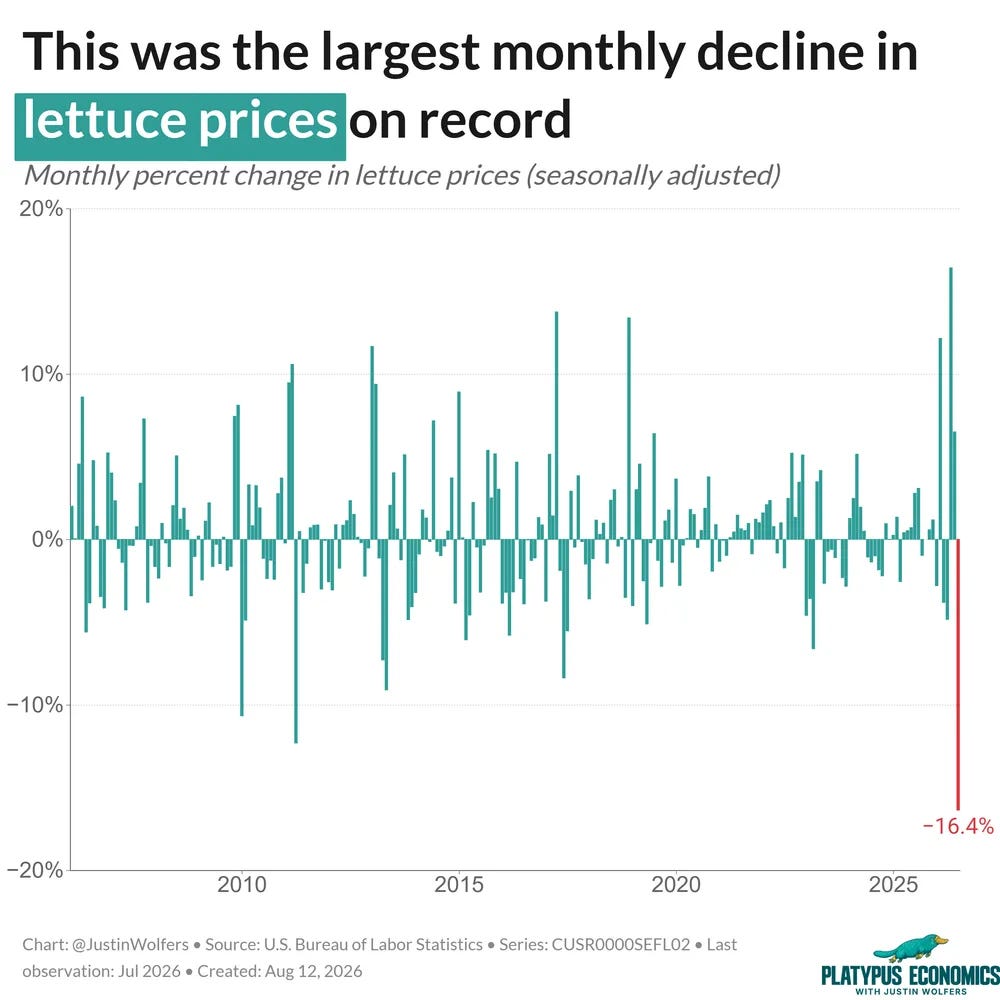
— On the bright side, hollowing out government capacity to track food pathogens could help Trump finally deliver on affordability. At least it’s helping reduce lettuce prices.
— Or maybe greed is just dead? Big Chicken is losing out, too.
— A new merger coming to Broadway: Hollywood mogul Ari Emanuel will acquire ATG Entertainment, a British company that operates seven theaters on Broadway and ten in the West End. Hey, maybe Broadway is worth investing in after all, despite Andrew Lloyd Webber’s warnings.
— “More than 10” companies have signed up to purchase early access to Trump’s posts on Truth Social, Trump Media says. On the one hand: “more than 10” doesn’t sound like a ton. On the other hand: 11 signups × ~$100k/month × 12 months/year = $13.2 million/year. That’s pretty good money. On the other, other hand: Trump Media on Monday reported $238 million in net losses in its second quarter (mostly due to bad bitcoin bets). So it’s still got a pretty big hole to dig itself out of.
— Meanwhile, a new lawsuit has been filed challenging this Truth Social scheme. Watch this space.
— Trump is paying yet another company to cancel its offshore wind projects. Including this latest deal, the government has so far spent roughly $3.9 billion to get companies to terminate twelve offshore wind leases. The irony here is that turbines are back-ordered, so this might never have gotten built anyway. But we’re spending billions of taxpayer dollars to make certain.
At the time the White House said he vetoed this primarily for reasons unrelated to these shell-company provisions, including language renaming military installations honoring Confederate figures.
[Update (August 7, 2026, 2:05 p.m. EDT): The bill discussed in this newsletter passed the Senate 86–11 on Friday afternoon. Efforts to strip the tariff powers from the legislation (led by Sens. Ron Wyden and Rand Paul) failed. The bill now goes to the House.]
DONALD TRUMP HAS SPENT the past year and a half bending every obscure trade law until it snapped, alienating global allies and jacking up costs for Americans. Democrats have heaped scorn on him for this, and Republicans have expressed their own displeasure via indirect or anonymous grumbling to the press. Yet now, lawmakers from both parties are poised to give the president even more tariff power.
And not just any tariff power. It’s potentially the nuclear bomb of tariff power.
A new, bipartisan bill could allow Trump to drop 100 percent tariffs on virtually any country he likes, for as long as he likes, and with pretty much bulletproof legal authority to do so; which means even the Supreme Court couldn’t bail out Congress (or the rest of us) next time.
This is all happening through the Lindsey O. Graham Sanctioning Russia Act, which is rapidly moving through Congress with broad bipartisan support. It is expected to clear the Senate, where it has 62 cosponsors (including 21 Democrats), as soon as today.
As the name implies, the bill is intended to honor the legacy of the late South Carolina Republican and to punish Russia via sanctions.
In reality,
Blast past the paywall: Sign up for Bulwark+ to read on.
Sen. Ron Wyden (D-OR) joins Catherine Rampell to discuss his years-long investigation into Jeffrey Epstein's finances and why he believes major Wall Street banks helped enable Epstein's sex trafficking operation by failing to report suspicious transactions. Wyden explains why he says top bank executives should be held accountable, responds to questions about the 60 Minutes interview that never aired, and lays out what Congress could do if Democrats retake the Senate. Wyden also breaks down his opposition to the bipartisan Russia sanctions bill, arguing that it would hand Trump sweeping new tariff powers that could drive up costs for American consumers.
(Photo illustration by Bill Kuchman/The Bulwark | Photos: Shutterstock)
STOP ME IF YOU’VE HEARD THIS ONE BEFORE: Republicans are on the verge of finally fixing our out-of-control budget deficits.
But first they need to get just one more unfunded spending binge out of their system—and then (they swear) they’ll get around to that purge.
This is the story we’ve been hearing from supposed fiscal hawks in the GOP about why they have repeatedly voted to jam costly budget bills through the fast-track process known as “reconciliation.” Once a rarely used procedural tactic, reconciliation allows a budget bill to get through with only a simple-majority vote. In recent years, the majority party has typically pulled the reconciliation trick at most once per Congress, when it’s trying to expedite some big, splashy, high-priority measure or a must-pass budget bill; in this Congress, however, Republicans are trying to do it a record four times.
To wit:
Last year, the Republican fiscal hawks were unhappy that reconciliation 1.0 (aka Donald Trump’s “One Big Beautiful Bill”) didn’t have sufficient spending cuts to offset its enormous tax-cut costs. As a result, the bill added more than $4 trillion to deficits over a decade. But Republicans voted “yes” amid promises that their fiscal corrective would come in reconciliation 2.0.
Then, this year, reconciliation 2.0 had no spending cuts, only $70 billion in new spending for Trump’s deportation machine. The Republican fiscal hawks were again unhappy. But they voted “yes” anyway, when promised that fiscal probity would come in reconciliation 3.0.
We are today on reconciliation 3.0. Still no spending cuts, or other forms of deficit reduction.1 And yet again, the Republican fiscal hawks in the House said they were unhappy. Some, like Rep. Eric Burlison (R-Mo.), demanded pay-fors as a condition for their votes. Rep. Warren Davidson (R-Ohio) declared the budget resolution “DOA,” saying that there was “no path” to passage without some sort of offsets.
Lo and behold, no offsets materialized, yet still somehow a path was found: Leadership promised that spending cuts would come in . . . reconciliation 4.0.
“We’re right now looking at a reconciliation 4.0 to do the things that are left out of this one,” Majority Leader Steve Scalise said last week, right before nearly every member of his conference2 voted for reconciliation 3.0.
While the budget resolution for reconciliation 3.0 ultimately sailed through the House, it does appear to be at an impasse in the Senate. That’s in part because some Republican senators are demanding it be paid for. Sample objection, courtesy of Sen. Bill Cassidy (R-La.): “Obviously our country is having a problem with deficit spending, so it should be offset.”
We’ll see how long this professed commitment to fiscal discipline lasts.
Careful reporting.
Savvy commentary.
And a growing pro-democracy community.
Become a Bulwark+ member today, starting with two free weeks.
AS I MENTIONED, IT’S UNUSUAL to have this many bites at the reconciliation apple, at least in one Congress, though theoretically the rules have always allowed for an unlimited number of reconciliation bills (at least with enough technical machinations). There have been only a handful of times over the past forty years that two reconciliation bills have passed in the same Congress, and just once has a Congress (the 97th, back in the early 1980s) passed three, according to the Congressional Research Service.
Four would be a new milestone, and a sign of just how broken our budget process has become. What was once an arcane procedural measure designed as a deficit-discipline mechanism is now one of the primary tools for getting bills through—and for adding billions or trillions to deficits.3
This is hardly the only way the budget process appears irreparably broken. As Congress fumbles its constitutional duty to control the power of the purse, Trump is openly stealing it away.
As Cerin Lindgrensavage and David A. Super explained last week in the Hill, Office of Management and Budget Director Russell Vought has been unilaterally refusing to spend congressionally appropriated funds. His maneuvers are plainly illegal. But Vought is claiming he is empowered by obscure budgetary tools created in the late nineteenth and early twentieth centuries, intended for different purposes, that have remained on the books.4
“He’s throwing all sorts of other monkey wrenches in there, in particular saying, ‘You can’t spend this without prior approval from us,’ and then not answering his phone—figuratively, anyway,” said Super, a professor at Georgetown Law. “That’s how he’s whacked the Smithsonian and a bunch of other stuff he doesn’t like.”
Unsurprisingly, the GOP-controlled Congress is not fighting back.
The reasons why are multifold: Most Republican lawmakers are too spineless to oppose Trump, who might (heaven forbid) withhold his endorsement or sic the MAGA mob on them. To avoid blowback from their own voters, some lawmakers have cut side deals to protect programs in their districts or states that might otherwise be felled by Vought’s axe.5
“Russ Vought cultivates this image as Dr. No and an absolutist and all that, but I think the reality is that he is willing to make just enough deals to have members decide it’s in their interest to play ball,” Super adds.
Indeed, some lawmakers may appreciate having Vought provide them a fig leaf of fiscal rectitude.
But it is just a fig leaf: When you hear that Trumpers are slashing funds for the Smithsonian, Community Development Financial Institutions, USAID, medical research grants, and so on, you might think they are substantially slimming down budgets. In reality, while these cuts will devastate the individual programs themselves, the dollars in question represent pocket change in the grand scheme of federal spending and tax-cut costs. But Trump and GOP lawmakers can still claim to be “saving money” when questioned about their unfunded tax cuts, wars, deportation machine, and farmer bailouts.
And make no mistake: Even if Republicans’ professed concern for the federal debt is disingenuous, the federal debt itself is very much real and very much a problem. Earlier this year, it surpassed 100 percent of GDP. And the cost of managing that debt is growing more expensive, too, given that 30-year Treasury yields just hit their highest level in nearly two decades.
Not to worry; presumably the next reconciliation bill will take care of it.
— The U.S. Bureau of Economic Analysis is reworking how it calculates prices in some parts of the economy, in a manner that is expected to lower official readings of inflation. This will take some pressure off the Federal Reserve to raise rates. Economists suggest there are sound reasons for the methodological change but the optics still aren’t great. Which is what happens when you try to politicize independent statistical agencies: Even legitimate changes start to look suspect.
— Speaking of politicization: The Fed held interest rates steady at its meeting this week, with three regional Fed presidents dissenting because they thought rates should be higher. Unsurprisingly, Trump claimed his newly chosen chair Kevin Warsh (who voted to keep rates as they are) really truly wanted to cut rates but was stymied by a “political board.” Trump’s attack dog Peter Navarro likewise lamented “how much work remains to educate a central bank still too slow to recognize the power of Trumponomics.” Meanwhile markets still widely expect rates to be raised by the end of this year; how will Team Trump react if and when Warsh presides over a rate hike?
— The Trump administration is considering adding a whopping $100,000 fee to the program that allows international students to work for a time after graduation while still on their student visas. This is in addition to a recent regulatory change limiting student visas to four years, regardless of how long an academic program takes. (Most STEM Ph.D. programs, for example, take more than five years.) The Great American Brain Drain continues.
— Diamonds are apparently not forever after all: In 2001, De Beers was valued at more than $18 billion. Today the company is in talks to be sold off for $1 billion.
— Hmmm: Andrew Crapuchettes, founder of RedBalloon, received an unsolicited message from a State Department official urging him to bid on a contract to help identify (MAGA-friendly) candidates for the U.S. foreign service. RedBalloon won the contract. Just coincidentally, Don Jr. is an investor.
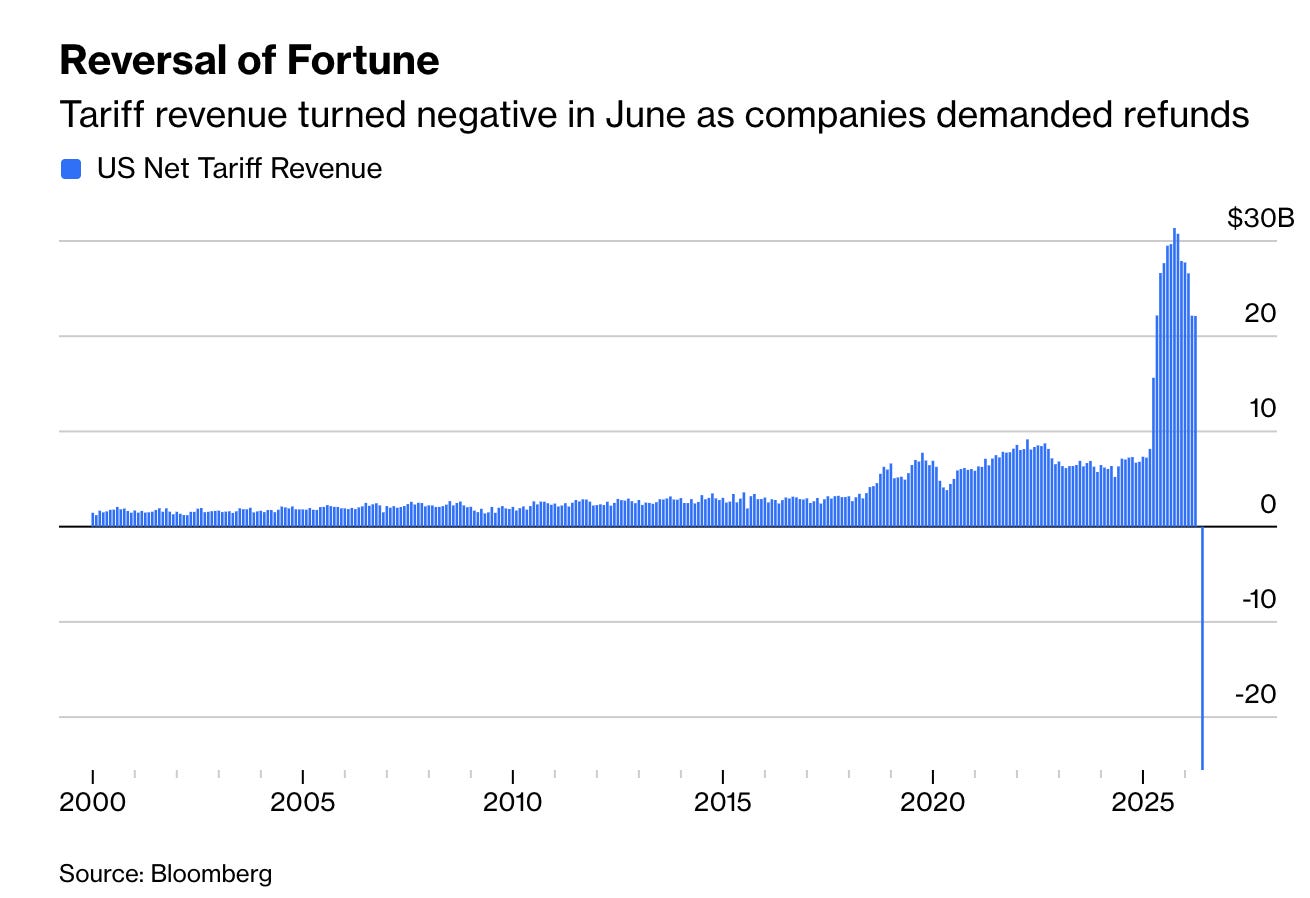
— Tariff revenue turned negative in June, after refunds finally began to flow, thanks to the Supreme Court decision ruling Trump’s tariffs unconstitutional. He is trying to rebuild his tariff wall with other authorities nonetheless.
Although budgetmaking via reconciliation bills is hardly the norm, that doesn’t mean that the rest of the time lawmakers are meeting their obligations to debate and pass annual budgets in an orderly and timely way. In recent years, the budgeting process has usually been a matter of brinkmanship over shutdowns. As James C. Capretta wrote in The Bulwark four years ago, “According to the rules now in effect, Congress is supposed to approve separate bills reported by each relevant appropriations subcommittee before October 1 (there are now twelve such bills). Congress has not met that deadline since 1997, and in fact has met it only four times since 1977. The new normal is the late . . . approval of a phone-book length measure, negotiated behind closed doors by a small group of leaders, covering the entire federal enterprise (and often much else besides).”
The “apportionment process” is a tool intended to prevent the government from blowing too quickly through funds Congress has appropriated, and then coming back to lawmakers, hat in hand, asking for more money. It was designed to prevent overspending; instead, Vought is weaponizing it to underspend.
Sen. Mike Rounds (R-S.D.), for instance, had initially opposed measures clawing back funding for public radio and TV, which were at first unilaterally executed by the White House. Then he cut a side deal protecting funds for tribal broadcast stations in his own state, and voted for a rescissions package formally blessing the clawback.
(Photo illustration by Bill Kuchman/The Bulwark | Photos: Shutterstock)
A VAGUELY OMINOUS BUT LITTLE-NOTICED regulatory filing issued in late June could have a profound impact on business, immigrants, and the balance of power in our country.
The filing was a notification that the Trump administration had drafted new rules governing the decennial census. The actual specifics of those new rules remain scant. But from conversations I’ve been having with people close to the process, it is widely expected that the administration will try to recategorize millions of immigrants (both unauthorized and legal) as not actually living here in the United States.
Why would they do that? For several reasons.
The first is a longstanding animus that the president and his top aides have to the immigrant population. The administration has unleashed unprecedented border crackdowns and interior enforcement measures, in the service of a vast project of mass deportation. Through the census, it can continue the spirit of that campaign. Put another way: If you can’t deport every immigrant, you can at least remove evidence they exist.
The second is power.
An “actual Enumeration” of the entire U.S. population is required by the Constitution’s Census Clause.It’s pretty clear that the Constitution requires counting the full population, based on the use of the word “Persons” in this spot in the original text (rather than “Citizens” as used elsewhere), and similar language—“the whole number of persons”—in the Fourteenth Amendment.1
Join Bulwark+ to support independent media built by readers who refuse to be anyone’s plaything.
The resulting census is hugely important to the functioning of our government. It determines how many congressional representatives each state gets and how districts are drawn. It thereby also affects how many votes each state has in the Electoral College process used in presidential elections. And it plays a role in how trillions of federal dollars are allocated each year, since census data are used to calculate funding levels for health care programs, nutrition, highways, housing, school lunches, etc.
The stakes, in other words, are incredibly high. Which makes this rules submission process so profoundly important.
And here’s the kicker: So far, virtually no one has noticed.2
Let me warn you that this issue gets a little weedy. That’s by design; the administration wants you to not understand what they’re doing, so you won’t notice you’re being disenfranchised and robbed until it’s too late.

 Login
Login