 Login
Login
AI data centers are currently our most viable lifeboat, he said. Hmmm.
Usual notice before getting started: If you like what you find here, thanks in advance for your subscription (possibly but not necessarily paid) or, even better, one-time donations for any amount, or consulting, writing or speaking work.
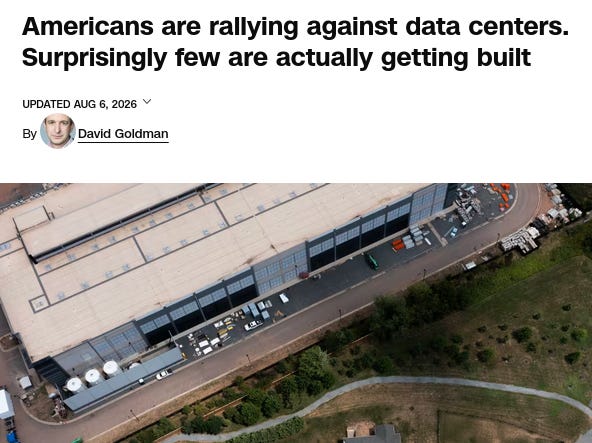
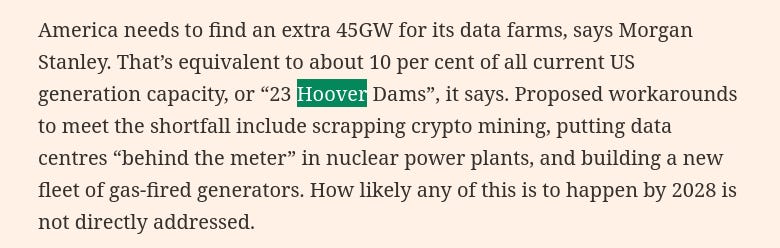
These days, everybody loves (or needs) to hate data centers for AI, and with good reasons: assuming they are built in the quantities AI companies want them, which there is plenty of reasons to doubt, they will suck up really huge quantities of energy, money, water and human creativities that there are thousands better ways to use. A few days ago, however, someone called Brooks Fiesinger (of whom I know nothing except the post mentioned below) made on Facebook the opposite point, which is quite interesting as food for thought, if nothing else.
Here is a synthesis of Mr. Fiesinger thesis, partly reformatted as a numbered list to make it easier follow the comments, and counter-proposals, that I make right after it.
THE UNCOMFORTABLE TRUTH: We are running out of workers, traditional intelligence metrics are dropping, and despite their unpopularity, AI data centers are currently our most viable lifeboat.
The data points to a massive structural deficit hitting our economy over the next 30 years, and we aren’t taking the infrastructure requirements seriously enough. Here is what we are facing:
The Workforce Collapse: We are mathematically running out of humans to keep the economy running. 2024 was “Peak 65”, roughly 12,000 Boomers are retiring every single day, taking decades of institutional knowledge with them.
The Cognitive Shift: Empirical studies from the US, UK, and Norway show that the “Flynn Effect” (the steady historical rise of IQ scores) has inverted for cohorts born after 1975. Recent testing of 400,000 US adults shows measurable drops in vocabulary, mathematical logic, and complex problem-solving.
(consequently) Millennials are likely the peak of traditional, deep-work intelligence. The next generation of professionals is highly optimized for fragmented, rapid data, but they will struggle with sustained deductive reasoning.
The Bottom Line: We need AI capabilities to replace the workforce that lacks both the raw headcount and the traditional cognitive processing power of previous generations. AI agents must replace the missing administrative volume, while frontier models synthesize complex data so future doctors, engineers, and teachers can make informed decisions.
This software requires heavy hardware. You cannot have cognitive augmentation without hyper-scale data centers. The physical infrastructure must be built right now.
First critical caveat: just because we desperately need data centers doesn’t mean we should be reckless. I fully support stringent environmental protections, proactive grid and energy management (we need advanced nuclear and baseload power, not rolling blackouts), and strict financial responsibility.
Second critical caveat: we must actively guard against the “Wall-E Effect. If we build AI to compensate for declining human reasoning, human reasoning will decline further because it’s no longer exercised.
Mr. Fiesinger conclusion: We are walking a dangerous line between necessary cognitive support and catastrophic human dependency. Do you have a better proposal?
My own comments and counter-proposals
In general, I sincerely thank Mr. Fiesinger for connecting some points that everybody should see they are connected, and for stimulating thinking about the role of AI in the full picture, regardless of what the current crow of challenged children that leads it claims.
Point 1 is true and really concerning, the only thing wrong in it is “the economy” instead of “society”, which is what really matters. It’s true and concerning because overpopulation has already started to end. I already wrote about this here.
Points 2 and 3 are quite close to an unfair generalization, but there still is more truth in them than what would be comfortable. In them, I would add “AI-dependence” to the “highly optimized for” list.
I also have to say that I will steal, obviously giving credit, the “highly optimized for fragmented, rapid data” definition, because I really love it. It is, for everybody it really applies to, the most elegant way I’ve seen so far to tell somebody that he’s too dumb to function as adult, because either parents or institutions that snobbed or even boycotted adequate education (with humanities in the right place), love of reading for reading’s sake and sensible protection from high-tech during childhood left him the attention span and memory of a goldfish.
I also agree with Point 6.. for the data centers that will be actually needed, including the part that calls for nuclear power, if developed in the “revolutionary” way I suggested two years ago
My disagreement, and counter proposals, are about Points 4 and 5, and with the underlying assumption hidden that what we call AI today is unavoidable and can only grow. That’s just not true, not true at all. Never was, never will.
Here is my main objection about Point 4: for what purpose, exactly, should we “replace the workforce that lacks both headcount and brain power”? For the same dung pit of nonsense we call the economy today? Should that workforce be replaced to keep running a world where people work themselves to oblivion, and where Europe (or any other place, of course) is supposed to do with tech the same mistakes the US did, mistakes of which the US will free themselves of through a crash that will damage the rest of the world? Of course, answering such a big question was outside the scope of Mr. Fiesinger’s post. I am not blaming him at all, just pointing out the questions we should answer before any concrete proposal to “keep the economy running”.
Moving to Point 5: well before replacing any job, the first volume frontier AI models should reduce is not in work, but in systemic excessive overhead, for example giving humans pointers to stupid complexity that shouldn’t exist, starting with laws as I suggested here.
Also, please note that many of the highest-paid administrative jobs that AI should replace often are jobs that shouldn’t exist at all. That is, the job that may entitle to a beautiful personal office and traveling business class, but under the facade are just “performance art... professional email forwards... human middleware between systems that could probably talk directly to each other... managing projects that exist primarily to justify the existence of project managers.... creating strategies for strategies, optimizing things that didn’t need optimizing, disrupting things that were working fine.”(read the whole thing this comes from, it’s great! Especially if your salary is high).
Ditto for, sticking to AI, all the managerial jobs that promote AI at all costs just because those doing them are afraid to do otherwise.
Let’s talk infrastructures, instead of keep this “economy” running: the most important workers needed in the next decades may not be people with two or three PhDs and excellent AI-enhanced management skills, but electricians, plumbers and other tradespeople, as well as firemen, nurses and caregivers in general... Thank heaven, there are now students “Seeking To AI-Proof Their Careers With Trades Over College”.
As far as AI physical infrastructure goes... the huge number of huge data centers is needed only by the hyperscaler companies that push the current AI bubble, in order to delay their crash. Stop that senseless rush, stop public access to AI for idiotic tasks (me on this, two years ago again), and we’ll find ourselves with plenty of data centers, or real possibilities to build them, to make a new wave of AI do stuff we all actually need.
One paragraph summary
AI running in data centers will be needed to solve the huge problems (global aging, inequality, agricultural crises, resource conflicts) that will only get worse in the next years if nothing happens. The AI that’s needed, however, is not the AGI the AI cabal wants to impose on the world out of sociopathy and greed, but it will never achieve. It is a much smaller set of task-specific AIs, like China is doing, that will need many, many less data centers. And decently educated youngsters to handle it, of course. This is my better proposal, with sincere thanks to Mr. Fiesinger for his stimulus.