❌

Reading view

The Dictator Thing

Donald Trump’s giddiness around dictators is one of the abiding themes of his two presidencies. You can see it now in the eagerness with which he’s anticipated his summit/meeting with Xi Jinping and Vladimir Putin. Indeed, in the last two days Trump’s been casting about for the possibility of adding Kim Jong Un to the trio. These are quite simply the men he admires the most because they embody his actual vision of what a leader should be. It’s easy to get the sense in these meetings that Vladimir Putin heads one of the world’s three great powers. But that simply isn’t the case. Russia is a comparatively minor economy. It has a lot of oil and gas. It has nuclear weapons, really the only thing that makes it a major player on the world stage. As a conventional military power it’s struggled for years to subdue even Ukraine. The U.S. and China are great powers, with mammoth economies vast enough to sustain huge militaries. Russia is really only in this group because it has become what amounts to a junior associate of China and because of Donald Trump’s fixation on it as a kind of model power. In a way, Trump’s eagerness to add Kim Jong Un to the group underlines why Russia is there in the first place.

  •  

The single market is the EU’s greatest strength

The EU is searching for ways to strengthen its competitiveness with the likes of the United States and China. But one of its greatest advantages is already within reach: a single market of 450 million people. Today, it runs at half its potential. The IMF estimates that barriers inside the single market are equivalent to a tariff of 44 percent on goods. The priority should be to close the gap between the promise of a single market and the reality of doing business across 27 member states.

Mars, Incorporated is a global business that has been operating in Europe for almost a century. We employ more than 30,000 people in the EU; we have 24 factories and more than 450 veterinary clinics. In recent years we have invested more than €1.5 billion in Europe, with another billion coming by the end of this year.

From my vantage point, Europe remains a good place to do business. But running a global business also gives you a clear view of where Europe could do more. In an increasingly competitive global economy, the costs of fragmentation are hard to ignore, and addressing them could help unlock even greater investment across the continent.

Making the single market work as one

Few markets offer the EU’s combination of scale and cross-border access. Yet common rules must work consistently in practice. Take a pouch of Whiskas cat food. Manufactured in the same factory to the same standards, it can require different labels, recycling information and packaging fee arrangements depending on where it is sold.

If the single market is to really work, the principle should be straightforward: one rule, applied once, consistently. An EU law should mean the same thing in Madrid as it does in Warsaw. Greater consistency across member states would make it easier for businesses to expand, innovate and invest further.

From my vantage point, Europe remains a good place to do business. But running a global business also gives you a clear view of where Europe could do more. In an increasingly competitive global economy, the costs of fragmentation are hard to ignore, and addressing them could help unlock even greater investment across the continent.

Varying taxes, packaging requirements, logistics and retail structures also have an impact on consumer pricing. Making the single market work for business can benefit European consumers at the checkout.

Staying open to the world will make Europe stronger

A more effective single market would also strengthen Europe’s position globally. For manufacturers, exporting competitively matters as much as operating efficiently within Europe. Put simply, the better the single market works within the EU, the easier it is for us to export from the EU.

Mars’ European factories supply countries beyond the EU. The conclusion of the EU-India Free Trade Agreement earlier this year was very welcome and supports further efforts to enable European manufacturers to compete globally. Closer to home, this week’s EU-UK summit is an opportunity to make trade easier with our nearest neighbour across the Channel. The United Kingdom is one of our most important trading partners, and many of our products now face checks and paperwork that did not exist before Brexit. A food and veterinary agreement would remove much of that friction, and I hope leaders seize this moment to finalize it.

Predictable, well-designed regulation builds investment confidence

Europe’s high standards of safety, sustainability and consumer protection are its strengths. But delivering them requires clear, workable and predictable regulation.

A more effective single market would also strengthen Europe’s position globally. For manufacturers, exporting competitively matters as much as operating efficiently within Europe. Put simply, the better the single market works within the EU, the easier it is for us to export from the EU.

Packaging illustrates the challenge. Under new EU rules, packaging must be designed for recycling by 2030, yet some technical criteria defining compliance are not expected until 2028. Investment decisions cannot wait until every regulatory detail is settled. Businesses are making choices now about factories, equipment and supply chains that will operate for years.

The goal is rules that achieve their objectives without creating unnecessary uncertainty. Clear, predictable rules strengthen the single market and give businesses the certainty to invest.

Making Europe’s advantage count

Europe does not lack competitive strengths. But fragmentation makes it harder to realize its full potential.

For many years Mars has worked to support more uniform regulation. That work is not finished. Harmonized labeling is one practical starting point. Products manufactured to identical standards should not require multiple packaging versions to circulate across member states, provided consumers receive the information they need.

Europe does not need to invent a new competitive advantage. It needs to make better use of the one it already has. Making the single market work as one is where that effort should begin.

And fixing fragmentation is only half the battle; we must also build smarter regulation from the start. Reporting is a good example. We support transparency, but EU reporting requirements have multiplied in recent years and now place a heavy administrative burden on businesses of all sizes. Patchwork exemptions and higher thresholds bring welcome relief for smaller companies, but they are a patch, not a solution. They do not make the rules themselves any simpler. The lasting fix is to design rules that are simple, efficient and predictable from the outset for all businesses.

Europe should establish clear compliance requirements before major investments are needed, involve industry early and apply common rules consistently. Combined with a commitment to open international trade, these are practical steps toward a more competitive Europe.

Europe does not need to invent a new competitive advantage. It needs to make better use of the one it already has. Making the single market work as one is where that effort should begin.


Marc Carena is global president of Mars Petcare, the +$30 billion pet care division of Mars, Incorporated.


Disclaimer

POLITICAL ADVERTISEMENT

  • The sponsor is Mars Incorporated.
  • The political advertisement is linked to advocacy around boosting the competitiveness and efficiency of Europe’s single market.

More information here.

  •  

Jensen Resurrection Watch

I’m watching Jensen Huang’s increasingly public bid to be reinstated as CEO of NVIDIA, a company he and many of his Silicon Valley allies clearly see as his. I’m unclear how much to see this as a kind of fantasy or fan fiction or a process of Silicon Valley corporate governance. Remember that something broadly similar happened with OpenAI’s Sam Altman. He was dismissed as CEO, for never entirely explained departures from the original mission of the company. Then he was returned to power — something like a dictator triumphantly returning from a failed coup. Most of the board who fired him got the boot and that was that. We’ll see what happens here. The board is probably going to have to explain just why they forced him out. There’s a lot to choose from. But just which of the reasons or what mix remains unclear.

  •  

GAOing Very Strongly

The choice of who to pick to lead the GAO (Government Accountability Office) is one of those subjects that is at once hopelessly niche and technical but also foundational to, among other things, making presidents follow the law. Specifically, the GAO serves as the watchdog keeping track of what crooked operators like Russ Vought at OMB are doing. So Trump has nominated Eric Ueland, one of Vought’s deputies, to run GAO. But we’re already seeing signs that Ueland’s nomination might have difficulties even in the lame duck Republican Senate. Sens. Curtis and Collins are signaling they may not be on board. Remember, too, that unlike the other new senators, Sherrod Brown will get sworn in mid-Decemeber rather than January 3rd, since John Husted was serving out an unexpired term. So it’s not clear yet that this is a done deal. Meanwhile, Bobby Kogan, senior director of federal budget policy at the Center for American Progress, notes that notwithstanding the 15-year term, Ueland could be removed in 2029 with a Democratic trifecta.

  •  

Is Netanyahu Feeding Trump Scary Iran Intel In a Desperate Bid to Remain in Power?

CNN just published a story claiming that U.S. intelligence had picked up evidence that Iran may be planning a dirty bomb or chemical weapons attack in Washington, D.C., targeting top administration officials. They make no mention of Israel or Israeli intelligence, but if you’re following news out of Israel since the October 27th election, you’ll know that Benjamin Netanyahu has been working in overdrive to get the U.S. to restart the hot war with Iran, apparently believing that a renewed conflict will give him leverage to remain in power. There were similar efforts just before the election. The aim then was to perhaps delay the election as a war-time measure.

Here are the details.

For the last several days the Israeli press has been talking about how Netanyahu’s government has been telling the U.S. it has intel on possible Iranian attacks on top Cabinet officials as well on Trump himself. This comes as the opposition bloc has been warning Netanyahu not to take any steps to restart fighting while Gadi Eisenkot works to form a “change” government unless a military action is based on some concrete imminent threat. They clearly think he’s going to try to do that. And the Chief of Staff of the IDF has apparently already resisted pressure to back such action.

At first Netanyahu’s caretaker government was refusing to provide security briefings to opposition leader Eisenkot as he tries to form a new government. (Eisenkot is the former Chief of Staff of the IDF, 2015-19). That briefing eventually did happen. But afterwards it was revealed that Netanyahu didn’t brief Eisenkot on the fact that he was in the process of sending Mossad chief Roman Gofman to D.C. to discuss Iran with CIA chief John Ratcliffe. That visit happened last Friday.

  •  

Techlords and Billionaires Mobilize for Jensen Huang Restoration

It’s not clear to me that this will go anywhere. And I don’t want to hang too much on one decision of corporate governance. But a fascinating and, I think, pretty significant development occurred over the weekend in the Silicon Valley tech world — or, more specifically, a development that’s tied to Silicon Valley’s rapid turn to the right. Their argument is that the problem isn’t whatever Huang did, but rather, it’s that he didn’t sufficiently control his board. Because he didn’t, they were able to force him to resign.

This isn’t as crazy as it sounds. There’s a big contingent in Silicon Valley that believes companies should operate in “founder mode.” And a lot of big tech companies especially are structured in a way as to guarantee the control of founders even though they control only a small percentage of equity in the company. Still, boards are a central feature of corporate governance, even though they are often dominated by powerful CEOs. They should either exist or they shouldn’t.

  •  

Jensen Huang’s Role: A Different Picture Comes Into Focus

I don’t want to make too much of a single report. But I’m flagging it here because it fits with a number of other emerging data points about the NVIDIA-Huang scandal. What are those emerging data points? I’d describe them broadly as suggesting there was at least as much push from NVIDIA/Huang to keep selling its chips into China, in the face of tightening export controls, as there was intelligence skullduggery by China to bring them into the country. In that context, Alice Huang seems as much an intermediary or partner as a spy or trickster pulling anything over on anyone.

The report comes from CBS News and it was published late Friday evening.

  •  

Back To the Electoral College, And Why Getting Rid of It Is a Big Mistake

As the dust settled on the 2026 midterm elections, a number of stories were published noting that states now fully under Democratic control include enough electoral votes to make the National Popular Vote Interstate Compact a reality. To review, this is the plan, devised in the aftermath of 2000 presidential election, that would allow an end-run around the Electoral College. A sufficient number of states agree to award their electoral votes to the winner of the popular vote regardless of how their own voters voted in that particular state. Once a sufficient number of states agree, it’s done. The effect of the Electoral College disappears even as its architecture remains.

  •  

Finding the Signal in the Noise of NVIDIA-Gate

Earlier this evening, I was exchanging notes with TPM Reader NH and I told him this: “I’ve had a very hard time today trying to put all of this into a coherent whole. Part of me thinks you’ve got a bunch of highly questionable stuff happening, at least semi-corrupt, very questionable behavior on NVIDIA’s part vis a vis China, some intentional slow-rolling from Commerce for very questionable reasons. And a lot of it is at least loosely known to a lot of people. Then the Times publicly confirms the relationship and U.S. assumption that Alice Huang is a spy. And then everyone runs for cover — even though a lot of the stuff surrounding that relationship was at least semi-known. I don’t know if this is a plausible way to look at it. But in a way I’m not sure she even needs to exist for a lot of this stuff to happen?”

  •  

Van Hollen Says the Filibuster Should Go

WASHINGTON, DC - JUNE 08: Senator Chris Van Hollen (D-MD) walks through the basement of the U.S. Capitol building following a vote in the Senate on June 8, 2021 in Washington, DC. Senate Democrats and Republicans are continuing their negations on President Joe Biden’s infrastructure plan and have yet to come to a deal. (Photo by Samuel Corum/Getty Images) *** Local Caption *** Chris Van Hollen

As I’ve noted, these leadership challenges don’t mean a lot if they don’t include abolishing the filibuster. This afternoon Sen. Chris Van Hollen (D-MD), who just announced what remains a fairly longshot challenge to Chuck Schumer, says he supports getting rid of it.

“My personal opinion is that we need democracy in the United States Senate and that means allowing ultimately a majority of senators to answer the call of the American people, so that means 51 votes … My personal view has been all along that the filibuster is an anti-democratic — small “d” — provision. It’s not in our Constitution. It was put in there by senators to enhance their power over the power of the people.”

As you can see he’s framing this as his personal view. But that goes without saying. As I explained, a parliamentary leader isn’t a “decider,” as George W. Bush famously put it. He or she steers where their caucus wants to go. So it’s not a matter of him saying I will do this when I’m leader. But him pretty unequivocally supporting it is a big, big deal.

  •  

There’s More Here Than We Thought

This is just a general observation. When I first started following the NVIDIA scandal, I had the sense that Jensen Huang was either duped by these cut-out companies sending NVIDIA chips (physically or virtually) to China, or perhaps he was beguiled by Alice Huang, the suspected Chinese spy. But it’s very hard to square that basic take with the various reports we’re seeing.

  •  

No Room on the Lifeboat … Admin Sharks Circle Lutnick

The attempt to pin the NVIDIA-Huang spy scandal on Commerce Secretary Howard Lutnick is galloping forward. Earlier today Treasury Scott Bessent went on CNBC and squarely laid the blame on Lutnick for slow-rolling and loosely enforcing export controls on NVIDIA chips. This is no different from the accusations we’ve been hearing about from unnamed sources in numerous reports. But going public and laying blame on CNBC is a whole ‘nother thing. This Journal article goes deeper into the specifics of the accusations, Lutnick’s apparently fairly close relationship to Jensen Huang and other details of this internal administration battle.

  •  

The Filibuster Runs Deep. Very Deep.

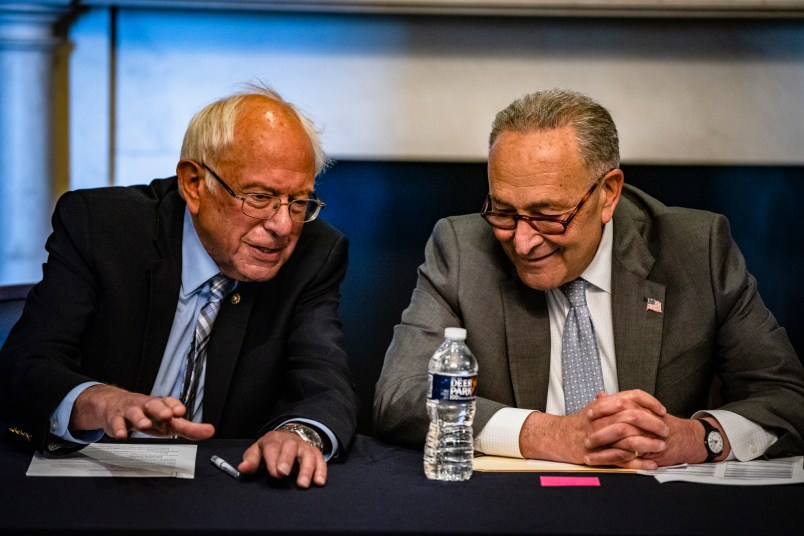
WASHINGTON, DC - JUNE 16: (R-L) U.S. Senate Majority Leader Chuck Schumer (D-NY) and Committee Chairman Bernie Sanders (D-VT) holding a meeting with Senate Budget Committee Democrats in the Mansfield Room at the U.S. Capitol building on June 16, 2021 in Washington, DC. The Majority Leader and Democrats on the Senate Budget Committee are meeting to discus how to move forward with the Biden Administrations budget proposal. (Photo by Samuel Corum/Getty Images) *** Local Caption *** Chuck Schumer; Bernie Sanders

I went back and forth with a number of people yesterday about the filibuster and the leadership contest in the Senate Democratic caucus yesterday. You want Van Hollen because among other reasons, some contended, he gets you closer to getting rid of the filibuster. Don’t be so sure of that. I want to show you something that popped up yesterday in my Twitter feed that is a good example of why. TPM alum Sahil Kapur posted this clip of Bernie Sanders getting asked about the filibuster. The answer isn’t great. I’m not picking on Sanders here. I’m flagging this precisely because Sanders is a key player making this leadership contest possible and people imagine, with some good reason, that Sanders is most willing to upend conventions, take on establishment thinking, etc. It’s an example of how deep filibuster thinking runs.

  •  

Forget the Leadership Fights—Everything Comes Back to the Filibuster

In her note to TPM over the weekend, Theda Skocpol made a long list of good observations and suggestions about Democrats’ path forward. One of them was deceptively simple: “Stop passing huge kitchen sink bills no one understands and instead pass one at a time popular measures and force Trump to veto them.” This is one of the great lessons of the first two years of the Biden presidency. The lesson stretches back into the Obama years. His administration and congressional Democrats actually went to some lengths to hide Great Recession public relief/stimulus checks in the innards of tax refunds. This should be obvious to everyone by now. One of the perverse side effects of Democrats being the party that is serious about governing is that they tend to think of legislation purely in policy terms. But legislation isn’t just a technocratic fiddling under the hood of the engine of government. It’s a public conversation with voters.

But there’s a catch. There’s another reason they do those huge omnibus bills where no one knows what’s in them. The filibuster. There’s simply no way to do them with the filibuster in place. The only way around the filibuster is the reconciliation process. And you can only do a couple of those a year. Even then, only certain kinds of legislation are allowed. So if the plan for the next two years is to pass a bunch of popular bills and force Republicans to vote against them and Trump to veto them you actually can’t do that because none of that will even get to a vote in the Senate.

  •  
❌