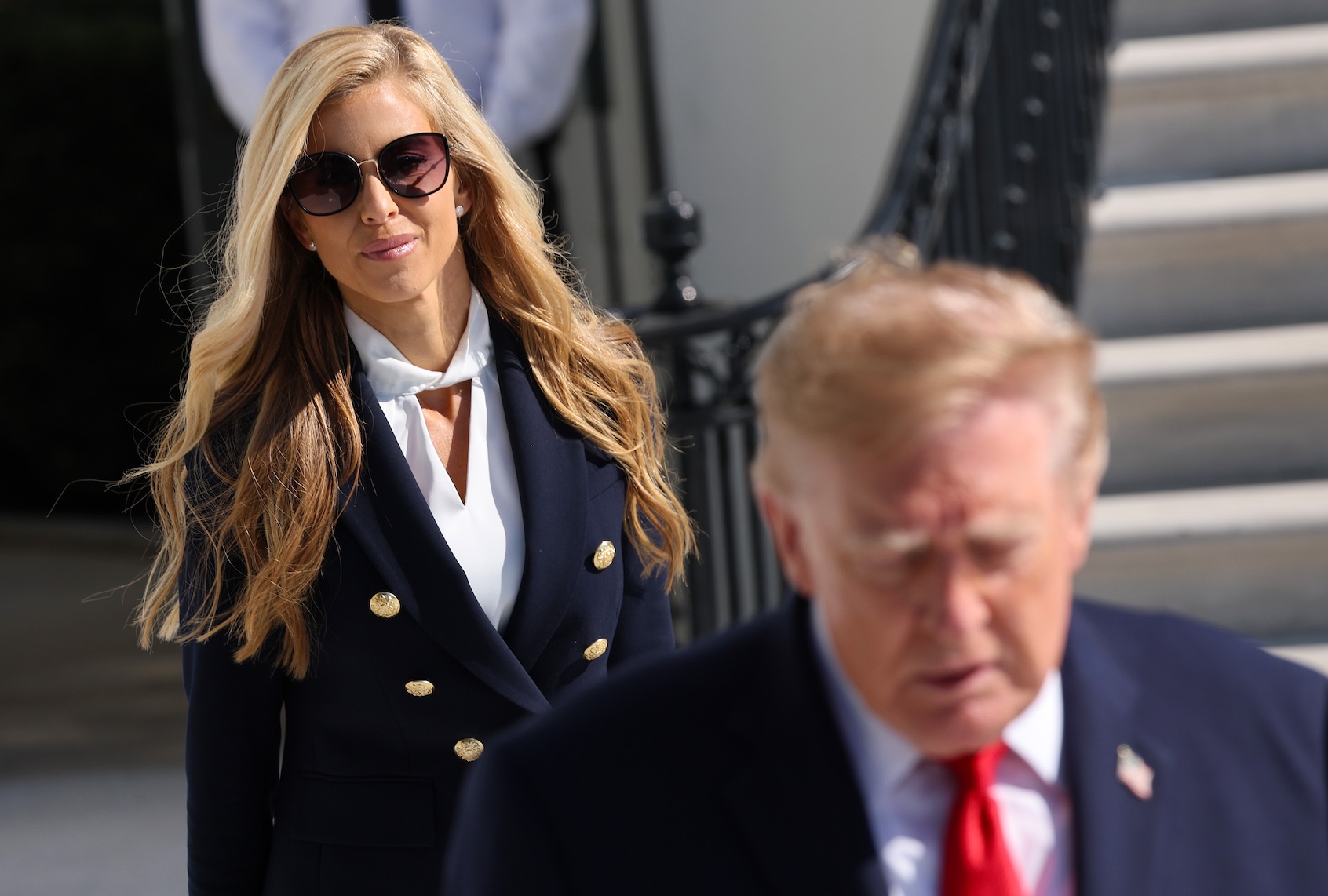
Well, that didn’t last too long. Katie Zacharia became White House press secretary just five days ago, but after President Donald Trump told reporters she should “reconsider,” the New York Times reported she’d been fired Friday afternoon.
Zacharia held the position for less than a week, but generated considerable controversy in that short time. Her first briefing on Tuesday lasted only 14 minutes as she took questions from just three reporters at Breitbart, Fox News and the Daily Mail, appearing flustered and disorganized. Meanwhile, questions about her credentials took center stage, as she identified herself as a lawyer but in fact had never passed the bar exam. Her long history of pushing far-right conspiracy theories like QAnon also resurfaced.
Then, Zacharia made two appearances on Fox News, both of which did not seem to go well. Sean Hannity grilled her on her false credentials Thursday night and told her, “I can give you some unsolicited advice. That’s never going to be a friendly room to you,” referring to the White House press pool. The next morning, she appeared on “Fox and Friends” and was asked if she still had the “confidence” of the president. “I-I-I’m standing here and I was able to travel with him through all of the midterm convention — or, excuse me — the midterm rallies, and I hope to be able to build the trust and confidence of everyone around me,” she replied.
Apparently, she did not have Trump’s confidence. Speaking to reporters at the White House Friday, the president said he told her “Honestly, if I were you, I’d reconsider.” He added that he would leave the decision to her, according to CNN, but said they would speak when he returned to the White House. “Katie, do you need this? I don’t think you need this,” he said he told her. A few hours later, she was out.
Numerous people online compared Zacharia’s short tenure was compared to Anthony Scaramucci, who was appointed White House Communications Director in 2017 during Trump’s first term, but just lasted 11 days. “To put it more precisely: a Zacharia is about .4 of a Scaramucci,” Anna Bower, a senior editor at Lawfare, posted on Blue Sky. The Mooch, as Scaramucci is popularly known, posted on X that “Records are made to be broken. But I take no pleasure in other people’s pain.”
Zacharia replaced secretary Karoline Leavitt, who resigned from the position in August.
😳 Zacharia flames out on Fox News for the second time in 12 hours 😳
With the wreckage still smoldering from her debacle on Hannity, Katie went on Fox & Friends and received another grilling from Fox hosts
LAWRENCE JONES: It’s been a tough week for you. Do you wish you would’ve disclosed to the president about not passing the bar?
Earlier this month, three data centers in western Russia suddenly went dark due to a “rapid unplanned disassembly,” to use euphemistic engineering parlance. They exploded, in other words. Operated by Yandex, a Russian technology company often compared to Google that offers many similar services — a search engine, online shopping, cloud computing and the like — the centers were heavily damaged in a series of coordinated drone strikes over four days by Ukraine, which saw them as a valuable target in the country’s military campaign against Russian infrastructure.
As Russia’s war against Ukraine slogs on, both sides are increasingly adopting this strategy. While power plants and oil refineries have been hit, data centers and internet facilities are becoming the latest quarry for drone and missile strikes — and not just in Europe. Data centers operated by Amazon in Bahrain and the United Arab Emirates have also been targeted in the ongoing Iran war.
Few Americans have probably heard of Yandex, let alone use its services, and most likely didn’t notice when many of its hosted websites became inaccessible. But after Ukraine’s attacks, many people started to claim that social media was seemingly different. Ukrainian President Volodymyr Zelenskyy was quick to suggest his country had dealt a massive blow to Russia’s online disinformation machine, saying, “It suddenly became a little easier to breathe on many social platforms. There was less hate, less division and fewer provocations.” Several reports seemed to support his claims, citing data from internet monitoring service Cloudflare, that allegedly showed “Russia’s Yandex bot traffic nearly eliminated overnight.”
But the truth is far more complicated, as some experts have noted. Yandex did experience a crash in bot activity, but at least some of that traffic seems to be legitimate. “When Cloudflare data shows a precipitous drop in ‘bot’ traffic, that does not mean ‘automated social media troll accounts’, it means ‘software that makes automated web requests on a large scale,’” Michał ‘Rysiek’ Woźniak, an internet infrastructure expert, told The Guardian. Others noted that they haven’t seen an actual drop in online disinformation. “Our platforms are still monitoring Russian social networks across the world and there is no discernible change in their posting patterns,” said Amil Khan, the chief executive of Valent, a tech startup that tracks disinformation.
None of that has stopped Reddit and other corners of the web from celebrating and memeing the issue. If those celebrations aren’t quite justified, there’s still something to be learned from the ordeal, which digs into the so-called dead internet theory. The basic premise is that almost nothing we see online is human-generated anymore. In his 2025 book “Market-Oriented Disinformation Research,” business academic Carlos Diaz Ruiz, who has studied how disinformation spreads in social media echo chambers, describes what many of us experience online on a daily basis: “an eerie feeling that the Internet is made up of bots talking to bots, following and liking bots, and posting AI-generated content designed for machine consumption, the algorithm, not humans.”
Indeed, bot traffic makes up an increasingly large share of the internet, surpassing human traffic for the first time in history over the summer, according to a June Cloudflare report. No doubt the surge in generative artificial intelligence use is what tipped the scales, but of course, not all bots are created equal. Many have legitimate, beneficial uses, like archiving web data.
Some people have wedged dead internet theory into a conspiracy theory that Diaz Ruiz divides into “weak” and “strong.” The weak version of the theory is that the internet is now little more than a hall of mirrors used to manipulate the masses into fighting a culture war instead of a class war. “The Internet drama keeps the population occupied and distracted, preventing them from resisting the elites secretly controlling the world,” as Diaz Ruiz says. “The ‘strong’ version of the dead internet conspiracy theory claims that online activity is entirely disconnected from human activity because our society ceased to exist some time ago. In some versions, a catastrophic event occurred in the past, triggering society’s collapse.”
OK, so we’re basically talking the plot of “The Matrix” here. The argument that humanity peaked in 1999 may be compelling, and I won’t argue against it. If reality truly is nothing more than a hallucination, dream or computer screensaver in the brain, why should we waste time disputing it? Proving a negative with such a lack of evidence is fruitless. The point is, some people may be taking dead internet theory a little too far, but that doesn’t change the fact that within the last week people felt like they got a taste of some version of it.
If we lift the hood on some of these conspiracies, we can understand what people are really afraid of. Last December in the journal Computer, Hal Berghel, a computer science professor at the University of Nevada, argued the dead internet is more than a conspiracy and should not be dismissed, writing, “There’s certainly evidence of the distortion of the internet from the original concept as a liberating, self-healing, packetized purveyor of useful and important information: the original commitment to net neutrality is on life support, the goal of a shared public information repository is constantly compromised by paywalls, the content has moved from valuable scholarship to a sub-cerebral landfill, and the users are subjected to a mind-numbing cacophony of digital threats: spam, phish bait, spyware, malware, online bullying, online fraud, extortion, hacking, VoIP 911-swatting, doxing, slander, pretexting, etc.”
In other words, there’s a good reason so many people find dead internet theory attractive. Once a zone of promise and connection, the web has not only rotted and enshittified, it’s turned into a literal warzone. There really are algorithms out there, unleashed by governments actively dropping bombs on one another, that are designed to infect our minds and prejudice our ability to perceive the truth. It’s one of the many ways modern warfare has become invisible, pervasive and endless. No wonder social media is making so many people depressed — it can be a form of assault.
“In tandem with proxy warfare, cyber operations have become a central pillar of modern statecraft. Cyber warfare enables states to conduct aggressive acts; espionage, sabotage, infrastructure disruption without engaging in kinetic violence,” philosophers Oluyemi Opeoluwa Adisa and Kareem Shwan Adham wrote last year in a study published in the International Journal of Scientific Research and Management. “The strategic advantage of cyber warfare lies in its stealth and ambiguity. Because it blurs the line between war and crime, attribution becomes difficult, enabling perpetrators to operate with minimal consequences.”
How do we even tell how much of the dead internet theory is true? Perhaps through that old tech-support adage: Turn it off and back on again. And no, I don’t mean bombing more data centers, though we’re likely to see more of that, for better or worse. If everything feels fake, maybe we’re better off getting outside and experiencing something real for a minute. Yeah, yeah, we’ve all been told to touch grass so much that such advice is routinely mocked, and anyway, not everyone can easily do that.
But here’s your daily reminder that humans are primates whose still-evolving brains are exponentially outpaced by technological advancement. Being in nature is essential because we are nature. There’s a certain reset available in the presence of trees, birds and clouds. Even more important is connecting with real humans: family, friends, neighbors. Socialization is the essence of the primate brain too. You don’t have to uninstall any apps or delete Facebook, though you could try it too. Off, on again.
And when you are online, which is unavoidable for many of us, try to remember that you are probably interacting with fewer humans than you might think. So don’t take it so seriously. Temper those outrageous emotions, the ones the algorithms have gotten so good at teasing out of us. Maybe instead we can fortify them into weapons to attack the real problems we face, like widening wealth gaps, destruction of the environment and the rise of authoritarianism.
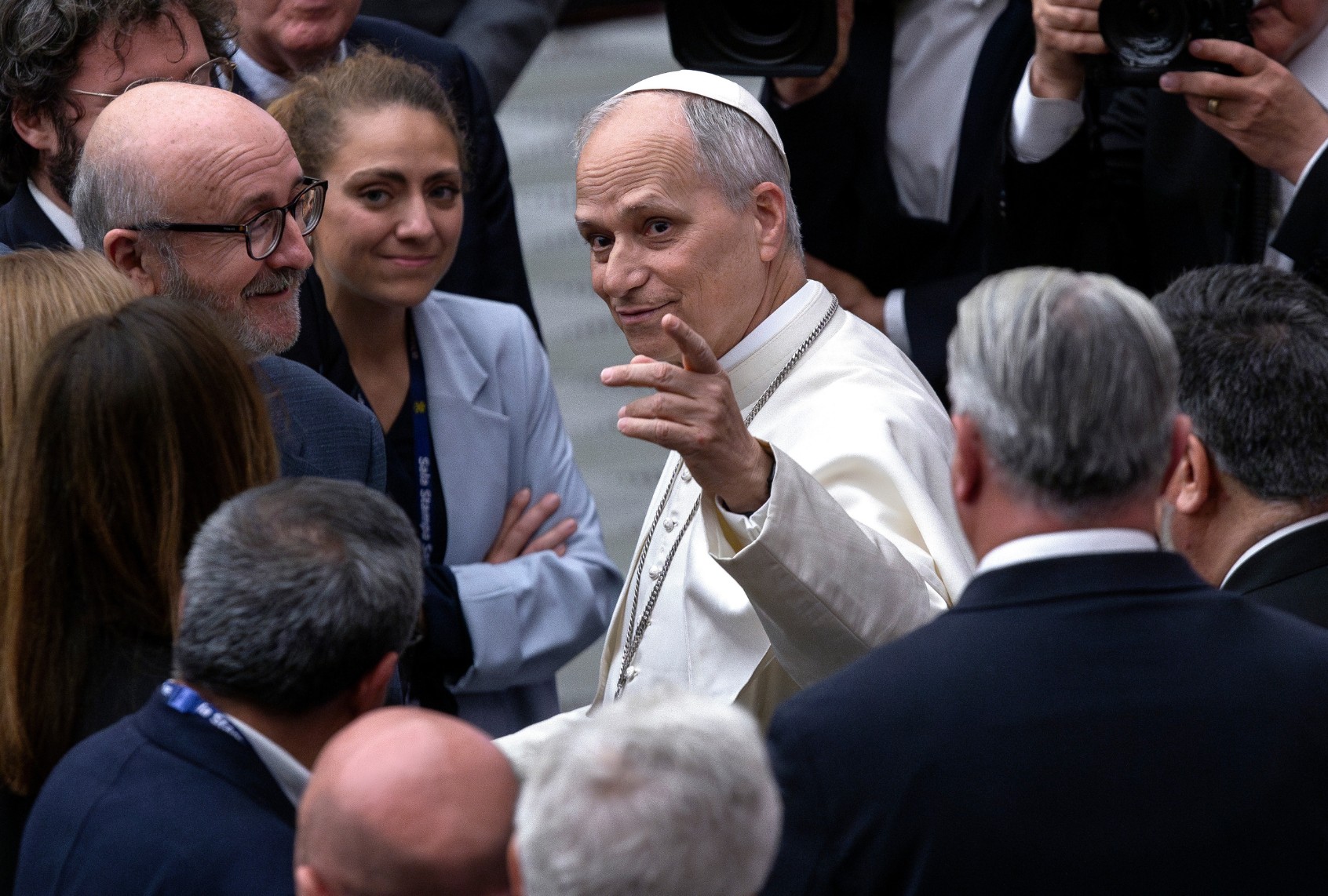
Pope Leo XIV underwent surgery earlier this week, which led to a diagnosis of lung cancer on Tuesday. At a recent health checkup, doctors had discovered a small nodule in the 71-year-old pontiff’s lung, known as adenocarcinoma. It is a common form of non-small-cell lung cancer and was removed by cutting it out. The Vatican also released a statement saying the lower lobe of the pope’s right lung was removed, but that he experienced no complications from the procedure and returned to his room. It is the first significant medical procedure of the pope’s tenure.
“You can heal from a lung tumor,” Dr. Lorenzo Spaggiari, a thoracic surgical oncologist at the European Institute of Oncology in Milan, told the New York Times. Spaggiari, who is not part of the pope’s medical team, also said one of his patients ran the New York Marathon after having a lung removed. “The important thing is to catch it [at] an initial stage,” he said.
Leo was elected as head of the Roman Catholic Church in May 2025, the first American to hold the role. In that short time, members of the Trump administration have repeatedly clashed with the pope, with President Donald Trump once accusing him of being “soft on crime.” Leo has been outspoken about Trump’s war against Iran and immigration policy, urging Catholics to “welcome the stranger.”
In the 1987 Nintendo game “Zelda II: The Adventure of Link,” there is a village you can visit and a home you can enter and a man in a purple shirt you can speak with. But the only thing he says is “I am Error.” I was unexpectedly delighted by this dialogue when I first encountered it on a Gamecube emulator in 2009 (I’m not that old). It felt both meta and existential, or just an amusing bug. It turned out that Error was actually the character’s name, a sort of in-joke slash translation mistake that has since become a meme akin to “Your princess is in another castle” or “It’s dangerous to go alone! Take this” from the original “Legend of Zelda.”
Error is a non-player character (NPC), meaning one that the player can’t control but is usually more than just video game wallpaper. Nearly 40 years later, NPCs have come a long way, with increasingly complex behaviors and conversational dialogue that span far more than just three words. The upcoming game “Grand Theft Auto VI” is rumored to feature unprecedented complex NPCs with rich, fleshed-out personalities and backstories, while video game companies explore using artificial intelligence to let players train NPCs as they interact.
In many ways, NPCs are how many people were first introduced to AI, although in a relatively simplistic form compared to the chatbots and massive data center hogs that we have come to either love or loathe, with little room in between. Years ago, NPCs became an insult spun out of 4Chan, the anonymous online forum, to describe real people who don’t think for themselves and follow a set of cultural programming, usually illustrated by an expressionless gray cartoon avatar. The meme became popularized by chronically online cohorts of Donald Trump supporters during his first presidential term, adjacent to the idea of “Trump derangement syndrome,” both implying that people oppose the MAGA movement out of reflexive mindlessness and not, you know, because they’d looked under the hood and seen it for what it is.
It might just sound like a new way to call someone an idiot, but the NPC label has much deeper, scarier implications. On the surface, it seems like harmless video game humor, and I’m sure we’ve all had encounters with actual humans that resembled interacting with tautological machines programmed with limited responses. “There is weather today. Did you hear about celebrity? Sports.” And certainly social media, now overrun by bots, increasingly feels as if every conversation is between different viruses. These realities don’t map to every experience yet following the NPC slander to its logical conclusion can be dangerous: declaring that a person’s alleged lack of inner thinking is justification for dismissing their humanity. After all, they’re just mindless characters in a video game (and maybe reality is just The Matrix, so whatever), so it’s fine to ignore them, disenfranchise them or abandon them to a grim fate.
Solipsism, the philosophical position that you can only experience your own consciousness, and therefore other people might not exist or have souls, is not a new idea. René Descartes believed animals were soulless, unthinking automatons, though modern neuroscience has repeatedly disproven that one. (On some level, “I am Error” echoes Descartes’ famous quip about thinking and therefore am-ing.) But now that complex AI has spilled from video games into the mainstream, it’s especially dangerous to see the NPC label has become embedded in mainstream politics, whether explicitly or not.
All this is rooted in Donald Trump’s recent campaign to rebrand artificial intelligence as “super intelligence” via executive order, posting on social media Thursday that “The White House considers anyone that uses the term, ‘Artificial Intelligence,’ as opposed to the highly accepted new and more accurate term, ‘Super Intelligence,’ THE ENEMY!” The idea has quickly been embraced by tech leaders, with SpaceX CEO Elon Musk saying this week that AI is “no more” and promising to change the name of his AI company, SpaceXAI, a subsidiary of SpaceX, to SpaceXSI. More recently, Amazon founder Jeff Bezos shared his approval in a Wednesday interview with Fox News. “I do like SI, because ‘artificial’ is not a very flattering thing. Like, nobody wants an artificial sweetener, artificial flavoring,” Bezos said. “Artificial sort of means fake.”
Yeah, most of us are going to roll our eyes hard at AI being “super,” but if these attempts at normalization gain ground and get pushed to their absurd conclusion, it might end in providing AI more rights than humans. (It’s worth noting Musk invokes the NPC meme often.) It’s right there in the name: “Super intelligence” is better than the old, human kind, so why shouldn’t we give these computer programs rights and defend them from regulation? That’s why stories about AI bots being put into virtual torture chambers aren’t just silly, but foregrounds the false notion that AI is capable of suffering. (Maybe don’t put bots in rooms like that anyway — at the very least, it’s a waste of energy.)
After all, AI will either become the savior of humanity or make humans obsolete, depending on what day of the week it is. Sure, this technology is nifty, even as it comes with an enormous environmental destruction. But we are still a long way from elevating the technology above regular human intelligence. But as in a two-for-one, if you can be sold on the myth that AI is superhuman, it travels along with the idea that regular humans are disposable. In other words, the tech bros are trying to turn us all into NPCs, into Errors, not least through the mass surveillance programs being used to hunt migrants and spy on protesters.
Yes, thankfully, granting above-human rights to supposedly sentient AI sentience is still a fringe idea, but we can see that changing before our eyes, not to mention we already kind of did that with corporations. Recently, OpenAI CEO Sam Altman told POLITICO that the “world should accept some bad things happening for the benefits of this technology and people having the agency.” To further consolidate its power — or at least keep the economy from crashing — Silicon Valley wants us to believe their latest technological invention can think, reason and moralize. It’s no surprise that tech bros were recently exposed trying to convince none other than the pope that AI is conscious, but to his credit, Leo XIV has rejected this idea, saying “Algorithms lack the spark of humanity” and elsewhere warning against “losing our humanity amid a ‘paradise of machines.’”
Spending time with large language models like ChatGPT and knowing a little about how they work, it becomes clear that it’s just a really good computer program that can mirror human expression, sometimes terribly and sometimes surprisingly well. There remains zero hard evidence that AI algorithms are sentient.
Yet an increasing number of people are convinced otherwise, as seen in the controversial AI psychosis phenomenon, which makes me wonder how so many people have persuaded themselves a souped-up version of “I am Error” is a conscious being. It can feel like human interaction typing back and forth with these things, but there are always gaps where you can sense the uncanny valley, where you know it’s just a lot of math and nothing more. Perhaps, if you want to be really cynical about it, you could boil down all of human nature and biology and the emergence of consciousness into “a lot of math” as well. But our brains aren’t computers and physics has yet to fully explain consciousness — that’s why they call it a hard problem. Instead of stewing in this mystery, tech bros have gotten the metaphor backward, assigning personhood to bots while denying it to living humans. Talk about soulless.
In mid-September, Chinese scientists announced a breakthrough in extracting hydrogen and fresh water from the ocean with about 15% better energy efficiency than older techniques. Their research, published in Nature Energy on Sept. 15, underscores that China continues to dominate in the renewable energy race, generating so much that the country can’t even use it all. As Reuters reported in August, “China turned away enough clean energy to power Mexico for a year in the six months through June as its grids hit their limits.” At the Fortune Leaders Forum in Macau on Sept. 8, Youyuan Huang, executive vice chairman of BTR New Material Group, the world’s top maker of battery anode materials, said “China’s grid is a very strong and stable one . . . but we’ve installed too much green energy.”
Boy, the U.S. could sure use some of that excess juice. Currently, this country is embroiled in a self-inflicted energy crisis, largely a result of President Donald Trump’s war against Iran, that is sending deep ripple effects across the globe as oil prices spike. In the U.S. alone, diesel prices have risen around 70% since before the war began on Feb. 28, hitting a record $6.52 on Sept. 22, and in the last two months, at least 16 trucking companies, both large and small, have been bankrupted. The world’s richest nations are trying to staunch the bleeding, recently vowing to release up to 100 million barrels of diesel and crude oil within four months. But on Monday, Amin Nasser, CEO of Aramco, the world’s largest oil company, cautioned that this is little more than a Band-Aid and that long-term supply issues remain. Until the Strait of Hormuz “fully reopens and confidence returns, the crude reality is that pressure at both ends of the barrel will intensify,” Nasser said at the Energy Intelligence Forum in London.
Some “crude reality” would be another nice-to-have for those helming U.S. policy. The rising fury against the war and high energy prices threatens to clobber Republicans in the midterm elections. So the Trump administration is frantically trying to drive down diesel prices, first by floating the idea of banning exports. This tactic, criticized as “unwise” by some oil executives, has been abandoned for now, but at a Monday rally in Nebraska — where Trump also seemed to promote the idea of Iran attacking two California cities — he signed an executive order promoting the use of red-dyed diesel. Normally reserved for agriculture operations, red diesel is exempt from highway fuel taxes, but experts caution that expanding its use probably won’t help much because major fuel suppliers are unlikely to go along with it. For one, the taxes are only deferred, meaning companies could end up paying them later. But red dye, when used, can also gum up tanks and fuel systems. “We do not expect most reputable diesel retailers and fuel marketers to do this,” the Society of Independent Gasoline Marketers of America and the National Association of Truck Stop Owners said in a note to their members, citing “limited upside.”
On Friday, Trump announced his latest bid to reduce prices: buying oil from Russia. Shortly afterward, the Treasury Department issued a temporary license allowing Russian diesel to be supplied to the global market. Though details were scarce, this undermines the president’s own sweeping Russia sanctions law he signed last month. Regardless, it doesn’t look like it will do much to lower prices. “It’s kind of shuffling deck chairs on the Titanic,” Michael Lynch of the Energy Policy Research Foundation, told the Associated Press. “If we get diesel from Russia, basically it means that their existing customers are not going to get it and they’ll have to go somewhere else, and that will keep the price basically where it is now.”
With diminishing options — besides the obvious one of ending the Iran war immediately, which Trump can do whenever he wishes — the administration’s primary strategy is to blame everyone else. On Monday, he repeated claims on social media that Ukraine is most at fault for high oil prices thanks to their continued attacks on Russian oil refineries, and that “What’s driving up gasoline is no longer the Strait of Hormuz.” The president also said the closure of oil refineries in “blue states” is part of the problem.
With diminishing options — besides the obvious one of ending the Iran war immediately, which Trump can do whenever he wishes — the administration’s primary strategy is to blame everyone else.
Energy Secretary Chris Wright has also spread these claims, appearing Oct. 4 on “Face the Nation” to blame Ukraine and California Gov. Gavin Newsom, the latter for closing two refineries. (In fact, Newsom had nothing to do with the refinery closures.) Wright insisted that fuel prices will drop soon, as Trump has been claiming for months now. He also said that Trump was warned before attacking Iran that it might create an energy crisis — “he was well aware of the risk to energy flows that were coming out of the Persian Gulf region” — but the president insisted it would all be worth it to stop Iran from getting a nuclear weapon.
Wright has been especially busy lately trying to instill a sense of optimism around the energy sector, dismissing climate change as a non-issue while laundering Trump’s vision of “energy dominance.” All of this is remarkably myopic. Half of it is an artificial war against renewable energy projects, including the cancellation of almost $8 billion in Biden-era clean energy grants, and using specious claims about “national security” to cancel offshore wind projects. The other half is accelerating oil, gas and coal extraction while slashing protections for endangered species threatened by drilling in the Gulf of Mexico. But here’s the rub: Neither approach has made fuel cheaper, and it doesn’t seem that will change any time soon.
There’s little wonder why: Wright founded Liberty Energy in 2011, one of the fossil fuel giants that led that decade’s fracking boom, and he has attacked renewable energy projects almost as enthusiastically as Trump, saying they can never fully meet increasing energy demands. China and other countries have conclusively proved that false, but it’s not an either-or situation. Despite being the world’s No. 1 renewable energy producer, China is also rapidly expanding its coal industry. “The growth of renewable electricity is not incompatible with maintaining, and sometimes developing, fossil-fuel capacity,” science and technology historian Jean-Baptiste Fressoz explains in his 2025 book “More and More and More: An All-Consuming History of Energy.”
In other words, human energy consumption is rising so fast that we’re continuing to grow all energy sectors rather than entirely replacing fossil fuels with renewables. (That’s not great news for the climate, of course.) But only the U.S. is leaning quite so hard into 19th-century fossil fuels instead of 21st-century solutions.
Why would the Trump administration push so hard for retrograde technology? Perhaps it’s time to admit that the president actually has no interest in driving down consumer prices or the cost of living, let alone ending the war, whether it hurts his party’s electoral chances or not. Trump is deeply invested in oil and gas companies, which have enjoyed obscene profits throughout the conflict. As Reuters reported in late September, “The five largest Western oil companies — BP, Chevron, ExxonMobil, Shell and TotalEnergies — are expected to report combined third-quarter profits of around $53 billion, according to RBC Capital Markets estimates, up from $48 billion in the second quarter and more than double year-earlier levels.”
Trump has caught plenty of these profits, with an August report from the Joint Economic Committee finding that the president “owned as much as $45.6 million in oil and gas company stocks in 2025, a portfolio that is now worth as much as $61.1 million given the surge in oil and gas stocks driven by Trump’s war in Iran.”
No wonder Trump continues to hint that the Iran war will heat up again after the midterms: He has a vested interest in keeping it going and inflating gas prices, so maybe it makes sense to call his bluff here. After all, truckers may be dropping more than $1,000 every time they fill up, or losing their jobs entirely, but the ultra-rich aren’t feeling much stress from all this. They are well positioned to buy up bankrupt trucking companies and jack up prices, further consolidating their monopolistic or oligarchic power. It’s the classic “shock doctrine,” in which corporations exploit disaster conditions, created intentionally or not.
It would be more sensible to follow China’s lead on renewable energy, just as it would probably be smart to retreat on Iran rather than get entrenched in another forever war. But that just wouldn’t generate such spectacular windfall profits for Trump or those in his orbit. The solution is to nail these people to the consequences of their decision. They don’t want to end this crisis, so we must make them.
White House press secretary Karoline Leavitt, 28, the youngest person to hold the role, served as one of the biggest and most controversial mouthpieces for President Donald Trump, describing Democrats as “terrorists,” making “your mom” jokes and organizing a White House “media offender” list. In August, Leavitt announced her resignation, saying she wanted to focus on her family. In May, Leavitt took time off from work for the birth of her daughter. She also has a two-year-old son.
Rumors swirled around her departure that it was due to Trump’s ruse of switching planes on the way home from a NATO summit in Turkey in July, with the president reportedly hiding in a catering truck and taking a different plane, Air Force C-32A, instead of the former Air Force One, like he claimed on social media. Those Trump brought with him included the president’s aides, like Natalie Harp, who fawns over Trump with love letters, body man Walt Nauta and Secretary of Defense Pete Hegseth.
On the might’ve-gotten-blown-up decoy plane were Secretary of State Marco Rubio, Treasury Secretary Scott Bessent, White House deputy chief of staff Stephen Miller, the White House press pool and others. Leavitt announced her resignation only a few days after The Washington Post and The New York Times reported on Trump’s disappearing act.
However, there’s no evidence she was even on the trip. Yet it doesn’t seem like Leavitt is going to be a full-time stay-at-home mom or trad wife either, as it was announced in early October that she will join Fox News next month as an on-air contributor. For nearly two months, it has been unclear who would replace Leavitt at the White House, but perhaps unsurprisingly, it turns out to be another Fox News and Newsmax favorite.
On Friday, Trump announced his new pick for White House press secretary, Katie Zacharia, a 42-year-old conservative commentator and public relations liaison who frequently appears on Fox. Trump made the announcement on his website Truth Social, saying “She has an unblemished record of support, and has been a loyal and brilliant supporter, right from the beginning. She is, likewise, a devoted fan and member of MAGA! I am confident that Katie will deliver strong results for our country as the next White House Press Secretary, as she has the respect of, and will work fantastically with, the media, the American People, and my administration.”
Zacharia will now be at the center of Trump’s administration as it navigates record low approval ratings, record high energy prices and entrenchment in the Iran war all before the November midterms. CNN reported the president sought Leavitt’s counsel before making a final decision and offering Zacharia the position. She is married to film producer Tyler Zacharia and they have four children. Zacharia’s most recent job was as a communications advisor for Trump Media & Technology Group, which owns Truth Social. Before that, Zacharia worked as a deputy assistant secretary of Homeland Security for Public Affairs, starting in February 2026, but resigned just weeks later in March.
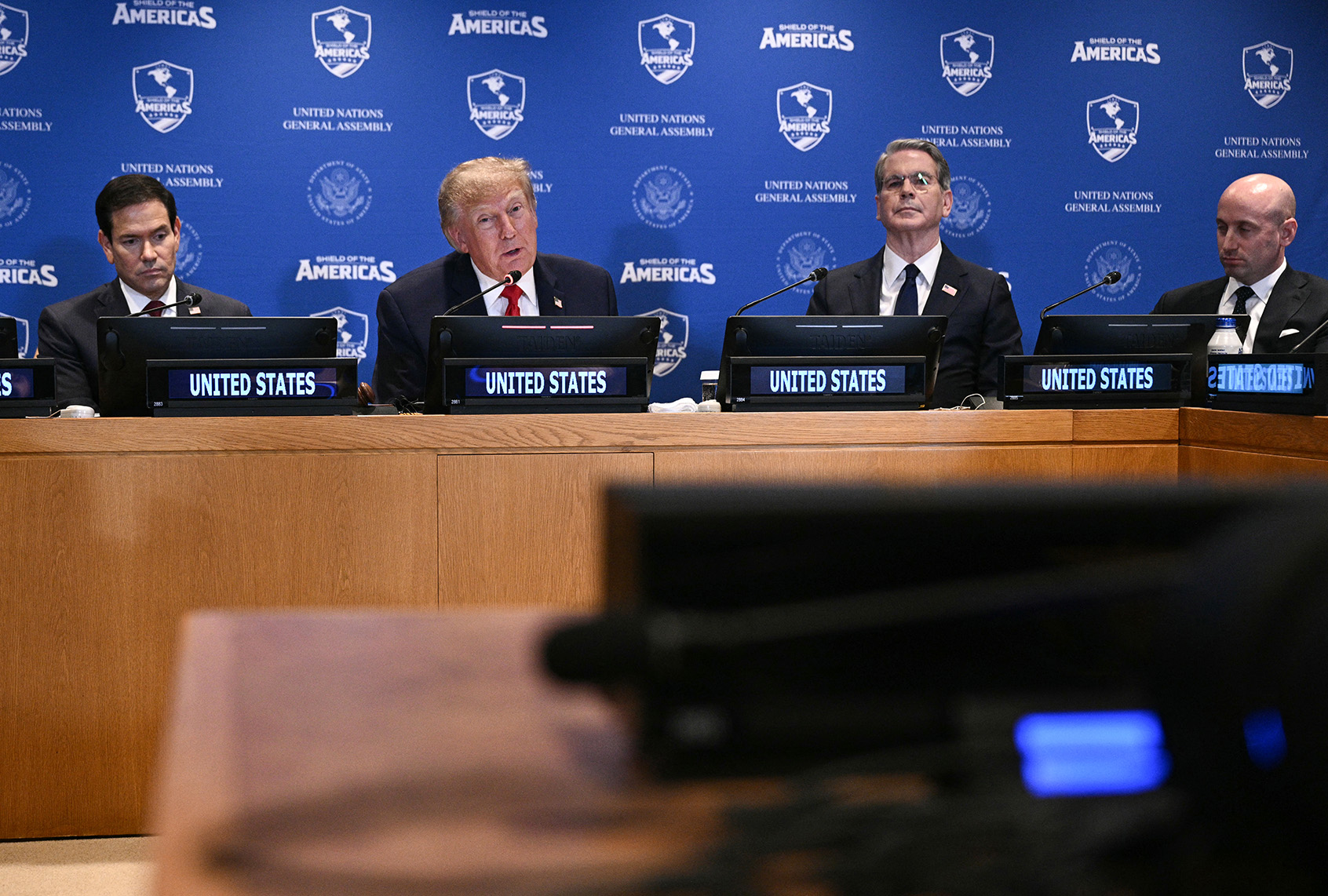
She was allegedly ousted from DHS over her close ties to Corey Lewandowski, chief of staff to then Secretary of Homeland Security Kristi Noem, who were alleged to be having a romantic affair together. Mocked as “Concentration Camp Barbie,” Noem saw the high-profile sieges of American cities she ordered attract negative media attention, especially when two protesters, Renée Good and Alex Pretti, were killed by federal ICE officers in Minneapolis. Noem was summoned before Congress over those scandals and others, including her alleged misuse of government funds on television advertisements and private luxury jets. She was later fired by Trump, reassigned as “special envoy” for the Shield of the Americas, and replaced by Markwayne Mullin, who currently heads DHS. Noem filed for divorce in late September.
The 1975 film “Jaws,” in which a local government hires a shark hunter to protect the town’s tourism industry, delighted me as a 10-year-old. But other than its infamous opening sequence, I don’t recall being scared. My younger sister, however, developed a years-long fear of deep water, even our 11-foot-deep pool. Maybe I’d just cultivated too much shark knowledge, well aware that these apex predators are docile and do not hunt humans like they do in Peter Benchley’s novel. The book and the film — I consumed both and can report that Steven Spielberg’s adaptation is better — only instilled in me a deeper love and respect for sharks. They are still my favorite fish to observe in aquariums or the ocean.
Outside of the movies, shark bounties are uncommon these days. That’s why news this week that Greenland was planning to cull 1,000 Greenland sharks was so alarming to many online. Officials in the Avannaata municipality on the island nation’s west coast approved the plan, offering fishers 300 Danish kroner, or about $45, per shark heart. The government complained that hungry sharks are eating too much Atlantic cod and Greenland halibut, cutting into what humans can bring home and damaging their gear. Lars Erik Gabrielsen, mayor of Avannaata, told The Guardian, “We need to safeguard the income of fishermen and the catch so that we can continue to eat the foods that we have relied on for generations.”
Conservationists and shark lovers were outraged at the proposal. Nick Dulvy, a professor and marine conservationist at Simon Fraser University in British Columbia, called it a “disaster” and said that biologically, the sharks are “the most sensitive species in the ocean to overfishing.” Marine ecologist Spencer Roberts, whose advocacy work includes calling out shark poaching, posted on X that “There is a psychotic sense of entitlement spreading around the world that imagines humans own the fish in the sea and demands retaliatory killing of predators who rely on these fish. Even centuries-old sages of the Arctic Ocean are not safe from this deranged human delusion.”
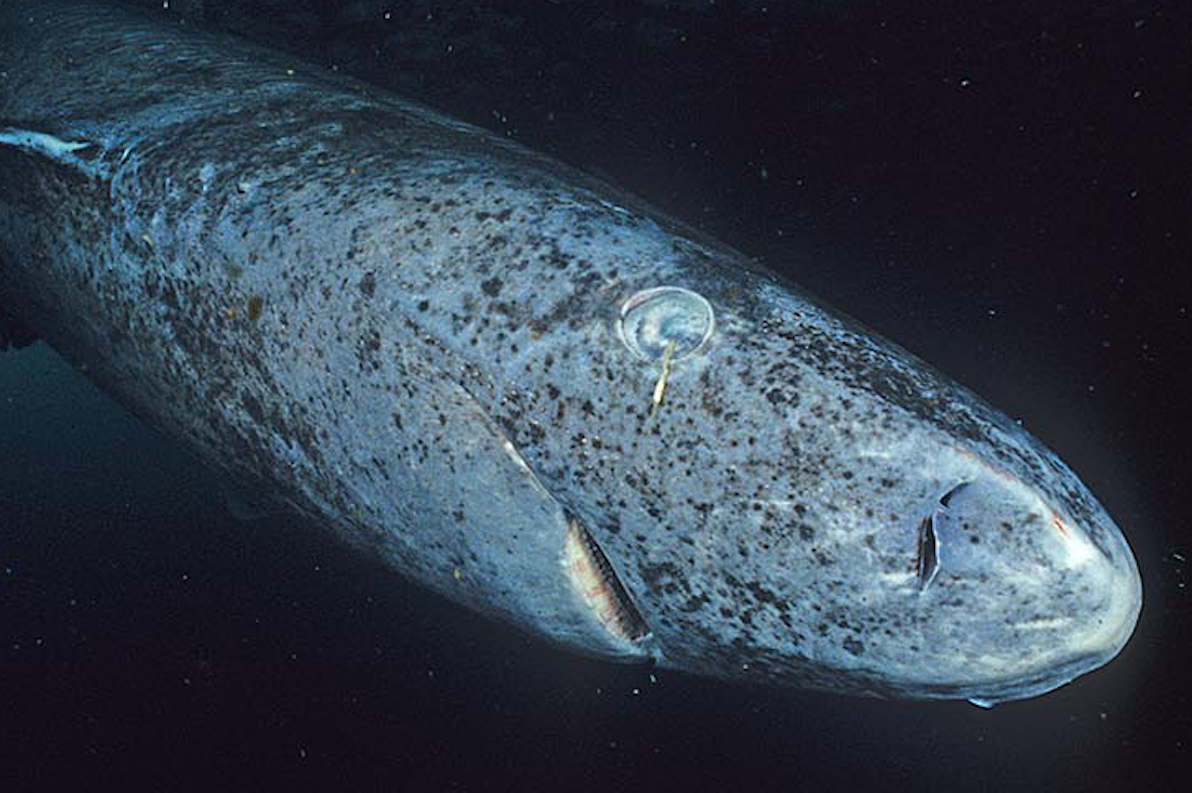
Indeed, the Greenland shark (Somniosus microcephalus) is bizarre and misunderstood, basically being the couch potato of the depths of the North Atlantic and Arctic Ocean, where waters are just above freezing. Known as an abyssal species, it slothfully trawls the shadows like some mournful Lovecraftian being, possessing an especially sluggish metabolism, which isn’t surprising considering its size. Greenland sharks weigh in at one ton and reaching up to 23 feet in length. The maximum lifespan can average 400 years, the longest lifespan of any known vertebrate, meaning there are apparently Greenland sharks that are older than the United States. If that doesn’t blow you out of the water, I don’t know what will. Humans are famously bad at mentally fathoming deep time, so thinking about these ghostly rotund things hiding in the dark of the ocean, outliving empires like an ichthyological Ozymandias, fills me with even more awe than most sharks do.
In a rare spot of good news, the local government dropped the plan after national officials questioned its legality, but a future cull hasn’t been ruled out. Still, it’s worth upholding this turnaround as an example of why speaking out on animal rights can be successful. We don’t need to just sit back and watch the extinction of any species that doesn’t directly benefit us, while of course recognizing that fishers have to eat too. Some have proposed reimbursing fishers or using acoustic deterrents instead of mass slaughter.
But it’s more than just Greenland sharks at risk, with an estimated 79 million sharks dying in fisheries in 2019. At least 25 million of those species are threatened. As coral reefs struggle to survive, many sharks are losing their main food source, but humans are to blame for that one. These animals can be dangerous, same as a grizzly bear or elephant, but people tend to value sharks a lot less. This is in spite of their critical role in a healthy environment. Sharks aren’t monsters, they evolved to fill very specific roles in the ocean — a huge block in the Jenga of life — and if they go, our oceans would dramatically tumble in ways that would negatively impact humans too.
“Jaws” is a fantastic film if you can suspend your disbelief about a great white being the menace of the seas. That’s really us, but it doesn’t have to be.
If people don’t widely embrace artificial intelligence out of fear or a godlike savior complex, AI’s biggest champions will try something else: labeling critics “the enemy.” That’s precisely how President Donald Trump described people who don’t like his rebrand via executive order of AI to “super intelligence,” posting on social media Thursday that “The White House considers anyone that uses the term, ‘Artificial Intelligence,’ as opposed to the highly accepted new and more accurate term, ‘Super Intelligence,’ THE ENEMY!”
As noted by Axios, the White House still uses the term “AI” including on websites like ai.gov, though that website was updated Thursday with “SI.gov” in massive text. “The URL is still ‘AI.gov,’ though, with ‘SI.gov’ leading to an error page,” Axios reported, which Salon confirmed.
Tech billionaires are already embracing the term super intelligence. This week, SpaceX CEO Elon Musk said AI is “no more” and promised to change the name of his AI company, SpaceXAI, a subsidiary of SpaceX, to SpaceXSI. More recently, Amazon founder Jeff Bezos shared his approval in a Wednesday interview with Fox News. “I do like SI, because ‘artificial’ is not a very flattering thing. Like, nobody wants an artificial sweetener, artificial flavoring,” Bezos said. “Artificial sort of means fake.”
Peter Thiel, founder of the tech company Palantir that aggregates data used in federal mass surveillance and deportation programs, has gone as far to describe AI’s critics as “the Antichrist.” Apocalyptic eschatology has long been an interest of Thiel’s, who has made the Antichrist a central topic of secretive lectures he’s given behind closed doors. Thiel doesn’t seem to believe in an Antichrist like in the “Book of Revelation,” but rather as a force that imposes a one-world government and stifles technological development.
In leaked recordings obtained by Politico’s Decoded of Thiel’s speeches in Nashville in late September and published Thursday, the tech mogul claimed former President Barack Obama and Pope Leo XIV only oppose AI to boost their popularity, which is apparently something they would need.
“Many people know that AI is politically unpopular, and want to leverage that to boost their own popularity,” Thiel said. “Both Obama and the pope fall into this category. Obama knows the Democrats have no ideas, but they can at least oppose AI,” adding “AI is the threat über alles of late modernity. The pope knows it. That’s why he wrote his first encyclical … he needed something politically popular to distract from the church’s child sex abuse scandals, and he found it in AI.”
Obama recently called for public oversight of AI while the pope’s first encyclical focuses on “safeguarding the human person in the time of artificial intelligence.”
At a Monday night rally in Nebraska, President Donald Trump spoke about the Iran war and record-high oil prices, both of which are outraging voters and promise to be deciding factors in the November midterm elections. First the president downplayed the high costs, saying they are “artificial” and “a little bit high.” Then Trump said that by attacking Iran, he was promoting peace.
“It’s a small price to pay for keeping the world safe, keeping our country safe,” Trump said to applause. “They can take out a city. Let them take let it let them take out Los Angeles. Let them take out San Diego. That’s this is a very small price to pay and it’s going to be over with very soon. It’s essentially almost over with and they might keep going a little long. You know, they always say they have a big threshold for pain. They need it. Let me tell you.”
The New York Times reported “It was not immediately clear what Mr. Trump meant,” but to others, the message was clearly about inciting violence on an American city. Politicians, especially in California, erupted in outrage, at least on social media. San Diego Mayor Todd Gloria posted on X that “San Diego is not collateral damage … Keep our city out of your reckless war talk.” Los Angeles Mayor Karen Bass described Trump’s comments as “dangerous,” posting on X that “In the face of irresponsible threats, as Angelenos, we know how to stand together and protect our city.”
California Gov. Gavin Newsom echoed Bass, posting on X that Trump’s comments could be “treasonous” and claimed he is “directing the State Threat Assessment Center to actively monitor the situation in the event that foreign actors interpret the President’s remarks as an invitation to target California.” All three are Democrats but at least one Republican shared the sentiment that Trump’s speech wasn’t harmless.
“As a Navy veteran, I served to protect Americans, not write off American cities as an acceptable price of war,” Jim Desmond, a Republican congressional nominee in a San Diego metro district, posted on X. “Our job is to keep Americans safe, stand up to our enemies, and make sure a threat like that never becomes reality. No American city is expendable, and no American family should ever be treated as collateral damage.”
But on Tuesday, the White House said this was all just a big misunderstanding and the president actually wants to prevent Tehran from taking out a city. White House Communications Director Steven Cheung posted on X that “The media freakout over President Trump’s comments is not rooted in reality. He was clearly stating U.S. cities would have been threatened if a nuclear Iran hadn’t been stopped. America is safer because of the President. Iran has no nuclear, no navy, no air force, and no money.”
Also on Tuesday, it was reported that most families of the six soldiers killed in the deadliest attack of the Iran war would not be attending a major White House event for Gold Star families hosted by Trump.
American health officials are on high alert following reports of a death in Russia that may be linked to pneumonic plague. The cause of death for the individual has yet to be officially confirmed by lab testing, but Daria Shipilova, a 28-year-old lab technician, worked at the Irkutsk Anti-Plague Research Institute of Siberia and the Far East, an institute that, as the name implies, is dedicated to studying plague. The illness is highly fatal, with average fatality rates approaching 100%.
Pneumonic plague is also highly contagious and can spread from person to person via air droplets. That gives the disease a high potential for an epidemic spread or even a global pandemic, but health officials have cautioned we have a long way to go to get to that point. The plague is treatable with antibiotics, but must be caught early enough. Due to the potential severity here, approximately 200 people have also been placed under medical observation in Irkutsk, a region in eastern Siberia, and some hospitals have been placed under quarantine.
U.S. officials are paying close attention. The State Department, Centers for Disease Control and Prevention, the Administration for Strategic Preparedness and Response, and other agencies are all trying to learn more. Axios reported this info as a “scoop,” but it’s relatively routine to surveil any pathogen that could cause severe damage to national security. However, Russia does not seem to be fully cooperating, with reports that Russian officials’ are being hesitant to share info while Russian intelligence officers are reportedly getting involved.
“We don’t have a lot of intel,” one U.S. health official told the Washington Post. “It’s in Siberia. Unless someone gets on a plane and gets to the U.S., it is low risk. We should be alert but not panicked.” Based on the available information, the World Health Organization said “the public health risk to the general population appears to be low.”
Even President Donald Trump weighed in, telling reporters Monday that “We’re looking at it very strongly. He said he hasn’t yet talked with Russian President Vladimir Putin about it, but offered U.S. help with the issue. “It’s a rough disease. You know, that’s a disease we used to be able to control, but somehow those microbes have gotten stronger and smarter,” Trump said. “Anybody that has that kind of a problem we’ll always [be] willing to help. We’ll help you.”
I couldn’t help but notice some people on social media dunking on a post from @nicksaraev, a self-described entrepreneur helper, who boldly proclaimed on X a few days ago: “I am not joking when I say this. Spotify, Apple Music, and streaming in general is over. AI music is now very, very good. You just don’t know yet because all AI music circulating today is from ~2-3 generations ago. Suno v6 pro et al has solved infinite personalized music.” He followed it up with “Yes, this probably hurts your feelings. It’s still going to happen.”
While my feelings are unhurt, and I don’t really know what “infinite personalized music” means or how it could be “solved,” at the same time, I can easily guess what is implied here and I don’t actually want to know more. As one Bluesky user observed, the inherent idea here comes “when you have no concept of how people engage with music.”
The only thing I can think of that’s worse than getting stuck on Greatest Hits or Top 40 is pushing a button and generating “infinite personalized music” with no human influence.
Nonetheless, we don’t seem able to escape this trend. I have a friend who has, on a few occasions, sent me AI-generated raps with his name or a joke inserted as the lyrics. They can be technically proficient, maybe even a little funny, but there is always an underlying cadence of the uncanny valley that I still doubt Suno v6 pro et al. or whatever has totally overcome. Please don’t send me examples; I actually don’t care. It’s not that I’m offended by the idea of generated art; it’s just that it bores me. I’m having plenty of fun engaging with music made with human ears, hands and minds.
Way back in the Bush II and Obama years, I volunteered at my college radio station in the Music Procurement Department or whatever it was called. Our job was to sort through the massive mailer box of padded envelopes and bubble mailers that came in from record labels, big, small and in-between. It was like Christmas every Wednesday afternoon as we shredded packages and stacked CDs, occasional stickers and vinyl, splitting the spoils and loading them into our computers — by hand even! We made notes about what should get added to the radio catalog as fodder for our aspiring DJs — and what should get chucked out or given away for free at radio events.
If we didn’t already know the band, the way we chose which albums to review was often based on cover art, the promo materials we skimmed, or a sticker on the front that read RIYL: Recommended If You Like. Almost every artist would put something like “RIYL: Jay-Z, Radiohead, The Beatles, Led Zeppelin, Talking Heads.” Sure, totally random indie label from Seattle, all of your bands sound exactly like Nirvana. It could be a pretty boring, sometimes horrifying process — I’ll never forget the thrash metal song we received about Shannen Doherty that sounded like it was recorded in a blender. I still can’t get over the inane lyrics: “Shannen Doherty, Shannen Doherty / You’re in my head. Shannen Doherty, Shannen Doherty / I like bread.” I wish I were making this up.
But the crate digging, which I also did in physical record stores, was always worth it when you found your new favorite band or heard the summer’s hit track long before any of your friends. I was introduced to so many artists, many of whom I still turn to today. Hot Chip, Sea Wolf, Fleet Foxes, to name a few. It taught me to always give music a chance, no matter how ugly the art or how crusty the jewel case. Usually, you can listen to the song up to when the vocals kick in before giving up or listening longer. By then, you usually know if you’re gonna hate it or not.
I have no doubt AI music will keep improving, at least to a point, but I predict few people who actually love music are going to listen that way because it has lost its essence.
I still devour new music this way, clocking a daily average of four hours of tunes familiar and novel. It helps me write and focus and relax and otherwise temper my mood throughout the day. I’m always looking for new artists to try. And I hope I always consume — I hate that word, but there it is — music this way, instead of becoming a curmudgeon who only appreciates the tunes from their youth and thinks anything modern is trash. If you think that, you aren’t digging deep enough.
The only thing I can think of that’s worse than getting stuck on Greatest Hits or Top 40 is pushing a button and generating “infinite personalized music” with no human influence. It bores the sh*t out of me. It’s not just the lack of discovery, though that is critical, maybe because it scratches those deep primal hunter/gatherer itches. It’s more about the lack of anything personal behind the music. No history, no struggle, no catharsis, no exploration, no humanity. I listen to music because it’s flawed, raw and human, not just noise to fill my day. I have no doubt AI music will keep improving, at least to a point, but I predict few people who actually love music are going to listen that way because it has lost its essence.
Yes, I have streamed plenty of AI music on YouTube, often unintentionally when the vaporwave or atmospheric DnB mix I’m vibing to autoplays some slop channel. I can almost always tell when it’s generated. There’s a flatness, like an echo of a song you heard a long time ago, something better. It puts me to sleep and I inevitably switch it off. Maybe it’s gotten better lately. But I still think I’d notice. At any rate, I’d never seek it out.
As a child I was once gifted a “custom” cassette tape with songs “written for me.” Every single track on the album was centered around “Troy,” with my name mentioned as often as possible. I listened to that thing over and over again, until I spilled a bottle of soap in my tape deck and ruined it. But anyway, none of the songs were actually produced with me in mind. It was made by a company called Kidselebration that in 1986 made “personalized” cassette tapes like these for a whole boatload of names. The songs never changed, someone just dubbed in a different name into the song for Kyle, Sarah, Robert, etc. I can’t imagine how much friggin’ work this must have been before Pro Tools, but it was probably just the ‘80s equivalent of a lot of cut-and-paste.
You can listen to the one for “Jessica” here if you really want to. Every time they say “Insert Name,” it sounds totally awkward and weird. But even as a kid, I suspected on some level that this tape wasn’t really for me specifically. Something always felt off. If infinite personalized AI music doesn’t give people the same vibe, maybe they’re not listening hard enough. And please, don’t send me your robot music. Send me anything else.
President Donald Trump’s war against Iran, which just passed its seven month mark, is deeply unpopular among Americans, new polling continues to suggest. A survey from the Associated Press/NORC Research Center published Thursday reports that 71% of adults disapprove of how Trump is handling the Iran war, started alongside Israel in late February, while 69% say the war has not been worth fighting.
“More than half of adults say the country as a whole, the national economy, and their local economy are worse off since Trump was reelected in 2025,” the survey reports. “Most Americans (73%) say the country is heading in the wrong direction, including 92% of Democrats and 47% of Republicans.”
The president seems to realize this growing frustration could cost Republicans dearly in the midterm elections next month, possibly losing GOP control of the House, Senate or both. “It’s possible,” Trump mused to reporters outside the White House Thursday. But he continues to insist that the Iran war is worth it — ostensibly to prevent the nation from obtaining a nuclear weapon, despite the nuclear stockpiles of both the U.S. and Israel — while doubling down on threats and deploying even more troops to the region.
On Thursday, officials told the Wall Street Journal the Pentagon is sending a third aircraft-carrier strike group and additional Marine Corps ships to the Middle East, expected to arrive at the end of November. It would add around 10,000 more troops to the region, putting further strain on the Navy, which has been under pressure from near-record deployments and supply shortages.
But it does seem like Trump is waiting until after the voting to renew bombing Iran, as the Journal reported in late September. In a sprawling interview with Time published Thursday, the president said as much. “Because by annihilating Iran, we’ve created peace in the world,” he said. “With Iran, I don’t think you could ever have peace.”
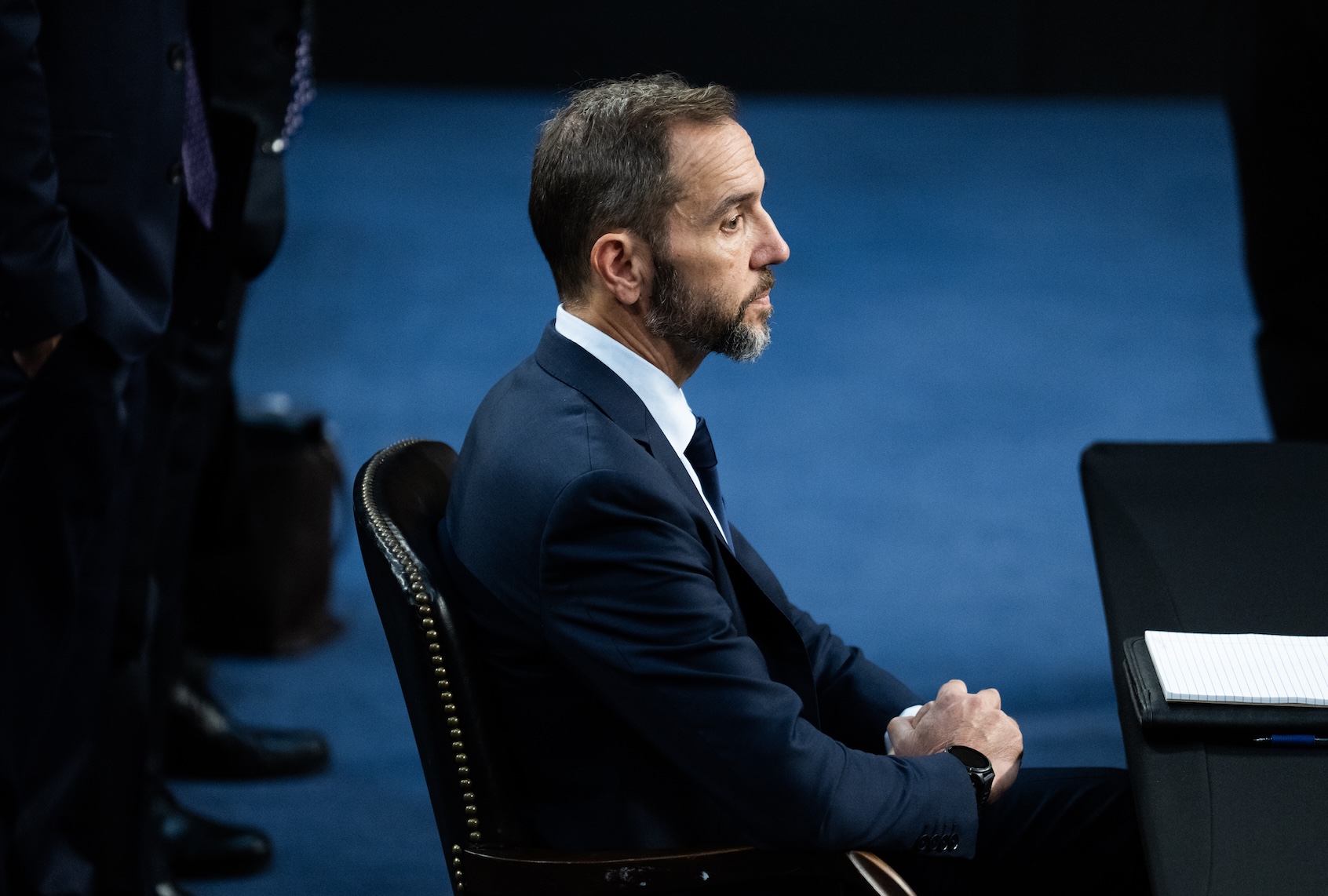
It was a bit tense watching Jack Smith get grilled before the Senate Judiciary Committee on Tuesday. During his testimony, the former special counsel defended himself against accusations of partisanship in his failed effort to prosecute President Donald Trump two years ago. The chaos of the current era has made the 2024 presidential campaign feel like it was a decade ago, but it’s important to recall that Smith secured indictments on Trump’s role in the Jan. 6 attack on the U.S. Capitol, and the other on his alleged mishandling of government records, including the classified documents he had stored at Mar-a-Lago. Both cases fell apart as Trump was elected to a second term.
Now Republicans, including Trump, are pushing for Smith himself to be prosecuted. This wasn’t the first time he has been dragged before Congress so lawmakers could get the soundbites needed for Fox News hits. But to his credit, Smith doubled down and said he would prosecute the president all over again.
“Our investigation developed proof beyond a reasonable doubt that President Trump engaged in serious crimes against our nation,” Smith said during the hearing, adding, “If asked whether to prosecute a former president today, based on the same facts, I would do so regardless of whether that president was a Republican or a Democrat.”
Republicans took the opportunity to lob insults and accusations at Smith for hours. Texas Sen. Ted Cruz accused him of bringing “the Department of Justice into disrepute,” while Louisiana Sen. John Kennedy was more graphic, telling Smith “You make me want to throw up in my mouth.”
Sen. Eric Schmitt of Missouri claimed Smith “will go down as a total dirtbag” and also attempted to corner the former special prosecutor into possible perjury, accusing him of attending an Atlanta Hawks game in 2024 as a pretext for meeting with Fani Willis, the local district attorney who prosecuted Trump in Georgia. But Schmitt — or some staffers who will soon be looking for employment — apparently confused the Hawks and the Iowa Hawkeyes — which are different teams, as it turns out. Smith had watched the Hawkeyes play in Maryland. (As a non-sports person, I confess I might have made the same mistake, except I check my facts.) Sen. Amy Klobuchar, D-Minn., did Schmitt the favor of pointing out his error, quipping “Perhaps you should have looked at it more carefully.”
This only seemed to further anger Schmitt, who is reportedly angling to be Vice President JD Vance’s running mate in 2028.
The whole bit, including a poster board of Smith’s blown-up text messages, was amazingly lazy, even for this Congress. It seemed as if some aide suffering from conspiracy-brain didn’t bother to check the details, or maybe they asked ChatGPT for help. Still, getting the facts wrong probably won’t hurt Schmitt. He got in the abusive remarks that will earn him MAGA’s seal of approval.
Not surprisingly, Democrats also defended Smith. “The aspersions cast on Mr. Smith nonstop are petty, personal and political,” Illinois Sen. Dick Durbin said. Cory Booker of New Jersey claimed “This is gaslighting of the American people,” telling Smith, “I am so sorry that they’re attempting to put investigators on trial while ignoring the extraordinary conduct that that they are duty bound to really investigate.”
Maybe this all seems like theatrics, more fodder for the cable news spectacle. But the stakes for Smith are real, and this charade could also carry severe consequences for Americans. Since the moment he returned to office, Trump has worked overtime to take down his enemies. That hasn’t been too successful yet — emphasis on yet — but this is about much more than potentially putting Smith behind bars. By playing the victim, the president benefits from controlling the narrative, and perhaps rewriting history, which becomes even more critical as we approach the midterms and he continues promoting the lie he won the 2020 election. So Smith continuing to give the president and his MAGA trolls the proverbial finger isn’t just satisfying — it’s necessary.
I’m not a Smith fanboy, though I certainly admire him for serving as a specialist prosecutor investigating war crimes in the Kosovo War. It feels misguided to turn public figures like Dr. Anthony Fauci or Sen. Jon Ossoff, D-Ga., into heroes or thirst traps just for doing their jobs. Still, it’s worth noticing when someone in the hot seat does more than pay lip service to the idea of a just and accountable society, knowing that the consequences extend much further than their own personal freedom.
Last Wednesday, the head of an AI tech company casually announced, in a long-winded post on X, a discovery that, if true, would represent a major breakthrough in biomedical research. Dario Amodei, CEO of Anthropic, wrote that his company’s large language model Claude had found “a molecular machine that we suspect could represent a new gene editing mechanism.”
So what does this “molecular machine” actually do? No one is entirely sure yet. But that hasn’t stopped tech bros from already upholding it as a new version of CRISPR, the enzyme-wielding tool that cuts up DNA like nobody’s business, sparking a revolution in ultra-precise genetic modification that has spanned research in everything from agriculture to cancer therapy. It’s no surprise its discoverers earned a Nobel Prize in Chemistry. If an AI program really just made a similar discovery, it would be big news.
Indeed, Amodei goes on to say that this finding could be a step toward developing cures for most diseases in five to 10 years. The company’s press release goes into more detail, but basically says that Claude was prompted to search through a massive database of DNA sequences for reverse transcriptases, enzymes that copy RNA into DNA. “After 21 hours spent searching this data by roughly 950 agents using 210 million tokens, one of the agents spotted something remarkable: a repeating pattern of DNA sequences that occurs next to the gene for an odd-looking RT,” the statement reads. Except that nothing about that is so “remarkable,” at least according to numerous people who study and work in this field.
“It is too soon to say that Claude — or the team of human researchers involved has discovered a ‘new CRISPR,’” Dimitri Perrin, an associate professor at the Queensland University of Technology, writes in The Conversation. He goes on to emphasize that what Claude found — a previously uncharacterized enzyme system found in viruses that infect bacteria — isn’t necessarily going to be useful. More research is needed, but Perrin explains that for now, the discovery is “CRISPR-like in its architecture, but there is no evidence that it is CRISPR-like in its function.”
“Claude’s work isn’t even close to being in the same league as DeepMind’s AlphaFold system for predicting protein structure, which is proving to be truly transformative,” Michael Le Page, a senior reporter at New Scientist, wrote. Social media exploded with other examples of people dunking on Anthropic’s PR, with Simon Maechling, a PhD chemist, writing on X, “Claude discovered something in biology. Nobody knows what it does. But we already have the press release. … Finding something interesting isn’t the same as understanding it. Understanding it isn’t the same as showing it works. And showing it works isn’t the same as making it useful.”
Perhaps AI researcher Timnit Gebru summarized it best: “Please see what experts in this field are saying about this ‘discovery’ and not these scammers or press stenographers. This hype DDOS from them isn’t going to stop any time soon and we’ve seen how the mainstream media is doing press-release-as-a-service at this point.”
So it seems like Anthropic is making some pretty bold claims over something that is mildly cool and worth investigating, but at this point, also seems unlikely to revolutionize medicine or science. Why does this matter? A tech company making extreme claims is far from new. Big deal. But contrast all this hype (not to mention the energy spent debunking it) with the buzz just a few weeks ago about how, in just a few years, AI will supposedly gain sentience and kill off humanity. Consider how Anthropic CEO’s Amodei is among those pushing such a narrative, including warning that his company’s tools carry a risk of being used for cyberattacks or terrorism, including developing deadly viruses. Taken together, this presents a false dichotomy: AI will either end disease and suffering or inflict it in untold measure. Might there be a third option?
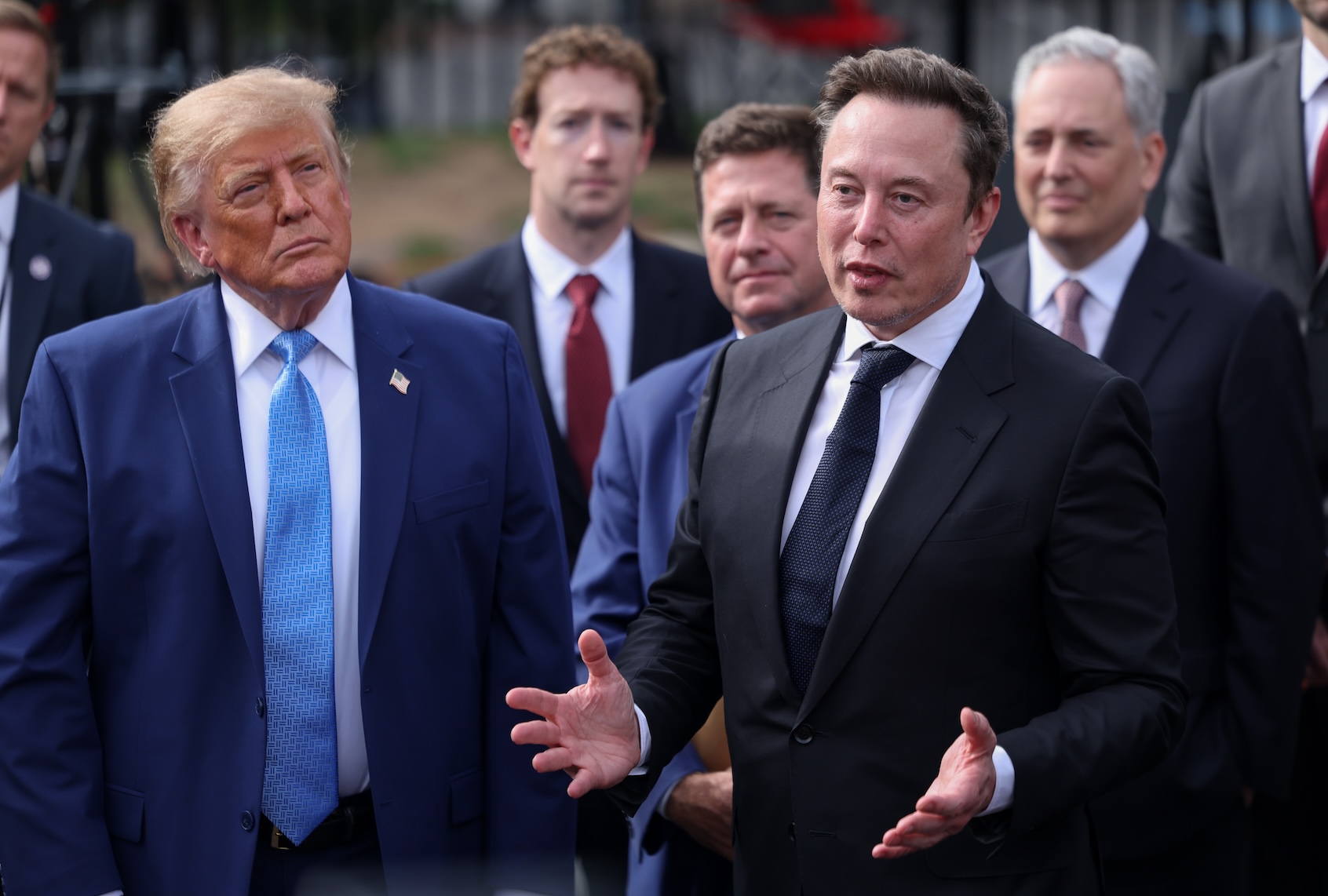
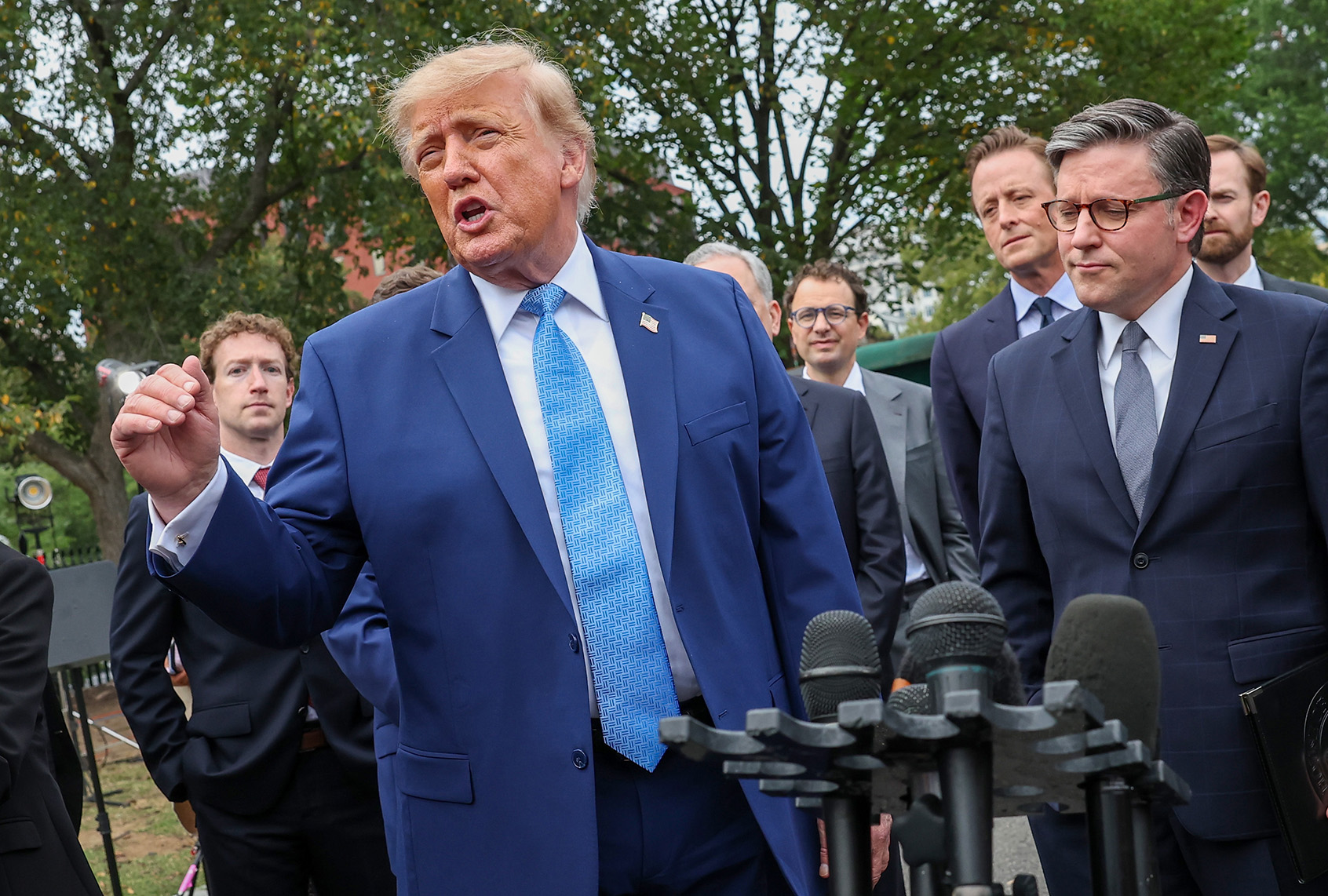
For anyone who buys the AI spiel, it’s a tool with boundless power. For now, however, the tech companies still rely on an old-fashioned kind of power offered by the state, which is precisely why other tech CEOs were seen sucking up to Chinese President Xi Jinping during his recent U.S. vacation. Amodei missed meeting Xi, for what it’s worth, but had a private dinner with President Donald Trump late Sunday night and later this week joined other tech leaders for a luncheon hosted by Trump and House Speaker Mike Johnson. There — joined by Nvidia CEO Jensen Huang, Tesla and SpaceX CEO Elon Musk, Meta’s Mark Zuckerberg and others — the president signed a “morally binding” artificial intelligence document, which sounds promising, until you hear Trump repeatedly tell reporters that tech companies can supervise themselves. “The self-regulation is very important,” Trump said. The document signed seems to have zero enforcement or legal mechanisms, so in this context, it appears “morally binding” just means “self-policing.”
It’s no mystery why the president — heavily invested in the AI industry as he acridly dismisses any notion of regulation — is cozy with the idea of AI’s alleged abilities. In his latest effort to sell the American public on the coming “golden age” of AI (of course Trump would use that phrase), on Monday the Trump administration both launched America.gov, an AI chatbot powered by Google’s Gemini and Elon Musk’s Grok, and signed an executive order to rename AI “super intelligence.”
As Gebru observed, the grift has no end. All the more reason to pour cold water on outrageous claims about flagging little enzymes in huge databases. (Let’s avoid anthropomorphizing these programs by using the verb “discover.”) The goal of Anthropic’s AI propaganda — because that’s what it is — is to get most people skimming past the headlines to only catch “AI finds new CRISPR” and think a cure for cancer and world peace are right around the corner. All we have to do is hand the keys and all our money to Silicon Valley. Whether it’s utopia or dystopia, that’s the pitch: cede control of this tech to the billionaires in charge. In that sense, blindly swallowing AI’s positive hype can be as dangerous as its alleged existential risks.
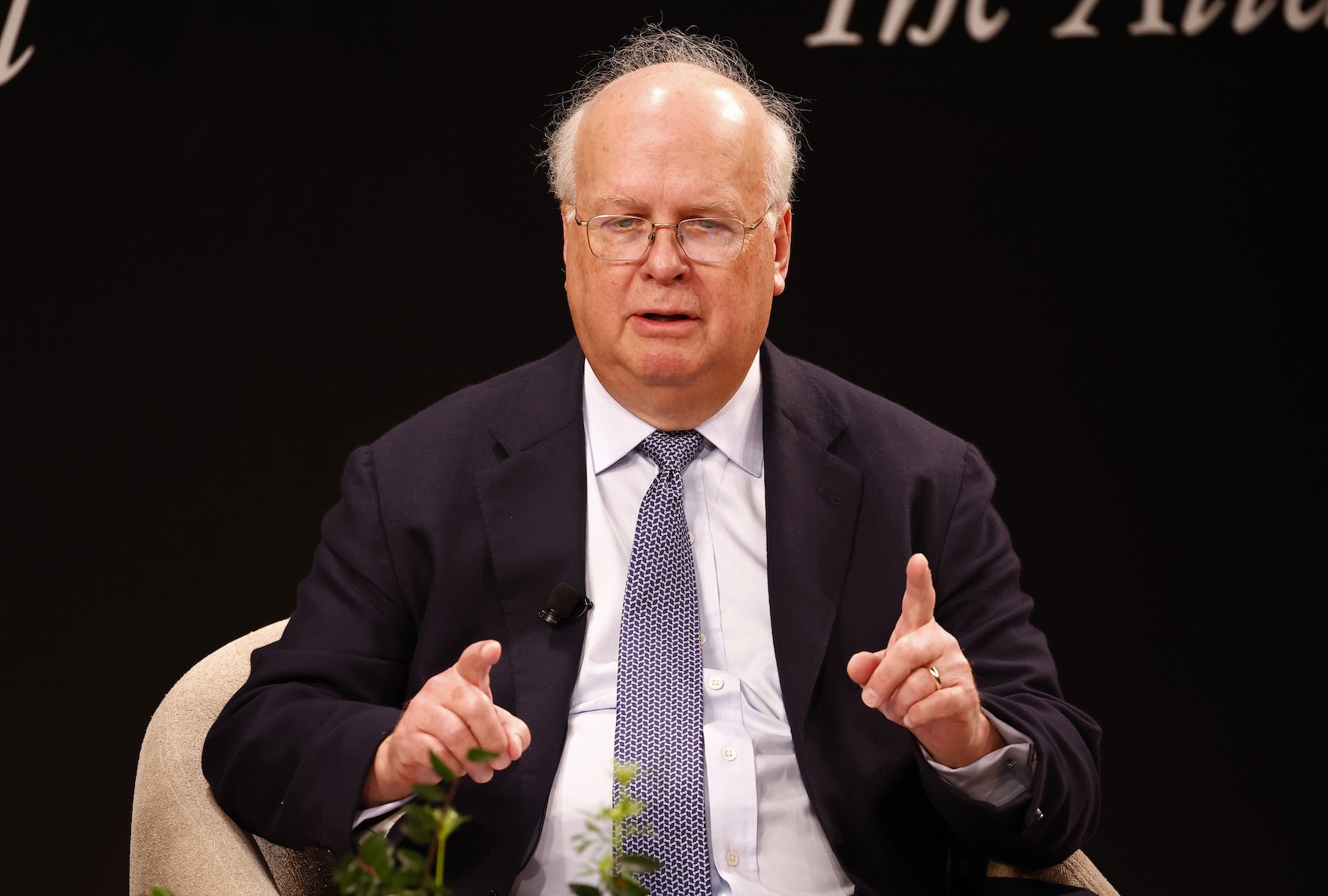
In a recent interview, conservative political operative Karl Rove said he’s voting for a Democrat in the upcoming midterms, breaking three decades of precedent exclusively supporting Republicans, and lamented the GOP’s embrace of far-right individuals.
“My party is being infiltrated by people like Bo French,” Rove said in an interview with The Texas Tribune. Weeks earlier, Rove described French, the Republican candidate for Texas Railroad Commissioner, as a “bigot,” after he posted several xenophobic social media posts taking aim at students of color celebrating a college football game. Earlier in September, the Tribune reported that Rove planned to vote for French’s rival, state Rep. Jon Rosenthal, D-Houston, in the race that will regulate the Texas oil and gas industry.
Rove also decried the relationship between Texas Republicans and a right-wing podcaster. “Nick Fuentes goes to Dallas and meets with a bunch of Republican leaders. This guy is a Nazi,” Rove said.
Rove served as a senior advisor and deputy chief of staff during George W. Bush’s presidency, in which he was described as “the architect” of Bush’s re-election campaign. Rove has also been credited for the successful campaigns of Sens. John Ashcroft, R-Mo., John Cornyn, R-Texas, and Texas Gov. Bill Clements, among others. So he may be qualified to weigh in on the Senate race between Texas Attorney General Ken Paxton and former state Rep. James Talarico.
“If John Cornyn were the nominee, this race would be over,” Rove told the Tribune. Cornyn lost the Texas primary to Paxton after the latter received an endorsement from President Donald Trump. “But when you got a guy who’s got multiple girlfriends, $200,000 worth of improvements in his house from a corrupt business guy for whom he does favors … and now it’s in the court of public opinion. If this were not out there, this would be a normal Republican versus Democrat.”
Rove did not say whether or not he’d vote for Paxton.
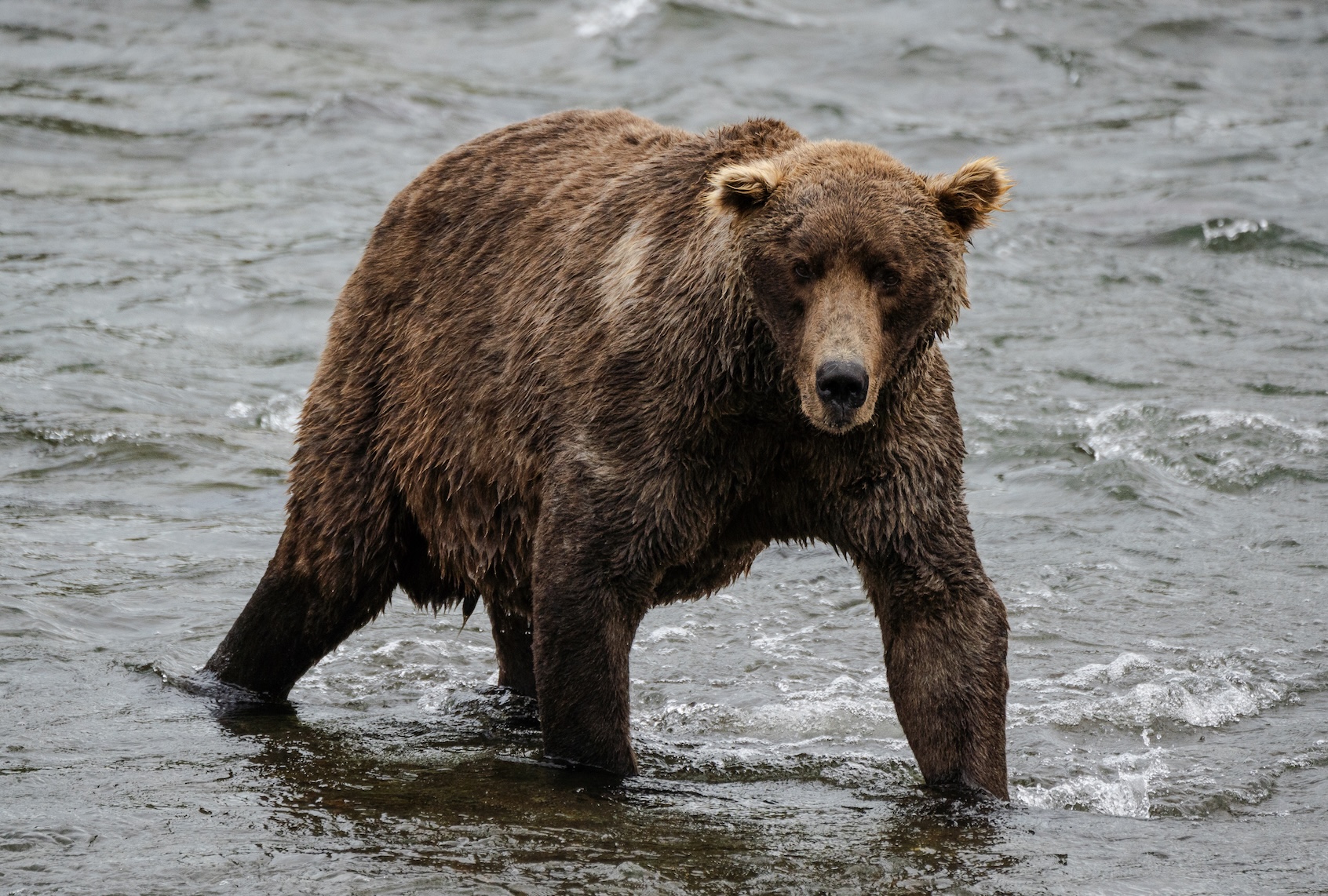
It’s time to vote in one of the most consequential elections of the year, one only slightly less important than the November midterms. Of course I’m talking about Fat Bear Week, the annual event in which people elect — well, yes, the fattest bear. The candidates are bears in Katmai National Park and Preserve in Alaska, who are currently busy devouring as many calories as possible to fatten up for winter hibernation. Voting officially opened Sept. 22, continuing a tradition started in 2014 to select which bears are the best and most fat using a March Madness-style bracket. You can learn more and vote here, plus read some delightful bios on the bears in the running or peruse its hall of champions.
Something like a million people vote in this event every year, according to the daytime news segment that I caught at the dentist the other afternoon while getting a tooth cleaning. Do I need to fact-check that? Sometimes information just comes at you when you have your mouth wide open and people are prodding their fingers around inside. (It remains a mystery, however, why my dentist has a TV on in every room.)
My point is, everyone is talking about Fat Bear Week, and I encourage it. Growing up, I was one of those reflexively contrarian teenagers who hated anything popular and found value in almost anything obscure, independent or weird. These days I’m much less anti-mainstream, especially when it’s something that brings us closer to our true human nature, which is reflected to some degree in the seasonal behaviors of other species. I, too, will fatten up this winter, whether I want to or not.
I wish Fat Bear Week could be every week. Some people are trying. There’s now a Fat Marmot Week, a similar event inaugurated this year. But I must add that a family of marmots devastated my garden in April and destroyed my precious stargazer lilies (I am not joking about this; it was brutal and saddening), so I’m having a hard time jumping on that bandwagon. But I’ll try! Go fat marmots, go! Plump yourself on the spoils of would-be gardeners. I was a big fan when succulents became a dumb little trend, because at least that was boosting an interest in plants rather than mass-produced ugly dolls from China or something. I can’t stand all this plastic trash we elevate above the natural world. Maybe I have retained my anti-establishment roots after all.
This would be the point in the essay where I introduce some sad facts about falling grizzly population levels or remind everyone that climate change is going to make it harder for bears to exist or something. I definitely need to fact-check that, but I don’t want to. Even coming across news this week that a mining project is being fast-tracked at Lake Clark National Park and Preserve, which neighbors Katmai National Park and could impact bear populations, is not what I need to hear right now. Sometimes we all need some joy in life, such as contemplating the fattest bears without all the other gloomy stuff in the world. I do find plenty of things to be grateful for and optimistic about, even if it doesn’t always come through in my published writing. While I don’t want to ignore all the very important chaos — facts that barely register on the news cycle, like how we keep breaching the planetary boundaries necessary for the flourishing of life — I try not to wallow in it either. That’s what Fat Bear Week means to me, and I think we could all use more stuff like it. Ping me when there’s a Sleekest Dolphin Week, Plumpest Mushroom Monday or the Most Insane Octopus of the Month. Give me the “American Idol” version of meadowlark songs.
I am always humbled and delighted whenever the internet explodes over some recently indexed cat species or a shiny new NASA artifact, like the first images of a black hole or the recent trip around the moon, maybe because the collective awe inspired by stuff like that reminds me that people do feel connected to something larger and more mysterious, whether it’s little red dots in the early universe or bears munching on berries in Alaska. From there, maybe people will take more responsibility for the home we share. There’s not much I can do about grizzly bear populations — which are indeed at greater risk under the Trump administration — but I can show my solidarity; I can vote, not just in fun online elections but in the real, super serious one coming up. And I can dream of — no, demand — a better world for all species. Oh, and by the way, I’m rooting for unnamed bear 909. Read her bio. She’s been through a lot of grief, and I admire her resilience.
A new political ad airing this week features clips of President Donald Trump pledging to defeat “communism, socialism and Marxism in America,” and promising “America will never be a communist country.” It cuts to flashing text reading the “largest tax cuts in history” and “reigniting American manufacturing” while a choir repeatedly sings “love me” in the background. The sample is from JMSN’s song “Love Me,” who said on X that he did not authorize license of the song. The UFC’s Dana White chimes in, saying Trump “is the toughest, most resilient person that I’ve ever met, and nothing was going to stop him from fighting so hard for the country he loves.”
The 30-second spot seems like any other campaign ad, designed to use emotion to sway voters, but it turns out that taxpayers actually paid for the whole thing, which may not be legal. That’s sparked considerable controversy on Capitol Hill, with both Republicans and Democrats criticizing the ads. The cost of the ad is $430,000 and is running across multiple network TV channels across the country, though the Associated Press reports “The actual amount spent could be significantly more, depending on whether networks classified the ad as a political ad.”
Sen. Thom Tillis, R-N.C., who is not running for reelection, called the ad “inappropriate” and compared it to messaging from former right-wing Hungarian Prime Minister Viktor Orban.
“This may be felony criminal theft and conversion of government property for political campaign purposes,” Rep. Jamie Raskin, D-Md., said on X. “It is a Hatch Act violation for any government employees who worked on it or used government resources to make it. It is blatantly unethical under numerous federal ethics provisions proscribing the use of government resources for political campaigns.”
As a result, Public Citizen, a consumer rights advocacy group, filed a complaint with the Government Accountability Office and Office of Special Counsel, alleging “The TV ad boosting the image and character of Donald Trump as well as reiterating Trump’s campaign rhetoric, paid for by taxpayer dollars, and produced and distributed by Trump’s White House staff, appears to be a clear violation of the laws prohibiting the use of taxpayer dollars for propaganda purpose as well as a violation of the Hatch Act.” Public Citizen also noted that they have filed a dozen Hatch Act complaints with OSC over the past year, all of which have been ignored by the agency.
The White House defended the ad and said it is “educational and unapologetically patriotic,” according to AP.
The White House is currently airing this video as an ad during commercial breaks on Fox News.
It looks and sounds like a political spot and includes a disclaimer stating that it is paid for by the U.S. government.
President Donald Trump’s war with the press hit a temporary stalemate Thursday as a federal judge restored White House access to CNN, MS NOW and Politico for two weeks. Last Friday, the president banned the three outlets, calling them “fake news,” as their journalists reported being blocked from accessing the White House.
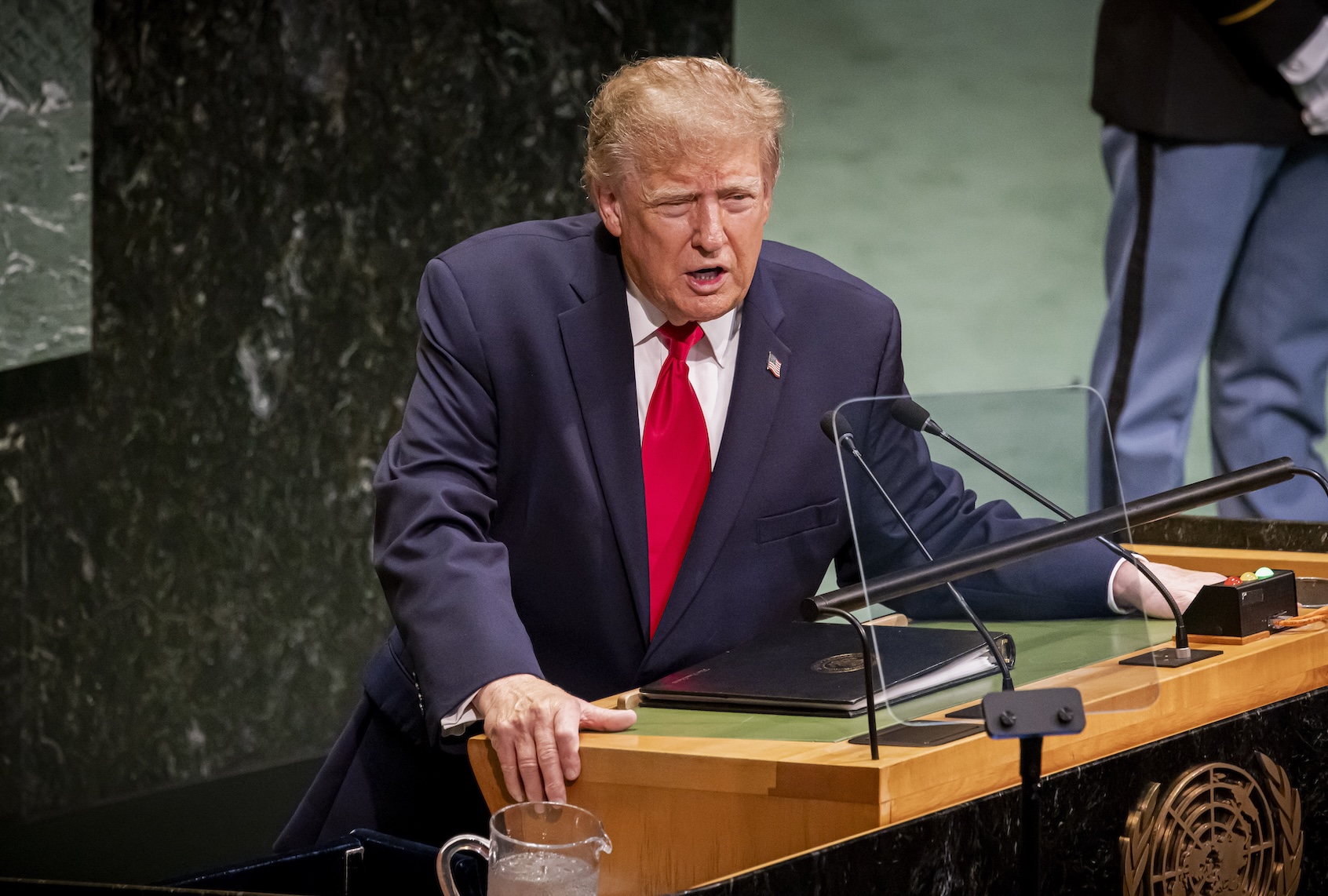
In response, CNN, MS Now and Politico sued, and the Trump administration launched “Trump TV,” which is essentially a livestream of speeches and other reruns that apparently almost no one is even watching. During this week’s U.N. General Assembly, before giving a speech in which Trump mulled the annihilation of Iran, the president snarled at a reporter for asking him a question.
“You should not be here,” Trump told CNN’s Kaitlan Collins. “You should not be here covering me. You said you weren’t going to cover me.” Collins later said on air, “We never said we were never going to cover the president.”
Trump didn’t follow due process in the ban, according to U.S. District Judge Timothy Kelly, a Trump appointee, who ordered the administration to restore their access as the case is litigated. Reporters from all three outlets thus began reporting at the White House again, but the move has raised questions of whether Trump could try again, this time following due process.
Gabe Rottman, vice president of policy at the Reporters Committee for Freedom of the Press, told NPR “The White House facility doesn’t need to let journalists in … But once it does … it cannot exclude journalists or news organizations because it doesn’t like what they report.”
“Certainly, the trajectory has been in the direction of more restraints on press access than less,” Rottman added. “I think the public can easily wrap their head around the danger of the leader of the country retaliating against news organizations, denying them access because he doesn’t like their coverage.”
Trump did not mention the judge’s ruling but decried on Truth Social about CNN and MS Now’s “low ratings” that “have dropped considerably” and criticized their coverage of his meeting with Chinese President Xi Jinping this week.
“Trump blocking access is bad, but what’s so annoying about Big Media folks’ self-righteous indignation is that the White House and Congress routinely deny credentials to smaller independent outlets and Big Media folks say nothing and show no solidarity,” David Sirota, a journalist and former senior advisor to Bernie Sander’s 2020 presidential campaign, said in a post on X. “They don’t actually care about the press freedom principles they are pretending to care about here. They care about their own access, their own business models, and virtue signaling to their own elite class of media.”
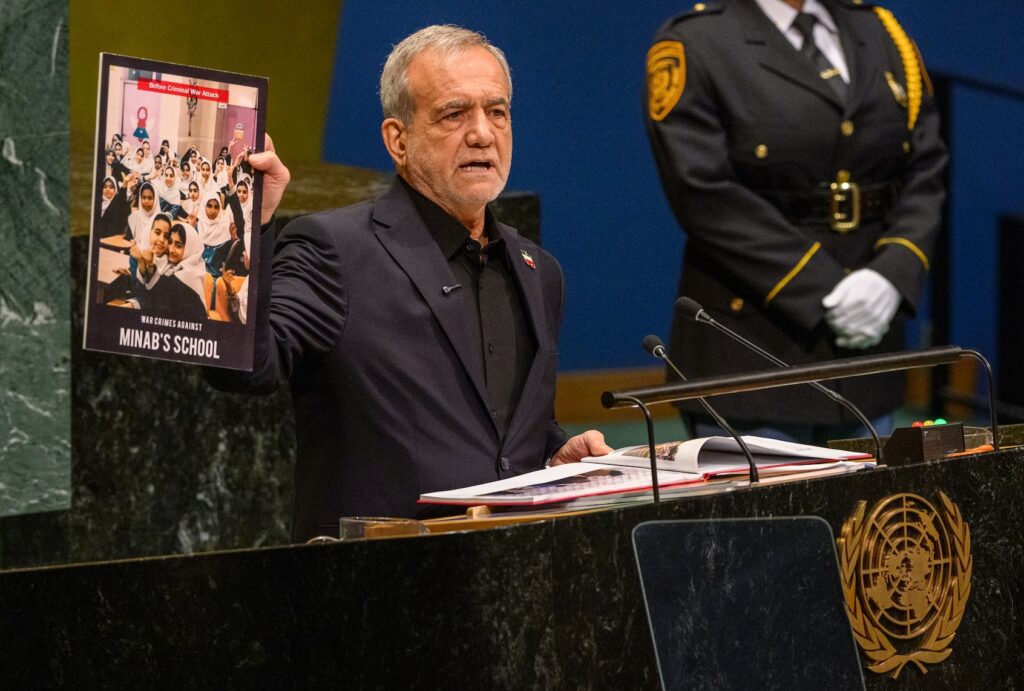
The U.N. General Assembly in New York this week honed in on global conflicts, especially the Ukraine-Russia war and the U.S.-Israel war against Iran. On Tuesday, Iran’s President Masoud Pezeshkian gave a speech describing his nation as “victims of terrorism” by the U.S., emphasizing that Iran was “hit” but “we did not bend the knee.” He held up images of more than 120 children killed by a U.S. missile strike in the early days of the war, actions described last week by a U.N. fact-finding mission as “reasonable grounds” for war crimes.
“It must be understood by Mr. Trump and those who seek to bully us that we are ready for dialogue and diplomacy and negotiations without accepting the language of force,” Pezeshkian said. It was, as the Associated Press put it, “a striking instance of a foreign leader addressing the world body while their country is at war with the host nation.” A U.S. representative at the U.N. walked out during Pezeshkian’s speech.
U.S. Secretary of State Marco Rubio dismissed Pezeshkian’s speech, telling reporters afterward “I don’t know what standing Iran has to lecture anyone on human rights or the international system when they habitually violate it.”
“They violate the sovereignty of every one of their neighbors by sponsoring terrorist organizations that reside in the borders of those countries. They slaughter their own people,” Rubio added.
(Photo by Alexi J. Rosenfeld/Getty Images) President of Iran Masoud Pezeshkian holds up a poster of a girl’s school that was attacked while addressing the 81st session of the U.N. General Assembly on September 23, 2026.
During his own speech the day before, Trump continued to mull the idea of escalating the Iran war, which has seen global energy prices spike to unprecedented levels and killed between 1,800 to 3,000 civilians across the Middle East. The Washington Post reported last week that the Pentagon is also not disclosing the true number of U.S. soldiers who have died in the war. The Pentagon’s public database cites 18 servicemember deaths, but officials who spoke on the condition of anonymity to discuss the figures, said the true number could be as high as 23.
“I have a big decision to make,” Trump said Tuesday. “Will a deal be made with Iran that lets them rebuild and create a far greater country than it ever was before, maybe one of the greatest in the Middle East or even the world. Or do I annihilate the Islamic Republic and do it quickly, never giving them a chance to kill and destroy people and countries again?”
Meanwhile, Ukrainian President Volodymyr Zelenskyy delivered remarks Wednesday urging the world to keep up the economic pressure on Russia to impede their ability to wage war against Ukraine. “When someone gives Russia more money through trade, they give this war more time. And that is exactly why we insist on limiting trade with the aggressor, and why we are burning Russia’s revenues ourselves,” he said, describing Russian President Vladimir Putin as unable to embrace peace. Russia will address the assembly Saturday.
“Can you even imagine him without war? He is ‘Patient Zero’, the one from whom war keeps spreading further,” Zelenskyy said. “‘Patient Zero’ must be stopped.”
Additionally, Japan’s prime minister, Sanae Takaichi, called on the U.N. to stop using references to former Axis powers as “enemy states” in its charter, a World War II-era designation that the New York Times reports China and Russia have recently used to attack Japan. “Japan feels a sense of responsibility to safeguard the ideals of the United Nations as our beacon of hope,” Takaichi said on Tuesday.
On Monday, President Donald Trump launched what is ostensibly state-run media, dubbed “Trump TV,” while decrying the “fake news” media. Late last week, Trump abruptly banned CNN, MS Now and Politico from the White House. In response, the outlets sued on First Amendment grounds as major television networks — including ABC, CBS, NBC and even Fox News — boycott the White House press pool in solidarity. During one press conference Monday, Trump was completely inaudible while C-SPAN said it would not show the president’s White House helipad ribbon-cutting because it relies on the pool for its feed.
So now Trump is launching his own news service, which is mostly just a live feed on the White House app and YouTube channel. “The press, in some cases, reported inaccurately or not at all on the Administration’s many record breaking accomplishments on behalf of all Americans,” Kaelan Dorr, the White House head of digital strategy, claimed on social media. “Trump TV is a 24/7 livestream of the Administration’s greatest hits, unfiltered.”
Such greatest hits include, according to Variety, “Trump’s July 3, 2026, speech at Mount Rushmore, in which he dubbed his political rivals ‘godless’ and ‘evil’ communists.” Yet Trump TV is attracting comparisons to state-run TV in actual communist countries like China and North Korea, though with presumably much less viewership. “At its launch Monday night, Trump TV peaked at 8,000 viewers, dipping to around 4,000,” the Independent reported.
“It’s official, we live in North Korea,” commentator Dean Withers said, while Trump’s former White House Press Secretary during his first term, Stephanie Grisham, said “Trump TV” is similar to what U.S. adversaries use. “You know who else does this? Russia, China, and Iran to name a few…”
“This is truly autocratic behavior from a failed President,” California Gov. Gavin Newsom, a Democrat, said on X.

 Login
Login