❌

Reading view

Pluralistic: Gerontocracy's failure mode (14 Jul 2026)


Today's links


The Angel of Death, peering down from a break in a menacing sky full of clouds, looking upon the Capitol Dome, wreathed in spooky mist. To the Capitol's left is a spooky graveyard.

Gerontocracy's failure mode (permalink)

The "designated survivor" is one of the weirder aspects of America's (very, very weird) political system.

Each year, during the State of the Union address, when both houses of Congress and the President are all under one roof, a single political figure, in the line of succession for the presidency, is spirited away to a hidden bunker, just in case the US legislative and administrative branches are decapitated in a single, spectacular terrorist strike:

https://en.wikipedia.org/wiki/Designated_survivor

Initiated during the 1950s, designated survivors are a paranoid relic of the Cold War, but they're also a relic of an era when America was a less chud-dominated, more technocratic land. It's a longtermist sort of procedure, in stark opposition to vibes-based MAGA chaos in which the Mad King makes daily announcements of new wars, tariffs, monuments, and existential threats to the nation.

America's ruling class have always sought an equilibrium between its pure Id of hatred for labor, autocratic yearnings and apocalyptic fantasies, and its patient, scheming Ego, the author of endless FedSoc judicial nominee listings, Projects 2025, and decades-long schemes to overturn Roe and reverse the New Deal.

(Democrats have their own version of this, of course – the endless contest between the McKinsey wing of the party's right and its infinitely embroidered Machin-Synematic Universe.)

The problem is that once the atavistic, impulsive elements of your project escape containment, the resultant turbulence sucks everyone else into their chaotic vortex. How can you plan for anything when you're buffeted by endless stunts, feints, and distractions?

Nowhere is this failure to plan more vivid than in the age distribution of both chambers of the US legislature, its presidential candidates, and its judicial appointments. What's more, this is equally true of the Democrats and the Republicans.

The equilibrium of all of America's key institutions is brittle: legislative majorities are often just one or two seats wide. Key federal circuits and the Supreme Court are knife-edge balances. We keep getting presidential races between septuagenarians and octogenarians.

The question here isn't whether old people can be good at those jobs. They obviously can be. The problem is actuarial: old people are far more likely to die, or suffer severe medical episodes, than younger people. This is a fact of life that every person understands, and the older you get, the better you understand it.

I'm 55. 20 years ago, it was unusual for just one of my peers to die in a given year; now I lose a couple every year. It could be me next (my doctor just informed me that I am cancer free, following excision, radiotherapy and immunotherapy). Anyone who pretends this isn't true is setting themselves and the people around them up for terrible things.

If you're a writer, this means making plans for the smooth management of your literary estate. For the past couple decades, John Scalzi has been my anointed literary executor. He's a great choice: a fabulous writer with a good head for business and a strong handle on my politics and artistic sensibility, whose personal ethics are above reproach. The only problem is that John is a couple of years older than me, which means that he'd be a great executor if I got hit by a bus tomorrow, but not if I keel over with a heart attack in 20 years.

So this year, I added a second executor, Molly White, who is also a fantastic writer, also extremely ethical and also very attuned to my politics and literary sensibilities. Molly is 20 years younger than me, and she has relevant experience: she's also the executor of the literary estate of her great-grandfather (EB White).

In the unlikely event of my untimely death, Molly and John will do a great job running the estate (which mostly will consist of reviewing my agents' recommendations). And if John keels over right after me, Molly will be fine on her own.

Of course, the only reason I need a literary executor is that my kid is only 18. At 18, she's a remarkable, level-headed, ethical young person, but she's not yet fully formed. Literary history is filled with descendants who take over a literary estate and run it in terrible ways. The most notorious example here is Stephen Joyce, grandson of James Joyce and a colossal asshole:

https://en.wikipedia.org/wiki/Stephen_James_Joyce

The most likely destiny for my literary estate is that I will grow older alongside my daughter, who will mature in ways that make her a perfectly suitable literary executor (in addition to being the beneficiary of my literary estate) and in a few years I'll send a note of thanks to John and Molly and change the paperwork. But in the unlikely, awful event that my kid runs into serious challenges that make me question her judgment and probity, I'll be covered.

That's what planning is all about: thinking through various scenarios, including low-likelihood, high-salience ones that have easy mitigations, and taking appropriate and proportionate steps to avoid disaster.

You know: like squirreling away a designated survivor in a bunker far from DC during the State of the Union.

This is what makes America's political gerontocracy so weird. In their true hearts, the nonagenarian (1), octogenarians (5), septuagenarians (27) and late sexagenarians (7) in the US Senate know that they could keel over at any moment, and that in a 53:47 Senate, this could spell doom for their political project.

Sure, Mitch McConnell might be secretly dead and that's bad and weird. But it wouldn't be exceptional. We're talking about a legislature whose members sometimes disappear for months, only to be discovered in care homes with advanced dementia, while still somehow holding office:

https://www.politico.com/news/magazine/2025/03/14/kay-granger-dementia-dc-media-00210317

It's a legislature whose most prominent grandees cling to power at the very brink of death's door, long after they can be effective leaders, just so they can anoint their successor during the next election:

https://en.wikipedia.org/wiki/Dianne_Feinstein#Personal_life

Elections have consequences, but special elections, called after the sudden death of an elderly lawmaker, have wild consequences.

Of course, anyone can die suddenly. 15 years ago, one of my dearest friends, a contemporary, went to bed in seeming perfect health and never woke up. He was only 44. I still miss him, every day:

https://memex.craphound.com/2012/06/28/eulogy-for-erik-possum-man-stewart/

But the likelihood this happening goes up the older you get, and once you cross a certain age threshold, the odds rise sharply. If you're part of a political project that's laying and executing long-term plans whose outcomes turn on hair-fine majorities, this should factor into your thinking. The failure to do so can throw everything you've worked for into disarray:

https://prospect.org/2026/07/13/budget-consequences-of-lindsey-grahams-sudden-departure/

It's not limited to the legislature, of course. The Supreme Court's slide into its role as handmaiden to totalitarianism began when the dying Ruth Bader Ginsburg refused to step down, because she wanted her successor to be picked by the first woman president:

https://www.nytimes.com/2020/09/21/magazine/ginsburg-successor-obama.html

The amazing thing here is that RBG made her name as a master strategist, but when it came to this incredibly consequential matter, she set strategy aside for hubris:

https://radiolab.org/podcast/more-perfect-sex-appeal

Security practitioners know that anyone can be hacked or scammed, and that the biggest vulnerability of all is to be so confident in your own procedures and discernment that you assume it could never happen to you. If you think you can't get scammed, you are a danger to yourself and others:

https://pluralistic.net/2024/02/05/cyber-dunning-kruger/#swiss-cheese-security

By the same token, any politician in their 70s or 80s who thinks that they can't suffer a stroke or heart attack or the kind of lapse that makes you freeze up during a presidential debate is a danger to their party, their politics and their nation:

https://www.cbsnews.com/news/jill-biden-joe-biden-stroke-2024-debate-sunday-morning-interview/

This isn't about how healthy or robust any given politician is or feels; this is about the cold reality of actuarial tables. The older I get, the more those actuarial tables factor into my own decision-making. The fact that our political classes seem to think that they can choose the time and manner of their passing is baffling.


Hey look at this (permalink)


A shelf of leatherbound history books with a gilt-stamped series title, 'The World's Famous Events.'

Object permanence (permalink)

#25yrsago Microsoft less hostile to MP3s https://web.archive.org/web/20010716103233/http://news.cnet.com/news/0-1003-200-6567844.html

#25yrsago UK record lobby demands copyright school curriculum https://web.archive.org/web/20010718135130/https://www.salon.com/tech/feature/2001/07/16/abc_ip/index.html

#25yrsago Gary Larson on online comics sharing https://web.archive.org/web/20010610081014/http://www.creators.com/index2_anotefromgarylarson.html

#10yrsago San Francisco’s bike lanes have become Uber’s pickup/dropoff zones (and the cops don’t care) https://sf.streetsblog.org/2016/07/13/collecting-data-to-push-for-safer-biking-on-valencia

#10yrsago For 90 years, lightbulbs were designed to burn out. Now that’s coming to LED bulbs https://web.archive.org/web/20160717090604/http://www.newyorker.com/business/currency/the-l-e-d-quandary-why-theres-no-such-thing-as-built-to-last

#10yrsago Why do Pokemon avoid Black neighborhoods? https://www.bnd.com/news/nation-world/national/article89562297.html

#10yrsago To hell with the Trolley Problem: here’s a much more interesting list of self-driving car weirdnesses https://medium.com/studio-d/15-more-concepts-in-autonomous-mobility-8fd1c794e466#.s10ldm5nf

#10yrsago Royal Society’s #1 cybersecurity recommendation: don’t backdoor crypto https://royalsociety.org/~/media/policy/projects/cybersecurity-research/cybersecurity-research-report.pdf

#10yrsago UK PM Theresa May nukes climate change department, appoints a climate denier as Climate Secretary https://web.archive.org/web/20160714173020/http://www.independent.co.uk/environment/climate-change-department-killed-off-by-theresa-may-in-plain-stupid-and-deeply-worrying-move-a7137166.html

#5yrsago Facebook's alternative facts https://pluralistic.net/2021/07/15/three-wise-zucks-in-a-trenchcoat/#inconvenient-truth

#1yrago When Google's slop meets webslop, search stops https://pluralistic.net/2025/07/15/inhuman-gigapede/#coprophagic-ai


Upcoming appearances (permalink)

A photo of me onstage, giving a speech, pounding the podium.


A screenshot of me at my desk, doing a livecast.

Recent appearances (permalink)


A grid of my books with Will Stahle covers..

Latest books (permalink)


A cardboard book box with the Macmillan logo.

Upcoming books (permalink)

  • "The Post-American Internet," a geopolitical sequel of sorts to Enshittification, Farrar, Straus and Giroux, 2027
  • "Unauthorized Bread": a middle-grades graphic novel adapted from my novella about refugees, toasters and DRM, FirstSecond, April 20, 2027

  • "Enshittification, Why Everything Suddenly Got Worse and What to Do About It" (the graphic novel), Firstsecond, 2027

  • "The Memex Method," Farrar, Straus, Giroux, 2027


Colophon (permalink)

Today's top sources:

Currently writing: "The Post-American Internet," a sequel to "Enshittification," about the better world the rest of us get to have now that Trump has torched America. Fourth draft completed. Submitted to editor.

  • A Little Brother short story about DIY insulin PLANNING

This work – excluding any serialized fiction – is licensed under a Creative Commons Attribution 4.0 license. That means you can use it any way you like, including commercially, provided that you attribute it to me, Cory Doctorow, and include a link to pluralistic.net.

https://creativecommons.org/licenses/by/4.0/

Quotations and images are not included in this license; they are included either under a limitation or exception to copyright, or on the basis of a separate license. Please exercise caution.


How to get Pluralistic:

Blog (no ads, tracking, or data-collection):

Pluralistic.net

Newsletter (no ads, tracking, or data-collection):

https://pluralistic.net/plura-list

Mastodon (no ads, tracking, or data-collection):

https://mamot.fr/@pluralistic

Bluesky (no ads, possible tracking and data-collection):

https://bsky.app/profile/doctorow.pluralistic.net

Medium (no ads, paywalled):

https://doctorow.medium.com/

Tumblr (mass-scale, unrestricted, third-party surveillance and advertising):

https://mostlysignssomeportents.tumblr.com/tagged/pluralistic

"When life gives you SARS, you make sarsaparilla" -Joey "Accordion Guy" DeVilla

READ CAREFULLY: By reading this, you agree, on behalf of your employer, to release me from all obligations and waivers arising from any and all NON-NEGOTIATED agreements, licenses, terms-of-service, shrinkwrap, clickwrap, browsewrap, confidentiality, non-disclosure, non-compete and acceptable use policies ("BOGUS AGREEMENTS") that I have entered into with your employer, its partners, licensors, agents and assigns, in perpetuity, without prejudice to my ongoing rights and privileges. You further represent that you have the authority to release me from any BOGUS AGREEMENTS on behalf of your employer.

ISSN: 3066-764X

  •  

Pluralistic: Why aren't AI companies competing directly with their customers? (13 Jul 2026)


Today's links


Three gold rush miners standing around a mule wagon piled high with mining supplies. They are surmounted by a Gold Rush-era advertisement reading 'GOLD MINING will be the leading business in the Northwest this year/EVERY MERCHANT can be prepared to supply his customers and keep his Profits and Money at home by inspecting/OUR LINE. It is complete. Send for our prices. Prompt shipments made.' The three miners' heads have been replaced with the heads of robots ganked from old pulp sf magazines. In the background a young man is performing a joyous headstand. The image has been sepia-toned.

Why aren't AI companies competing directly with their customers? (permalink)

"I often wonder what the Vintners buy/One half so precious as the Goods they sell" -The Rubáiyát of Omar Khayyám

I first encountered that quote from someone extolling the virtues of bookstores, and it stuck with me, because for most of my childhood, every bookstore visit ended with me broke and wishing I'd had three times as much to spend.

As a larval hyperlexic, I just didn't understand what a bookseller could possibly buy with my money that was better than the books they already had? Of course, then I became a bookseller and discovered that Sturgeon's Law ("90% of everything is shit") applies to a bookstore's wares as much as it does to anything else. I also acquired a monthly rent obligation and discovered just how important money could be.

Nevertheless, Omar Khayyám's question stuck with me, especially when I fell down a years-long rabbit-hole of learning about scams and the finance sector (but I repeat myself). Every get-rich-quick schemer will tell you that they've found the infinite money hack, which they will sell to you for a remarkably reasonable sum. Likewise, every stock picker claims they can outperform a simple low-load index fund, and all they ask of you is a few hundred basis points in exchange for multiplying your wealth beyond the dreams of Creosote. Neither one has a good answer to Khayyám's question: if you can make all the money with your amazing system, why do you need my money?

This is a question that needs to be forcefully put to AI hucksters. In their more expansive moments, the Altmans and Amodeis of the world will tell you that they're planning to teach the word-guessing program so many words that it will wake up and become god. DOGE's broccoli-haired brownshirts laughed in the faces of the NIH lifers who begged them not to vaporize their long-running cancer research projects: "General AI is around the corner and it's going to cure cancer. Cancer research is a waste of money!"

Which all raises the question: if you've truly incubated a foetal demiurge in your "AI lab," why are you offering to sell it to me? What do the AI hucksters buy/One half so precious as the Gods they sell?"

Of course, they might answer, "We need your money now so we can make god later." That's why they want your boss to fire you and replace you with their chatbots and split your wages with your former employer. But this just raises the same question: if you have a chatbot that can do a doctor's job, why sell it to a hospital? Why not just open your own hospital? If you've got a chatbot that can do a tax accountant's job, why sell it to a tax-prep service? Why not just open a tax-prep service? If you've got a chatbot that can teach my kids, why sell it to my local school district? Why not just open a school?

If the chatbot can do the job, and if the chatbot costs less than the worker who does the job today, then the chatbot company can profitably sell services more cheaply than anyone who presently employs that worker, because the chatbot company already owns the chatbot. If you were really on a glide path to creating an all-powerful deity and just needed cash to keep the venture going until the cancer-curing word-guesser awoke from its long slumber, then wouldn't you want as much cash as possible? Why would you voluntarily split the take with some sucky, washed, non-god-generating business from before 2022?

I think the only reason this question doesn't come up more frequently is that we're stewing in what Douglas Rushkoff calls the "go meta" economy, in which the most respectable and smartest business to operate must be as many abstraction layers away from real work as possible. Don't drive a taxi, own a medallion that you rent to the cab driver. Don't own a medallion, start a "rideshare" company. Don't start a rideshare company, invest in a rideshare company. Don't invest in a rideshare company, buy options to invest in a rideshare company:

https://pluralistic.net/2022/09/13/collapse-porn/#collapse-porn

The inverse relationship between doing something useful and making money is deeply ingrained in our economic wisdom. Take the world of online grifters, who don't just peddle get-rich-quick PDFs, they also peddle tools to generate get-rich-quick PDFs, as well as tools to steal other "wealth influencers'" insta videos and deepfake yourself into their pretend private jets:

https://www.404media.co/how-i-bought-a-private-jet-by-selling-10-subscriptions-to-404-media/

The scam economy boasts a bewildering array of ancillary services, like a $150/month service that lets you produce fake screenshots showing vast monthly income on other scam services (November Kelly calls this "The world's most expensive 'inspect element'"):

https://www.patreon.com/trashfuture/posts/faux-high-level-163443872

It's an old truism that in a gold rush, the only people who come out ahead are the people selling the picks and shovels. But that's not true – there's even more money to be made wholesaling picks and shovels to the retailers who operate the frontier mercantiles. Go meta!

https://commons.wikimedia.org/wiki/File:Alaskan_Gold_Mining_Supplies_(1897)_(ADVERT_277).jpeg

Today's economy is dominated by pick-and-shovel wholesalers. America is a gerontocracy drowning in MBAs, while there's no one to do eldercare:

https://www.msn.com/en-us/news/us/why-recruiters-can-t-find-workers-and-new-grads-can-t-find-jobs-it-s-not-ai/ar-AA27K57y

So it's not surprising that we don't ask why these AI god-botherers need our stupid money while they're immanentizing the eschaton. Why would they operate a hospital if they could go meta and sell the doctorbots to the MBAs running the hospital?


Hey look at this (permalink)


A shelf of leatherbound history books with a gilt-stamped series title, 'The World's Famous Events.'

Object permanence (permalink)

#25yrsago Pro-lumber industry spoof of The Lorax https://web.archive.org/web/20010721042828/http://www.forestcouncil.org/news/articles/truax1.htm

#25yrsago Remixable vocal tracks from the next Public Enemy release https://web.archive.org/web/20010813195140/http://www.slamjamz.com/slamnews.php?article=7

#20yrsago Wikipedia creates RSS for its posts https://web.archive.org/web/20060718103013/http://www.micropersuasion.com/2006/07/wikipedia_entir.html

#20yrsago Anti-DRM picture-book https://web.archive.org/web/20060721095740/https://dustrunners.blogspot.com/2006/07/pig-and-box.html

#10yrsago The US has spent $122B training foreign cops and soldiers in 150+ countries, but isn’t sure who https://web.archive.org/web/20160713145824/https://theintercept.com/2016/07/13/training/

#10yrsago German free school teaches without grades, timetables or lesson plans https://www.theguardian.com/world/2016/jul/01/no-grades-no-timetable-berlin-school-turns-teaching-upside-down

#10yrsago For the first time, a federal judge has thrown out police surveillance evidence from a “Stingray” device https://www.rawstory.com/2016/07/federal-judge-throws-out-evidence-gathered-with-stingray-cell-phone-tracker/

#10yrsago Day on a Device: art made by screenshotting a multitasker’s screen with each context-switch https://www.theverge.com/2016/7/13/12170526/multitasking-phone-laptop-pierre-buttin-art

#10yrsago Remarkably Normal: the true stories of abortion in America https://web.archive.org/web/20160810092901/http://jezebel.com/the-vagina-monologues-but-for-abortion-1783289270/amp

#10yrsago Theresa May performs the Fresh Prince of Bel-Air theme https://www.youtube.com/watch?v=xv7Jd94bnOI

#10yrsago UK Labour’s dirty trick excludes 130,000 members from leadership vote https://web.archive.org/web/20160712225142/http://www.itv.com/news/2016-07-12/corbyn-opponents-try-to-fix-vote/

#10yrsago Security researchers: the W3C’s DRM needs to be thoroughly audited https://www.eff.org/deeplinks/2016/06/call-security-community-w3cs-drm-must-be-investigated

#10yrsago Help Doctors Without Borders fill in the geodata blanks for vulnerable communities https://missingmaps.org/blog/2016/07/14/mapswipe/

#10yrsago Sign a book of congratulations for America’s new Librarian of Congress https://web.archive.org/web/20160718023555/https://action.everylibrary.org/congratulate_carla_hayden_today

#10yrsago Hungary’s Cold War cartoons were weird and awesome https://globalvoices.org/2016/07/14/the-fascinating-world-of-cold-war-era-hungarian-cartoons/

#10yrsago The ACLU has a roadmap for defeating President Donald Trump’s signature initiatives https://web.archive.org/web/20160715131734/https://action.aclu.org/sites/default/files/pages/trumpmemos.pdf

#10yrsago America’s infrastructure debt is so bad that towns are unpaving roads they can’t afford to fix https://web.archive.org/web/20160713170836/https://www.wired.com/2016/07/cash-strapped-towns-un-paving-roads-cant-afford-fix/

#10yrsago It’s official: the Olympics result in the worst budget overruns of any megaproject https://papers.ssrn.com/sol3/papers.cfm?abstract_id=2804554

#10yrsago Vivendi lobbyist appointed to run copyright for UN agency https://web.archive.org/web/20160717052135/http://keionline.org/node/2614

#10yrsago The long, racist history of Brexiteer Boris Johnson, the new UK Foreign Secretary https://www.bbc.co.uk/news/world-36792746

#5yrsago Facebook employees stalk users https://pluralistic.net/2021/07/14/who-watches-the-zuckmen/#pecksniffs

#5yrsago Semantic drift versus ethical drift https://pluralistic.net/2025/07/14/pole-star/#gnus-not-utilitarian


Upcoming appearances (permalink)

A photo of me onstage, giving a speech, pounding the podium.


A screenshot of me at my desk, doing a livecast.

Recent appearances (permalink)


A grid of my books with Will Stahle covers..

Latest books (permalink)


A cardboard book box with the Macmillan logo.

Upcoming books (permalink)

  • "The Post-American Internet," a geopolitical sequel of sorts to Enshittification, Farrar, Straus and Giroux, 2027
  • "Unauthorized Bread": a middle-grades graphic novel adapted from my novella about refugees, toasters and DRM, FirstSecond, April 20, 2027

  • "Enshittification, Why Everything Suddenly Got Worse and What to Do About It" (the graphic novel), Firstsecond, 2027

  • "The Memex Method," Farrar, Straus, Giroux, 2027


Colophon (permalink)

Today's top sources:

Currently writing: "The Post-American Internet," a sequel to "Enshittification," about the better world the rest of us get to have now that Trump has torched America. Fourth draft completed. Submitted to editor.

  • A Little Brother short story about DIY insulin PLANNING

This work – excluding any serialized fiction – is licensed under a Creative Commons Attribution 4.0 license. That means you can use it any way you like, including commercially, provided that you attribute it to me, Cory Doctorow, and include a link to pluralistic.net.

https://creativecommons.org/licenses/by/4.0/

Quotations and images are not included in this license; they are included either under a limitation or exception to copyright, or on the basis of a separate license. Please exercise caution.


How to get Pluralistic:

Blog (no ads, tracking, or data-collection):

Pluralistic.net

Newsletter (no ads, tracking, or data-collection):

https://pluralistic.net/plura-list

Mastodon (no ads, tracking, or data-collection):

https://mamot.fr/@pluralistic

Bluesky (no ads, possible tracking and data-collection):

https://bsky.app/profile/doctorow.pluralistic.net

Medium (no ads, paywalled):

https://doctorow.medium.com/

Tumblr (mass-scale, unrestricted, third-party surveillance and advertising):

https://mostlysignssomeportents.tumblr.com/tagged/pluralistic

"When life gives you SARS, you make sarsaparilla" -Joey "Accordion Guy" DeVilla

READ CAREFULLY: By reading this, you agree, on behalf of your employer, to release me from all obligations and waivers arising from any and all NON-NEGOTIATED agreements, licenses, terms-of-service, shrinkwrap, clickwrap, browsewrap, confidentiality, non-disclosure, non-compete and acceptable use policies ("BOGUS AGREEMENTS") that I have entered into with your employer, its partners, licensors, agents and assigns, in perpetuity, without prejudice to my ongoing rights and privileges. You further represent that you have the authority to release me from any BOGUS AGREEMENTS on behalf of your employer.

ISSN: 3066-764X

  •  

Pluralistic: Workplace "flexibility" isn't (11 Jul 2026)


Today's links


A giant arachnoid woman arched backwards on the banks of a tropical river alongside which stand armed men. Behind loom palms, mountains and a smoking volcano. Rain sleets down over the scene.

Workplace "flexibility" isn't (permalink)

Here's an irony: the "gig economy" is a statistical black hole. Workers, customers and regulators know very little about the most basic aspects of it: how much workers get paid, for example, or much unpaid time on the clock a worker puts in before they get a job from the app.

The reason this is ironic is that the "gig economy" is dominated by a handful of massive, data-driven firms that know the precise, up-to-the-second answer to these questions. The problem is that they won't share the data. Of course, workers and customers have the data, too, but our data is widely diffused, with each worker and each customer only representing a single, infinitesimal pixel in this massive picture.

Most of our industry-wide figures about the sector come from painstaking, expensive survey work. The expense and effort involved in conducting this analysis means that the public's understanding of the gig companies' business is fragmentary and thin.

But every now and again, we get a flashbulb glimpse of the full picture. One of those glimpses was captured by David Weil, the former labor standards boss at the US Department of Labor. In 2024, the Massachusetts Attorney General sued Uber over worker misclassification, with Weil serving as an expert witness, who was able to access the raw data on Uber's business operations.

In a new American Prospect longread called "The Dangerous Myth of Flexibility," Weil builds on the public record developed in the case to demolish the central myth of the gigwork companies: that they enter into a mutually beneficial arrangement with their workers by offering "flexibility" that lets workers "choose work that fits the rhythms of their lives, not the other way around":

https://prospect.org/2026/07/09/dangerous-myth-of-flexibility-uber-lyft-gig-economy/

This quote comes from Tony West, the Uber executive who has led the company's efforts to formalize its worker misclassification program, notably California's Prop 22, a $225m statewide campaign that overturned the state's landmark gig work standards. West is also Kamala Harris's brother-in-law, and he served as her campaign's corporate liaison, senior strategist and economic policy advisor.

On its face, West's statement sounds reasonable, and most of us have heard a version of it, possibly even from an Uber driver. But what Uber calls "flexibility" is really a way for the company to offload its operational risks onto its drivers.

Anyone who runs a business has to manage a key operational risk: staffing levels. A restaurateur who doesn't schedule enough cooks, bussers and servers might have to turn away business at the door if there's a rush. But if the restaurateur schedules too many people for a shift, they'll end up paying for those workers to stand around scrolling Tiktok.

In America, Congress and state legislatures have created a system that allows restaurateurs to transfer this risk onto their employees: the "tipped minimum wage." Federally, the minimum wage for tipped employees is only $2.13/hour, with the caveat that employees are obliged to "top up" their workers' pay if the tips from their shift don't add up to $7.25/hour. So if you work five hours and don't wait on a single table, your boss has to pay you $36.25 ($7.25/hour * 5 hours). But if you have a busy shift and you make $40 in tips, your boss only has to pay you $10.65 ($2.13 * 5 – the tipped minimum).

This is a transfer of risk from bosses to workers. The boss can schedule extra servers and offload most of their wages to diners who come through the doors. If your boss overestimates the amount of business, much of the cost of that miscalculation comes out of your paycheck.

This is quite a sweet deal for bosses. After all, servers have virtually no control over the amount of business a restaurant attracts. It's the boss, not the server, who decides where the restaurant will be, which hours it will keep, which food it will serve, how much the food costs, what advertisements to run, and where and when to run them. The boss controls the decor, staff attire and the music. They make the decisions, and workers pay the price if they decide poorly.

For most businesses, workers are less exposed to risks from their boss's strategic errors. If your boss screws up, you might see a lower annual bonus, or take a career hit thanks to the bad company's presence on your CV. Of course, if your boss really messes up they might lay you off or go out of business altogether, but it's a rare business that gets to externalize its risks onto its workers on a shift-by-shift basis the way restaurants get to.

But as sweet as restaurateurs have it, that's nothing compared to the incredible deal that gig platforms get. Companies like Uber and Lyft get to shift nearly all their risk to their workers, and then insist that they're doing workers a favor by offering them "flexibility." Like a restaurateur, Uber and Lyft control all the mechanisms by which the number of riders is set. They decide how to advertise and how to price their rides. When a driver signs on and makes themselves available – at no charge – to Uber, it is the company's actions, not the driver's, that determine whether that driver gets a job, and how much they'll get paid.

Uber and Lyft claim that drivers have control, too – when (if) they're offered a job, they get to decide whether to take it. This is true, but it's more complicated than that. Drivers get about 15 seconds (!) to decide whether to accept a job, which means they have 15 seconds to calculate the mileage and time-based rate on offer, all while operating a vehicle in traffic. Drivers who accept lowball offers risk having their base pay permanently eroded through "algorithmic wage discrimination," which is when the gig platforms infer that workers who accept very low wages are economically desperate and can be offered even lower wages in the future:

https://pluralistic.net/2023/04/12/algorithmic-wage-discrimination/#fishers-of-men

But workers can't simply refuse offers and wait for the wage on offer to increase. That increase may happen, but if a driver is too picky, the platform will punish them for turning down too many offers by excluding them from future opportunities. If this happens often enough, the driver may end up broke enough to start accepting those lowballs, triggering the inexorable downward trajectory of their expected earnings.

This is "flexibility," but mostly it's flexibility for Uber, not for drivers. Uber controls when a driver gets paid, and they control the data about that payment. This allows Uber to claim to be paying well north of minimum wage, while drivers average less than $2.50/hour. Uber exploits its information asymmetry to publish only the numerator (the amount a driver makes when a passenger is in the car) while hiding the denominator (how many hours it takes for Uber to put a passenger in that car):

https://pluralistic.net/2024/02/29/geometry-hates-uber/#toronto-the-gullible

Uber has perfected a system of algorithmic pricing that allows it to dangle just enough money in front of drivers to maximize their number on the road, irrespective of how many riders are looking for cars. The fact that they have all the information (while drivers have none) allows them to extract vast amounts of totally unpaid labor from those drivers. And then, once a passenger gets in the car, Uber's informational systems let it pay that driver the absolute minimum they will accept for the ride.

Of course, it works the same way for passengers, each of whom is offered a different price for the same ride, based on the company's surveillance data and its realtime calculations about how much the rider is willing to pay. When Uber launched, driver pay and passenger fares were linked (the same way a server's tips and the cost of a meal are linked). Today, these are fully decoupled. Uber runs a kind of cod-Marxist operation where workers are paid according to their desperation, and passengers are gouged according to their ability to pay:

https://pluralistic.net/2025/01/11/socialism-for-the-wealthy/#rugged-individualism-for-the-poor

This works so well (for Uber) that Uber has launched a side hustle selling algorithmic pricing and algorithmic wage discrimination systems to companies in other sectors, so expect this arrangement to infect ever-wider swathes of the economy:

https://investor.uber.com/news-events/news/press-release-details/2025/Uber-Expands-AI-Data-Platform-to-Power-Next-Gen-Enterprise-and-AI-Lab-Needs/default.aspx

(And this is neither here nor there, but holy shit, is Uber's investor relations site seriously serving ASPX pages in 2026?! Hey Khosrowshahi, the DOJ called and it wants its Clinton-era antitrust evidence back!)

Back to algorithmic pricing: this opaque, take-it-or-leave-it algorithmic pricing arrangement sets Uber apart from other platforms where sellers offer temporary use of their property to buyers. As Weil writes, at least Airbnb hosts get to override the nightly rate suggested by the platform (though I'd add that the platforms will downrank and bury people who resist their suggestions).

As Weil points out, even if Uber had to pay the minimum wage and assume other operational risks associated with running a business, they'd still have access to these algorithmic tools, albeit with different parameters. Rather than setting the wage floor for drivers at $0/hour, they'd have to pay $7.25/hour (the federal minimum wage, or more, depending on the state). This would force the company to refuse shifts to drivers when there were enough workers on the road to handle demand, but drivers would benefit from this arrangement – rather than driving around for a shift, burning gas and putting wear on your car without getting paid, Uber would just tell you to stay home.

Uber could try to offload those risks onto passengers, but remember, Uber is already charging riders a personalized price based on massive troves of surveillance data that is continuously re-analyzed to guess the largest sum you're willing to pay for any given ride. You're already paying the highest price Uber can set for you, in other words.

Weil has been in many forums – including that Massachusetts courtroom – where Uber touted its "flexibility" as a benefit to drivers. But as he shows, Uber could offer all the same flexibility to drivers without the downside risk of driving around for hours without earning a dime. Sure, forcing Uber and Lyft to extend rights and protections that every employee gets would raise their costs – but "the same is true for any company having to comply with employment law and work protections."

Outside of the US, these companies are being forced to shift the risk from their workers' backs to their own balance sheets. As Weil writes, the UN's International Labor Organization has set binding labor standards for gig companies, called Convention 193, "Decent Work in the Platform Economy":

https://onlabor.org/a-win-for-platform-workers-ilo-convention-no-193/

The US government is pulling out all the stops to prevent these standards from being applied to US gig companies, even abroad. Trump's labor boss Keith Sonderling told the world that the US government "will not sit on the sidelines while some foreign governments push to hamper American innovation in the gig economy worldwide":

https://www.washingtonexaminer.com/opinion/3435961/america-must-lead-gig-economy/

But, as Weil says, this isn't about innovation, flexibility or AI. It's about gig companies changing the distributional outcome of whole sectors, to shift money from workers to investors.

The rest of the world has its own ideas. In Switzerland, the Supreme Court found that gig companies' businesses were illegal and ordered them to extend normal labor protections to gig workers. Naturally, the gig companies just ignored the law and continued to screw those workers. Gig workers, as noted, are diffused. They don't work in the same place. They have no way to find out who else works for the same boss as they do. The same factors that keep us from gathering stats on gig work also keeps gig workers from comparing notes on how they're getting shafted.

What's a labor organizer to do? The Swiss labor union Syndicom came up with an ingenious solution. They partnered with a popular, pro-union pizza restaurant, listed it on the delivery platforms, and then placed orders for tons of pizzas through the scofflaw food-delivery platforms. They transformed the pizzeria into a pop-up union labor hub, and had an organizing conversation with every rider the company dispatched to the restaurant:

https://vimeo.com/1203473793

This is deliciously ingenious, and the labor organizing need not stop there. Companies like Para have shown how, by jailbreaking the apps used by gig workers, they can allow those workers to comparison shop for the best wage. Rather than getting 15 seconds while navigating traffic to decide whether a job is worth taking, drivers and riders could use a "counter-app" that evaluates all the offers on all the platforms and coordinates with other workers to mass-reject lowball offers:

https://pluralistic.net/2021/08/07/hr-4193/#boss-app

The only problem is the "anticircumvention" laws that criminalize this kind of reverse-engineering and modifications of apps. These laws make it a literal crime to change how an app running on your own phone works. These laws were invented in America, with 1998's Digital Millennium Copyright Act, but in the ensuing years, the US Trade Rep has used the threat of tariffs to force every country in the world to adopt their own anticircumvention laws. By caving into US bullying, all of America's trading partners have left their workers and consumers vulnerable to technological surveillance, manipulation and price-gouging, to the great benefit of the US tech companies that have fused with the Trump regime.

This is the hidden silver lining to Trump's lunatic tariffs: they take away the threat that kept all those US-protecting foreign IP laws in force. When someone threatens to burn your house down unless you do as you're told, and then they burn your house down anyway, you really don't have to keep complying:

https://pluralistic.net/2026/01/01/39c3/#the-new-coalition

The possibilities for counterapps in gig work are endless. In Indonesia, gig rider co-ops commission "Tuyul" apps that mod their dispatch apps in ways small (upsizing the font) and large (spoofing the GPS):

https://pluralistic.net/2021/07/08/tuyul-apps/#gojek

In his article, Weil cites a study showing that customers for gig apps tend not to comparison shop – once you choose your default taxi-hailing app, that becomes your go-to. But with counter-apps, your default could be a price-comparison app that bids out your job to all the platforms and chooses the cheapest one, forcing the gig companies to compete with each other:

https://papers.ssrn.com/sol3/papers.cfm?abstract_id=5729723

The platforms like to pitch themselves as "frictionless," but the reality is that they don't reduce friction so much as reallocate it. Because they control the technology, because the law makes it a literal crime to wrestle that control away, they can shift all the friction from their side of the ledger to yours, whether you're a worker or a customer:

https://pluralistic.net/2025/08/23/become-unoptimizable/#downward-redistribution

Tony West isn't lying when he says Uber values flexibility – they value their flexibility, which arises out of the constraints (technical, legal) they impose on us: the drivers and passengers.


Hey look at this (permalink)


A shelf of leatherbound history books with a gilt-stamped series title, 'The World's Famous Events.'

Object permanence (permalink)

#20yrsago Alanya to Alanya: feminist science fiction adventure https://memex.craphound.com/2006/07/12/alanya-to-alanya-feminist-science-fiction-adventure/

#20yrsago Soviet jokes https://web.archive.org/web/20060708144926/http://www.prospect-magazine.co.uk/article_details.php?id=7412

#10yrsago Empirical proof that Terms of Service are “the biggest lie on the Internet” https://web.archive.org/web/20160712233511/https://arstechnica.com/tech-policy/2016/07/nobody-reads-tos-agreements-even-ones-that-demand-first-born-as-payment/

#10yrsago Fox’s employee contracts may mean Gretchen Carlson will never get her day in court https://web.archive.org/web/20160712123858/https://thinkprogress.org/justice/2016/07/11/3797060/dirty-trick-fox-news-using-undercut-gretchen-carlsons-sexual-harassment-suit/

#10yrsago To see the future, visit the most remote areas of the GBAO https://medium.com/studio-d/6-1-glimpses-of-the-future-e3fdb510dcc1#.iwyo4x141

#10yrsago Benjamin Frisch’s “Fun Family”: good old American narcissism https://memex.craphound.com/2016/07/12/benjamin-frischs-fun-family-good-old-american-narcissism/

#5yrsago The Sacklers will get to keep billions https://pluralistic.net/2021/07/12/monopolist-solidarity/#sacklers-billions


Upcoming appearances (permalink)

A photo of me onstage, giving a speech, pounding the podium.


A screenshot of me at my desk, doing a livecast.

Recent appearances (permalink)


A grid of my books with Will Stahle covers..

Latest books (permalink)


A cardboard book box with the Macmillan logo.

Upcoming books (permalink)

  • "The Post-American Internet," a geopolitical sequel of sorts to Enshittification, Farrar, Straus and Giroux, 2027
  • "Unauthorized Bread": a middle-grades graphic novel adapted from my novella about refugees, toasters and DRM, FirstSecond, April 20, 2027

  • "Enshittification, Why Everything Suddenly Got Worse and What to Do About It" (the graphic novel), Firstsecond, 2027

  • "The Memex Method," Farrar, Straus, Giroux, 2027


Colophon (permalink)

Today's top sources:

Currently writing: "The Post-American Internet," a sequel to "Enshittification," about the better world the rest of us get to have now that Trump has torched America. Fourth draft completed. Submitted to editor.

  • A Little Brother short story about DIY insulin PLANNING

This work – excluding any serialized fiction – is licensed under a Creative Commons Attribution 4.0 license. That means you can use it any way you like, including commercially, provided that you attribute it to me, Cory Doctorow, and include a link to pluralistic.net.

https://creativecommons.org/licenses/by/4.0/

Quotations and images are not included in this license; they are included either under a limitation or exception to copyright, or on the basis of a separate license. Please exercise caution.


How to get Pluralistic:

Blog (no ads, tracking, or data-collection):

Pluralistic.net

Newsletter (no ads, tracking, or data-collection):

https://pluralistic.net/plura-list

Mastodon (no ads, tracking, or data-collection):

https://mamot.fr/@pluralistic

Bluesky (no ads, possible tracking and data-collection):

https://bsky.app/profile/doctorow.pluralistic.net

Medium (no ads, paywalled):

https://doctorow.medium.com/

Tumblr (mass-scale, unrestricted, third-party surveillance and advertising):

https://mostlysignssomeportents.tumblr.com/tagged/pluralistic

"When life gives you SARS, you make sarsaparilla" -Joey "Accordion Guy" DeVilla

READ CAREFULLY: By reading this, you agree, on behalf of your employer, to release me from all obligations and waivers arising from any and all NON-NEGOTIATED agreements, licenses, terms-of-service, shrinkwrap, clickwrap, browsewrap, confidentiality, non-disclosure, non-compete and acceptable use policies ("BOGUS AGREEMENTS") that I have entered into with your employer, its partners, licensors, agents and assigns, in perpetuity, without prejudice to my ongoing rights and privileges. You further represent that you have the authority to release me from any BOGUS AGREEMENTS on behalf of your employer.

ISSN: 3066-764X

  •  

Wissen über Laminieren von Croissantteigen

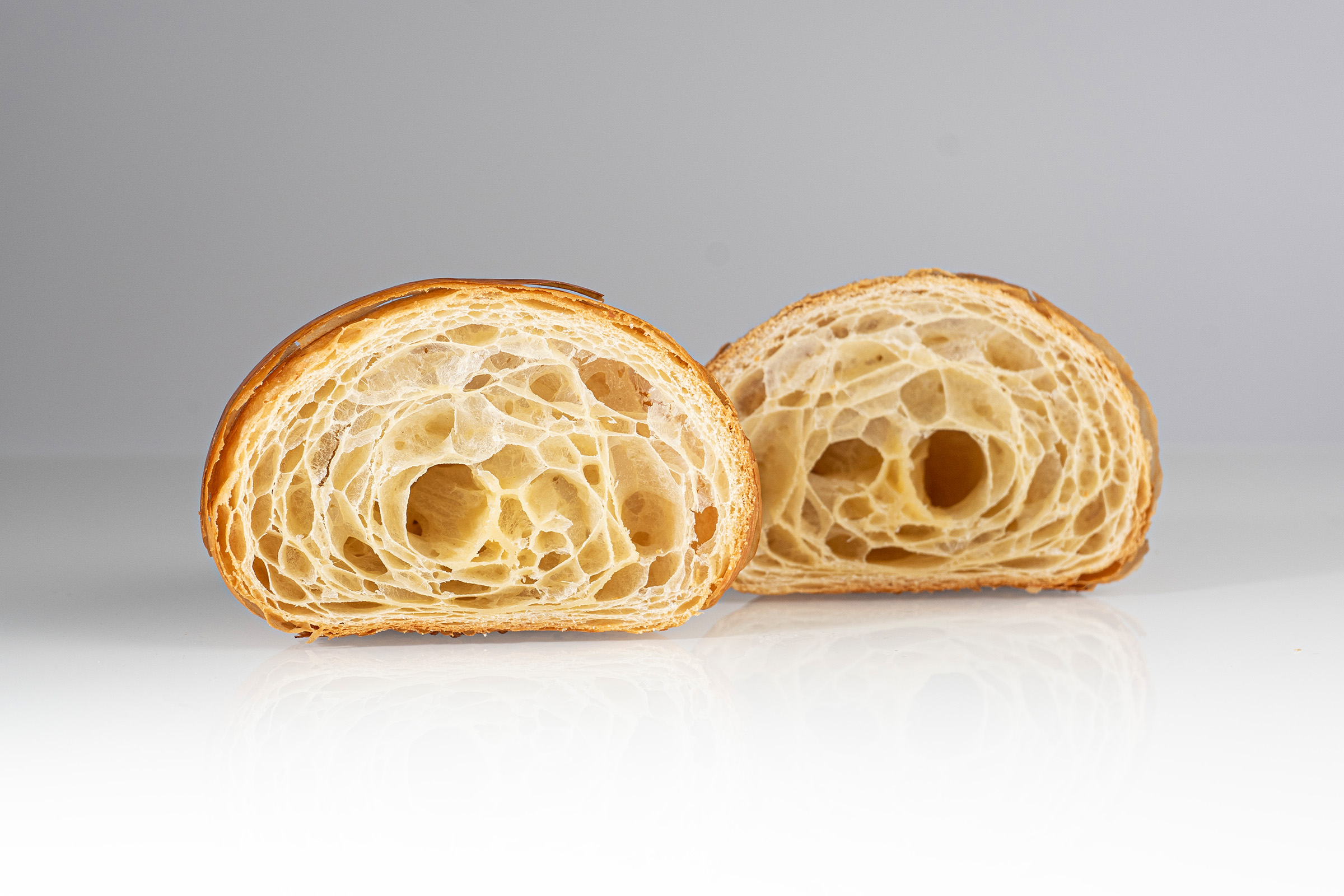
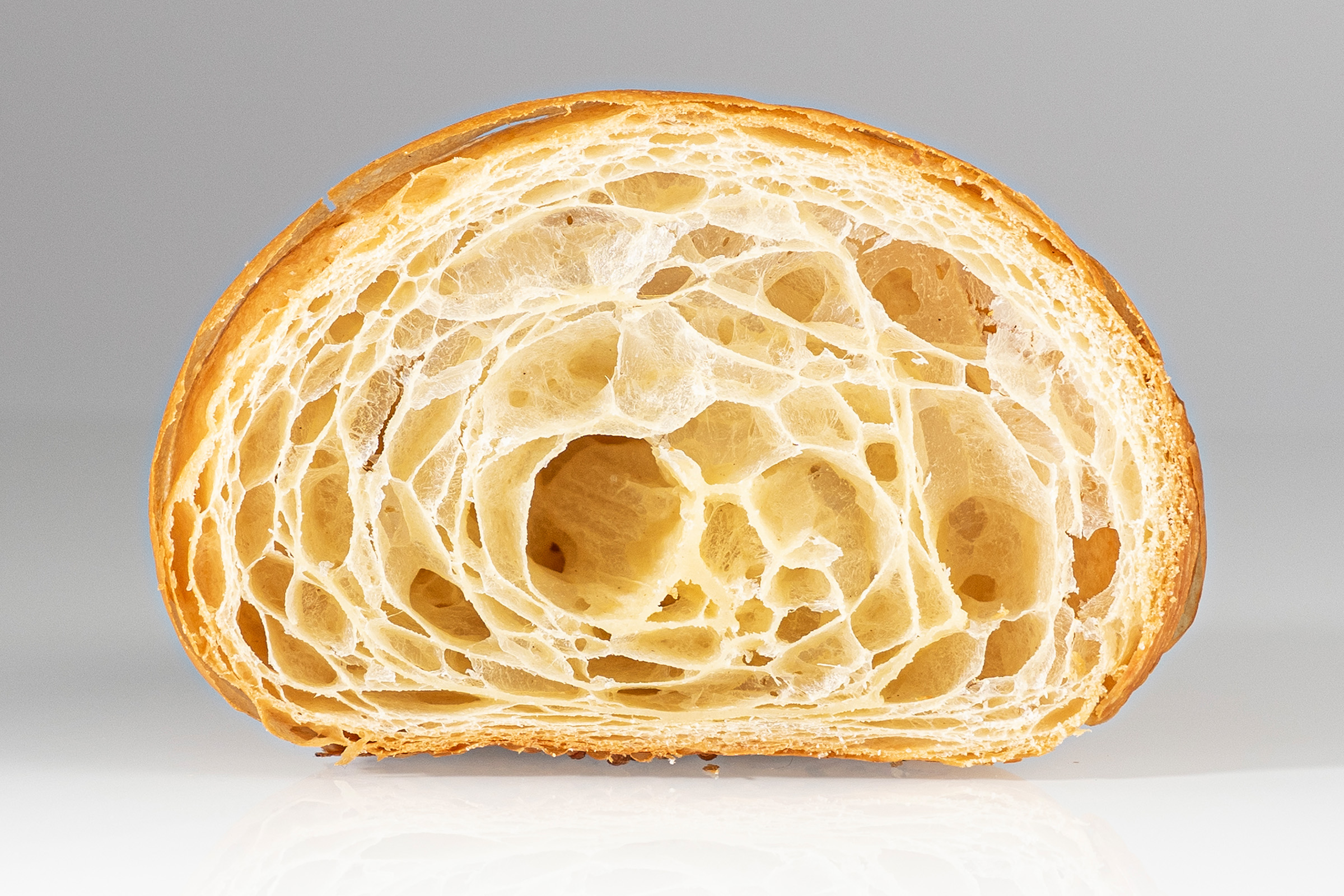
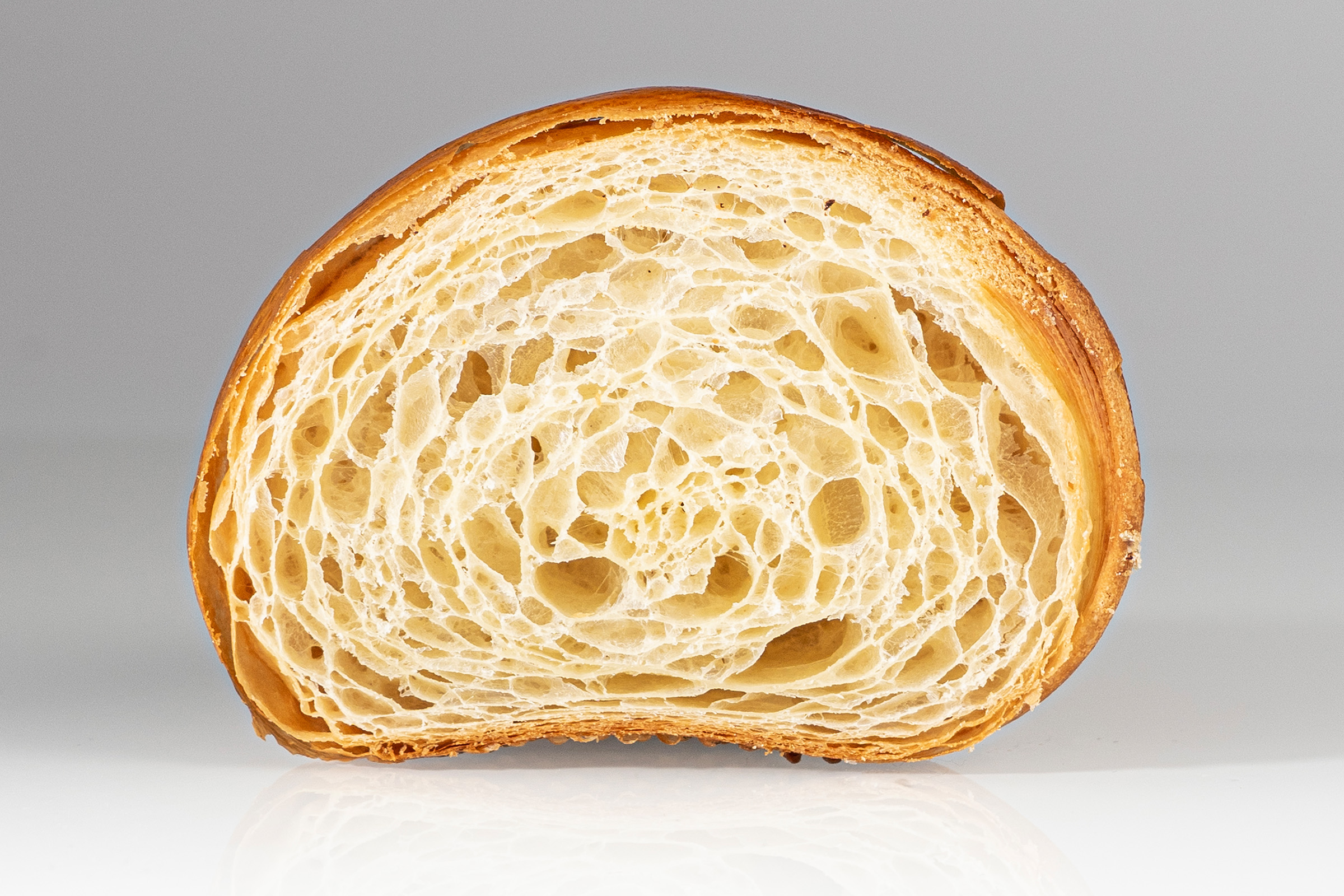
Ein gutes Croissant erkennt man nicht nur an der Form oder an der Farbe – sondern vor allem an seiner Krume. Feine, gleichmäßige Schichten, eine splitternde Kruste und ein butteriges Aroma entstehen nicht zufällig. Genau hier beginnt die Kunst des Laminierens.

Bereits der Grundteig entscheidet später über Erfolg oder Frust. Croissantteige müssen intensiv ausgeknetet werden, damit sich ein stabiles Klebergerüst entwickeln kann. Knetzeiten von 15–20 Minuten sind dabei keine Seltenheit. Die ideale Teigtemperatur liegt zwischen 24–25°C. Wird der Teig zu kalt geführt, entwickelt er sich nur langsam – wird er zu warm, leidet später die Tourierung.

Nach dem Kneten folgt eine Teigreife von etwa 60 Minuten. Anschließend sollte der Teig mehrere Stunden gut durchkühlen. Viele der besten Ergebnisse entstehen sogar bei Kühlzeiten von 12–15 Stunden. Der Vorteil: Der Teig entspannt sich, entwickelt Aroma und lässt sich später deutlich sauberer laminieren.

Ein entscheidender Punkt ist die Butter. Sie bestimmt später die Qualität und Definition der Butterschichten. In der Regel werden etwa 25-35 % Butter bezogen auf das Teiggewicht einlaminiert. Dabei darf jedoch die bereits im Grundteig enthaltene Butter nicht vergessen werden. Je höher die Gesamtbuttermenge, desto sensibler reagiert der Teig beim Tourieren und Backen.


Butter trifft Teig – der Einfluss der Tourierung auf perfekte Croissants


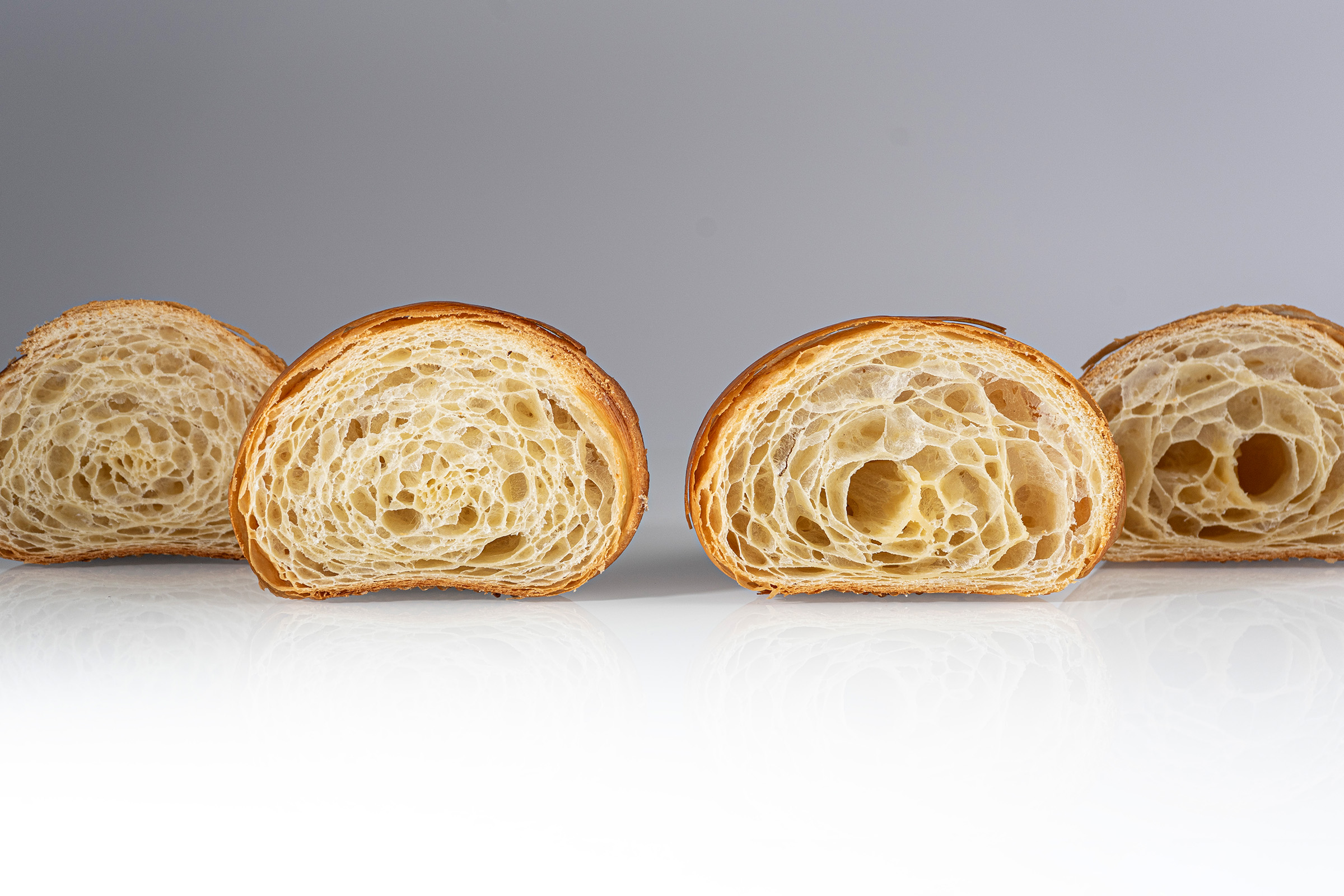
Je nach gewünschter Größe und Charakteristik des Croissants sollte die Anzahl und Art der Touren angepasst werden. Oft wird angenommen, dass viele Touren zu einer stärkeren und deutlicheren Schichtung führen – tatsächlich ist eher das Gegenteil der Fall. Mit jeder zusätzlichen Tour werden die Butter- und Teigschichten dünner. Dadurch steigt die Gefahr, dass die Schichten beim Ausrollen miteinander verschmelzen und sich im Ofen nicht mehr sauber voneinander trennen können. Weniger Touren sorgen daher für kräftigere, klar abgegrenzte Schichten, während mehr Touren meist zu einer feineren, dichteren Krume und einem größeren Volumen führen.

Die Wahl der Tourierung sollte deshalb immer an das gewünschte Endprodukt angepasst werden:

1.) Zwei einfache Touren – für markante Croissantschichten


Ein Croissant, das mit zwei einfachen Touren in Brieffalttechnik hergestellt wird, besitzt insgesamt neun Butterschichten. Diese vergleichsweise geringe Schichtanzahl sorgt für besonders kräftige, klar voneinander abgegrenzte Lagen und eine ausgeprägt knusprige Kruste.

Im Gegensatz zu mehrfach tourierten Teigen bleiben die Butter- und Teigschichten auch bei dünnem Ausrollen deutlich sichtbar. Dadurch eignet sich diese Methode besonders für Croissants mit markanter Schichtung sowie für Mini-Viennoiseries, bei denen die Struktur optisch stark zur Geltung kommen soll.Bei Verwendung einer Teigausrollmaschine kann die zweite Tour direkt nach der ersten durchgeführt werden.

Auch der Butteranteil spielt bei dieser Tourierung eine wichtige Rolle. Da bei zwei einfachen Touren nur neun Butterschichten entstehen, verteilt sich die Butter auf vergleichsweise dicke Lagen. Bereits moderate Butteranteile zeigen daher eine starke Wirkung auf Schichtung und Knusprigkeit. Bewährt haben sich etwa 25–30 % Butter bezogen auf die Teigmenge.

Während niedrigere Butteranteile eine etwas rustikalere und knusprigere Struktur fördern, sorgen etwa 28–30 % für eine besonders ausgewogene Balance aus Aroma, Saftigkeit und klarer Schichtung.

Auch Laugencroissants werden häufig mit zwei einfachen Touren hergestellt, da die klar abgegrenzten Schichten nach dem Laugenbad besonders schön sichtbar bleiben und für eine splitternde, aromatische Kruste sorgen.


2.) Eine doppelte und eine einfache Tour – der Klassiker


Ein Croissant, das mit einer doppelten Tour (Buchfaltung) und anschließend einer einfachen Tour (Brieffaltung) hergestellt wird, besitzt insgesamt zwölf Butterschichten. Diese Tourierung gilt als die klassischste und universellste Methode in der Croissant-Herstellung, da sie eine besonders ausgewogene Balance zwischen Volumen, Schichtung und Zartheit erzeugt.

Die Reihenfolge der Touren spielt dabei eine wichtige Rolle: Zuerst wird die doppelte Tour, anschließend die einfache Tour durchgeführt. Dadurch entsteht beim späteren Ausrollen eine deutlich gleichmäßigere Teigstruktur. Idealerweise wird bereits bei der letzten Tour die gewünschte Teigbreite erreicht, sodass der tourierte Teig vor dem Formen nur noch auf die benötigte Länge ausgerollt werden muss. Das schont die Schichten und sorgt für ein gleichmäßigeres Backergebnis.

Die zwölf Butterschichten sorgen für eine feine und gleichmäßige Innenstruktur, ohne dass die einzelnen Lagen zu dünn werden. Dadurch entsteht ein stabiles Verhältnis zwischen Teig und Butter, was diese Methode besonders fehlertolerant macht und das Risiko von Butteraustritt oder verschmierten Schichten deutlich reduziert.

Auch beim Butteranteil zeigt sich diese Methode besonders flexibel. Bewährt haben sich etwa 28–32 % Butter bezogen auf die Teigmenge. Durch die gleichmäßige Verteilung der Butter entstehen Croissants mit feiner Schichtung, lockerem Volumen und ausgewogenem Aroma.

Das eigentliche Spiel der Butterschichten entscheidet später über die Krume. Viele Schichten erzeugen eine feinere, gleichmäßigere Porung. Weniger Schichten führen dagegen zu einer gröberen und oft spektakuläreren Wabenstruktur. Genau deshalb sollte die Anzahl der Touren immer mit der Buttermenge abgestimmt werden. Denn je weniger Schichten vorhanden sind, desto geringer sollte auch die laminierte Buttermenge ausfallen. Ansonsten steigt die Gefahr, dass die Butter beim Backen ausläuft.


3.) Zwei doppelte Touren – für voluminöse und gefüllte Croissants

Ein Croissant, das mit zwei doppelten Touren im Buchfaltverfahren hergestellt wird, besitzt insgesamt sechzehn Butterschichten. Durch die höhere Anzahl an Schichten entsteht eine besonders feine und gleichmäßige Struktur mit großem Volumen und einer sehr lockeren Krume.

Bei Verwendung einer Teigausrollmaschine kann die zweite doppelte Tour direkt nach der ersten durchgeführt werden. Auch bei dieser Methode sollte bereits bei der letzten Tour möglichst die gewünschte Teigbreite erreicht werden. Der tourierte Teig muss anschließend nur noch in die Länge ausgerollt werden, wodurch die feinen Butter- und Teigschichten geschont werden und die Struktur besonders gleichmäßig bleibt.

Die sechzehn Butterschichten sorgen für eine sehr feine Laminierung und ein üppiges Volumen. Gleichzeitig werden die einzelnen Schichten etwas dichter, wodurch diese Tourierung besonders stabil wird. Aus diesem Grund eignet sich diese Methode hervorragend für gefüllte Croissants und Viennoiserie-Produkte mit höherem Gewicht oder viel Volumen.

Besonders häufig wird diese Tourierung bei Croissants mit Cremefüllungen eingesetzt – etwa bei Karamell-Vanille-Croissants, exotischen Croissants oder anderen gefüllten Varianten. Auch Produkte wie Pain au Chocolat, dänisches Gebäck oder fruchtgefüllte Plunder profitieren von der stabilen und voluminösen Struktur dieser Tourierung. Häufig wird dabei mit einer etwas stärkeren Endteigdicke von etwa 4 mm gearbeitet, um ausreichend Stand und Volumen zu erzeugen.

Beim Butteranteil haben sich etwa 30–35 % Butter bezogen auf die Teigmenge bewährt. Durch die höhere Anzahl an Schichten verteilt sich die Butter besonders fein im Teig und sorgt für eine zarte, saftige Krume mit guter Frischhaltung.

4.) Drei einfache Touren – für maximales Volumen

Ein Croissant, das mit drei einfachen Touren in Brieffalttechnik hergestellt wird, besitzt insgesamt siebenundzwanzig Butterschichten. Damit entstehen von allen klassischen Tourierungsarten die meisten Butterlagen, wodurch ein besonders feines und voluminöses Croissant erzeugt wird.

Bei Verwendung einer Teigausrollmaschine können die ersten beiden einfachen Touren direkt hintereinander durchgeführt werden. Anschließend sollte der Teig etwa 30 Minuten ruhen, bevor die dritte Tour erfolgt. Auch bei dieser Methode empfiehlt es sich, bereits bei der letzten Tour die gewünschte Teigbreite zu erreichen, damit der tourierte Teig später nur noch in die Länge ausgerollt werden muss.

Durch die hohe Anzahl an Schichten wird der Teig extrem fein laminiert. Das Ergebnis sind sehr dünne, zarte Teiglagen mit einem besonders lockeren Volumen. Gleichzeitig bleiben die Lufteinschlüsse im Inneren kleiner und dichter verteilt, wodurch beim Anschnitt eine gleichmäßige und stabile Krume entsteht.

Diese Methode ist in Frankreich deutlich weniger verbreitet als die klassischen Varianten mit zwei Touren, bietet jedoch einige interessante Vorteile. Durch die vielen dünnen Butterlagen bleibt das Croissant besonders lange knusprig und weicht deutlich langsamer durch. Vor allem die Frischhaltung profitiert von der fein verteilten Butter im Teig.

Aus diesem Grund eignet sich diese Tourierung besonders für Croissants mit höherem Butteranteil oder für Produkte, bei denen eine längere Knusprigkeit und Haltbarkeit gewünscht wird.

Beim Butteranteil haben sich etwa 32–38 % Butter bezogen auf die Teigmenge bewährt. Durch die vielen dünnen Schichten kann die Butter besonders gleichmäßig verteilt werden, ohne dass die Croissants schwer oder fettig wirken.


Wichtig:

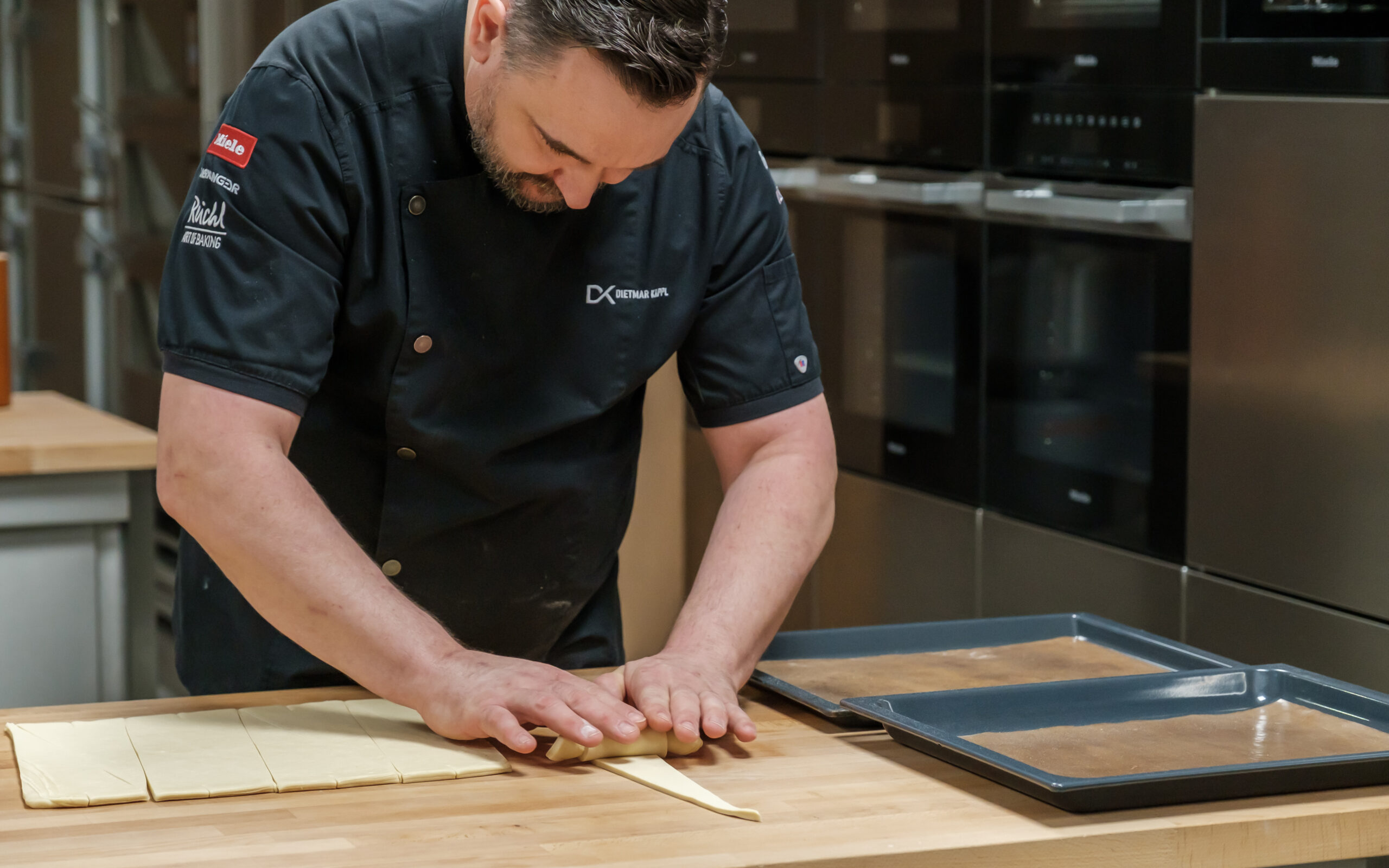
Besonders wichtig beim Laminieren: Sowohl der Grundteig als auch die Butterplatte sollten möglichst dünn und gleichmäßig ausgerollt werden. Dadurch lässt sich die Butter deutlich einfacher und sauberer eintourieren. Zusätzlich empfiehlt es sich, die Eckkanten beim Ausrollen sauber abzuschneiden. Das erleichtert die weitere Aufarbeitung enorm und sorgt für gleichmäßige Butter- und Teigschichten bis in den Randbereich.

Die richtige Formgebung – Teigstärke, Dreiecksgröße und Einfluss auf das Croissant

Je nach gewünschtem Endprodukt gibt es bei Croissants deutliche Unterschiede in Form, Größe und Tourierung. Neben der Anzahl der Touren spielen auch Teigstärke sowie die Abmessungen der Teigdreiecke eine entscheidende Rolle für das spätere Backergebnis. Während kleinere Croissants meist mit stärker ausgeprägter Schichtung und geringerem Gewicht hergestellt werden, benötigen großvolumige Croissants breitere und längere Teigdreiecke.

Als grobe Richtlinie wird der tourierte Teig häufig auf etwa 3,5 mm Dicke ausgerollt. Die Dreiecke besitzen dabei meist eine Breite von 9–10 cm und eine Länge von 28–30 cm. Diese Maße ermöglichen ein ausgewogenes Verhältnis zwischen Volumen, Schichtung und einer gleichmäßigen Formgebung. Je nach gewünschter Optik und Gewicht können diese Richtwerte jedoch individuell angepasst werden.


Gare

Auch die Endgare wird häufig unterschätzt. Croissants sollten möglichst nicht über 28°C gegärt werden. Wird die Gare zu warm geführt, beginnt die Butter zwischen den Schichten weich zu werden und verliert ihre stabilisierende Wirkung. Die Folge sind flache Croissants mit wenig Volumen und unsauberen Schichten. Dauer der Endgare ca. 2,5-3 Std, bei 75% Luftfeuchtigkeit und 27°C

Backen

Mindestens genauso entscheidend ist das Backen selbst. Ein hohes Anbacken sorgt für Stabilität und garantiert, dass das Croissant seine Form behält – 200-205C^fallend auf 170-180°C haben sich als richtwert bewiesen. Wird zu kühl gebacken, fallen Croissants während des Backens oft sichtbar zusammen – ein klassisches Zeichen für zu niedrige Anfangshitze. Die Backzeit sollte je nach Größe etwa 17–18 Minuten betragen.

Besonders gute Ergebnisse liefern Heißluftöfen. Durch die gleichmäßigere Hitzeverteilung entstehen stabilere Croissants mit besserer Krustenbildung und schönerer Ausbundentwicklung. Wichtig bleibt dabei jedoch immer die Balance zwischen kräftigem Anbacken und ausreichender Backzeit.


Eistreich und Glanzstreiche – für perfekte Farbe und Glanz bei Croissant

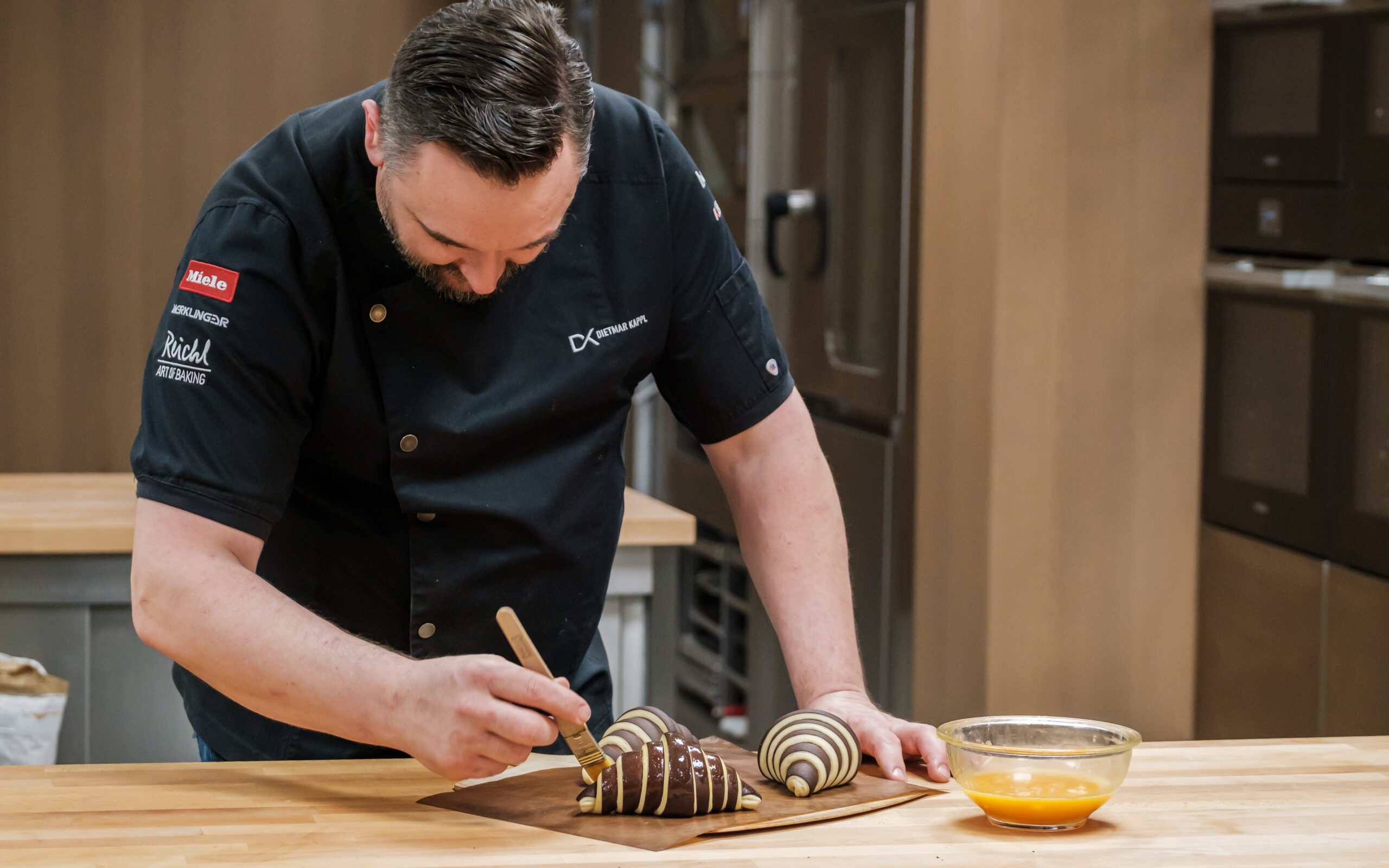
Der richtige Eistreich entscheidet maßgeblich über die spätere Optik von Croissants, Plundergebäck und anderen Viennoiserie-Produkten. Eine ausgewogene Mischung sorgt nicht nur für eine gleichmäßige Bräunung, sondern auch für einen feinen Glanz und eine attraktive Oberfläche nach dem Backen.

Zutaten

  • 50 g Vollei
  • 50 g Eigelb
  • 50 g Milch
  • 5g Honig
  • 1 Prise Salz

Herstellung

Alle Zutaten in ein hohes Gefäß geben und etwa 30 Sekunden mit dem Stabmixer gut vermischen. Durch das Mixen verbinden sich die Zutaten zu einer homogenen Masse, die sich später besonders gleichmäßig auftragen (sprühen) lässt.

Anschließend die Mischung durch ein feines Sieb passieren. Dadurch werden Eifäden und mögliche Klümpchen entfernt, was einen sauberen und gleichmäßigen Auftrag ermöglicht.

Der fertige Eistreich sollte bis zur Verwendung im Kühlschrank gelagert werden.

Wirkung der Eistreich

Der Anteil an Eigelb sorgt für eine kräftige Farbgebung und einen schönen Glanz, während die Milch die Bräunung unterstützt und den Auftrag geschmeidiger macht. Dadurch entsteht nach dem Backen eine gleichmäßige, goldbraune Oberfläche ohne Fleckenbildung.

Besonders wichtig ist ein dünner und gleichmäßiger Auftrag. Zu viel Eistreich kann die feinen Teig-Butterschichten verkleben und das Ofentriebverhalten negativ beeinflussen.

Glanzstreiche mit Sirup

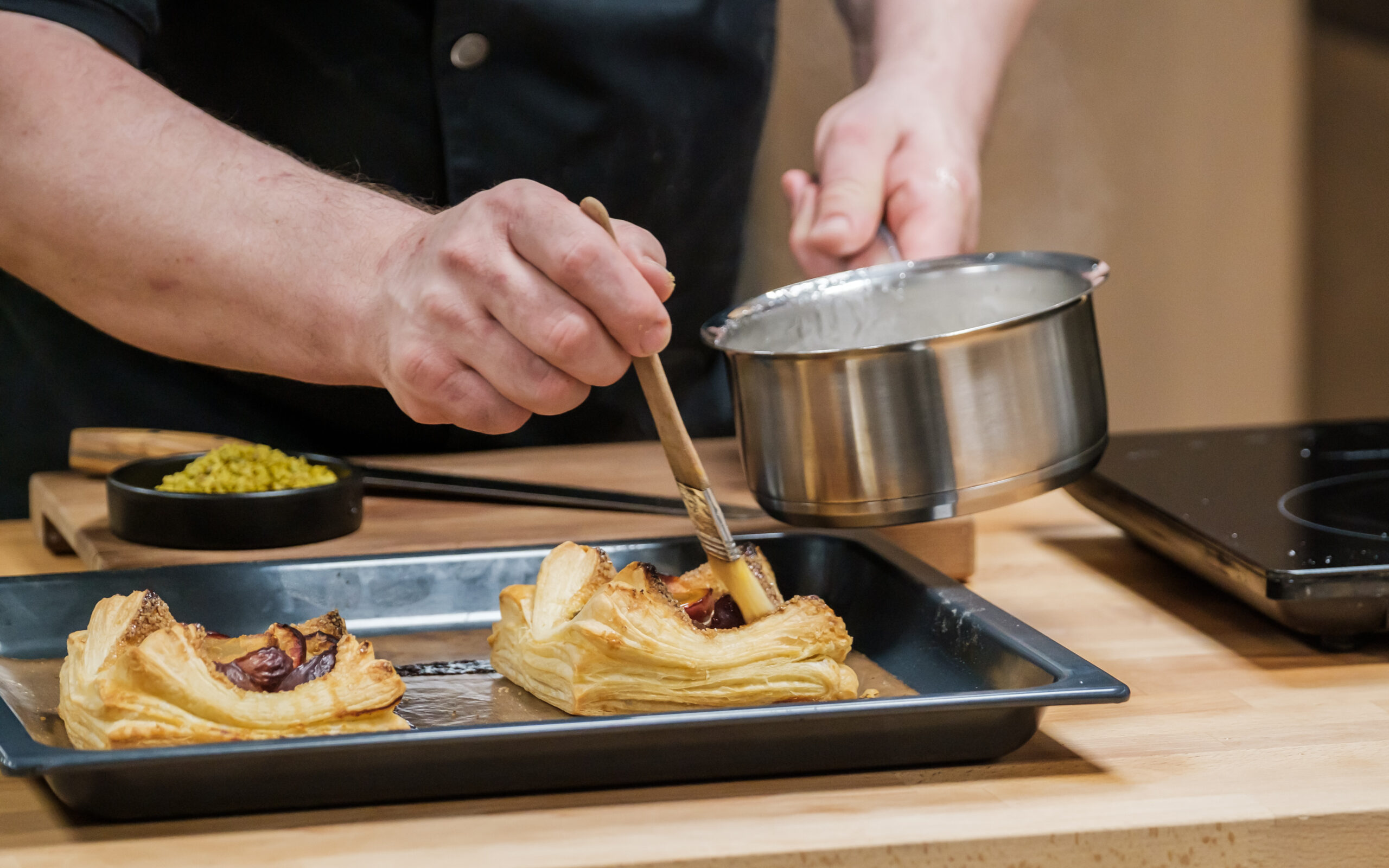
Um Croissants und Plundergebäck nach dem Backen zusätzlichen Glanz zu verleihen, eignet sich ein einfacher Zuckersirup hervorragend. Dieser wird direkt nach dem Backen dünn auf das heiße Gebäck aufgetragen.

Zutaten

  • 100 g Wasser
  • 100 g Zucker

Herstellung

Wasser und Zucker in einen Topf geben und unter ständigem Rühren erhitzen, bis sich der Zucker vollständig gelöst hat. Sobald die Mischung aufkocht, den Topf vom Herd nehmen und den Sirup auf Raumtemperatur abkühlen lassen.

Der fertige Sirup kann im Kühlschrank gelagert und bei Bedarf verwendet werden.

Der dünn aufgetragene Sirup sorgt für einen attraktiven Glanz und schützt die Oberfläche zusätzlich vor dem Austrocknen. Gleichzeitig bleiben Croissants und Plundergebäck länger frisch und wirken optisch hochwertiger. Besonders bei gefüllten oder dekorierten Viennoiserie-Produkten verleiht die Glanzstreiche ein professionelles Finish.


Keyfacts zum Laminieren von Croissantteigen

  • Knetzeit: 15–20 Minuten für ein stabiles Klebergerüst
  • Optimale Teigtemperatur: 24–25°C
  • Teigreife nach dem Kneten: ca. 60 Minuten
  • Anschließend mehrere Stunden bis 15 Stunden gut durchkühlen
  • Buttermenge: ca. 25 % vom Teiggewicht oder 50 % der Mehlmenge je nach Laminierung
  • Butter im Grundteig zusätzlich berücksichtigen
  • Grundteig und Butterplatte möglichst dünn ausrollen
  • Eckkanten beim Ausrollen abschneiden für gleichmäßige Schichten
  • Mehr Schichten = feinere Krume
  • Weniger Schichten = größere Wabenstruktur
  • Weniger Touren benötigen meist auch weniger laminierte Butter
  • Endgare nicht über 28°C
  • Kräftiges Anbacken sorgt für stabile Croissants
  • Zu niedrige Backtemperatur führt oft zum Zusammenfallen
  • Backzeit: ca. 17–18 Minuten
  • Heißluftöfen liefern meist stabilere und gleichmäßigere Ergebnisse


  •  

Spring 2026 Book Tour news!

May 5th marks the release of The Great Book of Chocolate which is now available for pre-order from your local independent book seller as well as Bookshop, Amazon, and Barnes & Noble online. And I’m going on book tour! Due to global events, travel has become more challenging, especially internationally.

  • If you can’t make it to an event, and I’m not coming to where you live, and you’d like a personalized, signed copy of a book, you can order one from Kitchen Arts & Letters (before May 4th), Omnivore Books (before May 11th) or Now Serving LA (before May 14th), and they will send you a copy. Should you have questions, please contact the shops.

Note that a number of events are ticketed, which helps support the bookstores, and at places where books can be pre-purchased, that ensures that you’ll get a book. If you do have questions about events, please contact the venue directly as they are best equipped to answer your questions.

Hope you can make it!

May 4: Chat and booksigning with Matt Rodbard of Taste Live at Rizzoli Bookstore, New York City – tickets here

May 5: Booksigning at Williams-Sonoma, Columbus Circle, New York City – tickets here

May 6: Booksigning at Williams-Sonoma, Short Hills, New Jersey – tickets here

May 9: Markethall Foods, Oakland, CA – more info here (I’ll be signing books Noon to 1:30pm)

May 11: Omnivore Books, in conversation with Kate Leahy, San Francisco, CA – more info here.

May 12: Dandelion Chocolate, San Francisco, CA – tickets here

May 14: Now Serving LA, Los Angeles, CA, in conversation with Clémence de Lutz of Petitgrain boulangerie – tickets here

May 16: Friends & Family Bakery, with Roxana Jullapat, Los Angeles, CA – tickets here.

Note that this event is open to all, but books can be prepurchased from their website prior to event, and pastry boxes inspired by The Great Book of Chocolate and Ready for Dessert will also be available for pre-purchase. Prepurchasing a book ensures that you’ll get a book and also supports small, local businesses. Check the event page for details!

May 30: Booksigning at La Trésorerie Rive Gauche (48, rue de Grenelle, 7th, Paris), 3pm to 4:30pm. Copies of The Great Book of Chocolate and My Paris Kitchen will be available for sale and signing.

You can purchase or order the book at your local bookstore or online retailer from one of these links:

Amazon | Bookshop.org | Now Serving | Barnes & Noble | Omnivore | Book Larder | Kitchen Arts & Letters | Bold Fork | Books are Magic | Amazon France | Powell’s | RJ Julia | Strand | Smith & Son Paris | Amazon UK | Politics and Prose | Vivienne Culinary Books | Book Passage | Elliot Bay | Village Books | East End Books | Indigo Canada

Events will be published and updated here as they are announced. Please note that events on this page are subject to change and revision. It’s suggested that you contact the venue before an event to confirm the time and date, as well as if a ticket or purchase is required, if you can bring books purchased elsewhere to be signed, or if you have any other questions or need additional information.

  •  

Deine Stimme für “Baking Next Level”!

🥖 Baking next Level Roggen ist für den Deutschen Kochbuchpreis nominiert! 🎉

Was für eine Freude – mein Buch „Baking next Level Roggen“ wurde beim Deutschen Kochbuchpreis 2025 in der Kategorie „Brot“ nominiert!
Damit tritt es gegen fünf weitere großartige Brotbackbücher an – und ich freue mich riesig, dass die Leidenschaft für Roggenbrot auf diese Weise gewürdigt wird.

Doch das ist noch nicht alles:
Neben der Jurywertung gibt es auch den Publikumspreis, bei dem ihr mitentscheiden könnt! 💪

🗳 Jetzt abstimmen & unterstützen

👉 Abstimmung läuft bis zum 24. November
➡ Zum Voting: kochbuchpreis.de/voting

Jede Stimme zählt – und vielleicht holen wir gemeinsam den Publikumspreis nach Hause!
Teilt den Link gern mit Freunden, Familie oder eurer Back-Community – je mehr Stimmen, desto besser.

📲 Bleibt dran auf Instagram

Der Deutsche Kochbuchpreis postet regelmäßig Updates auf @kochbuecher.
Ich werde natürlich auch auf meinem Kanal Einblicke, Roggenpower und ein paar Überraschungen teilen – schaut also vorbei und helft mit, das Roggenbrot auf die große Bühne zu bringen!

Danke euch allen für die großartige Unterstützung, das viele Feedback und die Begeisterung für echtes, handwerkliches Brotbacken.
Egal, wie das Voting ausgeht – dass Baking next Level Roggen so viele Menschen inspiriert, ist für mich schon der größte Gewinn. ❤

Euer
Dietmar

  •  

„Der Countdown läuft”

🏆 Hauptverlosung – Wichtige Infos

Ihr Lieben,
bald ist es soweit – die Hauptverlosung steht vor der Tür! 🎉
Am Sonntag 2. November um 19:00 Uhr findet die Ziehung live auf meinem Facebook-Account statt.

Wir haben uns bewusst für eine Live-Verlosung entschieden, um eine ehrliche und transparente Ziehung zu ermöglichen.
So kann jede und jeder, der möchte, den Ablauf direkt mitverfolgen und sicher sein, dass alles fair und offen abläuft.

Keine Sorge, wenn ihr keinen Facebook-Account habt – alle Gewinnerinnen und Gewinner werden selbstverständlich im Anschluss auf unserem Blog bekannt gegeben, damit niemand etwas verpasst.

Die enorme Beteiligung hat uns wirklich überwältigt – damit hätten wir nie gerechnet!
Damit alles fair bleibt, werden alle gezogenen Lose nach der Ziehung nochmals sorgfältig überprüft.

Dabei achten wir besonders auf:

  • Wurden beide Fotos korrekt eingereicht (ein Teigfoto und ein Foto des fertigen Produkts)?
  • Wurden die Rezept-Kriterien eingehalten?
  • Wurde das vorgeschlagene Rezept tatsächlich gebacken?

Da einige Teilnehmerinnen und Teilnehmer mehrere Posts eingereicht haben, erhöht sich dadurch natürlich auch die Chance auf einen Gewinn.


Trotzdem möchten wir klarstellen:
👉 Pro Person wird nur ein Gewinn vergeben.
Sollte es also passieren, dass jemand zufällig mehrmals gezogen wird (bei der großen Anzahl an Losen kann das durchaus vorkommen), wird selbstverständlich nur ein Gewinn pro Person ausgegeben – so bleibt es für alle fair.

Und nicht vergessen: Ihr habt noch 12 Tage für den Endspurt! Nutzt die Zeit, um eure Einträge abzuschicken – wir drücken euch die Daumen!

Wir freuen uns schon riesig auf die Ziehung und sind gespannt, wer diesmal das Glück auf seiner Seite hat!
Vielen Dank für eure wunderbare Teilnahme!

Bitte in hier keine Ergebnisse in den Kommentaren posten!!!!

  •  

Paris book launch and booksigning of ready for dessert!

I’ll be at AXS design, one of my favorite shops in Paris, celebrating the release of Ready for Dessert on Sept 30th from 5:30 to 7pm.

AXS is filled with treasures, including French dinnerware, glasses and linens, and lots more. They were kind enough to lend me some of their beautiful items for the photos in book, so I’m thrilled they’re hosting the book launch and signing. Books will be available for purchase and I’ll be on hand to personalize them for you.

Thanks to Comté for providing samples of French cheese for the event.

See you there!

  •  

paris book event – june 29, 2025

The Sweet Life in Paris

Join me and my friend Jane Bertch in Paris on Sunday, June 29th, for a booksigning event from 3pm to 4:30pm at La Cuisine Paris at 78 Quai de l’Hôtel de Ville (4th).

I’ll be signing paperback copies of my books L’Appart and The Sweet Life in Paris, and Jane will be signing copies of her memoir of opening a cooking school in Paris, The French Ingredient.

Note that books are in limited supply and you are welcome to bring books you’ve purchased elsewhere. Please note that the venue is not able to take credit card payments on-site.

Stop by and say hi!

  •  

Teigfestigkeit

Warum dein Brotteig zu weich oder zu fest wird – und was du dagegen tun kannst

Oft werde ich angeschrieben mit Fragen wie: “Warum ist mein Teig so klebrig?”, “Warum ist er so fest geworden?”, oder “Stimmt die Rezeptur überhaupt?” – diese Unsicherheit ist völlig normal. Tatsächlich gibt es viele Gründe, warum ein Teig nicht wie gewünscht ausfällt, und die liegen oft nicht am Rezept selbst. In diesem Beitrag erkläre ich dir, woran es wirklich liegen kann – und wie du ganz einfach gegensteuern kannst.

Du freust dich aufs Backen, hast alles vorbereitet – und trotzdem ist dein Weizenteig viel zu weich, klebt an den Fingern oder ist so fest, dass er kaum aufgehen will? Keine Sorge: Das passiert selbst erfahrenen Hobbybäckerinnen und Hobbybäckern.

In diesem Beitrag zeige ich dir die häufigsten Ursachen für unpassende Teigkonsistenzen – speziell bei Brotteigen und Weizenteigen für Brot und Kleingebäck – und gebe dir hilfreiche Tipps, wie du diese Probleme ganz leicht in den Griff bekommst.


1. Mehl ist nicht gleich Mehl Auch wenn auf der Packung “Weizenmehl Typ 550/700” oder “Roggenmehl 960/997” steht – Mehl ist nicht gleich Mehl. Je nach Hersteller, Mahlgrad und Lagerung nimmt es unterschiedlich viel Wasser auf. Das hat direkten Einfluss auf die Teigkonsistenz.

Tipp:

Starte mit 10–15 % weniger Flüssigkeit als im Rezept angegeben.

Beim ersten Versuch eines neuen Rezepts: Gib die Flüssigkeit nach und nach dazu, bis der Teig geschmeidig, elastisch und nicht mehr klebrig ist.

Wenn du regelmäßig dasselbe Mehl verwendest, notiere dir die optimale Wassermenge – das spart beim nächsten Mal Zeit und Frust.


2. Backrezepte sind ein Leitfaden, aber keine exakte Wissenschaft. Faktoren wie Raumtemperatur, Luftfeuchtigkeit, Mehlsorte oder das eingesetzte Knetsystem beeinflussen die Teigentwicklung enorm. Wer sich stur an Milliliter- und Grammangaben klammert, erlebt schnell Enttäuschung.

Tipp:

  • Beobachte deinen Teig und verlasse dich nicht nur auf die Waage.
  • Ein guter Brotteig ist glatt, elastisch, dehnbar – aber nicht zu klebrig.
  • Brötchenteig darf etwas fester sein, damit er Form und Ofentrieb behält.

3. Ungenaue Messmethoden Volumenangaben wie “1 Tasse Mehl” sind zu ungenau. Je nachdem, wie das Mehl geschöpft wurde, können sich schnell 30–50 g Unterschied ergeben – das reicht, um den Teig zu feucht oder zu trocken werden zu lassen.

Tipp:

  • Nutze immer eine digitale Küchenwaage – auch für Flüssigkeiten.
  • Faustregel: 100 ml Wasser entsprechen 100 g.
  • Kleine Ungenauigkeiten summieren sich – besonders bei Teigen mit langer Gärzeit.

4. Knetzeit – zu kurz oder zu lang Weizenmehl benötigt Energie beim Kneten, um ein stabiles Glutengerüst zu entwickeln. Nur so kann der Teig beim Backen stabil aufgehen. Zu langes Kneten, insbesondere mit der Maschine, macht ihn dagegen gummiartig.

Tipp:

  • Fenstertest: Ein kleines Teigstück dünn ausziehen – wird es durchsichtig? Dann ist der Teig optimal geknetet.
  • Beim maschinellen Kneten: Lieber mehrmals kontrollieren als zu lange kneten lassen.
  • Brötchenteige eher mittelfest kneten, Brotteige dürfen elastischer sein.
  • Roggenhaltige Teige nur kurz mischen: Zu langes Kneten macht sie weich.

5. Falsche Reifezeiten! Ein zu kurzer oder zu langer Reifeprozess bringt den Teig aus dem Gleichgewicht. Überreifer Teig fällt zusammen, unreifer Teig hat unkontrollierten Ofentrieb.

Tipp:

  • Reifezeit nach Volumen beurteilen, nicht nach Zeit: Hat sich der Teig sichtbar vergrößert, ist er bereit.
  • Fingertest: Leicht eindrücken – bleibt die Delle, passt der Gärzustand.
  • Gehzeiten sind Richtwerte, kein Dogma – beobachte deinen Teig.

6. Überreife Sauerteige oder Vorteige – ein häufig unterschätzter, aber sehr wichtiger Punkt: Überreife und zusammengefallene Sauer- oder Vorteige können gebundenes Wasser nicht mehr halten. Das führt zu weichen, instabilen Teigen. Zudem erschwert der hohe Säuregehalt insbesondere bei Weizenteigen die Teigentwicklung erheblich. Der Teig löst sich schlecht von der Kesselwand. Bei Roggenteigen zeigt sich der Fehler oft erst bei der Endgare durch flache, breitgelaufene Brote.

Tipp:

  • Sauerteige nicht zu lange reifen lassen.
  • Weizenvorteige besser kühl führen. Eine längere Reifezeit im Kühlschrank schadet kaum.
  • Werden überreife Vorteige verwendet, halte zu Beginn etwas Wasser zurück. Gib es erst dazu, wenn sich der Teig von der Kesselwand löst.

Fazit: Deine Hände sind die beste Anleitung Die perfekte Teigkonsistenz lernst du nicht durch exakte Grammangaben, sondern durch Fühlen, Beobachten und Ausprobieren. Je öfter du backst, desto besser wird dein Gespür für Teige.

Extra-Tipp: Führe ein Teig-Tagebuch und notiere dir:

  • verwendetes Mehl
  • Teigkonsistenz und Teiggefühl
  • was besonders gut funktioniert hat
  • und natürlich: das Backergebnis

Das macht dich Schritt für Schritt zum Teigprofi!

  •  

7hauben Backkurs – Viennoiserie

Es ist endlich soweit! Mit großer Freude darf ich euch meinen zweiten Onlinekurs bei 7 Hauben vorstellen. Nachdem mein erster Kurs zur Vollkornbäckerei auf so viel Begeisterung gestoßen ist, lade ich euch jetzt ein, in die Welt der Viennoiserie einzutauchen.

Im neuen Viennoiseriekurs dreht sich alles um feine Gebäcke, die für ihren zarten, buttrigen und unnachahmlichen Geschmack bekannt sind. Ich zeige dir, wie du Croissant-Teig meisterhaft von Hand laminierst, um das perfekte Buttermuster zu erzeugen. Aber das ist längst nicht alles!

Was erwartet dich im Kurs?

  • Croissant-Variationen: Lerne, wie du klassische und kreative Croissants in verschiedenen Formen herstellst, die garantiert alle begeistern.
  • Swiss, Cruffins und New York Rolls: Diese innovativen Gebäckideen sind der neue Trend am Backhimmel – und du kannst sie bald selbst backen!
  • Französischer Blätterteig: Ich verrate dir meine besten Tipps, wie du den perfekten französischen Blätterteig zubereitest – schichtreich, buttrig und luftig. Das Besondere daran: Die Butter wird außen und der Teig innen laminiert, für ein besonders zartes Ergebnis.
  • Französische Brioche: Ein Klassiker, der durch seine lockere, weiche Konsistenz überzeugt.
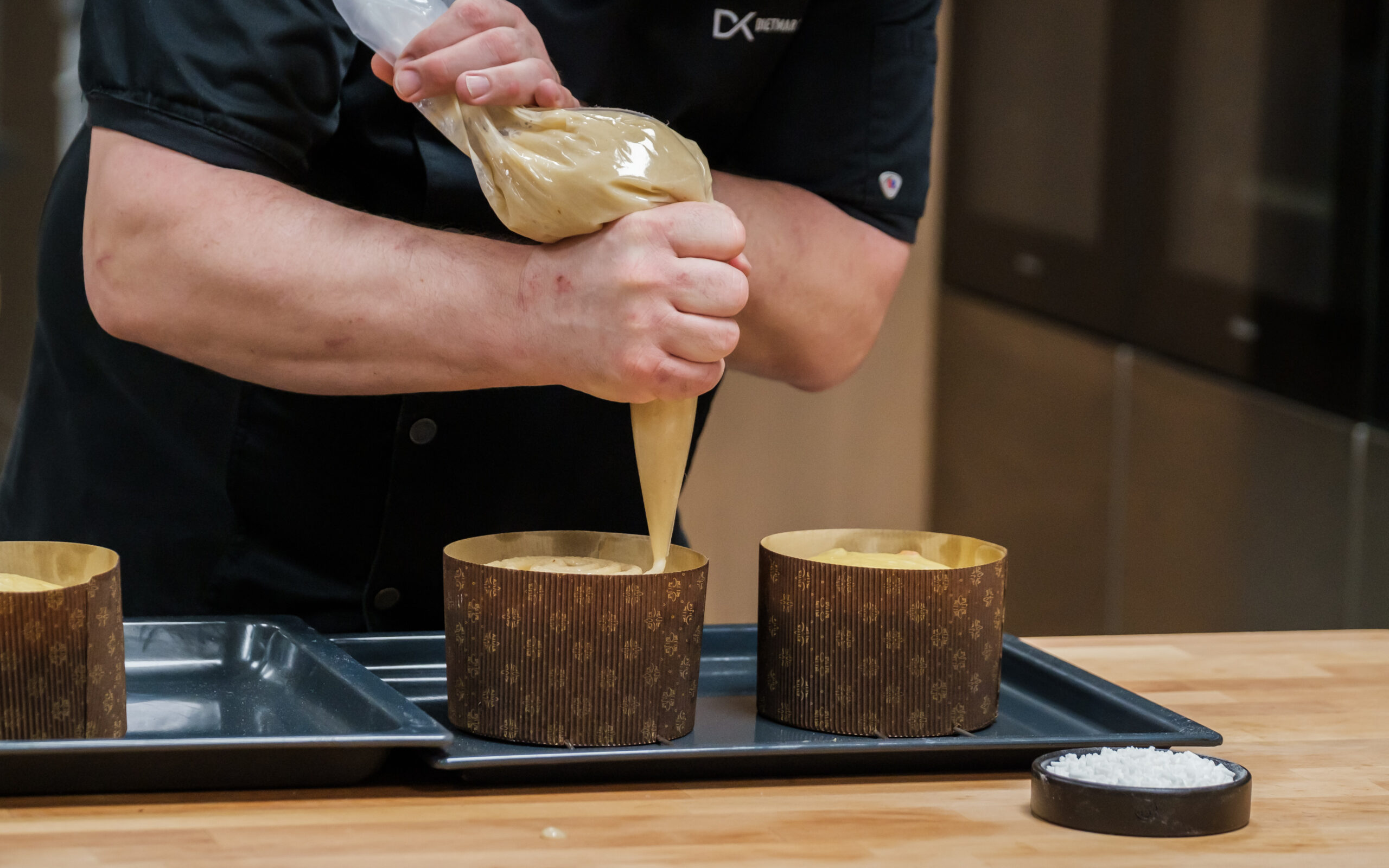
  • Panettone – die Königsklasse: Dieses anspruchsvolle italienische Festtagsgebäck ist das Highlight des Kurses. Schritt für Schritt zeige ich dir, wie du Panettone perfekt hinbekommst – von der Teigführung bis zum Backen.

Tipps und Tricks zur Hand-Laminierung

Im Kurs lernst du, wie du Croissant-Teige und französischen Blätterteig von Hand laminierst – ganz ohne Maschine. Das richtige Laminieren verleiht deinem Teig die perfekte Textur und sorgt für das unverwechselbare Buttermuster. Ich zeige dir alles Wichtige: von der richtigen Teigtemperatur bis hin zur perfekten Laminierung.

Ich freue mich schon sehr, dich auf dieser kulinarischen Reise zu begleiten und bin gespannt, welche köstlichen Meisterwerke du erschaffen wirst!

Klick dich rein – du wirst begeistert sein!

  •  
❌