❌

Reading view

The Broadview Six Case May Be About to Break Open

Here is a short update on the so-called Broadview Six case — one of the high-profile prosecutorial abuse cases coming out of ICE/CBP Midway Blitz occupation of Chicago in the fall and winter of 2025-26. To catch everyone back up, this was a case involving four candidates or elected officials, one campaign staffer and one activist. It was tied to ongoing protests outside the ICE Broadview facility outside Chicago. Federal prosecutors took a situation that involved protestors briefly making contact with a vehicle unexpectedly trying to drive through a protest line and jacked it up to a felony case. As one of the lawyers on the case told me at the time, the facts supported at best a misdemeanor disorderly conduct charge, and even that would been a wild overreaction to what actually happened.

Throughout the case, it was clear that the case was part of the Trump administration’s larger strategy of targeting peaceful protestors with wildly excessive charges. Eventually the case fell apart when major prosecutorial misconduct was uncovered on the part of the prosecutors in the case. All charges were eventually dropped in May with prejudice, just before the trial was to take place. The remaining mystery was tied to the original prosecutor in the case, who committed the misconduct securing the indictment the previous fall. (There was other misconduct tied to turning off doctored transcripts of that grand jury session.) That prosecutor, Sheri Mecklenburg, had a generally apolitical reputation and certainly was no right-winger. Defense attorneys had the impression she didn’t have a lot of confidence in the government’s position. She left the case with little explanation for a DOJ assignment working on the Senate Judiciary Committee under Sen. Dick Durbin (D-IL) in February. Meanwhile, the U.S. Attorney for the Northern District of Illinois — Andrew Boutros — and Mecklenburg’s replacement — William Hogan — were both known to be strongly onboard with the Trump/ICE program. (Hogan also had a tattered reputation on the professional ethics front.)

  •  

Are the Polls Accurate? (Are We Doing This Again?)

This is the weekly, free edition of The Backchannel. If you’d like to receive the free edition of The Backchannel in your inbox, you can subscribe here. If you’d like to upgrade to the members’ edition for full-access to The Backchannel and everything else we publish at TPM, this is the final week we are offering a special promotion for 50% off an annual Prime membership.

This won’t come as huge news to most. But I’m getting asked about it a lot: can the polls be wrong? What do you think?

So let me put an answer here. They can obviously be wrong and you should be prepared for them to be wrong. If you’re running a campaign or SuperPAC, they can give you intel about where to deploy resources. If you’re just observing, they’re more about human nature and anxiety management. But whether you get excited or pushed into despair, we’ll know the actual results in about six weeks. Watch them or don’t. It’ll will be fine either way. There are no poll hubris gods. They can’t strike you down.

Let’s talk specifics.

The polls we’re seeing now are almost certainly directionally accurate. But they could be overshooting on their margins, which are quite large now. If they are we should expect to see that most in red states. (Even for someone like me who’s been bullish about this midterm cycle since mid-2025, some of these numbers are hard to believe.) States have partisan muscle memory that polls can miss. So for instance, yesterday Sabato’s Crystal Ball changed the Kansas Senate race from Likely Republican to Leans Republican, an astonishing development. The polls there are pretty close given that it’s Kansas, and the most recent, an Emerson poll, has Democratic challenger Adam Hamilton up by 1 point. But this is a classic case where you have to weigh a substantial amount of GOP muscle memory into the equation. Polls can miss that, or it can simply mean that undecideds break heavily for the state’s dominant party. To be clear, if I were a Kansas Democrat canvassing I’d be pretty pumped right now. A win is possible. But this is the cautious/realistic way to look at it. The same applies to the handful of other seemingly competitive races in deep red states.

  •  

We Didn’t Know Until This Day … Twitter Was the Echo Chamber All Along

Daniel Drezner says we are now in the Wile E. Coyote phase of the 2026 midterm, the phase of six weeks or so in which everyone knows the GOP is toast but we pretend we don’t. Some of this is simply the political press’s collective suspension of disbelief. It’s neither fair nor fun to act as though the outcome is mostly known. Nor is this new. G. Elliott Morris notes that election odds makers consistently overstate the odds of the president’s party in the midterms, which is sort of another way of saying the same thing since the president’s party is usually on the losing end of the proposition. I would argue that a significant amount of this remains the structural, though not necessarily ideological, bias in favor of the Republican party — two decades on, Washington, D.C. remains wired for the GOP. But what all of this really reminds me of is the aftermath of the 2024 presidential election and what was then referred to as the “vibe shift” — both the hidden reality Donald Trump’s narrow but clear victory had purportedly revealed but also the shift in attitudes about cultural power and the future driven by that victory.

In elite circles the argument and belief went something like this. We thought that MAGA was a movement of reaction fueled by those left behind or discarded by the forward march of history and culture trying to wrench society back to an imagined 1950s. Not at all. In fact, it was the movement of the young and the most vital elements of the culture and the future. It was even expanding in the non-white constituencies which were supposed to be the anchors of the political left, the communities which were supposedly the targets and victims of MAGA, not its latest converts. Most of all, MAGA now had cultural sway to match its electoral power. And both were growing.

  •  

Things Fall Apart (in the Middle East): The Donald Trump Story

One of the key arguments for a great power — other than the great power itself wanting to be one — is that they act as a guarantor of stability and the status quo. That is far from the only public or global good. And a great power will ensure that status quo on its own terms and mostly to its own advantage. But if you have any acquaintance with history, you know you can do a lot worse than relative peace and the status quo. Trump’s Iran War has been a bracing illustration of all these realities. Once the great power starts letting things break, those breakages can start multiplying very fast. Eventually you’ll find a new equilibrium, of course. But eventually can take a long time. And again, even a passing acquaintance with history tells us that things can suck without end for extended periods of time.

There’s an interesting New York Times piece from over the weekend that illustrates all these things. We know the outline. But it provides new details. As a knock-on effect of the U.S. war with Iran, the ongoing battle between Saudi Arabia and the Houthi rebel government in Yemen has again become hot. In recent weeks, the Houthis have partly cut off Saudi Arabia’s other path to the ocean. Put simply, the Saudis can export oil through the Strait of Hormuz or the Red Sea. The former has been mostly closed for months. Now the Houthis are in de facto or near control of the second. That’s a big crisis for the Saudis. This is part of the larger U.S.-Iran battle because the Houthis are clients of Iran. And Iran’s core strategy has been to create enough pain for the U.S.’s regional allies that they will force the U.S. to end the war. Remember, each time the U.S. attacks Iran, they respond by attacking the various Gulf emirates.

  •  

Notes on the Florida Senate Race

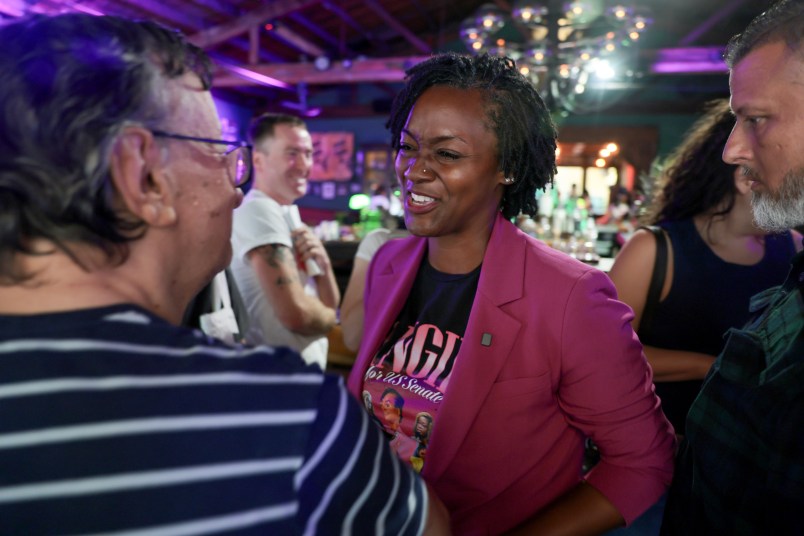
I want to flag this poll for you. It’s a poll of the Florida Senate race by St. Pete Polls, a mid-tier regional pollster. It shows appointed incumbent Senator Ashley Moody (R) and Democratic nominee Angie Nixon tied at roughly 45% of the vote. There’s not much polling of this race. There are two other recent polls, one by Change Research a respected but generally Democratic-aligned pollster, and another from Quantus Insights, a GOP-aligned pollster with an iffy reputation. Change Research had a tied race a week ago. Quantus had Moody up by eight points a bit less than a week ago.

I want to be clear that I am not predicting or expecting Nixon to win this race. What I do expect is that Republicans will likely need to fight to hold it. And that is significant in itself. There are other signs that Republicans are facing a rough political environment in Florida this year, at least one that looks very different from where Florida has been trending since 2018-20 when the state went from a GOP-tilting purple state to something approximating bright red. Yesterday, Nicole LaFond highlighted the video put out by South Florida Rep. María Elvira Salazar (R-FL) which basically had Salazar telling Donald Trump: We didn’t know you meant mass deportation when you promised us mass deportation.

We can joke about the the substance of Salazar’s video but it speaks for itself as a measure of the political climate in the state.

  •  

We Need to Talk about AI, the ‘Rationalists’ and ‘Longtermism’

As I’ve suggested in recent posts I’m finding it quite challenging to make sense of this roiling debate about AI safety. When I write about American politics, American history and a few other topics I have a body of knowledge that I draw on and try to share with readers — explain how it might illuminate present-day questions. I may be right or wrong. But I’m speaking from a background of some real knowledge and study. When I delve into questions like AI or AI dangers I’m seldom trying to come up with definitive answers. I lack the qualifications or foundational knowledge. What I’m trying to do is first try to educate myself, but in my writing I at least try to frame the basic questions, provide a framework for considering the issue, point to what are at least good faith and knowledgable voices if not necessarily people who are “right.” But while I’m still uncertain about dangers posed by the companies doing the most advanced and often reckless research on artificial intelligence I’ve been increasingly stuck on the prominence in the AI world of people who are in the overlapping communities of “effective altruism,” “rationalism” and “longtermism”.

Just to point to the latest examples, the Journal has a write-up on Jacob Coxon, the AI researcher whose Twitter thread quite literally triggered the current freakout/reckoning. It turns out his formative years were spent in the various parts of the “rationalist” subculture in London before he migrated to the U.S.

I’ve been loosely aware of the first and the second for a while, but didn’t have much pressing need to learn more because they didn’t seem connected to much that I care about. But they’re very big in the AI world and maybe even bigger in the AI will wipe out humanity worlds. So given the global freakout getting a handle on this becomes more pressing. Just as an aside, I will note that I don’t know how the dorks operating under the “rationalism” label secured exclusive branding rights to that term. Like, rough day for Descartes and quite a few other philosophers. But I digress. What I’m going to argue here is that at least the popularized versions of what I’ll call ERL (“effective altruism”, “rationalism” and “longtermism”) is made up of a mix of absurd and nonsensical ideas. The fact that so many AI doomers are part of that world gives me a lot of pause. But we can’t go from ERL is absurd to AI is fine.

So let’s get down to it.

  •  

AI Isn’t Conscious But Are Its Feelings Getting Hurt?

This is the weekly, free edition of The Backchannel. If you’d like to receive the free edition of The Backchannel in your inbox, you can subscribe here. If you’d like to upgrade to the members’ edition for full-access to The Backchannel and everything else we publish at TPM, this week we are offering a special promotion for 50% off an annual Prime membership.

I just noticed this Politico piece which contains a poll they just conducted about AI and the odds that AI will lead to the extinction of humanity. 63% of Americans think there is at least a “moderate risk” that AI means our species is toast. 20% see a “significant risk” and an another 17% think our demise is “almost certain.” As with data centers, there’s little difference between Republicans and Democrats.

Needless to say, this is not an issue on which we want to assume that majority opinion is a good proxy for reality. But it is a potent reminder of the almost unfathomable depth of negative opinion about AI, ranging from hate to fear and basically all the other negative emotions in between. Meanwhile, this question seems pretty distinct from the even more overwhelming opposition to data centers. They’re not two expressions of the same animus but two distinct channels of opposition directed at the same thing.

  •  

Yep, the Anti-Trump Wave Is Building

Conventional wisdom holds that a midterm election only fully comes into focus after Labor Day. That’s when a critical slice of the electorate starts focusing on the election and the choices before them. More or less in line with that, we’ve had a spray of polls out in the last few days showing the congressional generic ballot shifting decisively in Democrats’ favor. Looking only at generic ballots fielded entirely in September by pollsters the New York Times rates as trusted we have D+7, D+9, D+9 and D+11. If that trend or average is representative, it shows Democrats opening a big lead on this measure where the earlier average had been in the 5-7 point range. As Ron Brownstein notes here, history also tells us that in the final weeks of a campaign, this generic ballot measure will bend toward the president’s approval number. That appears to be happening. One of those, from the Times itself, was released today (D+9) with an accompanying write-up which, simply because it’s the Times, will probably draw attention to this trend even though the Times poll is only one of several.

Polls and trends can of course be wrong. But these numbers are extremely bad for the GOP, and if anything in this ballpark is accurate Republicans will likely lose the Senate as well as the House. Indeed, the variability in possible outcomes may be even higher in the Senate since it’s not amenable to gerrymandering. Even the Times, usually eager to find possible downsides for Democrats, frames their poll with declarative statements like this: “Voters see Republicans broadly as more extreme, more elitist and more corrupt than Democrats, according to the poll. And while voters continue to have doubts about both parties, they aligned more with the Democratic Party on both cultural and economic matters than the Republican Party in the survey.”

  •  

AI Frontier Labs and the Loving Hand of Product Liability

As you’ve likely seen, a strange and perhaps positive chain of events unfolded over the weekend in the world of AI and what we might call human extinction discourse. Dario Amodei, CEO and cofounder of Anthropic, posted an essay calling for a global slow-down in AI development to allow more time to prioritize safety and what the industry calls “alignment” and pledging that Anthropic would take a series of steps in that direction unilaterally. Somewhat surprisingly, OpenAI CEO Sam Altman and archvillain Elon Musk stepped forward and said they agreed and appeared to agree to join Anthropic in the proposed slowdown.

Regardless of what one thinks of AI and its possible dangers — existential or otherwise — it’s hard not to see this as at least a somewhat good development. And I say that with full cognizance of the various arguments about financial overextension or heading off sterner regulation that may make these moves self-interested. (AI critic Gary Marcus gives it a qualified endorsement along with a good cross-section of responses.) But I wanted to step back for a moment and talk more generally about the question of “externalities” which has always been the problem lurking in the background of Big Tech’s road to national and global domination.

  •  

Inside a Perfect Storm — How Dangerous Is AI?

You’ve probably seen these reports of an employee of the AI company Anthropic who quit his job and issued a warning on X that suggested AI could, in next few years, escape control and lead to the extinction of humanity. These sound like not just wild but science fiction-type claims. And they’ve lurked around frontier AI labs for years. It’s one of the many weirdnesses of the AI world and those who lead it. The basic pitch: AI is awesome. We need to built it as quickly as possible. Also it might lead to human extinction. Quite an attractive offer! There’s always been a strong sense among many observers that these claims or suggestions or warnings are part of the AI hype machine itself, albeit of a kind of contradictory or paradoxical variety.

But this warning by the ex-Anthropic employee, Jacob Coxon, seems different and is unquestionably being reacted to very differently. That’s the one part of this that is new and real – the reaction to this warning/comment etc is much bigger and operating in the tech, financial and general media. Wired has a good interview with him here. (I think you can read it as a free article if you haven’t read other Wired articles this month.) The gist is that Coxon says it’s imperative to create a regulatory structure, or at least an ad-hoc agreement that can slow the competition between OpenAI and Anthropic, the two most advanced AI engines and research entities. (The inflection point people are focusing on is something called “recursive self-improvement,” which is when this generation of AI model builds the next one.) The problem is that you really need an agreement that brings China into some common framework too. Because they’re in this same hunt, running these same risks, even though I think the common consensus is that Chinese companies are running at least somewhat behind the most advanced U.S. companies. China’s strength has been building models which are only a bit behind the U.S. models but at dramatically lowest costs.

  •  

Britain’s Sanctions on the West Bank Settlements Are the Right Step Forward

On Tuesday the United Kingdom announced a series of sanctions against Israeli settlements in the West Bank. They were joined in this by Canada and France. The sanctions include a ban on imports on goods produced in the West Bank as well as those who provide services including “construction, infrastructure, financing or real estate for settlement expansion.” That sounds like it involves sanctions on banks funding settlements. The Times refers to this as a “symbolic step.” But I’m not sure that’s the case. The devil is really in the details of that clause I quoted, how it is interpreted and enforced; just what counts as services, direct or incidental; and what counts as expansion. It also, of course, matters a great deal whether other countries adopt the same policy.

This is a wise, judicious and necessary policy. If Barack Obama had put measures like this at least on the table back in 2009 when he tried to force a resumption of final settlement talks we might be living in a much better and very different reality today. When the then-newly elected Benjamin Netanyahu rejected Obama’s overtures Obama mostly walked away and gave up. In his semi-defense he wasn’t elected to bring about a final settlement of the Israel-Palestine conflict and it would have required an immense amount of political capital simply to set the stage for it, let alone accomplish it. The key feature of this new British policy is that it distinguishes between what is legitimate (Israel within its internationally recognized 1967 borders) and what is not (its settlements on the West Bank).

  •  

In and Outside of History at Once

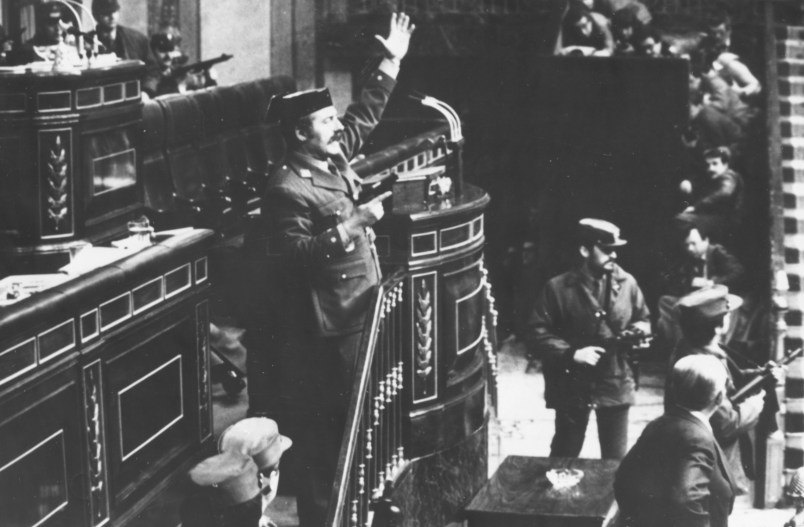
Yesterday I was kind of randomly rereading some details about Spain’s transition to democracy after the death of Francisco Franco in 1975, as one does. And I noticed that Spain had finally released the last classified documents tied to the attempted coup of 1981. The non-disclosure of these documents had helped maintain various conspiracy theories and counter-narratives about whether King Juan Carlos played quite the heroic role history has assigned him. In brief, Franco groomed Juan Carlos to succeed him believing he would maintain the Franco-ist dictatorship. But Juan Carlos quickly set about putting Spain on a path to democracy and when Francoist dead-enders in the army mounted a coup in 1981, Juan Carlos famously went on television, denounced the coup, thus leading to its total collapse. The counter-argument or claim is that Juan Carlos knew about the coup or perhaps even supported it and only pulled the plug when it looked like it was failing.

The release of the documents was just this last February. And they basically confirmed the established story, that there was no reason to believe Juan Carlos knew about the coup in advance and acted decisively to undermine and bring it to an end. But it was a small note in the Times article I read about this that got my attention: one of the reasons for the release, overseen by Spain’s current center-left government, was to combat historical revisionism and growing nostalgia for Franco among young men.

  •  

DC Starts to Get Worried for the GOP

Over the last day or so, a number of the big inside DC sheets have run pieces striking a skeptical note about the GOP’s 2025-26 redistricting — Axios and Politico, for examples. It’s not just that they maybe aren’t strong enough to withstand a Democratic wave (no gerrymanders are impregnable) but that they are fundamentally based on the assumption that the 2026 electorate would look basically like the 2024 electorate, as Axios put it. That’s not quite the same as saying “as popular as.” It’s more the shape of the electorate. And that’s why it’s not quite as silly as it might sound, though not wholly unsilly. And one example of this is that Republicans made a bet that things like the big Hispanic shift toward the GOP, especially in places like Texas and the Southwest, represented a kind of realignment as opposed to just a really bad year for Democrats.

  •  

Mild-Mannered and Cautious Election Guru Charlie Cook Predicting GOP Armageddon

Longtime election analyst Charlie Cook has a piece up on his Substack looking at the fast-approaching midterms. It’s an interesting piece, an artifact of the moment, not simply because of what it predicts but because of the nature of the writing in which Cook seems to be grasping for metaphors about just how bad a situation Republicans face — a bit more stream of consciousness and performance art than one is used to in election analysis.

Let’s start with the lede …

With 64 days before Election Day (although the first mail-in ballots will go out in a matter of days), Republicans should brace themselves: The three most plausible outcomes are that it will be bad, really bad, or truly horrible. 

A few sentences later he describes what he considers the most likely scenario.

Let’s start with the most likely scenario: that this is a “really bad” election for Republicans, losing between 26 and 35 seats in the House, and either four or five seats in the Senate. 

He then describes a less drastic and merely “bad” scenario in which aggressive gerrymandering on both sides keeps House losses in the 15 to 25 range. But he thinks that this scenario still nets Democrats four to five Senate seats. He calls the GOP’s worst-case scenario the same 26 to 35 House seats lost but “at least six” Senate seats gone too.

  •  
❌