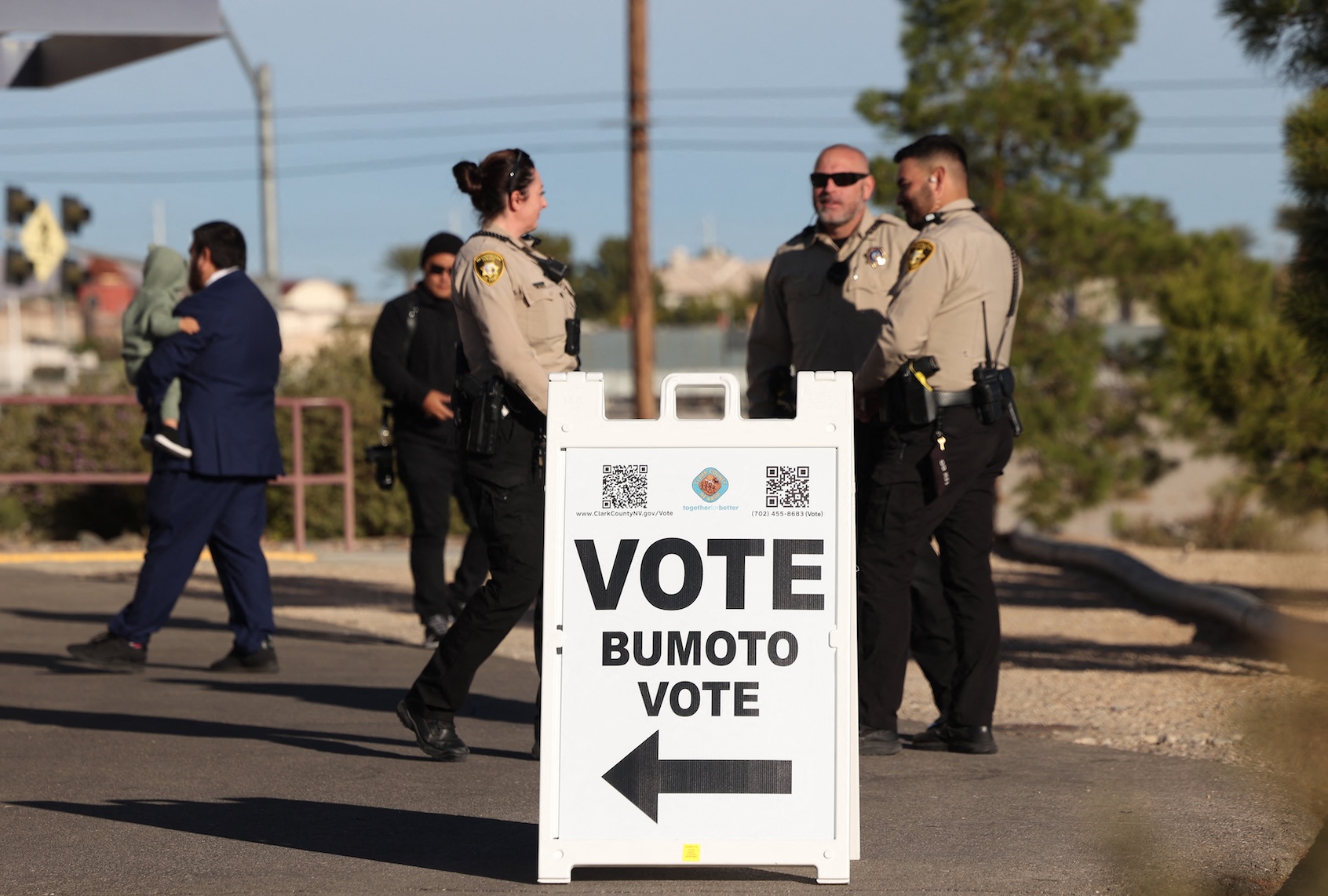
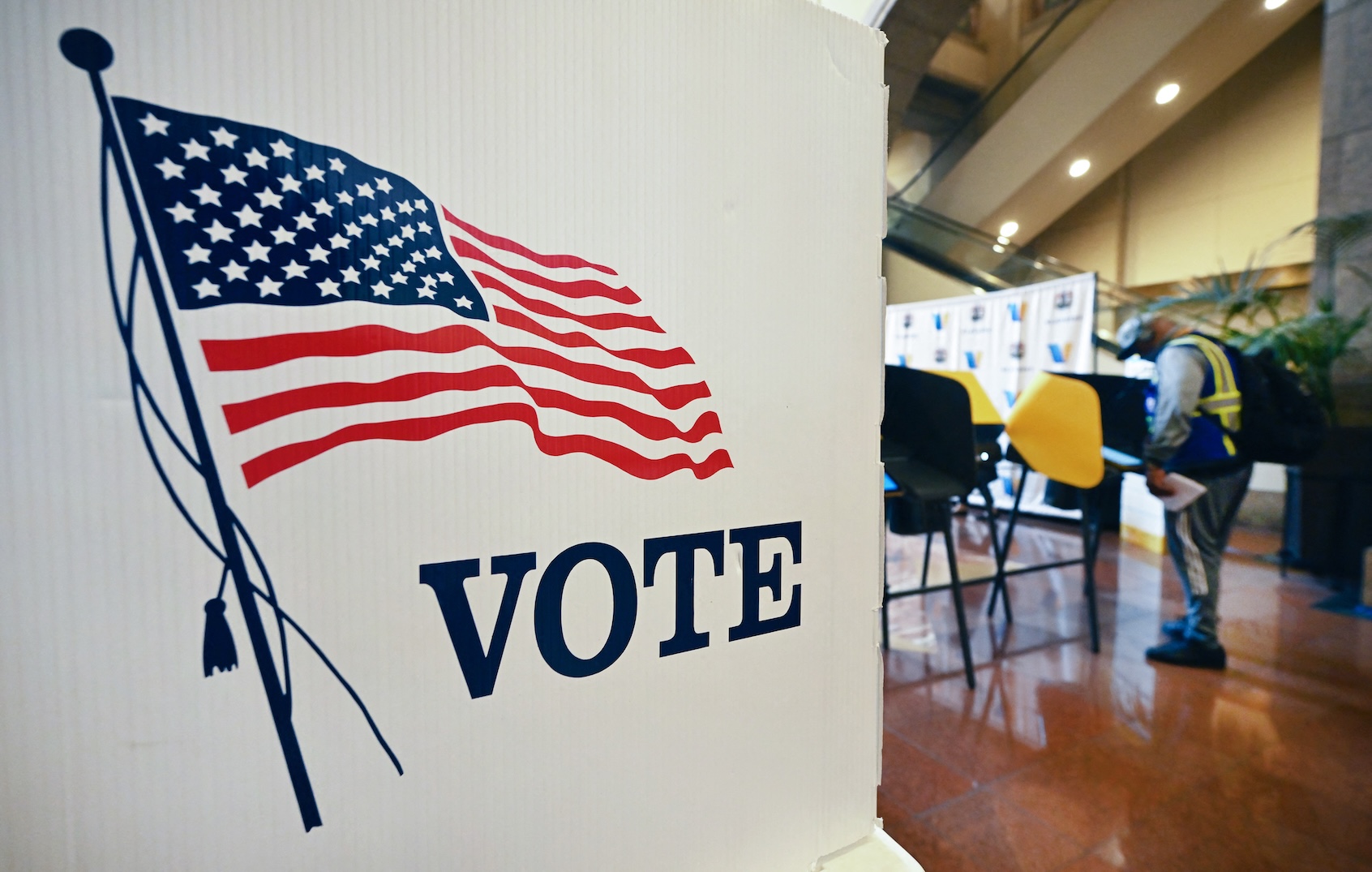
In the run-up to the November election, federal officials have sent conflicting signals about whether law enforcement agents could show up at polling places.
FBI Director Kash Patel declined to rule out deploying FBI agents to voting sites. The Department of Homeland Security has said ICE does not plan to patrol polling places, while leaving open the possibility that agents could respond to threats or serve warrants nearby. The Justice Department, meanwhile, has said it will continue sending federal personnel to polling locations as part of its election-monitoring efforts.
The mixed messages are already shaping preparations around the country: In Wisconsin, election officials are being trained on how to respond if armed federal agents appear at polling places, while in Michigan, the attorney general’s office has prepared agents, state police officials and legal filings to respond quickly to election-related incidents.
The uncertainty has left election officials preparing for scenarios they may never face and voters unsure what federal presence, if any, to expect in November.
A recent University of San Diego poll found that 40% of Americans said they think it’s likely that ICE agents will show up at the polls, and a third said their presence would reduce their trust in elections.
Federal law sharply restricts the deployment of armed federal agents at polling places, and experts say election officials have tools to respond if agents show up in violation of those restrictions.
Federal law prohibits U.S. officials from sending or keeping “troops or armed men at any place where a general or special election is held,” with only narrow exceptions for when those people are voting or if their presence is necessary “to repel armed enemies of the United States.”
Another federal law prohibits voter intimidation, with up to a yearlong prison sentence for anybody who intimidates, threatens, or coerces somebody else with the purpose of interfering with another person’s right to vote.
“It’s low likelihood, and it’s certainly impossible that any sort of federal presence could be there at every polling site in America,” said Aaron Blacksberg, federal policy counsel at the Institute for Responsive Government. “But without knowing for certain, people are concerned.”
Blacksberg said that voters especially worried about the possibility of federal law enforcement at the polls could vote by mail, drop their ballot at a drop box or or use another alternative voting option available in their jurisdiction.
The prohibition on deploying armed federal personnel to polling places is a criminal statute, said Jonathan Diaz, director of voting advocacy and partnerships for the Campaign Legal Center. “The person who orders the agents or officers to the polls also would face criminal liability for doing that,” he said.
In most jurisdictions, Diaz added, election officials are empowered to remove people from the polls if they’re causing a disruption or violating polling place rules, and they can work with local law enforcement to enforce those rules. If a voter sees federal agents at polling places in a manner that may be illegal, Diaz said, they should alert their local election officials.
Federal agents could also end up near a polling place for reasons unrelated to the election.
That happened in May, when a traffic stop led to a car being pulled over near a polling place, and ICE agents showed up to question the driver. Local law enforcement quickly showed up to tell the federal agents to leave the premises. County officials said voters weren’t questioned and polling places ran normally despite the brief ICE presence nearby.
Courts have confronted voter intimidation before
There’s little precedent for the possibility of federal agents at the polls, but courts have addressed other efforts involving law-enforcement personnel at polling places.
For example, in 1981 the Democratic National Committee took the Republican National Committee to court for allegedly seeking to revoke the registrations of minority voters in New Jersey and enlisting off-duty officers to intimidate voters by standing at the polls in heavily Black and Latino precincts. The Republican Party entered a consent decree that lasted over three decades, heavily restricting its planned election security efforts.
The decree is no longer in effect, but it could be cited in future cases “if something really grotesque were to happen in the area of voter intimidation by people looking like law enforcement” said Lorraine Minnite, a Rutgers University political science professor who served as an expert witness in the case.
She also said voters should feel confident that election officials are prepared to respond to federal interference.
Recent Votebeat reporting illustrates that around the country, top state prosecutors, secretaries of state and local election officials are preparing for scenarios like ICE showing up at the polls and preparing legal filings in advance. Some have rehearsed how to respond if federal agents seek access to polling places, ballots or voting equipment, while others are lining up attorneys and law enforcement who could act quickly.
The prospect of federal agents at polling places is already being litigated.
In September, nine groups filed a federal lawsuit against the U.S. Department of Homeland Security and several other agencies and officials over statements the groups say amount to threats to deploy federal agents to polling places. The groups argue such a deployment would violate federal law, including a section of the Voting Rights Act that bans voter intimidation. They are seeking an injunction blocking federal agents from being used in ways that unlawfully intimidate voters.
The Justice Department, which is named as a defendant in the lawsuit, has rejected its premise, arguing that federal officials have never said they would send law enforcement to polling locations. The Department of Homeland Security has said ICE is not planning operations targeting polling places. The case is still in its preliminary stages.
Local police have a different role at polling places.
Unlike federal law enforcement, local police routinely coordinate with election officials around polling place security.
In many cases, Diaz said, local law enforcement are at the polls at the request of election officials, who have received extensive harassment and threats since the 2020 election. Law enforcement often coordinates with election officials to keep officials and voters safe without their presence intimidating voters, he said.
“It’s far more normal for a county official or a state official from a law enforcement agency to be at or near the polls because usually they’re working with election officials, versus federal law enforcement, who have no role in the election process,” he said.
But even a lawful local police presence “can raise concerns about voter intimidation.”
In August, the Sheboygan County Sheriff’s Department in Wisconsin said they would be sending some deputies to polling locations to ensure a safe and secure election. That drew criticism from the ACLU of Wisconsin and other groups. The sheriff responded that deputies had conducted brief and routine polling place visits for years.
A few days later, legal groups sent the sheriff a letter saying that while local law enforcement can play a helpful role in elections, their presence can intimidate voters — and that intimidation may violate state and federal law.
Even when local law enforcement is working with election officials, officers are subject to the same voter intimidation restrictions as anybody else, Diaz said.
“It’s important for them to behave responsibly and transparently with election officials and with the public to reassure voters that they’ll be able to vote safely,” he said, adding that officers should carefully avoid inadvertently creating an intimidating presence for voters.
Alexander Shur is a reporter for Votebeat based in Wisconsin. Contact Alexander at ashur@votebeat.org.
Votebeat is a nonprofit news organization covering local election integrity and voting access. Sign up for their newsletters here.
We’ve spent our entire political careers in different camps. One of us was a Democratic governor and chairman of the Democratic National Committee. The other served as a conservative Republican in Congress for over a decade, representing a deep-red district in the Indiana heartland that President Donald Trump won in each of his three presidential elections by over 30 points.
But before we got into politics, we were both physicians in internal medicine and cardiothoracic surgery, respectively. We’ve seen firsthand how crucial it is for the patient-provider relationship to guide and determine the right care. And that’s why we’re so alarmed that nearly half of Americans, according to a recent survey by KFF, the independent health organization, now report that their health insurers have delayed or denied coverage for a doctor-recommended treatment within the past two years.
Corporate insurers should not be at the forefront of patient care. Delays and denials put patients’ health at risk. And they often lead to preventable complications and higher long-term spending.
We both believe reforming the health insurance system is a moral and an economic imperative, as do many of our colleagues on both sides of the aisle. Even in a bitterly divided Congress, we have seen encouraging signs that reform is possible.
In recent months, Democrats and Republicans have worked together to hold insurers accountable — especially when it comes to “prior authorization,” the notorious and widely despised insurer practice of denying certain procedures and treatments unless doctors and patients first obtain permission. In a recent American Medical Association survey, 95% of physicians said they’ve seen prior authorization requirements delay necessary care. Nearly four in five have witnessed patients abandon treatment because of problems with the process.
Leaders in both parties already agree that improvements to the American insurance model are necessary. The bipartisan Improving Seniors’ Timely Access to Care Act would move Medicare Advantage prior authorizations to an electronic system and require quicker response times and greater transparency from insurers. Significantly, over 300 House members and 70 senators have cosponsored the legislation. This summer, it cleared two House committees unanimously.
Lawmakers are also finding common ground on transparency. In July the House Energy and Commerce Committee advanced a bipartisan bill that would require health insurers to publicly report how often they deny claims.
That scrutiny is overdue. Medicare Advantage insurers denied more than four million prior authorization requests in 2024.
When patients and their doctors appealed those denials, insurance companies reversed roughly 80% of their initial decisions. That high reversal rate suggests insurers are denying lots of medically appropriate procedures, tests and treatments — and hoping that doctors and patients will be too busy, sick and frustrated to follow through with an appeal.
That’s often a safe, albeit callous, bet. For too many Americans, fighting insurance companies can feel like a battle they cannot win. It often requires tremendous mental and emotional fortitude at a time when they are simply trying to get well. That is why Congress must take on that fight for them. Families already pay extraordinary sums for health coverage — by some measures, the monthly cost of employer-sponsored family health coverage now rivals the typical monthly mortgage payment. And still, these families face denials, delays and difficulty accessing the care and medicines they need.
As physicians, we know that time matters when someone is sick. As a Democrat and a Republican, we also recognize how rare genuine consensus is in Washington. That’s why we’re cautiously hopeful that after the midterms, Congress will seize the opportunity to make prior authorization and broader insurance marketplace reforms a priority.
The conservative media behemoth is celebrating 30 years on the air this week. I have been a loyal, daily viewer for about half that run. I remember the inaugural episodes of “The Five” and “Outnumbered.” Before Marc Lamont Hill was helping elevate the conversation on one of the country’s biggest podcasts, I watched him school Bill O’Reilly as a Fox contributor and Temple University professor. And who can forget Alan Colmes, forever assigned the role of hapless Democrat?
For years, I believed there was no particularly good reason for a serious progressive to go on Fox News. The network touts its “fair and balanced” tagline, but it is not a neutral venue and it does not deserve to be treated like one. Its business model is grievance. A Democrat on Fox is a prop. The network invites them into the studio so its audience can watch them lose. Why submit to the bad faith interruptions and the inevitable social media clip engineered to make the left look elitist or insane?
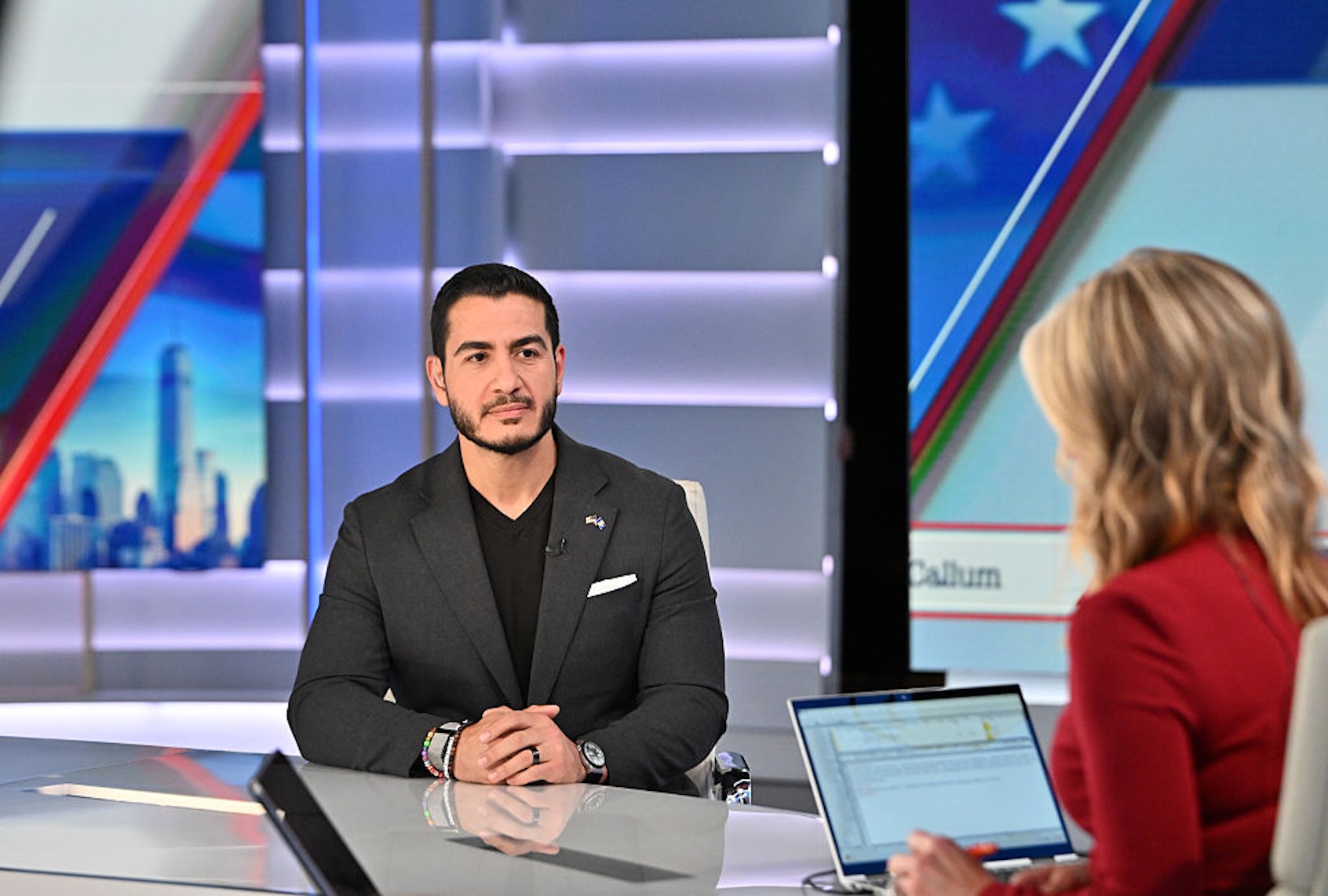
Dr. Abdul El-Sayed has made me reconsider that.
El-Sayed is not merely surviving Fox News hits. He is dominating them, and the hosts know it — and Donald Trump definitely knows it.
The Michigan Democratic Senate candidate has emerged as an anomalous fixture on the conservative network, dominating segments with a cool composure that leaves hosts alternating between hostility and reluctant infatuation. El-Sayed is not merely surviving Fox News hits. He is dominating them, and the hosts know it — and Donald Trump definitely knows it.
The president raged on social media about El-Sayed’s Monday appearance on “The Story with Martha MacCallum” that Fox News spends more time covering “Democrat jihadists” than they do GOP candidates. Trump’s temper tantrums highlight a fundamental structural weakness in contemporary conservatism: Right-wing ideology is inherently hierarchical, predicated on the worship of strength and dominance. When El-Sayed goes onto Fox and refuses to shrink, when he looks a host in the eye and dismantles talking points with data and empathy, it scrambles the entire authoritarian matrix.
The psychological fallout among the network’s talking heads has been equally telling. Jesse Watters, a stalwart of the network’s macho posturing, has spent weeks gushing over El-Sayed with an almost comical bewilderment. After the Democratic candidate casually skewered his Republican opponent Mike Rogers as a “beta” on air — eliciting an involuntary chuckle from Watters — the Fox host found himself helplessly admitting that he liked the progressive Democrat despite himself.
This is a model for the left — and there is a lineage here.
Democrats on Fox News used to be cast in a narrow role: the tame liberal who could be invited on to lose politely. Sen. Bernie Sanders, I-Vt., was one of the first politicians on the left who seriously engaged with the network’s audience. He appeared on Fox during his 2016 presidential run and talked directly about wages, healthcare and corporate power. Former Transportation Secretary Pete Buttigieg’s 2020 presidential campaign proved a Democrat can leave the network Roger Ailes built with their own viral moments. He routinely met a hostile premise with calm facts, a sharp answer and a smile that made the host’s irritation look frivolous.
El-Sayed is the next stage of that evolution. He adds something that many national Democrats still lack: an understanding that a media hit is not a policy seminar. It is about making the audience see who is in command. El-Sayed has figured out how to talk to the people who love Fox without pretending that the network is something it isn’t.
He refused to let Fox’s presenters dictate the terms of the conversation. In August, El-Sayed sat for a 25-minute one-on-one with Watters, who confronted him with the inventory of right-wing obsessions: Immigration and Customs Enforcement, Trump’s war with Iran, transgender athletes and his Muslim faith. Watters wanted to compress El-Sayed into a caricature, a radical leftist Muslim candidate who could be made alien and threatening to the people watching at home.
El-Sayed did not take the bait. When Watters pressed him about abolishing ICE, he did not surrender the moral argument or get stuck in a defensive loop. He pointed out that the U.S. enforced immigration law before ICE’s creation and that the agency’s existence has not solved the problem Watters claimed to care about.
“We were able to enforce our immigration policies without shooting people in the face and the back of the head,” El-Sayed said, while dodging several of the culture war questions and steering the interview back to healthcare and affordability. When Watters raised surgery for minors in the crudest possible terms, El-Sayed answered by asking whether the host was circumcised. Right-wing influencers howled that it was a nightmare. The clip went viral anyway.
El-Sayed’s appearance on Monday with MacCallum was masterful policy communication. The host pressed the candidate on terrorism, the Iran war, Medicare for All and campaign financing, and the two talked over each other at points because El-Sayed kept answering the question behind the question.
On terrorism, he was unequivocal that the victim is never at fault. Then, he pivoted: “Why are we fighting this war, to what end? Who benefits from it? Why did we do this? What are we paying for it?”
When MacCollum played a clip of New York City Mayor Zohran Mamdani defining socialism as everyone having what they need to live a dignified life, and then asked if that disturbed El-Sayed as a capitalist, he dismantled the frame in seconds. “Well, Martha, I assume you went to good public schools.”
Yes.
“And you got to drive on good roads today.”
Pretty much.
“And when you put your garbage out, somebody comes and picks it up.”
Yes.
El-Sayed embodied the most devastating move in American politics: When someone tries to explain socialism to you, explain the socialist parts of the life they already love. MacCallum pressed him on campaign finance and high-profile donors, and El-Sayed did not stutter or retreat. He pivoted to the fundamental reality that ordinary people across the political spectrum despise: the corrupting influence of corporate money in politics.
This connects directly to a deeper truth about the American electorate that corporate-backed consultants consistently fail to grasp. And there is evidence it is landing. In a recent New York Times/Siena poll, El-Sayed outperformed other swing-state Democratic Senate candidates in capturing a vital sliver of 2024 Trump voters, securing 8% compared to paltry single digits elsewhere.
This is not because those voters have suddenly embraced intersectional environmentalism or Medicare for All in its entirety; it is because working-class Americans are profoundly alienated by corporate malfeasance, stagnant wages and the hollow promises of career politicians. When a candidate like El-Sayed — just like Sanders and Buttigieg before him — speaks directly to economic class struggles without patronizing rhetoric, a significant percentage of non-ideological working-class viewers listen. And they recognize the fundamental truth in the critique.
The left does not need to pretend that Fox News has suddenly become fair. It has not. One candidate’s successful appearance does not redeem a network that has fueled racism, conspiracy theories, anti-immigrant panic and the authoritarian politics that brought Trump to power.
But refusing to appear on Fox News is no longer a tenable position if it merely concedes millions of viewers to an information ecosystem with no meaningful counterargument that can reach them.
The latest report about far-right extremists in Georgia Republican candidate Mike Collins’ orbit comes from the Daily Beast, which identified two people associated with the far-right group American Patriots USA serving as campaign-appointed “convoy captains” in his bid for Senate. Convoy captains head up grassroots organizing efforts in Georgia’s counties.
American Patriots USA is classified by the Southern Poverty Law Center as a “white nationalist” group, or a group that believes “white identity should be the organizing principle of the countries that make up Western civilization.” It was founded by a Klan leader who attended the 2017 neo-Nazi rally in Charlottesville, Virginia.
One of the two convoy captains identified by the Daily Beast served as a state director of American Patriots USA, and the other as a vice president of the group, the outlet reported.
These two are the latest in a long line of extreme far-right figures who have surfaced in Collins’ orbit. Perhaps most notoriously, Collins’ son-in-law was identified by CNN as a white nationalist influencer with millions of followers who has promoted the neo-Nazi group Patriot Front, called for Muslims to be deported from the country, and shared the antisemitic conspiracy theory that Jews control politics in the U.S. The Washington Post found a former Collins staffer posting a swastika and an image of himself in a Klan robe to Twitter. Slate discovered that Collins’ (now former) chief of staff informed a group chat that included Nick Fuentes and Richard Spencer that he was trying to use his influence to spring notorious Holocaust denier and troll Chuck Johnson from prison.
Perhaps — perhaps! — you might be inclined to think Collins is just unlucky, and these guys are turning up all around him by coincidence. But I can’t see these repeated headlines emerge without thinking about Collins’ unique online persona, which includes multiplejokes about killing immigrants through a method far-right Latin American dictators, including Chile’s Augusto Pinochet, were known to deploy against their political enemies: tossing them from aircraft. These “death flights” have become a jokey meme among online extremists, one with which Collins is seemingly very familiar.
Jose Antonio Ibarra would make a great first passenger for the new Pinochet Air.
“Another week, another scandal for Mike Collins, who is surrounded at work, at home, and now at his campaign by white nationalists, neo-Nazis, and Klan associates,” Collins’ opponent, Sen. Jon Ossoff (D-GA), said of the Daily Beast report, adding that Collins will “have to answer” during tonight’s debate “for his extensive and disqualifying ties to white nationalism.”
Trumpworld Reportedly Looking for a Scapegoat
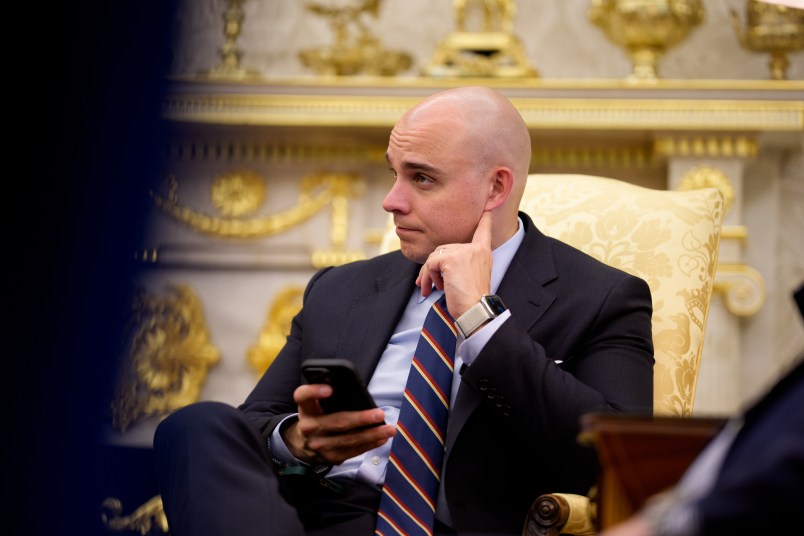
WASHINGTON, DC – SEPTEMBER 19: White House Deputy Chief of Staff for Legislative, Political, and Public Affairs James Blair sits in the Oval Office as President Donald Trump speaks before signing executive orders in the Oval Office at the White House on September 19, 2025 in Washington, DC. (Photo by Andrew Harnik/Getty Images)
Politico informs us that, amid indications of a dismal upcoming midterm election, political operatives around the president are turning on two leading figures in his orbit: Chris LaCivita, one of Trump’s 2024 campaign managers, and James Blair, who served as White House deputy chief of staff. The two now run the pro-Trump Super PAC MAGA, Inc., through which Republicans are routing much of their midterm spending.
Ironically, the cause of the fracas is that LaCivita and Blair recently spent several days in the Balkans, advising a pro-Putin party in Republika Srpska. The New York Times broke that story earlier this week.
Trump reportedly isn’t pleased. His problem here, to be clear, is not that the two were helping a pro-Putin political party, but that they were doing so with a month to go before what is expected to be a GOP rout, during a time when they presumably should have had their hands full back in the U.S.
“I do not have any idea who else they work for but will, on reflection, ask them and, if there’s a conflict, I will terminate them, immediately!” Trump posted to Truth Social yesterday, a reaction to the Times’ reporting that, per Politico, has MAGA world all atwitter.
Tabs
Don’t miss the Wall Street Journal’s deeply bizarre story about Ambassador to Greece Kimberly Guilfoyle’s insistence that a MAGA donor pay off her American Express card.
The Trump administration successfully pressured Canada and the EU to drop their sponsorship of a disinformation conference at which one panel would examine the U.S.’s role as a spreader of disinformation, the Guardian reports.
Man of the Hour
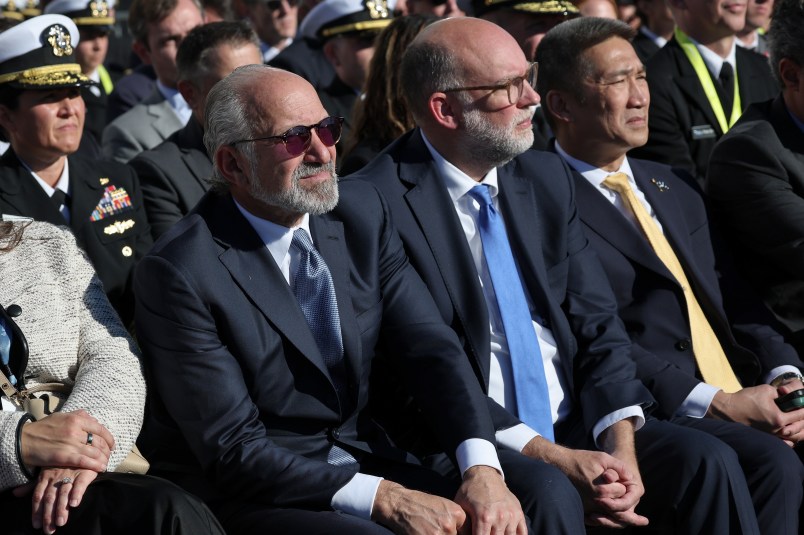
U.S. Commerce Secretary Howard Lutnick, Director of the U.S. Office of Management and Budget Russell Vought and Acting Secretary of the Navy Hung Cao listen as U.S. President Donald Trump delivers remarks at Tradepoint Atlantic on October 06, 2026 in Sparrows Point, Maryland. (Photo by Win McNamee/Getty Images)
It’s Office of Management and Budget Director Russ Vought, about whom Trump recently said, not at all ominously, “We have some big surprises coming up in another few weeks, right Russ?”
“He’s gonna be one of the very important people in the history of our country, in my opinion,” Trump added. “He’s got some great things happening.”
President Donald Trump has made no secret of his desire to exert control over the Federal Reserve’s economic policy. His primary demand? Cut interest rates.
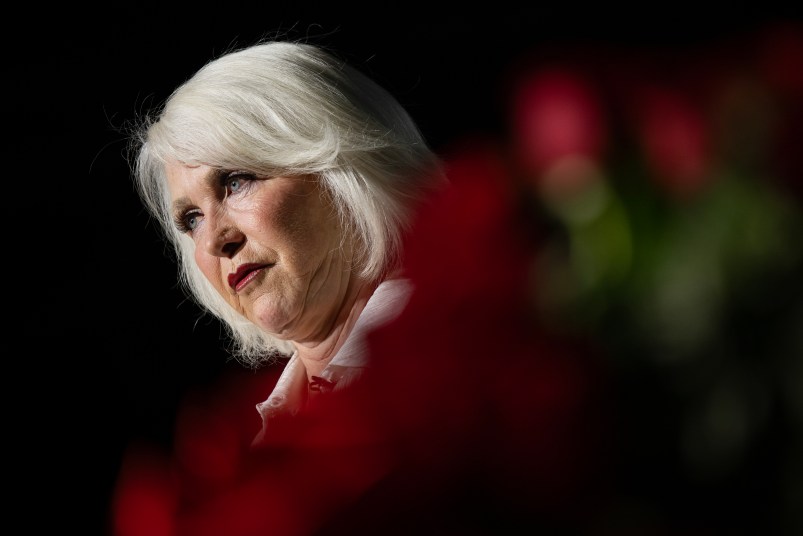
President Donald Trump is, apparently, being advised on the midterms by former Colorado elections clerk Tina Peters. The two met Monday at the White House.
Peters was convicted in 2024 of a series of state crimes related to a plot to undermine the results of the 2020 election. Colorado’s Democratic governor then commuted her sentence earlier this year amid a pressure campaign by Trump.
After the meeting on Monday, former DOJ official and longtime conservative gadfly Ed Martin helpfully blabbed about what the two discussed, enthusing to the MAGA news outlet Real America’s Voice he was “going to break some news.”
“There is local control,” Martin said of U.S. elections. “However, the laws that govern the system, like safety and national security, are federal laws. So Tina Peters, famous Colorado clerk, was in the Oval Office today just two hours ago talking about this question. The president’s taking it seriously.”
Martin claimed that voting machines are compromised by foreign governments (a familiar, baseless allegation), and suggested that Peters and the president were discussing what he could do about it.
“If the Congress won’t pass the Save America Act, and they won’t, the president’s going to have to do what he’s going to do,” Martin said. “And it’s not a local issue when it’s national security, and it’s clearly national security. So we’ll see how it plays out. But again, four weeks from today, we have an election that has to be safe, has to be secure.”
Martin, of course, is not the most reliable narrator. The Jan. 6 organizer-turned-pardon attorney was ousted from the DOJ after Todd Blanche reportedly became extremelyannoyed with his grandstanding. So, though ABC did independently confirm the news of the Trump-Peters meeting, take Martin’s description of what occurred with a grain of salt.
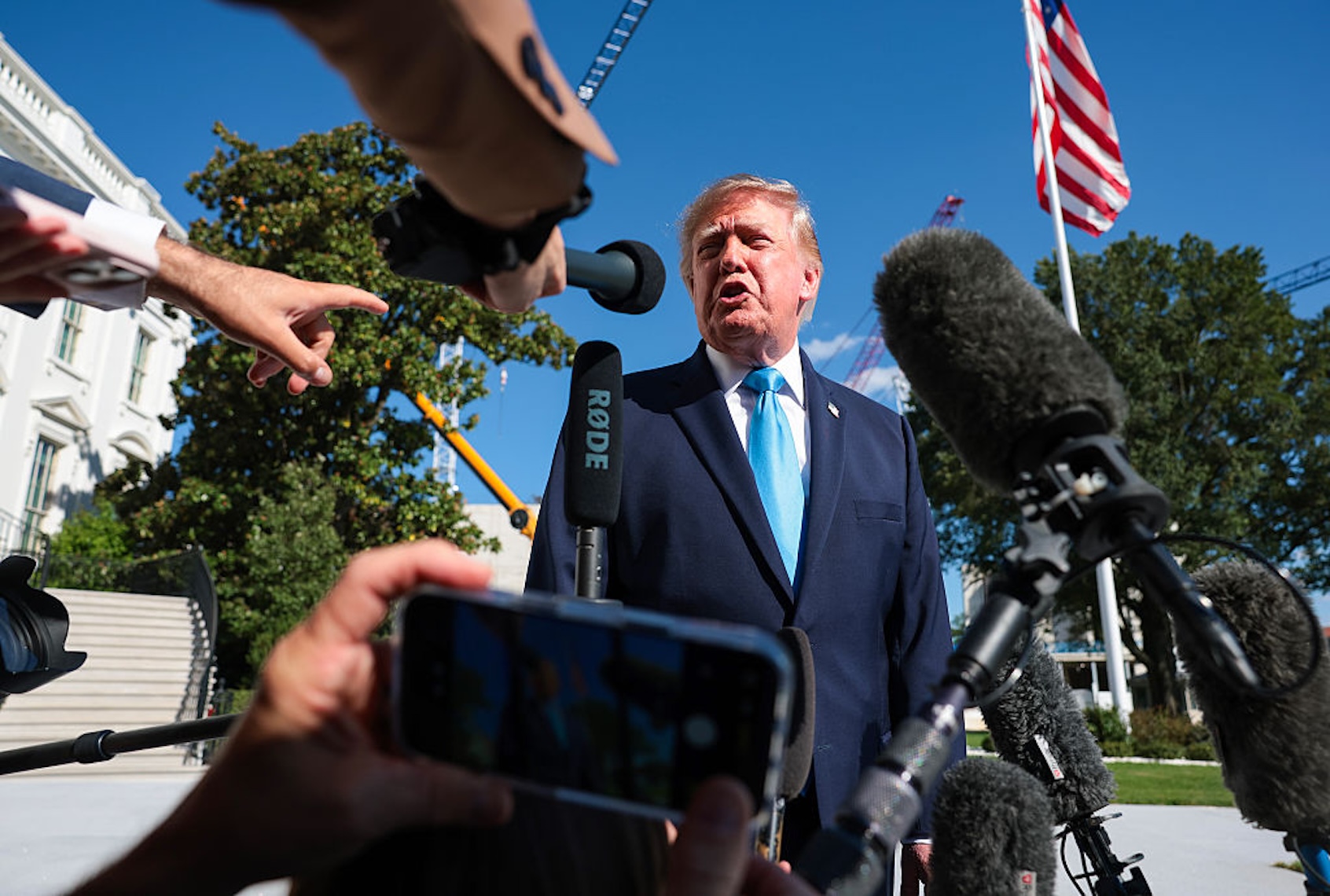
After the meeting, Trump spoke to the press, making seemingly contradictory statements about mail-in voting. “Vote by mail or vote in person. I’d rather have a vote in person. But they can vote by mail if they want, because we seem to have no choice,” he said, adding his usual claim that “there is a lot of cheating in vote by mail.” He did not, however, announce any new, election-related plans.
It’s also not terribly clear from Martin’s description what he and Peters want the president to “do.” Activists in their world have at times tried to pressure Trump to declare a national emergency, and, while that could stoke the chaos in which Trump thrives, experts say it wouldn’t give him any new authority over elections which, as Martin acknowledged, are run by the states.
Everybody’s Thinking About What a Democratic Senate Majority Would Mean for a Supreme Court Vacancy
US Associate Supreme Court Justice, Samuel Alito, attends an audience of Pope Leo XIV as part of the Jubilee of Justice at St Peter’s square in The Vatican on September 20, 2025. (Photo by Tiziana FABI / AFP) (Photo by TIZIANA FABI/AFP via Getty Images)
The big news, as Kate Riga wrote for TPM, came yesterday, with Supreme Court Justice Samuel Alito insisting to Bloomberg Law that he did not plan to retire in the last months of 2026 should Democrats retake the Senate.
Ever since both Alito and Justice Clarence Thomas — the furthest right, and oldest, justices on the Court — declined to retire at the end of the Court’s last term, speculation has run rampant about whether they might swiftly step down in late 2026, allowing the White House to work with the Republican-controlled Senate to confirm a similarly right-wing successor before Democrats, potentially, take over.
Democrats, for their part, are taking a page from Mitch McConnell’s playbook and mulling the possibility of refusing to confirm Trump’s nominee for any opening on the Supreme Court during the last two years of his term. “We’ve got to do exactly what McConnell did to us,” Sen. Ruben Gallego (D-AZ) told NBC, one of several Democrats to express that sentiment.
Republicans, meanwhile, told Politico they are ready to spring into action, though they doubted they would need to. If a justice has plans to retire, “They would have done it already,” Thune told Politico.
You have questions, we have answers. Since TPM readers are as obsessed with political minutiae as our staffers are, we’re launching a special limited-run bonus version of the pod in this final month before the 2026 midterms. Introducing: the Polltober Show.
On Tuesdays, Josh and Kate will get into the weeds on all things midterms, drawing on questions that you — our lovely readers — will submit! If there’s anything you want to know about specific races, candidates, chamber control, the courts, the polls, whatever, just drop your queries in the YouTube comments on the latest episode of the TPM Show or the Polltober Show itself. Our producer Jackie Wilhelm will scoop them up and pass them on to Josh and Kate to mull over.
Donald Trump has spent his political life treating the press as a prop. Friendly outlets are the audience he performs for, while hostile ones are the villains he performs against. But the president has never had to confront a prop that has stopped cooperating. It’s why he has spent several days raging at nearly every corner of the media, including the one network he has long treated as his own. Increasingly obsessed with controlling the image of his political decline rather than reckoning with reality, Trump has set out on a campaign of intimidation as his usual spectacle starts to finally fizzle out following more than a decade of domination. But browbeating Fox News and continuing to sideline CNN and POLITICO cannot conceal what is there in plain sight: shrinking crowds and falling poll numbers.
Over a whirlwind weekend of rallies across Alabama, Ohio, Oklahoma and Texas, the cracks in the MAGA facade became impossible to ignore. Trump has always treated crowd size at his rallies as a proxy for legitimacy and domination. In his eyes, the image of an overflowing arena functions as proof that the country loves him, that the media lies about him and that his political project remains invincible. This is why the sight of empty seats in high school gymnasiums and muted cable coverage that tell a less flattering story cuts so deeply.
“In actuality, my Events for very good Republican Politicians are probably more crowded than ever. There are no empty seats, there haven’t been for years, and there never will be. The Rallies are ‘HOTTER’ than ever,” he wrote on Truth Social Monday, demanding that “The New York Times, and many other Artificial Media Outlets, should be arrested for their dishonesty.” The president was referencing a Times report that during an event on Friday, Trump’s venue on the campus of the University of South Alabama was not full and that Trump’s midterm campaign swing feels “more like a farewell tour.”
But the day before, Trump had turned his fire on a less obvious target.
“Sad to see that Fox & Friends (Sunday) is not covering our packed house and incredibly enthusiastic (beyond!) Rally that took place in Ohio last night, or the ones in Alabama, Texas, or Oklahoma over the past two days,” he posted on Truth Social Sunday morning. The rallies were “absolutely phenomenal, better than ever,” he insisted. “Our people want to see our Rallies, and reports on our Rallies, on FoxNews, or they will very quickly stop watching (like I am doing right now!).”
It was the second time in five days Trump had attacked the conservative media powerhouse by name, and this time he brought a hit list. He accused Fox of forcing Democrats down MAGA’s throats and demanded to know who fired “the great Maria Bartiromo,” the ex-host who reportedly shared internal network communications with the administration. “Who makes these decisions at FoxNews?” Trump asked, before demanding the network cover his “happenings” or soon have the ratings of “FAKE NEWS CNN or MSNOW,” because “Fox tried this act once before, and almost went out of business (and always right before an election!). That can happen again!”
But Fox had already covered the Ohio rally before Trump posted his tirade. A Snapstream search found that “Fox and Friends Weekend” aired a segment on his event supporting Senate hopeful Jon Husted and gubernatorial candidate Vivek Ramaswamy in Vandalia shortly before Trump’s post, focusing on his data center comments. Significantly, though, the network’s pattern across the four-state swing shows that hosts tease the president’s speeches, throw to a live correspondent report, but rarely air the rally live. While Fox didn’t air Trump’s Ohio speech live, it ran a report at the top of the hour and showed Ramaswamy warming up the crowd. The network did the same in Alabama on Friday, and in North Carolina last month.
There are exceptions. Sean Hannity cut into his show on Thursday and aired 36 uninterrupted minutes from Oklahoma. But the usual approach is no secret — and it didn’t start this weekend. Tellingly, after Trump’s attacks, Fox opened “The Five” and “The Will Cain Show” on Monday with rally clips.
The president has been escalating his rhetoric against the network for months. In April, he told Fox executives to “take Jessica Tarlov off the air.” He has also gone after hosts Bret Baier and Shannon Bream, complaining that the latter failed to challenge a Democratic congressman on her Sunday program. As CNN’s Brian Stelter noted, Fox has calculated that Trump’s rallies — which are long, repetitive and rarely produce news — are “not a ratings magnet right now.” The Republican National Committee’s midterm convention in Texas apparently was not either, meriting just one segment on “The Five” per day; most speakers were never shown on the network. Ironically, the unprecedented spectacle resulted in a rare reverse bounce that left Trump’s net approval declining and the Democrats’ advantage on the generic ballot increasing.
Trump’s media strategy depends on collapsing every unfavorable fact into the same category: enemy propaganda.
When CNN’s Kristen Holmes asked Trump about the NBC News/Telemundo poll that found his approval with Latino voters at just 27% on Monday, he cut her off, “You’re fake news! You’re CNN. You’re fake news. My poll numbers are great, and all you have to do is look at the crowds we’re drawing.” Days before, he delivered a characteristically crude address that singled out CNN anchor Kaitlan Collins in front of a hostile crowd, eliciting angry boos and vicious chants. Trump’s media strategy depends on collapsing every unfavorable fact into the same category: enemy propaganda.
The administration’s treatment of CNN, MS NOW and POLITICO made that purpose impossible for even the White House press corps to ignore. On Monday, the White House barred POLITICO from traveling aboard Air Force One, preventing the outlet from fulfilling its role in the presidential press pool, having been scheduled to serve as the print representative. Trump has already kicked CNN out of the television pool on the plane, replacing it with friendly outlets including LindellTV and Real America’s Voice.
The legal fight over that control comes to a head Thursday, when Trump-appointed federal Judge Timothy J. Kelly is scheduled to hear arguments on whether to extend the block on the president’s ban of CNN, MS NOW and POLITICO from the White House. Last month, Kelly issued a temporary restraining order requiring the administration to restore the outlets’ credentials, rejecting, at least at that stage, the administration’s national security rationale for yanking access.
The Justice Department nevertheless asked the court late Friday to permit the ban’s reinstatement, suggesting in the government’s filing that “bona fide journalists would identify sources instead of relying on anonymous sources.” This reasoning is especially rich, coming from a White House that routinely briefs reporters on background, requiring them to grant anonymity under its own ground rules. One “reporting incident” cited against POLITICO was a June story quoting a “senior administration official” — exactly the arrangement the White House demanded.
From the courtroom to Truth Social, Trump’s increasingly unhinged media attacks expose a serious weakness in his political model. He is a president with nothing to sell. But he needs constant confirmation that his movement is growing. When even Fox News declines to provide uninterrupted validation, the illusion becomes harder to sustain.
The American public is increasingly seeing through MAGA’s smoke and mirrors. Ultimately, no amount of bullying, executive bans or early morning social media rants can paper over the fact that one month before the midterm elections, the Democratic Congressional Campaign Committee added six more candidates to its “Red to Blue” list this week, districts Trump won by an average of 16 points or more in 2024.
For more than a year, journalists Maggie Haberman and Jonathan Swan had been trying — and largely failing — to raise awareness about the very strange story of Donald Trump and his aide Natalie Harp. Shortly after the 2024 election, the New York Times journalists published a profile of the lithe blonde in her early 30s, complete with photos of her gazing at Trump adoringly, explaining how she left him love letters with language like, “You are all that matters to me.” On Aug. 16, Haberman was still trying to raise the issue during an appearance on MS NOW, describing Harp as Trump’s “human binky.”
But in the end, it was Sen. Jon Ossoff, D-Ga., who woke up much of the public to this disturbing relationship by mentioning Harp on the campaign trail. “He doesn’t want to do the job,” the senator said of Trump, the sleeves of his blue shirt rolled up. “He wants to build his ballroom and travel with Natalie on their apparently defenseless flying palace gifted by the Emir of Qatar.”
The defensive reaction from the White House was so over-the-top that it backfired, drawing more attention to the relationship.
But a mystery remained. Haberman, Swan and many others had been talking about Harp, but it wasn’t until Ossoff said something that the White House truly lost their minds.
The reaction likely had little to do with Ossoff’s comments, as elegantly as they were constructed. No, this recoil was more about the messenger than the message. At 39, Ossoff isn’t just young. He is strikingly handsome. The boyish good looks of his early career have matured into something closer to the old-fashioned allure of a 1960s-era movie star, such as Gregory Peck or Warren Beatty. Broad-chested, with great hair and a winning smile, Ossoff has a cool demeanor, good sense of humor and moral seriousness in a proportion that’s rare in politics — and that hasn’t really been seen since Barack Obama. Ossoff, in other words, can get it.
I’m talking about votes.
Put another way, Ossoff is everything the 80-year-old president wishes he were, but isn’t. Harp’s presence is a touchy, daily reminder to both Trump and his staff of the president’s thick catalog failings as a human being. Having a young, handsome, talented man mock Trump for his emotional support aide had to have stung with a special precision. No one needs to tell the president or his staff that Ossoff feels just fine about himself — and doesn’t need a full-time emotional support aide to follow him around, praising his every move.
Considering how much the White House communications staff is extremely online, they are also likely to know that Ossoff has become quite the thirst trap, even among young women and gay men who otherwise aren’t especially political on social media. As Grace Panetta of The 19th recently explained, the senator is a reliable, if unwitting, model for light-hearted crush content, much like what creators generate in tribute to movie stars like Timothée Chalamet or Tom Holland.
“Take a scroll through Instagram and TikTok, and you’ll see fan edit-style videos of Ossoff at campaign rallies and in Senate hearings,” Panetta wrote. Women jokingly call out Ossoff’s “slutty Atticus Finch cosplay” or predict that Ossoff will be “a hot president in my lifetime.” It’s reached the point where a reporter from TMZ asked Ossoff if he has “BDE,” which is not short for Big Dictionary Energy, despite the senator very much seeming like he’d be a fan of Oxford’s quintessential publication.
Ossoff’s sex appeal doesn’t just offer a striking contrast with Trump’s oversized suits and comical combover. He’s also very different than men in the Republican ranks who are closer to his own age and, like himself, are widely seen as potential 2028 presidential candidates. At 42, Vice President JD Vance is also the subject a lot of online content. But most of it portrays him in a comically unflattering manner, with tiny dead eyes, oversized cheeks and a maniacal grin. Secretary of State Marco Rubio, 55, isn’t mocked for his looks, but he is often portrayed as a sad sack, a man too slow-witted and spineless to be much use beyond his role as Trump’s patsy. Defense Secretary Pete Hegseth, 46, is blessed with good looks that even three breakfast gin-and-tonics can’t take away. But with the help of Colin Jost on “Saturday Night Live,” he is mostly viewed like an overgrown frat boy crushing beer cans on his forehead. None come even close to the dreamboat treatment Ossoff receives.
This disparate treatment is especially amusing because the MAGA movement has insisted for years that they are bringing back a more virile masculinity — supposedly to cure all the allegedly poisonous feminism inflicted upon America by those WNBA-loving Democrats. No doubt there are some people impressed by all the workout videos posted by MAGA leaders, though that audience probably doesn’t have much crossover with people who get second dates. But what all the chest-thumping and push-up contests of the right really communicates is overcompensation rather than reclaiming some “lost” masculinity.
Beneath the right’s meltdown over Ossoff’s relatively tame comment about Harp was a molten layer of male insecurity. Steven Cheung, the volatile White House communications director, tweeted, “Jon Jackoff has to be the biggest cuck loser in politics.” White House spokesman David Ingle called the senator a “cringeworthy, feminine theatre kid.” Both unwisely lobbed these insults from X accounts featuring photos of themselves. The handy comparison left the observer to contemplate how, with MAGA, it’s typically true that every accusation is itself a confession. Similarly, Trump compared Ossoff to Pee-wee Herman, a reference to a film that is older than the senator and only served to underscore how old and out of touch the president is.
MAGA’s belief that masculinity is on the decline is more a reflection of their personal fears and resentments than an accurate picture of the world. Men who can just act normal continue to do fine, or as much as one can in this economy. As with many of the thirst-trap Democrats that are rising stars, including New York City Mayor Zohran Mamdani and Michigan Senate hopeful Dr. Abdul El-Sayed, a large part of Ossoff’s charm is that he possesses an easy masculinity, one comfortable with women’s equality. MAGA influencers may deny it, but men who actually like and respect women tend to be more attractive to women and gay men.
Being chill with women’s power projects confidence. Insecure men are the ones who demand that women are forced into subservient roles, just so men can feel bigger. It speaks to an internal belief that they can’t win without cheating. That’s loser energy, not the Big Dictionary Energy being given off by Ossoff and this new crop of young, vigorous Democratic men.
On Thursday afternoon in Dallas, in what looked like a farewell tour, the president of the United States told his Texas followers to “Hold your nose” and vote for Republican Senate candidate Ken Paxton, a man he also described as a “pain in the ass.”
Donald Trump then sped off in the presidential limo known as the Beast — at nearly 100 mph, according to pool reports — and headed for an event in Oklahoma. Republicans gazed in mock wild wonder, palms outstretched, claiming they have no idea why they’re staring at potentially historic losses in the midterm elections next month.
Afterwards a MAGA supporter told me that Trump’s performance was just “presidential humor.” And fair enough. Donald Trump has spent a lifetime being, in effect, the Wednesday night open-mic comic at a backroom bar in some college town in Missouri.
Neither capable of growth nor understanding, he’s that guy with just one punchline. He’s a one-trick pony: “Sir, she said. Sir.” He’s the most talentless man ever caught in the bright glare of the light he demanded from the world.
But he is persistent. That’s his superpower. The grift? Oh, that part he learned from experience. But he’s naturally persistent, and out of that grew the corruption, fearmongering and boundless anger — all driven by his superpower. He learned to be transactional. Every failure is fuel for the next fiasco.
The first Trump administration was an accident, largely brought about by the split I witnessed firsthand between Hillary Clinton’s and Bernie Sanders’ supporters at the Democratic convention in Philadelphia during the last week of July 2016. What a shock: The Democrats destroyed their chances through infighting. Who knew?
Trump never thought he’d win that election. Some Republicans, who later fled the party, never accepted him as a legitimate heir to the GOP’s legacy when he did. Now, critics and fans alike have pointed out that there’s no doubt he’s the rightful heir to the Republican Party of Richard Nixon, Ronald Reagan and George W. Bush; more corrupt than Nixon, a happy practitioner of Reagan’s economics and more of a mean-spirited-wimp than Hunter S. Thompson ever thought Bush could be.
Trump’s refusal to bust up monopolies while cutting staff to the National Park Service and selling off public lands has removed any illusions that he might be a Teddy Roosevelt Republican. His lack of military service takes him out of the realm of being a Dwight Eisenhower Republican. As for Abraham Lincoln, Trump has tried his best to divide a nation, not unite one.
Since Trump never thought he’d win in 2016, he never really planned anything; he let the Republican establishment run things until he got comfortable sleeping in the big chair in the Oval Office and declaring each week “infrastructure week” while doing nothing about it.
The former East Room of the White House looks like Dresden during postwar reconstruction; the Kennedy Center resembles a Greek ruin; the Reflecting Pool is empty and broken, and for some reason Trump wants to build a triumphal arch and stuff it with weapons.
Then came COVID, and in 2021 Trump found himself out of power after, of course, refusing to concede the election and inciting a failed insurrection. That failure fueled his persistence and led to his 2024 re-election. The failure also fueled his anger. His subsequent 34 felony convictions in New York and the federal investigations into his actions became motives for Trump to seek and destroy all who tried to bring him to justice.
His persistent greed, anger and need for revenge empowered him during his first 100 days back in office in 2025, leading to sweeping, Nazi-esque changes sold to the public by discrediting or co-opting the media.
Meanwhile, the former East Room of the White House looks like Dresden during postwar reconstruction; the Kennedy Center is starting to resemble a Greek ruin; the Lincoln Memorial Reflecting Pool is empty and broken, and for some reason that can only be understood under the influence of hallucinogens and Red Bull, he now wants to build a triumphal arch and stuff it with weapons.
We have no idea why we’re at war with Iran and no idea how to negotiate a peace. Trump’s latest attempt at that answer came in the Oval Office on Wednesday when he said, for what must be the fifth or sixth time, that he could just blow Iran up.
At least 58 people have died after being remanded to ICE facilities. Homeland Security chief Markwayne Mullin shrugs that off and says nothing ICE does is controversial and he’s not running “Holiday Inns — these people broke the law.” His superpower seems to be life-ending, militant ignorance.
Then there’s Russia, Ukraine, China and a host of other scandals. Those include but aren’t limited to spending taxpayer money on political ads, the price of diesel fuel, the slaughter of Palestinians in Gaza, antisemitism, misogyny and the L.A. mayor’s race.
While covering Trump is always a challenge, covering his minions is another story. Sen. Eric Schmitt of Missouri, who made his bones trying to kill the Affordable Care Act and challenging the results of the 2020 election, made a complete fool of himself this week in the Senate while attacking former special counsel Jack Smith.
Schmitt’s superpower is apparently making an ass of himself in public. By misrepresenting nonsensical evidence, he accused Smith of perjury. When called out for his sophomoric display, he then went on right-wing media and lied some more.
Smith, who still reminds me of Coach Beard in “Ted Lasso,” explained that his prosecution wasn’t politically inspired. It was driven by facts. “My service has spanned both Republican and Democratic administrations. I am not a politician, and I have no partisan loyalties,” he said. “My career has been dedicated to serving our country by upholding the rule of law and the core principles on which our country was founded,” Being driven by facts and principles is a pretty decent superpower and should describe most people, including reporters, lawyers, scientists, politicians and clerics.
“The charges against President Trump were the result of the evidence,” Smith said. “Grand juries in two separate districts reached this conclusion based on his actions. Rather than accept his defeat in the 2020 presidential election, President Trump engaged in a criminal scheme to overturn the results and prevent the lawful transfer of power.”
That conclusion shouldn’t come as a surprise to anyone after all this time. Trump told me in the Brady Briefing Room, six weeks before the 2020 election, that “If you stop counting the votes” there wouldn’t need to be a peaceful transfer of power. He’d just stay on indefinitely.
Trump thus teaches us that persistence pays off even if the proposition is criminal and the facts aren’t in your favor. That’s why he currently commands the center ring of the circus.
Meanwhile, down in Texas, we have the aforementioned Sideshow Ken Paxton, one of the most loathsome individuals ever to climb out of the primordial ooze and declare himself a human being. This is a man so vile that even Trump hates him, and so do the Trump-happy Texas Republicans who have been known to embrace faith healers and hunt snakes in shorts and cowboy boots. They tried to rid themselves of Paxton, but he somehow slipped away.
Paxton’s superpower is his lack of spine and his greasy nature. That, combined with Trump’s (ahem) support, is the reason Paxton isn’t in prison.
But time has its way with everyone. After more than a decade of deploying his superpower, Trump is noticeably faltering, even conceding from the Oval Office this week that his party may lose the midterms. The man who has traded on fear, corruption and grift for so long that he looks like a cartoon Tasmanian devil without the charm has now come to resemble Otis, the sleepy town drunk in “The Andy Griffith Show” (look it up, for heaven’s sake).
Waiting in the wings is “Hillbilly Elegy” JD Vance, worming his way through the crowd. That’s his superpower: He’s a bearded human worm. If you don’t like him, you might place a bet on Marco “The Juggler” Rubio. His superpower is handling a variety of tasks without the loud explosive thud of total failure often seen from Trump, Vance and Pete Hegseth, who’s more like the the secretary of fashion than the “secretary of war.” That makes “Li’l Marco” a bright star in Trump’s dark firmament, even if it’s evident nobody likes him.
Hegseth, on the other hand, is among the dimmest. His superpower seems to be the ability to cosplay a vain summer camp counselor in the Adirondacks from a bad Hallmark comedy.
For the comic book fans out there, the Republicans are led by a Yellow Lantern with fading powers, delusional in his beliefs and actions, too fearful to change and faced with the overpowering realization that his time in power is quickly coming to an end.
He even sent an email to supporters Thursday claiming “This could be my final four weeks as president.” Sure, it was another grift, as well as fatalistic and totally disingenuous.
For the comic book fans out there, the Republicans are led by a Yellow Lantern with fading powers, delusional in his beliefs and actions, too fearful to change and faced with the overpowering realization that his time in power is quickly coming to an end.
They may have to pry Trump out of the Oval Office with a crowbar and a handful of sedatives in 2029, if he lasts that long. But next month’s midterm elections, should they go as badly as Trump obviously fears, will mean the effective end of his presidency. What comes after that could be chaos. Don’t expect mature or professional behavior from a party that can’t tell the difference between an NBA game in Atlanta and a women’s college basketball game in Silver Spring. Just realize it’s the same party that wants to punish transgender Americans while rewarding the ultra-rich.
The only question that matters is this; Does Trump have enough juice left in his Yellow Lantern ring for one last fearful victory? At his mini-convention in Dallas he told his followers to “cheat like hell.” At the same time Trump asked everyone to vote as if he were on the ballot; unfortunately for the Republicans, many will do just that. At this point, it’s almost as if Trump is campaigning for the Democrats.
Seems appropriate. Most of the Democrats are counting on winning by simply saying, “I’m not Trump.”
Folks, they’re not putting Vance out in the field for the Donald’s sake. He’s there for the same reason: Because he’s not Trump. Soon enough, JD could graduate from the sideshow to the center ring.
Should Trump and the Republicans suffer the historic midterm blowout everyone sees coming — barring armed confiscation of ballot boxes — the president will play the victim, a martyred hero who will claim the elections were rigged and blame Joe Biden, China, Canada, our NATO allies and Iran. If he somehow finds a miraculous recharge for his ring, he will use his superpower to foment further revenge and retribution. Every failure is fuel for the next fiasco.
I’ve been told that everyone has a superpower. If so, I’ll defer to what my father told me was mine: asking annoying questions. I still have a few for you, Mr. President.
President Donald Trump’s war against Iran, which just passed its seven month mark, is deeply unpopular among Americans, new polling continues to suggest. A survey from the Associated Press/NORC Research Center published Thursday reports that 71% of adults disapprove of how Trump is handling the Iran war, started alongside Israel in late February, while 69% say the war has not been worth fighting.
“More than half of adults say the country as a whole, the national economy, and their local economy are worse off since Trump was reelected in 2025,” the survey reports. “Most Americans (73%) say the country is heading in the wrong direction, including 92% of Democrats and 47% of Republicans.”
The president seems to realize this growing frustration could cost Republicans dearly in the midterm elections next month, possibly losing GOP control of the House, Senate or both. “It’s possible,” Trump mused to reporters outside the White House Thursday. But he continues to insist that the Iran war is worth it — ostensibly to prevent the nation from obtaining a nuclear weapon, despite the nuclear stockpiles of both the U.S. and Israel — while doubling down on threats and deploying even more troops to the region.
On Thursday, officials told the Wall Street Journal the Pentagon is sending a third aircraft-carrier strike group and additional Marine Corps ships to the Middle East, expected to arrive at the end of November. It would add around 10,000 more troops to the region, putting further strain on the Navy, which has been under pressure from near-record deployments and supply shortages.
But it does seem like Trump is waiting until after the voting to renew bombing Iran, as the Journal reported in late September. In a sprawling interview with Time published Thursday, the president said as much. “Because by annihilating Iran, we’ve created peace in the world,” he said. “With Iran, I don’t think you could ever have peace.”
Andy Beshear has a favorite song: “Universal Sound” by Tyler Childers, the Grammy-winning country artist with a special place in the Kentucky governor’s heart. That title is something of a metaphor, about connecting to a deep, abiding spirituality accessible to us all. It’s meant to be an ecumenical message — just like the one Beshear hopes to deliver.
“Universal Sound” carried him through a “nasty” reelection campaign in 2023, which ended with a comfortable victory over his GOP opponent, state Attorney General Daniel Cameron, who had been hand-picked for the race by Sen. Mitch McConnell. Amid mounting speculation that Beshear could become a leading contender in the 2028 Democratic presidential primary, “Universal Sound” may well become familiar to more voters.
Beshear’s newly published book, which is de rigueur for potential candidates seeking to raise their political profile and lay out a vision, is also stoking talk of 2028. With its title taken from the biblical parable of the Good Samaritan, “Go and Do Likewise: How We Heal a Broken Country” explores how President Donald Trump and his administration have, in Beshear’s words, “hijacked” Christianity, and how the governor’s brand of inclusive faith underpins his political life, offering readers a blueprint for governing with compassion.
I interviewed Beshear last week on the sidelines of Bourbon & Beyond, the music festival held annually in Louisville, Kentucky. He spoke about a reinvigorated religious left, addressed the tricky question of whether Trump should be considered a Christian, discussed his willingness to take unpopular stands in a red state, hinted at his plans for 2028 and explained why, as a politician often compared to Mr. Rogers, his kindness shouldn’t be mistaken for weakness. (Full disclosure: My husband, the novelist Silas House, served as Kentucky poet laureate under Beshear, and I once briefly assisted the governor on a writing project.)
This conversation, which took place in a backstage trailer vibrating from the country and hip-hop tunes emanating from nearby stages, has been edited for length and clarity.
Governor, thank you for taking the time to talk. “Go and Do Likewise” is centered around the parable of the Good Samaritan from the Bible. What do you think that story has to tell us and teach us today?
Well, it’s a perfect story for a moment of division. So the parable of the Good Samaritan is about a man lying bloodied and naked on the side of the road, and everybody that looks like him and thinks like him and votes like him and prays like him and loves like him goes to the other side of the road, ignores him and walks on. But Jesus chooses someone who’s raised to hate that man on the side of the road — the man on the side of the road was raised to hate the Samaritan — and that’s the person he has come over, not kick the man while he’s down, but lift him up, carry him to safety and, if you read it carefully, pay for his healthcare moving forward.
But the parable of the Good Samaritan is more than just a story to emulate; it’s an instruction, because Jesus then looks at the crowd and says, “Now go and do likewise” . . . This is one of the fundamental — not teachings but instructions of the Bible. It’s for us to be good, especially when it’s hard. For us not to judge people, and at people’s worst moments, to just be good to each other.
Faith is obviously so important to you, and I’ve heard you many times refer to it as your “authentic why.” What do you mean by that?
“In an age of authenticity — when your Instagram video is important and your TikTok video is important — people want to know you, what drives you. They don’t have to agree with what drives you. They just want to see that it drives you to do good. And for me, that is my faith.”
Well, first, I would never impose my faith on anyone. I’m not somebody who thinks that my faith needs to be written directly into law. That’s Christian nationalism, and I’m against that. But I do think in an age of authenticity — when your Instagram video is important and your TikTok video is important — people want to know you, what drives you. They don’t have to agree with what drives you. They just want to see that it drives you to do good. And for me, that is my faith.
It tells me I’m supposed to leave this world a little better than I found it, and that’s one of the reasons I’m still [here]. You know, I thought that two terms as governor would be enough, and they still may be. But I see a world now that’s moving backward and not forward. And doesn’t faith call you to stand up and to speak out at that moment?
What do you think being in that position — I imagine you sitting there in Frankfort at night, weighing this [calculus] — has taught you?
First, I believe in any job that I’ve taken on. I am fully dedicated to the people of Kentucky, and when I fight with the president, it’s not because I’m a Democratic governor and he’s a Republican president. It’s because he’s doing something that hurts the people of Kentucky, and whether it’s popular or not, that was the job I took on to do my very best to move us not right, not left, but forward.
But you know, [the COVID pandemic] taught me a lot of lessons. I did what I thought was the right thing, that might not be the popular thing, the thing that would save the most lives. And you know what I found? As long as you’re willing to respect people enough to explain your why and not just your what, doing the right thing is oftentimes the politically popular thing, even if it wasn’t beforehand. People respect conviction, even if they don’t necessarily agree with it. And when you’re willing to explain why you did something, people can disagree with you but still believe you’re coming from a good place.
One thing I’ve been thinking about as I read your book is that the religious left used to be such a strong force in American politics. You know, Bobby Kennedy, all of his work —
All of the War on Poverty, even if notcouched in those terms —
Yes. Bobby Kennedy’s work for social justice was rooted in his Catholicism. Jimmy Carter, famously a Sunday school teacher, spoke about his faith a lot. Even Hillary Clinton, in her husband’s 1992 presidential campaign and administration, talked about her faith and took a lot of flak from establishment media. What happened to the religious left? Why do you think it declined, or kind of went underground?
Well, what I think we’re seeing now, when you see the James Talaricos of the world, our Kansas Senate candidate [Democrat Adam Hamilton] who’s a Methodist minister and others . . . you know, the media will always try to take something as a tactic. They’re like, “Why are Democrats talking more about faith right now?” instead of “Why are people of faith running as Democrats right now?” And I think it’s because there is such a manipulation and a hijacking of faith going on, in such a transparent manner, that people of faith are saying, “I’ve had enough.”
When you see Donald Trump hold a Bible in a way that you’re pretty sure he’s never held it, much less never read it; when he says he doesn’t think there’s any way he’s going to heaven, he doesn’t seem to be worried about it; when he walks out after Erika Kirk gives voice to the Golden Rule in such a beautiful way, and says, No, no, I believe in the exact opposite; when you see JD Vance using faith to kick people while they’re down instead of lift them up, and to judge as many people as possible — then I think people of real faith want to stand up and take that back. Or at least to provide the counterexample. I think people are tired of seeing faith used for bad in public life instead of for good, and that’s the core of why I wrote the book.
You don’t shy away from going after President Trump. You write that he “makes people feel good about themselves by telling them it’s okay to be the worst version of themselves.” At another point you say, “Trump may occasionally talk about Jesus (or ‘Two Corinthians’), but he has missed the point. Jesus lifted up the very people this Republican administration pushes down . . . Trump throws Gatsby parties with his billionaire friends, while Jesus hung out with the exact opposite. Trump clears the very people out of city parks that Jesus would minister to.”
That’s a powerful indictment. You’re saying that the president doesn’t love his neighbor as himself.
No, he calls his neighbor “the enemy from within.” It is the most stark contrast. I think about “love your neighbor as yourself” versus the president [characterizing] your neighbor as the enemy from within. I also think about Erika Kirk saying, I forgive my enemies, and Donald Trump saying, no, I hate my enemies . . . It’s just the exact opposite of what the Bible is supposed to teach us.
At one point, you question if he even knows the story of the Good Samaritan.
I’m not sure he does.
Christ said, “You will know them by their fruits,” right? Do you think President Trump is a Christian?
I try not to question people’s faith, because I admit that that is judging. But he is not living and he is not governing like a Christian. Now, when you think about the miracle of the fishes and the loaves in each of the four first books of the New Testament, it’s that important. Jesus, in a time of scarcity, makes sure everybody has enough. Donald Trump has repeatedly tried to take food off kids and seniors’ table [and] was willing to use starving Americans as leverage during a government shutdown. That is not living or governing like a Christian, and I doubt they ever run out of food at the White House.
“Jesus, in a time of scarcity, makes sure everybody has enough. Donald Trump has repeatedly tried to take food off kids’ and seniors’ tables [and] was willing to use starving Americans as leverage during a government shutdown. That is not living or governing like a Christian.”
I think about the “Big Ugly Bill,” and it’s causing kids to lose having enough food, but it’s also taking doctors away from the sick. And while I think he was talking about spirituality, the actual words of the Bible — which many people believe is the direct word of God — is that Jesus said a doctor is for the sick. Yet there’s a lot of sick [people] that aren’t going to have a doctor. So Donald Trump certainly isn’t living out faith. And for those that preach that he is a person of faith, my granddad, a lay Baptist minister, always said, you know, faith without action —
Yeah, is “dead.” In the book you call for a “Great American Reset.” What do you mean by that? How would you define that?
I did not live through McCarthyism, but we have read about McCarthyism — about attacking and othering people, throwing them in jail — and Donald Trump’s doing it right now. He’s so desperate, he’s calling people communists. I mean, just blatantly ripping off Joseph McCarthy. But the president himself is doing it. But we reached a point where people said enough, and they took a breath, and we came back together and did not repeat it — at least until now.
I don’t want to leave a broken country to my kids or to anyone else’s. I don’t want to leave this divided of a country to anyone else. I don’t want to leave a country where we are told it’s OK to hate each other and that your neighbor is the enemy. And so while I judge MAGA politicians, I don’t judge MAGA voters — and I don’t even use that phrase. Why? Because I want them to take a breath and to say, “OK, you know, let’s do something better. You know, this went too far. Let’s repair the wounds that we have,” so that we don’t move from retribution from one side to retribution to another side, and back and forth and back and forth, but that we get something more like what we had growing up.
When you were talking, I thought of another scripture — “the repairer of the breach” from the Book of Isaiah, which Bill Clinton used quite a bit. That’s kind of what you’re talking about, bringing people back together, healing divides.
I feel like we’ve done that better in Kentucky than most places. I still don’t always agree with the way people vote, but if you look at where we were with [my predecessor as governor] Matt Bevin, [who was] going after everybody who is different, othering anyone and everyone, judging everyone . . . Look at where we are now. That last [presidential] election, you didn’t see nearly the signs or the flags or anything else. You saw people who, in the very least, wanted to genuinely respect their neighbors.
You talk about that happening here in Kentucky. How do you think that can begin nationally, though, when a lot of MAGA Republicans out there think, as you write in the book, that “Democrats are Satan in the flesh”?
Well, Republicans right now are costing them about $4,500 extra a year in tariffs, about $800 extra a year in gas. If they need diesel, it’s even worse. So they might think that Democrats are Satan in the flesh, but Republicans are bankrupting them. If you want to eat, to be able to afford groceries for yourself or your kid, if you want to be able to see a pediatrician for your child in your own community, you’re going to think about things a little bit different. Democrats have the chance to grab that lane. And we should be. That’s where we should want to be. That’s certainly where I’ve always governed.
Think about a soybean farmer, and you and I both know we got a lot in Kentucky, and I’m not sure if any of them voted for Kamala Harris. But look at what’s happened to them. First, the USAID program’s eliminated. That’s one of their major clients, because if you feed starving nations, people like the United States better. Then [Education Secretary] Linda McMahon comes in, using her wrestling knowledge, to end the farm-to-cafeteria program. Then Donald Trump — and he alone decides on tariffs — throws them on China, and they stop buying our soybeans. They’re the largest purchaser in the world. They move to Brazil and Argentina.
Then he decides to get in a war with Iran that he doesn’t even explain to the American people a couple days before in his State of the Union. And now the price of diesel, which runs all farm equipment, is at an all-time high. If that’s not enough, a third of the world’s fertilizer runs through the Strait of Hormuz. So, a soybean farmer that voted for Donald Trump, who believed that was their guy, is totally betrayed, trying to decide if they’re going to plant crops at all, or if Donald Trump has bankrupted their family farm.
You’re the most popular Democratic governor in the country, according to the polls, and this book is introducing you and your beliefs to a whole other set of people, of potential voters. What are your plans for 2028?
Well, I haven’t made any final decisions, but I will say when I walked off the stage in 2023 . . . I looked at [my wife] Britainy, and I said, “Hoo, I’ll never have to run for anything ever again.” As I’m here today, I’m not sure that’s the case anymore. And I’ll make that decision later.
But I think about two core tenets of my faith. Number one, that I am made by a loving God that calls me to love other people, and that ought to be the baseline. And number two, I ought to leave things better than I found them.
Listen: When you’re governor of a place you love, it’s enough. It’s special. What we’ve done in Kentucky together, all of us, people of all different parties over the last seven years, [has] been transformational, and I couldn’t be more proud — and I was willing to go out on top . . . But I can’t watch a country slide back. I can’t see progress that folks in Selma marched for 60 years ago, undone by a rogue Supreme Court. So I don’t know exactly what my role will be in the future, but I just will not leave a broken country to my kids or anyone else’s. I will not.
I want to ask you sort of a different question. Let’s say that a popular Democratic governor, who has been elected twice to that job in what many see as one of the reddest states in the country, decides to run for president. What would they offer the American people?
Well, a vision of both reviving the American dream, of proving to people [who] believe the economy is broken that it can work again. That if you work hard and play by the rules that you can get ahead — that you can take your kids on the same vacation that you went on, that you can leave your family better off. That we can fix the darn government that people look at as corrupt right now, and we can heal this divide that is such a threat to our future as Americans. And none of us enjoy — none of us wants to be mad at the person that lives across from us. I think we can get back to being, yes, an imperfect nation, but one that’s stable, [where] at least we are moving toward progress each and every day.
“Don’t mistake kindness for weakness. If I’m Kentucky’s ‘Mister Rogers’ — he went up against Trump before Trump. He went up against a Republican incumbent governor that attacked him every day for four years, and the ‘Mister Rogers’ is the one still standing.”
Right now, polls are showing that Democratic voters want fighters, leaders who are unafraid of punching back against corrupt and MAGA politicians. Some Democratic politicians are resorting to using strong language, dropping F-bombs to get their point across. You, by contrast, have built your political identity on leading with kindness. “Kentucky’s Mister Rogers” is how many people see you. One of your book’s chapters is titled “Be the Adult in the Room.” So I wonder if you think there’s room for that kind of politics in the party and America today, coming in the wake of Donald Trump.
Don’t mistake kindness for weakness. If I’m Kentucky’s “Mister Rogers” — he went up against Trump before Trump. He went up against a Republican incumbent governor that attacked him every day for four years, and the “Mister Rogers” is the one still standing. A lot of people can claim they’re fighting in different ways from the bluest of states. How many people have sued [Trump] 30-plus times from the reddest of states? How many people speak out against him when it could negatively impact their approval rating instead of positively impact their approval rating?
You know, every day that I stand up for Kentuckians and Americans, every day that I fight back against this administration, I have more to lose than anybody else. But what’s an approval rating worth if you’re not going to use it for something? So there are different ways to fight, and here’s what I’d say to a lot of people: If somebody’s yelling, and you yell back, then nobody can hear a thing. There’s effective ways to defeat that person to fight and win. But shouldn’t we want one that will actually win in the end? And so I think that when people look at who’s fighting in the hardest of places, they see this governor.
The midterms are about six weeks away. What do you think the Democratic Party is getting right, and where do you think it’s falling short?
“What’s an approval rating worth if you’re not going to use it for something? There are different ways to fight, and here’s what I’d say to a lot of people: If somebody’s yelling, and you yell back, then nobody can hear a thing. There’s effective ways to defeat that person, to fight and win.”
I think that they are getting right how hard the world is on American families right now. I hate to use the “affordability” word, because I believe it’s becoming like a political science term. What it really [means] is that your medical bills cost too much. That’s why we forgave $250 million in medical debt here in Kentucky [via executive order]. It’s that your utility bill is going up. It’s that groceries are too much, and my goodness, gas is through the roof. We need to make sure that we’re communicating in terms that the American people communicate in.
You said something at a recent book event that caught my ear, that the Democrats have gone too far on a few things. I’m wondering what those might be.
We went too far on overregulation. We’ve got to protect our environment, we’ve got to protect our workers. But if we make things so onerous, then it takes a long time to accomplish anything. If you believe we need more housing, and it takes that much longer to build housing, then people lose out. If it takes too long to build a factory, you don’t have those jobs that pay the good wages. So we’ve got to have a sense of urgency . . . Democrats have to design our policies in a way to get results, and if we believe truly in something, even if we’re only 80% right on what the policy looks like, understanding if we get it done faster, it benefits more people.
You come from what many observers would call the party’s more traditional wing. Right now, there’s a lot of energy behind progressives like Dr. Abdul El-Sayed of Michigan, and democratic socialists like Alexandria Ocasio-Cortez and Zohran Mamdani. Do you think there’s room in the party for this wide range of political identities?
I think — and you’re not doing it — but I think that the media tries to put everybody in a box to have a narrative. How many people in a Trump plus-30 state that have vetoed every anti-LGBTQ+ bill that [has reached] their desk would suddenly be lumped in as a moderate? And that’s not to suggest I view myself as a progressive. I just — I don’t view myself as either. I view myself as pragmatic.
My job is to stand up for my people and all their rights, live out my faith and to see everyone as a child of God, but [also] to solve problems. And that’s where Democratic governors are. You know, I think that this debate can play out in the House and in the U.S. Senate, where they might have different caucuses. But governors aren’t one of 50 or one of 24 in a party. You’re one of one, and your job, if you’re doing it right, is to get things done, to actually improve people’s lives. So, I can’t be as ideological as someone who votes on the amendment to the rule, right? My job has to be to figure out how to get the best results for our people on each and every day.
Are you worried that Republican attempts to deploy terms like “communist” across the board will hurt the Democratic brand overall?
Oh, I think what the president’s doing is so hyperbolic and so transparent that people see right through it. There is only one elected official in the entire country actively engaged in socialism, and his name is Donald J. Trump.
The definition of socialism is government ownership of the means of production, and he is the only person negotiating a U.S. government interest in a private company. But, you know, what you do is you call people the name that you’re worrying that you are, and so he’s calling people “communist.” So now that he’s engaged in socialism, which he is, what is the difference between that and communism? It is the people in charge enriching themselves, which he and his family are doing. It’s turning the police and the justice system into your own personal force, which is what he’s doing. You see in each and every one of these that the things that Trump is calling people is what he’s actively engaged in.
Donald Trump has never been one for subtlety, so it follows that his taxpayer-funded “public service announcement” instructing Americans to love him would literally feature a gospel choir singing the words “Love Me.” Along with many of his closest allies, the president is a fan of pseudo-science, so perhaps he believes the repetition will have a hypnotic effect on viewers, reversing through pop psychology trickery the free-fall that has beset his approval ratings.
This is just one of three separate ads, totaling $1.5 million so far, that feel less like a sincere effort to persuade voters and more like an expensive effort by the White House to soothe the temperamental 80-year-old. Either way, what’s indisputable is that Trump is becoming increasingly frustrated that the chicanery he has used throughout his life no longer seems to be working.
The president has perhaps the most staggering track record of defrauding Americans of any hustler in the country’s 250-year history. His glib assertions of being the greatest genius who knows more than any other person about any subject under the sun have served him well for decades, and his 34 felony fraud convictions and civil fraud cases paint a picture of a man who always seems to find marks who will believe his transparent, self-aggrandizing lies.
Before he won the White House in 2016, “The Apprentice” managed to convince millions of viewers that a man who managed to lose nearly a billion dollars was some great businessman. Even when Trump argued that he, unlike medical experts, understood the salutary effects of household cleaners to treat Covid-19 patients, his followers stayed by his side, some of them putting their trust in MAGA quackery over science-based healthcare like vaccines. The cult of personality built around his persona of presidential greatness remains a puzzling swindle.
But on Monday in the Oval Office, Trump did what he usually does these days when presented with a microphone: He whined at length at how he isn’t getting the love he believes he deserves.
“Nobody talks about all the incredible things,” the president complained, saying America has “the best economy we’ve ever had.” He added, laughably, that people are “twice as wealthy” as they were as two years ago under the Biden administration. Then he repeated his false promise that, if Republicans win the November midterms, the government would issue a “dividend” check of $5,000 to every adult American.
Polls, however, suggest that Americans are finally waking up. A recent Reuters/Ipsos poll found his approval rating at a dismal 32% — hitting, in other words, the very bedrock of his MAGA base.
It may be easy to laugh at this stuff, but it’s worth taking a moment to remember that Trump has always been this way. Polls, however, suggest that Americans are finally waking up. A recent Reuters/Ipsos poll found his approval rating at a dismal 32% — hitting, in other words, the very bedrock of his MAGA base. Worse for him, only 13% of Americans, according to an analysis by G. Elliott Morris, are willing to tell a pollster they buy the president’s $5,000 check lie, showing that even people who claim to approve of him can’t be bothered to trust him any longer.
People could be learning from experience. As Catherine Rampell of the Bulwark detailed, the $5,000 check promise is only the latest in a long list of false second-term promises that Americans would be receiving fat checks from the government. Her “partial list” includes these examples:
$5,000 stimulus checks via a “DOGE dividend” (February 2025)
$2,000 stimulus checks via a “rebate” or tariff “dividend” (July 2025, August 2025, November 2025, December 2025, February 2026)
Checks of indeterminate value that would redirect money that would have been spent on Affordable Care Act subsidies (November 2025)
$500 Obamacare “rebate” checks (September 2026)
$5,000 “dividend” if Republicans win the midterms (yesterday)
Thankfully, there now appears to be a limit to the number of times a fraudster can promise the check is in mail before even some MAGA voters start to wonder if they’re being had. Most clung to two big reasons to justify their vote in 2024: the president’s promises to lower prices and end foreign wars. Trump broke both in a dramatic fashion, starting a war with Iran and a trade war with, well, much of the world, both of which have escalated inflation, particularly of fuel prices. Even his most ardent followers are reminded of his lies every time they buy groceries or gas. Running ads that repeat his failed promises only serve to remind people of the broken trust.
Beyond bigger propaganda, Trump has no other ideas for how to change the situation. On top of the ads, last week the White House launched “Trump TV,” which was billed as an alternative to cable news but mostly runs pro-Trump content so poorly produced that it makes AI slop seem compelling. As Salon’s Sophia Tesfaye chronicled, the viewership started at a paltry 8,000 people and, by the next day, had faded to fewer than 1,000. It would have likely been even lower if it weren’t for journalists watching it to report on the emptiness of the enterprise.
Perhaps the surest sign that these efforts are more about placating Trump than persuading voters is the his travel schedule. The president is avoiding visiting states with close congressional races, where he risks being shunned by Republican candidates trying to distance themselves from his unpopularity. Instead, he is mostly sticking to deep red states like Alabama and Oklahoma, where they can still scare up enough MAGA diehards to fill stadiums and, crucially, give Trump hours of reassurance that he’s still got fans. On Tuesday, he spoke at an event heralding our era as a “golden age” due to AI. As a political maneuver, his words were baffling, as most Americans deplore the economy and loathe AI. But being surrounded by billionaires while applauding himself with gold-related talk is Trump’s happy zone, and keeping the president there appears to be all that matters to his West Wing staff.
For the worrywarts of the left, there remains plenty to be concerned about. Ahead of the midterms, Democrats are facing intense gerrymandering and voter suppression, which could blunt the wins currently projected by the polls. Even if the party were to take both the Senate and the House, Trump will still occupy the Oval Office for two more years. Armed with the criminal immunity granted him by the Supreme Court, he has no reason to stop blatantly flouting the law in a myriad of ways, ranging from his attacks on the Kennedy Center and prosecuting the Iran war without congressional approval to his own mysterious swelling wealth.
Still, even though it’s almost certainly illegal, there is an upside to Trump using taxpayer money for ego-gratifying TV ads and propaganda. The more time he spends on his futile efforts to restore the glory days when only half of Americans opposed him, the less energy he has for the work of actually governing. Everything he’s done in that arena has been an unmitigated disaster. Keeping Trump distracted from making serious decisions is a good thing for us all.
Without Amy Miller, some elderly and disabled people wouldn’t be able to vote.
The attorney for Disability Rights Nebraska travels the state, investigating the quality of nursing homes and assisted living facilities. As she reminds the residents how they can report abuse or neglect, she also offers voter registration forms. Last month, she helped a veteran with a traumatic brain injury fill out change-of-address paperwork so he could vote in the upcoming midterm elections. “He 100% knew who he wanted to vote for,” Miller said, but he struggled to write with a pen.
Congress funds her organization’s efforts to ensure that even people who might not have access to the internet or transportation have the opportunity to participate in elections.
Miller, who has worked at her nonprofit for six years, said she’s never faced regulators wanting to impede her work.
“Shutting that down and making it more difficult for these Americans to access the ballot box is bewildering to me,” she said.
The proposal is part of the Trump administration’s broader assault on federal efforts to expand access to voting, especially among groups that have historically faced discrimination and disenfranchisement.
President Donald Trump has championed the SAVE America Act, a bill that would require people to provide documents proving their citizenship when registering to vote, and that may require everyone to deliver that proof in person, which would effectively end voter registration drives.
Last year, the Trump administration banned nongovernmental organizations from conducting registration drives at naturalization ceremonies, though the agency temporarily lifted the ban amid litigation over the policy change. The Department of Education also sent a letter to colleges and universities stating that they could not use federal work-study dollars to support voting-related work. (The directive has been contested.) Previously, those funds were used to pay students who had part-time jobs to conduct voter registration on campus and in neighboring communities.
And on the first day of Trump’s second term, the president rescinded an executive order signed by Joe Biden that had directed federal agencies to expand opportunities for registration. Biden’s order acknowledged that some Americans, including Black citizens and people with disabilities, face historic and ongoing barriers to voting access.
Neither Vought nor his office responded to ProPublica’s questions about the proposed change. But in a letter sent to state officials in 2022, he condemned Biden’s executive order as a “power grab” that would “increase voter registration and turnout, especially among Democratic Party supporters.”
Vought’s proposed change, which wouldn’t go into effect until after the 2026 midterms, could have ramifications for the next presidential election well beyond voting accessibility.
Nonprofits that receive government funds to help people sign up for Medicaid benefits, food stamps or other programs subject to the National Voter Registration Act are required to provide registration forms and help people fill them out. Like Disability Rights Nebraska, these groups would be caught between contradictory federal directives if the proposed ban is finalized.
Thousands more nonprofits receive federal funds for other services but provide voter outreach using private donations. Nonprofit experts said the confusion over which groups the ban affects and the burden of proving an organization is in compliance could lead many to pause or curb registration efforts ahead of the 2028 election. Colleges and universities that help students navigate registering to vote while away from home could be similarly affected.
But it is nonprofits like Disability Rights Nebraska and the people they serve that will be among the most directly hit.
“I don’t really think this rule had in mind that we are going to disenfranchise voters with disabilities. But it’s going to have that kind of effect,” said Rabia Belt, a Stanford law professor who’s an expert on disability and citizenship.
In 2002, Congress helped tackle the challenges people with disabilities face in voting when it passed the Help America Vote Act. The legislation was designed to upgrade states’ voting systems and improve security in the wake of the controversial 2000 election, when close results in Florida triggered a recount, followed by lawsuits that ultimately ended with a U.S. Supreme Court decision that led to George W. Bush being declared the winner.
That funding has narrowed the gap in casting ballots between those with disabilities and those without, according to an April 2024 report from Rutgers University’s Program for Disability Research that was written for the Election Assistance Commission, a bipartisan panel that helps implement the reforms put in place by the Help America Vote Act.
But challenges persist when it comes to voter registration. During the 2024 election, 3.6% of registered voters with disabilities reported difficulties with registering, compared to 1.4% of registered voters without disabilities, according to survey data from Rutgers. That gap may sound small, but it is statistically significant and represents the experiences of about 740,000 registered voters with disabilities, said Douglas Kruse, one of the Rutgers professors who compiled the survey.
The draft version of the OMB proposal was published in May. It is part of an extensive attempt to remake the rules governing federal grants. Once OMB’s final rule is released, it will almost certainly be subject to litigation. Legal experts said some lawsuits will likely focus on how the rule contradicts existing laws and policies, like the grants that were enshrined in the 2002 law and repeatedly approved by Congress.
Samuel Bagenstos, who served as general counsel of the OMB for part of Biden’s administration, said the proposal disregards how the Constitution gives Congress the “power of the purse.” The legislative branch sets the budget and gives dozens of federal agencies instructions on distributing those funds; the agencies create detailed policies to select grant applicants and get the money out the door.
Vought understands that federal funding provides a tool to consolidate power into the White House, said Bagenstos, who is now a law professor at the University of Michigan, specializing in disability and appropriations law.
“This is not even a surgical power grab,” he said. “It’s just a massive across-the-board power grab.”
Disability Rights Nebraska was awarded $141,000 in voter accessibility funds this year. When the organization heard about the proposed rule, it submitted a public comment in opposition. Such a change “would affect the ability of nonprofits such as ours to conduct” voter registration drives, which are “an invaluable service to Nebraskans with disabilities who are otherwise locked out of the voting experience,” the group wrote.
The organization’s work is strictly nonpartisan as mandated by law, the letter said. During a visit in June to a rural assisted living facility, the group wrote, 30% of the new voters its staff helped register identified as Republican, 20% as Democrat and 50% as nonpartisan or affiliated with a third party.
To ensure their drives are nonpartisan, Miller said she and her colleagues conduct the work in pairs, with each person representing a different party, as required by law.
Many of the residents she speaks with are essentially cloistered, Miller said.
She recalled one visit to a rural assisted living facility in early 2024. The community is so small it doesn’t have a library or a gas station. The nearest election commissioner’s office is a 30-minute drive away.
Disability Rights Nebraska had put up a poster inside the building, listing key facts about voting access for people with disabilities. At one point, Miller said, a young man in a baggy T-shirt pointed at the poster. “Is this true?” He asked her.
Yes, she told him.
“So I could register?”
“You can,” Miller said. “Do you want to register?”
He did. Miller said he knew what party he wanted to register with, though she declined to identify the party publicly or give personal details about him to respect his privacy. She said he told her he had lived at the home for a couple of years and this was the first time someone had offered to walk him through the registration process.
Miller said she wished the politicians making rules about voting rights could witness such moments.
“If I could just bring a politician with me to stand in the front hall of a nursing home” and see how people react when they realize they can vote again, she said. “I wish they could see that and realize how important the work is.”
Fox News is confronting an awkward problem of its own making. Conservative media has spent years teaching its audience to distrust the institutions building artificial intelligence, but now those same institutions are working with Donald Trump and Republicans nationwide to secure billions of dollars in public infrastructure, regulatory favors and political protection to build the physical machinery that makes AI possible. So the network is now trying to discipline a conservative backlash it helped build by recasting public anger as a threat to Trump’s economic agenda and America’s rivalry with China.
The shift was gradual. The network did not simply move from being skeptical of AI to becoming enthusiastic about it. Instead, it changed the question. What began as a story about whether AI was “woke” became a story about whether the U.S. could afford to not dominate its development.
Over the past three years, as Trump’s alliance with tech oligarchs deepened, network hosts have seemingly dropped their culture war suspicion of AI, which at first centered on ChatGPT and accusations that the chatbot, produced by OpenAI, was “woke” and exhibited an “anti-Trump bias.” They have now adopted an aggressive defense of the industrial buildout behind the technology. What began as a moral panic over Silicon Valley chatbots and censorship has turned into a desperate campaign to douse the flames of a conservative grassroots rebellion against AI data centers.
What began as a moral panic over Silicon Valley chatbots and censorship has turned into a desperate campaign to douse the flames of a conservative grassroots rebellion against AI data centers.
When ChatGPT exploded into public consciousness in early 2023, network hosts used its standard culture war playbook to raise the alarm against generative AI. Jesse Watters complained on “The Five” that AI would discriminate against conservatives and said he feared machines would become another mechanism for censorship. Laura Ingraham held up the news that Vanderbilt administrators had used the chatbot to draft a message after the Michigan State shooting as proof that intellectual standards were collapsing. Tucker Carlson, then still on the air, gave Elon Musk a platform to voice apocalyptic warnings about where the field was heading.
For a moment, the right-wing media apparatus seemed positioned to critique AI as an anti-human concentration of corporate power. But when Carlson was ousted only days after the April 2023 interview, he took that strain of populism with him to the political periphery, joining voices like former Trump adviser and podcast host Steve Bannon in expressing sustained alarm over AI from the right.
But as Salon’s Amanda Marcotte has documented, the politics surrounding the technology changed as the money got bigger. Tech companies began pouring hundreds of billions of dollars into data centers. After the federal government’s own assessment estimated that data centers consumed about 4.4% of total U.S. electricity in 2023, and could consume between 6.7% and 12% by 2028, conservative voters who distrust Silicon Valley and resent rising utility bills collided with Trump-aligned officials who want to build the technology and its data centers at breakneck speed. A July Fox News poll found that 70% of Americans opposed data centers being built in their communities. Faced with a genuine populist uprising against corporate extraction, the network seems to have stepped in to perform damage control for Big Tech and the Trump administration.
By August 2026, “Fox & Friends” began reassuring viewers that local opposition was not an authentic community defense but rather a deceptive plot orchestrated by the “far left.” Host Brian Kilmeade suggested that calls to slow down AI expansion could “tank” the economy ahead of the midterms, effectively warning viewers that defending their local water source was an act of economic sabotage. On “The Five,” Greg Gutfeld picked up the same talking point, arguing that Democrats were weaponizing local opposition to AI development as a sneaky way to undermine Trump’s economic numbers. Will Cain’s program has similarly cast local opposition as a Democratic weapon for stirring outrage in swing districts.
Fox reached for establishment gravitas and deployed heavyweights from the national security state like former Secretary of State Condoleezza Rice to sell the data centers buildout under the banner of “techno-optimism.” Dismissing concerns over sweeping job losses on Monday, Rice framed the issue around international competition. On Fox Business, Larry Kudlow has argued that opposing data centers amounts to promoting China, and Charles Payne has described a New York moratorium as part of a Democratic war on AI. In May, Payne went further on “Jesse Watters Primetime” when he accused Sen. Bernie Sanders, I-Vt., of working with the Chinese to kill the American AI industry.
An incident involving businessman and television personality Kevin O’Leary is the classic cautionary tale taught in journalism schools. In May, the “Shark Tank” investor appeared on former Fox Business host Maria Bartiromo’s show promoting his proposed Utah data center when he claimed that local groups and residents opposing it were proxies for the Chinese government. The allegation was subsequently repeated across Fox programming. O’Leary later acknowledged that he had no evidence that the organizations or individuals he identified were funded by China or the Chinese Communist Party. Fox News Media eventually issued an on-air apology.
This campaign to pacify the conservative base culminated in Trump’s direct intervention. Characterizing fears of existential risk from AI as a “hoax,” Trump made it clear that corporate expansion would take priority over local or environmental concerns. After returning from a golf tournament in Illinois over the weekend, Trump openly boasted to reporters at Joint Base Andrews about his late-night dinner with Anthropic CEO Dario Amodei, illustrating the strange politics of this moment. Anthropic has become one of the most prominent companies arguing that powerful AI systems require safety measures and public oversight. Amodei himself has warned that AI could pose a risk to humanity if developed badly.
On Tuesday, ahead of a scheduled lunch with industry executives to discuss the technology, Trump announced the launch of America.gov, a government chatbot billed as a research tool for public services. “We do not surrender to fears about what technologies will do to us,” he said. “We decide that those technologies will do for us some very, very incredible things.” Using his preferred moniker for AI, the president added. “This kind of innovation in government is just a preview of what is possible with super intelligence.”
Trump’s rhetoric and actions underscore that his role in selling AI to a skeptical public is central. He has dismissed existential AI fears as a “hoax” and made expanding data centers a centerpiece of his agenda. That is why Fox was so quick to abandon the rural and suburban communities facing the real-world fallout from data centers, choosing instead to lecture its audience on the national security duty of surrendering their power grids and backyards to Big Tech.
UPDATE: This column has been updated to include President Donald Trump’s announcement that the government is launching its own chatbot, America.gov.
Susan Collins is very concerned — and she should be. As a politician who has only run for one office in her life and held the same seat for nearly 30 years, the Maine senator is facing a possible loss in what looks more and more like a big blue wave coming in November’s midterm elections. As the rare GOP senator representing a blue state, she should be the first one caught in that undertow. But Collins is a rare creature: a virtual Houdini who has always managed to fend off defeat during tough elections. Whether she will somehow work her magic again is one of the biggest questions of 2026.
At the start of this election cycle, Democrats had two competing strategies about how to beat her. Senate Minority Leader Chuck Schumer was convinced that because more women than men vote in the state and Collins wins most of them, the answer was to find a Democratic woman that closely matched Collins’ profile. So he persuaded the popular Democratic Gov. Janet Mills, 79, to run for the seat. A progressive faction took the opposite approach, believing that a younger, male populist outsider would provide the contrast Mainers were looking for. So they recruited a oyster farmer, Graham Platner. It soon became clear that Schumer’s bet was the wrong one, and that Platner’s persona and message were more appealing. Mills’ heart wasn’t really in the race, and she dropped out fairly quickly. But then, after Platner was forced to withdraw from the race due to credible allegations of sexual assault, he was replaced with another salt-of-the-earth working man type. Troy Jackson, a fifth-generation logger who once served as president of the Main Senate, was well-known in the state and became something of a compromise candidate. Collins is currently trailing Jackson in most polls, although the revered New York Times/Portland Press/Siena poll, released Thursday, showed her with a small lead.
While no one is counting their chickens, the environment appears to favor Democrats. This is the first election for Collins since the Supreme Court’s Dobbs ruling, which overturned Roe v. Wade and decades of access to abortion. Since the senator had effectively cast the deciding vote to confirm Brett Kavanaugh to the Supreme Court in 2018, vouching for his mainstream credentials and assuring Americans he considered Roe “settled law,” the case also severely damaged her reputation as a moderate among many Maine voters, most of whom — remember — are women. Collins has since claimed she was “misled” by Kavanaugh, but she has refused to repudiate her vote.
What had once been one of the senator’s selling points — her position on choice — is now a liability. But it doesn’t stop there. According to analysis by Planned Parenthood, Collins has subsequently supported 95% of Trump’s judicial nominees — to be fair, that percentage is roughly on par with her votes in previous administrations — including for anti-choice judges. She has also voted against the Equality Act, which would add sexual orientation and gender identity to civil rights laws, legislation she had previously co-sponsored. For some voters who backed her before, this is a deal breaker.
Collins’ other selling point to Mainers of all political stripes has been her dedication to bringing home pork for the state as the chair of the powerful Appropriations Committee. While that power has been somewhat curtailed by both parties in recent years after revelations of such schemes as former GOP Alaska Sen. Ted Stevens’ infamous “bridge to nowhere,” Collins has managed to keep the tradition going, albeit with a more subtle application.
Throughout the campaign, Jackson has portrayed Collins as a tool of the corrupt GOP swamp, tying her to Trump and the party’s overwhelming corruption. While it’s hard to know how much traction Jackson has been getting on that issue, last week he was handed a gift in the form of a Pro Publica story alleging that Collins engaged in suspicious pay-to-play arrangements via a high-powered Washington lobbyist who is close to her and her husband. (Reporting by the New York Times supported the claim.)
In a nutshell, the former CEO of a defense contractor told the FBI that he created a shell company to hide a $150,000 donation to a super PAC supporting Collins in exchange for her help in obtaining millions in contracts, which he received. There is evidence that she not only knew about it, but worked with others to make it happen. After a preliminary FBI investigation in 2023 didn’t lead to any charges, new evidence was apparently leading the bureau to a larger investigation when the Trump Justice Department quashed it as part of their purge of the agents and lawyers who were working political corruption cases.
Collins maintains she was cleared of any wrongdoing, but there is a big cloud over her head at the exact moment voters are increasingly concerned about government corruption writ large. It doesn’t help that she has enabled Trump and his administration all along the way. She might vote with him less than other Republican senators, but that’s not saying much, since many of them are barely sentient rubber stamps. And Collins certainly hasn’t been a crusader against his unconstitutional usurpation of Congress’ power of the purse, which is only going to get worse now that the president is entering his lame duck period. Among her confirmation votes was one in favor of budget director Russell Vought, the main author of Project 2025, who continues to make the case that Trump has the power and right to cancel congressional appropriations he doesn’t like.
Collins’ big pitch to the people of Maine is her perennial favorite — that she has seniority and power, and that she will use it for their benefit. But she has shown little appetite for using any of it to stop the worst consequences for Maine and the country-at-large. In the end, it may come down to whether Mainers care more about Collins’ record of bringing home the bacon or about saving the country from a malignant administration.
UPDATE: This column has been updated to reflect Graham Platner’s job as an oyster farmer.
Earlier this month, the Supreme Court blocked an executive order from President Donald Trump restricting voting by mail in ways that could have thrown the upcoming midterms into chaos. But the White House originally had far more disruptive plans, ProPublica has learned.
According to several people knowledgeable about the discussions, the administration initially floated an idea that would have virtually shut down mail voting: requiring all ballots to be delivered exclusively through certified mail. The proposal — which would have required voters to be home and sign for delivery of their ballots — was ultimately abandoned, after vehement Postal Service objections that it would have been impossible to execute.
Even after the idea fizzled, Postal Service officials were cut out of crucial conversations as the Trump administration moved forward with what became the final executive order, two people familiar with the matter said. Issued in March, its contents came as a shock even to the Postal Service’s lawyers.
Trump’s order would have forced postal workers to serve as gatekeepers, deciding which ballots would be delivered and which wouldn’t. Beyond that, it would have inexplicably handed authority over the plan’s execution to Commerce Secretary Howard Lutnick, who has no formal oversight over the Postal Service.
Inside the Postal Service, which is overseen by a bipartisan Board of Governors, deliberations on whether to comply with the order stretched on for weeks. Some board members found it alarming but feared Trump would respond to a direct challenge by trying to fire them, sources familiar with their concerns told ProPublica. Instead, they remained silent, counting on the courts to block the measure.
“The board was being careful how or when it took action, knowing that it might be its last action,” one source said.
ProPublica previously detailed postal officials’ deep concerns with the Trump order. Now our reporting reveals how the order came to be and who was involved in crafting it, as well as the extent to which the White House tried to dictate how mail-in ballots would be processed.
The White House team leading the mail-in voting discussions included J. Brian Sikma, a special presidential assistant who has been involved in other administration election initiatives,
The commerce secretary, Lutnick, served in “an advisory and coordination capacity” in drafting the order, a department spokesperson confirmed to ProPublica.
“President Trump values Secretary Lutnick’s advice on many matters,” the spokesperson said.
In an emailed statement, White House spokesperson Lauren Bis denied the administration had interfered improperly with the Postal Service, an independent agency whose governance structure is specifically designed to protect it from political influence. She said the executive order “added important safeguards to vote-by-mail. These were commonsense measures to protect the security of mail-in ballots and to ensure only Americans vote in American elections.”
Bis also rejected the idea that the certified-mail proposal was “unworkable,” saying this played no part in the administration’s decision “to go in another direction.”
A Postal Service spokesperson declined to comment on the agency’s internal deliberations about the executive order and said it was the Board of Governors’ policy not to discuss them.
He referred ProPublica to an earlier statement by Postmaster General David Steiner that said: “Postal employees take great pride in their responsibility to support the democratic process. We will continue to approach that responsibility with the care, professionalism, and dedication that voters and election officials expect from the United States Postal Service.”
In an interview, Jonathan Smith, president of the American Postal Workers Union, called the Trump administration’s push to revamp mail voting problematic and baseless.
“The ultimate goal was to create chaos and doubt in the vote-by-mail process,” he said. “You’re creating a rule to solve a problem that doesn’t exist.”
The White House first reached out to the Postal Service in the fall of 2025, saying the administration wanted to explore how to improve mail voting.
Trump has long claimed without evidence that mail voting is riddled with fraud, though he frequently votes by mail himself. He’s said the process is “inherently corrupt” and contributed to his defeat in the 2020 presidential election.
Postal Service leaders responded to the administration’s late 2025 overture with recommendations they had been making to local election officials for years. Nearly a third of all ballots in the 2022 and 2024 elections were cast through the mail. Mostly, independent audits showed, the system worked reliably. But at times, ballots got lost or delayed.
Officials with the Postal Service had long wanted election offices to use standardized ballot envelopes with scannable barcodes, logos and other features that would make it easier to separate election mail from other first-class mail. In 2024, a bipartisan bill to turn those recommendations into requirements stalled in the Senate.
When Trump retook the Oval Office, it soon became obvious the White House had other ideas, including requiring ballots to be sent by certified mail.
Doing this could, in theory, erase some security concerns, but local governments would have to pay a higher fee to send each envelope and postal workers would have to conduct millions of identity checks, crippling timely delivery.
“It was just, for many reasons, a terrible idea,” one top Postal Service official said.
The White House backed down, but when the final order was unveiled, postal officials said they were surprised to see it demanded that they implement the envelope changes and ballot-tracking measures they’d recommended in time for the midterms.
The directive also required states to provide the Postal Service with lists of eligible mail voters, which workers would then try to match with ballots before sending them out. Designing a new ballot-tracking system would normally take about a year, postal officials said.
They were particularly concerned with the order’s requirement that Postal Service workers reject ballots for an array of reasons, ranging from outdated voter information to unscannable bar codes. All mail ballots from a state could be rejected if the state refused to provide its voter list.
“That’s not what we do,” a former official involved with the discussions said. “We deliver mail. We don’t decide what goes and what doesn’t.”
Postal Service officials were taken aback that the final order put Lutnick in charge of coordinating with other agencies and the postmaster general in “effectuating all relevant aspects of the implementation.”
Lutnick’s involvement came after Trump had discussed putting the Postal Service under the Commerce Department. At Lutnick’s February 2025 swearing-in, Trump said he thought Lutnick’s “great business instinct” was just what the Postal Service needed. (The postal board fought back, and Trump’s idea of merging the agency into the Commerce Department is apparently no longer on the table.)
Steiner, appointed at Trump’s behest in mid-2025, directed Postal Service leaders to prepare to implement the order. In public statements, he defended the measure and said he would leave it for the courts to decide. At his direction, postal officials began establishing procedures to comply with Trump’s order.
As they started to craft rules, career postal officials, concerned about voter privacy and disenfranchising legitimate voters, attempted to do as little as they could to comply, three people knowledgeable about their deliberations said. They looked for ways to protect workers from having to step out of their traditional lanes.
For example, they proposed having states turn over their voter lists but not requiring Postal Service workers to use them to decide which ballots to send out. When the Postal Service’s lawyer took the idea to the White House counsel, however, it was rebuffed as “not enough,” the former official said.
The White House team made clear that if even one ballot envelope in a batch mailing didn’t match the state list, the entire mailing should be rejected and election officials should be notified. “That means if four addresses don’t align in a mailing of one million, 999,996 other people don’t get their ballot tomorrow,” the former official said.
As ProPublica has reported, staffers found these issues highly troubling. A whistleblower complaint released in August warned that the system designed to carry out the executive order was rushed into being, untested and error-prone.
The final rule — 95 pages spelling out how the agency would carry out Trump’s order — was issued on Aug. 21, less than a month before the first mail ballots were due to go out.
It left many questions unanswered: How would lists of voters be kept updated? How would the Postal Service ensure local officials were able to upload voter information to the agency’s new portal? How could postal officials approve the new ballot envelope designs required by nearly 10,000 voting jurisdictions in just weeks?
“This was going to be a disaster,” the former postal official said.
The Sept. 14 Supreme Court ruling provided a reprieve, but Smith, the postal union president, criticized agency leadership for not stepping in more forcefully. Counting on the courts to halt the order, said Smith, was “a dangerous calculation, and showed a clear lack of courage and integrity.”
The big story coming out of the 2024 election was how Donald Trump orchestrated a realignment of American politics, bringing demographic groups that had long eschewed the Republican Party into the tent. Latinos, Black voters and young people, mostly males, had voted for him and the GOP in larger numbers than anyone could remember, and it was seen in some quarters as a sign that the party was embarking on a thousand-year reign. Conventional wisdom held that Trump was something of a magical figure who had defied the odds, defeated the majority of the legal and political efforts to hold him accountable, and triumphantly returned to power.
Many attributed the president’s success to a new political power on the block — the so-called manosphere, consisting of male podcasters with millions of followers who had enthusiastically endorsed Trump. Many pundits said that Kamala Harris lost the race because she didn’t try hard enough to appeal to these influencers, even though many are heavily misogynistic and wouldn’t have been open to her candidacy in any case. Their juvenile humor and oppositional defiance also happened, incidentally, to be perfectly matched to Trump’s sophomoric style.
However, like transgressive boys everywhere, they have a short attention span; Trump has not turned out to be as fun as they thought he would be. Although anecdotal evidence suggests they have been less fervent followers of the president for several months now, The Wall Street Journal analyzed nearly 70,000 hours of podcasts to see if it was true. What they found was revealing: “Mentions of Trump’s name per hour on conservative podcasts have fallen nearly 70% from their peak in the run-up to the 2024 election.” Many are publicly unhappy with the economy and the war, both of which are seen as broken promises and could account for the decline in mentions, but the hosts are mostly spending their time trashing Democrats like James Talarico, the Texas state representative who is running for the Senate and may just win. (Significantly, the king of the manosphere, podcaster Joe Rogan, is actually a fan of Talarico.)
There are some other big names in the podcasting world, like Tucker Carlson and Megyn Kelly, who are now openly antagonistic toward Trump, mostly for opportunistic reasons. The pair are among the early crowd jostling for power within the post-Trump right-wing ecosystem. Kelly has railed against the Trump family’s alleged corruption, while Carlson appears to be positioning himself as a presidential candidate, with his iconoclastic takes on a number of issues and increasing talk of a third-party bid. He recently told NPR that Trump should be removed from office.
But mainstream conservative media is still largely on board the Trump train, although Fox News’ firing of Maria Bartiromo for coordinating with the White House — hilarious as the network’s outrage is, considering the cozy relationships between the president and Fox hosts Sean Hannity and Laura Ingraham — and its decision to stand against Trump in support of CNN, MS NOW and POLITICO has revealed a schism. The Rupert Murdoch-owned Wall Street Journal has also been pulling no punches throughout the second term.
But what of the Republican establishment? Since Trump’s exultant victory in 2024, they have behaved as if he were ordained by God to be America’s reigning monarch, omnipotent and infallible. Republican governors have largely abdicated their own roles as one of the Constitution’s checks and balances, agreeing to give up their own sovereignty to serve his agenda, while the GOP majorities in Congress have proven to be nothing more than trained seals happily signing on to the president’s usurpation of their own power.
Until quite recently, there was no shaking the hold Trump had on the GOP base. They were willing to believe that everything wrong in the country was the fault of former president Joe Biden, and that Trump was left with a massive disaster he had to clean up. The truth, of course, was the opposite.
But you can’t really blame them. Until quite recently, there was no shaking the hold Trump had on the GOP base. They were willing to believe that everything wrong in the country was the fault of former president Joe Biden, and that Trump was left with a massive disaster he had to clean up. The truth, of course, was the opposite. He actually inherited a recovering economy — dubbed “the envy of the world” in 2024 by The Economist — and newfound global respect. If Trump had done nothing and simply continued the policies that were already in place — and then taken credit for them, as he is wont to do — he would be in a different position today. But he surrounded himself with radicals and sycophants, and he believed his own hype. The results have been a disaster.
As Republicans prepare to face the voters in the November midterms, they are finding out that the “magical” Trump mystique was actually luck and hot air. Reality still exists, and it bites. Hard.
As we head into the final month before the election, the polls appear very bad for Republicans. The House majority is almost certainly gone, and the Senate is increasingly in play, something that wasn’t seriously contemplated six months ago. The president’s approval ratings are in the low to mid-30s, and his ratings on the most important issues of the economy and the Iran war are even worse. Gasoline and diesel prices have turned the two big promises Trump made — to lower prices and keep the nation out of wars — into epic failures, and voters are livid.
Suddenly, GOP candidates are running for the hills. Candidates in tight races in battleground and red states — including Mike Rogers, who is running for the Senate in Michigan against Democratic nominee Dr. Abdul El-Sayed in Michigan, and Rep. Ashley Hinson, who faces Josh Turek, a Democrat, in Iowa — are saying the Iran war must end. (As the New York Times pointed out, Hinson was among seven House Republicans who recently supported a resolution calling on the president to stop or seek congressional approval for military action in Iran.) Others are scrubbing or downplaying endorsements by or mentions of the presidents on their campaign websites. According to The Washington Post, Mike Beltran, the Republican nominee running against Rep. Kathy Castor, D-Fla., touted on his website earlier this year how he had “stood with President Trump every step of the way.” That language has now vanished, along with photos of Trump and references to “America First.” At least seven other GOP congressional candidates, reported the Post, are doing the same. One Florida Republican. Rep. Maria Elvira Salazar, has even publicly condemned the president for elements of his radical deportation policy.
Historically, this is common. Midterms are notoriously hard on the party in power, and presidents usually take the blame. Often, the approved strategy is for candidates to go ahead and distance themselves from the president, and try to win their races by portraying themselves as independent thinkers who will not rubber-stamp the unpopular majority’s agenda. Whether it’s Bush in 2006 or Obama in 2014, close midterm races almost always feature some version of that same sales pitch. The only exception in recent years I can think of is 1998, when the GOP’s threats to impeach President Bill Clinton over the findings of the Starr Report with regard to his relationship with Monica Lewinsky blew back on them, costing them seats and resulting in the resignation of the House Speaker Newt Gingrich in disgrace.
But this time it is especially jarring considering the fealty Republicans have been required to show their leader — and have willingly given him — until now. That loyalty ended up not helping Texas Sen. John Cornyn, who lost his primary just a few months ago when Trump endorsed his opponent in retribution after Cornyn waited too long to endorse him in 2024. As the midterm campaign has unfolded, it’s belatedly become clear to many Republicans that standing with Trump may be riskier, even among the party’s base, than standing against him.
But they have a problem. The president won’t shut up. To the chagrin of most of his own party, he is insisting on making the midterms all about him. A narcissist to the core, Trump believes that the only way Republicans win in November is if he is out there bragging and blaming and lying as he always does, because that has been the secret sauce that brings out MAGA voters. He has even released a taxpayer-funded propaganda ad — which is illegal — touting his alleged accomplishments.
No one should mistake the Republican retreat from Trump as a full-scale rebellion. Instead, it’s a tepid, last-minute attempt on the part of some desperate candidates to show independence, knowing they may lose anyway — and that the president will say it’s because they didn’t support him enough anyway. The Republican Senate had a chance to take a stand on one of the biggest issues in the campaign, and the one that’s causing the most pain for average voters: Iran. On Thursday they voted down a resolution to end the war. The tally was 50-49. When it comes to putting their votes where their mouths are, it’s clear they will default to Trump as always. Voters, though, are finally seeing through them.
Votebeat is a nonprofit news organization reporting on voting access and election administration across the U.S. Sign up for our free weekly newsletter to get the latest.
For years, Khalwinder Singh Bhengura lived an unassuming life in Arlington, Texas, where the 69-year-old Indian immigrant works a graveyard shift preparing passenger meals for an airline catering company.
Bhengura moved to the U.S. and spent 18 years working toward becoming a legal resident, securing his green card in 2022. It was a cause for celebration in the Bhengura family. Then things took an unexpected turn.
In 2024, according to a federal indictment, Bhengura registered to vote and cast a ballot in the November presidential election, even though he’s not allowed to do so without being an American citizen.
On Sept. 10, federal authorities arrested Bhengura and charged him with voting as an alien in a federal election and making a false statement about being a U.S. citizen in order to register to vote. That makes him one of 70 people the Trump administration has charged in voting fraud cases this year, according to Acting Deputy Attorney General Trent McCotter.
The list includes noncitizens from all corners of the globe, residing in all corners of the U.S. It features everyone from a 20-year-old college student from the Philippines accused of voting in Hawaii to a 39-year-old New Jersey restaurant owner from France. And an examination of the defendants and the filings in their cases found no sign of any organized efforts to cheat the American electoral system.
Votebeat reviewed Justice Department press releases and news accounts since June 1st and identified 41 recent cases involving noncitizens accused of voting. At least 23 defendants are legal residents holding green cards. Those charged range in age from 19 to 73 and come from at least 18 different countries, including Russia, Mexico, Australia, Israel, and Nigeria. Eight of the cases involved undocumented immigrants. About half of the cases come from Texas and New Jersey, with others popping up in a dozen other states, from Alaska to Louisiana.
Lawyers for most of the defendants did not respond to requests for comment. The list contains an eclectic assortment of alleged voter fraud cases. For example, one suspect in Massachusetts is accused of falsely impersonating his landlord to vote as part of a long-running feud between the two Chinese nationals.
The Justice Department has also charged American citizens in connection with the crackdown on fraudulent voting. One Pennsylvania man is accused of voting in both Alaska and Pennsylvania in the November 2024 presidential election. A city manager in Oklahoma is accused of signing voter registration forms for 11 residents.
But most of the cases involve immigrants like Bhengura who were on the pathway to U.S. citizenship when they voted in elections over the past decade. Bhengura’s lawyer says he acknowledged voting, but many of the cases involve nonresidents who secured their green cards, voted in elections, and then denied doing so when they were filling out paperwork or doing interviews to get their American citizenship, according to the legal filings.
Joshua Ferrer, an assistant professor of government at American University, said many legal residents charged with improperly voting don’t realize they weren’t supposed to do so.
“It’s likely most of this is the result of confusion on the part of voters or election officials,” Ferrer said.
The fact that there are no indications that these voters were connected as part of any larger scheme “is another sign that the president’s claims of widespread voter fraud aren’t true,” he added.
Bhengura’s case raises a number of unanswered questions. Federal prosecutors said Bhengura registered to vote in 2024 when he applied for a driver’s license. But Texas law requires proof of citizenship or lawful presence to get a license, so it’s unclear how he could have been registered to vote if he had provided the documentation.
Knox, Bhengura’s attorney, defended him as “an honest, hard-working taxpayer and proud U.S. resident. He is terrified to face the government of the same nation that promised liberty and freedom. He prays that justice will prevail.”
Carol Lam, who served as U.S. attorney for the Southern District of California under President George W. Bush, questioned the Justice Department’s choice to prosecute these people. In her opinion, the government shouldn’t try to deport green card holders who didn’t know they couldn’t vote until they became American citizens.
“Our justice system was not created to terrorize people,” she said. “I think voting in national elections when you are not a citizen is a bad thing, but how you deal with these things is the question. If there is good evidence that the person didn’t intend to vote, that would be a slap-on-the-wrist kind of situation, and it’s instead being used to leverage people to be deported.”
Lam acknowledged that every administration has the leeway to decide what crimes to prioritize. But she questioned the Trump administration’s decision to devote so much time and energy to cases like Bhengura’s.
“Taking a 69-year-old grandfather with a green card with no apparent intent to violate the law who may have voted based on bad information and using it as a jumping-off point to deport a person would be at the bottom of my pile,” she said. “We had suspects who actually committed acts of violence, so there were so many more cases where life and limb were actually at stake.”
Dion Nissenbaum is Votebeat’s senior national reporter and is based in Houston. Contact Dion at dnissenbaum@votebeat.org.
Votebeat is a nonprofit news organization covering local election integrity and voting access. Sign up for their newsletters here.
A new political ad airing this week features clips of President Donald Trump pledging to defeat “communism, socialism and Marxism in America,” and promising “America will never be a communist country.” It cuts to flashing text reading the “largest tax cuts in history” and “reigniting American manufacturing” while a choir repeatedly sings “love me” in the background. The sample is from JMSN’s song “Love Me,” who said on X that he did not authorize license of the song. The UFC’s Dana White chimes in, saying Trump “is the toughest, most resilient person that I’ve ever met, and nothing was going to stop him from fighting so hard for the country he loves.”
The 30-second spot seems like any other campaign ad, designed to use emotion to sway voters, but it turns out that taxpayers actually paid for the whole thing, which may not be legal. That’s sparked considerable controversy on Capitol Hill, with both Republicans and Democrats criticizing the ads. The cost of the ad is $430,000 and is running across multiple network TV channels across the country, though the Associated Press reports “The actual amount spent could be significantly more, depending on whether networks classified the ad as a political ad.”
Sen. Thom Tillis, R-N.C., who is not running for reelection, called the ad “inappropriate” and compared it to messaging from former right-wing Hungarian Prime Minister Viktor Orban.
“This may be felony criminal theft and conversion of government property for political campaign purposes,” Rep. Jamie Raskin, D-Md., said on X. “It is a Hatch Act violation for any government employees who worked on it or used government resources to make it. It is blatantly unethical under numerous federal ethics provisions proscribing the use of government resources for political campaigns.”
As a result, Public Citizen, a consumer rights advocacy group, filed a complaint with the Government Accountability Office and Office of Special Counsel, alleging “The TV ad boosting the image and character of Donald Trump as well as reiterating Trump’s campaign rhetoric, paid for by taxpayer dollars, and produced and distributed by Trump’s White House staff, appears to be a clear violation of the laws prohibiting the use of taxpayer dollars for propaganda purpose as well as a violation of the Hatch Act.” Public Citizen also noted that they have filed a dozen Hatch Act complaints with OSC over the past year, all of which have been ignored by the agency.
The White House defended the ad and said it is “educational and unapologetically patriotic,” according to AP.
The White House is currently airing this video as an ad during commercial breaks on Fox News.
It looks and sounds like a political spot and includes a disclaimer stating that it is paid for by the U.S. government.

 Login