The resonances between my own work and Rajbir’s felt obvious on the surface. We both work with 19th century figures and materials that are routinely routed toward historicist and redemptionist ends. The sense of an impossibility of recuperating what has been lost and refusing to simply repeat a narrative of fulfillment drives both of our analyses. While working with different histories of loss and narratives of redemption, the resemblance between the Western forms of statecraft and social order that have produced discourses of racial classification and their juristic and imperial enforcement means Rajbir’s work has significant implications for thinking and rethinking something like 19th century black internationalism.
When I first began reading Prophetic Maharaja and about Duleep Singh, sometimes called the black prince, I immediately thought of W.E.B. Du Bois’ novel Dark Princess. Written in the years of Du Bois’ waning influence in America, the novel follows the African American protagonist Matthew Towns, who, exiled in Berlin, finds himself introduced into an international movement for the darker peoples of the world against European imperialism. Through his relationship and repeated rescue by the Princess Kautilya, the Maharanee of Bwodpur and Sindrabad who is his love object, Towns staves off a crisis of faith in the radical democratic vision of a global socialist movement animated by solidarity amongst people of color and Europe’s internal revolutionary forces. The novel ends with Towns and Princess Kautilya welcoming their son, fulfilling the need to provide a ruler to Bwodpur and Sindrabad and staving off England’s rule. Instead, they renew Indian autonomy against the ever encroaching forces of the white Western world and empower those once enslaved with a singular and global historical contribution to the revolution against empire. Crowning him the Maharaja of Bwodpur, “Messenger and Messiah to all the Darker Worlds,” Princess Kautilya and Towns’ child represents, not only the hope and possibility of an Indian nationalist vision, but also an internationalist sign of the future overthrow of the forces that have captured African Americans and all other darker peoples and workers of the world, condenses the messianic and the message in the figure of the child ruler.
Rajbir’s Prophetic Maharaja takes up the kinds of messianic messages generated in Du Bois’ novel by considering the impossible figure of Duleep Singh, a former child ruler, as the hopes for a restored Khalsa Raj circulate around his unstable form. The weight of possibility placed on Duleep Singh can often lead to anxieties that drive a quest for the fulfillment of dreams more than staying with the texture and effects of the dreams themselves. Reading Rajbir’s work at this point in my own writing of a book manuscript was also, at turns anxiety producing, deeply challenging, compelling, and always tinged with the excitement of uncertainty. This uncertainty, I take as an effect of Rajbir’s approach to narrating the figure of Duleep Singh in terms that depart from the strictures and reassurances of the salvation that so often and uncritically underwrites thickly descriptive histories. Rather than the engorgement of an alternative and recuperative history, Rajbir’s book takes knowledge’s inadequacy to its object as a point of departure for a different question: “How do we drive at the impossible Duleep Singh–a Duleep Singh we can never arrive at?” (183)
Rather than attempting to arrive at a settled and known sense of Singh, this uncertain terrain, too, becomes an unexpected means of revelation through Rajbir’s examination of loss, not as a known and accomplished fact, but as dynamic effect of the work that constitutes a living community. If the messiah is also the messenger and his figure circulates as the message and in the messages generated around his body, what is it that he communicates? What is it that he stimulates even as what is communicated exceeds his sovereignty and self? I was very struck by Rajbir’s examination of the prophetic’s effects on the fashioning of publicity and the press, for instance. He shows how loss, sovereignty, dreams, and history converge and deform colonial logics as “aspects of the community that had been presumed lost, such as the Khalsa Raj and Duleep Singh, continually erupted into public discourse”(66).
What Rajbir brings to the fore, here, is how the unexpected reappearance of what was presumed lost staves off the success of a recuperative act, fulfilling a salvific quest for fulfillment through the recovery of what was. Instead, what is revealed in the secret that the impossible Duleep Singh makes visible is that “there is no secret to be revealed” (87). Rajbir contrasts this lack of a secret revelation with readings of what the instability of meaning circulating around Duleep Singh reveals. In part, the revelation generated by his instability is the work by which “Colonial administrators regulated the public by creating a typology of racial difference” producing the possibility for the revelation of the secret that is “essential because it functions as a presupposition that sustains the entire order of things” (58). But, a distinct difference to the secret’s function in colonial societies lies in its establishment of the public as lacking in the judgement that would set up an exchange of trust and legitimation to circulate between the public and imperial rule. Instead, the distrust that structures the colonial relation depends on the denial of knowledge to the colonized public. Rajbir’s deft insights here expose the production of concealment and revelation as an effect of the colonial state’s censure of publicity in order to manage the threat of disorderly knowledge.
The irruptive, disruptive, ordering, and disordering circulation of the impossible figure of Duleep Singh also extends to his name. The press’s threat resided in its ability to “[expose] excitable forms of belief to the danger of an impossible unity through the name Duleep Singh” (70). The contestations of colonial racial classification that Duleep Singh’s name makes possible depend on an eroticism that exceeds imperial orderings of race and belonging to go about the work of fashioning a dynamic and uncertain mode of oneness. Sikh’s gathering around, under, and against the name of Duleep Singh generate possibilities that, even in their not coming to fruition, refuse the anticipatory assumptions of knowing on which colonial logics depend. In this way, “the public emerges as a knot unable to be adjudicated into historical form” (87).
That historical form so often serves as a way of resolving the knots that undermine colonial logics is reflected in the pressures of history that attempt to measure the “success” of an idea, a movement, a cultural product, in terms of its historical accuracy or faithfulness to a historical form. In recounting the reception of Du Bois’ Dark Princess, for instance, Claudia Tate highlights the mixture of defense, criticism, embarrassment, and incomprehension that Du Bois’ romance—which is routinely identified as a “historical novel”—engendered:
The reviewer for Hampton Institute’s The Southern Workman defends Dark Princess against claims that it is unrealistic by identifying its problem as the search for “the plan of emancipation.” The reviewer adds, the problem “is not, however, solved; but is discussed from many angles” (336). Allison Davis’s review in The Crisis argues that Du Bois “has raised the dead weight of our stolid depression by propaganda at once eloquent and sane.” He further adds that Dark Princess “must be evaluated” for its “spiritual influence in Negro life,” for its “propagandic purpose” (339). Despite the efforts of these sympathetic critics to efface the novel’s eroticism and to recast the work in the more favorable light of racial propaganda, privately, they seem to have regarded Dark Princess as a dirty old man’s fantasy that should never have been published.
Reviews of Du Bois’ novel routinely set the spiritual against the material, the idealism of propaganda against historical fact, the eroticism of fantasy against the sober chastity of reality, and the stability of policy against the quest for a “plan of emancipation.” Rajbir’s challenge to the historicist presumptions that underwrite distinctions between the political and religious would teach us well, here, and have implications for all of us interested in the study of race, religion, and politics.
I first read Dark Princess when I was maybe 18 or 19, having had it recommended to me by my sometimes conspiracy theorizing oldest brother who had stumbled across it in the public library. I was totally taken by the book, pushing through even the many moments I did not understand because something about its eroticism and mythic sensibility, its internationalism and religiosity, stirred up a drive in me to see the novel through. Upon the novel’s end, I remember feeling in a haze. I could not put into words what the novel was “about,” nor what I was “taking” from it. I could probably recount some plot points and significant events, describe the key players and the protagonist and his love object. But the thing I’ve carried with me most from this book, over the nearly 2 decades since I first read it was the impression of a vision, almost a fever dream, and a sense of possibility that could never be foreseen in advance or fully articulated and encapsulated in words. The novel was certainly historical, and Du Bois’ place in black history gave gravity to it, but what the novel actually does, by refusing to be a realistic historical representation of black internationalism actually offers a more powerful counter to the strictures of a imperialist binaries.
I felt, upon reaching the novel’s last page, that I had been shown something about the possibility of an internationalist sense of black life, culture, and literature that exceeded the standard narration of black possibility, built on redemptive logics of reproductive futurity, that I had inherited. Having been exposed to this unstable and open sense of possibility, I was relieved of some of the pressure of following the redemptive Americanist narrative of our great overcomings from slavery to freedom. If Du Bois, one of the most prominent black leaders of the late 19th-20th century, could produce an at times irrational and affecting, didactic and poetic, political romance predicated on the mythic work that makes an international solidarity of darker peoples of the world possible, then perhaps what I thought I knew about black culture, black history, black romance, needed to be upended. Yes, this was a romance. Yes, it was an ostensibly historical novel. Still, what it amounted to with its inadequacies and incoherences held a salvific satisfaction at bay.
Upon reaching the final pages of Rajbir’s book, I felt that his treatment of Duleep Singh reminded me of the feeling of a fever dream that Du Bois’ novel stirred up in me. The lack of a salvific satisfaction, which is not identical to the lack of eroticism. Rajbir highlight’s prophecy’s ability to reroute our staid senses of sovereignty into a much more critical but also creative and curious direction. Rather than treat the dreams and myths and prophecies stirred up by the figure of Duleep Singh as irrational forms in conflict with political forms, Rajbir makes clear what Cedric Robinson, in his Terms of Order shows, which is the fundamentally mixed-paradigms that serve as the basis of human fashionings of order and authority. Indeed, these mixed-paradigms are central to the ongoing work of learning that undermines colonial certainty. As Rajbir notes, this also can have the effect of taking the pressure off those of us attempting to write in the wake of these stories of loss and stories of history. Approaching the messianic and the messenger as sites of learning, we may find that
[i]n our learning there might be no need to conclude, which means that there is no need to convince, to produce a final conviction about our loss in the carceral operation of history that arrests a community, a tradition, and the very questioning of sovereignty. (185)
Repeating the announcement of a knowledge that exceeds our words, Rajbir’s reminder of our freedom from the need to conclude, convince, or produce a final conviction, offers a lesson in learning to stay with the uncertainty as a way of staying with the singularity and totality of what is at once a tradition and a dynamic and open-ended effect of communities in, across, and against time.
Scientists used fluid dynamics to learn how to get the most flavor from pour-over coffee.
More than a billion cups of coffee are consumed daily: French-press, espresso, cold brew, whatever it takes.
Arnold Mathijssen, a physicist at the University of Pennsylvania, is partial to pour-over coffee, which involves manually pouring hot water over ground beans and filtering it into a pot or mug below. Surely, he figured, applying the principles of fluid dynamics to the process could make it even better.
With two students of similar mind, Dr. Mathijssen began studying how to optimize the pour in a pour over. Their science-backed advice: Pour high, slow and with a steady stream of water. This ensures the greatest extraction from minimal grounds, enhancing the coffee’s flavor without added beans or cost.
The findings, published this month in the journal Physics of Fluids, highlight how processes that unfold in the kitchen — from making foie gras to whipping up a plate of cacio e pepe — can inspire new scientific directions. In turn, science can enhance the art of cuisine.
“Kitchen science starts off with a relatively low entry barrier,” Dr. Mathijssen said. “But it’s more than just cute. Sometimes fundamental things can come out of it.”
Dr. Mathijssen primarily studies the physics of biological flows, such as the way bacteria swim upstream in blood vessels. But when he lost access to his lab during the Covid-19 shutdown, he started playing with his food — literally. He shook up bottles of whiskey, tested the stickiness of pasta and slid coins down slopes made of whipped cream and honey. The interest culminated in a 77-page review, structured like a menu, of the physics involved in making a meal.
We are having trouble retrieving the article content.
Please enable JavaScript in your browser settings.
Thank you for your patience while we verify access. If you are in Reader mode please exit and log into your Times account, or subscribe for all of The Times.
Thank you for your patience while we verify access.
For many years, I have been using my Amazon Wish List as a vast “to-read” list — including recommendations, books of which I’ve read interesting reviews, books I want to remember for my research, etc., etc. (I very rarely actually buy the book from Amazon; instead, I’m free-riding on their easily accessible database of virtually every book ever published.). Over time, the list became so unwieldy as to be useless, and this year I resolved to attack the problem from two directions. First, I would go through the list and be honest with myself about whether I would actually read certain titles (or groups of titles on topics I have lost interest in). Second, and more interestingly, since I am between research projects, I wanted to use my ample commute time to actually read a good chunk of them by fully leveraging my access to interlibrary loan.
The result has been an enjoyable semester of miscellaneous reading that is often pegged to certain times of my life or certain friends. It was so nice to get off the treadmill of work-oriented reading that I even resisted writing up a blog post, because it would potentially make it “feel like work.” But as an aid to my own memory, I present the list here:
Susan Stewart, The Ruins Lesson: Meaning and Material in Western Culture — this was a good way to consolidate memories of my trip to Rome, overlaying what I had seen with its broader historical significance.
Shabbir Akhtar, The New Testament in Muslim Eyes: Paul’s Letter to the Galatians — this is related to a long-planned article on Paul and the Qur’an; I found it to be extremely strange and borderline unreadable, to be honest.
Robert O. McDonald, Works Like a Charm: Incentive Rhetoric and the Economization of Everyday Life — I already blogged about this one.
Jiwei Ci, Dialectic of the Chinese Revolution: From Utopianism to Hedonism — I’ve read a lot on Soviet Communism but comparatively little on China, and a review article on Ci’s work in NLR made this seem like a good starting point. It was pretty bracing, presenting Mao’s career as marked by magical thinking and a weird secular eschatology.
John Rieder, Science Fiction and the Mass Cultural Genre System — an effortlessly authoritative overview of science fiction studies, through the lens of the ways that commercial culture transforms the meaning and function of “genre” compared to classical models.
Seth Benardete, Achilles and Hector: The Homeric Hero — this was recommended to me way back when I was first prepping Shimer’s senior capstone sequence. I probably should have read it back then!
Seth Benardete, The Bow and the Lyre: A Platonic Reading of the Odyssey — This wasn’t a “recommendation,” but I figured I enjoyed Achilles and Homer so much I would check this one out. It gave me a lot to think about for particular details of the Odyssey, but I’m not sure I understand the overarching argument about how Homer is somehow Platonic in approach (such as it is discernible in his almost Gillian Rose-like severe style).
Zdravko Planinc, Plato through Homer: Poetry and Philosophy in the Cosmological Dialogues — This was a recommendation from my summer seminar on Plato and Homer; it similarly gave me a lot of insights for future teaching.
Norbert Elias, The Civilizing Process: The History of Manners — my friend Bruce Rosenstock, who passed away in 2023, recommended this to me way back when I was working on Awkwardness. Since I didn’t have reliable library access at the time and wasn’t planning on making it a scholarly book, I left the recommendation aside — but picking it up semi-at-random now, I enjoyed the morbidly fascinating tidbits of medieval manners, as well as the introduction in which he uses his own sociological method to account for why the sociology of his time sucked.
Erving Goffman, Stigma: The Management of Spoiled Identity — another Bruce recommendation from the Awkwardness days. This is remarkable for the author’s matter-of-factness about the negative valence of certain traits in the context of mandatory “normality.” I was also struck by how his discussion of affinity groups, complete with publications, for most stigmatized identities anticipates the explosion of similar groups in online settings.
For the summer, I’m going to need to shift gears back toward class prep and research for most of my reading, so this is where I leave this particular project. I think I’m going to make an effort to do something similar every few years, though. Undirected reading is really important for keeping one’s mind fresh and nimble.
This post is by LL Hodges, a writer, historian and professor based in Los Angeles. They focus on queer history and questions of memory, loss and time.
It was the Monday in November after the daylight saving time ended. Riding my bike home in the City of Quartz after work suddenly meant navigating a setting sun. I was unprepared. So, I rode on the concrete sidewalk portion of the bridge over the Los Angeles River instead of on the road. That’s when the sign came into view. From the corner of my eye, I saw bright red and yellow and stopped pedaling. Cars sped behind me as I turned to look. Had this always been there? And so it was that during the reminder of time’s construction, rolled back an hour and plunged into darkness, I saw— perched on a rooftop and written in neon—Concrete is Fluid.
I’d had the pleasure of reading the introduction to Rajbir Singh Judge’s book Prophetic Maharaja by then. Ideas of loss, mourning, and grasping perseverated. Not to mention the claim: “One could say that mourning is the project for historians (Judge 15).” Full disclosure: I am a historian. This means many things. For starters, I should believe in determinate negations and aufheben (truthfully, I shouldn’t even know what that is since I was trained in the U.S. and not supposed to learn theory). I’m supposed to take out my thread and needle to repair our current/past loss, progressing society forward with each suture. I build narratives across space. Doesn’t concrete do the same? Isn’t it an example of how “success is grasped through a frozen hold on time” (Judge, 16).
As a kid I used to dial a number on our house telephone and, at the tone, hear what the time would be. But on that evening of all evenings, just after the state exercised its power over time, my mind was left malleable. Concrete. Space. Time. As a trained historian, I want to eschew the prickliness that disrupts teleology promise (Arondekar, For the Record, 17). Yet the time-change lingered in unfixed aches that day as it worked itself through my unadjusted body. I could not ignore it. I started to lose my grasp on history. Queerness has a way of ungrasping.
Concrete is not solid. This became clear, freeing even. Thus, the idea conjured queerness. It brought the orbits of Jean Genet and Gerry Bibby together with Gayatri Spivak and Anjali Arondekar and Rajbir Singh Judge. These orbits aligned or even crashed in the space of my brain. Is this a fair collision? It is in this post. And not to worry, the event did not signify an end or a conclusion. I am still floating in that space.
In the writer Jean Genet’s only film, Un Chant d’Amour, the queer desires of men in prison exceed their concrete walls of confinement. The film revels in its homoeroticism, but that isn’t my concern here. Instead, I pull out two themes that recall the discourses of Duleep Singh’s public and hidden transcripts (Judge 30). Publicly, there is a swinging of flowers. Privately, there is a blowing of cigarette smoke.
The film opens as a guard walking to work sees two arms hanging outside of the barred prison windows. From one window an arm swings a string with a bouquet of flowers tied at the end. The waiting hand of the next window over tries to grasp the bouquet. He misses. Again, the bouquet pendulum swings, again a miss. Loss becomes continuous. This opening, like the opening to Prophetic Maharaja, asks the viewer to sit with Spivak’s idea of “simultaneously grasping and ungrasping,” as Rajbir reconceptualizes it (25). We are not asked to grasp and hold on. In this book Rajbir asks of us to keep grasping. I cannot think of a more intellectually caring call to arms. Be wary of redemption, keep letting go.
What might this mean for an archive? Rajbir turns to Arondekar for “an archival approach that articulates against the guarantee of recovery” (Judge 60). I turn back to Genet’s afterlives. In 2010 and then again in 2023, the artist Gerry Bibby performed an ode to Genet. Once called Un Chant. Grotto Giganta: stalactite/stalagmite (2010) and later Un Chant/A Shoe/Achoo. We’re gonna have a Good Time: For BP(2023), Bibby’s performance centered on the swinging bouquet. Rather than swung between two hands, a bouquet swung back and forth above a photocopy machine. Bibby tried continuously to capture a photocopy of the bouquet, all while reading the technical manual to the copy machine out loud. These fleeting moments of desired intimacy evaded capture, despite the drone of technical, administrative operation.
Then, like Rajbir, I, too, turn to Arondekar, imagining the copy machine spewing attempt after attempt. “What if the recuperative gesture returns us to a space of absence? How then does one restore absence itself? Put simply, can an empty archive also be full?” (Arondekar, For the Record, 1). Subverted, the question echoes: Can a full archive also be empty? Yes. “The colonial archive is thus most empty precisely when it is most full” (Arondekar, For the Record, 12). This is Bibby’s archive of photocopies gathering in the machine’s receptacle. A full archive moves towards what Rajbir explains as the colonial politics of “securing the world” (2), one that creates a “carceral register” (20).
A pile of paper can easily become an archive. “The carceral operation of history” (185), however, is not without its difficulties. The frustrations of the colonial apparatus, of mechanical administration and bureaucratic systems is the site of queerness constituted against capture or redemption. The machine does capture something, but only the right-before-vanishing.
Here, Dhurm Singh transitions us, in a slippery way, from the outside of concrete to the inside. A man with good intentions and lucky timing. As Rajbir writes, he was “both meager and many, lacking and copious, absent and present, Dhurm Singh had arrived at his destination and disappeared” (85). Could a poesis be at play here? This suspension, to be empirically determined but lost, to live on the edge of the limits of the state, slips through time. Like the failed photocopy of the bouquet, Dhurm Singh appears as a sort of blur. In this blur he avoids becoming objectified and overdetermined as an archival subject. In these current times of heightened surveillance, there is a way of being here that I find inviting. With AI object recognition technologies trying to “secure the world,” how might we endeavor to live in blur.
Now within the prison walls, there is another kind of grasping at play. In Genet’s film, two men in neighboring cells share cigarette smoke through a hole in the concrete wall between them. The act arouses them, frustrates them.
We should not be surprised by such little holes. Prophetic Maharaja reveals the tears and the holes of the carceral operation, to show, for example, how everyday practices like taking amrit render the colonial order “a sieve” (105). Like a sieve, the concrete wall allows for movement. The smoke moves like rumor, dissident and uncapturable, as irreducible as air. Sometimes the man ignores it, sometimes he inhales it. Desire itself becomes unfixed and free within concrete.
Genet’s film ends with the hand firmly grasping of the bouquet. Maybe affection is allowed to be secured. But Bibby’s performance, ends without a clear photocopy, leaving a lingering suspension, exceeding placement. This feels more apt to Rajbir’s work.
Prophetic Maharaja rejects a neat conclusion into the future, instead asking for the present act of learning. Specifically, it asks of us “to learn without closure” (185). But its opening challenge moves further, “to learn…without end, without satisfaction, and open to the possibility of failure” (26). What might it mean to have a failed history? Not a history of failure, not a failed historian, but a history that reneges on The Promise?
Recall that mourning is the project of historians. In our desire to secure the present through interpretations of the past, we are tied to the future. The secure past works to secure the future. They are inseparable for many. I might go as far as to say that to the extent that we spend our time in the past, we are stuck in the future. Perhaps this is why, after discussing research on the past, a historian is liable to face the question: “So, what do you think will happen?” The common historian answers, “Well, I study the past, so I can’t see into the future. But…” and continues. Orthopedics, indeed.
Yet Prophetic Maharaja asks us to avoid satisfaction. What, then, if there is something satisfying in the lack of satisfaction?
By now the sky was dark purple and reaching for black. The city’s skyscrapers glowed in the distance as the Los Angeles River trickled down its concrete banks below. The neon sign continues its challenge: Concrete is Fluid. I looked this up later and found it part of the artist Lauren Bon’s greater project to hack the LA River’s infrastructure. It seems possible. But of course, concrete is also solid. It builds and it traps.
In Los Angeles, the weight of concrete has its own character. According to Mike Davis, who spoke with a piece of concrete in his hand at the 1998 Critical Resistance conference , the substance used to hold promise, but now seems sinister. Now it holds “the stink” of, among nefarious things, claustrophobia. I think back to the pile of photocopies growing during Un Chant, of the historian wading through piles of documents. Davis opened by saying the Romans invented concrete, thus evoking empire. If one could trace the development of concrete, would they find it paired with the development of the archive?
I looked down at my watch and realized the time. My watch is powered with help of a quartz, a component of concrete. This moment both could not have happened on any other day and continuously happens ever since. I turned and rode my bike home.
This is a guest post by SherAli Tareen, Professor of Religious Studies at Franklin and Marshall College.
At its core Rajbir Singh Judge’s dazzling monograph Prophetic Maharaja presents an argument for “dwelling in loss” rather than seeking the enticing yet entrapping desires for restoration, recovery, and healing. By writing a “historical narrative that refuses to historicize,” Judge pushes his readers to examine notions of sovereignty and history that the practice of dwelling might make available. Conceptually, through the example of Duleep Singh (d. 1893) and the politics his life and memory make possible, the book seeks to interrupt dominant scholarly notions of historicism and colonial logics of religion and sovereignty, that reappear in varied apparitions in contemporary scholarship as well. It is very rare for a monograph, and even rarer for a first monograph, to offer an example of close and patient reading that rattles deeply held and deeply prized normative assumptions of one’s field of intervention. Judge achieves precisely that. And he does so in multiple ways and registers.
In Panjab Studies, there is a pervasive trend of excavating a redemptive narrative of a Panjabi cosmopolitan ethos that might offer the fantasy of traversing and transcending the alleged juggernaut of religious convictions that according to this view stifle such “cosmopolitan” pasts and futures. The Sikh tradition, under the calculus of this desire for “Panjabiyyat” or “Panjabiness” can either work as a quintessentially hybrid religion that naturally inheres pluralism or as a model for a colonial infested discursive machine that can only be repaired through the prophylactic of secular baptism. Judge entertains none such fantasy. In fact, Prophetic Maharaja conducts a devastating indictment of the politico-conceptual coherence as well as the desirability of the secular quest for Panjabiyyat by presenting a reading of Duleep Singh’s quest for sovereignty that does not seek to resolve, recover, overcome, or redeem any restorative project of liberal redemption and goodness.
Through an analysis both painstakingly layered and theoretically vivacious, Judge masterfully walks his reader through a terrain of political theology populated by visions of sovereignty neither liberal nor secular, but rather nestled in the refusal to exercise the sovereign decision to historicize, humanize, and heal any alleged ruptures of history. Judge’s analysis of Duleep Singh’s attunement to the loss and possibility of sovereignty propels the reader to confront and wrestle with a grammar of life that is not driven by or available for secular projects of dividing that life into binaries like religion and culture, state and society, plural harmony and exclusivist bigotry. Life, Judge teaches us, taking a cue from anthropologist Talal Asad, is “essentially itself.”
One of the great lessons of this book that I found particularly striking and productive concerns its theorization of loss and its simultaneous recognition that loss escapes and exceeds any neat theorization. Judge is at his most brilliant and intellectually courageous during moments in this book when he meditates on the aporias of his own encounter with the conceptual constitution of his project. And remarkably, and again in a rare achievement, these are precisely the moments when his argument is most piercing and compelling. His discussion of loss is a great example of this. As Judge writes very early in the book (in its Introduction), signposting an analytical attitude and conviction he sustains throughout the monograph: “rather than provide a new theorization of loss-which cements a relation to loss-this book endeavors to reckon with the powerful resources that work on loss, such as mourning and melancholia, and what they have already provided.” Judge continues, in a flash of utter brilliance, “I contend with loss instead of transcending it through recovery [emphasis mine]…I do not tie a thread throughout the text that provides an adequate answer to loss because there might not be any answer to it. In this sense the book does not provide a theorization of loss but dwells in the various rhythms of loss. My goal is not to recognize loss and provide it taxonomic space but to sit with losses as they appear, disappear, and reappear throughout the text” (p. 13). This mini paragraph I have just cited represents a moment of tremendous significance in the study of South Asian History and Religion. Note, in the interest of careless readers who will rush towards the inconsiderate gesture, all too pervasive among historians of a certain ilk, to dismiss or undermine careful theoretical interventions as Judge’s here as convoluted high theory. Note particularly that dwelling, in Judge’s account, as both an analytical concept and as a mode and practice of life, is anything but passive inactivity. Exactly to the contrary, dwelling represents that aggressive commitment to a politico-conceptual ethic of refusing to repair and overcome loss through secular gestures of managing and healing the violence of history.
Dwelling in loss, instead of activating the secular instinct of historicizing, humanizing, and supposedly transcending loss makes possible a horizon of the political that comes to live with rather than attempt to overcome the aporias of life. Judge’s invitation to his readers to “sit with losses as they appear, disappear, and reappear” in the passage of a text or in the passage of history is I believe a profound call for suspending sovereign confidence in compensating for loss and treating the wound of historical contingency through the fantasy of historicist rigor, of returning life to its immanent materiality. What sort of politics and possibilities of sovereignty might become available by dwelling in loss, by sitting with rather than treating with the prophylactic of secular historicism the vertigo of historical conjunctures such as the one involving the loss, renewal, and diffusion of Duleep Singh’s aspiration for sovereignty? In asking and addressing this question, Judge successfully offers pathways for recognizing and exploring the political power and philosophical sophistication of imaginaries of sovereignty, like Duleep Singh’s, that are otherwise conveniently though perniciously catalogued as sorry tragedies of a colonized subject. Making Duleep Singh’s example speak back to and interrupt the alleged tragedy of his quest for sovereignty, Judge undertakes a critically important endeavor of decolonizing both colonial and contemporary secularist models of South Asian history populating the Western academy. This forum brings together outstanding scholars, conducting theoretically cutting edge critiques of secular power from multiple disciplinary perspectives, to engage, wrestle with, and celebrate a book with major ramifications and consequences in the study of religion, history, philosophy, and South Asia. The Prophetic Maharaja is in many ways a model and master seminar in bringing together invasive attention to the particularity of an archive and theoretical reflection that paves as well as shifts the terrain of multiple fields of knowledge simultaneously.
SherAli Tareen is Professor of Religious Studies at Franklin and Marshall College and currently a Patricia Crone member in the School of Historical Studies at the Institute for Advanced Study in Princeton NJ for the academic year 2024-25. His book Defending Muhammad in Modernity (University of Notre Dame Press, 2020) received the American Institute of Pakistan Studies 2020 Book Prize and was selected as a finalist for the 2021 American Academy of Religion Book Award in the Analytical-Descriptive Studies category. His second book is Perilous Intimacies: Debating Hindu-Muslim Friendship after Empire(Columbia University Press, 2023) which was selected as a finalist for the 2024 American Academy of Religion Book Award in the Textual Studies category.
Rajbir Singh Judge is Assistant Professor in History at California State University, Long Beach. Prophetic Maharaja: Loss, Sovereignty and the Sikh Tradition in Colonial South Asia was published in 2024, and over the next few weeks we have a series of contributors who’ll be offering their reflections, followed by a response from Rajbir. I’ll update this post with links to the other posts as they’re published:
There’s something about Trump that draws comparisons with Communism. The one I’ve heard most is the Cultural Revolution, where Chairman Mao incited a rebellion against the state he ostensibly led, with the Great Leap Forward (rapid economic transformation through absurd magical thinking) as a close second. Mao does not exhaust the field, however. There is a rich vein of ironic parallels to be found in the career of Mikhail Gorbachev. Here I am drawing on Vladislav M. Zubok’s Collapse: The Fall of the Soviet Union, which I discussed at greater length here.
There are any number of parallels that immediately leap to mind — such as their strange trust in their country’s historical enemies (Reagan for Gorbachev, Putin for Trump), their tendency to indulge in personal projects instead of governing (writing Marxist theory for Gorbachev, golfing for Trump) or even the fact that both have a bizarre visual feature on their head (the birthmark and the combover, respectively).
More informative, though, are the parallel dynamics of their careers. The first is that both shocked the political establishment with their radicalism. In both cases, establishment figures assumed they would be a fresh outsider face (Trump as a political novice, Gorbachev as the first Soviet leader born after the Russian Revolution) who could be controlled. In fact, in the case of Gorbachev it was likely that the need to control him didn’t even occur to most of the relevant power brokers, since he had previously been such a “go along to get along” kind of guy. But both Gorbachev and Trump 2.0 moved much faster and made much bigger changes than anyone was anticipating. In Gorbachev’s case, the establishment was too blindsided to do much of anything prior to the abortive coup attempt (famous for the Soviet TV station’s decision to play Swan Lake on repeat for the duration rather than report on events), and this time around it doesn’t seem like much of anyone with institutional power is making serious plans to counter Trump.
The nature of those rapid changes also bears comparison. Perhaps most notably, Gorbachev’s decision to simply leave the Eastern Bloc countries to their own devices was as shocking to Soviet insiders as Trump’s omni-trade war has been to their American counterparts. This decision is representative of a broader trend — their rapid changes tended to be strangely self-undermining. Gorbachev seems to have believed he would gain some moral authority and shed an economic burden by abandoning the Warsaw Pact, just as Trump claims to be righting a major wrong in the world trade system by fighting back against our allies’ supposed parasitism. In practice, though, both moves seriously undercut the sources of the respective superpower’s sway on global events.
The same was true domestically. Gorbachev styled himself as a new Lenin, instituting a renewed revolution to fully actualize socialism in its ideal form — including an eventual transition to democracy. Ironically, though, he ruled more purely dictatorially than most post-Stalin Soviet leaders, even as he continually undercut the sources of his own power. Key to his plan to democratize the Soviet Union was the ambition of reenvigorating the individual republics and their local “soviets” — moves that wound up stoking nationalistic fervor that had mostly lain dormant, which (shockingly!) proved to be counter to Gorbachev’s socialist goals. And though this analogy is admittedly a bit strained, both also made changes to the “official” history of their countries that hurt their legitimacy — Gorbachev by belatedly admitting the truth that the Baltic states had been annexed by force (morally good, tactically stupid) and Trump by hamfistedly imposing a white supremacist narrative to counter the scourge of “woke” (morally evil, also tactically stupid).
Similarly, the attempted reform of the Soviet economy took on a DOGE-like “move fast and break things” tone, as the few people who still had some idea how the planning system worked were sidelined and the functioning systems were gummed up. The attempt to make the constituent republics “real” again also had the effect of severely disrupting supply chains, similar to Trump’s antics. Contrary to the hagiography by which Gorbachev wisely oversaw the inevitable dissolution of the Soviet Union, the events of his rule were chaotic and unpredictable to almost everyone involved, due to the unique combination of naivety and recklessness he brought to the table.
In summary, both were aspiring revolutionary dictators, aiming to revive an idealized heroic national past, and both relentlessly destroyed the state capacity necessary to carry out their stated goals. Both responded to economic discontent by heedlessly making things even worse. Both abandoned allies and cozied up to long-time enemies who did not actually have their nation’s interests at heart.
Where the parallel begins to break down is that Gorbachev’s intentional stoking of intra-Union nationalism wound up creating independent power centers that ultimately dissolved his country out from under him. A few months into the Trump administration, we don’t seem to be very far down that road — though arbitrarily witholding federal funding to “blue” states could do for state-level identification what Trump’s abominable threats have done to Canadian nationalism. Maybe Gavin Newsom will turn out to be America’s Boris Yeltsin, withdrawing the single biggest constituent unit from a tottering federal structure (though of course California is proportionally nowhere near as dominant as the Russian “Republic” was within the USSR).
And of course, for most Western readers, the parallel rankles because Trump is bad and Gorbachev was good. Personally, I’m not so sure that dissolving a major world power, permanently racheting down the life prospects of everyone in the successor nations, and abandoning a major region of the world to what amounts to mafia rule was an unalloyed good. If the choice were between the continued existence of the USSR and the constituent republics becoming nice, normal, prosperous liberal democracies, obviously the latter outcome holds considerable appeal — but it is not remotely what happened, nor is there really any reason to imagine that option was on the table. Meanwhile, judging from the early days of Trump’s second term, the world may well regard the dissolution of the United States with relief by the time he’s done.
If that sounds impossible to you, well, the dissolution of the Soviet Union would have sounded impossible to everyone in the early 80s — from Gorbachev and Reagan all the way on down. A superpower doesn’t just destroy itself! That would be crazy! But sometimes crazy things happen. We unfortunately seem to be living through one example — hence the value of thinking through a previous case.
[Editor’s note: While preparing for my frequent course “Deals With the Devil,” which centers on the Faust theme, I discovered that one of my favorite filmmakers, Éric Rohmer, wrote a doctoral dissertation on F.W. Murnau’s silent filmFaust. To force myself to read it, I put it on my syllabus, hoping that it would set up an exercise where my students could build connections between the Faust theme and a major work not obviously based upon it, in this case, My Night at Maud’s. As you will see, it turned out that much of the material in the book was not directly relevant to the course, but Rohmer does have some good stray observations about Murnau’s reworking of the Faust theme and his relationship to Goethe in particular. I share the text of the handout I will be distributing to my class in case anyone might find it interesting or useful. My translated excerpts below are drawn from Éric Rohmer, L’organisation de l’espace dans le Faust de Murnau (Paris: Union Générale d’Editions, 1977). Page numbers refer to this edition.]
Éric Rohmer (1920-2010) was a French filmmaker associated with the New Wave movement pioneered by directors like Jean-Luc Godard and François Truffaut. Like Godard and Truffaut, Rohmer actually started out as a film critic and scholar, and he did his doctoral dissertation on Murnau’s silent film adaptation of Faust (1926). As a film critic and aspiring filmmaker himself, Rohmer is much less interested in the plot of the film than in Murnau’s cinematic technique. In fact, he believes that the familiarity of the plot was what allowed Murnau to be so innovative in the way he presented it—all his attention was focused on technique rather than narrative. Nevertheless, Rohmer does make some very insightful remarks about how the film functions as an adaptation of Goethe’s Faust. Here I will provide an overview of Rohmer’s work and a translation of those passages. My hope is that this will help us to make connections between the Faust theme and Rohmer’s film My Night at Maud’s (1969).
Rohmer opens the book with the claim that “Of all filmmakers, F.W. Murnau is perhaps the one who knew how to organize the space of his films in the most rigorous and inventive way” (9). He defines three different kinds of space that a film can create. The first is the pictorial space, which talks about the way that individual shots or frames are composed. The second is architectural space, which refers to the way a film creates the illusion of a “real world” that the characters are moving through. The third is filmic space, which refers to the way that the film creates a sensation of movement.
The main chapters of the book go through these versions of space one by one. In the first chapter, on pictorial space, Rohmer claims that most filmmakers of Murnau’s time were inspired by photography, but Murnau preferred to use painting as a model. Rohmer goes through many individual painters he believes inspired Murnau’s broad style, including Rembrandt, Caravaggio, and Vermeer. He also mentions several specific paintings that he sees as models for particular scenes and refers, in broader terms, to the way that illustrations of Goethe’s Faust may have influenced him as well. This chapter basically does not discuss the plot at all and hence does not include any substantial passages relevant to our class discussion.
In the second chapter, on architectural space, Rohmer does a detailed study of the layout and décor of the various spaces that appear in the film. This chapter includes some analysis that is so detailed that it may border on the insane—for instance, at one point he provides a chart listing and categorizing every single object that appears on screen (80-82). He also includes sketches where he tries to reconstruct the layout of Faust’s study (67), Gretchen’s house (71), and Martha’s house (72). More relevant to our discussion is his inventory of the scenes from Goethe that Murnau excluded or modified, which leads to an analysis of Mephistopheles as a character:
Now let us precisely determine, while examining each scene in detail, the places that are in Goethe and those that have been modified. Auerbach’s tavern disappears, but it is in a tavern that we see Mephistopheles provoke Valentine and engage in a feat of sorcery, here more terrifying than burlesque: the flame shooting out of the wine. If the character of Mephistopheles retains all the comic force of his literary model (without going beyond it, except perhaps in Martha’s house), Murnau wanted, however, to preserve the seriousness of the wonders he shows us, whereas Goethe tinged the legacy of the Volksbuch [a term for the original Faust legend] with derision. The demon is not presented to us, as in the play, in the form of a poodle; it is Faust himself who evokes him, just as in the legend; and the sinister monk who emerges, though sarcastic, cannot provoke in us the slightest chuckle. Murnau will equally avoid showing us the gallery of animals that is the witch’s kitchen (Hexenküche); it is in his study that Faust’s rejuvination is carried out. Walpurgis Night, which inspired painters and musicians, has also disappeared, but I do not see how a cinematographic translation of that satiric-philosophical interlude could be given, except in a spirit of Goya-esque masquerade, which is quite far from Murnau. (60-61)
Rohmer then takes a step back to think about Murnau’s relationship to Goethe more broadly:
If Murnau and Kyser [the writer of the screenplay] ultimately remain so faithful to Goethe, despite their apparent desire to distance themselves from him and return to the sources of the myth (“an old German legend,” as the credits say), it is perhaps also the case that the play carried the seed of its cinematographic transcription. It is true that the settings of the scenes, in this philosophical drama that was made above all to be read, even if they do not play a truly active role, assert their presence more forcefully than in many works better conceived for staging: that of Shakespeare, for example, or the Greek tragedies. The “tragedy” of Faust is indeed more cinematographic than theatrical, in its first and second parts. We never find in it a banal waiting room, an anonymous place, but always a well-defined place, which makes up an integral part of the old myth and of what Goethe himself forged, in the same way as the names of characters or the epoch when the story unfolds—which no one would dare change. (61)
Later in the chapter, after his reconstruction of the various sets and his listing of all the objects, Rohmer reflects further on the idea that everything in the film has a very defined purpose:
In Murnau, the same thing holds for clothing as for objects: it is never a means, a tool, a weapon for getting what one wants or seducing someone. We are in a world made of relationships of force, not of persuasion. Not of a lover’s courtship: the woman does not play the flirt, the man does not play the rake. In this universe of pure desire, there is room only for predator and prey: whether he uses the fascination of his looks or pure violence, it is all the same. Each being is for the other a vampire or a victim. Each knows what he is after from his counterpart, or what he fears. Deception is impossible. There is no need to strut about: one passes immediately to action, which is to say to assault or its simulation. The love scenes are conceived as battles where now the man, now the woman is attacking or attacked, pursuing or pursued. Thus, for example, the scene in Martha’s garden… (86).
This concreteness holds especially for costumes:
To a change in clothing there almost always corresponds a profound transformation of one’s being, and Faust, with its theme of rejuvenation, puts out in the open a theme that is elsewhere latent [in Murnau’s other films]. Moreover, the transition is not forcefully abrupt. It would be more fair to speak sometimes of blossoming or blooming. In the famous scene with the jewelry, reduced by the filmmaker to a simple necklace, or in the one where Valentin offers a shawl to his sister, the two faces of Gretchen are revealed, today a reserved young girl, tomorrow a woman and a lover. The fact of wearing such and such clothes is not for Murnau a social act, but a natural phenomenon of evolution, of growth or decline. (87-88)
In the third and final chapter, Murnau analyzes the idea of filmic space or the creation of motion. Here he emphasizes Murnau’s use of sudden appearances, which leads to another massive table listing and categorizing every example (96ff.). This chapter also includes a long section where he provides multiple abstract sketches of different scenes to trace the direction of the main movements (125ff.). He discusses the overall pattern of motion in the film as a kind of strategy, which is sometimes apparently violated by the actors. In this context, he talks about individual performances, particularly those of Emil Jannings (Mephistopheles), Yvette Guilbert (Martha), and Camilla Horn (Gretchen):
Certainly one can say that Emil Jannings and Yvette Guilbert “go too far.” It is certain that the gestures of these two actors, especially in the scene where they meet, appear indifferent to the general dynamic of the film’s strategy. They are gestures that bear a significance without reference to the global conception of the mise en scène. Their direction owes nothing to their inscription in the space of the film… But one must not confuse the direction of the film and what is proper to each filmed element…. This mode of expression is the responsibility of the characters…. It is not Yvette Guilbert, nor Jannings who “goes too far,” but Martha and Mephistopheles…. This comic verve, though due in part to the personal rapport of the actors and though apparently foreign to the general spirit of the mise en scène, is ultimately integrated successfully into the film’s modelling and its motor scheme….
By opposite means, Murnau obtains with an unknown, Camilla Horn, in the role of Gretchen, the same result…. Did he lead his actress to find some of these poses and gestures herself, or did he suggest them right from the start? It is of little importance whether he uses one or the other method. The fact is that he succeeded there as well in perfectly marrying what came from him and what he owed to the actress, giving us the impression of cutting her to the quick, of forging a new being who would be, from birth, “Murnauian”… This second nature which she is granted renders her always absolutely “natural.” (108-110)
In the footnotes to this chapter, Rohmer also returns to the notion that the Faust legend is more intrinsically cinematic than theatrical. Here he quotes Goethe’s version of the wager, where Faust defies Mephistopheles to give him happiness so great that he will declare, “Beautiful moment, please do not pass away”:
It is an idea more cinematographic than theatrical, because tragic theater, whether Greek or Shakespearean, puts the accent on the impossibility of innocence, not of happiness, having in view action rather than contemplation. The feeling of the incompleteness of the moment, associated with that of is fullness, we find in a vague way in almost all films, in the guise, most often, of a “sentimental” optimism, in search of one of those “suspensions”… that the screen is well suited to achieve by its magic and that of the soundtrack. In this sense, the “happy ending” of Murnau’s Faust appears to be more in line with the typical mythology of the cinema than with the ambiguous conclusions of the first and second parts of Goethe’s Faust. (123)
Conor McGregor is running for president of Ireland on an anti-immigrant platform, Ultimate Fighting Championship head Dana White has personally welcomed the Tate brothers to events, and both are closely aligned with Donald Trump. How, asks writer and longtime UFC fan Vince Mancini, did a sport for the “weird little guy” not only become politicized, but positively toxic?
There was a time when the UFC was strenuously apolitical. There were fighters who seemed like assholes and others who didn’t, of course, but that was part of the fun. When Matt Serra famously disparaged his welterweight rival Matt Hughes as “a jock asshole” in season 6 of The Ultimate Fighter, it could be hard for an outsider to know what to make of it. One professional athlete calling another a jock? Aren’t they all jocks? It only made sense within the peculiar logic of MMA broadly and the UFC at the time, which was somehow both a sport and not a sport, “as real as it gets,” but also transparently entertainment. To its fans, it was somehow both the only pure sport and the anti-sport sport. MMA writer Ben Fowlkes once described it as “sports without the metaphor.”
There are a number of candidates for “the book that predicted Trump,” from Octavia Butler’s eerily prescient near-future dystopia that purported to “Make America Great Again” to Corey Robin’s The Reactionary Mind. I have occasionally quipped that Creepiness is the book that truly deserves the title. There is a moment of truth there — I do argue that the creepiness trend was in large part about the breakdown of white masculinity — but it was mostly just a joke about the almost overwhelming creepiness of Trump himself. More recently, though, it has dawned on me that another book in the series may deserve some prophetic credit, namely Why We Love Sociopaths. Or rather, it seems to have initially dawned on Aaron Bady, who tweeted about it a few times, and that prompted me to realize that Trump fits my cultural diagnosis in that book in a way that is, dare I say it, almost creepy.
My argument in Why We Love Sociopaths is that the remarkable prevelance of sociopathic characters in 2000s television was a symptom of a broken cultural contract. With the decline of the Fordist order and the rise of neoliberalism, one long-standing narrative about social mobility and merit had been discarded without being replaced by a plausible alternative. This situation gave rise to a growing sense that the only reliable means to get ahead in the system is to cheat. Certainly we can read Trump 2.0, and especially the seeming public indifference to his flagrant violation of laws and constitutional structures, as an extreme outgrowth of that basic tendency.
I organized my account around three types of sociopaths, all of which seem in retrospect to capture the Trump phenomenon in some way. The first category was the Schemer, which I mainly associated with cartoon shows where the characters are attempting to get away with mischief for its own sake. My key example was Eric Cartman from South Park, the strangely charismatic and resourceful child who periodically comes close to taking over the United States and even the world. Though Trump obviously lacks Cartman’s discipline and focus, there is something of the childish schemer in Trump — though that element is less prevalent in the embittered end-state we are now witnessing.
The second was the Climber, who stops at nothing to climb the social ladder. My key examples here was Don Draper from Mad Men. Here the connection to Trump is admittedly more distant, since my analysis was focused on meritocrats of the Obama type, who I argue should not be counted on to challenge the basic terms of the system that enabled their rise. Yet I do start out with an analysis of reality television, which I present as a “dumbed-down” version of the same basic worldview we see in prestige dramas like Mad Men and The Wire, and so I want to claim partial credit due to Trump’s association with reality TV.
The final sociopathic archetype was the Enforcer, the lawman who breaks the law in order to save it. My key example here was Jack Bauer of 24, who murders and tortures his way to stopping terrorist attacks that only see seems to have the insight to predict. Trump himself has identified unambiguously with this category, in his infamous quote (attributed to Napoleon) claiming that it is impossible to violate the law in service of your country. Clearly he is counting on his fellow citizens to decide that it doesn’t matter if he follows the legal niceties as long as he gets things done — nor is there any way to deny that the system as constituted on January 19, 2024, was basically incapable of delivering any meaningful results in a way that would be legible to the public.
Not only does Trump fit, in some way, into all of these categories, but his appeal depends on his ability to pivot among them. His status as a Cartman-esque provocateur gives people license to dismiss his scarier or more nonsensical declarations as mere bluster; his reputation as a (sort of) self-made businessman is key to his appeal; and his promise to “get things done” by any means necessary both emboldens his supporters and cows his enemies into submission. You can’t hold all three of these images together simultaneously, but they often combine in a kind of one-two punch. Cartman Trump seems most useful for such strategies. For instance, the existence of Climber Trump allows people to use the Cartman Trump to dismiss his destructive economic plans as bluster, while the frightening ambitions of Jack Bauer Trump can be rendered more palatable by reference to Cartman Trump. But on the less jovial side, it is precisely the Climber Trump that renders him plausible to many as a Jack Bauer figure who won’t be beholden to political restraints.
While in my conclusion I do offer up the feeble hope that, in a broken system, we might all benefit from being more sociopathic — a counterintuitive soundbite that was for a time picked up by Slavoj Žižek in his public lectures — my overall assessment of this trend is negative. It does offer a diagnostic of our broken system, sometimes even (in the case of The Wire in particular) a remarkably insightful one, and I admit up front that I enjoyed many of these shows (including South Park and some reality TV).
But its dominance of the entertainment field was, I believed, socially corrosive, and I think events have proven me correct. Trump 2.0 is not just politics as entertainment, which is bad enough, but it’s politics as 2000s entertainment, it’s politics as designed by people who watched way too much South Park, 24, and reality TV. I’m not making this up. Literal Republicans say as much, about themselves. Ross Douthat wrote a famous column on the rise of “South Park Republicans,” motivated primarily by a brash anti-PC attitude rather than any positive ideology. Supreme Court Justice Scalia — supposedly “the smart one” — literally cited 24 in an opinion, and the current conservative supermajority are all intellectual heirs of Scalia. As for the influence of reality TV, Trump’s trajectory speaks for itself, and clearly neither J.D. Vance nor any of Trump 2.0’s luminaries are “here to make friends.”
Obviously sociopath TV is not the only cause of Trump — nor am I saying as much. I’m saying the trend itself arose as a symptom of social breakdown, which it then helped to exacerbate. The one thing my diagnosis excludes is social media, for which I can perhaps be forgiven since I was writing in 2012 (and the book was after all about TV). But I think that many of the attitudes inculcated by South Park, reality TV, and 24 — the reflexive anti-PC “provocativeness,” the endless zero-sum competition for “clout,” and the ambient menace of violent fantasies — have shaped the social media field as well.
I’m not sure how much credit I really deserve for this prediction, since the fact of having written the book didn’t help me to predict either Trump’s success in the primaries nor his Electoral College technicality. But then, like most sane people, I had not up till that point given Donald Trump — who was little more than a vapid media phenomenon — much thought. If I had, perhaps I would have seen how well the cultural trends I diagnosed in Sociopaths converged in him. The cost, though, is that I would have squandered some of those precious remaining years and months before I was forced to spend so much of my time and energy thinking about one of the most worthless human beings ever to live. I stand behind that trade-off, even if I had no way of knowing I was making it. And if it turns out that my little book about TV trends, properly contextualized, could have prevented Trump’s rise — all I can do is apologize.
From mid-April to early May we’ll be hosting the next AUFS book event on Rajbir Singh Judge’s recent book Prophetic Maharaja: Loss, Sovereignty and the Sikh Tradition in Colonial South Asia. Rajbir is Assistant Professor in History at California State University, Long Beach, and the book explores loss and the limits of history by considering Maharaja Duleep Singh and his struggle during the 1880s to reestablish Sikh rule, the lost Khalsa Raj, in Punjab. Do get your own copy of the book and join us to talk about it. The event is currently scheduled to run as follows:
As a Gen X parent of Gen Z teens and young adults, I'm used to cringing at things from 80s and 90s movies that haven't aged well. However, a beloved movie from my youth that I didn't expect to be problematic, "Dead Poets Society," sparked some unexpected negative responses in my kids, shining a spotlight on generational differences I didn't even know existed.
x
next
stay
I probably watched "Dead Poets Society" a dozen or more times as a teen and young adult, always finding it aesthetically beautiful, tragically sad, and profoundly inspiring. That film was one of the reasons I decided to become an English teacher, inspired as I was by Robin Williams' portrayal of the passionately unconventional English teacher, John Keating.
The way Mr. Keating shared his love of beauty and poetry with a class of high school boys at a stuffy prep school, encouraging them to "seize the day" and "suck all the marrow out of life," hit me right in my idealistic youthful heart. And when those boys stood up on their desks for him at the end of the film, defying the headmaster who held their futures in his hands? What a moving moment of triumph and support.
My Gen Z kids, however, saw the ending differently. They loved the feel of the film, which I expected with its warm, cozy, comforting vibe (at least up until the last 20 minutes or so). They loved Mr. Keating, because how can you not? But when the movie ended, I was taken aback hearing "That was terrible!" and "Why would you traumatize me like that?" before they admitted, "But it was so gooood!"
The traumatize part I get—that film gets very heavy all of a sudden. But in discussing it further, I uncovered three main generational differences that impacted their "Dead Poets Society" viewing experience and what they took away from it.
1) Gen Z sees inspiring change through a systemic lens, not an individual one
The first thing my 20-year-old said when the credits rolled was, "What? That's terrible! Nothing changed! He got fired and the school is still run by a bunch of stodgy old white men forcing everyone to conform!" My immediate response was, "Yeah, but he changed those boys' individual lives, didn't he? He helped broaden their minds and see the world differently."
I realized that Gen X youth valued individuals going against the old, outdated system and doing their own thing, whereas Gen Z values the dismantling of the system itself. For Gen X, Mr. Keating and the boys taking a stand was inspiring, but the fact that it didn't actually change anything outside of their own individual experiences stuck like a needle in my Gen Z kids' craw.
2) Gen Z isn't accustomed to being blindsided by tragic storylines with no warning
To be fair, I did tell them there was "a sad part" before the movie started. But I'd forgotten how deeply devastating the last part of the movie was, so my daughter's "Why would you do that to me?!" was somewhat warranted. "I thought maybe a dog would die or something!" she said. No one really expected one of the main characters to die by suicide and the beloved teacher protagonist to be blamed for it, but I'd somehow minimized the tragedy of it all in my memory.
But also to be fair, Gen X never got any such warnings—we were just blindsided by tragic plot twists all the time. As kids, we cheered on Atreyu trying to save his horse from the swamp in "The Neverending Story" only to watch him drown. Adults showed us "Watership Down" thinking it would be a cute little animated film about bunnies. We were slapped in the face by the tragic child death in "My Girl," which was marketed as a sweet coming of age movie.
Gen Z was raised in the era of trigger warnings and trauma-informed practices, while Gen X kids watched a teacher die on live TV in our classrooms with zero follow-up on how we were processing it. Those differences became apparent real quick at the end of this movie.
3) Gen Z fixates on boundary-crossing behavior that Gen X overlooked
The other reaction I wasn't expecting was the utter disdain my girls showed for Knox Overstreet, the sweet-but-over-eager character who fell for the football player's cheerleader girlfriend. His boundary-crossing attempts to woo her were always cringe, but for Gen X, cringe behavior in the name of love was generally either overlooked, tolerated, or sometimes even celebrated. (Standing on a girl's lawn in the middle of the night holding a full-volume stereo over your head was peak romance for Gen X, remember.) For Gen Z, the only thing worse than cringe is predatory behavior, which Knox's obsessiveness and pushiness could be seen as. My young Gen X lens saw him and said, "That's a bit much, dude. Take it down a notch or three." My Gen Z daughters' lens said, "That guy's a creepo. She needs to run far the other way."
On one hand, I was proud of them for recognizing red flag behaviors. On the other hand, I saw how little room there is for nuance in their perceptions, which was…interesting.
My Gen Z kids' reactions aren't wrong; they're just different than mine were at their age. We're usually on the same page, so seeing them have a drastically different reaction to something I loved at their age was really something. Now I'm wondering what other favorite movies from my youth I should show them to see if they view those differently as well—hopefully without them feeling traumatized by the experience.
Maybe there's no such thing as a "basic" taste after all
Homage to the Futoccho Burger, Lucky Pierrot, Hakodate (photo by Laura Edwards, from Hokkaido). You didn’t think I was done talking about burgers, did you?
I recently had the privilege to appear as a talking head on Dr. Anna Sulan Masing and Lucy Dearlove’s podcast series “To Be Delicious: A Cultural Context of MSG in the UK.” Across five episodes, Masing and Dearlove examine MSG and umami from multiple angles, investigating how they can be understood through both science and culture, and how it connects to larger concepts like nostalgia, racism, language, and a sense of place. The podcast clearly differentiates between MSG and umami (it bears repeating: they are not the same thing), while also explaining their inseparability and universality. MSG and umami feature in all cuisines. Literally all of them. But their specific forms, the way they are used, and the way they are understood all vary widely from culture to culture.
I went back through my old blog posts and college essays (embarrassing) to see if I could pinpoint when I first learned about umami.1 In November 2004 I wrote a paper called “Adaptation of the Chinese Noodle in Pre-Modern Japan” that explains umami and key umami ingredients, such as katsuobushi and soy sauce.2 By December 2006, I was mentioning umami casually in recipes for chowder on my blog. Back then, umami was novel to me, but also relatively unremarkable. It wasn’t the gastronomic buzzword or international phenomenon it is now. I remember noticing it on a lot of Japanese food packaging in banal contexts: as an ingredient (うま味調味料 umami chōmiryō (umami seasoning)), or in marketing copy and descriptors, such as this “rich taste” (深い旨み fukai umami, literally “deep umami”) nattō sold by Lawson.
In both instances, you could translate umami as “savory,” and it would make sense, and adequately describe the flavor or ingredient in question. But! Note that “umami” is written differently in each instance: うま味 for the umami seasoning, and 旨み for the “rich taste” nattō. This is a difference I only recently came to understand. The former refers specifically to umami the basic taste – you can think of “umami chōmiryō” as analogous to the word “sweetener” on English food labels (though of course that applies to sweet compounds rather than umami ones). The latter is more vague – just like the other umami, it derives from “umai,” which means “tasty,” but in this sense it implies a satisfying, balanced flavor. The Umami Information Center’s Japanese site has an explainer about this, which doesn’t appear on their English site. They take for granted that in English, umami is understood only as savoriness.
Except… it kind of isn’t! There’s still a lot of confusion about what exactly umami is, and some of this confusion comes from how umami as a concept is communicated by the Japanese outwardly, to a global audience. On the podcast, I said that my understanding of umami is really “umami in translation.” But it might be more accurate to say that my understanding of umami is actually limited to the relatively straightforward English definition of umami, which avoids the Japanese issue of homophonic ambiguity. Even so, some of the fuzziness derived from that ambiguity persists in English; the secondary Japanese definition of umami as “deliciousness” isn’t so much lost in translation as warped in translation.3
Back in 2015, The New Yorker published an article by Hannah Goldfield provocatively titled “You Think You Know Umami.” At the time, I felt it badly misrepresented what umami is, while also overcomplicating it, leaning hard into stereotypical characterizations of Japanese cuisine (and Japanese culture generally) as mysterious and inscrutable. (It’s annoyingly common for people writing about Japan to take the position that if they don’t know something, then it must be unknowable.)
The article made me so angry that I ranted about it on my blog, and later adapted that rant into an explainer of umami in Vegan JapanEasy. Here’s one particular snippet from the article that triggered me:
When I asked him to describe what umami tastes like, he grew philosophical. “It’s something that’s kind to the body,” he said. “It’s mild, and, after eating, it’s not heavy on your stomach. It helps you wake up better in the morning. That’s what deliciousness is about. It’s about feeling good after eating.” The most balanced meals, he said, have the same level of saltiness as exists naturally in our bodies, and umami in other countries can be too heavy on the stomach. “In Japan, we talk about it tasting good, sleeping well, and clean bowel movements.”
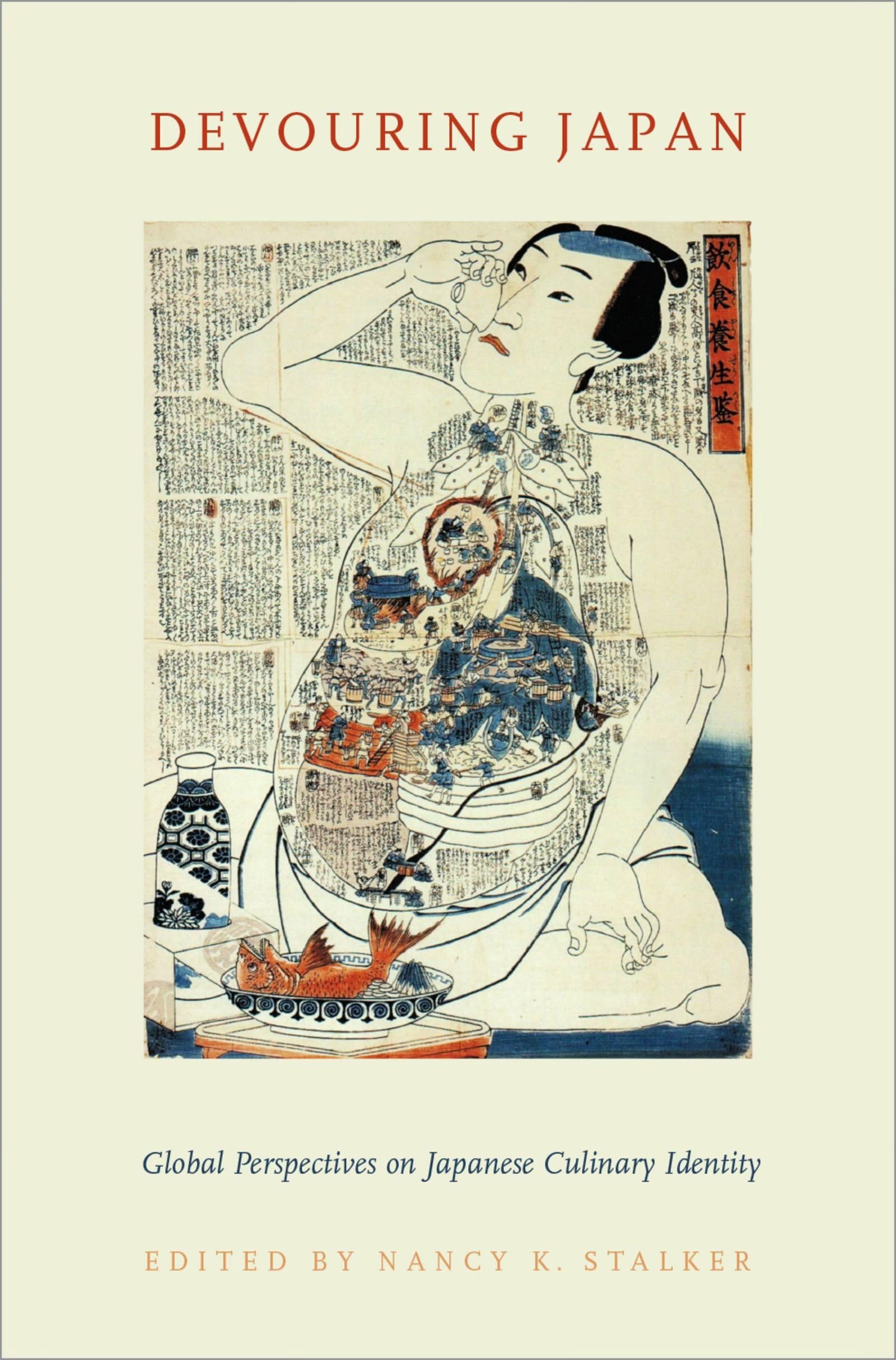
These statements were made by Kazu Katō, a representative of JRO, the Organization to Promote Japanese Restaurants Abroad. Though JRO’s stated purpose is to promote restaurants, what they really promote are Japanese exports, via the businesses that sell them. They operate mainly at expos and trade events, but also run occasional public campaigns like last year’s Japanese curry stamp rally in London. Umami itself is one of their most prominent marketing assets. But JRO was initially conceived as an organization that would not only promote Japanese food, but also regulate and certify it. Ted Bestor explains the background in an article in Devouring Japan:
In the mid-2000s, Minister of Agriculture, Forestry and Fisheries Matsuoka Toshikatsu complained about “inauthentic” Japanese restaurants after visiting a Colorado emporium that featured both sushi and Korean barbecue on its menu. In response, he advocated a system of certification to be applied to restaurants outside of Japan that represent themselves as serving genuine Japanese cuisine.
The proposal was ridiculed in the Japanese press, as well as in government circles; the project came to naught. Nonetheless, the notion of “sushi police” was picked up by the Japanese media and has remained in popular consciousness, perhaps as a shorthand for referring to officious gatekeeping of what is and what isn’t actually Japanese cuisine. Indicative of such popular derision is a 2016 Japanese television anime series entitled Sushi Police… [which] portrays bumbling Japanese officials, accompanied by a robot powered by soy sauce, pursuing inauthentic sushi in the United States… and elsewhere.4
Although Matsuoka’s specific proposal never materialized, it morphed into JRO, which tacitly certified restaurants by including them in campaigns, or by endorsing them in designated restaurant guides. Furthermore, the MAFF scheme turned out to be a hydra: its head may have been cut off, but two more grew in its place: JETRO’s “Japanese Food Supporter” designation, and the completely opaque Nintei Nihon Restaurant accreditation program (apparently initiated by a Japanese restaurant owner in London, with no connection to any other governing body).
This is all to say that umami has been used by Japanese government ministries and trade organizations like JRO as a political and economic tool to support a narrow, generally conservative image of Japanese food, and Katō’s comments should be understood in that context. Elsewhere in Devouring Japan, Yoshimi Osawa investigates the idea of umami as Japanese cultural property in her article “We Can Taste but Others Cannot”:
[Some] Japanese now commonly assert that umami is a taste recognized only by Japanese or that the Japanese understand umami better than foreigners… There are at least three technical reasons why these claims exist: (1) all three umami substances (MSG, IMP, and GMP) were discovered by Japanese scientists, (2) Japanese is one of only a few languages to have a word to describe the umami type of taste, and (3) the existence of umami as a fifth taste was not believed outside of Japan until the discovery of the umami receptor in 2000.5
Osawa’s research included interviews with a number of Japanese chefs in both Japan and the UK, some of whom were absolutely damning in their appraisal of non-Japanese palates as inferior and unable to perceive or understand umami.6 And is it any wonder, when official explanations of umami, such as Katō’s, can be so esoteric and abstract that they invoke sleep quality and bowel movements? Mythologizing umami like this creates a feedback loop between Japan and the West that supports an Orientalist/exceptionalist view of Japan while making umami out to be something more difficult to grasp than it actually is.
The New Yorker article also features commentary from Adam Fleischman,7 founder of the now mostly-defunct Umami Burger. The whole idea of an “umami burger” is irksome to me, because burgers are already inherently umami, especially if they contain accoutrements that bring their own umami compounds to the party: common toppings such as cheese, tomatoes, ketchup, or pickles. Even at their most basic, burgers express an extraordinary level of umami intelligence. That’s why most of the world’s best burgers are not that different from ones that would have been made one hundred years ago. Adding high-concept condiments such as Fleischman’s “Umami Master Sauce” or “Umami Dust” is… fine, I guess, and probably quite tasty. But it’s also unnecessary. I get the impression that in the case of Umami Burger, umami was deployed primarily to generate marketing buzz, and only secondarily in the service of making a better burger.
The Japanese, [Fleischman] told me, define umami as “an over-all harmonious state of perfection where the ingredients come together, a really rounded and harmonious dish. They have a sort of zen way of looking at it.”
The invocation of Zen says it all: umami is meant to be something mystical, rarefied, profound. But one of Osawa’s interviewees, a Japanese food TV presenter, offers a counterpoint: “To be honest, umami is a convenient expression. If I cannot find an appropriate expression to describe the taste of food, I sometimes use umami instead of just saying oishii (tasty).”8
Imagine, if you will, a parallel universe in which the chemical compounds responsible for the subtle but distinctive taste of savory food were isolated by an Italian scientist, who named this taste “gustosità” or something. I wonder what the discourse surrounding gustosità would look like. Would the Italian government use it to promote anchovies and cheese and tinned tomatoes, and to support the idea that Italians have superior palates? (Lol I can’t even keep a straight face writing that – of course they would.) Would non-Italians be producing podcasts and writing lengthy think pieces about it, like this one?
Or would we all just shrug and say, “Oh yeah, gustosità – I get it, savoriness. American food is savory, too. Burgers are totes savory.”
Clearly, I am very dismissive of the notion that umami is anything more than just a universal basic taste – too dismissive, in fact. Masing and Dearlove’s podcast – which compellingly connects umami to feelings of comfort, satisfaction, nostalgia, and self-care – has made me rethink my hardline, just-the-facts position on umami. Because taste is not just a matter of, you know, taste. How we perceive food and understand our relationship to it, and its relationship to the wider world, has a lot to do with how we contextualize it and talk about it.
Katō’s musings about how umami is “kind to the body” and helps you poop sound pretty woo-woo, but a more open-minded and perhaps less arrogant interpretation would be that he’s expressing an aesthetic sensibility related to umami, rather than trying to define the term in a purely academic way. And certainly, that approach has merit, especially because when it comes to describing sensations, words often fail us miserably.
In a way, it’s no wonder we’ve all latched on to umami so excitedly. We don’t have a lot of words to describe tastes, so when a new one comes along, it’s like finding a key to a door that’s been locked our whole life. Now we can name it; now we can talk about it, explain it, move in and make it our own.
Discussing the sensory characteristics of food often involves metaphors. We describe tastes in terms of other things, and vice versa: a bittersweet memory, a sour expression, salty language. But savory…? That’s a bit trickier. We can savor a moment, or meet an unsavory character, but the actual word “savory” doesn’t appear in any English figures of speech that I can think of. Perhaps this indicates that we don’t have strong, definitive associations with the word. It may be worth noting, as Osawa does, that Japanese dictionaries also define umami as “a skillful thing to relish, especially techniques in art” and “profit that is easily gained in business.”9 As a more familiar, more lived-in word (and again, a homophone), umami naturally has other connotations in Japanese.
How on earth would you describe a savory taste to someone else? How would you describe any taste? It’s actually kind of impossible, which is why using metaphors, using narratives, and expanding on the emotions we associate with a taste can be useful – as Masing and Dearlove and their interview subjects have done, and indeed, as Katō does in his explanations. The language Katō uses to explain umami is delicate and calm: “kind,” “mild,” “feeling good,” “sleeping well.” They’re the same sort of words you might hear in a meditation app. Now, compare this to Adam Fleischman’s cookbook:
To quote Clive Badger from Fantastic Mr. Fox: Explosions! Flames! Burning things! The back cover copy boasts that this book will teach you how to “detonate flavor”! Kaboom! Could this take on umami be more American?10 Of course it’s to be expected that in a country where there are more guns than people, even umami is weaponized. Goldfield points out that “Fleischman’s approach — Where do I find the umami, and how can I get as much as possible? — is distinctly American.” She also reports that in 2013 David Chang set out to create something he called “the New York umami.” What does this even mean? If you want New York umami, eat a slice of pizza. If you want American umami, just eat any normal cheeseburger. In his cookbook, Fleischman acknowledges the inherent umami of pizza and burgers – but it’s not enough for him. And maybe that’s the American approach to umami, as Goldfield suggests: to ramp up, maximize, exaggerate, explode.
Umami is a basic taste – and I still think that’s the best and simplest way to understand it. But perhaps basic tastes just aren’t so basic after all. Sweet, sour, bitter, salty, and umami: we associate all of them with particular things outside the realm of food, and it is in those associations that they take on new, more complex meanings, which will inevitably vary between different cultures and languages. Tastes are like colors: we all see the same red, blue, and green, but how we interpret them as symbols depends completely on our cultural vantage point. We are what we eat – that’s a given. But we are also the way we talk about what we eat.
24 Hour Pancake People is a reader-supported publication. To receive new posts and support my work, consider becoming a free or paid subscriber.
Thanks for reading! If you enjoyed this post, you may like some of the articles I’ve written for Pellicle, which also explore how symbolism and sense-memories connect to taste and flavor.
I remember my MSG “aha!” moment clearly. When I was living in Japan, at some point I clocked that the salt shaker on the table at my go-to yakitori joint wasn’t just salt. It was aji-shio, or “flavor salt,” a mixture of salt and MSG. So that’s why it makes everything taste so good, I thought. This came after growing up in America and seeing “no MSG” labels on food packaging for years and years, and hearing about MSG primarily in the context of widespread, casually racist demonization of Chinese food. I never really knew why people thought MSG was bad, and it didn’t take much Googling for me to realize that it wasn’t.I’ve been all in for Team MSG ever since.
The paper also refers to synergistic umami, although only in a misspelled citation that took me a while to figure out: “sojo-kaka,” which should have been “sōjō kōka” (相乗効果). To be honest, re-reading this paper made me feel like I’ve been spinning my wheels for 20 years when it comes to communicating about umami!
This is a pretty common occurrence in popular writing about Japanese culture. So many Japanese words have undergone a similar treatment, like ikigai – I really enjoyed this article explaining how it’s been misrepresented in the West. And it’s worth pointing out that we already have cultural concepts analogous to ikigai: raison d’être, or simply one’s life purpose – just like we already have the concept of savoriness. Do we even need “umami”?
Bestor, Theodore. “Washoku, Far and Near: UNESCO, Gastrodiplomacy, and the Cultural Politics of Traditional Japanese Cuisine.” Devouring Japan, edited by Nancy K. Stalker, 109-110. Oxford University Press, 2018.
Osawa, Yoshimi. “We Can Taste but Others Cannot: Umami as an Exclusively Japanese Concept.” Devouring Japan, edited by Nancy K. Stalker, 127. Oxford University Press, 2018.
Out of curiosity, I Googled うま味爆弾 umami bakudan (umami bomb in Japanese), and there are actually quite a lot of results. (The first and most interesting one is for 3D-printed canapés!). So maybe this idea of a violent, explosive umami isn’t so all-American or un-Japanese after all.
Dopamine rushes, withdrawals, and detoxes are trending among wellness gurus online. But experts say the science behind the trendy phrases doesn’t hold up.
The nerve cells pictured here are responsible for producing dopamine, a neurotransmitter that has become an obsession among online wellness gurus. But experts say the popular understanding of dopamine is often wrong—and the chemical actually plays a critical role in learning, movement, memory, attention, mood, and motivation.
Micrograph by Dr. Nick Gatford, Research Fellow/Kavli Institute of Nanoscience Discovery/University of Oxford
ByKatie Camero
February 4, 2025
Dopamine is widely known as a “feel-good” hormone, a major reason why we may feel happy after a shopping spree or eating pizza.
Thousands of TikTok videos reveal how interested people have become in boosting or lowering their daily doses of dopamine—whether through dopamine “rushes” and “withdrawals,” or dopamine “fasts” and “resets.”
But now that the chemical has become an obsession among wellness gurus, scientists who study it want to make it clear: Dopamine can do a lot of things, but making us “feel good” isn’t one of them.
Dopamine doesn’t work like that, and it’s certainly not a “catch-all term for happiness,” says Daniel Dombeck, a neurobiology professor at Northwestern University who studies the molecule.
Dopamine is a sophisticated neurotransmitter that also acts like a hormone and plays critical roles in learning, movement, memory, attention, mood, and motivation. While dopamine contributes to our feelings of pleasure, it doesn’t directly cause them—and it definitely doesn’t act alone.
“There's a lot of ignorance about what dopamine does and how the brain functions,” says Anne-Noël Samaha, an associate professor of pharmacology and physiology at the University of Montreal who studies the science of rewards and motivation. But in a nutshell, “it’s one of the molecules that allows us to stay alive.”
How dopamine works in the body
Dopamine acts as a chemical messenger, allowing neurons in different parts of your brain to communicate with each other. How it affects you depends on where it’s acting in your brain, Samaha says.
“In some regions [of the brain], an increase in dopamine can help people focus,” Samaha says. “In others, it could make people more impulsive.”
A lack of dopamine in certain areas of the brain can also negatively impact functions like concentration and movement, and is associated with conditions like attention deficit hyperactivity disorder, Parkinson’s disease, and addiction.
This prismatic photo captures a network of dopaminergic neurons—nerve cells that produce and release dopamine—generated from human stem cells. Scientific studies have shown that dopamine doesn't actually make you feel good as some people claim—it makes you want the things that make you feel good.Micrograph by Dr. Nick Gatford, Research Fellow/Kavli Institute of Nanoscience Discovery/University of Oxford
An illustrated view of a synaptic cleft, the space between a neuron and the cell where the neuron releases neurotransmitters such as dopamine. A "dopamine rush" is a misnomer, experts say; when you engage in an enjoyable activity you actually experience a rise in levels of several types of neurotransmitters.Illustration by Science Picture Co/Science Photo Library
So why is dopamine mostly known for its part in our pleasure and reward system? Dombeck says that’s because it was the subject of early research in the 1980s that found our brains release the molecule when we receive food or another reward. As a result, experts generally accepted that dopamine mediates pleasure.
But in the 90s and early 2000s, mounting evidence challenged that idea. Turns out that when you shut down an animal’s dopamine system, they enjoy their rewards just as much but lose all motivation to seek more.
In other words, dopamine doesn’t make you like something, it makes you want it.
“It's not the molecule of pleasure,” Samaha says. “It's the molecule of the pursuit of pleasure.”
This is why you may want to stop doomscrolling before bed—or using drugs or drinking alcohol—but can’t bring yourself to quit even when it makes you feel terrible. Every time you swipe past funny, shocking, or otherwise engaging content, your brain releases dopamine and records the details about the moment in an attempt to boost the likelihood you repeat it whenever you’re exposed to cues like the ping of a notification on your phone, Dombeck says.
This was an evolutionary advantage for humanity.Today, most things we want and need are incredibly accessible for people in wealthy countries. But our ancestors needed dopamine to make them want to walk several miles for a meal or spend months building shelter with their hands.
You May Also Like
“We evolved in environments where we had to mobilize our energy and attention to seek out things that were necessary for our survival,” Samaha says, including safety, shelter, and social connection—and dopamine helps us do that.
Dopamine ‘rushes’ are more than just dopamine
Yes, dopamine levels do rise when you engage in enjoyable activities like listening to your favorite song. But to call that surge in positive feelings a “dopamine rush” is “more than an oversimplification,” Samaha says, “it’s just plain wrong.”
Those activities also elicit a rise in levels of other neurotransmitters that affect mood like serotonin and oxytocin, as well as endorphins, Dombeck says. How and where these molecules interact with each other determines how you feel.
“At the time of a positive outcome, there’s a rush of activity throughout the brain,” Dombeck says. “To call the whole thing a dopamine rush is underselling what’s actually happening.”
These peaks in dopamine aren’t inherently good or bad, Samaha says—what matters most is that they aren’t extreme. Too much dopamine is associated with conditions like mania, while too little is linked to depression. In most scenarios, though, “dopamine is just neutral,” Samaha says, and is around to “keep us alive.”
Dopamine withdrawals are complicated too
Just because you feel temporarily irritated or anxious after losing access to something that brings you joy, it doesn’t mean you’re experiencing a dopamine withdrawal, Samaha says.
“Anytime people have to change their habits, there's always an adjustment period that’s accompanied by some level of anxiety and stress,” Samaha says. “That doesn't mean dopamine levels have greatly decreased and they're now dangerously low.
There is a real condition called dopamine agonist withdrawal syndrome, but that only happens to some people who take medications that mimic dopamine to treat conditions such as Parkinson’s disease and restless leg syndrome. If they suddenly reduce their dose or stop taking their meds, they may experience symptoms similar to drug withdrawal such as agitation, excessive sweating, nausea, and pain.
But a post-vacation gloomy mood, for example, might just be a sign that you’ve gotten used to the high of that stress-free life—not a full-blown dopamine deficit. “It'll take time for your dopamine system to kind of recalibrate and come back down to a normal threshold where other parts of your daily life could activate it,” Dombeck says.
The ‘dopamine fasting’ trend isn’t literal
“Dopamine fasting” is another buzzword that, according to the psychologist who coined the term in 2019, is meant to be an “antidote” to our highly stimulating society: Easy access to activities that give us quick dopamine hits are, as the theory goes, numbing us to the pleasures of slower activities like reading or creating art.
Now that we can do most things with a tap on a touchscreen, we’re bombarding our dopamine systems with “very potent rewards that require almost no upfront work,” says Anna Lembke, professor of psychiatry and addiction medicine at the Stanford University School of Medicine and author of Dopamine Nation. As a result, the things we like don’t satisfy us as much, but we still crave them in an “attempt to bring baseline dopamine levels back up to normal, healthy firing.”
Some people, however, have taken the concept of dopamine fasting too literally. Rather than asking you to stop doing everything that might stimulate dopamine in your brain, dopamine fasting is about limiting or completely refraining from impulsive and problematic behaviors.
Besides, there’s no way to actually drain yourself of dopamine, Samaha says. “It's not like Dry January where you decide for a whole month that you won't drink alcohol because it's good. You can't have a dry dopamine day, it’s not possible,” Samaha says. “Dopamine is an ancient molecule…that has been conserved across evolution. It certainly has not evolved to be influenced by social media or people's phone habits.”
Furthermore, although habits like checking social media or gambling can be addictive, there’s no direct evidence that they can dramatically rewire your brain like drug abuse can, Lembke says.
The bottom line? Avoiding harmful habits are bound to benefit you, but you don’t have to avoid the things that make you happy.
“Trust that your dopamine is going to do what it does,” Samaha says, “and just leave it alone.”
estimated reading time: 10 minLike many memoirs, J. D. Vance’s book misses a few details, some of which complicate the story upon which he has based much of his politics.
Last month, after I published an article about the Republican Vice-Presidential candidate J. D. Vance and his fixation on the traditional nuclear family, I received an e-mail from Donna Morel, an attorney in San Diego. Morel is a fact-checking hobbyist—notably, she exposed major fabrications in best-selling books by the late celebrity biographer C. David Heymann. After Donald Trump named Vance as his running mate, Morel had begun looking closely at “Hillbilly Elegy,” the 2016 memoir that brought Vance to national prominence and provided the springboard for his foray into politics. Morel suspected that the book was “a little too made for Hollywood,” she told me—in 2020, it was adapted into a movie starring Glenn Close and Amy Adams—and she wanted to see if her hunch was correct.
Vance, it must be stressed, is no C. David Heymann. Judging by what Morel has unearthed from the archives, Vance has blurred some details, perhaps unintentionally, in a manner that likely comports with most memoirs, especially those that rely heavily on family lore. Vance is careful to acknowledge spots in “Elegy” where he may not have all the facts in place; in the introduction, he writes, “I am sure this story is as fallible as any human memory.” Still, Morel has identified discrepancies and omissions that complicate the family narrative upon which Vance has based so much of his conservative politics and ideology. Some of what was left out of “Elegy” undermines Vance’s larger political project, in which matrimony and the nuclear family are the foundation of a civil society that stigmatizes divorce, single parenthood, same-sex marriage, and, of course, “childless cat ladies.”
“Two generations ago, my grandparents were dirt-poor and in love,” Vance writes toward the start of “Hillbilly Elegy.” “They got married and moved north in the hope of escaping the dreadful poverty around them.” Bonnie and Jim Vance, who are immortalized in “Elegy” as Mamaw and Papaw, left their Appalachian home town in Kentucky in their teens, eventually settling in Middletown, Ohio, where Jim got a union job at the Armco steel mill; tragically, their first child died in infancy. (“Without the baby, would she have ever left Jackson?” Vance asks in “Elegy.” His grandmother’s “entire life—and the trajectory of our family—may have changed for a baby who lived only six days.”) Vance describes Bonnie and Jim as “alone in their new city” and “isolated” from the family they felt closest to. He allows that Jim’s mother, Goldie, was “nearby,” but that Bonnie disliked her, and that she was “mostly a stranger to her own son.”
Morel dug up census records and other documents that add nuance to this tale. “Hillbilly Elegy” doesn’t name Jim’s stepfather, Julius Blackmon, who had worked at Armco for years before Jim was hired there. (“Applicants with a family member working at Armco would move to the top of the employment list,” Vance notes in his memoir, without making the connection.) Despite any disdain that Bonnie may have felt toward her mother-in-law, Bonnie and Jim lived with Jim’s mother and stepfather at two different residences following their move to Middletown, according to the census records. Uncle Jimmy’s birth announcement, in 1951, also shows the young couple living in the Blackmon home. When Bonnie and Jim did get their own place, it was less than a mile away. And, when Julius Blackmon died, Jim was named the executor of his estate—yet another data point that contradicts the picture of estrangement that Vance sketches in “Elegy.”
None of these findings destroys the portrait of two teen-agers leaving their lives behind in Appalachia and striking out to create a better life for themselves in the industrializing Midwest. But the surprising elisions work to exaggerate Bonnie and Jim’s circumstances, putting dents in Vance’s version of their plucky, up-by-the-bootstraps story.
Bonnie and Jim’s marriage was, at times, deeply troubled—in Vance’s telling, both of his grandparents were violent, and Jim was a vicious drunk. But Vance praises them in his memoir and elsewhere for sticking it out. Later in the marriage, Vance writes in “Elegy,” they “separated and then reconciled, and although they continued to live in separate houses, they spent nearly every waking hour together.” (The relationship seems to have improved immensely, Vance observes, after Jim Vance quit drinking, in 1983.) During a 2021 talk in which Vance discussed how divorce harms children, he suggested that, following the sexual revolution of the nineteen-sixties, too many couples in flawed marriages began falling back on divorce as an easy way out, and he offered up Mamaw and Papaw as an aspirational counterexample. His grandparents, he said, “had an incredibly chaotic marriage in a lot of ways, but they never got divorced, right? They were together to the end, ’til death do us part. That was a really important thing to my grandmother and my grandfather.” By the nineteen-seventies and eighties, Vance told his audience, couples were more likely to see marriage as a “basic contract,” one that could be entered into and exited with ease, even caprice:
But that recognition that marriage was sacred, I think, was a really powerful thing that held a lot of families together, and when it disappeared, unfortunately, a lot of kids suffered. And this is one of the great tricks that I think the sexual revolution pulled on the American populace, which is this idea that, like, well, O.K., these marriages were fundamentally—you know, they were maybe even violent, but certainly they were unhappy, and so getting rid of them and making it easier for people to shift spouses like they change their underwear—that’s going to make people happier in the long term.
According to records sourced by Morel, Bonnie and Jim—Vance’s flawed but heroic avatars of traditional marriage—entered divorce proceedings twice. In the first instance, according to court documents and also an announcement in the March 22, 1955, edition of the Middletown Recorder, Bonnie, then twenty-one, filed for divorce from Jim on grounds of “extreme cruelty” and “gross neglect of duty.” Joseph Nigh, a family-law attorney in Columbus, Ohio, told me that “ ‘extreme cruelty’ is a broad spectrum,” and can encompass physical assault, verbal abuse, or “demeaning conduct.” “Gross neglect of duty” is even more of a catchall term, Nigh said, intended to be left to a court’s broad discretion. (Nigh spoke with me about Ohio family law as a general matter, and did not address the Vance case specifically.)
The timing of Bonnie’s divorce petition is out of step with “Elegy,” in which Vance’s Uncle Jimmy compares the early years of his parents’ marriage to “Leave It to Beaver,” and says that, while their bond was always volatile, before the nineteen-sixties, “they were united, they were getting along with each other.” In the divorce petition, Bonnie asked the court for a restraining order against Jim as well as alimony, child support, and custody of three-year-old Jimmy. In August, 1957, the divorce filing was dismissed “without record,” leaving no documented clue as to why. Bonnie and Jim went on to have two more children.
Taylor Van Kirk, a spokeswoman for Vance, said, in an e-mailed statement, “JD’s grandparents lived difficult lives amid struggles with poverty, miscarriages, and alcoholism. But in their later years, they became overwhelmingly positive forces in the lives of their children. The decision for a married couple to divorce is deeply personal and individual—JD respects those decisions.” A representative for Vance also cited recent comments that the candidate made on Fox News in which he stressed that he has never “supported women staying in violent marriages.”
It’s entirely possible that Bonnie and Jim Vance reconciled because of their commitment to the sanctity of marriage. But it’s also useful to place Mamaw and Papaw’s first aborted divorce—which goes unmentioned in “Hillbilly Elegy”—in some historical context. Before the state of Ohio introduced no-fault divorce, in 1974, anyone unilaterally seeking a divorce needed to prove that her spouse had committed a misdeed that was enumerated in Ohio’s divorce code; in addition to “extreme cruelty” and “gross neglect of duty,” these faults included adultery, bigamy, impotence, and “habitual drunkenness.” Prosecuting such a case against one’s spouse required money and resources. In seeking divorce, “the problem that so many women had was that they weren’t financially independent from their husbands,” Elaine Tyler May, a professor emerita of history and American studies at the University of Minnesota, said. “It’s not a coincidence that divorce rates went up as an increasing number of women began working outside the home and were able to support themselves.” (Bonnie Vance, it might be noted, was not employed, did not complete middle school, and did not seem to have any family in Ohio.)
Vance is correct that the nationwide advent of no-fault divorce in the nineteen-seventies did make marriage more akin to a “basic contract.” But a range of statistics drawn from subsequent decades is highly suggestive of the kinds of contracts that some women wanted to break. Research by the economists Betsey Stevenson and Justin Wolfers has shown that, as no-fault divorce became the norm in state after state, domestic-violence rates dropped by some thirty per cent, suicides among women dropped by as much as sixteen per cent, and the number of women murdered by their partners dropped by ten per cent.
In 2020, Vance, who had recently been baptized and confirmed as a Catholic, published an essay in the Catholic journal The Lamp about how his grandmother influenced his decision to convert. “I felt desperate for a worldview that understood our bad behavior as simultaneously social and individual, structural and moral,” he wrote. The philosophy he craved, Vance went on, “could speak against rising rates of divorce and addiction, not as sanitized conclusions about their negative social externalities, but with moral outrage. And I realized, eventually, that I had already been exposed to that worldview: it was my Mamaw’s Christianity.”
Divorce rates have not been rising for some time—they peaked in the U.S. at the turn of the eighties, before Vance was born. Still, it is his prerogative to imagine that his grandmother might have felt a sense of moral outrage about the evolution of divorce law. And Vance’s reader is free to feel a sense of moral outrage on behalf of any young mother of the nineteen-fifties who might have sought to escape a marriage that was characterized by “extreme cruelty.”
A quarter century after Bonnie Vance’s first divorce petition was dismissed, her marriage appears to have reached another breaking point. According to a decree that Morel procured from a court in Butler County, Ohio, Jim filed for divorce from Bonnie; Bonnie filed a counterclaim, and, in 1981—incidentally, around the time that the rate of divorce in the U.S. reached its historical apex—the court found Jim “guilty of gross neglect of duty.” Still, the couple did not divorce. Instead, they legally separated. Nigh, the Ohio family-law attorney, said that a couple might pursue a legal separation instead of a divorce if one or both spouses had religious objections to divorce, for example, or if there was a question of one spouse forfeiting health-insurance coverage. Yet, despite these considerations, “it’s very rarely used,” Nigh said. “In nineteen-plus years of practicing, I’ve only done one or two legal separations.”
The decree ordered that the “parties to said contract shall live separate and apart,” and Jim was required to pay Bonnie seven hundred dollars a month in alimony. He also had to “relinquish all claim” to “the family residence,” cede property he co-owned with Bonnie’s brother to their mother, and hand over the title of the 1980 Buick to Bonnie, even as he continued to make the monthly payments on it. Yet the “marriage contract” between them, the decree states, “shall continue in full force and effect.” Mamaw and Papaw may have looked and sounded divorced. But, technically, they never did give up their claim to “ ’til death do us part.” ♦
This is the text of an address I (Marika) gave recently as part of the KULeuven annual Thomas Feast on the theme of theology, art, and decolonisation.
For several years now I’ve been haunted by a piece by Étienne Balibar about the relationship between politics and knowledge in the university. Balibar wrote that, ‘We realise now that our ruling class is no longer a bourgeoisie in the historical sense of the world. It does not have a project of intellectual hegemony, nor an artistic point of honour. It needs (or so it thinks) only cost-benefit analyses, ‘cognitive’ educational programs, and committees of experts. That is why, with the help of the pandemic and the internet revolution, the same ruling class is preparing the demise of the social sciences, humanities, and even the theoretical sciences. To accelerate the process, why not have the victim become the culprit (‘Islamo-leftist’, ‘activism’, ‘ideology’…)? It will make things easier.’[1]
It’s a strange time to be reflecting on the relationship between theology, art and decolonisation, as both theology and the arts are struggling for survival in a global war waged ‘on wokeness’ – which is to say, on the side of white supremacy. When things that we love – or that we depend on for our salaries, stipends, or future job prospects – are threatened, it can be tempting simply to knuckle down, to try to cling to what we still have for as long as we can. But I want to suggest that we take our cue from Cedric Robinson, who writes in Black Marxism that his goal in writing the book was not simply ‘a question of outrage or concern for Black survival’ but ‘a matter of comprehension.’[2] How can we understand the relationship between theology, art, and empire?
Two things are often missing from contemporary attempts to grapple with this question, which are frequently both too abstract and not abstract enough. Our conversations often get stuck at the level of theological and artistic content – questions of who or what is represented or talked about. What this misses is both the very particular and material question of the institutions and resources which make theological and artistic expression possible, and then the more abstract question of theological and artistic form. So I want to spend some time sketching out some thoughts on these two areas.
Both the arts and academic theology in the Western world take their shape in large part from the huge social transformations which took place within Europe over the late medieval and early modern period along with the emergence of slavery, colonialism, and racism. I’m going to focus here on the role of universities, both because that’s what I know most intimately and because that’s where we currently are, but the other institutions on which theology and the arts rely – churches, galleries, concert halls, philanthropic and government funding bodies – were also transformed with or emerged out of these same processes. Universities were born from Christian Europe’s encounters with its others, out of the wealth of cultural, scientific, and philosophical materials which became available in the wake of the fracturing of Andalusia; out of European encounters with the Arab and Ottoman worlds through the Crusades; and from the age of European discovery, conquest, and slavery. They emerged in ways which reflected the needs of growing European nations for clerical and economic administration of emergent European nation states and empires, for legal and theological justifications for new forms of property and dispossession and, connected to all of this, for new frameworks of nation, race and history within which all of these could take place; frameworks created and sustained by theology, art, and culture.
I’ve come to think that theology, art, and the institutions in which these are done, can be best understood in terms of social reproduction. For the most part, that is, theology and the arts tend to function both to repeat and to re-inscribe the hierarchical ordering of the societies which produce them, along with the spiritual and aesthetic values which sustain these hierarchies; and also to rework these values as the societies which they organise encounter new challenges. As Sylvia Wynter suggests, we see within the Western world a gradual shift from ideas about racial hierarchy which were justified in the late medieval period on theological grounds, to a justification of racial order through reason – the predominant frame of the 16th through to the 18th centuries – followed by a hierarchy in which evolutionary and economic success come to measure eugenic perfection from the 19th century onwards; the belief that economic success indicates not only intelligence but also racial superiority.[3]
Universities exist both to reproduce the forms of knowledge which justify and re-make interconnected distinctions of race, class, and gender and also to reproduce the people who will in turn re-make the world which relies on these distinctions. The crisis we find ourselves in, then, can be understood as the result of the ongoing shifts by which racial and colonial order remake themselves. The second part of the twentieth century can perhaps best be grasped through the framework of neo-colonialism globally and multiracialism in the imperial core: a form of racial order in which, as Denise Ferreira da Silva argues, white Westerners invite non-white people to enter into the supposedly secular sphere of universal values and human rights, both failing to recognise the particularity of our own sense of what is universally human, and relying implicitly on the figure of the inhuman, fanatical or unassimilable other: the barbaric and homophobic Hamas fighter; the misogynistic, violent, immigrant; the drug addicted and welfare-dependent black mother.
Much of what passes for decolonisation in this period, then, can be better described as diversification. The West allows for formal desegregation and decolonisation, welcoming diversity into its ranks precisely in order to maintain its imperial power. We see this reflected in the paradoxes of contemporary theological and artistic institutions: the galleries showing work by black artists with the help of funding from oil companies; universities who refuse to take down statues honouring slave-owners whilst advertising their diversity schemes, running workshops on decolonising the curriculum next door to departments partnering with arms companies; or working to widen access whilst closing off our students’ future possibilities by delivering them into debt. This conjuncture has created challenges for those of us seeking to confront the historical entanglement of theology and the arts with racism and colonial violence. The university is asking us to talk about these things, but not too much; as Fred Moten and Stefano Harney wrote twelve years ago of the subversive intellectual: ‘the university needs what she bears but cannot bear what she brings.[4]’
And of course, all too often we choose not to confront our institutions but to hold back; to limit what we say and do for the sake of our jobs, our connections, or our future employment prospects. To live in the university is to be formed by its systems and structures in ways that I do not think we are very good at reckoning with, and so it is often our undergraduate students who are able to see with the clearest eyes and speak with the bravest voices. I think we’ve seen very clearly in the wake of October 7th the limits of the neoliberal university’s commitment to decolonisation. The violence with which universities have shut down even the mildest demands for disinvestment from the machinery of destruction throughout the ongoing genocide of Palestinians has been revealing. I wonder whether we will look back on these protests as a turning point: the absolute failure of liberal institutions to defend free speech, the capitulation to pressure from donors and governments perhaps the death knell for the Western commitment to the multicultural ideals of diversity, equality and inclusion; and perhaps for the university as such.
What comes next of course, looks to be worse. What does it mean to confront the possibility that, as Balibar suggests the golden age of the university is over? The destruction of the university may look like what is currently taking place in the US, where an attempt is underway to systematically dismantle both universities and the arts, or in the UK, where instead of the wrecking ball of Elon Musk’s DOGE, a purportedly left wing government is overseeing the gradual death by starvation of both the university and the arts sectors. What does it mean to recognise that these changes are happening not, whatever politicians, consultants, or vice chancellors claim, out of economic necessity, but out of a groundless insistence, a kind of pure faith in the superfluity of the arts and humanities?
Let’s talk about abstraction. Jacob Taubes suggests that the fundamental shift which takes place between the medieval and the modern world can be understood, if not explained, in terms of the shift from Ptolemaic to Copernican cosmology.[5] Medieval Europeans understood themselves as part of the great chain of being, a cosmic order reflected not just in the ranked ordering of humans and other creatures but in the very universe itself, a hierarchy both literal and figurative leading from the chthonic darkness below the earth up to the celestial spheres and the heavenly beings.[6] This cosmic and metaphysical order gave both theology and art a firm anchor in the universe.
To speak of God, to make art, was to reflect an order of goodness, truth and beauty in which what was said and done on earth corresponded in a very real sense to what was done in heaven. The Catholic Church was right, Taubes says, to see in Copernicus not just a new scientific theory but an existential threat to the metaphysics which grounded both ecclesial authority and artistic representation. After Copernicus, unable to ground spiritual or ecclesial authority in the external order of the universe, Taubes suggests, both philosophy and theology turned inwards: a shift which we see both in the Kantian turn to human categories and in the ongoing struggle of Christian theology to reconcile the now antithetical poles of God and human being.
This turn inwards is reflected too, I want to suggest, in an inwards turn which we can see in both Catholic and Protestant piety: a new emphasis on inwardness, on intention over action, on self-examination; a proliferation of new mysticisms of internal ascent leading not from heaven to earth but up the stairways of the interior castle to the darkness of God. But art, too, is unmoored, and comes to find its bearings within the individual mind and imagination. Stephen Prickett connects this process both to the spread of literacy and the newly emergent European divide between the public and the private spheres, suggesting that this internalisation of imagination and speculation is seen first in the newly emergent art form of the novel, but appears also in the visual arts and in poetry in tendencies towards realism, idealism, and perspectivalism.[7] Along similar lines, Victoria Nelson has traced the transposition of ancient ideas about underworlds into what she calls ‘psychotopography’, the literary and visual depiction of the underworld as an image of the inner depths of the mind and imagination; an allegorical rather than analogically artistic vision which, she argues, shapes the emergence of the grotesque, the fantastical, and the science fictional in artistic representations in the West.[8]
But these transformations are also racial transformations. As Willie Jennings writes, the emergence of racial slavery and European empire is characterised by a forcible deracination of enslaved and colonised people; the destruction of their relationships with one another and with their particular places and contexts in order to place them instead within a racial scale which runs not from heaven to hell but from white to black.[9] This racial logic is also a logic of property. Enslaved people, Jennings argues, are relocated both into Christian identity and also into ‘the market’. New European notions of the interior self are themselves tied to new orders of property. Balibar finds in John Locke the first full expression of the notion of self-consciousness; a notion which, he suggests, cannot be separated from Locke’s understanding of personhood as property.[10] It’s the opening up of inner space which makes it possible for Locke to understand personhood as self-possession, and this relationship of self-possession which in turn opens up new forms of possessive relation to the external world. It is this understanding of personhood which allows Locke to claim ownership not only of the ore dug up by his own hands, but also of the grass that his horse has eaten, and the turf cut by his servant. It is this interiority, this self-possession which, Brenna Bhandar and Alberto Toscano argue, smuggles ‘a racial anthropology of the human’ into the very heart of Western ideas of personhood, the self-conscious, rational, imaginative and self-possessed person contrasted with racialised non-persons, understood to be lacking in self-consciousness, irrational, and trapped outside of history in the realm of nature.[11]
The racial frame within which this new interiority is mapped is also a historical frame, an account of progress in which the gradual abstraction and spiritualisation of all things which was once worked out along the great chain of being comes now to be mapped across a historical scale. Here theology is placed as one stage along a developmental scheme within which, in its classical form, the pagan deification of nature gives way to the outward law of Jewish monotheism, then the inward law of Christianity, and finally the spiritualisation or internalisation of theology’s claims; the realisation that it is not God but reason which drives forward history.
A similar process of interiorisation and abstraction is at work in narratives of the development of art over history. The novel is placed towards the end of a process of development which begins in myth and fable.[12] What is modernity if not Don Quixote, awakening from a dream of chivalry and romance to discover himself, the protagonist of a work of fiction? The modern art gallery removes works of art from religious, ritual or social function and places them into a blank white box. Something similar can be said of the museum, which marks its difference from the gallery precisely by placing the works it holds into context, thus marking them out from art works proper, at the same time as it insist on the relegation of these contexts to the past. Recent conflicts over the fate of the Benin bronzes, for example, looted by British soldiers from Nigeria, have included contention both over the appropriateness of displaying the bronzes as separate works, rather than within the altars for which they were originally made, and also over the practice of removing them from the daily life of the communities from which they were stolen.[13]
In Black Marxism, Cedric Robinson says that his work began from the recognition that the theories of history which he encountered in Western radicalism were insufficient; that ‘something more than objective material forces were responsible for “the nastiness”’. But this need to understand was ‘not simply a question of outrage or concern for Black survival. It was a matter of comprehension.’ We are talking, then, about a double excess; two forms of desire, of pleasure, connected to the acquisition of knowledge. One thing that has happened with the shift from formal and explicit logic of segregation and empire to the less tangible and explicit order of neoliberal multiculturalism has been a shift towards the language of culture and religion as a justification for racial violence under the banner of the threat to Europe’s Christian heritage, or the decline of Western culture.
This shift implicates both theology and the arts more deeply, at the same time as it has heightened the attacks on both insofar as they have resisted these attempts to weaponise them. I wonder whether this has to do with the ambivalent role of pleasure which is more explicit here than in the sciences, precisely because both theology and the art deal with that which is not quite graspable or containable; precisely because both open up the space to confront what cannot quite be contained within the logic of racial order, alongside the pleasures which sustain it. Both theology and art have to do both with beauty and with suffering, and with the slippage between the two. Both know how to redeem the suffering of others, how to turn it into profit. The cost of interiorization and abstraction is sometimes described as ‘disenchantment’; the reward of centuries of violence and dispossession has been, for both art and theology, a certain kind of crisis of confidence, a loss of faith in the reality or value of what we do. What certain kinds of theological or artistic diversity work have in common with the violence of reactionary politics unfolding around the world is perhaps a need to witness certain kinds of suffering in order to restore a sense of reality or urgency or pleasure to the world. What is the difference between a White House video of immigrants being deported to Guantanamo and the keffiyeh-wrapped baby Jesus in the Vatican nativity scene?[14] In Heidelberg, recently, I went to an exhibition about the history of Orientalism in German art. I found myself in a room full of people looking at racist art, wondering whether we were there to enjoy the racist art, or to enjoy feeling superior to the people who made the racist art, or to enjoy feeling bad about being part of a society that had made so much racist art. What is coming for us now, I think, is a movement of reaction which both feeds on the pleasure of racial violence and very much does not want to think about those pleasures. Perhaps that is a place for us to start.
[2] Cedric J. Robinson, Black Marxism (The University of North Carolina Press, 2000).
[3] ‘Unsettling the Coloniality of Being/Power/Truth/Freedom: Towards the Human, After Man, Its Overrepresentation – An Argument’ in CR: The New Centennial Review 3.1 (2003), 257-2337.
[4]The Undercommons: Fugutive Planning & Black Study (Minor Compositions, 2013).
[5] Jacob Taubes, ‘Dialectic and Analogy’ in The Journal of Religion 34.2 (1954), 111-119.
[6] Cecilio M. Cooper, ‘Fallen: Generation, Postlapsarian Verticality + the Black Chthonic’ in Rhizomes 38 (2022).
[7] Stephen Prickett, Secret Selves: A History of Our Inner Space (Bloomsbury, 2021).
[8] Victoria Nelson, The Secret Life of Puppets (Harvard University Press, 2001).
[9] Willie James Jennings, The Christian Imagination: Theology and the Origins of Race (Yale University Press, 2010).
[10] Étienne Balibar, Identity and Difference: John Locke and the Invention of Consciousness, translated by Warren Montag (Verso, 2013).
[11] Brenna Bhandar and Alberto Toscano, ‘Race, real estate and real abstraction’ in Radical Philosophy 194 (2015).
[12] Atesede Makonnen, ‘Romanticism and the Novel(ty) of Race in Manu Samriti Chander, The Cambridge Companion to Romanticism and Race (Cambridge University Press, 2024.
[13] Barnaby Phillips, Loot: Britain and the Benin Bronzes (Oneworld, 2021).
This piece was edited on 12/3 at 10:29am to add additional information on the DNA profile, explain the grand jury decision, the handwriting analysis, a few interviews with detectives and FBI investigators, and findings in JonBenet’s room the night of the incident that hint at Netflix and Berlinger manipulating the truth. I also added clips from the Dr. Phil interview because clips are being removed.
I edited it again to add info on the duct tape, Ramsey PR machine, screenshots from their 1997 website.
This case has likely been solved, but will never see justice. The real mystery is why.
A new Netflix documentary on the JonBenet Ramsey case came out last Monday. Prior to its release, the media hyped this new doc as something that would break open the case. The director, Joe Berlinger, did interviews saying he believed the case could be solved with new DNA evidence and couldn’t believe he previously thought conspiracies the parents did it could be true. People who have watched every doc on the case, read books and pored over the released grand jury papers thought this might be the doc that would finally bring new information to light.
In fact, it doesn’t do that at all. Cold Case: Who Killed JonBenet Ramsey presents no new information and is created by someone who seems more enamored with the fact that he got an interview with John Ramsey than anything that points to him being a serious suspect. Of course, without John, there’d be no family or personal involvement and we probably wouldn’t be watching this on Netflix.
What this creates is a terribly one-sided documentary that does a disservice to everyone involved by leaving out crucial information that points to anyone but an intruder. In fact, the documentary uses the idea that the Ramseys did it as a playful twist designed to trick the audience. The first episode highlights how complicated the house was, how the police noticed odd behavior. It leads you to believe it’s the parents before episode 2 comes in and says, well wait, there was DNA!
The problem is, the first episode doesn’t actually get into the evidence that made the police consider the Ramseys. In fact, they repeat a lot of the lies that are in the Ramsey’s book and have been disproven to make the cops look dumb. For example, the Ramseys say the cops focused on them immediately because they said there weren’t footprints outside in the snow. The Ramseys and Berlinger’s doc point out that there were no prints because there was no snow and show photos of the back of the house. This, to them, is evidence that the cops were trying to make them look bad from the start! The thing is, that’s not what the original police report says.
James Kolar was a detective who worked the case. He started working on it in 1997 when he was asked to stake out one of the Ramsey’s friends at a ski resort. In the week after JonBenet’s funeral, the cops couldn’t find the Ramseys and they wouldn’t share their whereabouts. Kolar worked for the Boulder Police Department for 17 years, but had transferred to Telluride when the murder took place. They asked him to head to the ski resort to see if they were there. He didn’t find them, but this pulled him into the case.
By 2005, he was lead investigator. By 2006, he left the case to go back to Telluride, discouraged by what he witnessed from the DA. In 2012, he released a book with his findings called Foreign Faction: Who Really Kidnapped JonBenet?
Kolar’s book is considered one of the best on the subject, though the Ramseys disagree. We’ll get to why, but he mostly does a great job of compiling all primary sources. You see the child abuse report, the photos of the spiderwebs in the grate, the failure to recreate stun gun marks on a pig. He also points out where the cops made mistakes. So, you remember how the Ramseys said the cops tried to pin it on them from the start by making it sound like there was snow everywhere and no footprints when there wasn’t snow?
Kolar’s book is the first time we find out that’s not true. The cops said exactly what the Ramsey’s said in their initial report: there was some snow on the grass and no snow on the rear patio:
Officer Reichenbach clearly stating where there was and was not snow in his report from Foreign Faction, pg. 45
The photo of the clear rear patio the documentary uses as a gotcha to prove police incompetence doesn’t do that at all. It matches exactly what the first officer on the scene wrote in his report. There was no attempt to make it seem like the lack of footprints was suspicious, he just wrote down what he saw. The Ramseys, however, saw a narrative that helped them prove bias and ran with that.
This is what the case of JonBenet has become, sadly. A millionaire family with power and PR behind them, a DA with ties to that family and a police force that did make mistakes, but who also were hindered nearly every step of the way.
Netflix’s Cold Case: Who Killed JonBenet Ramsey tries to hide or simplify details to present a clean cut, TV-ready conclusion: we need the police to do more DNA testing, we need to focus on the DNA! They hope, with advances in technology and additional DNA from scraping the additional evidence, some day, they’ll be able to link this DNA to a relative of the killer.
Meanwhile, experts have said this probably isn’t a DNA case from the start because the scene was so contaminated and the sample was so small. This remains true. The evidence has not gotten less contaminated over time.
The current DNA profile is actually too small to use genealogical testing, even though this is what the documentary presents as the solution. Again, it is an example of a documentary that is eager to present the truth as black-and-white. DNA must be the solution! How can DNA be wrong? Well, we will get to that.
First, I just wanted you to know, whether you’ve watched the Netflix doc already or not, it is far from the entire story.
I watched Cold Case: Who Killed JonBenet Ramsey as soon as it was out. I’d been waiting for it to drop because, well, this case is the case to me. Am I proud to be a true crime person? Maybe? No? I don’t know? I am aware of the ethical issues and all the bad things it does to society to have 800 podcasts that oscillate between horrific murder details and discounts for Squarespace.
Still, I will put on the latest episode of Evil Lives Here to fall asleep at night. Let’s blame my mom, like I do for most things. She’s the one who raised me on CourtTV! She’s the one who showed me you could read police reports and autopsies online! When I got my first laptop in 2003, I was 12 and ready to become Harriet the Goddamn Spy, okay?
JonBenet was 3 months older than me and like most girls born in 1990, I was obsessed with the photos of her that were all over the news and tabloids. How could something like that happen to a girl my age? At 6, I wasn’t into the details of the case, of course, I was just struck by this pretty girl who suddenly made me realize the world may not be such a nice place for little girls.
By 2003, there’d been a grand jury non-indictment, multiple books on the case released and still no trial or justice. I wanted to know everything. I dug into Angelfire websites, forums, Geocities websites, sketchy transcriptions of police tape interviews and radio interviews. I read Steve Thomas’ 2000 book, JonBenet: Inside the Ramsey Murder Investigation, from an illegal .pdf someone shared and that changed everything for me.
Steve Thomas is featured heavily in the Netflix documentary as a bumbling idiot. The Ramseys sued him after the release of the book and the doc features discrepancies he was caught in. Some of these discrepancies are fair and do point to a man guessing at motive and some details, but he also shares facts on the Ramseys removing items from the crime scene with the permission of the DA.
He mentions leads he wasn’t allowed to follow that would point to the Ramsey’s, like the fact that beaver hair was found on JBR’s (JonBenet Ramsey) panties and the duct tape. The police noticed Patsy wore black furry boots to an interview and asked to test them for beaver hair, but she never turned in the boots. In fact, Patsy and John don’t turn in their clothes from that night until over a year later according to Thomas. Why was this allowed? Why doesn’t the Netflix documentary mention this? Thomas does:
Inside the Ramseys Murder Investigation, Pg. 153
It’s a fair question for Thomas to have while he worked the case. Netflix doesn’t think this is worth mentioning, despite mentioning the many unidentified fibers on JBR’s body. If the parents wanted to clear themselves and help provide a better profile of the killer’s DNA or clothing, why not turn your stuff in immediately so it can be excluded? Instead, the Ramseys waited a year, when these clothes had been washed and mingled with other things to turn them in. It’s almost like the Ramseys don’t actually want a DNA or fiber sample that isn’t compromised.
Foreign Faction
Take, for example, their actions after receiving the ransom note. Patsy says she didn’t read the entire note, but saw the beginning, went to check on JBR, she wasn’t there, she called for John and then went to call 911. John says he heard Patsy scream, met her on the backsteps, took the letter, laid it out on the floor and started to read it.
This is a bit odd, since Patsy mentions details from the end of the letter on the 911 call, but it is possible John read it aloud or was relaying this info. What’s odd though is that the letter says they’ve been watching the family, they’re related to John’s businesses and if the Ramseys tell anyone about this, they’ll kill JBR.
It makes sense to call the cops immediately, even though the letter says not to. What doesn’t make sense is Patsy calling her four best friends to come over because there was an emergency and she needed them. Barbara Fernie, John Fernie, Fleet White and Priscilla White head over to the Ramsey house without knowing JonBenet has been kidnapped, Patsy doesn’t say this on the phone according to Foreign Faction, pg. 45. At this point, it’s possible someone close to the Ramseys has done this or is involved and they invite friends who know personal details from the letter over?
Foreign Faction, pg. 45
If Patsy had told them a kidnapping with a ransom note occurred, these friends probably would’ve acted like they were arriving at a crime scene. Instead, they thought JonBenet might just be missing in the house and proceed to get their DNA everywhere. A year earlier, Fleet’s daughter, Daphne went missing and was eventually found hiding in their home, so this instinct makes sense.
Fleet thought JonBenet was doing the same and went to search the basement, calling out JonBenet’s name, despite there being a ransom letter. John Ramsey would later point to this as suspicious behavior when he added Fleet White to the suspect list. Well, how unfortunate you invited a possible suspect to roam the house and contaminate the scene before the cops even got to your house.
Not that Fleet was a viable suspect. Someone would’ve noticed if he left his own party the night JBR was murdered. In the time since, White has sued to get the grand jury documents released, as he believes this will clear things up for the public. He cooperated with police and got in a fight with John after the funeral because he felt the Ramseys should talk to the police immediately. It’s unlikely he’s involved if he’s doing everything he can to get information and evidence released. The Ramseys still have him on their suspect list, however.
And while the Ramseys take a year to turn their clothes in from that night, their friends, staff and others are happy to do so immediately. People at the White’s party turn in their clothes to clear themselves and find the person who did this. Because the scene was so contaminated, the officers who arrived also had to turn in their clothes from that night. Trace DNA from all of these people could be eliminated from the trace DNA on JBR fairly soon. The Ramsey family’s was not.
Inside the Ramsey Murder Investigation
When the documentary discusses the Ramsey’s odd behavior when cops arrived, they talk about John seeming distant or going through the mail, but this when the cops start to suspect the Ramseys. They don’t take their clothes that night and they try to interview them but agree to wait. The Netflix doc fails to mention that it’s their shifting stories in the ensuing weeks that raise suspicion. For example, John tells two officers he read to JBR then went to bed. When he finally does his police interview in April, 4 months after the murder, he says they misunderstood him and that he said he put her to bed and he went to read a book.
The two officers felt like he’d been clear and there was no misunderstanding. Patsy also changes her story. The day of the kidnapping, she says she put a red turtleneck sweater over JBR’s white top and white longjohns. It was winter and cold, so she put two layers on top of JBR. That morning, Det. Arendt (the female officer the documentary depicts as crazy) wrote in her report that she noticed a red garment in the laundry area next to JBR’s bedroom.
When JBR is found she’s wearing a white shirt and white longjohns. In April, Patsy changes her story and says she only put JBR in the white longjohns and she always had a white shirt on. In the interrogation, officers push this and she says she can’t recall when or why the red turtleneck was put in the laundry. Maybe, these are two frazzled parents who can’t remember details, but here’s another bit of info the documentary leaves out:
The Ramsey’s lawyers refused to let them be interviewed unless they could have access to police reports and the previous reports of what they said. Their lawyers were essentially given everything they needed to get their story straight. If JBR was wearing a red turtleneck, how did it end up off and in the laundry? Certainly an intruder didn’t do that. Officer Thomas sees this lie as a red flag. JBR’s longjohns were stained with urine, she had a history of wetting herself, maybe she’d wet the bed and stained the red turtleneck, angering her mom and forcing her to put it in the wash. In a 2015 AMA, Lead Det. Mark Beckner confirmed her long johns and the bed had urine stains.
This is why Officer Thomas is seen pushing the “Patsy lost it because JBR wet herself” theory so hard in the documentary. The doc tries to make it seem like a ludicrous idea with no backing that shows how dumb he is, but he’s led to this conclusion because of Patsy’s lies.
People often say this is a case of he said/she said between the Ramseys and the police, but what you’ll find is that, most often, the police take their lead from the Ramseys changing their story and saying conflicting things. Yes, it is bad the police tried to bait the Ramseys into talking by leaking fake information to the media, but remember, these are the parents of their victim and they can’t even find them after the funeral. They’ve failed to answer questions. They’ve failed to turn over crucial evidence. By this point, it’s been two months since JonBenet was murdered, is it so odd they start to take a focus on the parents by February after such behavior?
The doc leads you to believe the focus on the Ramseys was a quick, lazy decision made by bumbling cops that hindered investigations into an intruder. This isn’t true. The Ramseys became suspects after their own lies and behavior couldn’t be written off. Also, officers did investigate intruder theories immediately! Officer Thomas lists all the steps they took: they used cameras from a business in the area to track every car that turned onto the Ramsey’s street that day (a car is the only means of transportation that makes sense if you’re kidnapping a 6 year old).
They interviewed everyone who’d been at the White’s party the Ramseys attended the night before. They took every lead seriously! This is mentioned in both Foreign Faction and JonBenet: Inside the Ramsey Murder Investigation, but Netflix make sit seem as though this leads just sat until Lou Smit joined the case.
Shall we get into the Lou Smit of it all? He’s often considered the Best Detective and Smoking Gun in the JonBenet case. He didn’t solve it, but he dedicated his life to it and even passed his work on to his kids, as the Netflix doc tells us. Lou was brought in as the case stalled by the DA. From the beginning, he made it clear he didn’t think the Ramseys were capable of committing such a crime; this is why the DA liked him.
He went to work on beefing up the intruder theory. Smit would eventually leave the case when a grand jury was put together that focused on the parents. He was certain they’d be indicted because of the media treatment they received and the facts other officers shared. Some point to Smit’s work as the key to stopping the indictment since the defense was allowed to present the intruder theory to the grand jury.
Maybe, Smit did help. He presented two main theories that made sense of things the cops could never understand:
How the hell did someone get her from her room to the basement without making any noise or disturbing the scene? JonBenet’s room was pristine, it looked like someone just got out of bed, not like an attack occurred. Nothing from her room to the basement was out of place, meaning she wasn’t kicking or screaming on the way down. How was she subdued?
Smit suggests: a stun gun. You see, there are two sets of bruises equal distance apart on the right side of JonBenet’s neck and lower back. Smit believes they look like the pattern of a stun gun. If you’ve watched the doc on him, JonBenet Ramsey: What Really Happened (2021) you’ve seen the clips of him recreating stun gun marks on dead pigs to see if he can recreate similar bruises to JonBenet. He sort of does, they kind of look like the same distance, but they’re burn marks instead of bruises.
He was also only able to recreate it with one brand of stun gun, an Air Taser, and the maker of that stun gun said they’d never had a case where a stun gun renders someone completely unconscious and created bruises rather than burns. He also couldn’t get the dimensions to match JonBenet’s abrasions exactly. The train tracks police initially thought caused them though? A direct dimension match. This reddit thread has information (and sources!). The below images are from Kolar’s book (pg. 241 and 354, respectively):
The stun gun marks, it’s wider than the marks on the body
The train tracks they believe she was poked with. These train tracks were found next to the body.
Why does the doc spend so much time convincing you the stun gun could be possible when it was debunked years ago? Because it helps the Ramseys and is the only thing that could explain how JBR was removed from her bed by an intruder. If it’s the train tracks, an intruder wouldn’t make sense. Why would he decide to poke her with a child’s toy once in the basement?
The Window Well/Grate Theory
Perhaps, Smit’s biggest help to the Ramseys was finally giving them a potential entry point for the intruder. The morning of the kidnapping, police and the Ramseys found all the doors locked as they had been. When asked about the broken window in the basement, John said he broke it months prior when he was locked out. John said that he and Fleet found the window open and a suitcase under it just before they found JonBenet’s body in the wine cellar at 1:05pm.
John said this before he knew Fleet told police he was in the cellar at 6:40am, the window was closed and he moved the suitcase there to investigate the window. When asked about this discrepancy, John said he was in the cellar before 6:40am and had found the window open, but closed it because he “wasn’t thinking” (his daughter had just been kidnapped, there’s a ransom note and he doesn’t think the open window matters?). He then changes his story to say he reopened the window at 1pm with Fleet to see if there was any new glass.
Why does this matter? The window with the suitcase under it seemed like an obvious exit for the intruder before John was caught in his lie in April, during his interrogation. Once it was established no one could say for sure if the window was open or if the suitcase had been moved by Fleet or the intruder, the likelihood of the window as the entrance/exit became a little less likely.
That is, until Lou Smit joined the case. He said it was totally possible that someone had moved the grate above the basement window, jumped down into the window well, opened the window through the hole and gained entrance. He even makes a video showing that he could do it. This has become a huge piece of evidence people turn to! Look, he got in that way and he got out using the suitcase! See, this is a plausible entrance/exit!
There’s just one problem: the window well and grate were covered in spiderwebs. Like, so many that the officers initially thought, well no one could’ve gone through there without disturbing the spiderweb or getting dirt/dust everywhere. From crime scene video taken that day and published in Kolar’s book, we can see this spiderwebs were not disturbed at all:
Foreign Faction, pg. 231
Uncleared debris on the windowsill, Foreign Faction, pg. 231
Smit demonstrating how someone could’ve gone through the window while also highlighting they couldn’t have done it without disturbing those cobwebs
This is how Kolar describes viewing this evidence against Lou Smit’s famous window well video. It took until 2005 for a lead investigator on the case to debunk this theory with crime scene video and until 2012 for the public to know this theory was debunked.
And if you’re thinking, well maybe the intruder got out, destroyed the cobwebs and then the spider rebuilt his web by the time the video was taken? Well, Officer Thomas can speak to that in his book. They had a spider expert at University of Colorado Boulder come in and look at the spider/web. He confirmed these spiders go into hibernation in November and the web couldn’t have been rebuilt that morning.
Despite Lou Smit’s two biggest theories being debunked in the years after they were shared publicly, the Netflix documentary still acts as though these are legitimate theories that haven’t been tested. They still present Smit as an expert and an authority on the case, even though his intruder theory falls apart without the stun gun or the window.
Okay, at this point, maybe you think I’m trying to convince you that the Ramseys did this. I’m not! I mean, I definitely think they did and will lay my theory out at the end, but what I love about my theory is that I came up with it from my own research. I really just want you to know that in this modern media landscape, where it’s easy for streamers to sell narratives via documentary, that you have to be discerning. Dig into books, documentaries and interviews! I encourage everyone to do the same.
So, if the Netflix documentary just offers one part of the story, what else should people watch or read? Hit up the below!
I’m Just Curious
This DNA Explainer - Despite everything you will read in this, people still see all of this information and go “Well, the DNA.” There’s a lot of science behind why this DNA sample is most likely useless. If the Ramsey’s were staging the scene, they could easily plant unidentified DNA by rubbing different items from the house on the body (unidentified fibers were found on JBR - navy and tan cloth, beaver or rodent hair - the coroner thought it seemed like someone wiped areas of her body, Kolar and Thomas).
When the FBI and Boulder PD say this is a DNA case, it’s because they think the DNA won’t point to anyone. They think if this DNA eventually does match something, it will be innocent trace DNA that has nothing to do with the murder and, if it matched other fibers or trace DNA on items in the house at the time, would point to a cover-up. This would be the final nail in the coffin for the Ramseys. This is unlikely, as you’ll see below. The Ramseys removed a lot of items from the house the day after the murder.
However, people who believe an intruder did it think the evidence needs to be scraped again for additional DNA to create a better profile of the suspect. Interestingly enough, if the Ramseys had left those items in the house or turned in their clothes from that night sooner, it would’ve allowed the police to exclude fibers and touch DNA to create a better profile from the start!
As long as this DNA remains “unidentified” the Ramseys can always point to an intruder. If the cops figure out it came from items in the house or people with alibis, they know it’s unrelated to the crime, thus narrowing in on the Ramseys. So, in a way, this is a DNA case, but probably not in a way where AncestryDNA is going to find a match or something.
That the documentary and John Ramsey act as though a better DNA profile could point to John Mark Karr points to how ridiculous this notion is: Karr was in Georgia at the time of the murder and knew no new details. That they even present Karr as a viable suspect shows how little integrity this project has. Most likely, John knows this DNA will never match anyone and that’s why he pushes for a genealogical match as the key to the case.
Cold Case: Who Killed JonBenet Ramsey (Netflix) - What, I’m recommending the doc I just trashed? Well, how else will you know what the discrepancies are!! Also, while this doc is very Pro-Ramsey Family, it inadvertently throws their biggest defense out the window by ending on the fact that the DNA profile used to exclude intruders and the family is contaminated and probably invalid so no one previously excluded can be. That includes the family.
JonBenet Ramsey: What Really Happened (2021) - This is Lou Smit’s take, it is very biased. Still, if you want the parent’s side of things, this is the closest you’ll get.
The Case of: JonBenet Ramsey (2016) - This is the first documentary that presents The Brother Did It theory. It’s based on Kolar’s book which comes to a similar conclusion. The Netflix doc acts as though this doc is ridiculous and invalid because Burke sued CBS and settled, but it actually has legit interviews and science. Also, despite the lawsuit, the documentary is still publicly available.
A lot of the questions this doc brings up have never been addressed by the Ramseys. “Burke Did It” is considered the most “out there” theories by people who only sort of know the case, but it makes sense when you consider that’s the theory presented to the grand jury after the murder (along with the intruder theory) and dig into some of the stuff below.
I Want To Solve This Thing
r/JonBenetRamsey - Do I believe reddit is a legit source for information? No. Do I think incredibly dedicated true crime nerds have created a great subreddit that maintains primary sources, interview transcripts, and photos? Yes. If you have a question about anything in this case, you can probably find a detailed thread that looks into every possible answer. This subreddit explained that the DNA was too degraded to provide a legit suspect DNA profile 4 years before this Netflix doc! So, yknow, dive in, but do your research.
Lead Det. Mark Beckner’s Reddit AMA. It’s verified! He makes it clear Burke was involved, the parents staged a cover-up, this will never go to court or be solved without a confession and BPD and the FBI both believe there was no intruder.
Foreign Faction: Who Really Kidnapped JonBenet? by James Kolar - Kolar’s book is a must-read to me. He lays out the scenario that would be necessary for an intruder to make sense in the first chapter and you can understand how ludicrous it would be for a kidnapper to get so lucky. He then starts diving into the debunked myths he was sold by the DA and lies he catches the Ramseys in.
By the end, he suggests there was an incident involving Burke and JBR, he hit her and the parents covered it up. He points to Burke’s swiss army knife and boot print being found in room where JBR was found. Oh, yeah, that thing in the Netflix doc where they say the Hi-Tec boot print was from the cops? It also could’ve been Burke. Investigators knew when Patsy was interviewed that Burke had a pair of Hi-Tec boots with compasses on them and asked her about it. She claimed she couldn’t remember what shoes she bought him.
Foreign Faction, Pg. 221
JonBenet: Inside the Ramsey Murder Investigation by Steve Thomas - Netflix and the Ramseys don’t want you to read this book, so you probably should. He comes to the conclusion Patsy did it because there are signs she, like Burke, lied about being asleep that night. Her fingerprints are on the bowl of pineapple, she most likely put JBR’s red turtleneck in the wash and there were open suitcases upstairs because the family was going on a trip early the next day and she was still packing when the family came home from the White’s.
This is his theory. He thinks Patsy lost it in an act of rage when JBR wet the bed, I think his theory falls apart there. Also, the only evidence we see of Patsy in the basement is that her palm print is on the wine cellar door where JBR was found twice.
The Death of Innocence - This is the book the Ramseys wrote. It is…interesting. It’s mostly about John feeling like he lost this innocence.
The Bonita Papers - In 1998, Boulder PD brought in three lawyers to help assist the case because they felt the DA wouldn’t let them properly investigate. One of the paralegals who worked with these lawyers gathered all of her unedited notes for a book. The notes were leaked to the press by her nephew and uncovered some lies from the Ramseys and confirmed a lot of what Thomas wrote in his book.
The JonBenet Ramsey case is one of the most researched and investigated out there. It isn’t hard to dig in and find a theory that works for you and the evidence you find. This is why it’s easy for one documentary director to manipulate the narrative.
So, at this point…you probably want to know what I think happened. I’ve been tweeting about it in a lot of threads that are hard to follow, so I’ll break it down below based on my take on reading/watching the above. From the jump with this case, I believed the Ramseys did it. When the Lou Smit stuff came out in the early 2010s, it was the first time I really believed an intruder could be possible.
When Kolar’s book came out in 2012 debunking the Smit stuff, I went back to Ramseys Did It. When the 2016 CBS doc and Burke’s Dr. Phil interview came out, I joined Team Burke Did It. With the most recent Netflix documentary, I once again became convinced of the intruder theory, until I revisited Kolar’s book and the other info left out of the doc.
Oh, let me introduce you to some online nerd case terms: -RDI (Ramseys Did It) -BDI (Burke Did It) -JDI (John Did It) -PDI (Patsy Did It) -BDIA (Burke Did It All Except the Cover-Up) -IDI (Intruder Did It)
You will see people in online forums use IDI, PDI, RDI as badges to denote their favorite theory. You’ll see people who go from IDI, RDI to BDI or BDI to IDI to RDI. Whichever your choice, each one comes with a certain set of facts that those theorists believe. Are you IDI? You probably believe in the stun gun. RDI? Your focus might be the fake ransom letter. (Yeah, the BPD and FBI both think the ransom letter is fake, despite the Ramsey civil suit.)
Where am I on this now? Well, I am back to my 2016, Burke Did It All belief. Even more now that the Ramseys are pushing a new documentary that seeks to bolster the intruder argument again while leaving out facts and promoting debunked evidence. After watching the doc, I reread Foreign Faction and re-watched Burke’s Dr. Phil interview. I’d forgotten about the boot match and Burke’s reveal in 2016 that he hadn’t been asleep all night like his parents said. In fact, he was up after everyone went to bed according to him. Let me lay out how I got here.
The Ramseys Lies
They lie about a lot. Whether they put JBR straight to bed or read to her, whether Patsy noticed JBR was missing and then saw the note or saw the note and then went to her room. Whatever, these are things that could be explained by frazzled parents. It’s just odd that their biggest lies all revolve around Burke, his whereabouts, and his belongings:
The Pineapple Lie - The Ramseys say JBR and Patsy went to bed immediately. John played with Burke for a bit, then put him to bed. He read for a bit and then he got in bed with Patsy, took a melatonin and went to sleep. According to them, everyone in the house slept soundly and heard nothing until Patsy woke up to make coffee, found the ransom note and screamed. The scream alerted John, but according to the Ramseys, Burke slept through this, the 911 call and police arriving.
Here’s the thing: JBR ate pineapple at 11pm/midnight, 2 hours before she died. They estimate she died at 1am or 2am. How do we know this? They found undigested pineapple in her stomach. They know it is not from earlier in the day or from the dinner at the Whites because the food from earlier was further along in her digestive tract. Also, officers find a bowl of pineapple on the dining room table. It is a bowl of pineapple in milk next to an empty cup with a tea bag in it.
The Ramsey’s maid said this was Burke’s favorite snack. And, in fact, only Patsy and Burke’s fingerprints are on the bowl of pineapple (see below) and the cup. But, we know JBR ate some from this bowl because they collected it into evidence and tested it against the pineapple in her stomach: it was the same pineapple. Patsy tried to say she had no idea where it came from and someone must’ve left it out in the morning, but how can that be possible if JBR ate some?
Foreign Faction
Burke and John say they have no clue either. Well, someone fed that girl pineapple 2 hours before she died and it’s very unlikely an intruder did that. It’s unlikely she could’ve prepared a bowl of pineapple with milk alone at 6 without making noise and waking someone. It’s also unlikely she was eating at midnight with her brother at midnight and an intruder could’ve committed the crime in a 2-hour timeframe without anyone hearing anything.
Below is Burke acting weird about the pineapple in 2016 on Dr. Phil. It’s interesting he says he can’t remember if they ate pineapple and how could anyone remember something that happened so long ago, but when asked about the 911 call, he says he couldn’t forget something like that.
With the pineapple evidence, it is clear she was awake at midnight, allowing 1-2 hours for an intruder to do everything. The Ramseys need to say they all went to sleep as soon as they got home because that opens the window of opportunity up from midnight to 10pm-2am and allows time for an intruder. If it’s as simple as “oh yeah, the kids wanted a snack when we got home,” why not say that? Of course, there’s another reason Patsy and John may not have known about the pineapple: Burke made it himself and JBR went downstairs when she heard him getting a snack and playing with his toys.
The maid said the kids would often go play or get food after bedtime because the house was so large their parents couldn’t hear them. Burke said in his interview he could hear the fridge open from his room. We also know JBR and Burke would share the same room sometimes. If JBR would wet the bed, she’d change herself and go sleep in Burke’s extra bed. Each child had 2 twin beds in their room (see below). Burke would sleep in JBR’s room sometimes because his would get cold, he says this in his first interview.
The Ramseys say the kids never did that. But, Burke even says JBR slept in his room on Christmas Eve because he wakes up before her and she wanted to him to wake her up for gifts. Basically, there’s a lot of evidence pointing to the two siblings being together without their parent’s knowledge, which would explain the pineapple.
Two twin beds in JBR’s room, Foreign Faction
The Ramseys say this isn’t possible and Burke was asleep all night. In 2016, Burke goes on Dr. Phil and admits he was up after everyone went to bed for the first time, giving the pineapple theory more credence. Also, you’ll notice the bedroom light is on in the above bedroom picture. The bedroom is the only scene at the crime that we know was actually secured. It’s fair to assume, this is how it was when the incident occurred. If the intruders had a flashlight, why would they enter the room, walk around the bed and turn on JBR’s bedside light?
In addition to that, it would’ve taken someone with inside knowledge to know that was the only working light in her room, according to the Ramsey’s maid. How would a kidnapper know about the light switch and, again, why would they need a light if they have a flashlight? It seems more like JBR woke up in the night, turned her light on, got out of bed and possibly went to go see who was in the kitchen.
The pineapple lie confuses a lot of people and they dismiss it as a red herring, but it is probably the most important piece of information. The medical examiner is able to determine that JBR died shortly after eating the pineapple. Whoever gave her the pineapple knows how she hit her head:
Foreign Faction
Here is how Patsy explains the pineapple. It’s all we have since Burke doesn’t remember and won’t answer questions. She thinks the kidnapper fed JBR pineapple right before hitting her. Why would the intruder need to hit JBR then if they’d already subdued her enough to get her downstairs to the table to eat? Why stop to feed her pineapple? You supposedly have a stun gun and duct tape, why not use them and go? Oh, also, if she was stun gunned and dragged from her bed like Lou Smit says, did the intruder wake her up to feed her pineapple in that case?
Foreign Faction
One more thing about the pineapple? One of the few witnesses in this case is Scott Gibbons, he’s the neighbor to the immediate north of the Ramseys. According to Kolar he tells detectives, “He had been in his south-facing kitchen around midnight on Christmas night. He observed that the upper lights in the Ramsey kitchen were on, but dimmed low. Gibbons didn’t observe anyone inside the residence at the time, and noted that it was not unusual for lights to be on in the home at night.” (Foreign Faction, pg. 101)
That means the light was on in the kitchen around the time she ate the pineapple. If it was the intruder, why would they turn a light on? They have a flashlight. Why risk being seen? Clearly, there are witnesses close by.
The Enhanced 911 Call Lie- Patsy and John swear that Burke was nowhere in the vicinity the entire morning they realized JBR was missing. They do not wake him up for information, they just check on him, see he’s sleeping and leave him alone. They say he didn’t wake up until Fleet White went to get him and take him to the White’s house. Well, that is a lie.
Kimberly Archuleta was the 911 operator who took Patsy’s call. Almost immediately, she felt like something was off about the caller. At the end of the call, when the caller thought they’d hung up, Archuleta heard a change in tone and someone said “What do we do?” This was suspicious to her. She immediately went to her supervisor and noted this. After JBR’s body was found, she went back to her supervisor and said the 911 call should be enhanced because she swore there was more said at the end.
The FBI and Det. Trujillo thought she was right. They sent the tape to the Secret Service and Aerospace. The Secret Service wasn’t able to pick up on anything, but Aerospace, which had better recording equipment, could. The first two experts wrote down what they thought they heard independently. The third, a detective on the case, also wrote what she heard independently. All three of them wrote the same thing:
The enhanced 911 call is considered such legit evidence, we learn when the grand jury papers are unsealed in 2013, that it was presented to the grand jury. In fact, they asked Burke about the voices on the tape. He said to the grand jury, as confirmed by the 2016 CBS documentary, “It sounds like my voice on the tape,” but he still said he couldn’t remember if he was awake or not. Burke will later lie in his Dr. Phil interview and say he hasn’t heard the 911 call, but he has heard about it. However, we know the enhanced version was played for him at the grand jury and he said it sounded like him.
John and Patsy swore Burke was nowhere in the vicinity and slept the entire morning. The enhanced 911 call proves he was in the vicinity. If he did wake up and was curious about what was going on and awake because of Patsy’s scream, why hide that? On Dr. Phil, Burke and John say again that Burke was in bed asleep during the 911 call, despite the tape.
After Dr. Phil and the CBS lawsuit, Burke’s lawyer put out a statement saying that Burke never said he was asleep all morning, his parents did and he may have heard the commotion downstairs and screamed from the stairs “What did you find?” This contradicts what Burke says himself on Dr. Phil. It also doesn’t necessarily make sense of John angrily saying “We’re not speaking to you!” In his actual interview after the event, Burke does say he was awake in bed that morning. See below:
Here is the dispatcher talking about it and Burke answering questions about it on Dr. Phil in a way that seems…not so honest. Again, when during the lawsuit, CBS is able to confirm Burke said it sounds like him to the Grand Jury:
Below is the excerpt from the grand jury from Dateline covering the CBS lawsuit:
A quote from Burke’s grand jury interview used by CBS to prove even he inferred it sounded like he’s on the 911 call in court.
The red shirt and bedwetting lies - John said in their CNN interview that they weren’t aware of JBR wetting the bed. Their maid said John was there many times when JBR wet the bed and it’s odd he lied about this. He also must’ve known about Burke’s bedwetting and feces issues. Burke confirms that John and his mom knew that JBR wet the bed and he describes their routine around it in his videotaped interview.
This interview was eventually shared with the public on Dr. Phil in 2016. The Ramseys lying around JBR wetting the bed is, again, what most likely raised Dt. Thomas’ suspicions around that theory. Netflix makes this sound ridiculous, but they ignore that the Ramseys did lie about it. I clipped Burke’s part of the footage from Dr. Phil below. It’s also interesting Burke says he and JBR wet the bed a lot and his parents would clean it up and he remembers this in 2016, but John couldn’t recall if JBR wet the bed in the 1997 CNN interview.
I also believe Patsy did put the red turtleneck Det. Arendt saw in the wash on JBR that night, as mentioned above. She later lied about just putting her to bed in the white shirt. Again, just minor things there’s no real reason to cover up:
Foreign Faction, Pg. 133
This could also be another clue that JBR woke up in the night and took off the red turtleneck herself, another sign she was awake after her parents say she was asleep. Or did someone else take it off of her?
The Flashlight Lie - Police found a black flashlight in the kitchen. The Ramseys said they didn’t recognize it, but may have owned one. The maid and family friend John Fernie said she absolutely recognized it as the flashlight Burke would sleep with. He’d use it in case he had to go to the bathroom at night. And AGAIN, in 2016, Burke says his dad put him to sleep with a flashlight! Dr. Phil asks if he took the flashlight downstairs and he says he can’t remember. That’s a huge change in John and Burke’s stories!
A flashlight sounds like something a kid sneaking downstairs to get a snack and play with his toys would bring with him. Why lie about recognizing the flashlight? Well the flashlight was the only item able to recreate the damage JBR suffered to her head. It was most likely the weapon used to hit her and BPD has held onto it as the murder weapon.
Foreign Faction, Pg. 67
Here is Burke on Dr. Phil in 2016 admitting for the first time that his father put him to sleep with a flashlight and he was up after everyone else went to bed. In this moment, Burke breaks his 20 year alibi and connects both him and his father to the murder weapon the Ramseys previously said they weren’t sure they owned. John doesn’t recognize the flashlight he used that same night with Burke?
The 11am Timeline Lie - When John’s children from his first marriage came to the house after JBR was kidnapped, officers said it was a little before 1pm. This matters because John found JBR at 1:05pm. John’s son-in-law and daughter said that John got in their van as soon as they got there. He climbed in and said “JBR is with Beth now (his daughter who died 5 years before). I found her at 11am this morning.” Well…that means he found JBR before he “officially” did for police. It means he told his other children that JBR was dead before he “found” her at 1:05pm.
John will eventually say got the timezones mixed up, but his son-in-law points out that he was referring to his own timezone, so why talk about a different time zone? Later, the Ramseys will say the kids arrived at 2pm or 7pm, despite John saying in his police interrogation that the entire family left the house at 1:30pm and never returned again.
It’s a little hard to believe his kids arrived at 2pm or 7pm if the Ramseys weren’t there. Also hard to believe they arrived in the 1:05-1:30 window when John would’ve been finding JBR. It is most likely that the cops are telling the truth and the other kids arrived before 1pm, the body was then found and the family left the house for good at 1:30pm as John said in the interrogation. Officer Thomas documents this moment:
JonBenet: Inside the Ramsey Ramsey murder Investigation, Pg. 146
Some believe John did this because he knew the staging was shoddy and didn’t believe that he and Patsy would get away with it. With this move, John gave himself an alibi and potential witnesses who could say he wasn’t involved with the crime until 11am if this did blow up in their faces.
The American Girl Doll Theory - Ok, this isn’t REALLY the American Girl Doll theory, I just call it that because it’s fun. BUT, people who think an intruder did it point to the fact that there was no matching source for the duct tape in the house and the Ramseys hadn’t left all morning, so how could they dispose of the tape? It must’ve come from outside the house. WELL, in his book, Det. Steve Thomas outlines a very easy way the Ramseys could’ve snuck evidence out of the house: they were allowed to.
The day after JBR was found, the Ramseys asked if they could retrieve clothes for the funeral/JBR’s burial. The lead detective said sure, but you have to send someone else, we’ll take them to each room, they’ll point at what they need, we’ll document it and allow it to leave the property.
At least, that’s how it was supposed to go. According to Det. Thomas, when Pam, Patsy’s sister, shows up to gather items, she has an entire list from the Ramseys. It includes credit cards, jewelry, passports, JBR’s American Girl Dolls and stuffed animals, clothes, and other items. Det. Thomas says she filled a car with suitcases, the officers on scene didn’t properly itemize everything taken and if the Ramseys did want to sneak stuff out, this is how they’d do it. How Thomas describes it:
NOW, really crazy conspiracy ppl believe the source of the tape was the American Girl Doll. You see, in 1996, American Girl Doll stores trained employees to put tape on the back of the doll to cover a cord that came from the back of the doll’s neck. They also encouraged people who bought the dolls to do this. Det. Thomas looks into this theory and says it’s farfetched. It’s more likely they just hid the tape in a suitcase and had Pam take it out of the home.
But it is weird that Pam takes a Molly doll that JBR only owned for about a month. Sure, maybe Patsy did want things that reminded her of JBR, but why a doll that’s only a month old and was a gift from her grandma? Well, tan and navy fibers were also found on JBR’s longjohns and the tape. These people think the tan and navy fibers would match the tan body of the Molly doll and her navy clothes. Did the police want to check the Molly doll for a fiber match? Yes. Could they? No. The Ramseys wouldn’t give it to them.
In addition to that, the Molly doll drives suspicion because a few months after the murder, an employee at the American Girl Doll company reached out to Boulder PD to say someone ordered a Molly doll in JonBenet’s name after she was killed. The doll was bought with a money order and was sent to John’s office. John denies knowing anything about the doll, but it’s odd he didn’t go to police and say a stranger mailed him a doll in his dead daughter’s name that she owned before she died.
Couldn’t that be a potential clue? Is it unrelated? Most people think they ordered a new Molly doll and destroyed the one that would match the fibers. People who don’t want to believe in the power of an American Girl Doll to solve this case, however, just think Pam snuck the tape and other evidence out when she grabbed their things.
The Ransom Note - Pretty much everyone thinks Patsy wrote the letter, but I mostly care about the opinion of James Fitzgerald. He was a linguistics expert who caught the Unabomber based on language in letters! He is very good at his job! He says it was Patsy. But, that is just his opinion.
He wasn’t asked to officially review the case, even though he offered to do it for free with a panel of other experts in 2009. Chief Beckner said in his 2015 AMA that he declined the offer because Fitzgerald had trained a previous forensics expert on the case and he felt that was a conflict of interest the defense could benefit from, so there was no point in using Fitzgerald’s panel.
Foreign Faction, pg. 338
I know Netflix showed you something that said “6 experts said it wasn’t Patsy,” but you see those were 6 experts hired by the Ramseys to help them in the civil suit they filed against Dt. Steve Thomas. These were not the findings of the handwriting experts the grand jury heard. The standards of a civil suit are very different from a criminal suit so their findings can hardly be accepted as the final word.
Oh, also the FBI said in the history of kidnappings, there has never been a 2.5 page ransom letter and they felt it was written as a cover-up. Even if you think Boulder PD were bumbling idiots who dropped the ball, the FBI was a different team of people and the below statement is what they thought about the note.
Also, let’s think about this. If you’re a kidnapper who wants an amount with specific instructions, do you hope there’s paper and a pen in the house so you can write that demand out when you get there? What do you do if you can’t find a pad of paper? If that’s your motive, you’re just crossing your fingers that you get there and find a way to communicate your demands?
Also, if you’re in the middle of kidnapping her and she dies, why leave the ransom letterthat’s the only evidence pointing to you anyway? Without the ransom letter, the kidnapper could take all evidence pointing to him and easily pin this on the parents.
The FBI thought it was odd a kidnapper would leave something so incriminating with the body in the house, which would immediately negate any chance of getting the ransom money and provide a clues on a suspect. If you accept the ransom note is fake, that’s incredibly damning for the Ramseys.
Inside the Ramseys Murder Investigation, Pg. 131
The Morning Timeline Lie/Was Burke Awake? - For 20 years, John and Patsy told the same story about that morning: Patsy woke up to make coffee, she went down the stairs and found the ransom note. She didn’t read all of it, she just immediately ran to JBR’s room. When she saw she wasn’t there, she yelled for John. John ran out of the bathroom to the back stairs and found Patsy. He took the letter and told her to call 911. He says at this point he or Patsy went in to check in on Burke, but they left him sleeping. Both Patsy and John say they never looked for JBR because of the ransom note
For 20 years, the police thought that was weird as hell. Whose daughter goes missing and they don’t call her name out or search for her? Why wouldn’t they wake Burke up and ask if he knew anything? Kolar documents this:
Here, is John saying he was the one who checked Burke’s room and Burke was still asleep.
Foreign Faction, Pg. 44
In 2016, thanks again to Burke’s Dr. Phil interview, we find out that Kolar was right to feel suspect about this because the Ramseys did lie. According to Burke, his mom came bursting into his room, searching for JBR, not his dad. She was screaming, “Where is my baby?!” and woke him up. About an hour later, a police officer enters his room and he says that he stays in bed. This means the Ramseys did search for her, they knew Burke was awake and there was at least an hour between Burke waking up because of his mom and the 911 call and police showing up.
You know I have the clip!
The thing is, Kolar and the police knew to be suspect about this during the case because Burke told the police in 1996 that his mom came rushing into his room looking for JBR. They knew she and John were lying about Burke’s whereabouts and when they woke him up from day one. That’s why the police suspected the Ramseys. Burke’s police interview is below. Dr. Phil also points out it’s weird that Burke would hear his parents searching for his sister and wouldn’t get up to see what was happening:
If the Ramseys did search Burke’s room, they probably searched the rest of the house looking for JBR too. We now know about an hour went by from Patsy waking Burke up to the cops showing up, rather than her original “I found the letter, John checked Burke and I called the cops shortly after, Burke never woke up” timeline.
Did they tell police Burke was asleep and they didn’t search the house because he could mess up their timeline and prove they’d been searching for her for at least an hour before cops arrived?
Burke and JBR’s Behavioral Histories
Most people hate the Burke Did It theory because they can’t imagine a 9yo boy being violent or doing these things. However, Burke had a history of violence with JBR. By the end of this, you’ll see that he was a 9 year old boy who previously sent JBR to the hospital, had issues with bedwetting and feces, and may have been a victim himself.
When Burke was 6, he hit her in the face with a golf club and sent her to the ER. This is in her medical records. At the time, Patsy told friends he lost his temper. In their book, the Ramseys say he was practicing his golf swing and lost control. JBR was taken to the doctor 33 times in the last 3 years of her life. There were frequent doctor calls including three 8 days before the murder. It’s more than likely that Burke hit JBR more than once. As far as we know, he’s the only person in the family to ever send JBR to the ER:
Foreign Faction, Pg. 83
Foreign Faction, Pg. 341
People point to JBR wetting the bed and getting clingier with her mom in the days leading up to her death as evidence she was being sexually abused or suffering trauma. What they tend to ignore is that Burke was also wetting the bed at an older age and people around the Ramseys heard odd comments from the family about his body.
JonBenet Ramsey: Missing Innocence, Vanity Fair, 10/1/1997, Ann Louise Bardach
Of course, this could be how the family jokes around. In addition to that, however, his previous nanny said he was wetting the bed until he was at least 7. Cops asked him about it and he got defensive. If JBR regressing and her bed wetting getting worse is a sign of abuse, the same could be said for Burke. Was he wetting the bed because someone in the family was also sexually abusing him? If that’s the case, could he have picked up learned behaviors that he took out on JBR?
Wilcox says that JBR’s bedwetting was getting worse, but what we also know is that Burke’s issues with feces were also escalating. When Patsy was first diagnosed with cancer, housekeeper Geraldine Vodicka found him smearing poop on the walls. This would’ve been around the time of the golf club incident.
Nedra, JBR and Burke’s grandmother cleaned up the incident Vodicka mentioned so she also witnessed this. Another maid, Linda Hoffman-Pugh, previously found feces in JBR’s bed sheets and thought it may have been Burke’s. This matters because feces were found in JBR’s room when the crime scene was processed:
Foreign Faction
Foreign Faction
The Ramseys say that Burke lived in the house and they can’t say when he may have left the pajamas there and question if he even did. Boulder PD didn’t have a chance to question him about it. However, the fact that it was still present at the crime scene points to it being recent: The Ramseys had maids, does it really seem likely they left poop-stained pajamas and candy in JBR’s room for days? A maid was there on the 23rd according to witnesses (this is the day Fleet White makes an “accidental” 911 call at the Ramsey’s home, they had guests over).
We know JBR slept in Burke’s room on the 24th because he says this in his interview. Did Burke do this on the 25th? If so, why? Did the maid leave poop-covered pajamas and a candy box in JBR’s room for days? Did this cause a fight between Burke and JBR that night? It’s unlikely the feces is connected to the intruder, but if Burke did do this on the 25th, again, it points to him being awake that night.
Maybe it was an innocent prank, but did he hear anything while intruders came to kidnap his sister while he happened to be leaving feces in her room? These are questions he could answer, but he doesn’t seem interested.
Back when Burke did his Dr. Phil interview in 2016 and admitted he was up after everyone went to sleep, Boulder PD asked to interview him again. They even sent two people out to his house. They wanted to ask if he heard anything since this was a new revelation after 20 years. That makes sense! They have a possible new witness! Even John Ramsey was shocked at this revelation.
John says he had no idea Burke got back up, “if he even did.” He thinks Burke might’ve misunderstood Dr. Phil’s question, but it’s clear that Dr. Phil asks twice. Dr. Phil says, “Your father says he put you to sleep with the flashlight and you went downstairs.”
Burke says “Yeah, I had some toy that I wanted to put together. I remember being downstairs after everyone was in bed…wanting to get this thing out.” Dr. Phil replies “Did you use the flashlight so you wouldn’t be seen?” Burke says, “I don’t remember. I just remember being downstairs with this toy.” I’ll share this YouTube clip of an interview John did this year for Crime Junkies where he expresses shock that Burke left his room after everyone was asleep. Apparently, John and Burke never talked about this:
John says Burke wouldn’t keep any information to himself, but Burke refused to answer any questions after this revelation and sent a message via his lawyer to never contact him again. If he is interested in finding his sister’s killer, that isn’t something anyone has ever seen, at least outside of the family. Even after the murder, he seemed uninterested in where JBR was or who may have taken her. Fleet White noticed he didn’t ask any questions when he drove Burke from the Ramsey’s home to his the morning JBR was kidnapped. Kolar notes this:
Foreign Faction, pg. 343
Burke’s interrogation as described by Dt. Thomas in Inside the Ramsey Murder Investigation, Pg. 116
Apparently, no new questions have come up for Burke since 1996. Even though he’s connected to the pineapple, the feces-smeared pajama bottoms and admitted he was up, he has nothing to say. He was willing to talk to Dr. Phil, but not the police. That’s odd.
The Evidence of JBR’s Previous Sexual Assault
Ok, this is a very complicated topic and I will beg you here to read this 2 part reddit thread that quotes from the child abuse panel’s findings on JBR directly. But, look, I know, the Netflix documentary showed you a clip of JBR’s pediatrician from ages 3-6 and he said he saw no signs of sexual abuse during his exams of her. The documentary presents this as final evidence: there was no previous sexual assault before her murder, see her pediatrician said so.
As I’ve said so many times: this isn’t the case! In order to see signs of child sexual abuse, thorough exams are needed that look at the hymen and internal vaginal walls for damage. JBR’s pediatrician never performed a test like that and said so to the grand jury. That wouldn’t have been typical for him to do when JBR wasn’t brought in for those reasons and he had no reason to suspect that. Of course he saw no evidence for sexual abuse, he wasn’t looking for it.
The coroner who did the autopsy did see signs of previous sexual abuse, but couldn’t say when it occurred. The Boulder PD decided to put together a panel of child sexual abuse experts to examine the body and look into the case. This panel included John McCann, who created the standard now used to define child sexual assault in hospitals and police cases. Basically, these are authorities on the topic. The strongest evidence of the previous sexual abuse is that it was allowed into the grand jury evidence:
The other four people on the panel were Richard Krugman, James Monteleone, Valerie Rao and Andrew Sirotnak. Every sexual abuse expert who examined the genital findings from JBR’s autopsy recognized physical signs of sexual abuse that predated her murder. The only thing they couldn’t agree on was when and how often it occurred. McCann said the abrasions were 7-10 days healed, Rao said it could be 2 months, some didn’t feel comfortable trying to date it but could say it was damage that predated her death.
You may have heard that this damage and JBR’s bedwetting were caused by UTIs and irritation that’s common in kids. This is what the Ramseys put out through their lawyers. However, the abrasions seen on the hymenal transection by the panel could only be done through sexual assault or a massive injury. There was no massive injury in JBR’s medical history that pointed to something like this. It couldn’t have been caused by horseback riding or a bike, as these were abrasions that had healed, opened and re-healed, pointing to chronic sexual abuse.
If there was some intruder or pedophile stalker who managed to get access to JBR and assault her 7-10 days before her death, that would be a huge lead. This is evidence that, like the pineapple in her stomach, cannot be denied. But the Ramseys dismiss the evidence from this panel outright. Additionally, if there’s evidence that JBR was being chronically abused, who is to say Burke wasn’t also being abused, causing him to wet the bed again or take out the same abuse on his sister? And even if you don’t believe it’s Burke, couldn’t this be possible evidence that John was abusing his daughter and it’s still someone in the family?
Many believe Burke perpetrated the previous abuse on JBR and not John because a maid previously saw them “playing doctor.” When she asked what was going on, Burke got mad at her. Also, John was gone a lot. Additionally, the previous summer at the family’s Michigan house, Patsy told staff that Burke and JBR couldn’t be alone together. A family friend said Patsy said it was because they were “exploring” with each other too much.
Of course, these are secondary accounts, but coupled with the fact that Burke and JBR would share bedrooms occasionally and they both showed signs of regressing due to sexual abuse, there is a chance that their doctor “play” wasn’t so innocent. Was Patsy having issues with Burke? We can’t say for sure, but police do know that her mother, who cleaned up after Burke spread feces on the wall, gifted her 3 books on raising problem children in the year before JBR died.
One was Why Johnny Can’t Tell Right From Wrong (see above screenshot on feces). Of course, she might just like parenting books and they were just gifts.
The above facts usually get people around to Ramseys Did It. It was this thread that got me fully convinced of Burke Did It. Basically: everything done by JBR could’ve been done by a child and an adult would’ve caused more damage. The Netflix doc ignores all of this. The hit to the head wasn’t enough to kill JBR, it caused internal bleeding and knocked her out, but she wasn’t dead. The choking started 45 minutes to 2 hours after she was hit in the head and also wasn’t enough to kill her by itself. While the skin on the outside of her neck was red, there was no internal damage to the windpipe.
If an adult hit her head, it would’ve killed her. If an adult strangled her, there would’ve been internal damage to the windpipe. She was either choked by an adult who didn’t want to hurt her or a child who wasn’t strong enough to. Also, why would an intruder hit her in the head and wait 45 minutes to 2 hours to choke her? If you’re there to kidnap her, why not just leave now that she’s unconscious and you have her? Also, If you think she’s dead from the hit, why leave the ransom note that would point to you?
And while the garrote used was described as “complex” by the Ramseys, a knot expert and the FBI said it was a simple loop knot a boy scout could make and the tool was rudimentary. Burke was a cub scout. In Officer Thomas’ book, he says these are the facts that even made the FBI ask if a child could be involved.
Let’s get into the reason so many people believe the garrote was complex, despite the opinion of experts. That would be thanks to the Ramseys. You see, soon after their daughter was killed, the Ramseys decided to start a foundation in her name. By March, the foundation was created with tax documents filed.
The Ramseys still wouldn’t talk to police until April, but they took time to do this. Part of the foundation was a website, ramseyfamily.com (since taken down). On this site, the Ramseys shared a tip phone number that led to their lawyers and not the police.
Foreign Fugitive
They also shared intimate details about the case before police said it was okay. You see, the Ramseys point to the media circus causing them to become suspects. The truth is that it was the Ramsey’s circus. When the police started leaking information to the media, it was only after the Ramseys started a website with information from the case and started buying ads in the newspaper that also leaked information about the case!
The police couldn’t understand why the Ramseys wouldn’t talk to them to answer questions or get updates, but they wanted to put things online. The World Wide Web! In 1997! The Ramseys published crime scene photos, direct messages from family members, photos of JBR, drawings she did, and updates.
They even published a photo of the garrote, where they ask people to notice the “complexity”:
That’s odd considering police experts felt it was a simple knot with a bunch of loops that any adult or Cub Scout could’ve done. The police wondered why the Ramseys were purposefully putting out misleading information. That wouldn’t help find the killer. If it was a close friend or someone in the pedophile circuit, what if they had used simple knots and weren’t an expert? Sharing this information with the public would also mean any wanna-be fake confessor could share details of the case and confuse the suspect list.
Foreign Fugitive
The Ramseys are also the ones who leak the ransom note to the press. They buy an ad and publish it in the paper, despite the police begging them not to. The Ramseys even admit on their website that the police have told them not to share details from it, but they share samples of the writing with the public. Now, if an intruder tried to mimic Patsy’s handwriting or just tried to conceal their handwriting, how would releasing this to the public be helpful? This was the most intimate, direct piece of evidence from a supposed intruder and they published it in the paper and on their website:
Wayback Machine screenshot of the Ramsey ad published August 1997
The Ramseys making sure any pedophile with internet access can learn to copy the note if they’d like to take claim for an infamous case
Well, the police didn’t like this. Neither did their friends. Even Barbara Fernie, one of the people Patsy called over immediately, noticed the Ramseys were misleading the public by presenting false information. She let investigators know that one of the ads the family published was intentionally misrepresenting things. Fleet White also begged the family to stop posting and going on TV and to talk to the police.
Steve Thomas
This was the power of the Ramsey PR machine! To this day, people think the knots were complicated. They think there was evidence of a break-in on the backdoor! They think an intruder could’ve found duct tape, a paintbrush and cord in the basement of a house this crowded, big and dark (someone leaks the crime scene video at some point)! Oh, are you shocked you just saw a full video of the inside of their house? Yeah. That's pretty weird for 1996.
Maybe the cops leaked it to show the public how hard it would be for anyone to find anything in such a dark, big, crowded basement. Maybe the Ramseys leaked it so there’d be more doubt about who exactly knew the layout of their basement. Who knows?
This is also why John Mark Karr persists as a suspect. Because he knew “private” information. Well, the Ramseys maintained a website for years where relatives left personal messages. Did she ever sign one with that nickname? Hard to say, most of the site has been scrubbed from the internet. If Karr was obsessed with the case, he easily could’ve seen that there. The family put personal photos and crime scene photos on the site, anyone interested could’ve checked obsessively.
Despite the family making all this information public, Boulder PD investigators who previously worked on the case like Kolar knew that Karr was a fraud as soon as his emails came out because he still couldn’t get the details right. Boulder PD did manage to keep a few details from the public and Karr didn’t know them says Kolar in his 2014 AMA. The police know Karr is a fraud from these details, but Netflix dedicates nearly an entire episode to him. Why? It helps the Ramseys and supports their intruder theory.
Boulder Police dropped the ball on this case on day one by failing to secure the crime scene. However, the Ramseys are the people who failed to secure crucial information about the investigation and case after day one. The Ramseys benefit from muddying the evidence, the suspect list and anything else. If the police were able to rule people out, something might point to the Ramseys.
If the Ramseys could make details widely known, there’s just more people to point away from them. Their PR team goes to work at this and, now, the myth that the garrote was “complex” persists. Today, the Ramseys can use Netflix instead of a geocities site. I would be willing to believe they created their site in good faith, to collect evidence or tips, but it’s odd that they dismantled the site a few years after her murder. No one was arrested. They stopped communicating with Boulder PD after they moved back to Georgia. Was the site just a temporary PR effort?
The Ramseys continue to use the media to push the narratives they want. Let’s take, for example, something as simple as the order of JBR’s injuries. The Netflix documentary says it’s “unclear if the head injury or choking” happened first. It makes it nebulous, like no one could tell! Well, the medical examiner could. he listed this as the order of death:
Foreign Faction
Det. Kolar also points to evidence that this is likely the order. As he says below, if the garrote caused her death or brought her close to death and then she was hit in the head, her head wouldn’t have bled for 45-90 minutes:
Kolar 2014 Reddit AMA
There’s a lot of evidence that makes the timeline clear, so why don’t the Ramseys want you to know the above timeline? Because it makes them look guilty as hell. In fact, the grand jury thought this pointed to the Ramseys. Why would an intruder sit around for 45 minutes to an hour waiting to choke her and not just leave with her?
A few members of the grand jury have spoken out. They said this timeline was one of the most convincing pieces of evidence that the parents did it. They felt the DNA didn’t matter. Naturally, the Ramseys use Netflix to confuse the timeline and make the DNA sound incredibly important.
I found the Ramsey site when I was 12. I remember thinking it was so weird I could see crime scene photos and evidence. Isn’t it strange how much publicly available information there is in this case, but the Ramseys still create their own narrative?
Once you accept that these injuries could be caused by a child, the Ramsey’s PR works harder than Kris Jenner, Burke may have been a victim of sexual abuse himself and Burke may have been doing this to his sister, the case makes a lot more sense than a magic intruder floating in through a window without touching spiderwebs or the world’s quietest stun gun.
It also explains why the Ramseys would cover for Burke. If they said he did it, he might tell the police their dad had been inappropriate with both of them. If John or Patsy did it, they have little reason to cover for each other. If either parent did it, why would the other keep Burke around them? Either parent could’ve turned on the other and the innocent parent would look like a hero.
However, if it was Burke that did it, that would damage Patsy and John’s reputation as parents. Could John work for the government if he was famous for raising a son who killed his beauty pageant daughter? Would Patsy still be loved in the community? Patsy also said she’d die if anything happened to Burke. When asked if she’d protect John if he did it, she said no, she’d kill him herself.
John also said he wouldn’t protect Patsy if she did it. When asked if she’d protect Burke if he did it, Patsy screamed “You can’t ask that!” However, Burke being involved is the only reason to do a cover-up or lie about his whereabouts or keep him from answering questions about direct evidence connected to him. John and Patsy wouldn’t have covered for each other.
What do I think happened that night?
The family came home at 9:30/10pm. John did put JBR to sleep and her mom did go in and change her into a red sweater over her white shirt and longjohns. Burke, however, didn’t want to go to bed yet. John said in his interview that Burke wanted to build a car garage toy he got, but he made him go to bed. John goes to bed where Patsy is already asleep after changing JBR.
Thinking everyone is asleep around midnight, Burke gets his flashlight and decides to sneak back downstairs to get his favorite snack, pineapple and milk, and to play with his new toys. I tend to think Burke made the pineapple alone because Patsy would’ve known to clean it up with everything else if she’d known about it.
He gets to the kitchen, makes the bowl and a cup of tea. He finishes the tea, but only eats some of the pineapple. He grabs his flashlight and goes down to the basement. The basement is known as Burke’s toy room. He has an entire train room down there, he often whittles in the wine cellar and is basically left to roam down there a lot according to their maid:
At some point, JBR wakes up in the night. Maybe she heard Burke in the kitchen (her room is above it and even Burke said he could hear the fridge open from his bed). Maybe she hears him playing with toys. Maybe she wet herself and is doing her usual routine of changing and going to his room, but notices he isn’t there. Either way, she’s a six year old and she wants to play too so she goes to find him. Downstairs, she sees the leftover bowl of pineapple and grabs a piece. She heads down to the basement to play with her brother.
Burke has been in the wine cellar, we know this because he later says he opened the gifts that were being kept there (see below), even though Patsy lies and says she did this. She most likely wants to distance Burke from the scene. When JBR comes down, perhaps he sees a chance to “play doctor,” since he believes his parents are asleep. I think this is actually when the paintbrush comes into play. Or, maybe, they just get into a fight over the gifts.
Photo of the opened gifts and their location in the wine cellar where JBR is found.
The previous abrasions caused to JBR were thought to be caused by digital penetration. Perhaps, Burke saw his mom’s paintbrush in the basement and escalated things. According to the autopsy, the paintbrush was inserted once and removed. The FBI thought this was odd if it was a pedophile: they’d probably do something similar to sexual stimulation, not jam it in and remove it once. Their conclusion was that it was staged to hide previous sexual abuse. As you see from Dr. Meyer’s report below, this is another grey area the Ramseys took advantage of. It sounds horrific, too horrific for a 9yo to do it, but the actual physical evidence was not consistent with torture:
Foreign Fugitive
But, imagine a young boy who has been abusing his little sister. Or you just hit her and she’s knocked out and you want to try something extreme to wake her up. He happens to see a paintbrush around, escalates the situation, she screams in pain, jumps up and says she’s going to tell mom. Burke grabs her by the collar to stop her (see below, does this sound like the action of an intruder?).
We know someone grabbed the front of her shirt because it had a wrinkle pattern that looked like someone grabbed it. She scratches at her neck and his hands to get him to let go, which is how DNA ends up under her fingernail. When he lets go, she turns around to run. He grabs his flashlight and hits her on the head. She falls unconscious.
Foreign Fugitive
Burke is now a scared little boy who is trying to wake his sister up. He grabs the train tracks that are later found next to her body and starts poking her in the back and in the neck to get her to wake up. She doesn’t. He realizes he might be in big trouble now. He can’t let his parents see what he did. He breaks the paintbrush. He wraps a cord around the broken brush with a knot and decides to strangle her with it. Maybe he thinks that won’t look as bad as what he actually did with it. Or, maybe he simply left the paintbrush there and when Patsy and John find her, they create the garrote to hide what Burke did with the paint brush.
Whoever strangles her isn’t strong enough to break her windpipe or they were careful not to use too much pressure. However, it is enough to kill her with the head wound. After the murder, Burke will casually talk to a friend about possible ways JBR was strangled and how JBR may have been hit in the head. Officers will note he seems comfortable talking about violence. Others believe the garrote is part of the parent’s staging.
Now, Burke or his parents have to hide his crime. Maybe he’s angry and also breaks the Train Room window (some believe it was broken that morning and John’s story about breaking it months prior was a lie.) Maybe he’s so angry about what he’s done, he regresses to smearing poop in JBR’s room. He tries to hide what he’s done and grabs a blanket off of JBR’s bed. He doesn’t realize her Barbie pajamas are wrapped up in it. He goes back to the basement, throws the blanket over it and goes to bed. Some think the parents carefully wrapped her in the blanket with her favorite pajamas, however.
At some point, Patsy wakes up, well before 5:30am. They had to be at the airport at 7am and she hadn’t finished packing yet. We know this because there were open suitcases with clothes in them in the room next to JonBenet’s. Or, maybe she never went to sleep.
When Patsy greets officers after the 911 call, she’s wearing the same clothes she wore to the party at the White’s the night before and she has a full face of make-up. She says she threw on the same clothes from the night before. The Crime Junkies episode and Netflix treat this as normal for her. However, it wasn’t according to her maid. Her friends say she’d never be caught dead wearing the same clothes two days in a row. The family was also headed to the airport for a trip that morning, why travel in party clothes and not something more comfortable if you don’t care? Investigators see it as a sign that she didn’t actually go to bed.
Foreign Faction, Pg. 127. Also, just a side note, but in the Netflix doc, John says he woke up just before the alarm and before Patsy. Patsy says they woke up with no alarm.
Did Patsy stay up because she heard a fight start between JBR and Burke that escalated into him hitting her? Did Burke sneak into JBR’s room with his flashlight to leave the feces, wake her up and start a fight that ended with him hitting her in the head and Patsy rushing into the room to turn on the only light that worked?
Personally, I do believe her when she said she went to JBR’s room first that morning and noticed she wasn’t there. If John or Patsy had known about the pineapple or feces, they probably would’ve cleaned those parts up, so these activities probably happened without their knowledge.
If she saw JBR wasn’t in bed, she most likely went to search for her. She goes downstairs, she checks the dining room, eventually she goes to check Burke’s playroom downstairs. Maybe she notices he left his new toys out, but she doesn’t see JonBenet. Maybe she notices the door to the wine cellar is partially open. We do know her palm prints are found on the wine cellar door in two locations. She finds JonBenet and screams, waking John up.
John and Patsy go into panic mode. They know Burke has been violent with JBR before, they probably suspect he did it immediately. They can’t lose two children or have Burke admit to any abuse in the home, so they decide to cover it up and make it look like a kidnapping. Patsy or John decide to write a ransom note. He dictates it to Patsy, she writes it. He’s very specific about two things in the letter: they cannot call the police or tell anyone and John must bring a large enough bag to carry the $118k broken down in small bills. He pulls out a large, blue Samsonite suitcase. Later, JBR’s DNA will be found inside this suitcase according to Det. Lou Smit.
This, perhaps, is a clever attempt by John to find a way to remove JBR’s body, I believe. He intended to put JBR in the suitcase and leave the house to dispose of it. The letter would give him cover for leaving the house before calling 911 (“I went to get the cash, they told us not to call,” he could say). However, this didn’t work. Rigor mortis had already set in, they couldn’t get JBR into the suitcase.
Det. Lou Smit offered that theory on Larry King when he leaked info that JBR’s DNA was found on a duvet in the suitcase and he thinks the intruder tried to leave with the body in the suitcase, but couldn’t get it through the window. I don’t think this is realistic. Most likely, she had previously used the duvet and Fleet put the suitcase there. However, if Smit knows there’s DNA beyond the duvet, that really only points back to the parents.
Transcript of Lou Smit on Larry King, May 28th, 2001
Why would an intruder just hope a perfectly-sized suitcase is there to help smuggle her out that window? Smit believes they changed course and killed her because the suitcase wouldn’t fit (there were scuff marks on the wall). If you’re a kidnapper with only one small, awkward window well to leave through, wouldn’t you prepare?
It doesn’t matter, the parents have to pivot now anyway and leave her in the basement while still making this look like a kidnapping. Patsy gets duct tape and puts it over her mouth. The FBI, Boulder PD and coroner believe the tape was placed on JonBenet after she was dead. Why put tape over a dead or unconscious girl’s mouth?
Inside the Ramsey Murder Investigation, Pg. 224
Foreign Fugitive, Kolar also believes the duct tape was applied after the injuries.
The tape also had Patsy’s from the jacket she wore that night at the White’s (see below) . That means the tape definitely came from the house. John said he carried JBR into the house. Patsy went in to change her, but most likely removed the tape from JBR’s mouth in the basement. It wouldn’t make sense for Patsy’s jacket fibers from that night to be on it if this were brought in by an intruder.
Remember back when I said the Ramsey’s might’ve snuck tape out through Pam? Did the intruder just hope they’d also be able to find duct tape in the house? They didn’t bring it with them for a kidnapping? And why would you need duct tape if you she’s knocked out, bleeding from her mouth and mucous is running down her face? Does it make sense for an intruder to take time at this crucial moment to go search the house for duct tape when the girl is incapable of talking or moving from the head injury?
Foreign Fugitive
This is the family staging the scene. John ties loose restraints around her wrists. They tuck the blanket in around her. Some believe this is when John may have used the paintbrush to hide his previous sexual assault or he made the garrote to hide Burke’s assault if you can’t believe that Burke made this tool.
It’s time for the Ramseys to call 911 and put on a show, Patsy is yelling into the phone. At some point, this wakes Burke up or he was already up. He asks them “Please what should I do” (this is according to the CBS enhancement of the 911 call, the Aerospace enhancement doesn’t have this). Thinking she hung up the 911 call, his father yells “We’re not talking to you!” His mother says “Help me, Jesus. Help me, Jesus.” Burke asks, “Well what did you find?” and the call clicks off.
Within minutes, the police will be here, but the Ramseys aren’t dumb. They already wiped JBR’s body with a navy blue cloth to mix up DNA. Unsourced fibers are eventually found on her vaginal area. The coroner says it looks like someone tried to “wipe clean” the body with a cloth, but a matching cloth is never found in the Ramsey home. Perhaps Pam removes it when she’s given access to the scene. Maybe an intruder used something with them, but if you’re concerned about leaving evidence on her…why not just take her body like you intended?
Foreign Fugitive confirming she may have been “wiped clean with some kind of cloth”
Some have mentioned that it was the 90s and people weren’t thinking about DNA. Well, I’m sorry, but I’m old and that’s not true! On top of that, guess what case happened the year prior? OJ Simpsons! That was a huge case where the main attraction was DNA. OJ was found innocent because of DNA. There’s no way the Ramseys weren’t aware of the case.
In fact, in their first interview a week after their daughter dies on CNN, Patsy mentions OJ. They were aware of him when their daughter died:
Patsy and John, New Years Day CNN Interview
So, yeah, the Ramseys know it matters that only the Ramseys have been in the home and they really want to make sure there’s other DNA around the body. They call their closest friends and tell them to rush over immediately, there’s an emergency and they need them. Hopefully, this will muddy the crime scene. Fleet White comes and immediately heads to the basement, but doesn’t see JBR in the wine cellar because it’s dark and he can’t find the light. He notices the train room window is closed, but it is broken. He moves the suitcase that happens to be there over to look into the windowsill for glass. At some point after this, John goes back down and opens the window.
As the police start to arrive and his friends begin searching the house, John grows frustrated that 2 police officers have failed to find JBR in the wine cellar. When Det. Arendt suggests that he and Fleet go search the house top to bottom to find anything off, he realizes now is his chance. Fleet and John first go to the train room. Fleet asks about the broken window and John says he did it months prior. According to John, they look around for any new broken glass.
Then, as Fleet is still in the train room, John heads to the wine cellar door. With Fleet standing 20ft away, John opens the door and says, “Oh my God, Oh my God.” Fleet follows behind him and sees John turn the light on. For a moment, Fleet considers that he had just walked in that room and couldn’t see anything without a light but John screamed before the light was even on, but he doesn’t make much of that for now. John will eventually say he could see the white blanket. Yet Fleet and a police officer who peered in the room could not.
Rather than risk someone finding the body where the crime occurred, John sees another chance to muddy DNA evidence. He picks up JBR, despite it being clear she is dead, rigor mortis has set in, and rushes her upstairs to “get her help.” Det. Arndt tells John to put lay her at the top of the stairs. He asks if she’s dead and moans when the officer confirms she is. Det. Arndt moves JBR’s body to the living room, but before she can tell anyone not to touch her, John places a blanket over her and a sweatshirt.
He lays on her and cries, he lays next to her and puts his arm around her. Det. Arndt tells him not to touch her hands. Next, Patsy comes in and does the same, laying all over JBR. Their friends stand around JBR and pray. If there was any hope of getting DNA from a single suspect who interacted with the body, that hope is gone now. The Ramseys have successfully created an “unidentified” third profile. I think if this DNA ever does match to anything, it will prove to be touch DNA unrelated to the killer.
Anyway, there’s too much information out there for this to still feel like a mystery. The only mystery is why the Ramsey Family has worked so hard to create a different narrative through their PR, but even that isn’t a mystery.
Well yes, and I imagine the police have already done this. You’ll remember when you started reading this an hour ago, that I told you feces were found on a candy box in JBR’s room and in a pair of pajama bottoms that were too big for her? Well, there’s your answer. Examinations can tell you how old or fresh stool is. The contents of the stool could match the meal served at the Whites and police would know someone in the family was in her room after everyone went to sleep, smearing poop on her candy.
Odds are, the poop was fresh. It’s one piece of evidence the Ramseys have never addressed or tried to spin. It’s also a detail the cops rarely mention. With all that publicly available info, isn’t it odd that this detail is the one that hasn’t been mentioned a million times? If Burke did this in her room that night, did it start a fight? Did he see an intruder while playing this prank in her room? If the poop is old, it’s irrelevant. It’s just…that that’s highly unlikely.
The Ramsey’s maid confirmed she was at the house on the 23rd and there was a huge party. She probably would’ve noticed large, stained grey pajama pants in JBR’s room. She was supposed to go back on the 24th, but didn’t. However, Christmas Eve, JBR sleeps in Burke’s room according to his testimony to police. She wanted Burke to wake her up early for Christmas presents. Seems unlikely he could’ve done this that night without the parents or JBR noticing it Christmas Day. I tend to think John and Patsy didn’t know about the feces incident or they would’ve cleaned it up.
JBR’s nanny, Linda Hoffman-Pugh confirming she was in the home on 12/23 with a lot of people. Most likely, someone would’ve noticed Burke smearing feces in JBR’s room if it was that day
Another way we know the pajama bottoms were probably left Christmas night? Patsy says in her interview with police that she checked JBR’s bed Christmas morning. If the accident happened then, Patsy surely would’ve noticed soiled pajama bottoms. Plus, she even says that JBR had on pink pajamas, not grey, large pajama bottoms.
The pajama bottoms were very visible in JBR’s bathroom (each bedroom had its own bathroom), so a maid, JBR or a parent would’ve seen them. Patsy definitely would’ve seen them that Christmas morning. They weren’t hidden or tucked behind anything. If Patsy and John came right home from the White’s and took JBR to bed, did they not notice them right next to the toilet?
Investigators aren’t able to ask Patsy about these pants until 1998, a year and a half after the murder. She said they were JBR’s, not Burke’s despite appearing to be his size and “boys flannel pajama bottoms.” She said it was from JBR not wiping properly. She couldn’t recall when JBR wore them last. Kolar says it’s hard to know if she’s lying about who they belonged to or not in his verified AMA 4 years ago.
Kolar, Generation Why podcast interview, 35:55 mark
So, let’s say Patsy was lying about who the pajama pants belong to. Doesn’t that mean it’s possible Burke left the feces the night of the murder? He said he got up after everyone went to bed, did he do it then and that’s why his parents didn’t know? If the police have confirmed when this happened, it throws everything the family has ever said out the window. There’s a completely different timeline. That puts Burke in JBR’s bathroom and bedroom. And, if you have a hard time with my theory that Burke was involved with the paintbrush at all, some people think it went this way:
The family came home. Patsy and John tell the kids to go straight to bed, but Burke wants to stay up. After his dad reads him to sleep with the flashlight like he says in Dr. Phil, he goes downstairs. Maybe he makes some pineapple and this wakes up JBR. She eats some of his snack. Either this made him mad or something involving the gifts did and he hits her in the head. He tries to poke her awake with the train tracks, but she doesn’t move. Some time passes, maybe 30 minutes, an hour. He gets nervous, maybe he starts yelling for her to wake up, eventually getting Patsy to come downstairs.
Patsy immediately tells him to go to his room, noticing that JBR isn’t moving. JBR isn’t bleeding, so maybe Burke doesn’t realize how hard he hit her or that she’s really hurt. Maybe he throws a tantrum, angry that he can’t finish his snack (you’ll notice there’s a lot in the bowl) or play with his new Christmas toys because his sister got him caught.
Burke storms upstairs and, out of anger, smears feces on JBR’s candy box and goes to his room. He falls asleep, unaware his parents are creating the scene. He has no idea what they’re do. They have no idea he left feces in JBR’s room or left pineapple out. Now the Ramseys have to stage a crime so horrific that no one would ever consider a 9-year old who previously hit his sister did it again with an object he was often seen with, his bedtime flashlight.
Theoretically, John may have a problem now too. If he’s been abusing his children, he needs to conceal it. If Burke has been “playing doctor” and Patsy and John know that, then they both know they’ll need to hide evidence of that. There will be an autopsy and there needs to be doubt as to where the previous injuries come from. This also explains why they can’t just call 911 after JBR is hit. This is a serious head injury, if they take her to the hospital, they might do an exam and see the prior sexual abuse. They conceal evidence of this abuse and stage the scene.
They miss the feces and pineapple, though.
It also would explain Burke’s comment on the enhanced 911 call. “What did you find?” He might’ve thought they found the pajama bottoms and the candy box. He stays in his room all morning because he thinks he’s in trouble for that. Eventually they tell him JBR was fine after their fight. She went to bed and he didn’t do anything bad. Everyone went to sleep, an intruder came in and now she’s missing.
At 9, Burke might’ve truly believed this was the case. He just has to keep his temper tantrum a secret. He wouldn’t want anyone to know what he did in her room anyway.
When a few people involved in the case did a panel in 2016, they said: The JonBenét Ramsey case is not a mystery. It just remains unsolved. Because the Ramseys want it that way. The grand jury, however, unraveled that mystery and wanted to indict the parents for child abuse.
Some people believe the feces information and who it belonged to was in the grand jury trial because it was relevant. Some people think it wasn’t included because it was found to be irrelevant or was JBR’s. Well, it’s sealed, so we don’t know! Either way, it potentially points to a 9-year old being involved in the incident and that’s where the real problem with the idea of “justice” in this case comes in.
If the feces were relevant and Burke hit her, the DA knew they couldn’t prosecute a 9-year old in Colorado and Boulder PD knew they couldn’t leak the source of the feces that confirmed an intruder couldn’t have been in her room if it was related to a child. Without Burke’s exact involvement, you can’t say which parent did what and they can point to the kid or each other (or just John to Patsy, now). It’s a no-win case. There will never be charges.
The only hope this case will be solved? If all the grand jury documents are released. Colorado has strict laws around this, but Fleet White and officers in the case have sued to get them released in the past and ~4 pages have been released. The total indictment is 18 pages. White and the Boulder PD seem to think making the grand jury documents public will solve this for everyone.
When those 4 pages were released, the judge initially decided to release all of them, then changed his mind. Kolar believes it’s because it contained information about a juvenile:
Kolar, Reddit AMA
The grand jury who recommended the parents be charged with child abuse for knowing their child was in danger, but not providing help seemed to solve the case. Of course, most people are only just finding out the grand jury made this recommendation because it came out in 2013. The DA and the Ramseys kept that information sealed for 14 years and the Ramseys presented this as them being “cleared.” That was, once again, far from the truth. The grand jury did recommend charges, but the DA declined to move forward.
Netflix tells you the answer to this case is DNA, but the answer sits with the grand jury. While the documentary does mention that the jury did want to convict Patsy and John of 2 charges each, it doesn’t get into the details. The specifics make clear the grand jury believed that Burke was involved. Why does Netflix make this theory sound so ridiculous?
The charges were child abuse and “unlawfully, knowingly and feloniously render assistance to a person.”:
COUNT IV (a)
On or between December 25, and December 26, 1996, in Boulder County, Colorado, John Bennett Ramsey/Patricia Paugh Ramsey did unlawfully, knowingly, recklessly and feloniously permit a child to be unreasonably placed in a situation which posed a threat of injury to the child's life or health, which resulted in the death of JonBenet Ramsey, a child under the age of sixteen.
As to Count IV (a), Child Abuse Resulting in Death: A TRUE BILL
and
COUNT VII
On or about December 25, and December 26, 1996 in Boulder County, Colorado, John Bennett Ramsey/Patricia Paugh Ramsey did unlawfully, knowingly and feloniously render assistance to a person, with intent to hinder, delay and prevent the discovery, detention, apprehension, prosecution, conviction and punishment of such person for the commission of a crime, knowing the person being assisted had committed and was suspected of the crime of Murder in the First Degree and Child Abuse Resulting in Death.
As to Count VII, Accessory to a Crime: A TRUE BILL
If the jury thought the only two people involved were Patsy and John and charged them with assisting each other, one would be charged with the underlying crime. The fact that no one is charged with the underlying crime points to someone who couldn’t be charged, like a child. Colorado Attorney Lisa Polansky agrees with this take in the CBS documentary:
Lisa Polansky, CBS
Outside of those documents that made the grand jury feel a third person was involved, is there any hope of solving this? Well, someone could confess.
Yeah, I’m back I’m so sorry, I forgot to mention one more thing.
John Mark Karr - The Netflix doc spends a lot of time with this suspect and his voice messages to a detective on the case. They almost make it seem like he could be a legit suspect if only the DNA was a match. However, Karr has an alibi: he was in Georgia with his family according to them.
Oh, also Boulder PD found pictures of him in Georgia with his family within 18 hours of hearing he was a suspect. They felt the DA never should’ve brought him in. He also didn’t know any private details of the case. He only knew publicly available information. As I told you above, the Ramseys had that damn website with all their info!
Outside of that, the nickname for JBR’s grandma was known in the pageant circle. Her grandma planned most of it. If he attended shows, he may have heard it. However, the doc makes it seem like this wasn’t known at all. Anyway, Karr was cleared in 2006 for those reasons.
Most people do not consider him a serious suspect and view him as a mentally ill pedophile seeking fame. It’s insulting his pedophile audio fan fiction is given serious time in this documentary and he’s getting the fame he wanted. However, it helps the Ramseys, so that may have guided the director’s desire to spend so much time on him. I think that is another bad decision and wanted to make that clear too.
Interview with JBR’s nanny, Linda Hoffman-Pugh in Perfect Murder, Perfect Town saying Nedra did most of the pageant planning/was involved

 Login
Login