Pineapple Chicken is a little bit sweet, a little bit spicy, and full of tender velveted chicken and juicy pineapple chunks. Why Does Pineapple Feature in Chinese American Recipes? This Pineapple Chicken is a retro Chinese American stir-fry dish that, depending on where you live, you may not see too often. But once upon a […]
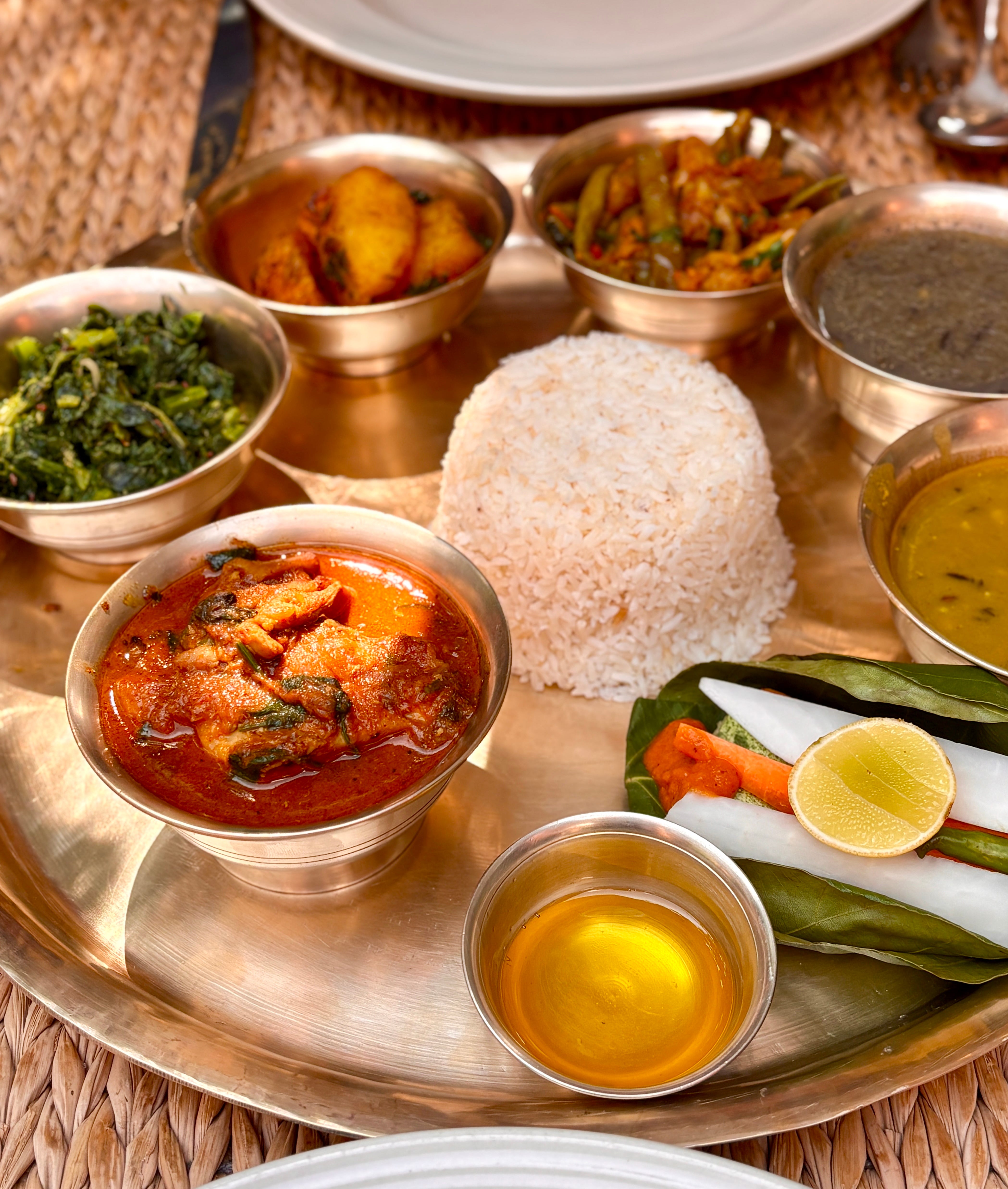
It was an opportunity that was too hard to pass up. A good friend was celebrating his 70th birthday and decided to do it in Nepal. I’d never been to South Asia and Kathmandu had always had a bit of a mystique to me. India is still on my bucket list to visit, but I’ve been holding off on going there until I could go with an Indian friend, who knew the lay of the land and who could explain all the customs and cuisines to me. You could use up a continent of water understanding them all with an AI chatbot, so I won’t do that.
And I’m also sitting in a hotel room while everyone else is asleep, sipping instant coffee from the hotel minibar at 4:40am, using the feeble internet connection, to upload some pictures to share. So sorry about any typos or lapses in knowledge about Nepal and Nepalese cuisine, which I’m trying to fill as I go along here. This was a relatively last-minute trip, so I should have crammed and studied up with some books on Nepalesecooking, but there really isn’t a better way to understand a country than through its food, and that’s what we did.
After a night of flying, we arrived pretty early, so unloaded our luggage at our hotel and hit the ground. The people at the desk warned us about walking around, saying it was a little dangerous. I wasn’t sure if that meant we would get mugged, but in the end, their concerns were for our safety due to the chaos of drivers and motor scooters coming at you from every which way. Apparently crime in Nepal is very low, but doing things like crossing a busy street can be harrowing due to a riot of traffic, so you might feel like you’re in a pinball machine, avoiding the flippers, if you walk around. (In Paris, we have food delivery drivers on bikes who seemingly have no idea about the rules of the road, and other cyclists who whiz through red lights, to worry about.) I felt very safe and while I’ve only been here a few days, everyone has been very kind.
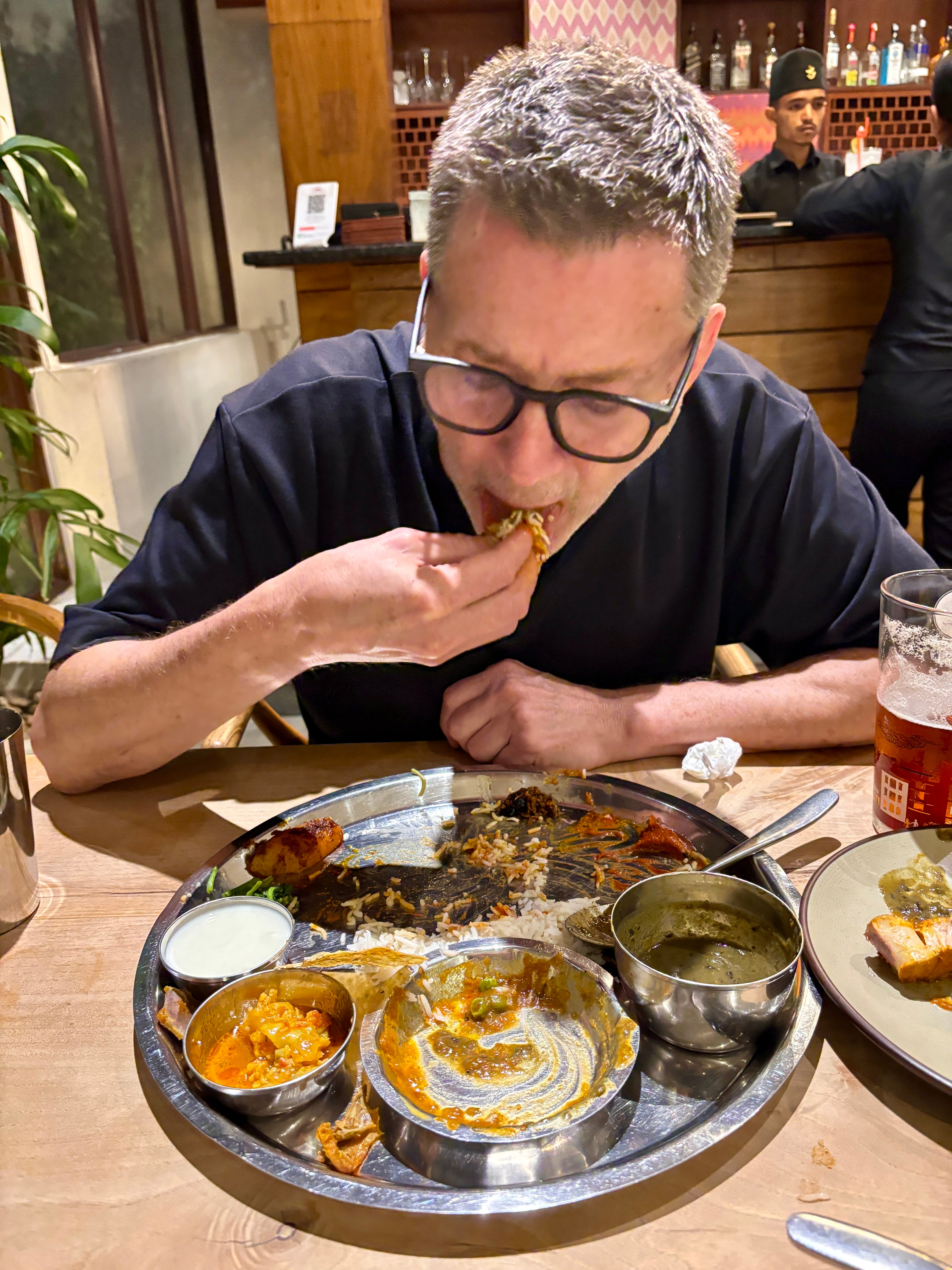
My friend, another David, mastered using his hands as utensils better than I 😄
At our first meal, the waiter gave us some guidance on eating with your hands. I’ve been out in Paris with my friend Beena Paradin, who gave me some tips, but it’s a talent I’ve yet to master.
I also took a chance on ordering dhido, a buckwheat dumpling of sorts, which came out in a big, gooey lump, drizzled with ghee (clarified butter). I can’t say it was my favorite thing that I ever ate, and the super-nice server told me it was best eaten by tearing off a chunk and dipping it in the sauce, then swallowing it without chewing. Since it had the texture of mochi, which people choke on in Japan, I decided that it may not be the best way to eat it. And talking to locals later about dhido, I realized it wasn’t everyone’s favorite. But they gave me kudos for trying it!
I hope you had a good week, despite the general levels of angst that seems to float about these days over the economy, AI, and so much more!
I’m not quite ready to crawl into a cave because there’s a lot of optimism out there. For instance, our neighbors have been starting families and their young are full of life, curiosity and hope. I also find solace in people doing good things in the culinary world.
Food and Wine magazine released its 2026 Best New Chefs list, and I contributed the write up on Kiln, a two-Michelin star restaurant in San Francisco. I wasn’t prepared to enjoy the 20-course tasting menu but it was super flavorful and not fussy. Chef John Wesley is also a remarkable person with incredible talent. Moreover, FW’s picks includes The Paper Bridge, a Vietnamese restaurant in Portland, OR, owned by Quynh Nguyen, a Hanoi-native, and Carlo Renardi, her American husband. Check out the BNC 2026 listing to see what may be near you!
If you subscribe to , its new issue #35 celebrates women at the forefront of home cooking. Yours truly is in the issue (contributors were asked: “What tastes like home?”). CB selected Cooking Thai as an outstanding fall cookbook and included Pim’s kabocha squash coconut custard dessert recipe.
And, my local Bookshop Santa Cruz announced that our book sold very well last month. 🥳 You may still get signed copies there or at Omnivore Books in SF.
What to cook right now? Some dishes are evergreen like my Vietnamese fish salad (gỏi cá), which Gail recently made with cod cheeks and reported stellar results, including the leftovers!
On the other hand, certain dishes are seasonally appropriate. October is part of the shoulder season. Summer warmth lingers in the day while autumn cool creeps in as the golden light fades. The two recipes I’m sharing this week help you straddle and enjoy the best of both seasons and make the most of what you’ve got.
Make a swank take on a Thai icon 🍃 🌶️
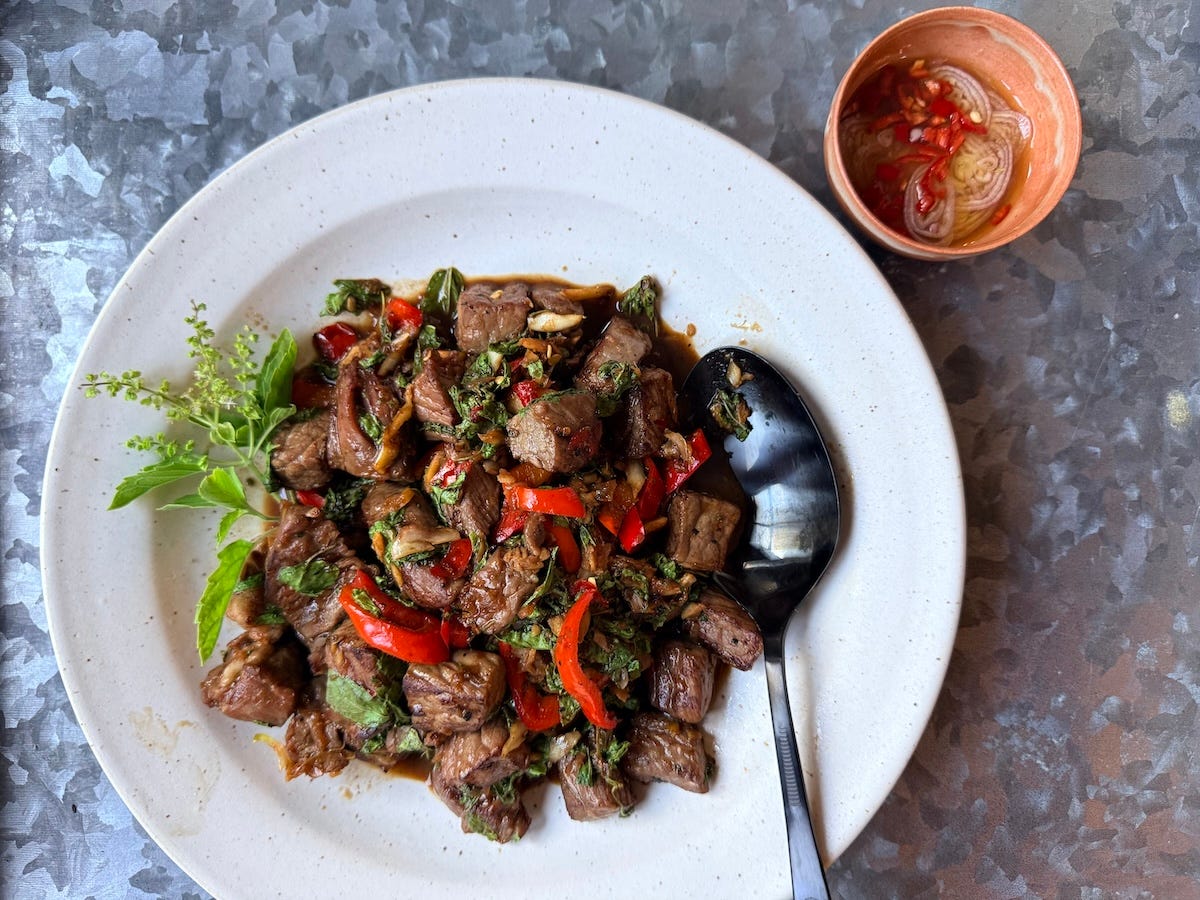
First up is a premium take on pad gaprao, the go-to stir-fry for many people in Thailand. The Thais eat it about once a week, according to an article that Pim found while we were writing Cooking Thai. (Sorry, pad Thai!) I asked her for a recipe and she returned with a masterful one featuring juicy, seared beef steak cubes that are shot through with the garlicky, punchy heat that makes Thai food sultry and exciting. Lots of basil functions as a seasoning, not a garnish.
This came from my kitchen and soon, you’ll be making your own too!
Pim cheekily named her recipe Bougie Pad Gaprao because the typical rendition uses ground meat. If you have the book, the main recipe is on page 233 followed by three (3) variations on page 234. For those of you who don’t yet have the book, I’ve shared our recipe and pro tips — including smart basil swaps — on my website. Pad gaprao is on rotation at our house. It comes together fast so get the 🆓❣️ pad gaprao recipe to experience Asian basil are at its peak.
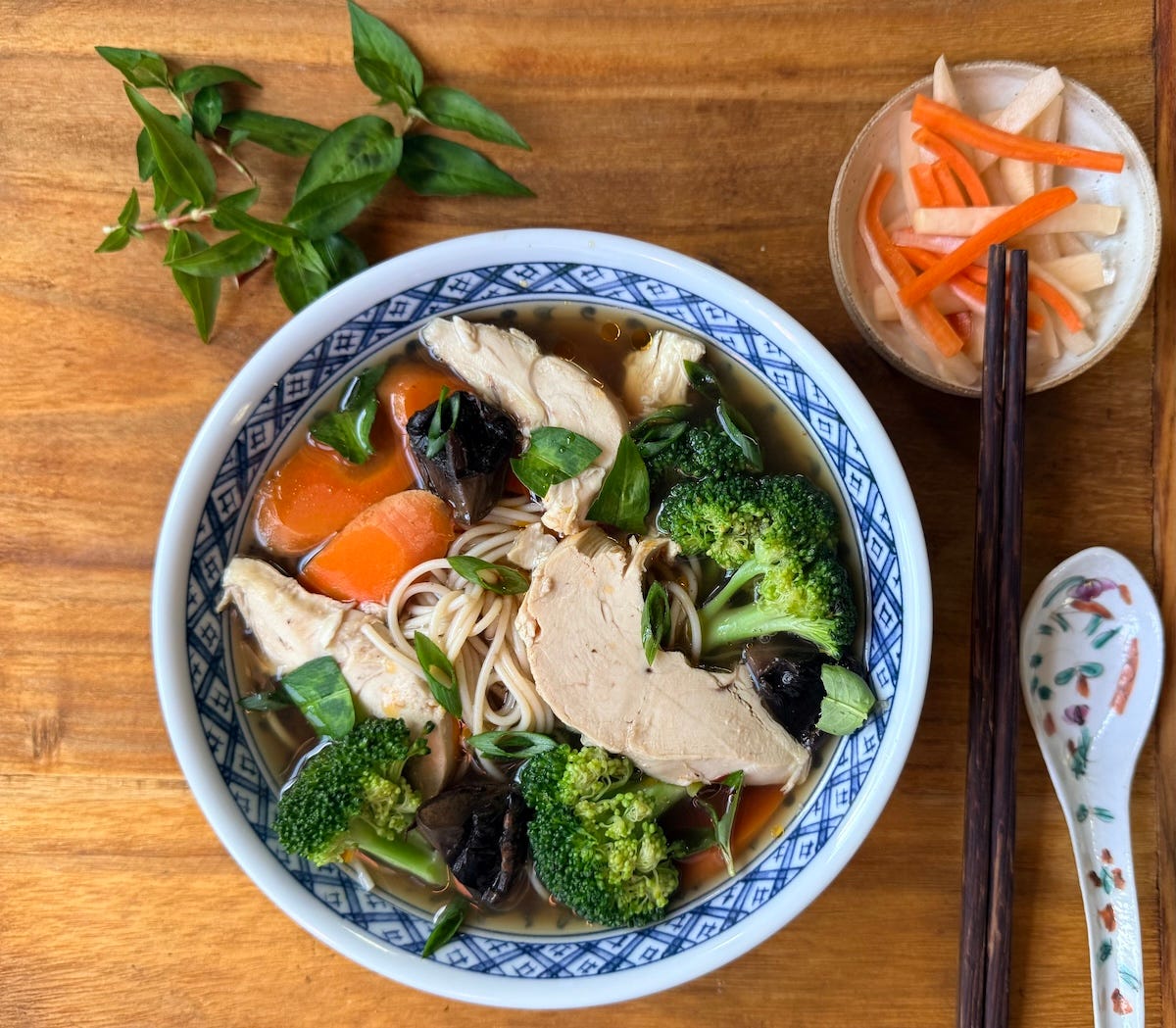
Use leftover rotisserie chicken for shortcut Viet-Chinese noodle soup (mì gà tiềm)🍗 🍜
While there’s a hurry to savor summer herbs, we’re also looking to hibernate a bit with cozy soup. There’s plenty of time to simmer for hours during winter’s depth. For now, I’m still into quickies and hacks.
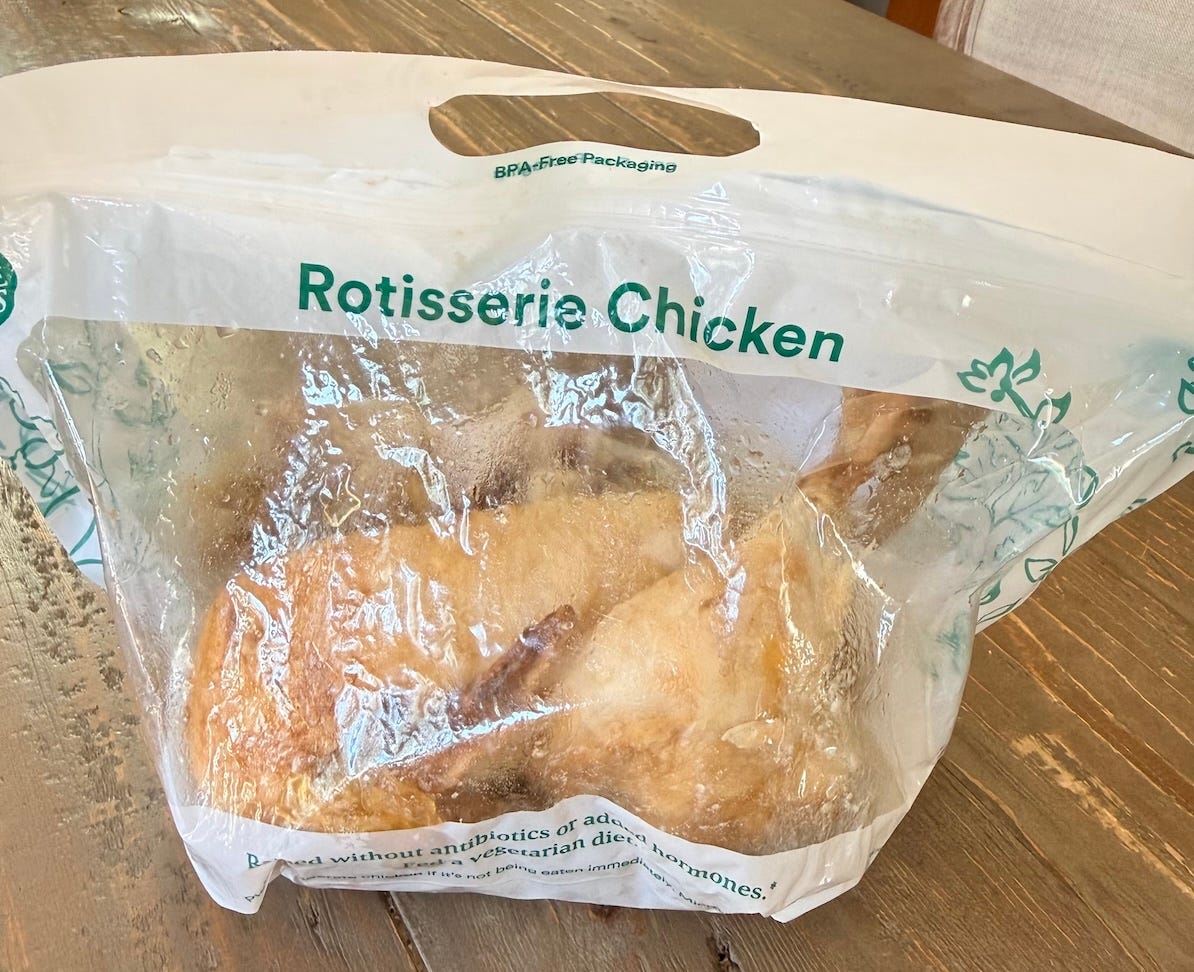
This week, I needed to deal with leftover rotisserie chicken. The store bought bird saved my cooking life last Sunday when I was too tired to cook from scratch. Its comforting roasted flavor, convenience and affordability rescued me. But what to do with the leftovers? Yes, you can make a sandwich or salad but those dishes often blatantly remind you that you’re still eating the same bird. Day-after rotisserie chicken can be dry as a cotton ball and hard to swallow.
This bird didn’t know what would soon happen to it! On Tuesdays, my local Whole Foods runs a $2 off sale on rotisserie chickens. Maybe yours does too?
Not wanting to discard more than half of the bird, I transformed its flesh and all the scraps into a Vietnamese-Chinese noodle soup. It took about 45 minutes and transported me to a family friend’s Chinese barbecue shop in San Diego. Mr. and Mrs. Tan owned the shop that my parents frequented. While the adults talked, I scarfed down Mrs. Tan’s specialty — mì vịt tiềm (“mee VEET tiam”), a braised duck Vietnamese egg noodle soup with a rich, spiced broth. It’s a specialty of the Chinese diaspora in Vietnam, particularly the one in Chợ Lớn, Saigon’s Chinatown neighborhood.
The landmark Binh Tay market in Cho Lon. You can’t miss it. Great place to shop for wholesale housewares though you have to buy lots.
Mrs. Tan gave my mom her recipe, which I used to create the recipe for my first cookbook, Into the Vietnamese Kitchen. That twenty year old recipe on page 220 remains my favorite iteration but it’s time consuming to prepare. Who wants to roast duck or go find one? When traffic is perfect, the closest Chinese barbecue shop is 45 minutes away! And nowadays, what’s sold at those shops as roast duck is anemic.
Wanting a cozy shortcut and aiming to use up my rotisserie chicken, I cooked up this shortcut version with chicken. This 45-minute Mì Gà Tiềm hack transforms the chicken into a remarkably fun and special treat. The flesh moistened up, but most importantly, the results made me forget that we were eating humble leftovers. Rory dreaded eating rotisserie chicken dishes but he perked up when I served him a bowl of this noodle soup.
I loaded mine up with vegetables. That’s not traditional but it makes for a complete, wholesome meal. If you want to be super traditional, eat this noodle soup with pickled daikon and carrot. The tang and crunch adds textural contrast and brightens the noodle soup.
When you make this shortcut Mì Gà Tiềm (“mee GAH tiam”), you’ll realize its many virtues.
It uses every bit of the bird for a potent broth. Use your roast chicken leftovers, if you want. Rotisserie chicken isn’t the only game in town. 😆
If you don’t have enough meat, at least turn the leftover scraps into tasty broth. Add mushroom, tofu and napa cabbage and you have quick and easy soup for lunch.
Use Chinese egg noodles, rice noodles, soba, or ramen. Instant ramen is fine.
Employ fresh or dried mushrooms, depending on the time used.
Below you’ll find the recipe in text and a downloadable PDF. Plus you’ll have all my recipe development notes for you to tinker with.
Ok, the clock is running and you’re hungry. Let’s make this noodle soup!
Support Pass the Fish Sauce as much as you can. Become paid subscriber for this recipe and access to 225+ others, along with class discounts and much, much more.
Beef with Garlic Sauce is a savory, garlicky, saucy stir-fry that hits all the best notes of Chinese-American takeout. Tender beef, crisp vegetables, and a glossy brown sauce with just enough tang and a hit of garlic, it’s a one-pan meal with meat and vegetables that comes together in about 30 minutes! What Is Garlic […]
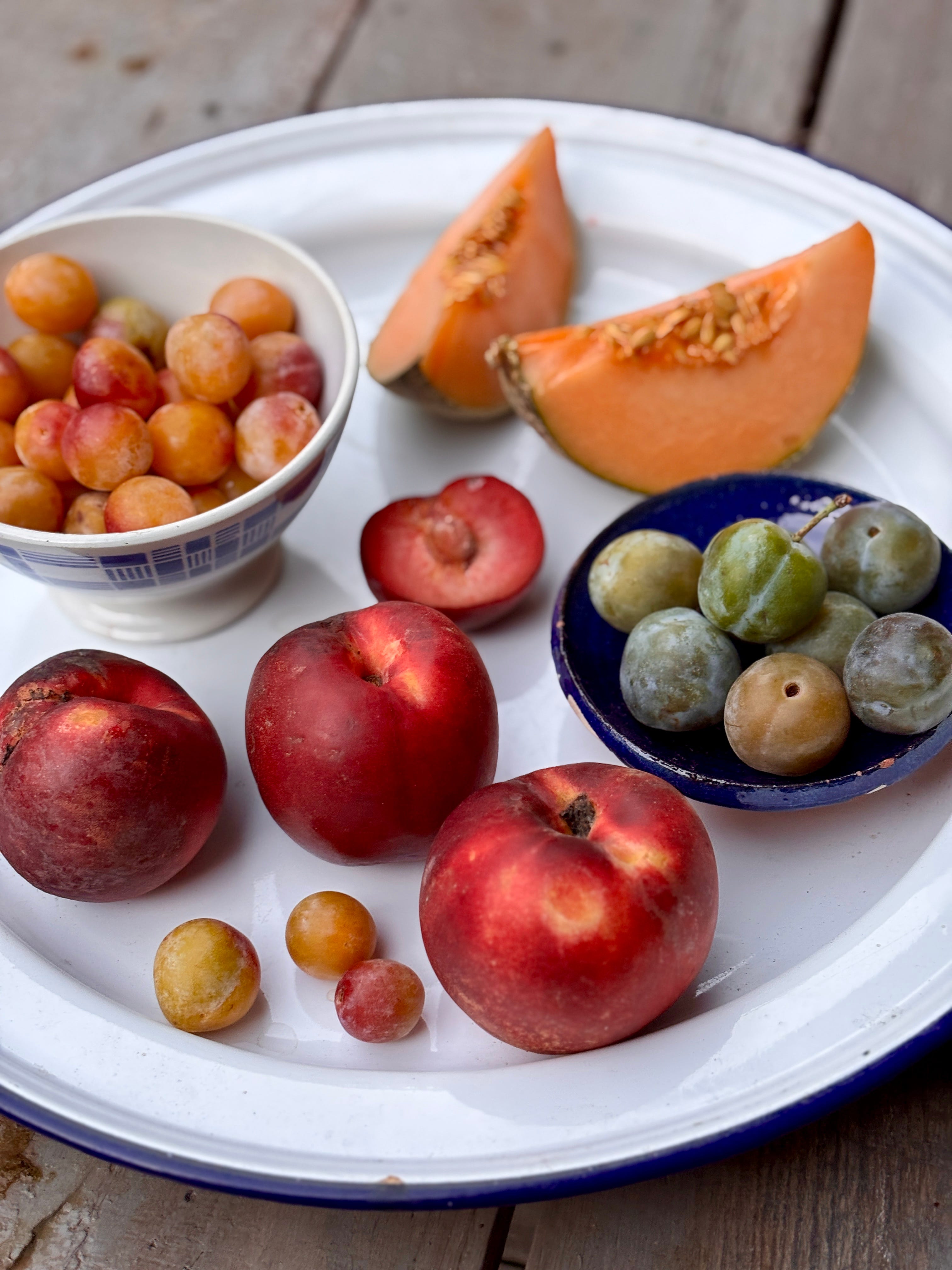
Something I’ve noticed is that in the summer months, when we’re visiting friendsin and around France during July and August - when summer fruits are at their absolute peak - everybody has a bowl of pears and apples in their kitchen.
It strikes me as odd that in the midst of apricot, cherry, melon, strawberry, peach, and nectarine season, when the most outstanding fruits of the year are at the markets, people are eating apples and pears. A sign popped up at my local natural food store that said, “Finally, apples and pears!” It’s as if people have been waiting patiently for the end of summer so they could have apples and pears.
In spite of crazy heatwaves this year, summer is my favorite season, mostly due to the fruits. But I’m not the only one who’s ever dreamed of an endless summer. So did Californians in 1964…
But they changed the title of the movie in France, from Endless Summer to Wave Chasers.
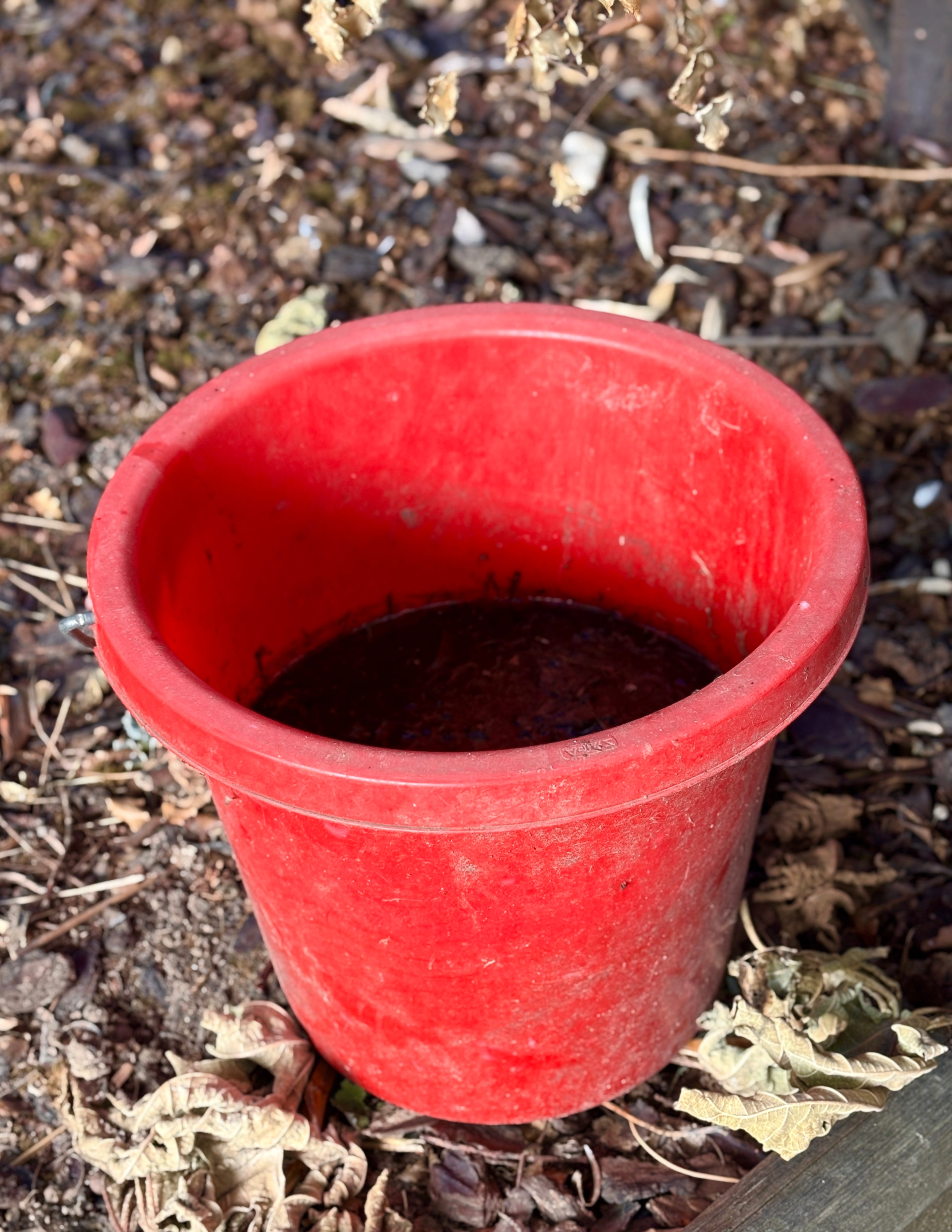
In France, people are excited about the rentrée, when people come back after summer vacations and celebrate being back by having parties and get-togethers. There’s something to be said for people who wait all year for their summer vacation, then celebrate when it’s over. Maybe it’s my California roots, but I wish summer would never end. I like wearing short-sleeve shirts and sandals, and eating outside, although the mosquitos followed everyone back and even the two “buckets of doom” I concocted failed to curb them.
One of my “buckets of doom,” which I should have dubbed “buckets of hope.” Apparently the constant fluctuations in the weather this summer, and droughts, provided the perfect breeding ground for mosquitos in France.
I love summer and wish it would never end, and if I’m being honest, coming back took me a few weeks to catch up on everything. I try not to do anything during my summer vacation except read, eat, drink, swim, and relax, but I do forget that the rest of the world isn’t France (or Europe, for that matter), where summer vacations are taken seriously. Yes, people at the beach are still scrolling, but no one seems to be spending a lot of (or any) time answering business emails, at least in my orbit.
Are you a subscriber? If not, subscribe to my newsletter to get recipes, videos, Paris restaurant tips, podcasts, and more, sent right to your Inbox. Free subscribers get most posts, and paid subscribers get all posts and access to archives, as well as the ability to be part of the lively, and lovely, community of commenters. (Thank you, commenters, for providing such interesting tips and points of view!)
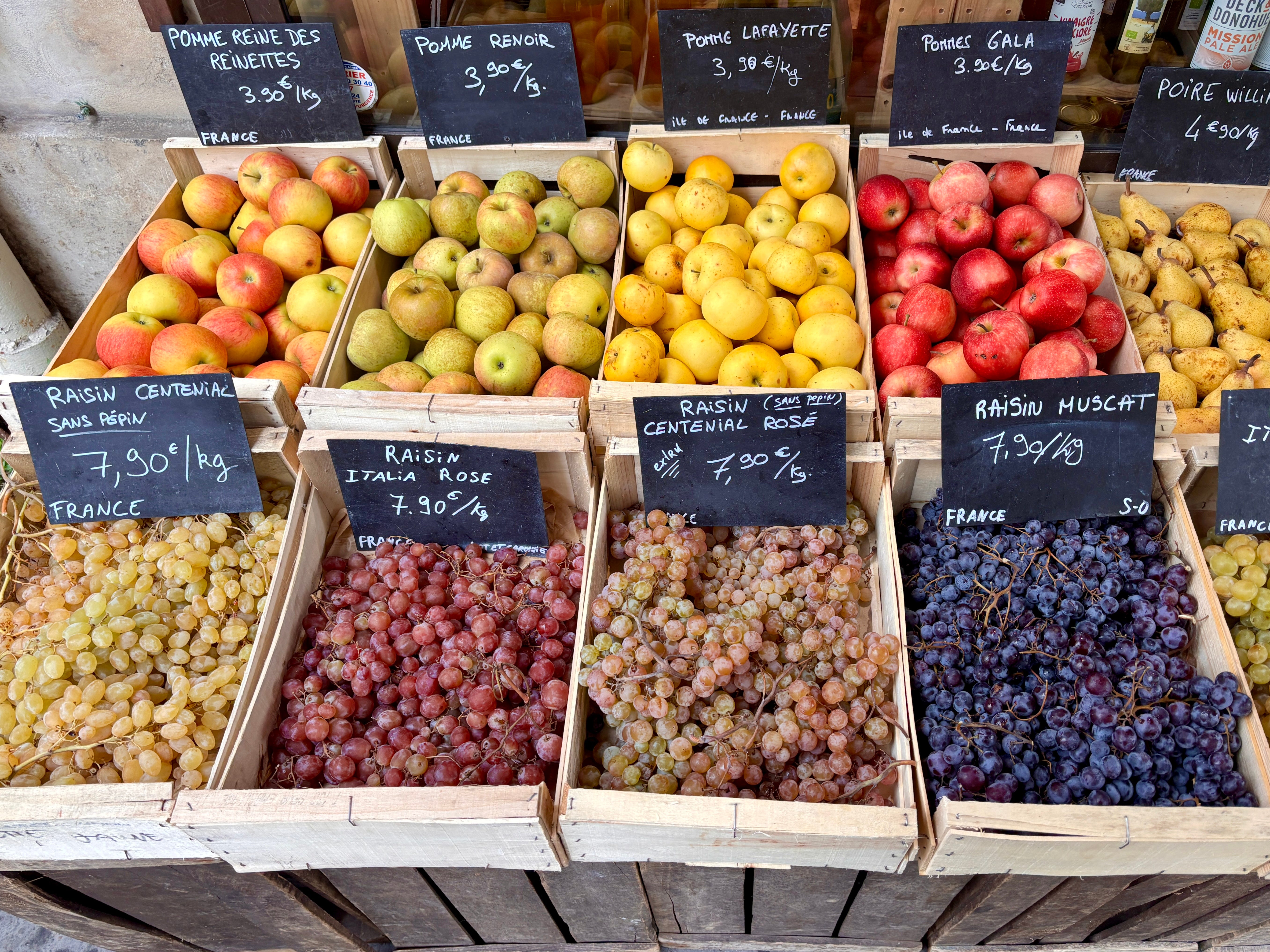
I did my best in September to hang on to all the lovely summer fruits, but soon will succumb to apples and pears, since there are lovely, aromatic Williams pears at the markets, fragrant quince, and wooden crates of heirloom apples, perfect for making French apple tarts.
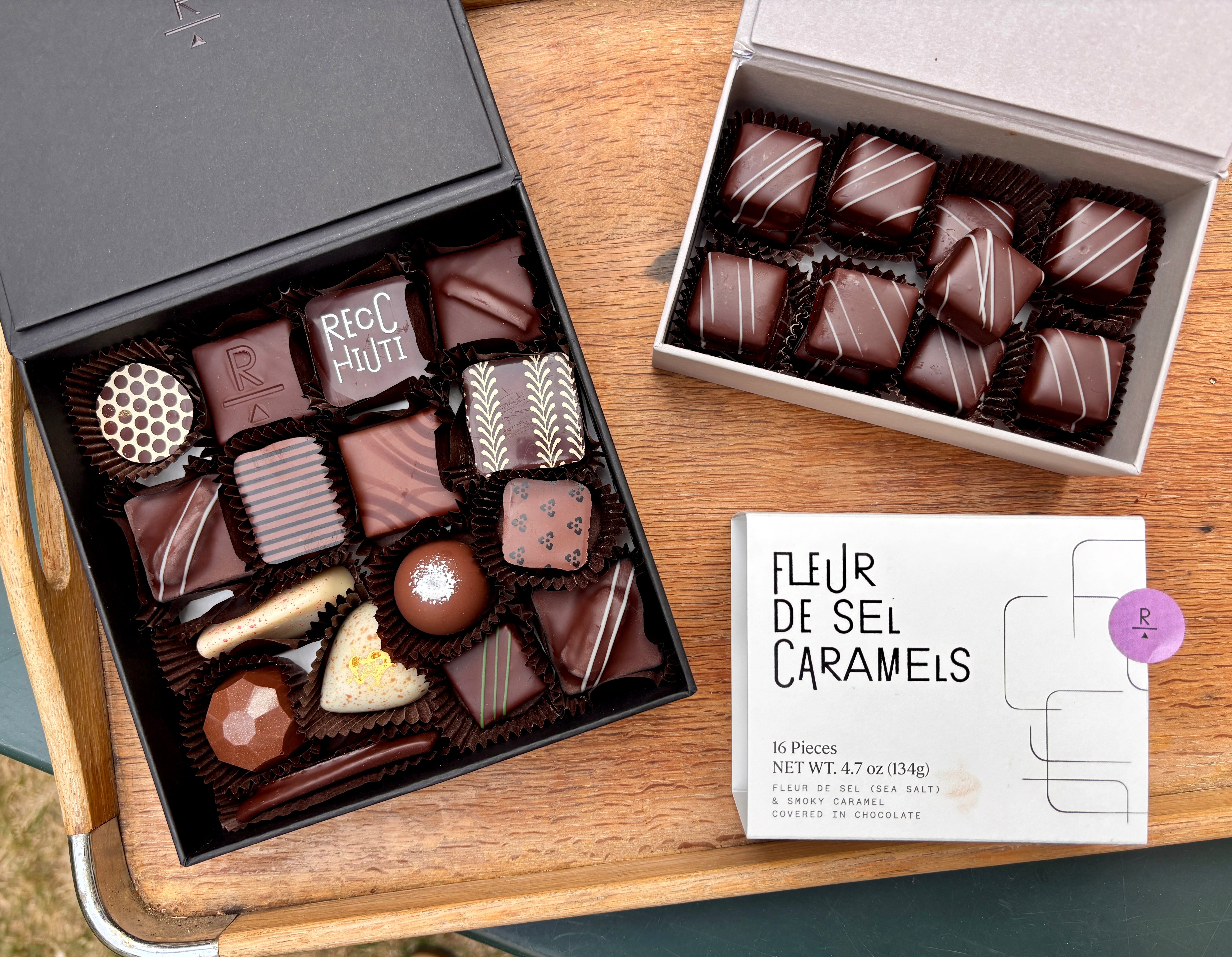
I love when friends from San Francisco come visit, especially ones who make chocolate! Coming soon on my podcast, a chat with Michael and Jacky Recchiuti of Recchiuti. Stay tuned…
A few thoughts and stories that caught my eye recently:
A New York City vintage cookbook store owner landed in jail over a line dispute, which gave us a brief respite from all the influencers on social media complaining about the $60 loaf of rye bread in New York. My take is, like a $16,000 Hermès handbag, you don’t have to buy it. On the other hand, I agree with a baker who posted that they didn’t want bread to become a fancy commodity, as coffee did, being sold in precious little bags at high prices.
But to the people who were amused by a Lidl truck advertising their $3.99/loaf of bread outside the Soho bakery, you can’t compare a loaf of industrially made bread to a loaf of handmade bread. I worked in a bread bakery exactly one night, and I almost didn’t make it through the whole shift. It’s very hard work.
I know people are on a budget, but I’ve tasted Lidl bread and, sorry, but it’s not very good, imho. Fortunately I live somewhere where bread is considered a right, and more affordable. And I agree that $60 is a lot for a loaf of bread but, thankfully, New Yorkers can buy terrific bread from bakeries, such as She Wolf, Frenchette, Runner & Stone, La Cabra, and Lost Bread, that are a fraction of the price. And while I’m not someone who thinks you have to DIY everything, you can make your own bread without spending a fortune.
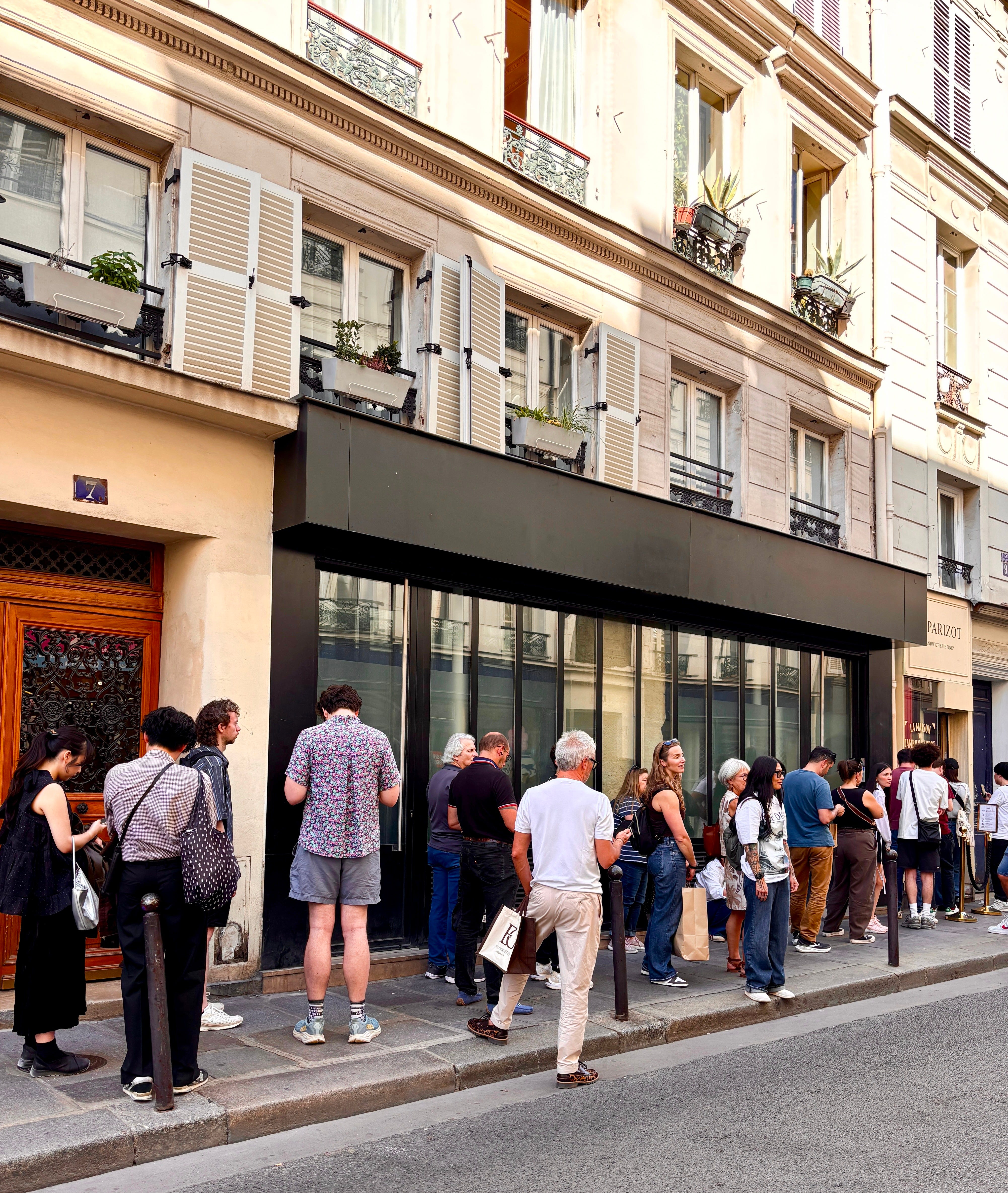
I thought I’d give Parizot a try, known for making a great jambon-beurre sandwich. But the line at 2:30pm was looong.
Speaking of lines, Paris seems to be all about lines these days. I wanted to try a newish shop that opened up, selling jambon-beurre (ham and butter) sandwiches. But when I rode my bike by it the first time, which was 40 minutes before they opened, people were already lined up. Two of my favorite sandwich shops, which I wrote about in 2011 and 2014, now require a wait as well, thanks to social media…and serving delicious sandwiches!
While it’s true that the two aforementioned sandwiches are worth waiting for — which is coming from someone who waited thirty minutes in Copenhagen for a cardamom bun that was scrumptious — I miss walking into a place, chatting with the owner or the clerk for a few moments, i.e., human interaction, and leaving with a nice sandwich for lunch.
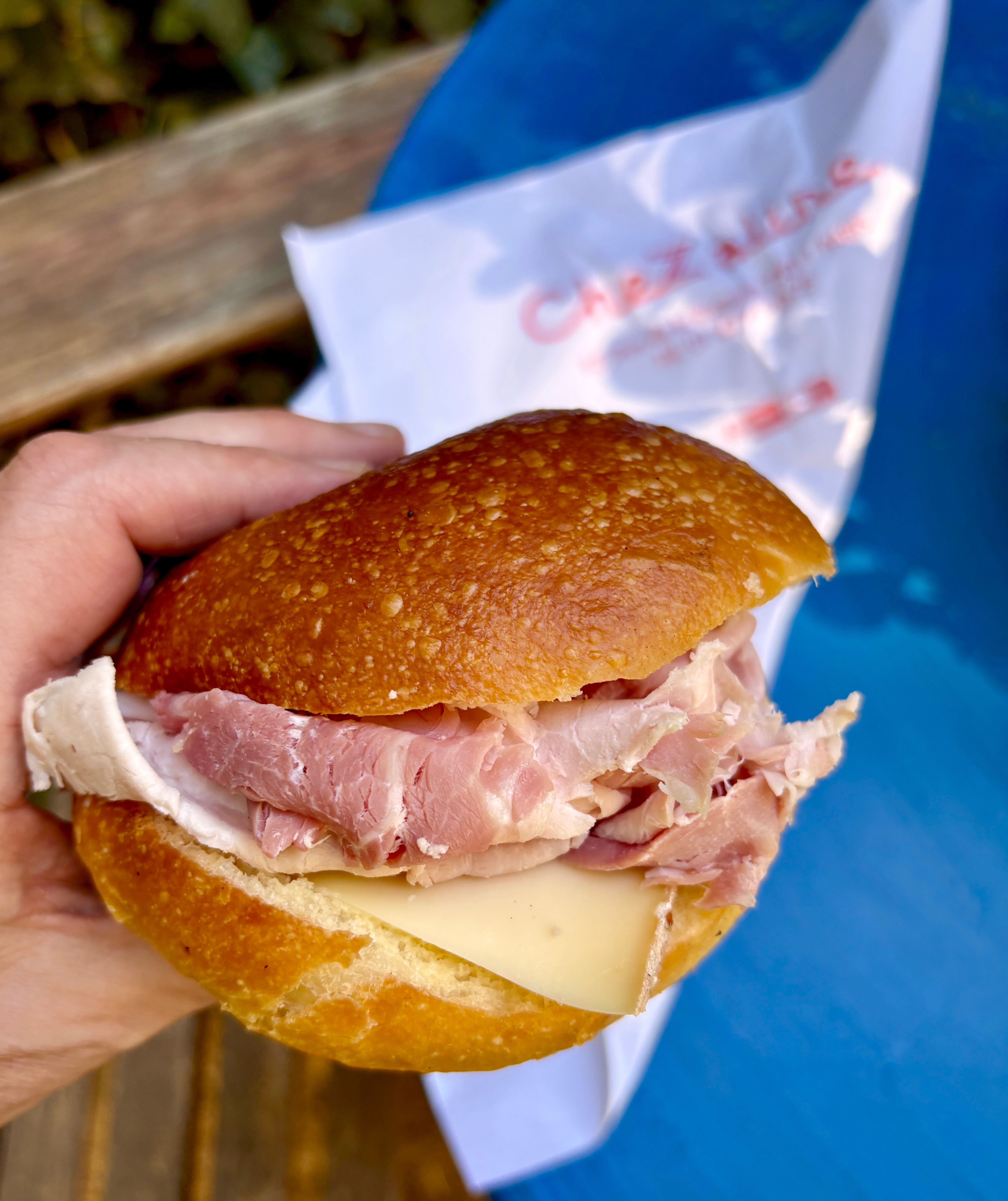
Fortunately the other day, after seeing the lengthy queue at Parizot, I decided to stop by sandwich stalwart, Chez Aline, for a jambon-fromage. Frequented by locals, it also happens to be in my neighborhood. The owner was locking the door as I pulled up, but offered to make me a sandwich. She was out of baguettes so made it on a round roll. I do prefer baguettes for sandwiches, so maybe I will give Parizot a go another time. One draw is they apparently offer a cornichon relish, which sounds delicious. On the other hand, I could just make my own.
Although I haven’t experienced it, a few people online have been talking about an arnaque (scam) involving taxis in Paris. Apparently some people said after they paid for their taxi by credit card, they found their card had been charged thousands of dollars, claiming the driver likely switched credit card machines, and not using the one they’re supposed to use.
First up, you can always pay for a taxi in cash, and exact change (or close) is best if you want to, because they rarely have change. (G7, the most reliable taxi service in Paris, has an app you can hail a cab and pay through, if you want to go cashless.) Second, before you accept a credit card transaction, take a look at the screen and verify the amount. Third, after you pay, ask for a fiche (receipt). Official taxis in Paris are required to accept credit cards, in spite of some of them saying otherwise 🙄. And they are required to have meters that will show the fare.
Lastly, everyone in France is familiar with paperwork (believe me…), and it’s very common to ask for, and get, a printed receipt. So ask for one. If you don’t get a receipt, take a screenshot of the meter or credit card machine screen if you can and one of the taxi license number, too, in case of a dispute. There’s a website in France, which is also in English, to report fraud and scams. You can submit a report here.
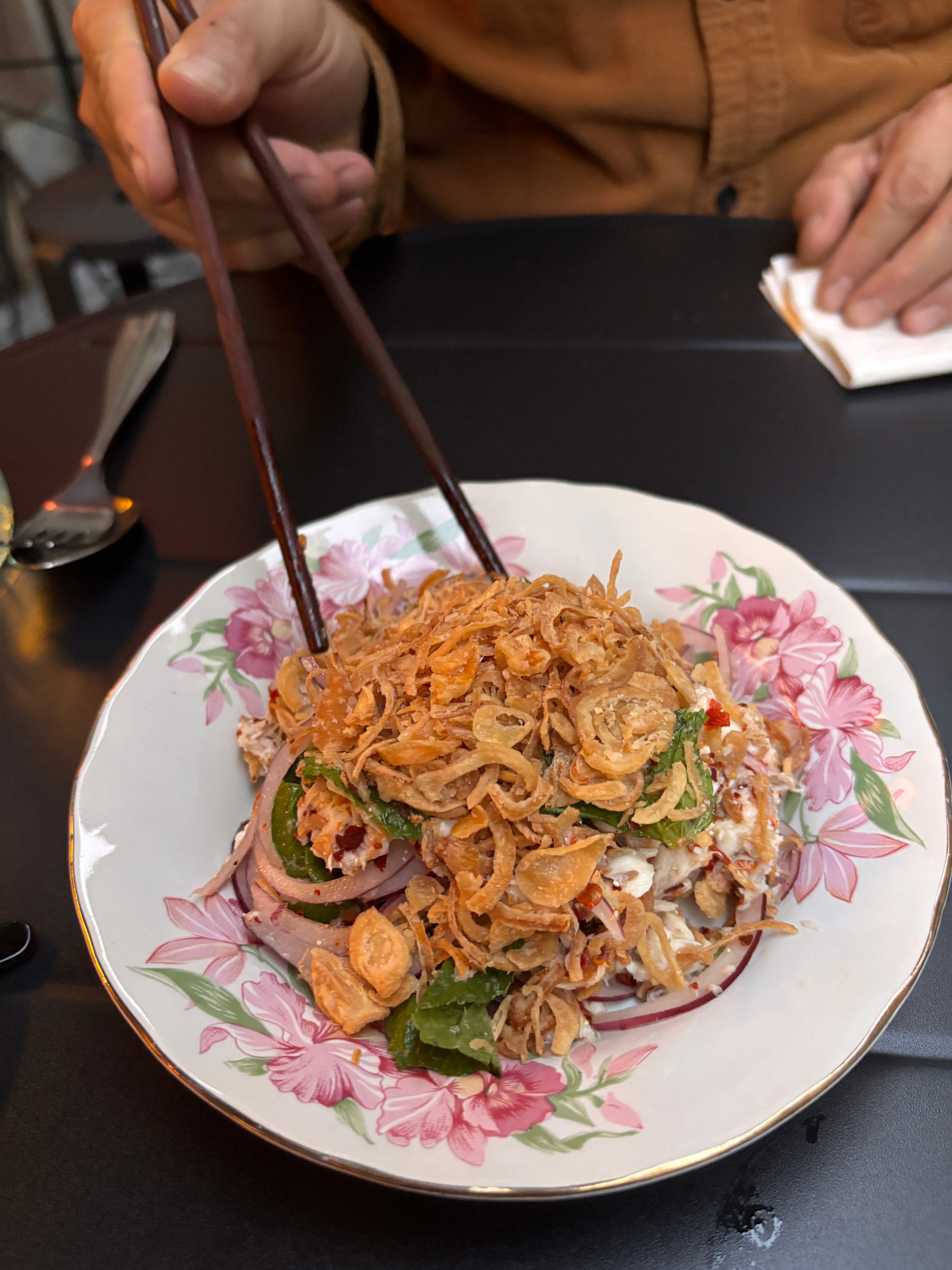
Excellent (and spicy) fish laab with fried shallots at Pochana in Paris. It was worth trying to balance sitting on the low, three-legged stools for.
It was just a matter of time, I supposed, that there’s now a butter shop in Paris, which is on my list of places to get to. The owner seems like a nice guy who joked that influencers were sending him offers to get paid a few thousand dollars to promote his shop, which apparently is already crowded, thank you very much. (But more lines?!) But since French butter is so good, what a good idea to open a whole shop devoted to it.
Just an fyi: This store-brand butter won the taste test in Que Choisir, France’s version of Consumer Reports. There are fancier brands out there, but if you want to live like a local, that’s a brand many French people buy.
I did a YouTube interview with Fabien Pelissier ofFab Expat, who helps foreigners with visa, insurance, relocation support, and other issues that arise when moving here. I don’t spend a lot of time on YouTube, especially in the comments, but —yikes. Someone criticized Fabien’s French accent (um…he’s French), and another said I wasn’t a chef, which was news to me, because while my memory isn’t what it used to be, I remember being the pastry chef at two restaurants and consulting pastry chef at another. (And have the leg and back problems to prove it.)
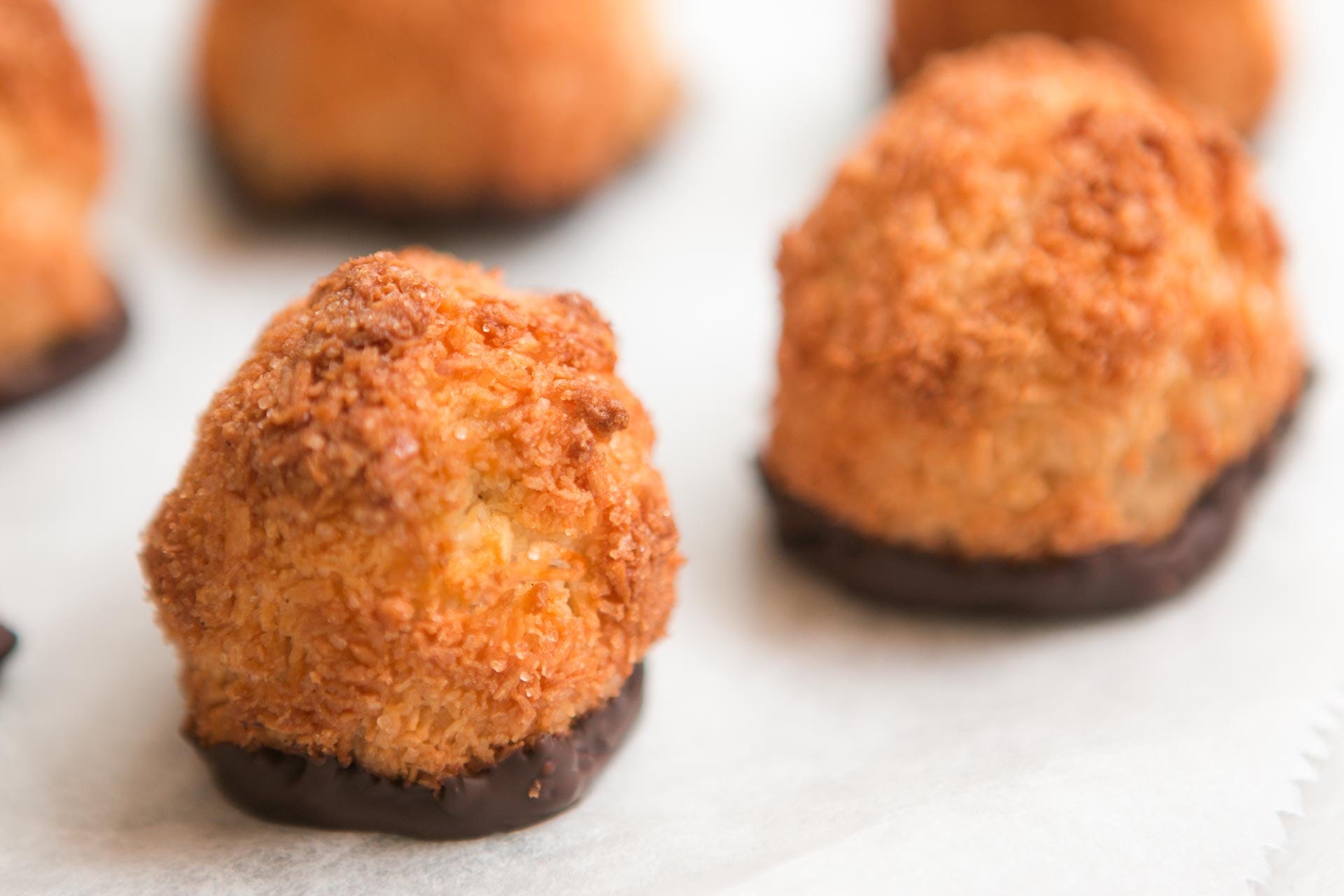
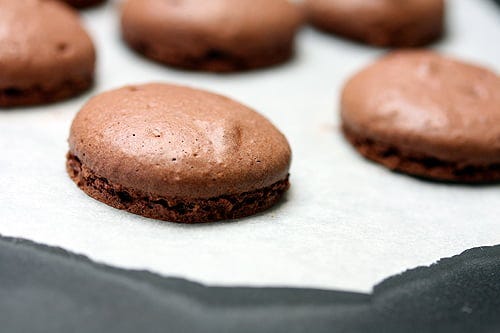
Another said I didn’t know what I was talking about, when I talked about French macarons, made with egg whites and nuts, which share similarities with American macaroons, which are also made with egg whites and nuts. The almonds used in French macarons technically aren’t nuts, and coconuts aren’t either, but they can be considered nuts.
I don’t argue with people online, but macarons aren’t originally from France; they arrived here from Italy. The Italian ones were likely inspired by cookies or small cakes from the Arab world. Today, French bakers in many regions make their own version of macarons from almonds, untilLadurée starting making Parisian macarons, sandwiching two macarons together with buttercream or another filling.
This website claims coconut was added in France, which made the cookies easier to ship since coconut stayed fresher than almonds. While they don’t refer to them “macarons” in France, the French make cookies called rochers au coco or congolais, which are similar to American macaroons, but not sure if selling “American macaroons” next to “macarons parisiens” in a French bakery would go over very well.
Another theory I heard is that when Jewish European settlers came to America, they couldn’t find almonds, orsome say, because almonds weren’t kosher, they used coconut. But as someone told me about what happened hundreds of years ago, if you weren’t there, you can’t be sure.
Almost everything we eat can be traced back to somewhere else, so I’m not sure what the point of battling with each other about these things is. I often say, you never know how many things you’re doing wrong until you put it on the internet. On the upside, I had such a great time with Fabien that I’ve invited him to be a guest on my podcast in the future. If you have a question you’d like me to ask him about moving to or living in France, let me know in the comments.
The commenting section in the newsletter is accessible to paid subscribers. If you want to become a paid subscriber, you can use this link to take 20% off a paid subscription. Link valid through October 10th.
In other news, our two favorite contractors are moving back to their home countries. It’s interesting talking to them, to see what they miss and why they’re going back. My first French teacher, at my first French classes shortly after I arrived in France, said to start a conversation (in French), he asks people in his classes what they miss most about home, and Americans always said the same thing: customer service.
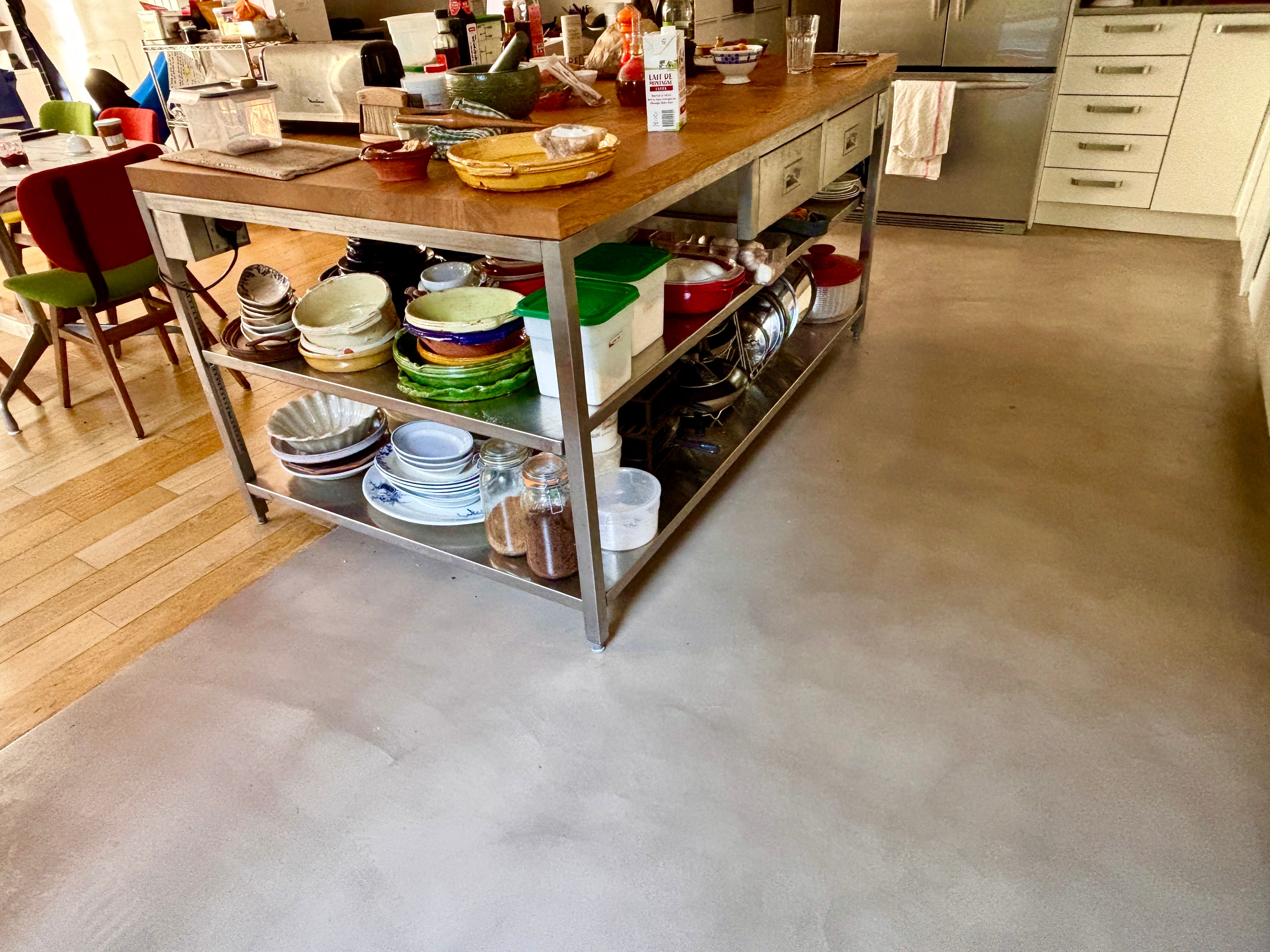
That’s improved a lot in France* and while frustrating, the French seem to be right about making things difficult to return. But we loved our painter, who redid our kitchen floor, which wasn’t properly sealed the first time. (An example of not-great service.) He was super nice and we often had coffee together, and I even gave him a few jars ofFig jam, since he grabbed handfuls of the figs I picked in Provence when I offered him one. So I knew he’d like the jam.
Fortunately he’s also super honest and promptly returned the money that was accidentally wired to him, twice. In France, people get paid by virements, bank transfers, which are very common for transactions here, but there are a bunch of steps and security questions to go through to initiate one. What’s most challenging is that you need to enter the twenty-seven numbers of the recipient’s IBAN in the bank form on app or website, and if you get one digit wrong, someone else is going to be very happy to find an unexpected windfall landing in their bank account.
Other contractors would have…well…we already covered that in my book, L’Appart.
How can I resist all these beautiful fall fruits?
In addition to having to find another place in my kitchen for a shiny new cocotte, I’ve got lots going on this month. I’ll be traveling a bit for a friend’s 70th birthday, which promises to be a lot of fun, and I’ll get to see friends that I worked with at Chez Panisse, and others. I’m also planning another trip to Japan in the spring so am looking at options for that. And even more important, Romain’s birthday is next month, so I’ve reserved seats at the restaurant in the Eiffel Tower, which he’s been bugging me to try. (He’s a sucker for a view.) I ate there back in 2008, when they had a different chef. So it’ll be interesting to see how it’s changed.
Lastly, every year my friend and I treat ourselves to a fancy restaurant in Paris for our birthdays, which take place in December. Last year we trudged through a snowstorm that left waist-high drifts of snow on the sidewalks of Paris for a lovely meal at Alliance. In previous years we did La Tour d’Argent, which was great, save for a snafu with a wine that was past its prime.
And the year before, it was lunch at Le Clarence, situated in a gorgeous 19th-century mansion. So any suggestions that you have for a celebratory lunch that feels special, let me know. It’s never too early to start planning a great meal…
-David
Favorite Fall Desserts
By the time mid-October rolls around, I’m firmly back on team apples and pears. Here are some of my favorite recipes for using them, and more:
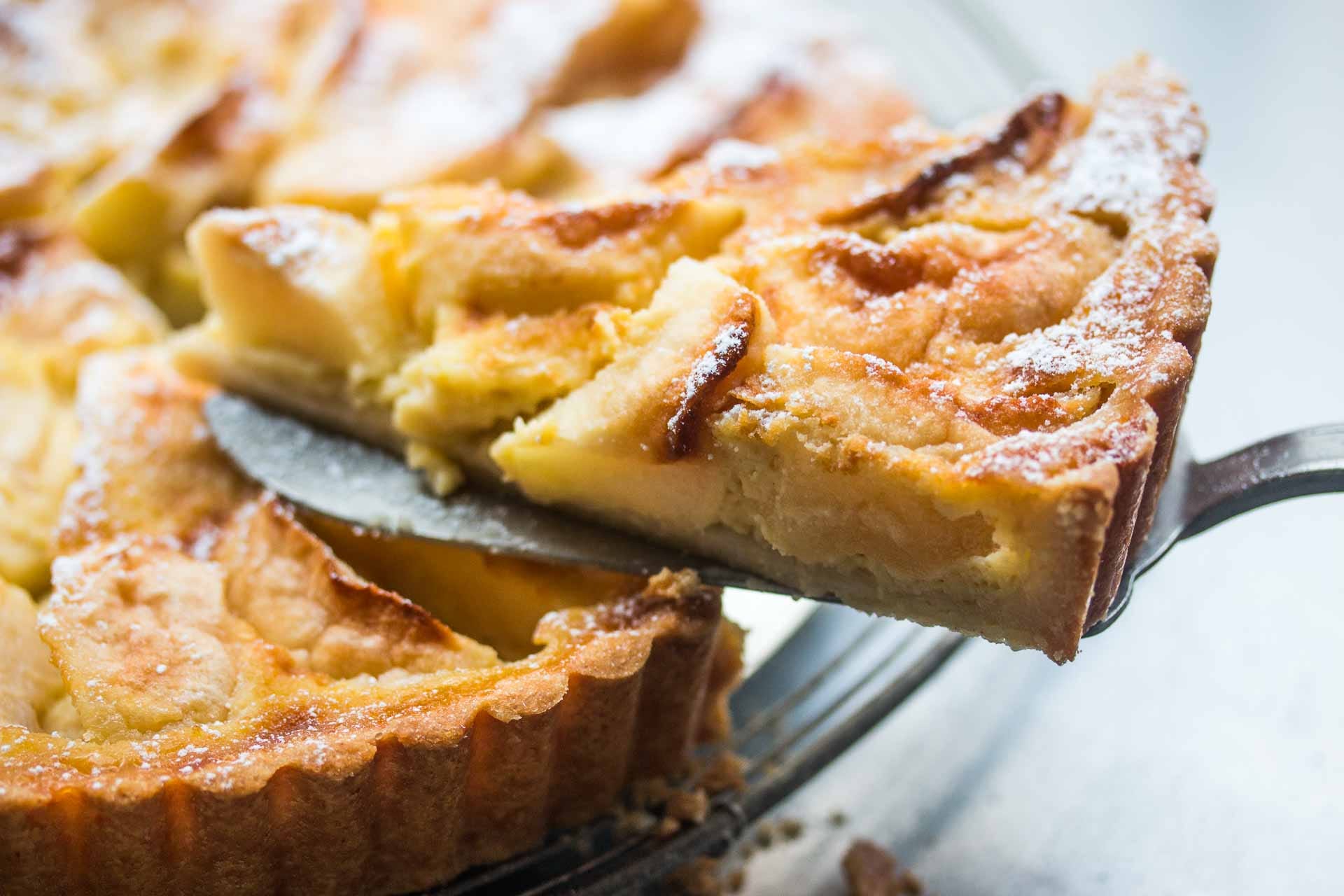
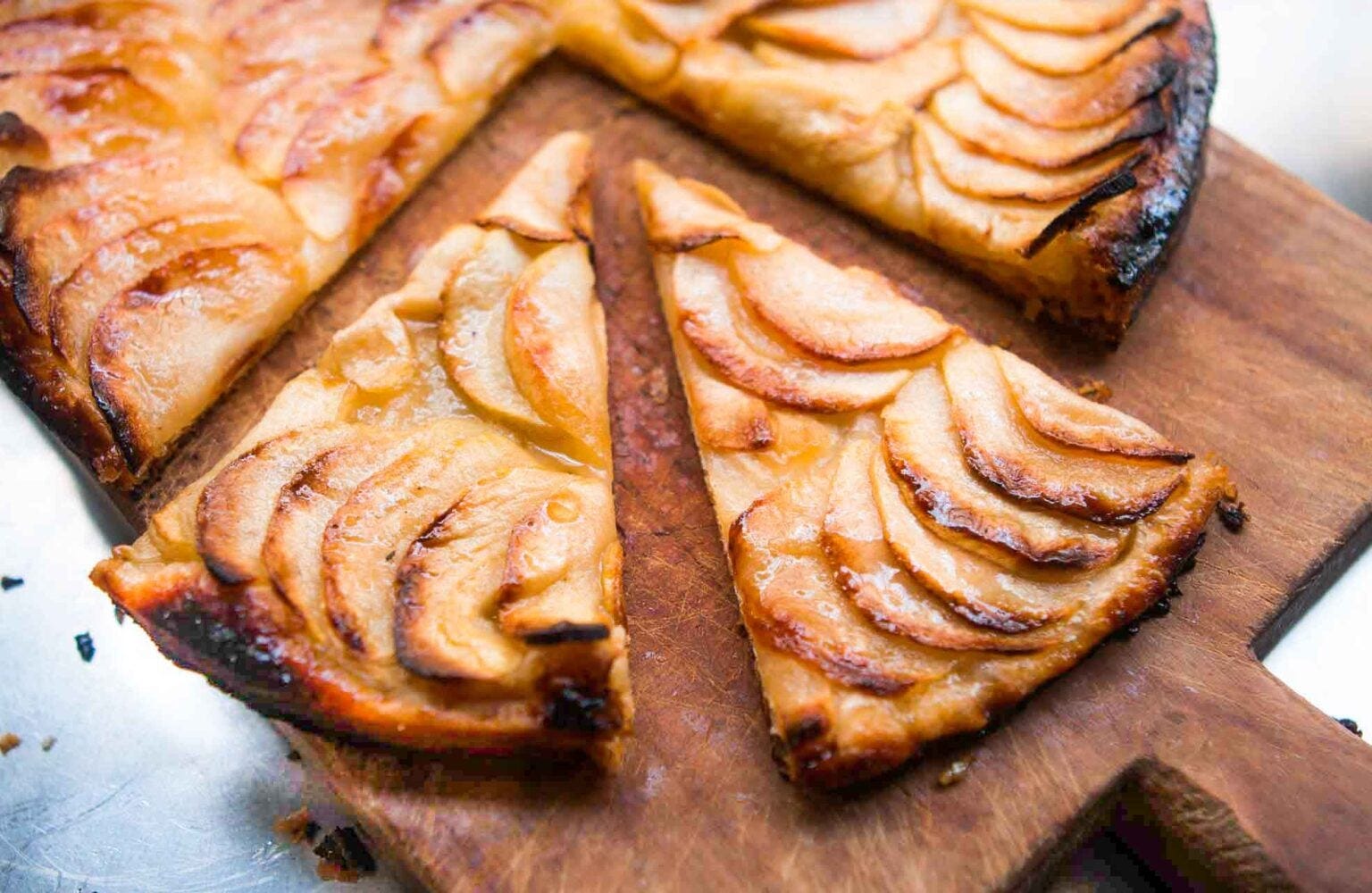
Inspired by the tart at a bakery that won the Best Apple Tart in Paris award, this tarte normande takes its name from the hint of apple brandy used in the filling, and of course, the apples, which Normandy is famous for. My version is just as good as the bakery’s, if I do say so myself. And you can make it at home, wherever you live. (recipe here)
Yes, you can make the same whisper-thin tarte fine aux pommes that is on offer at French bakeries. People often stop in to buy a slice for a snack or a whole one to take home for dessert. If you can roll pie dough, you can make the crackly-crunchy quick puff pastry. And if you’re anything like me and not great at entertaining, double the dough recipe and freeze half to make a tarte for future fêtes. (recipe here)
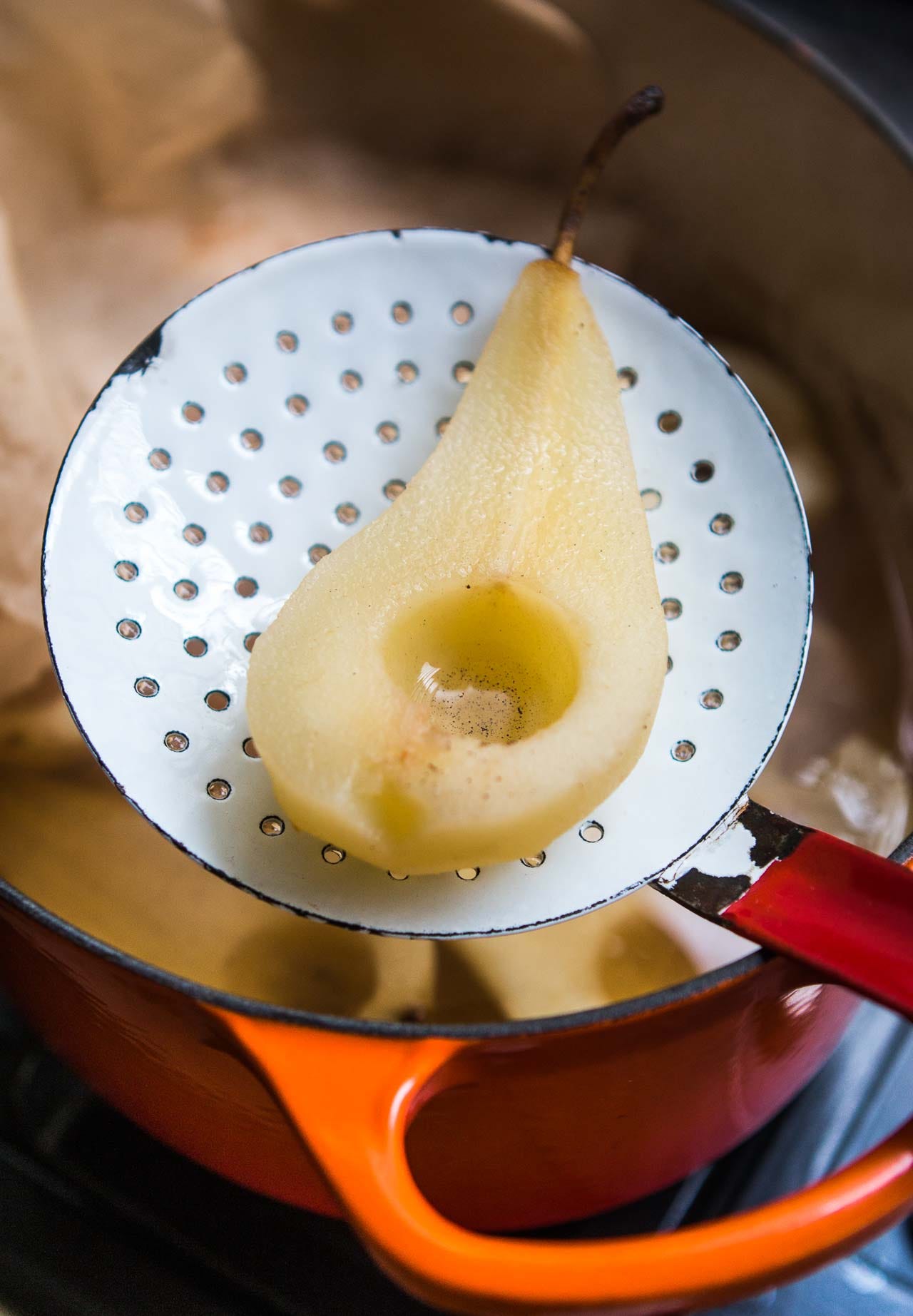
One of my searched-for posts on my website is How to poach pears. Poaching pears is a super-simple way to add flavor to the fruit. However, if your pears aren’t as delicious as you’d hoped, poaching will infuse them generously with flavor. Poached pears only get better when stored in the poaching liquid, so do-ahead folks will rejoice. Having a batch of poached pears in the refrigerator also means you’ll have an instant dessert when sliced and served with a scoop or two of ice cream or sorbet.
If you pair them with a scoop of vanilla ice cream and a ladle of warm chocolate sauce, you’ve got the French classic, Poires belleHélène. You can also serve slices alongside French chocolate cake. In case you haven’t noticed, the French have a thing for poached pears and chocolate, and so do I. (recipe here)
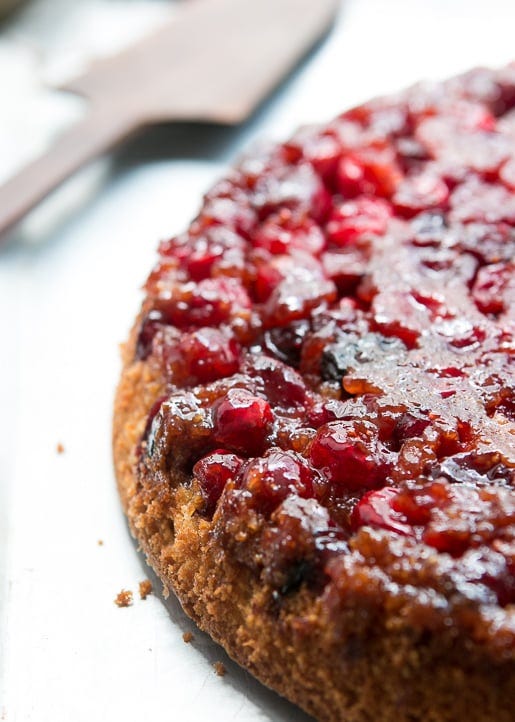
Finding cranberries in Paris makes you feel like you’ve landed on the holy grail. When I see them at the markets, fresh, I scoop them up as fast as I can. (Apologies to other Americans in Paris, looking for cranberries.) They go remarkably well in Cranberry upside down cake, an American classic that marries the tangy orbs with a shimmering brown sugar topping, which is my favorite part of this cake. The delicious layer of buttery cake below, well…that’s the icing on the cake, so to speak. (recipe here)
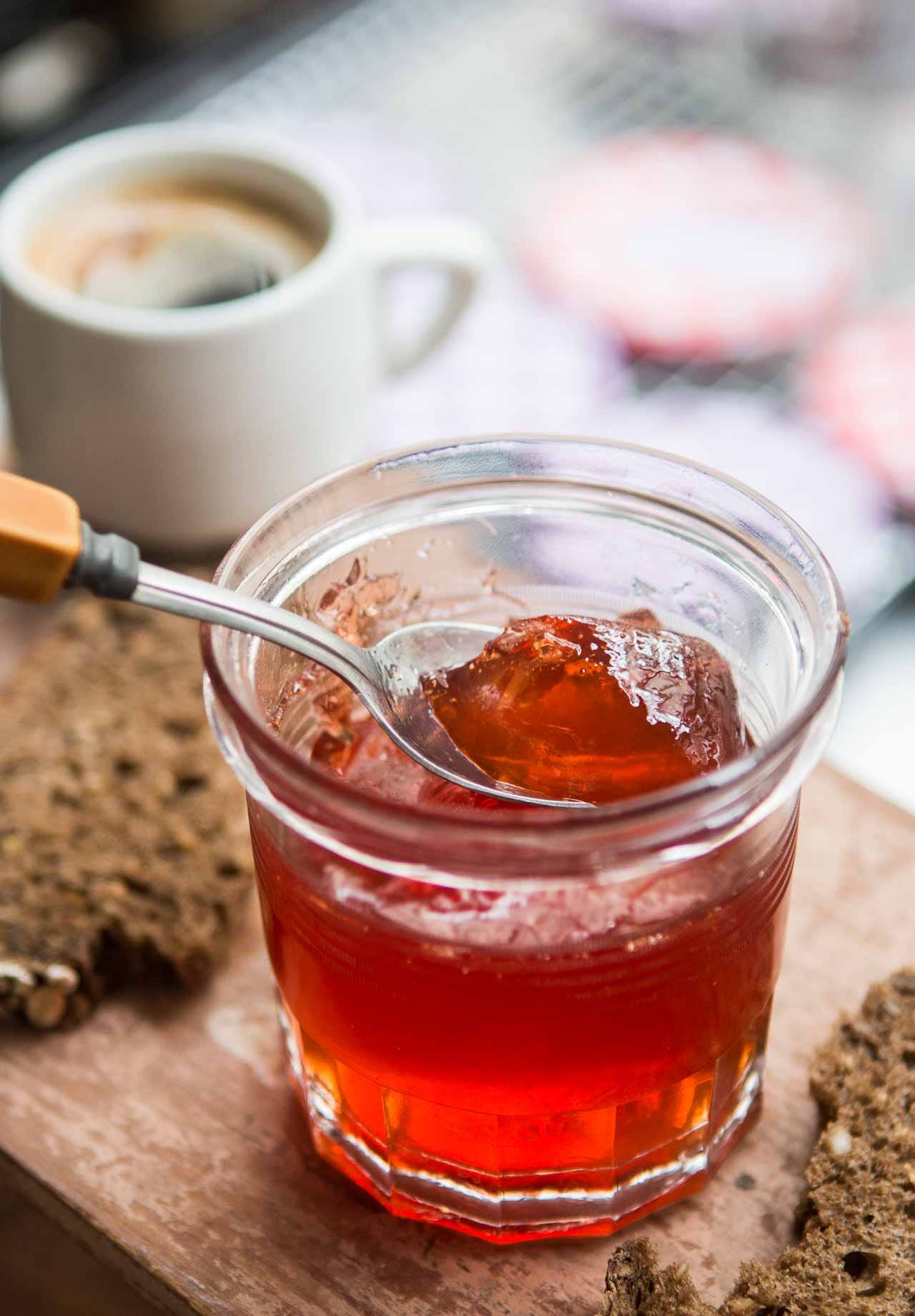
If you find yourself with an overload of apples — lucky you! Perhaps you’ve got a tree or know someone who does. If so, Apple jelly is the perfect way to use them. I was visiting friends in Brittany who have a few apple trees that are adjacent to their house, and was piling as many as I could into baskets to bring back to Paris. When a neighbor came by and thought I was stealing them, I told him I was friends with the owners of the tree, and was going to make jelly with them, he smiled and said it was -“une bonne idée!”
This apple jelly requires no peeling, no seeding. You just just chop ‘em up and cook them up.Another friend in the countryside and was eyeing his medlar tree that he’s promising me the fruits from. If you can get your hands on those curious fruits, here’s a recipe for Medlar jelly.)
Apple jelly tip: If you have a farmer’s market and there’s someone there who sells apples, or you don’t want to get accused of stealing someone’s apples, you can sometimes score apples that are discounted due to dings and dents, which are called à cuire (to cook) in French. Smart shoppers search for those.(recipe here)
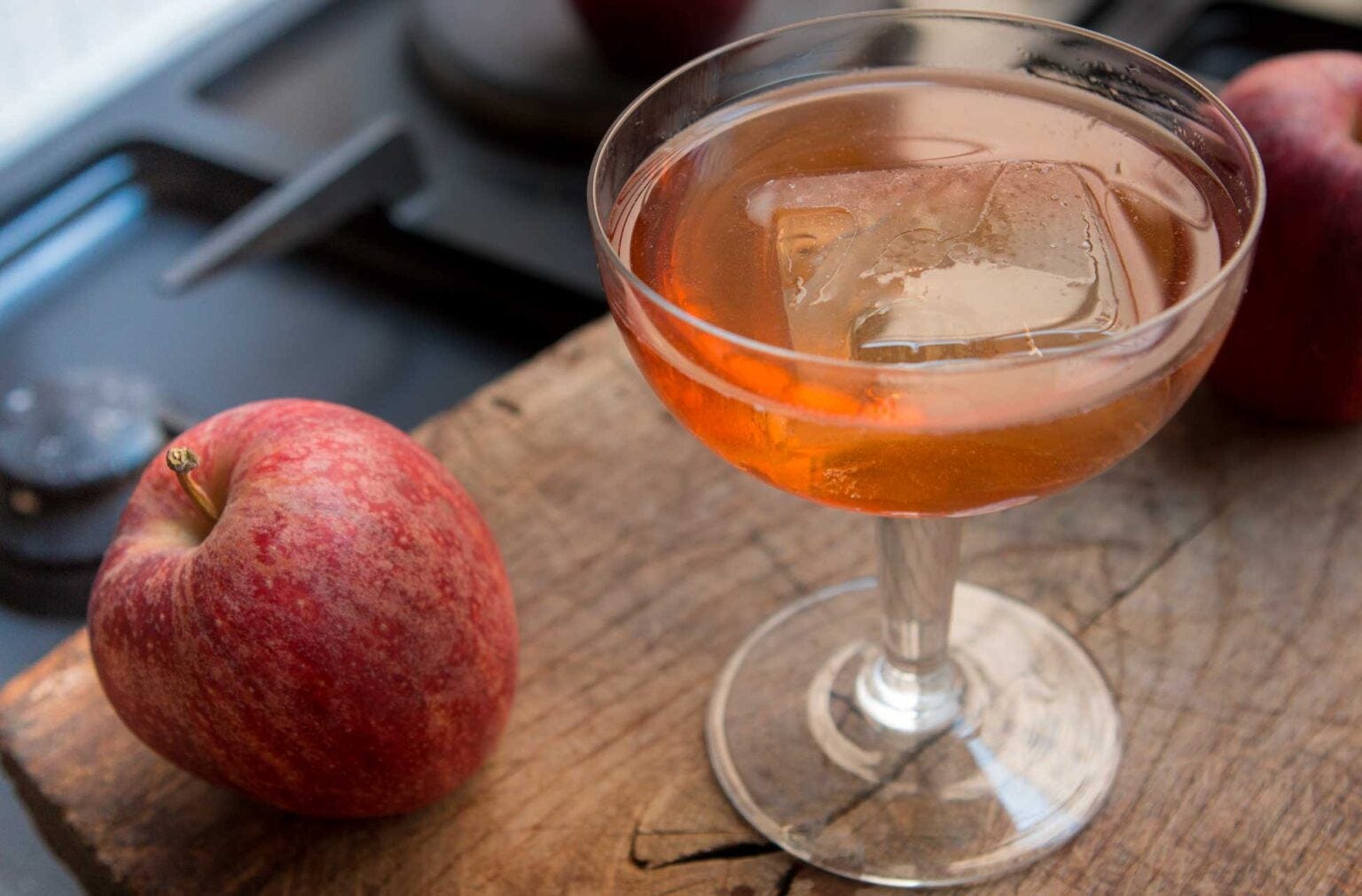
Ed, who photographed my last four books, gifted** me a bottle of St. George Spiced Pear Liqueur, whose beguiling spicy flavors prompted me to come up with the Far from the tree cocktail. True to its name, the spirited liqueur packs a seasonal mouthful of spices in each sip, making it the perfect cocktail for fall. As the holidays approach, top it with sparkling wine or cider for a festive touch. (recipe here)
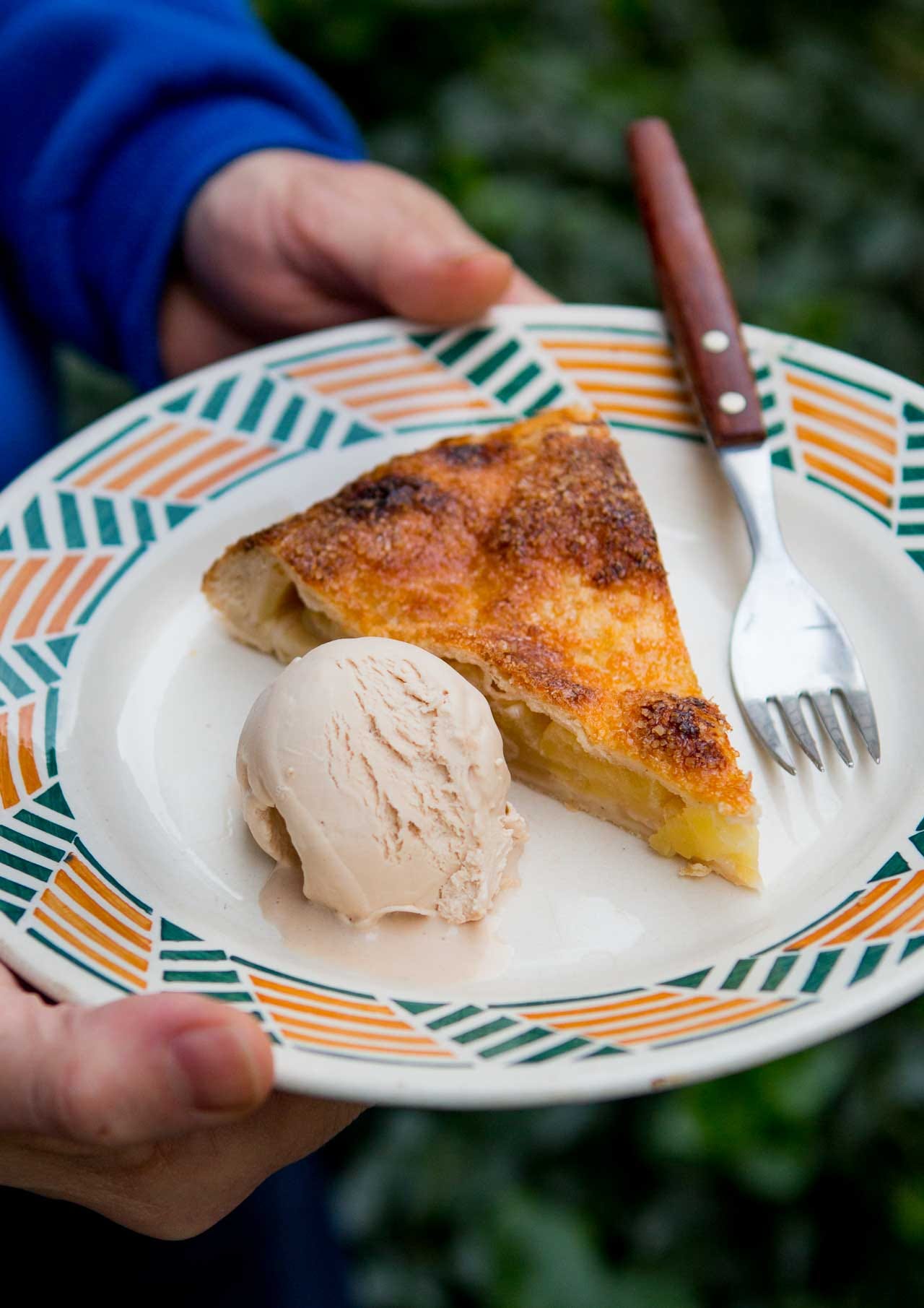
When Jacques Pépin came to work with us in the pastry department at Chez Panisse, he introduced us to his Apple crunch tart, which was so good, it went on heavy rotation on our dessert menus. At some point, we ditched the top layer and called them apples galettes. While galettes are now a dime a dozen, I thought I’d bring back the OG and discovered that the crunchy topping was definitely something I missed. Serving it without a scoop of ice cream is definitely a miss, too, so don’t forget it. (recipe here)
It’s no secret that I love thrifting in flea markets and brocantes. And I don’t want to brag, but I’m pretty good at it. (Actually, if you saw my stockpiles, you might say that I’m too good at it.) In France, you can find amazing things at these, like vintage baking dishes in my favorite cookware color, bright orange, sold for a song.
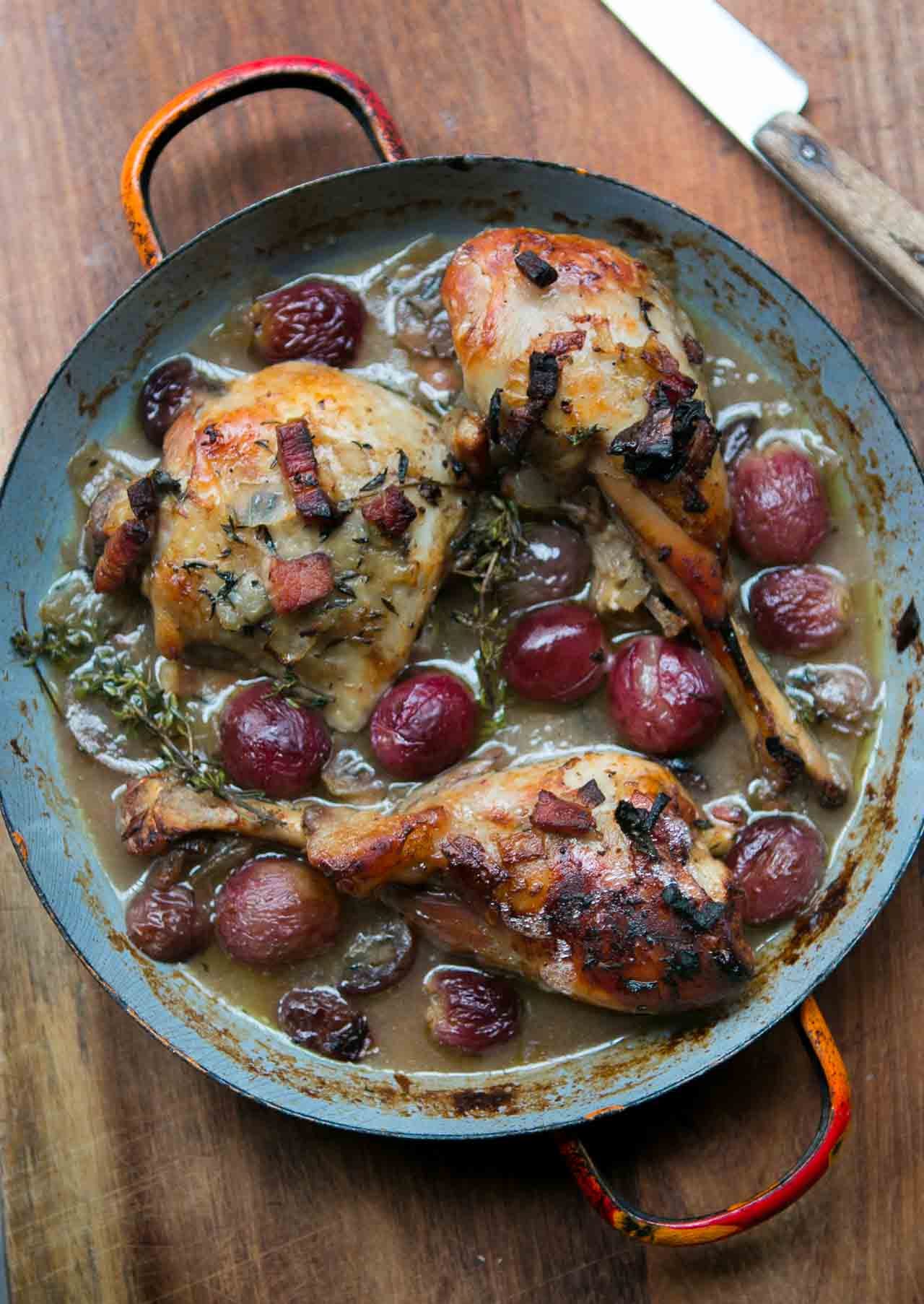
Another secret is that fruit isn’t just for sweet dishes. It’s also for savory dishes, like Wine harvester’s chicken. I’m not sure of the origin of the dish but it’s easy to imagine during the grape harvest, there were so many grapes, someone got the bright idea to use some of them in the kitchen, such as in this easygoing braise. It’s filled with fall flavors and perfect with a light-bodied Riesling or a more substantial Chablis. But really, anything with grapes will do. (recipe here)
*People aren’t fond of Amazon and Uber these days, but their arrival in France was a wake-up call to stores and taxis to improve their service, which they did. A recent Uber ride in Paris confirmed my move away from the platform due to 1) Difficulty booking one, 2) An unpleasant driver (who finally arrived…), and 3) A hefty surcharge added to the bill, which made it the same price as a taxi.
**I used this word online a while back and was told that I shouldn’t use it as a verb. See what I mean about not knowing what you’re doing wrong until you post about it on the internet? For the record, Merriam-Webster says it’s okay, and I ain’t arguing with Webster.
Our recipe for Disco Fries features crispy crinkle cut fries smothered with plenty of melty mozzarella cheese and our literal secret sauce: egg foo young gravy! These are insanely tasty and a real treat! A New Jersey Dinner Staple For most New Jerseyans, Disco Fries need no introduction. They’re a staple in New Jersey Diners […]
Twenty years ago, I started this website because I wanted a place to share recipes I was excited about, as it’s practically coded into my DNA to be an unfettered yap about the things I love. [This is me.] The larger context was that upon reaching so-called adulthood, I’d found that while I knew how to cook, there were still so many things I hadn’t figured out, such as: how to turn a can of tomatoes into not just an okay pasta sauce, but a spectacular one; how to make really good meatballs; perfect hummus; and a crumb cake I’d want to make forever.
You’d think that 20 years and more than 1400 recipes later, I’d be closing this chapter. What could there possibly be left to know? Haven’t we kale salad-ed and tomato soup-ed and apple pie-d our way to fulfillment yet?
Well no, absolutely not. In fact, most days, I feel like I’m just getting started.
Folks, we’re in a critical four-week window here—and no, I’m not talking about the upcoming midterm election campaigns in America. I’m talking about the garden.
For those of us in the Northern Hemisphere, autumn is officially here, but there are still lingering warm days. That means one thing: it’s time to enjoy, harvest, and preserve your summer bounty before it’s lost to cooler, darker days!
This weekend, I’m at my mom’s house to check in with her. We’re also celebrating the Harvest Moon Festival. It’s a massive holiday across East Asian cultures—celebrated in China, Japan, North and South Korea, Vietnam, and anywhere vibrant East Asian communities thrive. (Despite being in Southeast Asia, Vietnam is anthropologically an East Asian country because it’s heavily influenced by China.)
Growing up Vietnamese, I know it as Tết Trung Thu (pronounced “Teyt Troong Too”), which literally means "Mid-Autumn Festival” but mostly identified the holiday with the annual lantern festival. I always looked forward to lighting those glossy, colorful cellophane lanterns whose frames were made of delicate bamboo. Then, we’d parade around the neighborhood holding our lanterns. Back then, the night skies in Saigon were often clear and people felt a certain happiness. The lanterns were so fun, nearly magical — well, up until when my lantern would inevitably catch on fire because I was such a klutz!
Why do you celebrating Tết now?
We’re not replacing or double dipping for the New Year. Tết means “festival” so even though Viet people say “Tết” as a shorthand for Tết Nguyên Đán (Lunar New Year), it’s not the only Tết people celebrate. In the scheme of things, Tết Trung Thu is second to the Lunar New Year. It falls during the end of the rice harvest so it signals a pause to assess all the blessings in life. If possible, you you go home to see family and celebrate togetherness. Think of it as an early Thanksgiving!
This year’s holiday fell on Friday. For a bit of cheesy fun, Rory and I went outside to check out the moon and sing “Moon River.” We repeated it last night when the moon was technically at its brightest — officially called the Harvest Moon because it’s closest to the autumn equinox. The moon will remain big and luminous for a few more days, so make sure to gaze!
Stepping outside to see the moon was a perfect excuse to get up from the dinner table, where we’d just finished an incredible meal of Bún Chả (“boon chah”), the famous Hanoi-style grilled pork and rice noodles. There was also mixed nut moon cakes, a gift from my friend Stacey, a local Chinese restaurateur.
I make this Northern Vietnamese icon my way, but my mom, who is 92, has her own brilliant, time-tested approach:
The Cut: Mom uses only sliced pork for casual bún chả. I prefer a mix of sliced pork and pork patties for textural contrast. You can easily do both!
The Shortcut: For ultimate convenience, she marinates the pork and keeps it frozen for weeks, trotting it out whenever she wants it. Remember, she’s 92 and still cooking! (Personally, I keep just the marinade frozen to save prep time.)
The Heat: She slices the pork on the thicker side and broils it. Her days of grilling outdoors over charcoal ended the moment she left Vietnam in 1975. You can broil it, grill it on the stove, or cook it outdoors. In a pinch, just sear the pork on a ripping hot cast iron, carbon steel, or stainless steel skillet!
And, if you’re not into pork, try my Vegan Bún Chả. It’s an absolute knockout that stands entirely on its own, or you can serve it alongside the traditional pork version to please everyone at the table.
Get herby while they’re still good
Whichever version of bún chả you prepare, you’ll need a mini mountain of fresh herbs. Every herby leaf we’ve been eating at Mom’s came straight from my own garden, which looks completely jungly these days. NOW is the time to enjoy herbs at their absolute peak—before they fade for the winter or become harder to find at the markets!
When I harvested a bunch of basil this week, I noticed my Italian basil was looking incredibly scrawny. Why? Because my Asian basil varieties grew so wild that they completely eclipsed it. They have officially taken over my garden!
I don't expect you to let them take over your yard, but you should absolutely let them take over your kitchen. To help you dive in, head over to the website for Beyond Pesto: A Guide to Thai, Holy and Lemon Basil (it’s 🆓).
Use Asian basils and other herbs (get quick guidance from my Vietnamese Herb Guide 🆓) for these brilliant seasonal dishes from the blog and newsletter archives:
Malaysian Herb Rice (Nasi Ulam) 🆓 - Uses up a mountain of fresh herbs, lime leaves, and leftover rice for a fragrant Southeast Asian treat
Grilled lemon basil chicken🆓 - Can be made with Thai basil, lemon basil, or whatever you have available in the garden or at the farmer’s market
Bun rice noodle salad bowls 🆓 - Consider this the ultimate blueprint for your everyday Vietnamese food adventures
Gingery chimichurri- An Asian-accented green sauce designed to instantly remedy mid-week dinner doldrums
Need more inspiration? Paid subscribers can unlock our full, searchable PTFS Recipe Index, which now contains over 225 master recipes!
Unlock the 225+ Recipe Index by becoming a paid subscriber. Thanks for supporting me at any level!
Alright, I’m heading back to the kitchen to see what my mom is cooking up next. Whether you’re harvesting the wild corners of your backyard or hunting for herbs at the market this weekend, I hope you pour yourself a beverage, step outside to check out that massive moon, and eat something incredibly fresh.
A simple stir-fry of scallions and peppers showcases just how delicious each ingredient is. This dish is for anyone who loves strong flavors! It’s spicy, oniony, and definitely a break from our usual. For the Spice Lovers Let me tell you, this unassuming-looking dish is not for everyone thanks to its heat! Plenty of oniony […]
I’ll admit that entertaining isn’t my strong suit. I wistfully look at cookbooks that break down exactly how to plan a dinner party, sharing multicourse menus that promise you can do it all in one afternoon. And by the time guests arrive, you’ll have changed out of your T-shirt and sweatpants, wearing your best outfit, and enjoying drinks and appetizers with guests, knowing that everything in the kitchen, which is all cleaned up, is ready to serve. You’ve done it. All you need to do now is to enjoy yourself.
Some books have the nerve to insist that there’s nothing better than getting everyone to come into the kitchen, grab a wine glass, and “join in the fun” of preparing dinner. I’m a dictator in the kitchen and don’t want anyone in there with me, if they’re just there to “have fun.” We’ve got dinner to work on…and there’s a reason they call it “work.”
When someone’s coming for dinner, the panic starts a few days before, planning the menu, and the shopping. Because I am insane (I realize insane + dictator may not be a very appealing combination for potential guests, but these days, here we are), there is one store where I get onions and garlic, another where I buy my lettuce, and another that has the kind of plums I like, that will be ripe by the time I need them.
I get a sustainable seafood delivery once a week, so that needs to be organized and ordered in advance, if fish or shellfish are on the menu. If I’m going to serve meat, I either get it at my local natural food store, which sells meat that’s responsibly raised, and they only have it on certain days. If they don’t have it, I hoof it over to the butcher shop that’s a twenty-minute walk, but it’s worth it because the guys who work there are très beaux, and when you walk in, they dazzle you with their extra-friendly welcome, so it’s worth the trek. The meat isn’t bad, either.
Even if I’m just serving a simple appetizer, a main course, salad, cheese, and dessert, I start first thing in the morning while Romain is huddled over his coffee, wondering what that crazy man in the kitchen is doing. By the time dinner rolls around, to be honest, my goal is to go to bed. Since it’s Paris, people arrive between 8 and 8:30, and I try to get dinner on the table by 9, although we have friends who don’t serve dinner until 10pm or later. By then, all I want is to be horizontal.
Sometimes I have to make dinner when friends come to Paris, because they don’t heed my advice that reservations nowadays need to be made at least a week in advance, especially if you want to eat out on Friday or Saturday night. Most just want to be a free man (or person) in Paris, unfettered and alive, but even if Joni Mitchell just walked intoSeptime, the toughest reservation in Paris, (or Serena Williams walked into L’Oiseau Blanc), they wouldn’t get a table.
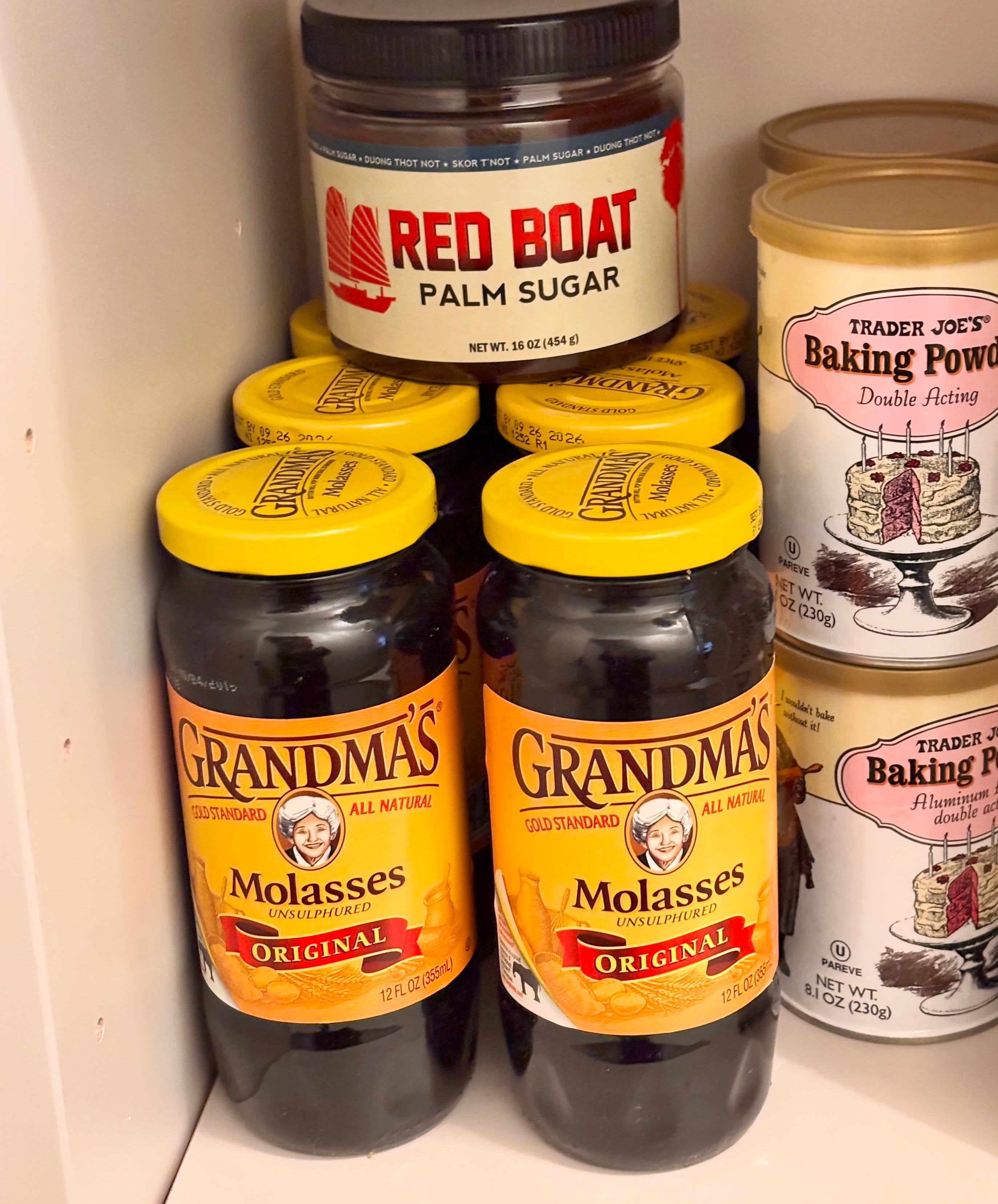
Fortunately I keep a stash of molasses on hand. Molasses isn’t widely used in France and the mélasse sold in natural food stores is closer to blackstrap molasses, whose flavor can overwhelm when used in cakes and cookies.
So when a good friend was coming for dinner recently, and yes, it was on a Friday, and the three restaurants I was hoping to get into were, of course, fully booked, I offered to make dinner.
I made a batch of hummus after I picked up a jar of chickpeas at the natural food store, then rode my bike over to Utopie to pick up a poppyseed-hazelnut baguette, and grabbed some small eggplants at one produce store to grill, a head of lettuce at the other produce store that had the lettuce I like, and a few slabs of tuna at a new poissonnerie in our neighborhood (which involved a very interesting and lengthy discussion with the owner of the shop, whose wife is Japanese, who explained why he keeps the best grades of fish in the refrigerator, which keeps the fish fresher, not on ice like they normally do at seafood shops). Then I stopped at the fromagerie to get some cheese.
The upside is that when you have really good ingredients, which I’m (obvs) picky about, you don’t have to do a lot to them. One entertainment-friendly cue I have embraced is always having ice cream on hand, in this case, Fig leaf ice cream and Plum sorbet, so dessert was mostly done. I roasted some figs that I’d picked in Provence, which I plucked from one of the bags I’m storing in the freezer, but needed something to go with dessert.
I have plenty of cookies in my repertoire, but I’m embarrassed about the high stack of cookbooks on my desk that I’ve bookmarked with recipes I want to try. One book dates as far back as 1976, so I’m pretty behind.
One newer book was Will This Make You Happy, which bills itself as a “narrative cookbook” (think: memoir), by baker Tanya Bush about navigating her life as a budding baker. This includes a disappointing, yet informative…and formative, internship in Tuscany, working at a cooking school, and hopscotching through rocky relationships. She eventually finds her footing in baking, and her book has recipes such asSoba Cha Panna Cotta, Dark Chocolate and Coconut Birthday Cake, and Toasted Croissant Ice Cream.
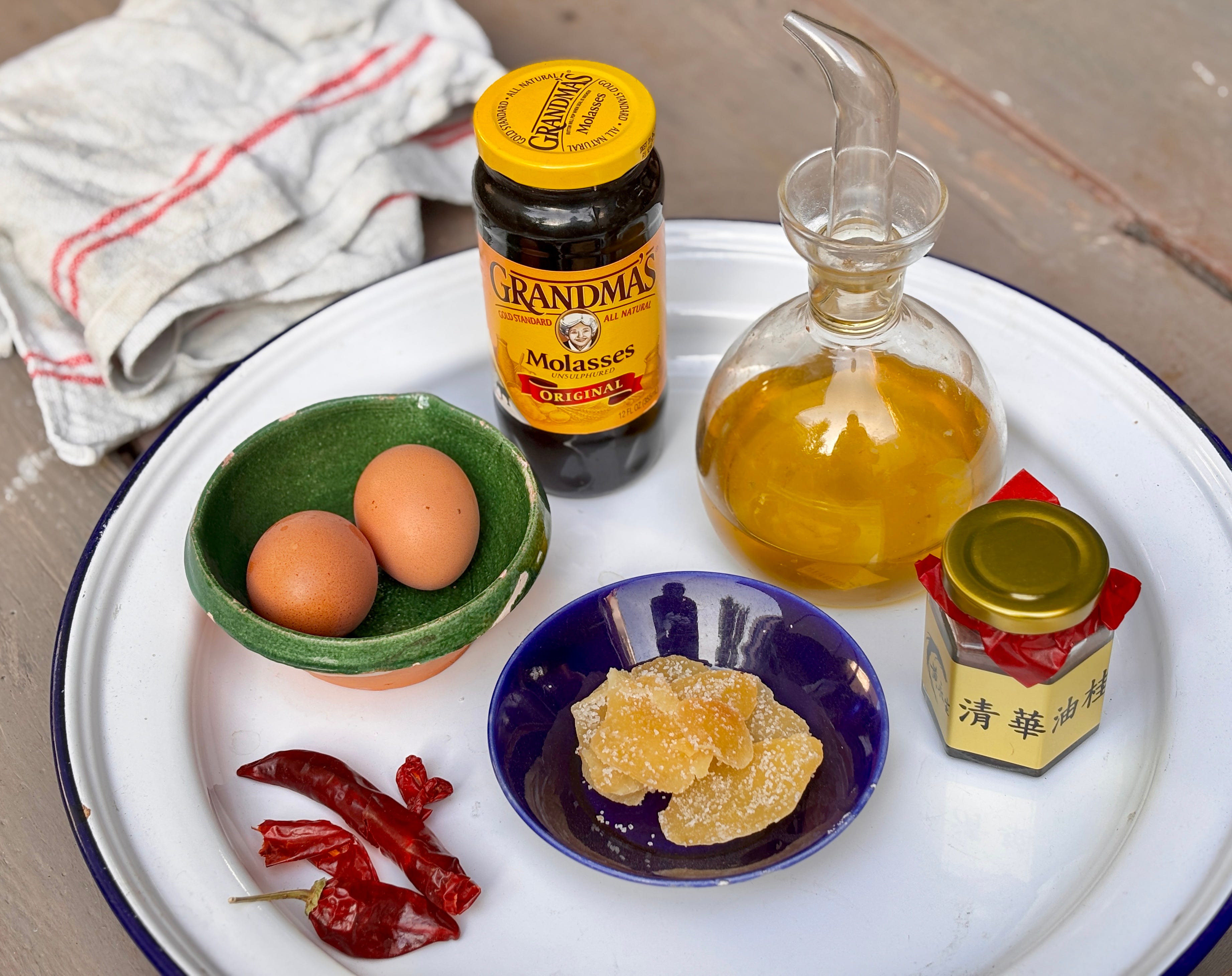
I didn’t have a lot of time to spare and was intrigued by herSpicy Olive Oil Ginger Cookies, partially because a spice cookie is welcome with any fruit dessert, and partly because I had all the ingredients on hand, so I didn’t have to do any shopping.
An intriguing thing about these cookies is that they use olive oil rather than butter, so you don’t have to wait for butter to come to room temperature and can make them right away. They do need time to rest in the refrigerator for about 30 minutes, but then, you just roll them in sugar and bake.
After I baked the cookies and they cooled, I tasted one. I was a bitdéçu that I didn’t find the spices punchy enough, and was wondering if I needed to make the recipe again, dialing up the spices.
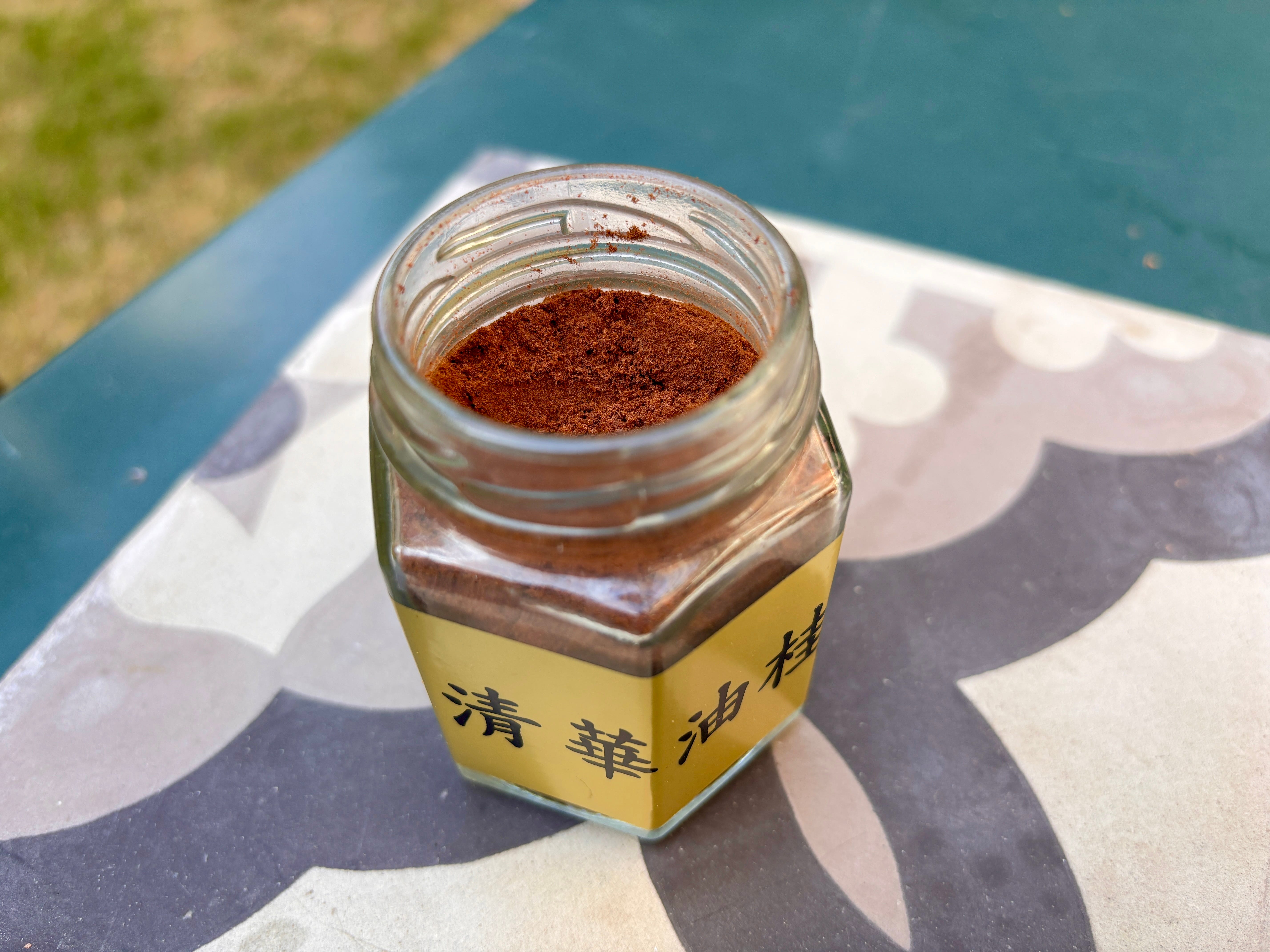
I reread the recipe, which called for a generous 2 tablespoons of ground ginger and 4 teaspoons of cinnamon. That gave me a chance to use the very special, and very expensive, cinnamon I got in Taiwan, although I did swap a teaspoon of ground cardamom for the nutmeg, so maybe that was the culprit.
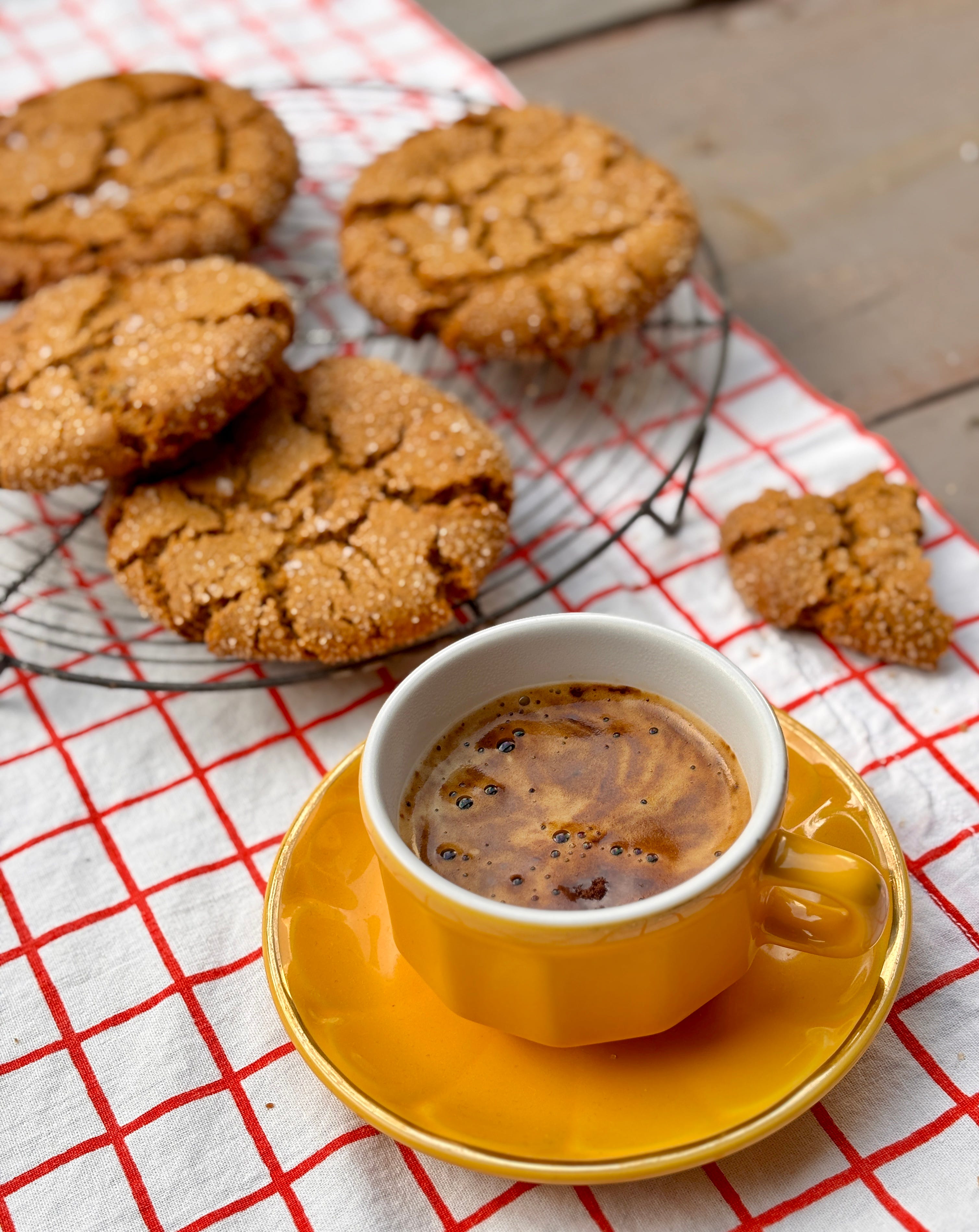
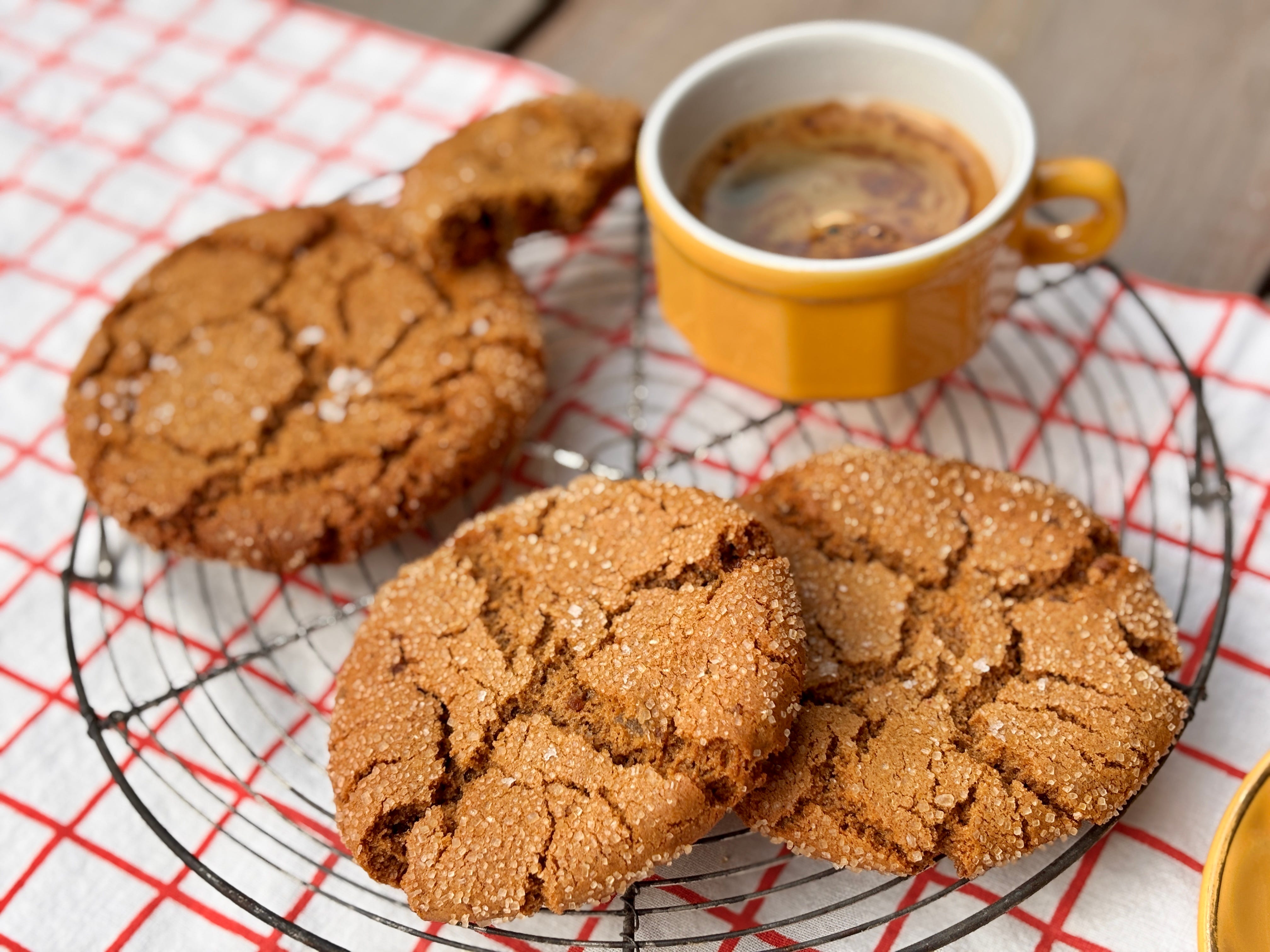
But the more I dug into the cookie, the better it got. And by the time dessert rolled around that night, the flavors were spot-on and the spice level hit its stride. Even better, the next day, I found that the flavors developed even further, making the cookies extraordinarily delicious, with just the right level of spiciness. And the chewiness increased as well. After all that panicking, things eventually worked out and they were the perfect chewy, chunky, spicy cookie.
The original recipe was written in metrics, and that’s what I used when making these cookies. (I’ve included Tanya’s conversions here.) More and more people in the U.S. are baking with scales, which provide more consistent results. If you don’t have a scale, consider getting one.
Tanya’s instructions said to flatten the cookies to 3 inches (7,5cm) in diameter before baking, but I prefer them a bit thicker and flattened mine to 2 inches (5cm). If you like thinner cookies, go ahead and flatten them to her dimensions.
Turbinado sugar (called cassonade in French) are free-flowing, large crystals of natural sugar, which add a marvelous crunch to anything they touch, including these cookies. But you can roll the cookies in granulated sugar if you don’t have turbinado.
The cookie dough
150g (3/4 cup) granulated sugar
50g (scant 1/4 cup, packed) light brown sugar
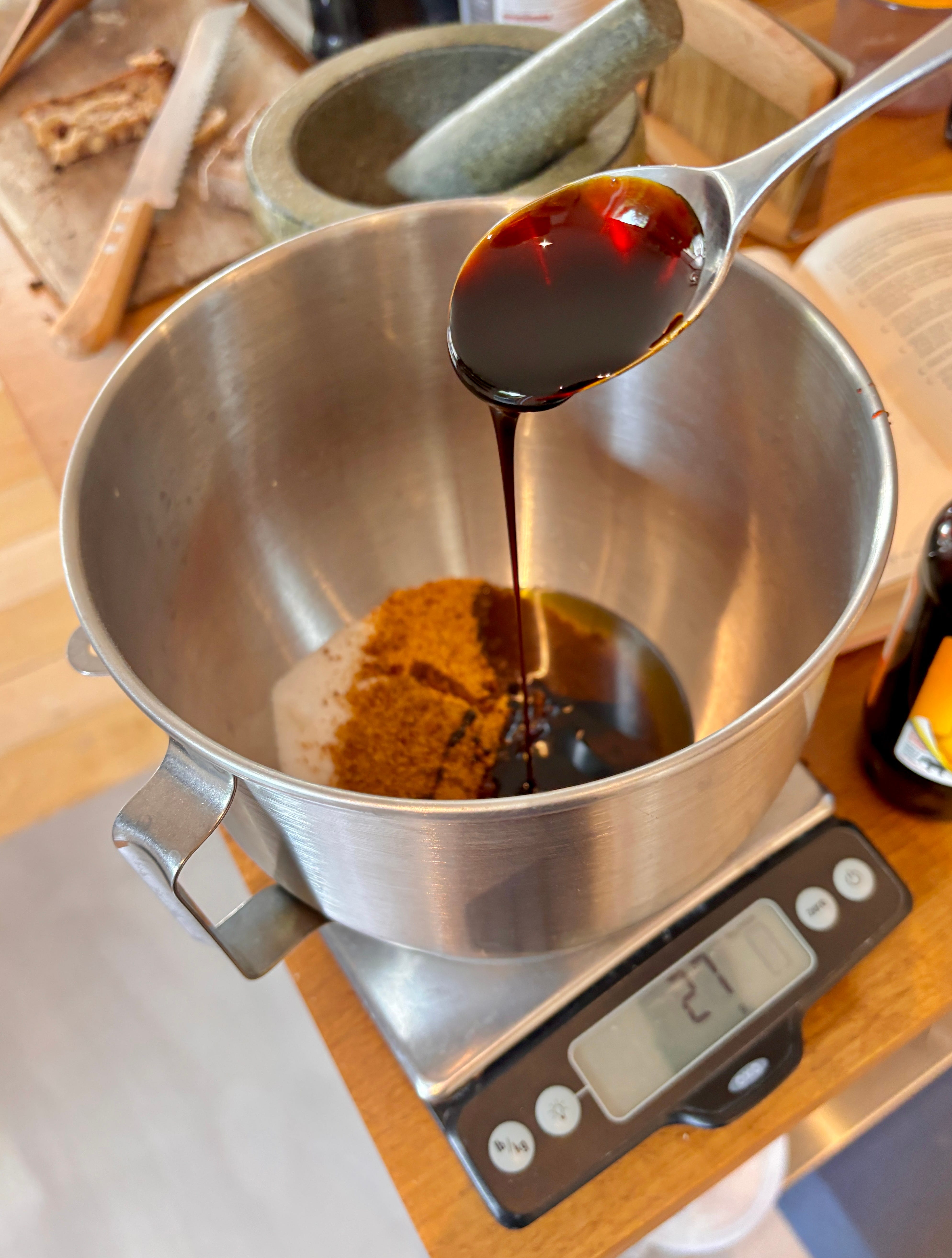
90g (1/4 cup plus 1 teaspoon) light or mild molasses
65g (5 tablespoons) extra-virgin olive oil
1 large egg, preferably at room temperature
1 large egg yolk
1 teaspoon pure vanilla extract
280g (2 1/3 cups) all-purpose flour
2 tablespoons ground (dried) ginger
4 teaspoons ground cinnamon
1 1/2 teaspoons baking soda
1 teaspoon ground cardamom or a scant teaspoon of ground nutmeg
Flaky sea salt, such as fleur de sel or Maldon (optional)
In the bowl of a stand mixer fitted with the paddle attachment, or by hand in a large bowl, mix the granulated and brown sugar, molasses, and olive oil on medium-to-low speed until combined.
Add the egg, egg yolk, and vanilla, and beat on medium speed until they’re well incorporated.
In a separate bowl, whisk together the flour, ginger, cinnamon, baking soda, cardamom or nutmeg, salt, and cayenne pepper. With the mixer on its lowest speed, gradually mix in the dry ingredients. Stop the mixer midway through, and use a silicone spatula to make sure any dry ingredients at the bottom of the mixer bowl are getting incorporated. Remove the bowl from the mixer and mix in the candied ginger.
Cover the bowl and chill the dough for at least 30 minutes. (The dough can also be refrigerated for a few days.)
To bake the cookies, preheat the oven to 325ºF (165ºC). Line a baking sheet (see note, below) with parchment paper or a silicone baking mat.
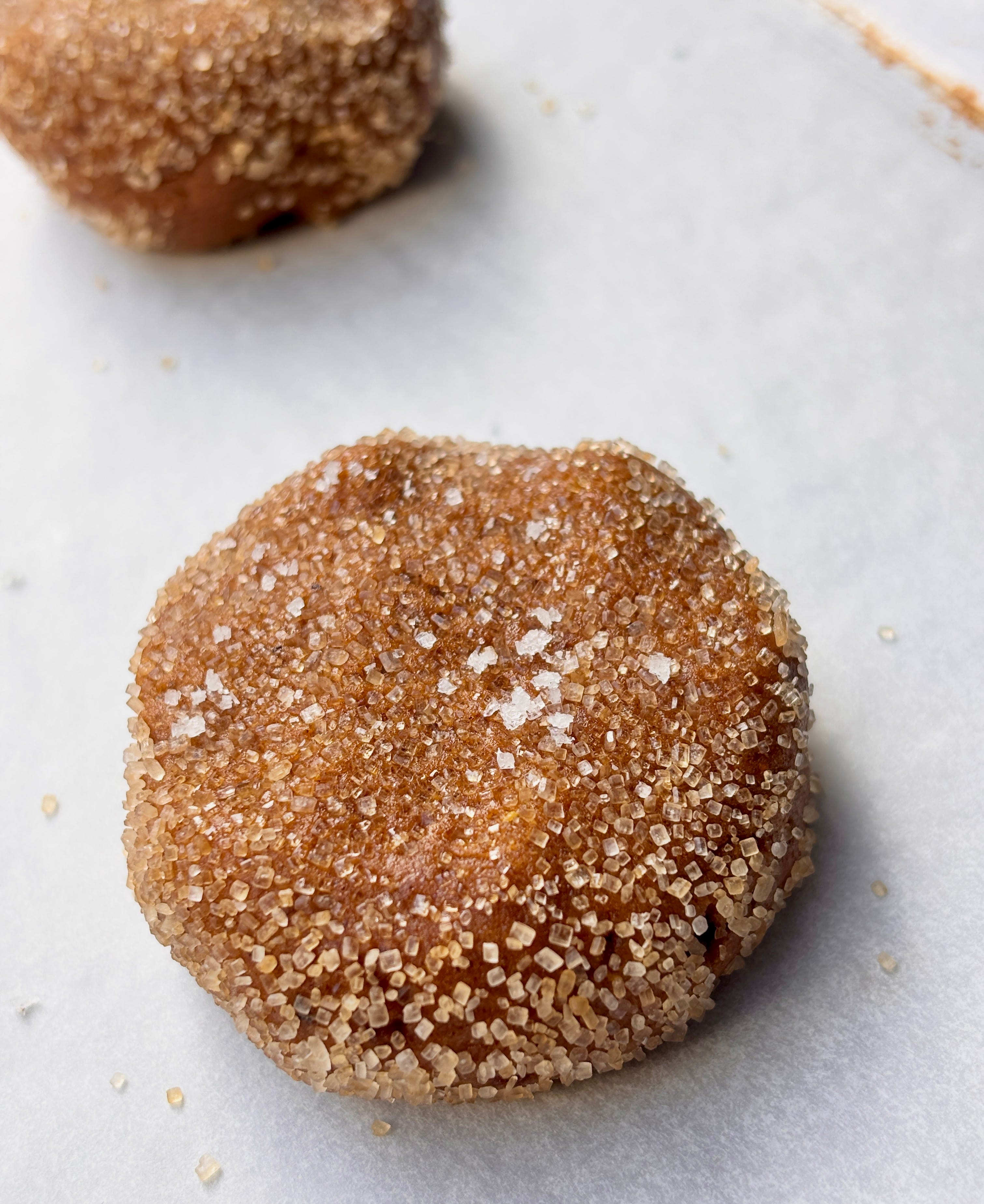
Spread the turbinado sugar in a shallow soup bowl or small dinner plate. Shape the cookie dough into 12 equal-size rounds, each about 55 grams, or a scant 1/4 cup.
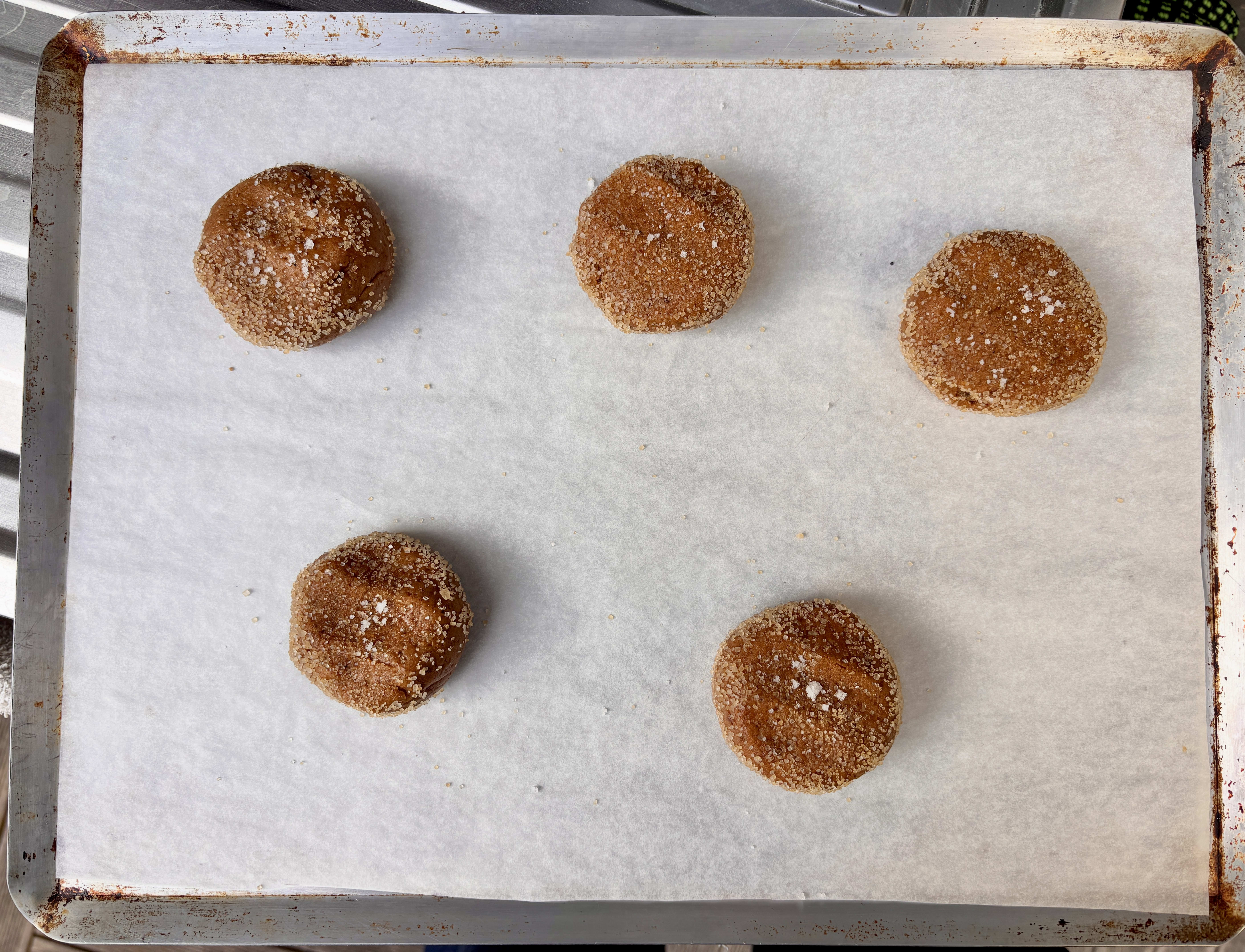
Roll six of the cookies, one at a time, in the turbinado sugar, covering them as thickly and completely as possible, and place them equally spaced apart on the baking sheet. Use your hand to flatten the cookies so they’re about 2 inches (5cm) in diameter.
Bake the cookies on the middle rack of the oven, turning the baking sheet midway during baking so the cookies bake evenly. The cookies are done when they’re light-to-moderately golden brown across the top and puffed up. In my oven, a baking time of 10 minutes was right. If you want them a bit more firm, you can bake them for 12 minutes.
Remove the cookies from the oven and bang the pan on a sturdy countertop once or twice to slightly flatten the cookies, so they are no longer domed. Sprinkle the cookies with a little flaky sea salt, if desired, and let the cookies cool for a few minutes, then transfer them to a cooling rack.
Allow the baking sheet to cool completely, then bake the remaining six cookies the same way.
Note: On a standard American half-sheet pan, which is about 13 x 18 inches (33 x 46cm), you should be able to get six cookies on the baking sheet. I baked these in my compact oven so used a European-size baking sheet pan, which is smaller than American baking sheet pans, and baked five cookies on the baking sheet, as shown in the photo in the post.
This basic, easy Chinese pork stock can be used as a base for many dishes, from wonton and noodle soups to braises and gravies! The key to a really clean and flavorful pork stock is a couple simple preparation steps. We’ll show you how to make it! How to Get a Really Clean Flavor We […]
These healthy Chicken Meatballs are delicious and fiber-rich. Plus, they’re versatile enough to meal prep and use in all sorts of ways throughout the week! Your New Favorite Chicken Meatball Recipe In the past, I’ve made a version of ground turkey or ground chicken meatballs with carrots, a little onion, garlic, and herbs. They’re great, […]
It was quite an experience eating at les Grands Buffets, the world-famous, all-you-can-eat buffet in France, last month. There was a lot to eat, and a lot to write about. So I divided the post into two parts. You can read part 1 here:
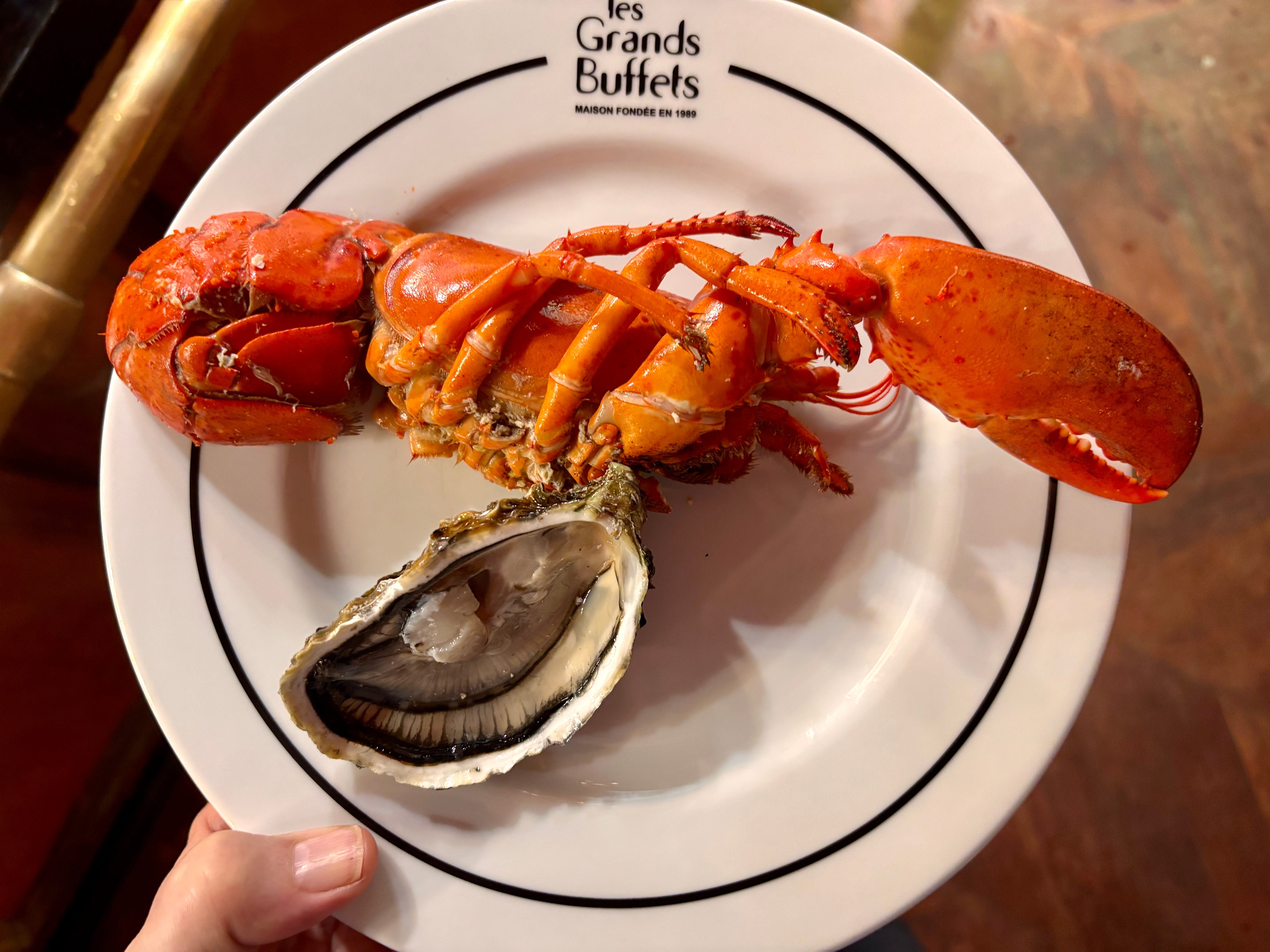
After grazing our way through appetizers, truffle-scented scrambled eggs and soup, lobsters and oysters (and foie gras and ham), we headed over to the main course area, known as La Rôtisserie, which serves up more of Escoffier’s recipes. The main area offers several different dishes, each one plated to order.
You stand in a single, well-organized line and let them know what you want. Then, depending on what you’ve ordered, they hand you a plate with what you asked for, some of it having been cooked almost to order. Among the offerings are filets of beef Rossini, sautéed in butter, with foie gras and black truffles, vol au vent (puff pastry) filled with sweetbreads and morel mushrooms, quail stuffed with foie gras, andlièvre à la royale, a traditional dish of hare braised in red wine, with blood sauce and innards (although more modern renditions often use a bit of chocolate in place of the blood and innards), along with cassoulet de Castelnaudary.
The last two I don’t remember seeing on offer, but they’re not exactly summer dishes. Although I do love cassoulet and would have liked to have tried theirs. (Maybe I need to go back in the winter?)
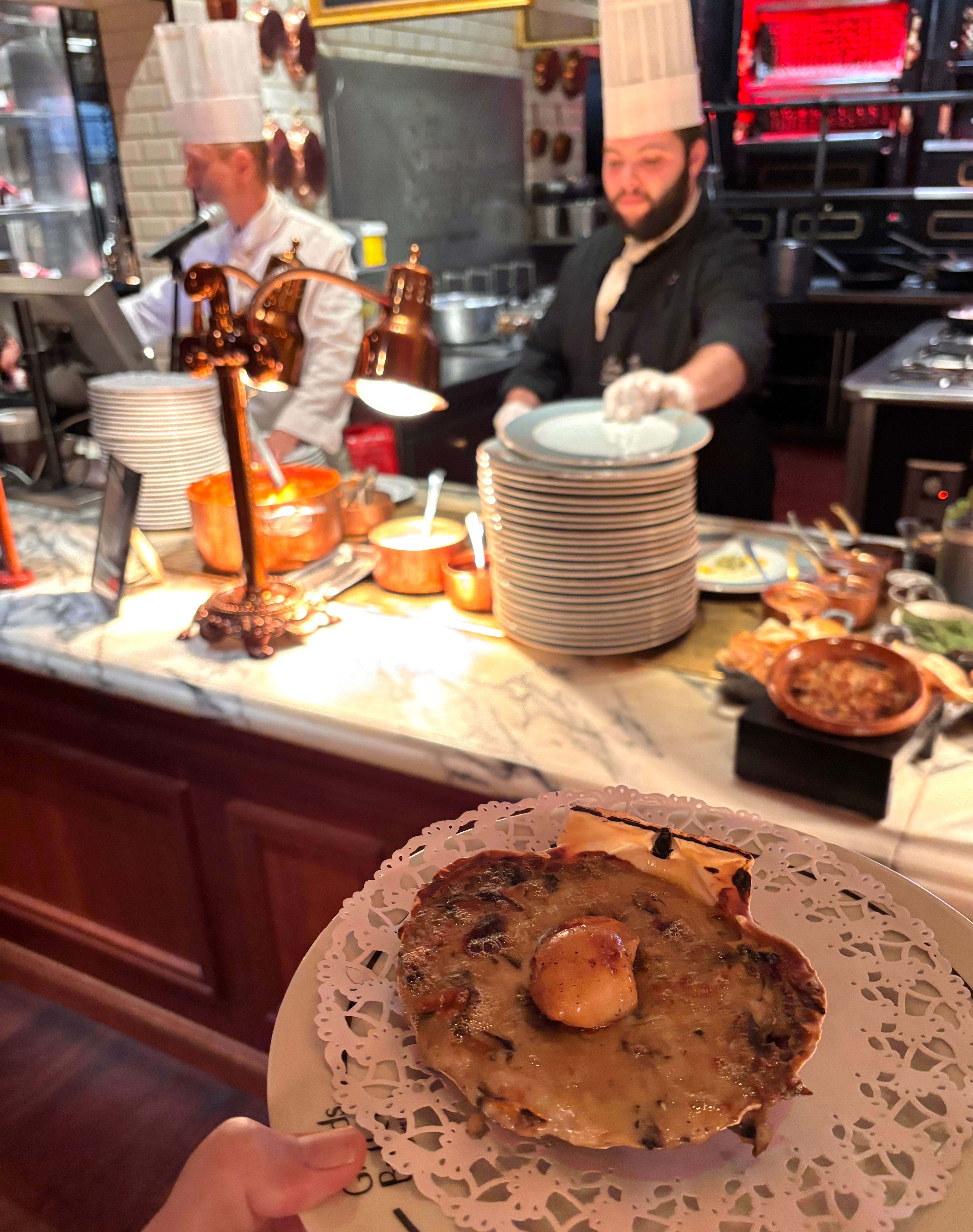
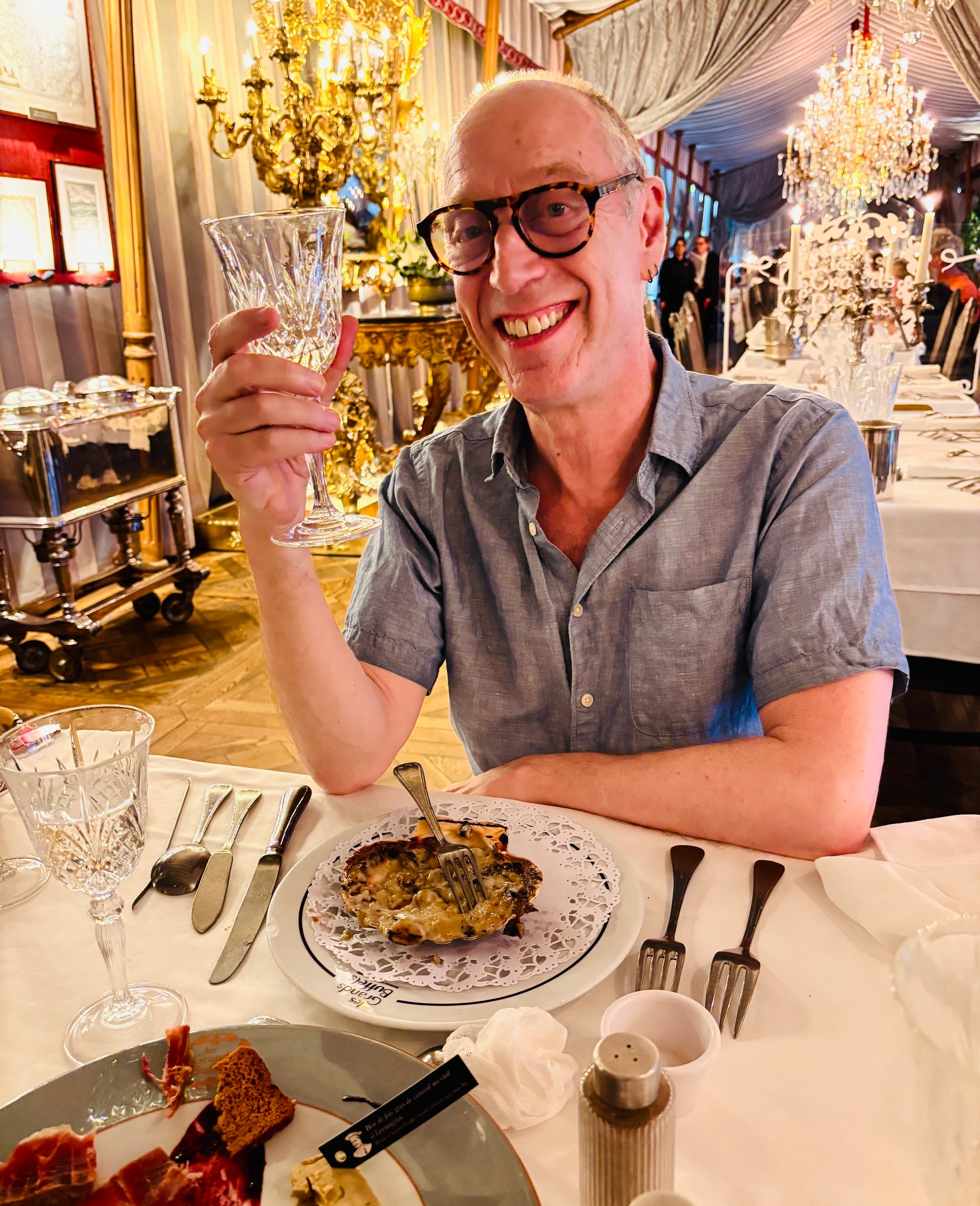
On the rich front, I ordered a Saint-Jacques à la Nantaise, a dish I wasn’t familiar with. After looking it up (and after eating it), I found out that it’s traditionally scallops, mussels, and a sauce made from mashed pain de mie (white bread). It’s perhaps a dish that was better left in the past, when French cooking meant smothering foods, including seafood, with rich, thick sauces. While it was good, with apologies to Escoffier, I think it’s pretty hard to improve on fresh scallops pan-seared in butter. I ended up picking out the seafood and eating that, since I didn’t want to fill up on sauce.
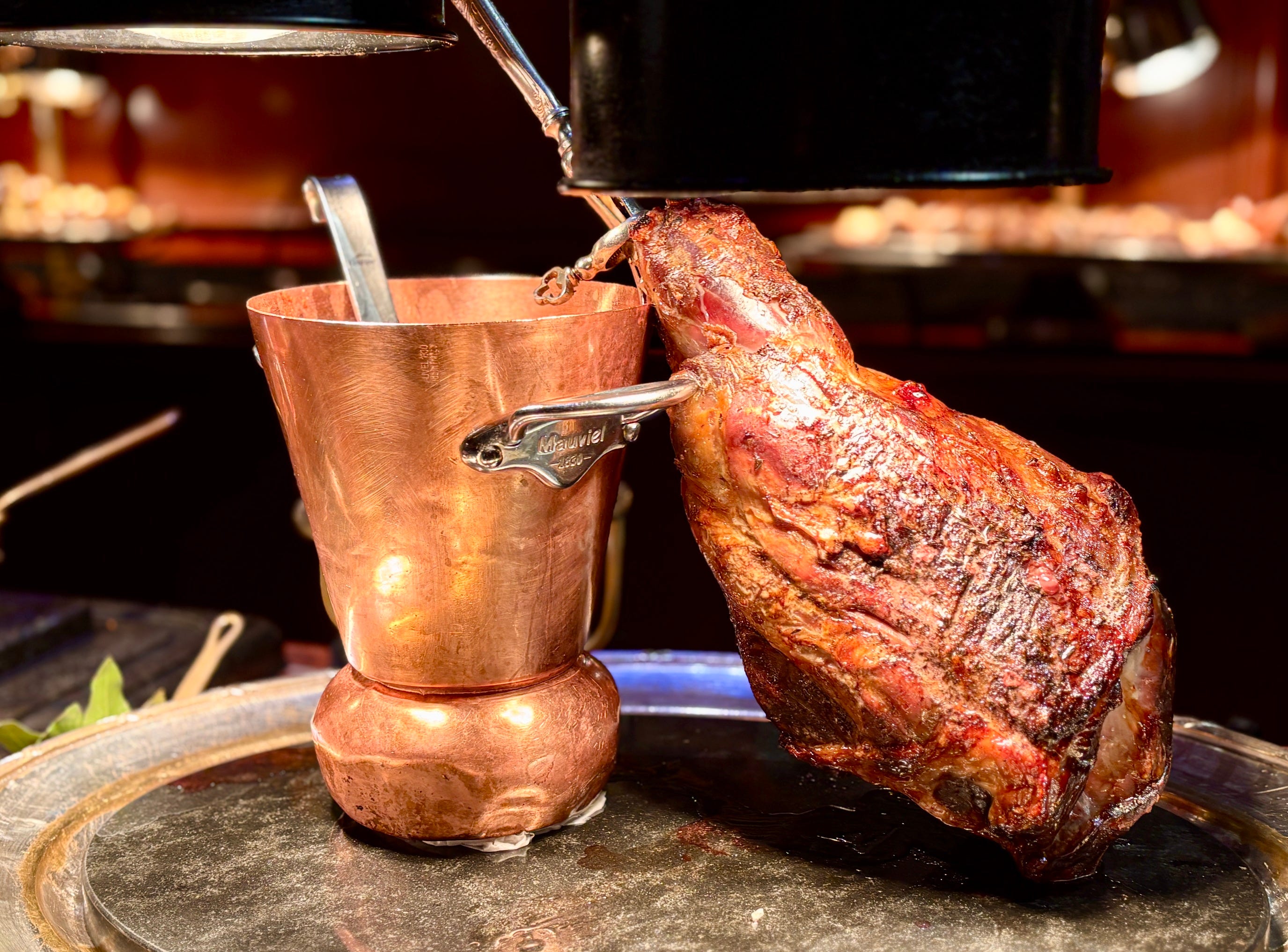
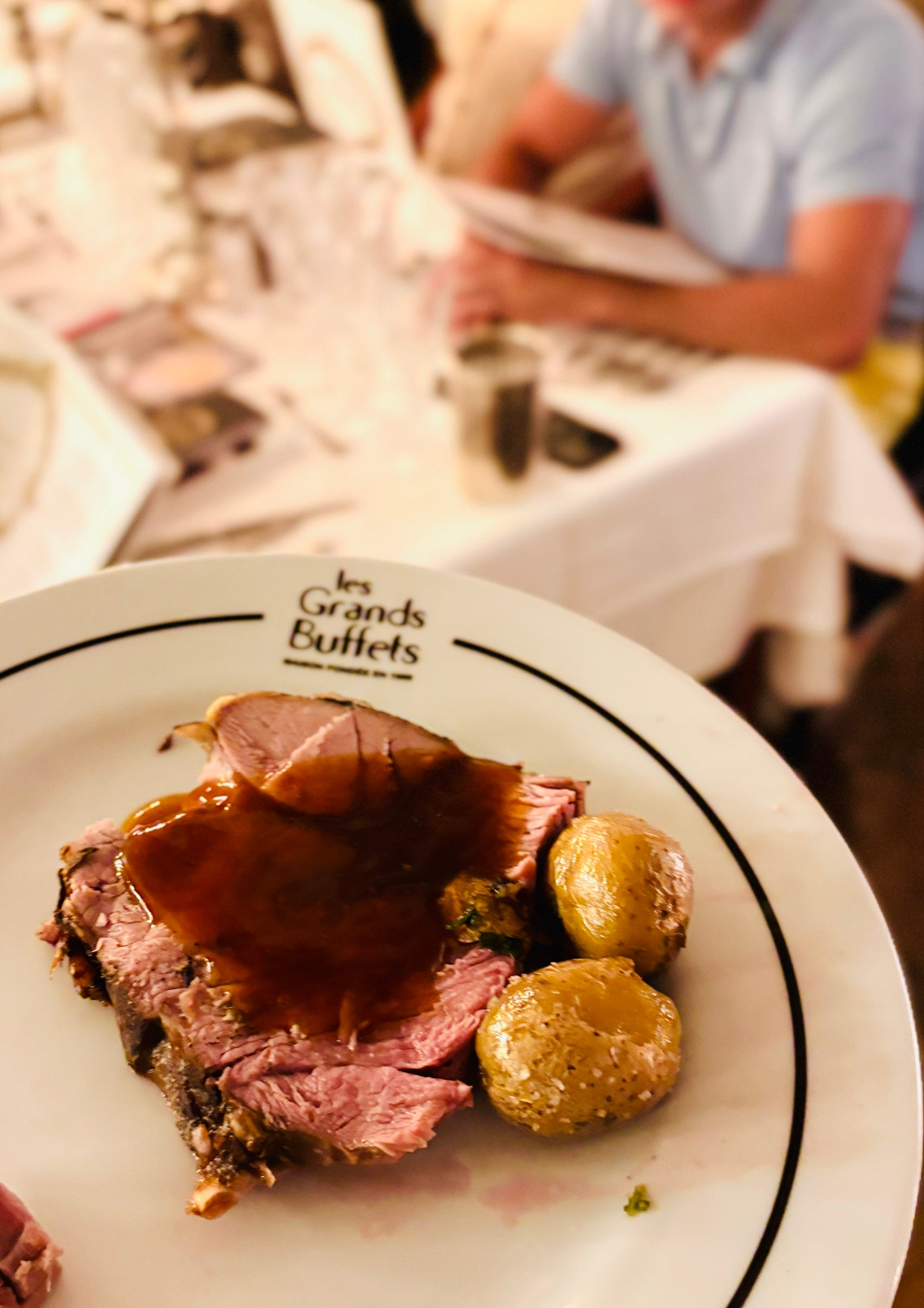
There were also stations where you could get leg of lamb, which I enjoyed a slab of. I did jockey myself in line so when it was my turn, I’d get a piece with some of the crispy crust. And I broke my rule about not filling up on carbs with two delicious pommes grenaille flecked with sea salt.
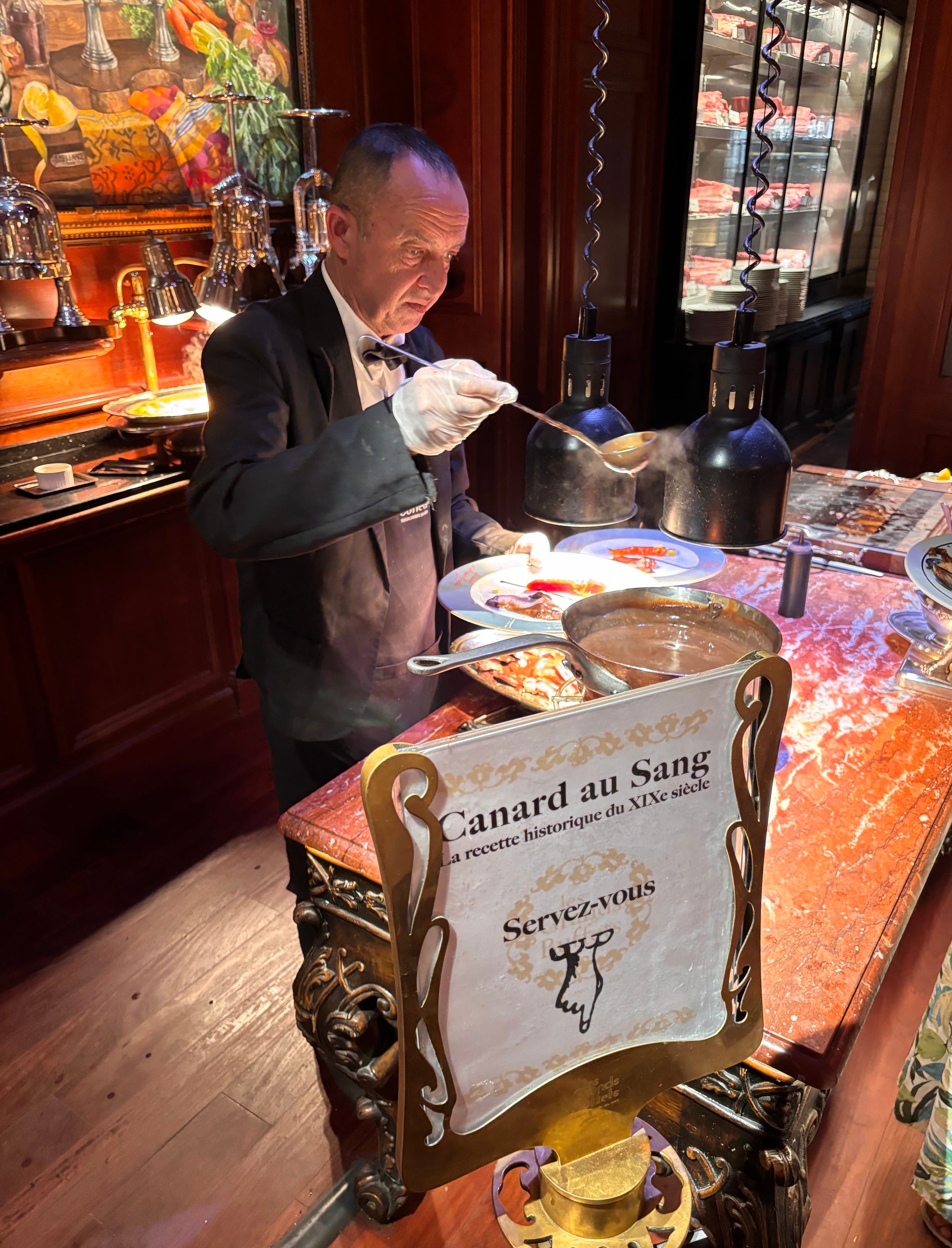
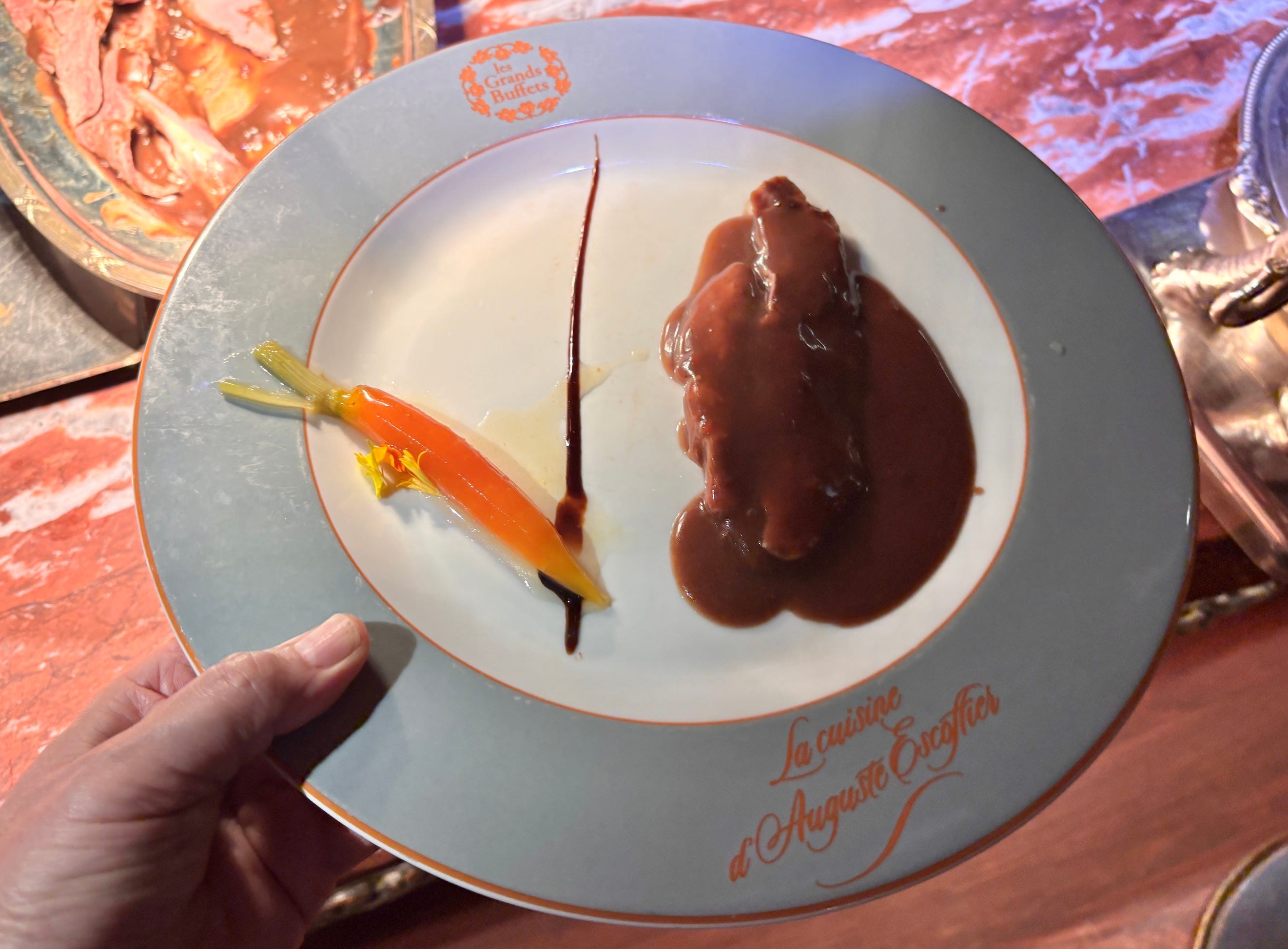
At another station, which some consider the highlight of the buffet, a serious-looking gentleman was serving canard au sang: duck served with a sauce made by crushing the carcass and using the juices, and the blood, to thicken the sauce.
The sign notes they follow the historic recipe from the 19th century.
As you can see, the portions aren’t huge.
Canard au Sang
They’re not being stingy. They don’t want you piling a whole bunch of things on the same plate. Being France, where appearance is everything, a big pile of food on a plate isn’t very becoming. Plus they don’t want to waste food. I didn’t see any signs at les Grands Buffets, but restaurants elsewhere with buffets are starting to charge people for uneaten food. The average diner at les Grands Buffets eats between seven and eight plates of food, which I found was about right. The owner was quoted as saying something along the lines of, it’s not about all you can eat, but it’s all about what you want to eat.
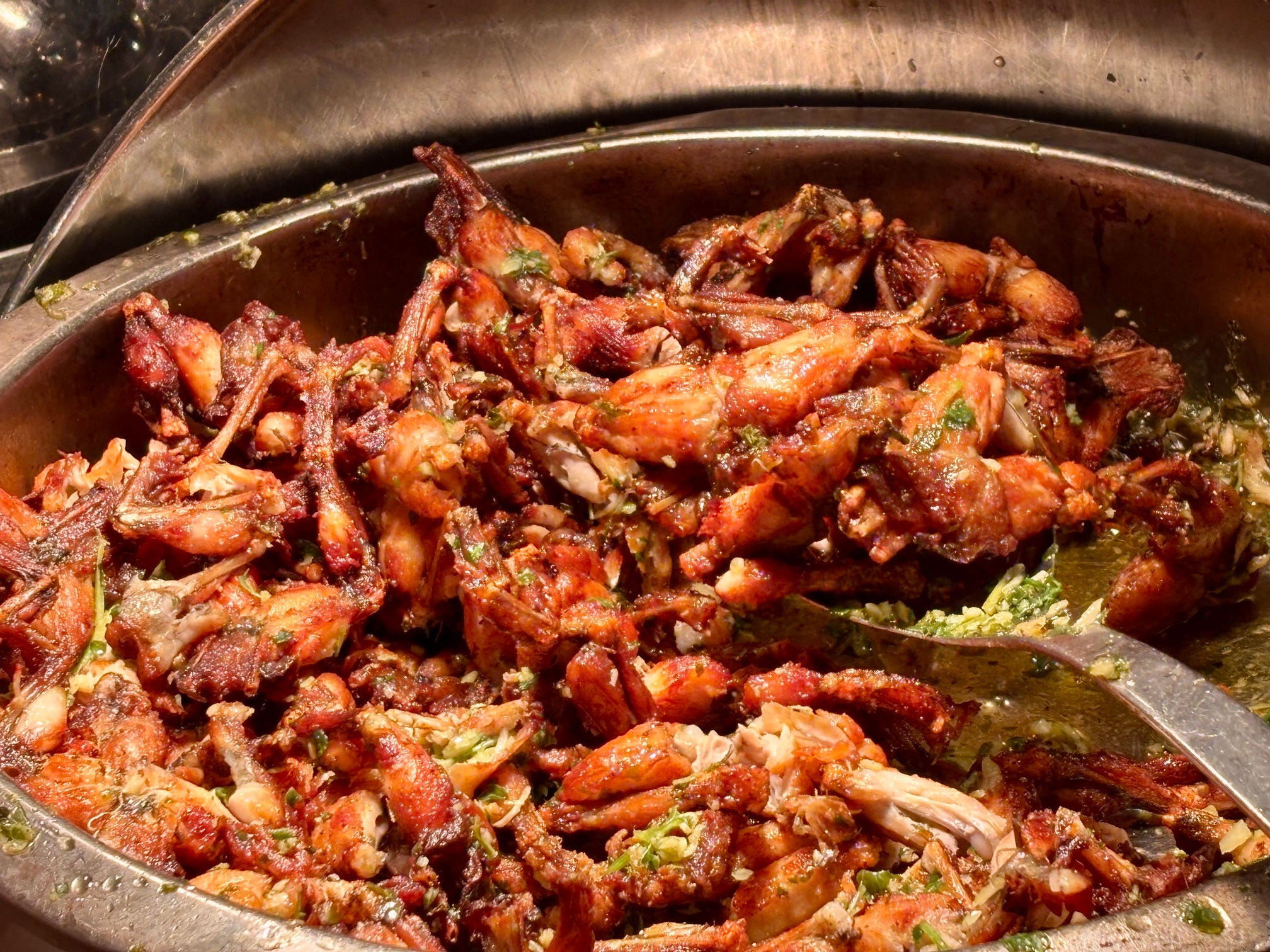
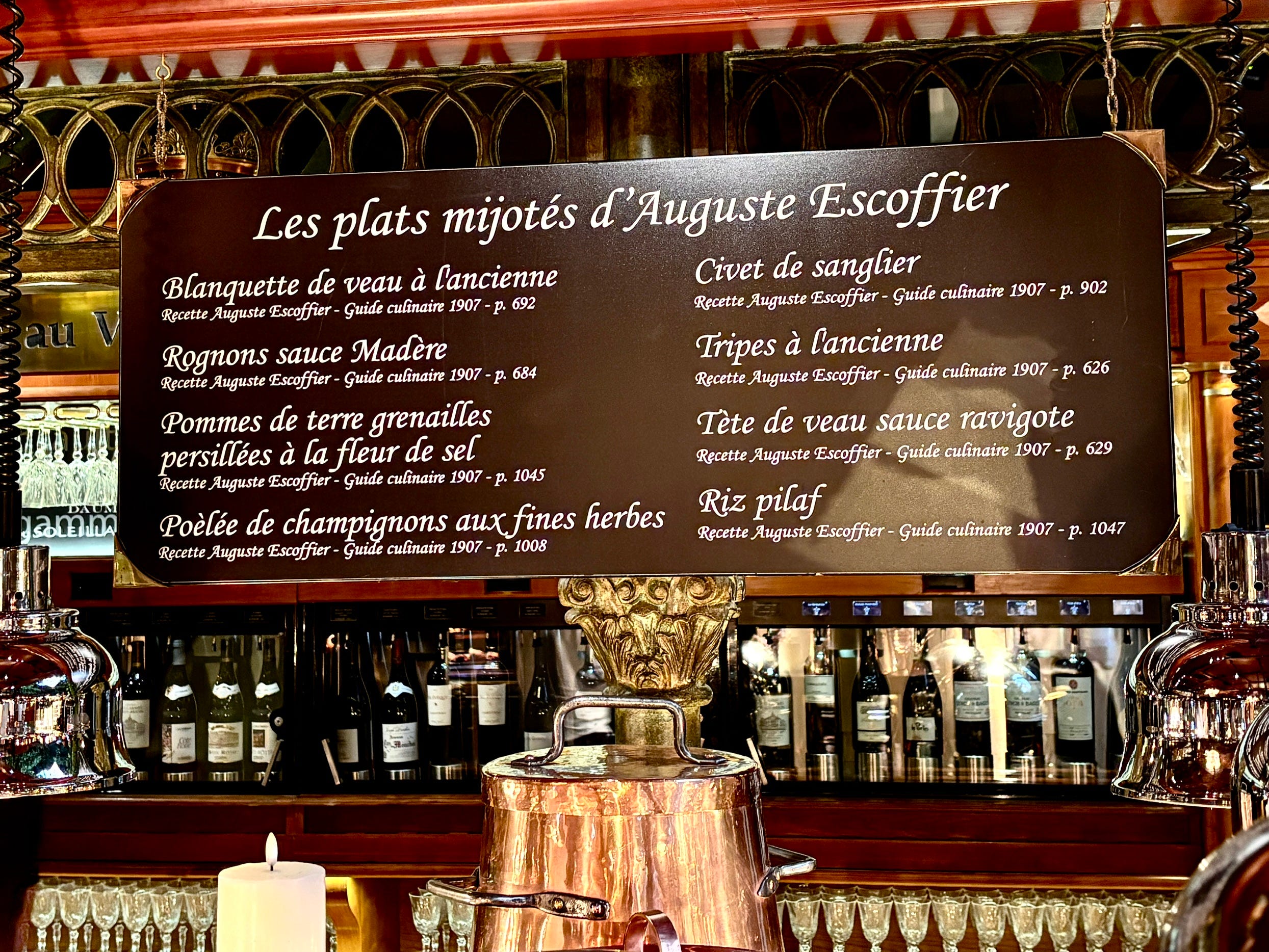
Intriguing, but less compelling to me, were the plats mijotés, simmered dishes, which were presented in chafing dishes, with items like frog’s legs, snails, veal kidneys, and tripe. In case you’re interested, some of those recipes appear in Escoffier’s book on pages 544, 543, and 626. You’re welcome.
Frog’s legs.
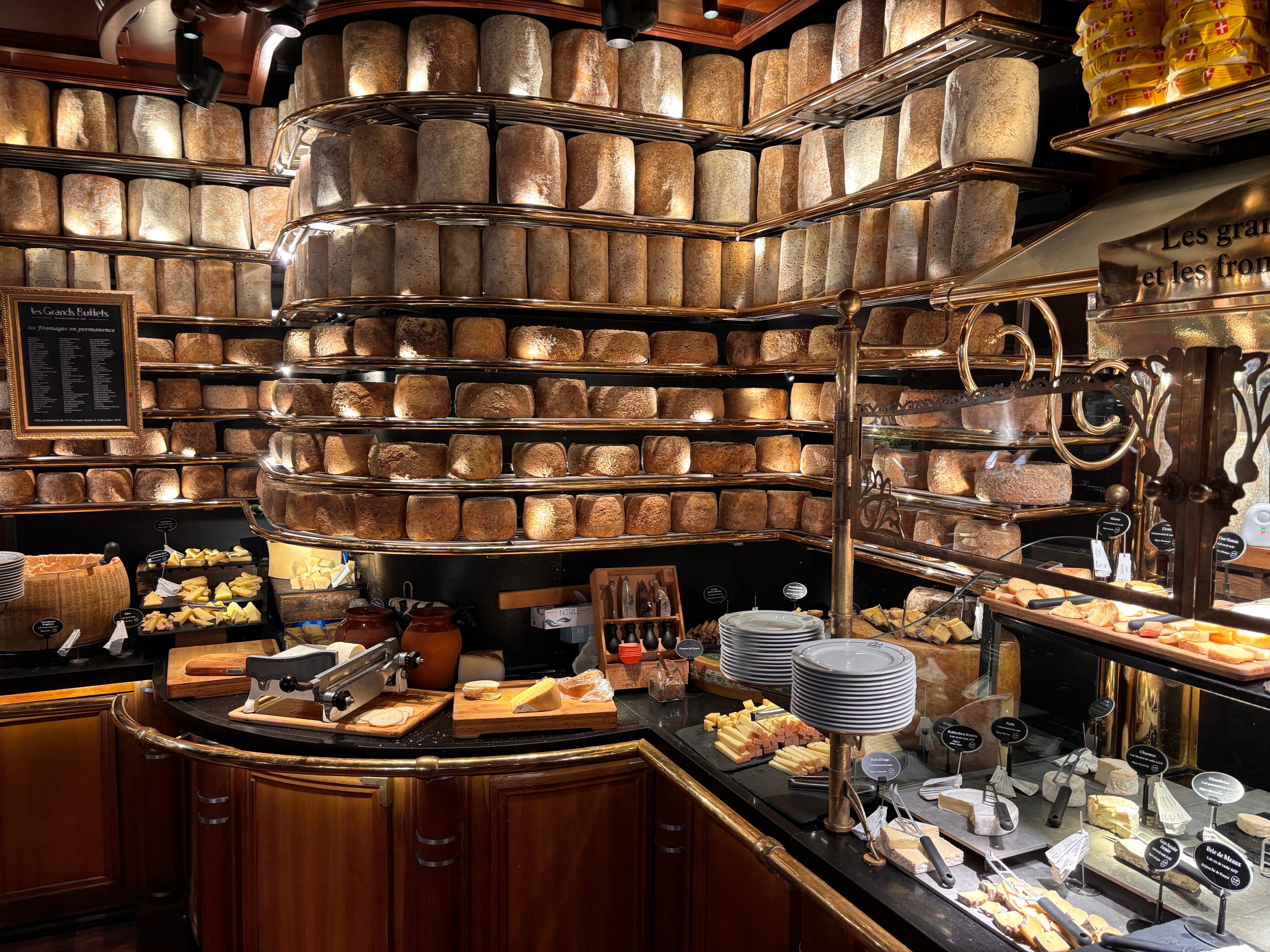
Before dessert, you’re faced with what Guinness World Records certifies is the largest restaurant selection of cheese in the world.
Sesame chicken is one of the most popular dishes on the menu at any Chinese takeout restaurant or buffet. Deep-fried boneless chicken coated in a savory sweet sauce and topped with toasted sesame seeds? It’s a favorite here in America. That said, there is a lot of subpar sesame chicken out there! Too sweet, too […]
Supermarket fish counters in America can often be uninspiring. You see the same usual suspects — salmon and mild white fish fillet such as cod, rockfish, sole, and tilapia. Fish is healthy and delicious but what healthy thing can you do with fish aside from grilling or pan-frying it? It can get b.o.r.i.n.g.
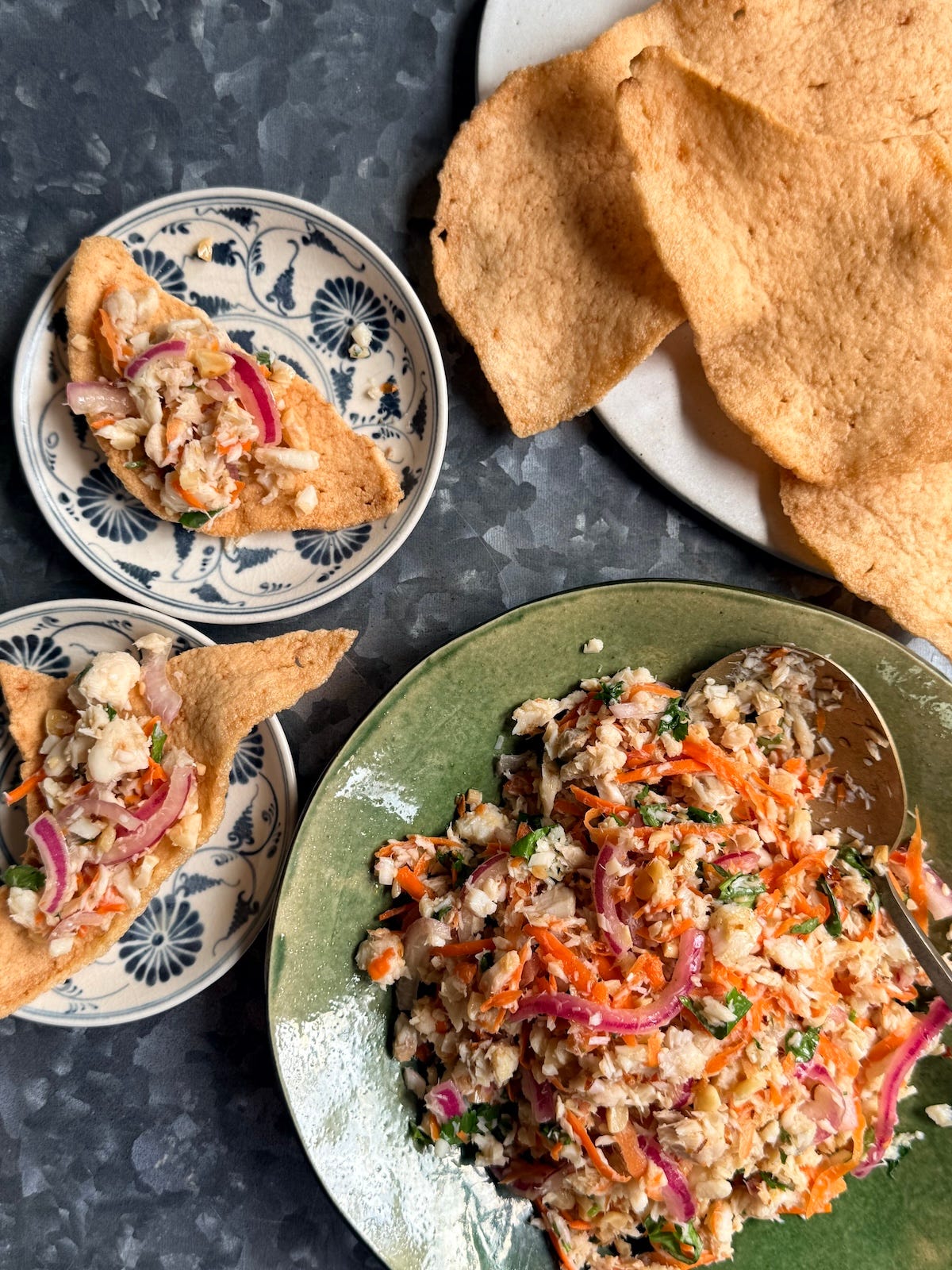
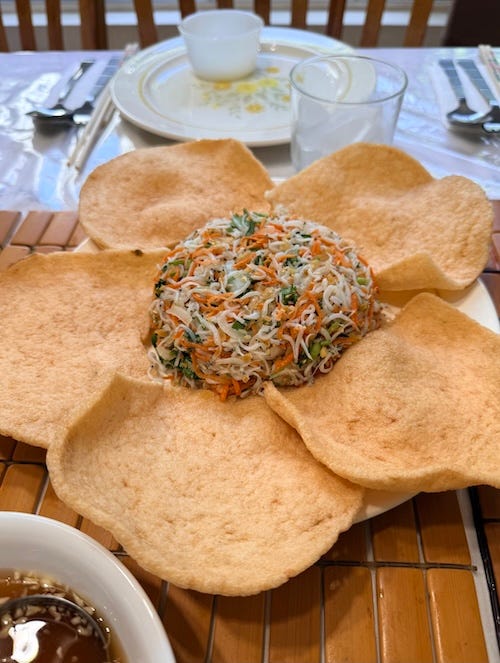
How about turning it into a tangy, garlicky, herbaceous, and slightly spicy Vietnamese fish salad called gỏi cá? It’s a refreshing salad that my family enjoys with crunchy fried shrimp crackers for a classic Viet-style starter or snack.
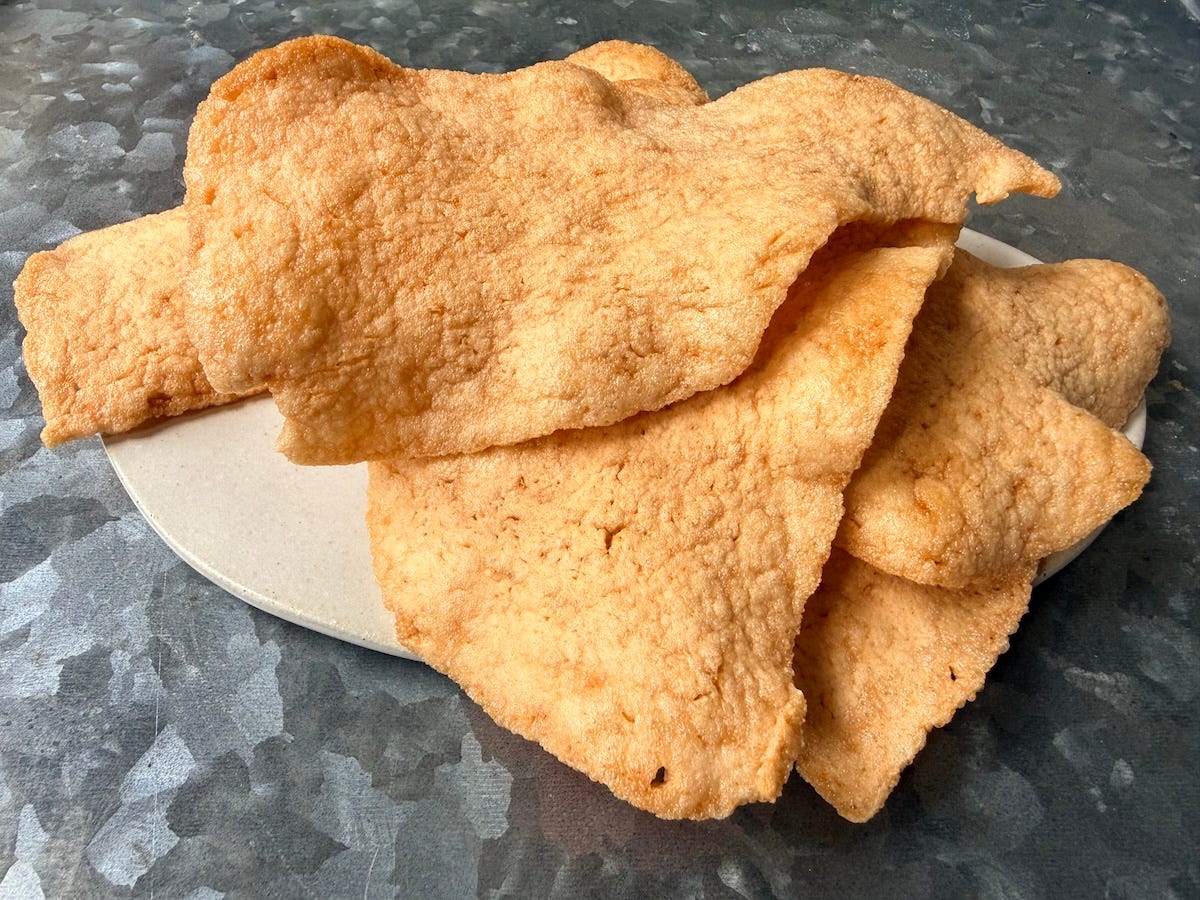
In fact, to eat properly eat many Viet salads, you need the ultimate crunchy scoop: fried shrimp crackers (banh phong tom). If you’ve never made them at home, I just published a guide to buying and frying the best ones on my website. (Don’t want to get the crackers? I suggest substitutes in the recipe below!)
But you don’t have to be traditional with gỏi cá. Let loose your creativity and cravings. Viet salads aren’t usually lettucey affairs BUT that didn’t stop me from serving my fish salad atop a pile of lettuce ribbons (no need for dressing because it’s well seasoned). Rory added tomatoes for a fab plate. You can even put it in a rice paper roll!
Traditional Vietnamese Fish Salads
But first, let me explain what Viet fish salads are about. In Vietnam, there are many regional kinds of gỏi cá (pronounced “goy KAH?”) that feature raw super fresh fish. For instance, cooks on Phu Quoc island prepare gỏi cá with freshly caught sardine filets, which you can buy from the ladies who expertly fillet the fish at the daily outdoor market.
Given the freshness of the fish and other ingredients, please don’t ask me to replicate what I’ve eaten there. It’s a specialty best left to the island folk.
What my family enjoys as gỏi cá is a lightly cooked version created by my aunt Bác Hàng. She came to America in the 1980s, married my dad’s older brother, and became a nail artist and breadwinner for her family. She also cooks very well. She’s a superwoman in many ways.
For about 30 years, my mom made Bác Hàng’s fish salad like her sister-in-law did — with tiny slender frozen silverfish (aka icefish or noodlefish) that’s sold froen at Chinese and Vietnamese markets. My family’s gỏi cá composition of the miniature white fish accented by fried garlic oil, shredded orange carrot slivers, pickled red onion, and chopped fresh herbs. Lime juice and vinegar lends the salad a bright ceviche-ish quality but the fish is fully cooked. It looks special too.
My sister Tasha adores the salad so my mom, even at 92, still makes extra to pack up for her daughter to take home. My husband Rory adores the salad but gets creeped out at all the little eyes staring back at him in every bite. (You can’t see them in the photo below but they’re there.)
August 1, 2026. For her 92 birthday bash, Mom made the fish salad with silverfish. That. may be the last time, now that I’ve got this recipes!
What I didn’t realize was this:My mom has long wondered if the salad can be made without her having to shop at a little Saigon market. “It’s too much trouble to go all the way there for the fish,” she said. Silverfish have little flavor on their own, but they readily absorb the flavors of other ingredients, which are nothing special. They’re loaded with water so removing excess moisture is laborious and the yield is not much — a waste of money!
Earlier this week, standing at the fish counter and eyeing a glistening, very fresh fillet of cod, I had a revelation: What if I used cod as a Silverfish substitute? My mom’s reaction to my newfangled method, “If you can make the salad with supermarket fish I would be relieved. It would be much easier!”
I’m here to report that I did it! It only took one try to get this gỏi cá exactly where I wanted it. All the intriguing textures and flavors are there. Compared to the silverfish version, this evolved gỏi cá version 2.0 tastes more vibrant because the fish is fresh, allowing all the other elements to shine brighter and create excellent flavor.
With this new recipe, my mom and sister will be happier, and so will Rory! More importantly, Bác Hàng’s awesome fish salad can now be enjoyed by you and many other people! Make it whenever you want, with whatever kind of mild, white-flesh fish you find at the market or catch!
The ultimate crunch: How to fry perfect shrimp crackers
What are Asian shrimp crackers? The Viet version is called bánh phồng tôm, and they are a legendary snack and salad accompaniment.
A quick warning: Resist the temptation to microwave them! While it’s a common hack to make them puff up, they just turn out hard and tasteless. For the real deal, buy the dried discs and shallow fry them at home—they are leagues better than any pre-bagged shrimp chips you’ll buy at the store.
Want to master the perfect puff? Check out my step-by-step guide to buying and frying the best shrimp crackers on my website (it’s 🆓 and includes a quick how-to video!).
With the shrimp crackers and fish salad on hand, you can enjoy them many ways.
And I nearly forgot this — leftover fish salad tastes nearly as good as fresh. The salad keeps well so take it on the road, make it for a party, share it at a potluck.
This Vietnamese fish salad is ridiculously easy and versatile. Below, you’ll get the (1) full recipe in text and downloadable PDF, (2) process shots to guide you to success, and (3) many other pointers.
Curious cooks, readers and eaters fuel this newsletter. Paid subscribers sponsor PTFS and this gỏi cá recipe is designed for them. Join us as a paid subscriber for the whole shebang, fully use the recipe index + save 25% on future cooking classes! Thank you!
We are all obsessed with this Toum, or Lebanese garlic sauce. It is spectacularly garlicky, creamy, and a little bit tangy thanks to lemon juice. It’s absolutely addictive with lamb chops, salmon, chicken, potatoes, and is one of those sauces that makes anything better! The Non-Traditional Difference: Egg White Toum is traditionally made with four […]
There are two things I need to tell you about these cookies.
One is that they’re crazy-good. And the other is that they’re huge. The recipe makes just five cookies but each one is so packed with flavor, that you’ll be glad you can have one all to yourself. Your other four friends or guests will be delighted as well. (But they’re quite generous, so it’s okay to share…)
What makes these cookies extra special is their slightly savory, umami note, due to walnuts glazed with white miso. Miso is fermented soybean paste that can be purchased in Asian markets, but has become so popular, you can often find it in grocery stores. In these cookies, it adds a little je ne sais quoi, since it adds a subtle, yet complex note of flavors. Umami is often described as a flavor that’s craveable, and it certainly makes a compelling case for that description in these cookies.
If you don’t have white miso, or don’t want to make the candied walnuts, no problem. Just use toasted walnuts. Pecans, or another favorite nut will also work. You can also leave the nuts out, or swap in dried fruit for them. Do-ahead tip: The walnuts can be made a few days in advance and kept in an airtight container. The glaze will get a little sticky, but the walnuts are perfectly fine to use in these cookies.
Another “secret” to these cookies is to incorporate large chunks of chocolate into the dough. While it may be tempting to use chocolate chips, they’re really best if you chop up chocolate from a bar of good-quality chocolate. I leave the pieces quite rough and irregular, which – when baked – create large pockets and bites of dark chocolate.
I’ve adapted the recipe from SIFT: The Elements of Great Baking by Nicola Lamb. Her book explains many of the hows and whys of baking, as well as offering an array of creative recipes. Some are completely original and others are riffs on classics, and it’s a book that I refer to often and these cookies are a big hit whenever I bake them. I hope you enjoy these cookies as much as I do!
Adapted from SIFT by Nicola LambWhen you form the five mounds of dough, avoid compacting them too tight. You want to form them into loose balls rather than rolling them in your hands into smooth rounds. They're best when you chop the chocolate from bars of good-quality dark chocolate, and I leave the pieces fairly large – about the size of almonds, but you can use store-bought chocolate chunks if you wish.I baked my batch of cookies for 15 to 16 minutes, although the original recipe says 18 minutes. All ovens are different, but they're done when they're light brown across the top. The cookies shown in the post were baked on a cloudy day, so may look a bit dark. You want to err on the side of underbaking rather than overbaking. Another tip is that you can sprinkle extra flaky salt on top of each cookie when they come out of the oven. These cookies are best enjoyed the day they’re made but are delicious the next day as well. Store them in an airtight container at room temperature.
6tablespoons (90g)unsalted butterat room temperature
6tablespoons (85g)light brown sugar
6tablespoons (85g)granulated sugar
1largeeggat room temperature
1 3/4cups (220g)all-purpose flour
1/2teaspoonbaking soda
1 1/4teaspoons flaky sea saltor 1 teaspoon Diamond Crystal kosher salt, plus more for sprinkling (optional)
9ounces (255g)bittersweet or semisweet chocolatechopped in large chunks
Instructions
To make the miso walnuts, in a medium saucepan or skillet over moderate heat, warm the mirin, the granulated sugar, and the miso, stirring to incorporate and smooth out the ingredients. When the mixture starts to boil, add the walnuts and cook, stirring frequently, until the walnuts are completely coated and the miso mixture has almost all been absorbed by the walnuts, which will take a couple of minutes. They're done when there's only about a tablespoon of the miso syrup in the pan. Remove from heat and let cool, giving them a stir a few times as they cool.
To make the cookies, preheat the oven to 375ºF (190ºC). Line a baking sheet with parchment paper.
In the bowl of a stand mixer fitted with the paddle attachment on low speed, or by hand, cream the butter and sugars until well-incorporated for about 1 minute. Do not beat the mixture until it's too light or overly fluffy, which can cause the cookies to spread too much during baking.
Mix in the egg. Sift the flour and baking soda together in a small bowl, then mix that into the dough along with the salt.
Break or cut the walnuts up a little, but not too much, and stir them into the dough, then stir in the chunks of chocolate. You may need to get your hands in there to get everything thoroughly combined, but don't overmix. The dough can be somewhat irregular.
Shape the dough into 5 equal mounds on the baking sheet, each about 6 ounces (180g), placing them evenly spaced apart. Bake the cookies for 15-18 minutes, sprinkling them with additional flaky sea salt after they come out of the oven, if you wish. The cookies are done when they are light golden brown across the top. Err on the side of underbaking rather than overbaking.
Notes
Mirin is a sweet rice wine, available in Asian markets and well-stocked supermarkets. There are some substitutes for mirin here.
Consider this your new go-to marinade for grilled lamb chops. While our choice of spices borrows from Sichuan and Northern Chinese flavors, they have a chameleon-like quality and don’t read “Chinese” at all. They just season the lamb so well, and go with a wide variety of other flavors and side dishes! Pure Umami If […]
If you’re one of those people who gets irritated by the specter of pumpkin spice — or, gasp, Halloween decor — on an 85-degree week in September; if you understand that there are what will feel like infinite months left to spend shivering and longing for stew, and there’s no reason to beckon them any sooner; if you find yourself gritting out “but there’s another week of summer!” at your screen when confronted with ads for wool coats and other things you simply refuse to acknowledge before you must, come sit down. You’re among friends.
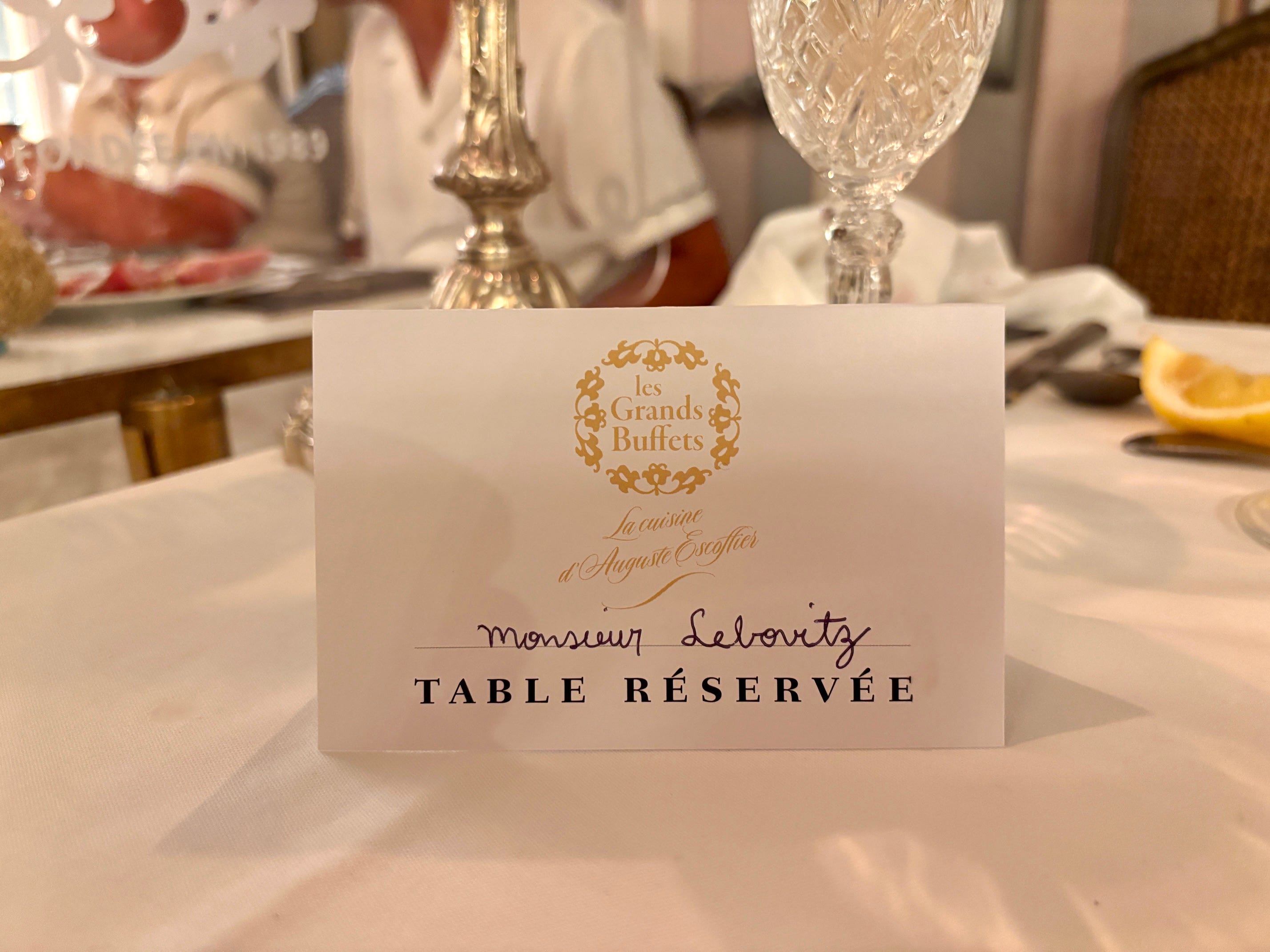
Perhaps you’ve heard about les Grands Buffets, the buffet in the south of France that’s à volonté. The all-you-can-eat restaurant is so popular, tables are booked months and months in advance. Like a number of things in France, what’s generally a straightforward process can become…a process.
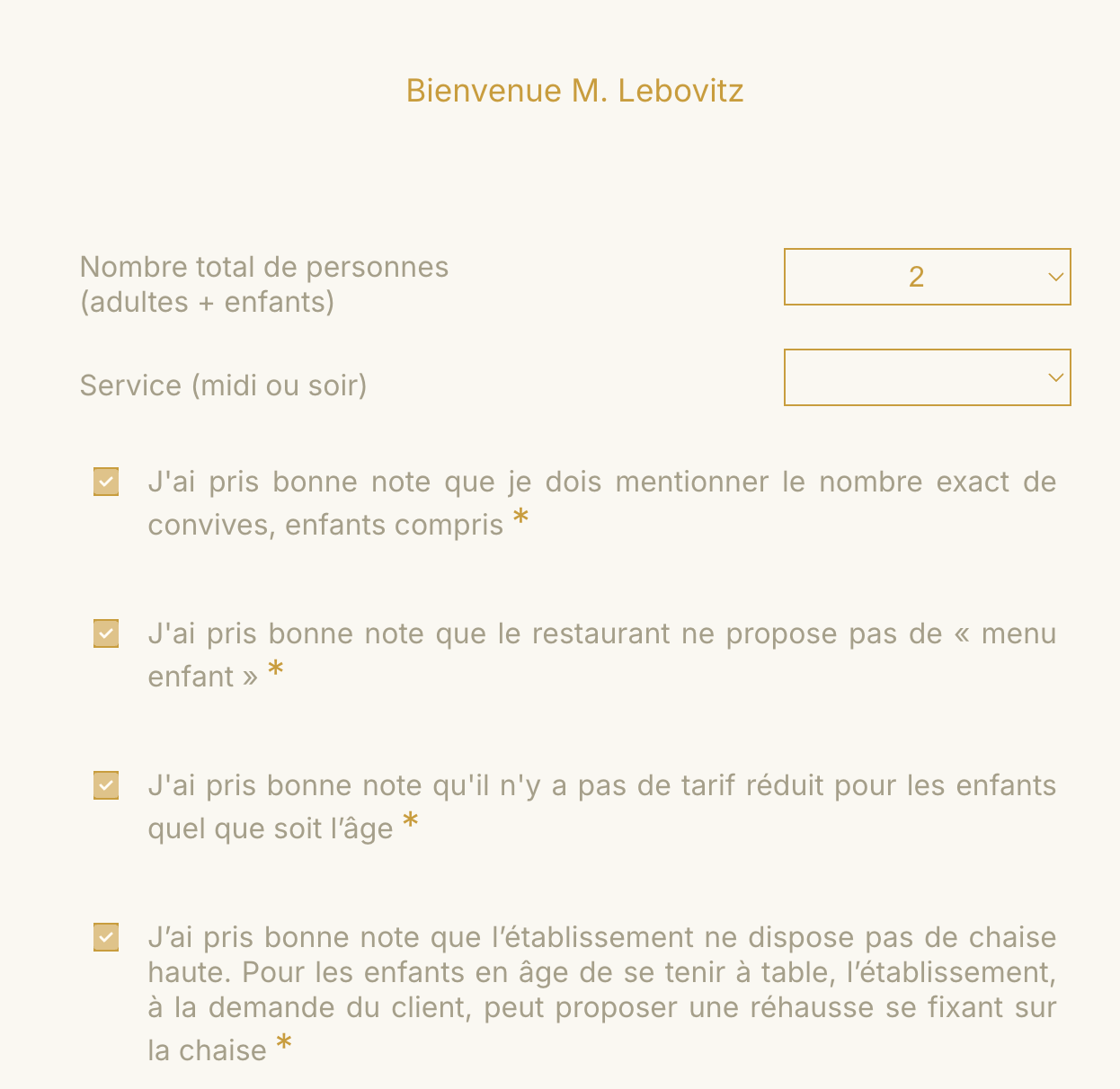
When booking your table, there are multiple screens to pass through, with a lot of boxes to check, making sure that you agree to everything…
You need to confirm that you understand the reservation is for the exact number of people you are asking for (you can’t change it later), that there is no children’s menu or special price for them, and there are no high chairs.
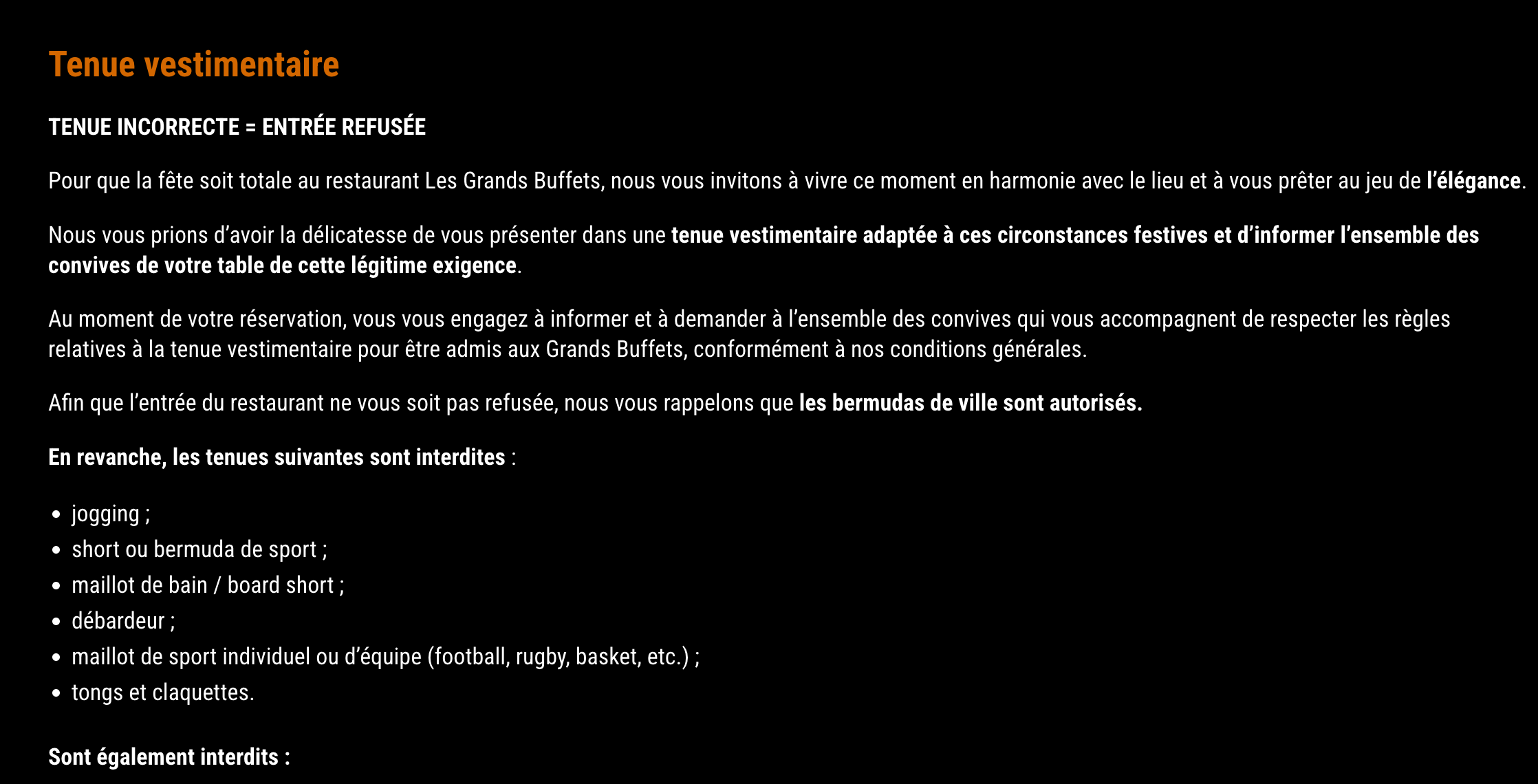
… including a strict schedule of deposits and payments. As someone who loves rules, and who lives in a country where rules are often considered for other people but not for you, I understand why. So they make everything very clear, including the dress code, with entrée refusée if wear athletic clothes, tank tops, flip-flops, or baseball caps:
For men, les bermudas de ville (chino-style shorts) are authorized, since this is, after all, the south of France where people are generally more relaxed. But just to be on the safe side, I wore linen pants. I didn’t want to get there and be refusé at the door.
I don’t think they want to police people, but in France you’re often sized-up on how you present yourself. Romain once got into a verbal tussle with a waiter at a restaurant in the French Alps because he was wearing a baseball cap and didn’t want to take it off. The idea, I think, is that they realize les Grands Buffets is a special experience (the night we went, a few women were wearing evening gowns), and they want people to be respectful of that. As long as I don’t have to wear a tie and jacket, I’m fine with whatever.
They’re also strict about seating times, and guests are booked and seated at 15-minute intervals, so everyone isn’t seated (or hits the buffets) all at the same time.
Les Grands Buffets isn’t in the center of town, but is part of a public building adjacent to the zone industrielle of Narbonne.
Recently I had on my podcast, and we had a great chat that included talking about her excellent article in the New Yorker, The Hottest Restaurant in France is an All-You-Can-Eat Buffet (possible paywall), which put the place on the map for many people who didn’t know about it.
The restaurant was founded in 1989. The city of Narbonne was looking for someone to open a restaurant in a municipal sports center, which Louis Privat did. Currently the restaurant feeds over a thousand people a day at lunch and dinner. There are hundreds of dishes presented, prepared, and served by close to two hundred employees, and the price is €65,90 per person.
According to the BBC, the restaurant grosses €30 million ($35 million) and is the highest-grossing restaurant in France, and 86% of the customers are French. A lot of guests are Spanish since Narbonne is close to the Spanish border…and Spanish people like to eat. Privat has resisted opening another restaurant, even though he frequently is presented with opportunities in other cities. (And likely, in other countries.)
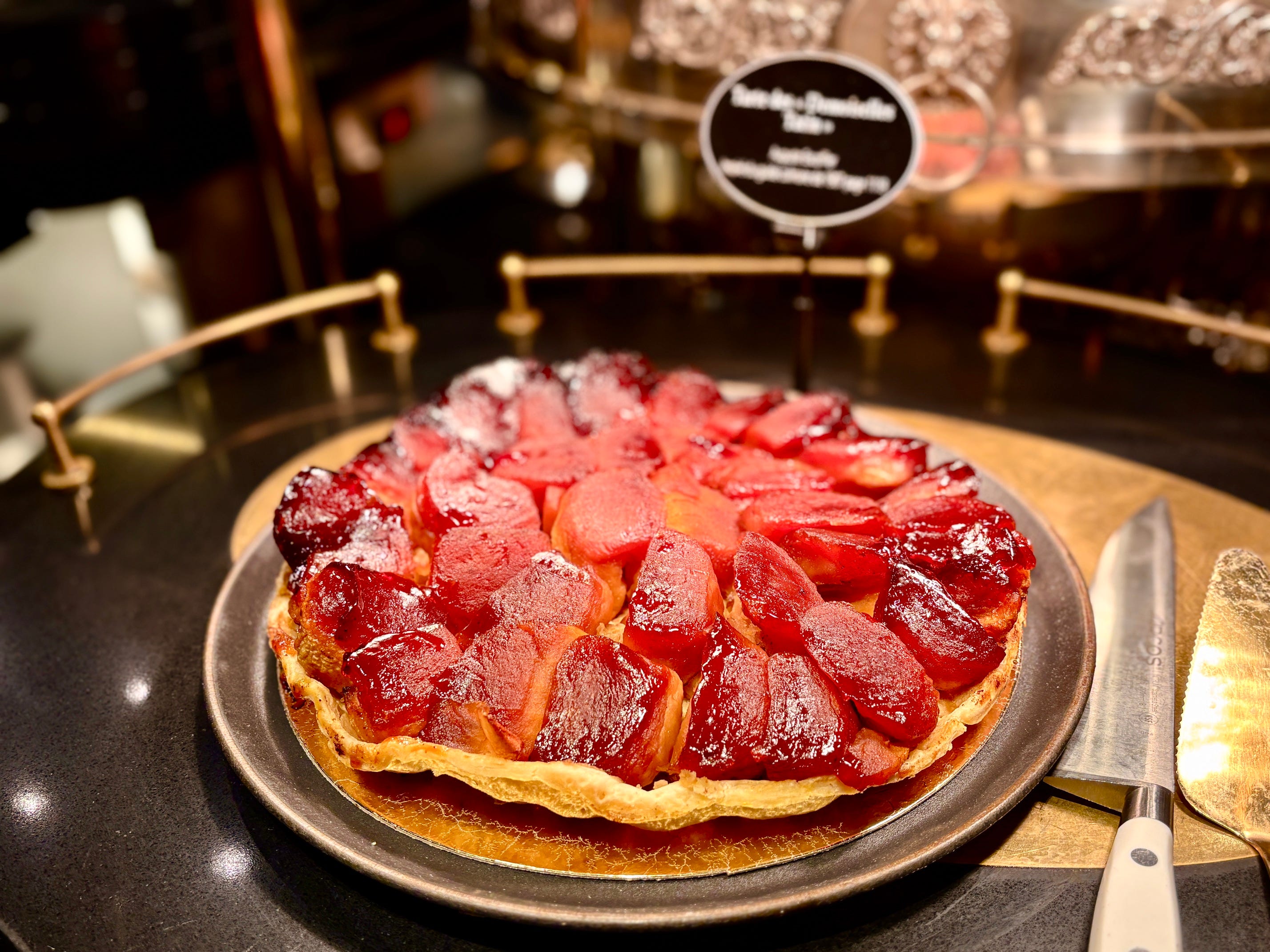
The main mission of the restaurant (aside from being a business) is to preserve French cuisine and traditions, set forth by Chef Auguste Escoffier, who wrote what’s considered the seminal book on French cuisine, Le Guide Culinaire, with instructions for preparing over five thousand French dishes. In it, you’ll find recipes for frog’s legs, snails, and tripe, which have fallen out of favor but are offered at the restaurant to keep those foods, as well as others, alive. My favorite quote from Privat was in Lauren’s article, “Why would you put a tarte Tatin in a shot glass?”
True to his word, thankfully, they don’t.
My own experience with Escoffier was when I was a line cook in San Francisco and ran across the street to the store to get an ingredient that we were out of. When I came back, the head chef wasn’t amused that I wore my chef’s coat to run the errand. “What would Escoffier say?” he admonished me. “I don’t know,” smart aleck me replied. “He’s dead.”
I didn’t see any staff members in chef’s coats running out the door, but a very nice woman named Elodie greeted us as we walked towards the door fifteen minutes early. In a very organized fashion, she made a note that we were there and directed us to their bar, which was next door, by the bowling alley. Knowing how rules about lines in France can be one of those things that are “for other people,” she said that when we came back, if there’s a line, just head to the front of it and ask for her.
The bar that looked out over the bowling alley was hopping, and I had a glass of Suze, a bitter French apéritif that’s particularly appealing in the summer. To accompany your drinks, there are help-yourself appetizers, such as this DIY Tête de moine cheese machine, which produces perfectly scraped ruffles of cheese with a push of a lever:
The cheese is named after a monk’s tête (head) and one theory goes that it was a symbolic way to get revenge on the monks, who people had to pay rent to hundreds of years ago, for using the land. A few othertheories are out there, but as the head of Chartreuse told me when I asked him to fact-check what I wrote in Drinking French about the Carthusian monks, who now make Chartreuse, whose history dates back a thousand years, he replied, “It’s hard to know what happened then…we weren’t there.”
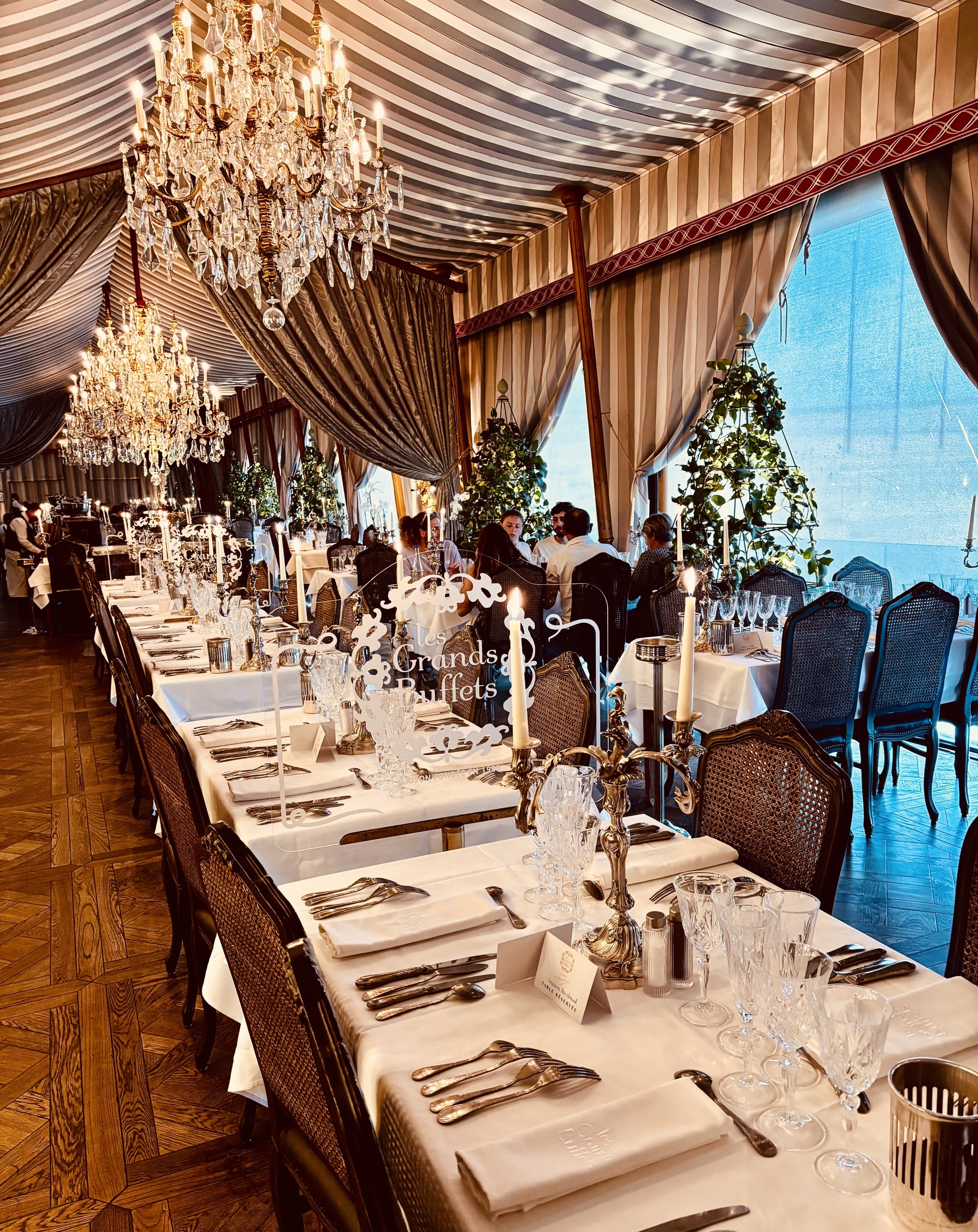
The dining room of les Grands Buffets is a surprisingly elegant affair, and you might feel like you’re attending a wedding or a gala event when you enter the room.
We kicked things off with a bottle of Heidsieck & Co Monopole champagne. Part of the restaurant’s philosophy is to charge close to retail prices for wines, rather than jacking them up. So the wine list is remarkably affordable and many producers from the region are featured in a section marked “Autour de Narbonne” — wines from around Narbonne. A majority of the wines are in the €20-25 ($23-29) per bottle range, which included that champagne.
There are various strategies for tackling les Grands Buffets. Unlike Las Vegas buffets, which a friend noted was likely the inspiration for this restaurant, there wasn’t any shoving or elbowing others out of the way, which also was because the restaurant is in the south of France, not in Paris. Diners lined up politely and waited their turn for their food.
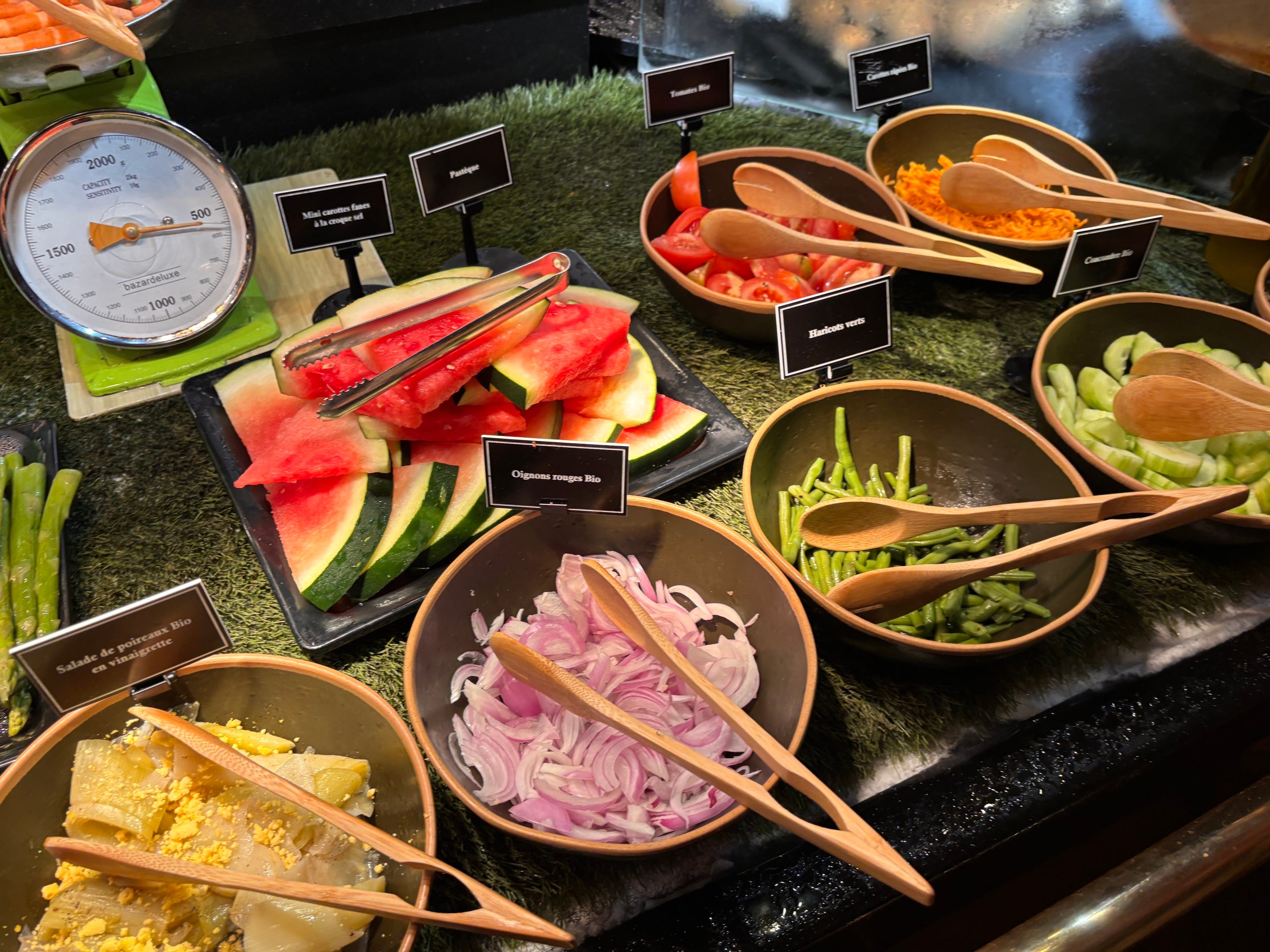
It’s best not to fill up on bread or vegetables, and I noticed most of them went untouched. Another strategy that I read was not to skip lunch if you were going there for dinner, since you’re going to be starving upon arrival and probably fill up on carbs.
I made the truffle station my first stop, where they don’t skimp on truffles. And yes, they’re the real ones. Not “summer” truffles. There wasn’t a whiff of phony truffle oil in sight, nor a smell.
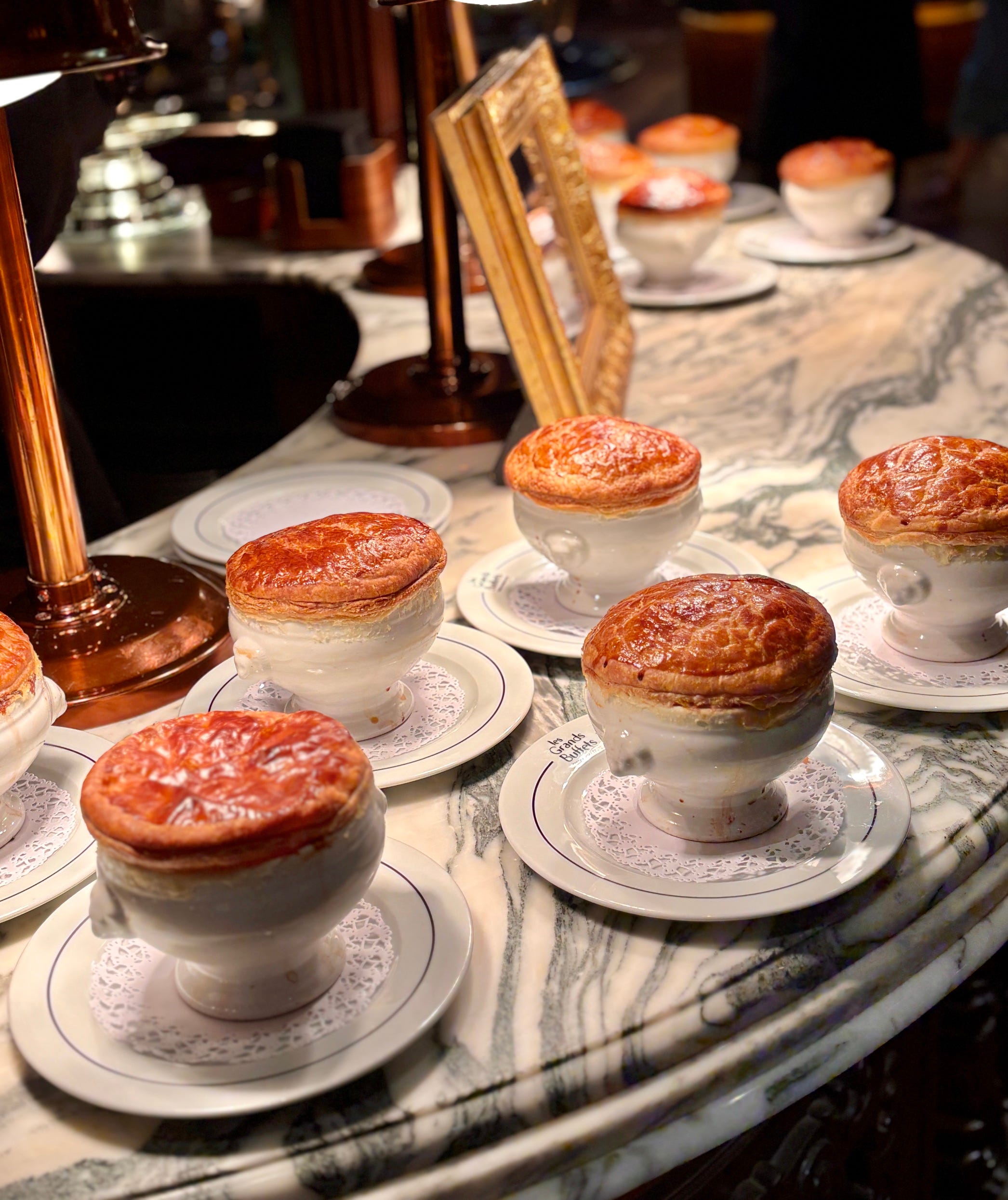
One offering was a soup made with black truffles and foie gras under a cap of feuilletage, buttery puff pastry.
Since I was skipping carbs, I skipped that, but the woman seated at the neighboring table took the soup, lifted the cap off, and ate it like a cookie. I admired her creativity.
I went for the brouillade, a mound of freshly made scrambled eggs, which were scrambled with a lot of minced truffles inside and topped with shaved black truffles.
I was never a big truffle fan. When I worked in restaurants, I would occasionally get to eat them for free (ditto with caviar), so it’s hard for me to pay for truffles and I was never gaga for them. However, years ago, I went on a truffle hunt in France and was in a room with hundreds and hundreds of truffles. Every course at dinner that night was loaded with truffles, and I was hooked. Still, I didn’t go back for the soup but moved on to the charcuterie.
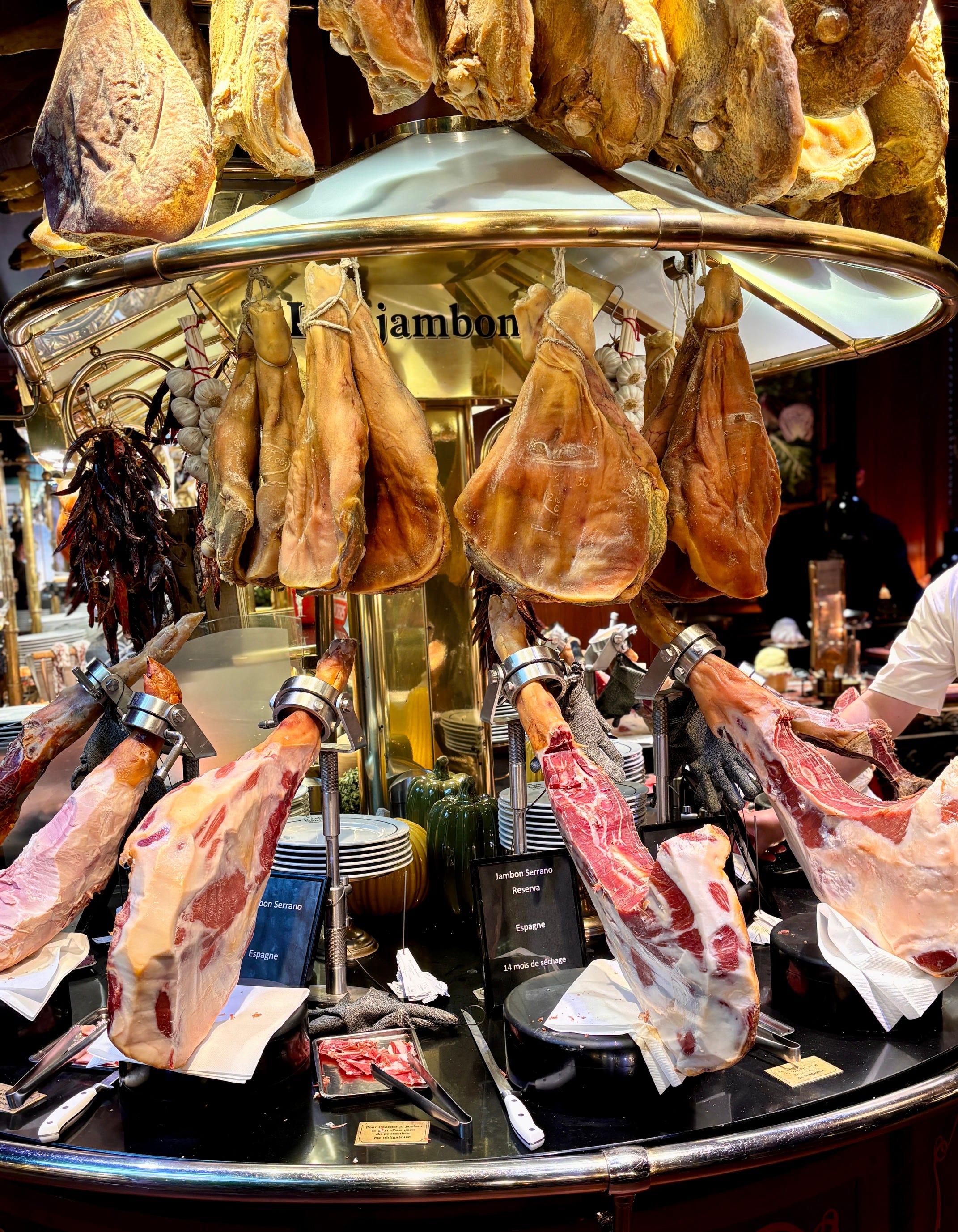
The pièce de résistance in that department was a station of hams, sliced to order. Each one listed its provenance and in France, they tend to slice ham thicker than they do in Spain and Italy, which makes it a little tougher to eat. Romain once told me to tell the person at the charcuterie that I wanted my ham “as thin as cigarette paper.”
I tried that and the guy deadpanned back to me, “Monsieur…je ne fume pas…” I don’t smoke.
Personally, I think it’s a strategy to sell more ham since when something’s sold by weight, ten thick slices weigh a lot more than ten cigarette paper-thin slices. The lone slicer at les Grands Buffets was doing his best to keep up with all the customers, and the hams. So it was hard to fault him for the thickness of the slices. But maybe he wasn’t a smoker either.
While I was on vacation, I posted a few pictures from the restaurant. Someone made a comment wondering aloud how there could be so much food, when others have so little? It’s definitely true that most of us have access to food that’s sadly, not available to everyone. Narbonne is not a wealthy city and most people earn less than the national average. Unemployment is around 18%, which is over double the national average (8%) in France.
While researching her article, told me that some people save up all year just to have dinner at les Grands Buffets, that it’s their special night out. After thirty years, the restaurant has figured out how much food they’ll go through each night so there’s very little food waste, and whatever is left over is served at the staff meal. Being in a municipal building, the restaurant is a strong supporter of the local community, which also includes winemakers and other producers, in addition to supporting a staff of hundreds of people.
It’s hard to size up people by how they look and are dressed, but the people eating at les Grands Buffets seemed to be “everyday” people. (I didn’t see any fancy cars in the parking lot.) Judging from their accents, it sounded like there were many locals. Folks in this part of France have what’s referred to as an accent du midi and pronounce certain words, such as wine (vin), as ving, with a bit of a nasal twang on the final “g.” And unlike the buffets of Las Vegas, this restaurant isn’t a palace of gluttony. People weren’t loading their plates up as full as possible, overindulging in whatever they could. It was all quite civilized.
I suppose you can criticize people eating at restaurants when others can’t. But not sure how one draws the line. At least the price point here is not too far from the price of a 3-course dinner at a mid-range restaurant in Paris.
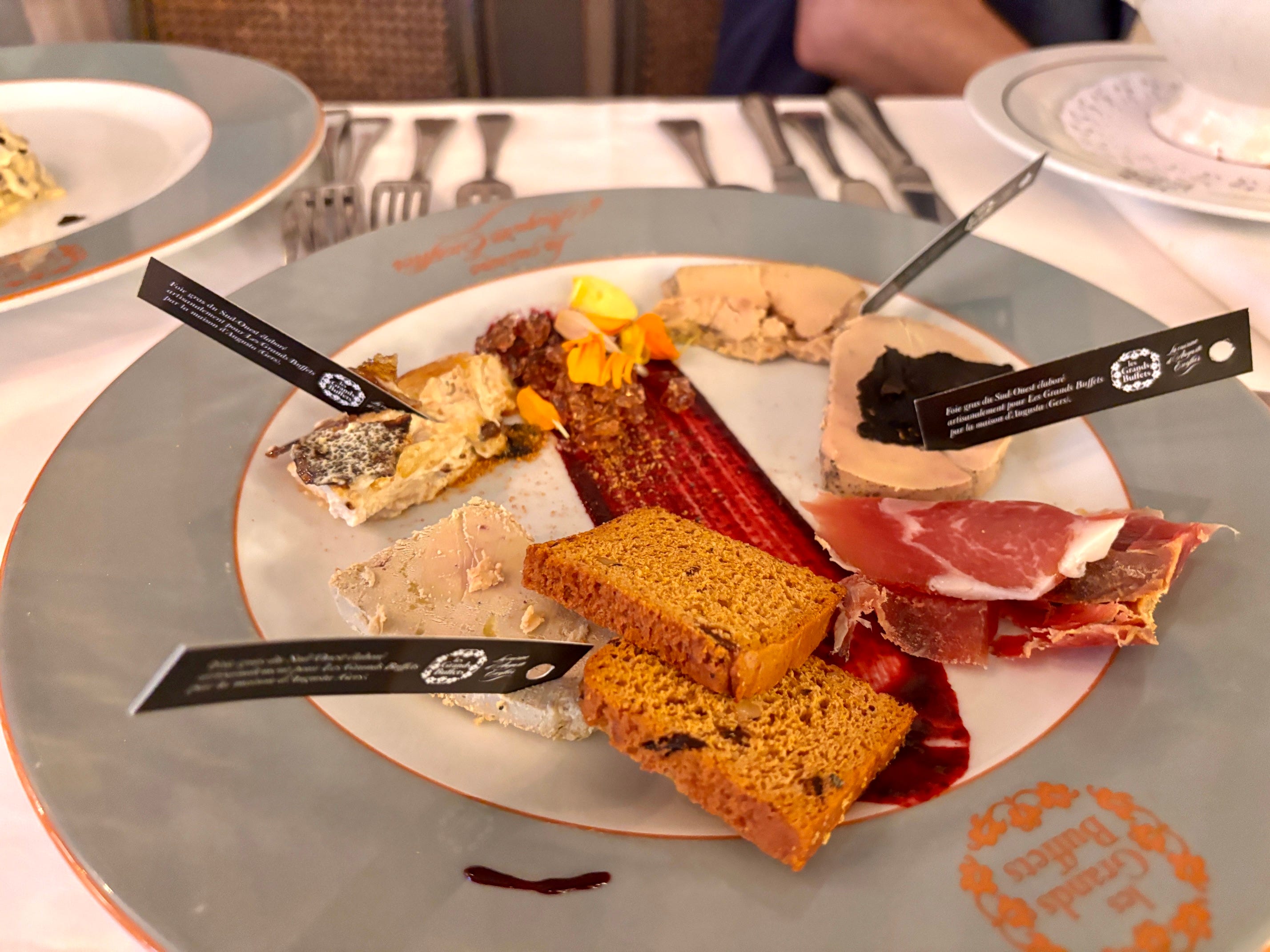
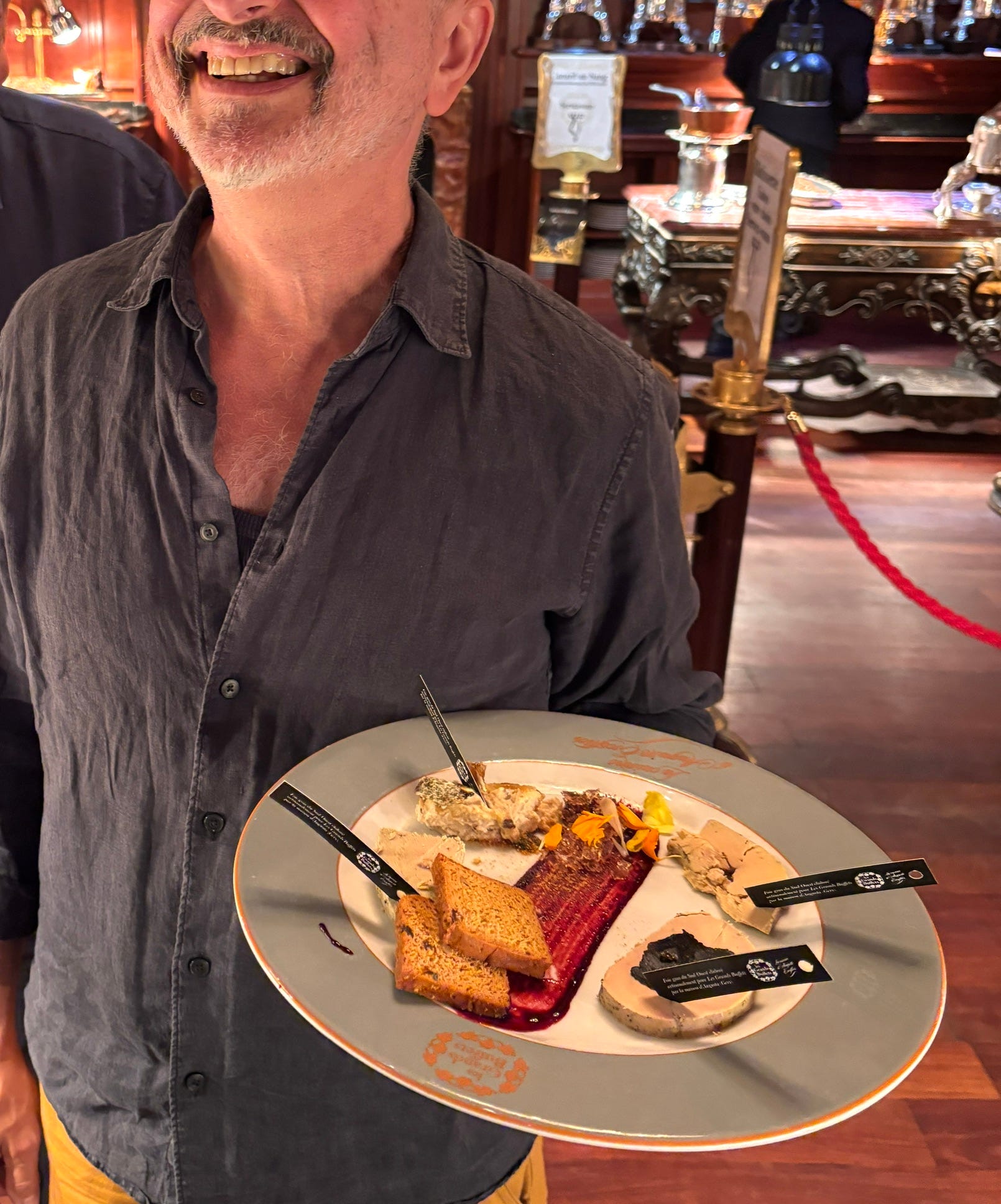
Four presentations of foie gras, with little explanations attached: Lightly smoked, with truffles, mi-cuit (partially cooked) with Armagnac, and in the style of crème brûlée, with port wine.
It’s true that the lobster tower could be considered a little over the top, but as a winemaker in the region told me once, “People who live here know how to cook, so they don’t go out for the food. They go out for the experience.” And the lobster tower is giving it to them.
As mentioned, one objective of the restaurant is to guard the heritage of Auguste Escoffier and la cuisine française. They adhere so closely to his recipes that the page numbers from his book, Le Guide Culinaire, are listed on the menus.
Subscribe to my newsletter to get new posts, Paris dining tips, recipes, and more, sent right to your Inbox. Sign up here!
An undeniable part of French culinary heritage is foie gras. It’s a controversial ingredient, even in France, and is not something we eat often. When we do, I try to make sure that it’s produced in France, not just “packaged” or “transformed” in France, as some jars and cans say, which means the foie gras can be produced elsewhere.
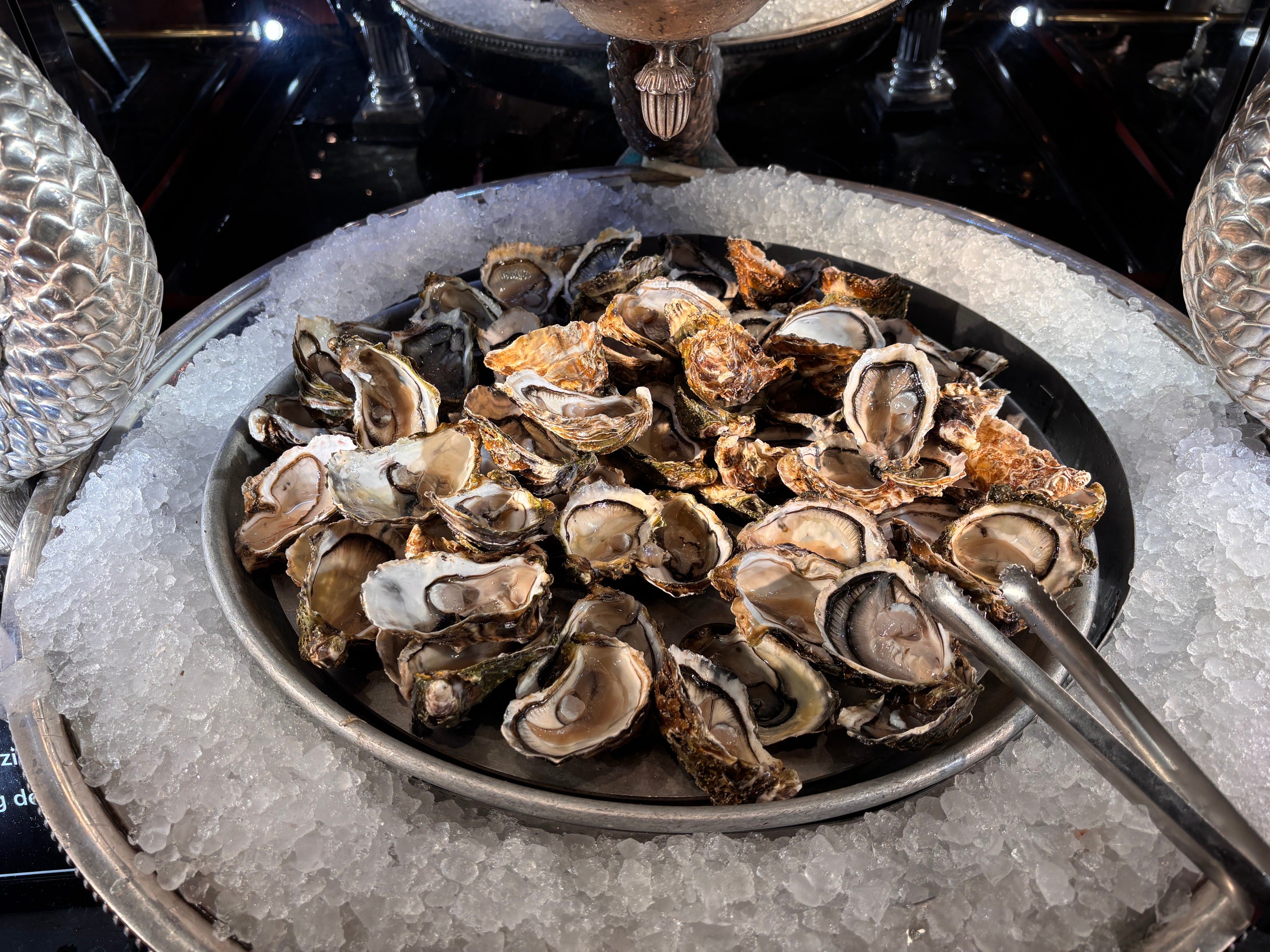
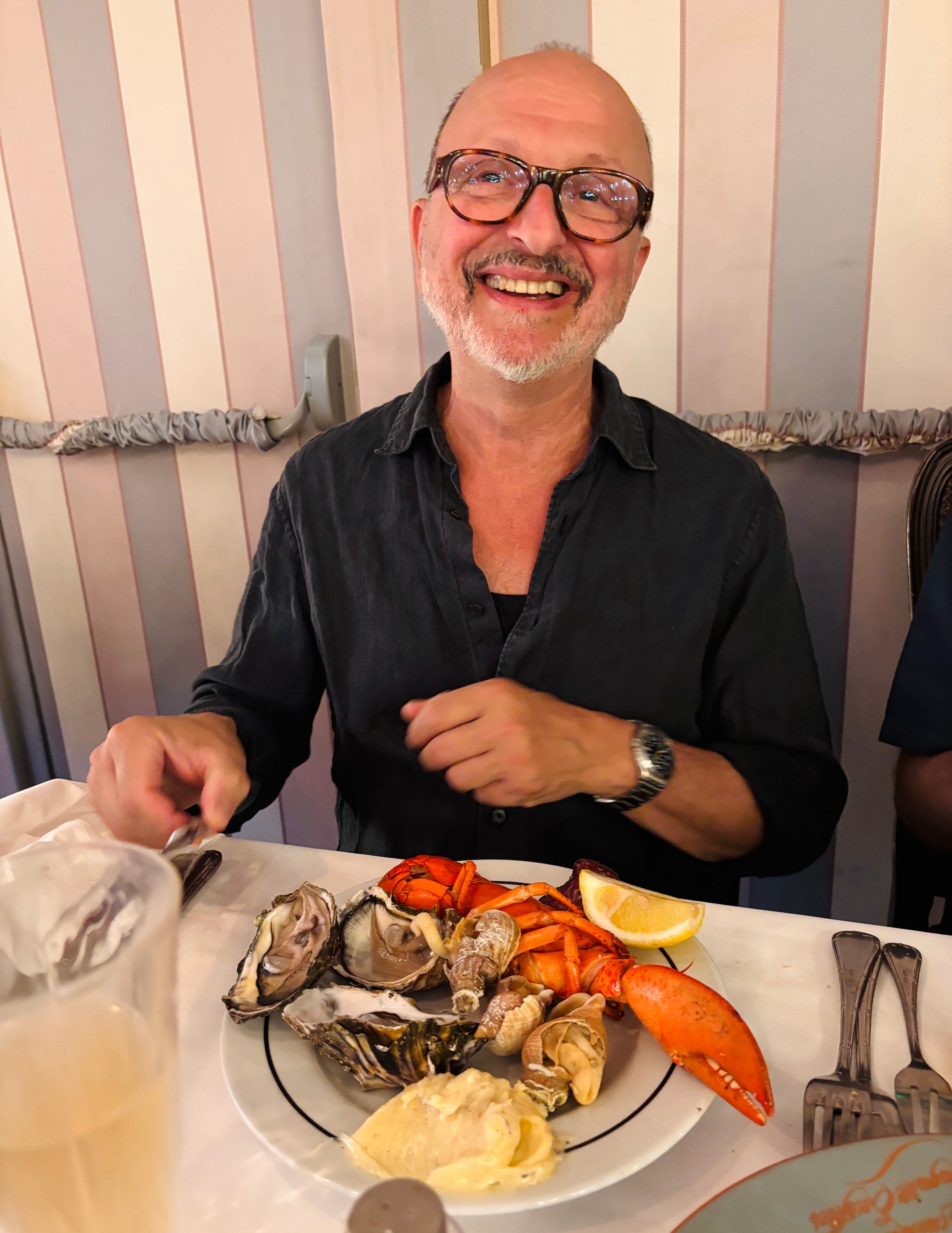
After nibbling around that plate of richness, we headed to the seafood section and loaded up on oysters. They also had mussels, bulots (sea whelks), and smoked salmon, heaped up on ice, all for the taking.
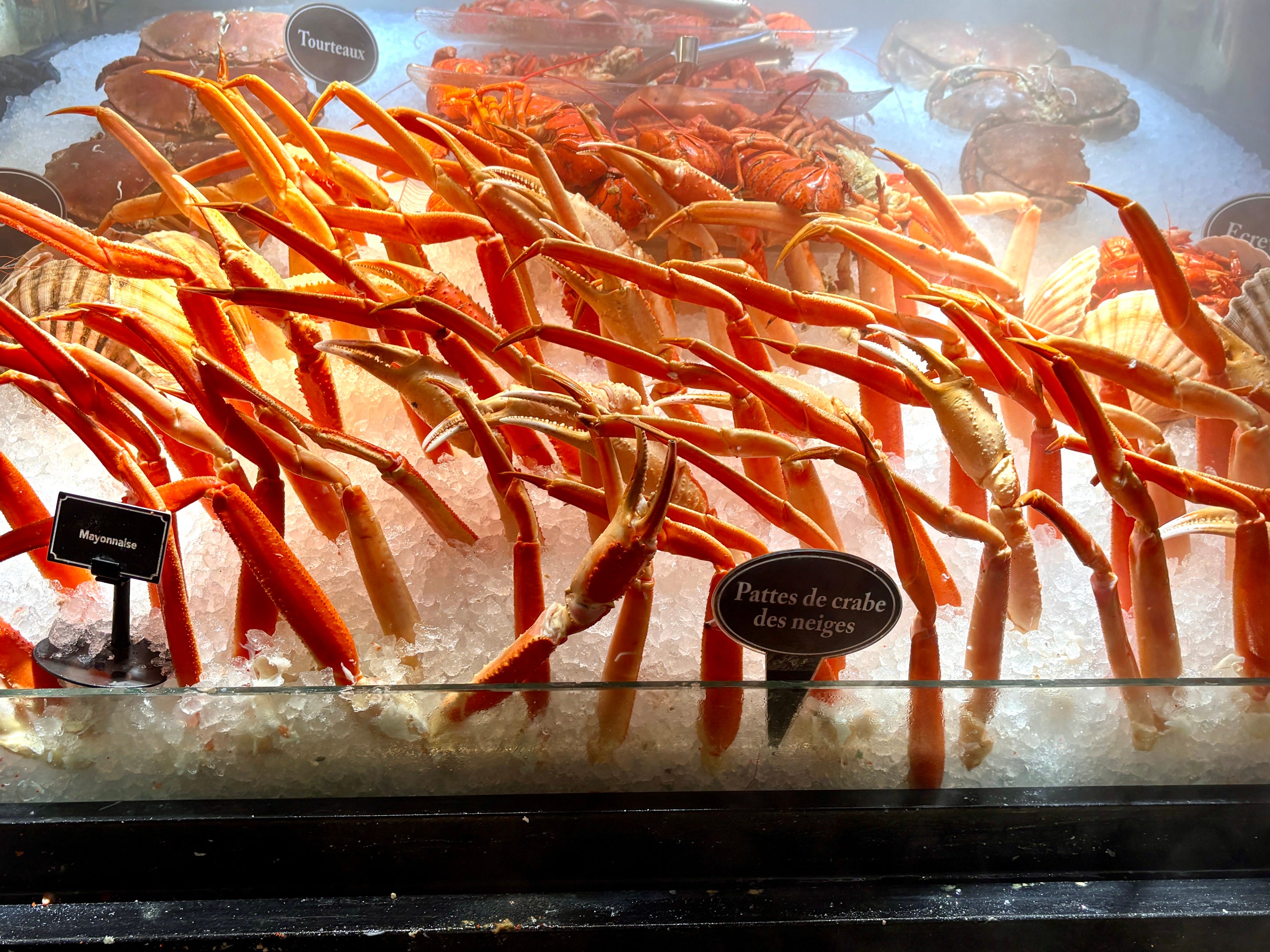
I didn’t try the crab claws, below, which a reader told me was better than the lobsters. As a New Englander, I’m pretty partial to Maine and Canadian lobster. Lobsters from France are twice as expensive are they are in the States, and a pricey indulgence.
I was wondering if the restaurant would haveFrench lobsters, which they didn’t. I guess they blow their budget on black truffles. So if you go, grab a claw or two, or three, and let me know what you think.
Stay tuned for part 2 — main courses, the cheese course from the largest selection of cheeses in the world, and, of course, dessert(s).

 Login
Login
 Pineapple Chicken is a little bit sweet, a little bit spicy, and full of tender velveted chicken and juicy pineapple chunks. Why Does Pineapple Feature in Chinese American Recipes? This Pineapple Chicken is a retro Chinese American stir-fry dish that, depending on where you live, you may not see too often. But once upon a […]