Normal view

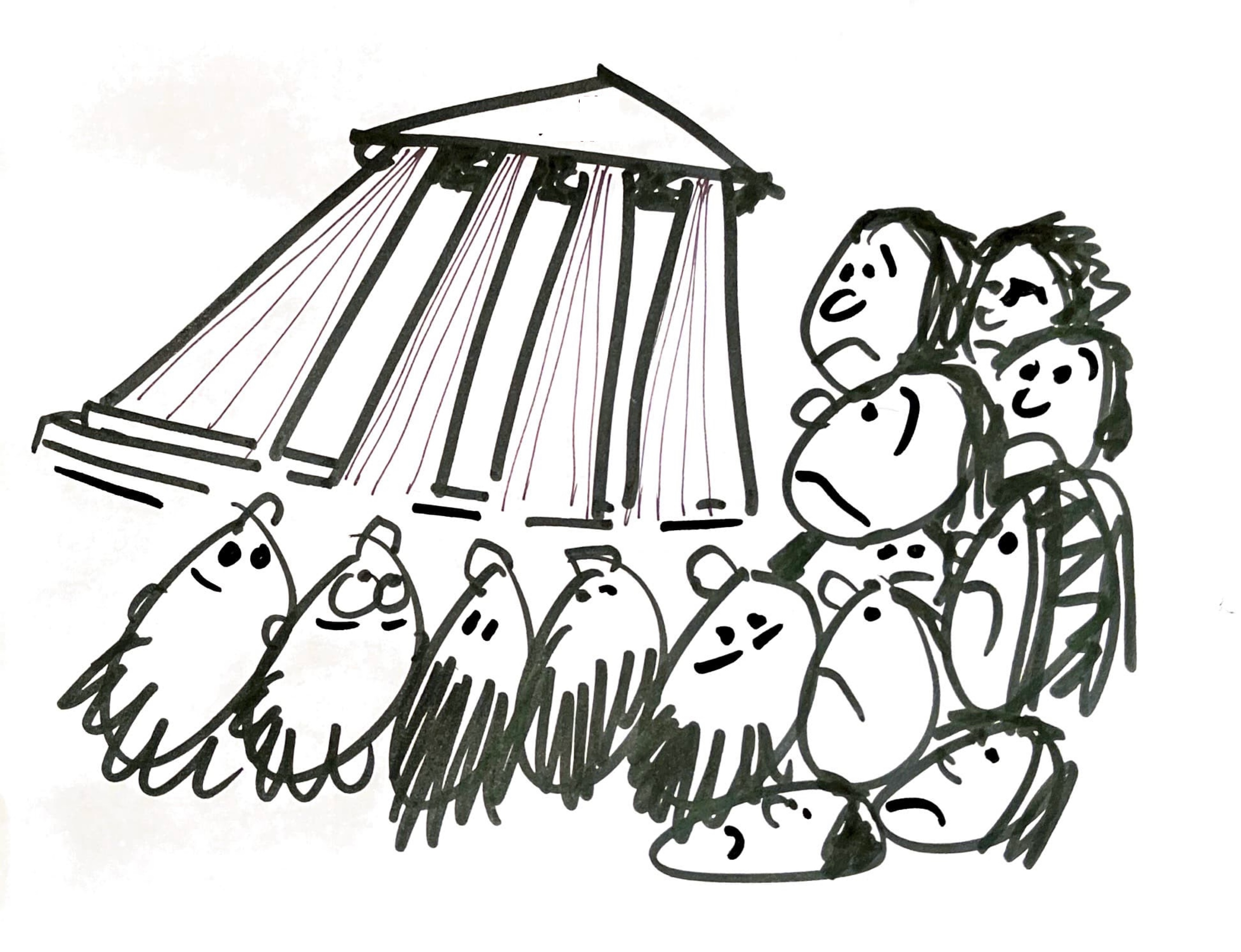
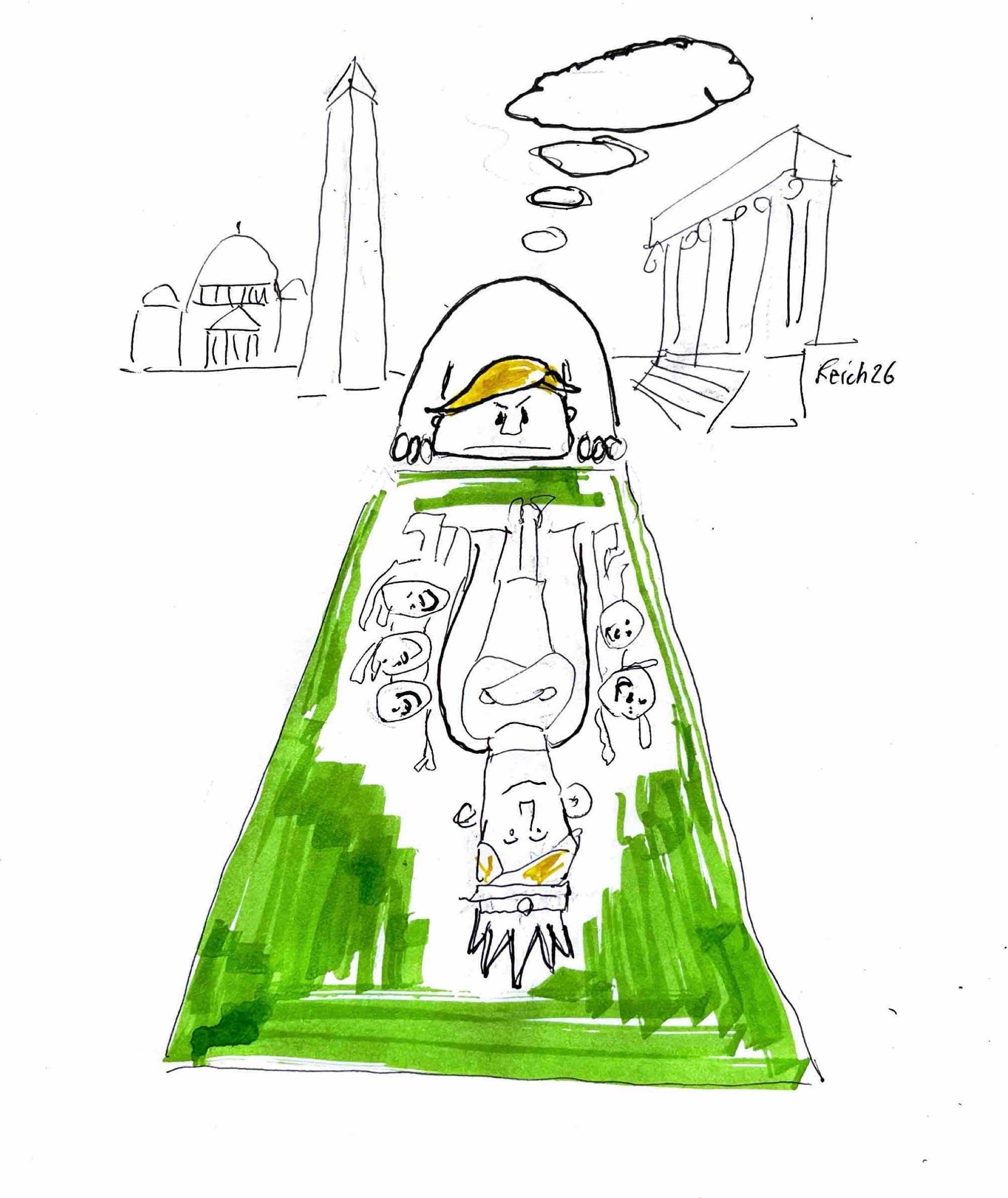
America should offer asylum for the persecuted — not persecute those seeking asylum.

3 July 2026 at 21:00

New York Mayor Zohran Mamdani this morning

Friends,

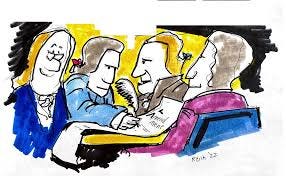
Sorry to invade your inbox again today, but New York Mayor Zohran Mamdani just gave an address about America on this eve of our 250th anniversary, which is the opposite of the speech Trump is expected to give tomorrow. A naturalized citizen born in Uganda to parents of Indian origin, Mamdani sat behind a desk used by George Washington, with naturalized immigrants standing around him holding American flags.

I want to share parts of Mayor Mamdani’s address with you. The full address can be viewed here.

“For generation after generation, we have been told that when the world has sent its people to our shores, it has not sent its best.

It sent Puritans and Sikhs and Quakers and Muslims and Jewish people who were banished for praying the wrong way, worshipping the wrong Gods, angering the wrong people. It sent peasants and serfs from slums and shtetls who were treated as less because they hardly owned clothes, let alone land. It sent immigrants for whom power was something someone else had.

We are told that America is exceptional because we are richer, stronger, more powerful than everyone else.

The truth, my friends, is that America is exceptional because here, nothing is fixed into place. The frontier may be closed, we may have walked on the moon, but the work of fulfilling the values first enshrined in the Declaration of Independence — that work endures, my friends, and it belongs to us all….

You each hold a special power. The power to determine what America means.

The powerful have always known their answer. America, in their view, is an arena of supremacy, where only a select few are allowed freedom, where not all are created equal. America, if you ask them, becomes less the more people it welcomes. America, they will tell you, belongs only to those with the right accent or the right shade of skin. The rest of us, they insist, should be grateful for merely being allowed to visit.

How small they are, how weak, how unoriginal. At every moment in our past, those who led through exclusion and isolation have tried to win power and enrich themselves by turning us against one another. Division is the oldest trick in politics, and the cheapest. But time and again — including 250 years ago — those forces of division have been vanquished by the forces of progress. As Thomas Paine once wrote, “this new world hath been the asylum for the persecuted lovers of civil and religious liberty ... hither have they fled.”

And yet today, too many of our leaders do not believe in a vision of this nation as an asylum for the persecuted — but rather as one that persecutes those seeking asylum.

As we mark 250 years, what do we see?

We see the wealthiest country in the history of the world — one where children go to sleep hungry while the world’s first trillionaire hungers for more.

We see monopolies that dominate every industry and oligarchs who buy elections.

We see masked agents terrorizing our streets, eating food cooked by our undocumented neighbors before spiriting them away in unmarked vans.

We see a nation whose immense wealth has been built by those with calloused, dirt-streaked hands — those who toil on factory floors and chisel into stone — and we see a nation that has allowed so much of that wealth to be held instead in the soft hands of a precious few.

Yes, we see America in a health insurance industry that exploits the sick, but that is not all I see when we look for America. We see it too in the nurse who works a double shift and then stops on her way home to check on an ailing neighbor.

Yes, we see America in corporate landlords for whom negligence is a business model.

We see it too in the father who tucks his children into bed beneath a ceiling stained with leaks, who wakes before dawn to go to work, and still believes his country can do better by his family.

Yes, we see America when we spend our tax dollars on bombs and bailouts, when we sell our elections to the highest bidder.

Yet we see it just as clearly in every American who still believes this country belongs to we, the people.

We see America each time neighbors link arms with neighbors — without asking how long they have lived here, or what papers they have — as ICE invades our neighborhoods.

We see America each time those young and old stand in the beating rain or the stifling heat to cast their ballots.

We see America each time working people demand more — not just for themselves, but for their fellow Americans.

There are some who respond to those who ask for more from America with a simple refrain: Love it or leave it, they say.

But patriotism has never been about pretending our nation is without flaws. Patriotism is every act of righteous dissent, it is every march led under the heavy sun, it is every protest held a decade before its time.

It is precisely because we love this nation that we will not leave it. After all, who loves America more than those who have sacrificed so much to make it free?

Those ideals upon which our nation was built — they are strong enough to endure any authoritarian regime, but only if we reach for them.”

Share


A warning about American fascism

3 July 2026 at 19:00

Friends,

I came across this Public Service Announcement produced by the U.S. government in 1945. It seems apt today, on the eve of the nation’s 250th anniversary, when bigotry and hate are being stoked by a neofascist president. Please take a look:

This is a clip from the original, which runs 23 minutes. It was called “Don’t Be a Sucker.”

Share

Trump will cause some of you to die from the heat

3 July 2026 at 10:01
David Keeling

Friends,

Some 163 million people in the U.S. live in areas that experienced dangerous heat on Thursday, according to the National Weather Service — sending “heat risk” forecasts in major cities (including New York, Washington, Philadelphia, Pittsburgh and Atlanta) into the most extreme risk category through Saturday.

Part of the reason is the planet is warming dangerously, but Trump calls climate change a “hoax” and is encouraging more use of fossil fuels.

Especially endangered are workers toiling under the hot sun, or in stifling warehouses, or in delivery trucks with no AC.

Yet Trump’s pick to run the Occupational Health and Safety Administration, David Keeling, is weakening the agency’s own heat standards by removing specific inspection goals. OSHA’s Heat National Emphasis Program expired on April 8. Its proposed heat standard has been stalled.

For many workers, heat standards are literally a matter of life and death. Every year, workers collapse, suffer permanent injuries, and die while doing their jobs in extreme heat.

Years ago, when I ran the Labor Department, we had the toughest Occupational Health and Safety Administration in history, run by a truly committed worker advocate named Joe Dear. We made workplaces safer — reducing worker deaths and injuries.

Since its inception in 1971, OSHA has reduced workplace-related fatalities by almost 63 percent. It has slashed the rate of serious workplace injuries and illnesses by 75 percent.

But OSHA under Keeling is retreating from worker safety.

Before Trump picked him to head OSHA, Keeling was Amazon’s top safety executive.

During Keeling’s tenure at Amazon, a Senate report found that Amazon warehouses were twice as dangerous as those of its competitors.

This year, we’ve already seen reports of Amazon workers dying on the job on a near monthly basis, including incidents in Oregon and North Carolina. Why would we trust Amazon’s safety head with the country’s workers?

Before he was at Amazon, Keeling was in charge of safety at UPS. How did he do there? OSHA repeatedly cited UPS for exposing drivers to excessive heat. Federal investigators found at least 100 drivers were hospitalized for heat-related injuries between 2015 and 2018. UPS delivery trucks had no air conditioning until 2024, when it was won in a landmark collective bargaining agreement with the Teamsters.

Now Keeling is head of OSHA, and OSHA is weakening its heat protection standards.

Workers are already paying the price. Reports of worker deaths during extreme heat continue to emerge across the country. Heat exposure can trigger heat stroke, organ failure, and chronic kidney disease. These are among the most predictable workplace hazards, which means they can often be prevented with strong safety standards and rigorous enforcement.

But instead of strengthening those protections, OSHA under Keeling has weakened them. At a time when record-breaking temperatures are becoming more frequent, retreating from enforcement sends a dangerous message that worker fatalities are a cost of doing business.

When he was in charge of safety at Amazon, Amazon became notorious for dangerous warehouse conditions. When in charge of safety at UPS, UPS resisted providing air conditioning for delivery vehicles. Now, when the agency responsible for protecting millions of workers should be leading the fight against preventable heat deaths — it’s backing away from its most basic responsibility to protect people over profits.

What can you do? Demand that OSHA head David Keeling take the heat and restore strong heat protections for workers or be removed from his job. Please sign on now.

Robert Reich

Share

Pluralistic: CARDiac, syntax coloring, view source and vibe code (03 Jul 2026)


Today's links


An insanely complex machine made up of many gears, troughs, water wheels, springs, screws, etc. It is housed in a brick building whose facade has been broken away. Three human figures labor to power the machine, turning cranks.

CARDiac, syntax coloring, view source and vibe code (permalink)

In the mid-1970s, my dad – then a budding computer scientist, subsequently a math teacher – brought home my first computer: the CARDiac, a Turing-complete, all-cardboard papercraft computer that you could write and execute programs on:

https://en.wikipedia.org/wiki/CARDboard_Illustrative_Aid_to_Computation

CARDiac stands for "CARDboard Illustrative Aid to Computation," and it was created in 1968 at Bell Labs as a way to teach high schoolers how computers worked. I wasn't anywhere near high school age (I think I was in third grade?) but the CARDiac was revelatory. The year before, I'd had access to a teletype terminal and acoustic coupler that let me operate a PDP machine at the University of Toronto, and I'd been endlessly fascinated with the possibilities. I wrote simple BASIC programs, chatted with ELIZA, and messaged other system users, one keystroke at a time, all on paper (the terminal didn't have a screen, just a printer, and we fed it 1,000' rolls of paper towels my mom brought home from her kindergarten classroom, which I then rolled back up so she could put them back in the bathroom for the kids to dry their hands on).

Interacting with a computer in real-time was captivating, but it wasn't until I assembled and used the CARDiac that it all snapped into place. With the CARDiac, you composed simple programs with pencil and paper, then followed instructions that directed you to move paper tokens in and out of various slots representing memory cells and an accumulator. All an electronic computer does is repeat these crude mechanical operations, millions of times per second, using microscopic transistors. None of that action can be observed with the naked eye, of course. If you had a very sensitive multimeter and a very good microscope, it's conceivable that you could indirectly watch this intricate dance, but only on very early processors, and only if you drastically slowed down their operations.

Much later, I learned a word for what I got from the CARDiac: legibility. Together, the CARDiac and I made a working digital computer, with me standing in for the physics that propels electrons down the endless labyrinth of a microchip, like a pinball triggering various blooping, beeping bumpers. Though the computing we performed was sub-trivial (adding one and one was a major undertaking!), the physical performance of that computing imbued me with Fingerspitzengefühl ("fingertip feeling"):

https://en.wikipedia.org/wiki/Fingerspitzengef%C3%BChl

This stood me in great stead in the years to come. To this day, when I think about my computer, I sometimes imagine those little cardboard tokens, shuffling in and out of the slits in my paper CARDiac. There's something very reassuring about this imagery. No matter how many levels of abstraction sit between me and the nanoscale transistors ranked in their billions beneath my fingertips, they are all undertaking those familiar operations I painstakingly performed on my child's desk all those years ago.

(This is one of the things that makes Science Comics Computers: How Digital Hardware Works such an amazing kids' book! By illustrating how a computer's operations are built up from simple boolean logic that can be represented as physical switches, the comic performs that same legibilizing magic that I got from the CARDiac:)

https://pluralistic.net/2025/11/05/xor-xand-xnor-nand-nor/#brawniac

Not long after my CARDiac experience, my dad brought home an Apple ][+, which came with a schematic that revealed the inner workings of the machine in ways that I found visually striking, if significantly less accessible than the CARDiac:

https://downloads.reactivemicro.com/Apple%20II%20Items/Hardware/II_&_II+/Schematic/Apple%20II%20Schematics.pdf

(For me, at least. For the legendary hardware hacker Andrew "bunnie" Huang, it was the start of a journey that turned him into one of the world's virtuoso reverse-engineers and science communicators):

https://pluralistic.net/2026/01/09/quantity-break/#so-many-chips

The Apple ][+ did very little when you took it out of the box. It came with a few floppies' worth of demo programs, and we bought a few more down at the local computer store, but most of the programs I ended up using with that machine were ones I typed in myself, from magazines I bought at the corner store (I spent half my magazine budget on Cracked, Mad and Crazy, the other half on computer magazines full of BASIC program listings).

Typing in a program, keystroke by keystroke, was another Fingerspitzengefühl-generating exercise. I wasn't much of a typist, so it was slow going, and of course I made a lot of typos. What's more, BASIC had already fragmented into several dialects by this point, so even a correctly typed program could fail to run until it had been adapted for the BASIC that shipped with the computer. Getting a program to run on my computer required me to hone my typing skills, but even more so, my problem solving skills.

After months of this, I (re-)invented the debugger, from first principles, coming up with lots of little tricks and gimmicks (many of them horribly inefficient) for identifying and solving my programs' errors. In later years, I had lots of opportunity to work with real debuggers, created and maintained by trained programmers who'd forgotten more than I would ever know about writing code, and my own cack-handed efforts to build my own version of their tools conferred a confidence and intuitive understanding that I could not have achieved otherwise. Figuring out the need for a debugger and then rolling my own (crude, inefficient) one made all debuggers more legible to me.

I think that "legibility" is an underrated trait. If a system is legible to you, then you have a superior basis for understanding it, improving it, and making it work again when it breaks down.

There's an old joke that goes, "physics is applied math; chemistry is applied physics, and biology is applied chemistry" (I've also heard versions that start with "math is applied philosophy" and carry on to "sociology is applied biology," etc). While this isn't entirely true, there's something profound in it: we understand and manipulate our complex reality by wrapping it in abstractions that package up a writhing, shuffling, vibrating machine inside a smooth, serene membrane with a sturdy and easily grasped handle. You could do chemistry using the tools of physics, but it would take hours to perform the kind of calculations a chemist does in seconds (just as it takes an eternity to add one and one with a CARDiac).

Nevertheless, there are times when it is useful for a biologist to think about chemical processes, and for a chemist to think about interactions at the level of physics, and for a physicist to do math. The membrane and the handle are essential, but sometimes you have to decap the sealed package and inspect and manipulate its internals directly. Problem solving, improvement and maintenance all require the ability to move up and down the stack of abstractions to figure out where to stick your probes and stage your interventions.

This is where legibility comes in. Interacting with physical processes improves your mental model. In Broad Band (a magisterial history of women in computing), Claire Evans talks about how the first programmers were women who did the "unskilled" labor of physically cabling components together, developing powerful Fingerspitzengefühl, with such high-fidelity, trans-abstraction mental models of the machines' operations that they became the world's best programmers and debuggers:

https://pluralistic.net/2021/02/13/data-protection-without-monopoly/#broad-band

My early adventures in programming were so powerful and instructive because nearly all the programs I interacted with on my Apple ][+ were written in BASIC (not just the ones I keyed in, but also the demo software and much of the packaged software we bought). That meant that I could get a listing of any program I was using, peeling open the membrane to look at the machinery underneath. I could even laboriously trace the operations of that program using my toy debugger. This, too, was legibility: the ability to flip between the effects of the running code, and the instructions themselves (and then to mentally map those instructions onto the movement of cardboard tokens in my CARDiac).

This affordance was repeated later on the early web, thanks to the "View Source" function that came built into every browser, acting as a velcro tab for the membrane that separated rendered web pages from their underlying instructions. In my early years as a web developer, I copied, pasted, adapted, probed and traced HTML in ways that would have been instantly recognizable to the younger me, keying in those BASIC programs and ripping apart the commercial software on my computer.

I read somewhere that the Bell Labs scientists who created the CARDiac were worried that, thanks to transistorization, the next generation of programmers wouldn't understand the physical, material processes that unfolded when their programs ran, and that this would mean a loss of legibility and intuition and Fingerspitzengefühl. I can't track down the reference now, but it stuck with me, because the CARDiac is such a perfect way of preserving those virtues.

Modern computer science curriculum includes some chip design for just this reason (just as chemists study physics and biologists study chemistry). But there are plenty of programmers – better programmers than I ever was or will be – who taught themselves and never had a CARDiac or gave much thought to chip design. They work at different layers of abstraction and in different ways to solve different problems. Maybe they could improve their art by tinkering with FPGAs, but there's always something even the most skilled artisan can do to round out and incrementally improve their craft.

In the same way, there are plenty of programmers – better ones than I ever was or will be – whose journey started at higher abstraction layers than a teletype terminal or a CARDiac. Maybe they started with a browser's View Source, teasing apart other people's Javascript to create weird Myspace customizations. Maybe they tweaked a programmable block in Minecraft. Maybe they modded a Scratch game. Or maybe they recorded macros using Applescript or Hypercard or Visual Basic to automate a routine task, only to later open up the source code generated by the macro recorder to make fine adjustments.

Whether you're pasting source from Stack Overflow or recording a macro in Excel, you are just one operation away from unwrapping the membrane and exposing the code beneath it. And with the modern internet, with Wikipedia, with endless tutorial videos, you are one further operation from penetrating the high level code to get at the code beneath it, and the code beneath that, and the code beneath that, all the way down to the bare metal.

Which brings me to vibe coding. As I've written, there's a world of difference between writing code for production and writing "personal software" that solves a problem you have. Whatever deficits that code has (due to the fact that you're not a skilled programmer) are offset by the fact that you're the one making the tool (which means your needs aren't lossily filtered through a programmer's understanding of those needs):

https://pluralistic.net/2026/06/15/vernacular/#hypercardian

There's nothing wrong with code that solves your problem, even if you don't know how that code works, even if it breaks in a couple of years, even if no one else could maintain, extend or debug that code. Personal software is fundamentally different from software made to be used and maintained by others:

https://pluralistic.net/2026/07/02/canonization/#operate-iterate-improve

Higher-level abstractions are necessary. Moving tokens between the slits in a CARDiac is a powerful exercise, but eventually you want to do something more substantial than adding one and one, and so you need to package up the mechanics of computing inside a membrane with an easily grasped handle (knowing that you can always open the membrane if need be).

The more automated code you generate – macros, pasted Javascript, Minecraft blocks – the greater the likelihood that you will be failed by a readymade, prefab component. At that point, you have means, motive and opportunity to open the membrane and start tinkering with the internals, and every time you do, you have a better chance of making a realization that improves your grasp on the whole system.

Automated code – whether from an LLM, View Source, Stack Overflow, or a macro recorder – is the top of a funnel. Many – most – of the people who enter the funnel won't slip further down the abstraction chute. They'll solve their problem (a virtue unto itself!) and move on. But the more people we put at the top of the funnel, the more chances our civilization gets to produce another skilled artisan who understands and can improve, iterate and repair the code the rest of us use.


Hey look at this (permalink)


A shelf of leatherbound history books with a gilt-stamped series title, 'The World's Famous Events.'

Object permanence (permalink)

#20yrsago What real elections can learn from reality TV voting https://henryjenkins.org/2006/07/democracy_big_brother_style_1.html

#20yrsago Veteran print journo on neglected demographics http://citmedia.org/blog/2006/07/03/guest-posting-is-media-performance-democracys-critical-issue/

#10yrsago One of the copyright’s scummiest trolls loses his law license https://fightcopyrighttrolls.com/2016/07/03/prendas-hansmeier-stipulates-to-suspension-of-his-law-license/

#10yrsago Macedonia’s Colorful Revolutionaries defy the state by splashing paint on government buildings and monuments https://globalvoices.org/2016/07/03/defying-police-harassment-the-macedonian-colorful-revolutionaries-continue-to-chant-freedom/

#10yrsago Trump and Brexit are like lotto tickets: the more unrealistic, the better https://www.irishtimes.com/news/world/europe/fintan-o-toole-brexit-and-the-politics-of-the-fake-orgasm-1.2707398

#10yrsago Low income US households get $0.08/month in Fed housing subsidy; 0.1%ers get $1,236 https://web.archive.org/web/20160702151008/https://www.thenation.com/article/who-benefits-most-from-housing-subsidies-the-wealthy/

#5yrsago The future is symmetrical https://pluralistic.net/2021/07/03/beautiful-symmetry/#fibrous-growth

#1yrago Trump's not gonna protect workers from forced labor https://pluralistic.net/2025/07/03/states-rights-trumps-wrongs/#mamdani


Upcoming appearances (permalink)

A photo of me onstage, giving a speech, pounding the podium.


A screenshot of me at my desk, doing a livecast.

Recent appearances (permalink)


A grid of my books with Will Stahle covers..

Latest books (permalink)


A cardboard book box with the Macmillan logo.

Upcoming books (permalink)

  • "The Post-American Internet," a geopolitical sequel of sorts to Enshittification, Farrar, Straus and Giroux, 2027
  • "Unauthorized Bread": a middle-grades graphic novel adapted from my novella about refugees, toasters and DRM, FirstSecond, April 20, 2027

  • "Enshittification, Why Everything Suddenly Got Worse and What to Do About It" (the graphic novel), Firstsecond, 2027

  • "The Memex Method," Farrar, Straus, Giroux, 2027


Colophon (permalink)

Today's top sources:

Currently writing: "The Post-American Internet," a sequel to "Enshittification," about the better world the rest of us get to have now that Trump has torched America. Fourth draft completed. Submitted to editor.

  • A Little Brother short story about DIY insulin PLANNING

This work – excluding any serialized fiction – is licensed under a Creative Commons Attribution 4.0 license. That means you can use it any way you like, including commercially, provided that you attribute it to me, Cory Doctorow, and include a link to pluralistic.net.

https://creativecommons.org/licenses/by/4.0/

Quotations and images are not included in this license; they are included either under a limitation or exception to copyright, or on the basis of a separate license. Please exercise caution.


How to get Pluralistic:

Blog (no ads, tracking, or data-collection):

Pluralistic.net

Newsletter (no ads, tracking, or data-collection):

https://pluralistic.net/plura-list

Mastodon (no ads, tracking, or data-collection):

https://mamot.fr/@pluralistic

Bluesky (no ads, possible tracking and data-collection):

https://bsky.app/profile/doctorow.pluralistic.net

Medium (no ads, paywalled):

https://doctorow.medium.com/

Tumblr (mass-scale, unrestricted, third-party surveillance and advertising):

https://mostlysignssomeportents.tumblr.com/tagged/pluralistic

"When life gives you SARS, you make sarsaparilla" -Joey "Accordion Guy" DeVilla

READ CAREFULLY: By reading this, you agree, on behalf of your employer, to release me from all obligations and waivers arising from any and all NON-NEGOTIATED agreements, licenses, terms-of-service, shrinkwrap, clickwrap, browsewrap, confidentiality, non-disclosure, non-compete and acceptable use policies ("BOGUS AGREEMENTS") that I have entered into with your employer, its partners, licensors, agents and assigns, in perpetuity, without prejudice to my ongoing rights and privileges. You further represent that you have the authority to release me from any BOGUS AGREEMENTS on behalf of your employer.

ISSN: 3066-764X

The Forgotten Message

3 July 2026 at 01:01

Friends,

For this week’s video, my young colleagues dressed me up in 18th century garb to read portions of the Declaration of Independence that are often overlooked — but shouldn’t be, because they’re directly relevant to what Trump is doing to America.

Have a look:

Please share.

Share

The U.S. Economy is Shite

2 July 2026 at 22:25

Friends,

Job growth slowed considerably last month. Employers added a less-than-expected 57,000 jobs in June, according to Labor Department data out today.

That’s far below the 129,000 jobs added in May and comes amid high anxiety about the state of the American economy.

According to today’s report, average hourly earnings increased by 3.5 percent. But prices are increasing at an annual rate of 4.2 percent.

What do you get when prices are increasing faster than wages? You get people who are becoming poorer. And what do you get when people become poorer? Angry voters.

Trump is constantly talking about the strength of the stock market. This morning he even shared a link to an article called “S&P 500 closes with strongest quarter since 2020.” Yesterday, when asked about the huge profits he’s made off his stock trades, he countered, “Well, you know why I’m profiting? Cause the stock market’s going up. Everybody’s profiting.”

The truth is most Americans aren’t profiting in the stock market. The richest 10 percent own over 90 percent of the value of all shares of stock. The richest 1 percent own over half of the value of all shares of stock.

Trump frequently points to 401(k) accounts as evidence of Americans benefiting from the strong stock market. But only around a third of working-age individuals have any savings at all in 401(k) accounts. About 40 percent of all Americans have no retirement savings whatsoever.

Bottom line: It’s a lousy economy. Anyone who voted for Trump in 2024 should have buyer’s remorse.

Share

Pluralistic: The difference between "today's task" and "accretive work" (02 Jul 2026)


Today's links


A village revel in a sleepy wood, with many Renaissance peasants having a debauch. In the background is a hulking mainframe computer.

The difference between "today's task" and "accretive work" (permalink)

One thing I've learned about paradoxes: often the answer to the riddle of "how can this one thing have such a contradictory set of features and effects?" is "it's not one thing, it's two things*."

That's the idea that set me on the path to writing about "reverse centaurs" and AI. I was hearing from experienced programmers whom I knew to be reliable narrators of their own experience who described how AI was letting them write the best code of their lives; and from equally experienced and reliable coders who described a nightmare of tech debt: "I work in aviation, and I just don't think anyone should ever fly again, those things are now unsafe at any altitude, thanks to the code I had to sign off on":

https://pluralistic.net/2025/09/11/vulgar-thatcherism/#there-is-an-alternative

For so long as I thought of both of these groups as doing the same thing and getting wildly different outcomes, this was a paradox. But as soon as I realized that the former group were "centaurs" (workers who get to decide and direct their adoption of automation) and the latter were reverse centaurs (workers who were conscripted to serve as peripherals for automation systems), it all snapped into place. It only looked like they were doing the same thing – they were actually engaged in fundamentally different activities, which is why they were having such different experiences.

The same goes for vibe coding. Plenty of people I knew had gotten real value out of vibe coding personal utilities that made things better for them in a way that I instantly recognized from a life spent around people who'd been able to adapt and customize the systems they used to make their lives better:

https://pluralistic.net/2024/01/25/today-in-tabs/#unfucked-rota

Vibe coding can be seen as part of a lineage that includes shell scripting, Applescript, Hypercard and Visual Basic: ways for technical novices to directly create personal software, without having to ask a programmer to interpret their needs (and without having to pay every time they wanted to do something new with their computers):

https://pluralistic.net/2026/06/15/vernacular/#hypercardian

But if that's so, how to make sense of the seeming paradox of all that tech debt? For a tech company, code is a liability, not an asset:

https://pluralistic.net/2026/01/06/1000x-liability/#graceful-failure-modes

AI's pitch to bosses is that they can fire most of their workers in order to terrorize the remainder into tolerating a working life wherein they are made to mark the AI's homework, at superhuman speed, and to assume the blame when it goes wrong. This is obviously a terrible way to write code:

https://pluralistic.net/2024/04/23/maximal-plausibility/#reverse-centaurs

But it's also obviously going to produce terrible code:

https://pluralistic.net/2025/05/27/rancid-vibe-coding/#class-war

So is vibe code a way of empowering people to have the personal, vernacular tools that they design and adapt as they see fit? Or is it a way to shovel technological asbestos into the walls at scale, filling up our high-tech society with ghastly, lethal technical debt we'll be digging our way out of for generations?

Again: the paradox falls away once you realize that personal software you write for yourself is fundamentally different from "production code" that other people have to use, maintain and improve.

In an essay inspired by some thoughts on AI and mathematical theorem proving, Kellan Elliott-McCrea crystallizes this distinction in a really sharp way, bringing in Alex Kontorovich's idea of mathematical "canonization":

By canonization, I mean the process of taking a local, one-off formalization and turning it into library mathematics: general, reusable, coherent, efficient, and compatible with the rest… Canonization often changes the picture itself: the definitions, the abstractions, the API, and sometimes even the statement…

https://laughingmeme.org/2026/06/30/canonization-and-the-overhang.html

Elliott-McCrea posits that making code that is "socially constructed in a way that leaves the team prepared to operate on it, iterate it, and improve it" is the difference between "I got it working" and "something the future can build on."

He's not claiming that "I got it working" is worthless. There's plenty of space for "disposable and single use software." Sure, to a trained software engineer, this might be "bad code" but doing today's task has value, even if the code that performs that task isn't "accretive."

Canonization is accretive. To canonize code is to make it "legible to systems of humans and non-humans operating on it." Free/open source software is the backbone of the canon: "decades of…intelligible, build-on-able work, sitting in public repos."

My "reverse centaurs" thesis isn't just a way to understand how programmers who seem to be doing the same thing can have such different effects. It's also about how the way that the capital was raised for AI requires that it produce as many reverse centaurs as possible, because the only way to recoup the farcical sums associated with AI production is to fire millions of workers and replace them with defective chatbots backstopped by the jobspocalypse's terrorized survivors, who can be made to endlessly toil away at marking the AI's homework because there are so many other workers who'll take their jobs if they refuse.

The point being that while centaurs are good and reverse centaurs are bad, the AI bubble requires the production of reverse centaurs, to the exclusion of centaurs.

In a similar vein, Elliott-McCrea describes how the imperatives of the AI industry are devouring its seed-corn – consuming the canon without putting anything new back in it. In the same way that AI can do endless theorem-proving but is essentially useless for creating "library mathematics: general, reusable, coherent, efficient, and compatible with the rest," AI can write a lot of running code, but the AI industry is further devaluing the already undervalued work of cleanup and canonization. As Elliott-McCrea writes, "the social production of knowledge [is] the seed corn."


Hey look at this (permalink)


A shelf of leatherbound history books with a gilt-stamped series title, 'The World's Famous Events.'

Object permanence (permalink)

#20yrsago Sen. Stevens’ hilariously awful explanation of the Internet https://web.archive.org/web/20060704034735/http://blog.wired.com/27BStroke6/?entry_id=1512499

#20yrsago Best music of 1900s-1920s as MP3s https://web.archive.org/web/20060703112442/http://www.foldedspace.org/weblog/2006/06/in_the_good_old_summertime.html

#15yrsago “No Endorsement” — aligning the interests of creators and fans https://locusmag.com/feature/cory-doctorow-no-endorsement/

#15yrsago Peruvian TV station owners held out for bribes that were 100X larger than those received by judges https://web.archive.org/web/20110705085927/http://fsi.stanford.edu/publications/how_to_subvert_democracy_montesinos_in_peru/

#10yrsago Paralyzed, partially deaf-blind teen with brain tumor beaten bloody by TSA https://wreg.com/news/disabled-st-jude-patient-sues-airport-and-tsa-after-bloody-scuffle-with-airport-police/

#10yrsago China’s “ultra-unreal” literary movement takes inspiration from breathtaking corruption https://lithub.com/modern-china-is-so-crazy-it-needs-a-new-literary-genre/

#10yrsago London luxury property prices plummet after Brexit vote https://www.standard.co.uk/news/london/london-house-prices-slashed-after-brexit-vote-a3285731.html

#5yrsago Biden admin orders an end to surprise billing https://pluralistic.net/2021/07/02/spoil-the-surprise/#surprise-billing

#1yrago Tessa Hulls's "Feeding Ghosts" https://pluralistic.net/2025/07/02/filial-piety/#great-leap-forward


Upcoming appearances (permalink)

A photo of me onstage, giving a speech, pounding the podium.


A screenshot of me at my desk, doing a livecast.

Recent appearances (permalink)


A grid of my books with Will Stahle covers..

Latest books (permalink)


A cardboard book box with the Macmillan logo.

Upcoming books (permalink)

  • "The Post-American Internet," a geopolitical sequel of sorts to Enshittification, Farrar, Straus and Giroux, 2027
  • "Unauthorized Bread": a middle-grades graphic novel adapted from my novella about refugees, toasters and DRM, FirstSecond, April 20, 2027

  • "Enshittification, Why Everything Suddenly Got Worse and What to Do About It" (the graphic novel), Firstsecond, 2027

  • "The Memex Method," Farrar, Straus, Giroux, 2027


Colophon (permalink)

Today's top sources:

Currently writing: "The Post-American Internet," a sequel to "Enshittification," about the better world the rest of us get to have now that Trump has torched America. Fourth draft completed. Submitted to editor.

  • A Little Brother short story about DIY insulin PLANNING

This work – excluding any serialized fiction – is licensed under a Creative Commons Attribution 4.0 license. That means you can use it any way you like, including commercially, provided that you attribute it to me, Cory Doctorow, and include a link to pluralistic.net.

https://creativecommons.org/licenses/by/4.0/

Quotations and images are not included in this license; they are included either under a limitation or exception to copyright, or on the basis of a separate license. Please exercise caution.


How to get Pluralistic:

Blog (no ads, tracking, or data-collection):

Pluralistic.net

Newsletter (no ads, tracking, or data-collection):

https://pluralistic.net/plura-list

Mastodon (no ads, tracking, or data-collection):

https://mamot.fr/@pluralistic

Bluesky (no ads, possible tracking and data-collection):

https://bsky.app/profile/doctorow.pluralistic.net

Medium (no ads, paywalled):

https://doctorow.medium.com/

Tumblr (mass-scale, unrestricted, third-party surveillance and advertising):

https://mostlysignssomeportents.tumblr.com/tagged/pluralistic

"When life gives you SARS, you make sarsaparilla" -Joey "Accordion Guy" DeVilla

READ CAREFULLY: By reading this, you agree, on behalf of your employer, to release me from all obligations and waivers arising from any and all NON-NEGOTIATED agreements, licenses, terms-of-service, shrinkwrap, clickwrap, browsewrap, confidentiality, non-disclosure, non-compete and acceptable use policies ("BOGUS AGREEMENTS") that I have entered into with your employer, its partners, licensors, agents and assigns, in perpetuity, without prejudice to my ongoing rights and privileges. You further represent that you have the authority to release me from any BOGUS AGREEMENTS on behalf of your employer.

ISSN: 3066-764X

Trump Has No Conflicts of Interest

1 July 2026 at 23:01

Friends,

In financial disclosures released Tuesday, Trump reported earning more than $1.4 billion last year from his several cryptocurrency ventures.

All told — including other parts of his vast holdings, such as his real estate assets —Trump pulled in at least $2.2 billion last year. That compares to the roughly $622 million his enterprises raked in for all of 2024, before he returned to the presidency.

In other words, it’s a fair guess that last year he made more than $1 billion off his presidency.

We’re talking big money and big looting.

Trump has conflicts of interest up the wazoo.

For example, as a candidate in 2024, Trump embraced crypto. Then he and his family invested like mad in it — through CIC Digital — a Trump Organization affiliate that is behind his memecoin, $TRUMP. And through another Trump family-backed crypto company, World Liberty Financial, co-founded by Trump, his sons, and the family of special envoy Steve Witkoff in the middle of the 2024 presidential campaign. World Liberty is now behind several prominent crypto tokens.

The problem here is more than potential conflicts of interest, more than the mere appearance of conflicts of interest. The conflicts are real, blatant, outrageous.

Since taking office, Trump has installed friendly regulators to oversee digital assets, and he’s pushed for landmark crypto legislation that would further free crypto from being treated as a security (in which case all sorts of disclosures would have to be made about it).

It goes way beyond crypto. His investment accounts made more than 20,000 trades last year — and many appear to be timed to take maximum advantage of his public announcements that moved markets.

Just one day before he announced a 90-day pause on his sweeping tariffs, for example, his investment accounts made 327 individual stock purchases, each valued as much as $250,000. It was one of the largest single-day buys disclosed in Tuesday’s financial disclosures. The following day, when Trump announced the pause, the S&P soared nearly 10 percent — one of the biggest single-day gains in the index’s history.

He’s made a bundle from real estate deals that foreign governments have been eager to strike with him and his family, presumably because he’s given them — or will give them — something in return. Entities from the Persian Gulf paid around $300 million to Trump’s businesses last year, more than any other foreign region identifiable in his financial disclosures.

On Wednesday, he traveled to North Dakota on the maiden flight of the new Air Force One, a $400 million jet gifted to him by the Qatari royal family whose ownership will transfer to Trump when he leaves office (technically, it will go to Trump’s own presidential library foundation, but there’s nothing stopping him from using it for private purposes).

This is called corruption, folks. And it’s on a massive scale.

A White House spokesperson says neither Trump nor his family “has ever engaged — or will ever engage — in conflicts of interest.”

Oh please. Next we’ll be told Trump never tells a lie, either.

Conflicts of interest like these make it impossible for the public to judge whether Trump is working for America or for himself when he advocates for or implements a particular policy, such as his crypto policy or his moves in the Middle East.

We don’t even know for sure that Trump has disclosed all his investments. The financial disclosure made Tuesday was voluntary. Can anyone be certain Trump has come clean about all his conflicts of interest?

But perhaps the most troubling thing about all this is Trump doesn’t give a shite.

In his first term, when asked about conflicts of interest, he said, “the president can’t have a conflict of interest … because everything a president does in some ways is like a conflict of interest.”

He’s also said Americans “don’t care at all” about his unreleased tax returns or his personal finances.

In his second term, he’s even less inhibited about raking in money. “I found out that nobody cared,” Trump told The New York Times in January.

Now, he has nothing to lose by making as much money as possible off his presidency.

He probably figures he’s survived two impeachments so far and won’t be impeached for pesky conflicts of interest. He won’t be running for the presidency again, so he doesn’t have to worry that his conflicts of interest will be used against him in a future campaign. Why not rake in as much as he can?

As to his historic legacy, Trump isn’t worried about that either. He likely believes he can create his own history. That’s what he’s tried to do for the 2020 election and the subsequent attack on the Capitol on January 6, 2021. That’s what his “Presidential Walk of Fame” in the White House is all about — framed portraits of all U.S. presidents accompanied by Trump’s own partisan, gold-lettered plaques, many written by Trump himself.

In other words, we’re dealing with a malignant narcissist who thinks only about his own wealth and power and about vengeance against those who have tried to stop him from acquiring more.

How can we possibly expect that he’s working for the people of the United States rather than for himself?

Trump doesn’t have any conflicts of interest. That’s because he really has only one interest: Trump.

Share

One night only: Join us live on July 8 — 5:30 pm PT, 8:30 pm ET

1 July 2026 at 22:00

Friends,

I’m so pleased to tell you that we’re doing one last free watchalong of The Last Class, the documentary about my final semester of teaching. It will be next Wednesday, July 8 at 5:30 p.m. PT / 8:30 p.m. ET and all zones between.

I’ll be there live, as will Heather Lofthouse, who produced the film, and Elliot Kirschner, its director. I’ll introduce the film, we’ll watch it together, then take your questions and respond to your comments. \

Please join us!

Sign up here, and you’ll receive a viewing link by email on July 8, the day of the event:

Sign up for the watchalong here

Last December, I loved seeing thousands of you join us for a live watchalong of the film — asking questions in the comments and adding to the post-screening conversation.

It was such a success that the team decided to do one last free watchalong. We’ll also show you all an exclusive sneak peek of Inequality Media’s new film, which is coming out in September.

Remember: Next Wednesday, July 8, at 5:30 pm PT/ 8:30 pm ET. We’ll all watch together in real time, share some behind-the-scenes stories and commentary, and stay afterward for a live Q&A, followed by an exclusive preview of Elliot and Heather’s new film.

Sign up for the screening and you’ll receive a viewing link by email on July 8, the day of the event:

Sign up for the watchalong here

The watchalong is free. But if you’re able to make a donation to support our work, I hope you’ll consider doing so. Your support helps us continue sharing The Last Class with audiences around the country and helps power the work we’re doing.

One caveat: This really is a live event, and when it ends, the link expires. In other words, this is a one-time showing.

Hope to see you! July 8, 5:30 p.m. PT / 8:30 p.m. ET, and all zones between.

Robert Reich

Pluralistic: Technocarcinization (01 Jul 2026)


Today's links


Two crabs dance with their claws entwined; one has the Google logo on its back, the other, the Apple logo. Their audience is a much larger crab, bearing the Meta logo. The scene is set on a dune.

Technocarcinization (permalink)

"Carcinization" is a curious biological phenomenon: given enough time, across many environments, many species will evolve into crabs. The body-type of a crab, with its low center of gravity, sideways gait (useful for evading predators), ease of concealment and protected organs is suitable to many different environments:

https://en.wikipedia.org/wiki/Carcinisation

Lately, I've watched the American Big Tech platforms as they underwent their own form of technocarcinization, which is when every tech company turns into Facebook.

A 2x2 grid. The vertical axis is labeled 'more surveillant.' The horizontal axis is labeled 'more control-freaky.' The top right quadrant has the Google logo. The top left, the Facebook and Instagram logos. The bottom left has the Apple logo. The bottom right has a Free Software Foundation Gnu.

For a long time, it seemed to me that you could make sense of the tech platforms by placing them into one of four quadrants on a 2×2 grid, in which one axis denoted "control freakishness" and the other, "surveillance."

Each quadrant had its own canonical company. The most surveillant/least controlling company (top left) was Google. They would let you roam the whole wide internet and exert no control over your conduct, but would spy on you wherever you went. The least surveillant/most controlling company was Apple, who imprisoned you in its manicured walled garden, but promised never to spy on you. The non-spying/non-controlling option is free/open source tech (of course), which doesn't care what you do, and doesn't watch you do it. And the most spying, most controlling company was Facebook, a company whose products did everything they could to imprison you within their virtual walls, from which vantage they could effect maximal surveillance.

I've used this comparison many times over the years. I included in my 2023 book The Internet Con, along with the joke that Tiktok's position on the grid was so far up and to the right (maximum surveillance and control) that we'd had to put its logo on the back cover. Enough people took this joke seriously and wrote in to complain that they'd gotten a misprint without the logo that we added it to the paperback:

https://www.versobooks.com/products/3035-the-internet-con

The grid was useful, until technocarcinization started to push all the tech companies into that top right quadrant. Apple is no longer the company that protects you from surveillance – they're the company that spies on you, having secretly added a total surveillance system to the iPhone to target ads to you:

https://pluralistic.net/2022/11/14/luxury-surveillance/#liar-liar

Apple can't even claim to protect you from third-party surveillance. Sure, they block Facebook from spying on you, but they have barred ICE Block, an app that tells you if there are ICE chuds hunting in your neighborhood, looking to kidnap you and send you to a concentration camp. Apple declared ICE mercenaries to be a "protected class":

https://pluralistic.net/2025/10/06/rogue-capitalism/#orphaned-syrian-refugees-need-not-apply

And thanks to Apple's control-freakery – which prevents you from overriding Apple's decisions about your own devices – once Apple decides to spy on you or sell you out to fascist goons, there's nothing you can do about it:

https://locusmag.com/feature/cory-doctorow-neofeudalism-and-the-digital-manor/

Then there's Google, the company that ran a free-range livestock operation in which you could roam wherever you liked, because they could always find you when it was time for the slaughter. For years now, Google has been moving inexorably to the kind of control-freak nonsense that you used to only find in one of Apple's crystal prisons.

For example, every year or two, Google floats a proposal to use secure hardware in your device to rat you out if you've got an ad-blocker, privacy blocker, or other aftermarket add-on that lets you choose how you experience the digital world:

https://pluralistic.net/2023/08/02/self-incrimination/#wei-bai-bai

It's an idea they just can't quit, despite the fact that it's fucking abominable and everyone hates it:

https://pluralistic.net/2026/06/12/compelled-speech/#quishing

Google used to pride itself in its ability to send you to the open web, viewing search as a conduit to other peoples' resources. Now, with AI search summaries, Google is harvesting the open web and then eating the seed corn, keeping searchers inside of Google's walled garden:

https://pluralistic.net/2026/06/29/arsonist-firefighters/#im-feeling-lucky

Google also took the idea of a free/open browser and ran with it, rehabilitating some discarded Apple code and turning it into Chrome, the internet's most dominant browser – by far. Now, Google is nerfing that browser's plug-in architecture in a way that blocks all kinds of user-tunable options, including and especially ad-blocking:

https://protonprivacy.substack.com/p/google-is-finally-killing-ublock

And Google has also announced that they're going to turn Android into an iPhone, making it both technically challenging and radioactively illegal for you to install software of your choosing on your own property:

https://arstechnica.com/gadgets/2025/08/google-will-block-sideloading-of-unverified-android-apps-starting-next-year/

Google is adopting every one of Apple's worst practices, and Apple is adopting all of Google's worst practices, and so they're both turning into Facebook: technocarcinization!

What's driving this technocarcinization? Well, the obvious answer is that the more Facebooklike a company becomes, the more ways there are for it to rip you off. Surveillance can be monetized by selling your data, by ad targeting, and by surveillance-based pricing and wage-suppression:

https://pluralistic.net/2026/01/21/cod-marxism/#wannamaker-slain

Control lets platforms block competing products, extract massive junk fees to the businesses they connect you to, and control repair and end-of-life, forcing you to replace hardware by blocking parts and independent service:

https://pluralistic.net/2026/01/10/markets-are-regulations/#carney-found-a-spine

It turns out that "if you're not paying for the product, you're the product" is only half-right. The other half is, "even if you pay for the product, you're the product." Pay, don't pay: companies will productize anyone they can. And thanks to our enshittogenic policy environment – where the worst ideas of the worst people make the most money – you can always be productized:

https://pluralistic.net/2025/09/10/say-their-names/#object-permanence

This is independent of the kind of person running the company. Facebook is run by Mark Zuckerberg, a cringe halfwit whose only successful idea was to offer Harvard bros a way of nonconsensually rating the fuckability of female undergrads. Everything he's done since was an acquisition (Whatsapp, Insta) or a flop (metaverse, Libra), or both (Oculus). Zuck owns the majority of the voting stock in the company, which means he has total control over its actions. He can ignore or fire his board members at will. He is the move fast/break things guy, whose every foolish whim can become policy that impacts billions of people.

By contrast, Google and Apple are no longer run by their flamboyant founders, who were every bit as prone to folly as Zuck. They were constrained by their shareholders, which meant that the blast-radius of Steve Jobs's worst ideas (like treating his otherwise curable cancer with green juice) were confined to his own person.

Today, Apple and Google are run by bloodless business sociopaths who go to enormous lengths to project an air of sober adulthood. And yet, these people – who would never be caught dead bow-hunting their own livestock or climbing into an MMA cage – have steered their companies into Facebook's quadrant on our enshittification 2×2.

I think this shows just how much the enshittification of tech is a matter of the policy environment, not the personalities of the people involved. Sure, the worst people imaginable run these companies, but the reason they're able to yield to their most venal impulses and succeed is because the world has been re-arranged to make sociopathy and greed into fitness factors. We get technocarcinization because the most fit organism for a landscape without consequences is a zuckerbergian techno-crab:

https://pluralistic.net/2023/07/28/microincentives-and-enshittification/

What can we do about it? Well, we're going to have to remake the landscape to punish (rather than reward) enshittification:

https://pluralistic.net/2026/01/01/39c3/#the-new-coalition

And in the meantime, there is one inhabitant of the 2×2 that hasn't drifted up and to the right: free and open source software. It's still snugly nestled in the low-surveillance/low-control box, and if you live in that box, your life will be much, much better for it.

There's no better time to make the switch: with RAM and storage prices through the ceiling and OSes growing ever-more bloated with AI and spyware (but I repeat myself), this is the moment to rehabilitate that old computer with Linux:

https://www.fosslinux.com/158206/linux-on-older-hardware-revival-guide.htm

The alternative is to be tormented by crabs no matter what you're trying to do or where you're trying to get to.


Hey look at this (permalink)


A shelf of leatherbound history books with a gilt-stamped series title, 'The World's Famous Events.'

Object permanence (permalink)

#15yrsago Print-on-demand and donations - report on DIY publishing business models https://www.publishersweekly.com/pw/by-topic/columns-and-blogs/cory-doctorow/article/47858-with-a-little-help-heuristics.html

#15yrsago Brazil rises up for free speech in 40 national demonstrations https://globalvoices.org/2011/06/30/brazil-freedom-march/

#10yrsago Grandad builds miniature backyard Disneyland https://abcnews.com/Lifestyle/grandpa-builds-disneyland-inspired-backyard-theme-park-grandkids/story?id=40276633

#10yrsago Elizabeth Warren on monopolies in America, including Apple, Google, and Amazon https://washingtonmonthly.com/2016/06/30/elizabeth-warrens-consolidation-speech-could-change-the-election/

#10yrsago White House plan to use data to shrink prison populations could be a racist dumpster fire https://www.wired.com/2016/06/white-house-mission-shrink-us-prisons-data/

#10yrsago Even if Moore's Law is "running out," there's still plenty of room at the bottom https://www.technologyreview.com/2016/05/13/245938/moores-law-is-dead-now-what/

#10yrsago Black-hat hacker handles are often advertisements https://www.wired.com/beyond-the-beyond/2016/07/web-semantics-modern-german-black-hat-hacker-handles/

#10yrsago Spotify threatens to report Apple to competition regulators over App Store rejection https://web.archive.org/web/20160630220301/https://www.recode.net/2016/6/30/12067578/spotify-apple-app-store-rejection

#10yrsago Researchers find over 100 spying Tor nodes that attempt to compromise darknet sites https://www.defcon.org/html/defcon-24/dc-24-speakers.html#Noubir

#5yrsago Exxon lobbyist confesses to his crimes https://pluralistic.net/2021/07/01/basilisk-tamers/#exxonknew

#5yrsago When the Sparrow Falls https://pluralistic.net/2021/07/01/basilisk-tamers/#rage-against-the-machine


Upcoming appearances (permalink)

A photo of me onstage, giving a speech, pounding the podium.


A screenshot of me at my desk, doing a livecast.

Recent appearances (permalink)


A grid of my books with Will Stahle covers..

Latest books (permalink)


A cardboard book box with the Macmillan logo.

Upcoming books (permalink)

  • "The Post-American Internet," a geopolitical sequel of sorts to Enshittification, Farrar, Straus and Giroux, 2027
  • "Unauthorized Bread": a middle-grades graphic novel adapted from my novella about refugees, toasters and DRM, FirstSecond, April 20, 2027

  • "Enshittification, Why Everything Suddenly Got Worse and What to Do About It" (the graphic novel), Firstsecond, 2027

  • "The Memex Method," Farrar, Straus, Giroux, 2027


Colophon (permalink)

Today's top sources:

Currently writing: "The Post-American Internet," a sequel to "Enshittification," about the better world the rest of us get to have now that Trump has torched America. Fourth draft completed. Submitted to editor.

  • A Little Brother short story about DIY insulin PLANNING

This work – excluding any serialized fiction – is licensed under a Creative Commons Attribution 4.0 license. That means you can use it any way you like, including commercially, provided that you attribute it to me, Cory Doctorow, and include a link to pluralistic.net.

https://creativecommons.org/licenses/by/4.0/

Quotations and images are not included in this license; they are included either under a limitation or exception to copyright, or on the basis of a separate license. Please exercise caution.


How to get Pluralistic:

Blog (no ads, tracking, or data-collection):

Pluralistic.net

Newsletter (no ads, tracking, or data-collection):

https://pluralistic.net/plura-list

Mastodon (no ads, tracking, or data-collection):

https://mamot.fr/@pluralistic

Bluesky (no ads, possible tracking and data-collection):

https://bsky.app/profile/doctorow.pluralistic.net

Medium (no ads, paywalled):

https://doctorow.medium.com/

Tumblr (mass-scale, unrestricted, third-party surveillance and advertising):

https://mostlysignssomeportents.tumblr.com/tagged/pluralistic

"When life gives you SARS, you make sarsaparilla" -Joey "Accordion Guy" DeVilla

READ CAREFULLY: By reading this, you agree, on behalf of your employer, to release me from all obligations and waivers arising from any and all NON-NEGOTIATED agreements, licenses, terms-of-service, shrinkwrap, clickwrap, browsewrap, confidentiality, non-disclosure, non-compete and acceptable use policies ("BOGUS AGREEMENTS") that I have entered into with your employer, its partners, licensors, agents and assigns, in perpetuity, without prejudice to my ongoing rights and privileges. You further represent that you have the authority to release me from any BOGUS AGREEMENTS on behalf of your employer.

ISSN: 3066-764X

It's the Next America

1 July 2026 at 10:02

Melat Kiros

Friends,

In one of the most notable upsets of the Democratic primaries so far, democratic socialist Melat Kiros, 29, yesterday won the nomination over incumbent Rep. Diana DeGette to represent Colorado’s hotly contested 1st Congressional District.

I expect to see more stories about how the Democratic Socialists of America are taking over the Democratic Party. In New York last week, nine of 10 candidates endorsed by the DSA won primaries for the state Legislature and Congress. All three democratic socialist insurgents Mayor Zohran Mamdani backed for Congress prevailed. Two of them defeated incumbents.

Democratic socialist elected officials now include U.S. representatives Alexandria Ocasio-Cortez and Rashida Tlaib (both elected in 2018), New York City mayor Zohran Mamdani and Seattle mayor Katie Wilson (both elected in 2025). Democratic socialist Janeese Lewis George is set to follow as mayor of Washington, D.C.

In 2025, over 250 DSA members held elected public office across 40 states, with 90 percent of them elected after 2019.

Pundits eager to declare a new movement or sound the alarm about socialism are having a field day.

But they’re wrong.

I don’t mean to minimize the role of the DSA or the significance of democratic socialism. But that fact is, voters who have supported these candidates haven’t done so because they’ve been particularly attracted to the idea of democratic socialism. Most don’t even know what democratic socialism is.

In reality, voters have been attracted to vigorous young people who are committed to getting stuff done. Voters have had it with incumbents who have been in their jobs for decades. At a time of record inequalities of income, wealth, and opportunity — when billionaires are behind much of what our government is doing — voters want fighters who will get big corporate money out of our politics and go to the mat for average working people.

Colorado’s DeGette has held her seat for nearly 30 years. Kiros was born the same year DeGette was first elected to Congress.

Kiros is poised to become the first Gen Z woman elected to Congress. Her win in the solidly blue district that makes up most of Denver means Kiros is likely headed to Washington next year.

Kiros is a fighter who understands what’s worth fighting for and expresses it clearly. “The thing is, fighting Trump is just one piece of the problem. Trump is not the cause,” Kiros said during a debate earlier this month. “He’s a symptom of a system that is broken and has been broken for a really long time because our party has failed to understand the role that they need to take in getting money out of our politics.”

A former lawyer and Ph.D. candidate, Kiros easily presents herself as a politician for the working class. Her family immigrated to Denver from Ethiopia when she was a baby.

Kiros has never before run for elected office, but she won support from a range of voters with a message of fundamental reform of the American system.

Or consider Manny Rutinel, 31, a progressive Colorado state representative who on Tuesday defeated a moderate Democrat to win the primary election in Colorado’s most competitive swing district.

A Dominican American activist and lawyer with a significant social media following and a knack for fundraising, Rutinel isn’t a democratic socialist. He appealed to voters with his youth, energy, and multicultural biography in a suburban area north of Denver that’s nearly 40 percent Latino. He prevailed over Shannon Bird, a white moderate Democrat who had argued that she had broader appeal in the general election.

The district is one of Colorado’s ranching and agricultural hubs. It narrowly voted for Joe Biden in 2020 and for President Trump in 2024. It is one of just a handful of battleground House districts with a substantial Latino population.

Besides their youth and multicultural backgrounds, these young Democratic politicians are committed to making people’s lives better. New York’s Mamdani focused his mayoral campaign on what New Yorkers needed — affordable housing, childcare, and basic services like clearing sidewalks after a snowstorm.

Seattle’s Wilson, a self-described democratic socialist who won election without the endorsement of the DSA, rose to prominence for advocating affordable housing, increased taxes on large corporations, and workers’ rights.

In Washington, D.C., Lewis George, a city council member, ran on a platform of expanding childcare, education, and housing and revoking the district’s cooperation with federal immigration enforcement.

“From the start of this campaign, we championed the principle that D.C. residents deserve a government that works,” she said in her victory speech. “Over time, failing public services eroded people’s faith in government as a force of good in their lives. As mayor, I will be relentlessly focused on delivering reliable public services to every D.C. neighborhood. These are not trivial issues. They are core government functions, and we need them to work.”

These new young Democrats have also won because they inspired armies of young activists to knock on doors and work the phones for them. They didn’t rely on big money; they relied on big excitement.

Two final things about them. Most are the children of immigrants, and they’re disproportionately female. They’re living illustrations of the diversity, equity, and inclusion America can foster, at its best. They’re the opposite of the white, male, Christian, nationalism that has overtaken the Republican Party.

At a time when Trump and his regime have cast a dark pall over America, a new generation of Democratic politicians is shining a bright light. The source of the energy and excitement they’re generating isn’t democratic socialism. It’s the emergence of the next America.

Share

Born in the U.S.A.

30 June 2026 at 18:13

Friends,

Today, the Supreme Court struck down Trump’s Day 1 executive order canceling the right to birthright citizenship. Good. That executive order declared that children born in the U.S. would not be considered citizens if their parents were living in the country illegally or were visiting the country on temporary visas.

The executive order never took effect. It was quickly blocked by multiple lower courts because it appeared to directly conflict with the 14th Amendment, which states that “all persons born or naturalized in the United States, and subject to the jurisdiction thereof, are citizens of the United States.”

The Trump regime appealed the lower-court rulings, contending that the 14th Amendment’s citizenship provision had been misunderstood for more than a century. The administration argued that the drafters of the amendment were focused on guaranteeing citizenship for the children of formerly enslaved people — and that the amendment was never intended to extend citizenship to the children of people who weren’t living in the country legally.

Trump and his solicitor general, who argued this case before the court, also said that narrowing birthright citizenship was necessary to prevent “birth tourism”— the practice of immigrants coming to the U.S. to give birth here and obtain citizenship for their child.

Trump has been vowing to try to change the law since entering politics in 2015, arguing the 14th Amendment was written specifically to enshrine the rights of freed slaves. His critics have countered that it was always designed to apply to the children of immigrants, too. An 1898 Supreme Court decision confirmed that U.S.-born children of immigrant parents are entitled to American citizenship.

Today, Chief Justice John Roberts wrote that the deeply rooted understanding that virtually everyone born on American soil is automatically a U.S. citizen was enshrined in the Constitution with the passage of the 14th Amendment in 1868: “Citizenship, then and now, was the right to have rights — to freely participate in our political community,” Roberts wrote. “The Framers of the Fourteenth Amendment extended that promise to every free-born person in this land. We keep that promise today.”

In another era, this would have been a no-brainer. No constitutional lawyer I know thought the court would decide otherwise. The lower federal courts had consistently and unanimously ruled against Trump.

Had Trump won, it would have probably caused panic among recent immigrants and their families. Although Trump has insisted his policy would apply only to future births, it was far from clear that the logic of any win for Trump wouldn’t apply retroactively if a future president (JD Vance? perish the thought) wanted to go there.

What I find troubling is that the decision was 5 to 4 rather than unanimous or nearly so, as it should have been.

Only five of the nine justices ruled against Trump on constitutional grounds. Brett Kavanaugh dissented on statutory grounds; while agreeing that Trump’s executive order was unlawful, he argued that the court should have resolved the case under federal immigration law rather than the Constitution.

The court’s three most conservative justices — Clarence Thomas, Neil Gorsuch, and Samuel Alito — dissented. Thomas wrote for the group: “The Court adds to the sad history of the Fourteenth Amendment, which was designed and understood to secure equal rights for the freed blacks but has instead been repurposed for political projects that the Reconstruction Congress did not support.”

Pure and utter claptrap.

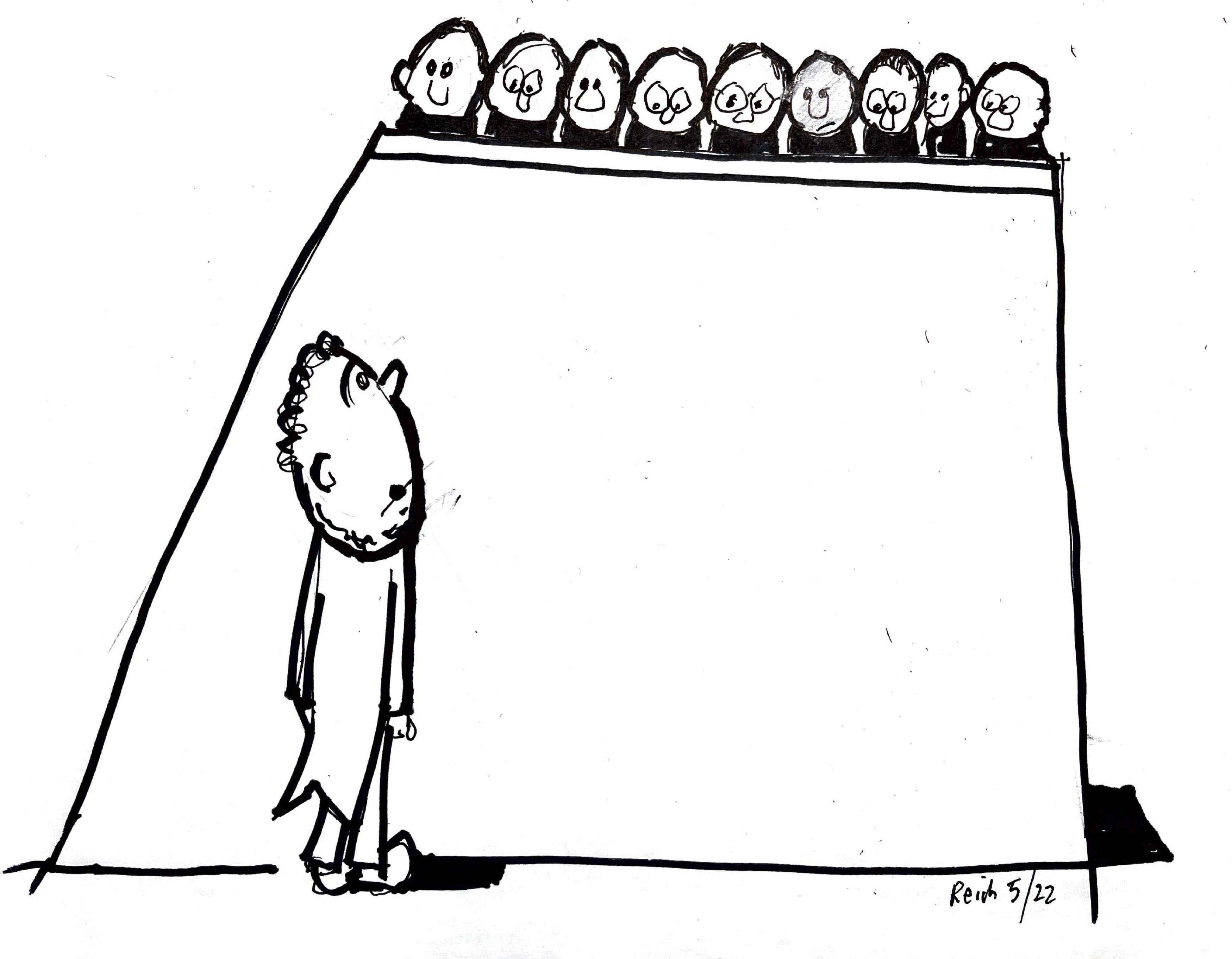
Thomas, Gorsuch, and Alito are so far to the right of America that their views on this case and other matters should be presumed bonkers. Yet what’s particularly sobering is that Trump is only one justice away from having a Supreme Court majority that would have gone his way on this absurd reading of the 14th Amendment.

Clearly, the Supreme Court must be changed — either by expanding the number of justices or by invoking term limits on Supreme Court justices. The Constitution would permit both remedies.

Perhaps the best thing about today’s majority decision is that it’s a direct repudiation of Trump, who has long taken a personal interest in the issue. During his 2024 campaign, he made curtailing birthright citizenship a key element of his immigration platform.

When the high court heard arguments on the case in April, Trump took the unprecedented step of showing up in person for the hearing, making him the first sitting president ever to attend a Supreme Court argument.

For the court to so directly reject Trump’s position today is surely a humiliation for him. But then again, humiliation requires a capacity to feel shame, and he has repeatedly shown he has no shame.

Share

Pluralistic: Jo Walton's "Everybody's Perfect" (30 Jun 2026)


Today's links


The Tor Books cover for Jo Walton's 'Everybody's Perfect.'

Jo Walton's "Everybody's Perfect" (permalink)

There's a new Jo Walton book, called Everybody's Perfect. Because it's a Jo Walton novel, you know in advance that three things are true about it:

  1. It is beautiful;
  2. It is profound;

  3. It is unlike every other novel, including every other Jo Walton novel.

https://us.macmillan.com/books/9781250314055/everybodysperfect/

Now, just because it's not like any other Jo Walton novel, that doesn't mean that it's not recognizably in a lineage of Walton's work, especially Walton's recent novels, which reflect an amazingly fruitful deep friendship and artistic relationship with the brilliant novelist and historian Ada Palmer:

https://pluralistic.net/2022/02/10/monopoly-begets-monopoly/#terra-ignota

Walton's work has always been incredible. I mean, every new Jo Walton novel is my favorite Jo Walton novel…until the next Jo Walton novel comes along and blows it out of the water. Her "small change" trilogy, a series of locked-door mystery novels set in a Britain that capitulated to the Nazis, is even more prescient today than it felt 20 years ago:

https://memex.craphound.com/2006/06/20/farthing-heart-rending-alternate-history-about-british-reich-peace/

Among Others – a fictionalized, fantasy memoir about growing up reading genre novels – was so good that it deserved to win two Hugos:

https://memex.craphound.com/2011/01/18/among-others-extraordinary-magic-story-of-science-fiction-as-a-toolkit-for-taking-apart-the-world/

And My Real Children haunts me to this day. I read it all in one sitting, in a hotel room, stricken by jetlag and hooked deep into Walton's narrative about the two paths her protagonist's life took in forking universes that I stayed up all night, and by the morning, I had cried my way through all the kleenex, toilet paper and towels in the room:

https://memex.craphound.com/2014/05/20/jo-waltons-my-real-children-infinitely-wise-sad-and-uplifting-novel/

But then came Walton's Palmer years, and everything got even better. There was the Philosopher Kings trilogy, an incredibly funny, incredibly ambitious tale in which every person who ever dreamed of living in Plato's Republic is brought to an island (along with Apollo, Athena and Socrates) to try the experiment, raising a cohort of orphans bought from the slave markets of antiquity to be philosopher kings:

https://memex.craphound.com/2015/01/13/jo-waltons-the-just-city/

And then there was Lent, an incredibly nuanced and sympathetic fantasy novel about Savonarola, the mad preacher and cult leader whose Bonfire of the Vanities and feuds with the Pope overshadow his legacy, which Walton recovers admirably as fodder for a novel that turns out to be as action-packed as any spy thriller:

https://web.archive.org/web/20190516170659/https://www.latimes.com/books/la-ca-jc-review-jo-walton-lent-20190516-story.html

And now it's Everybody's Perfect, a book that pretty much defines what it means for one text to be "in dialog" with another text. In this case, it's Ada Palmer's Inventing the Renaissance, a stunning magnum opus that tells not just the story of the Renaissance, but the story of the story, all the different ways the Renaissance has been used, abused, revised and recovered, starting with the Renaissance itself. It's a book that will make you rethink everything you know about European history, about the world today, and about the very idea of history itself:

https://www.adapalmer.com/publication/inventing-the-renaissance/

The back half of Palmer's Renaissance is a recursive retelling of the same events, from the points of view of 15 different historical personages, from the famous (Michelangelo) to the infamous (Lucretia Borgia). It's a kind of feltschrift, circling and recircling these moments, revealing their depth and contradictions.

Structurally, Everybody's Perfect feels very much like that final section of Inventing the Renaissance. Each chapter introduces a new point-of-view character, who reflects on a single, extraordinary series of events in an even more extraordinary city, the Serenissima, a phantom Venice that sits at the intersection of many parallel worlds with many parallel versions of humanity.

The sun never shines in the Serenissima; it is forever shrouded in mist. If enough of its denizens believe that something is true, it becomes true, and so islands and buildings and even gods are summoned up by the power of belief. The corollary of this is that anything that falls out of the city's regard might just melt into mist. When you tie up your gondola, you'd best pay an urchin to watch it – not just to keep it from being stolen, but to keep it from evaporating altogether. When two people meet in the Serenissima, they greet each other by reciting, "I see you." If you aren't seen, you might just disappear.

Eight different versions of humanity from eight different worlds mix in the Serenissima. They come from all times, and sometimes they go to all times as well. There's the Venetians, who come from our world, and who have kept the secret of the Serenissima for centuries, even as they've used it as a source of wealth and military advantage. But there are also races with the heads of dogs and cats and birds, a race whose faces are all inset with domino masks, and even stranger races still. There's even a rumored ninth race, who may or may not exist, and whose traits are not known to anyone, though surely they are fearsome (if they're real) (and if the people of Serenissima believe in them, mightn't they become real?).

The novel opens with a vision: the Serenissima will receive a doge. A low-born, weak and humble resident, a blind and partially paralyzed pauper who fell victim to a plague will marry the sea, and bring peace to the warring factions of the Serenissima. This prophecy is the prime mover for the eight tales that follow, as we move through the lives and geographies of one representative of each of the races of the Serenissima.

Walton conjures up the dream logic magic of Among Others, where the feeling that something might be magic can never be fully believed – or discounted. She revives the endlessly fascinating philosophical speculation of The Philosopher Kings. She invokes the tender love, sacrifice, and bitter heartbreak of My Real Children. And she invokes Palmer's Renaissance, endlessly reinvented by everyone who falls in love with it, and everyone who rejects it, for their own parochial reasons, and even the ones who are very wrong might just be a little right.

It's a remarkable novel. It's a gift, really. It's so complicated and yet so captivating, so wise and yet so simple. It won't make you feel like you've fallen into a dream – it will make you feel like everything you've lived up until now was the dream, and you have finally awoken.


Hey look at this (permalink)


A shelf of leatherbound history books with a gilt-stamped series title, 'The World's Famous Events.'

Object permanence (permalink)

#5yrsago Corruption https://pluralistic.net/2021/06/30/based/#high-bidders

#1yrago How much (little) are the AI companies making? https://pluralistic.net/2025/06/30/accounting-gaffs/#artificial-income


Upcoming appearances (permalink)

A photo of me onstage, giving a speech, pounding the podium.


A screenshot of me at my desk, doing a livecast.

Recent appearances (permalink)


A grid of my books with Will Stahle covers..

Latest books (permalink)


A cardboard book box with the Macmillan logo.

Upcoming books (permalink)

  • "The Post-American Internet," a geopolitical sequel of sorts to Enshittification, Farrar, Straus and Giroux, 2027
  • "Unauthorized Bread": a middle-grades graphic novel adapted from my novella about refugees, toasters and DRM, FirstSecond, April 20, 2027

  • "Enshittification, Why Everything Suddenly Got Worse and What to Do About It" (the graphic novel), Firstsecond, 2027

  • "The Memex Method," Farrar, Straus, Giroux, 2027


Colophon (permalink)

Today's top sources:

Currently writing: "The Post-American Internet," a sequel to "Enshittification," about the better world the rest of us get to have now that Trump has torched America. Fourth draft completed. Submitted to editor.

  • A Little Brother short story about DIY insulin PLANNING

This work – excluding any serialized fiction – is licensed under a Creative Commons Attribution 4.0 license. That means you can use it any way you like, including commercially, provided that you attribute it to me, Cory Doctorow, and include a link to pluralistic.net.

https://creativecommons.org/licenses/by/4.0/

Quotations and images are not included in this license; they are included either under a limitation or exception to copyright, or on the basis of a separate license. Please exercise caution.


How to get Pluralistic:

Blog (no ads, tracking, or data-collection):

Pluralistic.net

Newsletter (no ads, tracking, or data-collection):

https://pluralistic.net/plura-list

Mastodon (no ads, tracking, or data-collection):

https://mamot.fr/@pluralistic

Bluesky (no ads, possible tracking and data-collection):

https://bsky.app/profile/doctorow.pluralistic.net

Medium (no ads, paywalled):

https://doctorow.medium.com/

Tumblr (mass-scale, unrestricted, third-party surveillance and advertising):

https://mostlysignssomeportents.tumblr.com/tagged/pluralistic

"When life gives you SARS, you make sarsaparilla" -Joey "Accordion Guy" DeVilla

READ CAREFULLY: By reading this, you agree, on behalf of your employer, to release me from all obligations and waivers arising from any and all NON-NEGOTIATED agreements, licenses, terms-of-service, shrinkwrap, clickwrap, browsewrap, confidentiality, non-disclosure, non-compete and acceptable use policies ("BOGUS AGREEMENTS") that I have entered into with your employer, its partners, licensors, agents and assigns, in perpetuity, without prejudice to my ongoing rights and privileges. You further represent that you have the authority to release me from any BOGUS AGREEMENTS on behalf of your employer.

ISSN: 3066-764X

Office Hours: What to do about Israel?

30 June 2026 at 10:02

Friends,

Last week’s election results in New York City have shaken the Israeli-American alliance.

The sharp decline in Israel’s popularity over its prosecution of the two-year war in Gaza had already strained the relationship. Yet in those New York elections last week, three pro-Palestinian candidates backed by Mayor Zohran Mamdani, a harsh critic of Israel, defeated moderates in hotly contested Democratic congressional primaries.

These election results did not reflect a rise in antisemitism. After all, New York is home to the largest Jewish community outside of Israel. They reflected an upsurge in sympathy toward the Palestinian cause and rejection of Israel’s response to the Hamas-led attack.

To be sure, the Hamas attack was heinous and morally repugnant, regardless of whether you sympathize with the plight of the Palestinians. But Israel’s response to it — and the continuation of military aid to Israel in the future — is sure to be an issue in the upcoming midterm elections, in subsequent Democratic presidential primaries, and in general elections of 2028.

So today’s Office Hours examines your thoughts about Israel, its culpability, and what America’s future relationship to Israel should be. It’s a difficult question for many of us, but I think it important to discuss.

Herewith, the major positions on the subject as they’re now being expressed in American politics.

1. Israel is not culpable in the deaths of tens of thousands of Palestinian civilians, and the U.S. should continue to support Israel.

People who hold this view say that Hamas’s brutal attack on Israel on October 7, 2023, forced Israel’s response, which was understandable and necessary. Unless Israel fights to protect itself and its citizens, its very existence is threatened. This existential threat requires all the firepower Israel possesses. When others are committed to reducing Israel to rubble and murdering Jews living in Israel, the only conceivable response is to try to eliminate that threat by any means possible. So the United States should continue to ally itself with Israel, and continue to help Israel militarily.

2. Benjamin Netanyahu and his right-wing government of Israel are responsible for the deaths in Gaza and the West Bank, and the United States should do whatever it can to end Netanyahu’s reign so that a “two-state” solution can be sought.

By this view, neither Hamas nor Israel as a whole are responsible for the deaths in Gaza or Lebanon, nor even the aggression by Israeli settlers in the West Bank. The responsibility lies with Benjamin Netanyahu’s right-wing extremist government in Israel. The proper role for the United States at this juncture is to do whatever we can to remove Netanyahu from power and encourage a new regime to seek a “two-state solution” in which Palestinians have their own homeland.

3. It’s not just Netanyahu. Israel as a whole is to blame for genocide in Gaza, and the United States should stop supplying Israel with military aid and equipment and stop guaranteeing its security.

Two of the candidates who won in New York last week — Brad Lander and Claire Valdez — accuse Israel of genocide in Gaza and want the United States to stop supplying it with arms. Many who hold this view want to end the military security alliance between Israel and the United States, regardless of who’s in charge of Israel. (In a Pew survey in April, 60 percent of Americans say they hold an unfavorable opinion of Israel — up from 42 percent in 2022.)

4. Israel is not only culpable but it should not exist because it is a religious state that relegates non-Jews to second-class citizenship, and has no legitimacy in modern society.

One of the candidates who won last week in New York — Darializa Avila Chevalier — has questioned Israel’s right to exist. She is not alone. Since Israel’s attacks on Gaza, a number of Americans have questioned the legitimacy of a Jewish state. They argue that it relegates inhabitants who don’t hold its religious views to second-class citizenship, creating in effect an apartheid state. Some go further and argue that Israel rests on stolen lands (in contrast to Zionist narratives that emphasize the multi-millennial historical and biblical connection of the Jewish people to the Land of Israel and the legal purchase by Jewish organizations of vast tracts of land from willing sellers, including local inhabitants and absentee Arab landlords.)

***

Hence, this week’s Office Hours question: How should the United States treat Israel in the future?

Leave a comment

The Supreme Court's supreme error

30 June 2026 at 03:14

Friends,

Today’s Supreme Court decision ending the independence of independent regulatory agencies, and directly overruling a court precedent, was justified by a pernicious idea advocated by the conservative Supreme Court majority: that the framers of the Constitution envisioned a so-called “unified executive.” In fact, the framers’ focus was to prevent a United States president from becoming too powerful — like the king they were displacing — so they could not have sought a strong, centralized executive branch. Please see below.

Share

The End of Independent Agencies

29 June 2026 at 18:45

Friends,

First of all, you should know that I spent five years of my life advising the commissioners of the Federal Trade Commission how they could best protect Americans from monopolies and deceptive corporate practices.

I’m proud of the work the FTC did then and proud of much of what it’s accomplished since then. When I served there, the chair of the FTC was Michael Pertschuk, an energetic and charismatic trust-buster and consumer advocate. More recently, the FTC has been chaired by Lina Khan, who courageously stood up to some of the biggest and most politically powerful corporations in America.

Part of the reason the FTC has been so effective is that it is — or was — independent, and therefore immune to the political moves of powerful corporations seeking to stop it from acting for the common good.

The FTC was established in 1914 as part of what’s known as the “progressive era” when the government first sought to rescue the nation from the grip of the robber barons who then ran the railroads, oil, shipping, and much of the rest of the economy — and corrupted the nation’s politics — during the First Gilded Age.

Reformers of that era created an income tax to try to limit the robber barons’ incomes, caps on corporate campaign expenditures to limit their political reach, and independent regulatory agencies such as the FTC to limit their power.

That progressive era was followed by the New Deal, when Congress and FDR established other independent regulatory agencies, modeled in part on the FTC, to use their expertise for the benefit of the American people — and not just the wealthiest and most powerful citizens whose unbridled greed had led the nation into the Great Depression.

We’re now in America’s Second Gilded Age, when a new set of robber barons (think Elon Musk, Jeff Bezos, Mark Zuckerberg, and Larry and David Ellison) are running much of the economy and corrupting our politics.

Unfortunately, we now have a president and a Supreme Court, three of whose members he appointed, who are in their pockets.

Hence today’s Supreme Court ruling that a president can utterly disregard the will of Congress and install his own hacks in all independent regulatory agencies (with the odd exception of the Federal Reserve Board).

Today’s ruling is in direct conflict with a 1935 case in which the court ruled that FDR could not replace an FTC commissioner because Congress had explicitly given FTC commissioners protection against such firing, in a case known as Humphrey’s Executor v. United States. Today marks the culmination of a years-long weakening of that New Deal-era precedent.

Humphrey’s Executor v. United States concerned a federal law that protected commissioners of the Federal Trade Commission, saying they could be removed only for “inefficiency, neglect of duty or malfeasance in office” — the same language that Congress has since used to protect most other independent commissioners and board members throughout government.

Franklin D. Roosevelt nonetheless fired commissioner William Humphrey, arguing only that Humphrey’s actions were not aligned with the administration’s policy goals. The Supreme Court held that the firing was unlawful and the law establishing the independence of the Federal Trade Commission was constitutional.

But the Roberts Supreme Court doesn’t like independent regulatory agencies. Most of the current justices subscribe to what’s called the “unitary executive” theory, a bonkers notion that the framers intended for a president to have total control over every aspect of the executive branch.

It’s a bonkers theory because the framers didn’t say anything like this. In fact, their biggest fear was that the executive branch would become too powerful.

In 2020, the Roberts Supreme Court laid the groundwork for reversing Humphrey’s Executor in a case involving the Consumer Financial Protection Bureau. The law that created the bureau — again, using language identical to that at issue in Humphrey’s Executor — said the president could remove its director only for “inefficiency, neglect of duty or malfeasance in office.”

In a 5-4 decision, the Roberts Supreme Court struck down that provision, ruling that it violated the separation of powers and that the president could remove the bureau’s director for any reason.

Roberts, writing for the majority, said the presidency requires an “energetic executive.” He continued: “In our constitutional system, the executive power belongs to the president, and that power generally includes the ability to supervise and remove the agents who wield executive power in his stead.”

Two justices — Clarence Thomas and Neil M. Gorsuch — would have pulled the plug on independent agencies then and there. Thomas wrote: “The decision in Humphrey’s Executor poses a direct threat to our constitutional structure and, as a result, the liberty of the American people. With today’s decision, the court has repudiated almost every aspect of Humphrey’s Executor. In a future case, I would repudiate what is left of this erroneous precedent.”

Justice Elena Kagan, writing for what were then the court’s four liberals, dissented, saying the Constitution did not address the scope of the president’s power to fire subordinates. Congress should therefore be free, she said, to grant agencies “a measure of independence from political pressure.”

That 2020 decision by the majority of the Supreme Court anticipated the Supreme Court’s decision in July of 2024 that granted Trump, then a private citizen, immunity from prosecution for any “official” conduct during his first term.

Of all the things the framers of the Constitution worried about, their biggest worry was that a president would become as powerful as a king. Which is why they created Congress and the judiciary — to check and constrain him.

Congress has by now established 19 independent regulatory agencies, including the Securities and Exchange Commission, the Federal Reserve, the Commodity Futures Trading Commission, the National Labor Relations Board, the Federal Deposit Insurance Corporation, the Consumer Financial Protection Bureau, and the Office of Special Counsel.

These independent agencies, staffed with experts, have become a major countervailing power to the political clout of large corporations.

But as of today, they are no longer independent and no longer have any countervailing power.

Today’s ruling overturns the basic idea — part of the fabric of our government for well over a century — that Congress has the power to create independent agencies.

As the nation prepares to mark the 250th anniversary of our independence from a king, the Supreme Court and our current president are doing everything possible to resurrect a king in America.

Share

Pluralistic: Gemini is better than search because Google enshittified search (29 Jun 2026)


Today's links

  • Gemini is better than search because Google enshittified search: We're All Trying To Find The Guy Who Did This.
  • Hey look at this: Delights to delectate.
  • Object permanence: Microsoft antitrust overturned; Scammer carves C64; RIP Jim Baen; GOP rep to constituent's child: "drop dead" (literally); CCTVs jacked for botnet; Olympic profitability lie; Human factors in health infosec; Exfiltration via computer fans; Congress's summer schedule: 9 working days; Antitrust is political antigrav; Ted Chiang's 72 Letters; Microsoft antitrust appeal; Vinge on privacy; Breaking open the web; Bernie on Brexit; "The Perdition Score"; Intuit v Child Tax Credit.
  • Upcoming appearances: London, Edinburgh, Sydney, Melbourne, Brighton, London, South Bend.
  • Recent appearances: Where I've been.
  • Latest books: You keep readin' em, I'll keep writin' 'em.
  • Upcoming books: Like I said, I'll keep writin' 'em.
  • Colophon: All the rest.


The original Google homepage, loaded in the first Netscape browser. It is viewed under a giant magnifying glass. Inside the magnifying glass, we see a killer robot (with the head of the Android droid), choking a man to death.

Gemini is better than search because Google enshittified search (permalink)

Write a critical AI book, and you become everyone's confessor for their AI sins. People in my life keep telling me about their guilty AI pleasures, in search of an explanation, absolution or condemnation:

https://us.macmillan.com/books/9780374621568/thereversecentaursguidetolifeafterai/

Their most common confession: "I only ever use Google's AI-generated search summaries these days. I no longer click those blue links beneath it, not even to verify the summary." People know that the summaries are full of "hallucinations" (that is, "defects" or "errors") but the summaries are right often enough that many people have come to rely on them, to the exclusion of actual websites, made by actual people, on the actual internet.

Everyone knows this isn't good. The reason there's a web for Google's Gemini AI to summarize is that Google – the thrice-convicted monopoly search company with a 90% market share – directs people to websites, and when you visit a website, you generate revenue for the site, which pays for its maintenance. Most commonly, you generate an "ad impression," but you might also buy a subscription, or generate an "affiliate fee" by purchasing a recommended product.

When Google strips all this away by harvesting an "answer" and displaying it at the top of the page, the bargain between Google and the open web breaks down. Google is extracting 100% of the value from the websites it summarizes, and giving nothing back in return.

This is a marked reversal from Google's founding ethos. In the old days, Google measured its success by how little time you spent on its site. The ideal Google outcome was for you to visit its page (or even better, just a search-box in your browser), type a few words, and get "ten blue links" back, the top one of which was the correct link to locate the information or resource you were seeking. The point of Google was to serve as a conduit, a trusted intermediary that neutrally adjudicated the relevance of every web page for every web user from moment to moment.

Everyone dunks on Google for its high-minded motto, "Don't be evil," but over the years, the company's mission was far more important: "Organize the world's information and make it universally accessible and useful." That was the pole star that googlers followed for the first couple decades of the company's history…until, that is, the company saturated its market and its growth stalled out.

That was when Google started to panic over its plateauing search revenue, this being an inescapable consequence of 90%+ market-share. The ensuing power struggle pitted googlers who were committed to technical excellence against the company's most ardent enshittifiers, who pointed out that by making search worse, they could increase revenues. After all, if you need to search two or three times to get the answers to your questions, that means the company can show you two or three times as many ads:

https://pluralistic.net/2024/04/24/naming-names/#prabhakar-raghavan

Where once Google measured its success by how quickly it could send you away from its site and out into the open internet, today's Google is a sticky-trap full of ways to keep you inside its walled garden.

A decade ago, tech had three major approaches:

I. Google's: let you do anything you want, but spy on you while you do it;

II. Apple's: strictly control what you can do, but leave you alone to do it in private; and

III. Facebook's: control everything you do, spy on you from asshole to appetite.

Today, tech is undergoing a form of carcinization, in which every company is turning into a Facebook-crab: maximally surveillant and maximally controlling.

Apple has added surveillance to its walled garden:

https://pluralistic.net/2022/11/14/luxury-surveillance/#liar-liar

While Google has turned its free-range, internet-wide surveillance system into a walled garden that tries to keep you away from the open internet as much as possible.

Now, in Google's defense, the "open internet" kind of sucks these days. Any piece of useful information you seek out on the open internet is liable to be buried under half a dozen pop-ups, pop-unders, and dickovers:

https://daringfireball.net/2026/05/what_is_a_dickover

Even after you clear these away, the actual information you're seeking is further buried in word-salads that anticipated insipid AI prose by half a decade. Think of all those omelet recipes that appear beneath 2,500 words of cod-Proustian remembrances of "the first time I ate an egg."

The major advantage of AI search summaries is in shielding you from all this nonsense. But where did all that nonsense come from in the first place?

It turns out that this is largely Google's fault.

Google and Facebook monopolized the display advertising market, entering into an illegal, collusive arrangement to rig the bidding so that advertisers paid more and publishers received less:

https://en.wikipedia.org/wiki/Jedi_Blue

The Google/Meta duopoly sucks up 51% of display advertising revenue – more than triple the historic take for advertising intermediaries (buyers, brokers, agencies, etc). As ad revenues for web publishers cratered, the "ad load" on web pages went up. This set up a vicious cycle: increasing the number of ads decreases the number of readers, driving publishers to increase the ad-load even more to make up for the losses.

The major brake on this is ad-blocking. In a world with ad-blockers in it, publishers contemplating an increase in ad-load have to confront the possibility that they will induce ad-overload in their readers, who will install a blocker that stops them from seeing any ads:

https://www.eff.org/deeplinks/2019/07/adblocking-how-about-nah

Google has been looking to kill ad-blocking for a decade, and now they're on the verge of making it happen in Chrome, the dominant web browser they use to reinforce their search monopoly:

https://protonprivacy.substack.com/p/google-is-finally-killing-ublock

Google long ago did away with ad-blocking on mobile devices (reverse engineering an app is a felony, which means an app is just a web-page skinned with the right kind of IP to make it a crime to protect your privacy while you use it). Part of Google's argument for killing ad-blocking for the web is that this puts the web on an even footing with apps – which is a very weird way to describe a race to the absolute bottom:

https://pluralistic.net/2026/06/12/compelled-speech/#quishing

To top it all off, this decade has seen Google make a series of changes to its search prioritization that favored low-value shovelware sites over carefully researched, reliable alternatives. Search for product reviews and you're apt to get a "site reputation abuse" result from a once-reliable outlet like Forbes filled with useless and even dangerous reviews, which are ranked far above independently maintained, rigorous competitors:

https://pluralistic.net/2024/05/03/keyword-swarming/#site-reputation-abuse

This has only gotten worse with AI search, which preferentially draws from spam sites to produce decontextualized, highly confident recommendations for substandard, overpriced junk, at the expense of recommendations for good products:

https://pluralistic.net/2025/07/15/inhuman-gigapede/#coprophagic-ai

It's not like Google doesn't have the ability to sort the good from the bad. Kagi.com is a $10/month paid search engine whose results are vastly superior to Google's. But Kagi doesn't have its own search index: instead, they rent access to Google's index, but apply their own (much smaller and less resourced) team's algorithm to rank the results for your queries. In other words, Google could deliver good search results, they just choose not to:

https://pluralistic.net/2024/04/04/teach-me-how-to-shruggie/#kagi

Gresham's Law holds that "bad money drives out good." It refers to a counterfeit coin crisis in Tudor England, where people preferentially spent counterfeit money in order to make it someone else's problem; meanwhile, everyone hoarded their good coins. Soon, virtually all the money in circulation was bogus.

By downranking quality material in favor of low-effort spam, Google set up a web-wide version of Gresham's Law, where bad webpages drive out good ones, and since so many of those webpages contain product recommendations, they're greshaming the world of real products, too, so the bad is driving out the good there, too.

This is the problem that Gemini search summaries solve: in its role as the web's most important gatekeeper, Google remade it as an ad-festooned cesspit of garbage text and cynical shovelware sites. Now Google proposes to wipe out the publishers whose content they stripmined by breaking the web's bargain: that search engines are symbiotic with publishers. Google has turned fully parasitic, sucking the last drops of juice out of the open web before discarding its husk.


Hey look at this (permalink)


A shelf of leatherbound history books with a gilt-stamped series title, 'The World's Famous Events.'

Object permanence (permalink)

#25yrsago Appeals court strikes down Microsoft antitrust ruling https://www.nytimes.com/2001/06/28/business/us-appeals-court-overturns-microsoft-antitrust-ruling.html

#25yrsago Ted Chiang's 72 Letters https://web.archive.org/web/20010720192340/http://www.tor.com/72ltrs.html

#25yrsago Concept handheld devices https://web.archive.org/web/20010620115437/https://www.infosync.no/en/news/n/419.asp

#25yrsago Analyzing Microsoft's successful antitrust appeal https://web.archive.org/web/20010703085656/https://www.salon.com/tech/feature/2001/06/28/appeals_reaction/index.html

#20yrsago Bengali science fiction of the 1880s https://www.lehigh.edu/~amsp/2006/05/early-bengali-science-fiction.html

#20yrsago Vernor Vinge on computers, freedom and privacy https://www.theguardian.com/technology/2006/jun/29/guardianweeklytechnologysection5

#20yrsago Scammer convinced to carve replica Commodore 64 https://www.419eater.com/html/john_boko.php

#20yrsago Jim Baen, sf publisher, has passed away https://web.archive.org/web/20060703024337/http://david-drake.com/baen.html

#15yrsago YouTube listens to fraudulent NyanCat takedown notice, drags heels on put-back from creator https://web.archive.org/web/20110628132607/http://www.prguitarman.com/index.php?id=369

#15yrsago Wyoming’s corporation mills manufacture privileged artificial “people” to order https://www.reuters.com/article/2011/06/28/us-usa-shell-companies-idUSTRE75R20Z20110628/

#15yrsago Publishing in the Internet era: connecting audiences and works https://www.theguardian.com/technology/2011/jun/30/publishers-internet-changing-role?utm_source=twitterfeed&utm_medium=twitter

#15yrsago Why writers should have their own domains https://whatever.scalzi.com/2011/06/29/mastering-ones-own-domain-an-no-this-is-not-a-seinfeld-reference/

#15yrsago Copyright troll’s biggest fan commits terminal irony https://www.eff.org/deeplinks/2011/06/righthaven-cheerleader-wanted-irony-police

#10yrsago Mississippi state rep tells distraught mom to buy kid’s lifesaving meds ‘with money she earns’ https://www.sunherald.com/news/local/counties/jackson-county/article86416087.html

#10yrsago Always-on CCTVs with no effective security harnessed into massive, unstoppable botnet https://arstechnica.com/information-technology/2016/06/large-botnet-of-cctv-devices-knock-the-snot-out-of-jewelry-website/

#10yrsago Gun-waving cop who attacked black teenaged girl in her bathing suit faces no charges https://web.archive.org/web/20160624103549/http://dfw.cbslocal.com/2016/06/23/grand-jury-no-bills-former-mckinney-pool-party-cop/

#10yrsago The Olympics are profitable for every host city (that lies about the numbers) https://timharford.com/2016/06/how-do-you-make-the-olympics-pay-fudge-the-figures/

#10yrsago Healthcare workers prioritize helping people over information security (disaster ensues) https://www.cs.dartmouth.edu/~sws/pubs/ksbk15-draft.pdf

#10yrsago Fansmitter: malware that exfiltrates data from airgapped computers by varying the sound of their fans https://www.youtube.com/watch?v=3GCHCVpndaM

#10yrsago Labour’s knives come out for Corbyn, but he’s guaranteed a spot on the ballot https://www.politico.eu/article/inside-account-of-labour-mps-attacks-on-jeremy-corbyn-shadow-cabinet-resignations-brexit/

#10yrsago Hope Larson’s “Compass South”: swashbuckling YA graphic novel https://memex.craphound.com/2016/06/28/hope-larsons-compass-south-swashbuckling-ya-graphic-novel/

#10yrsago How to Break Open the Web: a report on the first Decentralized Web Summit https://www.fastcompany.com/3061357/the-web-decentralized-distributed-open

#10yrsago Californians will get to vote on legal recreational weed https://web.archive.org/web/20160629130245/http://abcnews.go.com/US/wireStory/voters-decide-legalize-recreational-marijuana-40206739

#10yrsago Bernie Sanders on Brexit: urgent lessons for the Democrats https://www.nytimes.com/2016/06/29/opinion/campaign-stops/bernie-sanders-democrats-need-to-wake-up.html

#10yrsago Electoral fraud: Trump sends fundraiser emails to foreign politicians https://www.cnet.com/culture/trump-spams-foreign-politicians-with-fundraising-emails/#ftag=CAD590a51e

#10yrsago The Perdition Score: Sandman Slim vs the One Percent https://memex.craphound.com/2016/06/29/the-perdition-score-sandman-slim-vs-the-one-percent/

#5yrsago Intuit sabotages the Child Tax Credit https://pluralistic.net/2021/06/29/three-times-is-enemy-action/#ctc

#5yrsago SCOTUS to wrongfully accused terrorists: "drop dead" https://pluralistic.net/2021/06/29/three-times-is-enemy-action/#transunion

#5yrsago Lazy Congress only schedules 9 days' work this summer https://pluralistic.net/2021/06/28/dubious-quant-residue/#back-to-work-you

#1yrago Antitrust defies politics' law of gravity https://pluralistic.net/2025/06/28/mamdani/#trustbusting


Upcoming appearances (permalink)

A photo of me onstage, giving a speech, pounding the podium.


A screenshot of me at my desk, doing a livecast.

Recent appearances (permalink)


A grid of my books with Will Stahle covers..

Latest books (permalink)


A cardboard book box with the Macmillan logo.

Upcoming books (permalink)

  • "The Post-American Internet," a geopolitical sequel of sorts to Enshittification, Farrar, Straus and Giroux, 2027
  • "Unauthorized Bread": a middle-grades graphic novel adapted from my novella about refugees, toasters and DRM, FirstSecond, April 20, 2027

  • "Enshittification, Why Everything Suddenly Got Worse and What to Do About It" (the graphic novel), Firstsecond, 2027

  • "The Memex Method," Farrar, Straus, Giroux, 2027


Colophon (permalink)

Today's top sources:

Currently writing: "The Post-American Internet," a sequel to "Enshittification," about the better world the rest of us get to have now that Trump has torched America. Fourth draft completed. Submitted to editor.

  • A Little Brother short story about DIY insulin PLANNING

This work – excluding any serialized fiction – is licensed under a Creative Commons Attribution 4.0 license. That means you can use it any way you like, including commercially, provided that you attribute it to me, Cory Doctorow, and include a link to pluralistic.net.

https://creativecommons.org/licenses/by/4.0/

Quotations and images are not included in this license; they are included either under a limitation or exception to copyright, or on the basis of a separate license. Please exercise caution.


How to get Pluralistic:

Blog (no ads, tracking, or data-collection):

Pluralistic.net

Newsletter (no ads, tracking, or data-collection):

https://pluralistic.net/plura-list

Mastodon (no ads, tracking, or data-collection):

https://mamot.fr/@pluralistic

Bluesky (no ads, possible tracking and data-collection):

https://bsky.app/profile/doctorow.pluralistic.net

Medium (no ads, paywalled):

https://doctorow.medium.com/

Tumblr (mass-scale, unrestricted, third-party surveillance and advertising):

https://mostlysignssomeportents.tumblr.com/tagged/pluralistic

"When life gives you SARS, you make sarsaparilla" -Joey "Accordion Guy" DeVilla

READ CAREFULLY: By reading this, you agree, on behalf of your employer, to release me from all obligations and waivers arising from any and all NON-NEGOTIATED agreements, licenses, terms-of-service, shrinkwrap, clickwrap, browsewrap, confidentiality, non-disclosure, non-compete and acceptable use policies ("BOGUS AGREEMENTS") that I have entered into with your employer, its partners, licensors, agents and assigns, in perpetuity, without prejudice to my ongoing rights and privileges. You further represent that you have the authority to release me from any BOGUS AGREEMENTS on behalf of your employer.

ISSN: 3066-764X

Is JD Vance More Dangerous Than Trump?

29 June 2026 at 10:03

Friends,

JD Vance said on Friday that the U.S. wins “either way” in negotiations with Iran. “If we make the final deal, then great,” Vance told HBO’s Bill Maher. “If we don’t make the final deal, their nuclear program is still destroyed. They’re still much weaker as a country.”

Just hours after Vance’s appearance on HBO, Iran launched attack drones on Bahrain — which hosts the U.S. Navy’s Fifth Fleet headquarters, a major logistical base for U.S. military operations. Iran also struck an oil tanker in the Strait of Hormuz, its second attack on a ship since Thursday.

So much for Iran being much weaker.

Pressed by Maher on whether Iran’s nuclear program has been destroyed, Vance shot back: “What part of it is not destroyed? The thing that you have to destroy is their ability to enrich uranium, which has been destroyed.”

In fact, Iran still has a stockpile of 60 percent-enriched uranium, which experts concede could be turned into a nuclear weapon.

Vance’s media appearance came two days after he visited the Richard Nixon presidential library and museum in California to talk about his new book on his journey from atheism to allegedly devout Catholicism.

During his visit he defended Nixon for the Watergate break-in scandal that ended his presidency. “I think that his historical legacy is enjoying a bit of a renaissance — but I think deservedly so,” Vance said of Nixon. “If Watergate happened tomorrow, it would be like a 12-hour news story. Like, the idea that it would have taken down a presidency is crazy.” It was the “deep state that took down Richard Nixon” — not Nixon’s serious crimes.

Hello? The only conceivable reason Watergate might not bring down a presidency tomorrow or be a 12-hour story is the gargantuan criminality and corruption of the Trump-Vance regime, which puts Watergate in the minor league by comparison.

I raise Vance’s recent bizarro comments because in a few months he’ll be actively campaigning to be the Republican candidate for president in 2028.

He’s a more dangerous demagogue than Trump because he wraps his demagoguery in the apparent thoughtfulness of a graduate of Yale Law School and a serious best-selling author.

I’ve spent the last two days reading his latest book, Communion: Finding My Way Back to Faith, a memoir focusing on his 2019 conversion to Catholicism, and can assure you of three things: First, it’s a serious book. Second, Vance’s mind is as vacuous and unprincipled as he is in person. Third, the book isn’t worth reading.

In one of the few mea culpas in the book, Vance writes that it was “boneheaded” of him — “one of the dumbest things I ever said” — to call Kamala Harris and several other prominent Democrats “childless cat ladies who want to make the rest of the country miserable too.” In the book Vance calls the insult, “intentionally (and successfully) provocative rather than illuminating.”

What Vance doesn’t admit to is that, when his remark resurfaced during his early days as Trump’s running mate, he refused to apologize or express any regret for it. “Obviously, it was a sarcastic comment. I’ve got nothing against cats,” he said then — sarcastically — adding that “if you look at Kamala Harris, Pete Buttigieg, AOC, the entire future of the Democrats is controlled by people without children,” which in his view had made the entire Democratic Party “anti-family and anti-child.”

Vance’s intentionally provocative rather than illuminating demagoguery was in evidence again when he insisted during the 2024 campaign that the pets of upright Americans residing in Springfield, Ohio, were being “abducted and eaten” by Haitian immigrants “who shouldn’t be in this country.”

When confronted with irrefutable evidence that Haitian immigrants were not eating pets in Springfield, Vance admitted publicly that he was speaking, shall we say, metaphorically: “If I have to create stories so that the American media actually pays attention to the suffering of the American people, then that’s what I’m going to do,” he told CNN.

It’s much the same with Vance’s recent response to the fatal stabbing of Henry Nowak by Vickrum Digwa in the British city of Southampton. After Digwa was sentenced to life imprisonment, Vance declared that Nowak would still be alive had Europeans “stood their ground against the politics of self-hatred and the mass invasion of migrants, many of whom despise the West and the people who love it.”

Inconveniently for Vance, Digwa didn’t migrate to Britain. He was born and raised there.

Vance would never have become a senator from Ohio in 2022 were it not for the billionaire tech financier Peter Thiel, who staked $15 million on Vance’s election — a major portion of all the funds that went into Vance’s Senate race.

Before running for the Senate, Vance had worked for Thiel’s California venture capital firm and was part of Thiel’s libertarian community of rich crypto bros, tech executives, back-to-the-landers, and disaffected far-right intellectuals.

Because Thiel had been a major funder of Trump’s 2016 presidential run, he had significant influence with Trump when urging him to pick Vance for his vice president.

Why was Thiel such a devoted sponsor of Vance? Because Thiel saw in his protege a future leader of a political movement to turn the U.S. away from democracy. “For Peter,” said one of the people familiar with his thinking, “Vance is a generational bet.”

Thiel is a self-styled libertarian who once wrote: “I no longer believe that freedom and democracy are compatible.”

Bullshit. Freedom is incompatible with democracy only if you view democracy as a potential constraint on your wealth and power.

Thiel and Vance believe that the only way true libertarians can win in the U.S. is for a Caesar-like figure to wrest power from the U.S. establishment and install a monarchical regime, run like a startup.

The first step, as Vance offered in a 2021 podcast, is to replace “every single midlevel bureaucrat, every civil servant in the administrative state … with our people. And when the courts stop you, stand before the country, and say” — as did Andrew Jackson — that “the chief justice has made his ruling. Now let him enforce it.”

The next step is to foment so much division and bigotry inside the U.S. and within other major Western nations that people come to view those on the other side of the political divide as the source of everything that’s wrong with their lives — which Vance has been eagerly trying to do.

That way, they won’t look upward to see that the billionaire robber barons, plutocrats, and oligarchs of this second Gilded Age have grabbed most of the wealth and power for themselves. Hence, average people will trade in democracy for strongman autocracy.

Behind Vance’s demagoguery about the U.S. winning either way in Iran, Nixon being taken down by the deep state, childless cat ladies, the Democratic Party being anti-family and anti-child, Haitian-Americans eating pets, and immigrants threatening Western civilization is a deadly serious plan to unite the far-right of America and Europe and rid much of the world of democracy. If Vance becomes president, he’s intent on furthering the job.

Vance resembles Trump in every way — he lies effortlessly, he’s utterly without principle, and he’s intent on gaining power — except that he’s smarter and more ruthless than Trump.

Take note and beware.

Share

Sunday caption contest: Trump's 4th of July

28 June 2026 at 23:00

Friends,

Please submit your caption in the Comments section and, as before, please use the Comments section only for captions.

Winners will be announced next Sunday. For consideration, please post your caption by Monday at 9 pm PT, 12 midnight ET.

Leave a comment

Last week’s winner:

“On reflection, I am now the King of Green-land.”

(Congratulations, Carol Nylen.)

Runners-up:

“Mirror mirror in the slime, who’s the sleaziest of all time?”

(Congratulations, Andrew Kelm.)

“Reflection, reflection in the pool: Am I wise, or am I a fool?”

(Congratulations, Steven Horowitz.)

“He’s ‘floating’ a run for a 3rd term as the Green Party candidate.”

(Congratulations, DZK.)

“Mirror mirror on the pool, who’s the greatest king of fools?”

(Congratulations, Mike Hammer.)

“Everything he touches turns to slime.”

(Congratulations, ISOequanimity.)

“It’s even more shallow than me!”

(Congratulations, John Powell.)

“Trump only looks, he never reflects”

(Congratulations, howard levitt.)

“Mirror, mirror in the pool, how do we get rid of this fool?”

(Congratulations, Diane Fogarty.)

“I hired the best pool guy, and I never make mistakes. He’s the greatest pool guy, better than any pool guy ever seen. So it must be some left-wing vandals that caused this.”

(Congratulations, Lynn E Levine.)

“Narcissus in green.”

(Congratulations, ERIK Payne BUTLER.)

“Mirror, mirror, on the mall. I’m the greatest one of all!”

(Congratulations, Sue Kayton.)

“What about my Rhapsody in Blue? I’m green with envy.”

(Congratulations, Laurence Hoffmann.)

“Yep, I am a king, and the water is crystal clear.”

(Congratulations, Michigan Banjo Man.)

Share

❌