The excitement is palpable. Texas! Kansas! North Carolina! South Carolina! (As I write this, Democrat Scott Colom is leading Republican Cindy Hyde-Smith in Mississippi!)
Democrats will control both chambers of Congress by a comfortable margin next year.
What does this mean, as a practical matter? More specifically, what’s the most important thing the Democrats should seek to achieve?
Even with full control of Congress, it won’t be easy. Trump will remain in the White House. He’s likely to veto whatever the Democrats try to do and ignore whatever they say. He and his Cabinet officers won’t willingly testify before congressional committees investigating the regime’s actions, pleading executive privilege.
I’ve asked a number of political advisers, Trump watchers, congressional staff, and Democratic insiders what they think the Democrats’ #1 priority should be next year and grouped their responses below. Please have a look, and indicate which you agree with (or add your thoughts in the comments).
Did you know that government contractors are currently banned from making campaign contributions?
The law was enacted to prevent corrupt pay-to-play arrangements in which companies seeking federal contracts curry favor with legislators and officials who decide where those federal dollars go, by making massive campaign contributions to them.
But the law doesn’t doesn’t cover the executive officers or major shareholders of government contractors.
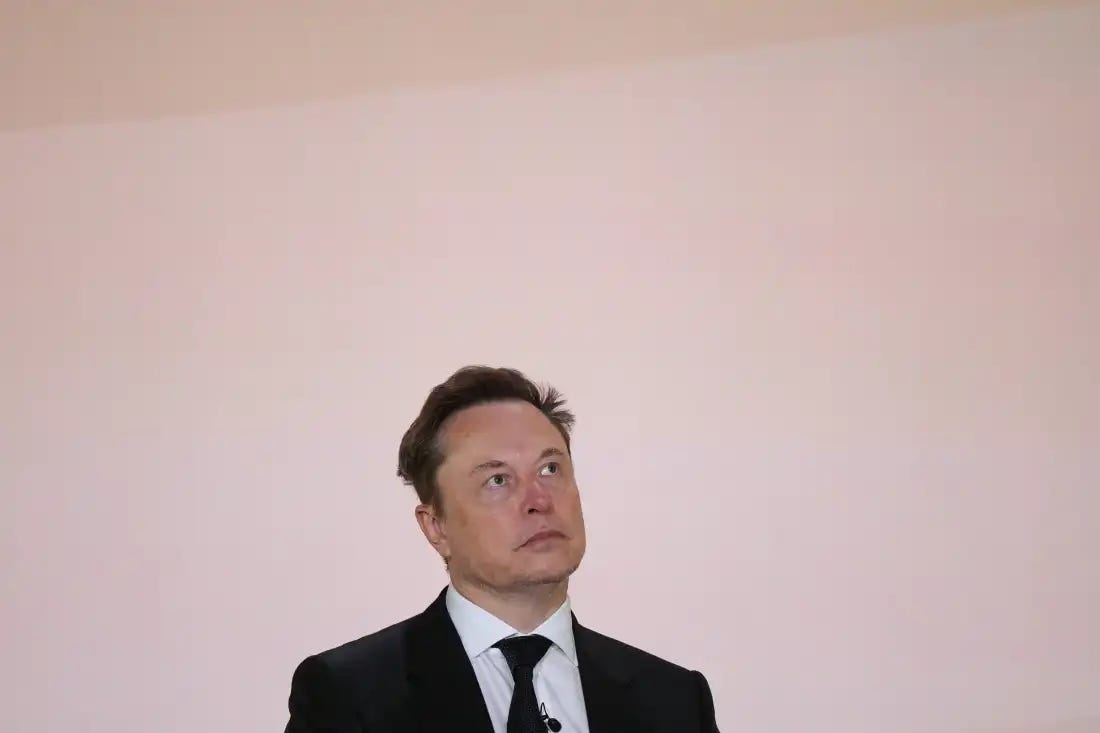
Call it the Elon Musk loophole.
Musk’s corporations have a reported $38 billion (at least) in government contracts. Yet while his corporations are banned from making campaign contributions, Musk — their CEO and major shareholder — is not.
The resulting Muskrat loophole is absurd. Musk is the biggest campaign contributor in American history. In 2024, he reportedly gave more than $250 million to support Trump and other Republican candidates.
In the 2026 midterms, Musk has given more than $483 million to political committees to support Republican congressional candidates. This includes at least $168 million in the Texas Senate race to support Republican Ken Paxton (almost all Paxton’s campaign money). Musk appears out to buy his own personal senator in Texas.
Musk’s total campaign contributions in 2024 and 2026 add up to some three-quarters of a billion dollars.
So Musk gets $38 billion in government contracts for his SpaceX and Starlink satellite corporation — enabling him to have an effective monopoly on intelligence that’s critical to U.S. security (and that of Ukraine).
Then he turns around and uses some of those winnings to pour a half a billion into the 2026 midterms to support candidates that presumably will keep awarding him lucrative contracts.
America shouldn’t be contracting out our national defense and foreign policy to Musk, who unilaterally decided three weeks ago that Ukraine should no longer have intelligence about incoming Russian missiles and drones — resulting in deaths and injuries to hundreds of Ukrainian citizens.
How do we close the Muskrat loophole in our campaign finance laws?
I’m pleased to report that Senator Chris Van Hollen (D-MD) and Representative Robert Garcia (D-CA) have announced they will introduce legislation to close it and thereby prohibit top executives and major shareholders of government contractors (i.e. Musk) from making campaign contributions.
If Democrats take over Congress Tuesday, the Van Hollen-Garcia bill should be high on their 2027 to-do list.
Now, for California’s Prop 40.
It’s a one-time 5 percent tax on California’s billionaires, who have been pouring hundreds of millions of dollars into opposing it and trying to persuade Californians it’s a bad idea.
Their costly campaign against Prop 40 is another reason why Californians should support the measure. Otherwise, billionaire campaign spending makes it impossible for the broad public to be heard.
The super-wealthy all over America are watching what happens in California. “If Prop. 40 goes down in California, I think it’s going to make, not all of the candidates, but it’s going to make a few of the 2028 candidates rethink how they slot that into their presidential policy agenda,” Zach Moller told TheNew York Times. Moller is the senior director of the economic program at Third Way, a think tank bankrolled by corporate Democrats.
Some potential Democratic presidential candidates have already taken a stance on Proposition 40, including Representative Ro Khanna of California, who has campaigned in favor of it, and Gov. Gavin Newsom of California, who has opposed it.
In reporting on the ballot measure, TheNew York Times today erroneously reported that “Even for billionaires who derive their wealth from the publicly traded stocks of companies they founded, collecting the tax could be complicated if they do not have enough cash to pay it without selling many of their holdings.”
Rubbish. Many of these same billionaires already borrow against their fortunes to pay for their lavish living expenses — a tax dodge that allows some of them to declare no income at all. If they can borrow against their fortunes for their living expenses, without selling their holdings, they surely can do the same to pay a wealth tax.
My strong recommendation to Californians: Vote YES on Prop 40, and vote NO on the poison pills designed to kill it, Props 41 and 42.
AI-enablers claim it will spawn a “Star Trek”-like utopia, where no one will have to work because technology can meet all of our needs. AI-skeptics warn of a “Matrix”-like dystopia, where machine-supremacy subjects humans to mass unemployment, even more rampant inequality, and environmental ruin.
The AI enablers want us to think we’re powerless, but we’re not. We must erect the following FIVE guardrails to protect humanity from AI:
AI Guardrail #1: Rein in data centers, starting with a total national pause on data center development until more regulations are in place. This is necessary AND popular. Over 70 percent of Americans oppose building AI data centers in their communities. A nationwide moratorium will buy us time while we figure out how to make data centers cover their own costs — both financial and environmental.
AI Guardrail #2: Block corporations from mass layoffs. We may not be able to stop all AI job losses, but we must have some guardrails in place to protect workers. We’ll need universal basic incomes and universal job guarantees to ensure that AI doesn’t leave people destitute.
AI Guardrail #3: Make the AI economy benefit everyone. One of the biggest threats from AI is that the wealth it generates will go exclusively to people like Elon Musk, but it doesn’t have to be that way. Every Alaskan, working or not, receives dividends from the state’s oil and mining proceeds. Why should an AI dividend for all Americans be harder to accept?
AI Guardrail #4: Label AI and stop abuses of our data. Deepfakes are a dangerous way in which our personal imagery and data can be abused with AI. We have to know what’s real and what isn’t — and we need federal laws to ensure the takedown of AI-generated content that uses someone’s likeness against their will.
AI Guardrail #5: New AI products must seek government approval. Tech billionaires will complain that this could stifle the “free market,” but that’s baloney. We don’t let corporations invent new types of nuclear weapons or new types of cocaine or new types of biological pathogens — or even new drugs without government approval that they’re safe and effective. We protect the public from certain kinds of innovation, and we should do the same with AI.
As humans, we can and must join together across party lines to demand these guardrails and ensure that the Big Tech oligarchs don’t drag us into a dystopia.
It is the only way for humanity to live long and prosper.
First, toss your salad. So far in 2026, there’ve been nearly 30,000 suspected cases of cyclospora — the explosive diarrhea parasite — with two fatalities. It’s been linked to produce from Taylor Farms, which supplies grocery stores and restaurants across the country, often under alternative brand names.
Next, throw out jalapeños, dips, and eggs because of salmonella recalls.
Trump claims grocery prices are coming down. I guess one way to bring them down is to leave us with nothing safe to buy.
All these recalls and illnesses aren’t a coincidence. They’re the result of incompetence and corruption within the Trump regime — and unchecked corporate power.
They dissolved a USDA advisory committee that existed to help prevent outbreaks like the ones we’re suffering. The USDA even CUTseveral cyclospora research projects — after the outbreak had already spread.
The Trump team was too stupid to realize that cutting food safety programs and firing thousands of public servants would have consequences.
Then there’s the possible corruption.
Rather than protect the public from cyclospora, Trump met with Taylor Farms executives at the White House as they sought to delay the FDA’s announcement linking their lettuce to the outbreak. Since then, the FDA sent mixed messages on its initial findings even as cyclospora cases continued to rise. Why?
Perhaps because Taylor Farms’ parent company has donated more than $2 million to Republican PACs this election cycle, with nearly half of that going to Trump’s MAGA Inc.
Welcome back to class. Today, I introduce issues that continue to be vigorously debated: the effects of globalization and technological change on widening inequality.
In case you missed them, here are the classes that have been released so far: Class 1, Class 2.
For Class 3, just double-click on the video below, and you’re in the third week of class.
Some background: Many policymakers regard both globalization and technological change as “inevitable” forces that improve economic efficiency — and that should not be altered by political decisions.
I remember discussions in the Clinton White House leading to NAFTA and China’s ascension to the World Trade Organization in which administration officials described both as “necessary” to the evolving global economy. New technologies such as supersonic jets, AI, and facial-recognition software have also been assumed to be beyond political debate or control.
But neither globalization nor the path of technological change is inevitable. Government decides on timing (how quickly should we globalize or should a new technology be introduced?). On what particular goods and services should be subject to globalization and technological change (more or less labor-intensive industries? technologies critical to national security?). On how these changes come about (trade or direct investment? public subsidies? regulations?). And on measures to help those who bear the costs and burdens of these changes (refundable tax credits? education and training?).
It’s called “industrial policy.”
The questions we’ll be exploring today are:
How have globalization and technological change widened inequality?
Given their effects, what are the major job categories now and into the future?
Why have low-wage “personal-service” jobs replaced higher-paying “routine production” jobs?
Why are high-paying “symbolic analytic” jobs usually limited to college graduates?
Why are all jobs becoming less stable — even before AI is fully felt in the workforce? What are the consequences of these trends for politics?
Knowing what you now know about the effects of globalization and technological change, what do you think of a universal minimum income?
***
Recommended readings on globalization and inequality (just click on them):
This Substack is reader-supported. To support this work, please consider becoming a paid subscriber.
A huge thanks to the Wealth and Poverty team — to Michael Lahanas-Calderón, Kyle Parker, Dan Davis, and Emmett Tjen — as well as Coro Fellows Ammar Ansari and Meagan Turner for preparing these course materials to be shared with all of you. And to Heather Kinlaw Lofthouse for making all this happen on this page.
Jeff Bezos says raising his taxes is pointless. “You could double the taxes I pay, and it’s not going to help that teacher in Queens,” he says.
Well, he’s partly right. Bezos has gotten away with paying no income tax in some years, so technically doubling that wouldn’t help. That’s why we need a wealth tax that even the slipperiest of billionaires can’t wriggle their way out of.
I’m so pleased that my good friend and colleague Gabriel Zucman, whose work has provided among the most important analysis of wealth taxes, is here to help us understand what it entails — and why the objections of the billionaires are wrong. Please watch.
Billionaire wealth is undermining our democracy. Just look at what Elon Musk is doing. Other billionaires are also polluting our politics.
Californians have an opportunity on November 3 to be the first state to enact a tax on billionaire wealth. It’s right and just. It would help defer the extra expenses to Californians of filling the hole created by cuts in Medicaid and Medicare by the Trump regime — cuts made in order to give a huge tax cut mainly to the richest Americans.
And it’s the beginning of a movement toward taxing billionaires across the nation. Which is why they’re so worried about it.
One of the reasons I write this letter to you each day is to arm you with the facts and analyses you need to respond to the garbage coming out of Trump’s Republican Party.
Today I want to talk to you about Social Security.
The trustees of Social Security — of which yours truly was once a member — say the program will be able to pay full benefits only until 2033. After that, Social Security will be able to dole out only roughly 77 percent of benefits due.
This summer, Ohio’s Republican Sen. Bernie Moreno joined Sen. Elizabeth Warren in proposing to raise the payroll tax cap so people with higher incomes pay more into the program.
Fairly suddenly, the idea is emerging as an acceptablefix among other GOP lawmakers,including Rep. Tom Cole (Oklahoma), the influential chair of the House Appropriations Committee.
Cole thinks the political blowback from Social Security benefit cuts would be far worse than a comprehensive solution that includes raising taxes.
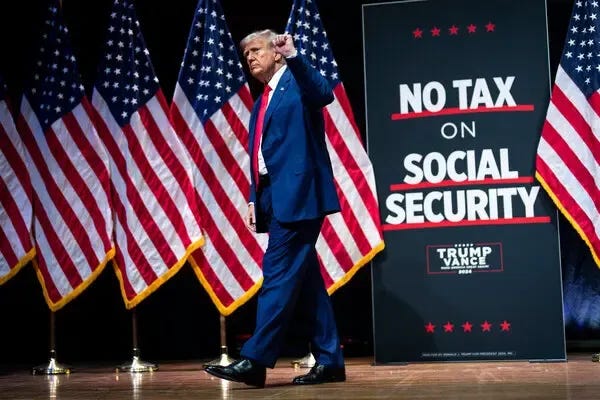
It’s another example of Republicans deserting Trump, who thinks the “fix” for Social Security is to repeal taxes on Social Security benefits. Trump’s fix will not save Social Security. In fact, quite the opposite. Without the revenue from Social Security taxes, the Social Security trust fund will run out of money even sooner.
I’m encouraged by what looks like the start of a Republican turnaround on this. Not only are Republicans deserting Trump, but they’re beginning — just beginning — to become sensitive to what average voters need and want.
Contrary to conventional wisdom, the reason Social Security is running out of money is not because so many boomers are retiring.
The Social Security trustees anticipated the boom in boomer retirements. This is why Social Security was amended back in 1983, to gradually increase the age for collecting full retirement benefits from 65 to 67. That change is helping finance the boomers’ retirement.
The real reason Social Security is running out of money is something the trustees never anticipated: how much of the nation’s total income is going to the top.
Had the pay of American workers kept up with the trend decades ago — as well as their growing productivity — their Social Security payments would have kept the program flush.
Yet income subject to the Social Security payroll tax is capped. No dollar of earnings above the cap is taxed. The cap in 2026 is $184,500.
So, as the rich have become far richer, more and more of the nation’s total income has escaped the Social Security payroll tax.
A CEO earning $20 million a year pays Social Security taxes on roughly 1 percent of their income, while a worker earning under the cap pays Social Security taxes on 100 percent of their income.
They both end up paying the same amount of money into the program. This isn’t fair.
The rise in the amount of income above the cap due to inequality has cost the Social Security Trust Fund reserve more than $1.4 trillion since 1983.
The solution is obvious: scrap the cap and make the rich pay more in Social Security taxes.
One plan introduced by Democrats in Congress would eliminate the cap on earnings over $250,000 and also subject investment income to Social Security taxes.
It’s estimated that this would extend the solvency of Social Security for the next 75 years without raising taxes on 93 percent of American households.
Bottom line: Trump’s plan will destroy Social Security.
The Democrats’ plan will save it — and do so fairly. Remarkably, Republicans are coming around to this plan.
If we want to ensure Social Security’s long-term future, and that working people can retire with dignity, we must make the wealthy pay their fair share.
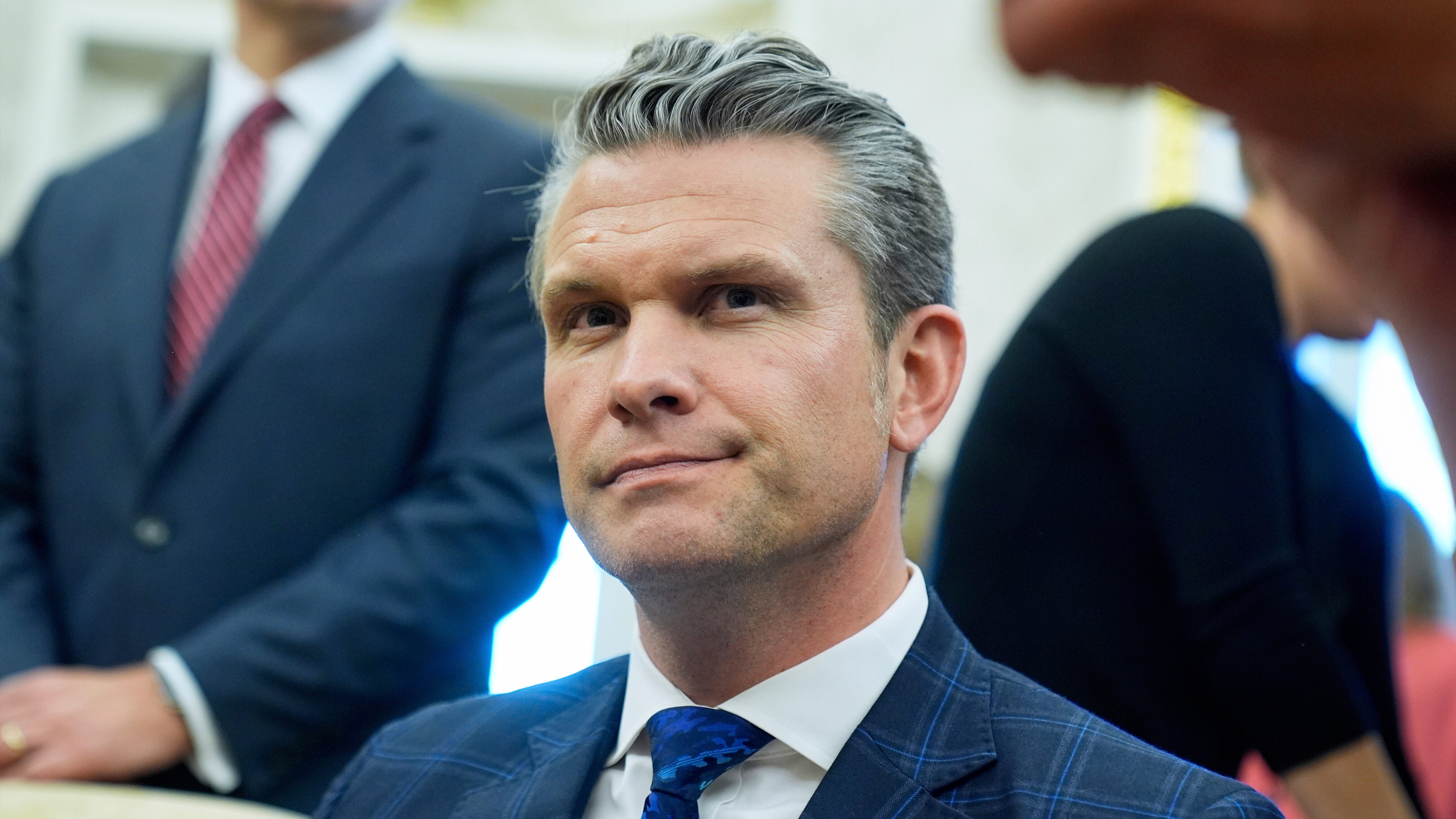
The latest casualty of Pete Hegseth’s disastrous tenure as Secretary of “War” is Dan Driscoll, who resigned Monday as Secretary of the Army after repeatedly clashing with the Heg.
Driscoll isn’t a liberal in lion’s clothing. He’s an old friend of JD Vance from Yale Law days. He resigned because of his concerns that Hegseth is damaging the Army’s efforts to modernize and adapt to the 21st century battlefield environment — where drone warfare is becoming increasingly important — by firing or pushing out leaders spearheading those efforts.
A defense official in Europe told CNN that even though Hegseth talks about technology reform, he’s focusing instead on “muscles, dudes in dresses, testosterone.”
Hegseth’s tenure has been disastrous from the moment he walked into the Pentagon. Even if Trump were capable of hearing sound advice, Hegseth hasn’t come close to giving it to him. Instead, he’s been pursuing grievances about DEI, promoting testosterone, and denigrating or firing women and Black officers.
The Army now has no Senate-confirmed secretary or chief of staff (George’s replacement, General Christopher LaNeve, so far doesn’t have the votes to be confirmed).
The Iran war, meanwhile, is requiring the ongoing deployment of 19 warships, air-defense units, fighter squadrons and paratroopers across the region — straining service members and their families and creating a maintenance backlog that could take years to unwind, according to The Wall Street Journal.
TheWashington Post reports that multiple senior military leaders — those still left, that is — have warned Hegseth that the United States cannot indefinitely extend military operations against Iran. Even the chief of naval operations, Admiral Daryl Caudle (who campaigned for the job by signaling agreement with Hegseth’s culture-war obsessions), told Hegseth that the Navy cannot “sustain its current level of support for the Iran conflict because there is no anticipated end date.”
Hegseth’s response? He castigated the media for revealing classified information.
I’ve known many other defense secretaries, starting with Cap Weinberger, who served as defense secretary under Reagan. I can say without fear of contradiction that Pete Hegseth is the stupidest and least qualified of them all.
Hegseth’s incompetence and determination to suck up to Trump helped launch the war against Iran in the first place.
Among the regime’s senior officials, Hegseth was the only one who supported Trump’s fantasies of a quick victory. Marco Rubio was against the war as was JD Vance; even then–Director of National Intelligence Tulsi Gabbard told Trump that a war with Iran was not winnable.
Since then, Hegseth has lied his way through more than six months of Pentagon and Iran war mayhem.
At a press briefing in March, Hegseth complained about a CNN report that the Trump administration had underestimated Iran’s ability to disrupt global oil traffic by closing the Strait of Hormuz. “Patently ridiculous,” Hegseth told reporters, adding — even as the strait’s blockage was proving to be Iran’s most powerful leverage in the war — we “don’t need to worry about it.” It was a false and insulting claim to an American public that deserved to know what the Trump regime was planning to do about soaring prices at the gas pump, directly due to that blockage.
He also denied that the U.S. bombed the school where some 175 children were killed — a claim belied by mounting evidence that the U.S. did bomb the school. Hegseth’s further insistence that the U.S. “never targets civilians” was refuted by the U.S. military’s killing of over 200 people on small boats in the Caribbean without evidence they were “narcoterrorists” rather than civilians.
Hegseth then lied about the severity of Iranian attacks on U.S. bases in the Persian Gulf that disrupted logistical support for American forces, leading to the deprivations suffered by the crew of the aircraft carrier the USS Abraham Lincoln.
Hegseth evidently believes that his job is to cheerlead and defend Trump with absurd claims like “We didn’t start this war, but under President Trump we’re finishing it” and “America is winning decisively, devastatingly, and without mercy” and “we will show no quarter for our enemies.” (“No quarter” means kill everyone and take no prisoners, which is a war crime.)
In the days leading up to the U.S. attack on Iran, Hegseth spent his time criticizing “wokeness” at American universities and forcing Scouting America to abandon programs aimed at promoting diversity.
Last year, he didn’t just mistakenly share the military’s plans with the editor of The Atlantic; we now know he shared them with a second Signal group, including his wife, brother, and personal lawyer.
John Ullyot, who resigned as Pentagon spokesman, said Hegseth had brought “total chaos” to the Pentagon and that the Pentagon “is in disarray under Hegseth’s leadership.”
Hegseth dismisses war crimes, pooh-poohs the rules of engagement, and projects unequivocal belligerence at a time when the United States is rapidly losing whatever moral standing it once had in the world.
Pete Hegseth is the most incompetent person in the Trump regime — with the exception of Trump himself — and a clear and present danger to the security of the United States and the world. If Trump won’t fire him, Democrats should impeach him when (hopefully) they take over the House next January, and two-thirds of the Senate should convict him.
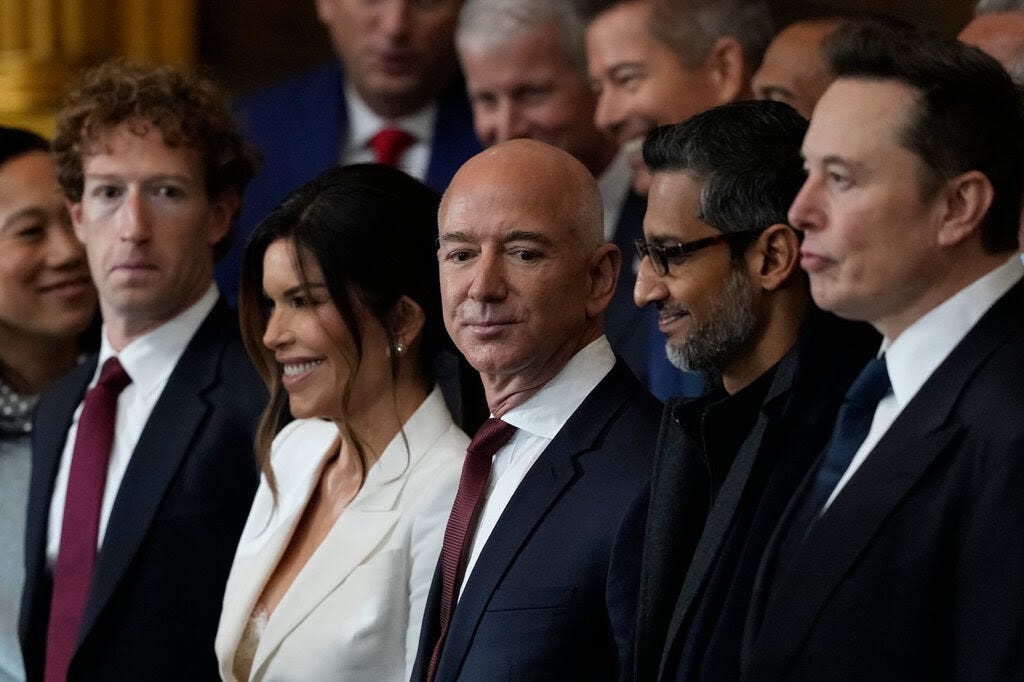
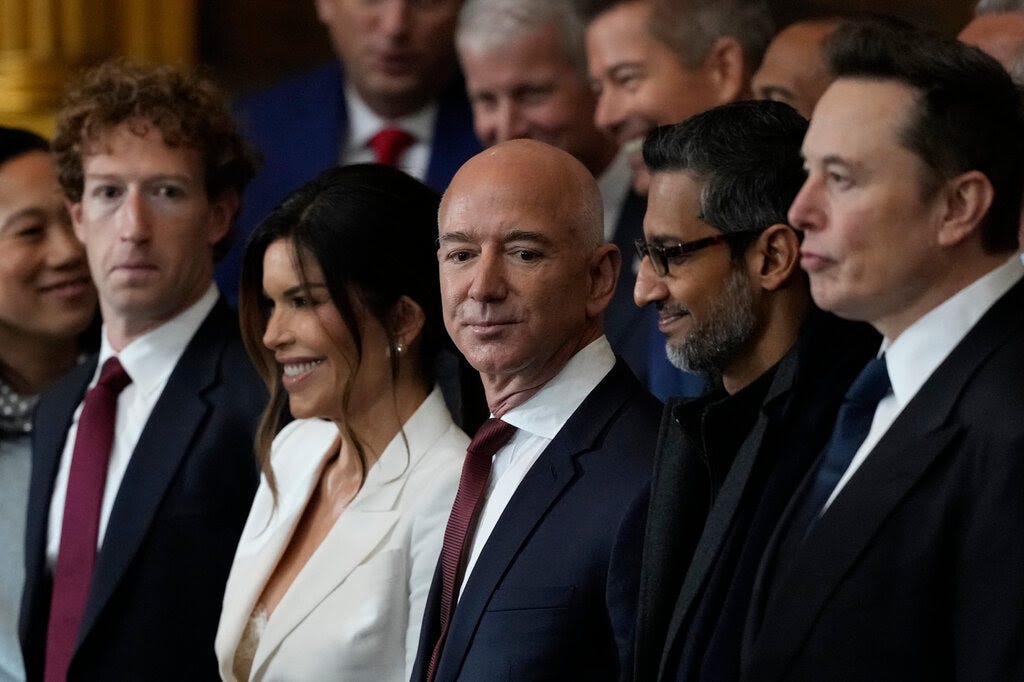
Today’s robber barons at the installation of their president
Friends,
As I mentioned in yesterday’s post, the only good thing to come out of the catastrophe of Trump is the exposure of the greed, venality, cupidity, and corruption of America’s corporate elite.
By giving CEOs of giant corporations and the titans of Wall Street free rein to do whatever they want — as long as they suck up to Trump — plus all sorts of added corporate welfare to those who richly bribe him, Trump has unveiled a truth that the captains of industry have long tried to suppress: that they’re willing to throw average working Americans under the bus to make more billions.
Don’t just take my word for it. I want to introduce you to Gerard Baker, editor-at-large of TheWall Street Journal, who used to be Editor-in-Chief of that distinguished old rag. I have read Baker for years, during which time he has predictably and defiantly extolled the wonders of American capitalism.
But in a recent editorial, Baker says something quite different and remarkable, at least for the editorial pages of the Journal. Although his sympathies most assuredly do not lie with socialism (which he opines is “always and everywhere a disaster”), he makes one of the strongest and most cogent statements I’ve read of what’s wrong with America’s current corporate capitalism.
Gerard Baker
He starts by conceding that, and I quote: “The widespread popular dissatisfaction with the working of modern American capitalism may be the product of some real, objective problems in the way American capitalism is working: income and wealth inequality on a scale not seen in a century; the concentration of economic, cultural and increasingly political power in a class of technology leaders whose products are dissolving the bonds that keep society together; the tightening nexus between business elites and the people who control the political process; rampant corruption and a political establishment that doesn’t seem interested in accountability; the revival, after decades of stable prices, of inflationary pressures that are pushing the cost of living to painful levels.”
I swear I didn’t ghostwrite this.
The editor-at-large of TheWall Street Journal goes on to note, correctly, that “these are the conditions that historically have made for collapsing popular faith in the system and demands for something radical to replace it.”
Baker points out that as inequality widens, social solidarity diminishes. “At some point disintegrating cohesion produces costs — social, economic and political — that undermine the benefits of the inequality and erode support for the system itself.”
He then admits — in contrast to Trump’s nitwitted lapdog secretary of the treasury — that “by almost all measures, American income and wealth inequality have been increasing sharply in recent decades and social and economic mobility falling.”
Baker reviews the evidence: “The New York Federal Reserve reported in June that the labor share of income — wages and salaries — fell to its lowest level in 80 years as returns to capital continue to soar. Studies of intergenerational mobility suggest the inequality is becoming embedded in what looks increasingly like a class-based socioeconomic model. The proportion of Americans earning more than their parents has dropped precipitously in the past 50 years and is expected to drop further. With the adoption of artificial intelligence promising — or threatening — to return ever greater rewards to a diminishing number of those best placed to exploit it, the trends will intensify.”
Finally, TheWall Street Journal’s editor-at-large concludes (and, again, I promise I did not ghostwrite this. I don’t even know the man):
“Most of the causes of America’s economic dysfunction are the result of a capitalism that has mutated into a system run by and for large corporate interests. If you look at America today and see a perfectly functioning free-market economy, a ‘neoliberal’ utopia guided by the invisible hand of Adam Smith, then you need to take off those rose-tinted spectacles and take a closer look: oligopoly-level industrial concentration in almost every sector, endemic cronyism, the application of regulation, legislation and policy for the benefit of big companies, a ruinously expensive healthcare system run principally for the benefit of insurers and pharmaceutical companies. In short, the steady accretion of market, economic and political power by a business-political class that promotes its own well-being at the expense of competition, the market and ultimately the people.”
My friends, when the editor-at-large of TheWall Street Journal — a newspaper that’s been devoted to extolling the virtues of capitalism for most of its 137 years — scolds America’s business-political class for promoting its own well-being at the expense of the American people, well, we’ve come to a giant fork in the road.
For which I credit Trump and the noxious people around him. Were it not for this detestable regime, the top reaches of America’s business-political class would not have gone to such wild extremes and been so garishly exposed —and the Wall Street Journal wouldn’t be rebuking them for threatening the well-being of Americans.
The question now is whether progressives will take up the invitation that the editor-at-large of TheWall Street Journal has so graciously laid out for us: to devise and implement a system that works for the well-being of the people.
We could start with what Gerard Baker seems to suggest — the need for more powerful anti-monopoly measures, including busting up the biggest corporations and banks. Also: a single-payer “Medicare for All” system. Regulations that prevent giant corporations and Wall Street banks from shafting average Americans. And laws that stop big corporate entities from making huge campaign contributions.
Hey, not a bad beginning for TheWall Street Journal.
When the hardback came out last year, I was gobsmacked to see it #1 on TheNew York Times nonfiction bestseller list.
That was after seven months of Trump’s despicable regime. Now, after a year and a half of it, I believe the book even more relevant.
I wrote it to share what I’ve learned about stopping bullies. Since then, Trump’s bullying has become far worse, throughout America and the world. And the unholy alliance Trump has forged between great wealth and great power has only intensified.
I’m proud of much that this nation has accomplished over my lifetime. I remain doggedly hopeful about the long-term future. But, undeniably, we now face a brutal set of crises — an economy that’s good only for the super-rich, a democracy imperiled, the rule of law deteriorating, and a planet succumbing to climate change.
I hope you find my book helpful for understanding how we cope with these crises in the years ahead, and why I believe so passionately that we will.
I also hope you draw insight and inspiration from ideas I offer for how to play the long game, toward a better and more decent nation and world.
—Robert Reich
P.S. You can purchase the paperback through your local bookstore or through Bookshop.org, or wherever books are sold.
I’ve argued that the K-shaped economy — a term used to describe growing inequality between high- and low-income households — can be seen in sales of McDonald’s burgers, whose lower- and middle-income customers fell by double digits in the first quarter of 2025 as they struggled with affordability.
Last Monday, you criticized me, arguing that McDonald’s problems are instead due to competition from rivals like Burger King.
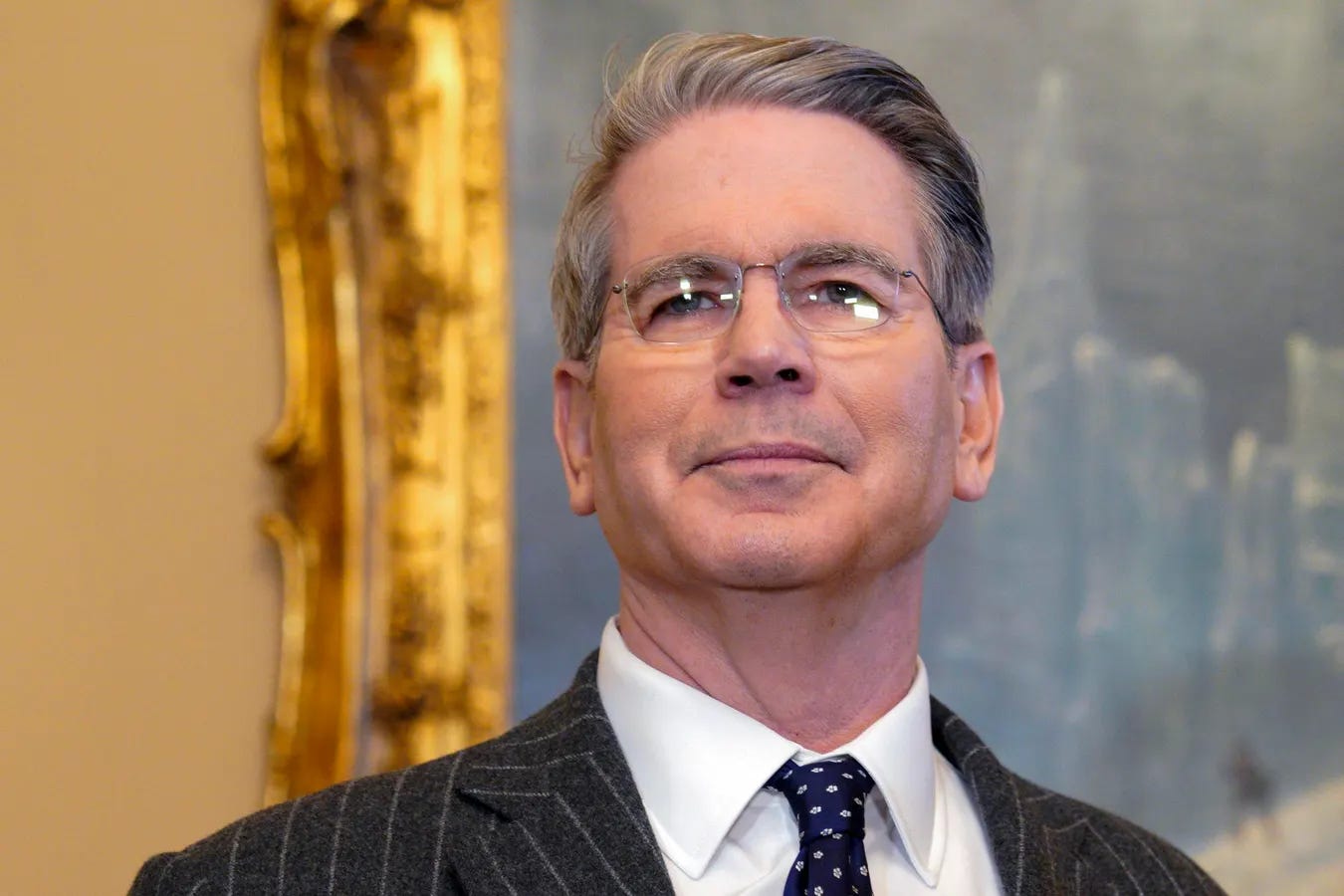
(By the way, Scott, Bill Clinton didn’t fire me and Berkeley won’t, either. But your boss has a well-recorded tendency to fire his Cabinet secretaries, so I’d be careful if I were you.)
In a recent interview on CNBC’s “Squawk Box,” you even declared that the U.S. economy is no longer in a K shape: “I got sick of hearing about this K-shaped economy. I can say here definitively, the K-shaped economy is over.”
As a former Cabinet secretary, I hope you won’t mind if I’m candid with a current one. Scott, your analysis is full of shite. It’s still a K-shaped economy.
Lower-income workers continue to struggle with stagnant wages and inflation, while high-income workers are riding high on the wealth effects of the stock market. Real wages may be growing slightly more for low income than high income, but the booming stock market is mostly benefiting the high income.
Widening inequalities are partly due to policies you and your boss in the Oval Office have been pursuing — especially your tariffs and war in Iran, both of which have been pushing prices upward and imposing a far greater burden on lower-income than high-income Americans.
July’s jobs report showed wage growth falling sharply, with average hourly earnings increasing at the slowest pace in five years — 3.2% year-over-year. Inflation, meanwhile, is not slowing. As a result, consumers’ purchasing power is falling. Prices are now rising 3.5% year-over-year, as wage growth has slowed to just 3.2% — meaning that the real earnings of Americans have been dropping since April.
And I’m not just talking about McDonald’s, Scott. When major retailers reported quarterly results in May, many noted the growing divide between high- and low-income consumers. Wealthier households continue to drive spending, while lower- and middle-income households struggle to keep up. “We certainly see with our higher-income consumers, they’re benefiting probably from the wealth effect of a buoyant stock market,” said Walmart’s CFO John David Rainey. “But with low-income consumers, they don’t necessarily get that benefit, and then it’s a little bit more of paycheck to paycheck.”
Grocery chains like Kroger are considering rolling back prices to gain market share in this K-shaped consumer environment. Target is also trying to adjust to it. We’re “expanding both low, low price points, starting at $1, all the way up to some of the new premium brands,” says Cara Sylvester, who became Target’s chief merchandising officer in mid-February.
On recent quarterly earnings calls, CEOs in grocery, outdoor apparel, and kids’ apparel noted the same K-shape pattern. Kevin Depew, deputy chief economist and industry eminence program leader at RSM, attributes what’s happening to an economy in which lower- and middle-income households face real spending pressure while upper-income consumers remain cushioned by equity gains. Home improvement retailer Home Depot notes the impact of higher fuel costs in particular. “There’s no question that the average consumer is feeling pressure from rising fuel costs,” Home Depot CFO Richard McPhail said.
Other major firms report that premium travel and high-end goods (luxury airline seats and high-tier tech products) have seen double-digit growth, while discount retailers and dollar stores report high demand for basic necessities from budget-constrained consumers.
Researchers at the Federal Reserve Bank of Kansas City confirm the same trend. After analyzing changes in consumer spending between 2021 and 2025, they found that households with high incomes (fourth and fifth quintiles) increased their spending substantially faster than did consumers with low incomes (first to third quintiles). Because inflation-adjusted wage growth for the bottom quartiles has lagged behind top earners, everyday expenses like groceries, rent, and insurance are consuming larger shares of lower-income budgets.
The Federal Reserve’s May Beige Book also reflects this K-shaped divide, noting that higher-income households have remained relatively resilient, while lower-income consumers are showing greater financial strain and increased reliance on credit.
According to Moody’s Analytics, the richest 10% of American earners — composed of households making about $250,000 a year or more — are driving a record 49.7% of total U.S. consumer spending, significantly boosting the economy through the wealth effect of higher stock and home prices. They own over 90% of the value of all shares of stock, so big gains in the stock market have encouraged them to splurge on everything from vacations to designer handbags. “The finances of the well-to-do have never been better, their spending never stronger and the economy never more dependent on that group,” says Mark Zandi, who oversaw the analysis, based on data from the Federal Reserve. Zandi says the K-shaped economy remains “firmly intact.”
All told, rich Americans have increased their spending far beyond inflation, but nobody else has. The bottom 80% of earners spent 25% more than they did four years earlier, barely outpacing price increases of 21% over that period. And they’re going into debt to do so (researchers find auto repossessions and credit card delinquencies rising among lower-to-middle-income borrowers). But the top 10% spent 58% more.
Research by U.S.Bank also shows the K-shaped economy’s divide across household balance sheets, labor market access, generational wealth-building, and sector performance. “Higher-income households are more likely to own homes, equities, and retirement assets,” says Matt Schoeppner, senior economist for U.S. Bank, “allowing them to participate more directly when financial markets and home values rise.”
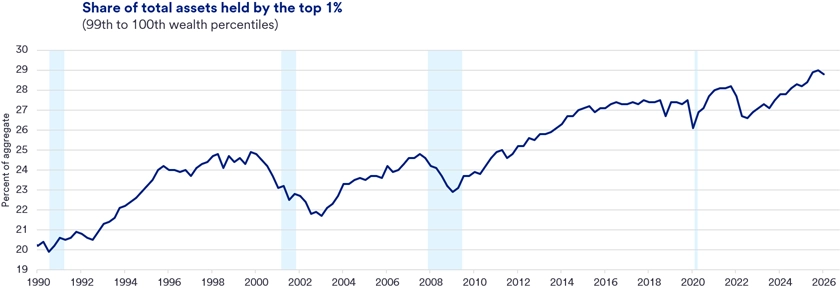
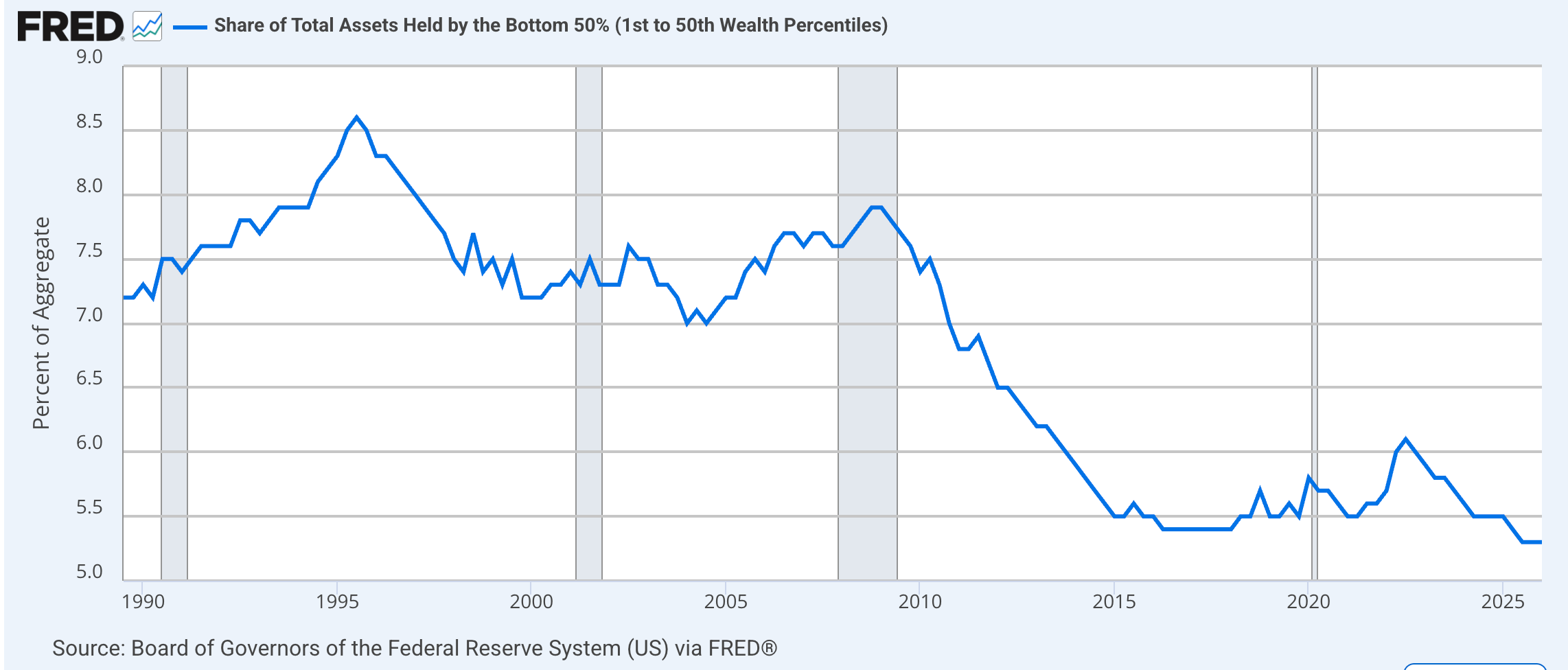
Federal Reserve distributional data reveal that wealth is increasingly concentrated. As of the fourth quarter of 2025, the richest 1% of Americans held 29.2% of the nation’s aggregate wealth (up from around 20% in the early 1990s), compared with just 5.3% for the bottom half.
Meanwhile, lower- and middle-income households are struggling. “Wage gains for most have been moderating, while essential costs for rent, groceries and gasoline remain elevated,” notes Schoeppner. “At the same time, savings buffers have continued to narrow while reliance on credit — particularly credit cards — has increased.”
Scott, what more evidence do you need? If this isn’t a K-shaped economy, what is it?
The labor market further reveals the K-shape. Hiring rates have fallen to 15-year lows of around 3.2% while layoff rates remain near historically low levels of 1.1%. In this “low-hire, low-fire” environment, workers who are already employed have some stability, but job seekers and those looking to advance are in trouble.
This is significant because mobility is the major way for workers to improve earnings, move into higher-productivity roles, and build financial buffers. “When hiring slows and job-switching premiums narrow,” says Beth Ann Bovino, U.S. Bank’s chief economist, “pathways to higher pay and better job matches become more limited.”
As a result, the labor market can appear stable at the aggregate level while becoming less dynamic beneath the surface — particularly for workers in lower-wage or more cyclical industries.
I’ve got to emphasize how badly the war in Iran is aggravating this K-shaped divide. U.S. Bank’s Schoeppner notes that “the resulting higher gasoline prices … may be more of an inconvenience for higher-income households, but for those with thinner buffers, they can quickly crowd out discretionary spending.” The San Francisco Fed has similarly noted that elevated gasoline and grocery costs are consuming a larger share of household budgets among the bottom 80%.
Credit conditions reveal the same widening divide. Bovino notes that lower-income households “tend to rely more heavily on higher-cost borrowing and devote a larger share of income to debt service, leaving them more sensitive to higher rates and reduced credit availability.” Recent Beige Book commentary also points to increased reliance on credit among lower-income households. The April 2026 Senior Loan Officer Opinion Survey shows tighter lending standards across key segments, suggesting that access to financing is becoming more constrained.
Scott, it’s important that you and your colleagues at the treasury and elsewhere in the Trump administration know what’s going on. The K-shaped economy can make the macro environment appear more stable than it is actually experienced by average working Americans. The fact is, the overall health of the economy increasingly depends on a narrowing base of consumption coming from the wealthy — who are spending because their stock market assets have risen so high but will stop spending if and when the stock market comes back to earth.
Meanwhile, inflation and credit pressures continue to land especially hard on lower-income Americans. In that sense, the K-shaped economy is not just a feature of recent cycles. It’s become the defining characteristic of how today’s economy absorbs shocks and generates growth.
Go ahead, Scott — attack me with all the ad hominem arguments you want. But you need to know the reality I’m talking about. You’re the one with the power. I’m just a retired professor. Your failure to comprehend the struggles facing average working Americans makes me worry that you and your boss will continue to pursue policies that worsen them.
It is important to understand that Trump is not the cause of the enshittification of America. He is a consequence. Unless the system is fundamentally changed, the enshittification will continue even after Trump is long gone.
As I’ve shown, wealth and power in America now reside in a relatively small group of (almost entirely) men — the American oligarchy. My prime example has been Jamie Dimon, chair and CEO of JPMorganChase, the largest bank in the world — because he’s regarded by corporate Democrats as the most trusted business leader in America — but I could equally focus on Peter Thiel, Jeff Bezos, Mark Zuckerberg, Elon Musk, Larry and David Ellison, or any other billionaire using his vast wealth to create and enhance his political power.
The Core Contradiction
The oligarchy is not interested in serving America, yet it dominates American politics and essentially runs the American system.
The oligarchy is not committed to the common good. It does not seek to raise the wages of working Americans, reduce inequalities of wealth and opportunity, guarantee all Americans access to good healthcare and a world-class education, or stop climate change.
The oligarchy’s allegiance is to itself, and its major interest is enlarging its wealth and power. The easiest way for the oligarchy to accomplish this is to hold down the wages of working people, roll back regulations, enlarge its monopolies, find ever-cheaper places around the world to produce products and services, fight unions, and secure giant tax cuts for it and its corporations that result in less money for education, healthcare, and everything else most Americans need.
The oligarchy cannot fulfill both roles: It cannot advocate for its giant banks or monopolistic corporations and simultaneously lead the nation. Dimon may sincerely believe that he’s a patriot before he’s the CEO of JPMorgan, but we would be foolhardy to rely on it.
The difficulty is not that corporate power is beyond the control of the American government. It is that corporate power controls the American government. Yet giant American corporations have no special allegiance to the United States and no responsibility for the well-being of Americans.
This contradiction has spawned three big conventional ideas about the American system that are dangerously wrong.
Conventional but deceptive idea #1: Americans are richer than the citizens of other rich nations
A few Americans are, but the vast majority are not, when you consider all the public benefits that the citizens of other nations receive. Note, for example, that:
— Most citizens of other wealthy nations receive free or nearly free healthcare, and most get free or nearly free college tuition. Americans receive neither.
— Among the three dozen wealthy countries in the Organization for Economic Cooperation and Development, the United States has the lowest minimum wage when measured as a percentage of the median wage. The typical American worker puts in more hours on the job than Canadian, European, or Japanese workers.
— The United States is the only wealthy nation that does not guarantee paid family leave. In Europe, the norm is three months paid leave. At most, Americans get 12 weeks of unpaid leave.
— America is also the only rich nation that does not guarantee paid sick days. It is the only one that does not guarantee workers any vacation at all. The European Union’s 28 nations guarantee at least four weeks of paid vacation.
— In other rich nations, most people who lose their jobs receive more generous unemployment benefits than do Americans. Employers cannot fire workers at will, as they can here.
— American corporations distribute a smaller share of their earnings to their workers than do European or Canadian-based corporations.
— Top corporate executives in America make far more money than their counterparts in other wealthy countries, and inequality of income and wealth is far wider in the United States than it is in any other wealthy country.
— The American middle class is no longer the world’s richest. Considering taxes and transfer payments, middle-class workers in Canada and much of Western Europe are better off than in the U.S. The working poor in Western Europe earn more than do the working poor in America.
Why are most Americans poorer than the citizens of most other rich nations? It is because of the way power is allocated and wielded in the United States, by contrast with other rich countries. Consider:
— Labor unions are stronger in Europe and Canada than they are in America, able to exert pressure both at the company level and nationally. Only 6 percent of American private-sector workers are unionized. As former New York Times labor correspondent Steven Greenhouse has observed, “In no other industrial nation do employers fight so hard to defeat, indeed quash, labor unions.” Over 25 percent of Canadian workers belong to a union, as do 37 percent of Italian workers, 67 percent of workers in Sweden, and 25 percent in the U.K.
— Most other rich nations are parliamentary systems in which workers are represented by parties that specifically advocate for them. The United States has a two-party system in which the winning party gets all of a state’s electoral votes, thereby discouraging third parties.
— Elections in other rich nations are less affected by big money than are elections in the United States, because other nations have stricter restraints on money in politics.
— Governments in these nations often devise laws through tripartite bargains involving big corporations and organized labor, which further binds their corporations to their nations’ workforces.
For all these reasons, Americans don’t get nearly as good a deal as do the citizens of other rich nations. Governments elsewhere impose higher taxes on the wealthy and redistribute more of it to middle- and lower-income households.
Conventional but deceptive idea #2: The “free market” is separate from government
The second conventional idea perpetrated by the American oligarchy is that we work and live in a “free market” that’s neutral and natural — existing outside government, unaffected by how power is wielded in the system.
We are repeatedly told that whatever inequalities and insecurities the market generates and whatever negative consequences it causes are beyond our control. Efforts to reduce inequality or insecurity are described as constraints on the market’s freedom, likely to cause grave unintended consequences.
By this view, if some people aren’t paid enough to live on, the “free market” has determined they aren’t worth enough. If others rake in billions, they must be worth it. If millions of Americans are unemployed or their paychecks are shrinking or they work two or three part-time jobs with no idea what they’ll earn next month or next week, that’s just the natural outcome of market forces.
If the planet’s survival is endangered because of fossil fuels, that’s at most an “imperfection” in the market. If government attempts to deal with such market imperfections, it must do so modestly and carefully because the “free market” knows best. As Jamie Dimon put it, “Don’t mess up the machine that creates the value so you can do these things. The economy is what gave us everything.”
This is bunk. In reality, the “free market” is nothing but a set of laws and rules about: What can be owned and traded (corporations? slaves? machine guns? nuclear bombs? babies? votes? the right to pollute?). On what terms (hostile takeovers? corporate monopolies? the right to organize unions? a minimum wage? the length of patent protections?). Under what conditions (uninsured derivatives? fraudulent mortgages? mandatory arbitration of disputes?). How to repay what’s owed (debtor’s prison? bankruptcy? corporate bailouts?). What’s private and what’s public (clean air and clean water? healthcare? good schools?). And how to pay for what’s deemed to be public (corporate taxes? personal income taxes? a wealth tax?).
These laws and rules do not exist in nature. The “free market” is created by people. The central issue is not more or less government. It’s who is government for? This is a question of power — who has it, and who doesn’t.
If democracy were working as it should, government officials would make the laws and rules of the “free market” according to what most citizens need. But in our current system, the rules are made mainly by those with the power and wealth to buy the politicians, agency heads, and even the courts and the lawyers who appear before them). As income and wealth concentrate at the top, so does political leverage.
As a result:
— Intellectual property rights — patents, trademarks, and copyrights — have been continuously enlarged and extended. This had created windfalls for pharmaceutical, high tech, biotechnology, and entertainment companies, which can preserve their monopolies longer than ever. It also means higher prices for American consumers, including the highest pharmaceutical costs of any advanced nation.
— Antitrust laws have been relaxed or nullified, resulting in larger profits and bigger political clout for the dominant corporations and higher prices and less leverage for workers.
— Labor laws have been weakened, allowing corporations to fire workers who try to join or form unions, with the only consequence that the corporation may be required to reinstate the workers and give them back pay after long and involved proceedings.
— Financial laws and regulations instituted in the Great Depression decade of the 1930s have been abandoned, allowing the largest Wall Street banks to acquire unprecedented influence over the economy.
— Bankruptcy laws have been loosened for large corporations but tightened for homeowners and graduates laden with student debt. The largest banks and auto manufacturers have been bailed out of a financial crisis, but homeowners — disproportionately low-income minorities — have not.
— Contract laws have been altered to require mandatory arbitration before private judges selected by big corporations.
— Securities laws have been relaxed to allow insider trading of confidential information. CEOs use stock buybacks to boost share prices and cash in their stock options.
— Tax laws have created loopholes for the partners of hedge funds and private-equity funds. They also contain special favors for the oil and gas industry.
— The top marginal income-tax rates have been lowered, corporate taxes have been reduced, and estate taxes on great wealth have been eliminated.
— Regulations that protect health, safety, and the environment have been repealed, rolled back, riddled with exemptions, or simply unenforced. Public health has declined.
— Schools in working-class and poor areas have become dependent for most of their funding on local property taxes, which aren’t enough to provide excellent schools. Hence, the notion of equal opportunity has become a bad joke.
The result of this vicious cycle is a giant but hidden upward distribution of income and wealth from the bottom 90 percent to the top.
Another consequence is growing anger and frustration felt by people who are working harder than ever but getting nowhere, accompanied by deepening cynicism about our democracy. That anger, frustration, and cynicism is corroding the moral foundation of our society. It has elected Trump, twice.
Conventional but deceptive idea #3: Corporations exist only for shareholders
The late economist Milton Friedman famously urged CEOs to give up stakeholder capitalism — under which the welfare of workers, communities, and the nation as a whole was considered in corporate decision-making, as well as shareholders. “What does it mean to say that ‘business’ has responsibilities?” Friedman wrote in 1970. “Businessmen who talk this way are unwitting puppets of the intellectual forces that have been undermining the basis of a free society these past decades.”
Michael Jensen, an economics professor who arrived at the Harvard Business School in 1984, gave academic ballast to the notion that the sole purpose of the corporation should be to maximize shareholder returns. In his many papers, public lectures, and oversubscribed classes — from which generations of business school students launched careers on Wall Street and in management consulting — Jensen reasoned that hostile takeovers disciplined what he termed “inefficient firms.”
Jensen forgot one big thing. He overlooked those who would bear the burden of the changes he pushed for. There have been several unfortunate consequences to Friedman and Jensen’s mistaken idea.
— The rise of corporate takeovers (now often undertaken by private equity). As Jensen predicted, stockholders of targeted companies have done well. That’s because the so-called “efficiency” gains have gone to them, as well as to the raiders and top corporate executives.
The costs of these maneuvers and of the obsession with maximizing share values, however, have been borne by workers who have been sacked, or whose paychecks have stagnated and whose benefits have been cut, and by communities that have been left behind.
The academic conceit that workers are simply “resources” that will move to “higher valued uses” has proven to be crushingly and cruelly naïve. Human beings are not like financial resources. They do not move easily or seamlessly to different jobs and other places. They are rooted in families and communities. They have particular skills, established routines, abiding understanding of positions and roles. They depend on some degree of security, predictability, and stability. They want to be respected and valued.
When “efficiency” gains go to a comparatively few people at the top, while the costs and burdens are borne by many others — as has been the case since the 1980s — the common good is not improved. It is cast to the winds.
— The monopolization of America. After 1980, antitrust law all but disappeared. The new view — popularized by a Yale Law School professor, subsequently Judge Robert Bork — was that large corporate size produced economies of scale, which were good for consumers, and anything that was good for consumers was good for America.
Power was no longer at issue. This was exactly the message that America’s emerging corporate oligarchy wanted to hear. They used the façade of Bork’s pinched academic analysis to justify killing off antitrust. Since the 1980s, after the federal government all but abandoned antitrust enforcement, two-thirds of all American industries have become more concentrated.
Monsanto now sets the prices for most of the nation’s seed corn. The government green-lighted Wall Street’s consolidation into five giant banks, of which JPMorgan is the largest.
Just four giant airline carriers now dominate the skies, down from 12 in 1980. American, Delta, Southwest, and United now control 80 percent of domestic seating capacity. Meanwhile, the merger of Boeing and McDonnell Douglas has left America with just one major producer of civilian aircraft, Boeing.
Three giant cable companies dominate broadband (Comcast, AT&T, Verizon). A handful of drug companies control the pharmaceutical industry (Pfizer, Eli Lilly, Johnson & Johnson, Bristol-Myers Squibb, Merck).
Just five giant high-tech behemoths preside over key portals and platforms (Amazon, Facebook, Apple, Microsoft, Google), together comprising more than a quarter of the value of the entire U.S. stock market.
Facebook and Google are the first stops for many Americans seeking news, and account for almost half of all advertising dollars spent in the United States. Apple dominates smartphones and laptop computers. Nearly 90 percent of all internet searches now go through Google. Amazon is now the first stop for a third of all American consumers seeking to buy anything.
All this consolidation has inflated corporate profits, suppressed worker pay, supercharged economic inequality, and stifled innovation. Amazon has put most bookstores out of business and is rapidly eroding retail businesses on the nation’s Main Streets. Google employs the world’s most widely used search engine to promote its own services and Google-generated content over those of competitors, like Yelp.
Facebook’s purchases of WhatsApp and Instagram killed off two potential rivals. This mega-concentration of American industry has made it harder for newer firms to gain footholds. The rate at which new businesses have been formed in the United States has been halved since 1980.
In many locales workers have less choice of whom to work for, which is also holding down their wages. Corporations are imposing additional conditions on workers that further weaken their bargaining power, such as noncompete, anti-poaching, and mandatory arbitration agreements.
Giant firms that dominate an industry also gain political power. They provide significant campaign contributions, have platoons of lobbyists and lawyers, and directly employ many voters.
As a result, their CEOs’ phone calls to members of Congress are promptly returned. Items they want included in legislation are dutifully inserted; those they don’t want are scrapped. They get the tax loopholes, subsidies, bailouts, regulatory exemptions, and loan guarantees they seek. They can stop laws in their tracks. Never underestimate the monetary value of such largesse. The financial returns on political investments are among the highest in the whole system.
Power has shifted in exactly the opposite direction for workers.
— The near disappearance of labor unions. Starting in the 1980s and with increasing ferocity since then, private-sector employers have fought unions. Ronald Reagan’s decision to fire the nation’s air-traffic controllers, who went on an illegal strike, signaled to private-sector employers that fighting unions was legitimate.
But it was really the wave of hostile takeovers (now often engineered by private equity funds) — the shift from stakeholder to shareholder capitalism — that pushed employers to crush unions. Payrolls are typically 70 percent of a corporation’s costs. The most direct way to raise profits and share prices is to cut payroll costs. The first step was to bust unions.
Corporations have replaced striking workers with non-union workers. Previously, when management was responsible to all stakeholders, workers who went on strike typically got their jobs back as soon as a strike was settled.
Shareholder capitalism changed this radically. Now, striking workers often lose their jobs forever. As Fortune magazine observed, “Managers are discovering that strikes can be broken, that the cost of breaking them is often lower than the cost of taking them, and that strike-breaking … doesn’t have to be a dirty word.”
Corporations have also threatened to move jobs overseas if workers don’t agree to pay cuts. Corporations have fired workers who try to organize, a move that’s illegal under the National Labor Relations Act but happens all the time because the penalty for doing so — restoring fired workers to their jobs along with back pay — is small relative to the profits that come from discouraging unionization.
Corporations also mount campaigns against union votes, warning workers that unions will make them less “competitive” and threaten their jobs. All the while, corporations have been relocating to states where so-called “right-to-work” laws bar unions from requiring dues from workers they represent. The Supreme Court, in an opinion delivered by the court’s five Republican appointees, has extended “right-to-work” to public employees.
The pressure has come from corporate raiders and their more recent incarnations, private-equity and hedge fund managers, demanding ever higher profits. Institutional investors (the managers of mutual funds, insurance funds, pension funds, endowments, and private equity funds) are just behind them, rooting them on. As power has shifted from workers to them, many of these investors and financial managers have become fabulously wealthy.
Meanwhile, as unions have shrunk, so has their political power. In 2009, even with a Democratic president and Democrats in control of both houses of Congress, unions could not muster enough votes to enact a simple reform that would have unionized workplaces as soon as a majority of employees signed pro-union cards.
Obama didn’t fight for this. Some Democrats, threatened by groups like the Business Roundtable, wouldn’t vote for it. When the legislation was introduced, 180 business executives descended on Capitol Hill to meet with swing senators. Corporations ran $1 million worth of television ads against the bill in Nebraska alone in order to pressure one vacillating Democrat, Nebraska Senator Ben Nelson, to vote no. He obliged.
— Hence, record-setting inequality. This great shift in bargaining power from workers to corporations and their shareholders has pushed a larger portion of national income into profits and a lower portion into wages than at any time since World War II.
Most of these profits are going into higher share prices (fueled by share buybacks) and higher executive pay rather than new investment.
The declining share of total U.S. income going to the bottom 90 percent over the last four decades correlates directly with this decline in unionization. No other change in the system provides as clear a relationship.
Meanwhile, and for the same reason, the rising share of total income going to the richest Americans is inversely related to the share of the nation’s workers who are unionized. The American economic pie continues to grow but most workers are getting only crumbs.
Most of the increasing value of the stock market has come directly out of the pockets of American workers. Three researchers — Daniel Greenwald at MIT’s Sloan School of Business, Martin Lettau at Berkeley, and Sydney Ludvigson at NYU — found that “from 1952 to 1988, economic growth accounted for 92 percent of the rise in equity values,” but that from 1989 to 2017, economic growth was responsible for just 24 percent of the rise. Most of the increase in share values has come from “reallocated rents to shareholders and away from labor compensation.”
America’s shift from farm to factory was accompanied by decades of bloody labor conflict. The shift from factory to office and other sedentary jobs created other social upheaval.
The more recent power shift from workers to large corporations and their shareholders — and consequentially, the dramatic widening of inequalities of income, wealth, and political power — has happened far more quietly, but it has had a more unfortunate and more lasting consequence for the system: an angry working class vulnerable to demagogues peddling authoritarianism, racism, and xenophobia.
Corporate profits have reached record levels and share prices have soared. This has been a boon to shareholders, especially the richest 1 percent of Americans who own about half of the value of all shares of stock, and the richest 10 percent who own over 90 percent.
Top corporate executives, whose pay is linked to share prices, have reaped a bonanza. Pay on Wall Street has reached jaw-dropping heights. But most Americans have not benefited. Many have lost ground. For most, wages have been flat or have declined, their jobs have become less secure, and their pensions have been turned into 401(k)s or have disappeared altogether. Abandoned communities now litter the nation. Entire regions of the country have been left behind.
Executives claim they have a “fiduciary obligation” to maximize shareholders’ returns. This argument is rubbish. It’s also tautological. It assumes that shareholders are the only people worthy of executive concern.
Yet as a practical matter they are not the only parties who invest in corporations, or who bear some of the risk that the value of their investments might drop. All Americans are stakeholders in the American economy.
Workers who have been with a firm for years develop skills and knowledge unique to it. Others may have moved their families to take a job with the firm, buying homes in the community.
The community itself may have invested in roads and other infrastructure to accommodate the corporation. When a firm abandons those workers and those communities, these stakeholders lose the value of their investments. Why should no account be taken of their stakes?
Corporation after corporation began laying off workers in the 1980s without easing the often difficult transitions that followed — without providing workers with severance payments, job retraining, job search assistance, job counseling, help in selling homes whose values predictably dropped when businesses left town, or help moving to where jobs existed.
They laid off large numbers of workers without aiding affected communities that were being jettisoned, or seeking to attract other businesses to make up for their losses of jobs and tax revenue, or finding other uses for the abandoned infrastructure of schools, roads, pipes, and real estate. And without giving workers and communities sufficient advanced notice so they could plan their own transitions.
Absent any of this, millions of Americans were left to fend for themselves. It was a systemic change that would scar the nation for decades, contributing to rising anxiety, anger, and resentment across the land, and eventually lead to the election of Trump.
As big corporations have grown larger over the last 40 years and labor unions weaker, wages have stagnated and profits have increased. It has been a direct transfer: A steadily larger portion of corporate revenues have been siphoned off to profits and a shrinking portion to wages. A growing share of the total economy, likewise, has gone to profits and a smaller share to wages. The stock market has soared. Workers have slumped.
Shifting Power Back to Workers: We’ve Done it Before
The way to end this vicious cycle is to reduce the huge accumulations of wealth that fuel it, and to get big money out of politics. But neither can can be accomplished when wealth and power are compounding at the top. It’s a chicken-and-egg dilemma.
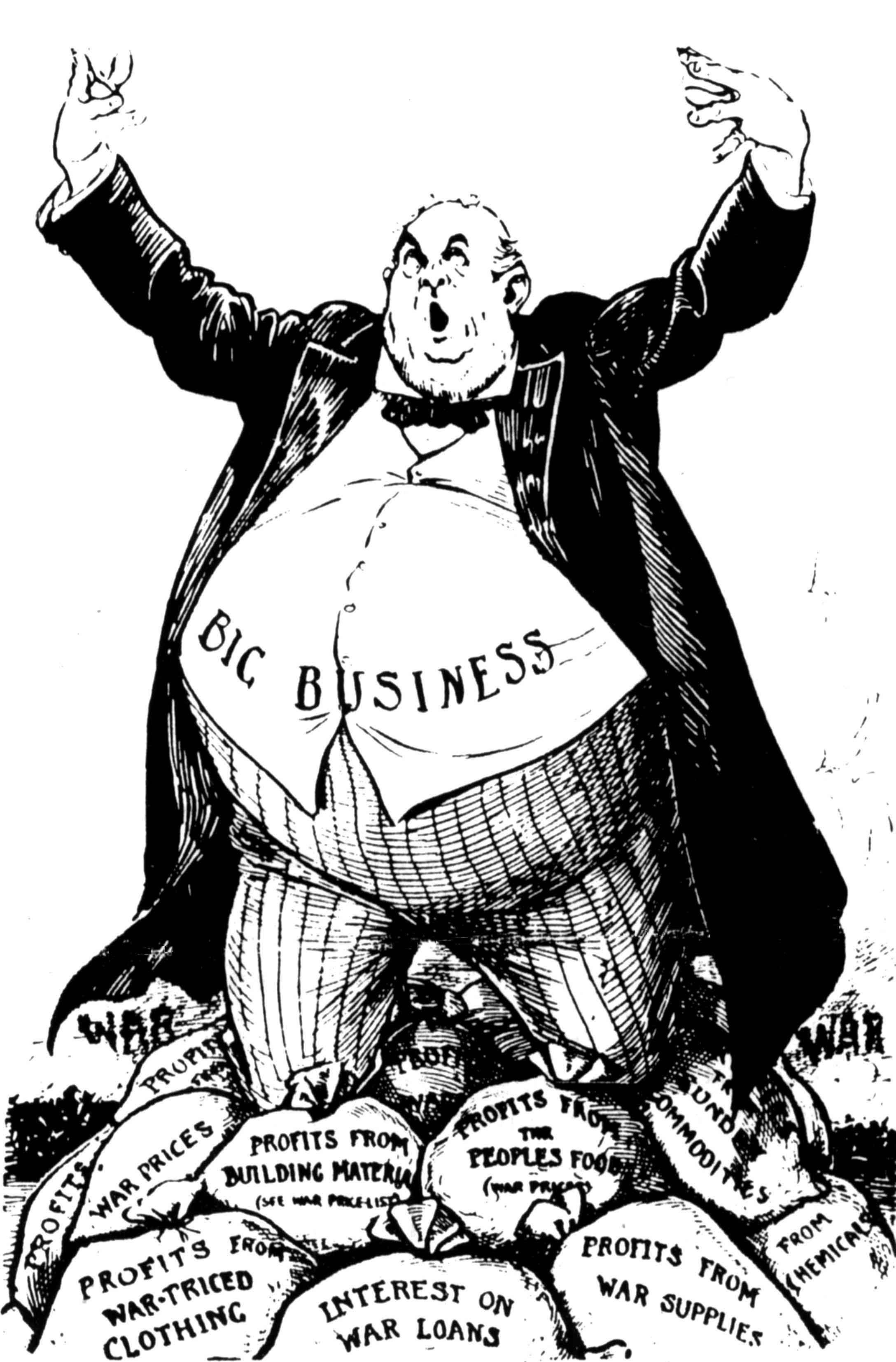
Yet such vicious cycles have been reversed before. In the early 20th century progressives reclaimed our economy and democracy from the robber barons of the first Gilded Age.
The political power that flowed from concentrated economic power was a central concern of the thinkers, writers, and muckrakers of that Gilded Age, starting in the 1890s. “Liberty produces wealth, and wealth destroys liberty,” wrote Henry Demarest Lloyd in his popular 1894 book Wealth Against Commonwealth. “The flames of the new economic evolution run around us, and we turn to find that competition has killed competition, that corporations are grown greater than the State … and that the naked issue of our time is with property becoming master, instead of servant.”
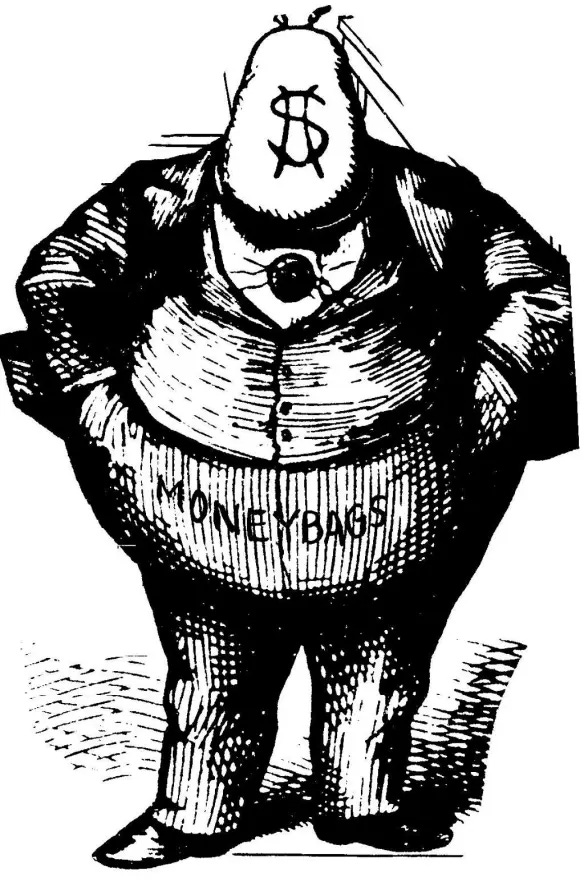
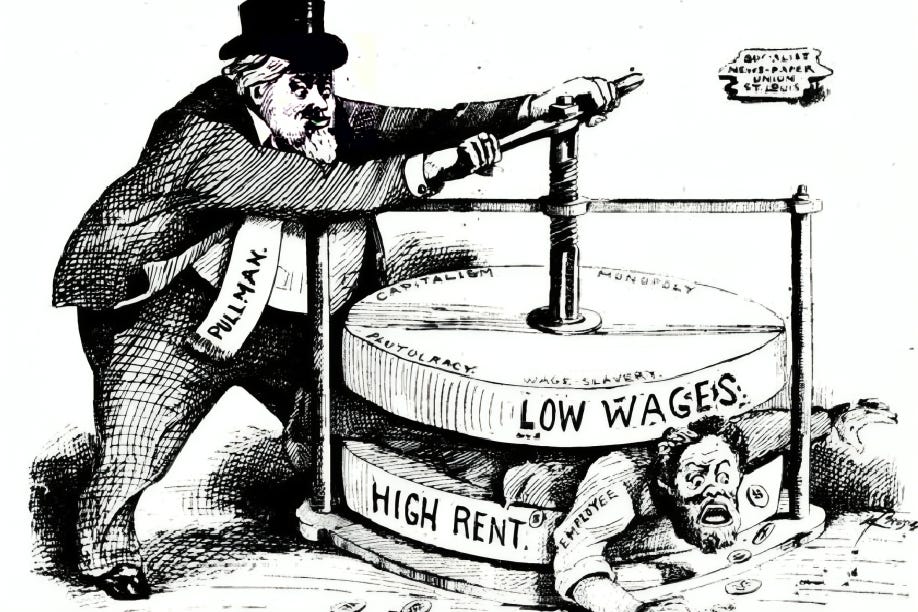
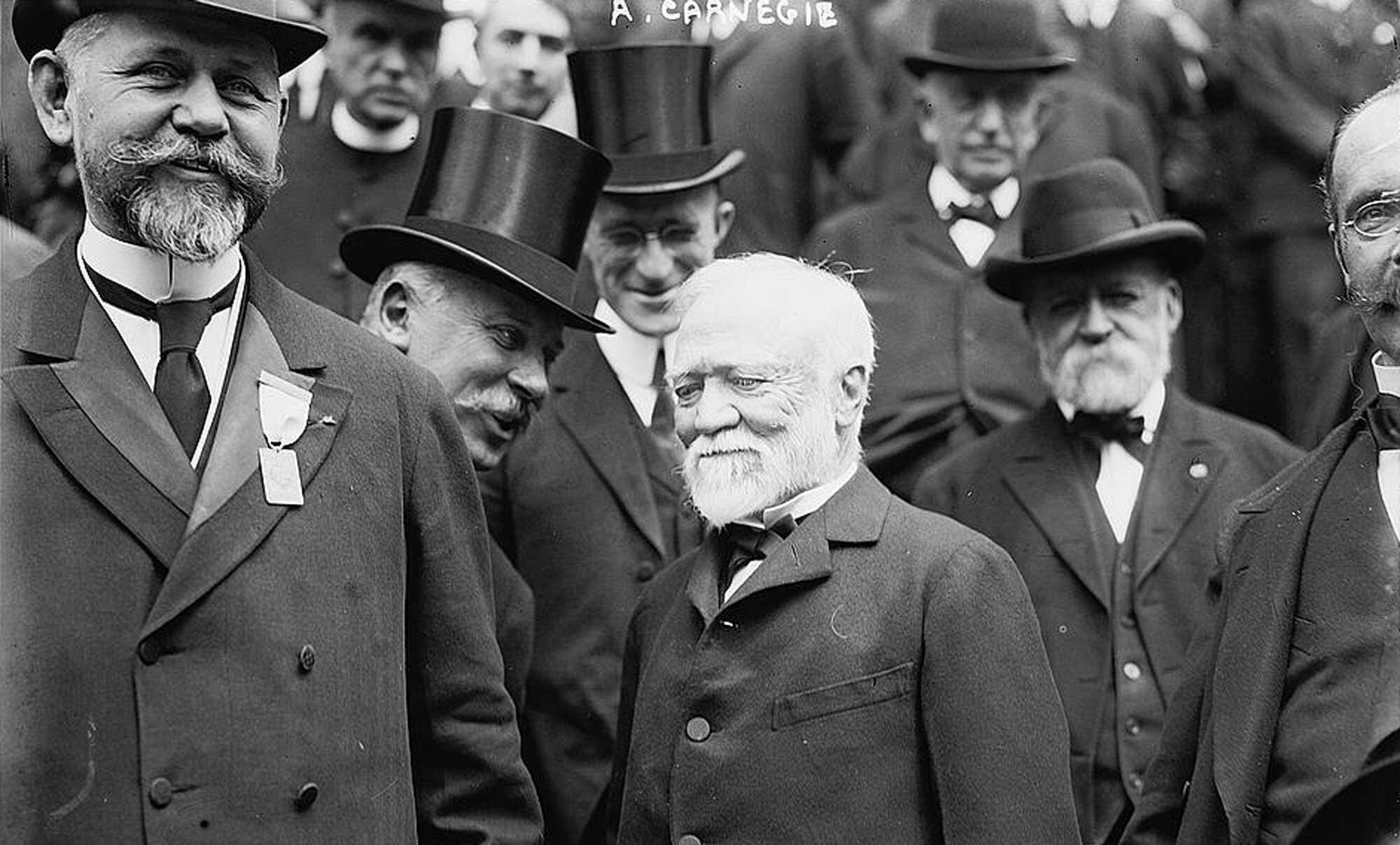
The field now called economics was then called “political economy,” and the public quickly came to understand that corporate power could undermine both the economy and democracy. Recall that this was the era of the robber barons whose steel mills, oil rigs and refineries, and railroad laid the foundations for America’s industrial might, but who also squeezed out rivals who threatened their dominance, ran their own slates for office, impoverished their workers, and brazenly bribed public officials — even sending lackeys with sacks of money to be placed on the desks of pliant legislators.
“What do I care about the law?” railroad magnate Cornelius Vanderbilt famously growled. “Hain’t I got the power?” Forty-eight of the 73 men who held Cabinet posts between 1868 and 1896 either lobbied for railroads, served railroad clients, sat on railroad boards, or had relatives connected to the railroads.
The public became enraged. “The enterprises of the country are aggregating vast corporate combinations of unexampled capital, boldly marching, not for economic conquests only, but for political power,” warned Edward G. Ryan, chief justice of Wisconsin’s Supreme Court. “Which shall rule — wealth or man; which shall lead — money or intellect; who shall fill public stations — educated and patriotic free men, or the feudal serfs of corporate capital?” Reformer Mary Lease charged that “Wall Street owns the country. It is no longer a government of the people, by the people and for the people, but a government of Wall Street, by Wall Street and for Wall Street.”
Antitrust — anti-monopoly — law was viewed as the means of breaking the link between the economic and political power of the new combinations. On introducing his antitrust bill in 1890, Republican senator John Sherman of Ohio thundered, “If we will not endure a king as a political power, we should not endure a king over the production, transportation, and sale of any of the necessaries of life.” Sherman’s bill passed the Senate 51 to 1, moved quickly through the House without dissent, and was signed into law by President Benjamin Harrison on July 2, 1890.
Theodore Roosevelt — condemning the “malefactors of great wealth” who were “equally careless of the working men, whom they oppress, and of the State, whose existence they imperil” — used Sherman’s Antitrust Act against E. H. Harriman’s giant Northern Securities Company, with which Harriman dominated transportation in the northwest. As Roosevelt later recounted, the lawsuit “served notice on everybody that it was going to be the Government, and not the Harrimans, who governed these United States.”
President William Howard Taft broke up John D. Rockefeller’s sprawling Standard Oil Trust in 1911. President Woodrow Wilson explained the danger of excessive economic and political power in his 1913 book, The New Freedom: “I do not expect to see monopoly restrain itself. If there are men in this country big enough to own the government of the United States, they are going to own it.”
Wisconsin’s “fighting Bob” La Follette instituted the nation’s first minimum wage law. Presidential candidate William Jennings Bryan attacked the big railroads, giant banks, and insurance companies.
The reform movement spread. Suffragettes like Susan B. Anthony secured women the right to vote. Reformers like Jane Addams successfully pushed for laws protecting children and the public’s health. Organizers like Mary Harris “Mother” Jones spearheaded labor unions.
The progressive era welled up because millions of Americans saw that wealth and power at the top was undermining American democracy and stacking the economic deck. Millions of Americans overcame their cynicism and began to mobilize.
In many important respects, the progressive era laid the foundation for the New Deal of the 1930s and the prosperity of the first three decades after World War II — featuring a growing middle class, a steadily more inclusive democracy, and a nation beginning to grapple with problems like poverty, inequality of opportunity, and environmental decay.
Black Americans and women slowly gained footholds in the system. Mass production begat mass consumption, and mass consumption relied on steady jobs with good wages. This balance relied on strong unions, a government willing to regulate corporations, and large corporations rooted in their communities and responsible for the well-being of their employees and neighbors as well as shareholders.
But over the last 40 years, the gains made then have disappeared. The opposite has occurred: The middle class has shrunk, democracy is malfunctioning, and the nation has turned its back on climate change, poverty, widening inequality, and the evils of racism and xenophobia.
As I’ve said, the economy doesn’t have to be a zero-sum game in which winners do better only to the extent losers do worse. But power is necessarily a zero-sum game. Certain people have it only to the extent other people do not. The connection between the economy and power is critical. As power has concentrated in the hands of a few, those few have grabbed nearly all the economic gains for themselves.
The oligarchy has triumphed not because Jamie Dimon, Jeff Bezos, Mark Zuckerberg, Elon Musk, Larry and David Ellison, or Trump have directly conspired to make it happen. I doubt any of them think about the system as a whole. They have triumphed because no one paid attention to the system as a whole — to the consequences of the shifts from stakeholder to shareholder capitalism, from strong unions to giant monopolistic corporations, and from regulated to unfettered finance.
The choices that the American public assumed were at stake — the so-called political “right” versus “left,” Republican versus Democrat, free market versus government, socialism or capitalism — distracted us from the more fundamental questions about power: Who is gaining it? Who is losing it? For what purpose? Are we satisfied with the results?
Through it all, Americans have clung to the meritocratic tautology that individuals are paid what they’re “worth” in the “free market,” without examining changes in the legal and political institutions that define the market. The tautology is easily confused with a moral claim that people deserve what they are paid.
Yet this claim is meaningful only if the system’s legal and political institutions are morally just. It has lured us into thinking nothing can or should be done to alter what people are paid because the market has decreed it. By this logic, the oligarchy is natural and inevitable. It is not. It is a cancer on our society. It is the cause of the enshittification of America.
Unless reversed, today’s concentration of wealth could soon resemble the kind of dynasties common to European aristocracies in the 17th and 18th centuries. Six out of the 10 wealthiest Americans alive today are heirs to prominent fortunes. The coming tsunami of artificial intelligence is likely to further entrench and enlarge oligarchic wealth.

 Login