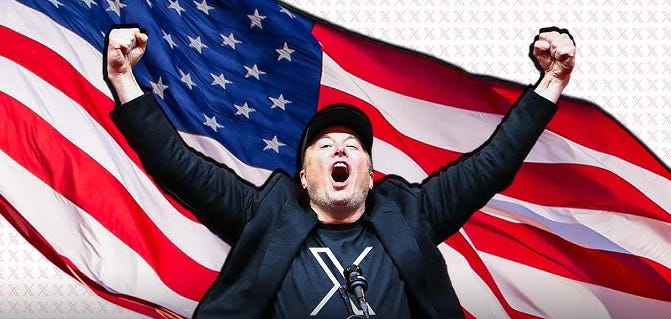
Elon Musk will be spending $100 million to $120 million in at least eight states to help elect Republicans in November, according to The New York Times.
Musk’s spending is set to begin next month, targeting Senate races in Alaska, Iowa, Maine, Michigan, and Ohio, and potentially North Carolina, Georgia, and Texas. Musk will also spend in House ra…
This morning, while standing in line at a local deli, I met an older couple named Larry and Wendy. They are from Galveston, Texas, and are briefly in northern California visiting their children.
“We recognized you,” Larry said, with a broad smile. “Just want you to know we’re Democrats! Can’t admit that to too many people in Texas!” he laughed.
“Welcome to California!” I said, grinning and extending my hand.
When Larry reached out, I couldn’t help notice that his fingers were almost curved shut. “Arthritis,” he said defensively. “Sorry.”
“Nothing to apologize for,” I said quickly. “Must be painful.”
“Well, yes,” Larry said, adding, “Doesn’t stop me, though!”
I must have looked puzzled because Wendy chimed in, “We write postcards.”
“Postcards?”
“We wrote postcards all July to people in North Carolina.”
“Tell me more,” I asked.
Larry explained: “We get their names and addresses from our local Indivisible chapter. They’re people who haven’t voted in the last several elections, so we remind them to vote and tell them how crucial this upcoming election will be. The postcards will be delivered in October.”
“You’ve got a big election coming up in Texas, too,” I said.
Wendy smiled. “In June, before we wrote to North Carolinians, we wrote to people in our part of Texas,” she said, proudly.
I must have glanced at Larry’s hand, because he quickly said, “It’s been a bit difficult, but, hell, it’s the least I can do.”
We continued talking until it was their turn to pick up their order. Then they turned to say goodbye.
“I appreciate your activism,” I said.
“It’s for our kids and grandkids,” Larry said. “I wish we could do more.”
I’ve been thinking about Larry and Wendy from Galveston, and how their postcards written by hand to people in North Carolina and Texas are acts of patriotism in these dark times. Larry has been writing them through his pain.
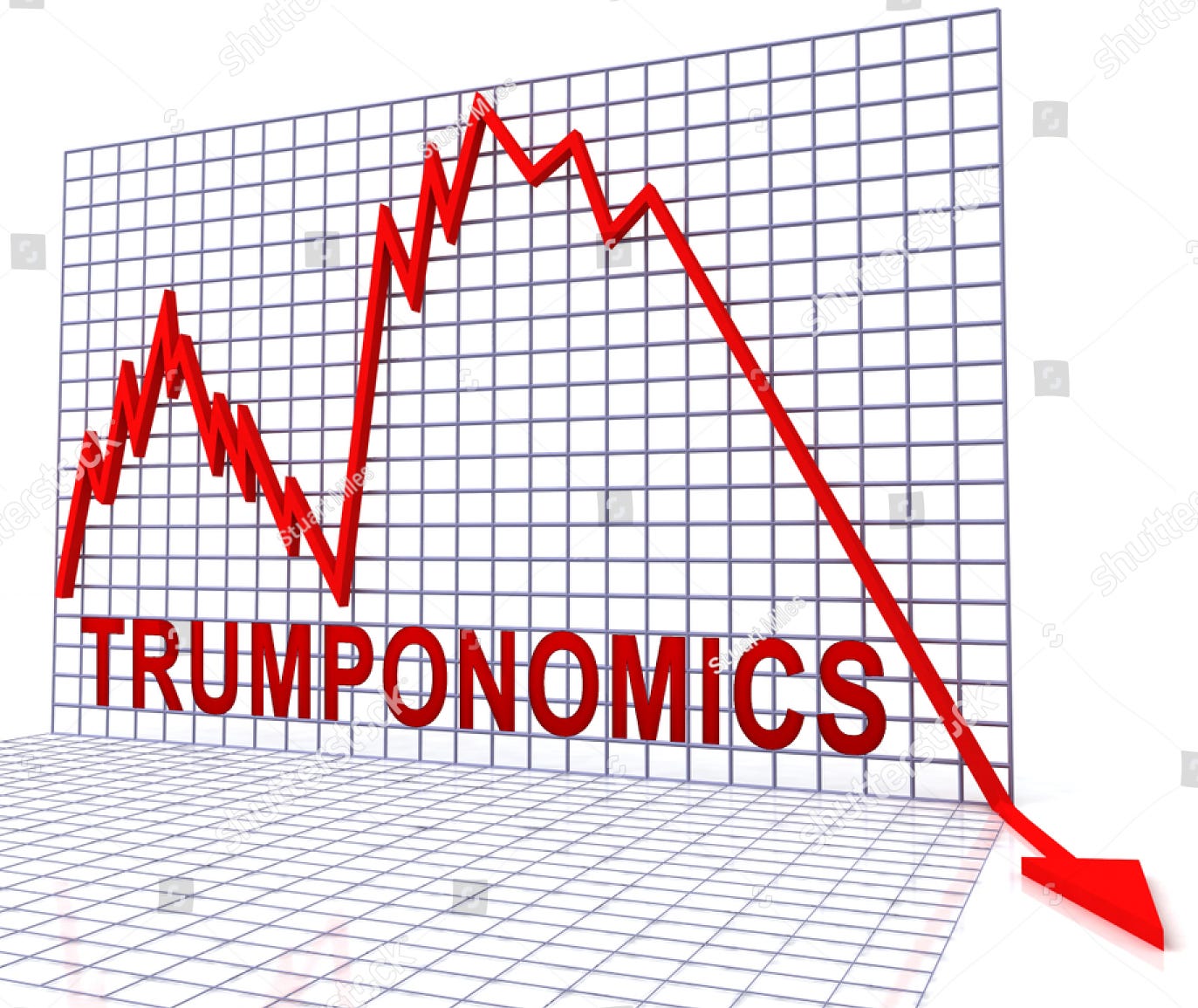
Trump’s war is a fiasco, and his economy is a disaster. According to The Washington Post, Republican pollsters and political groups are raising the alarm that Republican voters are listless and demotivated.
Yet Trump will do everything and anything to maintain control. He has shown repeatedly that he doesn’t feel bound by laws, norms, or patriotism. His only goals are wealth, power, and vengeance.
His billionaire backers, including Elon Musk, are prepared to sink record amounts of money into Republican campaigns.
Trump and his backers have power, money, and ruthlessness on their side.
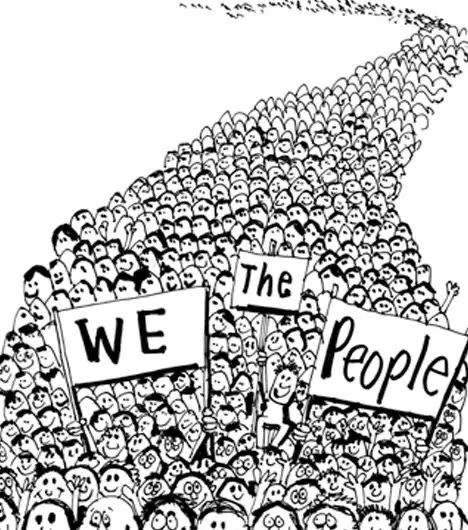
But we have the people on ours.
It will be a colossal stress test of our electoral system. But I believe We the People will prevail. And after speaking with Larry and Wendy this morning, I’m convinced of it.
Today, Michael and I delve into Trump’s plummeting approval ratings and ask whether they’re due to the economy, Trump’s war (which obviously affects the economy), the Epstein files, Trump’s skyrocketing inflation, or Trump’s corruption. Along the way, we explore what Democrats ought to be advocating (and not) in the upcoming midterms.
Please pull up a chair, grab a cuppa, and join in the conversation.
I’m devoting the next several Fridays to what I’m calling a “Realist’s Guide to the American System.” If you hadn’t noticed, almost everything’s going to hell.
Why? Trump is horrendous, but he isn’t causing all the failures of that system. He’s a consequence of that system. Think of him as a boil on its backside — an infected pustule on the gian…
This month, the Bureau of Labor Statistics reported that the labor participation rate — the percentage of people of working age who are working or actively looking for work — is now down to 61.5 percent. That’s 0.6 percentage points lower than it was at the first of the year.
In other words, the U.S. economy has lost 1 million workers since Janu…
As Trump’s tariffs and his war with Iran drive up prices of everything from oil to steel, you’d think big American corporations would be screaming bloody hell. Presumably, Trump’s tariffs and war are squeezing their profits just as they’re squeezing the wallets of average Americans.
To the contrary, corporate America is quietly encouraging both Trump’s war and Trump’s tariffs. Why?
One possibility is they’re raking in money off the war as defense contractors and suppliers.
Some surely are, but this can’t account for the acquiescence if not outright support by most big American corporations that have nothing to do with the defense-industrial complex.
Another possibility is they don’t want to piss off Trump, fearing his retaliation.
But if they were really concerned about the negative effects of Trump’s war and his tariffs on their bottom lines, surely they’d be using their armies of lobbyists and piles of campaign contributions to stop his war and his tariffs. After all, that’s what the armies and piles are for.
There’s a much simpler explanation for corporate America’s silence if not encouragement. In point of fact, both Trump’s war and Trump’s tariffs are helping their bottom lines.
Trump’s war and his tariffs are allowing domestic U.S. producers to raise their prices to match the elevated prices of imports. And those who aren’t directly affected are using the higher import costs as excuses to raise their prices, too.
Presto! — corporate profits have exploded, and their stock prices have soared.
But American consumers are getting shafted. Both Trump’s war and his tariffs are pushing up prices for a vast range of goods and services. The result is a massive redistribution of income and wealth from American consumers to big American corporations.
This is the story of the American political economy under Trump that’s rarely if ever told, but it’s critical to understanding why Trump has been getting away with his war in Iran and his tariffs without much political opposition.
Start with oil.
Brent crude is now selling for $90.05 a barrel. If the war drags on it could push crude prices much higher, especially if it further depletes oil inventories, and spreads to Houthi militants starting a naval blockade in the Red Sea and to other Gulf states.
Oil prices are set globally. As global supplies dwindle, oil prices rise across the board — including prices charged by domestic U.S. producers. They’re enjoying a huge windfall.
With crude oil prices averaging $95 a barrel between March and June — up from about $66 before the war — ExxonMobil, Chevron, ConocoPhillips, and Occidental Petroleum have collectively raked in some $31 billion in earnings for the second quarter of this year, according to FactSet estimates.
That’s up from about $12 billion for the same period last year.
These windfall profits have helped boost Big Oil’s stock prices. Big Oil’s investors and executives (who are paid partly in shares of stock) have done wonderfully well.
But American consumers are bearing the burden, as gas prices once again soar past $4 a gallon, a dollar more than they were before Trump started his war on February 28.
So is it any wonder that Big Oil isn’t criticizing Trump’s war, and is quietly rooting it on?
Or consider steel. Trump imposed steel tariffs of 50 percent in March and June 2025. These tariffs have driven up steel prices in the United States.
The tariffs have been a boon to American steelmakers, who have raised the prices they charge their American customers to match the higher prices now charged for steel from abroad.
As a result, leading American steel producers like Nucor and Steel Dynamics report significant year-over-year earnings increases.
Nucor’s profits in the second quarter of 2026 were $1.16 billion, up from $603 million a year earlier. Steel Dynamics has reported a second-quarter income of $534.1 million, nearly double its net income compared to the same period last year. A third U.S. producer, Cleveland-Cliffs, earned $97 million in the second quarter of this year (before interest, taxes, depreciation, and amortization), compared to a loss of $213 million last year, and the firm anticipates doubling earnings next quarter.
Who’s bearing these higher costs? American consumers of steel — in the prices of everything we buy that contains steel (such as cars and appliances).
The Producer Price Index (a widely used proxy for input costs) for steel mill products is now sitting at its highest point since May 2023.
American-based producers that utilize oil and steel have been able to pass those costs on to their customers without harming their profit margins. Some corporations that don’t depend on oil or steel have used the higher import costs as excuses to raise their prices, too.
Hence, Trump’s war and Trump’s tariffs are wins for corporate America. Profit margins are up, the value of shares on the stock market are up. Shareholders are happy.
Big corporations aren’t raising a fuss about the war or tariffs because they like what’s happening.
But American consumers are getting shafted. Their wages aren’t keeping up with the price increases. Yet they have no alternative but to pay the higher costs for energy and steel and everything else — which is the whole point.
As the inflationary effects of Trump’s war and his tariffs (taxes) on imports spread throughout the economy, they’re hiding what’s really occurring: an upward redistribution from consumers to big American corporations.
American consumers need to know the truth: Two of the major reasons why everything is less affordable are Trump’s war and his tariffs.
Consumers may not have armies of lobbyists and piles of campaign contributions to do their bidding, but they do have a way to express their disapproval. They can vote out Trump Republicans on November 3.
With just 97 days until the midterm elections of 2026, Democrats are fired up, while Republicans are in the doldrums. That means Democrats have a good chance of retaking control of the House. It’s even possible (although less likely) that Dems will retake the Senate.
One of the biggest uncertainties is what (if any) tactics Trump and his lapdogs will use to reduce the odds of a Democratic victory, especially in the House, where 435 seats are up for reelection.
I’ve spent the last several days talking with election experts and political advisers. When I spoke with them last year, they were most worried about gerrymandering, restrictions on mail-in voting, voter IDs, and the demise of what’s left of the Voting Rights Act.
They’re still worried about many of these things (Trump just filed with the Supreme Court an emergency request to allow his executive order that restricts voting by mail, after a federal appeals court blocked key parts of it over the weekend).
But now, with 97 days to go, they’re most worried about the elections process. I’ve summarized their concerns below.
It’s possible that Trump will do nothing to interfere in the elections, of course. It’s also possible that he’ll do everything the experts fear he might do. Please weigh in with your thoughts about what he’s most likely to do.
AI data centers ARE that bad. (They’re even worse.) And AI corporations have huge political power. But here’s the good news: The people are fighting back — and winning.
It happened to me twice today. A stranger came up and asked: “How do you stay sane?” (or some variation on the same question, such as “How do you keep your head from exploding?”)
Here’s what I say back:
We’re all trying to stay sane in this insanity.
How?
Well, here’s what doesn’t work: avoiding the news. It will hit you anyway because a friend or loved one will mention Trump’s latest outrage. Plus, you need to know so you can fight back.
Another thing that doesn’t work is telling yourself it doesn’t matter. It does matter. Trump’s forever war in the Middle East and his bonkers tariffs are driving up the prices of everything you buy. So are his pro-monopoly moves. His domestic police state is making life hell for many of your neighbors, if not for you and your family. His subsidies for Big Oil and rejection of wind and solar energy are making the planet unlivable. His bigotry is inviting cruelty against the most vulnerable. And so on.
A third thing that doesn’t work is pretending there’s nothing that can be done about it — that there’s no point in even trying because we’re all f*cked. That kind of cynicism is exactly what Trump’s billionaire backers and odious oligarchs want — so we give up and let them take it all.
So, what does work? What am I doing?
You should know that it’s not easy for me, either. I have my moments of sorrow and fear. But I’m trying to do three things.
First, I’m channeling my fury into as much active resistance as this old professor can muster. I’m writing you at least once a day on this Substack and doing videos and movies and podcasts — all to give you tools you may find useful.
Second, I’m staying in close touch with young activists who are brimming with energy and hope. Their commitment to democracy and social justice is infectious. They give me energy and hope.
Third, I practice gratitude. I’m grateful to them. I’m also grateful to you.
I appreciate your support and enthusiasm. I’m thankful that you read my daily letters, share them, and comment on them. I value whatever help you’re able to provide.
Friends, all of us are having moments of sorrow and fear. But I’m absolutely convinced we will get through these dark times, stronger than we were before.
Many of you have asked for a video that sets out simply and clearly how wealth inequality in the United States spiraled out of control, why it’s a huge problem, and what we can (and must) do about it. So here goes:
I want to start today with a warning about “charitable giving” and end with a primer on wealth inequality. The two are closely related, as I’ll explain.
We’re on the cusp of the biggest gusher of “charitable giving” in history. Beware.
We tend to think of “charitable giving” as unambiguously good because we equate “charities” with organizations that help the poor and equate “giving” with generosity. But both assumptions are wrong.
In fact, the “giving” is actually a giant tax loophole that provides the super-rich a means of dramatically cutting their tax bills while quietly funding their own priorities.
And “charities” under the tax code include elite universities, fancy opera houses, cultural palaces frequented only by the richest of the rich, and nonprofit “think tanks” devoted to right-wing causes.
The problem is that every dollar of “charitable giving” means substantially fewer dollars paid in taxes, because donors deduct their “charitable giving” from their taxable incomes. This tax loophole is especially big and lucrative for the super-rich.
Here’s the thing. Taxes finance public goods such as public education, scientific research, roads and bridges, nutrition and healthcare for lower-income Americans, and clean water and clean air.
But the “charitable” tax deduction taken by the super-rich finances things that the super-rich want, such as Ivy League universities and culture palaces.
This means a lot of “charitable giving” results in more money for organizations that cater to or do the bidding of the rich, and less for things we all need. Behind the facade of “charitable giving” is a profoundly anti-democratic tax loophole that allows the super-wealthy to effectively substitute their priorities for what would otherwise be public priorities.
Which brings me to the upcoming gusher of “charitable giving” — the consequence of the AI boom and the largest IPOs in history.
Thousands of people with shares of Anthropic, OpenAI, SpaceX, and other AI-related companies have seen, or soon will see, the value of their shares soar into the stratosphere. That means gigantic capital gains.
You don’t need a degree in high finance to understand that these capital gains could also result in big tax payments. If you sell, say, $10 million worth of stock, you could easily face a tax bill exceeding $3.5 million.
Unless you reduce that tax bill through your “charitable giving.”
Hence, the upcoming gusher in charitable giving. According to some estimates, it could be more than $100 billion a year.
Consider: The seven founders of Anthropic, which is expected to have an enormous IPO as soon as this fall, have each pledged to give away 80 percent of their wealth, which is estimated to be about $90 billion. Anthropic also has a philanthropic matching program, which would mean another $60 billion in funds earmarked for giving. Nan Ransohoff, who heads public goods at the payment processor Stripe, estimates that these will generate between $37 billion and $100 billion to charities annually.
Add in the newly rich created by SpaceX, whose IPO has spawned an estimated 4,400 millionaires (and some 400 employees now worth more than $100 million), as well as OpenAI’s IPO, which is likely to create as many more millionaires and multimillionaires, and you’re talking really big money — and huge incentives for making tax-deductible “charitable contributions.”
Don’t get me wrong. I consider the nonprofit sector of the economy enormously important. I just don’t want the nation’s priorities to be set by the moneyed interests. Their massive political donations already give them extraordinary power.
One reform would be to limit the definition of “charities” — that is, the sort of contributions that warrant tax deductions — to places and institutions that actually serve the poor.
Another reform would be to reduce the tax deduction for “charitable contributions” and increase the capital gains tax rate on very high incomes. (At the very least, raise the capital gains tax rate to match the tax rate on ordinary income.)
And by all means let’s get rid of the “stepped-up-basis-at-death” tax rule, which now allows families to escape all capital gains by leaving appreciated assets to their heirs. For example, consider someone who got OpenAI stock for almost nothing and watched its value explode, and then contributed enough of it to charity to allow her to make a nice living off it without paying any capital gains taxes. She gave the remaining shares to her children when she died. The kids can then sell those shares for what they’re worth at the time of her death — say, hundreds of millions of dollars — yet pay zero capital gains on it.
These three reforms are, or should be, no-brainers. There’s simply no economic or political justification for allowing the super-rich — even the nouveau AI riche — to get giant tax breaks by financing things they prioritize.
Granted, reforms like these don’t stand a chance under Trump or his lapdogs in Congress. (And, sad to say, too many Democrats are also dependent on campaign donations from the moneyed interests.) But these are high on my list for what must be done.
PS: That basic primer on wealth inequality in the U.S. that I mentioned at the start of this post is a video I’ll post this afternoon on this page. In it, I discuss why wealth inequality has gotten utterly out of control, why that’s a huge and growing problem for America, and what must be done about it.
We have been subject to the sociopath for a year and a half — 18 months of the most loathsome, least competent, and most corrupt person ever to be president of the United States.
We’ve watched him take a meat-axe to every major institution of our democracy, draw the nation into a never-ending war, establish a murderous domestic police state, reject renewable energy in favor of the dirtiest possible fossil fuels, make billions off his presidency, and cause most Americans to become poorer and less economically secure.
But here’s the good news. The sleeping giant of America is finally awakening.
Trump’s poll numbers are plummeting. They’re now at record lows. Even many Republicans have had enough. Progressives are winning election after election around the country.
The sleeping giant has always remained asleep until some venality becomes so noxious, some acts so disrespectful of the common good, some brutalities so noisy, that the giant has no choice but to awaken — blinking both eyes and then roaring, “What the hell is going on here?”
The first time I saw him awaken was during the witch hunts of Senator Joe McCarthy. He awoke again when the Ku Klux Klan tried to stop the Civil Rights Movement. Again when the Vietnam War was taking the lives of tens of thousands of Americans and millions of Vietnamese. And again when Richard Nixon threatened our system of government.
Each time the sleeping giant of America has awakened, the good sense of the American people has ended whatever it is that awakened him. Again and again, we’ve put the nation back on track toward democracy and social justice.
Trump isn’t gone yet, of course. He has another two and a half years. But he’s on his way out. He’ll soon be a cringeworthy irrelevance, a fat lame duck, excrement on the sidewalk of history.
In a few years, Trump’s gilded monuments will be razed, his name removed from every building and pediment, his pathetic attempts to glorify himself turned into bad jokes, his legacy object lessons in why big money must be banned from politics and dastardly dickheads like Elon Musk kept away from the levers of government power.
Trump will still cause a great deal of damage over the remainder of his term, the way a wild pig who’s been gored wreaks mayhem before it expires.
So this is no time to let down our guard or become overly confident about the coming midterm elections.
Quite the contrary. One hundred days from today must be a historic repudiation of Trump and his entire disgusting regime.
The blue wave must be a tsunami — inundating everything Trump may attempt to do to hold on to the House and Senate, overwhelming whatever lies he may tell about the election, and enveloping him in a rejection that’s so unmistakeable, a rebuke so unequivocal, a reproach so unambiguous as to cause the great giant of America to get up and dance.
Today, Heather and I take a dive into the muck of Trump, 101 days before the midterm elections. His war in Iran is worsening, with no end in sight. His economy is dropping, as gas and food prices soar and as his tariffs (import taxes) take their toll. His regime is descending into chaos, as public health is compromised, measles spreads, children aren’t getting nutrition assistance, and Medicaid is cut.
But how do we peacefully and legally get rid of him between now and the 2028 election? What’s our 2028 strategy for regaining the White House? And our 2029 strategy for cleaning up this horrific mess? Heather and I discuss these questions and more.
Please pull up a chair, grab a cuppa, and join the conversation.
A new Government Accountability Office study, released Wednesday, found that MacDonalds, Walmart, and Amazon — three of America’s largest employers, with billions in profits — are also among the top employers of workers who earn so little they have to rely on food stamps to put food on the table and Medicaid to obtain health coverage.
Yet according to the latest data, MacDonalds pays its CEO $18.2 million a year, Walmart pays its CEO $27.4 million, and Amazon CEO Jeff Bezos is the second-richest person in America.
The White House Correspondents’ Association annual dinner will be held tonight (after being cut short in April by a gunman). Once again, Trump will be on the dais, and his speech will be the main event.
But the highlight of the evening will be the award for “the most fair, impartial, objective news reporting” by a member of the White House press corps, which will be going to TheNew York Times’ Tyler Pager.
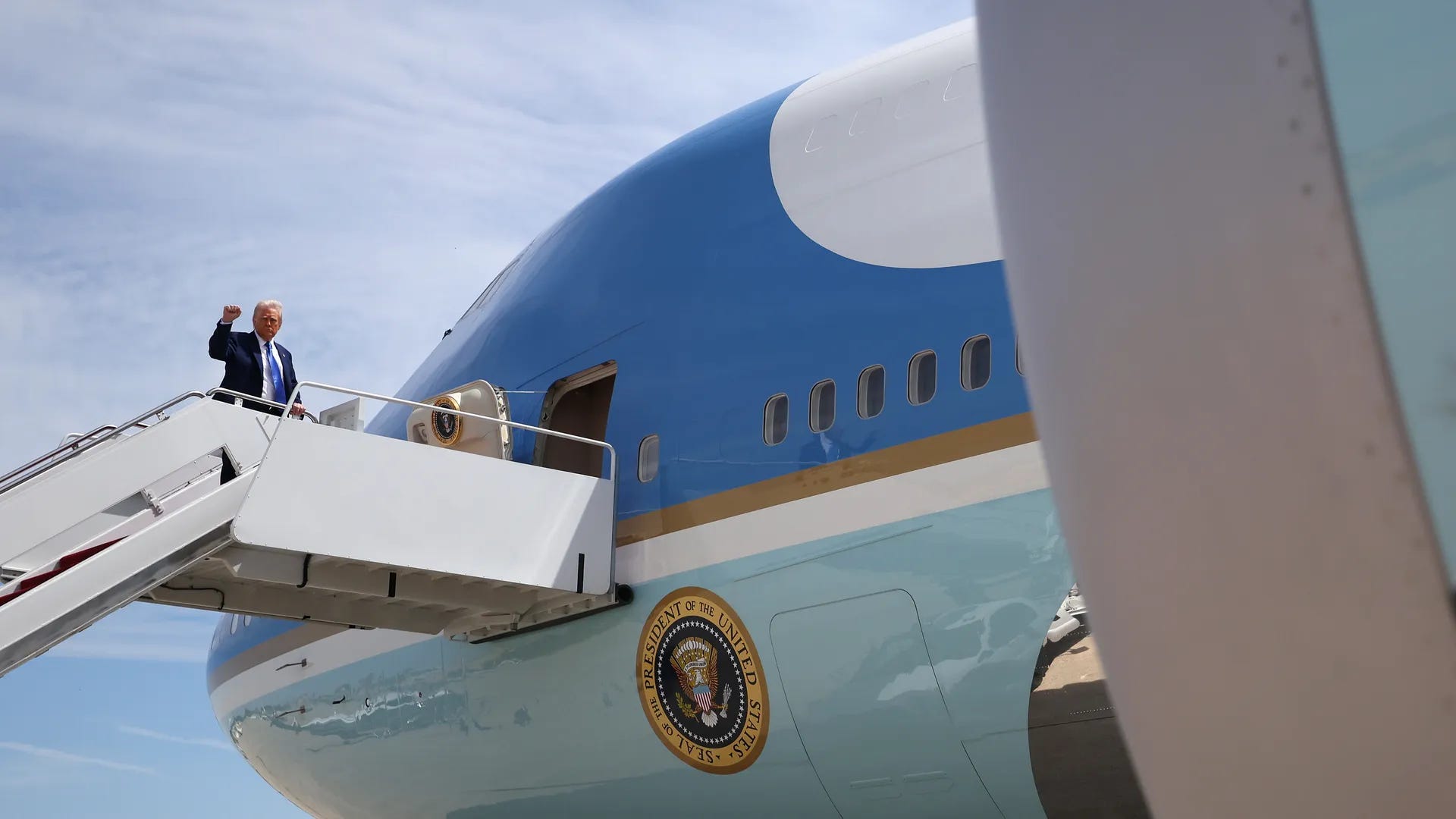
Pager is one of the Times journalists subpoenaed by Trump’s FBI to force the paperto reveal confidential sources behind its story about Trump’s Qatari-donated jumbo replacement for Air Force One. (A district judge has delayed enforcing the subpoenas.)
The backstory is that since returning to the White House, Trump has complained about the “look” of Air Force One. He was upset that other countries have newer planes that are “bigger and sleeker and sharper,” he told Fox News. “It doesn’t look right.” Of course, Trump wants the biggest, sleekest, and sharpest.
So in May of 2025 he accepted Qatar’s “gift” of a Boeing 747-8 jetliner, reportedly worth some $400 million. Trump described it as a gift to the United States (the Constitution prohibits gifts from foreign powers to presidents), but that’s rubbish. Trump says he intends to keep it for his presidential library (it’s hard to imagine a giant jumbo jet in a library or as a library) and post-presidential plaything.
The Qatari jumbo jet is intimately tied to Trump’s jumbo ego. Trump boasts that it will be “a flying White House at a level of luxury that nobody’s ever seen before,” adding, “Now when we land at airports in London and Germany and different places, nobody tops this one.”
He’s emphasized that it won’t cost taxpayers a dime, and would be easy to “bring it up to the presidential standards, meaning security wise.”
But the actual cost to taxpayers of retrofitting it to “presidential standards” has been between $400 million and $1 billion so far — more than the jet was worth in the first place. And it’s still not there, “security wise.”
Which brings us to the Times report, which drove Trump nuts. It said he had to fly out of Turkey (where the NATO summit was held) on the old Air Force One instead of his new Qatari-donated jumbo jet because the Qatari jet still didn’t have sufficient security, including antimissile capabilities.
According to CNN, Trump was “fuming,” “embarrassed and angry” by the Times story. It made him look bad, even stupid. What kind of a businessman would describe a $400 million jet as “free” and then charge taxpayers more than $400 million to have it ready to fly? Even now, it’s not ready.
Trying to make the story appear as a threat to national security, Trump instructed FBI director Kash Patel and his chief of staff, Susie Wiles, to oversee a leak investigation. These are his top guns. Patel was even summoned to the White House and reportedly worked on it for eight hours.
Trump is paranoid that someone with knowledge that could embarrass him would be so disloyal as to leak it.
Subpoenas were sent to the homes of Times journalists who reported the story —including Tyler Pager. Other subpoenas went to the journalists’ phone service providers, seeking phone and text-messaging records for the journalists and their spouses. Rarely in history has the White House and FBI been mobilized like this.
But the threat here has nothing whatever to do with national security. Trump has even publicly admitted that the jet still has to be “maxed” for security.
No, the threat here is to Trump’s giant ego. His humongous ego is why he always has to fly in the biggest and the best plane — such as the Qatari jumbo jet. His ego is also why he hates to be the brunt of jokes by late night comedians, who’ve had a field day with Trump and his not-quite-ready Qatari jet.
And his paranoid ego is why Trump can’t stand the possibility that anyone in the White House, Pentagon, or Secret Service might have revealed to journalists his utter stupidity.
This daily letter to you doesn’t offer financial advice. And most of you have been so worried by the nation’s lurch toward dictatorship under loathsome Trump that it seems almost unfair to burden you with an alarm about the economy. But we’re facing a five-alarm fire that you need to know about.
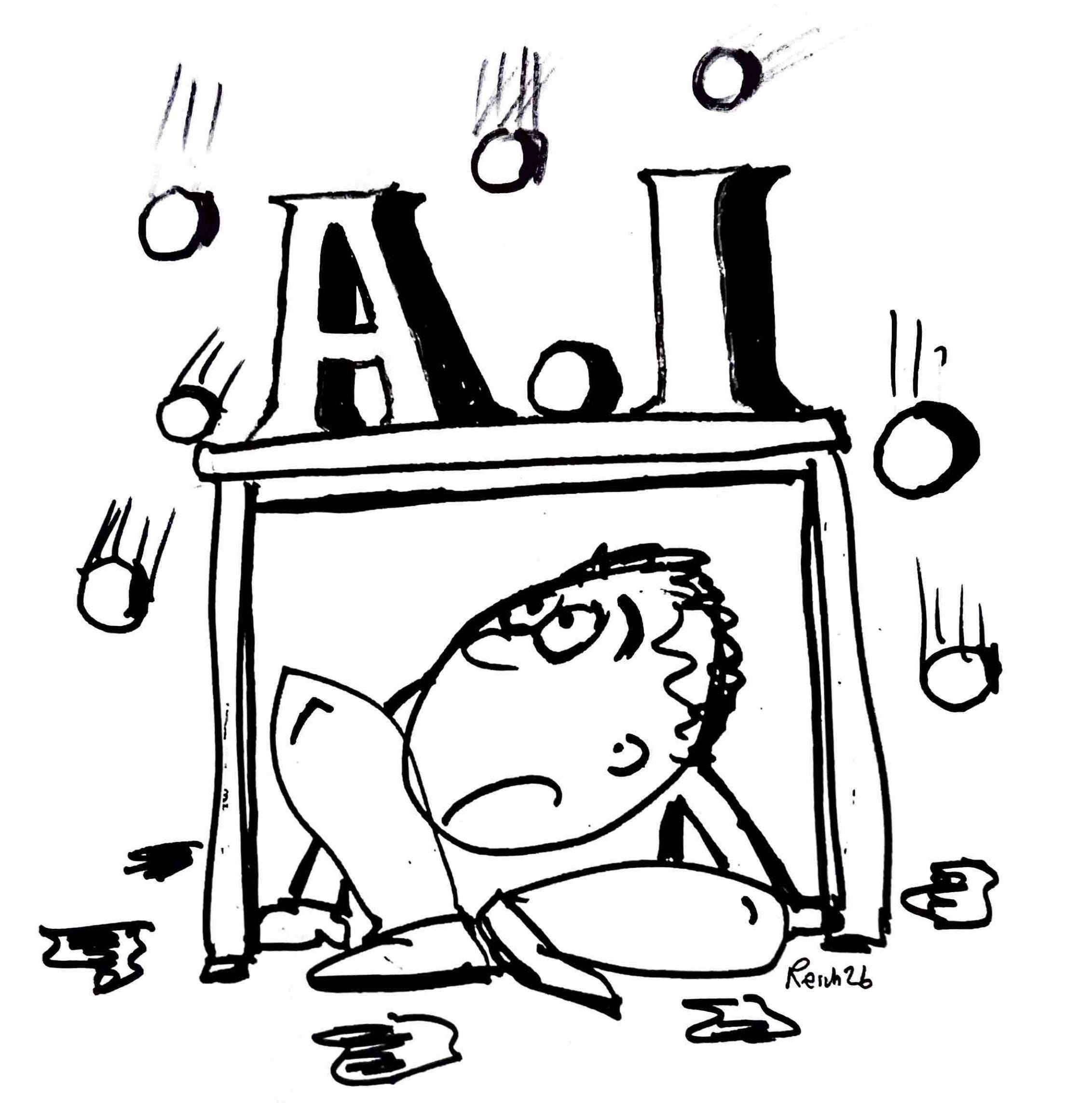
Much of the United States economy is now based on A.I. — or, more specifically, expectations that A.I. will pay off very big in the near future. A.I.-related stocks have accounted for roughly half of the rise in the S&P 500 this year. And U.S. economic growth is dependent to a remarkable degree on A.I. infrastructure spending.
But it’s becoming a house of cards.
Yes, America now dominates A.I. with the most powerful systems and more data centers than any other nation. But that lead hasn’t come free of charge, and it’s eroding quickly.
The lead is based on colossal spending on data centers, especially by Oracle, Alphabet, Microsoft, Amazon, and Meta. A stumble by any one of them would spill over to the rest of the economy.
It’s estimated that these five companies combined will account for more than $800 billion in A.I. investments this year. They plan to spend an additional $1.2 trillion in 2027 — more than Trump’s entire military budget request for 2027.
Where’s all this A.I. money coming from? Some from investors, but much of it is being borrowed.
One worry is their borrowing is outpacing their profits. Not surprisingly, the bond market has begun to charge premiums for what it considers a heightened risk that they won’t be able to repay.
Oracle’s debt now stands just a bit above junk bond status. Amazon’s bond prices have also been hard hit. So have those issued by SpaceX, which is also building A.I. data centers and whose bonds have been trading at junkish rates.
Here’s another worry. Chinese A.I. companies are now offering A.I. that’s almost as good as that emerging from Anthropic and OpenAI — but Chinese companies are offering it free of charge to companies anywhere in the world, including in the United States. This is likely to mean lower earnings for leading American A.I. corporations and less demand for data centers.
Last month, Chinese startup Z.ai released a model that’s been rapidly adopted by startups and independent developers across Silicon Valley.
What’s the consequence? So far this year, the stock prices of four of the five big data-center companies have trailed the overall S&P 500. Oracle’s shares have fallen more than 35 percent. Shares of SpaceX have fallen below their initial public offering price.
On Thursday, a Chinese startup called Moonshot AI released a new A.I. model called Kimi 3 that’s nearly as powerful as the leading American model, Anthropic’s Claude Fable 5. Moonshot said it would soon provide Kimi 3 as open source, essentially free. The news caused a sell-off of U.S. technology stocks on Friday.
The latest systems from companies like Anthropic and OpenAI still outperform Kimi and other Chinese models, but the top Chinese models are far cheaper — which is why Anthropic and OpenAI are now urging the Trump regime to block imports of Chinese A.I. Yet such blockage would competitively harm much of the rest of the tech sector and other big American companies that are using Chinese A.I.
The third worry is how much economic activity in the U.S. now depends on A.I. If investor confidence in A.I. crumbles, much of the economic activity built on it could come crashing down. The sell-off would make it more expensive for companies to raise and borrow the capital they need to fund further A.I. investments, causing companies to delay or cancel their plans for data centers and related infrastructure.
The drop would also push wealthy consumers to pare their spending. Much consumer demand in the U.S. now turns on spending by the richest 10 percent of Americans, who own over 90 percent of the value of all shares of stock traded on U.S. stock exchanges. They’re spending like mad now, largely because the ebullient stock market has made them feel far richer. If the market drops, they’ll pull back on their spending, which could lead to wider job losses and, ultimately, a recession.
Bank of America’s monthly global fund-manager survey for July reports that fund managers see the key risk to financial markets to be a bursting of the A.I. bubble. It’s also now the key risk to the economy.
I don’t want to rain on the A.I. parade. Maybe — just maybe — the extraordinary price-earnings ratios of A.I. companies will be justified by a torrent of A.I. buying by consumers and businesses in the next few years.
Even if it’s a bubble, it’s impossible to predict when it will burst. Maybe not for several years. And maybe not with a bang but with a whimper.
But the sobering reality is this: The U.S. economy has become so concentrated in a handful of giant A.I. corporations, so highly leveraged with A.I.-related debt, and so dependent on predictions about huge earnings flowing from A.I. in the foreseeable future, that the risks of a recession or even a crash are growing.
Yes, we have fiscal and monetary policy tools to counteract a sudden downturn. But will those tools will be powerful enough to respond if a significant portion of business and consumer demand suddenly shrinks, when investors and creditors are left holding nearly worthless pieces of paper, when the United States is already deep in debt, when the competence of government policymakers is highly questionable, and when trust in government has never been as low as it is today?

 Login
Login