Two weeks ago, I asked in our weekly Office Hours for your view on the biggest existential threat we face. Forty-three percent of you said climate change; 27 percent said authoritarianism; 17 percent said Artificial Intelligence; and 7 percent said nuclear or biological war.
In contrast to that dystopian inquiry, today’s Office Hours question focuses on the most important lesson you hope America has learned since the start of the second Trump regime.
I’ve made the rounds of several people whose political, historical, and philosophical insights I respect and come up with the four hopeful lessons that stand out. I’ll summarize them below. Please share your views on which you believe to be the most important. (Don’t worry that they may overlap or that you hope all will be learned.)
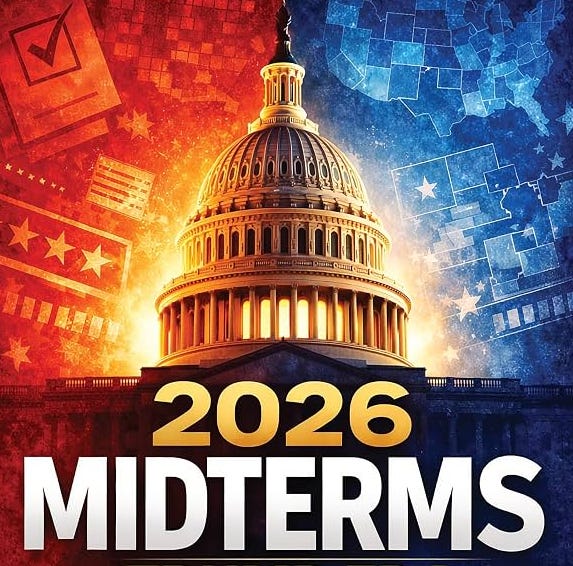
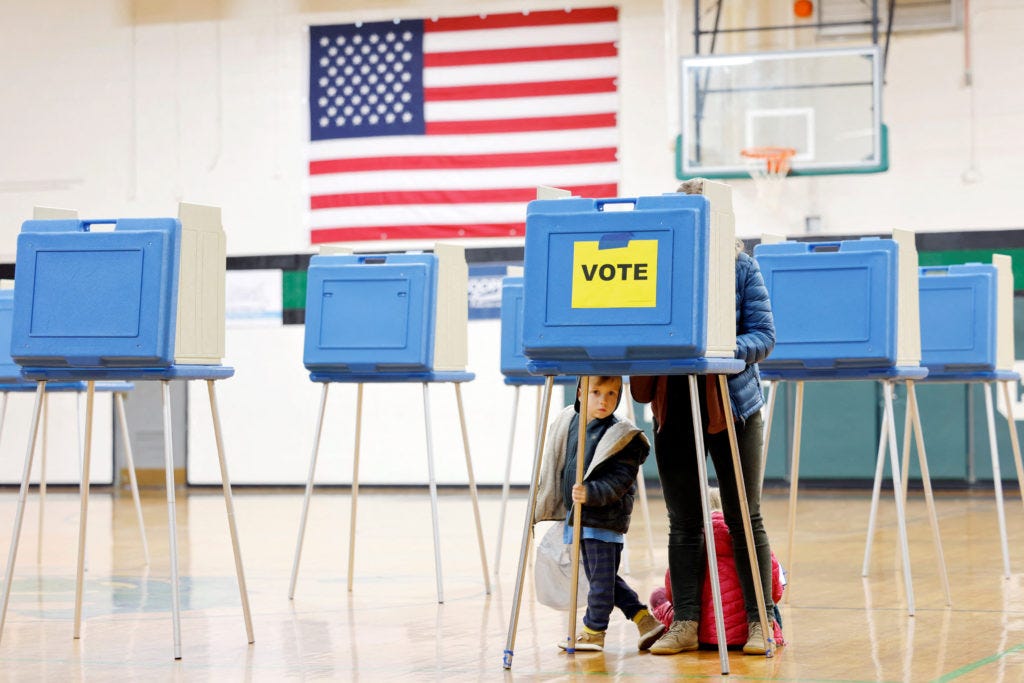
Five weeks from today, America will make a choice about the future of our democracy.
Today I had a chance to talk about tyranny, Trump, and the upcoming midterm elections with Professor Timothy Snyder, author of On Tyranny as well as a number of other important books.
At least since the 1950s, Congress’s funding bills have routinely banned the use of taxpayer funds for “publicity or propaganda.” The Government Accountability Office defines this as stuff that’s “purely partisan” or “self-aggrandizing.”
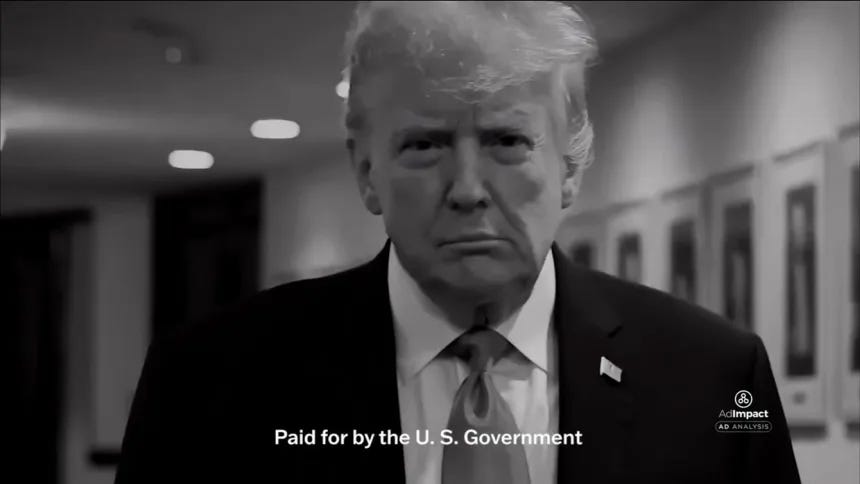
Now, just weeks ahead of the midterm elections, Trump is using taxpayer funds for ads that are purely partisan and self-aggrandizing.
One declares that “this is the final battle” as Trump walks down a hall, over audio of his warnings against “the deep state,” “warmongers,” “globalists,” “Marxists,” “communists,” and “fascists.” Another shows a montage of photos and videos of Trump, intercut with campaign talking points like “largest tax cuts in history” and “reigniting American manufacturing” over the song “Love Me” by singer-songwriter JMSN. A thirdfeatures views of Mount Rushmore interspersed with Trump’s speech there for the Fourth of July anniversary.
All end with “Paid for by the U.S. Government.” According to the advertising-tracking company AdImpact, the ads have cost U.S. taxpayers more than $1,700,000 so far.
You don’t have to have a law degree to know these are illegal.
Even Republican officials concede it. “I like the message, but it shouldn’t be paid for with taxpayer dollars,” Republican Senate Majority Leader John Thune told reporters yesterday. Texas Republican Senator John Cornyn said, “It’s not even a close question.”
So why is Trump running these ads? Not because he thinks they’ll help Republican candidates. As economist Paul Krugman has noted, Trump is so unpopular that Republicans in close races don’t want voters to be reminded that Trump is effectively on the ballot.
He’s running these advertisements for himself because Trump is consumed with himself. He knows he’s sinking in the polls and views positive publicity as a potential way to reverse the decline.
They’re also means of soothing his bruised ego. The more he hears and sees testimonials to himself, even if he has to order them, the better he feels. He may even think “Paid for by the U.S. Government” in bold letters at the end of the ad signals the ad’s official legitimacy.
Finally, he’s preparing his legacy. He’s losing his power and will soon be a lame duck, so naturally his thoughts turn to how he’ll be remembered. Like etching his name on buildings and erecting triumphal arches in his honor, he wants Americans to recall him as a great president.
The problem for Trump is that, as an old ad executive once told me, “no advertisement can save a shitty product.”
I’m so proud of my colleagues who have produced another fabulous film that speaks to what America most needs right now.
“The Work in Progress” is about Americans talking with one another — across the boundaries of age, ideology, ethnicity, gender, politics, and everything else now separating us.
It celebrates civic discovery, public deliberation, and coming together to ask each other hard questions and listen carefully to what each other says.
It’s now playing in 52 theaters across 27 states, with more being added daily. You can find where it’s playing near you, here.
Thank you for joining me for Week 2 of my “Wealth and Poverty” class. (If you’re looking for the first session of the course, just click this link: Class 1.)
In today’s class, we begin to explore why inequalities of income and wealth have soared since the late 1970s.
Click below to jump right in:
The questions we’ll focus on today are:
— How did the market for financial capital contribute to inequalities of income and wealth?
— Did the accepted purpose of the American corporation change over the last 50 years, and, if so, when and how?
— More generally, for whom should the corporation exist? Is there such a thing as “corporate social responsibility?”
You’ll find recommended readings linked below.
Thanks again for joining me! (And as always, let me know what you think in the comments below.)
P.S. If you’re enjoying this course and think your friends, family, colleagues, or social media networks would find it interesting and helpful as well, please share!
If you’d like to help with the costs of this effort, please become a paid subscriber — or give a paid gift subscription.
A huge thanks to the Wealth and Poverty team — to Michael Lahanas-Calderón, Kyle Parker, Dan Davis, and Emmett Tjen — as well as Coro Fellows Ammar Ansari and Meagan Turner for preparing these course materials to be shared with all of you. And to Heather Kinlaw Lofthouse for making all this happen on this page.
Today, with just over five weeks to go before the midterm elections, I want to point out a critical distinction that’s not being picked up in the media — between people who voted for Trump in 2024 but do not identify as part of the MAGA movement and people who voted for Trump in 2024 and still do identify themselves as part of the MAGA movement.
According to data from sources like the Economist/YouGov Poll, roughly 53 percent of Republican voters describe themselves as “MAGA Republicans” or consider themselves part of the MAGA movement.
That leaves a considerable number of non-MAGA Republican voters.
How do these two groups of Republican voters line up on the central issue of affordability?
A recent Politico poll showed that just 28 percent of voters who describe themselves as being part of the MAGA movement say expenses have become less affordable since Trump took office.
These MAGA voters are far more likely to say the economy has gotten better since Trump took office.
On the other hand, over half (52 percent) of people who voted for Trump in 2024 but don’t consider themselves part of the MAGA movement say the cost of living in their area is the “worst” it has ever been. Nearly half say they either wouldn’t vote for a Republican in the midterms or are still making up their minds.
How to explain this divergence?
Could it be that people who voted for Trump in 2024 and still view themselves as being part of the MAGA movement have done better economically since then compared to Trump voters who don’t consider themselves part of the MAGA movement?
No. Surveys show no meaningful distinction in the cost of living among people who voted for Trump in 2024. Their wages haven’t kept up with inflation, regardless of whether or not they consider themselves part of the MAGA movement.
Alternatively, could it be that Trump voters who consider themselves part of the MAGA movement have higher real incomes than Trump voters who do not, so they’re less encumbered by higher prices?
No again. In fact, Trump voters who view themselves as part of the MAGA movement have lower incomes than Trump voters who do not consider themselves MAGAs.
So why do people who voted for Trump in 2024 and who consider themselves part of the MAGA movement believe the economy is better now than it was when Trump was elected to a second term — in sharp contrast to people who voted for Trump in 2024 and don’t consider themselves MAGA?
The simplest explanation is that anyone who still identifies as being part of the MAGA movement remains in the Trump cult. Which means that — almost by definition — they accept Trump’s descriptions of reality, even if those descriptions don’t match these voters’ experiences.
In other words, they fully accept Trump’s lies.
So when Trump states that the economy is now far better than it was when he took over in January 2025 — a lie he tells repeatedly — they believe him, even though they’re struggling more now than they did then.
Trump’s continuous lies trump certain people’s lived experiences — people who have surrendered to him their critical judgment.
I feel optimistic about the midterm elections, just over five weeks away. But my stomach aches when I think of what’s at stake.
Call me nauseously optimistic.
I suspect you’re in a similar place.
If it were only the polls, I’d feel reasonably good. Here’s one that stuck out for me: The share of Republicans who say the economy is better than a year ago has collapsed from over 70 percent in January to 29 percent in September, according to last week’s New York Times/Siena poll.
Here’s another: According to a Wall Street Journal poll, just 37 percent of Americans approve of the job that Trump is doing — the lowest approval rating of any president heading into a midterm election in Journal polls dating to 1990.
Another good sign: Because of Trump’s unpopular war, his dreaded tariffs, and their effect on prices, Republicans in tight races are starting to tiptoe away from Trump. In recent days, Maine Senator Susan Collins and Kansas Senator Roger Marshall have distanced themselves from Trump on tariff policies that they say hurt small businesses and rural communities in Maine and aircraft production in Kansas. Nebraska Senator Pete Ricketts has questioned whether consumers would see lower prices from Trump’s decision to temporarily allow more foreign beef imports into the U.S., a move that’s opposed by ranchers. All three senators are seeking reelection this year.
In the House, seven Republicans, including a group facing tough reelection races, joined Democrats this past week in passing a measure directing Trump to remove U.S. forces from hostilities against Iran unless Congress authorizes the war.
Republicans are also uneasy with Trump’s refusal to regulate AI, data centers, or even Flock Safety cameras — which most Americans now oppose.
And I think this is fascinating: Mentions of Trump’s name per hour on conservative podcasts have fallen nearly 70 percent from their peak in the run-up to the 2024 election. Monthly mentions of his name have fallen 30 percent since the U.S. launched the war in late February.
All encouraging.
But what makes my stomach churn is the vast amounts of money from some of the worst right-wing billionaires in America (cue Elon Musk) now being poured into key races to finance a barrage of ads favoring Republican candidates and making stuff up about Democrats and progressives.
My stomach also aches when I think about what Trump and his regime may try (and have already tried) to do to interfere with our elections and further erode public trust in them. On Friday, for example, the Supreme Court lifted restrictions on a federal voter database pushed by Trump. Even worse, his regime refuses to rule out sending ICE agents to polling places.
So our work over the next five weeks is essential — phoning, writing, canvassing, getting out the vote, and, to the extent we can, funding candidates who will help average working Americans.
Yes, money talks, and Trump is a vicious dictator. But there are far more of us than there are Trump’s billionaires — more of us to do the talking and the organizing and the mobilizing. And far more of us to guard our electoral system than there are Trump lapdogs and agents.
And always remember this: We’re on the right side — the side of the people seeking the common good rather than the corporate and techno-billionaires seeking additional wealth and power for themselves.
Which is why I’m nauseously optimistic that we will prevail in just over five weeks. And you? How do you feel?
I’m spending all my time and efforts on the upcoming midterms (as many of you are) urging Dems to speak out for average working people, for lower prices and higher wages, and against the big-money corruption that’s the core of today’s Republican Party.
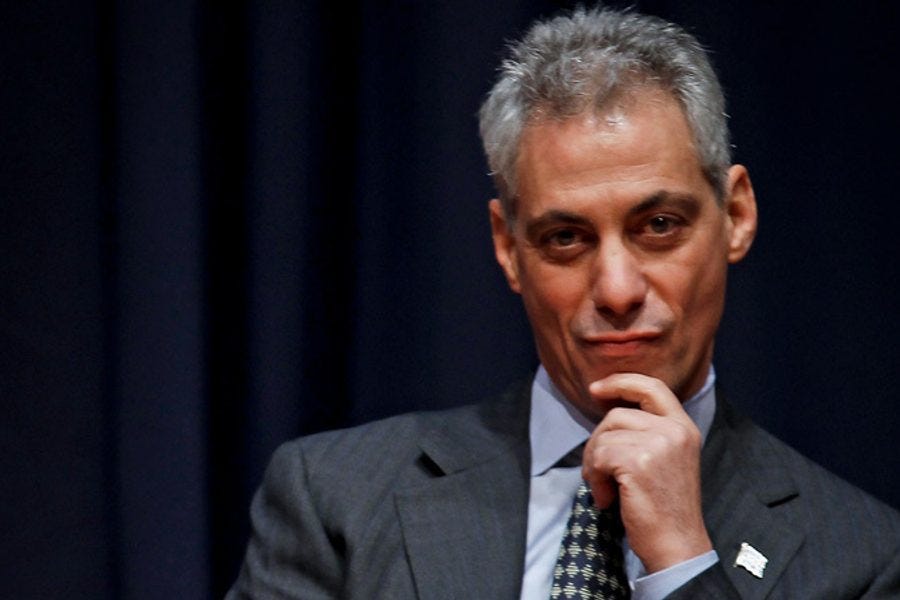
But I’ve also got to speak out about one Democrat who’s not running for midterm office but is using the midterms to build his base among future Democratic office-holders for his 2028 presidential run.
Today’s New York Times carried a Page 1 puff piece about him titled “Rahm Emanuel Makes His 2026 Play” with the subhead “The longtime Democratic insider has emerged as a behind-the-scenes force in his party’s push to win back Congress. After that, he’ll think about 2028.”
I know Emanuel. I worked with him for years in the Clinton administration, and then when he was Obama’s chief of staff.
Rahm Emanuel represents everything that’s been wrong about the Democratic Party for the last 34 years — its dependence on money from big corporations and the wealthy, its reluctance to embrace bold ideas to reverse widening inequalities, and its indifference to the needs of average working people — and Democratic candidates should be warned off him.
A specter is haunting the 2028 Democratic presidential field: the specter of reactionary centrism, which sports the political brand name of Rahm Emanuel.
Emanuel, the former Clinton White House policy enforcer who went on to become chief of staff in the Obama administration and mayor of Chicago, is going through all the motions of an early presidential hopeful.
He’s completed a “spin-free” bike tour through New Hampshire, he’s staged a photo-op on an Omaha “beer picket line,” and he’s delivered a high-profile speech arguing that America needs to adopt a more aggressive posture toward Benjamin Netanyahu’s irredentist warfare regime in Israel (without, of course, affirming anything close to the legitimate political agency of Palestinians). He’s making the rounds on the very serious interview and conference circuits to tout his broader foreign-policy sagesse.
Through it all, Emanuel has burnished his credentials as a wised-up disciplinarian figure in a Democratic Party that’s poised to succumb to a wild-eyed left-wing agenda that will poison its standing among independent-minded Real Americans during a pivotal election cycle.
There’s a singular irony in Emanuel’s peddling this prescription in 2026, ahead of an all-but-confirmed 2028 presidential run: It’s the same hoary consultant-brewed panacea that he introduced as one of the initial class of New Democrats in the early 1990s.
For this same structural critique to hold more than three decades later, you have to bracket the history of three centrist Democratic administrations, together with the disastrous legacies on trade, labor, financial regulation, and brain-dead austerity they left the MAGA movement to exploit at will.
You have to somehow accept the idea that a Democratic establishment dominated by big-money donors, tech lobbyists, and their leased consultant mouthpieces has fallen victim to a sans-culotte insurgency led by left-wing congressional staffers and “the groups” of the nonprofit sector, while the forgotten Middle America scours the political landscape in vain for a voice to represent it.
You also, not incidentally, have to disregard most of the actual political career of one Rahm Emanuel.
It’s no exaggeration to say, with apologies to Hegel’s characterization of Napoleon at the Battle of Jena, that Emanuel has embodied the neoliberal world-spirit on horseback. Back then, Emanuel’s policy portfolio was largely taken up with the push to win congressional approval for NAFTA and the 1994 crime bill—a measure that symbolized the savvy New Democratic repudiation of the old liberal interest-group model of lawmaking.
After weathering right-wing assaults on liberal governance as a prolonged study in crime coddling and kowtowing to union bosses, the Clintonian Capitol Hill strategists led by Emanuel were declaring their independence from the ancien régime by embracing traditional right-wing policy initiatives and placing a modest it-takes-a-village rhetorical spin on them.
By the squalid and inert later phase of the Clinton policy agenda—when the administration signaled total moral capitulation to the Gingrich right by signing its welfare-eradication legislation into law—it was no surprise to see Emanuel leading the charge in the White House.
Emanuel also sought, unsuccessfully, to turn Clinton into a hard-line immigration hawk, urging the president to “claim and achieve record deportations of criminal aliens.”
You could say that Emanuel was simply playing to his base: He became a key player in the Clinton White House after leading the big-donor fundraising initiative of the 1992 Clinton campaign. Emanuel’s long-mythologized DC reputation as a blunt, loud, and profane interlocutor stems from this time, when he could be heard berating big-ticket prospects with come-ons like “Five thousand dollars is an insult! You’re a twenty-five-thousand-dollar person!”
This marks the other sprawling paradox of Emanuel’s career: In posturing as the advocate of commonsense pragmatic governing, he is always representing a boardroom-first vision of politics.
Prior to his election to Congress in 2022, Emanuel spent a lucrative tour as an investment banker, bringing in a cool $16 million payday over three years. (He was, in fact, one of three former investment bankers to serve as chief of staff in Obama’s hope-and-change administration.)
When a pair of reporters from the Chicago Reader filed a FOIA request to access the mayor’s meeting schedule—which had been mostly shielded from public view—they found that he met almost exclusively with donors, and almost never with actual community leaders.
In other words, if you want an advance vision of a Democratic politics shorn of the influence of “the groups” and other irksome activists, look no further than Emanuel’s plutocratic governing record in Chicago. Alternately, you can divine the waning influence of groups-style activism in the very fact that Emanuel is now bruited as a serious candidate for the Democratic presidential nomination at all.
The scandal that paralyzed, and effectively ended, his mayoralty in Chicago was his administration’s obscene cover-up of the police murder of 17-year-old Lacquan McDonald, a Black man shot 16 times in the back by the police as he was walking away. When the video of McDonald’s killing was released, 64 percent of Chicagoans disputed Emanuel’s claim that he had never seen it before; more than half agreed that he should resign office immediately.
It says everything about the priorities of establishment Democrats that Emanuel should be an early 2028 contender, just six years after Senator Amy Klobuchar was effectively forced to scuttle her future presidential prospects in the wake of George Floyd’s police murder, since she had previously served as a county prosecutor in Minneapolis.
Grim as Emanuel’s litany of policy calls is, it may not represent his most woeful legacy in Democratic politics. That distinction likely falls to his 2006 tour as head of the Democratic Congressional Campaign Committee. During that pivotal midterm cycle, Emanuel largely prevailed in a feud over the “50-state strategy” advocated by Democratic National Committee chairman Howard Dean.
Dean argued that for the Democrats to secure a long-term governing coalition they had to mount viable candidates in—and devote resources to—states and districts that presented as redoubts of deeper-red Republicanism. The idea was akin to bolstering a flailing major-league team’s farm system with prospects that would yield significant dividends over the long haul, in lieu of a more myopic “win now” strategy focused on immediate returns.
In his accustomed role as gatekeeper to the large-donor caste, Emanuel carried the day, using his campaign coffers to effectively cut loose Democratic candidates in districts that would be a stretch to win in that cycle, and lavishing money on his preferred brand of donor-friendly campaign hopeful: right-leaning difference trimmers who often had a military résumé, some of them former Republicans. Even in that historic Democratic wave election, Emanuel’s handpicked standard-bearers fared poorly—but, far more consequently, Democrats relinquished viable candidacies in formerly contested states and districts for the political generation ahead.
A 2013 study from Governing magazine found that Dean’s project—which wasn’t officially mothballed until the end of his DNC tenure in 2009—yielded striking results. In 20 deep-red states, Democrats gained three House seats, and 39 state legislative ones, while clocking an increase in presidential vote share between 2004 and 2008 in 15 of the 20 states. … One could go further still, and note that as Democrats retreated to safer, donor-anointed battlegrounds to leave greater stretches of the political map in play for the right, ruthless GOP electioneers pounced.
The follow-on midterm cycle witnessed the devastating assault that the right termed Operation REDMAP—a bald effort to gerrymander as many congressional seats for Republican candidates as possible coming out of the 2010 Census.
In other words, as Democrats, high on their own donor-driven presidential-cycle savvy, believed they were cleverly targeting winnable districts in lieu of expanding the electoral map, Republicans seized control of the map, and every individual vote they could get their hands on.
Emanuel’s latest ploy for elite Beltway attention is an interview with Politico correspondent Jonathan Martin. It bears all the hallmarks of brain-dead access journalism, from a hackneyed introduction by Martin flogging all the clichés of Emanuel’s foulmouthed rise to power to Emanuel’s own farcical efforts to depict himself as a lone misunderstood apostle of financial regulation in the Obama White House and a heroic advocate of improved educational performance. (Tell it to the Chicago Teachers Union, pal.)
But its chief selling point—yet again—is Emanuel’s wised-up counsel to Democrats who dare to believe in a world where they might be allowed nice things. “I’m not very excited by people that took an election that was focused on Donald Trump’s corruption and now focused on a party that has candidates that want to defund the police, decriminalize the criminal justice system, and want to run an open border policy,” he maunders, before circling for good measure into some performative bigotry: “I’m tired of discussions about bathroom access, and I want to start having discussions about classroom excellence.”
The good news here is that the feeling is very much mutual. As Bernie Sanders declared on Face The Nation when host Margaret Brennan presented him with Emanuel’s latest screed against “the Bernie bros” in The Wall Street Journal: “People are sick and tired of the Rahm Emanuels and Democratic establishment and Republican establishment…. The American people are tired of a rigged economy, a corrupt campaign finance system. They want real change. They don’t want Rahm Emanuel and the establishment maintaining the status quo.”
Amen. Politico opportunistically titled Martin’s interview “Rahm Emanuel on Why the Democrats Keep on Losing.” The subhead should have simply explained that the short answer is Rahm Emanuel.
Today, Heather and I examine Trump’s efforts to silence criticism — not only by banning CNN, Politico, and MSNOW from the White House this week, but, even more worrisome, putting his billionaire buddy Larry Ellison and Larry’s son David in control of CNN as well as CBS News, HBO, TikTok, and other news outlets. (The deal to let Paramount acquire Warner Bros. Discovery went through this week with little public notice.)
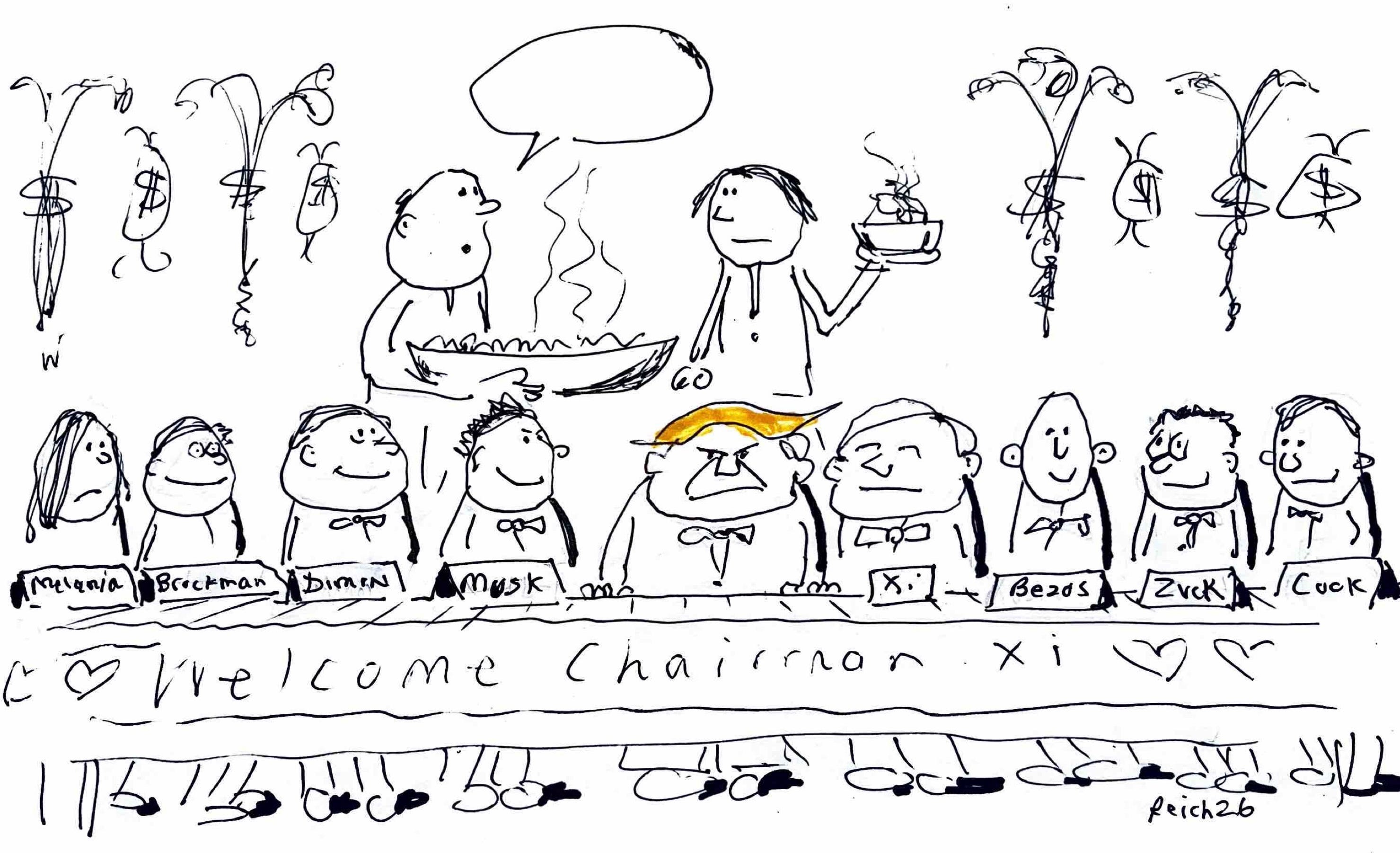
We also look at the larger issue of Trump’s billionaire buddies owning the media (Washington Post, X, Facebook, YouTube, etc.). Also: where the money is coming from to support Republican candidates in these last weeks before the midterm elections (spoiler alert: all of the above). Also: the attendees at Trump’s state dinner for Xi Jinping (spoiler alert: all of the above). Also: what this consolidation of wealth and power means for the upcoming midterms (no spoiler alert).
So please grab a cuppa, pull up a chair, and join the conversation.
Naomi Klein and Astra Taylor are two of my favorite thinkers who see the large patterns of wealth and power in our world, and the consequences for our daily lives. Their latest book, End Times Fascism and the Fight for the Living World explains how neofascist groups — religious extremists, right-wing nativists, and techno billionaires — are planning for and seeking to bring an end to civilization, while they alone survive.
Klein and Taylor also talk about what we can do to encourage a counter-movement based on human interdependence, preservation of our planet, and social justice.
My thanks to Naomi and Astra for sharing their thoughts with us.
Their new book, End Times Fascism and the Fight for the Living World, can be ordered here.
I spent much of this week talking with foreign officials who are in the U.S. for United Nations meetings. I was curious to know how they’re strategizing about the United States in the future — assuming Democrats do well in the midterm elections and Trump becomes a lame-duck president. (None of my nine sources were heads of state; my stature doesn’t reach that high. But they were high enough to give me some useful insights.)
Here’s what I learned:
1. Most are thinking past Trump. They believe his influence is already waning, and his bellicose rantings show that he knows it. He’s still dangerous, they say, but not nearly as dangerous as he was, and he’s no longer capable of plunging the world into war. Every one of them told me he’s deeply unpopular in their countries.
2. They’re thinking in a timeframe of five to 10 years. They see Trump as a temporary phenomenon and assume the United States will “return to its senses.”
3. But — and here’s the part that concerned me — they’re unsure they can ever again rely on the United States for world leadership. Several pointed out that the fact Americans elected Trump for a second time reveals, in the words of one of them, “there’s something troublesome about your nation that transcends Trump.”
4. Even post-Trump, they see the United States as unstable and unpredictable. They don’t believe the country will fall into civil war, but they worry that policymaking will cycle between extremes because, in the words of another, “your extreme inequality will make it difficult to achieve any longer-term consensus.”
5. As a result, they’re looking ahead to a world where another nation, or group of nations, will take leadership on global issues that need to be addressed, such as climate change, AI, migration, widening inequalities, Putin’s aggression, and disease prevention.
6. Which nation or group? Another official put it to me this way: “We don’t trust China, the U.N. doesn’t work because of its security council, but the EU isn’t strong enough yet. Several of us are hoping that over the next decade the EU will be joined by Canada, Japan, South Korea, Australia, and New Zealand, and that this new EU — really, a World Union — will devise a structure that enables it to work collaboratively and forcefully for the good of the world.”
If we want to clean up the mayhem Trump and his regime have created — and prevent anything like this from happening again — here are the 10 big reforms every political candidate should support.
They’re structuralreforms in how our political system works, rather than policies such as Medicare for All, affordable housing, childcare, or a $20 minimum wage. But these structural reforms are necessary prerequisites to getting good policies enacted. They must be passed by Congress in order for anything else to get done.
I’m summarizing them below the video. Please watch and share:
Here are the 10 necessary structural reforms:
1: Enact Supreme Court term limits. Limit justices to 18-year terms, after which they return to lower federal courts.
2: Crack down on conflicts of interest. Apply federal conflict-of-interest laws to the president and vice president, ban all elected officials (and Cabinet members) from trading individual shares of stock, and require their financial holdings be put in a blind trust.
3: Stop political interference in criminal prosecutions. Prohibit presidents from influencing Justice Department prosecutions and require congressional review of pardons and commutations.
4: End the gerrymandering wars. Require all states to create independent commissions that draw congressional district maps.
5. Restore the Voting Rights Act. Reinstate protections against racially discriminatory voting maps and restore federal oversight of states with a history of voter discrimination.
6. Protect the freedom of the press. Prevent media monopolies by stopping large corporations and major media owners from buying up more news outlets.
7: Eliminate political litmus tests for federal funding. Hold the president in contempt for impounding funds appropriated by Congress. This includes funding for academic and scientific research, which should be free from political influence.
8. Tax extreme wealth. Enact a wealth tax on multimillionaires and billionaires and end the stepped-up basis loophole that allows huge fortunes to be inherited without having to pay taxes on capital gains.
9. Elect presidents by the popular vote. Replace the Electoral College through a constitutional amendment or a compact among states to award their electoral votes to the national popular vote winner.
10. Get big money out of politics. Expand public financing to match small-dollar campaign donations and pass a constitutional amendment to overturn the Citizens United decision.
Trump has revealed how easily our system can be abused. But opposing him isn’t enough. We need lasting structural reforms that make it harder for anyone — president, speaker of the House, Supreme Court justice, or other officials — to abuse their power in the future.
Please send this list to any candidate you’d like to win on November 3.
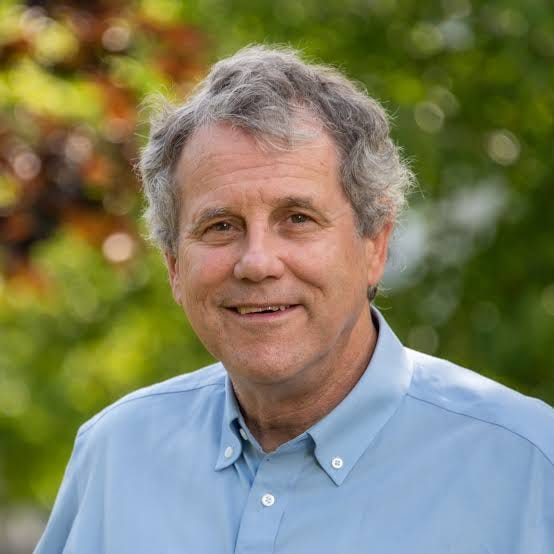
A crypto-backed PAC known as “Fairshake” just announced it would spend at least $30 million to help defeat Democrat Sherrod Brown in the race for Ohio’s Senate seat.
Ohio voters couldn’t have a clearer sign that Brown is on their side.
“Fairshake” is funded mainly by Big Crypto firms Coinbase and Ripple and venture capital giant Andreessen Horowitz. It has a war chest of more than $120 million.
In 2024, Big Crypto spent more than $40 million to defeat Brown, then chair of the Senate Banking Committee. A leading critic of crypto, Brown stopped industry-friendly crypto legislation in its tracks.
Brown lost by about 4 percentage points to GOP Senator Bernie Moreno — now a leading crypto booster in the Senate.
I don’t know of a more blatant case of big money corrupting the system.
But Brown is mounting a comeback bid in the Buckeye State, where he’s facing Sen. Jon Husted in a special election to replace Vice President JD Vance.
Big Crypto is going all out to stop Brown once again, because Brown hasn’t changed his views about the dangers of crypto.
Crypto’s promised public benefits are zilch while its costs and risks are increasing by the day. There’s simply no legitimate use for crypto. Its only practical uses are tax evasion, money laundering, human trafficking, fraud, speculation, and crime.
Trump’s own crypto business should be evidence enough. The Ponzi scheme he created shows how many people will get snookered if crypto continues to syphon off their hard-earned savings.
Yet there’s no lobby to guard small investors who are losing their shirts on crypto, or to guard the public against its many downsides. Which is why we need senators like Sherrod Brown, who’s not for sale — to crypto or anyone else.
I’ve known, worked with, and admired Brown for many years. Few people in public life have as much integrity, or shown as much concern for the lives of average working people.
The good people of Ohio don’t have to take my word for it. All they need do is look at who Big Crypto is funding (Husted) and who it’s fighting against (Brown) and vote accordingly.
Zoom out on the entire 2026 midterms and you’ll see the same pattern. The largest moneyed interests — Big Crypto, AI, AIPAC, Elon Musk, and Trump’s PACs (MEGA Inc., No Going Back PAC, and Safety and Affordability PAC) — are pouring record amounts into the campaigns of candidates who will do their bidding.
The pro-AI super PAC “Leading the Future” has a war chest of between $125 million and $140 million. It’s backed by OpenAI president Greg Brockman, Palantir co-founder Joe Lonsdale, and venture capitalists Marc Andreessen and Ben Horowitz.
AIPAC’s political action committee and super PAC, the United Democracy Project (UDP) has some $100 million on hand for the general elections. AIPAC says it supports Israel but it’s been a cover for big corporations and Wall Street.
Musk is backing Republican candidates who’ll help his businesses. Trump is doing the same.
All told, Republicans hold nearly a two-to-one cash advantage over Democrats going into the midterms. But you know something? American voters are catching on. The big money isn’t working.
In fact, being backed by big money is coming to be a major campaign disadvantage, because it’s seen for exactly what it is: a sign that a candidate is in the pocket of big business, Wall Street, and techno billionaires, who are shafting ordinary Americans.
Sherrod Brown’s campaign manager, Patrick Eisenhauer, said Brown’s opponent, Jon Husted is “for sale and the billionaires and corporations pouring millions into this race know it. Of course the special interests are panicking, they know Sherrod will fight the rigged system they’re feasting on to stand up for working Ohioans.”
Trump won Ohio by 11 points in 2024. Yet Brown remain 8 points ahead of Husted, 53% to 45% — a margin unchanged since June.
Yesterday at the United Nations, CNN anchor Kaitlan Collins asked Trump when the war with Iran would end, citing a poll showing that two-thirds of Americans don’t think the U.S. is winning.
“I’m surprised that CNN is here covering me,” Trump began before telling Collins: “You should not be here covering me. You said you weren’t going to cover me. You shouldn’t be covering me.”
Collins told Trump that the U.N. allowed her organization into the General Assembly, even though Trump had days before banned CNN (along with MSNOW and Politico) from covering his White House because he didn’t like their coverage of him.
Collins then repeated her question twice while Trump ignored her.
CNN’s days of asking hard questions of Trump may be coming to an end anyway, now that California Attorney General Rob Bonta has allowed Trump lapdog billionaire Larry Ellison and son David to take over CNN.
Bonta caved presumably because the Ellisons threatened to begin moving Paramount’s operations out of California starting in October if Bonta refused to settle his antitrust lawsuit against them.
Trump’s game plan all along has been for the Ellisons to control a huge media monopoly that won’t utter a critical word about him — including CBS News, CNN, Comedy Central (home to Jon Stewart), HBO (John Oliver), and even TikTok (where 1 out of 5 Americans now get their news).
What’s next for CNN? I doubt it will be gutted. That would be too obvious. It will just be defanged.
When the Ellisons gained ownership of CBS, they got rid of Stephen Colbert by not letting CBS renew his contract, and they ripped the guts out of CBS News and its flagship “60 Minutes” — firing Scott Pelley and other senior producers who refused to walk the Trump walk.
One departing producer there explained in a farewell memo to colleagues that she could no longer work where stories are “evaluated not just on their journalistic merit, but on whether they conform to a shifting set of ideological expectations — a dynamic that pressures producers and reporters to self-censor or avoid challenging narratives that might trigger backlash or unfavorable headlines.”
Anyone who believes the Ellisons will treat CNN (or Comedy Central or HBO) any better than they’ve treated CBS News hasn’t been paying attention to Trump’s and the Ellisons’ maneuverings over the past few months.
When Warner Bros. Discover — CNN’s parent — went up for sale, Trump said it was “imperative” that CNN be sold as part of the deal. “CNN should be sold because the people that are running CNN right now are either corrupt or incompetent,” he told reporters at an event at the White House. He continued:
“I think any deal, it should be guaranteed and certain that CNN is part of it or sold separately, but I don’t think the people that are running that company right now and running CNN — which is a very dishonest group of people — I don’t think that should be allowed to continue. I think CNN should be sold along with everything else.”
Last December, when a CNN reporter asked Trump a question he didn’t like, he shot back: “You know you work for the Democrats, don’t you? You’re basically an arm of the Democrat Party.”
The Ellisons — per et fils — have already promised Trump they’ll bring CNN to heel.
According to The Wall Street Journal, David Ellison promised Trump he’d make “sweeping changes” to CNN if he were allowed to acquire its parent company, Warner Bros. Discovery.
A White House official even discussed with Larry Ellison potential programming changes at CNN, including firing reporters such as Erin Burnett and Brianna Keilar, whom Trump is said to loathe.
At a press briefing in March, Defense Secretary Pete Hegseth complained about a CNN report that the Trump administration had underestimated Iran’s ability to disrupt global oil traffic by closing the Strait of Hormuz. “Patently ridiculous,” Hegseth told reporters, adding that “the sooner David Ellison takes over that network, the better.”
It’s the neofascist playbook: Take over the media and silence criticism. Even better (because it’s less out in the open), have your cronies take over the media and have them silence criticism. Better still, make deals with your cronies so when they take over the media, they have ongoing financial incentives to silence criticism. If they’re billionaires, they can keep buying up media and silence criticism as they make even more money.
Jeff Bezos has defanged the editorial page of TheWashington Post. Elon Musk has turned Twitter into global neofascist X. Trump suck-up Mark Zuckerberg controls Facebook, Instagram, WhatsApp, Messenger, and Threads.
And now the Ellisons, and CBS News and CNN (and Comedy Central and HBO).
What do you get when you combine the richest people in America with the biggest media corporations in America with the thinnest-skinned and most corrupt president in American history?
Voting in the midterm elections has already begun in several states.
Many people ask for my midterm predictions — and whether I believe they’ll spell the end of Trump. I’ll share them with you soon, but today I’d like yours.
Herewith, the four scenarios I’m hearing most often. Please select the outcome that seems most likely to you.
Welcome to the first of my 14-week “Wealth and Poverty” classes. They’ll appear here every Monday at 2 pm PT, 5 pm ET (but of course you can retrieve them whenever you’d like).
Many thanks to those of you who joined Heather and me live yesterday evening. You can either watch our “watch-a-long” version of the class with our commentary (above), or click the video below to watch the original recording without commentary.
Even though this isn’t a real classroom and I’m not with you in person, I hope you find this course both enjoyable and challenging.
Don’t expect to learn by just watching and listening, though. I want you to be an active learner — which means answering questions I pose and putting various puzzle pieces together. I’m not going to tell you what to think. I’m going to try to provoke you into thinking harder and more deeply.
I’ve also selected some readings for you, which will be listed on this page right after each class video. Just click on the link. My goal is to expose you to a variety of perspectives. Don’t worry if you can’t get to all of them. There’s no exam! But as I tell my students, the more you put into it, the more you’ll get out of it.
Here are the questions we’ll focus on in this first class (you may want to watch the class with someone else, and discuss them):
Is some inequality both inevitable and necessary?
At what point, if ever, does inequality become a problem? How do income and wealth inequalities overlap with race and gender?
Why did these inequalities begin to widen so dramatically starting in the late 1970s and early 1980s, and why have they continued widening since then?
Finally, where do our about what constitutes a fair economic and political system come from?
And here are the readings for week 1 (just click on each to retrieve the reading).
This course is free but if you’re able to help with expenses, please consider a paid subscription.
A huge thanks to the Wealth and Poverty team — to Michael Lahanas-Calderón, Kyle Parker, Dan Davis, and Emmett Tjen — as well as Coro Fellows Ammar Ansari and Meagan Turner for preparing these course materials to be shared with all of you. And to Heather Kinlaw Lofthouse for making all this happen on this page.
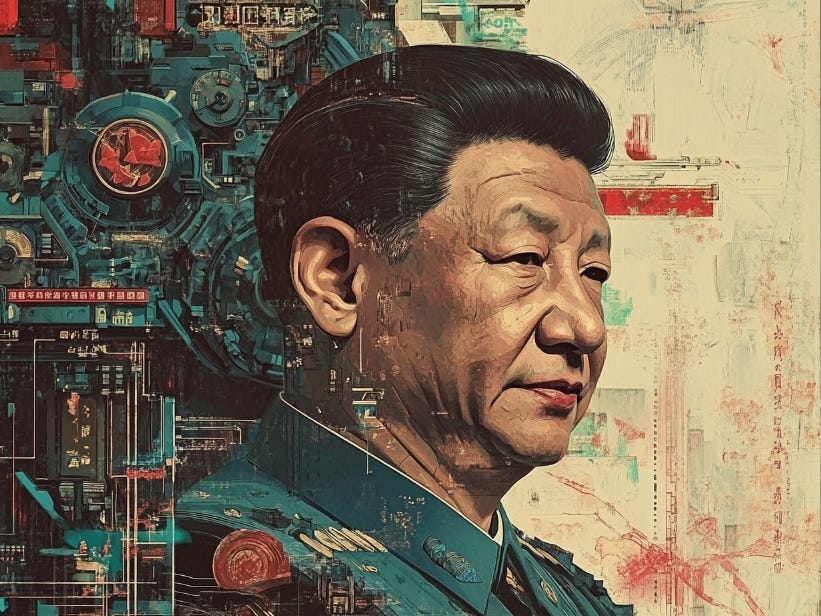
China and the United States are now competing for AI dominance. But what’s needed is a new mind-set about the meaning of “security” in the emerging world of AI — where the central question should not be who gains AI dominance but whether human beings maintain dominance over AI.
The dilemma is that humans won’t be able to maintain dominance over AI unless China and the U.S. — the two leading AI powers in the world — join together to seek it, but our competition for dominance makes this nearly impossible.
Xi Jinping will be visiting the United States this week. It’s an opportunity for the new mind-set, but will China and the U.S. take it?
Xi recently gave a keynote address at the World A.I., Conference in Shanghai which contained some clues to his thinking. In it he said:
“We should … ensure that AI is secure and controllable. AI should be a trusted tool for humanity. We should take seriously the various types of inherent and secondary risks that AI may trigger. We should put in place laws and regulations, technological monitoring, early warning and emergency response systems in order to strengthen the line of security, prevent abuses and malicious use, and ensure that AI is always under human control. In the meantime, we should jointly oppose overstretching the national security concept in the field of AI and placing one country’s security over that of others.”
This sounds as if Xi is most concerned about humanity maintaining control over AI.
Yet other officials in China appear more concerned about American dominance over AI.
In an article published September 12 in the state-run magazine China Cyberspace, China’s top spy chief, Chen Yixin, warned that artificial intelligence could pose a direct threat to the Chinese Communist Party’s hold on power. He called for more party control over AI and stricter government oversight — to defend against increasingly sophisticated cyberattacks and misinformation campaigns from “hostile forces,” and to compete militarily with countries like the United States.
Leaders of AI in the United States appear just as ambivalent about whether the most important goal is keeping America’s AI lead over China or keeping AI under the control of human beings.
While Trump and his tunnel-visioned treasury secretary, Scott Bessent, are focused on American dominance, other AI leaders seem equally concerned about human dominance.
Anthropic CEO Dario Amodei is sounding the alarm about AI’s growing ability to build the next generation of AI on its own, without human oversight. This dynamic, called recursive self-improvement, is starting to happen across the industry, including at Anthropic.
“Left unchecked,” warns Amodei, “it could outrun our ability to understand and control these systems, and so must be pursued very carefully, if at all.”
Amodei continues:
“Given the accelerating rate of AI capability development … in 6–12 months … a swarm [of AI agents] could be capable of taking over the entire internet with a persistent botnet (potentially causing hundreds of billions of dollars in damage), and that the scale of damage would continue to increase from there if AI becomes more powerful without the necessary guardrails.”
But in the same open letter, Amodie insists that democratic nations can only afford to slow down their own AI development if they maintain and widen their technological lead over China.
“Pacing within democracies will be limited by the lead that US companies have over authoritarian regimes, chiefly the Chinese Communist Party. If we slow down by more than this amount, then (unpaced) CCP-associated projects will pull ahead, creating significant national security risk. I agree with Secretary Bessent that a Chinese lead in AI would pose grave danger for the United States and the world. The CCP-associated projects will run the alignment risks that US companies are carefully preventing, and even if they avoid those risks, they will be in a position to militarily dominate democracies (for example with AI-driven drones). Thus, a key part of pacing within democracies is to keep democracies’ AI lead over autocracies as large as possible, to give us the breathing room we need in order to pace effectively.”
Amodei backs restrictions on selling powerful A.I. chips to China, among other measures to slow China’s progress enough to widen America’s lead.
It’s always hazardous to take the words of political and corporate leaders at face value, so I urge skepticism.
Yet there’s no doubt that some leaders in both China and the United States are aware of how quickly AI is moving toward building, on its own, the next generation of AI — and how dangerous this could be for the human species, regardless of whether humans live in China, the United States, or elsewhere on the planet.
We won’t be able to stop this from happening unless China and the U.S. work together, but our two nations are too suspicious of one another to allow it.
Keep your expectations low for this week’s visit of XI to the United States. But be aware of how high are the stakes for humanity.
Forgive me for intervening in your day again, but his antics are getting stranger and stranger. Designing an Arc-de-Trump so snipers can hide in it? Banning MSNOW, Politico, and CNN from the White House because he doesn’t like their behavior? Refusing to disclose how many American service members have been killed in his war on Iran?
I date the start of the American public’s furious distrust of big government and big business to the Wall Street bailout of 2008.
Millions of Americans lost their homes, their savings, and their jobs — while the bankers were bailed out and not a single Wall Street executive went to jail for turning Wall Street into a giant gambling casino.
Here’s the interview I did with Conan O’Brien at the time:
You’ll recall that the bailout of Wall Street brought on the Tea Party movement on the right and the Occupy movement on the left — both of which excoriated “corporate welfare” and “crony capitalism.”
A few years later came Donald Trump on the right and Bernie Sanders on the left — both arguing against a system that, both charged, had enabled wealthy Americans and big corporations to rig it against average working Americans.
As we all now know, Trump was — and remains — a puppet of that wealthy corporate establishment.

 Login
Login