Welcome to the first of my 14-week “Wealth and Poverty” classes. They’ll appear here every Monday at 2 pm PT, 5 pm ET (but of course you can retrieve them whenever you’d like).
Many thanks to those of you who joined Heather and me live yesterday evening. You can either watch our “watch-a-long” version of the class with our commentary (above), or click the video below to watch the original recording without commentary.
Even though this isn’t a real classroom and I’m not with you in person, I hope you find this course both enjoyable and challenging.
Don’t expect to learn by just watching and listening, though. I want you to be an active learner — which means answering questions I pose and putting various puzzle pieces together. I’m not going to tell you what to think. I’m going to try to provoke you into thinking harder and more deeply.
I’ve also selected some readings for you, which will be listed on this page right after each class video. Just click on the link. My goal is to expose you to a variety of perspectives. Don’t worry if you can’t get to all of them. There’s no exam! But as I tell my students, the more you put into it, the more you’ll get out of it.
Here are the questions we’ll focus on in this first class (you may want to watch the class with someone else, and discuss them):
Is some inequality both inevitable and necessary?
At what point, if ever, does inequality become a problem? How do income and wealth inequalities overlap with race and gender?
Why did these inequalities begin to widen so dramatically starting in the late 1970s and early 1980s, and why have they continued widening since then?
Finally, where do our about what constitutes a fair economic and political system come from?
And here are the readings for week 1 (just click on each to retrieve the reading).
This course is free but if you’re able to help with expenses, please consider a paid subscription.
A huge thanks to the Wealth and Poverty team — to Michael Lahanas-Calderón, Kyle Parker, Dan Davis, and Emmett Tjen — as well as Coro Fellows Ammar Ansari and Meagan Turner for preparing these course materials to be shared with all of you. And to Heather Kinlaw Lofthouse for making all this happen on this page.
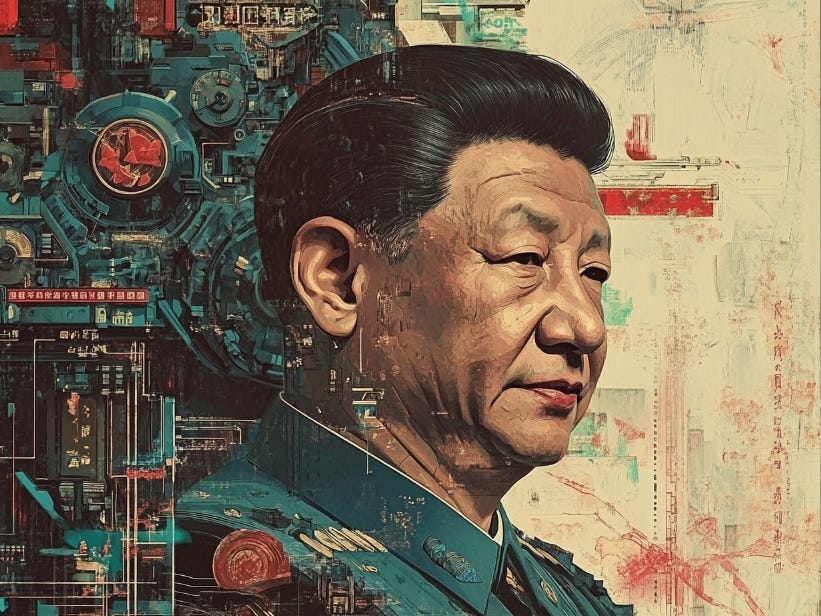
China and the United States are now competing for AI dominance. But what’s needed is a new mind-set about the meaning of “security” in the emerging world of AI — where the central question should not be who gains AI dominance but whether human beings maintain dominance over AI.
The dilemma is that humans won’t be able to maintain dominance over AI unless China and the U.S. — the two leading AI powers in the world — join together to seek it, but our competition for dominance makes this nearly impossible.
Xi Jinping will be visiting the United States this week. It’s an opportunity for the new mind-set, but will China and the U.S. take it?
Xi recently gave a keynote address at the World A.I., Conference in Shanghai which contained some clues to his thinking. In it he said:
“We should … ensure that AI is secure and controllable. AI should be a trusted tool for humanity. We should take seriously the various types of inherent and secondary risks that AI may trigger. We should put in place laws and regulations, technological monitoring, early warning and emergency response systems in order to strengthen the line of security, prevent abuses and malicious use, and ensure that AI is always under human control. In the meantime, we should jointly oppose overstretching the national security concept in the field of AI and placing one country’s security over that of others.”
This sounds as if Xi is most concerned about humanity maintaining control over AI.
Yet other officials in China appear more concerned about American dominance over AI.
In an article published September 12 in the state-run magazine China Cyberspace, China’s top spy chief, Chen Yixin, warned that artificial intelligence could pose a direct threat to the Chinese Communist Party’s hold on power. He called for more party control over AI and stricter government oversight — to defend against increasingly sophisticated cyberattacks and misinformation campaigns from “hostile forces,” and to compete militarily with countries like the United States.
Leaders of AI in the United States appear just as ambivalent about whether the most important goal is keeping America’s AI lead over China or keeping AI under the control of human beings.
While Trump and his tunnel-visioned treasury secretary, Scott Bessent, are focused on American dominance, other AI leaders seem equally concerned about human dominance.
Anthropic CEO Dario Amodei is sounding the alarm about AI’s growing ability to build the next generation of AI on its own, without human oversight. This dynamic, called recursive self-improvement, is starting to happen across the industry, including at Anthropic.
“Left unchecked,” warns Amodei, “it could outrun our ability to understand and control these systems, and so must be pursued very carefully, if at all.”
Amodei continues:
“Given the accelerating rate of AI capability development … in 6–12 months … a swarm [of AI agents] could be capable of taking over the entire internet with a persistent botnet (potentially causing hundreds of billions of dollars in damage), and that the scale of damage would continue to increase from there if AI becomes more powerful without the necessary guardrails.”
But in the same open letter, Amodie insists that democratic nations can only afford to slow down their own AI development if they maintain and widen their technological lead over China.
“Pacing within democracies will be limited by the lead that US companies have over authoritarian regimes, chiefly the Chinese Communist Party. If we slow down by more than this amount, then (unpaced) CCP-associated projects will pull ahead, creating significant national security risk. I agree with Secretary Bessent that a Chinese lead in AI would pose grave danger for the United States and the world. The CCP-associated projects will run the alignment risks that US companies are carefully preventing, and even if they avoid those risks, they will be in a position to militarily dominate democracies (for example with AI-driven drones). Thus, a key part of pacing within democracies is to keep democracies’ AI lead over autocracies as large as possible, to give us the breathing room we need in order to pace effectively.”
Amodei backs restrictions on selling powerful A.I. chips to China, among other measures to slow China’s progress enough to widen America’s lead.
It’s always hazardous to take the words of political and corporate leaders at face value, so I urge skepticism.
Yet there’s no doubt that some leaders in both China and the United States are aware of how quickly AI is moving toward building, on its own, the next generation of AI — and how dangerous this could be for the human species, regardless of whether humans live in China, the United States, or elsewhere on the planet.
We won’t be able to stop this from happening unless China and the U.S. work together, but our two nations are too suspicious of one another to allow it.
Keep your expectations low for this week’s visit of XI to the United States. But be aware of how high are the stakes for humanity.
Forgive me for intervening in your day again, but his antics are getting stranger and stranger. Designing an Arc-de-Trump so snipers can hide in it? Banning MSNOW, Politico, and CNN from the White House because he doesn’t like their behavior? Refusing to disclose how many American service members have been killed in his war on Iran?
I date the start of the American public’s furious distrust of big government and big business to the Wall Street bailout of 2008.
Millions of Americans lost their homes, their savings, and their jobs — while the bankers were bailed out and not a single Wall Street executive went to jail for turning Wall Street into a giant gambling casino.
Here’s the interview I did with Conan O’Brien at the time:
You’ll recall that the bailout of Wall Street brought on the Tea Party movement on the right and the Occupy movement on the left — both of which excoriated “corporate welfare” and “crony capitalism.”
A few years later came Donald Trump on the right and Bernie Sanders on the left — both arguing against a system that, both charged, had enabled wealthy Americans and big corporations to rig it against average working Americans.
As we all now know, Trump was — and remains — a puppet of that wealthy corporate establishment.

 Login
Login