Login
Login
Vorschau 10/86
19 August 2026 at 10:00

Das wünschen sich alle Besitzer eines MPS 802: Ihr Drucker wird grafikfähig und arbeitet ohne Probleme mit Programmen wie Print Shop, Hi-Eddi oder News Room zusammen....


LIKE THE UNITED STATES, Russia is having national elections this fall. From September 18 to 20, voters will cast ballots for (but not necessarily choose) members of the lower house of the federal legislature, the Duma. So far, the only party worthy of the label “opposition,” Yabloko, has been struck from the ballot, in a decision affirmed on Monday by the appellate college of Russia’s Supreme Court. On the same day, one of the same party’s most recognizable political figures, a former member of a regional assembly, was handed a prison sentence of eleven years and one month on charges of spreading “false information” about the Russian army. Earlier, another politician who had announced his Duma candidacy on an antiwar, pro-freedom platform had fled the country after a clear signal that he had to choose between emigration and prison.
It is, in other words, the sort of election you’d expect in Vladimir Putin’s Russia as the war in Ukraine creeps closer to the five-year mark.
But does the ruthless crackdown attest to the Kremlin’s totalitarian might or to its fragility—or both? And could it energize a new generation of young pro-freedom activists, hundreds of whom braved the police in Moscow to support Yabloko?
Defend democracy. Support independent media. Join our community.
YABLOKO, FOUNDED IN 1993—its name, Russian for “apple,” is also a portmanteau of the names of three founders, of whom only one, Grigory Yavlinsky, is still sort of on the political scene—has long been regarded as a quaint relic of the 1990s and as a pathetic symbol of impotent liberalism, or even faux liberalism. It has also been perceived as Putin’s pet opposition: Not affirmatively cooperative like the “establishment opposition” parties (Just Russia, Liberal Democratic Party, and even the Communists) but nonetheless tame, toothless, and permitted to exist as long as it knew its place. A former Yabloko member, blogger and activist Maxim Katz, accused the party of “self-castration” five years ago, citing such displays of cowardice as a 2019 post on the party’s Twitter account discouraging people from attending peaceful protests.
Until recently, other opposition activists generally despised Yabloko—which hasn’t had a caucus in the Duma since 2003 and has typically received less than 1.5 percent of the vote in parliamentary elections—as an officially approved spoiler deployed against genuine opposition forces. (Yavlinsky’s former personal friendship with Putin didn’t help.) In 2015, Yabloko sued Alexei Navalny, the late anti-corruption activist, over a post charging that a regional Yabloko chapter had been “bought” by an oligarch with ties to the ruling United Russia party. In February 2021, Yavlinsky shocked many people by writing an article assailing Navalny, then already imprisoned after an attempted poisoning by Russian special services, as a nationalist and populist with his own autocratic tendencies.1
Even so, Yabloko was Russia’s only officially registered political party to oppose the Crimea annexation in 2014 and the invasion of Ukraine in 2022. It also had a few highly visible and genuinely brave activists—among them Lev Shlosberg, a former member of the Pskov regional assembly who, back in 2015, publicized evidence of Russia’s covert involvement in the war in Eastern Ukraine. That’s the man who just got an eleven-year sentence for supposed fake news about the Russian armed forces. At least four other Yabloko members and activists, including the Deputy Chairman Maxim Kruglov, are already serving sentences on the same spurious charge.
Despite the official hounding, Yabloko’s registration for September’s Duma elections was approved by Russia’s Central Elections Commission in late July. It still faced some major handicaps. It was denied registration in several localities including St. Petersburg, where it enjoys relatively high popularity. In addition, over a dozen relatively high-profile Yabloko members, including Chairman Nikolai Rybakov, were disqualified from running because of typically absurd political charges such as posting “extremist imagery” online. In Rybakov’s case, the extremist image was a photo of Navalny in a condolence message on his death.
Still, Yabloko was on the ballot, with a slate of mostly young candidates and with the slogan, “For peace and freedom—for life without fear.”
That didn’t last long. Within days, Yabloko’s registration was challenged by the small, hawkish party Rodina (“Motherland”). Yabloko’s call for the immediate cessation of hostilities in Ukraine, Rodina charged, was extremist and unconstitutional because it meant leaving “Russian territory”—i.e., Ukrainian territories annexed by Putin in September 2022 and written into the Russian Constitution, but still under Ukrainian control—in the hands of “the Kiev Nazi regime.” Other allegations had to do with foreign funding, specifically donations from Russian citizens who had income from foreign sources; illegal campaign expenditures, on the assumption that social media posts and podcasts publicizing Yabloko were (or amounted to) paid advertising; and copyright violations in campaign materials.
The copyright charges were especially Kafkaesque. Initially, Yabloko was accused of the unauthorized use of a photo from the Kommersant newspaper (a tank in a sunflower field) in its campaign materials, but it turned out that the photo had been legally purchased and properly credited. When that charge fell apart, the complaint had to fall back on far more esoteric claims. Yabloko’s logo was accused of suspicious resemblance to an image from a 1920 Soviet poster by avant-garde artist El Lissitsky: both feature a triangle piercing a circle. Also flagged were a U.S. army photo of the ruins of Hiroshima (which is in the public domain) and an image made with ChatGPT without OpenAI’s permission. And then there was a podcast host’s utterance, in an interview with Yavlinsky that was later posted on the Yabloko website, of two Soviet-era antiwar quotes that have long been part of the common language: “Anything but war,” a slightly altered line from the 1959 play Five Evenings, and “May there always be sunshine,” from a famous 1962 children’s song. (The American analogues might be “War is hell” and “What is it good for? Absolutely nothing!”) To compound the absurdity, the son of the song’s composer publicly stated that his heirs had no objection to Yabloko using the line in any way it wanted.
But whether the accusations made any sense never really mattered: On August 10, Russia’s Supreme Court ordered Yabloko struck off the ballot. An appeal was filed; but, given that the Central Election Commission and the General Prosecutor’s Office supported the decision, the chances of it being reversed on were roughly the same as Putin publicly apologizing to Ukraine for the invasion. On Monday, the disqualification was upheld, after a supposedly “open” hearing where only six members of the public were allowed inside the courtroom and no audio or video feed was permitted. (Someone still managed to smuggle out an audio recording.) A final appeal to the presidium of the Supreme Court is a simple formality.
SO, WHAT IS THE MEANING of this charade? Why was Yabloko registered? Why was it booted from the ballot when, even if it miraculously won a majority of the vote nationwide, the Kremlin could have easily rigged the results—particularly now that Russia’s electoral districts include the annexed and partially occupied provinces of Ukraine, where United Russia can freely give itself 99.9 of the vote if needed?
The consensus among Russia’s independent, mostly exiled pundits and political activists is that giving Yabloko its moment in the electoral sandbox was intended primarily to demonstrate that antiwar sentiment in Russia is pathetically marginal—between one and two percent of the electorate. There’s also a view that Yabloko was meant to split the “tame liberal” vote and weaken New People (Noviye Lyudi), a six-year-old party which backs the war in Ukraine but opposes censorship and supports more democratic elections.2 While New People is basically a Kremlin project meant to appeal to young voters, the Kremlin may feel that it shouldn’t be allowed to get too big.
But something funny happened on the way to the voting booth: Support for Yabloko started to surge. The presence of an antiwar, pro-freedom party on the ballot galvanized large number of young Russians online. The party’s fruity name proved useful: Suddenly, merely posting a clip discussing one’s love for apples, or happily munching on one, became a sly act of political defiance. Apple memes and emojis multiplied, as did Internet searches for Yabloko. “Closed” government polls reportedly showed about 10 percent of voters expressing an intent to vote for Yabloko before it had even started campaigning. The threshold for representation in the Duma is five percent. (Yes, vote-rigging is a given—but too large a gap between the actual vote and the reported results could annoy enough of the populace to give the Kremlin a headache.) Meanwhile, even official and public polls have been showing United Russia’s rating at a record low of about 32 percent. And while majorities still profess approval of Russia’s actions in Ukraine—whether out of fear, passive conformism, or sincere conviction—recent polls find that nearly two-thirds of Russians support peace talks, while one in four favor immediate concessions for peace.
What’s more, it’s likely that the regime’s real fear was not so much the actual voting as the campaign. As former Duma member Dmitry Gudkov told Radio Liberty: “There are no elections in Russia—it’s a scam, the house always wins. But if we got six weeks of a legal antiwar campaign in Russia, that could have gotten a lot of traction. There would have been hundreds of thousands of activist volunteers all over the country distributing leaflets and so on.” Not to mention at least some access to mainstream media including federal television channels, guaranteed to every party on the ballot. Perhaps, by election time, the share of Russians who want peace now—even on Ukraine-friendly terms—would have risen from a sizable minority to a majority.
Many believe that the Kremlin’s strategists made another miscalculation, counting on the Russian opposition in exile—which still has an underground following in Russia, including on banned but widely accessed platforms like YouTube and Telegram—to join in a pile-on against Yabloko. Instead, there was remarkable consolidation behind it: Even activists from Navalny’s Anti-Corruption Fund, including his widow Yulia Navalnaya, set old grudges aside and urged voting for the only antiwar and pro-freedom party on the ballot.
TV-RAIN host and analyst Yekaterina Kotrikadze has said that the most dramatic effect of Yabloko’s campaign was its appeal to young people who had largely withdrawn from the political into the personal, only to see their personal world invaded by the war and the state: Ukrainian drone strikes at online retail warehouses, gas lines caused by strikes at oil refineries, moves to throttle the Internet. In Kotrikadze’s words, “People realized that they don’t want to live like this.” Hundreds of young people showed up to support Yabloko outside the Supreme Court offices, both for the initial hearing and for the appeal—braving dozens of arrests, as well as police warnings to young men that protesting would get the draft board’s attention. Dmitry Medevedev, former fake president and current Putin attack dog, was sufficiently rattled to gripe about young pridurki (“retards,” basically) who, he suggested, are either lured by promised benefits or want to show off their rebellion.
POLITICAL SCIENTIST EKATERINA SHULMAN told TV-RAIN that the rash decision to greenlight Yabloko’s run, followed by a scramble to block it, was not only a “massive embarrassment in two acts” but a sign of “dysfunction” in the regime’s upper echelons. Some see it as a sign of intensifying conflict between Kremlin factions—the legendary hawks vs. doves, or quasi-liberal technocrats vs. siloviki, hardliners from the military and security structures that represent brute force. (We could call it “technocrats vs. jackboots.”) Others agree with political analyst Stanislav Belkovsky that the warring “Kremlin towers” are largely a myth, and Putin is the only decider.
Whoever (besides Putin) may have played a role in the Yabloko two-step blunder, Russian dissidents in exile have widely viewed it as an encouraging sign of the regime’s weakness: as ex-party member Maxim Katz put it in a recent video, “from ‘Kyiv in three days’ to being scared of Yabloko.” A similar fragility can be seen in the response to onetime Duma member Boris Nadezhdin’s aborted campaign. Like Yabloko, Nadezhdin was once seen as a reliable “house liberal,” known mainly as a token dissident/whipping boy on Russian propaganda shows. In early 2024, he was allowed to register as a candidate for the presidential elections; after thousands lined up to sign his nomination forms, enough signatures were invalidated to keep him off the actual ballot. This time, 63-year-old Nadezhdin was handled far more harshly: Shortly after declaring his Duma candidacy last month, he was branded a “foreign agent,” making him ineligible to hold public office, and then arrested and fined for display of “extremist imagery.” (The offense? Once again, a Navalny photo.) When a foreign travel ban notice appeared on Nadezhdin’s electronic account for government services and then disappeared, he got the message: He is now in Paris.
Displays of weakness? In a sense, yes; but these are also displays of ruthless power. That’s why, for opposition veterans like former TV journalist Viktor Shenderovich, the signs of a new generation’s awakening are both heartening and terrifying. “We see that life goes on—there are sane people, wonderful people,” Shenderovich said in an interview on a Russian-language Polish channel. “But then I remember Iran and realize that in the next round, when Putin gets scared for real, they’ll start shooting people. For now, they’ll be throwing them in jail.”
It’s tempting to believe, with former political prisoner Vladimir Kara-Murza, that the regime’s collapse could happen soon and very suddenly. One can certainly see signs of hope in the fact that Russian troops are stuck in Ukraine and that Ukrainian long-range missiles are hitting more and more Russian strategic targets. But for the moment, Putin and his totalitarian machine are still more than capable of inflicting horrific damage—on Ukrainians and on Russian resisters.
Navalny was expelled from Yabloko for his nationalist views in 2007; he himself claimed that his expulsion had more to do with challenging Yavlinsky’s leadership.
New People initially came out against the invasion of Ukraine but quickly reversed itself. It is widely seen as a project of Putin’s first deputy chief of staff Sergei Kirienko.
Wednesday has a way of forcing the issue. You’re too far in to pretend things aren’t moving, stargazer, and the sky is firmly in agreement — Saturn opposing Venus is two days from exact, and the pressure on relationships, desires, and what you actually want is at full strength. Jupiter’s conjunction with Mercury closes today: whatever you’ve been building toward saying, this morning is the last call before that reach drops. Moon squared Mercury early, putting friction on the words; tonight Sun squares the Moon and pulls feeling and forward drive apart. The week is asking everyone to stop circling and decide something. Most of you already know what it is.
Read your horoscope for the week, and see what the stars have in store for your sign today.
The fog that’s been sitting on your drive all week is lifting — Mars square Venus wraps up today and the push-pull between what you want and how you’ve been going after it finally starts to ease. You’ve had two days of listening and sitting with things. That was necessary, Aries. Now you can actually move again. Pick one thing. Just one. Go.
The aspects that have been softening Venus all week drop away today, and what’s left is Saturn opposing your ruling planet with nothing buffering it — two days from exact and fully felt. That’s not as uncomfortable as it sounds. All week you’ve been circling something you needed to decide, Taurus. Today the circling stops. You already know what you think. Say it.
Jupiter’s conjunction with Mercury closes out today — the window that’s been making your ideas travel further, and your reach feel broader all week is wrapping up. That’s not bad news; it’s a deadline. Whatever you’ve been sitting on, whatever draft is still unsent or conversation still unstarted, this morning is the last call, Gemini. The amplification doesn’t carry over. Send the thing.
Yesterday the knowing was clean and wordless — you didn’t need to explain it, you just had it. Today, Moon squaring Mercury means someone wants you to put it into language, and the words keep missing the mark. That’s not a sign you were wrong, Cancer. You’re just not ready to articulate it yet. Hold it a little longer. The right words are coming.
You made a call this week that felt right — and it was. Tonight, the Sun squaring the Moon introduces some second-guessing, the emotional undertow that follows any decision that actually meant something. Don’t let late-night doubt talk you out of what you knew this morning, Leo. The discomfort isn’t a verdict. It’s just the feeling that comes with doing something that counts.
Jupiter’s conjunction with Mercury wraps up today, and you’re the sign most likely to exhale at that news. All week the thinking has been pushed toward bigger, bolder, further — useful in doses, exhausting to sustain. Mercury operating without Jupiter’s thumb on the scale means you get your natural frequency back: precise, careful, detail-first. That’s not small, Virgo. That’s where you do your best work.
You’ve known the answer to Saturn’s question longer than you’ve been willing to admit — the hold-up was never figuring out what you want; it was accepting that wanting it clearly might make things complicated. Saturn opposing Venus doesn’t do inconvenient timing, Libra. Two days from exact and it’s done being patient. Stop protecting everyone else from your actual preference. Say the thing.
Two days of excavation and now the thing is sitting in plain view — uncomfortable in a different way than the not-knowing was. Tonight, Sun squaring the Moon is the first quarter push: knowing isn’t enough anymore; the next move is doing something about it. Conditions won’t get more perfect, Scorpio. You’ve done the hard part. What’s left is the easier one.
The big amplified energy of this week is winding down, and what’s replacing it is less flashy but considerably more durable. Saturn trine Jupiter in the background isn’t the exciting aspect — it’s the one that means what you’re building will actually hold up, Sagittarius. The vision was always good. Today the sky starts putting the bones underneath it. That’s the part that counts.
Saturn retrograde opposing Venus surfaces commitments you made when your priorities looked different. Some still fit. Some don’t, and you’ve known it for a while. This isn’t about blowing anything up, Capricorn — it’s about getting clear on which obligations still belong to you and which ones you’ve just been carrying out of habit. Today is a good day to tell the difference.
The aspects giving your ideas favorable reception all week are winding down — what’s left is you and the follow-through, which is the less exciting part of any good idea. Aquarius runs on inspiration, and you’ve had plenty this week. Today the tailwind is gone, and the work is just the work. That’s not a problem. That’s how things actually get finished.
Three days of wandering through the fog, and today, Neptune retrograde wants to know what the fog is actually made of — not where you’re going, but what’s driving the going. That’s the retrograde doing what retrogrades do: pulling the lens inward. You’ve been moving, Pisces, which was right. Now take a breath and ask yourself what you’re actually moving toward. The answer might surprise you.
The post Daily Horoscope: August 19, 2026 appeared first on VICE.
Rep. Randy Fine, the Republican running for reelection in Florida’s Sixth Congressional District, has unfavorably compared Muslims to dogs and suggested Israel should starve Gazans. “We need more Islamophobia, not less,” he wrote in one tweet. “Palestinian is a synonym for evil,” he wrote in another.
You might think that such a person would obviously be the most repugnant candidate in tonight’s FL-6 primary. But then there’s Dan Bilzerian, the right-wing influencer who challenged him.
Bilzerian is an open antisemite and Holocaust denier with millions of social media followers who has said that “most of the problems today are caused by Jewish supremacy.” He has called the mastermind of October 7 a “hero” and fantasized about personally killing Israelis. During the campaign, he regularly called Fine a “fat Jew” and released an AI-generated music video on X that muses about a second Holocaust: “Jewish supremacist, Satan’s creepy little minions / should we revisit that Austrian painter’s opinions?”
Lest the reference be too subtle, the line is overlaid over a graphic of Adolf Hitler wearing a painter’s apron.
House leaders in both parties condemned the antisemitic attacks and Fine won easily, but Bilzerian appeared poised to finish with about 19 percent of the vote with over 90 percent of ballots counted, making him the top vote-getter out of four Republicans challenging the incumbent.
This should all be a giant flashing warning sign for the GOP’s post-Trump future.
As on the Democratic side, divides over Gaza and October 7 have created a schism inside the GOP. But the right has rejected the very idea of gatekeeping against bigotry as either “woke” or needlessly divisive. For all his anti-Muslim statements, Fine is a Republican in good standing, with Trump’s “complete and total” endorsement to prove it. And he and others with similarly vicious views have turned the right’s debate over the Middle East into an increasingly nasty fight over American Muslims and Jews themselves.
Fine and Bilzerian may be unusually blunt and cruel. But the tendencies they represent have much wider purchase in the GOP — and could end up derailing its future.
Prior to 2025, Randy Fine was a Florida state legislator best known nationally for his intervention in the most recent Republican presidential primary — during which he initially endorsed Gov. Ron DeSantis, but then flipped to Trump. In 2025, he ran for the US House in a special election to replace Mike Waltz, the member of Congress Trump initially picked to serve as national security adviser.
Fine coasted to victory in the GOP primary, but underperformed Trump by about ten points in the general election. That was still easily good enough to win, as FL-6 is very red, but it pointed to Fine’s weakness as a candidate.
”He repels people,” DeSantis said in a press conference after the special election.
Since joining the House, Fine has made a name for himself for two things: his unshaking personal devotion to Trump and his frequent bigoted comments about Palestinians and Muslims, which he revels in using to generate controversy.
After his February comment about dogs — “the choice between dogs and Muslims is not a difficult one” — prompted outrage from leading Democrats and civil rights groups, Fine went on the far-right TV station NewsMax to suggest that the United States should force Muslims out of the country. On his social media accounts, he started posting images of dogs superimposed on a Gadsden “don’t tread on me” flag.
As Fine was making a name for himself through explicit anti-Muslim bigotry, Bilzerian was doing the same with antisemitism.
Bilzerian, who retains a fortune of uncertain size from his prior career as a professional poker player, is best known for the hard-partying lifestyle portrayed on his Instagram. A manosphere influencer and self-proclaimed sex addict, he has claimed to be dating 50 women at once and to have suffered two heart attacks at age 25 due to a combination of sleep deprivation, Viagra, and cocaine abuse. He currently has 29 million followers on Instagram and 2.1 million on Twitter.
In November 2024, he did an interview with Piers Morgan — still pinned to his Twitter profile — that served as a kind of mainstream coming-out party for his antisemitic worldview. In the interview, he said, among other things, that Jews control the media, exaggerated the Holocaust, and killed JFK. He has escalated into eliminationist antisemitism from there.
When he entered the primary in Spring, Bilzerian framed his challenge against Fine entirely around the congressman’s religion. “This fat jew @RepFine…has no place in our govt,” Bilzerian wrote in a March post. “When I unseat him I’m going to draft laws to have anyone putting Israel before America tried for treason.”
Fine, ever the class act, responded by going after Bilzerian’s dual Armenian citizenship. “We don’t want Armenians to be able to serve in Congress,” he said in a May interview. The ensuing campaign has seen Bilzerian posting a pro-Holocaust video, a swastika spray-painted on a Fine campaign sign, and Fine attempting to get Bilzerian investigated by the FBI.
In a year full of ugly primaries across the country, this is without question the ugliest and most hateful.
The scary thing about Florida’s 6th is that it might not be an isolated incident.
Among elected Republicans, Randy Fine may have made the most violently offensive anti-Muslim comments — but he is not the only one doing so. In fact, one of the most striking trends among congressional Republicans in the past year has been an uptick in more of them talking like Randy Fine.
Sen. Tommy Tuberville (R-AL) posted on Facebook that “Islam is not a religion. It’s a cult.” Former Rep. Andy Ogles (R-TN) posted on X that “Muslims don’t belong in American society.” Rep. Nancy Mace (R-SC) tweeted that “every single Muslim holding public office in America is a Trojan horse.” Rep. Chip Roy (R-TX) declared there should be “no more Muslims” in Texas, and (per a Washington Post count) posted on the topic 244 times in the first three-and-a-half months of the year on the topic. Rep. Barry Moore (R-AL) even introduced legislation — called The CRUSADE Act — that would effectively require Muslim immigrants to disavow the Islamic legal-moral code, called sharia, as a condition of receiving a visa.
This isn’t entirely new territory for Republicans. In 2010, there was also a wave of right-wing panic about sharia conquering American law that led to over a dozen state-level attempts to ban it. Trump’s proposal to impose a “total and complete ban” on Muslim immigration was, of course, a huge part of his message in his first campaign. And the national security team in his first administration was heavily influenced by a group of anti-Islam activists who called themselves “counter-jihadists.”
What’s new about the current wave of Republican Islamophobia is the explicitness. In the past, Republicans typically differentiated between ordinary Muslims and extremists, claiming to merely be targeting the latter even when their proposals would have restricted the former’s rights. Today, however, Republican officials have become increasingly comfortable dispensing with this fig leaf — saying that Muslims and Islam are the problem, period.
This is rooted in some combination of genuine bigotry and a cynical read of the GOP primary electorate. Polls consistently show high levels of hostility to Islam and Muslims among Republican voters; in May, for example, the pollster PRRI released a survey showing that 76 percent of Republicans agreed that “the values of Islam are at odds with American values and the American way of life.”
Disturbingly, Bilzerian’s antisemitic strategy might be similarly in tune with elements of the GOP base.
Antisemitism is still far less tolerated within the Republican Party — in fact, condemnation of Bilzerian has been notably bipartisan and his support on Tuesday, while unnervingly high, was nowhere near enough to threaten Fine. But his hyper-online cohort of far-right influencers has been growing in relevance, especially among Gen Z conservatives, who (per recent polling) form the demographic epicenter of America’s growing antisemitism problem.
In fact, Bilzerian wasn’t even the most prominent extremist candidate in Florida on Tuesday. That would be James Fishback, the GOP candidate for governor who ran a longshot campaign against Rep. Byron Donalds that was frequently accused of racism and antisemitism and had a visible following among young “groypers.” He appeared set to finish with around 10 percent of the vote with over 90 percent of ballots counted. Both are following the trail blazed by Nick Fuentes, the right-wing livestreamer who has made a name for himself as a leading voice of antisemitism.
Increasingly, this overt antisemitism is becoming a normal part of the lexicon in certain corners of right-wing media. Tucker Carlson, who has long taken care to hide his more inflammatory ideas under layers of innuendo and plausible deniability, recently accused Jewish conservative Ben Shapiro of wanting everyone to eat “goyslop” — an antisemitic term popular with far-right young people that implicitly accuses Jews of ruining the lives of non-Jewish Americans. Candace Owens, the right-wing podcaster second only to Carlson in reach, has been even more brazen.
And while their clashes with the White House over the Iran War have recently alienated Trump, it’s still an open question what will happen when his influence wanes and whether the next Republican nominee — whether it’s JD Vance or someone else — will bring these figures in from the cold.
There is, of course, both Islamophobia and antisemitism on the Democratic side as well. But there are also some antibodies in that the party has, however imperfectly, long made anti-bigotry one of its core values — many of the critiques of “Woke 1” were about excesses in this regard.
By contrast, Republicans have turned on the very idea of imposing guardrails, making it harder to repel candidates who cross the line into hate. Last week, a pair of conservative writers — professor Greg Conti and journalist Aaron Sibarium — warned that this rejection was setting the party up for disaster.
“Frustrated by the suppression of mainstream, center-right views, conservatives increasingly reject as cancel culture any public repudiation of genuinely fringe ideas, creating a subculture of racism, sexism and antisemitism that did not exist to the same degree even five years ago,” they wrote in the New York Times.
The Fine-Bilzerian race shows that this concern is not hypothetical. Trends on the right are moving swiftly to normalize the unthinkable, to make it so two candidates in a primary race could think that the gutterest of gutter bigotry could be a ticket to victory (or at least, enhanced stardom).
If things keep going this way, the future of the Republican Party could end up looking a lot like Florida’s Sixth.
Usual notice before getting started: If you like what you find here, thanks in advance for your subscription (possibly but not necessarily paid) or, even better, one-time donations for any amount, or consulting, writing or speaking work.
These days, everybody loves (or needs) to hate data centers for AI, and with good reasons: assuming they are built in the quantities AI companies want them, which there is plenty of reasons to doubt, they will suck up really huge quantities of energy, money, water and human creativities that there are thousands better ways to use. A few days ago, however, someone called Brooks Fiesinger (of whom I know nothing except the post mentioned below) made on Facebook the opposite point, which is quite interesting as food for thought, if nothing else.
Here is a synthesis of Mr. Fiesinger thesis, partly reformatted as a numbered list to make it easier follow the comments, and counter-proposals, that I make right after it.
THE UNCOMFORTABLE TRUTH: We are running out of workers, traditional intelligence metrics are dropping, and despite their unpopularity, AI data centers are currently our most viable lifeboat.
The data points to a massive structural deficit hitting our economy over the next 30 years, and we aren’t taking the infrastructure requirements seriously enough. Here is what we are facing:
The Workforce Collapse: We are mathematically running out of humans to keep the economy running. 2024 was “Peak 65”, roughly 12,000 Boomers are retiring every single day, taking decades of institutional knowledge with them.
The Cognitive Shift: Empirical studies from the US, UK, and Norway show that the “Flynn Effect” (the steady historical rise of IQ scores) has inverted for cohorts born after 1975. Recent testing of 400,000 US adults shows measurable drops in vocabulary, mathematical logic, and complex problem-solving.
(consequently) Millennials are likely the peak of traditional, deep-work intelligence. The next generation of professionals is highly optimized for fragmented, rapid data, but they will struggle with sustained deductive reasoning.
The Bottom Line: We need AI capabilities to replace the workforce that lacks both the raw headcount and the traditional cognitive processing power of previous generations. AI agents must replace the missing administrative volume, while frontier models synthesize complex data so future doctors, engineers, and teachers can make informed decisions.
This software requires heavy hardware. You cannot have cognitive augmentation without hyper-scale data centers. The physical infrastructure must be built right now.
First critical caveat: just because we desperately need data centers doesn’t mean we should be reckless. I fully support stringent environmental protections, proactive grid and energy management (we need advanced nuclear and baseload power, not rolling blackouts), and strict financial responsibility.
Second critical caveat: we must actively guard against the “Wall-E Effect. If we build AI to compensate for declining human reasoning, human reasoning will decline further because it’s no longer exercised.
Mr. Fiesinger conclusion: We are walking a dangerous line between necessary cognitive support and catastrophic human dependency. Do you have a better proposal?
In general, I sincerely thank Mr. Fiesinger for connecting some points that everybody should see they are connected, and for stimulating thinking about the role of AI in the full picture, regardless of what the current crow of challenged children that leads it claims.
Point 1 is true and really concerning, the only thing wrong in it is “the economy” instead of “society”, which is what really matters. It’s true and concerning because overpopulation has already started to end. I already wrote about this here.
Points 2 and 3 are quite close to an unfair generalization, but there still is more truth in them than what would be comfortable. In them, I would add “AI-dependence” to the “highly optimized for” list.
I also have to say that I will steal, obviously giving credit, the “highly optimized for fragmented, rapid data” definition, because I really love it. It is, for everybody it really applies to, the most elegant way I’ve seen so far to tell somebody that he’s too dumb to function as adult, because either parents or institutions that snobbed or even boycotted adequate education (with humanities in the right place), love of reading for reading’s sake and sensible protection from high-tech during childhood left him the attention span and memory of a goldfish.
I also agree with Point 6.. for the data centers that will be actually needed, including the part that calls for nuclear power, if developed in the “revolutionary” way I suggested two years ago
My disagreement, and counter proposals, are about Points 4 and 5, and with the underlying assumption hidden that what we call AI today is unavoidable and can only grow. That’s just not true, not true at all. Never was, never will.
Here is my main objection about Point 4: for what purpose, exactly, should we “replace the workforce that lacks both headcount and brain power”? For the same dung pit of nonsense we call the economy today? Should that workforce be replaced to keep running a world where people work themselves to oblivion, and where Europe (or any other place, of course) is supposed to do with tech the same mistakes the US did, mistakes of which the US will free themselves of through a crash that will damage the rest of the world? Of course, answering such a big question was outside the scope of Mr. Fiesinger’s post. I am not blaming him at all, just pointing out the questions we should answer before any concrete proposal to “keep the economy running”.
Moving to Point 5: well before replacing any job, the first volume frontier AI models should reduce is not in work, but in systemic excessive overhead, for example giving humans pointers to stupid complexity that shouldn’t exist, starting with laws as I suggested here.
Also, please note that many of the highest-paid administrative jobs that AI should replace often are jobs that shouldn’t exist at all. That is, the job that may entitle to a beautiful personal office and traveling business class, but under the facade are just “performance art... professional email forwards... human middleware between systems that could probably talk directly to each other... managing projects that exist primarily to justify the existence of project managers.... creating strategies for strategies, optimizing things that didn’t need optimizing, disrupting things that were working fine.”(read the whole thing this comes from, it’s great! Especially if your salary is high).
Ditto for, sticking to AI, all the managerial jobs that promote AI at all costs just because those doing them are afraid to do otherwise.
Let’s talk infrastructures, instead of keep this “economy” running: the most important workers needed in the next decades may not be people with two or three PhDs and excellent AI-enhanced management skills, but electricians, plumbers and other tradespeople, as well as firemen, nurses and caregivers in general... Thank heaven, there are now students “Seeking To AI-Proof Their Careers With Trades Over College”.
As far as AI physical infrastructure goes... the huge number of huge data centers is needed only by the hyperscaler companies that push the current AI bubble, in order to delay their crash. Stop that senseless rush, stop public access to AI for idiotic tasks (me on this, two years ago again), and we’ll find ourselves with plenty of data centers, or real possibilities to build them, to make a new wave of AI do stuff we all actually need.
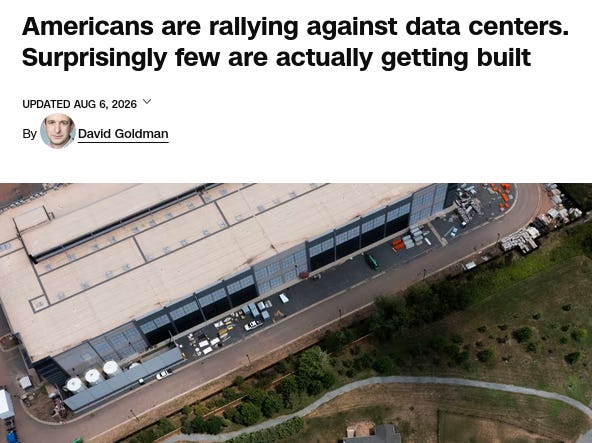
AI running in data centers will be needed to solve the huge problems (global aging, inequality, agricultural crises, resource conflicts) that will only get worse in the next years if nothing happens. The AI that’s needed, however, is not the AGI the AI cabal wants to impose on the world out of sociopathy and greed, but it will never achieve. It is a much smaller set of task-specific AIs, like China is doing, that will need many, many less data centers. And decently educated youngsters to handle it, of course. This is my better proposal, with sincere thanks to Mr. Fiesinger for his stimulus.