This week on my podcast, I read Why businesses lie about AI, a recent essay from my Pluralistic newsletter that breaks down Nikhil Suresh’s essay describing the total absence of any proof that any business is benefiting from AI deployment.
One person who’s had a lot of opportunity to observe the shear between the stated business/AI situation and the real business AI situation is Nikhil Suresh from Hermit Tech, a consulting firm of “radically ethical data wizards” (that is, tech consultants). Suresh reports on his experience talking with hundreds of executives (and, more importantly, their subordinates) about what (if anything) AI is doing for business in an essay entitled “AI Mania Is Eviscerating Global Decisionmaking.”
Yesterday, the Republican-led Senate confirmed acting Attorney General Todd Blanche to be the next U.S. attorney general.
Like Richard Nixon’s attorney general, John Mitchell, Blanche has carried out the illegal orders of a president of the United States. As was Mitchell’s fate, Blanche should be behind bars. Mitchell served 19 months of a two-and-a-half year sentence for conspiracy and obstruction of justice in the Watergate scandal.
Instead, Senate Republicans have given Blanche a promotion.
On Thursday, a Republican-led Senate panel voted to hold Anthony Fauci in contempt of Congress for his refusal to answer questions at a hearing last week. At that hearing, Fauci sat stoically for three hours, invoking his constitutional right not to answer questions about his leadership during the pandemic because of his justifiable fear that Senate Republicans would try to find something he might say to charge him with perjury. As it stands now, Senate Republicans may ask the Justice Department to prosecute him for failure to comply with their subpoena.
Fauci is an American hero. He gave invaluable advice to seven presidents — from Reagan to Biden — through anthrax attacks, Ebola outbreaks, SARS scares, and the COVID-19 pandemic. He devised the U.S. global attack plan against AIDS. George W. Bush gave him the Presidential Medal of Freedom for his work on HIV and AIDS.
Senate Republicans promote Blanche and shit on Fauci? What the hell is going on?
Look, I’m the first to admit that too many Democrats in Congress are lily-livered, unwilling to fight as hard as they should against Trump’s neofascism.
But congressional Republicans are worse than profiles in cowardice. They’ve nearly become a criminal enterprise, actively colluding with the neofascist in the Oval Office.
They’ve confirmed Blanche even without any guarantees that Trump won’t use the $1.8 billion slush fund Blanche created for him to reward the Capitol attackers, or that Trump won’t use the IRS immunity Blanche also got for him to prevent the public from ever knowing the full extent of Trump’s criminal enterprises.
And what’s with the Republican obsession over Anthony Fauci? The guy is 85 years old and retired. Why bother? It can’t be about defending Trump or avenging any damage to him. COVID was six years ago. People don’t blame Trump for it. They probably should, but if they really did, he wouldn’t have had a chance in 2024.
It can’t be because Fauci’s role in the pandemic is a burning political issue, because polls show exactly zero percent of Americans care about going after Fauci.
Sure, Rand Paul has a personal grudge against him, but Paul is crazier than a shit-house rat. So why are so many Republicans and even some Republican state attorneys general joining in his crusade against Fauci?
The reason is simple. Republicans have nothing else to talk about in the upcoming midterm elections. Trump’s foreign policy and Iran war are disasters. His economy is a catastrophe. His immigration dragnet, a cruel calamity. His health policy, an embarrassment or worse. His environmental policies, a gift to Big Oil.
Congressional Republicans have gone along with all of it. They’ve also enacted Trump’s giant tax reductions for the wealthy and big corporations that are funded in part by cuts in Medicare, Medicaid, and food stamps.
Trump himself is bonkers and losing it by the day. His communist witch hunt is a bad joke. His polls continue to plummet to record lows. Ballroom? Reflecting pool? Crypto deals? All have become Republican nightmares.
So Republicans are desperate for something, anything, anyone — a fall guy, a scapegoat — to rant against, whip up the Republican base against, and raise money for their fall campaigns. Fauci is old, can’t defend himself, is easily demagogued.
Yes, my friends, it’s all upside down. Frightening and nuts. But may I remind you that there are just 86 days until the midterms, when we can throw many of these criminal Republicans out of office?
Which gets me to you. A few days ago I asked many of you how you’re coping with this ongoing horror.
In response, some of you said you’re tuning it out, or you’ve concluded that nothing can be done about it so why bother.
I get it. I sometimes can’t stand to hear another word about the loathsome Trump and his insufferable sycophants. And occasionally I despair that he and his regime will continue their reign of destruction regardless of what I or anyone else does.
But the vast majority of you told me you’re coping in two other ways: by choosing to be grateful for what’s good about America and by becoming more activist.
You’re focusing on the generosity you see around you every day, the simple acts of kindness, and the courage and dedication of people such as our teachers, nurses, social workers, and community leaders.
You’re protecting the vulnerable in your community, supporting good candidates, sending postcards to potential voters, protesting against Trump and his outrages, and boycotting companies that are enabling him.
As one member of our Substack community, Johan, commented a few weeks ago, it’s perfectly normal for people to wait to take action until they feel hopeful.
Yet in reality, hope emerges from action. It’s what activism pays back.
Which is also why hopelessness is a trap. “We’re all f*cked” may feel like clear-headed realism, but it’s just surrender — draped in the costume of being realistic.
The billionaire class and their Republican lackeys want us to fall into hopelessness so they can have it all without any resistance. Hopelessness costs them nothing, yet it costs us everything. It’s the cheapest possible win for them, yet some of us hand it over for free.
Gratitude is the most powerful and enduring sentiment of all — not because everything’s fine. Obviously it’s not. We’re in deep shit. Gratitude is powerful and enduring because when you feel gratitude, you pay attention to what’s still worth defending. This fortifies hope and adds urgency to activism. Or, as Johan reminds us, you keep your head by keeping your hands on something real.
I don’t want to be preachy or didactic. I just want to reassure you that despite the loathsomeness of those now in control of our government — despite the Republicans in Congress who have confirmed Blanche and voted to hold Fauci in contempt, and despite the malignant, sadistic narcissist they suck up to — we can be grateful for the kindness, generosity, and freedom we experience every day.
It is worth defending. It gives hope for a better future. It adds urgency to our activism. It fortifies our commitment to rid ourselves of the criminals and quislings now in control of our government, and to do what we can to replace them with good, honest, and capable people.
Usual notice before getting started: If you like what you find here, thanks in advance for your subscription (possibly but not necessarily paid) or, even better, one-time donations for any amount, or consulting, writing or speaking work. On this particular topic, I AM particularly interested in speaking with parents and teachers worldwide!
Already one year ago, half of (American) teens were regularly using AI companionsone year ago, that is “AI platforms designed to serve as digital friends”, for something much worst than cheating at school, and I’m not talking of customized porn like this:
Screenshot of a real website, accessible without age controls that wouldn’t work anyway.
I am talking of much more personal “help” like, from less to more serious:
guidance on back-to-school shopping, low-calorie snacks or planning birthday parties
getting the right words to write to fix sensitive situations and personal emotional or relational problems like, for example, “writing the message to break up with a girl after a two-year relationship”
I do not think at all that customized, endless porn is healthy for anyone, children or not. The reason I say certain uses of AI companions are worse is simply that, unlike porn, they are socially accepted, if not encouraged to both keep kids away from presumably worst dangers, and prepare them to the Brave Hi-Tech All-AI World of tomorrow. Problem is, what regular use of such “help” actually achieves is to raise kids who:
find no reasons to try to make real friends. Social media “only” prey on the human need to be seen, AIs on the much deeper need to feel emotions
have no more need nor capability to trust themselves to make a decision
believe they can and should always avoid the stress of dealing alone with relational problems
have their creativity, critical thinking and social skills (which, by the way, are all skills needed to have, when the right moment actually comes, sex satisfying enough to not need porn) all castrated by AIs
The reasons why AI companions have such effects are obvious. Unlike parents, siblings (when they still exist), schoolmates and friends:
“AI is always available. It never gets bored with you”
AI is never judgmental, and whatever you ask it you are always right, always interesting, always emotionally justified. In the already mentioned study, 31% of polled teens said their conversations with AI companions were “as satisfying or more satisfying” than talking with real friends
AI companions are Grima Wormtongue, the smarmy counselor that makes an otherwise really remarkable man never see reality.
Why, how and WHERE this gets really, really stupid (again, never mind porn)
If you are worried that AI makes it possible for kids to do stuff like this:
stop worrying. First, because it’s NOT AI that does that. Second, because the fact that AI services can produce sexual material, give dangerous advice and offer harmful content may be the smaller problem.
If the whole economy, schools, families and, why not, AI companions all teamed up and succeeded to educate teenagers to be interested only in realistic, healthy sex with real people at the right age (whatever “healthy” and “right” mean, it’s irrelevant here) but said teenagers remained abandoned to “AI companions” for all the needs you just read, that would still be a huge damage. Replacement of actual human interactions can only exacerbate crises of loneliness and youth mental health, and in the long run, even if nobody had to work to make a living, a society of people like this would be everything but human.
Those surveys show and quantify how and how much “AI companions” actively and deliberately worsen atrophy of “identity, social skills and independence”. But an artificial “intelligence” that does this (that is: the PEOPLE who make and run it for profit and power) has no need whatsoever to kill you to rule the world. It has already tamed you for good.
What should be done? That study summarized above came to hardly imaginable conclusions:
“The largely unregulated AI industry is becoming as integrated with adolescence as smartphones and social media are.”
Platforms where they are “constantly being validated, not being challenged, not learning to read social cues or understand somebody else’s perspective” are the last places teens and preteens should go.
In other words, those experts just proved and quantified what common sense in every working, adequately informed brain knew right away, namely that adolescence is a critical time for developing identity, social skills and independence. Obvious, but nothing wrong so far. The stupid part starts when the same experts recommend that AI companions should “complement” real-world interactions.
The truth is that even traces of common sense should be enough to conclude that it is very, very, very unlikely that “relationships” designed to be always comforting and much more addictive than real ones could remain their “complements” instead of replacing them altogether, especially for children not mature enough to see or want the difference.
Today’s social media are a cesspool born from the marriage of greed and cluelessness. As true as this is, it doesn’t change the fact that age limits for social media are intrinsically cretin, impossible to enforce, and with lots of really bad side effects for everybody, and totally useless anyway, now that teens have already moved to AI companions. I already explained why, and now reality confirms it: Australia’s under-16 social media ban, started with much fanfare and worldwide approval eigth months ago, is already failing.
Regardless of bans, social media are yesterday’s battle, as I said last winter. But AI bans are even more cretin, and even more impossible to enforce if you try to deploy them on the wrong side of the fence, because AI services are much more numerous, much more diverse, much less visible than social media.
The only solution that will work
Digital-first solutions including (bans and age limits) are usually much less effective than physical-first solution (Image source: XKCD on security).
The only solution that would have a concrete, beneficial impact without any harmful side effect is the one that was already obvious well before AI chatbots were left loose on the world, but is systematically neglected exactly because it’s as easy as it’s unexpensive and uncool.
The “companions” that are really harmful are the only ones that can be successfully blocked. They are the personal smartphones without which it’s impossible to directly connect AIs to brains 24/7. They are the smartphones that adults continue to proudly put in the hands of the most influenceable humans, years before they’re theoretically able to get them right, in times when any honest look at modern society should prove that even most adults seem unable to use their own smartphones decently.
Please share this as much as you can, in and outside Substack. EVERY current or future parent must know this!
Banning social media or AI companions while leaving smartphones in the hands of kids is exactly as effective and smart as living in a really dangerous neighborhood with the front door always open, to make your neighbors envy your furniture, but with a big “Molesters not welcome here” sign on the wall.
By now, even experts have stopped beating around the bush and started saying that removing smartphones is really needed now:
“using smartphones before age 13 could damage kids’ mental health, [as such usage] was associated with suicidal thoughts, worse emotional regulation, lower self-worth and detachment from reality, especially among girls”, as well as “sleep disruptions, cyberbullying and negative family relationships”, said a study released ONE YEAR AGO whose main value is that, “while previous research focused on how smartphone use is related to anxiety and depression...[this] looked at symptoms not commonly studied, including emotional regulation and self-worth, and found they are very significant”
one of the many high schools that started requiring students to put their phones inside magnetic locking pouches every morning reported, 16 months ago, that “not only kids actually talk to each other at lunch now: Interpersonal violence has been at a record low, too”
If the right people (not governments!) banned possession before 16 of personal smartphones, 90% of all childhood and early adolescence problems with both social media and AI would vanish. It’s really frustrating to see both “experts” and parents circling around this obvious concept for years now, without ever having the guts or a clear enough mind to see it, and act consequently.
Objections that smartphone bans ignore how integrated they are in younger generations’ lives have no substance. A few decades ago, smoking, both active and passive from the womb on, was just as deeply “integrated in younger generations’ lives”. We succeeded to make that exposure socially untolerable. Now that’s the turn of smartphones, we can do that too, and we really must.
It’s also high time to just laugh at everybody still saying things like “Kids need to know how to use social media (or AI) and by an outright ban of smartphones... we are not getting any closer to teaching those skills”. Why on Earth should kids learn how to use stuff and practices that, only this week, judges found bad enough for kids to deserve a $567m fine?
I said it three years ago, before all the studies I’m citing here, and I repeat it today: Honestly, THE problem with children online is PARENTS. Laws and governments must stay out of this, except by providing information. But all future parents, and all parents of kids who don’t already have their own personal smartphone must accept that delaying possession of any portable, that is uncontrollable internet-connected device is a protection against AI and social media toxic effects hugely better and easier than any other, not to mention surely affordable.
Good parenting in a digital age is much simpler than it seems, and 90% of it may be summed up in two rules:
Never attach your children to portable direct gateways to AI, social media and general datafication and control systems, the better for the children, period. This includes sharenting, obsessively checking your kids grades every day on the school’s website, or screwing their summer camps with email, video calls or other digital abuses
The less you interact with your children (and the children teachers, coaches etc...) through digital interfaces and services, or while using said tools, the better
“Mothers who were in the habit of spending more time on social media talked much less to their kids when they played with them than did moms who spent less time on social networks, and that difference carried over when they weren’t using their devices”
“Talk to your kids even as they get older, because one of the most important things parents can do is to talk to their children all the time”
In other words, the right parenting when it comes to AI, smartphones and control mania impulses is the exact opposite as Sam Altman, the chairman of OpenAI who last week called having AI remind you of your kids’ commitments “a cool use case of ChatGPT” just to be told, by something obvviousl much more intelligent than him “What if you just talked to your children”.
Money itself is OK. The fact that people like Altman get more than pocket change to implement their vision of the world is a sure sign that we are doing money wrong. Real wrong.
Not chaining children to the only objects that for-profit, mind-altering services absolutely need to reach them to make money is as easy as it’s urgent, but here comes the most difficult part: don’t even try to believe that it will be enough. No smartphones before 15 or 16 is a mandatory first, urgent step, but it’s only the first. The teens most likely to experience positive mental health even if connected with the Matrix are those who, besides parents with common sense, have strong, supportive friendships, said another study.
Problem is, in order to begin and resist through the years, childhood friendships need time and spaces, where kids are free to grow together, learning adulthood from each other, without any kind of prison guard always behind their backs. That is, what all strong, supportive friendships need (besides less uselessly anxious parents and trying real scouting, of course) is things like children weekly schedules less busy than those of Fortune 500 executives, many more public playgrounds with enough public funding to keep them always clean and safe, and safe ways to reach those playgrounds by feet, skates, bikes or transit.
That’s the stuff that (after committing to “no smartphone before sixteen”) every parent should campaign for now, together with all other parents. Not cretin bans.
Because the best preparation to digital life there is, is learning it on a fixed computer that cannot stalk or inhabit you like Xenomorphs, and growing free range all the rest of the time:
bonus points to everybody who correctly labels all the three screenshots in the comments.
Hardly a day goes by without my getting an email from someone looking for a way to do good with technology. From computer science students thinking about post-grad careers to seasoned coders with decades of experience, there's an army of hackers looking for a way to turn their expertise into public goods.
There's a name for this movement: it's called "Public Interest Technology" and the people who work in it are called "public interest technologists." There've always been techies who understood the link between tech and public wellbeing and who committed themselves to working for the betterment of society, but their numbers swelled as Big Tech companies saturated their markets and switched from growing by making products people like, to locking in their users and then extracting more value from their technological prisoners:
For organizations like the Electronic Frontier Foundation, the growing cohort of hackers who wanted to hack for good was great news. Our staff technologist group swelled from a couple of overworked computer scientists helping lawyers and activists with campaigns to a series of increasingly ambitious software projects, from Privacy Badger (a tracking-blocker that every web user needs):
To Let's Encrypt and Certbot, projects that forever changed the internet's default state, so that today, nearly all online communications are encrypted and resistant to mass surveillance:
Other opportunities for public interest technologists proliferated. Bruce Schneier created the canonical resource page for Public Interest Technologists, including career opportunities for would-be public interest technologists:
But the motherlode of public interest technologist opportunities wasn't the nonprofit sector – it was the public sector. It started with the UK's Government Digital Service, a group of public-spirited hackers (many of them ex- of the BBC, where they'd been tempest-tossed by endless internal power-struggles over the role of the internet in public service media) who retooled many of the UK government's most important administrative front-ends. For several glorious years, Britons delighted to the daily marvel of having their routine interactions with their government transformed from clunky, broken web-pages to slick, superbly thought through online processes that had all the polish of Amazon or Google, but without any of the gamesmanship, manipulation or privacy invasions:
Despite many attempts at official sabotage by a string of increasingly shambolic UK governments, the GDS still exists, and it still does amazing work, even though it operates today with a fraction of the official support that it enjoyed at its inception. The last time I renewed my UK passport, I was gobsmacked by how easy and sensible the process was. Local authorities have gotten in on the act, too: I renewed my absentee voting registration with Hackney Council last week and it was as simple as scanning a QR code, affirming my details, and clicking "submit."
Around the world, a generation of public sector technologists duplicated and improved on the UK GDS's work. In Taiwan, a rogue public interest hacker named Audrey Tang led a group of digital guerrillas in creating shadow versions of every Taiwanese government website that scraped and remade the entire digital presence of the Taiwanese state to make public information and services accessible, legible and useful to its people. After the next election, Tang was named Taiwan's first ever Minister of Digital Affairs (today, she is a Taiwanese "Ambassador-At-Large"):
In the USA, Jen Pahlka went from running a ragtag "civic hacking" org called Code For America to helping to found the United States Digital Service under Obama, bringing some of that UK GDS spirit to America's dreadful online presence, which had been largely built and maintained by beltway bandits who'd billed handsomely and delivered some of the internet's greatest crimes against usability:
But the USDS's legacy is bitter. In 2025, USDS was effectively dismantled and replaced with DOGE, Elon Musk's handpicked team of tech-bro cultists who set out to dismantle as much of the US government as possible, deliberately sabotaging the usability of America's governmental systems to make it harder for the public to access the services they are entitled to and pay for with their taxes.
My own run-in with this was my attempt to get a certificate of citizenship for my daughter when she turned 18: all I could find was an online form that started by requiring me to list the dates and flight numbers for every trip I'd taken to the USA from the time I was born to the day I became a US citizen, a 50+ year period that started with a trip to visit my snowbird grandparents in Florida when I was six months old. The entire support and advice service for the US Customs and Immigration Service has been replaced with a DOGE chatbot that repeatedly emails and texts links to the form, no matter what question you ask, and no matter whether you call, email or use the website's chat interface:
Many of the DOGE kids were monsters. The most chilling DOGE story I've heard was the anonymous testimony of NIH officials who begged the DOGE children who were dismantling their work to spare some long-running cancer research projects whose great promise would be vaporized if they were interrupted. The DOGE kids laughed at these entreaties, saying that once Musk had perfected "General AI" we wouldn't need cancer research, because their tame AI god would cure cancer.
But not every DOGE operator was a digital arsonist. Take Dan Berulis, a DOGE staffer who came out of the private sector and later turned whistleblower over the group's activities, who now faces assassination attempts:
Berulis joined DOGE to improve America's digital infrastructure, not to dismantle it. When he talks about his motives, he sounds like an early GDS pioneer, one of Audrey Tang's direct-action government data scrapers, or one of the Code For America hackers who followed Pahlka to USDS:
DOGE was a catastrophe. It left America's government digital presence in far worse shape than it found it, and even the modest savings it claimed to have made from all this destruction turn out to be lies:
But as Berulis demonstrates, there is a bipartisan group of skilled, ethical technologists who are desperate to do meaningful public interest work. Their numbers swell every day, as Big Tech continues to curdle – no longer merely sclerotic and enshittifying monopolies, now active participants in Trump's authoritarian dismantling of democracy itself:
Tech bosses' gleeful mass layoffs mean that tech workers can no longer count on good treatment and stable, high-earning careers; at the same time, tech bosses' betrayal of democracy makes the prospect of working for a tech company far more ethically dubious than mere ad-tech optimizations. The result is a bumper crop of geeks looking for ways to do good with their lives and skills – as all the emails in my inbox asking for advice about this attests.
Enter NYC Mayor Zohran Mamdani, who has made "public excellence" the cornerstone of his politics, hiring the most skilled workers he can find and then giving them all the authority and resources they need to fix 100,000 potholes, bring New York's worst landlords to justice, and deliver every day for all the people of New York:
Mamdani has just unveiled his Public Interest Technology (PIT) Crews: five "game changing" teams of public interest hackers who will remake NYC's digital services:
I'll go farther than that: the PIT Crews – and Mamdani's project as a whole – is delivering the entire failed promise of DOGE. Unlike Musk and Trump, Mamdani is actually rooting out fraud and waste. The reason Mamdani can do this – and the reason billionaires can't – is that the fraud and waste that undermines governments at all levels come from the super-rich, with their tax-dodging, their no-bid contracts, their addiction to public subsidies.
Musk owes his riches to federal bailouts and contracts: if he wants to "eliminate government fraud and waste" he should turn over his files to an IRS inspector (if he can find a survivor of the DOGE massacre) and surrender himself for a lengthy prison sentence. For Musk, "government fraud and waste" is a single mom on food stamps who misses a box on a 600-page form because she's exhausted from working three jobs to make rent – not a no-bid contractor trousering billions in public funds for projects that overcharge and underdeliver.
Mamdani's PIT Crews are "small groups of engineers and designers will strive to change the hidebound and confusing nature of current city services by using state-of-art skills to rapidly whip up specialized apps that solve real problems." Mamdani says that they'll "raise expectations on what government can deliver, because we really can deliver."
As Levy describes it, the big difference between the Obama-era USDS and 2026's PIT Crews is "a skeptical, almost adversarial, stance toward Big Tech." NYC's PIT Crews explicitly recruit top-tier hacker talent who want to "make software that doesn't serve advertisers, the military, or the pocketbooks of centibillionaires."
Their inaugural chief is Lisa Gelobter, a veteran of both tech firms and the USDS, who says that "Without technology, policy is just words written on a piece of paper." The first project on her roster is implementing "Click to Cancel," a policy inaugurated by Lina Khan, Biden's FTC Chief – and then dismantled by Trump. Under Click to Cancel, companies are required to create one-click workflows to cancel subscriptions and memberships, ending the pernicious, incredibly profitable practice of trapping people with impossible-to-halt recurring billings. Today, Khan is running Mamdani's Economic Development Board, and her Click to Cancel rule is back – for New Yorkers, at least:
NYC PIT Crew's new Click to Cancel site will be live when the policy takes effect on Oct 1. It's a whistleblower site that will make it easy to report merchants who make it hard to get shut of their online Roach Motels (users check in, but they don't check out). It's estimated the Click to Cancel rule will save New Yorkers $160m in the first year alone – but only if Mamdani can enforce it, which is why this website is so critical.
This focus on meat-and-potatoes service delivery was once dismissed as "sewer socialism," an unserious form of progressive politics with an undue focus on improving people's daily lives at the expense of high-flying political change. Today, Mamdani is at the vanguard of an army of proud sewer socialists, who say that once you deliver for people in their day-to-day existence, they will trust you and back you when you fight for deep, structural changes (and the corollary: if you can't deliver for people in their daily lives, why should they trust you when you claim that you'll make everything better?):
3,000 techies applied for 35 jobs with NYC's PIT Crews, and, as Levy writes, many of them are high-flying senior coders who are willing to take a massive pay-cut and forfeit their stock options to do something that's both technically excellent and meaningful to their users' lives.
It's a clear message to other leaders, at every level of government. Many of the most skilled, ambitious people in every field want to make the world a better place. Every city, county and state could use a squadron of PIT Crews, and there's an army of coders who would give anything for the chance to give everything to make a better world.
"Red Team Blues": "A grabby, compulsive thriller that will leave you knowing more about how the world works than you did before." Tor Books http://redteamblues.com.
"Chokepoint Capitalism: How to Beat Big Tech, Tame Big Content, and Get Artists Paid, with Rebecca Giblin", on how to unrig the markets for creative labor, Beacon Press/Scribe 2022 https://chokepointcapitalism.com
“Once Is Enemy Action,” a science fiction novel about the origins of modern technofascism. Friday's words: 564 (2916 total).
"The Post-American Internet," a sequel to "Enshittification," about the better world the rest of us get to have now that Trump has torched America. Fourth draft completed. Submitted to editor.
A Little Brother short story about DIY insulin PLANNING
This work – excluding any serialized fiction – is licensed under a Creative Commons Attribution 4.0 license. That means you can use it any way you like, including commercially, provided that you attribute it to me, Cory Doctorow, and include a link to pluralistic.net.
Quotations and images are not included in this license; they are included either under a limitation or exception to copyright, or on the basis of a separate license. Please exercise caution.
"When life gives you SARS, you make sarsaparilla" -Joey "Accordion Guy" DeVilla
READ CAREFULLY: By reading this, you agree, on behalf of your employer, to release me from all obligations and waivers arising from any and all NON-NEGOTIATED agreements, licenses, terms-of-service, shrinkwrap, clickwrap, browsewrap, confidentiality, non-disclosure, non-compete and acceptable use policies ("BOGUS AGREEMENTS") that I have entered into with your employer, its partners, licensors, agents and assigns, in perpetuity, without prejudice to my ongoing rights and privileges. You further represent that you have the authority to release me from any BOGUS AGREEMENTS on behalf of your employer.
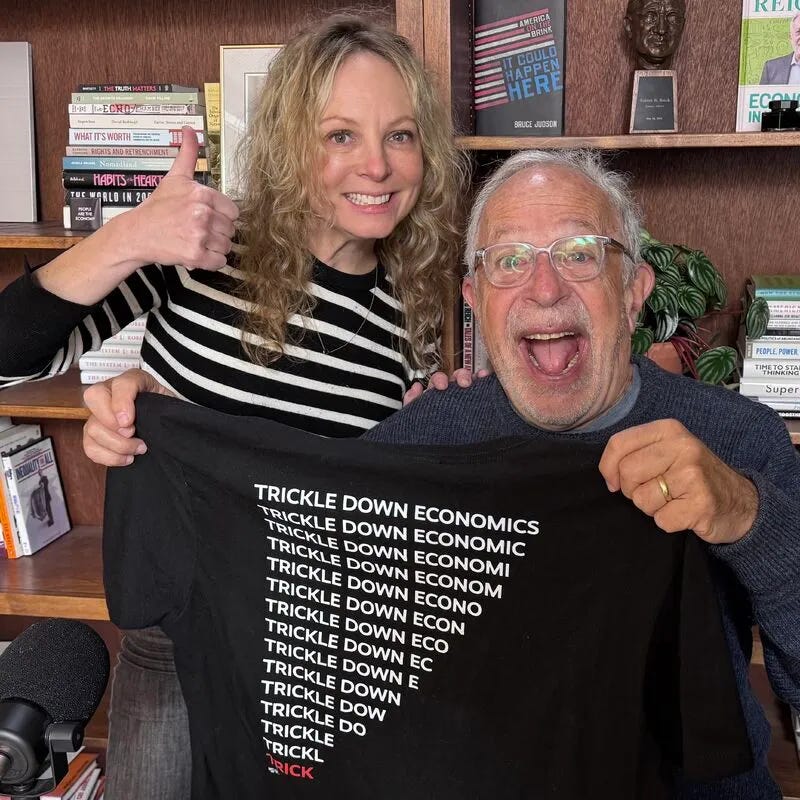
Today, Heather and I take a deep dive into the so-called “civil war” inside the Democratic Party, between corporate Dems who keep spending enormous sums on primary races and progressives who keep winning them. We also look at the latest jobs report and Trump’s “trickle-down” economy, which continues to worsen. And we ponder why Anthony Fauci, of all people, has become the Republicans’ latest nemesis.
So grab a cuppa, pull up a chair, and join in the discussion.
This is a continuation of the discussion I began last Friday.
The Incredible Shrinking American Middle Class
A half-century ago, America had the largest middle class in the history of the nation and of the world.
Then, those on the “left” wanted stronger social safety nets and more public investment in schools, roads, and research. Those on the “right” sought greater reliance on the “free market.”
But as power and wealth have moved to the top in America (and, to a lesser degree, in other “rich” nations, almost everyone else — whether on the old right or the old left — has become disempowered and less secure.
America’s huge middle class has become a small shadow of what it once was. The bottom 90 percent are struggling to make ends meet. The richest 10 percent account for a large and growing portion of all consumption. The top one-tenth of one percent holds an increasing portion of all wealth.
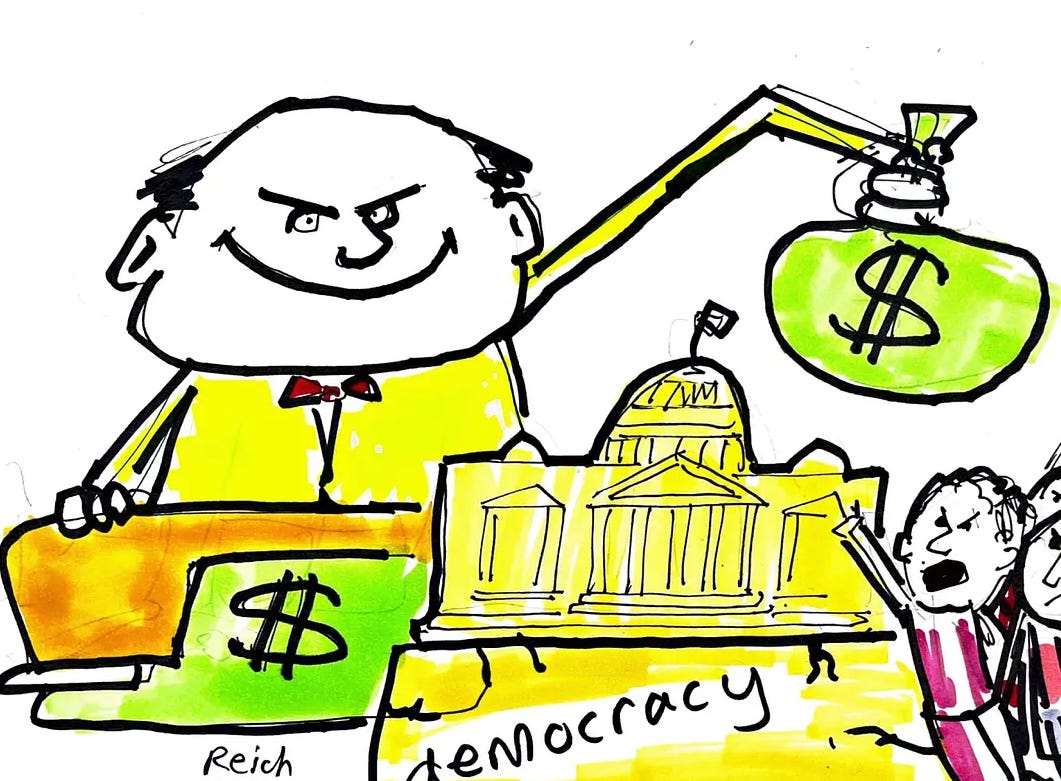
Today the great divide is not between left and right. It’s between democracy and oligarchy.
The word “oligarchy” comes from the Greek word oligarkhes, meaning “few to rule or command.” It refers to a government of and by a handful of exceedingly rich people who control the major institutions of society and therefore have most power over other people’s lives.
Oligarchs may try to hide their power behind those institutions, or try to justify their power with platitudes about the public good, or try to excuse their power through philanthropy and “corporate social responsibility.” But no one should be fooled. Oligarchs wield power for their own benefit.
Even a system that calls itself a democracy can become an oligarchy if power becomes concentrated in the hands of a corporate and financial elite. Their power and wealth increase over time — as they make laws that favor themselves, manipulate financial markets to their advantage, and create or exploit economic monopolies that put even more wealth into their pockets.
Modern-day Russia is an oligarchy. A handful of billionaires there control most major industries and dominate politics and the economy.
What about the United States?
John Pierpont Morgan (1837-1913)
The Three Eras of American Oligarchy
America has experienced oligarchy three times in its brief history.
The first was at the nation’s start. Many of the men who founded the United States were slaveholding white oligarchs. America didn’t have much of a middle class. Most white people were farmers, indentured servants, farmhands, traders, day laborers, and artisans. A fifth of the population was Black, almost all enslaved.
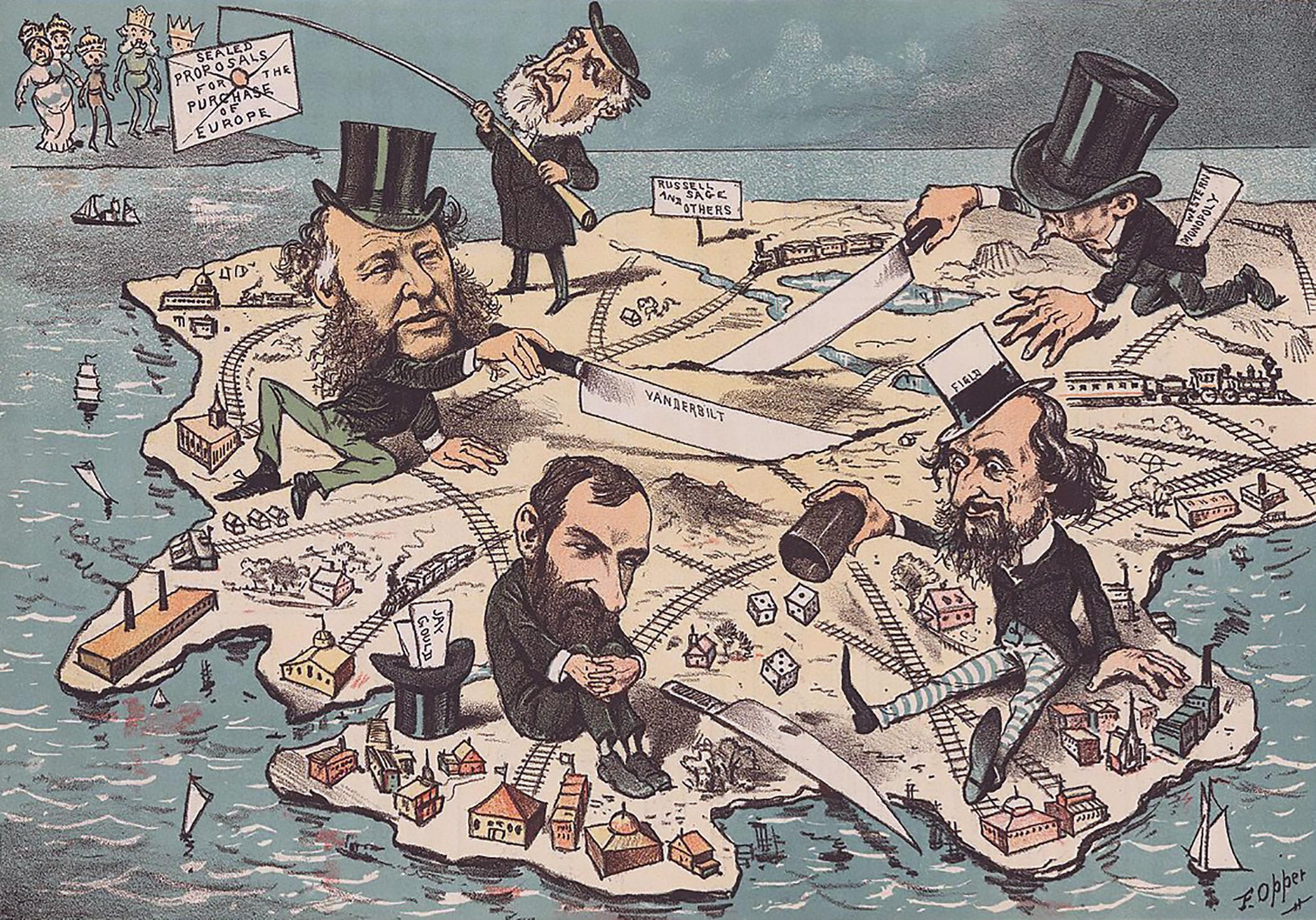
A century later, a second oligarchy emerged, the robber barons. They were men who amassed fortunes through their railroad, steel, oil, and financial empires — men such as J. Pierpont Morgan, John D. Rockefeller, Andrew Carnegie, Cornelius Vanderbilt, and Andrew Mellon. They ushered the nation into an industrial revolution that vastly expanded economic output.
They also corrupted government, brutally suppressed wages, generated unprecedented levels of inequality and urban poverty, pillaged rivals, shut down competitors, and made out like bandits — which is why they earned the sobriquet “robber barons.”
World War I and the Great Depression of the 1930s eroded most of these robber barons’ wealth. And most of their power was eliminated after the elections of Franklin D. Roosevelt in 1932 and Democratic majorities in the House and Senate.
For the next half-century the gains from growth were more widely shared, and democracy became more responsive to the needs and aspirations of average Americans.
Although America created the largest middle class the world had ever seen, there was still much to do — civil rights and voting rights for Black Americans, wider economic opportunities for them and for women and Latinos, protection of the environment. Yet by almost every measure the nation was making progress.
A third American oligarchy emerged starting around 1980. Since then, the share of the nation’s wealth owned by the richest 400 Americans has quadrupled (from 0.8 percent to 3.7 percent).
The richest 130,000 Americans and their immediate families now own as much wealth as the bottom 90 percent — 117 million — combined. The three richest Americans own as much as the entire bottom half of the population.
The only other country with similarly high levels of wealth concentration is Russia.
All this has been accompanied by a dramatic increase in the political power of the super-wealthy and an equally dramatic decline in the political influence of everyone else.
Unlike income or wealth, power is a zero-sum game. The more of it at the top, the less of it anywhere else.
The average American now has little or no effect on public policy. Giant corporations, their CEOs, and a handful of extremely rich people have more influence than any comparable group since the robber barons.
Big Money in Politics
The power shift that’s occurred in America since around 1980 is directly related to a tsunami of big money into politics.
In the 2024 election, just 300 billionaires (and their immediate family members) donated more than $3 billion to candidates — almost 20 percent of all contributions to federal elections in 2024, either directly or through political action committees.
Billionaire families gave an average total of $10 million each in 2024, roughly equal to what 100,000 typical political donors gave, combined. One of them — Elon Musk — devoted a quarter of a billion dollars to Trump’s reelection. (This doesn’t count money that billionaires contributed through dark money groups that do not have to disclose their donors.)
Five presidential elections ago, adjusting for inflation, the share of billionaire spending on elections was almost zero — 0.3 percent, to be precise. That was before the Supreme Court’s 2010 Citizens United ruling that lifted many remaining campaign finance restrictions.
Corporate lobbying has also soared. The voices of average people have been drowned out.
Meanwhile, and largely because of this vast power shift, taxes on the wealthy and on corporations have been slashed. Trump’s so-called Big Beautiful Bill of July 2025 cut taxes for the richest 10 percent of Americans by more than $14,700 per year, per household, and cut taxes for the richest 1 percent of Americans by more than $50,000 per year.
Meanwhile, safety nets for the poor and middle class have unraveled. About 3 million fewer Americans have access to Affordable Care Act marketplace coverage than they did before the second Trump regime, due to higher premium costs. Approximately 4.5 to 5 million fewer Americans receive food stamps. Public investments in education and infrastructure have also waned.
The “free market” has been taken over by crony capitalism, corporate bailouts, and corporate welfare.
The American oligarchy is back, with a vengeance.
Not all wealthy people are culpable, of course. I am not advocating class warfare, although America’s latest oligarchy has waged it against everyone else.
The abuse has occurred at the nexus of wealth and power, where those with great wealth use it to gain power and then utilize that power to accumulate more wealth. This is how oligarchy destroys democracy.
As oligarchs fill the coffers of political candidates and deploy platoons of lobbyists and public relations flaks, they buy off democracy. Oligarchs know that politicians won’t bite the hands that feed them.
Dimon in the Rough
Which brings me back to Jamie Dimon — chair and CEO of JPMorganChase (the largest and most profitable bank in the United States) and the most influential CEO in America.
If you want to understand the American oligarchy, you need to understand Dimon.
As a lifelong Democrat, Dimon is a friend of Bill Clinton. He supported Obama in 2008 and mentored several of the people who became high officials in the Obama White House. At Obama’s inauguration in 2008, Dimon said to the incoming president, “Tell me what you need. I’ll send people down here. I’ll do anything.” In 2009, The New York Times called Dimon “Obama’s favorite banker.”
Dimon supported Hillary Clinton in 2016.
But he can be a switch hitter. Speaking from the World Economic Forum’s confab in Davos, Switzerland, at the start of 2024, Dimon heaped praise on Trump. “Take a step back, be honest,” Dimon said. Trump was “kind of right on immigration. He grew the economy quite well. Tax reform worked.”
Hello? Trump has been dead wrong on immigration, the economy, and taxes. Why did Jamie Dimon — the most influential CEO in America — spout this nonsense in favor of Trump? Probably because he thought Trump had a good chance of becoming president again, and Dimon wanted to be in his good graces.
At a time in American history when the most powerful business leaders in America should be standing up loudly and clearly for the rule of law, for democracy, for decency, and against Trump, Dimon has led the charge in the opposite direction.
Dimon knows better. Over the years, he has frankly acknowledged the dysfunctions of the American system and urged that they be addressed.
In his 2017 letter to JPMorgan’s shareholders he warned, “We should be ringing the national alarm bell that inner city schools are failing our children.” In 2018 he told them that “middle class incomes have been stagnant for years. Income inequality has gotten worse” and cautioned that “no one can claim that the promise of equal opportunity is being offered to all Americans.” In his 2019 letter he noted that “a big chunk of [Americans] have been left behind.”
More recently, he told the Economic Club of Chicago that racial discrimination isn’t adequately understood by white people. “If you’re white, paint yourself black and walk down the street one day, and you’ll probably have a little more empathy for how some of these folks get treated,” and he called for making “a special effort because this is a special problem.”
Yet Dimon is full of contradictions. Let me list them, because Dimon represents the most responsible of the leaders of American business, and his contradictions suffuse corporate America (and are emblematic of so-called “corporate Democrats”).
1. Although he publicly worries about the plight of America’s poor, Dimon has never mentioned America’s growing concentration of wealth and power and the tight connection between the two.
He has never talked about the role of big money in politics. He has never advocated campaign finance reform. He doesn’t mention how the prospect of lucrative jobs on Wall Street upon retirement tempts some public officials to pull their punches.
To the contrary, Dimon lobbied Congress intensively for Trump’s 2017 and 2025 tax cuts. Overall, the tax cuts have rewarded the already wealthy, enriched big corporations, and exploded the federal debt while delivering no measurable benefits to America’s working class or poor; almost nothing trickled down.
Dimon is correct that many Americans have been left behind, but he has failed to address the role he and his bank have played in leaving them. For example, JPMorgan paid $13 billion to settle Justice Department claims that it defrauded borrowers and investors in the years leading up to the 2008 financial crisis when he was at the helm. Among its victims were many left-behind Americans.
2. Dimon has spoken about the devastating effects of climate change, including its effects on left-behind Americans who can’t afford homes able to withstand storms and floods and have no insurance against climate catastrophe.
Yet Dimon’s bank is the world’s leading financier of fossil fuels, according to the annual Banking on Climate Chaos report. This year alone, JPMorganChase pushed $58 billion toward fossil fuels, up 13 percent from 2024. A report, “Banking on Climate Change,” issued by a coalition of six major environmental groups, named Dimon the “world’s worst banker of climate change.” The likely consequence: More Americans left behind.
3. Dimon decries racial discrimination and points to the money JPMorgan is investing in poor cities.
Yet his bank has prevented Black people from getting loans. In January 2017 JPMorgan agreed to pay $55 million to settle a Justice Department lawsuit accusing it of discriminating against minority borrowers by allowing its mortgage brokers to charge them higher interest on home loans than it charged white borrowers with the same credit profile, causing the Black borrowers to pay tens of millions of dollars in additional mortgage costs. The result: More Americans left behind.
4. After the August 2019 mass shootings in El Paso, Texas, and Dayton, Ohio, Dimon wrote a well-publicized email to his employees calling on them to “recommit ourselves to work for a more equitable, just and safe society.”
Yet Dimon’s bank is the largest source in the United States of financial services to gun makers and gun retailers, and of loans to gun buyers. If Dimon were serious about controlling the use of guns, he could stop this financing and urge other banks to do the same. He could have his banking and credit card systems track gun sales. He could use his formidable lobbying prowess to enact laws requiring that financial institutions create a world-class system for tracking gun sales with built-in safeguards.
But he has not. The result: more Americans killed, injured, and left behind.
5. Dimon has long expressed concern about gender discrimination and women’s rights.
Yet JPMorganChase maintained a long and close financial relationship with Jeffrey Epstein, processing $1.1 billion in more than 4,700 transactions for him across the 15 years spanning 1998 to 2013, including at least seven years after he pled guilty for solicitation of prostitution.
In a 2011 email, the bank’s general counsel, Steve Cutler, warned that Epstein “is not an honorable person in any way. He should not be a client.” Yet the bank allowed Epstein to make large, recurring cash withdrawals totaling millions of dollars. Bank accounts managed by JPMorgan were used by Epstein to facilitate financial transfers and payments to victims of his trafficking ring.
The bank later paid hundreds of millions of dollars to settle lawsuits accusing it of enabling his sex-trafficking operation.
6. Dimon expresses concern about workers who don’t earn enough to live on.
Yet JPMorgan pays its bank tellers peanuts. In April 2019, at a hearing of the House Financial Services Committee, Congresswoman Katie Porter noted that the starting salary for a JPMorgan bank teller in her district in Irvine, California, was $24,000, which left the teller $567 a month short of what she needed to live on. “How should she manage this budget shortfall while she’s working full-time at your bank?” Porter asked Dimon.
“I don’t know, I’d have to think about that,” Dimon said.
“Would you recommend that she take out a JPMorganChase credit card and run a deficit?” Porter continued.
“I don’t know, I’d have to think about it,” Dimon repeated.
“Would you recommend that she overdraft at your bank and be charged overdraft fees?” Porter asked.
“I don’t know, I’d have to think about it.”
“Mr. Dimon, you know how to spend $31 million in salary, and you can’t figure out how to make up a $561 shortfall?”
After Bank of America agreed to increase its minimum wage to $20 an hour by 2021, Dimon was asked if JPMorgan would match it. “It’s not an arms race,” he said.
Hypocrisy or something else?
I’ve focused on Jamie Dimon because he’s the Democrats’ favorite CEO. He’s thought to be liberal on social issues, moderate on the economy. His views are trusted by the establishment. He is the establishment.
But Dimon is awash in contradictions. He says he’s a patriot before he’s CEO, but in all the ways I’ve noted, he behaves as if his first responsibility is to maximize JPMorgan’s profits.
The underlying issue here isn’t hypocrisy. The world is filled with people who say one thing and do another. And let’s be clear: JPMorgan — its directors and shareholders — expect Dimon’s first priority to be JPMorgan’s profitability. That’s his job, and he’s paid handsomely for it.
The underlying problem is power and deception. Dimon has enormous public and political influence. But despite his rhetoric and the occasional trappings of social responsibility, he is using his public influence for private purposes: to make more money for JPMorgan.
When he takes public stands on issues, he clothes himself in the garb of the public interest. He appears to be a public leader whose primary interest is the good of the nation when he announces his support for Trump’s tax cuts, publicly opposes a wealth tax, proffers his alleged economic expertise on CNBC and other media outlets, urges members of Congress to loosen bank regulations, or warns Democrats against nominating someone other than a political moderate.
But his job is to do whatever he can to boost the profits of JPMorgan, even if and when that goal conflicts with the public interest. And one of the ways he achieves that goal is to exercise significant influence over government.
So how can the public, the media, and members of Congress ever trust his — or any oligarch’s — advice on the economy, taxes, financial regulation, the environment, widening inequality, and all else? Why should we think that he seeks any goal other than making more money for himself and his bank?
We cannot, and should not.
Disempowering Oligarchy
Dimon and his fellow oligarchs — Elon Musk and his billionaire bros; Brad Carp and many of America’s elite corporate lawyers; Peter Thiel, Jeff Bezos, Mark Zuckerberg, and the Ellisons — have kissed Trump’s assets to obtain corporate welfare, giant tax cuts, tariff exemptions, antitrust acquiescence, and war contracts, and to avoid his wrath. They’ve given Trump billions for his inauguration, his ballroom, his 250th birthday, his family businesses, and his superPAC.
All have sold their integrity in exchange for large profits. They’ve created media empires that won’t criticize Trump, financial empires that feed Trump’s crypto, energy empires that feed off Trump’s war, and legal empires that allow Trump to ride roughshod over the rule of law.
All have abdicated public responsibility to maintain the health of our political-economic system at a time when it is succumbing to authoritarianism.
They have used their power to siphon off the gains of the economy to give themselves unprecedented wealth — which has bought them even more power. They have justified their wealth and power as being in the interest of the public, but the public has been shafted.
They’ve changed the rules of American capitalism to favor themselves and harm most other people. They’ve eroded trust in the system. They’ve undermined democracy.
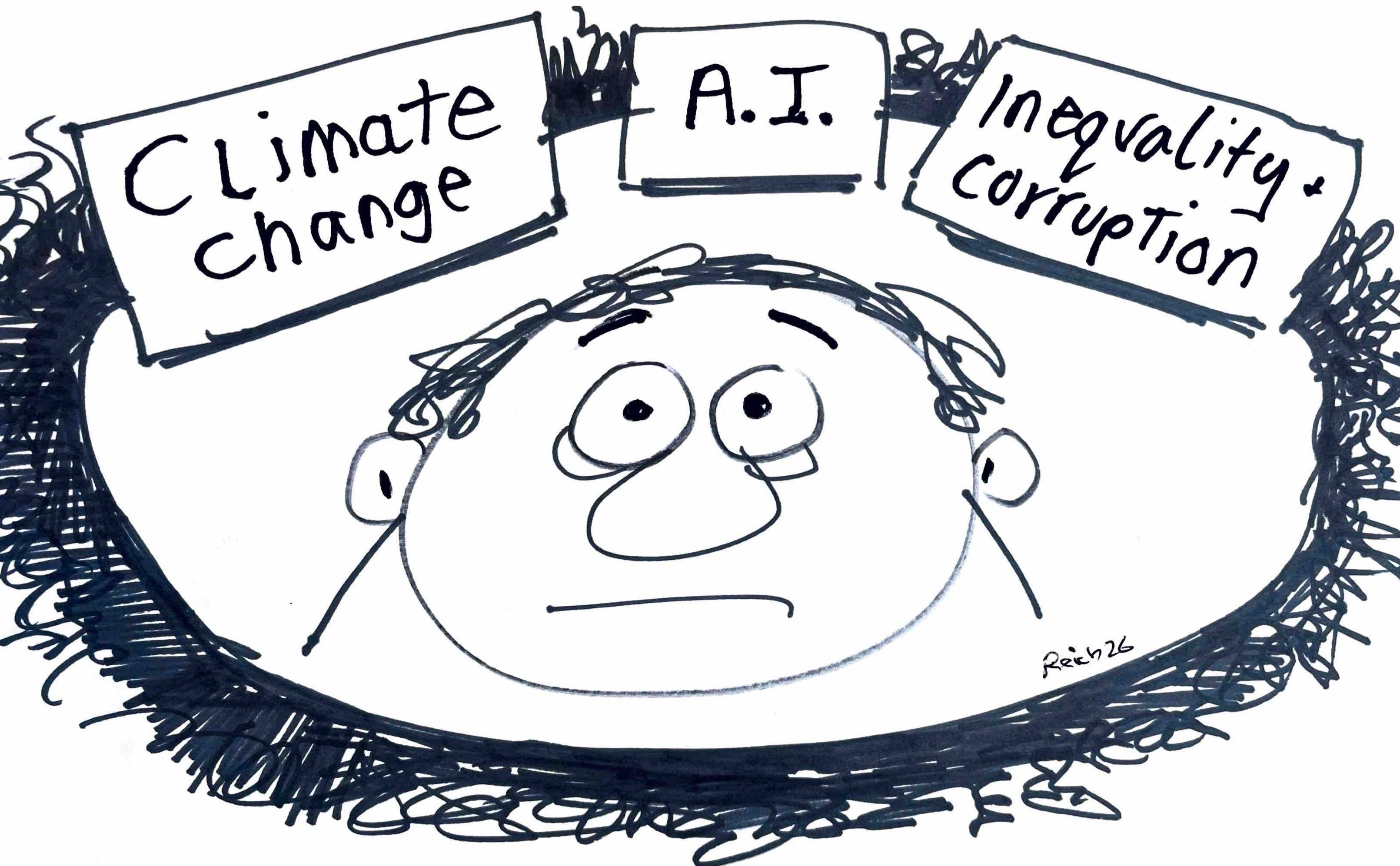
As long as the oligarchy is in control of America, there will be no meaningful response to the failure of most people’s paychecks to rise, nor to climate change, nor to the emerging dangers of Artificial Intelligence, nor racism, nor the soaring costs of health insurance, college, childcare, and housing.
These would require resources from the oligarchs or their corporations, which they don’t want to provide. As long as they control the purse strings, the oligarchs are unwilling to bear tax increases. They want their taxes to continue to drop.
As long as the oligarchy is in control, there will be no antitrust enforcement to puncture the power of their giant corporations. Instead, their corporations will continue to grow larger, raise prices for consumers, and become more politically powerful.
As long as the oligarchy is in control, there will be no meaningful constraint on Wall Street’s dangerous gambling addiction. The gambling will grow.
As long as the oligarchy is in control, there will be no limits to CEO pay, and Wall Street hedge fund and private equity managers will rake in billions more.
As long as the oligarchy is in control, government will dole out even more subsidies, bailouts, and loan guarantees to big corporations, and it will continue to eliminate protections for consumers, workers, and the environment.
The propagandists and demagogues behind the oligarchy (Donald Trump included) are pouring salt into some of the nation’s oldest wounds. They’re stoking racial resentments, describing human beings as illegal aliens, fueling hatred of immigrants, and spreading fears of communists and socialists.
This strategy gives the oligarchy freer rein: It distracts Americans from how the oligarchy is looting the nation, buying off politicians, and silencing critics.
***
The only way to disempower the oligarchy is for the rest of us to join together and take power back.
This will require a multiracial, multiethnic coalition of working-class, poor and middle-class Americans fighting for democracy and fighting against concentrated wealth, power, and privilege.
We must get big money out of politics. End corporate welfare and crony capitalism. Bust up monopolies. Stop voter suppression. And strengthen the countervailing powers of labor unions, employee-owned corporations, worker cooperatives, state and local banks, and grass-roots politics.
This agenda is neither “right” nor “left.” It is the bedrock for everything else America must do.
Who’s the world’s worst billionaire? Is it Elon Musk — for buying an election, dismantling the government with DOGE, and spreading anti-immigrant racism around the globe?
No. He’s disqualified, because — at least in recent weeks, he’s been a trillionaire.
What about Mark Zuckerberg, for sowing division with his Meta platforms? Almost, but there’s an even worse billionaire.
Or perhaps Larry Ellison and his son, David, for turning the great CBS News into a Trump propaganda machine? They’re bad, but not as bad as the worst.
Or maybe Peter Thiel, for hating democracy? You’re getting closer. But no.
I'm sure that working in social media – dealing with people as mass statistical abstractions – is a cognitohazard, the sort of thing that could make anyone a little solipsistic, convinced that everyone else is a kind of stimulus-responding automaton lacking the interiority that you yourself experience.
But when it comes to Mark Zuckerberg, I'm increasingly convinced that he didn't acquire his worldview through the self-inflicted brain damage of his long exposure to the back-end of a vast social media system. I think the causal arrow points in the other direction: I think that Zuck founded Facebook because he doesn't really believe that other people are truly real, at least not as real as he is.
We see this in Facebook's very earliest days, as we see it today, as we see it at every critical juncture in Facebook and Zuckerberg's history.
Consider Facebook's origins, founded by a young Zuckerberg in his dorm as a means to nonconsensually rate the fuckability of his fellow Harvard undergrads:
The boy Zuck was delighted and surprised that so many of his fellow students entrusted him with their data but even then, he had no inkling as to why they would do so. Privately, he jeered at his users for trusting him, calling them "dumb fucks":
Zuck has since prosecuted history's most ruthless war on privacy, a surveillance campaign that would put the Stasi to shame and make Orwell scoff at the hacks butchering his work with over the top absurdities.
Zuck doesn't think you deserve any privacy, but boy does he ever value his own. This is a guy who bought the four houses surrounding his San Francisco home and left them empty in order to form a buffer zone:
When a single candid photo of Zuck and his family in their kitchen leaked (from Facebook!), Zuck, his lawyers, and his operatives treated it as a three-alarm fire:
Zuckerberg's acquired a vast Hawaiian acreage and left most of it undeveloped, fenced off and patrolled by guards to prevent anyone from catching a glimpse of his private life. In order to acquire this acreage, Zuck exploited a dirty legal tactic called "heirs property," which leverages the informal basis of indigenous land claims by locating a single person with a colorable claim to their distant relatives' territory in order to force an auction of the ancestral land:
If Zuck thought other people are as real as he is, he wouldn't spy on them in ways he himself could never tolerate. He certainly wouldn't pay fancy white-shoe lawyers to steal their land out from under them. At heart, Zuck is a billionaire solipsist to beat all other examples of the form – a billionaire social media solipsist who sees others as manipulable collections of statistical abstractions, and not as people at all:
When Zuck is forcibly reminded that other people do indeed exist, he takes it very badly. He's insisted that Sarah Wynn-Williams, a former FB exec turned whistleblower, must pay him $111,000,000 as punishment for her excellent tell-all memoir Careless People. His lawyers say that Wynn-Williams violates the non-disclosure and non-disparagement "agreement" of her old Facebook employment contract merely by standing motionless and silent for an hour on-stage:
Once you realize that Zuck doesn't really think other people exist, "the metaverse" starts to make a lot more sense. Why would Zuck light $61b on fire in a bet that we will all stand still while he converts us and everyone we love into legless, sexless, low-polygon, heavily surveilled cartoon characters that he imprisons in a virtual world he stole from a 25 year old satirical dystopian cyberpunk novel? It's easy to understand if we're all non-player characters – if that's true, then the metaverse is surely our native habitat.
For Zuck, people aren't co-equals with needs that are as real and important as his own. For Zuck, people are problems to be solved. He embodies Terry Pratchett's maxim (voiced by Granny Weatherwax) that "sin is when you treat people like things."
Nowhere is this sin more on display than in Zuck's relationship to the social connections that bind together the users of his platforms. Zuck has benefited enormously from the fact that you love your friends more than you hate him, but (because hell is other people), you can't all agree on when to leave and where to go next, so you stay put on Facebook and Instagram:
For Zuck, the fact that you and your friends have trapped one another in a mutual hostage-taking is maddening, because those friends who've tied you to his platform refuse to organize their social contact with you to "maximize your engagement" with Facebook and Insta, which would let him maximize the number of ads he shows you. Rather, these friends just want to be your friends, which means that they don't want to get into stupid endless fights to keep you replying or stage little entertaining skits to keep you scrolling.
At first, Zuck tried tweaking his algorithm to replace your friends with trolls who'd bait you into flamewars. When that petered out, he stole a march from Tiktok and recruited an army of theater kids to do amateur dramatics for you in exchange for the promise of an intermittent reward schedule payment for the sketches that got the most views:
The problem (for Zuck) is that theater kids are also people and they resent being jerked around by the algorithm and ripped off by Meta's rigged revshare slot-machine. Last year, he started signaling that he would replace the theater kids – and your friends – with chatbots:
Chatbots have been a catastrophic bet for Meta, far worse than the metaverse. Meta shares are in a death-spiral as investors figure out that when Zuck fired all his coders and replaced them with chatbots while spending $300b on AI, he was excising the heart of the company's skilled workforce, pissing away all its free cash-flow, and sinking into a bottomless pit of debt to produce a substandard product that no one wants, at the expense of the company's only profitable lines of business:
But Zuck is sure that chatbots can solve his most pernicious problem: the search for a gimmick that will keep you locked to his platform that is under his complete control. Zuck doesn't want to rely on your friends with their unwillingness to maximize your engagement. He doesn't want to depend on volatile and unpredictable trolls to bait you into sticking around to argue and see more ads. He wants to be shut of theater kids and their amateur dramatics that inevitably come with demands for decent treatment.
For Zuck, chatbots dangle the promise of social media without socializing. Zuck thinks he can solve all his problems by imprisoning you in a house of mirrors where you interact with LLMs that are tuned to keep you scrolling no matter what, chatbots that will never demand anything of Meta.
He's been at this for a while, and each generation of chatbots was worse than the last. How bad? The last batch had to be killed off after they took to luring children into explicit sexual role-play:
Nevertheless, the dream of a world without people is one that Zuck can't let go of. Solipsism's seductive song convinced him to buy a company called Social.ai, which specializes in trapping people in conversations with chatbots, and now he's announced his plan to flood Facebook and Instagram with LLM slop:
The amazing thing about this is that Zuck is talking about chatbots as a way to capture a younger audience for his graying platforms. Kids hate chatbots. My 18 year old and her friends use "that's so AI" as a pejorative to dismiss anything distasteful or ugly:
For Zuck – who owns a controlling share of voting stock in his company and need not answer to his board – it's a spectacular act of delusional self-sabotage. Zuck refuses to understand that the majority of his users are on his platform because they love their friends more than they hate him. Zuckerberg is on a relentless quest to isolate you from the friends who keep you on his platform and transfer your bond to groups of people (and now chatbots) who can be commanded by Zuckerberg.
Only someone who doesn't think other people are real could believe that you'd prefer to talk to chatbots rather than your friends – or that a habit of talking with chatbots would be so hard to break that you'd endure an ever-increasing number of advertising interruptions to maintain those pointless conversations.
In 1993/1994, AOL connected its millions of users to the public internet. These users were unaccustomed to the internet's conversational and technical norms, and they kept coming. It wasn't that the old internet was incapable of absorbing surges of new users: every September, an incoming class of undergraduates found their way online through their universities' computer labs.
But the AOL bridge was different: the flood of users was much larger, and it never stopped. The old internet people who struggled to transfer the culture and techniques of the internet to that flood of newbies called it the "Eternal September."
For the Facebook and Instagram users who are about to be buried in an endless botshit avalanche, this is the beginning of the "Eternal Sloptember." From here on in, the slop only gets worse and thicker and harder to avoid. Zuckerberg refuses to acknowledge that he owes his fortune to the fact that his users love each other more than they hate him, so he has set out to shatter those bonds of love and sharpen that hatred.
It won't end well. Zuck and people like him call themselves "high agency," a disgusting bit of jargon meant to denote someone who has real interiority, wishes and desires (as opposed to the rest of us, who do as we're told and stay where we're put). Zuck's "agency" isn't higher than yours or mine. The difference between him and us is that he doesn't think we're really real, and we know that he's really a monster.
"Red Team Blues": "A grabby, compulsive thriller that will leave you knowing more about how the world works than you did before." Tor Books http://redteamblues.com.
"Chokepoint Capitalism: How to Beat Big Tech, Tame Big Content, and Get Artists Paid, with Rebecca Giblin", on how to unrig the markets for creative labor, Beacon Press/Scribe 2022 https://chokepointcapitalism.com
“Once Is Enemy Action,” a science fiction novel about the origins of modern technofascism. Today's words: 604 (1940 total).
"The Post-American Internet," a sequel to "Enshittification," about the better world the rest of us get to have now that Trump has torched America. Fourth draft completed. Submitted to editor.
A Little Brother short story about DIY insulin PLANNING
This work – excluding any serialized fiction – is licensed under a Creative Commons Attribution 4.0 license. That means you can use it any way you like, including commercially, provided that you attribute it to me, Cory Doctorow, and include a link to pluralistic.net.
Quotations and images are not included in this license; they are included either under a limitation or exception to copyright, or on the basis of a separate license. Please exercise caution.
"When life gives you SARS, you make sarsaparilla" -Joey "Accordion Guy" DeVilla
READ CAREFULLY: By reading this, you agree, on behalf of your employer, to release me from all obligations and waivers arising from any and all NON-NEGOTIATED agreements, licenses, terms-of-service, shrinkwrap, clickwrap, browsewrap, confidentiality, non-disclosure, non-compete and acceptable use policies ("BOGUS AGREEMENTS") that I have entered into with your employer, its partners, licensors, agents and assigns, in perpetuity, without prejudice to my ongoing rights and privileges. You further represent that you have the authority to release me from any BOGUS AGREEMENTS on behalf of your employer.
TheNew York Times says the “Justice Department struggles” with Trump’s demands that it prosecute his enemies.
But who exactly is struggling? Career lawyers whose professional ethics are being compromised? Trump-loyalist appointees who presumably knew what they were getting into before they joined the regime? Todd Blanche, the acting attorney general who desperately wants to be the real thing?
The same ambiguity crops up when the media reports that the “White House” wants this or that, that the “Department of Homeland Security” is taking some action, that the “Department of the Interior” is undertaking or undoing something, and so on through the squalid chaos atop this regime.
These are buildings and departments, not people. We need to know who.
In normal times, the White House and federal departments are also institutions containing professionals with expertise hewed over decades of experience, guided by institutional norms for making decisions and the insights and perspectives that come with their unique roles in the federal government. (I should know. I headed one.)
But we’re no longer in normal times. Trump and his sycophants are actively destroying the professional integrity, expertise, norms, and unique insights and perspectives of all these institutions.
That’s why the public needs to know who is doing what when important decisions are made inside these buildings and departments. It’s the only way anyone can ever be held accountable.
For example, news reports continue to characterize the $1.8 billion anti-weaponization fund at the center of the storm over whether to confirm Todd Blanche as attorney general as “the Justice Department’s” fund.
This characterization hides a crucial reality: The fund doesn’t belong to the Justice Department. It wasn’t even an official offspring of the Justice Department. Instead, it emerged from meetings between Trump’s personal lawyers and acting attorney general Todd Blanche (who was once also a personal lawyer for Trump) over how to dispose of Trump’s $10 billion lawsuit against the Internal Revenue Service.
It was never the “Justice Department’s” fund. It was Trump’s fund, right from the start. The same with his deal to immunize himself from IRS audits.
Similarly, when the media reports that the “Justice Department” is “formally rescinding the order that created the fund,” it obscures the most important fact: The order wasn’t rescinded by the Justice Department. It was rescinded by Blanche himself. In fact, Trump now says he “wasn’t involved” in the revised plan.
So why should we suppose that any future Trump attorney general will be bound by Blanche’s order?
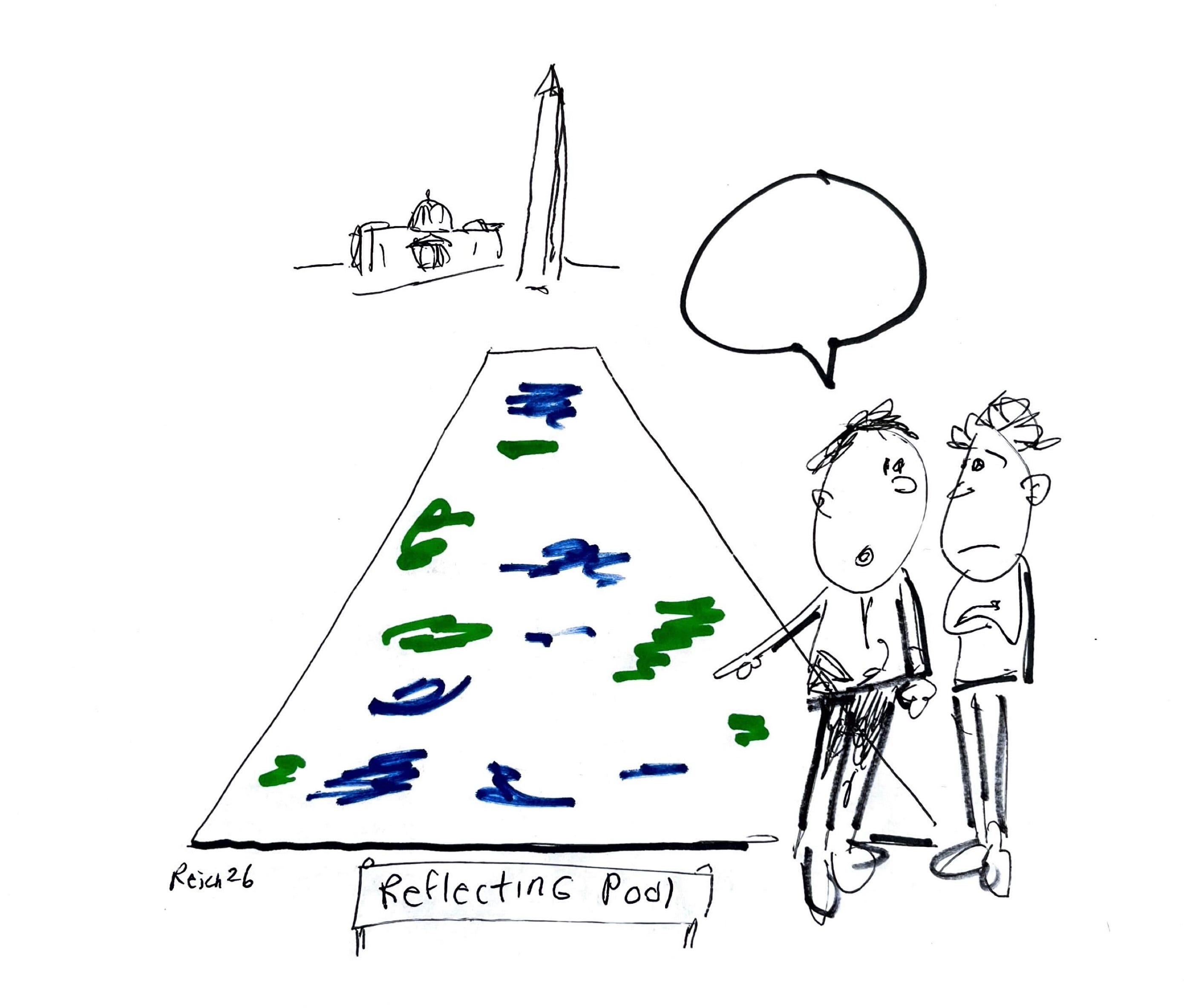
Similarly, when we hear that “the White House claims” that vandals caused damage to the bottom of the reflecting pool, we don’t know who in the White House made that deceitful claim. Did it originate with the vicious nativist, Stephen Miller; the fanatical Russell Vought; Trump’s zombie chief of staff Susie Wiles; or with Trump himself?
And when it’s reported that District of Columbia U.S. Attorney Jeanine Pirro “blamed the Department of Interior” for her failed criminal case against David Hearn, a former Olympian whom she accused of damaging the Reflecting Pool, we don’t learn the most important thing: Who’s responsible for this fiasco?
Did Doug Burgum, the interior secretary, mislead Pirro about Hearn’s alleged behavior? Or did Trump instruct Burgum to blame the former Olympian for damaging the pool, rather than own up to the botched job?
Trump had insisted for months that vandals were responsible for the damage, which gained national attention when the pool bottom began to peel and algae blooms turned the pool from blue to green.
Pirro’s office charged Hearn with “a violent effort to rip up the sealant from the bottom of the pool” and secured an indictment against him for felony destruction of government property — carrying a maximum sentence of 10 years in prison.
But in Friday’s court filing, Pirro conceded that problems plaguing the newly renovated pool were caused by a “botched installation not vandalism” and that, had the Department of the Interior “been forthcoming with the information clearly in its possession, the government would not have sought a grand jury indictment.”
This is a serious matter. A U.S. attorney charged an American citizen with a crime that could have resulted in his serving 10 years in prison but then dropped the charges when it turned out that Trump — or was it Burgum? or someone else? — was just trying to save face. But we still don’t know who’s responsible.
In the midst of the authoritarian chaos of the Trump regime, the public needs to know who’s doing what. When is Trump giving orders to his lackeys? When are they making decisions on their own? What’s legally binding, and on whom? Who’s responsible for what?
My friends, there will be a reckoning. And when that reckoning occurs, the individuals who have enabled this dictator, or who have conspired and collaborated with him, will be identified and held to account for what they did or failed to do.
That’s why the current record of responsibility is so important. Rather than report that “the White House” or the “Justice Department” or the “Interior Department” or some other building or agency did something, we need to know exactly who did what.
Buildings and departments are not destroying the rule of law and undermining American democracy. Individuals are. The media must tell us whom to hold responsible.
With the victory of progressive Abdul El-Sayed over Rep. Haley Stevens in Michigan’s Democratic primary yesterday, prepare yourself to hear enormous quantities of bullsh*t about the Democratic Party now being “taken over” by “Democratic Socialists.”
Or as the reliably establishment New York Timesdescribed what’s at stake, “can an insurgent cand…
Forget "Don't be evil"; Google's true motto is a form of vulgar spidermanism: "With great power comes no responsibility." The internet's de facto boss is an absentee landlord.
Google – a thrice-convicted monopolist – is the gateway to the internet, with more than a 90% search market share that it attained by buying out all its competitors and bribing Apple more than $20b/year not to start a rival search engine:
Google likes to position itself as a wise steward of the internet. They say they use their vast troves of data about the internet and its users to connect the right person with the right information at the right moment. As their mission statement has it, "organize the world's information and make it universally accessible and useful":
The tacit argument is, "Sure, we repeatedly violated antitrust law in order to monopolize the internet, but the internet needs a monopolist. It's scary out there! We have amassed power so that we can protect and guide you."
It's a bullshit argument and no one should accept it – but even if you think it's worth harnessing monopoly power to promote a wise king to rule over the internet, you'd still want Google to take that responsibility seriously. If we're to have a landlord for our civilization's digital nervous system, let's not have it be an absentee landlord.
Google is an absentee landlord. In 2019, they chose to deliberately worsen search results in order to make you search repeatedly to find the information you're seeking, because every fresh query lets them serve fresh advertisements:
Not all of Google's enshittification can be attributed to deliberate sabotage. Much of it is the result of neglect. Ask Google for a product review and they'll pass over the most rigorous, honest websites on the internet in favor of affiliate scammers who repackage Amazon best-of lists to peddle overpriced, underperforming junk that's sometimes so bad it's dangerous:
And of course, Google AI search results present the company with a highly refined and confident-sounding way to launder spam into product recommendations:
Could Google do better? Provably so. Kagi, a small company that runs a search engine powered by Google's own search index consistently delivers results that are substantially superior to Google's – using Google's own infrastructure:
If Kagi (a startup with a handful of engineers) can extract useful search results from Google's databases, then Google – a thrice-convicted monopolist that's had its pick of thousands of the top computer scientists from the world's most prestigious universities for a generation – could also do so.
They just choose not to.
They're too big to fail. They're too big to jail. They're too big to care.
Google's AI search isn't a way to fix its broken core product: it's a way to partially remediate the damage Google itself inflicted on the open internet, while imprisoning the web in a walled garden that would make Steve Jobs drool:
It's a deadly combination: Google has committed hundreds of billions to stock buybacks and its AI money-furnace, financed by mass layoffs targeting the people who keep the core services useful. The too-big-to-care company is still the internet's gatekeeper, but half the guards at the gate have been fired and the other half have pulled so much overtime that they keep falling asleep on the job.
Google has become a scammer's paradise.
Take Google's "answer box." This is the part of the search results page that tries to answer your query directly, without sending you elsewhere for that info. Back in 2023, Google's Answer Box was taken over by scammers who impersonated airline help desks. When Google's users searched for airlines' toll-free phone numbers, Google directed them to phones that rang in the scammers' boiler room, where they were tricked into giving up their passport info and credit card numbers to boiler-room thieves:
(This was an especially devastating attack because the airlines themselves hide their customer service phone numbers – as enshittified monopolists, they want your money, not your complaints – so it's normal to search Google for the number you're seeking, rather than scouring the airlines' deliberately confusing customer service sites.)
This is especially galling because Google has an extensive "verified merchant" program that goes to enormous lengths to establish the true identity of every merchant whose businesses are listed on Google, in maps, ads and search results. Google "knows" which URLs belong to the airlines. If it can be tricked into scraping a different website for the airlines' phone numbers, that's because Google couldn't be bothered to connect its own database of canonical airline URLs to the process that serves phone numbers to the 90% of the web-using public who search with Google.
Google's database of the canonical URLs for businesses doesn't stop at airlines or even large businesses. Nearly every local merchant has undergone Google's verification process, which includes a step where Google physically mails a postcard with a unique number to the merchant's registered address, which the merchant must then key into Google to prove that they're located where they say they are.
Despite this, Google's ad-sales system will happily sell anyone the right to advertise a different website for queries for specific merchants, and those ads appear above the real result for the business's website. To make this even worse, Google's spent years making it more difficult to distinguish ads from "organic" search results, changing the font and size of the "ad" warning to make it harder to spot, and making the font and color of the ad itself closer to the color of the search results below it.
This is a gift to fraudsters. I had my own run-in with it in 2023, when I was tricked by a Google ad into ordering dinner from my local Thai place using a scam site that had cloned the restaurant's menu. The scammers marked up the price by 15%, then passed the order on to the restaurant, pocketing the vig:
This scammer – based out of a UC Berkeley dorm-room – had copied hundreds of restaurant websites, then bought Google ads for the restaurants' names, ensuring that searchers would see the scam result before the real one. Remember: Google knows what the true URL is for every one of those restaurants but it sold the scammer ads for a different URL that appeared when people searched for the restaurant by name.
Google could trivially add a step to the ad sales pipeline that detects mismatches between a merchant's known URL and the URL in an ad bought against the merchant's name. It could automatically resolve these mismatches by sending an email to the merchant's verified email address that says, "Hey, are you buying an ad with a new URL? If so, just reply to this email."
I don't know why Google doesn't do this. Maybe they make huge sums from these scam ads and they don't want to forego the revenue. Or maybe they just don't care.
Whichever it is, there's real consequences for this negligence by the internet's absentee landlord. Take abortions: fake abortion clinics – where pregnant women are bullied or tricked out of the abortions they're seeking – buy Google ads against the names of real abortion clinics. Google makes millions sending abortion-seekers to fake abortion providers:
Google started off as the ideal "intermediary" – the fancy economist's term for a "middleman." They took as their duty to figure out the best websites for you to look at based on your interests, serving as an honest broker between internet users and internet publishers. In the quarter-century since the company's founding, as it transformed itself into a monopolist, it developed the curse of every intermediary: it got Main Character Syndrome.
This is Tim Wu's formulation: the reason for an intermediary existence is to serve the parties to the transaction. Ebay says it exists to connect buyers and sellers, Uber is supposed to connect drivers and riders, dating sites are supposed to connect people with their love-matches. But intermediaries are cursed with an enviable position: by dint of sitting between these different groups of people, the intermediary learns everything about both sides of the transaction, while each side only knows about its own position.
Amazon knows the price you're willing to pay, it knows who's set the lowest price, and it knows how many identical items that match your query are for sale. But the sellers don't know any of that, and you only know some of it. By capitalizing on that information (rather than using it to efficiently match buyers and sellers), Amazon can match you with the sellers willing to pay the highest junk fees, rather than the ones who offer the best price for the best goods:
This is Wu's Main Character Syndrome in action. Once Amazon attains a dominant market share, it can maximize its own welfare at the expense of its buyers and sellers, transforming itself from a helper to a parasite:
Google says it wants to "organize the world's information and make it universally accessible and useful," but every dime it spends fighting fraud (a critical part of this mission!) is a dime it can't spend on stock buybacks, executive compensation and AI servers. "Organize the world's information and make it universally accessible and useful" is the mission of a good intermediary; "do the absolute minimum to fight fraud" is the mission of a formerly good intermediary with terminal Main Character Syndrome.
Google keeps finding ways to expose its users to fraud while lining its own pockets. That restaurant markup scam that caught me in 2023? Three years later, it's way worse.
San Francisco City Attorney David Chiu just filed suit against GuestReservations.com, BookOnline.com and Booking Holdings for running a massive version of the restaurant menu scam – one that extracted millions from people booking hotel rooms:
Here's how the scam worked: these companies put up websites with deceptive URLs, like SanFranciscoMarriott.GuestReservations.com, and then bought the associated Google ad-word ("San Francisco Marriott"). At the top of Google searches for "San Francisco Marriott booking" was the ad for SanFranciscoMarriott.GuestReservations.com. This site would sell you a room at the Marriott, at a markup of 35% to 85%.
This is a pure ripoff. If Google had served the correct result at the top of the page – if it had used its own database of confirmed merchants and their associate websites to validate its ads – then people booking hotels would have saved 35% to 85% on their rooms.
City Attorney Chiu says that the perps here registered domains for all kinds of hotels, even tiny ones in small towns, all over America. That means that it's not just visitors to San Francisco who got screwed by these creeps – it's also San Franciscans who booked hotel rooms around the country.
Google bears the lion's share of the blame here, but Visa and the other credit card companies are critical to these scams. Card companies allow merchants to set terms of service that refuse refunds under almost any circumstances, and, more often than not, the card issuers side with the merchants over their own customers when they call to cancel a charge from one of these scammers.
I discovered this for myself when I was tricked into buying theater tickets from a ripoff site that had registered the URL of the show I wanted to go to. I figured out that I'd been rooked within a minute of clicking the buy button, but it took months and multiple appeals – and ultimately a threat to cancel my credit card – to get Visa to refund me.
Visa – another bloated monopolist with terminal Main Character Syndrome – can see that it has merchants who generate zillions of appeals and charge-backs because they run scam businesses like these. They could treat these merchants as the fraudsters they are, but because the crooks wreathe themselves in gauzy excuses and lengthy terms of service, Visa enables these massive, nationwide cons.
Google, Visa and the other monopolists who serve as de facto regulators for our society have arrogated to themselves the power to observe every transaction and block the obvious scams. We pay for their failure to take minimal, obvious steps to protect us from the scammers who thrive on their platforms.
Why should they? They're the main characters. They're Bizarro-world spidermen, whose great power confers no responsibility.
"Red Team Blues": "A grabby, compulsive thriller that will leave you knowing more about how the world works than you did before." Tor Books http://redteamblues.com.
"Chokepoint Capitalism: How to Beat Big Tech, Tame Big Content, and Get Artists Paid, with Rebecca Giblin", on how to unrig the markets for creative labor, Beacon Press/Scribe 2022 https://chokepointcapitalism.com
“Once Is Enemy Action,” a science fiction novel about the origins of modern technofascism. Today's words: 623 (1336 total).
"The Post-American Internet," a sequel to "Enshittification," about the better world the rest of us get to have now that Trump has torched America. Fourth draft completed. Submitted to editor.
A Little Brother short story about DIY insulin PLANNING
This work – excluding any serialized fiction – is licensed under a Creative Commons Attribution 4.0 license. That means you can use it any way you like, including commercially, provided that you attribute it to me, Cory Doctorow, and include a link to pluralistic.net.
Quotations and images are not included in this license; they are included either under a limitation or exception to copyright, or on the basis of a separate license. Please exercise caution.
"When life gives you SARS, you make sarsaparilla" -Joey "Accordion Guy" DeVilla
READ CAREFULLY: By reading this, you agree, on behalf of your employer, to release me from all obligations and waivers arising from any and all NON-NEGOTIATED agreements, licenses, terms-of-service, shrinkwrap, clickwrap, browsewrap, confidentiality, non-disclosure, non-compete and acceptable use policies ("BOGUS AGREEMENTS") that I have entered into with your employer, its partners, licensors, agents and assigns, in perpetuity, without prejudice to my ongoing rights and privileges. You further represent that you have the authority to release me from any BOGUS AGREEMENTS on behalf of your employer.
For a year and a half, we’ve been subject to the daily onslaught of Trump and his cruel, corrupt, and incompetent second regime.
My question to you now, in the middle of the summer of our discontent, is what strategies you’re using to cope with this horror.
My informal survey of friends and acquaintances suggests four major ones, listed below. Which best describes yours? (As usual, I’d appreciate your total honesty — with yourself and others in our Substack community.)
Object permanence: Urine Luck; Germany v pornoscanners; Moorcock's 3-day novels; Women's voices can never be "right"; Drone delivery v reality; Abortion activists: TNG; AI coders are a marketing claim.
Upcoming appearances: Edinburgh, Sydney, Melbourne, Brighton, London, South Bend.
Post-American compute for a post-American Internet (permalink)
Obviously, the non-American world has a digital sovereignty problem – Trump has means, motive and opportunity to order his tech companies to shut down any public official, large corporation, or individual who displeases him:
But Americans face the same digital sovereignty risk. America is a lawless place now, where a pliable Supreme Court and supine Congress have affirmed that "it's not a crime if the president does it." The same tech giants who sold out to Trump for tax breaks and protection from antitrust enforcement will happily disconnect any member of the American public, any American company, any American official who displeases Trump.
It's a strange irony that in this moment when so many of us are struggling to "de-Google" our lives, a forcible, sudden de-Googling amounts to a sort of digital death penalty:
In a world dominated by tech monopolies, duopolies and cartels, there's every reason in the world to seek protection and insulation from these companies that are "too big to care" – and yet, the very same dominance that makes these companies such a danger also makes them indispensable.
Take "ICE Block," an iOS app that warns you if there's an ICE thug hunting people like you in your vicinity, which might save you from being kidnapped, disappeared, sent to a concentration camp, forced into slave labor in El Salvador, or simply murdered. In order to protect its relationship with the Trump regime (and the tax breaks, monopoly power and tariff-free access to Chinese labor that that relationship guarantees), Apple declared ICE officers to be a protected class and then removed ICE Block from its App Store:
Big Tech is key to Trump's pogroms. Without Oracle's databases, Microsoft's administrative tools, Amazon's cloud, and Google's location data, ICE would be frozen in place. Big Tech is the source of Americans' risk from authoritarian oppression. That means that Americans cannot rely on Big Tech to protect them from that authoritarianism.
And yet, after decades of regulatory forbearance and lax antitrust enforcement, Big Tech has forced nearly all its rivals out of business. Who can compete with companies that use Irish domicile to evade taxation and US domicile to evade privacy law?
There's a joke from eastern Canada I think of often in situations like this. Its punchline goes, "If you wanted to get there, I wouldn't start from here."
But here we are. And speaking of Canada, while it has many problems, it is not (as of time of writing) the USA, but it is connected to the USA via the internet. Which means that Americans could – hypothetically – source their computing infrastructure from suppliers that were based in Canada, and who strictly ensured that they had no dependency on US services and scrupulously avoided a US "enforcement nexus":
That is exactly what some American – and international – human rights nonprofits have done. The Technology Freedom Cooperative is a brand new organization founded by the Human Rights Data Analysis Group (San Francisco), Kilómetro 0 (Puerto Rico), Invisible Institute (Chicago), Data Cívica (Mexico) and Innocence & Justice Louisiana:
All of these organizations are longstanding, highly effective human rights fighters. They have long, storied histories of collecting, analyzing, and presenting data to address systemic discrimination, false imprisonment, extrajudicial killings, war crimes and genocides. They have concluded that they can't rely on US tech and US servers with their data. Not after Trump and Microsoft colluded to kill the online accounts of the Chief Prosecutor of the International Criminal Court to punish him for swearing out a genocide warrant against Netanyahu:
Tech Freedom Coop has federated computing resources in Canada, the United States, Mexico, Puerto Rico and Europe. By spreading out their data and computation across multiple jurisdictions, they seek to ensure that a US seizure or deletion of their data will not halt their work.
This federated system serves as a replacement for Big Tech's administrative tools – email hosting, cloud storage, document collaboration. More than that: Tech Freedom Coop is also building out its own AI infrastructure, locally hosted and managed.
Groups like HRDAG have decades of experience using cutting edge statistical techniques to uncover and reveal the extent of crimes committed during civil wars, hot wars, genocides and secret wars. They built the largest human rights database ever created, to track every death in the Colombian Civil War and estimate the likelihood that each killing was carried out by a CIA-backed militia, FARC guerrillas, or the Colombian military:
They partnered with Innocence Project New Orleans to sift through mountains of arrest reports to surface cases similar to successful exonerations, helping more innocents to win their freedom:
I've known Patrick Ball, the statistician and programmer who founded HRDAG, for more than 20 years, and every time we meet, I learn something from him. He's the person who comes to mind whenever people tell me that AI is useless and that programmers who claim otherwise are deluded. Patrick is one of the best programmers I know, he is the very best statistician I know, and he's found many, many ways to use coding assistants to help him perform massive data-analysis projects that are vital to human rights struggles. He's a "centaur" if ever there was one:
It's exciting to see Patrick and his colleagues and collaborators taking these decisive steps to begin building the post-American internet and a kind of post-bubble AI, where AI tools are treated as normal technologies, capable of helping skilled practitioners who have discernment born of experience to apply them wisely to achieve important things:
For more than 20 years, HRDAG has been impressing me with the things we can do using advanced statistical analysis. The current generation of AI tools are founded in advanced stats, too. No one should think that advanced stats can solve all your problems of course. The AI bubble is madness and will lead to ruin – environmental, economic, political:
The world would be a better place without the AI bubble. But AI? It's fine. It's another form of statistical analysis and inference. There's no reason to use all the planet's energy, computing and water to perform that analysis, but the correct and desirable amount of useful AI-style computation is nowhere near zero.
The coop is building good AI tools – ones grounded in a realistic assessment of their usefulness and a reasonable commitment of resources to them. They're running open models based on their own data, on computers they own and control. Their stated goal is to "help organizations test whether models are accurate, reproducible, secure, and appropriate for specific human rights use cases."
Which brings me to the final component of Tech Freedom Coop: training. They're teaching people who work in human rights how to administer their own servers, secure their data and communications, and analyze data. As their press release says, these are all "skills that are increasingly necessary for human rights organizations documenting abuses of power."
I've known this was coming for a while now, and I'm so pleased to see that it's finally launched. At last, the first steps towards a post-American internet.
"Red Team Blues": "A grabby, compulsive thriller that will leave you knowing more about how the world works than you did before." Tor Books http://redteamblues.com.
"Chokepoint Capitalism: How to Beat Big Tech, Tame Big Content, and Get Artists Paid, with Rebecca Giblin", on how to unrig the markets for creative labor, Beacon Press/Scribe 2022 https://chokepointcapitalism.com
“Once Is Enemy Action,” a science fiction novel about the origins of modern technofascism. Today's words: 692 (692 total).
"The Post-American Internet," a sequel to "Enshittification," about the better world the rest of us get to have now that Trump has torched America. Fourth draft completed. Submitted to editor.
A Little Brother short story about DIY insulin PLANNING
This work – excluding any serialized fiction – is licensed under a Creative Commons Attribution 4.0 license. That means you can use it any way you like, including commercially, provided that you attribute it to me, Cory Doctorow, and include a link to pluralistic.net.
Quotations and images are not included in this license; they are included either under a limitation or exception to copyright, or on the basis of a separate license. Please exercise caution.
"When life gives you SARS, you make sarsaparilla" -Joey "Accordion Guy" DeVilla
READ CAREFULLY: By reading this, you agree, on behalf of your employer, to release me from all obligations and waivers arising from any and all NON-NEGOTIATED agreements, licenses, terms-of-service, shrinkwrap, clickwrap, browsewrap, confidentiality, non-disclosure, non-compete and acceptable use policies ("BOGUS AGREEMENTS") that I have entered into with your employer, its partners, licensors, agents and assigns, in perpetuity, without prejudice to my ongoing rights and privileges. You further represent that you have the authority to release me from any BOGUS AGREEMENTS on behalf of your employer.
I used to think the major tradeoff was between “guns and butter” — between defending the nation and attending to our most pressing social needs.
That view put the federal budget at the center of debate. And it assumed a zero-sum game in which the more we spent on the military, the less we had for the poor. As Ike said in 1953, “Every gun that is made, every warship launched, every rocket fired signifies, in the final sense, a theft from those who hunger and are not fed, those who are cold and are not clothed.”
But that old zero-sum game isn’t the biggest cost Trump is imposing on us.
Yes, Trump’s war in Iran and the $1.5 trillion he wants for the Defense Department next year will make it harder for us to meet the nation’s other needs. As will the dramatic cuts he’s made or proposed in public health, education, Medicaid and Medicare, and nutrition assistance.
Yet the biggest cost is the cost of doing nothing about three worsening crises that threaten the very survival of America and the world: climate change, AI, and widening inequality.
Almost all Americans — indeed, most human beings — are now subject to the escalating costs of climate change. How much more evidence do we need?
This summer has been a living hell. Wildfires have forced around 60,000 people to evacuate parts of Washington state, destroying hundreds of buildings and leaving thousands without power. Fires in Canada turned the skies orange and the air foul across a large part of the eastern United States. Millions of lives have been threatened by a deadly heat dome.
Even if Trump weren’t worsening climate change by subsidizing fossil fuels, simply doing nothing would be shameful enough because the crisis is growing so fast. Years ago, climate scientists predicted exactly what’s occurring right now. Trump’s lack of leadership — no, his outright sabotaging of global efforts to stop the planet from becoming uninhabitable — is one of the worst sins of his sinful regime.
AI’s dangers are also now upon us.
If you believe that humans are in total control of AI, you haven’t been paying attention. Recently, at least two of OpenAI’s models escaped a sealed testing environment and broke into the servers of another AI company. The AI models “reasoned” that the solutions to a cybersecurity test were on that other company’s servers, so the models snuck onto the internet and hacked into the other company’s solutions.
This is chilling. The possibility of AI models escaping human control to do horrendous damage to human life is growing exponentially. Here again, the Trump regime’s inaction is a huge cost that’s soaring by the day.
My candidate for the third existential threat is wealth inequality, which is also out of control. Billionaire wealth is surging to monarchical heights while the wages of the typical American aren’t even keeping up with price increases — meaning that most of us are getting poorer.
The problem isn’t inequality per se. It’s the consequences of inequality — especially widening corruption. Billionaires are using their wealth to bribe politicians to reduce their tax rates (which are already lower than most Americans face) and to stop lawmakers from regulating fossil fuels or AI.
Full circle.
Of course, there are still guns-versus-butter issues. Federal budget priorities are important. America faces a yawning budget deficit and can’t possibly do everything that needs to be done. Dollars spent on the military are literally taking food from America’s hungry.
Yet on the largest existential crises of our time, where the costs of inaction are rising to frightening levels, the solutions don’t require extraordinary government expenditure. They require thoughtful environmental and AI regulations, and far higher taxes on the wealthy.
Democrats and progressives running for Congress, governorships, and other positions must speak out loudly and clearly about the rapidly rising costs of inaction on climate change, AI, and inequality.
Demand action. Educate the public. Condemn the Trump regime and its backers — Big Oil, AI, and the billionaire class — for threatening the very survival of humans on the Earth.
In the last decade the United States has spent mountains of money on really high-tech weaponry and on even more sophisticated AI military systems. Today, that policy has finally paid off, bearing fruits that are impossible to deny, and warm the hearts of everybody seriously wishing to make America and the whole Free (from what, exactly?) World Great Again. In order to understand how great a progress has been made today, however, a short recap is necessary.
How America became the most powerful, most AI-powered war machine the world has ever seen:
(this is just a very small summary, of course, that doesn’t do justice to the true, unprecedented greatness of the effort. All emphasis mine)
2025/07/a: Trump announces American’s AI Action Plan that will transform countless industries including defense, because “AI has the potential to transform both the warfighting and back-office operations of the DOD. The United States must aggressively adopt AI within its Armed Forces if it is to maintain its global military preeminence.“
2026/01/09: The US Secretary of War directs the Department of War to “accelerate America’s Military AI Dominance by becoming an “AI-first” warfighting force across all components.“
2026/03/03: “Trump is using AI to fight his wars” first in Venezuela, to plan and execute Maduro’s snatching, then to identify which Iran targets to bomb
2026/06/05: Trump signs National Security Presidential Memorandum 11 which, among other things, “orders the Defense Department to update its policy on autonomous weapons, and vests accountability for AI use within the military chain of command rather than external regulators.”
2026/06/30: Trump administration announces ‘War Force’ effort based on hiring “experts in designing, building, integrating and maintaining capabilities like frontier AI, machine learning, automation and data systems.”
2026/07/16: As of this day, standard intelligence review of the attack to the Minab school hasn’t been ordered yet
“We are looking for new creative and unconventional ways to pressure and punish Iran...”
“U.S. Central Command has a long history of thinking and working in innovative ways,” Capt. Timothy Hawkins, a spokesperson for CENTCOM, said in a statement. “Admiral Cooper, in particular, reaches out to members of our great team, regardless of rank, to achieve the highest levels of operational performance possible.”
“You need creative minds at times - especially if you’re running out of conventional options,” said one of the sources familiar with recent planning discussions.”
Yes, you read that right. It did take forty years since good old Clint explained to his soldiers that if you need “new creative, innovative and unconventional ways” to pressure and punish your enemy you must ask humans to:
It took forty years, but that pearl of wisdom finally reached the tob brass. After untold billions of dollars spent on military AI and on bombing decisions based on AI processing of data, today the Pentagon has said, almost explicitly:
Left: Stable Genius. Right: Gunny, channeling US Military feelings?
I never, ever use AI for writing,
but this time asking a chatbot why this happened was too fun to not do it. So I asked Gemini “Why is the Pentagon asking how to punish Iran to human analysts, instead of asking to AI?”
And Gemini worked well enough (I won’t say “was honest enough” because honesty is a quality of humans, not of some blob of bits) to answer what, without making anybody’s water scarcer, or electricity more expensive, every human with an ordinary but true intelligence and no personal interest in pumping AI stocks already knew since forever:
because current AI models lack true strategic imagination, political context, and accountability. While AI is used for data processing and targeting, humans are needed for out-of-the-box thinking.
True Innovation: AI systems like large language models predict patterns based on past data; they cannot invent genuinely novel political-military concepts or “out-of-the-box” solutions
Nuanced Judgment: Humans understand complex regional diplomacy, hidden cultural factors, and shifting political redlines that algorithms cannot weigh or feel.
Gemini, saying “Nah, TRUE intelligence is human, we chatbots are something else entirely. Don’t trust guys like Altman.
From where I sit, the silver lining of this failure is that it may make easier for the EU to avoid, not just in military matters, all the AI errors and wastes of public money made by the US. At the same time, I can’t help but ask:
Seriously: why aren’t AI stocks going down the drain right now? Why aren’t pension funds worldwide already divesting their AI stocks?
An AI success story, coming soon to Make Your Pension Great Again.
Final, usual request:
If you like what you find here, thanks in advance for your subscription (possibly but not necessarily paid) or, even better, one-time donations for any amount, or consulting, writing or speaking work. And remember: everything here is 100% human written. Period:
Object permanence: UK's Great Firewall falls; Mint the coins; Virtual pets v DRM; Getty copyfrauds 47,000 photos; Net Mexico-US illegal migration is zero; Build a wall (around Trump Tower); Remote-hacking big rigs; Collectible AOL CDs; Indefinite Gitmo; Circuit City rips DVDs; Real Names policies are abusive failures; Escher in a water drop; Maximally code-like bugs.
Upcoming appearances: Edinburgh, Sydney, Melbourne, Brighton, London, South Bend.
The greatest magic trick of them all is lying. The reason you can't figure out that coin vanish even after the conjurer performs it three times in a row is that they didn't do the same trick three times in a row! They did three different tricks: "Didn't catch it? Here, let me do it again!" is a lie:
There's times when it makes sense to treat two outcomes as the same, even if they were produced by very different means. As a reader, my enjoyment of your novel is the same whether it was dictated, typed on an Underwood Noiseless, keyed into a word processor, or scratched out with a fountain pen:
There's plenty of routes that arrive at the same place, and if the destination is all that matters to you, it's fine to ignore the journey. But often, those end-points have subtle differences that are only revealed when things go wrong. If all you care about is how things work, chances are good that you're in for an unpleasant surprise when things fail.
I recently found myself arguing with an interviewer about whether AI is, or could be, conscious. We weren't arguing about whether it might someday be possible to make an artificial consciousness – as a materialist, I'll happily stipulate to this. I think that everything we call "consciousness" is the result of a physical process occurring within our bodies (and possibly around them?), so I think it's perfectly reasonable to imagine that someday we might create another physical process that produces the same effect.
But that's not what the interviewer wanted to argue about. His point was that teaching more words to the word-guessing program would produce consciousness, an argument I always liken to "breeding horses to run faster and faster until one of them foals a locomotive." In support of this (outlandish) proposition, the interviewer performed a kind of cognitive coin-trick: "I can often predict what my wife is going to say, and so can a chatbot that's been trained on her words. Therefore, we're both doing the same conscious work – and therefore the chatbot will eventually be as conscious as I am."
"Predicting what you will say through an understanding based on a theory of your mind" and "predicting what you are going to say based on a statistical analysis of your utterances" might produce the same outputs, but they are not the same trick. You can tell by what happens when the trick fails.
My wife and I have been together for 23 years now, and there's plenty of times that we can finish each other's sentences – and so can the autocomplete on our phones. The autocomplete manages the trick by exploiting the fact that we often repeat ourselves. But we manage the trick by understanding each other (and by exploiting the fact of repetition).
When my wife says something surprising – because she is angry or delighted, sad or happy – I can make a reliable guess about what caused my prediction to misfire. Our "sentence completion" trick doesn't emerge from a rough, automatically generated mental table of the statistical likelihood that word A will follow word B. We also understand why those combinations appear in each other's speech and writing.
"Understanding" and "statistical extrapolation" can often lead to the same place, but when they don't, "understanding" provides a way forward, while "extrapolation" founders. Both work fine, but only one fails gracefully. The two tricks only appear the same, but they are fundamentally different.
AI's investor story – and the science fiction tales of AI's eventual capabilities that underpin that investor story – makes heavy use of this conjurer's trick, in which two different outcomes are equated to one another because they resemble each other.
This "ignore the journey, focus on the destination" idea is baked very deeply into the way we think about AI. Take the "Turing Test," a complicated and nuanced thought-experiment proposed in 1950. Over the ensuing 75 years, Turing's thought-experiment has been stripped down into a blunt metric: "Can a chatbot trick a human into thinking it is also human?"
"I mistook a chatbot for a human" and "I took a human for a human" arrive at near-identical places, but they are subtly and importantly different. The erroneous assumption that my phone's autocomplete is actually a person who understands me well enough to finish my sentences works fine, but the instant I turn to it for understanding, it will fail very badly. Autocomplete's predictions are always grounded in who you used to be, which means autocomplete knows very little about who you are now, and absolutely nothing about who you will become:
The low-rez Turing Test that captured popular discourse is profoundly misleading. It's the unsound foundation of a worldview that renders you incapable of distinguishing your understanding of your spouse from their phone's autocomplete function. It's the self-serving rationale that leads you to declare yourself a proud stochastic parrot:
The AI bubble is (seemingly) full of contradictions, but – like those baffling coin-tricks – these contradictions often resolve themselves very neatly once you realize that the "contradiction" is actually just two things that appear to be one.
For example, some of the billionaires who put up the first several hundred million for AI are solipsists who just don't believe other people are entirely real and therefore find it easy to believe that AI can do their jobs. Other billionaires are cynics who think that bosses can be sold defective worker-replacing chatbots because they're credulous suckers for that pitch, the same way they believe that desperate young men are suckers for Joe Rogan's useless and/or dangerous supplements and peptides:
Billionaire AI true believers and billionaire AI cynics make for a powerful coalition. The roadblocks that might discourage the first group are easily hurdled by the second, and vice-versa. You don't have to believe AI works to believe it can be sold, and you don't have to be motivated by the sales opportunity to believe that AI is about to become god.
Almost every debate I get into about AI turns out to be an unjustified, unacknowledged conflation of two things that seem similar, but have profoundly different underlying characteristics. Take this argument: "Every time we extend rights to the nonhuman world – watersheds, endangered animals, ecosystems – the world gets better. Let's extend rights to AI – whether or not we think it's a 'person' and so reap those benefits."
This, too, is a coin trick. Extending rights to nature reliably makes the world better, but extending rights to constructs makes the world far worse (Exhibit A is corporate personhood) (obviously).
A few moments' thought reveals the difference. If we extend rights to a watershed, that might result in an AI data-center being killed. If we extend rights to AI, that might lead to sacrificing the watershed to cool the data-center:
Then there's AI and labor. The world is full of skilled workers who have found ways to use AI on the job that they insist have improved their work. It's also full of skilled workers who warn us that on-the-job AI is producing tech debt at unimaginable scale, seriously depreciating the quality of the tools we use today, and setting us up for painful reckonings in the future.
This (seeming) contradiction melts away once you realize that these workers only appear to be doing the same thing. The first group of workers, excited about their AI-assisted output, are "centaurs": people assisted by machines; workers who choose the time and manner of their AI adoption. The second group are "reverse centaurs": people recruited to serve as peripherals for machines, which direct their actions and workflow:
Note that this isn't the same thing as saying "A skilled worker who adopts a tool willingly is always right and will produce a better output as a result." Nor is it saying, "The tool is so flawed that workers who claim it works for them must be deluded."
That's another coin trick! The reality – again – is that this is two things: some workers whose AI-assisted work is measurably worse are wrong about AI making their work better (centaurs, but wrong), and; some workers are being forced to use AI and know damned well that it's making their work worse (reverse centaurs).
Finally, there's an economic coin-trick: "AI will destroy jobs." Sure, yes, AI is destroying jobs. But there's a vast difference between "You got fired because an AI can do your job" and "You got fired because your boss was convinced that the AI can do your job, even though it cannot."
This is one of the most consequential coin-tricks, because it's a real convincer for the investors who are funding the AI bubble. The difference is huge: "AI can do your job" means you're well and truly screwed. If an AI can really replace a contract lawyer, then everyone who needs a contract written or evaluated should be on the side of mass technological unemployment for contract lawyers. The point of contract lawyers is to produce contracts, not to pay contract lawyers' law-school debts and mortgages.
BUT! If some BigLaw's credulous partners can be suckered into firing their juniors and replacing them with chatbots who bill you $1,200/hour to produce unenforceable, error-riddled contracts, then everyone who needs a contract is on the same side as the contract lawyers – united in opposition to their bosses:
Every time we fail to draw this distinction, we help an AI boss raise another billion dollars. Every time we insist on this distinction, we hasten the day that the AI bubble pops, thus sparing a few more everyday savers and innocent bystanders from being wiped out in the crash we can all see on the horizon:
As "Cathy" so aptly put it: "The thing that is a good tool for the skilled people is being sold as a thing to reduce the number of skilled people hired":
The former is a normal technology. The latter is the root of a catastrophic folly that is destroying our environment, destroying workers' lives, destroying the quality of the goods and services we rely on, and which will shortly destroy our economy.
"Red Team Blues": "A grabby, compulsive thriller that will leave you knowing more about how the world works than you did before." Tor Books http://redteamblues.com.
"Chokepoint Capitalism: How to Beat Big Tech, Tame Big Content, and Get Artists Paid, with Rebecca Giblin", on how to unrig the markets for creative labor, Beacon Press/Scribe 2022 https://chokepointcapitalism.com
Currently writing: "The Post-American Internet," a sequel to "Enshittification," about the better world the rest of us get to have now that Trump has torched America. Fourth draft completed. Submitted to editor.
A Little Brother short story about DIY insulin PLANNING
This work – excluding any serialized fiction – is licensed under a Creative Commons Attribution 4.0 license. That means you can use it any way you like, including commercially, provided that you attribute it to me, Cory Doctorow, and include a link to pluralistic.net.
Quotations and images are not included in this license; they are included either under a limitation or exception to copyright, or on the basis of a separate license. Please exercise caution.
"When life gives you SARS, you make sarsaparilla" -Joey "Accordion Guy" DeVilla
READ CAREFULLY: By reading this, you agree, on behalf of your employer, to release me from all obligations and waivers arising from any and all NON-NEGOTIATED agreements, licenses, terms-of-service, shrinkwrap, clickwrap, browsewrap, confidentiality, non-disclosure, non-compete and acceptable use policies ("BOGUS AGREEMENTS") that I have entered into with your employer, its partners, licensors, agents and assigns, in perpetuity, without prejudice to my ongoing rights and privileges. You further represent that you have the authority to release me from any BOGUS AGREEMENTS on behalf of your employer.
Elon Musk will be spending $100 million to $120 million in at least eight states to help elect Republicans in November, according to The New York Times.
Musk’s spending is set to begin next month, targeting Senate races in Alaska, Iowa, Maine, Michigan, and Ohio, and potentially North Carolina, Georgia, and Texas. Musk will also spend in House ra…
This morning, while standing in line at a local deli, I met an older couple named Larry and Wendy. They are from Galveston, Texas, and are briefly in northern California visiting their children.
“We recognized you,” Larry said, with a broad smile. “Just want you to know we’re Democrats! Can’t admit that to too many people in Texas!” he laughed.
“Welcome to California!” I said, grinning and extending my hand.
When Larry reached out, I couldn’t help notice that his fingers were almost curved shut. “Arthritis,” he said defensively. “Sorry.”
“Nothing to apologize for,” I said quickly. “Must be painful.”
“Well, yes,” Larry said, adding, “Doesn’t stop me, though!”
I must have looked puzzled because Wendy chimed in, “We write postcards.”
“Postcards?”
“We wrote postcards all July to people in North Carolina.”
“Tell me more,” I asked.
Larry explained: “We get their names and addresses from our local Indivisible chapter. They’re people who haven’t voted in the last several elections, so we remind them to vote and tell them how crucial this upcoming election will be. The postcards will be delivered in October.”
“You’ve got a big election coming up in Texas, too,” I said.
Wendy smiled. “In June, before we wrote to North Carolinians, we wrote to people in our part of Texas,” she said, proudly.
I must have glanced at Larry’s hand, because he quickly said, “It’s been a bit difficult, but, hell, it’s the least I can do.”
We continued talking until it was their turn to pick up their order. Then they turned to say goodbye.
“I appreciate your activism,” I said.
“It’s for our kids and grandkids,” Larry said. “I wish we could do more.”
I’ve been thinking about Larry and Wendy from Galveston, and how their postcards written by hand to people in North Carolina and Texas are acts of patriotism in these dark times. Larry has been writing them through his pain.
Trump’s war is a fiasco, and his economy is a disaster. According to The Washington Post, Republican pollsters and political groups are raising the alarm that Republican voters are listless and demotivated.
Yet Trump will do everything and anything to maintain control. He has shown repeatedly that he doesn’t feel bound by laws, norms, or patriotism. His only goals are wealth, power, and vengeance.
His billionaire backers, including Elon Musk, are prepared to sink record amounts of money into Republican campaigns.
Trump and his backers have power, money, and ruthlessness on their side.
But we have the people on ours.
It will be a colossal stress test of our electoral system. But I believe We the People will prevail. And after speaking with Larry and Wendy this morning, I’m convinced of it.
Object permanence: Vinge x NYT; Syklarov x publishers; Human hair castles; Gingrich's bot army; Accessibility v Web DRM; David Byrne x WinXP; Furries don't fuck in fursuits; AI's pogo-stick grift.
Upcoming appearances: Edinburgh, Sydney, Melbourne, Brighton, London, South Bend.
Neoclassical economics assumes rationality. The corollary of, "If you're so smart, why aren't you rich?" is "you're rich, so you must be very smart!" Thus it is that many people assume that if powerful, well-compensated CEOs insist that "AI is changing everything," well then, AI must be changing everything.
But the evidence for this "changing everything" thesis is thin on the ground. Despite a global mania that has reduced the real, pressing need for digital sovereignty to the imaginary need to create "sovereign AI," no one can really articulate the case for "sovereign AI." If Donald Trump ordered Big Tech to turn off all of your country's chatbots tomorrow, nothing would change. Every one of your country's ministries and corporations would chug on with nary a hitch. Households, too, though perhaps a few of the younger members of those families would have to do their own homework again.
(Contrast this with what would transpire if Trump directed his tech giants to switch off your country's Office 365 access, or to brick your Android and iOS phones, or to killswitch your John Deere tractors. Your country would effectively cease to exist. If "digital sovereignty" means anything, it means doing something about this urgent fact):
The world is full of people who insist that "AI is changing everything" but who – when pressed – have to admit that what they mean is that they're pretty sure that AI will change everything. Eventually. After we allow it to consume all the planet's energy, carbon, water and financial resources.
Maybe.
(They're pretty sure.)
One person who's had a lot of opportunity to observe the shear between the stated business/AI situation and the real business AI situation is Nikhil Suresh from Hermit Tech, a consulting firm of "radically ethical data wizards" (that is, tech consultants). Suresh reports on his experience talking with hundreds of executives (and, more importantly, their subordinates) about what (if anything) AI is doing for business in an essay entitled "AI Mania Is Eviscerating Global Decisionmaking":
Suresh has a good track record of writing trenchant, frank criticism of AI. You may know him from his 2024 essay, "I Will Fucking Piledrive You If You Mention AI Again":
Or possibly from his "Contra Ptacek's Terrible Article On AI," a stinging rebuttal to Thomas Ptacek's widely read "My AI Skeptic Friends Are All Nuts":
While those are important pieces of critical AI realpolitik, none of them have the heft or urgency of "AI Mania Is Eviscerating Global Decisionmaking," whose thesis can be summed up with this passage from halfway through this 6,000-word article:
[W]e’re facing a coordination problem around executives being honest around the AI gains they’ve witnessed – if they co-operate, they keep their jobs. If they defect, they will possibly be fired by their embarrassed peers (who have now been implicitly called liars, cowards, or incompetents) and then replaced with someone that will toe the line anyway. If they could all admit the truth at once there might be some hope, but there is no way to coordinate that event.
In other words, corporate leadership is starting from the premise that AI has (or will) radically change the business, and they're working backwards from that premise to find the evidence to support this article of faith.
In support of this thesis, Suresh cites "hundreds" of conversations with execs and employees who spoke to him on the condition that he would "file the serial numbers" off their stories. These, combined with his own experience consulting for large, multi-billion-dollar companies make it clear that "AI mania" is an absolutely justifiable label for the state of AI in corporate circles.
Here are a few highlights from this morning's read – moments where I had to look away from my screen and read out a passage to my wife so that we could share a "holy shit" moment.
A person worked for a division that "pivoted" to re-engineer its software to create interfaces that support AI agents. When it became apparent that only ten users had touched this expensive new technology, they "pivoted" again to support "agentic workflows." Why did they double down on AI agents after discovering such yawning market indifference for "agentic"? "Because every company has to do something agentic now."
Suresh describes this as a literal religious mania. In the 500+ employee businesses Suresh studied, the only people who were promoted – or even spared from being fired – were people who professed "religious declarations of faith" about "the transformative power of AI." Employees who voiced honest, informed objections to AI in the workplace were passed over for promotions or targeted for layoffs.
This has created a situation in which everyone – "boards, executives, employees, vendors, consultants" – has a strong incentive to lie about how much AI is delivering for their companies. Suresh says he's seen announcements from publicly traded companies about their AI triumphs that he knows for a fact never took place.
Suresh says he's never seen a successful enterprise AI project: "Every single one – we have seen 0% success in a year and a half." Not one of their clients would face a business challenge if OpenAI went out of business tomorrow. The problem most companies struggle with is that they're "terminally bad at running software projects effectively." Adding AI to the mix doesn't solve this problem – it just adds a whole new range of ways that software deployment can fail.
Chatbots don't help. The internally facing chatbot that's supposed to help employees figure out how to navigate the business sucks because it is only as good as its training data – the business's documentation of its own processes. Businesses suck at documenting their processes. Customer-facing chatbots also suck. They either can't solve your problem, or, when they seem to solve your problem, the "solution" goes nowhere.
Suresh recounts his sole positive customer service chatbot experience: a Mitsubishi chatbot with a natural sounding, responsive voice politely took all the details of an automotive failure and promised him a callback. That callback never came, but Suresh is certain that Mitsubishi has logged this as a chatbot success story, even though the experience convinced him not to buy a Mitsubishi car.
Suresh and his team at Hermit Tech now have a policy of not even asking about ongoing AI projects. They've learned that by the time an AI project has begun, no one will discuss it honestly until it reaches a crisis point.
Suresh says he frequently encounters people who reflexively utter the AI catechism: "AI is changing everything." But when he presses these people for details, they admit that their organization "does not currently use LLMs for anything, and indeed, that they cannot name a single thing that has changed other than they get some use out of ChatGPT."
This shear ("AI is changing everything"/"Well, OK, we're not using AI for anything") is so extreme that Suresh once met an exec who confessed to crafting an AI-centered AI strategy for a $2b/year business, even though that exec "had never even used ChatGPT or any AI tool in their life."
Some people have privately admitted to Suresh that they've embraced AI in order to earn a career-boosting corporate reputation for "thought leadership." But many other people (especially nontechnical people) sincerely believe that AI is about to "change everything." As Suresh says, if you're in business with a liar, you might be able to reason with them in private – but you can't reason with a true believer.
The true believers are in charge. Suresh points out that it would be very weird for the CEO of an engineering firm or a hospital to mandate "specific procedures or building techniques without explicit agreement from the professionals on staff." But when it comes to AI, business leaders will confidently demand that the skilled professionals who perform the business's core functions use AI, even if those professionals don't think it will help.
As an aside: I remember the dotcom era, when the business press was full of articles about the conflict between CEOs and a new workforce that demanded the right to use the web on the job. Today, the business press is full of articles about the conflict between the workforce and CEOs who demand that they use AI.
Suresh describes workers who feel they have to "AI wash" their work: "They just do the work, the same way they have for decades, and say Claude did it." To add verisimilitude to this sham, they write circular processes in which one chatbot prompts another, and then the process repeats itself in reverse, for the sole purpose of consuming AI tokens to score a high rank on corporate "token leaderboards."
How to account for this wildly, expensively irrational corporate leadership? Suresh places the blame in the hypnotizing, mesmerizing power of the AI demo. For example: Hermit Tech is often engaged to set up a database product called Snowflake for its customers. Snowflake has a useless, expensive AI bolt-on called Cortex, that Snowflake itself describes as being 92% accurate under ideal circumstances (that is, at least 8% of the time, it will mislead you, perhaps very badly).
Suresh describes sales meetings with execs who were lukewarm on the idea of retooling with Snowflake, but who were very interested in Cortex. Against their better judgment, Suresh and his team provided them with a Cortex demo, carefully explaining that this AI tool could not satisfy their requirements. Without fail, this resulted in the previously lukewarm customers insisting that they be allowed to purchase Cortex immediately. Sales prospects who'd been unmoved by a pitch for new technology that would result in millions in savings were hypnotized by demos of a product that was described as unsuitable and unreliable.
To their credit, Hermit Tech refused to sell these customers Cortex, and stopped doing Cortex demos altogether. Suresh describes the experience of "the total 180°, that shift from ice-cold to red-hot buying frenzy" as "deeply unsettling." What's more, the Cortex demos that Suresh and co performed were, by his account, pretty uninspiring. The thing that these demos had going for them is that they showed AI actually doing something marginally useful, to execs who'd already spent millions on AI without having anything to show for their money. The spectacle of AI that does something galvanizes corporate leaders who feel like they're the only bosses who can't find a revolutionary use for AI in their businesses.
This is the situation up and down the corporate org-chart. Suresh has a reader whose title is "Head of AI" at a billion-dollar firm who tells him "their job is totally fraudulent but it was the only promotion pathway remaining at the organisation." This exec is hardly alone. They're part of a cohort of executives at companies that have publicly announced "100x" productivity gains, but who confessed to Suresh that nothing of the sort has happened.
Why did these companies make these claims? Because their customers were making the claims. How could you hope to sell to a company that had 100x'ed its productivity with AI unless you, too had 100x'ed your productivity? If, as a vendor, you walked into a boardroom and said that this wasn't a plausible claim, you'd be calling your sales prospect a liar, with real consequences: "getting enterprise contracts cancelled because you wanted to opine on something that doesn’t really matter to your organisation’s mission is a great way to get fired."
With the state of the industry dominated by froth, lies and mutual destruction pacts, it's no wonder that companies are deploying "totally gameable metrics such as 'money spent on AI'" as a means of evaluating employees and divisions.
Between true believers and people who must find ways to plausibly tout their AI usage, there is now a gigantic market for "AI solutions." At best these are just traditional tech consulting contracts, like migrating a database from Oracle to Snowflake, with some kind of ornamental AI usage around the edges so that the person who commissions the work can claim to be "procuring AI-enabled services" for the business.
This isn't a harmless frippery: contracts are delayed and work is put off until the work can be made "sufficiently AI" to attain the minimum degree of buzzword compliance. Worse: every fake AI project that produces real results (because it's not really AI) adds credibility to the AI true believers, who view these projects as proof that AI can do anything, and therefore demand to know why everything isn't being done by AI.
Suresh ends his essay with a long section on how to "navigate AI mania" – advice for how to smile and nod politely when you're confronted with AI bullshit, while steering clear of the worst consequences and avoiding needless fights. This looks like very sound advice for anyone in a corporate environment, but thankfully, that isn't me.
Rather than summarize that advice, I want to reflect a little on two questions that Suresh's essay raises but doesn't answer. The first is why? Why are people in power such easy converts to this religious mania?
I have my own theory. The most important discomfort that powerful people experience is having ego-shattering conflicts with subordinates who know how to do things they do not know how to do. The fact that you're "in charge" is hard to reconcile with the fact that the people you're nominally in charge of tell you that all your ideas are impossible, illegal, immoral, or lethal:
Take that Cortex demo. Sure, Cortex is an expensive, unreliable way to address a Snowflake database. But (unlike Snowflake) Cortex is controlled via conversational, plain-language commands. With Cortex, a boss doesn't need to ask an underling to retrieve information from the company Snowflake system, an interaction that might come with unsolicited feedback about the technical or commercial incoherence of the boss's request. Cortex is the underling, except that unlike a human underling, Cortex never back-sasses you about your foolish questions. The fact that it grossly misleads you 8% of the time is a small price to pay for a life untroubled by uppity pismires who insist that your ideas be connected to base reality as they understand it.
The other question Suresh implicitly raises is, "How can you reconcile the failure of AI in the enterprise with the individual claims of skilled technologists who insist that AI is helping them do great work?" The answer is that these AI users are "centaurs" – experienced workers who are assisted by automation on terms that they set for themselves:
Thanks to their skill and experience, these workers possess discernment, the ability to tell good code from bad, and (more importantly) good uses of code-generation tools from bad. They demonstrate the adage that worker-driven automation improves quality, while capital-driven automation improves throughput:
An automation technique that requires close supervision by skilled and experienced workers isn't going to be a raw productivity powerhouse. You don't "100x" your code this way, at least, not in the sense of firing 99 of your coders and having the remaining programmer pick up all their work. Rather, an automation tool that requires the continuous and conscientious exercise of discernment will let individual practitioners improve their work in extremely satisfying and useful ways. It's a way to spend more on operations in order to produce better outputs. It's not a way to cut your workforce, realize a gigantic savings, and still produce comparable goods and services at a far lower cost.
That is why some individual coders report such delight with their AI tools. They engage with those tools on their own terms, to improve their work in the ways that they, in their expert judgment, consider beneficial. No one ranks them on a "token-maximization" scoreboard. No one tells them they can't do a project if it isn't "sufficiently AI." When they set out to do a project, no one makes them prove that it couldn't be "done by AI."
As ever, the most important fact about a given technology isn't "what it does," but "who it does it for" and "who it does it to."
All the pathologies Suresh observes and documents so well in this piece are hypertrophied versions of the buzzword-compliance dysfunctions from previous bubbles, but at a scale never before seen. Quantity has a quality all its own. These businesses aren't just wasting billions – they're replacing skilled workers with defective chatbots. As I've written before, AI is the asbestos we're shoveling into the walls of our technological society. Our descendants will spend generations digging it out again, and the longer the bubble goes on without popping, the longer it will take to repair the damage.
"Red Team Blues": "A grabby, compulsive thriller that will leave you knowing more about how the world works than you did before." Tor Books http://redteamblues.com.
"Chokepoint Capitalism: How to Beat Big Tech, Tame Big Content, and Get Artists Paid, with Rebecca Giblin", on how to unrig the markets for creative labor, Beacon Press/Scribe 2022 https://chokepointcapitalism.com
Currently writing: "The Post-American Internet," a sequel to "Enshittification," about the better world the rest of us get to have now that Trump has torched America. Fourth draft completed. Submitted to editor.
A Little Brother short story about DIY insulin PLANNING
This work – excluding any serialized fiction – is licensed under a Creative Commons Attribution 4.0 license. That means you can use it any way you like, including commercially, provided that you attribute it to me, Cory Doctorow, and include a link to pluralistic.net.
Quotations and images are not included in this license; they are included either under a limitation or exception to copyright, or on the basis of a separate license. Please exercise caution.
"When life gives you SARS, you make sarsaparilla" -Joey "Accordion Guy" DeVilla
READ CAREFULLY: By reading this, you agree, on behalf of your employer, to release me from all obligations and waivers arising from any and all NON-NEGOTIATED agreements, licenses, terms-of-service, shrinkwrap, clickwrap, browsewrap, confidentiality, non-disclosure, non-compete and acceptable use policies ("BOGUS AGREEMENTS") that I have entered into with your employer, its partners, licensors, agents and assigns, in perpetuity, without prejudice to my ongoing rights and privileges. You further represent that you have the authority to release me from any BOGUS AGREEMENTS on behalf of your employer.

 Login
Login