❌

Normal view

Stephen Miller Is Anchoring the Trump Administration’s Nightmare Blunt Rotation

[Essay]

The Devil’s Advocates

There’s a scene in the classic 1997 horror film “The Devil’s Advocate” where Charlize Theron finds herself in a changing room with the other wives at the high-powered law firm that just hired her husband. A darkness lurks behind all of the luxury and hospitality since the founding partner of the company is actually Satan in the form of Al Pacino. As the women try on couture and sip champagne, they reveal themselves as demon hellspawn when their faces begin to morph and twist into distorted grimaces. 

It’s truly a fantastic movie, and I have thought of the shopping scene many times over the years when attending various Trumpworld parties in Washington and New York. There is, of course, a darkness lurking among the very ‘90s rococo, dated, black tie fetes popular with President Donald Trump and his cronies. It is beyond disturbing to find yourself clinking glasses and sharing hors d’oeuvres with the people who are dropping bombs, disappearing families, persecuting their political enemies, and looting the public coffers on a daily basis. The prevalence of “Mar-a-Lago face” and garish pancake makeup among the women (and men) at these ghastly events only makes the resemblance to Pacino’s demonic hordes hit harder. 

In today’s Washington, these types of hellish scenes seem to be playing out at one of the capital’s most terrifying places: the home of White House Deputy Chief of Staff Stephen Miller and his wife, Katie. 

Earlier this month, Vanity Fair published a fascinating look into how Katie is “becoming MAGA DC’s premier hostess” at the couple’s home. The story noted their parties have featured Cabinet secretaries, law enforcement officers, and other White House staffers. Recent bashes included a celebration of the confirmation of ethically challenged Attorney General Todd Blanche and a birthday-slash-farewell party for outgoing White House Press Secretary Karoline Leavitt before she dipped out through the administration’s revolving door into Fox News. Leavitt’s grand goodbye at the Miller manse featured cookies decorated in icing that spelled out MAGAworld’s aversion to transparency, reading “No More Questions.” 

Katie Miller has refashioned herself as a podcast momfluencer after stints working for Trump’s Department of Homeland Security — which oversees ICE — and for race-obsessed billionaire Elon Musk. She has also seemingly used her party-planning cachet to land guests and distribution for her show despite its middling traffic numbers. The spectacle of all the dealmaking and schmoozing against the backdrop of rampant corruption and cruelty that has defined Trump’s second term is made all the more grotesque since the Millers are two of the most extreme figures in the president’s orbit. 

Stephen Miller has long been known as the mastermind of many of the sickest aspects of Trump’s mass deportation agenda. He is also one of the White House advisers who most frequently and openly engages in borderline white nationalist rhetoric with bromides about the supposed cultural supremacy of native-born Americans. Just this week on X, Miller posted that low school test scores in the Golden State were due to children who were not “California kids.” That type of comment suggesting there is some population inside America that is inferior and un-American is something of a MAGA and Miller specialty. It is almost certainly an attack on minorities and immigrants that’s stated just indirectly enough to offer the thinnest degree of plausible deniability. 

Since stepping into her new role as an influencer, Katie Miller has  gotten far more explicitly racist. Along with dabbling in the debunked New Age conspiracies that have become a staple of the MAHA wing of the Trumpian right (Vanity Fair pointed out the Millers’ parties have featured chefs that cater to the pro-raw milk and anti-seed oil preferences of the RFK Jr. set), Katie has used her platform to espouse blatantly white supremacist “Great Replacement Theory” rhetoric.

“In America, foreign-born women … they’re having 25% of the births in the United States. Foreign born have more children than that of native born,” Miller said in one appearance this week where she railed against the “rape of Europe” and “unfettered migration” both here and abroad. 

“That is what happens when you have this replacement of civilization,” Miller added. “For societies to grow and societies to flourish and for there to be bonds to be between you and I … it has to have this common culture and, unfortunately we’ve lost that.”

The accounts of the festivities at the Millers’ home shows how common and accepted these racist views are  in the upper echelons of the Trump administration. 

To add to the dystopian vibe, Vanity Fair noted the Millers are among the Trump officials who have taken to living on military bases around Washington, D.C. These moves have been made to avoid public anger, protests, and the threats that come along with them. As a result, all of the crudites, Hibachi chefs and pizza trucks being enjoyed at Katie and Stephen’s parties are being shared behind barbed wire. 

In the article about the scene, Vanity Fair noted Trumpworld has operated under a sense of victimization and siege mentality, particularly in the diverse and largely liberal confines of Washington. These are people who see one of their own being turned away at a fancy restaurant as an outrage far worse than inhumane immigration detention camps. 

“It’s hard for anyone in the Trump administration,” Leavitt somehow told the magazine with a straight face. “So why not just create our own parties with our own friends?”

This article exposed the sick world of extremist parties taking place under high security in America’s center of power. Even some of the old elite seem turned off by the scene. Whenever there is a discussion of Washington society, reporters tend to seek out a quote from the quintessential Georgetown doyenne Sally Quinn. In this story, the famed hostess once again espoused the perhaps mythical idea of a bygone bipartisan party scene in the city. 

“When the five o’clock bell rang on the Hill, in the old days, that’s when they’d get out the bottles of bourbon and start drinking together,” Quinn said. 

Even Quinn, whose desire to paint the ancient political class as a bastion of civility has always seemed out of touch, recognizes things have changed now. 

“When Trump got elected the first time, that’s when the whole thing fell apart,” Quinn told Vanity Fair. “That’s when people stopped talking to each other.”

Things are different at the Miller home. It’s spooky season. The people sipping champagne are demons. Their faces are morphing and distorting before our eyes. 

Link Copied

By Hunter Walker

[Essay]

The Rise of Rationalist Media

The day after federal agents raided Ilhan Omar’s D.C. residence, I received an email from the prediction market Polymarket with the subject line: “World War Eleven.” If your brain hasn’t been fizzled by X fumes, “World War Eleven” is a reference to Omar’s misreading of the roman numeral in World War II while promoting the “Neighbors Not Enemies Act.” Naturally, it became a right-wing meme and then, of course, the Trump admin’s nickname for its operation targeting Omar’s immigration status. That Polymarket would use provocative right-wing framing for its daily newsletter was hardly surprising. The previous day, their newsletter’s subject line was: “The Texas Flu” — a reference to the MAGA conspiracy that Texas Senate Candidate James Talarico had been absent from the campaign trail because he was in a mental hospital in Ohio after a nervous breakdown (in fact, he had the flu). The body of the email featured a post from a user named Gaetan Dugas (not even going to attempt to unpack that one) who claims to be a top 1% trader on the prediction market Kalshi and whose tweet jokingly promoted the mental hospital conspiracy. To the extent that Polymarket editorialized the issue, it was to explain that regardless of whether Talarico had the flu or had suffered a mental breakdown, the big news was that a few points had been shaved off his lead in the Texas Senate race.

For months now I have been receiving Polymarket’s newsletter, Polygraph, and the examples above are far from outliers. Likewise, on X, Polymarket has been semi-secretly running accounts like NewsWire which often features headlines designed to excite a right-leaning audience. While it’s tempting to dismiss Polymarket as part of the online right’s milieu of gambling apps, crypto schemes, conspiracy culture, and try-hard transgressive politics, it might not be that simple.

As with gambling and crypto, prediction markets depend on a certain amount of what writer Max Read calls “suckerification,” where young men who hang out in right-wing spaces like X aren’t just the target audience, but the mark. What makes prediction markets, and particularly Polymarket, different from gambling and crypto is that they appear to have an objective beyond merely separating (primarily) young men from their money. As many before me have noted, and Katie Knibbs reported recently in Wired, Polymarket has clear ambitions to expand into a media company. And although they regularly post right-coded headlines to drive engagement to their markets, the push into media isn’t about promoting right-wing ideology, but rather the new ideological bogeyman on the block: rationalism.

By now you’re probably tired of hearing about the rationalists — the Silicon Valley pseudo cult best known for its embrace of polyamory, furry conventions, and believing that AI is a sentient God that may end humanity yet spending billions of dollars to be the first to build it anyway. That much of the recent discourse has focused on their weirdness (an understandable impulse when a group of people keep telling you they are building a doomsday machine) unfortunately misses the more salient point that a large and growing part of the population has already adopted the rationalists’ core concept of making decisions based on probabilities. While few of us are likely to think that software could have a soul or that effective altruism is the best way to deliver live-saving aid, many of us are comfortable making choices probabilistically. This may seem natural, and in some cases, it is. Statistical analysis has obvious social benefits, and plenty of industries and services couldn’t function without it. But we also need to draw a line between acting instinctively or according to internal values and/or judgement and opting to outsource our decisions to applied mathematics. Rationalists want us to keep blurring that line, and that’s where the prediction markets come in. 

It’s not a coincidence that prediction markets align with rationalists’ values. While the rationalists didn’t invent them, they’ve played a central role in building and popularizing modern iterations. Each year, the rationalists hold the Manifest conference at their Lighthaven headquarters in Berkeley, where they discuss the state of prediction markets and debate things like whether sports should have any place in them. Polymarket CEO Shayne Coplan has deep ties to the rationalist community and describes the prediction market as a “truth machine” that uses a wisdom-of-the-crowd mentality to overcome personal or media biases (a big no-no among rationalists). He has also cited as inspiration the rationalist-endorsed concept of “futarchy,” in which the government essentially operates on the precepts of prediction markets. But in order for prediction markets to be useful at the scale necessary to run something as big as the government, you need considerable engagement from the populace.  

One way the prediction markets looked to drive engagement was to take a page out of the gambling industry’s capture of sports media and partner with legacy news outlets desperate for new funding to replace the ad revenue gobbled up by the tech industry. This may have worked to mainstream the prediction markets, but the portion of the population most likely to speculate on essentially a new form of gambling has mostly tuned out traditional news media. To reach this demographic, as John Herrman at New York mag explained, prediction markets filled the news and information vacuum created when traditional media left X. Using provocative right-coded headlines to garner attention, Polymarket then pushed the idea that prediction markets were a method of news consumption where you could have “skin in the game.” In practice, this meant that you could bet money on the outcome of a news event like whether the Strait of Hormuz would open by the end of the year. At a deeper level, it appealed to a desire prominent among young, alienated men on the internet not to be a passive observer or non-player character (NPC) in events they mostly engage with by scrolling on their phone. The darkest interpretation is that it teaches people to only care about news that can be understood, and bet on, through probabilities. And while consumers of traditional news media dwindle, adoption of prediction markets is increasing rapidly. 

As with most things coming out of the rationalist community, it’s hard to know how much true belief there is in the promise of prediction markets and how much is motivated by good old-fashioned profit motive. But considering that the primary obsession of the rationalists is aligning AI with human interests, it’s not crazy to think that if the rationalists can’t figure out a way to make the machines think like humans, they might try to get humans to think like the machines instead.

Link Copied

By Derick Dirmaier

[Good Posts]

Kacey, 1. Kristi, 0.

I don’t think you have a dog in this fight but if you did you would have shot it. https://t.co/bI50bahJZu

— K A C E Y (@KaceyMusgraves) October 12, 2026
Link Copied

By

[TPM Trivia]

How Much of This Week’s News Do You Remember?

  1. Which Trump ambassador was forced to resign this week after a series of damning reports in the Wall Street Journal?
  2. How many days did White House Press Secretary Katie Zacharia last? a) 5 b) 4 c) 3
  3. Which single individual has spent the most money on the 2026 midterms elections, and how much has this person spent?

Answers below

Link Copied

By

[TPM in the Wild]

We’re Begging You to Stop Mainstreaming Christopher Rufo

From Haitian immigrants eating people’s pets to the Great Replacement theory, there’s hardly a far-right anti-immigrant talking point that conservative operative Christopher Rufo won’t contemplate. Yet he’s welcomed on New York Times podcasts and given Big Serious Profiles as a conservative thinker — someone whose ideas should be given real consideration. 

TPM’s Chris Mathias doesn’t see it that way. In an appearance on On the Media, Chris said, “I don’t believe that you can do a polite sitdown interview with someone like Rufo without him really advancing his agenda, and I would argue that that agenda is a white nationalist agenda — and that he is someone who deserves, I think, a lot more of our disdain and scorn than he does our respectability.” 

Listen to the full interview below and check out Chris’ recent coverage of Rufo’s fretting over the so-called “Indian question,” i.e. whether Indians can ever really assimilate to American society.

Link Copied

By

[Galaxy Brain]

Beware the Witches of TikTok

I guess he’s hoping no one watches the clip. Ty Masterson, president of the Kansas State Senate and Republican nominee for Kansas governor, accused his Democratic opponent of engaging in “witchcraft” in her bid to win the election. “They’re doing witchcraft spells on TikTok so she can win the governorship,” Masterson said of Sen. Cindy Holscher (D) at an event at Praise Chapel Wichita. “It’s like demonic stuff that they’re doing. Just in your face that way.” 

He was apparently referring to a TikTok video in which Holscher’s smiling 21-year-old daughter waves her hands around to a trending audio clip talking about “brujas” while her mom looks on indulgently. The text on the screen reads “Summoning a spell so my mom wins the governorship.” According to Masterson, this is evidence that the race is a “spiritual battle” in which “evil is maturing.” Think he’s onto something.

Link Copied

By

[This Effing Guy]

When Even Trump Thinks You’ve Gone Too Far

It’s hard to stand out as particularly ghoulish in the second Trump administration, but Pete Hegseth is doing his damndest. The defense secretary championed the idea of livestreaming the execution of the Army officer convicted for the 2009 Fort Hood shootings. “People need to understand that there’s serious consequences for these types of things,” Hegseth said in an interview promoting the broadcast of Maj. Nadal Halik Hasan’s execution. The proposal was met with bipartisan disgust, and even vice president JD Vance expressed skepticism. President Trump eventually intervened to cancel Hegseth’s gruesome Pentagon ceremony, saying, “Many very good and well meaning people would rather not watch him die, through streaming, or through any other visual device. He will die, as scheduled, by firing squad, but this event will not be streamed.”

Link Copied

By

[In the Cafe]

A Hideous Precedent

Donald Trump’s ability to jail millions of people without even a bond hearing depends on what the Supreme Court thinks about one man’s case. TPM alum Matt Shuham returns to explain the Trump admin’s ghoulish mass detention policy, and how it goes beyond even the Japanese internment camps and 19th-century law requiring hard labor from Chinese immigrants found to be in the U.S. illegally.

Link Copied

By

[No Words]

Caption This…

Now that is quite a photo.(Credit: Doug Mills / New York Times)

— Matt Novak (@paleofuture.bsky.social) 2026-10-14T16:25:20.230Z

This category is called No Words, but c’mon…what a rich visual! Weekender readers, send us your best caption ideas.

Link Copied

By

Trivia answers: 1) Kimberly Guilfoyle, ambassador to Greece 2) a. 5 days 3) Elon Musk, of course. He’s shelled out some $366 million so far.

Link Copied

By

How Maroš Šefčovič talked his way to a China trade breakthrough

13 October 2026 at 18:43

How Maroš Šefčovič talked his way to a China trade breakthrough

Europe’s trade chief has won a first concession from Beijing. Now he must convince EU leaders that dialogue can deliver more.

By Camille Gijs and Carlo Martuscelli
in Brussels

Illustration by Natália Delgado/POLITICO

When Maroš Šefčovič set out his strategy for engaging with China to European Union ambassadors in July, he had a warning for governments urging tougher action on trade against Beijing.

“Sometimes, it’s even popular to start a trade war, but it’s very difficult to finish it,” the EU trade chief recalled later in an interview with POLITICO.

Three months on, Šefčovič has secured a first breakthrough, reaching a deal in Beijing last week to sharply reduce imports of Chinese hybrid cars. The symbolic win marks a small step toward stabilizing a trading relationship that Brussels believes has reached a dangerous tipping point.

The agreement, which will initially cap imports at 350,000 vehicles a year, marks a significant concession from Beijing, whose carmakers have been flooding the European market with increasingly competitive vehicles. 

For Šefčovič, who negotiated last year’s tariff truce with Donald Trump, the agreement suggests his strategy of engagement backed by the threat of tougher trade measures may be starting to pay off.

Šefčovič agreed to launch the trade dialogue at a meeting with Chinese Commerce Minister Wang Wentao in Brussels in late June.

By focusing initially on cars — an area where the EU has leverage as one of the few major markets still open to Chinese manufacturers — the Slovak commissioner hoped to secure a confidence-building win before tackling thornier questions, from critical raw materials to China’s vast industrial overcapacity.

At the same time, he worked to coalesce European governments behind a parallel effort to strengthen the bloc’s trade defenses, reinforcing his negotiating position with the threat of tougher action to bring down the EU’s €1 billion-a-day trade deficit with China.

The hybrid deal, however, is only the opening move in a much bigger contest.

EU leaders meet in Brussels on Thursday to take stock, weighing the benefits of continued engagement against demands for more aggressive action to protect European industry from a surge in Chinese imports.

The meeting will test whether a commissioner who has made a career of finding compromises with difficult partners can maintain Europe’s support for a strategy whose success is far from assured.

“You have to deal with the same partner across the table,” Šefčovič said of the risks of starting a trade war, in the interview with POLITICO in August. “So if you can avoid this, it would be much better.”

Market power

Šefčovič’s opening move was to focus on an area where Europe still has leverage: access to its market of 450 million people.

China’s fiercely competitive manufacturers have become global powerhouses, but they are struggling with weak demand at home. A prolonged property slump has weighed on consumer spending, while cutthroat competition has triggered price wars. Domestic sales of passenger vehicles fell 28% in September from a year earlier.

That makes overseas markets increasingly important. With the U.S. shutting out Chinese imports, Europe remains one of the most lucrative markets still open to Chinese manufacturers.

Šefčovič gambled that Beijing would prefer to accept limits on exports rather than risk losing access to the European market altogether.

He set his sights on the automotive sector, where Chinese manufacturers have been making rapid inroads. Chinese carmakers accounted for just 2% of both the European hybrid and plug-in hybrid markets in 2024; by the first half of 2026, their respective shares had risen to 14% and 25%, industry figures show.

The Commission was preparing to restrict hybrid imports even without an agreement. But a negotiated settlement also offered Šefčovič something valuable politically: evidence that engagement with Beijing could deliver tangible results.

BYD electric cars in a dealership in Berlin on April 5, 2025. | Sean Gallup/Getty Images

The negotiations were intense, according to a person familiar with the talks on the Chinese side.

“It was very, very tough,” the person said, speaking on condition of anonymity to discuss the closed-door negotiations. “Both sides hadn’t seen such intensity in a long time. No summer break, no holidays. They worked around the clock even one, two days prior to Šefčovič’s trip to Beijing.”

While pursuing dialogue, Brussels also wanted to convince Beijing that it was prepared to take tougher action if the negotiations failed.

Šefčovič had earlier flagged plans for a new “diversification instrument” that would require businesses in critical sectors to source essential inputs from at least three suppliers — a move to reduce China’s ability to exploit Europe’s dependence on its critical raw materials.

Then, just three days before Šefčovič’s trip to Beijing, France and Germany raised the stakes.

President Emmanuel Macron and German Chancellor Friedrich Merz called for a powerful new trade weapon that would allow Brussels to restrict — or even shut off — access to the European market within days for countries deemed to have severely distorted the bloc’s single market.

The proposal did not explicitly name China, but Beijing was its obvious target. 

Keeping it together

EU leaders are expected to welcome the agreement but also press the Commission to act quickly to strengthen the bloc’s trade defenses, according to several diplomats. The understanding reached in Beijing has bought time, but hasn’t settled how far Brussels should go if Chinese exports keep rising or negotiations stall.

“We’re losing thousands of jobs in industry; olive oil and ice cream won’t solve the core issue,” said one EU diplomat after Šefčovič briefed ambassadors on Sunday, referring to reported deliverables from the talks.

A senior German official welcomed the Beijing deal as a first step in the right direction. “It’s a positive sign — which, of course, doesn’t fully solve the problem of the trade deficit with China,” the official said.

But Berlin’s support for a tougher line might prove short-lived.

Alicia García-Herrero, a senior fellow at the Bruegel think tank, argued that Beijing’s concessions had been calculated to assuage Berlin, given the importance of the automotive industry to the German economy.

Production line at the Stellantis multinational car manufacturer’s plant in Poissy, France on April 15, 2026. | Simon Wohlfahrt/AFP via Getty Images

“I’m just hoping Merz doesn’t turn away from the letter he sent to the Commission,” she said. With the German chancellor politically weakened at home, García-Herrero fears he may be reluctant to risk a prolonged confrontation: “I worry Merz will take this quick win and run.”

That leaves Šefčovič facing a balancing act: keeping EU governments on board with continued engagement with China while maintaining a credible threat of tougher action if the talks break down. 

“I expect [leaders] to give the Commission a nod to move ahead with other trade defense measures. China may see this as a betrayal. If that is the case, we could return to conflict very quickly,” said Noah Barkin, a senior adviser at the Rhodium Group’s China practice.

The battle ahead

For Šefčovič, the challenge now is to turn a limited breakthrough on cars into a broader rebalancing of trade with China — while buying Europe time to strengthen its defenses should the negotiations fail.

“There is an argument for doing to China what China had done to Europe for years — bogging Beijing down in dialogue and process while Europe gets its tools in place. But the EU needs to make full use of the time that these talks provide,” said Rhodium’s Barkin. 

The trade chief is expected to hold a video call with Wang in January, before the two meet again next March. Those talks will test whether Beijing is prepared to make further concessions in sectors where European industry is increasingly on the defensive, including chemicals.

Another priority is critical raw materials, where China has agreed to continue issuing export licenses for rare earths. Beijing’s grip on their supply gives it considerable leverage over European manufacturers, underscoring the limits of Šefčovič’s negotiating position.

The Commission is also preparing two proposals for December: the diversification instrument, aimed at reducing dependence on Chinese supplies, and a mechanism to shield European industries and regions from retaliation.

The scale of the challenge is daunting. Chinese hybrid imports were worth €6.7 billion in the first half of 2026, against an EU-China trade deficit of €360 billion last year. The agreement offers some relief to European automakers but does little to address the underlying imbalance.

Brussels hopes the hybrid safeguard can serve as a blueprint for protecting other industries facing a surge in Chinese imports.

“We hear our industry. That includes the chemical industry, the wind industry, the furniture industry. We know where there’s a surge, and we know what hits the hardest in terms of our deindustrialization,” a senior Commission official said on Monday.

Šefčovič acknowledged the limits of dialogue in his August interview, warning that negotiations would become harder to sustain without tangible progress.

“What would be very important is to come back to say there is acknowledgment of the issue and there are already some pilot schemes which we want to test and to see if they are working,” he said.

“But if simply there will be no action, then of course it will be much more difficult for us just to talk about these issues.”

Jordyn Dahl in Brussels and Hans von der Burchard in Berlin contributed reporting. 

Von der Leyen pitches AI as solution to reduce reporting for European businesses

12 October 2026 at 19:40

European Commission President Ursula von der Leyen on Monday pitched using artificial intelligence to streamline administrative procedures for European businesses as part of a broader push to simplify commerce and boost the EU’s competitiveness.

Speaking at a behind-closed-doors meeting of the European People’s Party in Taormina, Sicily, on Oct. 12, von der Leyen said the Commission would introduce an “only once” approach to business reporting. This would let companies submit information once, with AI helping public administrations use the data.

Von der Leyen argued that European companies repeatedly have to report the same information to public authorities, wasting time that businesses — and Europe — cannot afford, according to a copy of her speech seen by POLITICO.

“And this is why we will introduce ‘Only Once’, to report data only once – and with the help of AI the administration will ensure efficient use,” she said.

The speech marks the first time von der Leyen has explicitly pitched using AI specifically to reduce businesses’ administrative workload.

The “only once” principle itself is not new. The Commission already included it in its EU Inc. proposal presented in March 2026, which aims to create a harmonized corporate framework allowing companies to establish and operate businesses more easily across the bloc.

Under the EU Inc. proposal, companies could submit information once through an EU-level digital interface, with relevant data automatically transmitted between authorities. However, the proposal does not specifically envisage using AI to carry out that process.

Von der Leyen did not provide details on how the AI-supported system would operate, whether it would apply to all businesses or when the Commission intends to introduce it.

In her speech, the Commission president also encouraged governments to get on board with simplification efforts by signing a pact not to add extra requirements when transposing EU-mandated legislation into national regulations.

The central principle, von der Leyen wrote in a letter to EU leaders sent Oct. 12, is that “a rule agreed at European level cannot become more complex when transposed or implemented nationally.”

Under the proposed pact, capitals would have to identify and justify additional national requirements that go beyond EU legislation, including assessing their impact on businesses and the single market.

Zoya Shefatlovich contributed to reporting

China trade talks test EU’s appetite for tougher action

8 October 2026 at 16:05

BRUSSELS — European Trade Commissioner Maroš Šefčovič opened two days of talks in Beijing on Thursday aimed at rebalancing a gaping trade deficit, with failure to reach a deal likely to test Brussels’ resolve to impose tougher trade restrictions.

The meeting marks the final round of an effort launched in June to reset the lopsided trading relationship, and will hinge on whether China’s Commerce Minister Wang Wentao is prepared to make substantial concessions.

If no agreement can be reached to narrow the EU’s €1 billion-a-day goods trade deficit, Brussels and Beijing could find themselves on a collision course. EU leaders will review the outcome of the talks at a summit in Brussels next Thursday, where they will consider next steps.

Arriving in China, Šefčovič said his goal was to balance what he called an unsustainable trade deficit. Heading into a meeting with Wang, he said it was crucial that the talks deliver “tangible outcomes.”

The discussions have zeroed in on cars, with Chinese exports increasingly eating into the market share of European automakers. In August, one in eight cars bought in the bloc was Chinese, thanks largely to a boom in sales of plug-in hybrid electric vehicles.

European negotiators have been pushing China to commit to some form of export restraint — in particular for hybrids. Unlike Chinese-made battery-electric vehicles, which were hit with extra countervailing duties in 2024, plug-in hybrids are not subject to such measures.

Without meaningful commitments from Beijing, the Commission has warned it will resort to unilateral trade restrictions. For cars, it is considering safeguard measures that would mix import quotas and tariffs to protect European automakers.

Chemicals are next. Industry Commissioner Stéphane Séjourné said Thursday that the Commission plans to introduce targeted safeguards on plastics and composite materials, subject to a request from EU governments that Brussels do so.

Wind in his sails 

Šefčovič flew to Beijing with the backing of the leaders of Europe’s two biggest economies — France and Germany — to take a tougher approach to trade.

In a joint appeal on Monday, President Emmanuel Macron and Chancellor Friedrich Merz said the Commission should be given a freer hand to shut off access to the EU for goods from countries that distort the bloc’s single market.

While the two leaders did not mention China in their letter to Commission President Ursula von der Leyen, there was no mistaking the target of their proposed trade “kill switch,” which could be blocked only by a qualified majority of EU countries.

The EU already has a powerful trade weapon in its Anti-Coercion Instrument, designed to counter economic bullying by foreign powers. 

But Brussels has yet to muster broad support from member countries to deploy it, most recently in January when U.S. President Donald Trump threatened to seize Greenland, a Danish territory.

The EU’s difficulty in responding swiftly to trade threats has heightened concerns about a surge in Chinese exports that European officials say benefit from unfair government subsidies. With Trump hiking U.S. tariffs, ever more Chinese exports are heading to Europe — increasing pressure on industries that are already being forced to retrench.

Europe’s heavy dependence on China for processed rare earths and other critical raw materials also leaves it vulnerable to retaliation should relations deteriorate.

“If we aren’t willing to fix the way our model works, then we’ll be destroyed,” said one EU diplomat, summing up the concerns flooding Brussels.

“What’s the point of having [more tools] if the Chinese can shut down our strategic production in a matter of days?”

Low expectations

Although Šefčovič entered the talks strengthened by the Franco-German letter, a second diplomat said they didn’t foresee a deal with Beijing this week.

“He knows that a lot of member states are behind the Franco-German push,” the diplomat said, adding that this “has been seen in China.” 

But Beijing has little room to compromise, given its reliance on exports to sustain growth amid weak domestic demand and a prolonged property slump.

“The Chinese side is starting to recognize that there is a problem. But I don’t think they are ready to enter into a substantial deal,” said Gunnar Wiegand, a former head of the EU diplomatic service’s Asia-Pacific department.

Wiegand, now a visiting fellow at the German Marshall Fund, said Šefčovič had earned a reputation as a dealmaker in talks on Britain’s exit from the EU and in last year’s trade deal with Trump. This time, however, “both sides are bound by their own circumstances,” he said.

Europe is desperate to halt the erosion of its industrial base, while China remains heavily dependent on exports to sustain economic growth. 

“The Chinese are going to object to being singled out. Even if a deal with the EU would be the most rational solution, other important markets for Chinese exports, such as ASEAN countries, will start asking the same. It will undercut their global market,” he said. 

I was a farmers market failure

4 August 2026 at 15:00

When I moved to Chicago, I assumed I would become a slightly different person.

Not in the wholehearted country-song sense, where crossing the county line might allow me to outrun myself. The reinvention I had in mind was more municipal than spiritual: perhaps a change in infrastructure might produce a corresponding improvement in character.

I was moving without my car, so I would naturally become someone who walked, biked and took the train more. Our apartment was about ten minutes from Lake Michigan; perhaps proximity alone would turn me into one of those women who began the day with a brisk swim. At the very least, I would develop strong opinions about beach sandwiches.

And I would be living within walking distance of a sickening number of farmers markets.

Of course this would become part of who I was.

The life I pictured appeared in View-Master slides, each image crisp and complete, with all the inconvenient connective tissue outsourced.

Click. I’m on the train.

Click. I’m wheeling my bike off it with balletic ease, definitely not annoying my fellow commuters as I lug it down the stairs.

Click. I’m wearing a helmet that looks chic rather than orthopedic.

Click. The helmet — and any evidence that it has touched my hair — has disappeared. I am now carrying a gorgeous straw tote and wearing linen that has somehow survived public transit without acquiring a wrinkle.

Click. Farmers market stalls.

Click. Farmers market haul.

Click. A thrown-together dinner party on the rooftop of my building for all my neighbors. Yes, it overlooks a nest of alleyways, and no, management does not like people going up there, and no, I don’t know all my neighbors by name or even sight yet. But I have somehow assembled enough glittering people and enough secondhand objects — a woven rug, cushions, low tables, an impossible number of candles — that it feels like a tiny seventh-floor pop-up restaurant.

In my imagination, even the building superintendent has been cast. He arrives to break up the party with the energy of the businessman who plans to level the summer camp until he witnesses the final talent-show number. Then he takes a bite of the olive oil cake I have made for dessert. He softens. “Maybe we should do this more often,” he says.

Click. Community.

What I had not pictured was shopping.

In the View-Master version, the market haul arrived already edited. There were no prices to compare, no heavy bags to carry home, no stalls selling six unrelated things I suddenly believed might change my life. I would wander in with my perfectly sized tote, allow whatever charmed me to determine dinner and wait for the ingredients to organize themselves.

Later, when someone praised the meal, I would demur in the manner of women for whom this sort of thing came naturally.

“Oh, this?” I would say. “Just something I threw together.”

Little did I know.

I was a farmers market failure.


This remained true for an embarrassingly long time — including several years when I was already being paid to write about food. I knew how to want everything at a farmers market. I simply did not know how to shop at one.

The clearest evidence came one late-summer afternoon, when several weeks of bad weather produced a scheduling anomaly: two neighborhood farmers markets on the same day. The vendors posted flyers and made an occasion of it.

I decided I would, too.

The first occupied a roped-off parking lot beside an elementary school. I left home with $45 in cash—which felt ample, even indulgent—and one of the crinkly blue totes I had picked up on our last trip to the suburban IKEA.

The day was sticky enough that the plastic adhered to my bare shoulder. Every few minutes, I peeled it from my skin and transferred it to the other side, where it promptly attached itself again. The chic tote from the View-Master apparently had another engagement.

Everyone at the market seemed either to have a distinct plan or to be genuinely content wandering. A mother steered a stroller while consulting a list. A white-haired man in a Tommy Bahama shirt amiably haggled two dollars off his peaches. Another man had a shallot tattooed on his forearm, suggesting either a career behind the line or an allium devotion I could not hope to match.

I wanted to resemble the relaxed browsers who paused over a melon because its scent had summoned them. In fact, I am much more comfortable with a list. I hadn’t learned yet that I was a Type A person masquerading as Type B. The disguise began to fray almost immediately.


Want more great food writing and recipes? Sign up for Salon’s free food newsletter, The Bite.


I completed one slow circuit, attempting to look discerning. Nearby, a woman with timeless preschool-teacher energy played the accordion for a ring of toddlers as shoppers crowded around nearly white ears of sweet corn. Then I noticed things were disappearing behind me. Baskets I had paused over were emptier when I returned. Someone bought the last loaf of a bread I had not yet decided whether I wanted.

This sent me into a faster orbit.

The accordion sounded louder.

To steady myself, I bought a $12 arancini from a stall that accepted only cards. Because I had designated the cash as my farmers market budget, the card purchase belonged to a parallel economy; by this logic, my $45 remained intact. Arancini in hand, I passed a booth lined with turquoise jewelry, Coca-Cola merchandise and approximately 40 embroidered denim vests. It looked as though the vendor had raided a secret convention of 1990s elementary-school teachers and persuaded them to turn in their uniforms.

Then I made a beeline for the heirloom tomatoes.

I chose two: one ridged and heavy, its skin receding from burgundy into a deep, almost plum color; the other a cheerful red beefsteak. They were fat and beautiful and cost about $8. A woman carrying two heirloom tomatoes could still plausibly claim to be shopping for dinner. I was back on course. 

The plan splintered almost immediately. I ping-ponged from soft cheeses to eggs and squash, then past a gelato cart and a table crowded with jams, pepper jellies and a milk carton filled with VHS tapes.

Finally, I arrived at the pastry stall.

It was run by a man in his early 40s with a single gold hoop and a tight gray bun. I had never before described a man bun as severe, but no other word will do. He was arguing with another vendor in the unmistakable register of people with history. “You’re always like this,” one of them said. “I’m not sure why we’re even doing this again.”

I studied the pastries while pretending not to listen: tea-infused buns knotted with candied citrus, laminated pastry layered with spiced cream cheese, craggy oat muffins dotted with boysenberry preserves. I waited for a lull. I misjudged it. 

There was no visible menu, so I began, “Excuse me, how much—” just as the baker turned toward the other vendor. “Do you remember last August?” he demanded.

There was an awkward two-second collision. Then he looked at me.

“Prices are marked,” he hissed.

They were not.

I could have walked away. Unfortunately, I have always struggled with disappointing authority figures: professors, bosses, priests, parents — and, apparently, severe-bunned bakers. I pointed to two oat muffins. 

“For breakfast,” I told myself.

They were $7.50 each. I wanted them, though not $15 worth of them, but by then “Well, actually…” was beyond me. I paid and tucked them beside the tomatoes.

The bag remained almost offensively empty. For $23 in cash, it contained four objects, all of which now had to be protected from one another. Still, I had just over $20 left. The arancini did not count. The muffins were breakfast. Dinner remained possible.

I could turn this around.

I just needed to go to the second market. 


It turned out to be both prettier and worse.

The vendors occupied a tree- and bench-lined pedestrian stretch that I once overheard two teenagers in airbrushed wolf T-shirts nominate as the neighborhood’s most romantic place to smoke a joint. They may have been right about the romance. Unfortunately, everyone else had arrived before me.

By then, the baskets had been picked over. The best things had departed in the totes of people who knew what they were doing. I walked one more circuit, attempting to let the remaining produce speak to me.

It said very little.

I bought a jar of blackberry jam because it sounded good.

Then, on the way home, I stopped at the corner store and spent the rest of my cash on a frozen pizza.

Back at the apartment, I unpacked. Everything from the markets was beautiful, delicious or both. It simply did not add up to the thing I had gone there to find.

The only dinner in that day’s haul had come from the freezer aisle.

This shouldn’t have been a surprise, really.  It was not as though the open air of a farmers market was going to cure my base shopping instincts. Put me in a grocery store without a plan and I move through the aisles like a dog with the zoomies: produce, meat, back to produce, an abrupt dairy detour, then three aisles in reverse because I have remembered lemons.

For a long time, I assumed the solution was to become more instinctive. Food culture is inordinately fond of nonchalance: meals that are “almost too easy,” cakes that come together “in a snap.” It reminds me of how, recently, my younger sister — deep in the trials and tribulations of planning her wedding look — called me sounding breathless and almost conspiratorial. “Did you know pop stars wear hair extensions?”

Effortlessness, we agreed, generally has at least a little scaffolding underneath.

Perhaps the market shoppers I envied had simply made a few decisions before everything started charming them.


My reeducation began, as many good things do, with pasta.

I had rigatoni, olive oil and butter at home, which meant one good vegetable would be enough. Zucchini could be grated and cooked down until jammy, then loosened with pasta water; tomatoes could be sliced, salted and left to steep in olive oil. Cheese would be a bonus.

I wrote a two-item list: Good vegetables. Good cheese.

Then I took a beat and added: Pastries for morning.

I gave myself a five-purchase limit, leaving two slots open for surprise.

At the market, I moved differently. With dinner already half-imagined, I could pass the tomatoes and melons without treating each one as an alternate future I might regret abandoning. Instead, I gravitated toward a pile of thin-necked yellow summer squash. The day was in the low 70s, and a breeze was coming through our kitchen window; I decided I would not mind standing at the stove long enough to coax the squash toward sweet collapse. Because one caramelized vegetable is good and two are better, I added a white onion.

Then I followed my list to the cheese stall, where I found a soft chèvre, and to the baker (a different one, blessedly) for croissants and a hunk of cornbread, which I naturally counted as a single purchase. My wildcards were honey, for the vegetables and leftover cornbread, and basil, mostly for color and romance.

At home, I cooked the onion and grated squash in butter with a spoonful of honey, miso and red-pepper flakes until they became jammy. I crumbled some of the cornbread into olive oil and toasted it in a skillet. Then I added the rigatoni and enough pasta water to turn the vegetables velvety, finishing each bowl with the crisp crumbs, little pillows of chèvre and torn basil.

In a way, it really was something I had thrown together.

But the ingredients had not organized themselves. 

I had given them somewhere to land.

How I shop the farmers market now 

(Ashlie Stevens ) IKEA tote, and contents

The point was never to become less susceptible to the market’s charms. It was to stop asking every beautiful thing to become dinner. Here are five simple tips I keep in mind to let the market surprise me without leaving dinner to chance.

Choose a form, not a recipe

Before I leave home, I decide what kind of thing dinner will be. Not the exact recipe, but the form: toast, pasta, a frittata, a rice bowl, a substantial salad, perhaps a pot of soup or stew.

Even a well-stocked farmers market rarely behaves like a supermarket organized around a recipe’s demands. It offers what is there, in the quantity there is. A useful form already provides enough structure — a base, a binder, a vessel — that whatever looks best can find a place within it.

One tomato may not look like a grocery haul, but with bread, mayonnaise and an egg, it is dinner. A handful of mushrooms that seems meager in a paper bag can become the center of a frittata. A single bunch of greens can be folded into beans, piled onto toast or wilted through cheesy rice.

The form supplies the logic. The market supplies the surprise.

Start with the kitchen you already have 

A farmers market is not a complete food system. It is exceptionally good at providing the vivid part of dinner — the ripe tomato, the thin-skinned squash, the bunch of herbs still cool from the morning — but it may not provide the starch, protein, fat, acid or seasoning required to turn those things into a meal.

That is what the kitchen at home is for.

Before I leave, I “reverse-shop” my fridge and pantry, taking stock of the support system already in place: pasta or rice, bread or tortillas, eggs, tinned fish, tender white beans; butter, olive oil, yogurt, vinegar and whatever cheese is threatening to fossilize in the refrigerator.

I jot those ingredients at the bottom of my market list. Seeing eggs, rice, yogurt in writing makes it easier to recognize what a bunch of greens or a basket of cucumbers could become—and easier to pivot when the ingredient I imagined isn’t there.

The market ingredient does not need to do everything. It only needs to be good.

Set a limit, but leave room for surprise

A rigid list can make a farmers market feel like a slightly understocked supermarket. I have better luck shopping for roles rather than exact ingredients: Good vegetables, good cheese, pastries for morning. 

Perhaps the squash looks better than the zucchini. Perhaps the cheese is a bloomy little wheel rather than chèvre. The role remains useful even when the ingredient changes.

Then I decide roughly how many purchases I want to make. Three items may be plenty for tartines; a big, maximalist salad could happily accommodate eight or ten. The number is not sacred. It simply gives me a stopping point before I begin believing every peach, pickle and pastry belongs to the plan. When necessary, I set a spending limit, too. Other weeks, a predetermined number of decisions is enough.

I also leave room for wildcards. They might improve dinner—herbs, honey, good bread, something pickled—or have nothing to do with it: flowers, jam, a spice blend, a VHS tape, an embroidered denim vest.

Impulse is part of the pleasure. It simply does better with a little containment.

This also preserves the culinary reason for the limit without overpronouncing it: farmers market ingredients are usually best when they remain recognizable. You don’t need to cram every beautiful thing into the same dinner merely because it came home in the same tote.

Let one excellent thing be enough

On that note, a successful trip does not require a photogenic avalanche of produce.

One excellent vegetable can be cooked down with butter and tangled through pasta. One tomato can be grated onto toast. A small bundle of herbs can sharpen a bowl of rice and beans. A few peaches can become dinner with cheese, bread and something salty.

The smaller the minimum, the less likely you are to buy six unrelated ingredients in the hope that abundance will eventually explain itself.

Let the market be incomplete

Sometimes the stalls are picked over. Sometimes the beautiful thing costs more than you want to spend. Sometimes the market is rich in soap, flowers and decorative squash but not in dinner. Pivot to another generous form. Stop at the supermarket for eggs or bread. Buy one jar of good jam for the pantry and go home.

And when the entire enterprise has ceased to sound fun, there is always frozen pizza.

Dinner should not be held hostage by the farmers market.

This story originally appeared in The Bite, my weekly food newsletter for Salon. It is the  first half of this two-part farmers market special. Next week, I’ll be back with five flexible recipes to keep in your pocket for market day—including the jammy squash pasta with chèvre and cornbread crumbs that started this whole reeducation. There will be options for tomatoes, greens, fruit and the miscellaneous beautiful thing you bought before deciding what it was for. Subscribe here to have it sent straight to your inbox. 

The post I was a farmers market failure appeared first on Salon.com.

Kumquat Marmalade

By: David
19 January 2025 at 15:41

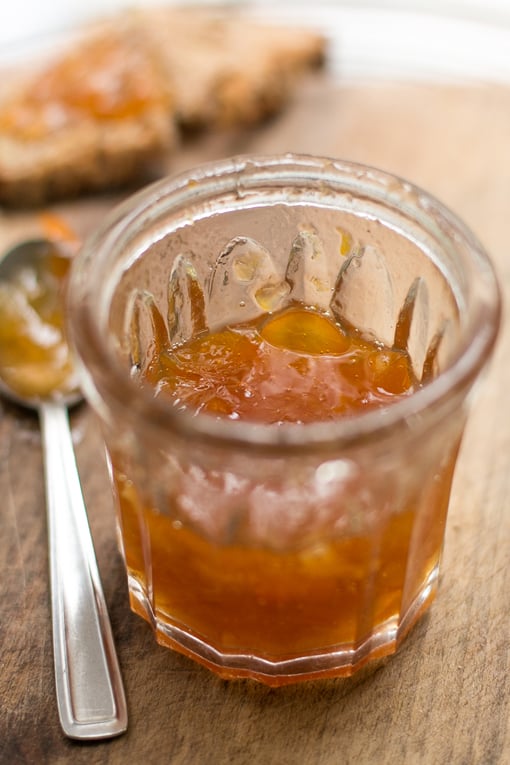
kumquat marmalade recipe

I’ve been on a marmalade bender lately. Well, it’s actually been for the last few weeks. Winter, of course, is marmalade season and the markets in Paris are heaped with citrus: Corsican clementines, pretty yellow bergamots, hefty pink grapefruits from Florida (although some infer appellations from elsewhere – namely, the Louvre), leafy lemons from Nice, and lots and lots of oranges.

Kumquat marmalade

The stands are so piled up that it’s not uncommon to be walking down the aisle and have an orange roll off of the piles and land on your foot. (Which is why it is a good idea to wash any fruit before you use it.) This means I’ve got so many jars of marmalade, that when my friend Luisa stopped by and saw the jars piled on top of a shelf in my bedroom, she said “I’ve doing the same thing ” at her apartment in Berlin. Sometimes I think jam-making could be classified as an epidemic and if so, there’s ample evidence that I’m ready for an intervention.

kumquat marmalade recipe

While kumquats were once classified with their look-alike citrus brethren and sistern (admittedly, it can be hard to tell as it’s difficult to get a look under their navels), they are now placed in another genus category (Fortunella), even though they share many characteristics of citrus fruits.

Kumquat marmalade

One of those characteristics is that they are winter fruits. And another is that they are très bon pour la santé (good for your health), containing lots of vitamin C. And they also make you feel happier, since not only does their tangy-bitter flavor brighten up even the darkest of winter day, nothing makes me happier than to wake up in the morning and gaze at my shelf of marmalade first thing in the morning.

Kumquat marmalade

I was especially happy when I was doing my shopping at the outdoor market and came across a big bin of kumquats. I scooped up a nice-sized bag of them and brought them home, where they patiently waited in the refrigerator until I decided what to do with them.

Originally I’d considered giving them a quick-candying and strewing them over poached prunes with a scoop of ice cream. But I ended up sticking my fingers into the bowl of prunes a few too many times during the week and ended up with a small puddle of cinnamon-spiced dark syrup pooled in the bottom of a container in my refrigerator, which I didn’t think would go with anything.

Kumquat marmalade

So I decided to get out my little serrated knife, slice up my Fortunella fruits, and make marmalade. I added a couple of lemons not just to bulk it up, but because I thought with the added sugar, the marmalade would benefit from some extra acidity.

Kumquat marmalade

I normally spoon my marmalades on morning toast, but after I made this batch, I had cleaned up the kitchen and was going to reward myself to a nice bowl of split pea soup for lunch with some Comté cheese and – like most good ideas (and a few of the bad ones) – it suddenly occurred to me that the tart marmalade might be nice with the nutty cheese I was cutting into batons.

Kumquat marmalade

And sure enough, it was. Fortunately I have three nice jars of marmalade to add to my collection. So far this year I’ve made Seville orange marmalade (eight jars) and four jars of mixed marmalade, using the bergamots and citron that were plucked off a tree in Sicily. After all that slicing, seeding, and simmering, the last pot of marmalade has been jarred and stored; they’ll last me through the winter. And if I am prudent, a number of spring and summer mornings as well.

Kumquat marmalade

Print

Kumquat Marmalade

Many of the little rings of kumquats will, unfortunately, come apart as you cook the marmalade. The reward, however, is gorgeous jars of tangy marmalade that you’ll be happy to spread on your morning toast or serve with a bit of cheese after dinner. I served mine with Comté, but a nice goat cheese or another nutty mountain cheese, like Gruyère, would pair nicely with it. It takes a bit of patience to slice and pluck out all the seeds from the kumquats, but you can get 2 to 3 jars of marmalade for your efforts. I use a small serrated knife to slice off the stem end, then start slicing the kumquats crosswise, until I get close to the center. Finally, I stick the tip of the knife into the area where the seeds are and slip them into a small bowl. Because the seeds are rather large, any that you miss you can usually find just by doing a little scanning of your pile of sliced kumquats. I use oval Nagami kumquats, which are more puckery than the round Meiwi kumquats, which you sometimes come across. Do try to get organic or unsprayed fruit from your local market or natural food store. The kirsch is optional, but it does nicely round out the flavor of the marmalade. You can substitute another liquor, such as gin, Grand Marnier or Cointreau, light rum, or a dash of brandy. Or it can be omitted, if you wish.

Ingredients

  • 2 lemons stemmed, halved lengthwise, seeded, and very thinly sliced
  • 1 pound (450g) kumquats stemmed, seeded, and sliced
  • Reserve the seeds from the lemon and kumquats
  • 5 1/2 cups (1.3L) water
  • 2 cups (400g) sugar
  • pinch of salt
  • Optional: 1/2 teaspoon kirsch or other liquor

Instructions

  • Put the lemon slices in a large non-reactive pot. Cover with cold water and bring to a boil. Reduce the heat and simmer until the lemons are translucent, about 5 minutes. Drain. (Discard the water.)
  • Put the blanched lemons back in the pot. Tie the seeds from the lemons and kumquats securely in a piece of cheesecloth and add the seed sack to the pot along with the sliced kumquats and water. Bring to a boil; remove from heat, cover, and let stand 24 hours.
  • The next day, put a small plate in the freezer.
  • Add the sugar and salt to the pot, and cook the marmalade for 30 to 45 minutes over medium heat. Remove the bag of seeds and when it’s cool enough to handle, squeeze the seeds in the cheesecloth using your hands or place it in a ladle and press it with the back of a soup spoon (being careful not to break the fabric and release the seeds) over the jam pot to so the pectin goes directly into the marmalade mixture.
  • Continue cooking until it has reached the jelling point, about 220ºF (104ºC) degrees, if using a candy thermometer. To test the marmalade, turn off the heat and put a small amount on the plate that has been chilled in the freezer and briefly return it to the freezer. Check it in a few minutes; it should be slightly jelled and will wrinkle a bit when you slide your finger through it. If not, continue to cook until it wrinkles slightly on the chilled plate when you nudge it.
  • Remove from heat, then stir in the kirsch (if using), and ladle the mixture into clean jars.

Notes

Note: I store my jams and marmalades in a cool place, often the refrigerator if not planning to use them within a few weeks. if you wish to can or preserve them, you can check out these canning tips.

Related Recipes

Kumquat Marmalade (Recipe Girl)

Kumquat Marmalade with Star Anise (Drizzle & Dip)

Sunday Morning Kumquat Jam (Amateur Gourmet)

Small Batch Kumquat Marmalade (Food in Jars)

Maple Kumquat Marmalade (A Bloggable Feast)

❌