This Pork and Onion Stir Fry is the kind of Chinese home cooking my dad Bill grew up with. It’s a marriage of Chinese techniques and American staples like ketchup and Worcestershire sauce. The result is downright tasty and comforting with a bowl of rice! A Simple Pork Stir-Fry This stir-fry has minimal chopping and […]
I've been confabbing with a friend from San Francisco, whose family is Hakka, from the south of Taiwan, to visit the country. And after a couple of years of talking about it, two friends of mine and I finally did it, and joined him there.
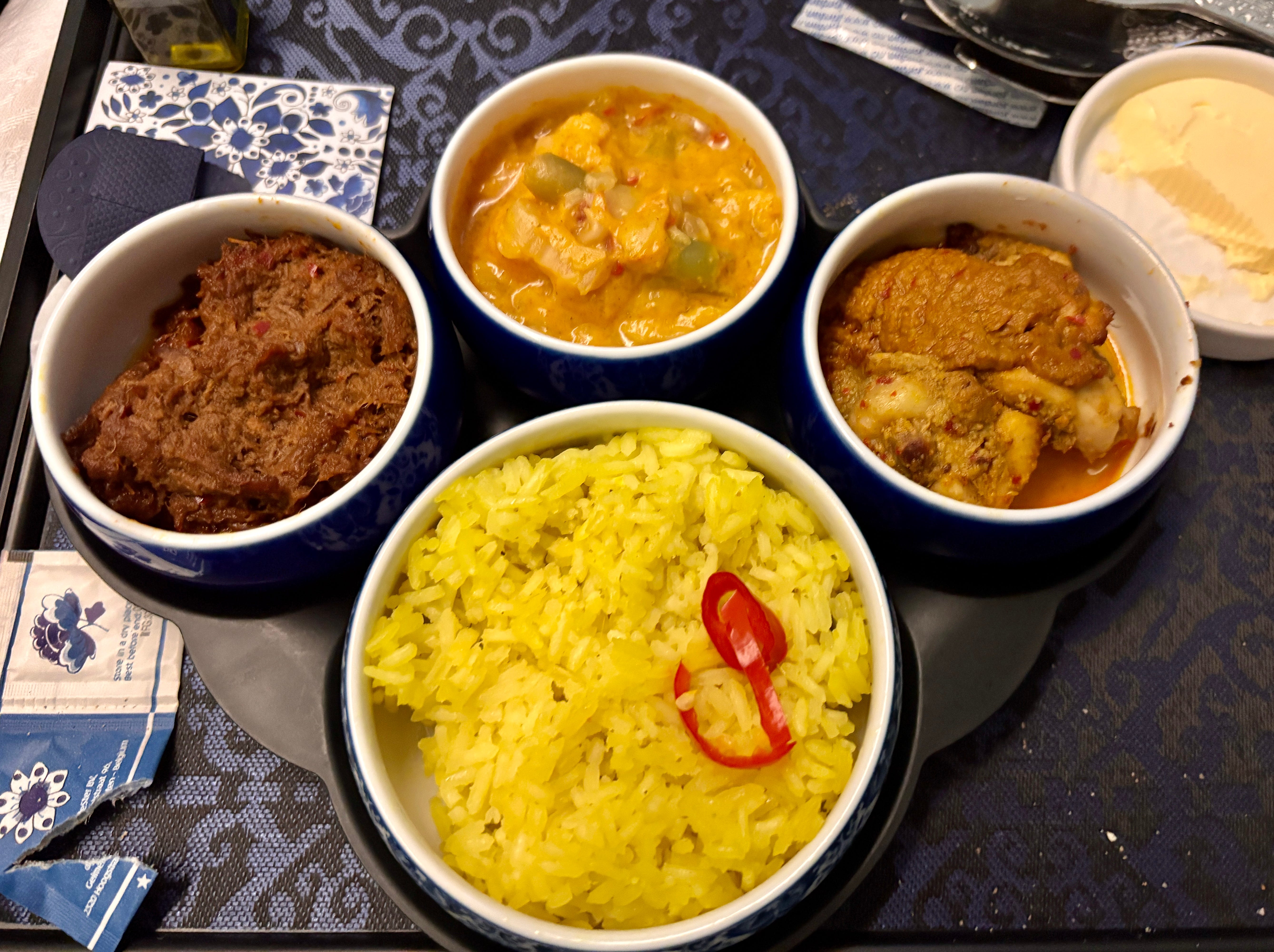
Lunch (or was it dinner?) on my KLM flight to Taiwan.
I had a bit of trepidation about the trip there since the itinerary was a bit complicated. Fortunately, though, I didn’t book on one of the flights that went through the Middle East, instead booking a KLM flight from Paris through Amsterdam, where there were only two of us going through immigration, and I made it through in record time, so making my connection was my first sense of relief.
Then I flew from Amsterdam to Taipei which, speaking of “relief,” — we were told as we were taking off that three of the bathrooms on our plane, which was filled to capacity, were out of service. So I didn’t drink much on the plane and arrived rather parched, to put it mildly. Shout-out to the flight attendants on KLM who were super lovely and very friendly. I watched two very good movies, Rental Family and Bugonia, which was wild, and had a good meal of what I think was Indonesian food.
My arrival in Taipei was pretty easy as well; unlike the airport in Paris, there are tons of bathrooms at the Taipei airport — you didn't have to hike twenty minutes and take two flights of stairs to find one. After hydrating myself back to normal, I took a train from the airport in Taipei to the high-speed train station, then another train to Kaohsiung. I arrived at my hotel about 23 hours after I left home. I rehydrated some more, then went to bed, relieved that I had made it.
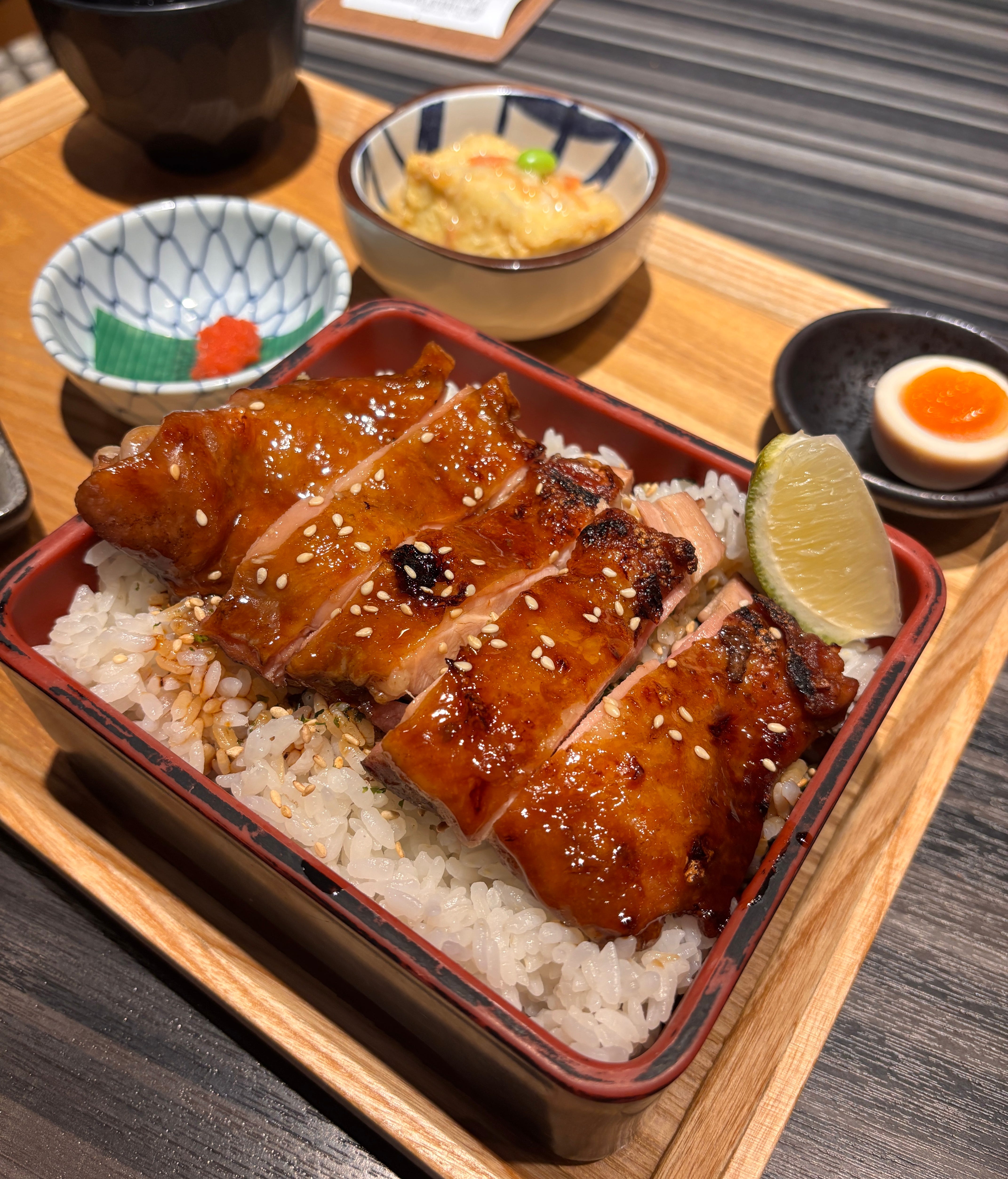
My first meal after landing with chicken teriyaki.
I don’t know much (or anything, really) about Taiwan or Hakka food, except that in San Francisco, I frequently ate at a Hakka restaurant, which was legendary — except I just read that it closed. But our friend is from this part of Taiwan and told me that because the Hakka were displaced, their food was on the simpler side. And because at one point the Japanese had colonized Taiwan, there remains a moderate Japanese influence.
The next day, I went to a funeral.
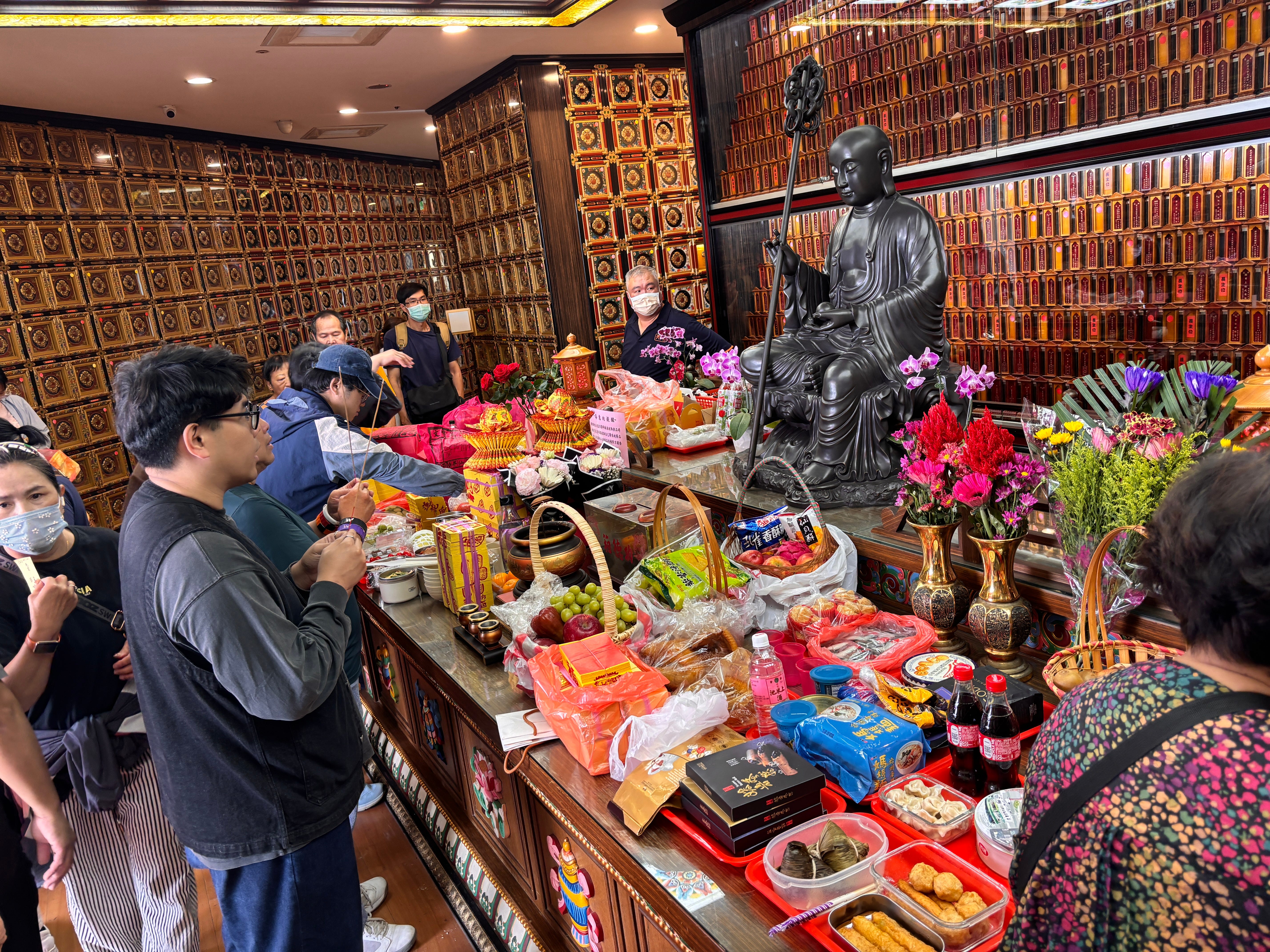
It wasn’t actually a funeral but “Tomb Sweeping Day,” when people visit cemeteries and columbariums to clean the tombstones of those who have passed. The columbarium that we visited was packed with friends and families bringing offerings of food. It was touching to be invited and to see how people celebrate and honor their ancestors. Afterward, of course, there was food.
(And don’t worry, all that food that’s brought for offerings gets taken home and eaten. I was also wondering about that…)
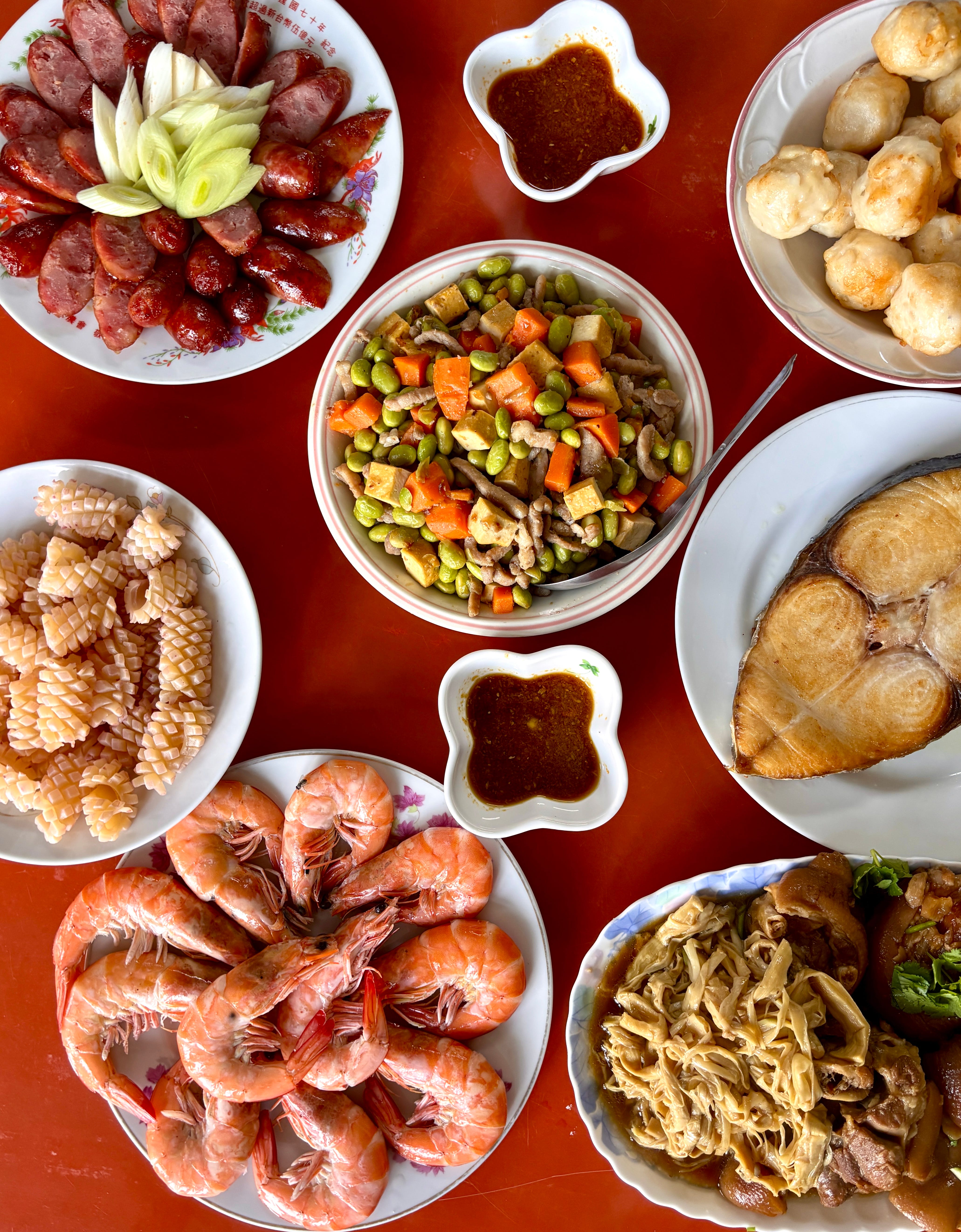
My friend’s cousin made lunch for us back at her house. And what a meal it was! There were probably ten or twelve dishes, put together in their humble kitchen, but with great finesse.
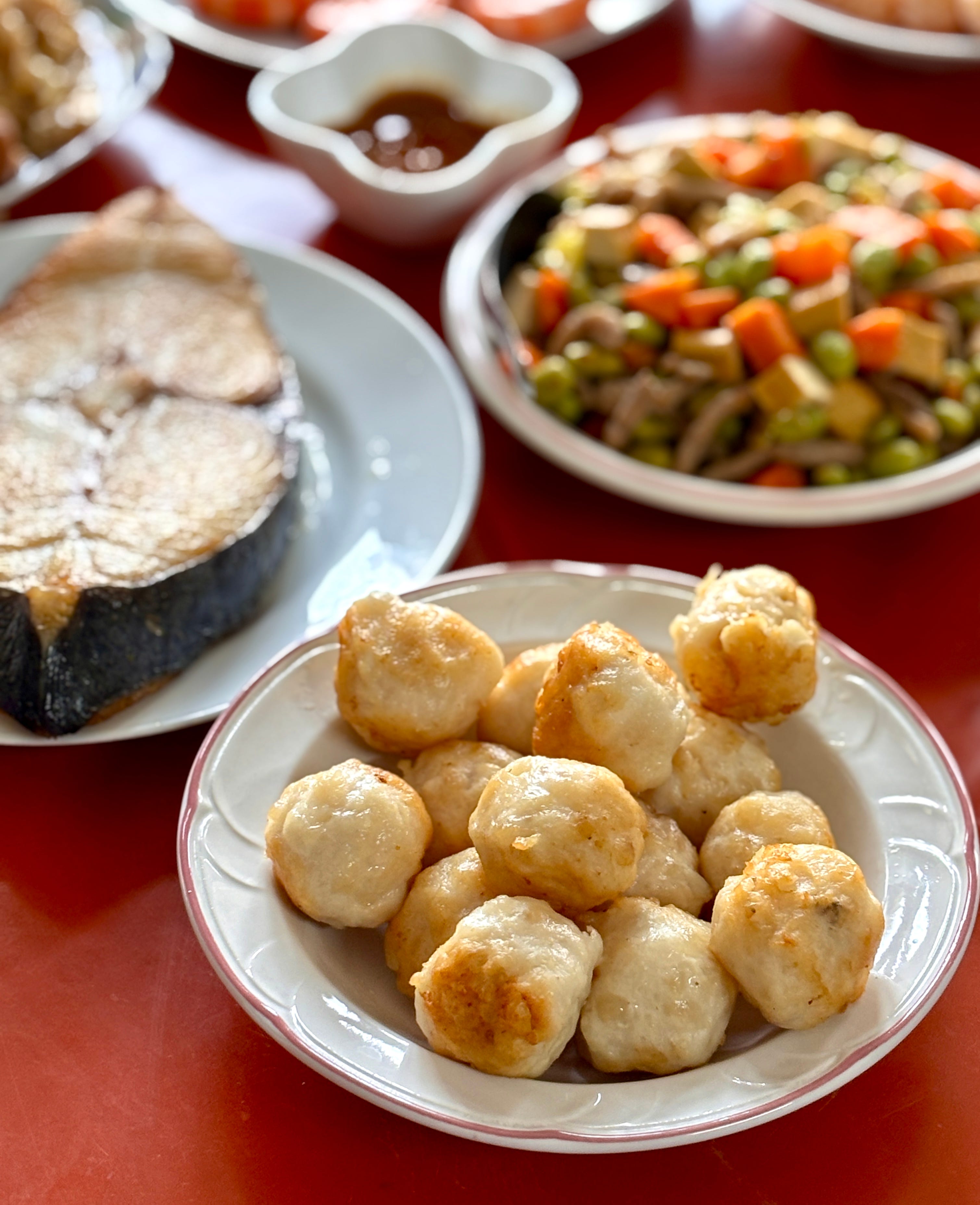
We had heaping bowls of fish cakes, and then a cascade of other platters and plates arrived. Braised pork trotters, Taiwanese sausages with fragrant and flavorful garlic greens piled in the middle, fresh shrimp and cuttlefish in the back — and my friend Cal showed me a locally grown star fruit. They are usually green, hard, and unripe, and this ripened one was a treat.
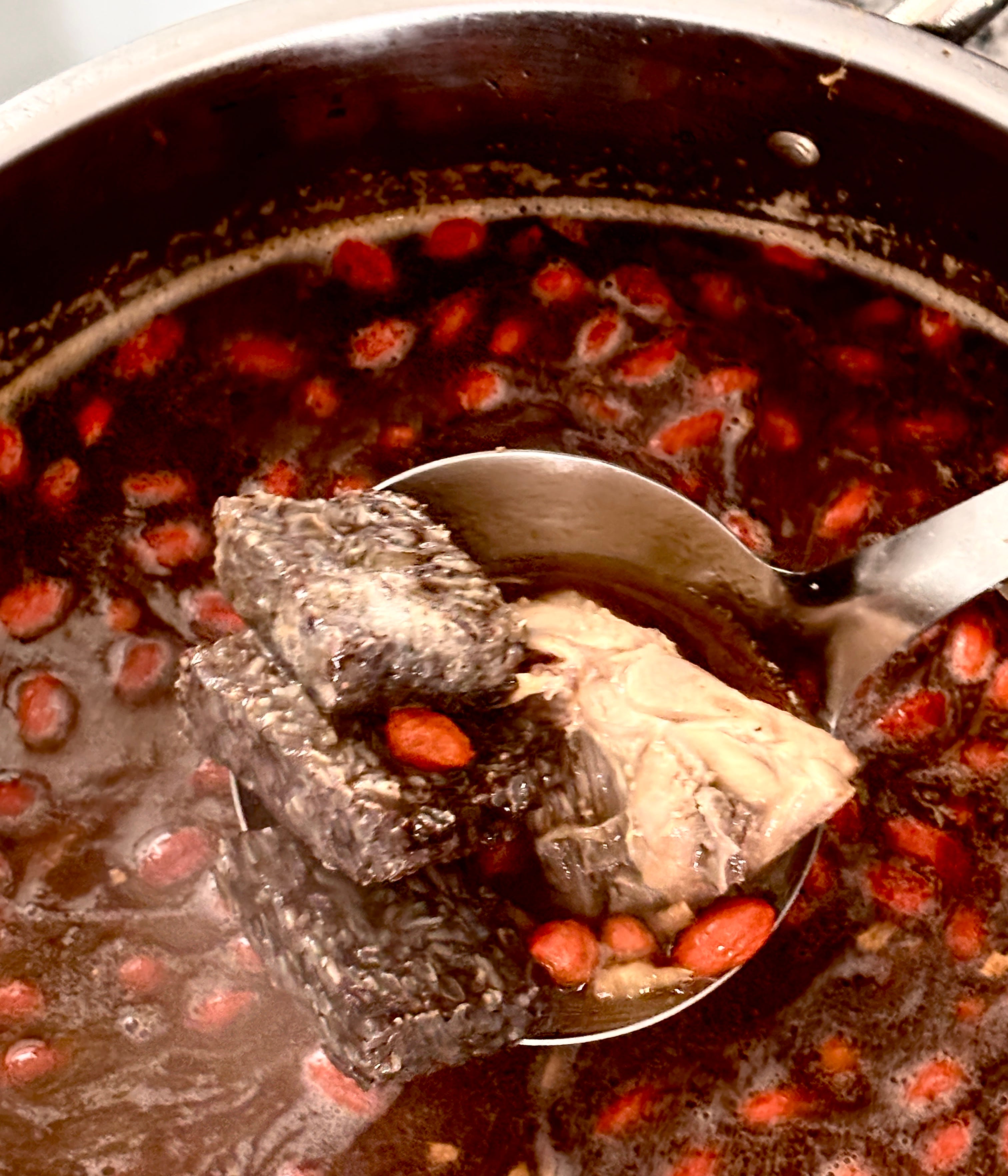
We finished the meal with an alluring soup…
…served from a big pot with cubes of blood-rice sausage and pieces of locally raised chicken (which was “sacrificed” that morning on the farm), spiked with a lot of millet “wine” — which was actually millet eau-de-vie, at 40% (or more) alcohol. It was so strong that my friends and I had a little trouble finishing a whole bowl, but the elders in the room didn’t have any trouble.
Desserts aren’t usually served after Hakka meals, but that didn’t stop us from heading over to the local shaved ice shop.
I fell hard for my bowl of shaved ice, which had layers of candied red and mung beans, as well as chunks of starchy taro root and grass jelly under a layer of snowy, airy wisps of ice.
My absolute favorite part of the 剉冰 were the chunks of candied winter melon the owner spooned on top, with a drizzle of raw cane sugar syrup. The dessert was barely sweet and completely refreshing. We'd ordered three bowls to share amongst the five of us, but our Taiwanese friends didn't want to share, and each ended up ordering their own — and finished them, as did I.
Well fed, and (finally) well-hydrated (no thanks to that soup!), the next day we visited a rice noodle factory where the layers of rice batter were rolled out by machines, then cut.
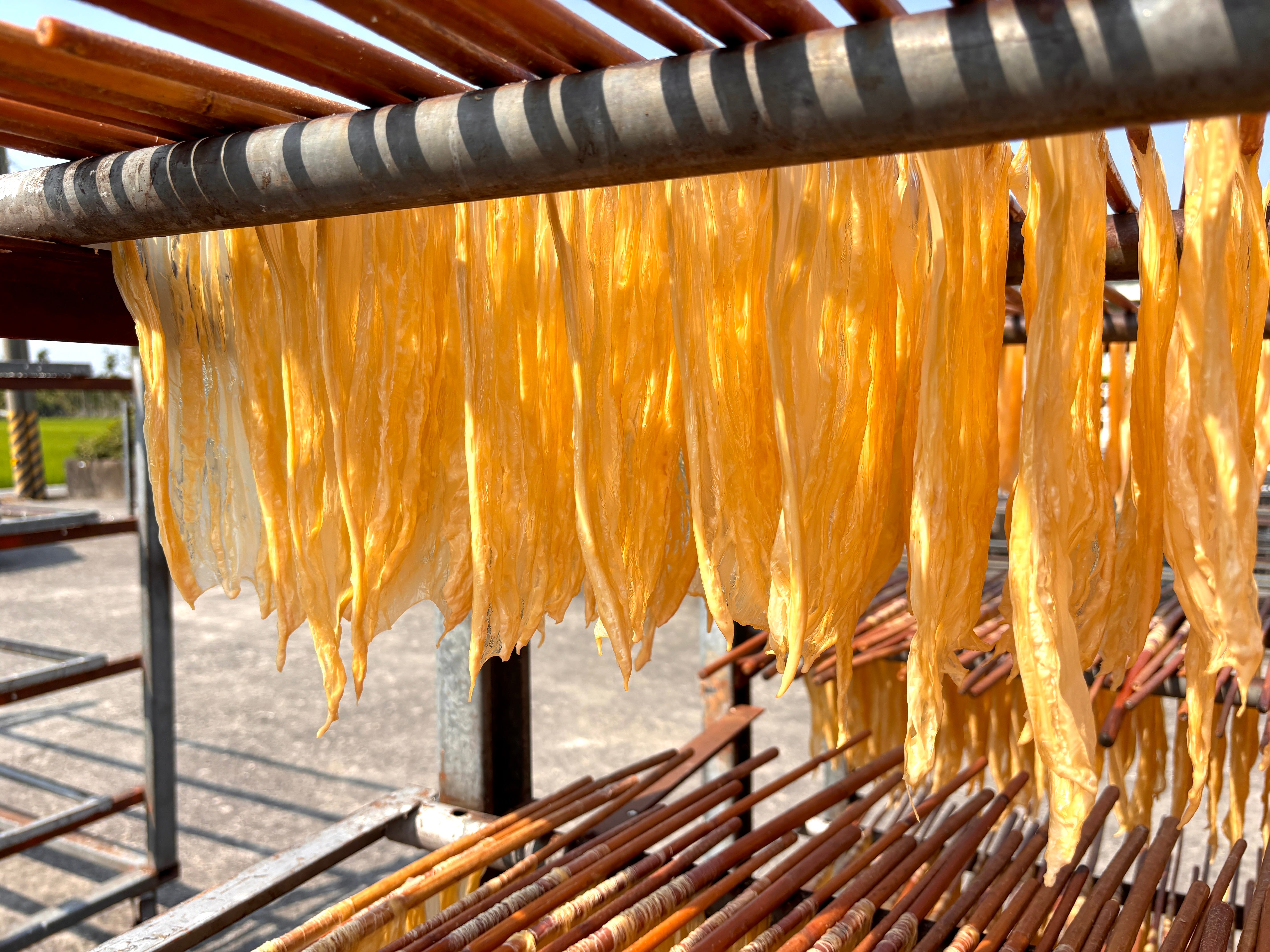
Taiwanese people are known for their love of noodles, and we also visited a famous tofu skin "factory" (although it was more like an outdoor workshop) where the soy milk is heated by fire, then poured into trays while it's warm. As soon as a skin forms on top, the women expertly run a long metal cutter to separate the skin from the edges, slip a wooden dowel underneath, and lift off the skin.
Then the skins are left to dry out in the sun until crisp. Even though they're dried, their shelf life is short — just a few weeks — so I didn't bring any home. But the tofu skins from this particular place are very sought after.
I asked if I could give it a try, after a bit of reassurance that I was a baker (so they'd know I wouldn't completely screw up their whole production) — and I got a little lesson:
It took me a few tries to get the hang of it. I was pleating them starting from the wrong end, and the woman who was showing me how to do it told me I needed to speed things up. 😂 I'm sure if I'd spent a little more time with them, which I would have been happy to do, I would have gotten faster and better at it. Watching rice noodles and tofu skins being made made me hungry for noodles. Fortunately, that was our next stop.
Tofu skins can be cooked and eaten like noodles, presoaked and tossed in stir-fries, or used to wrap dumplings. They're one of my favorite things, and when I was in Osaka, we ate at a restaurant that specialized in yuba, or tofu skins.
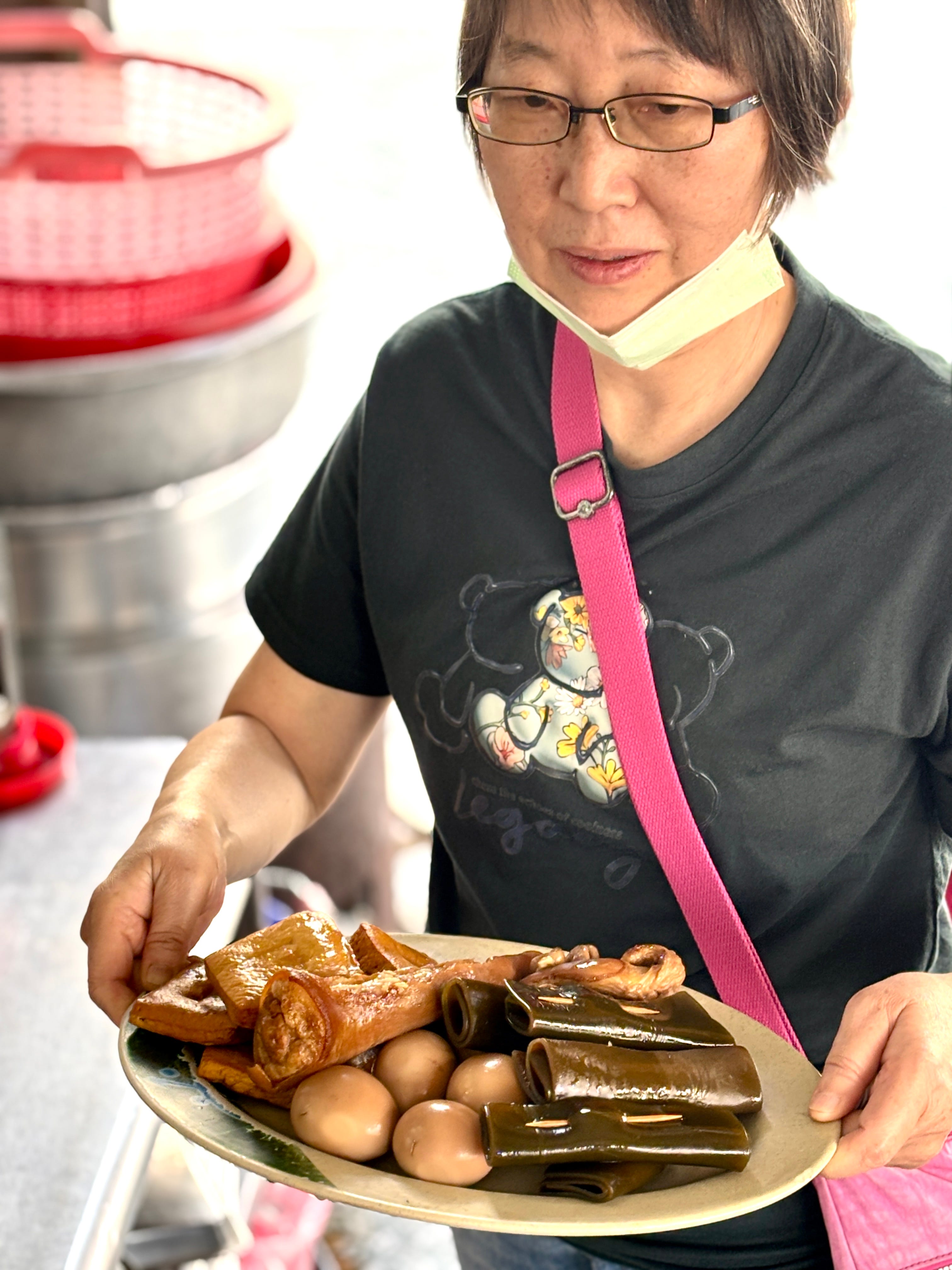
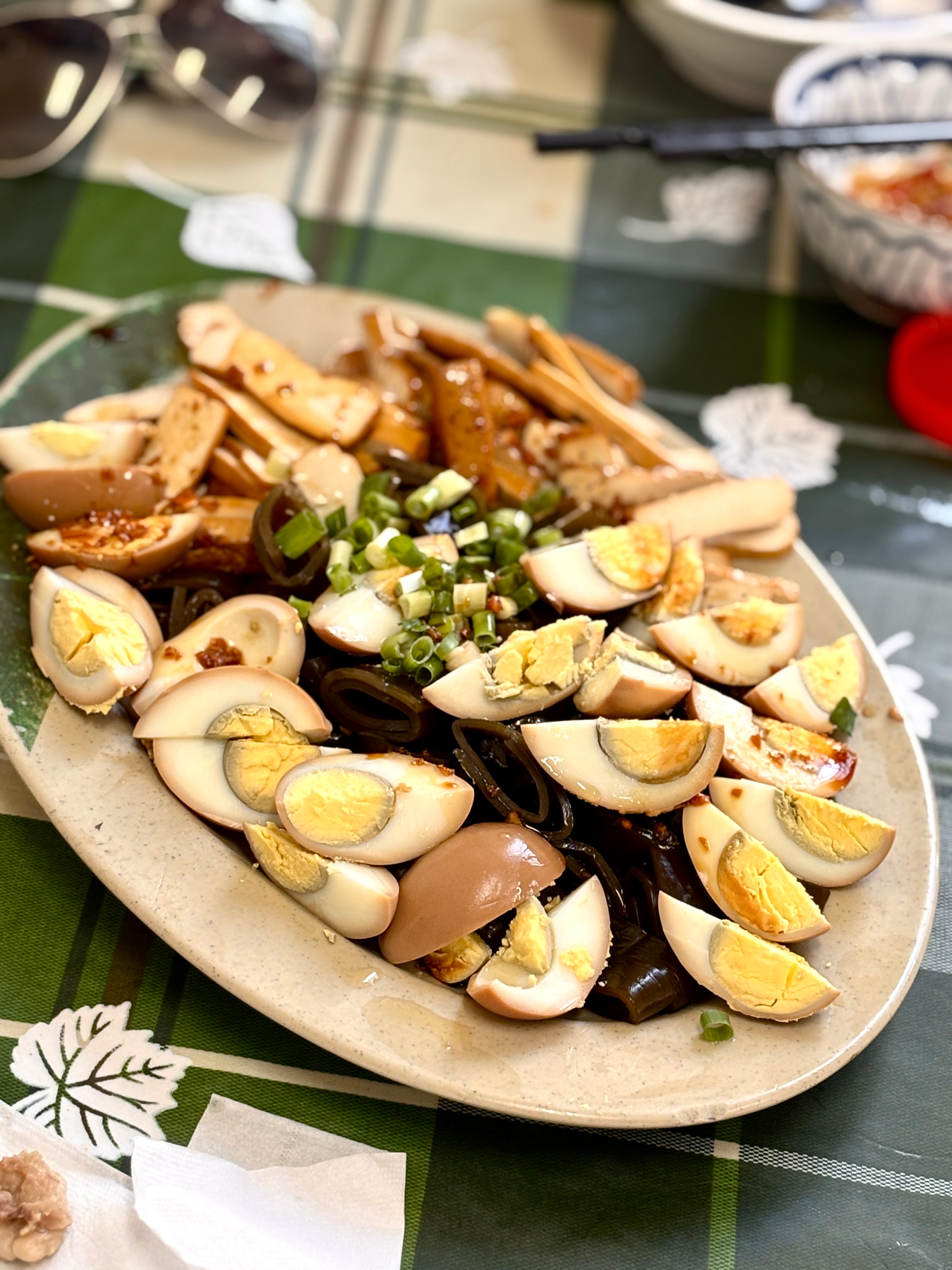
At the noodle shop, there was a platter of pig’s trotters, braised eggs, pressed tofu, kombu (seaweed), and some spicy condiments on the table, including jars of fermented pineapple.
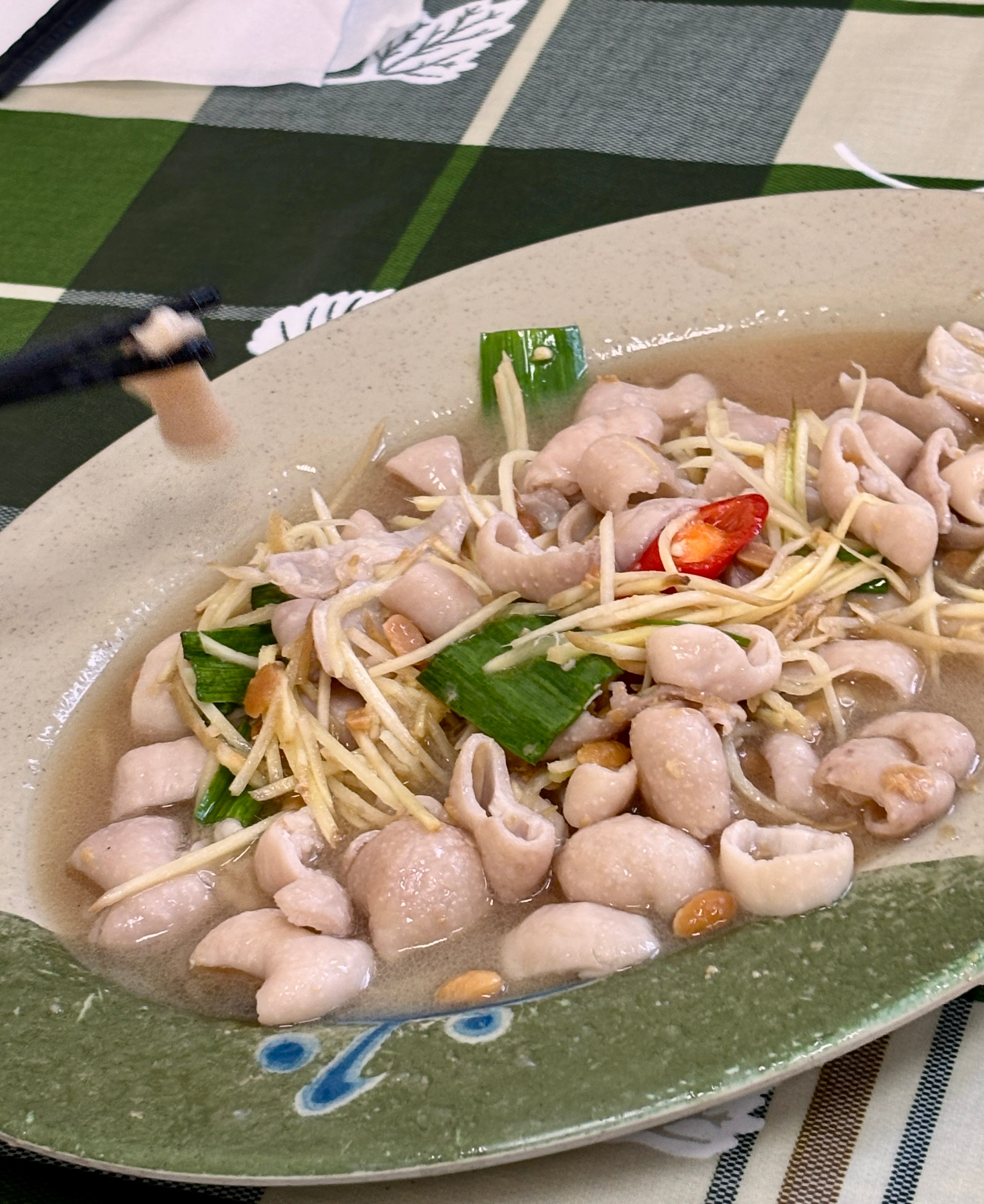
Before the noodles, out came a platter of pork intestines covered with slivered fresh ginger. The intestines were a little chewy, but the copious amount of ginger was a welcome treat.
Once all the accompaniments were sliced and presented to our table, I was ready for noodles.
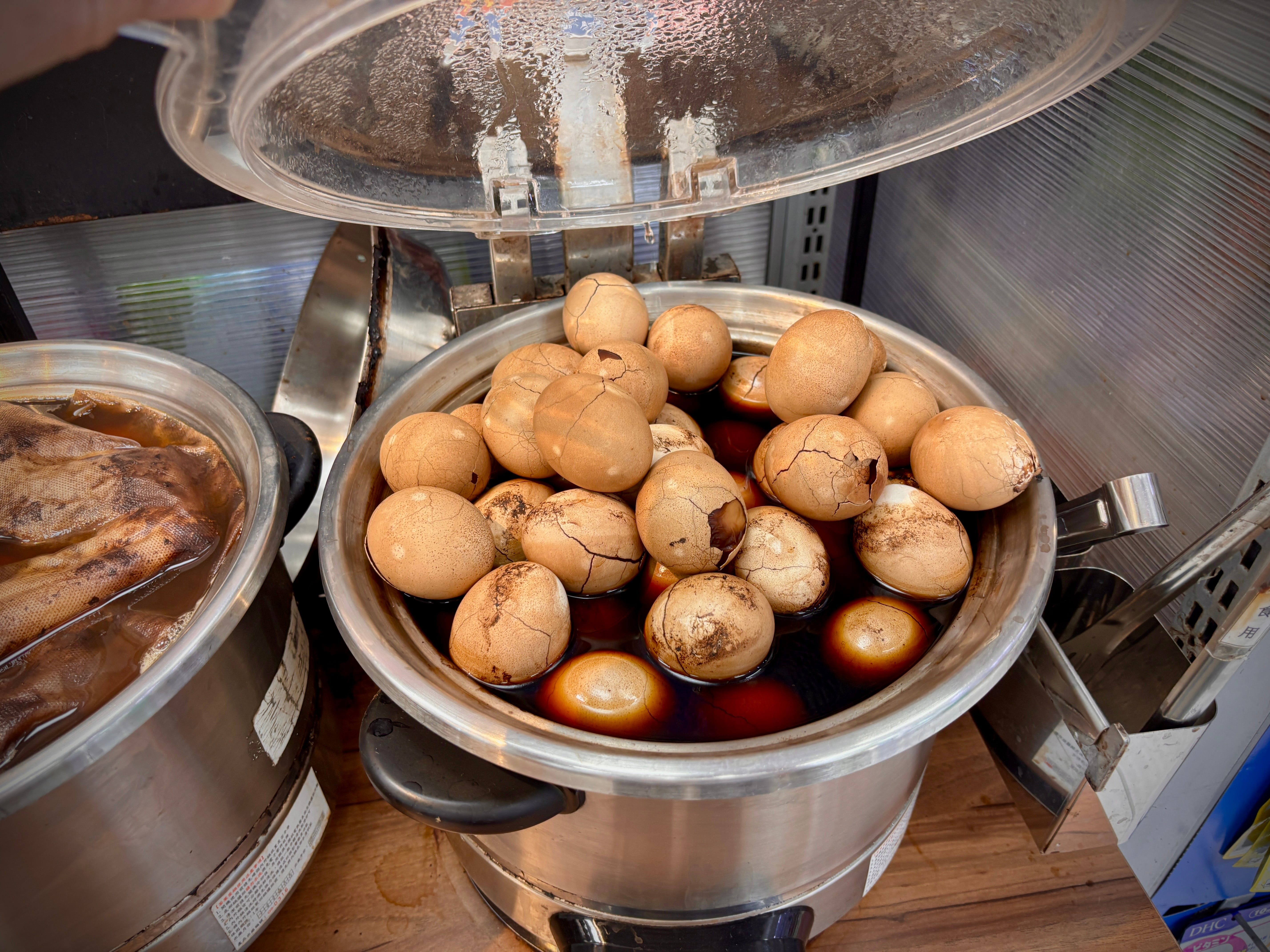
I'm sure some of you may be hovering over the "Leave a comment" button regarding the greenish outer yolks of the braised eggs, but there's a pot of them in every convenience store, bubbling away for who-knows-how-long, and they go fast. So it doesn't seem to bother anybody, including me, since they're pretty tasty.
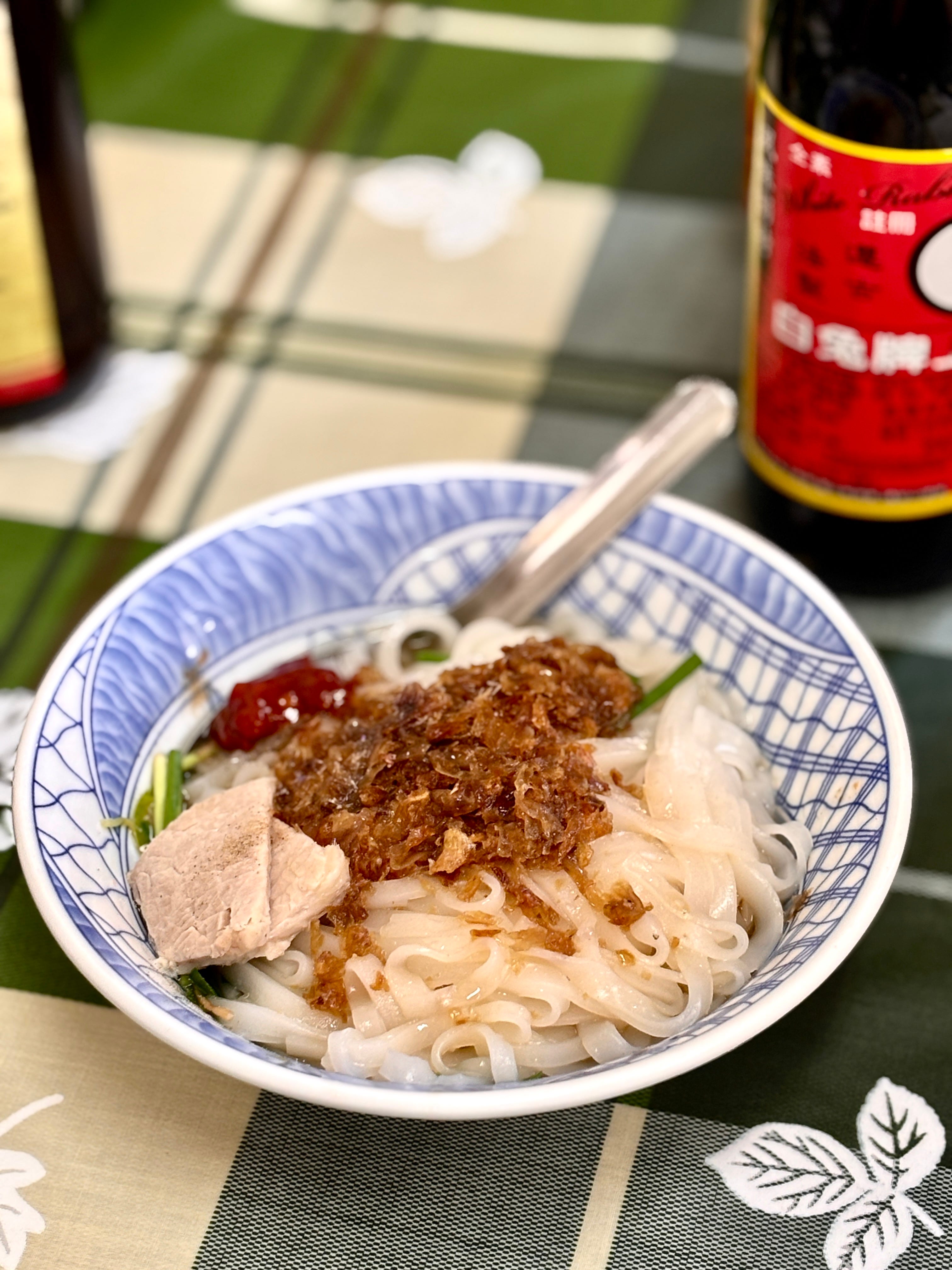
Then, out came the individual bowls of fresh rice noodles for us, which were topped with caramelized shallots — a popular condiment here — and then you add other condiments such as black vinegar, miso-based soy paste, and chili pastes. (I have this miso soy paste at home, which my Taiwanese-American friend sitting next to me on the train right now, tells me is thicker than what we had here.)
Subscriber to my newsletter here, to get the newsletter sent right to your inbox!
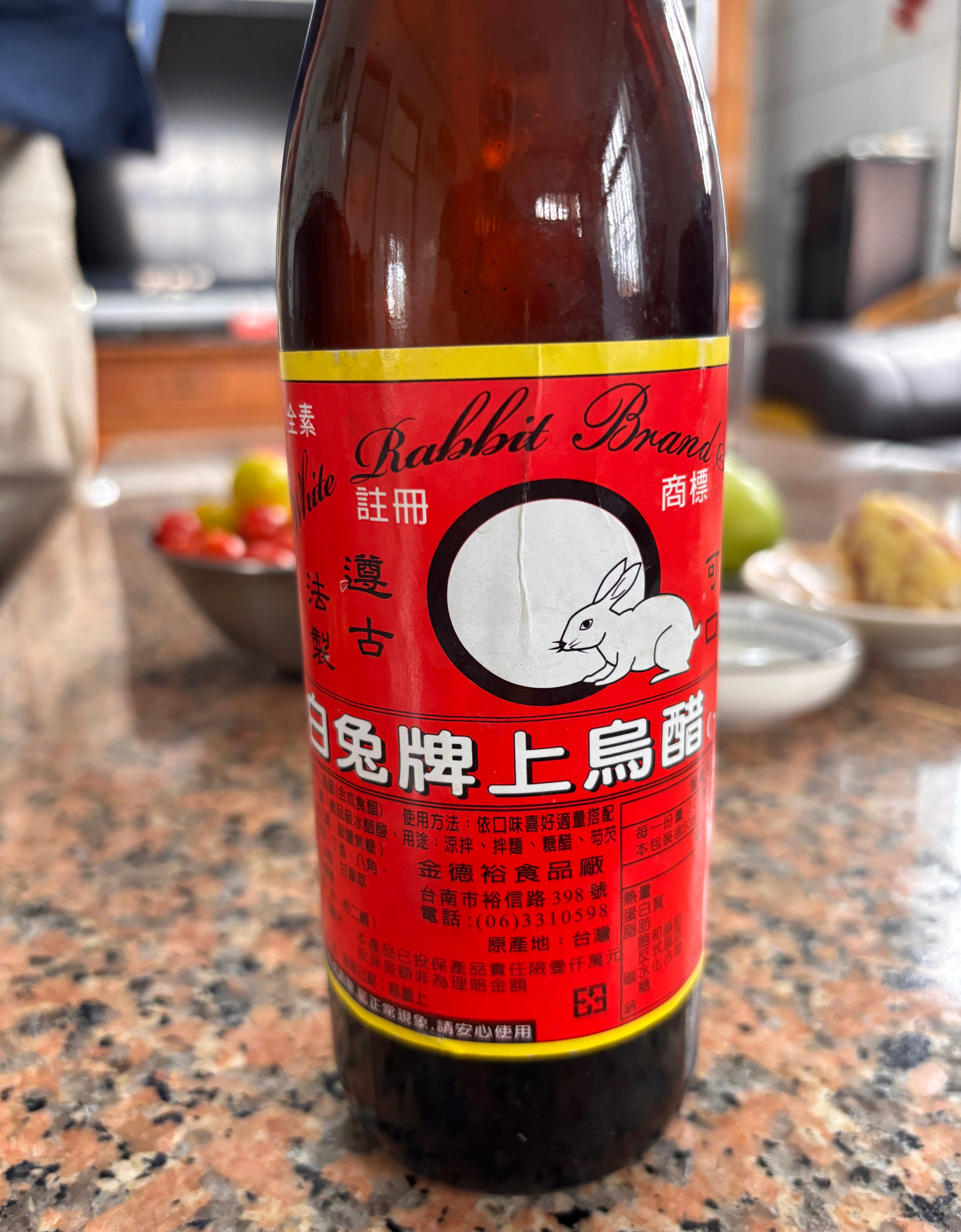
And the White Rabbit black vinegar we used was also a bit of a revelation to me as it was much better than the regular black vinegar I get at the Asian markets back home. It had a tangy, fruity flavor and my friend's cousin poured a little over my noodles, then a little of the miso soy sauce over them, and told me to mix everything up and eat. I added some of the chile sauce and paste as well.
Finally there was dessert (again), and at my request, we went for ice cream.
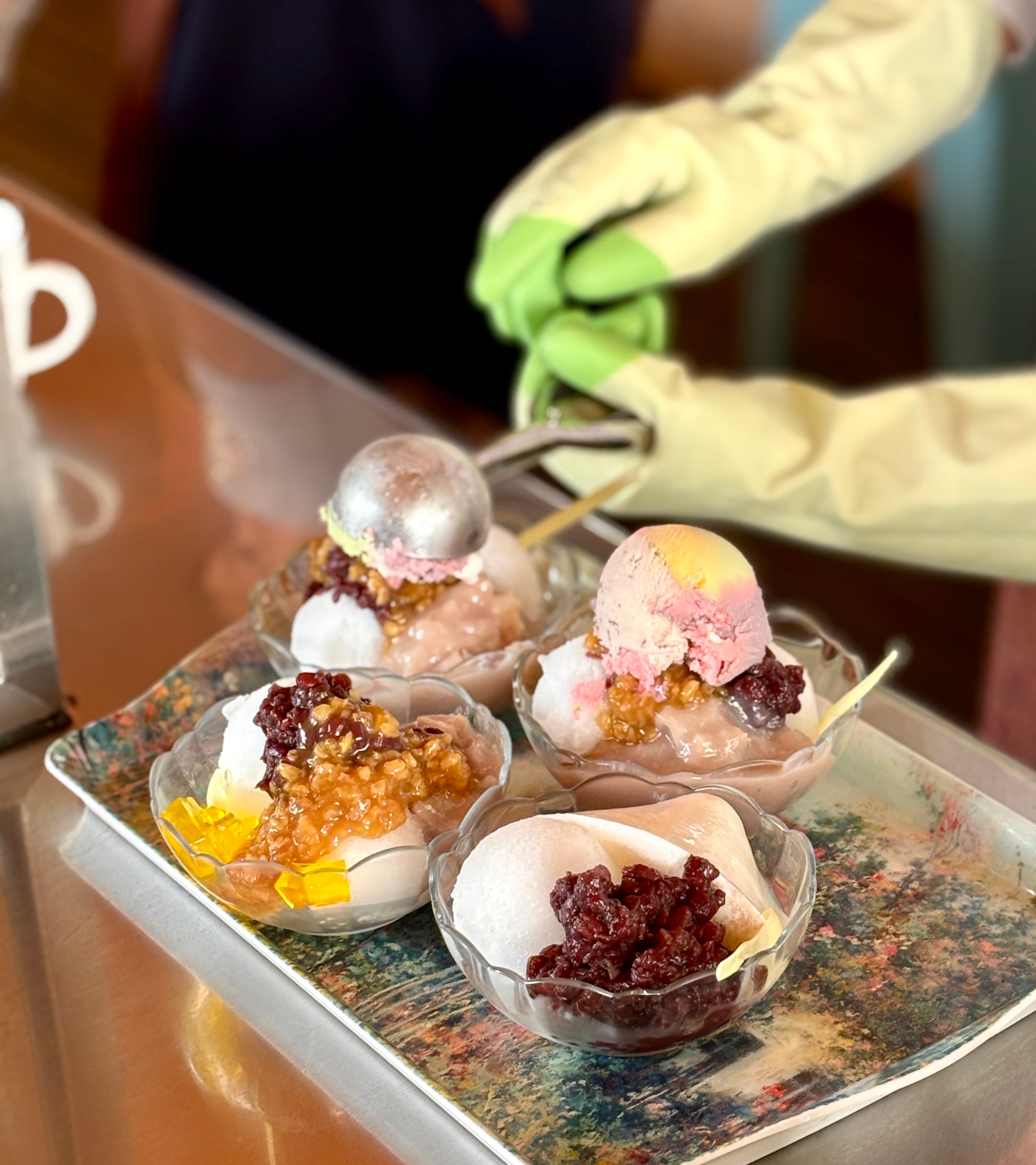
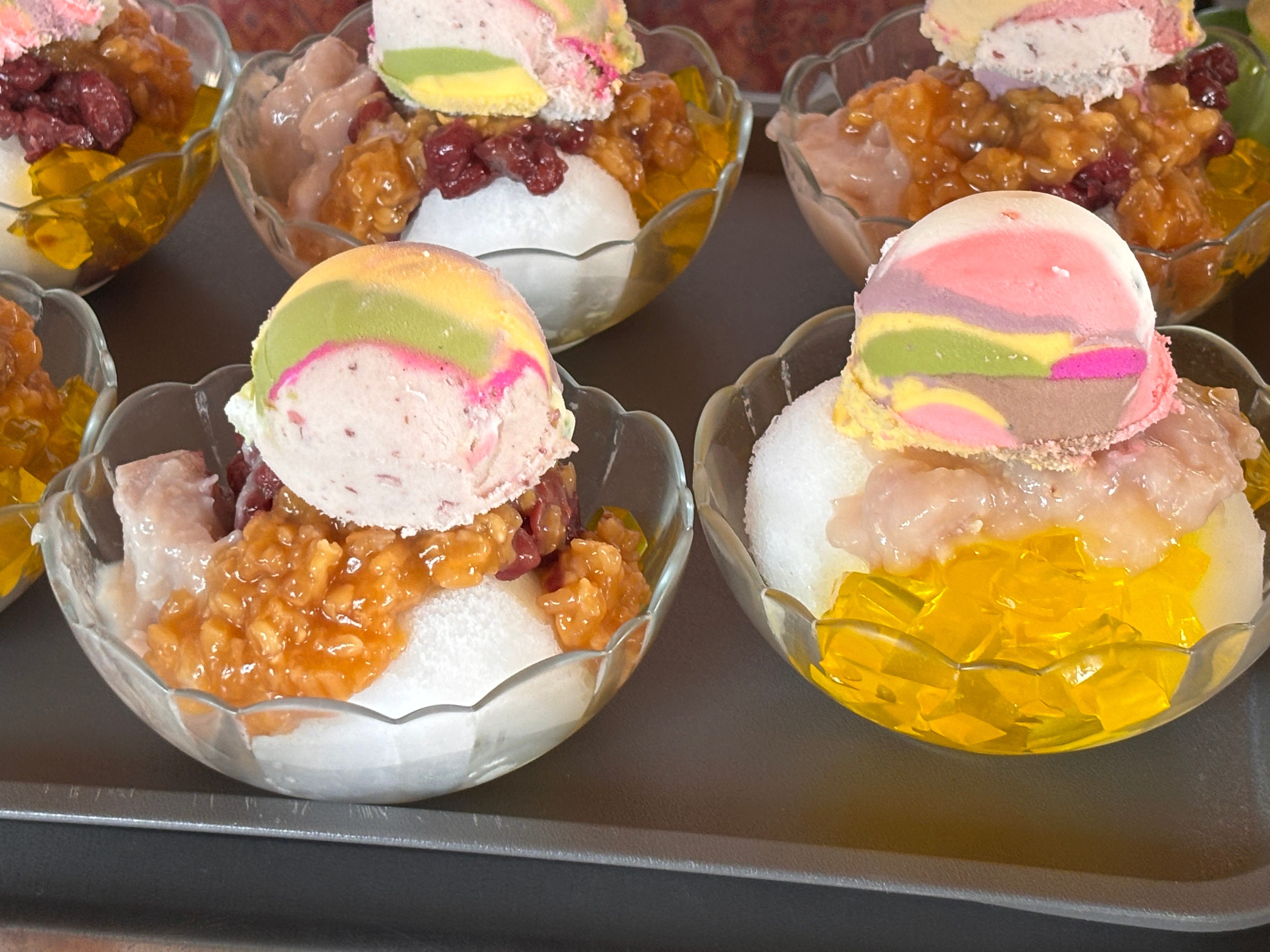
The menus were all in Chinese (or maybe they were in Hakkanese, the local language?) and while I used Google Camera to do some translating, my friend's cousin took control of the order, and I was glad that she did. She obviously knew what she was doing, and while I suggested we get a few to share, everyone wanted one of their own, customized the way they liked it, with various jellies and candied beans spooned on top and around the rainbow scoops.
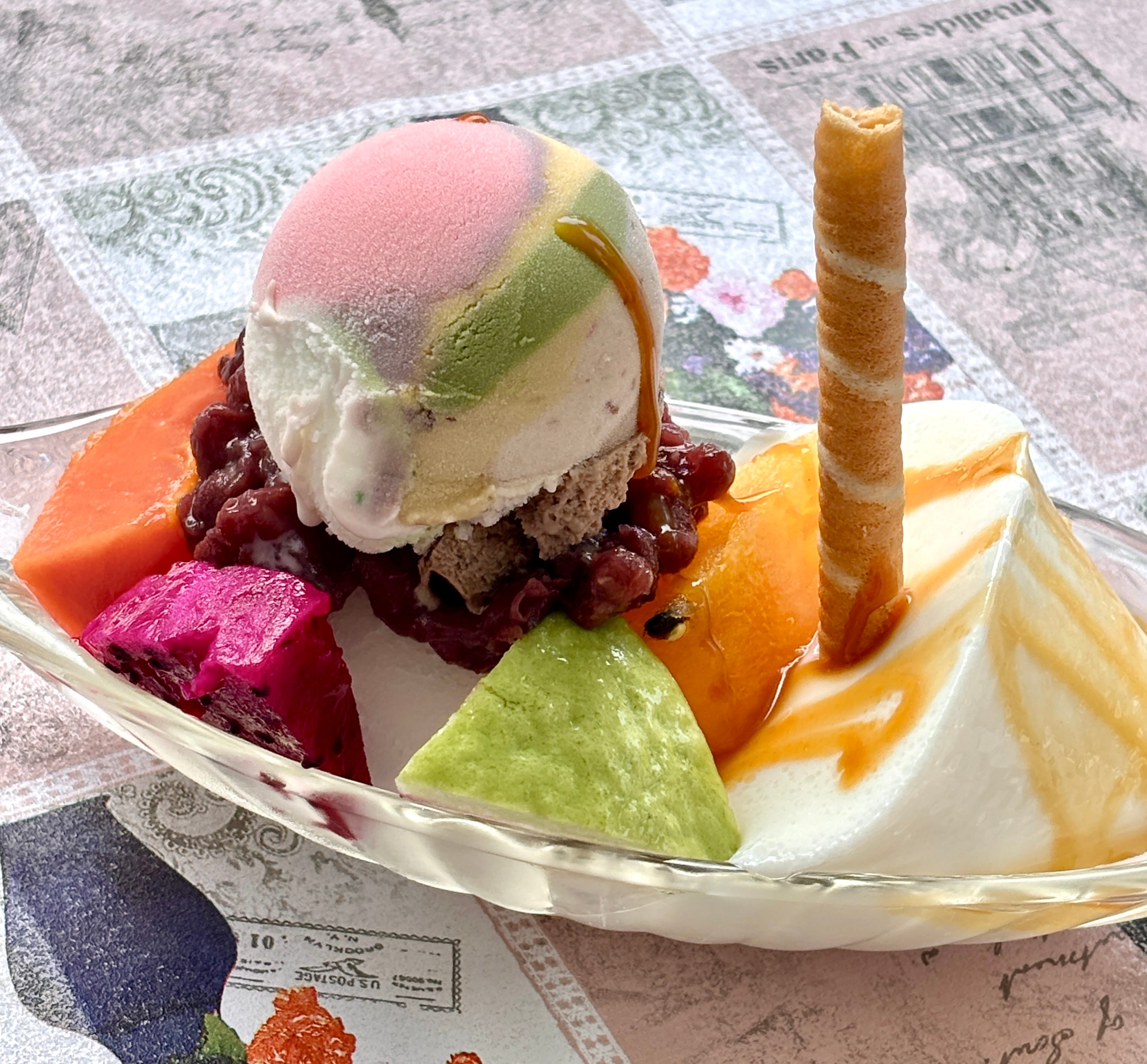
I also asked if we could add an almond jelly, which I like a lot. It came served with dragon fruit, papaya, and whole guava (the green chunk, whose skin you eat), with an extra dollop of candied red beans (which I also like a lot) under the ice cream.
The morning we left Kaohsiung, I planned to stop at Xing Long Ju for Taiwanese breakfast. In France, breakfast isn’t a big thing, and going “out” for breakfast means a café express and perhaps a croissant, standing at the bar in a café. Taiwanese people seem to love to eat, which they do at all hours of the day. Meal times here aren’t strictly defined as they are in France, and if you’re hungry and feel like eating, you eat.
Taiwanese breakfasts include things like cha siu bao (warm steamed BBQ pork buns), eggy pancakes, fan tuan (sticky rice rolls wrapped around crispy crullers, sometimes with meat), and dumplings. Almost over my jet lag, I woke up at 5am and was ready to head over there. Xing Long Ju opens at 4:30am, and just as I was about to head out, I did a quick search to confirm the address and saw they were closed on Tuesday. Zut!
Oh, well. You can’t do and see, and eat, everything — but when I get to Taipei, I hope to have a Taiwanese breakfast, no matter what time it is. Just as long as they’re open.
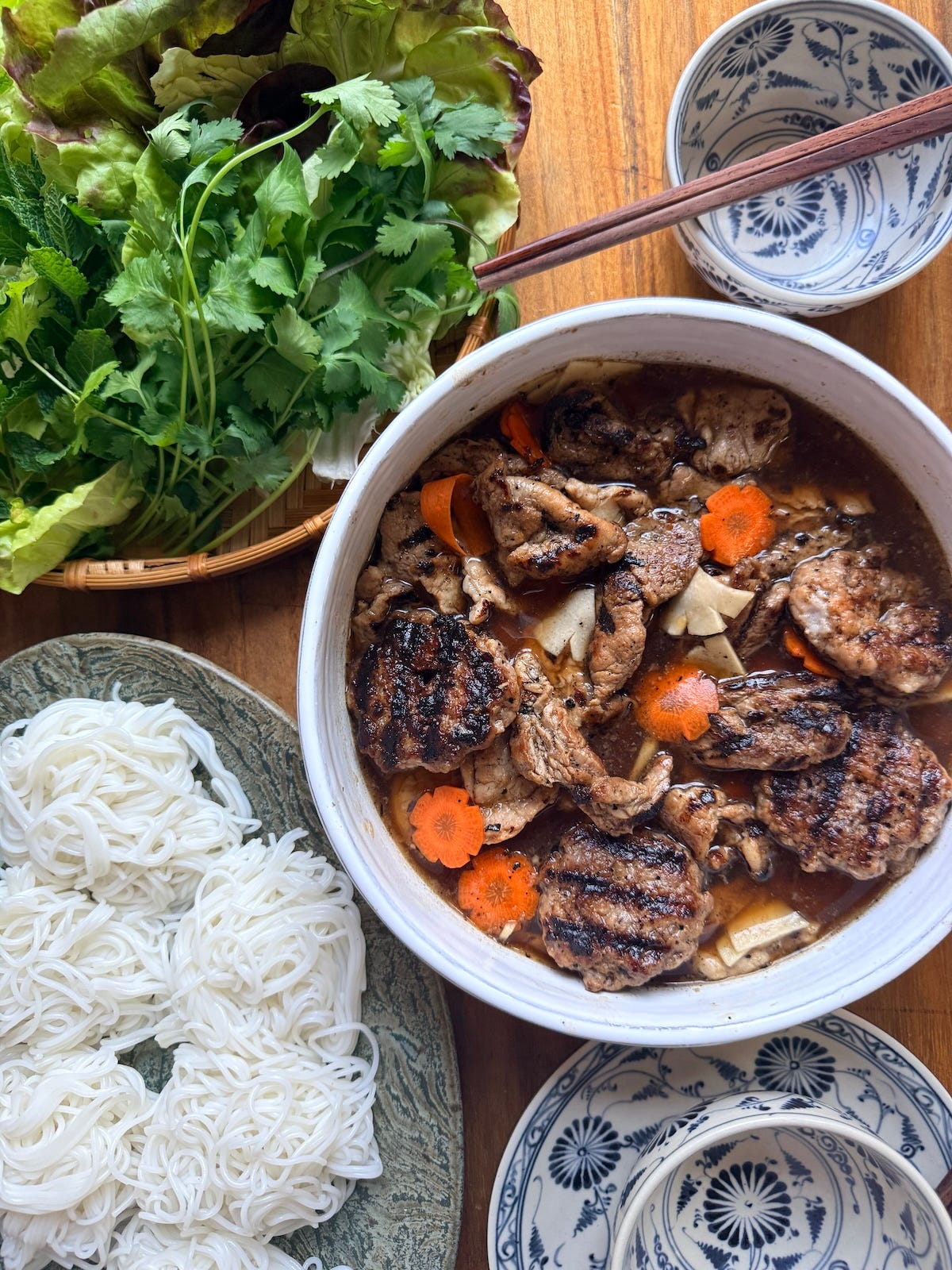
Vietnamese food doesn’t have to be complicated. In fact, the greatest dishes are ones that taste fantastic but feature minimal ingredients. There’s technique involved but not too much as to make the dish undoable by mere mortal cooks. Bún chả, the Hanoi-style rice noodle dish served with grilled pork that’s cooked two ways, to be among those great dishes. It’s simple and brilliant.
I know what you’re thinking. You’ve eaten Vietnamese grilled pork rice noodles bowls labeled “bún thịt nướng” on restaurant menus. You’ve doused it with plenty of nuoc cham. Maybe you’ve also made the salad-y rice noodle dish at home. What’s different about bún chả?
Compared to southern-Vietnamese (Saigon) bún thịt nướng, bún chả uses similar but fewer ingredients but it tastes more luxe and extra umami. Two cuts of pork are used – sliced fatty pork and pork patties, for you to experience different textures and flavors. The meat is juicy and seasoned by a savory sweet marinade, reflecting northern (Hanoi) flavor preferences. Sweet-savory flavors are what you typically taste in southern-style bún bowls.
Northern cooks cleverly craft bún chả’s sauce as an extra umami, delicious veil of flavor on everything that it touches. Despite similar ingredients as a southern bowl of bún thịt nướng, a meal of northern bún chả offers more nuance and depth.
Bún chả also has class. It’s eaten in a languid manner. When traditionally served, the components are served separately for diners to compose smallish bowls of greens, noodles, and grilled pork. Because there’s a certain formality involved, bún chả can be a celebratory one-dish meal or main feature of a complex party menu. In contrast, Saigon-style bún bowls are considered a casual one-and-done dish that you can eat on the run.
A bún chả meal invites lingering and coaxes conversation too. It’s the dish that Barack Obama and Anthony Bourdain shared in Hanoi in 2016.
If you venture to Bún Chả Hương Liên in Hanoi where they ate, you can’t sit at their table because it’s enshrined in plexiglass, I hear. However, you can order the “Obama Special”.
But to be honest, the version Obama and Bourdain ate doesn’t look fabulous: the meat hasn’t gotten the caramelized bits of char that comes from careful cooking and a good marinade. And, in Hanoi there’s a modern convenient method of eating bún chả in a big bowl with lots of soupy sauce (there are fewer dishes to set and wash for the restaurant operator!) However, the sauce is diluted and strangely bland. It’s not what I grew up with or read about in old Vietnamese cookbooks. You can do better!
In fact, you can make bún chả (pronounced “boon chahh”) with supermarket ingredients, if you want! Today’s dispatch equips you with the following for a most excellent bún chả adventure:
Explainer on how to achieve brilliant bún chả
Bún chả recipe in full text and as a downloadable PDF
Scalable marinade chart and recipe for you to serve 2 or 10!
Swaps and advance prep suggestions to fit bún chả into your life
Lots of prep tips and ingredient pointers
Video for noodle prep that you can (and should) use elsewhere to make solid Viet food!
Time to get bún chả-ing.
Pass the Fish Sauce is a 💯 reader-supported! Support it any way you can. Become a paid subscriber to enjoy The Full Monty of this recipe along with others in the past and future dispatches, plus other perks! 🙏
Forget canned biscuits. This monkey bread is made with fluffy milk bread dough—real ingredients, perfectly sweet, and the only version you need! What Is Monkey Bread? Monkey bread is a sweet, pull-apart bread made from small pieces of dough rolled in butter, sugar, and cinnamon, then baked together in a bundt pan. The result is […]
Since leaving Korea and living abroad for many years, I’ve come across a few fish that were unfamiliar to me when I lived in Korea. Two of them are whiting and branzino, and I found that they can be especially delicious when cooked with Korean flavors. In a previous recipe, I used whiting to make […]
I’ve yet to fully acclimate to daylight savings time. Have you? If anyone has tips for how to adjust smoothly, please share them! I haven’t gotten a decent good night’s sleep since the time change. I initially blamed it on post-menopause but Rory said that he also had not slept well since we had to move our clocks forward. We know it will pass.
Meantime, Vietnam does not adhere to daylight savings time. My brother, Dan, is vacationing there right now and this morning (his late night), he sent this video of a Hanoi bánh cuốn rice roll vendor:
That is the old school method. It’s tricky and you have to make the rice batter just right and have a special pot rigged up for steaming the batter. The egg is a novelty filling from northeastern Vietnam. Typically, the filling is pork and mushroom, or veggie. My workaround is a much easier rice paper hack published in my book, Ever-Green Vietnamese(see page 77); my mom hailed that bánh cuốn recipe as a game changer.
It’s been a while since I’ve posted Midweek Gems and I’ve been collecting some fun things for your consideration.
💎 Meet me at Viet Book Fest!
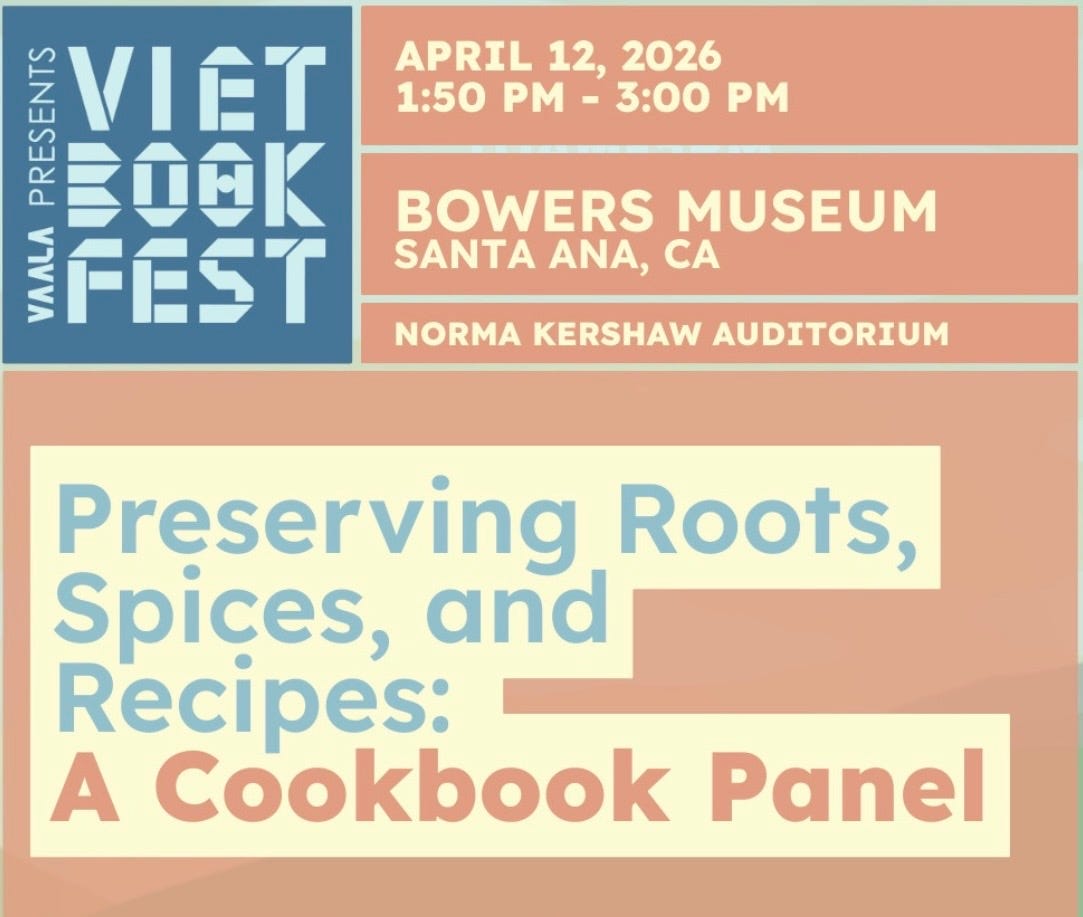
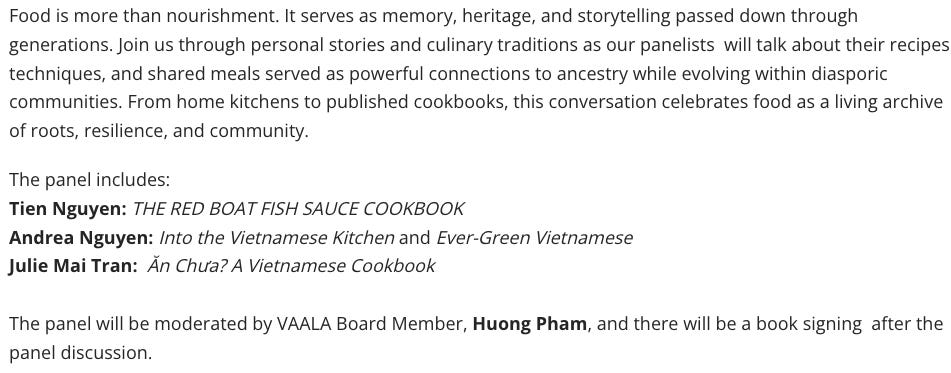
Twenty years ago when I wrote my first book, Into the Vietnamese Kitchen, no one organized Vietnamese American authors. That’s drastically changed, thanks to a younger crop of authors and events like the annual Viet Book Fest in Santa Ana, California. I’ll be speaking on this afternoon panel:
Knowing my fellow authors, it will be a spicy conversation. Join us if you’re nearby.
Speaking of Asian American heritage, many of us were introduced to Chinese food through mom-and-pop restaurants serving up Cantonese dishes. Those spots fed us quickly, affordably, and deliciously yet they often are unnoticed and under appreciated.
This year, the James Beard Foundation announced that it is awarding an American Classic award to Eng’s, a 99-year-old Chinese American restaurant in Kingston, a small town in upstate New York.
What is a Beard Classic award about? It is given to longstanding, beloved restaurants that have enhanced their communities. The restaurant business is hard and longevity is rare. If you last for decades, you deserve a medal, at the least.
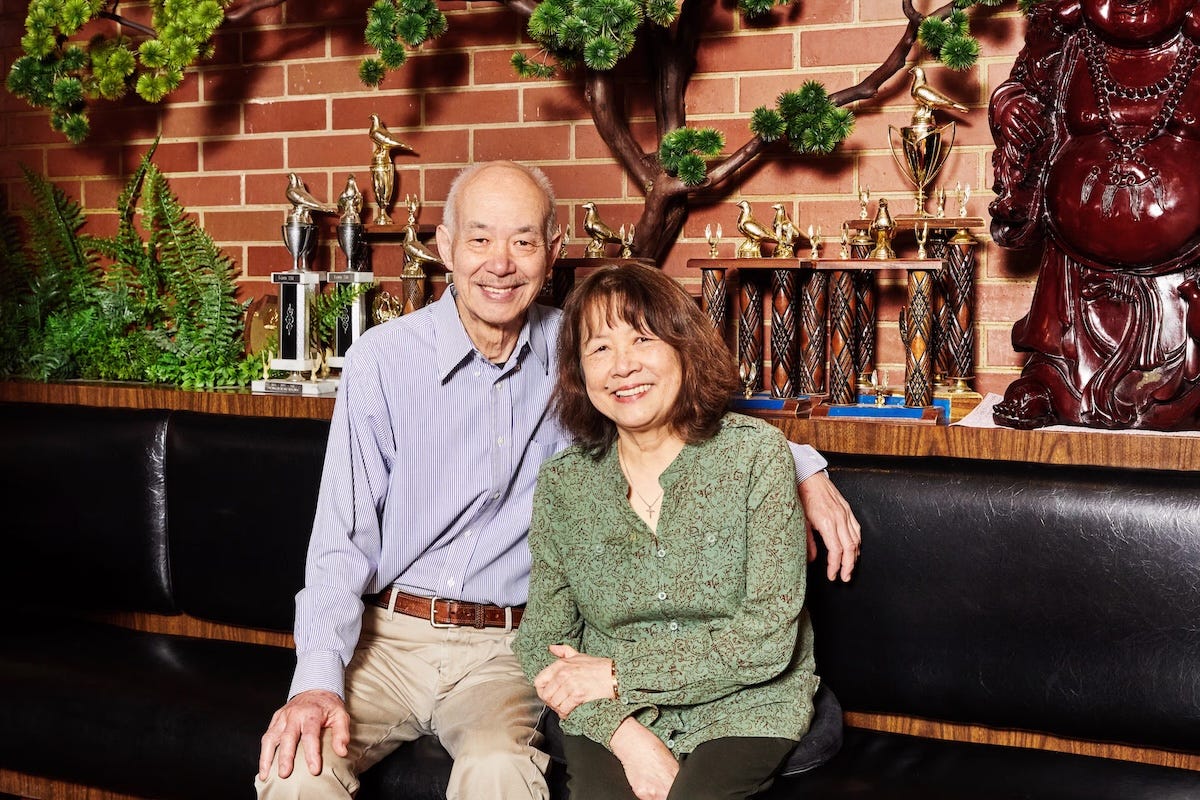
Operating since 1927, Eng’s was Kingtson’s first Chinese restaurant. Over the years, it has moved and expanded locations and is currently owned and operated by Tom and Faye Sit. They are the parents of a friend of mine, Jennifer Sit.
Tom and Faye Sit of Eng’s. They look fit and youthful for folks who’ve been in the business for over 50 years. Source: James Beard Foundation.
Jennifer is one of the best cookbook editors around. But she still has time now and then to put in a shift at Eng’s to help with the dinner rush for dine-in and takeout orders. Her parents are aged but they remain engaged with the business, she’s told me.
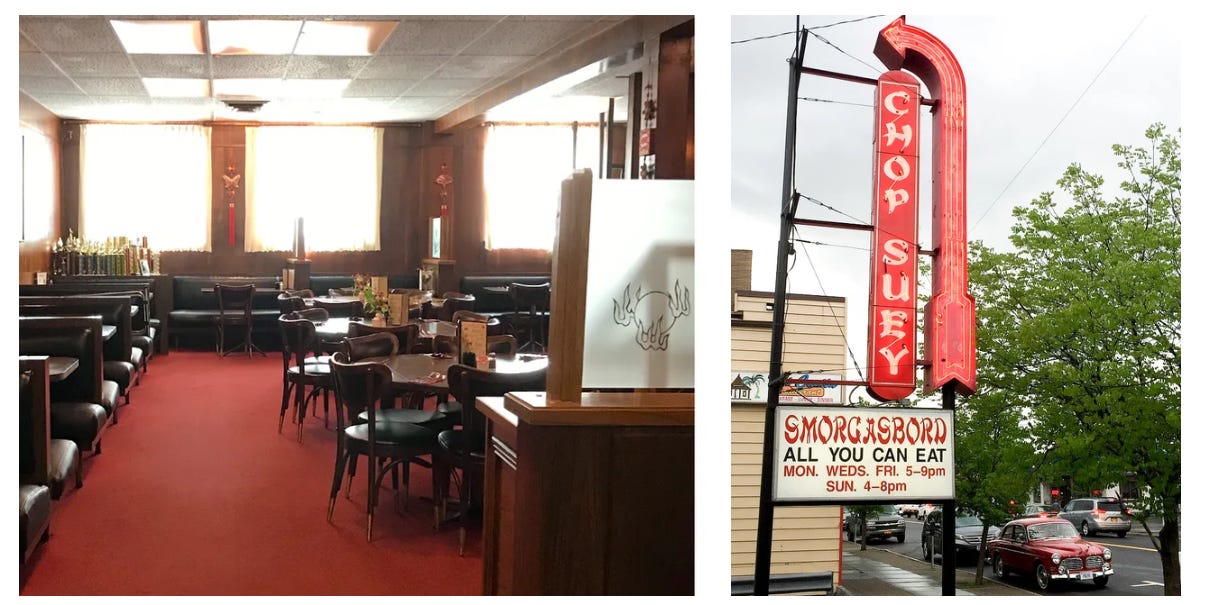
Eng’s restored midcentury dining room, “smorgasbord” buffet, and signage harken back to a different era. There’s even live music nowadays to draw diners in for sit-down meals. Source: Eng’s restaurant.
What makes a Chinese American classic menu? So many things. For instance,Eng’s menu includes a pu pu platter and tropical chicken on skewers. There are also Cantonese sub gum stir-fries, which feature a main protein supported by a colorful melange of other ingredients. “Sub gum” is similar to the Vietnamese notion of thập cẩm (a well-curated assortment of flavors, textures and color). On modern Chinese restaurants menus, subgum has been replaced by phrasing like “chicken and mixed vegetable stir-fry'“ which lacks pizzazz.
Seeing Eng’s get the national spotlight warmed my heart so much. There are countless restaurants like it all over the country. They make a difference in their communities by keeping flavors and traditions alive.
Read more about Tom Sit from the Beard Foundation’s awards page and check out Eng’s Restaurant if you’re in the area!
💎 What is a combi oven?
Many of you have expressed interest in multi-use compact kitchen appliances. I’ve been thinking about combi ovens because some of my chef friends adore how they cook with steam (wet) and conventional (dry) heat, or both. Professional combis are expensive but Ninja makes a good, affordable unit for home use. Last week, I purchased one and have been playing with it. There are fourteen (14!) functions so my evaluations will take time.
This combi oven is quirky but it shows promise. I’m impressed after a week, though Rory is on the fence. I like the baking and air-frying functions, thus far. I just wrote up my preliminary experiences and made a couple short videos to show you how the combi oven works. Learn more about the combi oven and weigh in at the website.
Support Pass the Fish Sauce! Join us as a free or upgrade to a become a paid subscriber to enjoy 125+ professionally developed recipes, seed new content, and get future class discounts. Thanks for your enthusiasm!
I hope you’ve been thinking about nước chấm since last weekend. Coming this Sunday is something to enjoy with your Viet dipping sauce!
These tiny homemade bread crumbs can make a big impact on your meal! They’re the perfect crisp finishing touch on casseroles, salads and more. Follow this recipe to make regular golden bread crumbs, or add the optional seasonings and your kitchen will smell like the best Italian restaurant.
This simple recipe is far more flavorful than store-bought options, and keeps well for months. Use your bread of choice, whether it’s your favorite crusty sourdough or whole wheat sandwich bread. If you have leftover bread that’s turning stale, turn it into bread crumbs to save it for later (or croutons or French toast)!
I don’t always love blue cheese, but I love this blue cheese dressing. It’s a great introduction to blue cheese if you’ve been hesitant to try it, and a guaranteed winner if you love it. You can use mild cheese, as I prefer, or a more intense blue cheese for a bolder dressing.
This blue cheese dressing recipe is creamy but not too heavy, nicely tangy, and tastes like the best restaurant versions, thanks to the fresh chives and garlic. It’s similar to my Easy Blue Cheese Dip, but ready to drizzle over greens.
Salads are my specialty, and my collection of dressings was incomplete without this classic. It’s so much better than store-bought!
Pretending to be French, before I actually became French.
The food world has been ablaze accusations made by former employees of Noma restaurant in Copenhagen against chef René Redzepi, who is “stepping away” from his position leading the restaurant. Many of us had heard about them for nearly a decade, and while some people have been saying that if the employees were so disgruntled, they should have said something, anyone who’s been bullied, or seen someone being bullied, knows that if you don’t keep your mouth shut, you may be next.
Inspired by a recent trip to China, this recipe for Chinese eggs with soy bean sauce is a quick, easy midweek dinner that’s savory and super tasty! Eggs for Dinner Eggs are a great, relatively low-cost source of protein that Chinese families often turn to for last-minute meals. Because they cook so quickly, you can […]
Phew! We sent Cooking Thai to print this week. Like I usually do, I kissed the last review copy and hit “send”; this time I was wearing red lipstick. It’ll be fabulous to soon have chef Pim’s brilliant recipes and techniques out for you all to use. The release date is August 25, 2026.
So, after what do I do after a lengthy stretch of nearly non-stop work? I spent time in my garden, then cooked and played in my kitchen to spark my brain to be extra curious and creative. I bought a new toy — the Ninja combi steam oven, and have been test driving it. The small appliance has 16 different functions! Yeah, it steams up when it cooks but for good reasons. As I progress in trying it out, I’ll report my experiences via the website.
I also made bún rice noodle salad bowls with grilled pork skewers and shrimp. It’s the cover recipe from Vietnamese Food Any Day (see page 197). It’s healthy, fresh, and versatile. I let the skewered meat marinate overnight and it got more tender. The shrimp were grilled shell-on for flavor; we peeled them at the table before diving in. Yes, those are Trader Joe’s fried shallots and roasted peanuts on top, excellent time savers.
Making the bún bowls got me thinking and then rethinking how to make nước chấm well. I’ve been making it for nearly forty-five years, since about the time I was in junior high school. Out of the blue one day my mom assigned me to do it. She likely said something like, “Mẹ cần con pha nước chấm,” which roughly means “I need you to make the dipping sauce”.
I knew the ingredients but there was little guidance. I don’t know if it was a rite of passage for a Viet girl or a test. But seeing as how my mom was put in charge of overseeing her family’s cooks when she was a tween, she likely looked at me and figured that the least that I could do is make rice and the dipping sauce — two fundamental Vietnamese foods that can make or break a meal. She’d already taught me to use the rice cooker so it was my time to pha nước chấm.
In Vietnamese, the word pha means to formulate, mix, prepare, or to make. I messed up so much at first because I was just randomly mixing stuff together — lime juice, sugar, water, and fish sauce. It did not always taste good but my family always kindly gave me a pass.
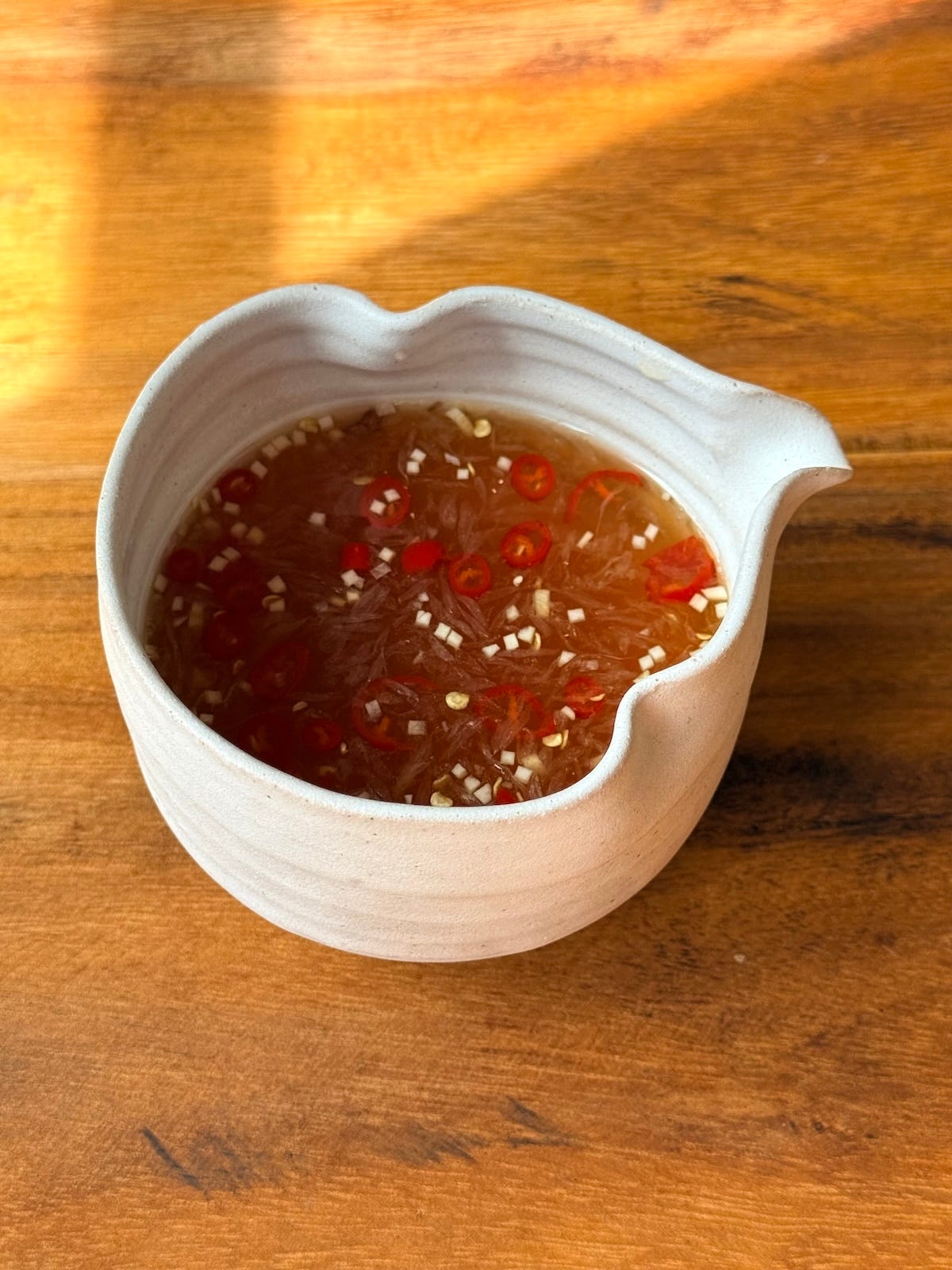
Nước chấm(pronounced “nook chahm”) defines the final flavors of countless Vietnamese snacks, salads, lettuce and rice paper wraps, noodle bowls, and rice plates. Even when the table sauce wasn’t officially part of dish, it’s an unspoken truth in Vietnamese cooking that the amber sauce is magical. It can transform mundane ingredients, making them say, “I’m Vietnamese!”
Drizzle, dunk or toss simply fried, grilled, steamed, boiled, or raw foods in nước chấm and they instantly taste special in a Viet-ish way.
If nước chấm is so tricky to make, can’t you just buy it? It’s silly to buy bottled premade sauce, labeled as “nước mắm pha sẵn”, sold at hardcore Viet markets. Who knows how old that stuff is? Who knows what kind of ingredients were used? And, what if you want to make it low sugar, low sodium, or vegan?What if you don’t have citrus around? What if you wanted to keep it for days?Why let someone else determine how your food tastes? The bottle is likely worth more than its contents. Seriously.
A word on words — nước chấm vs. nước mắm
Though the official name of the sauce is nước chấm (literally dipping sauce), Viet speakers often use the shorthand, “nước mắm” to mean nước chấm. Nước mắm on its own means fish sauce but in the context of “nước mắm pha” or “pha nước mắm”, the phrase signals that fish sauce has been diluted, seasoned, and formulated to serve as a table sauce to accentuate other foods.
You’re safest to say nước chấmto a Viet speaker so they are clear that you’re talking about the dipping sauce; reserve nước mắm for discussing fish sauce. However, if you hear someone talking about nước mắm, they may be talking about the pure condiment or the dipping sauce.
Over the years, I’ve made nuoc cham (let’s omit diacritics from here on in so I can type faster 😄) many ways and talked to others how they finesse theirs. I’ve futzed and finessed it to make it on a whim and have written recipes for it. I’ve got tricks and tips to share with you in this dispatch, which includes:
Three recipes in text plus downloadable PDF for:
Classic nuoc cham
Make-ahead nuoc cham
Vegan nuoc cham hack
A thorough break down of ingredients so you understand how each functions, how to choose them wisely, how to troubleshoot, plus how to get creative!
To borrow from the Home Depot’s slogan: You can do it. I can help.
Pass the Fish Sauce is a 💯 reader-supported! Support it any way you can. Become a paid subscriber to enjoy The Full Monty of this post along with many others plus other perks! 🙏
I was in Paris* last week — no, I cannot believe I get to utter sentences like that so casually, either, pinch me — and it was really, truly, and surprisingly spring. The magnolia trees at the Jardin du Palais Royal supplied us with a lace curtain of fluttering pink shadows, the daffodils and hyacinth were popping up from the ground like they’d missed us, and everyone was outside and stayed out until after midnight and this energy climbed inside me, evicted all of the seasonal malaise (turned out I was just cold!), and I did my best to bring all of this warmth and joy back to NYC with me. And despite the fact that my grouchy (sorry, “weathered”) friends tried to warn me that we were experiencing a “false spring” and “don’t fall for it,” la la la, I said, it is spring in my heart now — and in my kitchen, and busted out a warm weather salad. Which is to say: I’m sorry, this sudden cold spell might be my fault.
This turkey sausage recipe has the perfect balanced seasoning you want in a breakfast sausage—making it flavorful as well as healthy. Leaner than pork sausage and made with real ingredients, homemade turkey sausage is a great way to get healthy protein in the morning! Making Homemade Turkey Sausage is Crazy Easy There are a handful […]
If you’ve enjoyed the egg bites at Starbucks, here’s how to make them at home! These egg bites have become a staple recipe in my kitchen. Sure, they’re not the prettiest egg recipe, but they’re wonderfully flavorful and silky tender. They’re a protein-rich snack or ready-made breakfast to keep in your refrigerator (they freeze and defrost well, too).
These egg bites are a fun cooking project with a few twists along the way. I was surprised to find cottage cheese in Starbucks’ ingredient list. It’s the secret ingredient that offers a lovely tang and extra protein. Once blended, the lumpy texture disappears, which explains why I’d never guess it was there.
Instead of Starbucks’ sous vide cooking method, we’ll bake the muffin tray on a rimmed baking sheet filled with a small amount of hot water. The steam from the water bath gives these bites a luscious, smooth texture. Without it, the eggs would brown at the bottom and taste more like frittata muffins. It’s a small detail that makes a big difference!
This time of year brings Seville oranges to the markets in Paris. For the past few years, I kept wondering why they were so hard to find since it’s perhaps my favorite of all jams and jellies to make, and eat. But lately, they’ve been everywhere. And I found myself busy making a lot of marmalade, which was easier since I came up with a brand-new, revolutionary technique which I couldn’t wait to share.
Since Seville oranges are rife with seeds, which makes slicing them difficult since you have to keep moving the seeds around with your slippery fingers, while trying to cut the oranges, then finding more, and fishing around deeper inside to extract more, plucking them out, etc… Each Seville orange has perhaps twenty to thirty inside.
So I thought, what if I was to squeeze the juice and seeds out first, strain them, then pour the juice back in? The seeds are precious commodities in jam-making, and get saved and used since they’re so high in pectin.
They’re wrapped in a sack and cooked with the marmalade giving the marmalade gets a suave, jellied texture. And this simple method, featured in my book Ready for Dessert, makes the whole process much easier.
You might be interested to know that Seville Orange Marmalade was created because of an error. Apparently, an Englishwoman in 1700, the wife of a grocer, was stuck with some sour oranges that were bought cheaply from a boat that was carrying them from Seville.
Since there was a storm, they wanted to get rid of their stock or oranges quickly, so the grocer bought them. But they were inedibly sour so his wife decided to try making jam from them, and viola!…Seville Orange Marmalade was invented.
Adapted from Ready for Dessert (Ten Speed) In my book, I advise letting the cooked oranges and the seeds rest overnight. That's an optional step. If you want to go ahead and finish the marmalade the same day you start it, you can.
Course Breakfast
Keyword confiture, jam, marmalade, orange
Ingredients
6Seville oranges(see Note)
1navel orange
10cups (2.5L)water
pinchof salt
8cups (1.6 kg)sugar
1tablespoonScotch(optional)
Instructions
Wash oranges and wipe them dry. Cut each Seville orange in half, crosswise around the equator. Set a non-reactive mesh strainer over a bowl and squeeze the orange halves to remove the seeds, assisting with your fingers to remove any stubborn ones tucked deep within.
Tie the seeds up in cheesecloth or muslin very securely.
Cut each rind into 3 pieces and use a sharp chef’s knife to cut the rinds into slices or cubes as thin as possible. Each piece shouldn’t be too large (no more than a centimeter, or 1/3-inch in length.) Cut the navel orange into similar-sized pieces.
In a large (10-12 quart/liter) stockpot, add the orange slices, seed pouch, water, and salt, as well as the juice from the Seville oranges from step #1. Bring to a boil, then reduce to a simmer, and cook until the peels are translucent, about 20 to 30 minutes. (At this point, sometimes I’ll remove it from the heat after cooking them and let the mixture stand overnight, to help the seeds release any additional pectin. But it's not imperative.)
Stir the sugar into the mixture and bring the mixture to a full boil again, then reduce heat to a gentle boil. Stir occasionally while cooking to make sure it does not burn on the bottom. Midway during cooking, remove the seed pouch and discard.
Continue cooking until it has reached the jelling point, about 218ºF degrees (103ºC), if using a candy thermometer. I cook this slightly less than other jams and marmalades because the high amount of pectin helps the marmalade set up more stiffly. To test the marmalade, turn off the heat and put a small amount on a plate that has been chilled in the freezer and briefly return it to the freezer. Check it in a few minutes; it should be slightly jelled and will wrinkle just a bit when you slide your finger through it. If not, continue to cook until it is.
Remove from heat, then stir in the Scotch (if using), and ladle the mixture into clean jars. Sometimes I bury a piece of vanilla bean in each jar. (Which is a great way to recycle previously-used or dried-out vanilla beans.)
Notes
I don’t process my jams, since I store them in the refrigerator. But if you wish to preserve them by canning, you can read more about the process here.
Note: Sour or Seville oranges are called in French oranges amères and are available mid-winter in many other countries around the world as well.
I couldn’t resist bringing home all these cheeses. Could you?
When I moved to France and was doing food tours, at some point, a guest would inevitably ask, “Why did you move to France?” while we were in front of a bakery or a cheese shop. I wouldn’t say anything (which was unusual for me) but would just point at the magnificent pastries or cheeses in the window, and they’d get the message.
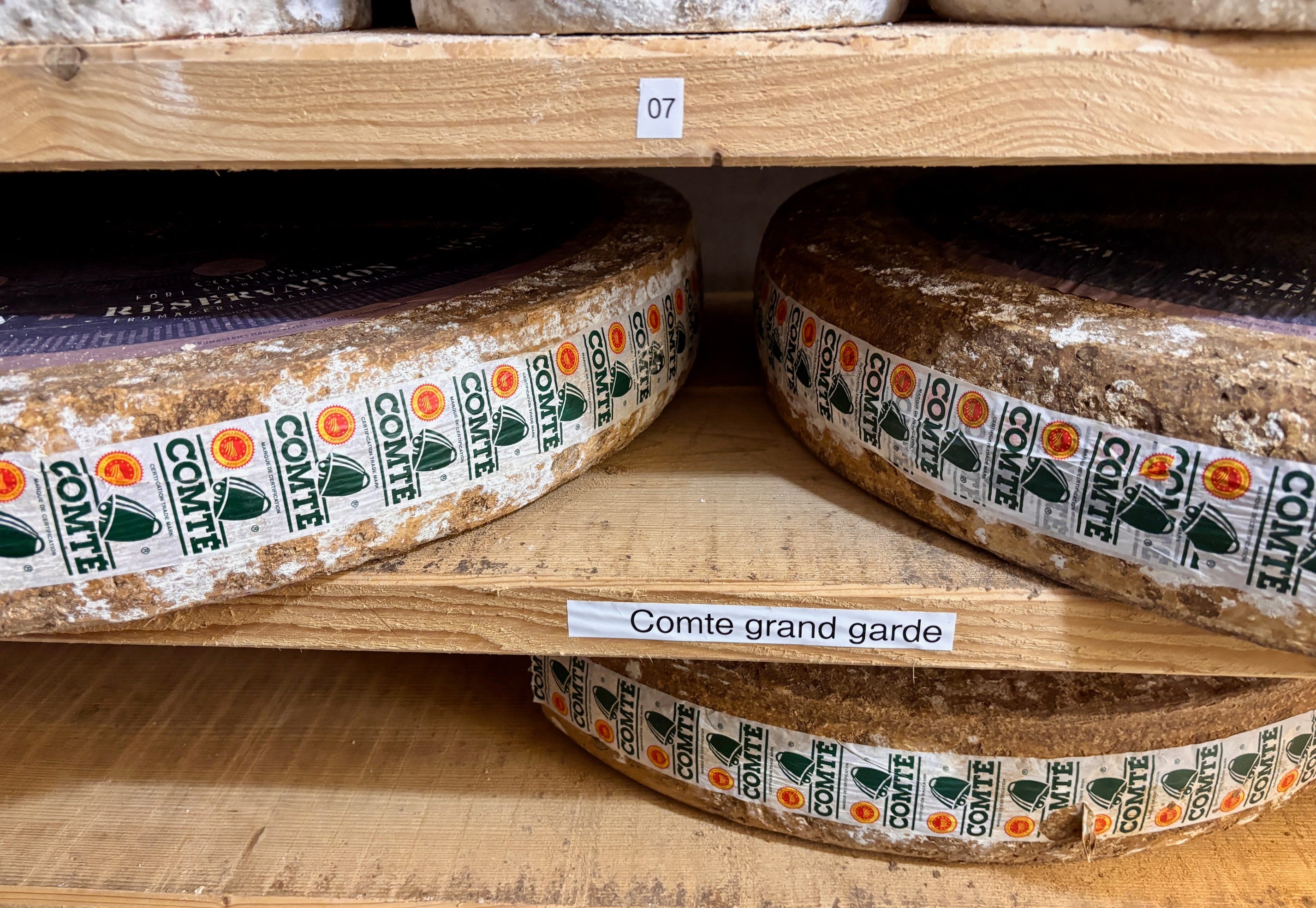
Also, nearly twenty years ago, during that same time in France, I was at a restaurant in the Champagne region and before dessert, was offered a plate of cheese that I still remember to this day. It was a Comté, aged for four years. The nutty, raw milk mountain cheese made in the French Alps is normally aged between 8 and 24 months. The longer a cheese is aged, the harder, drier, saltier, and sharper the cheese becomes, as it loses moisture.
When I visited the region, the fellows who made the cheeses told me they preferred the younger Comtés; they are smoother (doux) and milkier-tasting, which gave me a greater appreciation for younger cheeses, although I do like the concentrated flavors in a well-aged cheese.
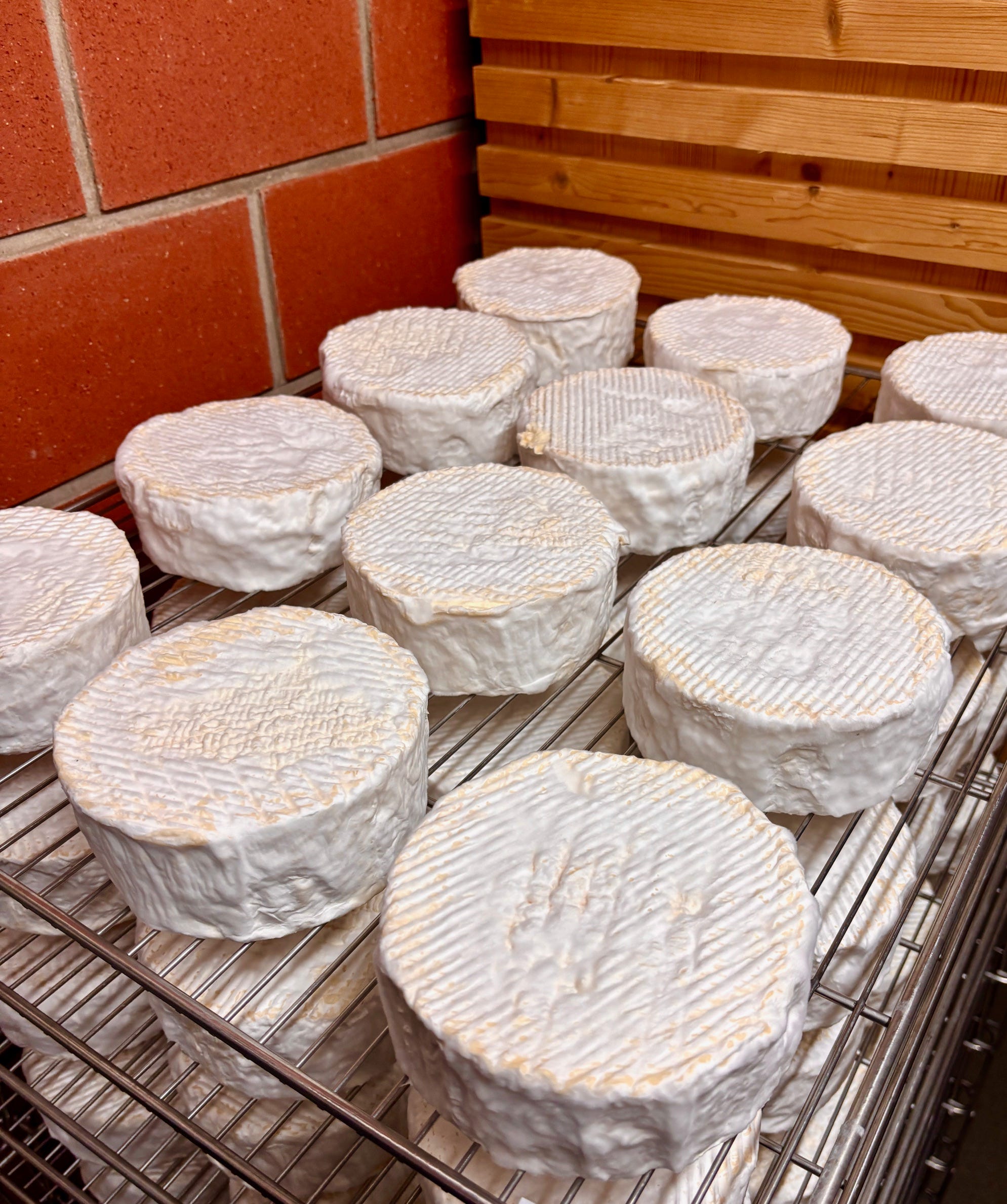
Camemberts de Normandie, one of France’s greatest cheeses.
As the years passed, I couldn’t stop thinking about the four-year-old Comté that was presented to me after dinner, served as lamelles, thin wisps stacked on a plate. The medium-dry shards of cheese, with notes of hazelnuts and grass, had little crackly bits in them and were a revelation.
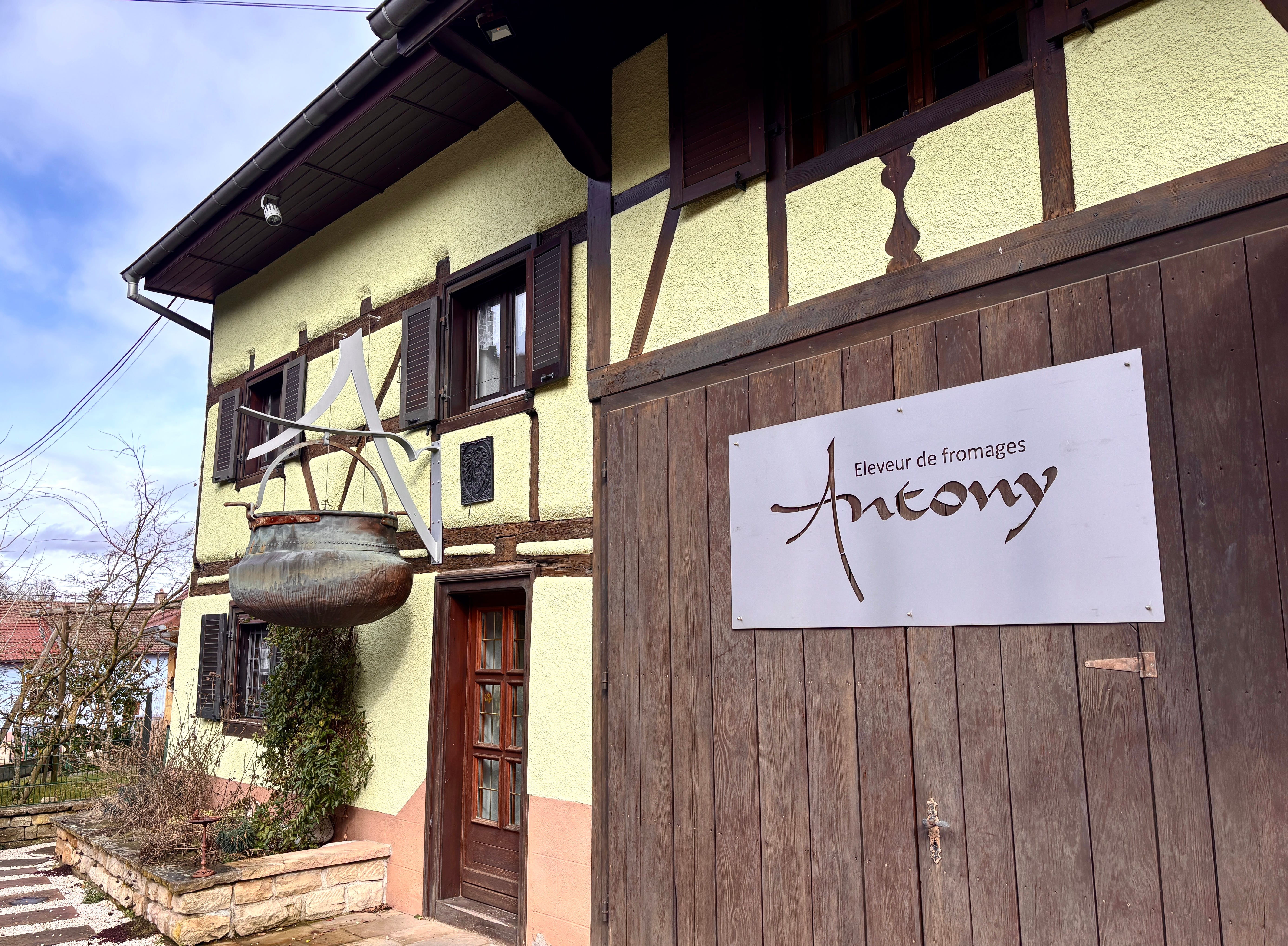
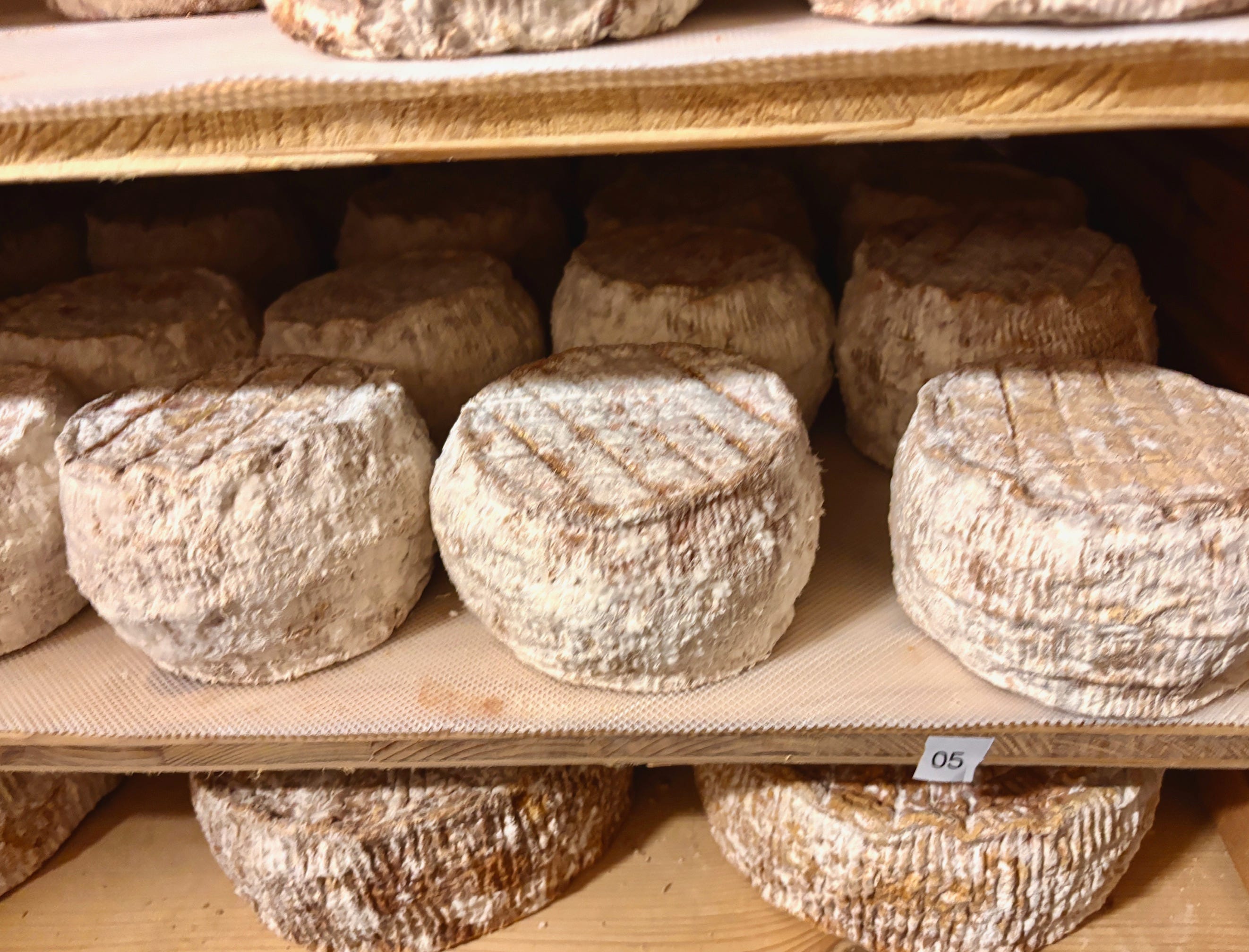
I was told that the amazing cheese was from an affineur (cheese ripener) named Bernard Antony, who was located in the small village of Vieux-Ferrette, in Alsace. As proof that good things come to those who wait, when an invitation arrived last month to visit his ripening caves and shop, it was a dream come true.
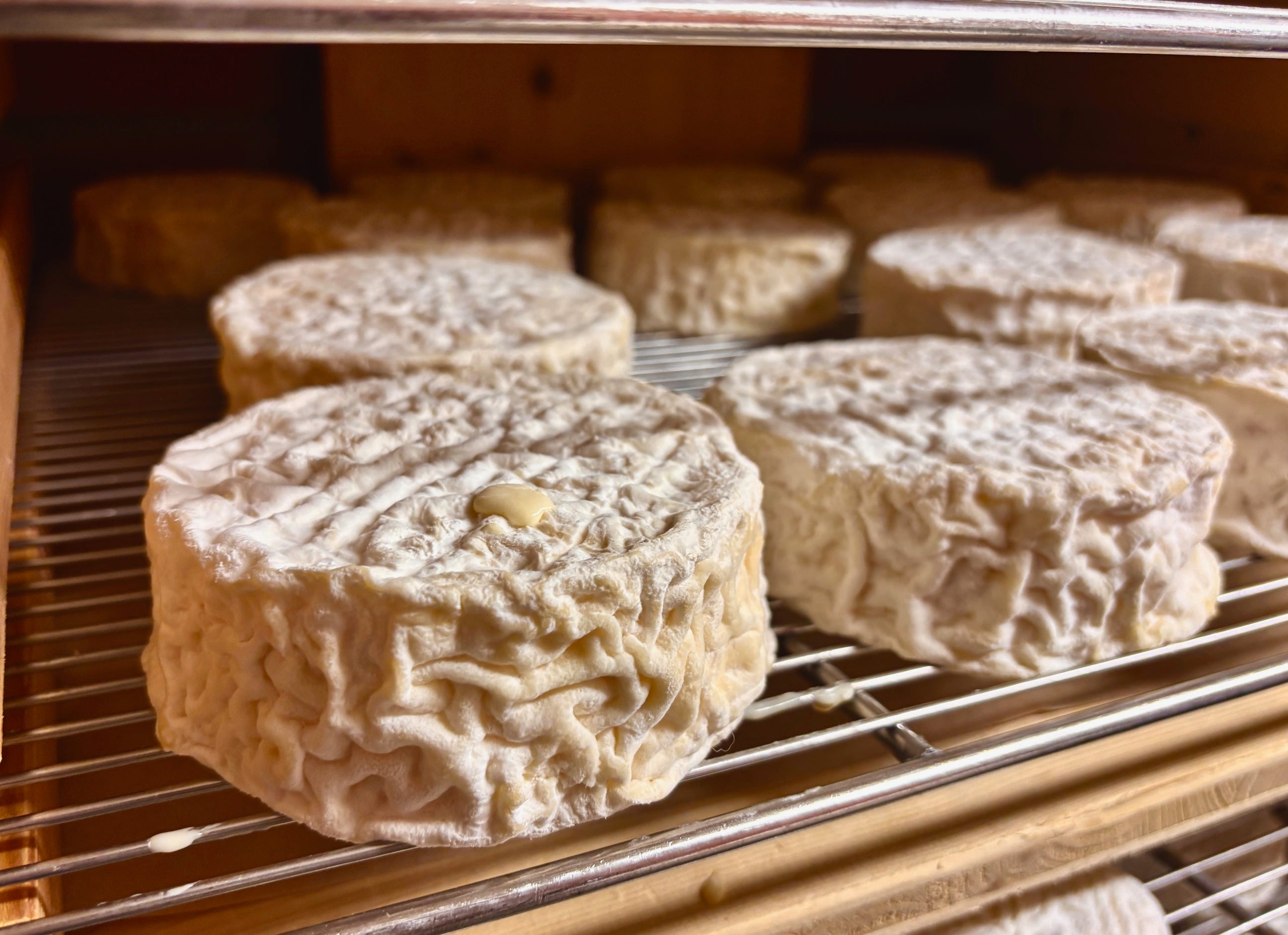
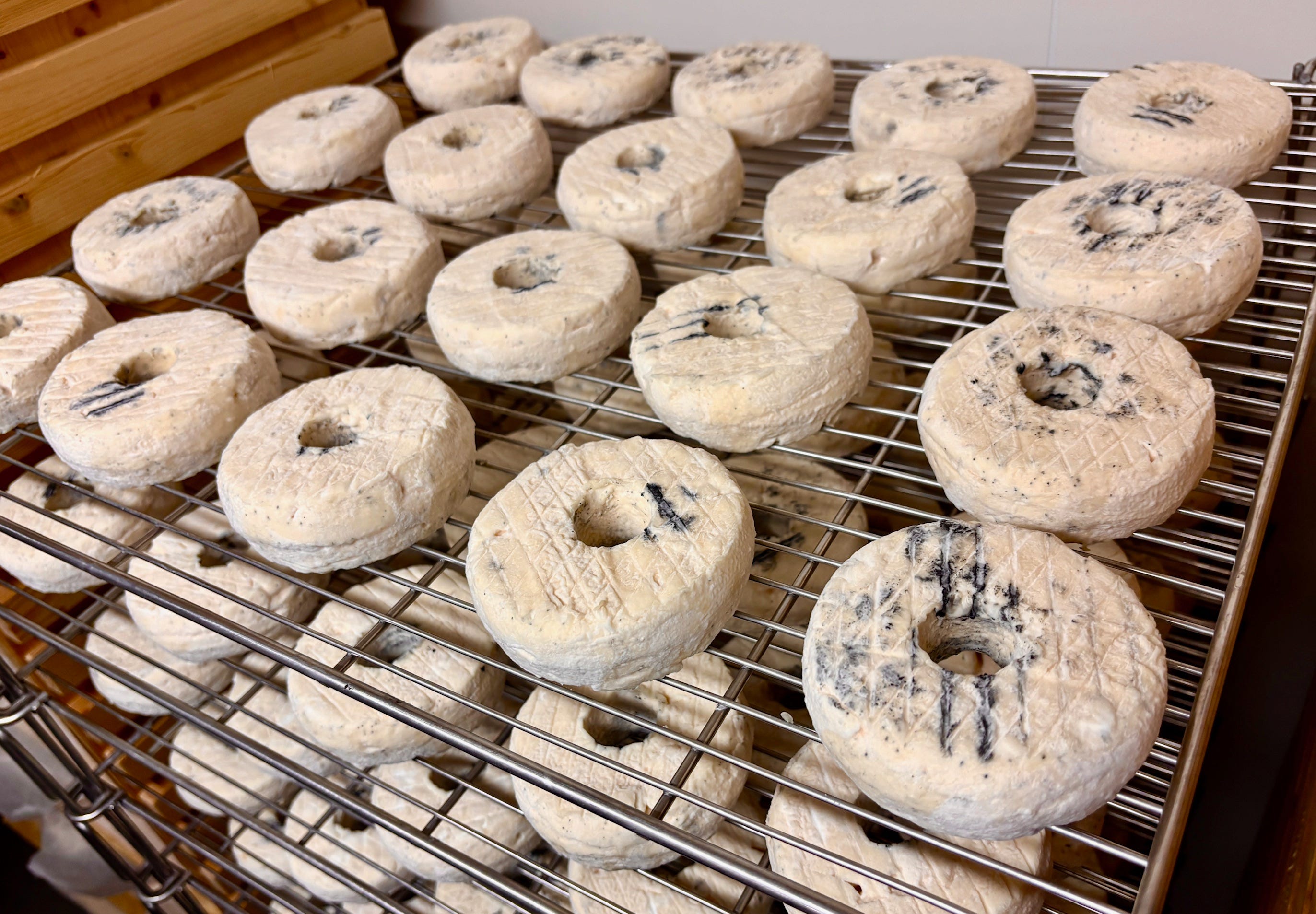
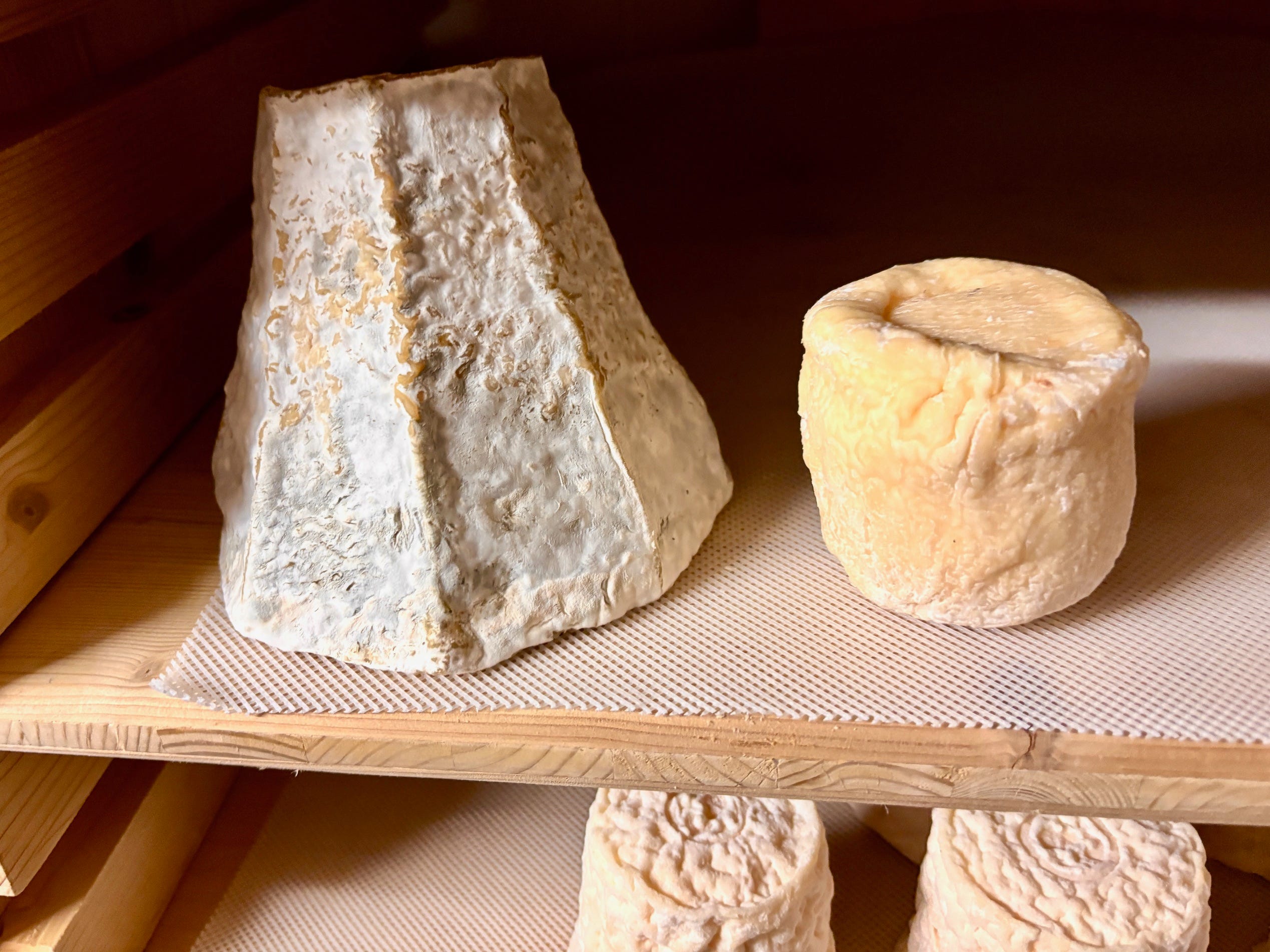
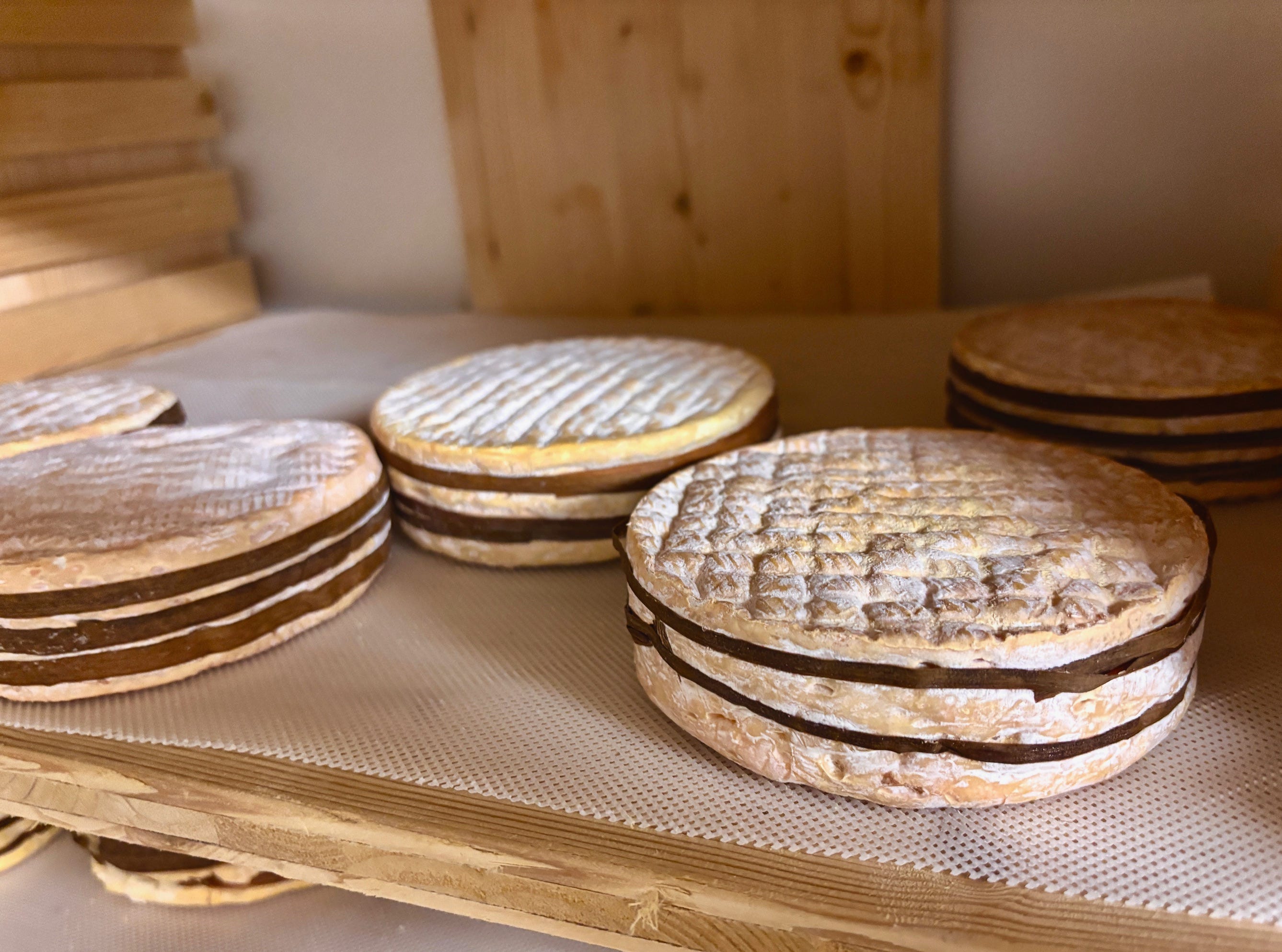
Brin d’Amour cheeses ripening.
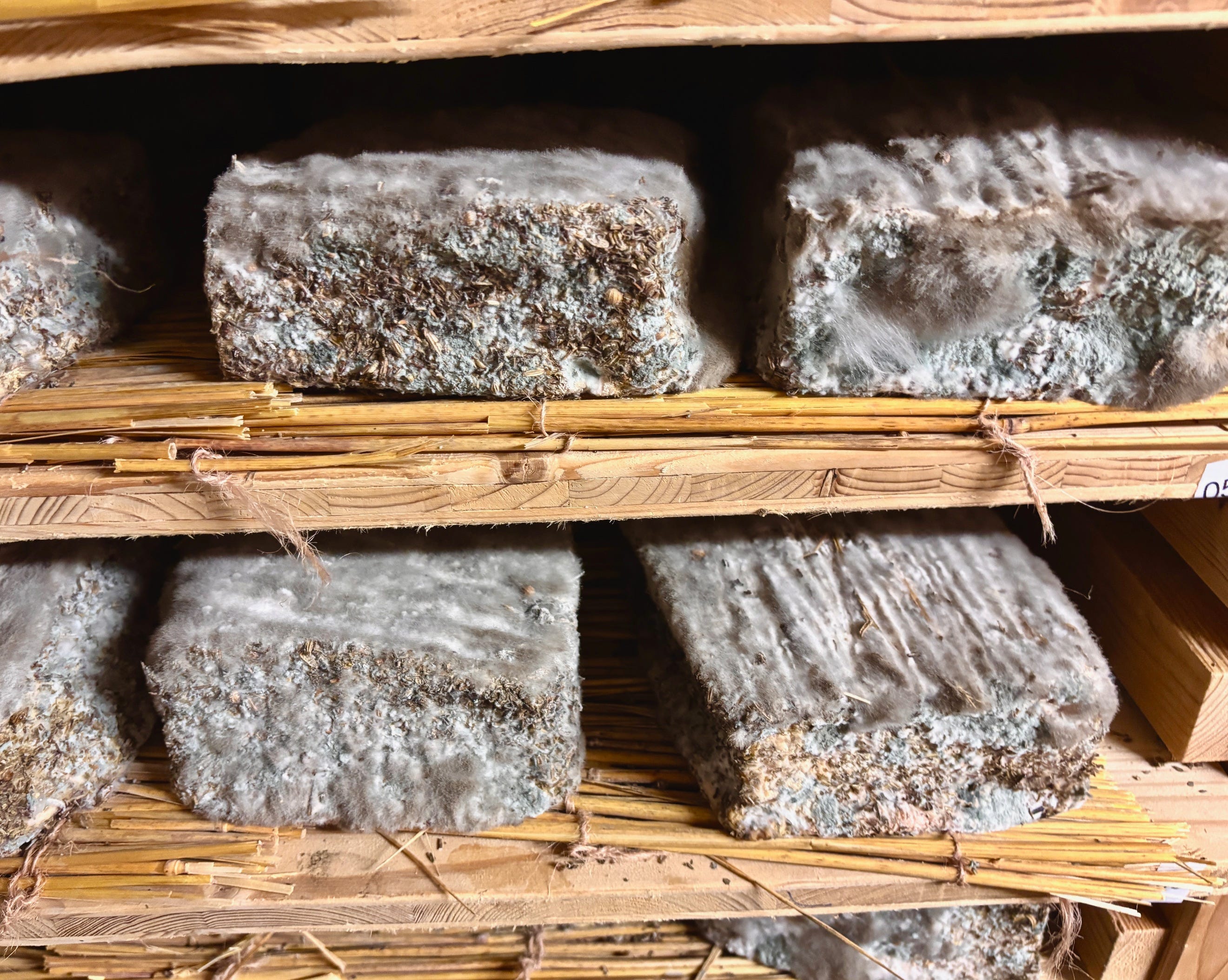
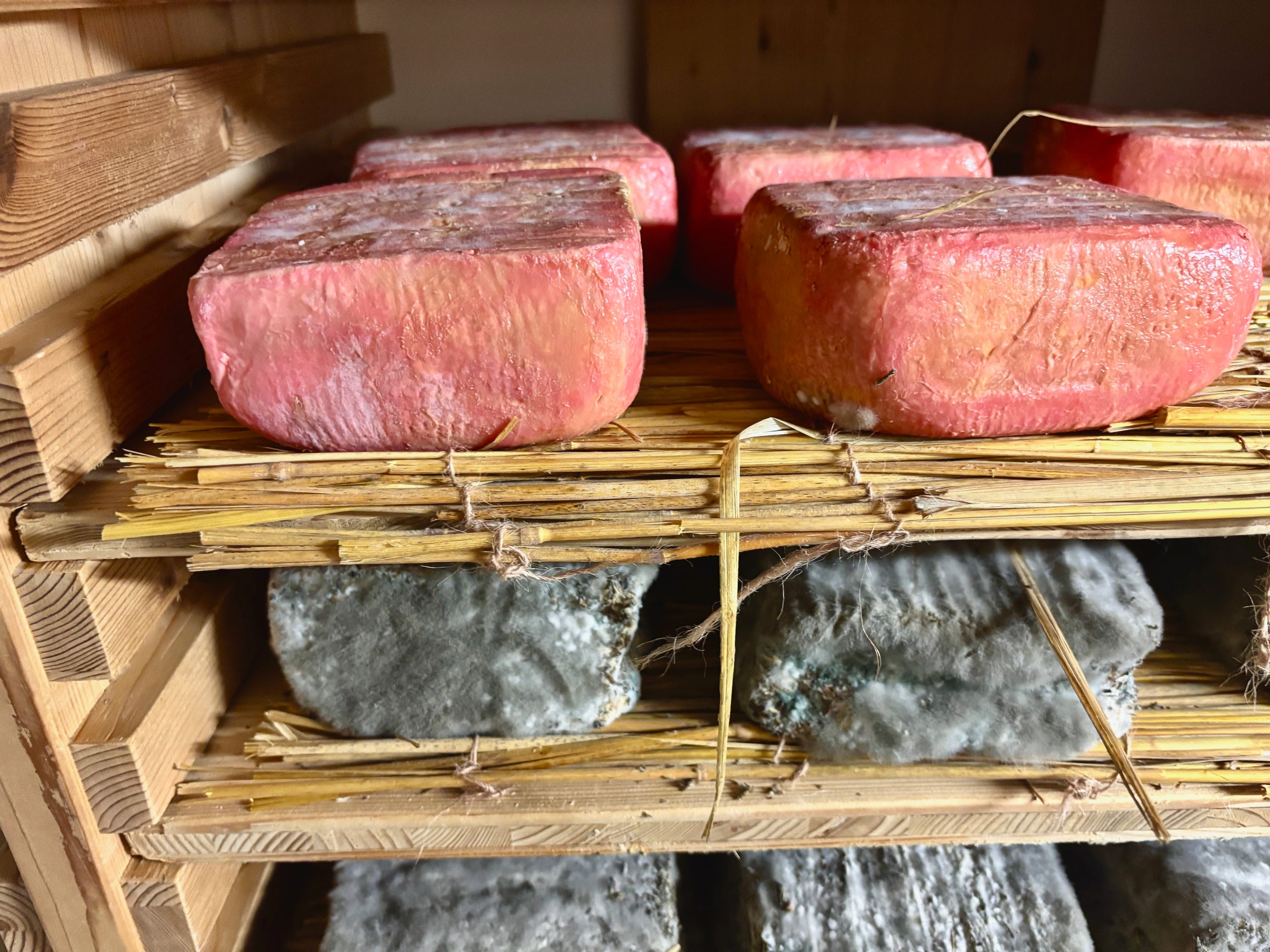
Cheese shops (fromageries) do their best to store cheese under proper conditions; some cheesemakers send their cheeses to affineurs, whose specialty is carefully ripening unfinished cheeses. They know exactly how each cheese needs to be treated, from the correct temperature and humidity levels in the caves, to what to brush or rub on the outside of the cheeses as they are ripening, and when.
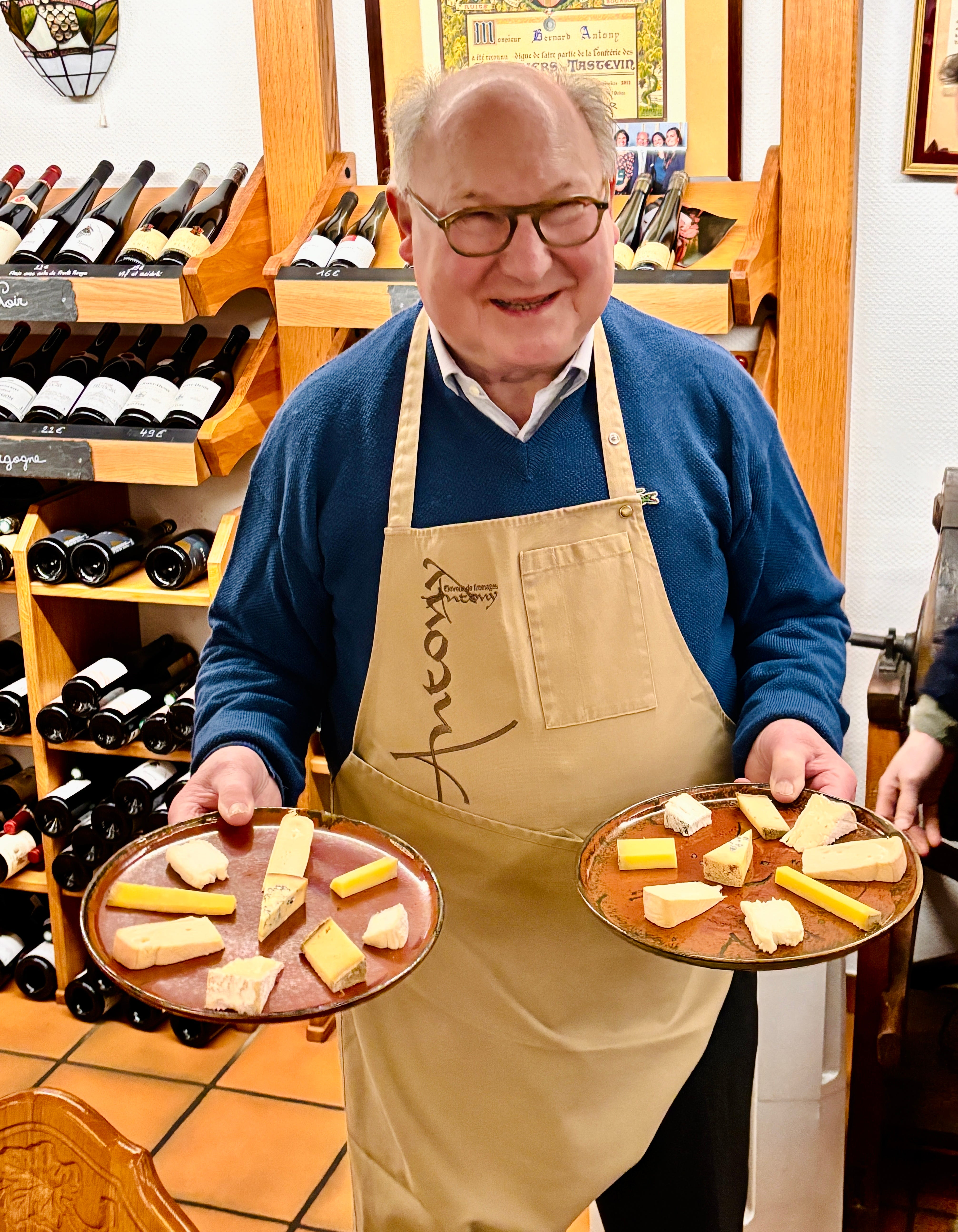
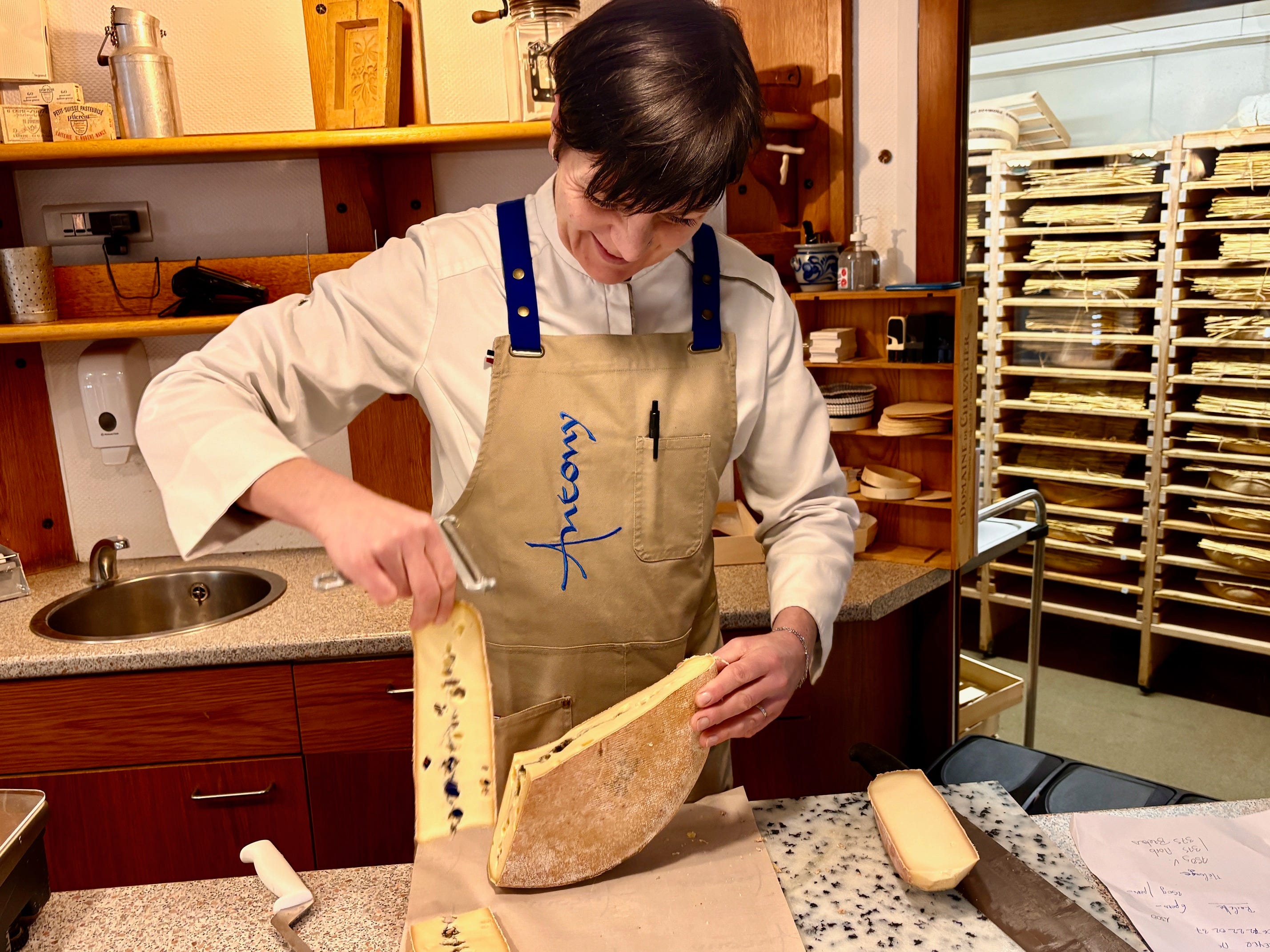
The jovial Monsieur Antony grew up in a family of farmers and started ripening cheeses in 1981 at his family farm, which is now his well-known shop and ripening caves.
This is still a local, family-owned business, and Monsieur Antony tends his six cheese cellars along with his son, Jean-François.
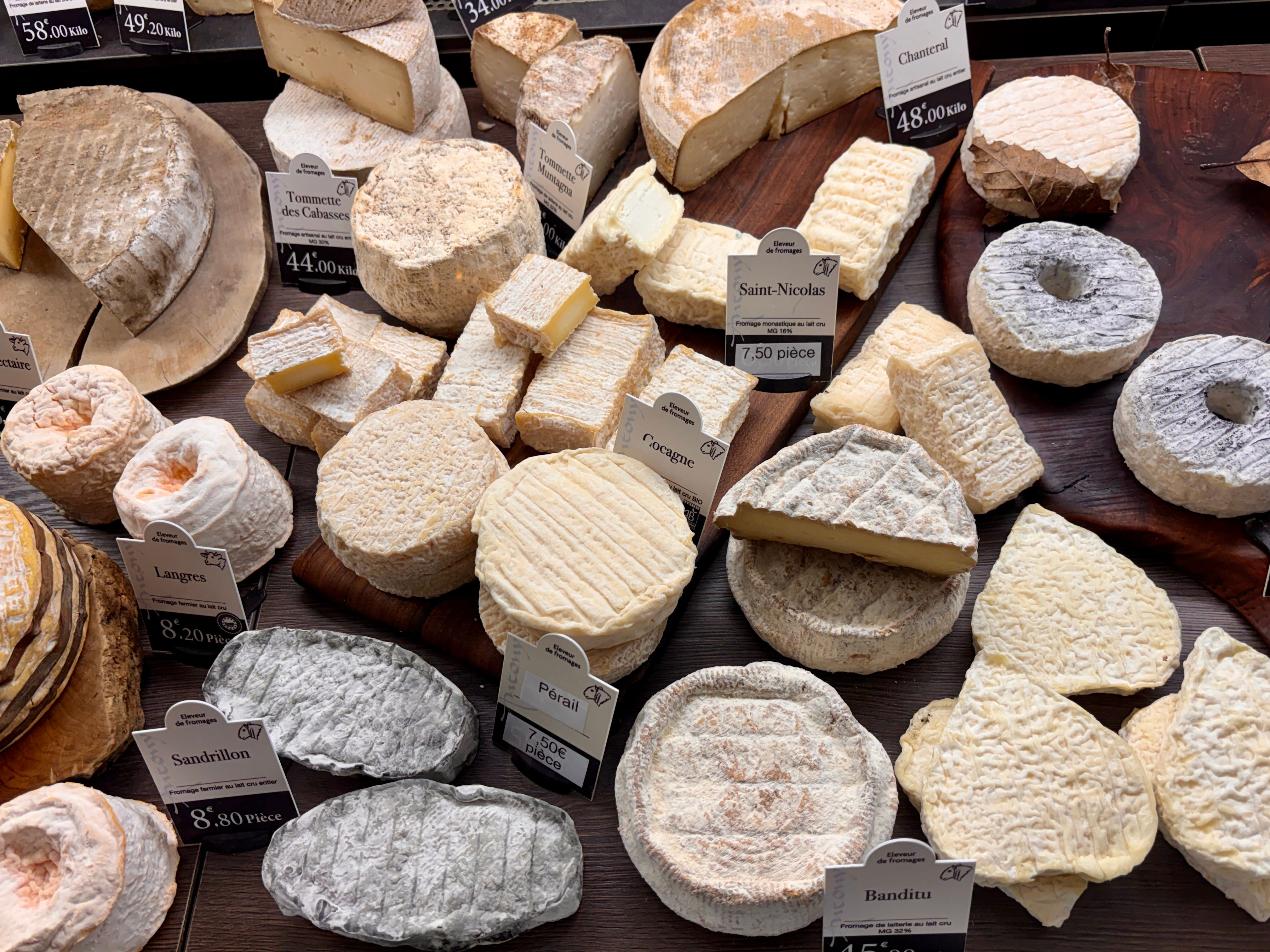
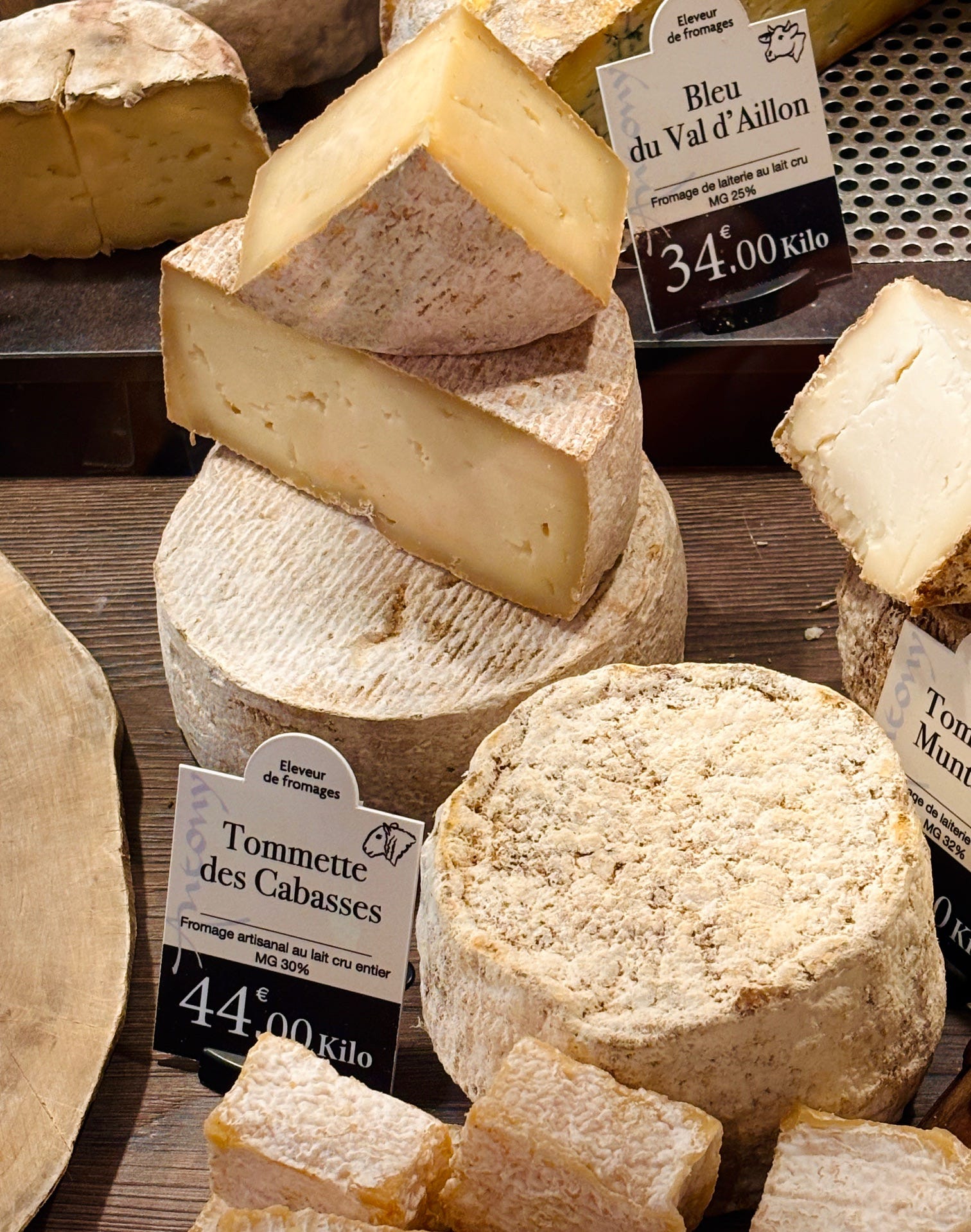
The shop was in full swing with cheesemongers talking to customers, helping them select the right cheeses, then carefully wrapping each one up to take home. The showcase was filled with spectacular cheeses. There were quite a few that I’d never seen before and was happy to try.
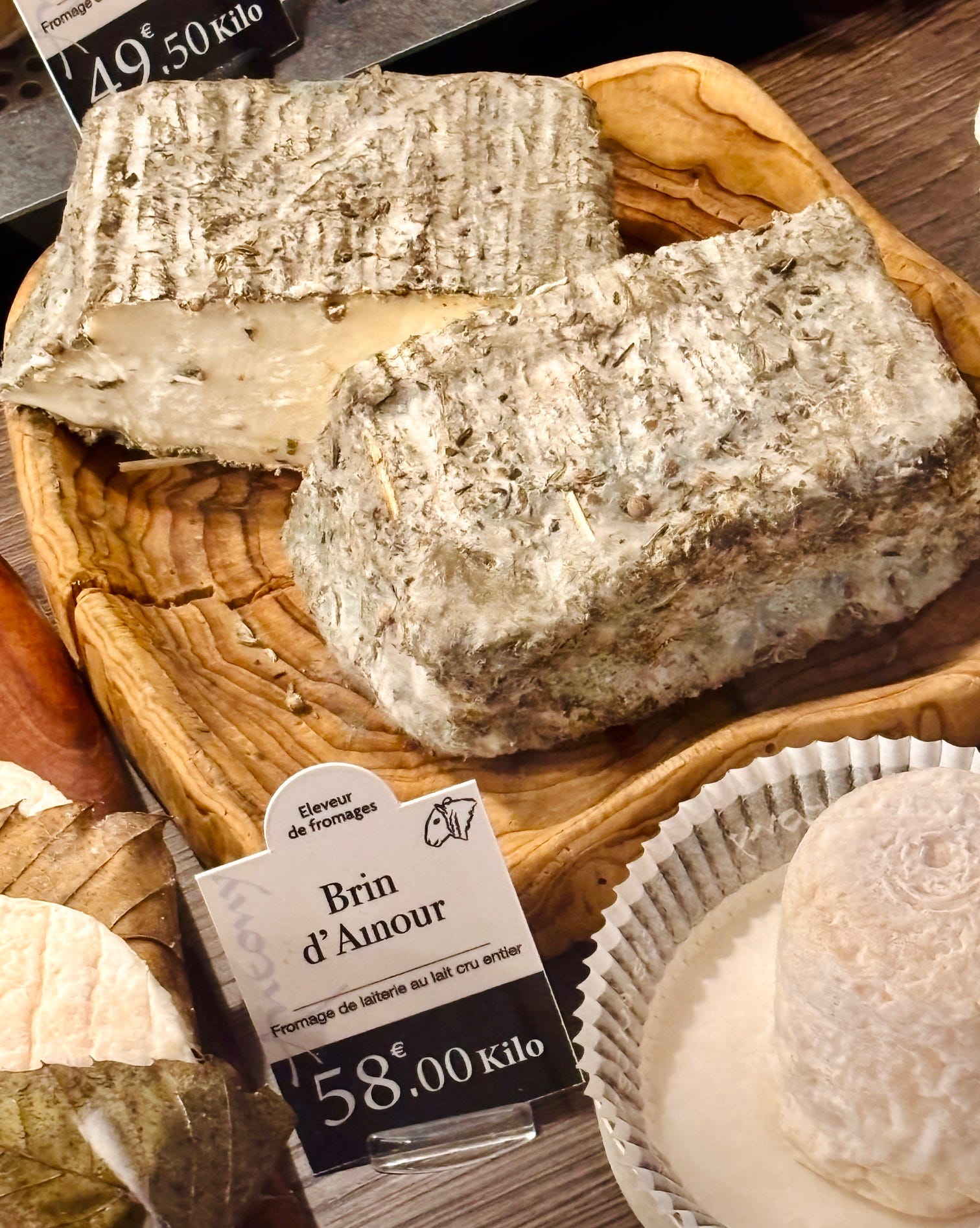
There were others that were familiar to me, such as the Brin d’Amour (below), that look quite different (and a lot better) than the ones I was used to.
Thanks for reading my Newsletter! This post is public so feel free to share it!
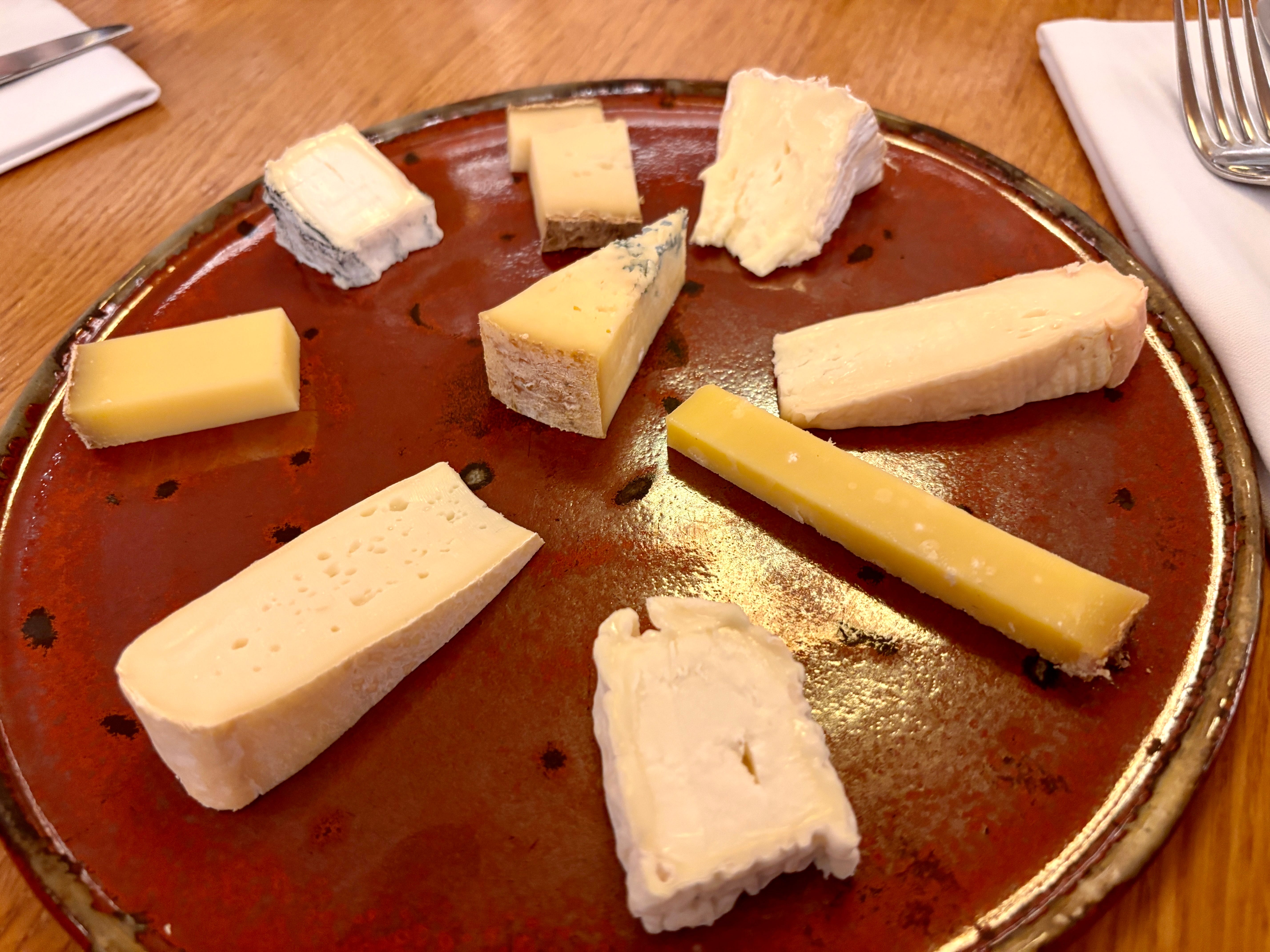
After I put my dropped jaw back into place, we were led toward a tasting room, where we were presented with a roundup of perfectly ripened cheese, ready for our dégustation.
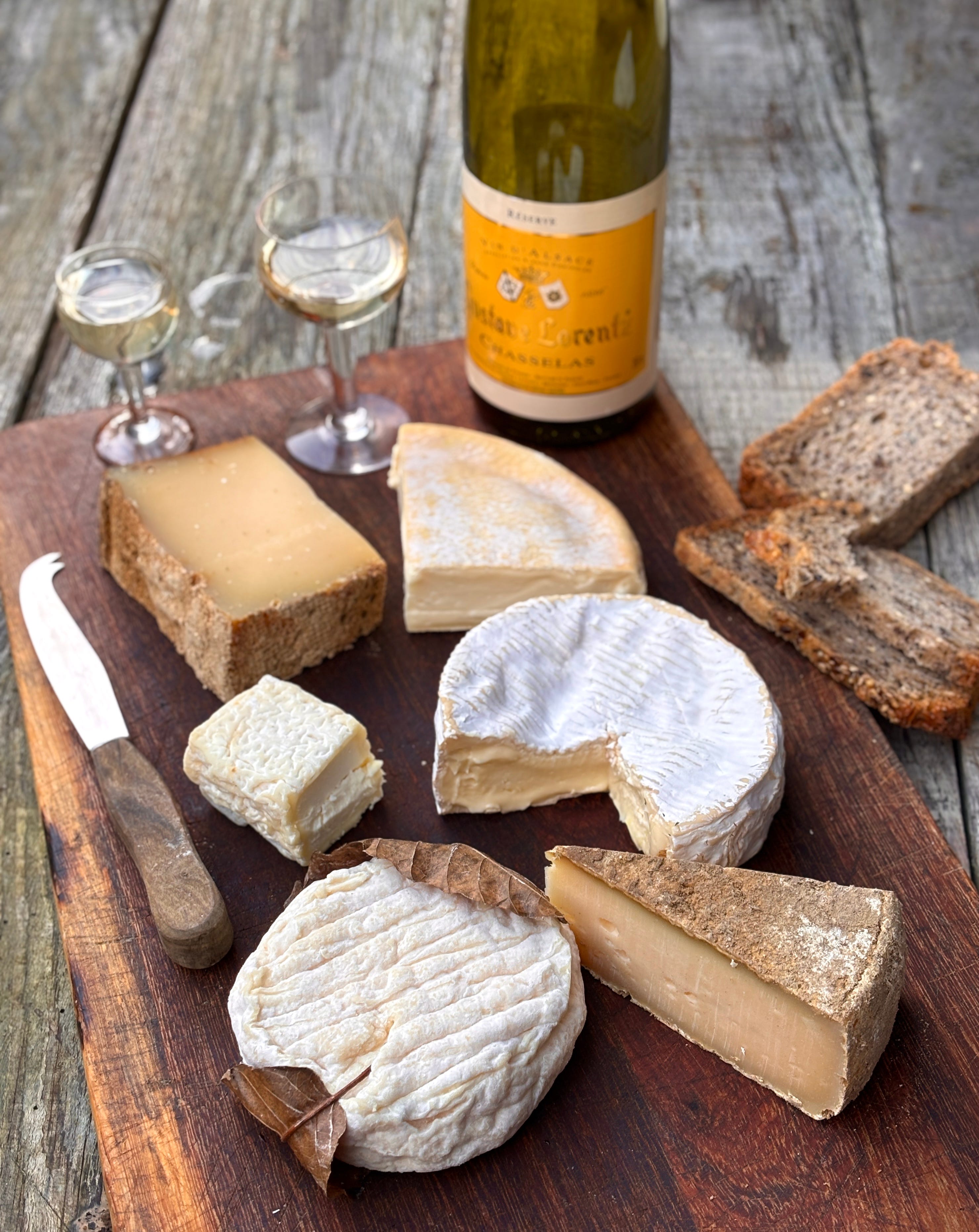
The cheese at the bottom was Saint-Nicolas, a partially aged cheese that had a delectably creamy tang due to the sheep’s milk used to make the cheese. The one next to it, with the rounded edges to its left, was an Abbaye de Cîteaux. Sometimes these kinds of washed rind cheeses can be rubbery, like Morbier can be, so I generally avoid them. But this was the most surprising cheese on the plate and was even better than perfect. It was divine.
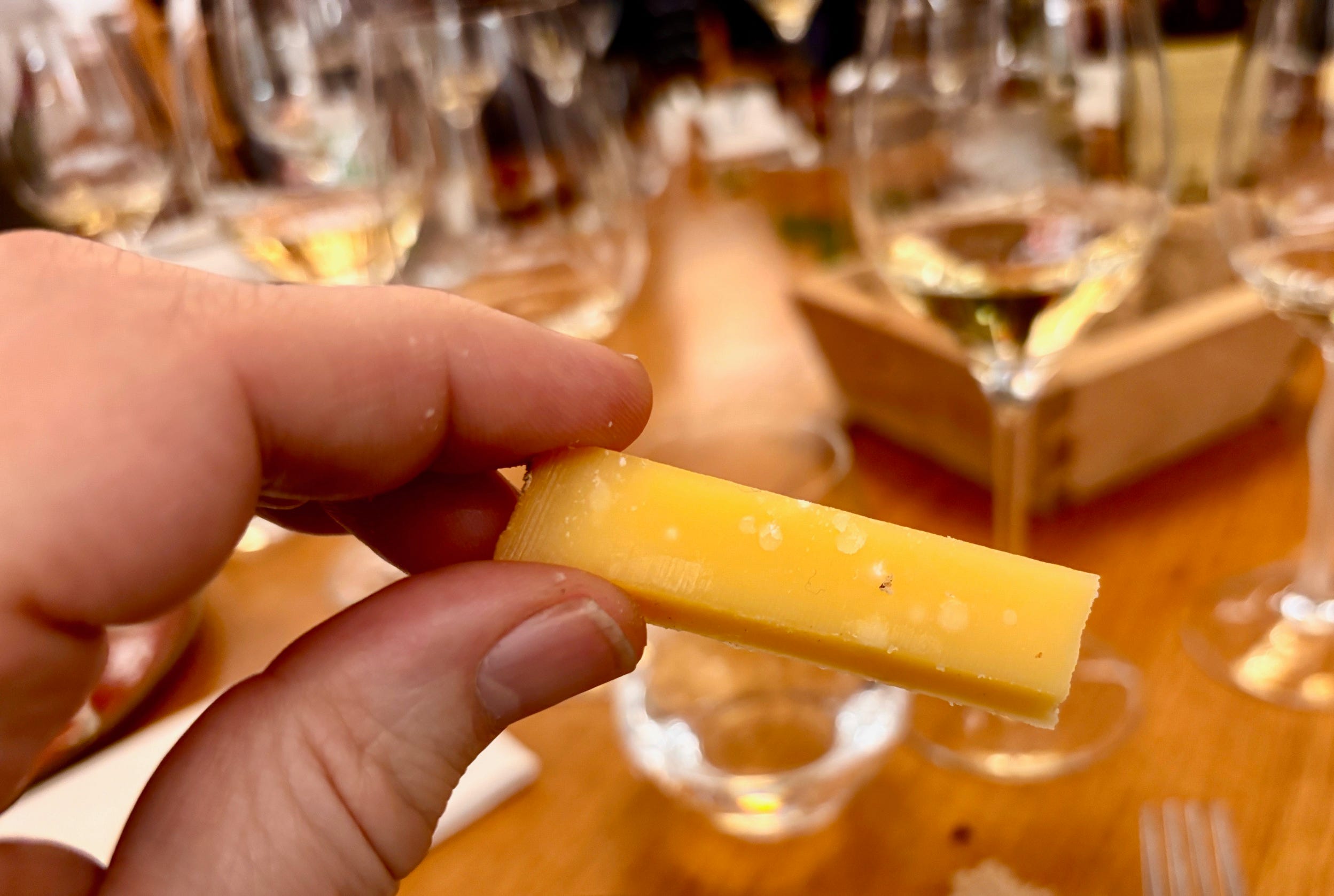
Moving on to the next one, the small block of golden yellow cheese was a twenty-month-old Comté Réserve. Comté is one of the most popular cheeses in France, and Jean-Francois (Monsieur Antony’s son) told us that, in his opinion, twenty months was the ideal age for Comté.
Another cheese was a Tomme de Savoie, a sort of catch-all term for a number of cheeses from the Savoie, that the Antony website says “doesn’t mean much anymore.” But like the Abbaye de Cîteaux, when you get a good version, you taste what the other tommes are missing. And this one was going on my mental list of cheeses to bring home.
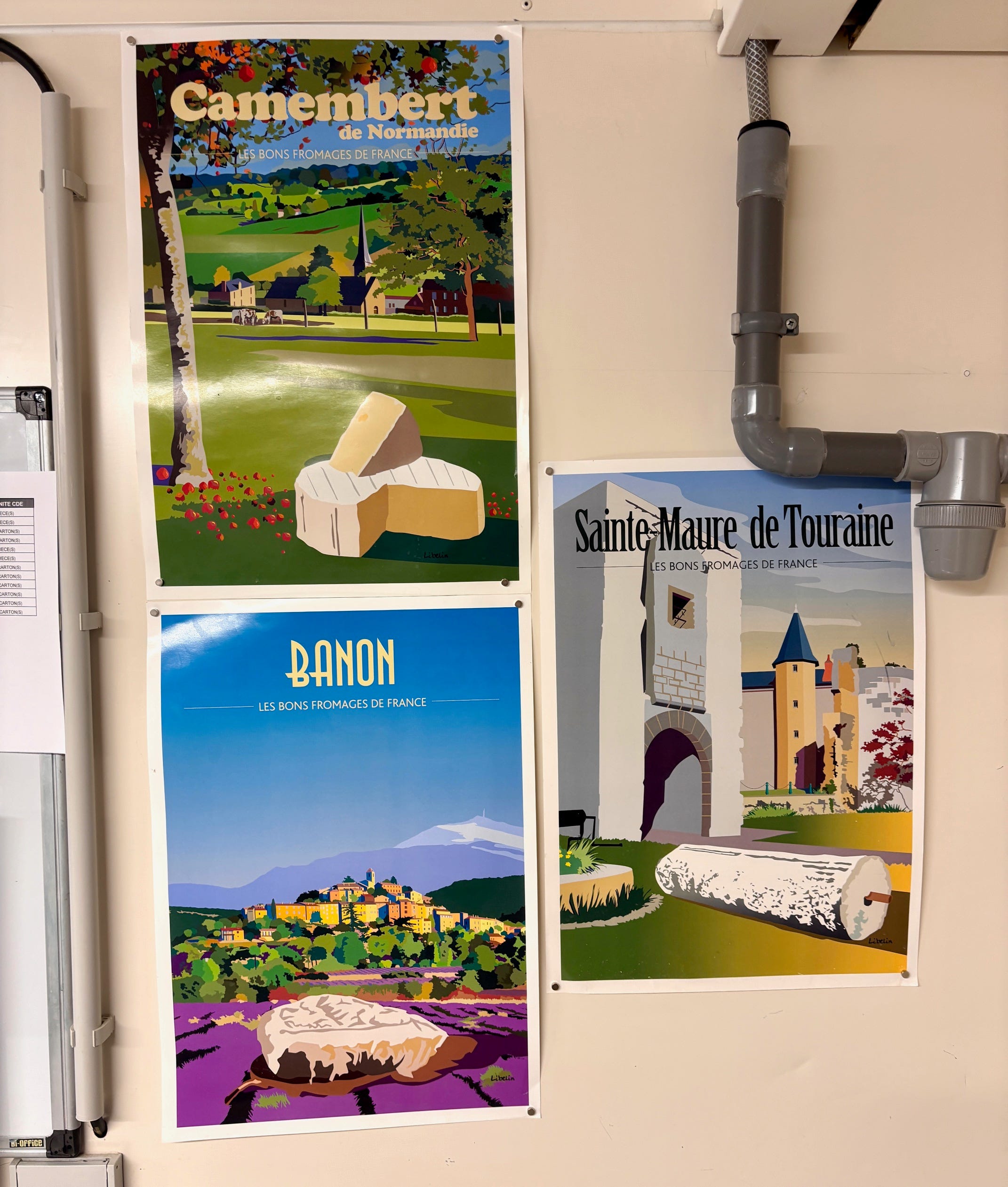
There was a small wedge of a truly remarkable Camembert de Normandie. Like “tomme,” the word camembert is applied to many cheeses that look like the real deal, but there are just a handful of producers left of Camembert de Normandie. Always look for “de Normandie” after the name if you want to get the real deal in France, made from raw milk and molded by hand.
Most Camemberts de Normandie are slightly musky and funky (in a good way), but this was a whole different category with powerful flavors of wild and dried mushrooms. It had an extra-strong creaminess thanks to the milk used to make the cheese, which comes from Normande cows, known for their especially high-quality milk.
I don’t buy Camembert too often since it’s so rich, and a good one starts oozing out shortly after you cut it - which is why they sell special boîtes to store ripe Camembert in. So when I do buy one, I get the best I can find. And while I thought bringing one home was a good idea, after it was gone two days later, I wish I’d bought at least a second one.
Because we were in Alsace, of course there was a slice of Muenster to taste. But I was still euphoric from that exceptional Camembert de Normandie and looking forward to the next cheese, the Comté I remembered from decades ago.
Yes, it was time to revisit the Comté Hors d’Age (Comté without age). They mentioned how aging this cheese up to 48 months can pose some challenges, namely a loss of moisture and higher salt content. Their knowledge of cheese ripening really shines in this elegant cheese, which keeps the character of Comté but deepens it. This was also the most expensive cheese that they sold, but all the work that goes into it definitely pays off.
The perfect pairing with cheese is wine, with cider and beer also being fine accompaniments. Alsatian wines are some of the best you can drink. And no, they’re not all sweet.
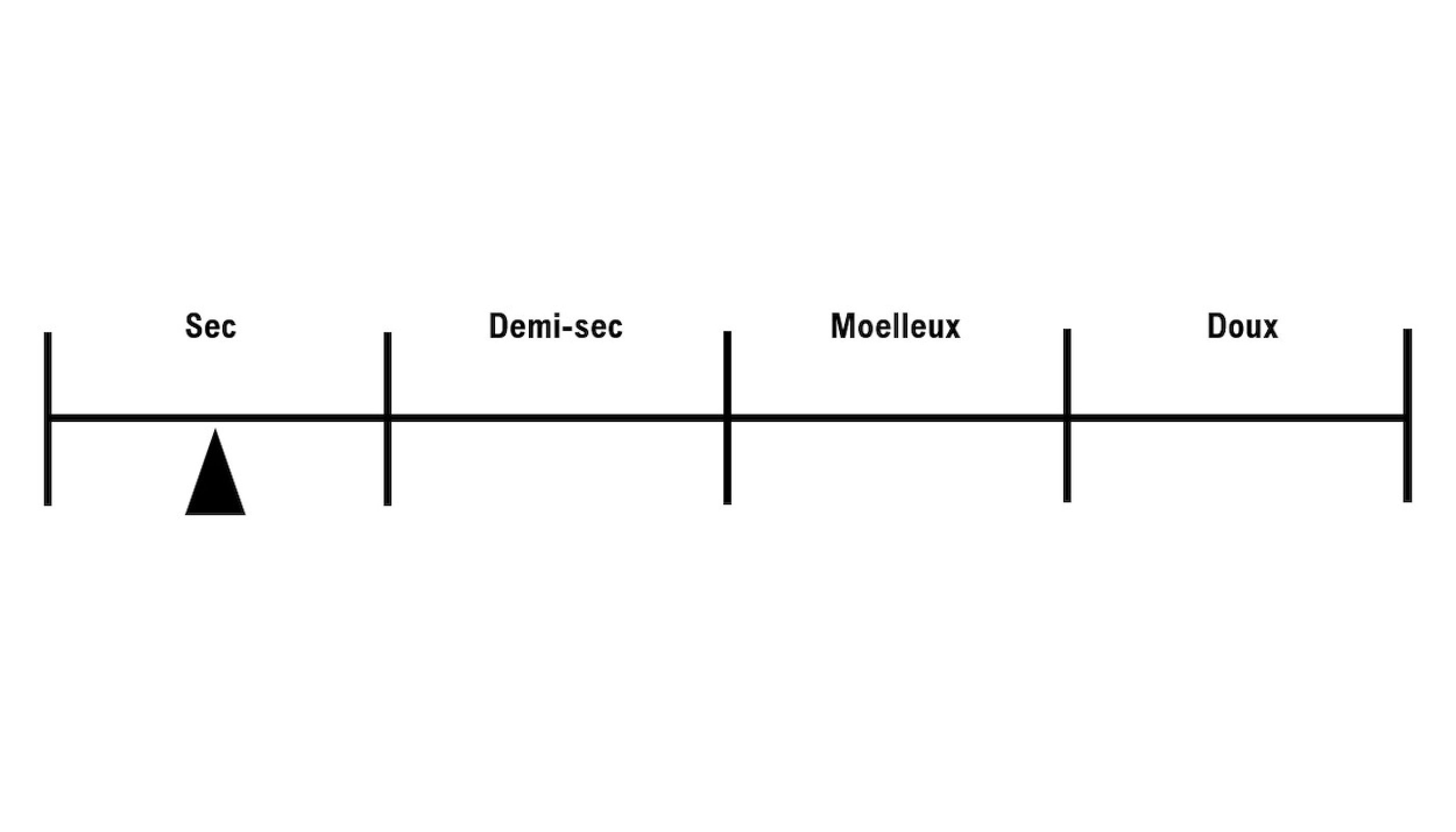
In fact, most are dry. But because that perception still exists today, a wine scale is posted on the back labels of Alsatian wines, which rates the wine from dry (sec) to sweet (doux).
Alsatian wine scale from Jancis Robinson.com, which has written more extensively about it here.
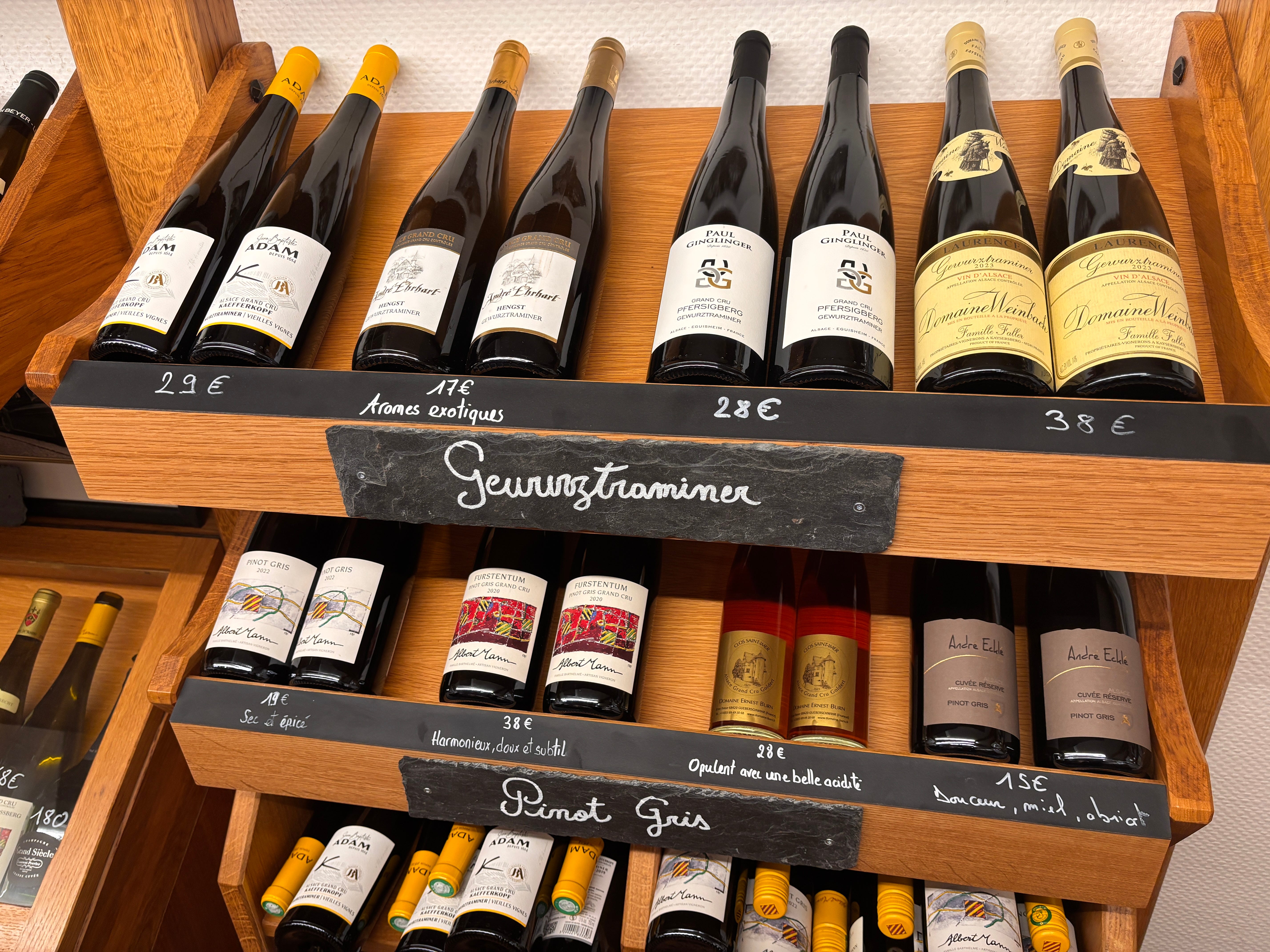
Alsatian wines are also notable as they’re sold by the cépage (grape variety) in France, rather than by the region. Few people in France know the grapes that go into, say, a red Burgundy or a white Muscadet from the Loire, but because of their Germanic influence, wines from Alsace are labeled by the grape variety and often sold in elongated bottles, called flûtes d’Alsace.
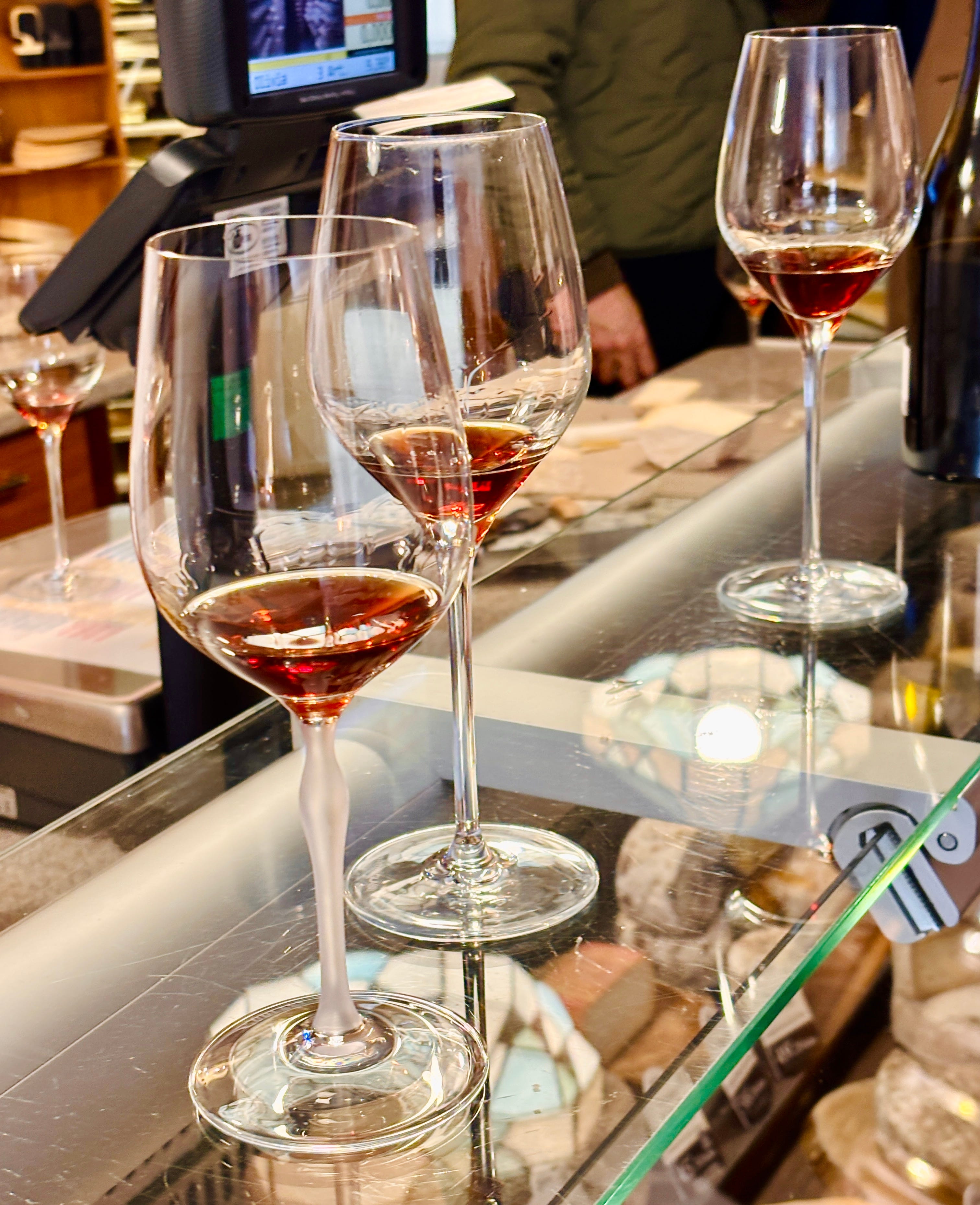
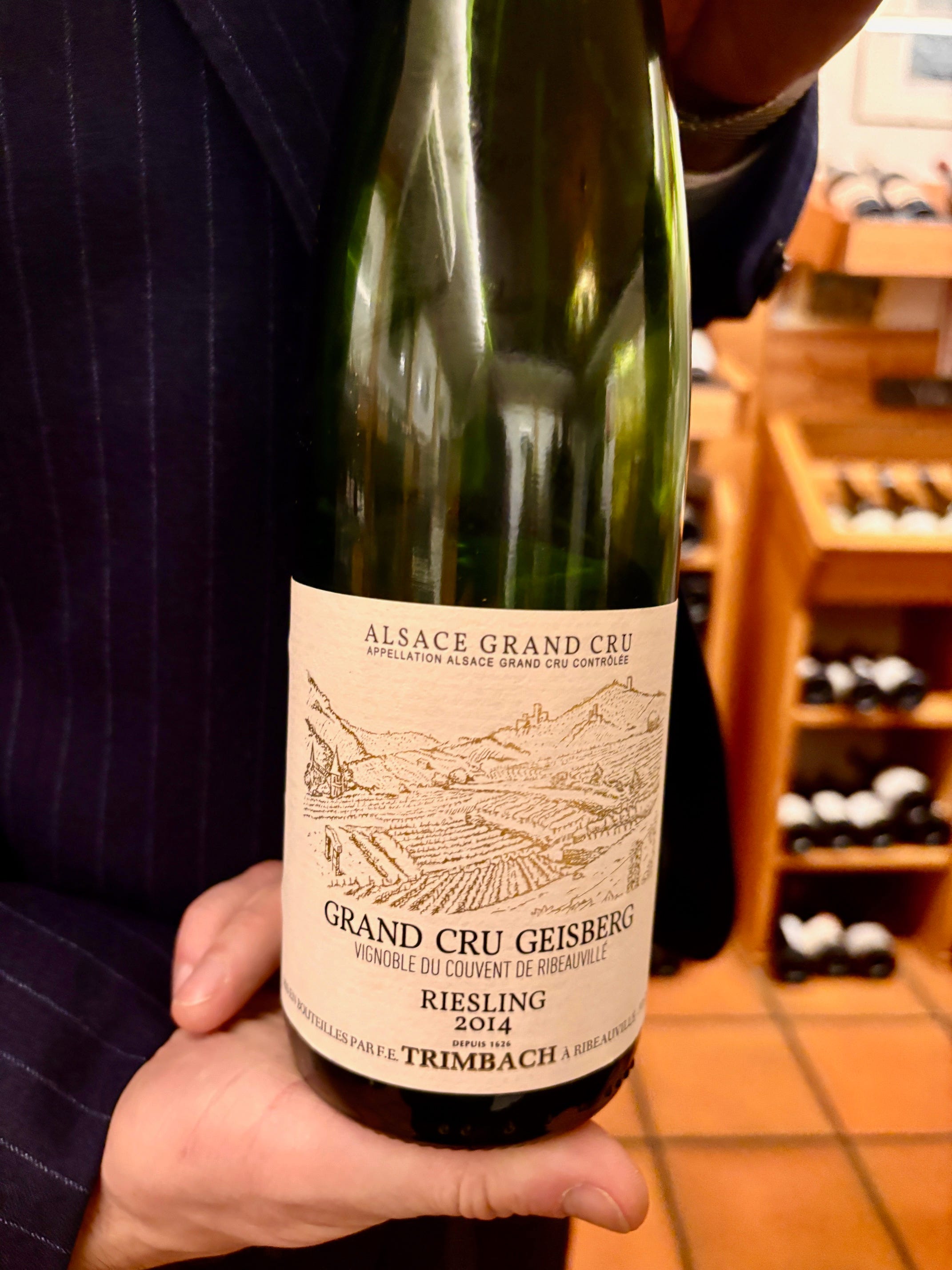
Because it goes so well with cheese, their shop sold quite a few wines, but sommelier Fabrice Langlois, who worked the night shift before our trip (and somehow managed to make the 7:20am train), came with a backpack rattling with incredible bottles of wine. This one was my favorite:
Following the “what grows together, goes together” theme, this Trimbach Grand Cru riesling was especially good with the Alsatian cheeses.
In addition to “Alsatian wines are sweet,” another myth that needs to go away is that red wine goes with cheese. There are a lot of subtle flavors in cheese and a tannic, heavy Cabernet Sauvignon, for example, can obliterate those flavors.
Even in France, the cliché of “red with cheese” is still strong. It reminded me of a passage in restaurateur Keith McNally’s memoir, I Regret Almost Everything, that I just finished. He talked about reading Don Quixote because his friends told him it was one of the best books ever written. And he hated it:
“I waded through the thousand-page ‘classic’ without enjoying a single page, but for the next thirty years told everyone it was a masterpiece. I said this not because I loved the book, but because I was supposed to love it.”
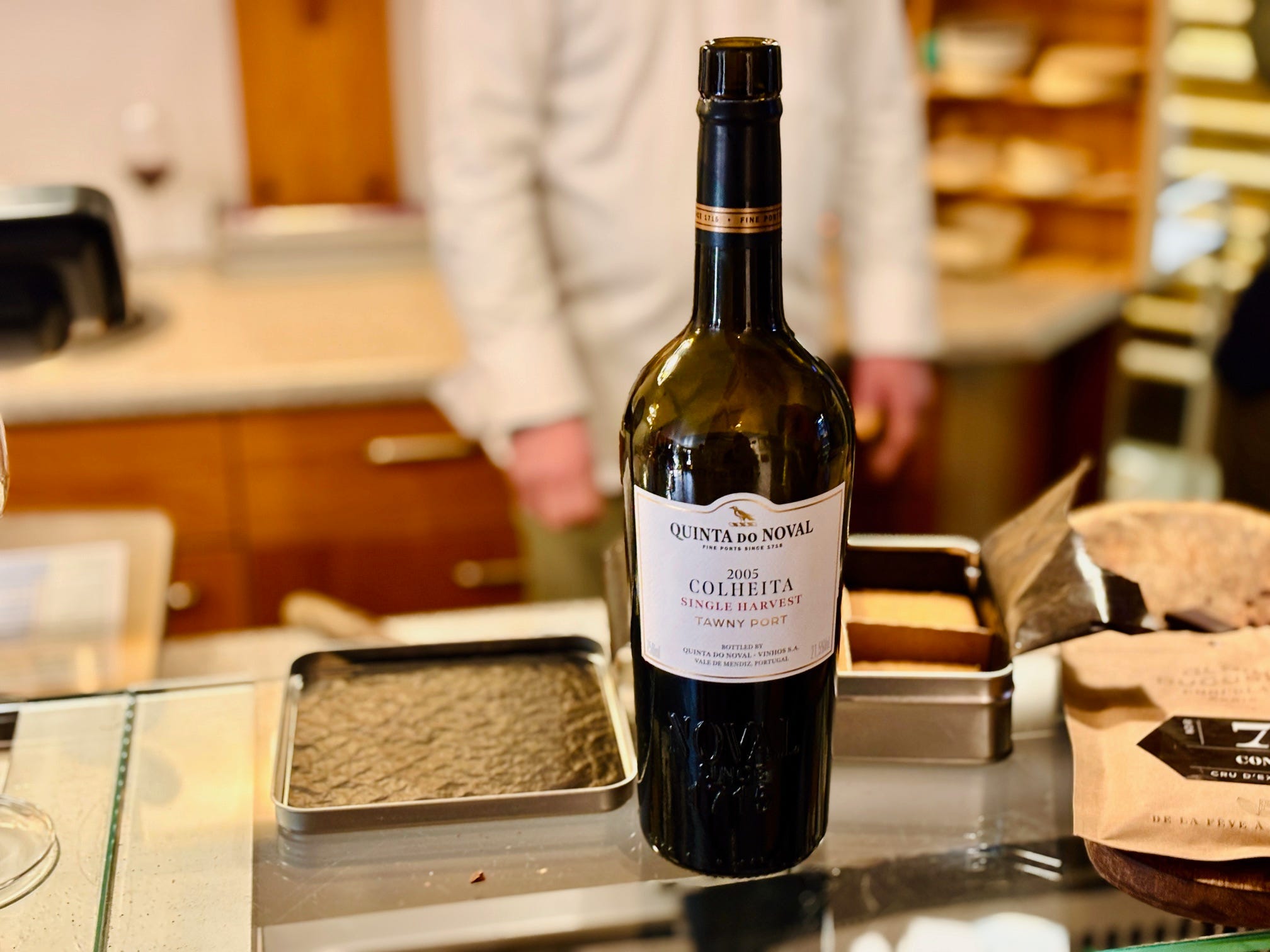
If you really do like red wine and cheese together, great! But if you want to go with red, I might suggest trying something with less tannins, or a softer, slightly sweet wine like port or sherry, which pair beautifully with many cheeses.
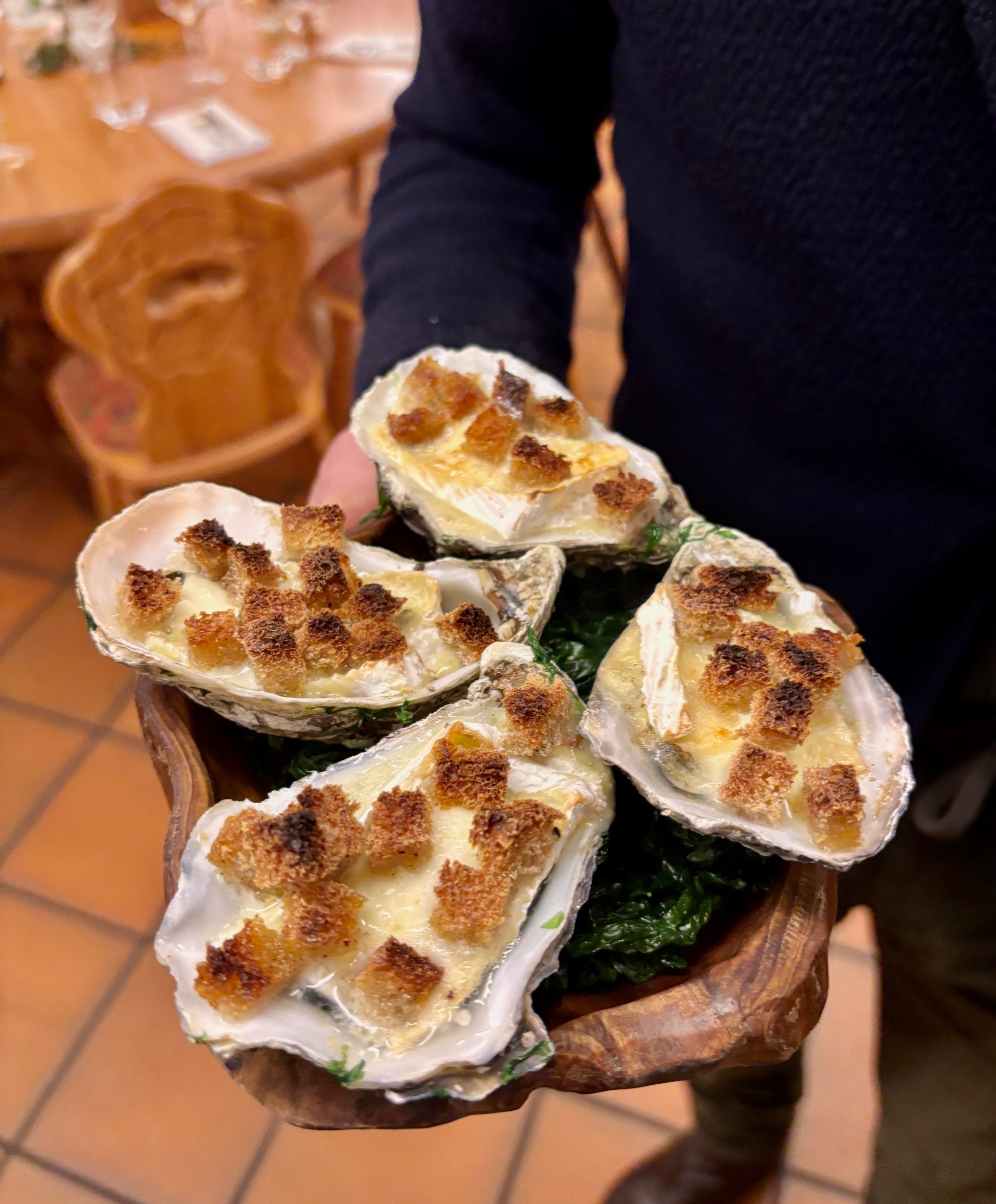
Another myth is that cheese doesn’t pair with seafood, which as anyone who’s had a tuna melt knows, isn’t true. But a pairing I wouldn’t have thought of were these oysters.
Chef Saintagne worked his magic on them, broiling up the oysters, gratinéed with slices of Camembert de Normandie, and dotted with toasted croutons on top. The salty, briny oysters were an incredible pairing with the rich cheese. They reminded me why it’s good to keep an open mind, rather than just following along with what everyone else says. Otherwise, I would have missed these oysters, which I might even try making at home.
After our extensive cheese and wine tasting, we visited the caves where the cheeses are ripened. As a side note, you often go to tastings and people just…taste, and leave a lot behind on the plates. When were were done, every plate was completely cleaned.
⭐ Bernard Antony Cheese Tasting in Paris ⭐
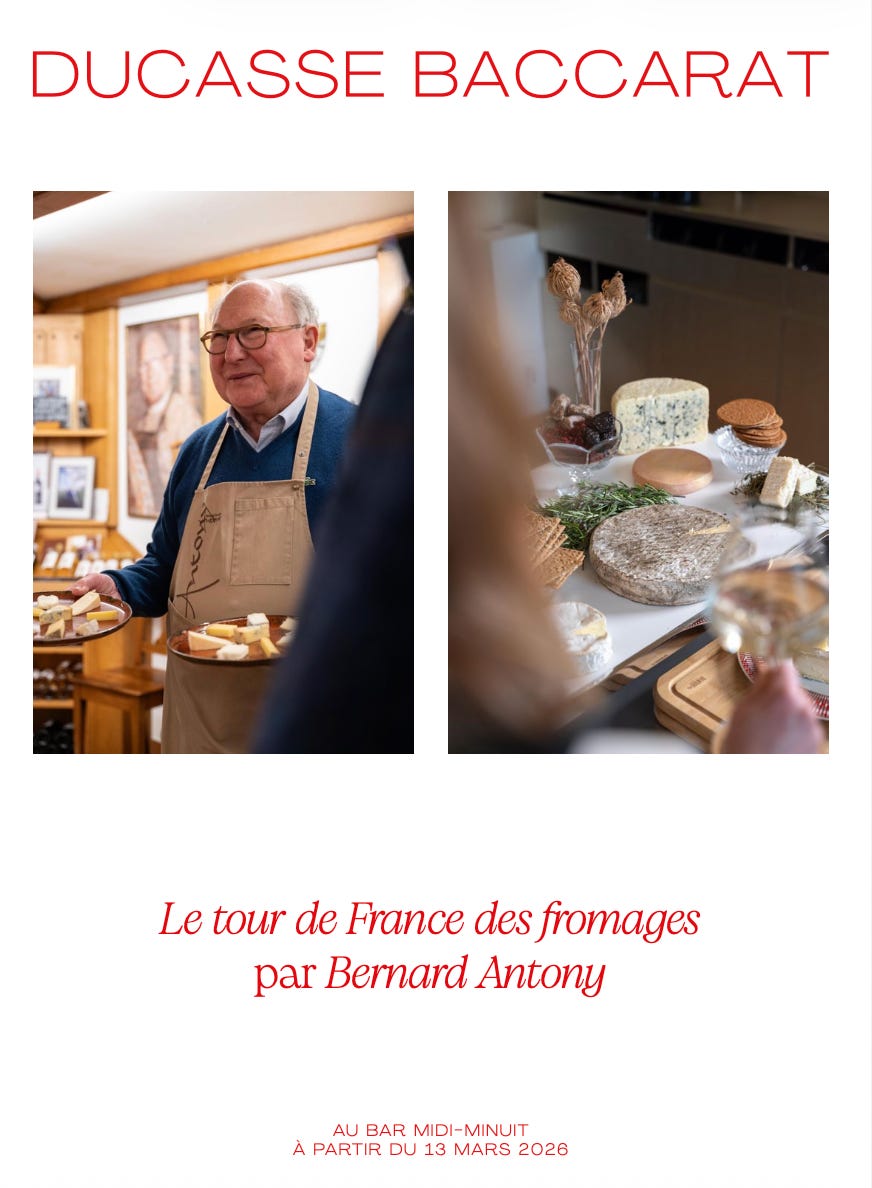
Starting on March 13th, 2026 and extending to the end of April 2026, “tour de France” cheese-tasting platters will be offered at Alain Ducasse Baccarat bar à vin, Bar Midi-Minuit for 35 euros, with the option to add a wine pairing by Sommelier Fabrice Langlois. (Bookings and more info here.)
We didn’t catch all the names of the cheeses (frankly, there were a lot), but often it’s best to go to a cheese shop and see what looks best or most appealing that day and make your selection then. That said, the shop has a page on their website in three languages that identifies and describes many of their cheeses.
Subscribe to my newsletter to get posts about eating around France and in Paris, as well as recipes, travel tips, and more, sign up to get my newsletter…sent right to your Inbox!
After visiting the caves to see the ripening cheeses, because I live in Paris, I’ve learned how to get — and remain — at the front of a line, no matter how many people are behind me. Fortunately, trying to cut in line hasn’t made it to Alsace, but because I am bien élevé (well-raised, and well-mannered), I let someone in our group go ahead of me.
He ended up buying at least as many cheeses as I planned to, but I was happy to be next in line, as a lengthy line was forming and snaking out the door, since they’d just reopened after their lunch break.
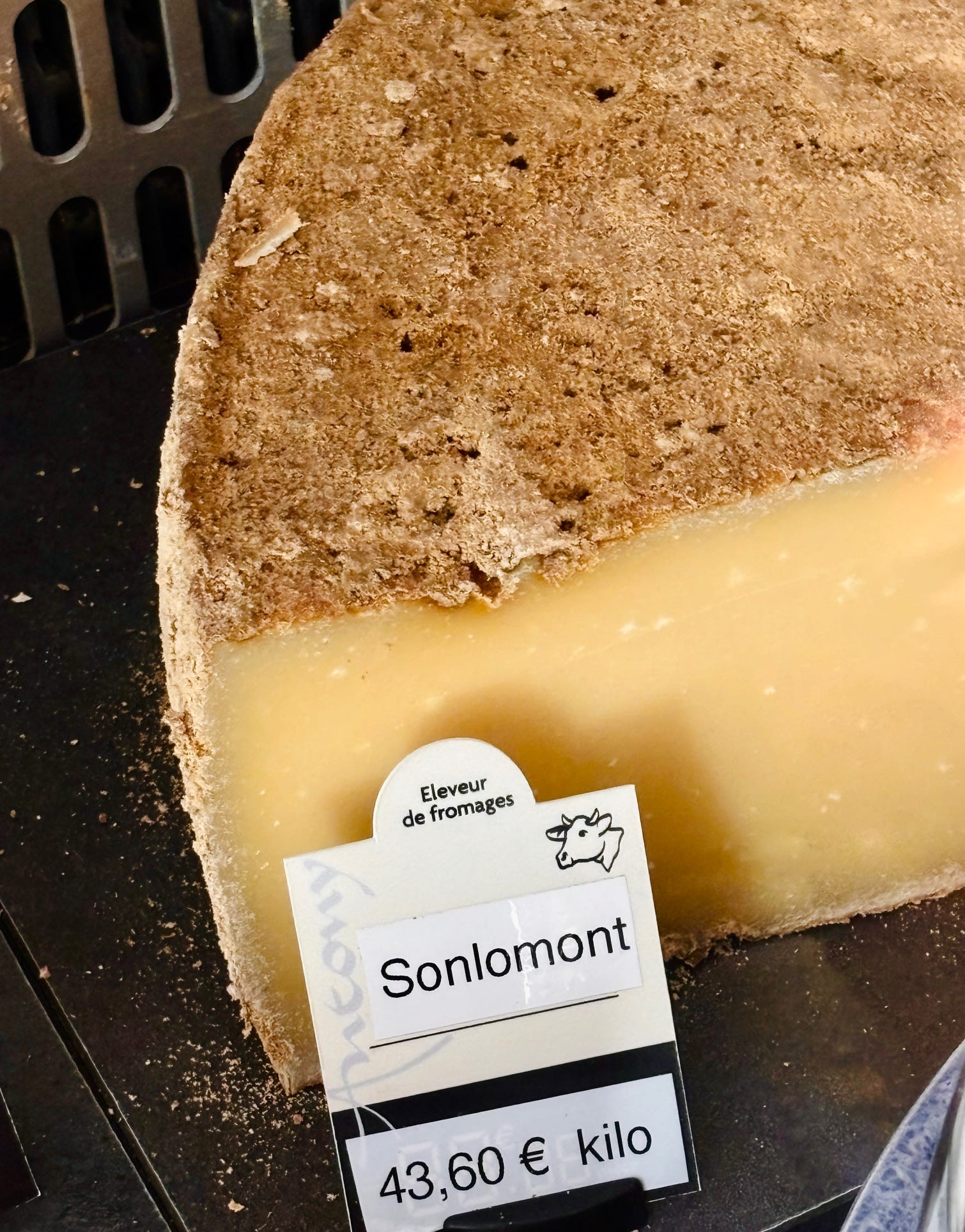
I’d never heard of Sonlomont, a cheese from Switzerland that I think is the same as Tome de Lomont, but happy to be corrected. They gave me a taste, which confirmed that I needed to bring a block of that home.
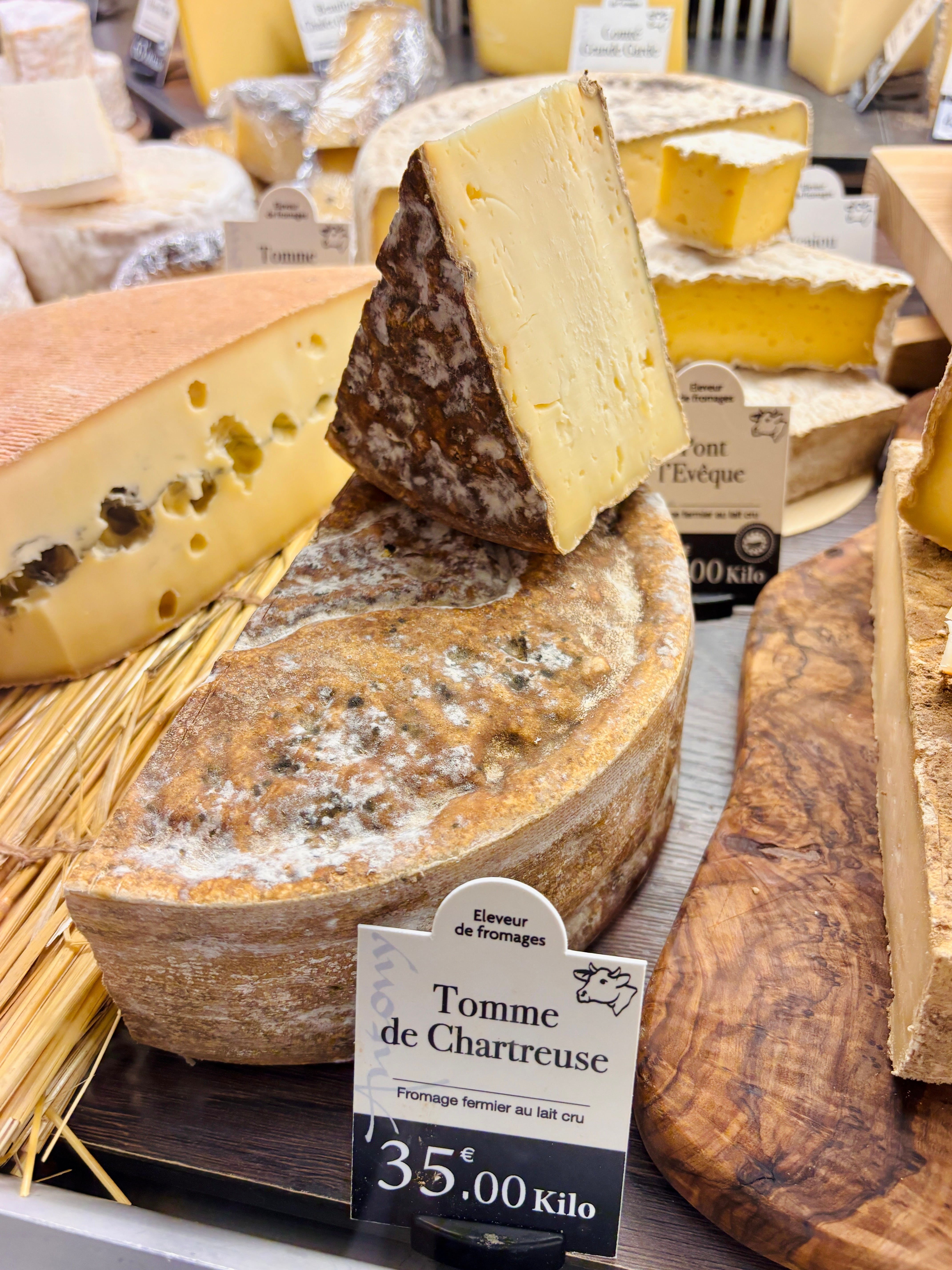
There was also this Tomme de Chartreuse, which didn’t contain any of the famed liqueur, but was made in the mountainous region called the massif de la Chartreuse. Following in the steps of “what grows together, goes together,” I’d imagined the mountain cheese with the semisoft texture and milky flavor would go well with the liqueur.
I made a mental note to bring a wedge of that home, but somehow, I forgot to ask for it, which I realized on the train back to Paris. That was also a shame because I was having drinks with friends from Chartreuse later that evening in Paris, which ended at 1:20am. (It was a long day!)
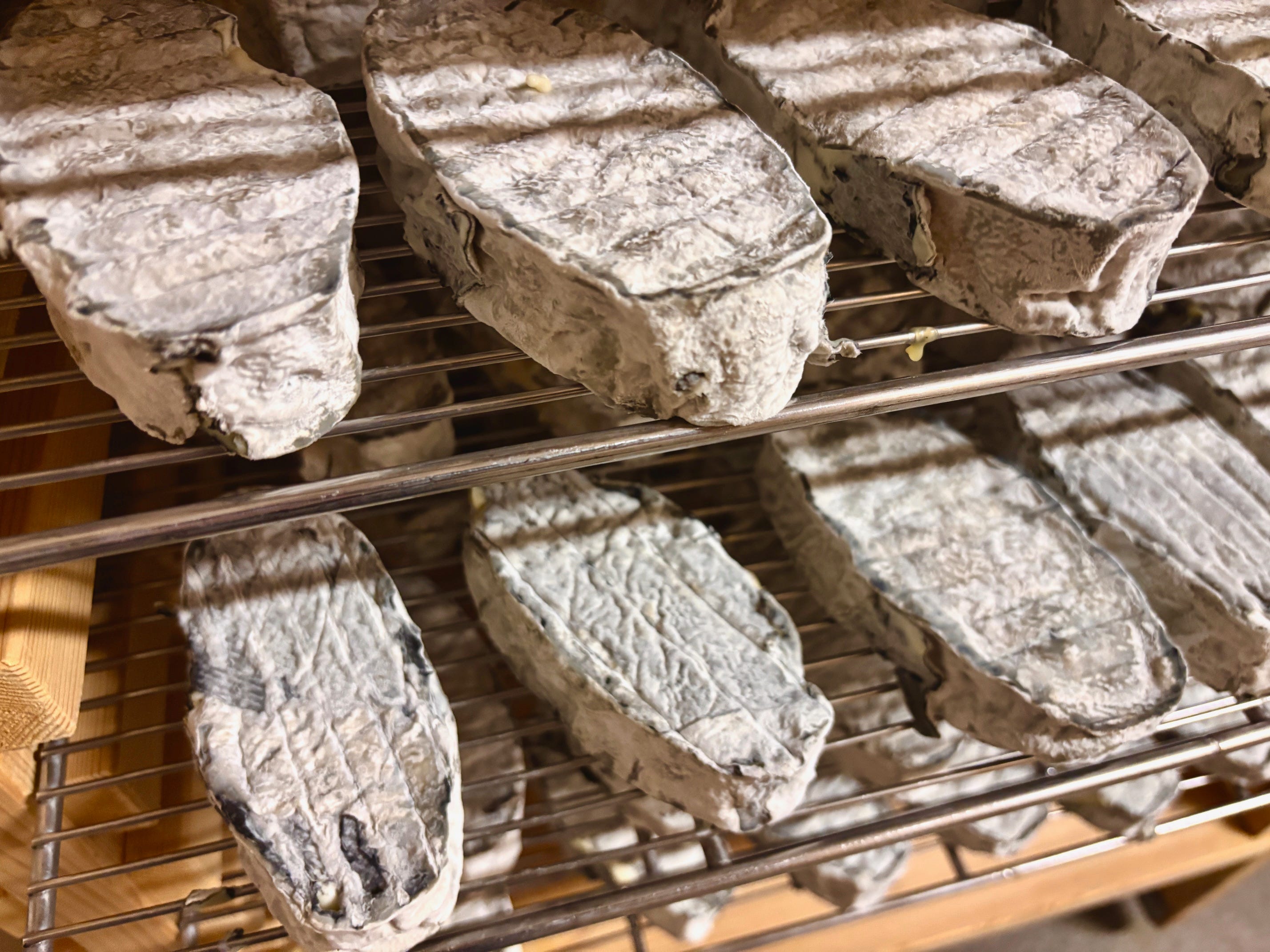
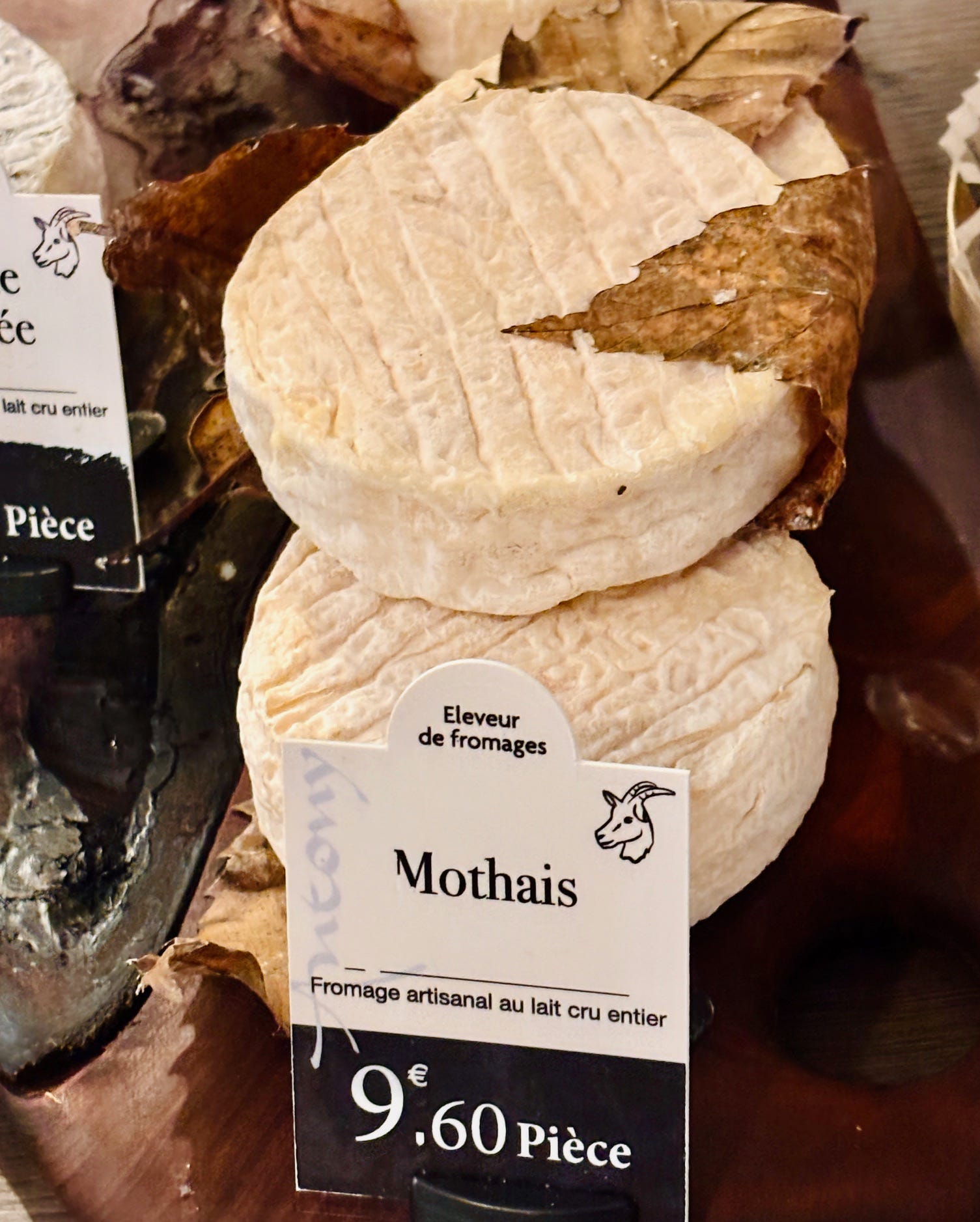
Monthais sur Feuille is one of my favorite goat cheeses, ripened on a chestnut leaf (feuille), which absorbs some of the humidity. While you can find this cheese at many fromageries, theirs is exceptionally good, made by a “passionate and incredibly gifted producer.” It’s nice to see them calling out the work and effort of producers they work with, since at Fromagerie Antony, cheese is a collaborative process. They follow the whole process, from milking the cows, to curdling and molding the cheese, and finishing it in their cellars.
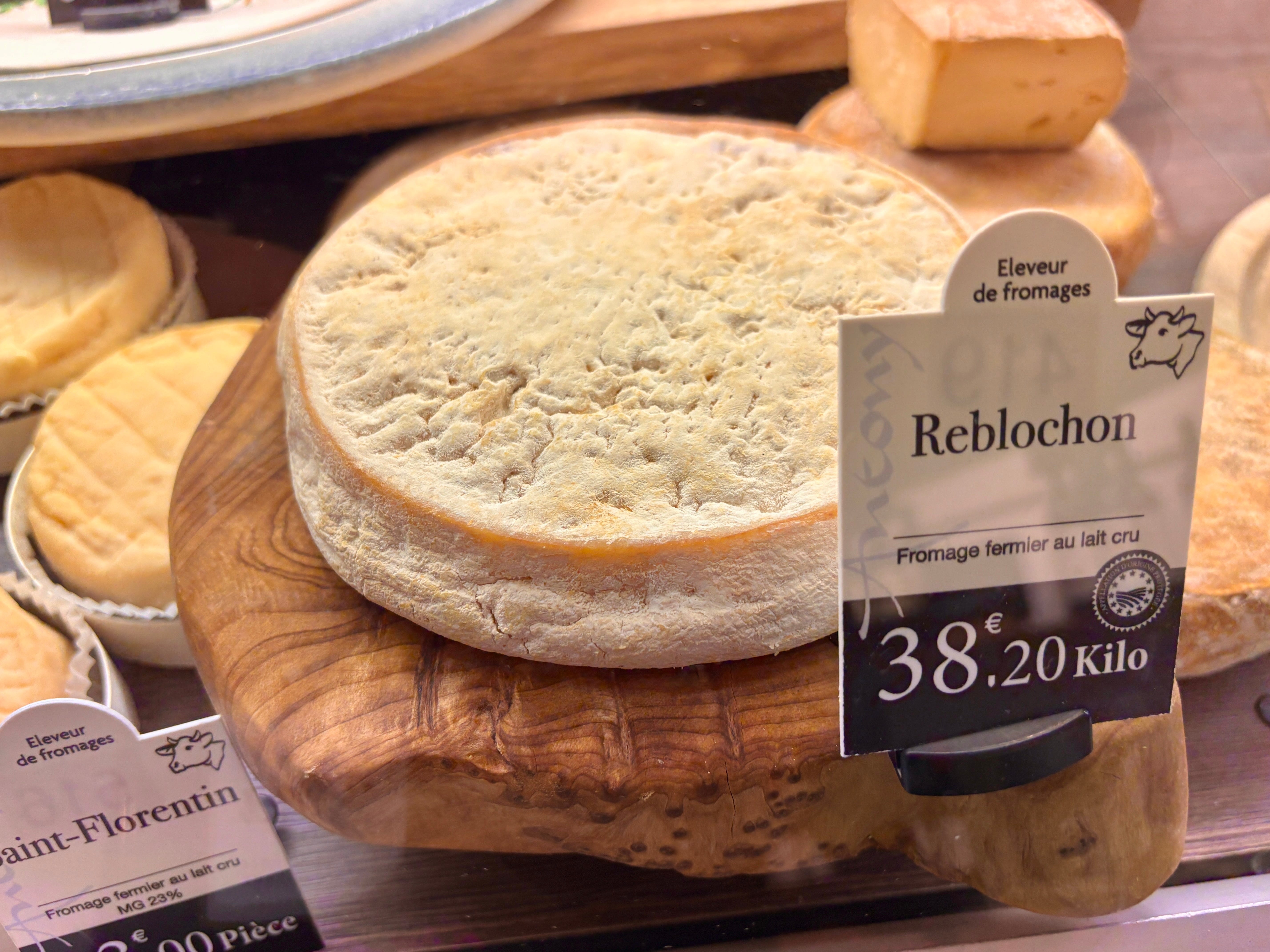
A few years ago I got picked on for making Tartiflette without Reblochon, the classic cheese. But I saw the high prices for it outside of France, and because, in reality, a lot of times in France, Tartiflette is made with othercheeses, sometimes labeled as “Le Fromage pour Tartiflette” (without a speck of Reblochon in its ingredients). I decided to let people know they can make it with other cheeses, as it’s done in France.
That said, if I lived near Fromagerie Antony, I would get my Reblochon there and make Tartiflette with that. Actually, if I lived nearby, I’d get all my cheeses there. Unfortunately, it’s a little too far to do my cheese shopping, but at least I had the good sense to bring enough cheese home to last us a few weeks…even if it didn’t.
If you want to visit, cheese tastings are available to the public by reservation here, with at least a one-day notice. Their website also offers information on lodgings in the area as well as taxi services. Getting there from Paris requires a train tripand a taxi or rental car.
(When driving, their website notes that navigation systems don’t always take you to the right village, even if you enter it correctly in a GPS system. They suggest you follow this Google Map.)
Firecracker chicken is an Americanized Chinese takeout dish consisting of crispy chunks of batter-fried chicken and a sweet-spicy sauce. While my parents once owned a Chinese takeout restaurant, I had never encountered this dish until recently. After trying it at a large fast casual Chinese takeout chain, I decided to create my own version! A […]
It’s been a brutal work week because we’re sending Cooking Thai to print very, very soon. This weekend, chef Pim and I are reviewing the book for the final time. Authors work with a team of folks to produce cookbooks, and given that there are countless moving parts (ingredient measurements, instructions, photos, page number references), mistakes may be made. At this stage, we scrub and polish and then practice the art of letting go.
It’s always an exhaustive process at the end but this time, I feel extra energized. That’s because now more than ever, there is incredible openness and interest in Asian cultures. I credit that to phenomena like Korean pop stars and Japanese anime.
Recently, there’s “Chinamaxxing” — a social media trend that has young American TikTokers wanting to ‘become Chinese’ by getting into things like practicing qigong, cooking congee, stocking up on groceries at Asian markets, and wearing slippers around the house. They want to be their “Chinese baddie” best because this is their “Chinese time of life”. (Remember the 1980 hit song, Turning Japanese by the Vapors? It did not result in women running out to buy kimonos.)
The rise of Chinese soft power, mostly among Generation Z, is an unexpected 180-degree turn. It’s uplifting but also ironic, given that there’s been a certain level of suspicion of Chinese goods and services for a long time.
Here at PTFS, we’ve discussed things like the fervent Prop 65 warnings on Asian ingredient labels. A few years back, shared his insights on people’s concerns over French made-in China cookware to empower consumers to thoughtfully choose.
And, remember when some folks nicknamed Covid-19 as “kung flu” and how the pandemic caused a surge in Asian hate crimes and discrimination? Those were good times, right?
Way before the pandemic, looking Asian could be viewed negatively. About fifteen years ago, as Rory and I were taking a walk in our neighborhood, a group of young men drove passed and one of them leaned his head out the window and screamed, “Go back to China!”
I reflexively stopped, raised my middle finger to give them the bird, and screamed back, “Fuck off! I’m not Chinese! I’m Vietnamese!” I stood my ground with minimal fear because we were across the street from a friendly Black-owned barbershop. We could run there for help, if needed.
The car briefly stopped before the young men took off. They surely forgot about the incident. For all I know, in 2026, they may be looking to live their best Chinese lives.
There’s plenty of analysis of Chinamaxxing from TIME magazine and also some humorous-not-so-humorous advice from the South Morning Post, the leading newspaper outlet in Hong Kong, China. I’m usure what to make of the current Chinamaxxing meme and trends, but I do hope that it results in genuine greater cultural appreciation.
Chinamaxxing also got me thinking about my own interests in Chinese culture, which started in college when I decided to minor in Chinese languages and culture. I eventually scored a fellowship in Hong Kong, traveled to China and partly built my food writing career on researching and writing about Chinese food.
Why go out of my Vietnamese lane? China is geographically and culturally connected to Vietnam through migration, politics, war, language, and yes, food. The relationship between the two countries has not always been a happy one, but understanding China helped me to better understand my Vietnamese heritage and history.
A temple in Hanoi, Vietnam. Note all the Chinese characters because Vietnamese was once written in a Chinese-character based language system.
For instance, when I was in my twenties, I hung out with Teresa, a gal from Hong Kong whose father used to be film director. Their family lived in Monterey Park and Teresa introduced me to a wonderful Chinese-Islamic restaurant, where I fell for dishes such as fragrant stir-fried lamb spiced with cumin and lots of green onions and a thick, crunchy sesame scallion bread. To this day, I love to eat the two together, stuffing the stir-fry into the bread and wiping up the sauce with even more bread!
Over the decades, I’ve tried all kinds of recipes for a fabulous rendition of the bread recipe and this past Friday, to get my mind off of book proofreading, I made it again and landed on my best rendition yet. Get the sesame-scallion bread recipe and make it sooner than later to enjoy its tender chewy, nutty, rich flavors.
Because Vietnamese and Chinese languages are linked in many ways, when I learned that the sesame scallion bread (zhīma dà bǐng) was a type of bǐng (餠, the Chinese word for bread, pancakes, pies, and certain other doughy foods), I was able to wrap my head around the Vietnamese notion of bánh, a very broad category of food that includes bánh mì, cookies, cakes, dumplings, crepes and other starchy foods.
When I started out writing about food, I befriended Chinese Vietnamese chefs too. The late chef Charles Phan of the Slanted Door was Chinese Vietnamese, for instance. So are my pals, chef restaurateurs Eric and Sophie Banh of Monsoon and Ba Bar in Seattle. Chinese people have been in Vietnam for a long time, so much so that there are countless people who identify as Chinese Vietnamese. They mostly see themselves as Vietnamese but can speak Cantonese and or Teochew.
Knowing about and being able to prepare and share Chinese cuisine is part of Vietnamese culture. In the early 1960s, when my dad was provincial governor in Phan Thiet in South Vietnam, my mom planned dinners that included Vietnamese, Chinese, and French dishes. She employed two cooks — one of whom was nicknamed Chú Năm Bếp (Uncle of Five Kitchens). Mom described him as a charming, talented man whose could cook practically anything; the five kitchens reflected his mastery of five cuisines.
Those factors and many others contributed to my affinity for Viet cha gio fried imperial rolls and bun rice noodle bowls as well as for Chinese fried wontons, lo mai gai sticky rice in lotus leaf, and wonton noodle soup. Hybrid foods like bo kho — the beef stew with star anise, lemongrass, tomato and carrot has southern Chinese Vietnamese roots and is considered an iconic Vietnamese dish. It has evolved over the years and cooks have taken to serve in many ways but it’s still Vietnamese at heart. I felt confident with turning the classic stew into a quick bolognese-style bo kho sauce to enjoy with wide rice noodles or pappardelle pasta. (Along the same vein, what would stop you from putting some in a banh mi roll because or use for a Viet-ish sloppy Joe. Just some suggestions!)
Chinese-ness in unexpected savors
So when I researched and wrote about the history of pho, it wasn’t a surprise that Chinese cooks and language were part of the story, which also includes the French colonials too. I’d always wondered if there was a Chinese pho recipe. ’s cookbook on Yunnan cuisine answered my question with its Chinese beef pho recipe, which you could add pickled mustard greens to, if you want. (The Red River flows from Yunnan eastward through Hanoi and out to the Gulf of Tonkin, so of course there are connections!)
Pho is highly elastic as I’ve written in The Pho Cookbook so you can play around with it with recipes like the beef short rib and vegetable pho. My traditionalist mother may think it’s weird but I like the recipe’s vegetable component, lower cost, and easy cooking in a pressure cooker or Instant Pot.
And, if you survey global cuisines, you’ll see how far Chinese foodways have migrated. Consider how widespread ingredients like tofu, soy sauce and rice noodles are. Chinese la mian noodles begot Japanese ramen. Wok cooking went to Peru and birthed Chifa cuisine and lomo saltado which then went back to Asia and eventually into Vietnam, where it yielded a beef stir-fry served atop fried potatoes. (Make my delicious umami-rich tofu and French fries iteration.)
Pass the Fish Sauce is a reader-supported publication. Get new posts and support my work by becoming a free or paid subscriber.
Finally, if you shop at a Chinese market or online at Weee!, check the frozen food section because you may find frozen peeled Chestnuts from China. As noted in an earlier newsletter, American chestnuts grow on Chinese trees. So you can purchase the Chinese chestnuts, know about their history, and use them in Chinese ways like the Red-Cooked Chestnut Chicken and Braised Chestnuts with Napa Cabbage which hail from Shanghai. These are no longer fall or winter dishes. They can be enjoyed whenever, if you get your paws on frozen Chinese chestnuts!
Today’s world is incredibly economically, politically, and culinarily interrelated. If you consider all the ways that China influences our lives, there is a certain truth to what China calls itself in Chinese: 中国 (中國; Zhōng Guó), which literally means the Middle Kingdom, the center of the world.
As a Vietnamese person who’s gone the extra distance to understand Chinese culture, do I want to become Chinese?
No way! I’m too feisty and proud to relinquish who I am. However, by cooking and looking around to connect the dots, I know that I can be a Chinese baddie on my own terms. I hope you find these insights and ideas to help you add to your knowledge base, if not just sound awesome to a young person. 😆
Back to proofreading the book. Thanks for being here.
Da Lu Mian (打卤面), commonly known as “Northern Chinese Gravy Noodles,” is a classic hearty dish from Northern China in which a rich, thick sauce is ladled over noodles. The sauce typically combines ingredients such as pork, mushrooms, lily buds, and eggs, and is given its characteristic consistency through the addition of starch. Long a […]

 Login
Login
 This Pork and Onion Stir Fry is the kind of Chinese home cooking my dad Bill grew up with. It’s a marriage of Chinese techniques and American staples like ketchup and Worcestershire sauce. The result is downright tasty and comforting with a bowl of rice! A Simple Pork Stir-Fry This stir-fry has minimal chopping and […]