In 2007, when this website was still in its infancy, I shared a recipe for a layered strawberry chiffon shortcake. I’d never made a chiffon cake before, but I brought it to a friend’s rooftop birthday BBQ, correctly assuming that no one would be unhappy with a towering, featherweight cake sandwiched with whipped cream and fresh strawberries, however inexpertly made.
I was recently gifted an overload of strawberries: I bought four baskets from a vendor at the market, whose booth I shop at often, and he threw in two extra baskets for free, the equivalent of a carte de fidelité (loyalty card) in Paris. So I’ve spent the past few days washing, hulling, cutting and cooking my unexpected bounty.
I’ve been making a number of things with the gorgeous strawberries. But I also realized that while I have a Strawberry-Rhubarb Jam recipe on the site, I didn’t have a strawberry jam. So here it is.
Although I’m giving you a recipe for the amount of strawberries that I used, you can use the same proportions if you have just a basket…or a bushel. You’ll just need to do a slight amount of math. Only the cooking time will change, so keep an eye on things.
Jam-making is not something you walk away from and you need to rely more on look and feel, rather than exact times. Another thing about jam-making is that fruit and berry jams are always better made in small batches; the shorter the cooking time, the better the flavor. So if you have more than 2-pounds (900g) of strawberries, consider making jam in a couple of batches rather than one big one.
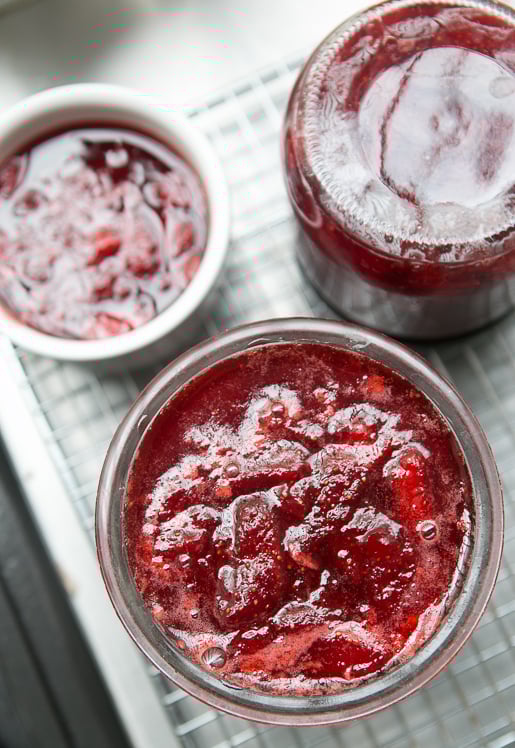
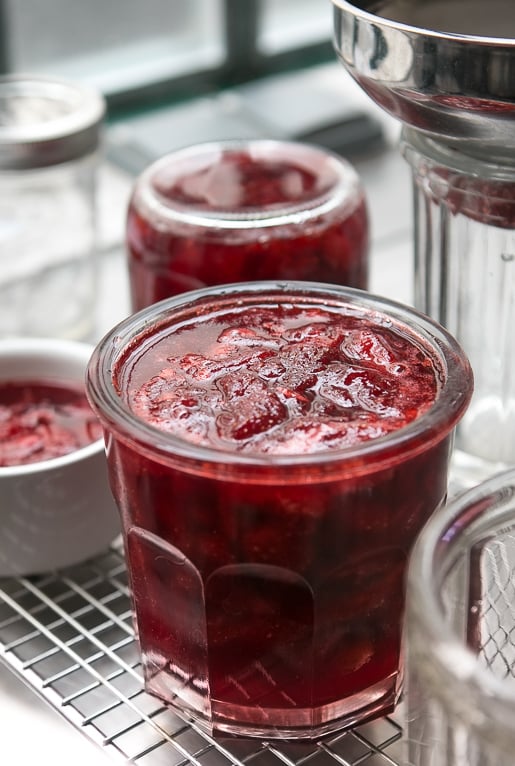
Many traditional recipes use an equal amount of sugar to fruit, by weight, but I find it’s okay to decrease it to these proportions. Sugar is both a thickener and a preservation agent. If you reduce it too much more, your jam may not thicken and won’t keep for a long time. (Which is okay if you want thinner jam, you keep it in the refrigerator, and eat it relatively quickly.) This recipe can be scaled up or down, depending on how many strawberries you have. But if you want to make a lot more, best to make it in a couple of batches. To prepare the jars, pour boiling water into them, as well as into the lids. Let them sit 5-10 minutes, then carefully pour out the hot water and set them upside down on a cooling rack until ready to fill.
Since I keep my jams in the refrigerator, I don’t put them up them in a traditional sense. I usually just overturn the jars and let them cool, which provides a reasonable seal, then refrigerate them. I find my jams keep well this way for up to one year. Check the National Center for Home Food Preservation website for instructions on how to can fruit jams.
Note: Last season strawberries tend to have less natural pectin than ones that arrive earlier. So your jam may be less jelled. One strategy is the finely grate a green apple into the strawberries before cooking them, which adds pectin. (There are guidelines here for using liquid and powdered pectin.) I don’t mind the slightly runnier jam and it’s terrific on yogurt or served with fresh goat cheese for dessert.
Ingredients
2pounds (900g)strawberries
1 1/4pounds (2 2/3 cups, 580g)sugar
onelemonorganic or unsprayed
optional: kirsch (or eau-de-vie, or crème de cassis)
Instructions
Wash and hull the strawberries and cut them into quarters. If some are larger or smaller, just make sure the pieces all about the same size.
2. Toss them in a large pot, such as a Dutch oven casserole made of a nonreactive material, with the sugar. Cut the lemon in half, squeeze the juice into the pot, and add the lemon halves to the berries. Stir well, cover, and let sit a couple of hours (up to 8 hours) at room temperature, stirring one or two times while they marinate.
Put a small plate in the freezer. Turn the heat on under the strawberries to medium-high and cook the strawberries, stirring occasionally, as they reduce and the juices thicken. If a lot of foam rises to the surface, skim it away. When the syrup is the consistency of warm maple syrup – it will take about 10 to 15 minutes or so, depending on the pot and berries, turn off the heat and put a spoonful of the jam on the frozen plate and return the plate to the freezer. Check it in a few minutes; if it wrinkles when you nudge it, it’s done. If not, return the plate to the freezer and cook the jam a little more, testing it again. It may take a few times before you get it to the right consistency.
When the strawberry jam is done, remove the lemon and stir in a few drops of kirsch, if using, then ladle the jam into the prepared jars.
This Shallot Vinaigrette makes even the most basic pile of mixed greens out of the box taste wonderful. A liberal drizzle of this salad dressing feels like you’re sitting down at a nice restaurant, and it couldn’t be simpler to make! Our New Go-To Salad Dressing I don’t know about you, but sometimes when I’m […]
Woks were invented in China about two thousand yeas ago but they remain a mystery to many cooks. That’s why my stir-fry recipes specify that you can cook the dish in a large wok or skillet. My recipe developer’s heart is always hoping that you’ll use a wok because that’s how the dish was meant to be cooked. A skillet will do but the explosive action of a good wokked stir-fry fills the kitchen with sizzling sounds, smells and then savors that a skillet cannot provide!
I’ve been spending more time on Substack’s Notes app and chatting with some of you. Earlier this week, remarked that she aspired to having a well-seasoned wok like the one I used in the kung pao chicken recipe video.
That tickled me because I don’t consider myself a master of the wok. Vietnam has being heavily influenced by Chinese culture but wok cooking is not a thing for many Vietnamese cooks. Most people choose skillets over woks, though as reminded me, some Viet pro cooks use woks for making sizzling rice crepes (bánh xèo). In the main, folks use skillets for those crepes and countless other dishes.
As I was growing up, my mom didn’t even have a wok. When you watch a video of me ‘effortlessly’ using mine, that’s the product of didactic practice. Over the years I’ve owned at least a dozen woks, and currently keep three (3) in my kitchen on rotation. Tinker and play with wok cooking to hone your skills.
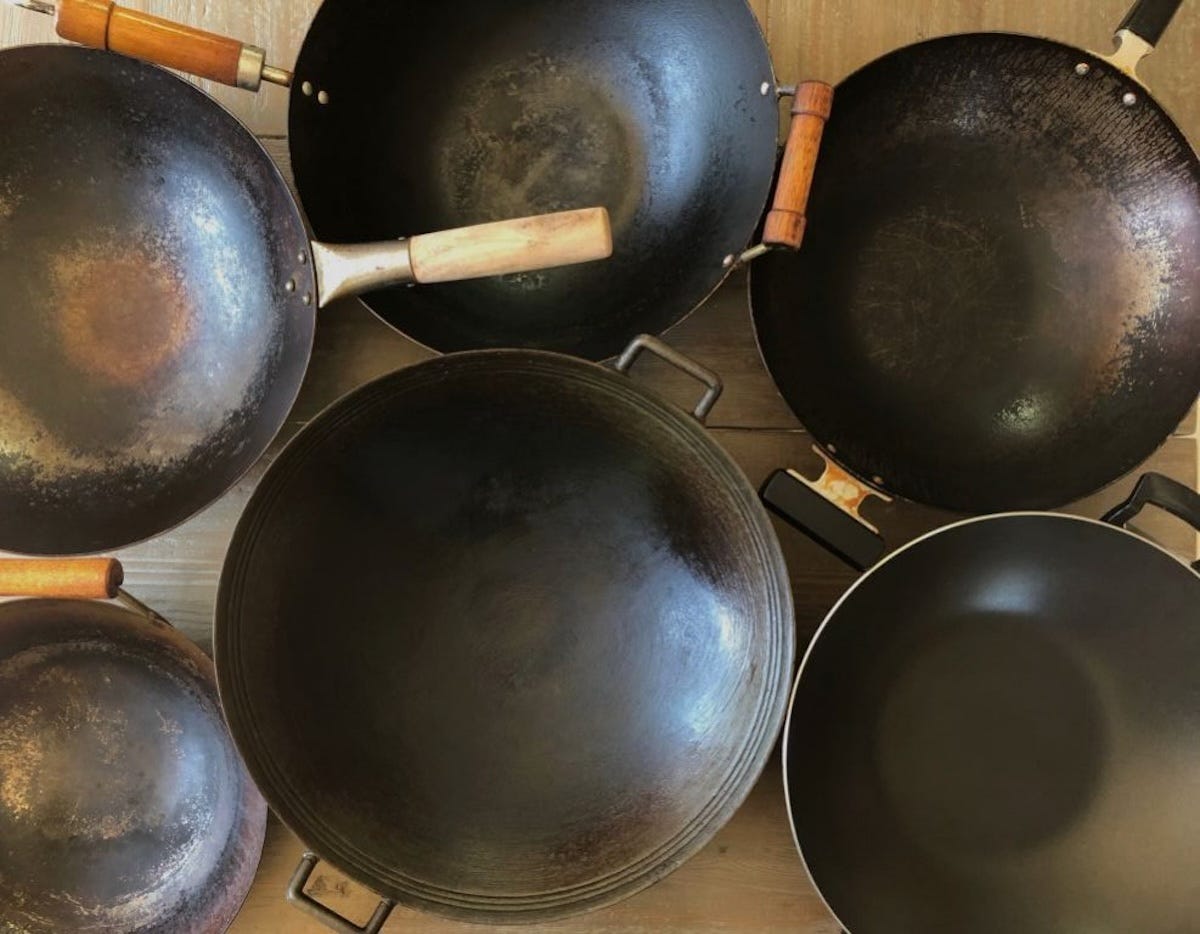
Top, left to right, are carbon steel woks. Bottom left is a carbon steel wok. Center bottom is a lightweight traditional cast iron won. Bottom left is an electric teflon coated wok. I’ve owned and tried these and more!
In this post, I’m going to offer my pointers on:
Selecting a good wok
Buying pre-seasoned carbon steel woks
Seasoning and re-seasoning a wok
Wok cooking and cleaning tools
Plus, I have a baker’s dozen (13) wok recipes for you to wok away!
How to choose a good wok
Woks are workhorses in the kitchen. They heat up in a flash and can cook food quickly or be used for braising, frying, smoking, or maybe even steaming, though that will wipe out much of the patina that you’ve built up.
When shopping for a wok, consider:
Round or flat-bottom wok? Both round and flat-bottom woks work great on gas stoves. If your stove is electric coil or induction, choose a flat-bottom pan so it will have maximum contact with the heat surface.
What is a good wok made of? Choose a metal that can heat up fast and effectively — the bottom and sides of the wok should get hot because you use all that surface area to cook with.
Carbon steel woks are king. They’re known for their durability, weight options (light or heavy, more below), and endurance (you can heat it until ripping hot and you can neglect it and it’ll come back to serve you well). BUT, a carbon steel wok often requires maintenance by way of seasoning to maintain a nonstick surface.
Coated nonstick woks seem dreamy but the only coated nonstick skillet worth considering is the Joyce Chen Excalibur nonstick wok, which I reviewed on my website (🆓). After using it for nearly five years, I ‘retired’ it to my mom’s house so I can use it when I visit. Carbon steel woks rock. Second to that are old school cast iron woks.
Chinese lightweight traditional cast iron woks are thin and lovely to cook with — lots of swooshes and sizzling noises to propel you ahead! Heavy cast iron woks, like those made by Lodge, are unwieldy for tossing food around and take too long to heat. The only cast iron wok I own is a small 9-inch one that I bought to test drive single portion recipes.
asked: What about stainless steel woks and why does mine stick so much? Stainless steel pans, like ones by All Clad, require a long preheating until they are super hot (to test: flick water onto the surface and it should literally dance around, not pool). Once sufficiently hot, then you add oil/fat to film and start cooking. There should be minimal sticking (practice by frying an egg.) My mom use a thin, stainless steel wok for deep-frying. I’ve only used her wok for stir-frying greens but it didn’t perform as well as others.
I’m nudging you toward carbon steel for a good reason.
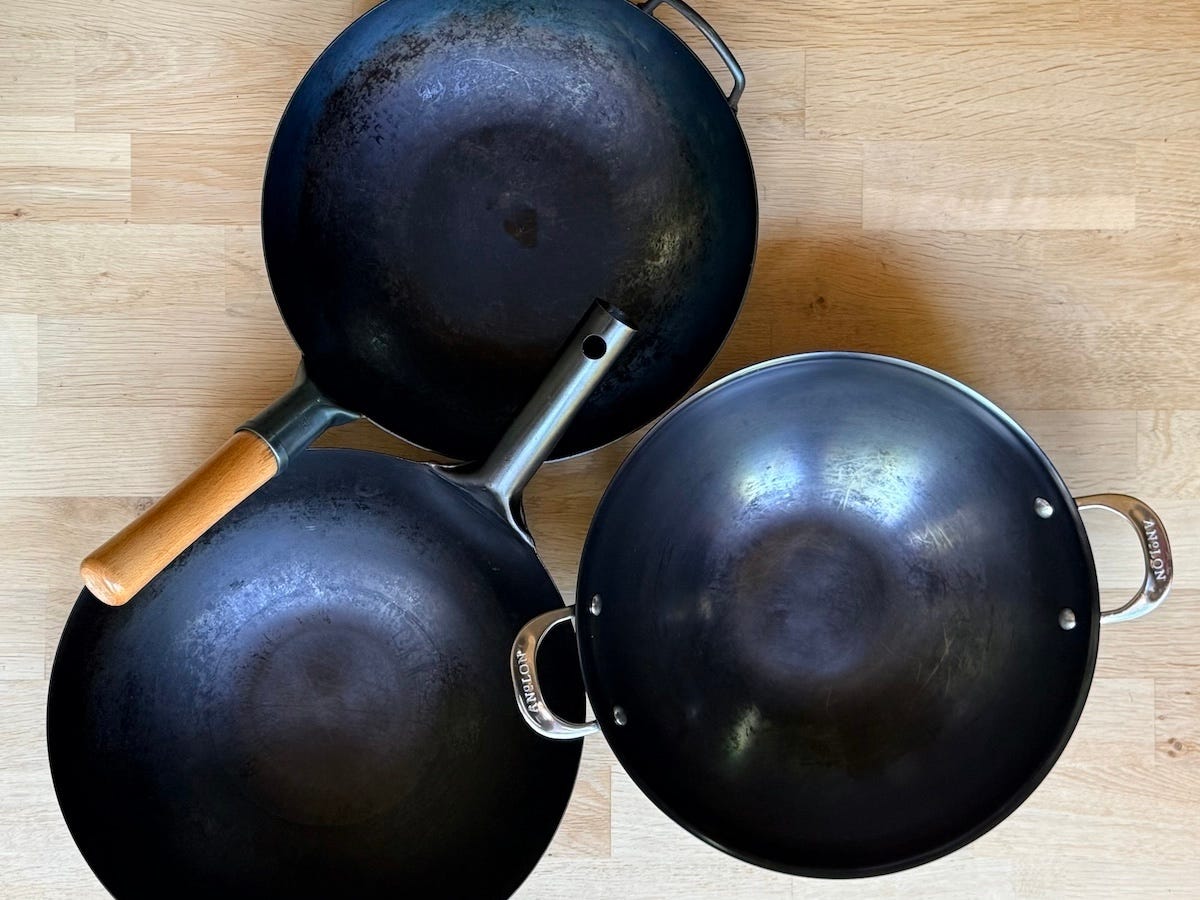
For the past two years, I’ve been road testing three carbon steel woks that are impressively good. Though they are are not all labeled as “pre-seasoned” they require very little elbow grease to prepare them for your wokking pleasures.
3 pre-seasoned carbon steel woks in rotation these days in my kitchen: the Yosukata (top), Anolon EverLast (bottom right), and a Japan iron wok/Beijing wok (bottom left).
Two are heavy duty and the third is lightweight. The lightweight Japan iron/Beijing wok is perfect for cooks who love to toss and flip food.
asked about a wok for cooks with carpal tunnel. My wrist issues are minimal but if I had wrist or hand pain, I would reach for the light Japan/Beijing carbon steel wok. It’s easier to maneuver than other woks, though it had its disadvantages. I put it to work in this kung pao chicken recipe video.
All three carbon steel woks are joys to cook with. I wrote up my review of each carbon steel wok (it’s 🆓 and at my website). Here’s the down and dirty on how they stack up:
When you’ve found a wok you like, you learn its strengths and identify its quirks. Unless a wok is Teflon coated, it needs to be seasoned. Even if a wok comes “pre-seasoned”, it still requires a little seasoning. It’s like with cast iron — you must maintain and cultivate the metal to ensure a lifetime of good cooking.
What exactly is seasoning a wok? Seasoning a wok involves heating the metal (carbon steel or cast iron) so it expand a bit to receive oil or fat, which gets into the microscopic crevices to form a film. This happens during a purposeful seasoning process as well as through regular usage. Overtime, as oil gets into the metal, a patina develops and the pan surface becomes more slick. As a pan gets seasoned, it may change color, depending on the metal.
To season a wok, I use one of these methods, depending on the pan and needs:
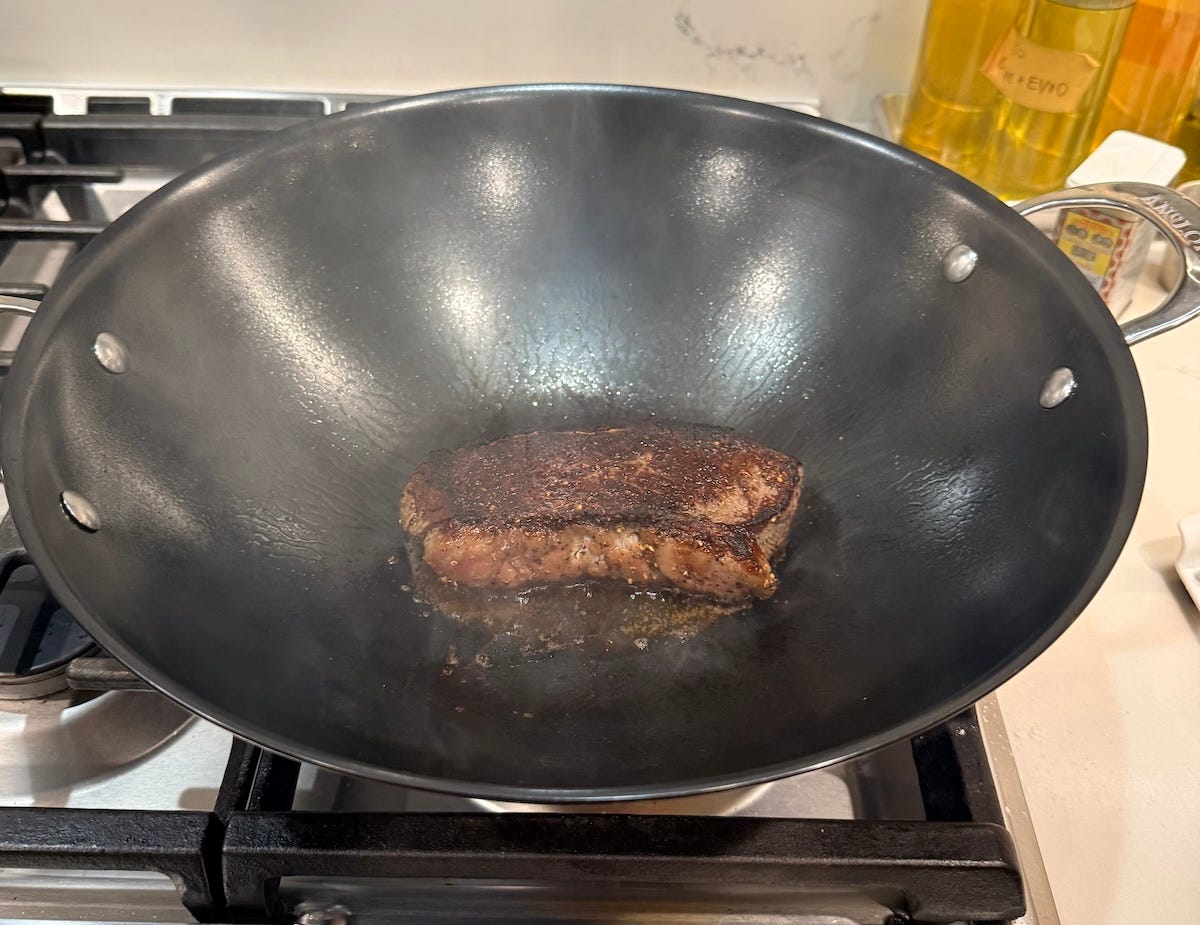
Cook with the wok regularly (I do it twice a week, at least) to keep the seasoning going. Aside from stir-frying, fry an egg or better yet — sear beef steaks or cook fish fillet in a wok.
Why sear steaks or fish in the wok? Because (1) the hot heat creates a crisp well browned exterior, (2) you can easily baste the food with butter or another fat that will pool in the bottom and (3) most oil droplets fall back down into the wok so there’s less of a mess to clean up.
I simply salted and peppered this steak well and added a drizzle of soy sauce to promote browning. Then I left it to sit out for about 30 minutes while I cooked other parts of the meal.
When and how to re-season a wok? I think of re-seasoning as refreshing the wok, only you’re not starting from scratch.If a wok looks dry or if food is sticking too much during repeated uses, re-season the wok. When I neglect to wash the wok well and black bits flake off during cooking, it’s time to re-season.
Here’s my quick “oil smear” re-seasoning process: Wash the pan well with coarse salt and soap, then I dry it over medium heat, add a tiny bit of oil, use paper towel to smear it all over, let the pan keep heating up till it smokes, then turn the heat off and leave the wok to cool. This whole process takes literally only a couple of minutes.
If the pan is super gross, then I may boil water and a little vinegar in it to thoroughly remove the gunk. Then I’d do one of the three seasoning methods instead of the oil smear.
A good wok talks to you over its lifetime of service in your kitchen. Sometimes it may need some extra love to perform better for you!
This free article was sponsored by paid newsletter subscribers. Join us to seed new content, fully use the recipe index, get class discounts, and more. I value your support at all levels! Thanks for being here.
Wok cooking and cleaning tools
To wok well, you don’t just need something that matches the shape of the wok to scoop, push, flip, and help you quickly move food around. In the photo below, my metal wok spatula has a gentle edge so it does not scratch or ding the wok much when I’m swiftly cooking. The handle is long so you can stand back from the stove and still cook easily. A broad wood spatula works well too!
For cleaning a wok, I love a good bristle brush. A favorite dish scrub brush works too. The handled brush in the above photo is a bona fide wok cleaning brush purchased from a restaurant supply shop.
How I clean my woks
Let the wok briefly cool after you dish out the food. Then hit it with a spray of hot water, a drop of dish soap, lots of active scrubbing and a good rinse to remove all debris; finish with drying on the stove over a low flame or wiping with a dishtowel, depending on the surface.
When stuff is super stuck on the wok, let the dirty pan soak with some water in it while you’re eating. Clean up will be lots easier. Re-season with the “oil smear” method if needed.
If a wok was used for deep-frying, let the oil cool then strain to reuse; or, stir in oil solidifier while the oil is still hot, let it harden, then discard the oil.
Get wokking with 13 recipes
A wok gets better the more you use it. Yes, food will occasionally stick but you’ll befriend the wok and know how to heat it just enough and how to use its best qualities to make great food. Here is a special collection of favorite recipes on my website (🆓) and this newsletter. Jam packed PTFS recipe dispatches often have multiple recipes so there’s lots of versatility built in.
This Sesame Tofu is deliciously savory and has all the trappings of another takeout favorite, Sesame Chicken! The tofu is crusted in sesame seeds and pan-fried until crispy and golden, then tossed in a classic sweet sesame sauce! Our Perfected Sauce The key to a great sesame sauce, whether for sesame tofu or sesame chicken, […]
A few days ago I ran into our neighbor, who kindly invited us for dinner this weekend. She was the first neighbor we met in the building, over our shared back wall, and we hit it off, right off the bat. People in Paris can have complicated (or, um…thorny) relationships with neighbors, which I wrote about in my book L’Appart. But we scored with this one. We now trade keys, look after each other’s apartments when one of us goes away, accept packages for each other, and even call on each other if there’s an emergency.
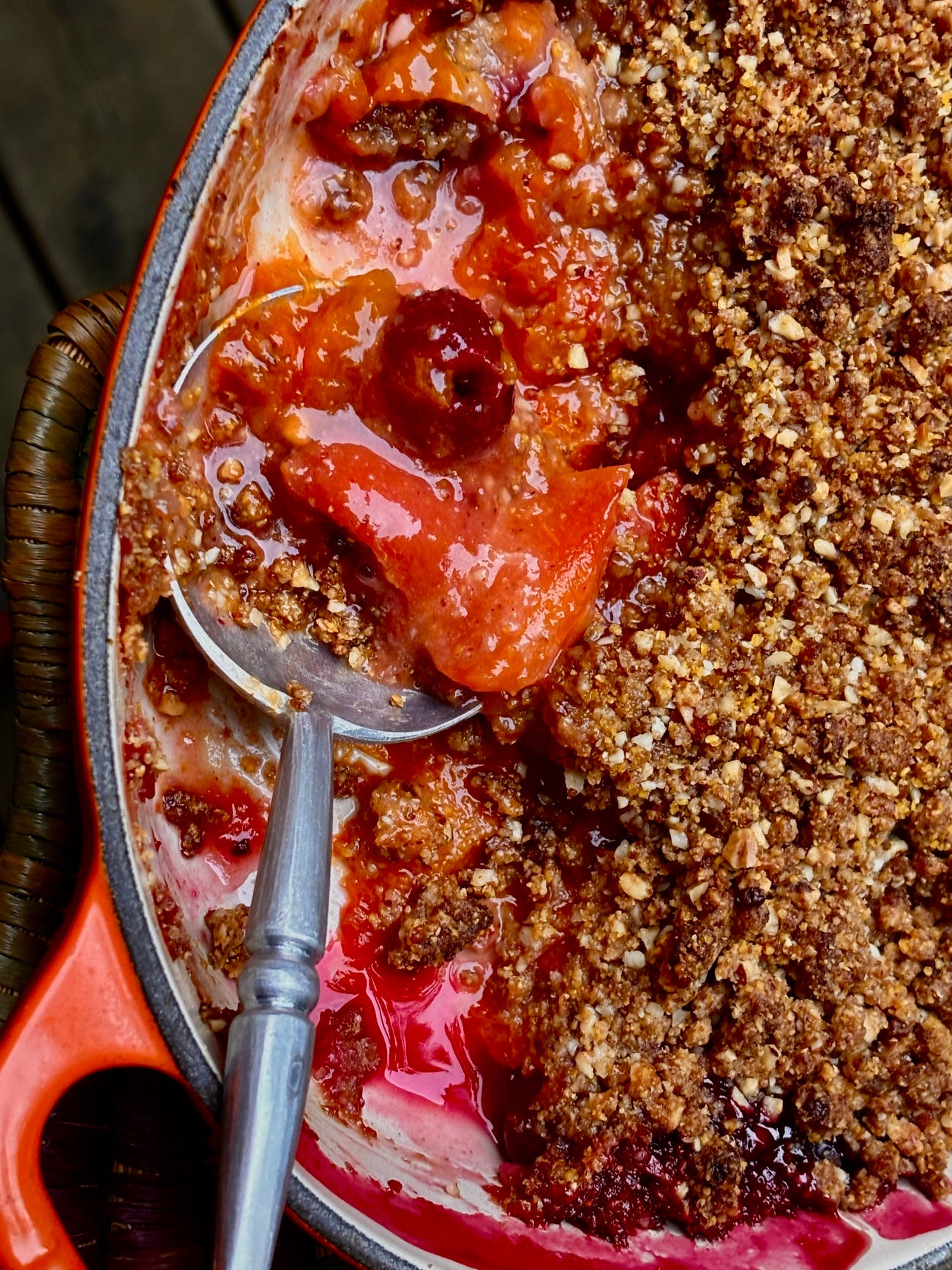
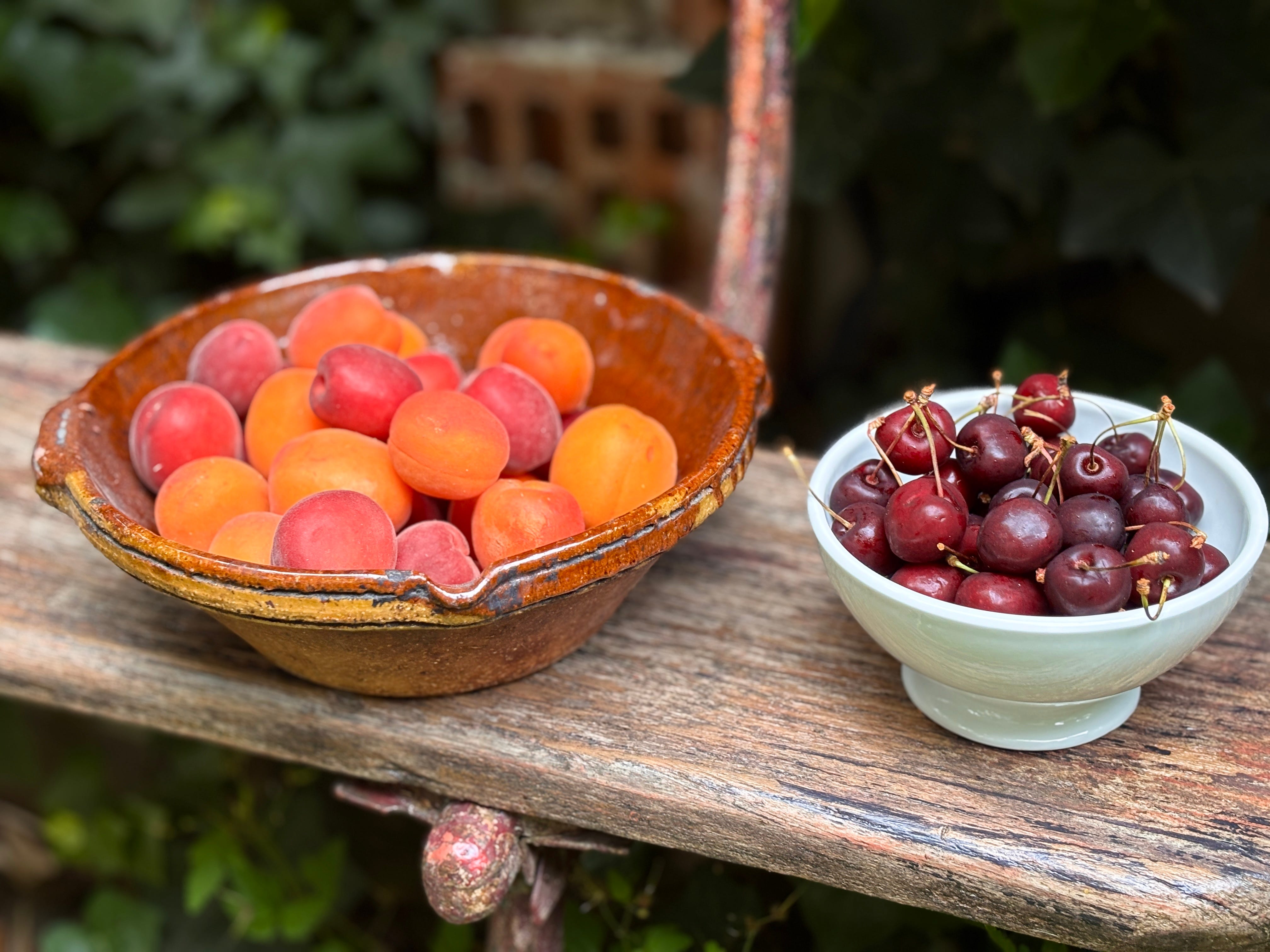
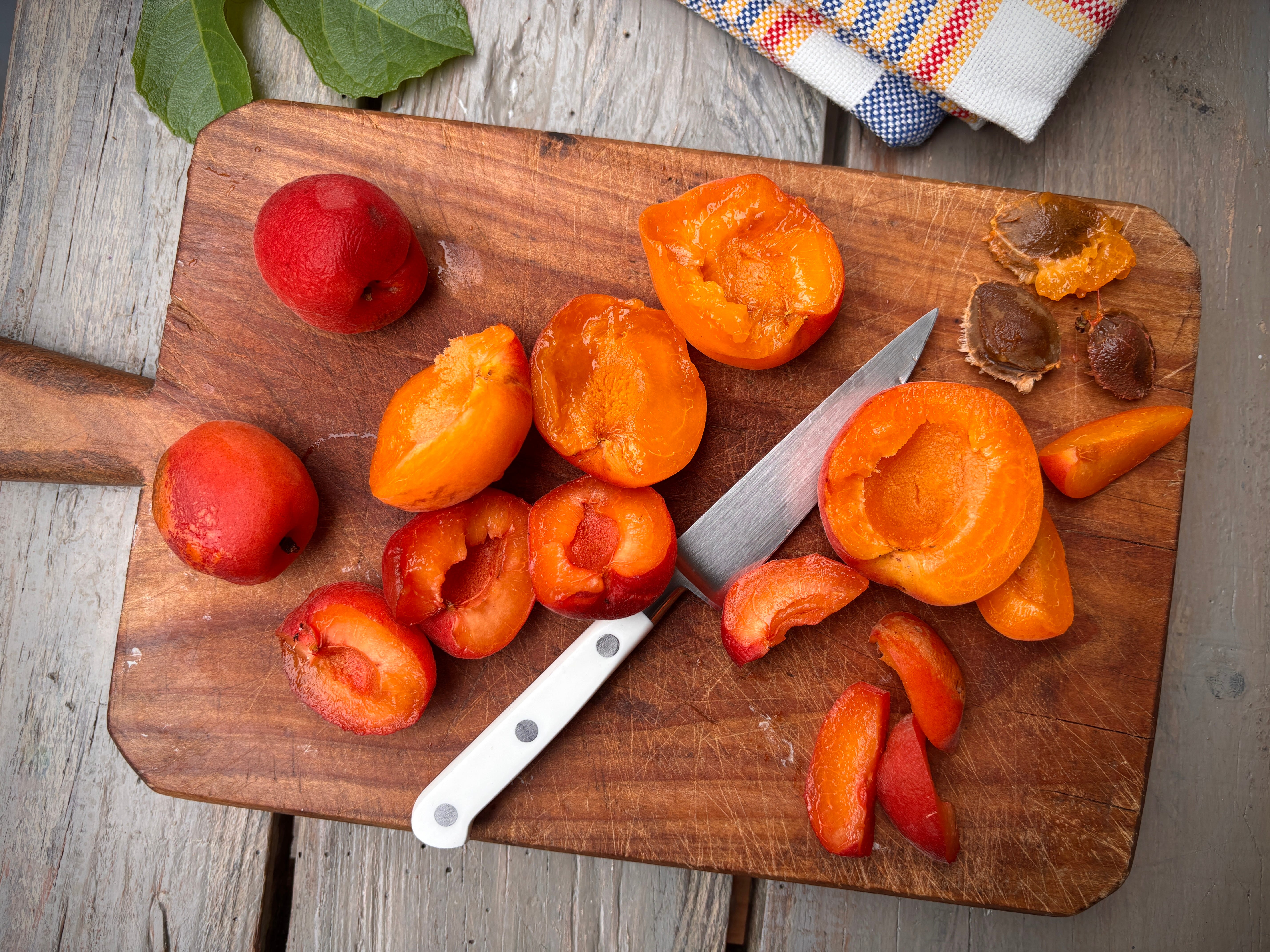
I offered to make dessert and decided to scoop up as many of the beautiful fresh apricots I could find, let them ripen a few days, and turn them into a fruit crisp, which are called crumbles in France. That’s a term picked up from our neighbors in England — un crisp doesn’t come off the tongue as readily as un crumble, but both sound a little funny to me with a French accent. But now that I’m on the 🇫🇷 team here, I call them crumbles, too.
But for now, I’m going to write them as crisps, and this is my favorite, go-to crisp topping. What makes it extra-crisp is the addition of polenta. It’s from my book Ready for Dessert, which is subtitled my “best” recipes, and it really is the best crisp topping, if I do say so myself.
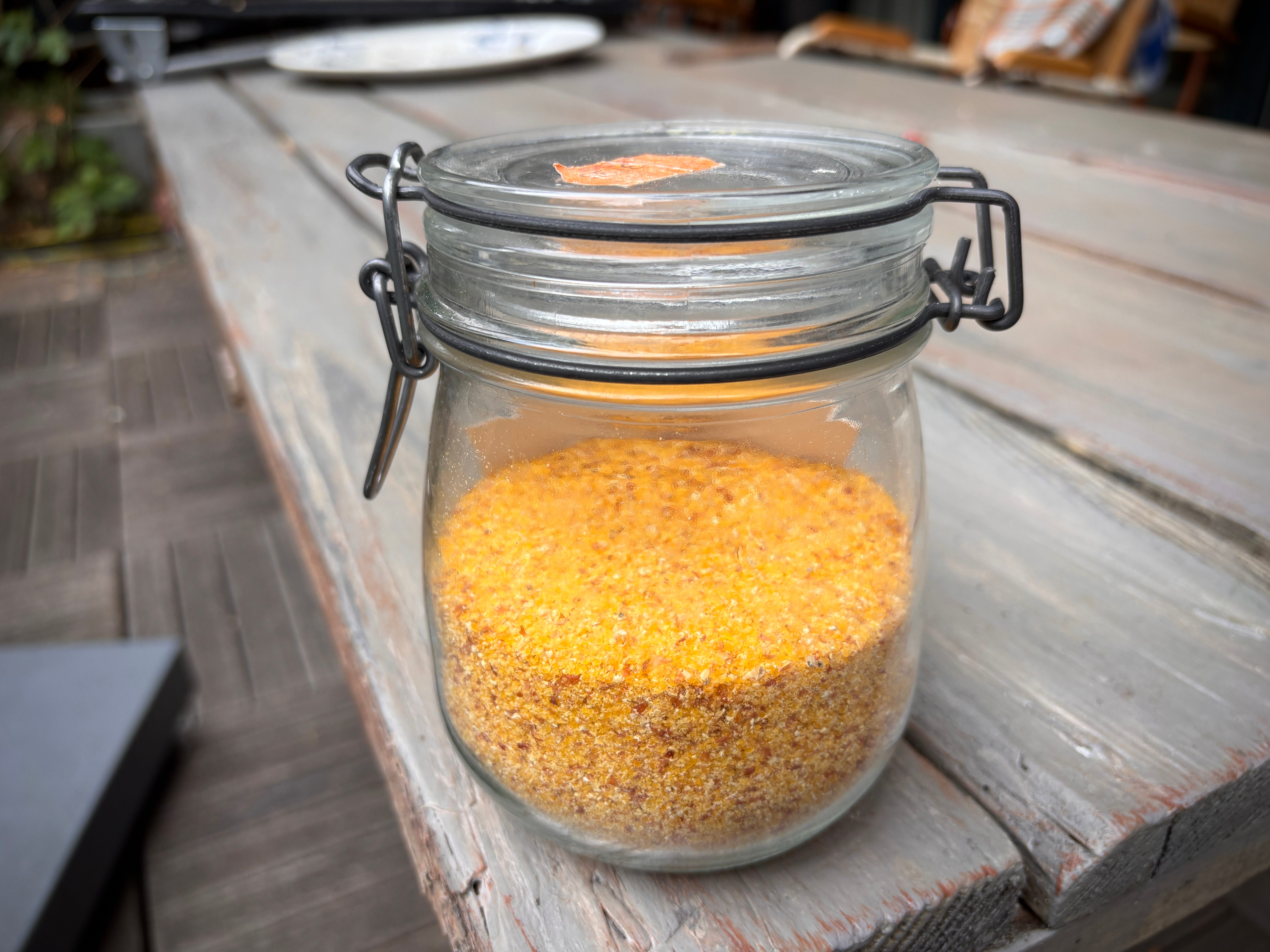
I use very coarse, stone-ground polenta since that has the most crunch, although regular polenta works well, and while I’m not as much of a fan of instant polenta as others are around here, that works too, as does cornmeal. As for the nuts, I generally go with almonds since they go well with stone fruits, but you can use walnuts or pecans if you prefer.
When I wrote my first book, back in 1999, I assumed people didn’t have food processors, although I think they may be more common these days? My KitchenAid food processor* has a broken bowl so the handle is filling with gunk, and they don’t sell replacements. I miss having a classic Cuisinart food processor, which I had in the States, and it was really a workhorse in the kitchen. (Even Wirecutter agrees with me.) But they’re not available in France.
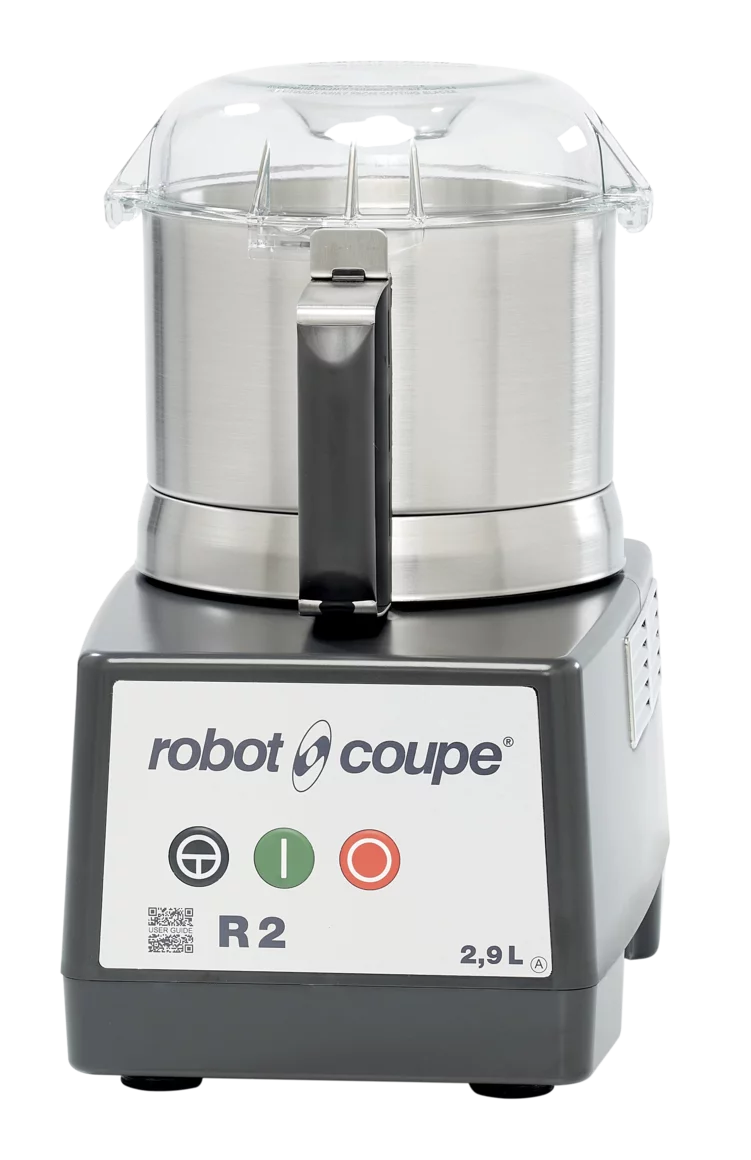
I’m thinking of springing for a Robot-Coupe, although with a starting price of €1200 ($1390) 💸 I’m going to hang on to my food processor until the day dies, then consider my options.
While I prefer to mix the topping in a food processor, you can also mix it in a stand mixer with the paddle attachment, or by hand if you chop the nuts first. When I make it, I pulse all the dry ingredients until the mixture is sandy, then add the butter and pulse it rapidly a few more times, just until I see small clumps sticking together. I like large, discernible bits of crisp topping in the finished crisp rather than a smooth, sandy texture.
Subscribe to my newsletter and get more recipes, posts, and Paris travel tips, sent right to your Inbox! Paid subscribers get full access to all posts as well as the recipe archives.
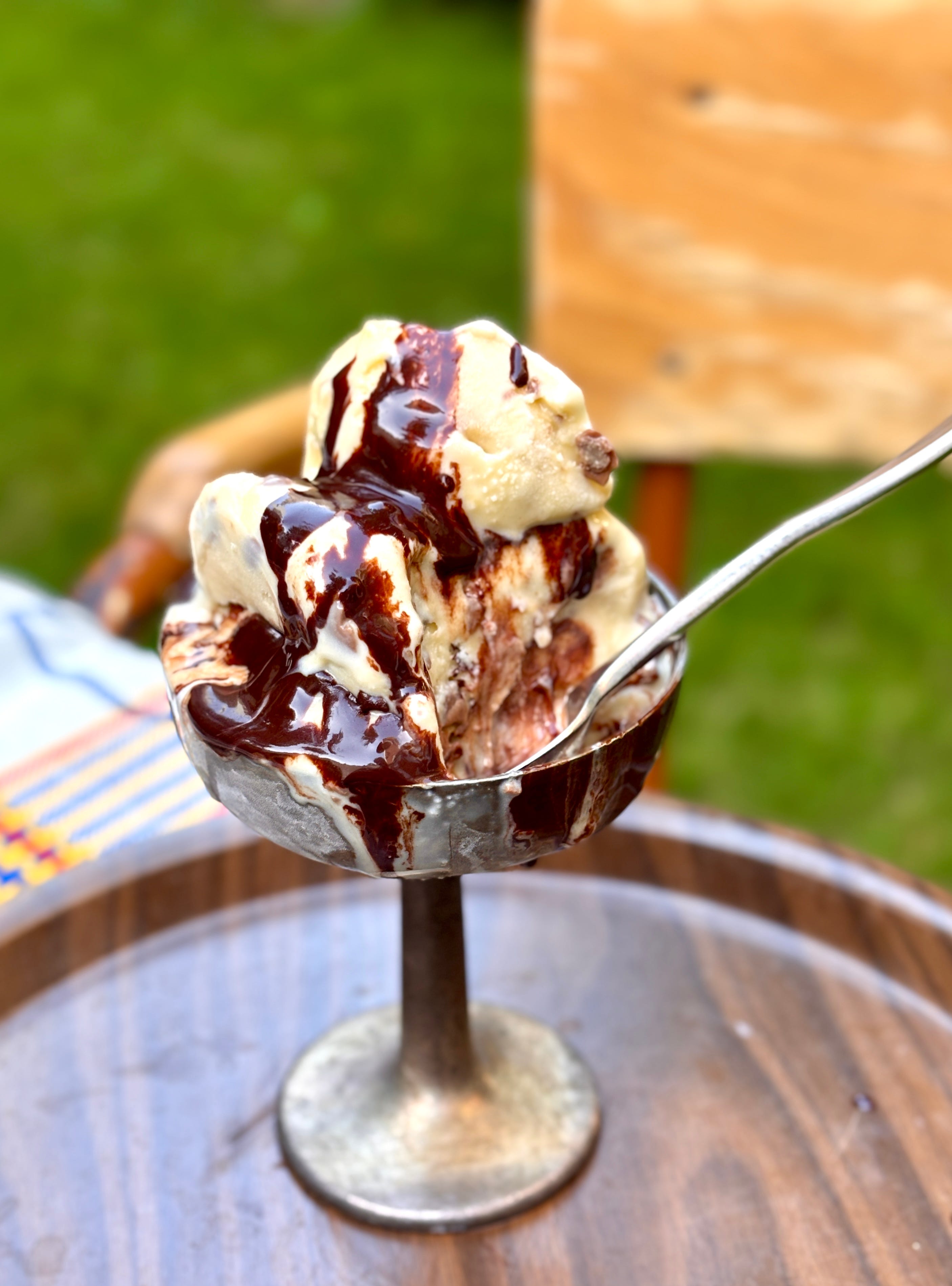
Ice cream, of course, is the preferred pairing with a warm fruit crisp. I just happen to have a lot of ice cream in my freezer at the moment, but the one I’m going to bring is the leftover apricot kernel oil ice cream that I made to impress a chef friend who came to make an upcoming video with me.
That was one of those recipes I shared back in 2008, when a few companies were making apricot or plum kernel oil, which has become harder to find. Some of it is sold for cosmetic purposes and isn’t intended for food use. I used the last of my bottle, but Vanilla, Cinnamon, White Chocolate-Fresh Ginger, or Malted Milk ice cream are great accompaniments, or just serve the crisp warm with a pitcher of cold heavy cream on the side.
We’re fortunate to have a lot of fresh apricots available to us right now, but if you want to swap inslices of nectarines or peeled peaches, reduce the sugar in the filling to 2 tablespoons. In place of the cherries, feel free to swap in blackberries, blueberries, or raspberries, or just use more apricots.
In place of the kirsch and almond extract, you can use 1 teaspoon pure vanilla extract, total. You can make the topping up to one week in advance and refrigerate or freeze it.
Topping
3/4 cup (110g) flour
2/3 cup (100g) polenta
1/2 cup(65g) lightly toasted almonds, walnuts, or pecans
1/2 cup (90g) packed light brown sugar
1 teaspoon ground cinnamon
1/4 teaspoon salt
8 tablespoons (4 ounces, 115g) unsalted butter, cubed and chilled
Make the topping by pulsing together the flour, polenta, nuts, brown sugar, cinnamon, and salt, just until the nuts are slightly broken up. Add the cubes of cold butter and pulse until the butter is well integrated. Pulse a few more times until little bits of the mixture begin to clump together.
Preheat the oven to 375ºF (190ºC).
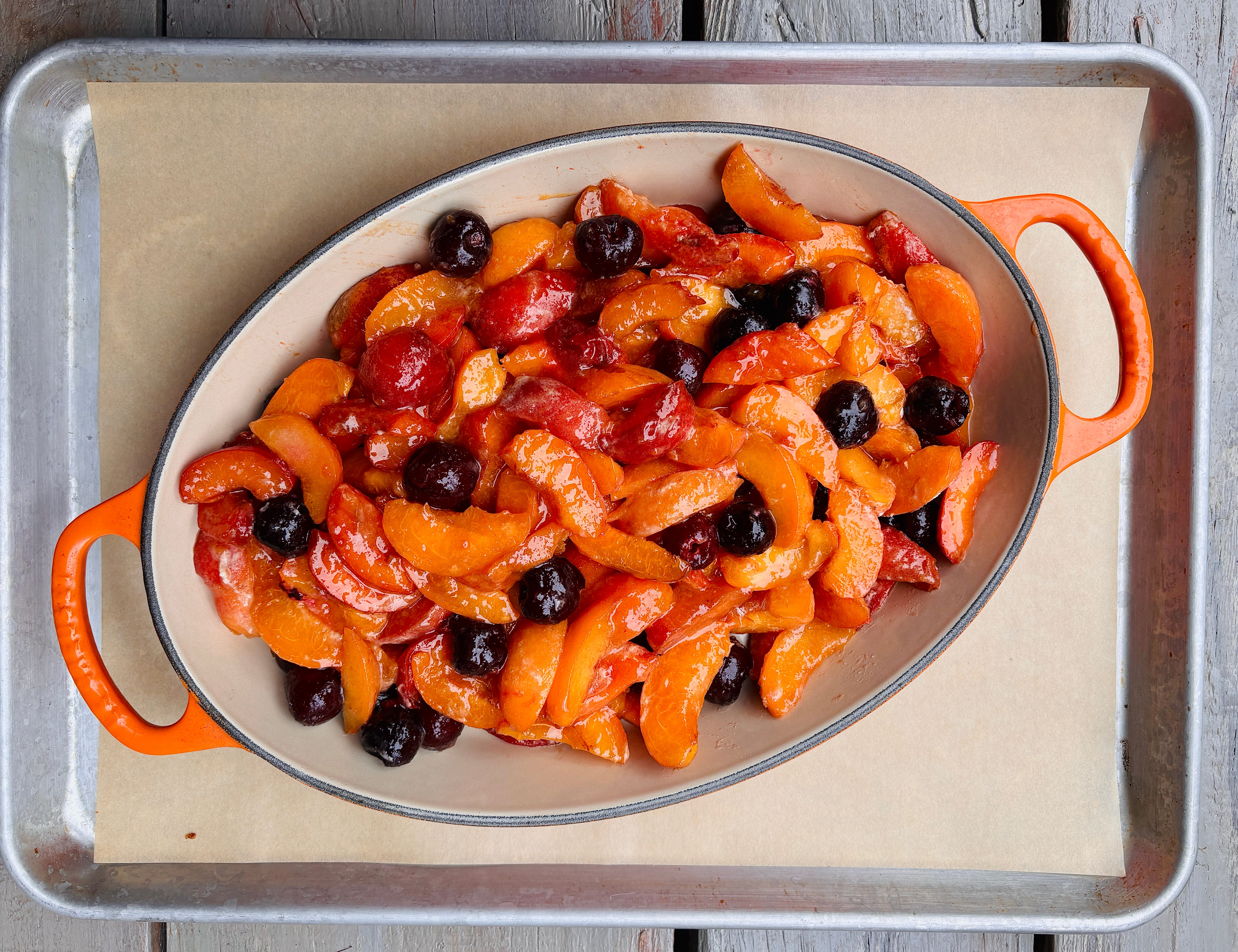
To make the filling, in a medium bowl, mix together the sliced apricots, cherries, sugar, flour, kirsch, and almond extract. Spread the fruit into a 2-quart (2L) baking dish, then strew the crisp topping evenly over the fruit. Resist the urge to press it down so it’s completely flat; I think it’s best when it’s a little unevenly baked, so you get lots of crunchy bits here and there.
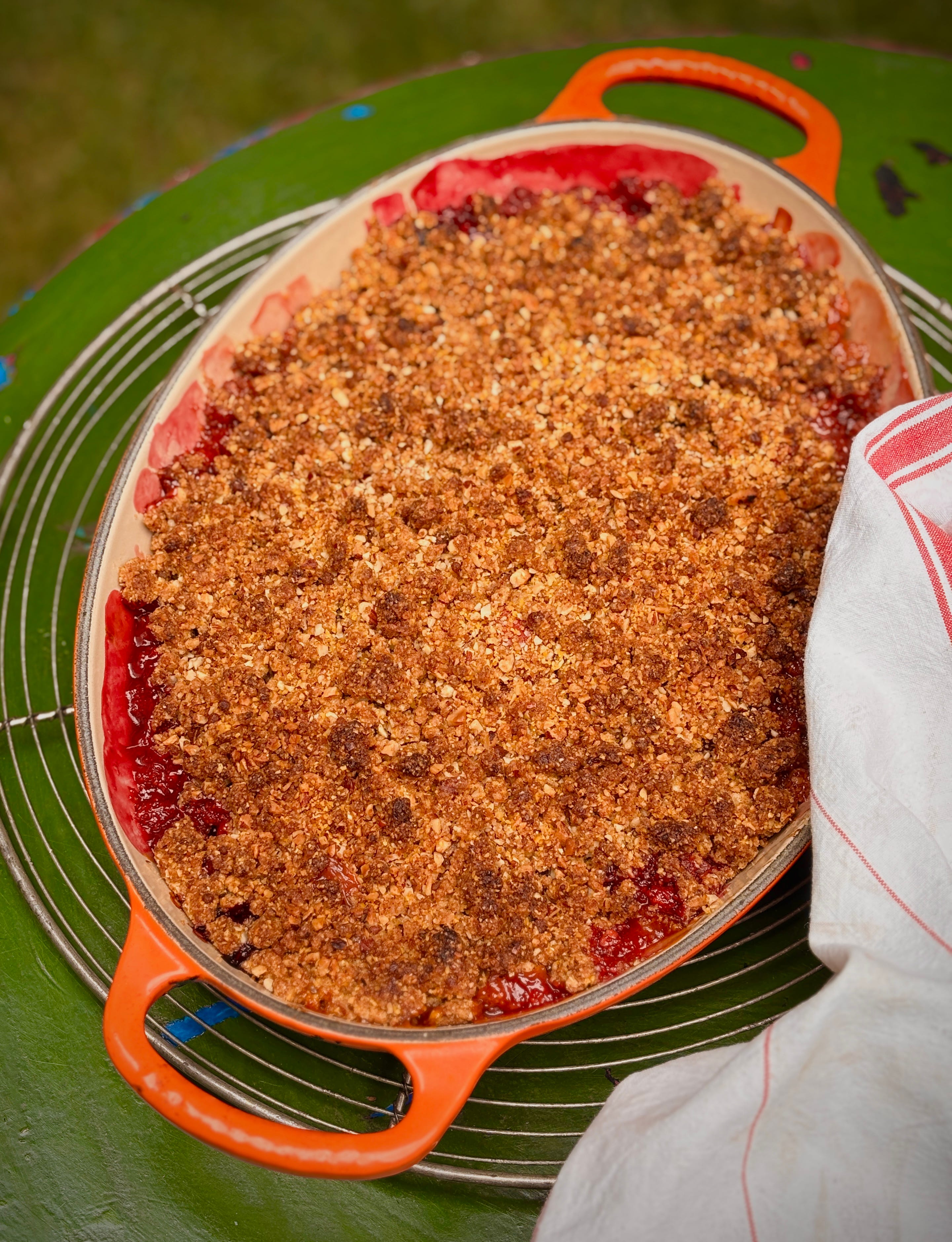
Place the baking dish on a baking sheet lined with parchment paper or aluminum foil, shiny side down. Bake in the oven until the top is golden brown and there are thick juices bubbling up around the edges. When you poke a paring knife into the center, if it meets no resistance, it’s done. If the topping is getting too dark before the fruit is fully cooked, you can drape a sheet of aluminum foil over the top and finish cooking.
The exact baking time depends a bit on the ripeness of the fruit but will take around 40 minutes to bake. Serve warm or at room temperature, with a scoop of ice cream or heavy cream.
*A number of people chimed in the comments, a few saying Cuisinart makes replacement bowls, but my current food processor is (or was) made by KitchenAid, and I’ve not been able to find a replacement bowl after a considerable amount of searching. (I’ve had mixed results ordering replacement parts online. A few times the item didn’t fit the machine I had, even through the item description said it did.
The model number of my KitchenAid food processor is #5KFPM771EWH0 - if anyone finds one, let me know : )
Thanks for reading my newsletter! Feel free to share it.
Meet the ultimate zucchini side dish. It features caramelized zucchini and red onion with toasted sliced almonds, seasoned with fresh garlic and a squeeze of lemon juice. The flavors are bold, the dish is vibrant, and I’m going to make this sautéed zucchini all summer long.
I don’t always like cooked zucchini, but I love this recipe. Zucchini can be squeaky or mushy, and I often avoid it on restaurant menus for those reasons. Not this recipe! The zucchini is perfectly browned and tender throughout.
The flavors in this recipe remind me of green beans amandine, if you’re familiar—another one of my favorite veggie side dishes. Our friend Erika introduced us to this concept last summer in St. Louis. It paired beautifully with pasta and grilled options on their back porch. I asked her for the recipe afterward, and I’m excited to share it with you today.
There’s something special about Pork Belly Char Siu that goes above and beyond a traditional roast pork char siu. Super-tender and decadent, pork belly roasts up beautifully and just melts in your mouth! Serve it over a plate of steamed rice with a simple side of blanched greens, and you have a simple but outrageously delicious meal. It […]
These red bean zongzi are sticky rice dumplings full of molten glutinous rice dotted with tender red (adzuki) beans! Serve with a little maple syrup or honey for a truly special dessert or snack, especially around the Dragon Boat Festival! Using Whole Red Beans for a Different Texture With the Dragon Boat Festival coming up, […]
When you write a cookbook, a question people frequently ask is, “What’s your favorite recipe in the book?” It’s hard to say because if a recipe wasn’t one of my favorites, I wouldn’t have put it in a book. I don’t have kids, but some people say that’s like asking a parent who their favorite child is. (Although I suspect if that question was asked to parents anonymously, some might have an opinion on that.)
When a recipe goes in one of my books, it’s generally been tested between three to five times, minimum, and sometimes up to seventeen, which was one recipe I got particularly obsessive about. (Often if I don’t get it by the sixth or seventh try, I give up because I think it just might be too fussy or difficult.) Years ago I was at a culinary conference talking with Flo Braker, an expert baker and cookbook author, and a young woman came over to us, who said she was working on her first cookbook. “Sometimes I have to test a recipe three times!” she told us.
When she walked away, Flo turned to me and said, “Oh my goodness, you’re lucky if you get it right by the third try.”
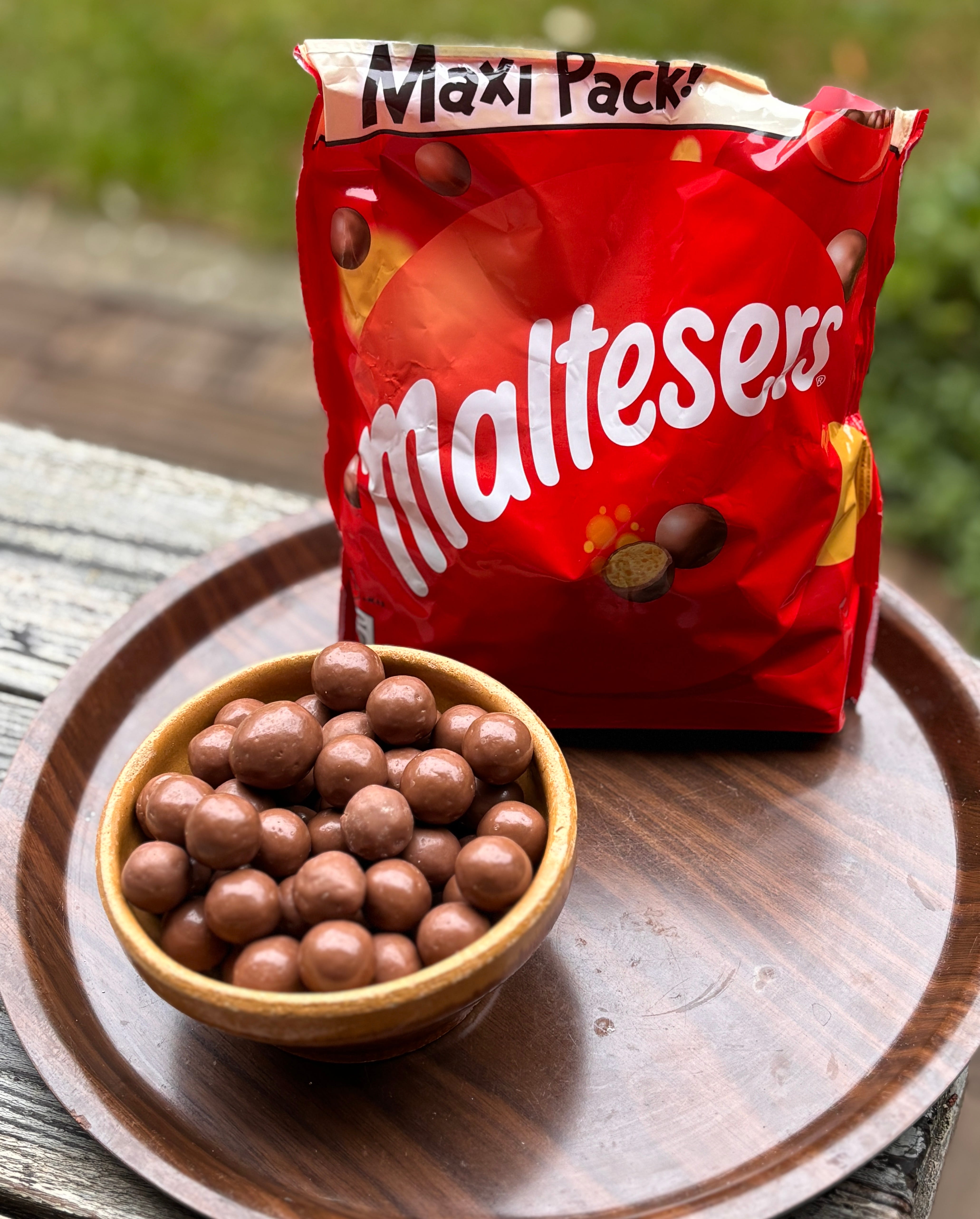
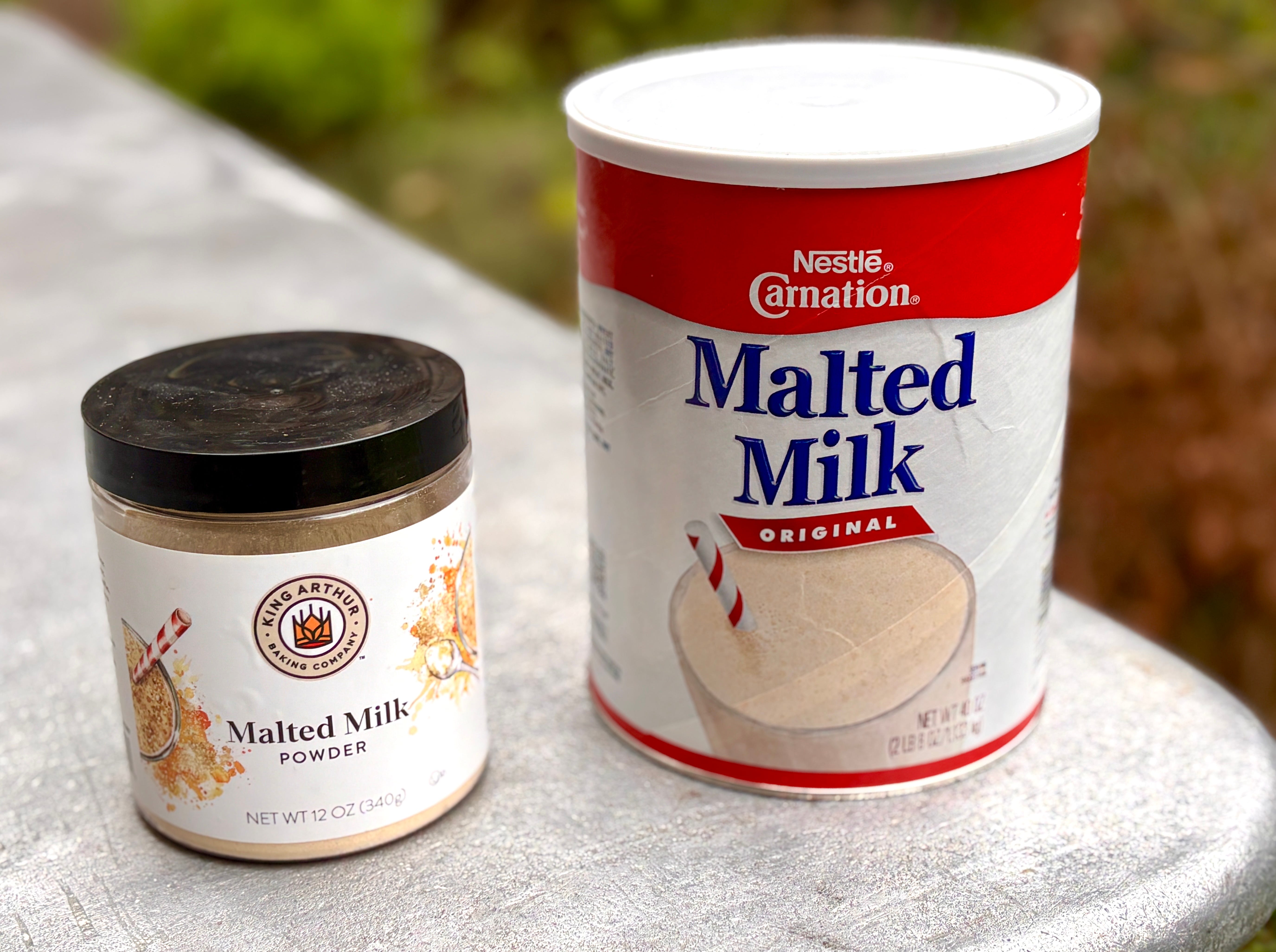
When The Perfect Scoop came out, I had an unofficial system of calibrating which recipe was my favorite. Because I was churning up so much ice cream, and a freezer can only fit so much ice cream in it, I had to give my trials away as fast as I could to make room for subsequent batches. But the one I didn’t give up was this one: Malted Milk Ice Cream.
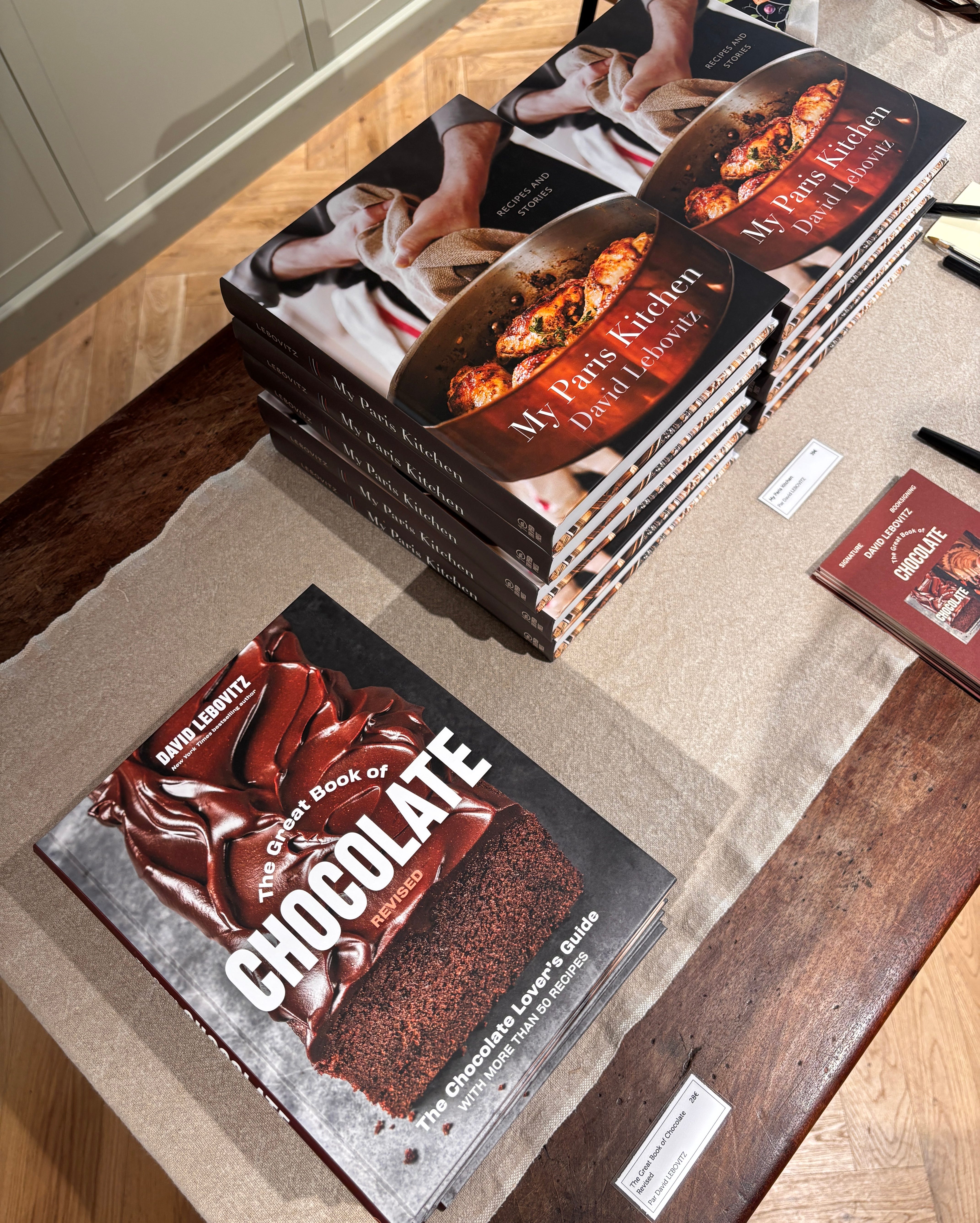
This year I was happy to revise and update two of my books: Ready for Dessert and The Great Book of Chocolate. Anyone who cooks or bakes knows that when you make the same thing over and over, after a while, you might change an ingredient, or figure out a new technique for making it that’s faster or more effective.
I thought - why not toast the malted milk powder first? How smart would I be, adding that step to the recipe? Feeling very satisfied with myself, I started heating the powder in a skillet and within a few seconds…
For those of you who wondered how long the Taiwanese sesame noodle sauce lasts, I’m confirming that it’s freezable. I froze a jar of it for a week, then drove it to my mom’s house in Southern California where I whipped up the noodles for a fast lunch. The sauce tasted like it was freshly made! So go ahead and make a double batch of the cold sesame noodles sauce and use one now. Freeze the balance as 1/3 cup (80ml) portions for single servings and faster thawing.
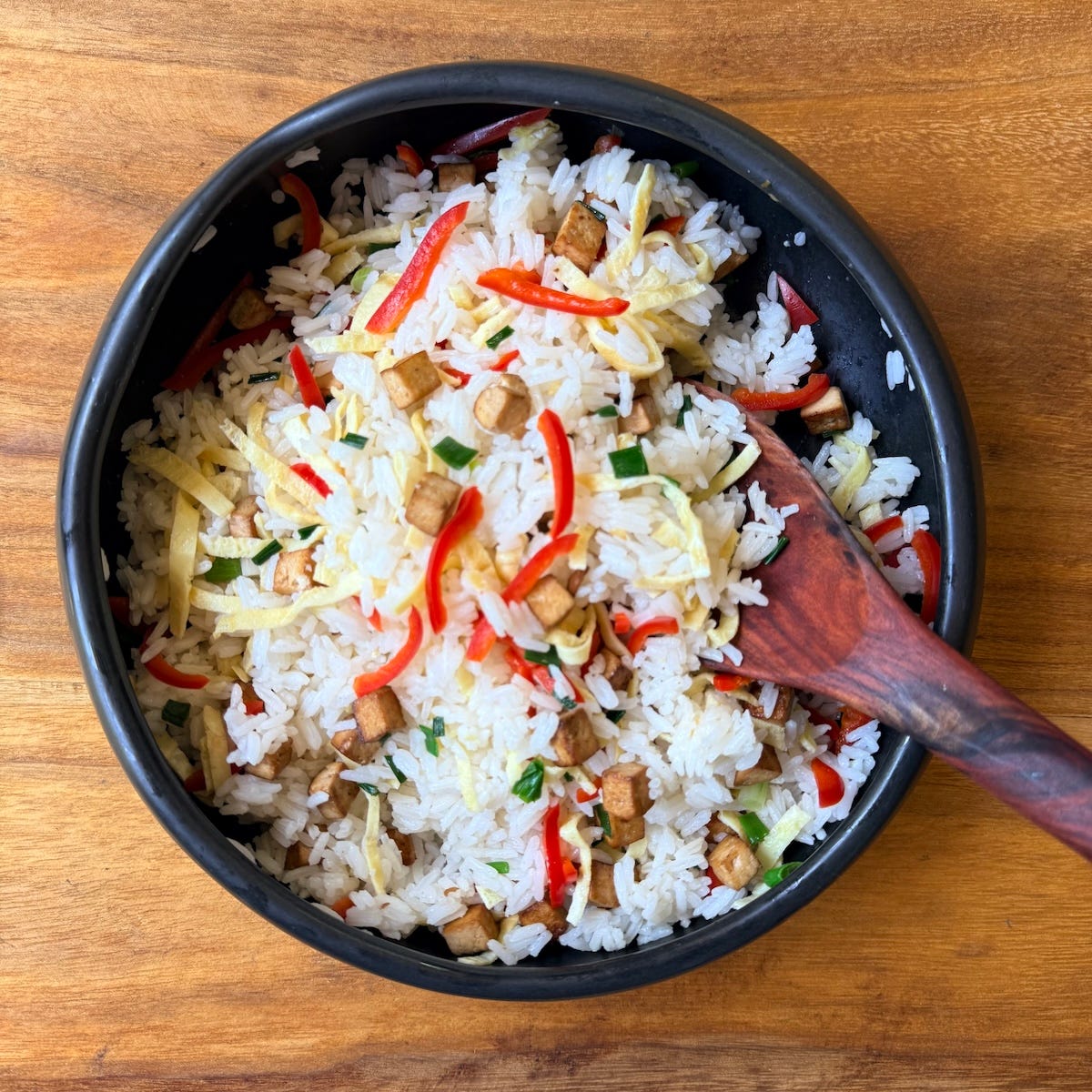
Using egg strips for the sesame noodles reminded me how useful egg sheets are as a protein-rich addition to East Asian noodles, dim sum, and rice dishes. I grew up with trứng tráng (egg sheets in Vietnamese) in sophisticated Hanoi-style bún thang noodle soup and cheery mixed rice (cơm trộn).
My mom regularly prepared the rice dish, which is easy breezy and healthier than fried rice. Cơm trộn is simply hot rice mixed with add-ins but done in a particular fashion so it tastes special and fun. In the photo below, the red strips are a quick pickled sweet pepper which lends a crunch, piquant note to the rice.
Vegetarian mixed rice (cơm trộn chay) with seared tofu. I’ve prepared it with grilled leftovers during summer and thrown in a handful of fresh herbs too. The sky’s the limit with mixed rice so get the blueprint and make it!
Feeling nostalgic and hungry the other day, I threw together a vegetarian batch of cơm trộn for an easygoing lunch. However you make mixed rice, it’s lite and can be served warm or at room temp. It was so good that I shared my blueprint recipe and tips on the website for you to craft your own. When you make my mixed rice, look for the link to the recipe for egg sheets too (you’re welcome). Get friendly with the Viet mixed rice recipe this summer!
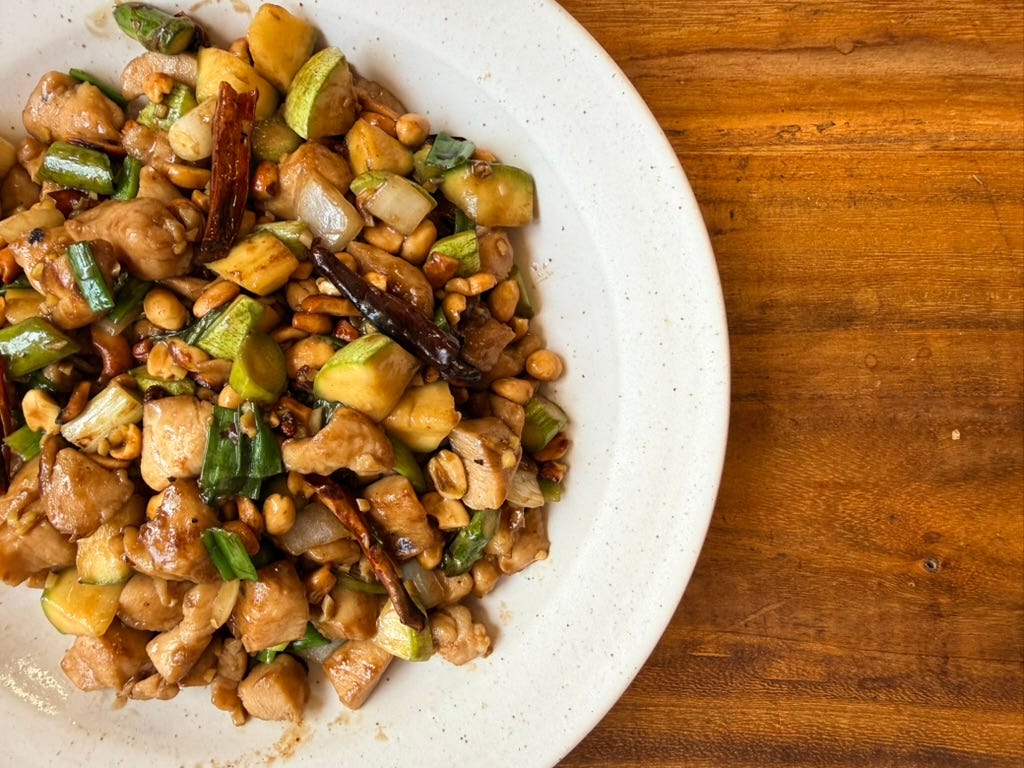
This week’s big cooking star was kung pao. I challenged myself to come up with a stellar kung pao chicken recipe that:
Can be used as a plug-and-play template to feature other proteins or be vegan
Includes enough vegetables so it can be eaten with rice as a satisfying, wholesome meal
Allows nuts to shine, not just be minor decor as they usually are in takeout versions
Breaking kung pao rules (sort of)
In Mandarin Chinese, 宫保鸡丁gōngbǎo jī dīng literally means “Palace Guardian Chicken Cubes”. It was a favorite dish of an 18th century provincial governor named Ding Baozhen (1820–1886). Parsing the Chinese name:
宫保 gōng bǎo (Palace Guardian) was part of Ding Baozhen’s official title
鸡 jī means chicken
丁 dīng means cubes and also is a pun on the man’s surname, Ding
Kung pao chicken, the Sichuanese spicy, tangy chicken stir-fry that we know today, likely originated from the time the governor spent his youth in Guizhou (a southwestern Chinese province located north of Vietnam). Modern cooks in Guizhou season kung pao with fermented bean sauce and chili-garlic-ginger paste. No nuts are included in Guizhou kung pao. And, there are versions with chicken, shrimp, potatoes, and even pig’s stomach.
Ding loved chicken stir-fries so much he told his cooks to include it on menus for guests. When he governed northeastern Shandong province, he enjoyed a chile-less version with walnuts or cashews instead of peanuts.
His last post was in Sichuan, which explains why the popularized version of kung pao chicken includes dried chile, Sichuan peppercorns, peanuts, and Chinkiang vinegar. Those ingredients are found in other Sichuan favorites.
My version of Sichuan kung pao chicken.
Compared to other Sichuan dishes like mapo tofu, kung pao chicken is not overly spicy or fiercely hot. Perhaps the governor’s cook incorporated all the ideas from the three provinces where governor Ding had been posted? He and his family moved about the country with a staff, including cooks, who likely adopted his favorite chicken dish to local tastes and ingredient availability, writes Fuchsia Dunlop in an article for the Los Angeles Times1.
As a result, nerdy kung pao fans will recognize Guizhou, Shandong and Sichuan versions. I’ve not graduated to nerdish level and am stuck in the Sichuan level so I focused on that iconic iteration for the foundation of my recipe. That said, kung pao has a rich backstory that makes it much more interesting than what we may normally think. You can play with it.
After formulating my kung pao chicken recipe, I used it to make scallop kung pao and a mushroom kung pao. From one recipe, I got three (3) surprisingly delicious kung pao stir fries. AWESOME.
To prime you to flex your kung pao muscles, watch me make the stir-fry and preview the techniques.
Below you’ll find:
My master kung pao chicken recipe in full text and downloadable PDF
Notes for making Kung Pao Scallop and Kung Pao Mushroom
Ingredient tips for chiles and peppercorns
Pointers for getting kung pao’s vinegary tang just right
Paid subscribers sponsor PTFS. This kung pao tour de force is for them. Upgrade to paid status to get the whole shebang, mine the full newsletter recipe index, and gain so much more. Thanks for your considerations.
Stir-fried Spinach is a popular choice of leafy green side when it comes to Chinese home cooking. It’s nutrient-dense and cooks quickly. Here’s how we do it! The Benefits of Cooked Spinach So much of spinach these days is consumed raw in salads, but when you stir-fry it, it’s much easier for your body to […]
These Gluten Free Scallion Pancakes are a marvel: chewy, crispy, scallion-packed and absurdly fast to whip up. Instead of using gluten-free flour, which produces a dense, dry pancake, we make them with layers of Vietnamese rice paper—to gloriously chewy and crispy effect! The Best solution for a chewy, flaky, gluten-free scallion pancake Making Chinese food […]
One of my most exasperating traits — or, perhaps one that makes me ideally suited for this space I invented, coincidentally, to suit my collection of traits — is that I have a terrific amount of random ingredient preparation ideas in the overflowing file cabinet of my brain that will spill into conversations the second I hear the triggering keyword.
The St. Paul Sandwich is a uniquely American creation, ironically originating in St. Louis, Missouri. It’s an Egg Foo Young patty sandwiched between white bread, with mayo, lettuce, tomato, and pickles, and it is glorious! We recently decided to put The Woks of Life spin on it, with a step-by-step recipe and a new YouTube […]
As someone who is passionate about cookbooks, I’m always up for talking about them with other cookbook collectors. I know there are lots of cookbook collectors out there, but one who really stands out is , who writes the Cookbookery Collective newsletter, which she describes as:
…a hub for the cookbook community—authors, eaters, cooks, editors, publicists, publishers, agents, and aspiring authors alike. It’s a place to celebrate all cookbooks, new and old, blockbuster and under-the-radar. It’s a place to hear from your favorite authors and talk amongst ourselves in the comments section. It’s a place where everyone is welcome, whether you have just a handful of beloved books or a collection in the hundreds.
I couldn’t have said it better, except to add what a wonderful resource Jenna, and her newsletter, have become to the cookbook community, which features interviews with cookbook authors, including me…
…plus seasonal round-ups of the latest cookbooks to hit the shelves, previews of cookbooks that are about to be released, as well as recipes from her favorite cookbooks.
Not only does Jenna write a newsletter, she’s also the food director at Real Simple magazine, the author of five cookbooks, and runs a personal chef business. Whew!
In addition to her other activities, Jenna is now a novelist, having penned her first novel, coming out this Fall, The Foreign Correspondent’s Wife, a mystery set in Paris.
I was thrilled to get a chance to sit down for this podcast episode with Jenna to talk about our favorite subject: Cookbooks! We talked about everything, from what makes a good cookbook (and what drives her crazy in a cookbook) to how she decides which cookbooks that cross her desk she holds on to, and which ones she lets go. We also discussed what she thinks of influencer cookbooks, and talked about one of the big questions of our time - how will AI affect cookbooks, and will it (or can it) replace them.
Subscribe to my newsletter to get future podcasts, videos, recipes, and Paris travel tips, sent right to your inbox!
I hope you enjoy my chat with Jenna as much as I did…and let us know in the comments what are some of your favorite cookbooks, and why.
It’s been a nutty and seedy time my kitchen these days. I mean that in good culinary ways. Two recipes got me thinking about how we transform nuts and seeds to use their lusciousness in foods. More often than not, we think of chopping nuts. Seeds are added whole to dishes.
But if you take a minute to pound or grind nuts or seeds, you’ll release their aroma and oils so they can efficiently enrich dishes. For instance, I pound sesame seeds for a last minute flourish in my Vietnamese pomelo salad (gỏi bưởi). It’s such a lean salad that it needs fattiness to help balance and unite all the components. Pounded sesame seeds enrich without making the salad slick and oily; the seeds are rendered into teeny tiny bits, not a liquid.
Vietnam is the world’s leading exporter of cashews but traditional Vietnamese recipes employ whole or chopped cashews only for stir-fries or candy. Andy Baraghani got me thinking otherwise. He grinds cashews for a creamy nuoc cham sauce that’s voluptuous, tangy, a little hot and a lot umami.
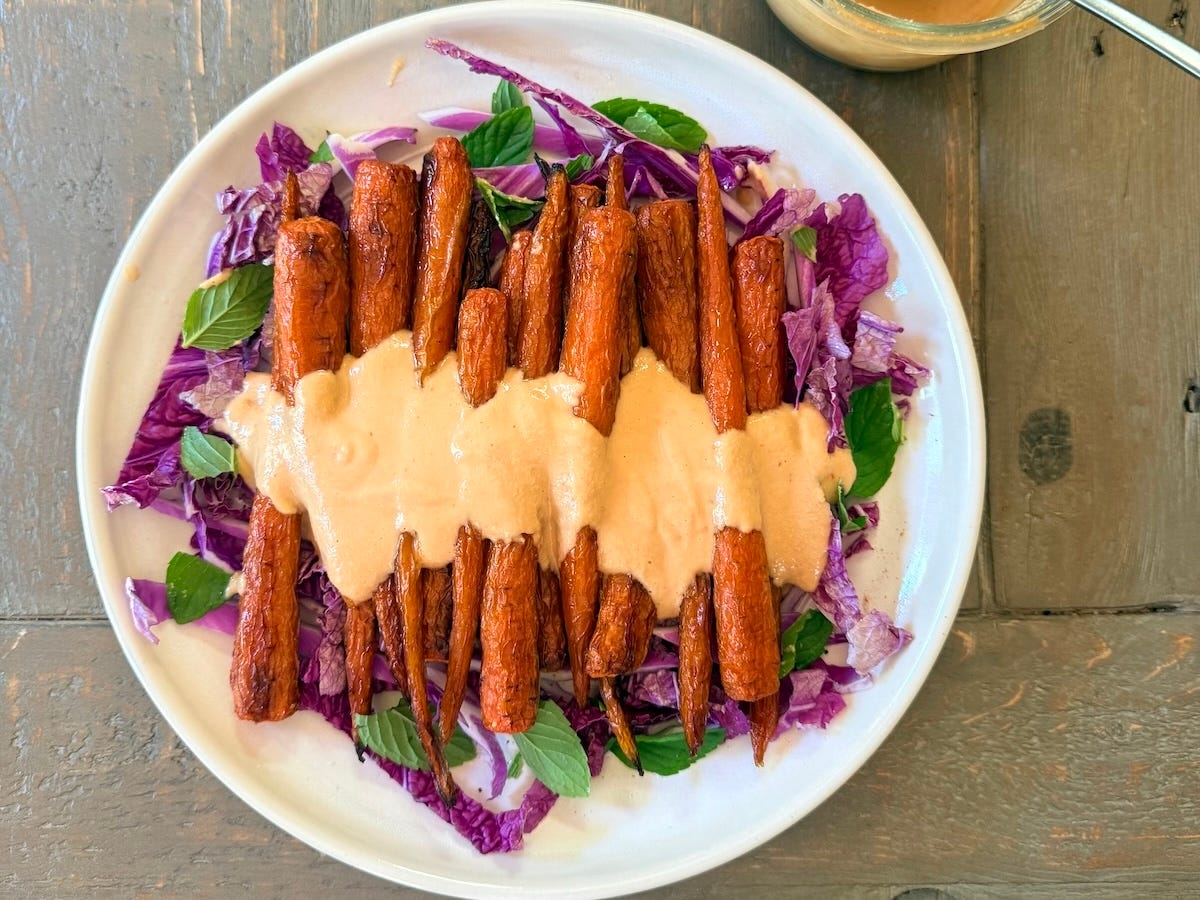
Cashews have a natural fattiness and mild sweetness so grinding them up for the sauce unlocks those qualities and then some. In the photo below, you wouldn’t know that cashews are behind the melon-colored sauce atop the roasted carrots, napa cabbage and mint. (There’s a hint of fish sauce in there but you could sub soy sauce, if you like!)
The purple napa could have been regular napa, mild radicchio, frisee, arugula, Romaine, iceberg or a mixture of them. I was inspired by springtime carrots at our local market and the mint growing with abandon in our garden.
Rory devoured nearly 75 percent of that plate. I should have doubled the recipe. He deemed the dish a keeper. I admitted that I’d simply riffed on the roasted carrots and creamy nuoc cham recipe at my website (which you should bookmark!). I added this iteration to the write up so you have my formula.
Note that the roasted carrots and creamy nuoc cham keeps for days in the fridge (hello meal prep!). Roast the carrots in the evening or early morning if it’s hot where you are. Double, triple, or quadruple the recipe for a crowd. Tinker with it because it goes with many other veggies and even lettuce wraps.
From that nutty sauce, I turned to a seedy recipe for Taiwanese sesame cold noodles (涼麵 Liáng Miàn, literally “Cold Noodles”), published in and Ivy Chen’s Made in Taiwan cookbook. Their recipe headnote (introduction):
There’s a cold noodle vendor called Liu Mama’s 劉媽媽麵館 in Taipei that’s open exclusively from 9:30 p.m. to 9:00 a.m. By virtue of their hours, they serve a distinct class of night owls who crave sesame-drenched noodles with scoops of julienned cucumbers. It sounds bland in comparison to the typical and perhaps more comforting repertoire of greasy late-night skewers, but there’s something both fortifying and refreshing about finishing off a really late night with a large plate of cold noodles. These noodles are also very much a popular lunch staple. So popular, in fact, that you can buy them refrigerated and ready-to-eat at all convenience stores across the country.
Noodles morning, noon and night? I’m in. I’ve used sesame paste for similar noodle dishes but theirs called for roasted sesame seeds and throwing all the sauce ingredients into the blender. So easy and I happen to have sesame seeds in the freezer!
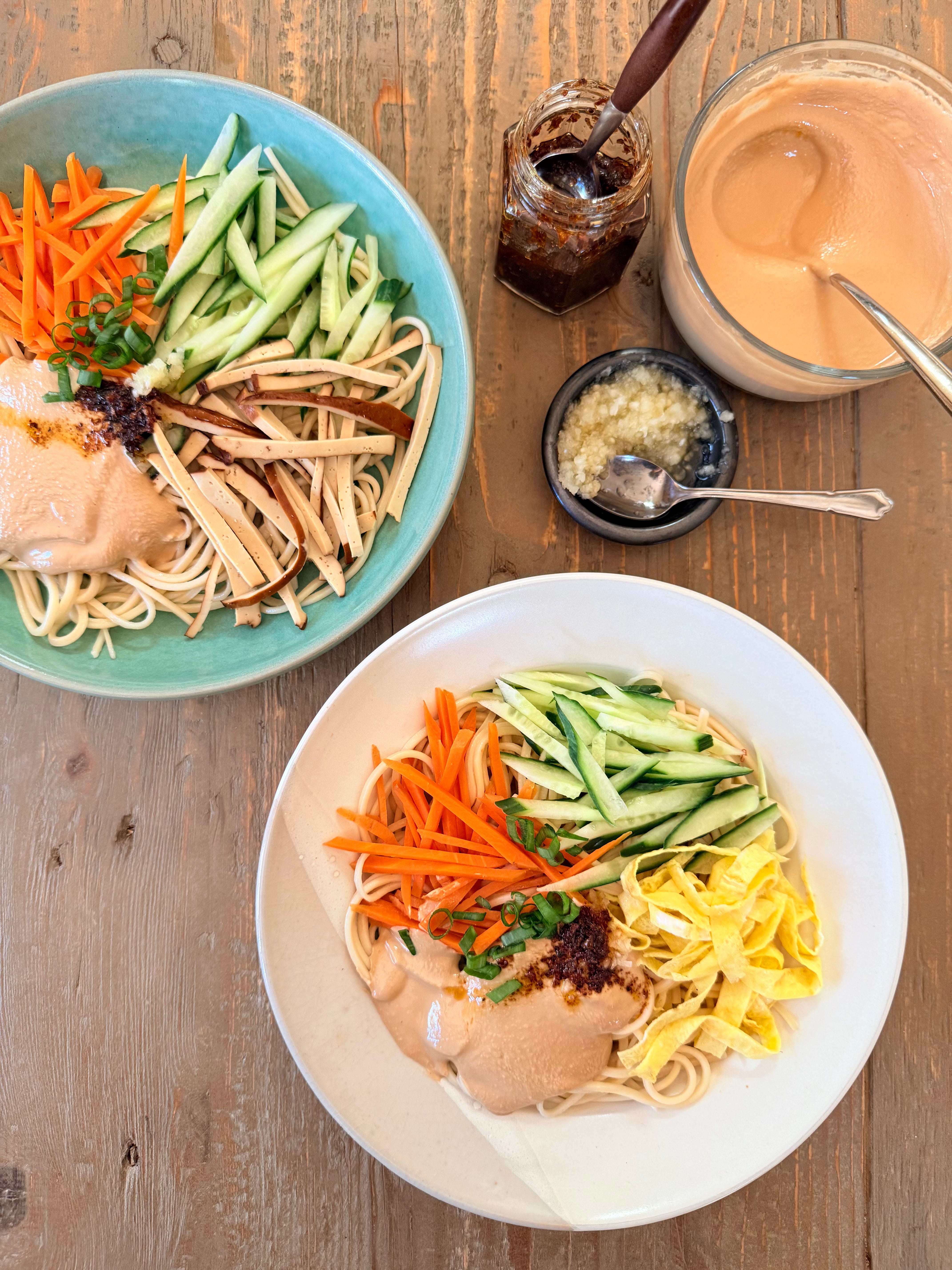
Ivy and Clarissa’s sesame noodles had a wonderful depth of flavor that I’d not experienced before. It was because of the freshly roasted sesame seeds and their sauce formula. The seeds lent flavor and body to the thick sauce, which was plop-able. Optional garlic and chile garnishes allow you to layer on flavors. WOW.
Even if you’re not a vegetarian or vegan, you’ll love these noodles.
However, we wanted more vegetables and a little less noodles and sauce. I remade the sesame cold noodles several times to tweak it to fit our lifestyle. Additionally, I came up with a shortcut sauce(!), if you don’t want to start from seeds and nuts.
After going multiple rounds with the recipe, I realized that you can take sesame cold sesame noodles many directions — vegetarian, vegan, or with chicken, if you like! I bet you’ll craft more ways to play with the versatile sauce.
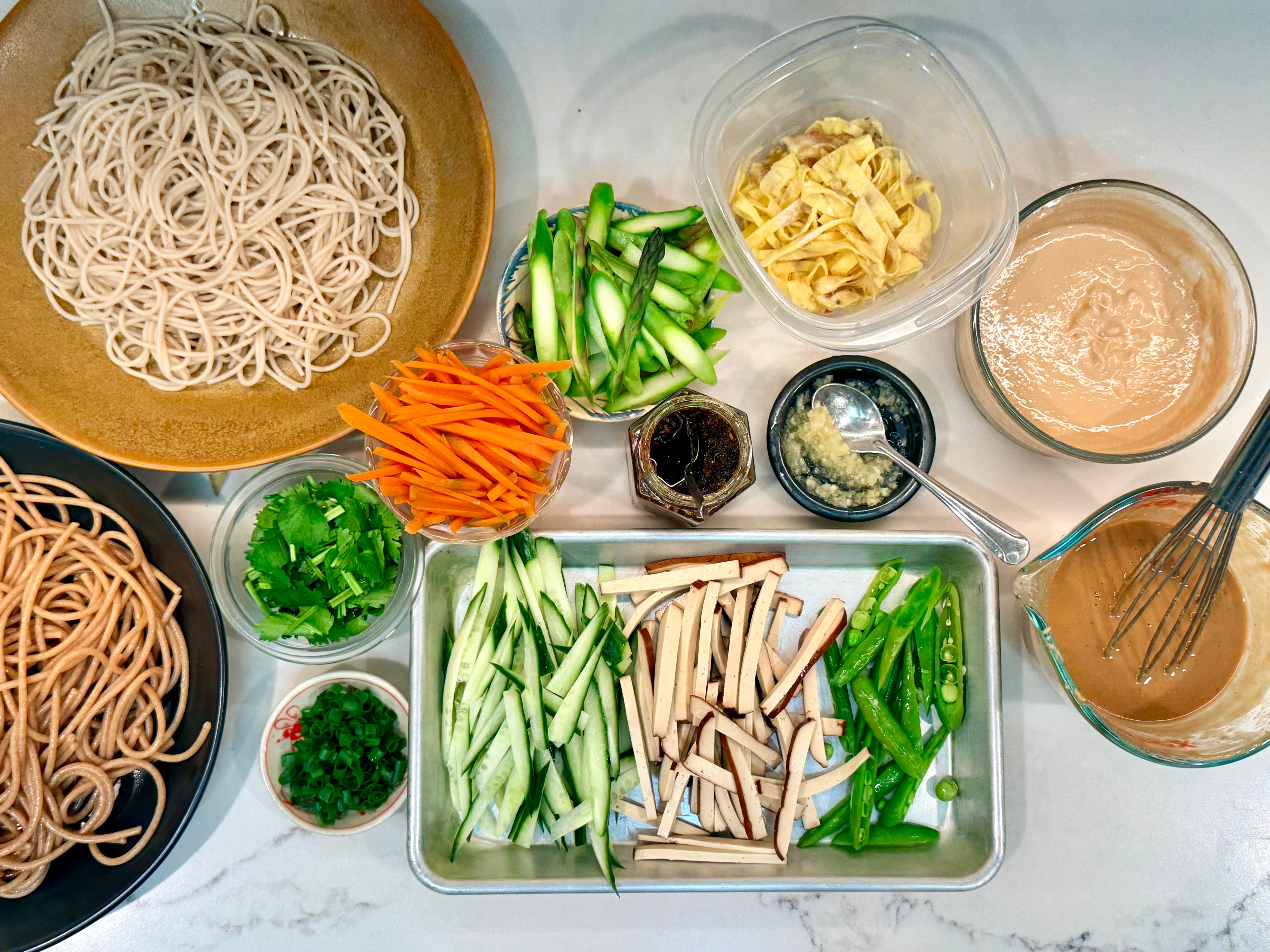
Part of my recipe development was trying all toppings, noodles, and sauces.
Below you’ll find:
Sesame Cold Noodles recipe in full text + a downloadable PDF
Shortcut sesame noodle sauce recipe in full text + a downloadable PDF
Sesame seed shopping and toasting tips
Noodle selection tips to go vegan, gluten-free, or whole grain + a pro-tipe for making them ramen-esque chewy
Keep this recipe handy for the summer for easy meals, entertaining, potlucks or taking on a picnic. You can have so much fun with it.
Paid subscribers sponsor this newsletter and this sesame noodle package is for them. Join us to access this complete post, mine the recipe index, and gain so much more. Thanks for your considerations.
My book tour was fun, which was how I spent most of May, with a final stop in Paris. Along the way, it was amazing to meet so many of you, including readers and followers, as well as other cookbook authors, bakers, owners of cookbook shops, chocolate-makers, and Paris-lovers.
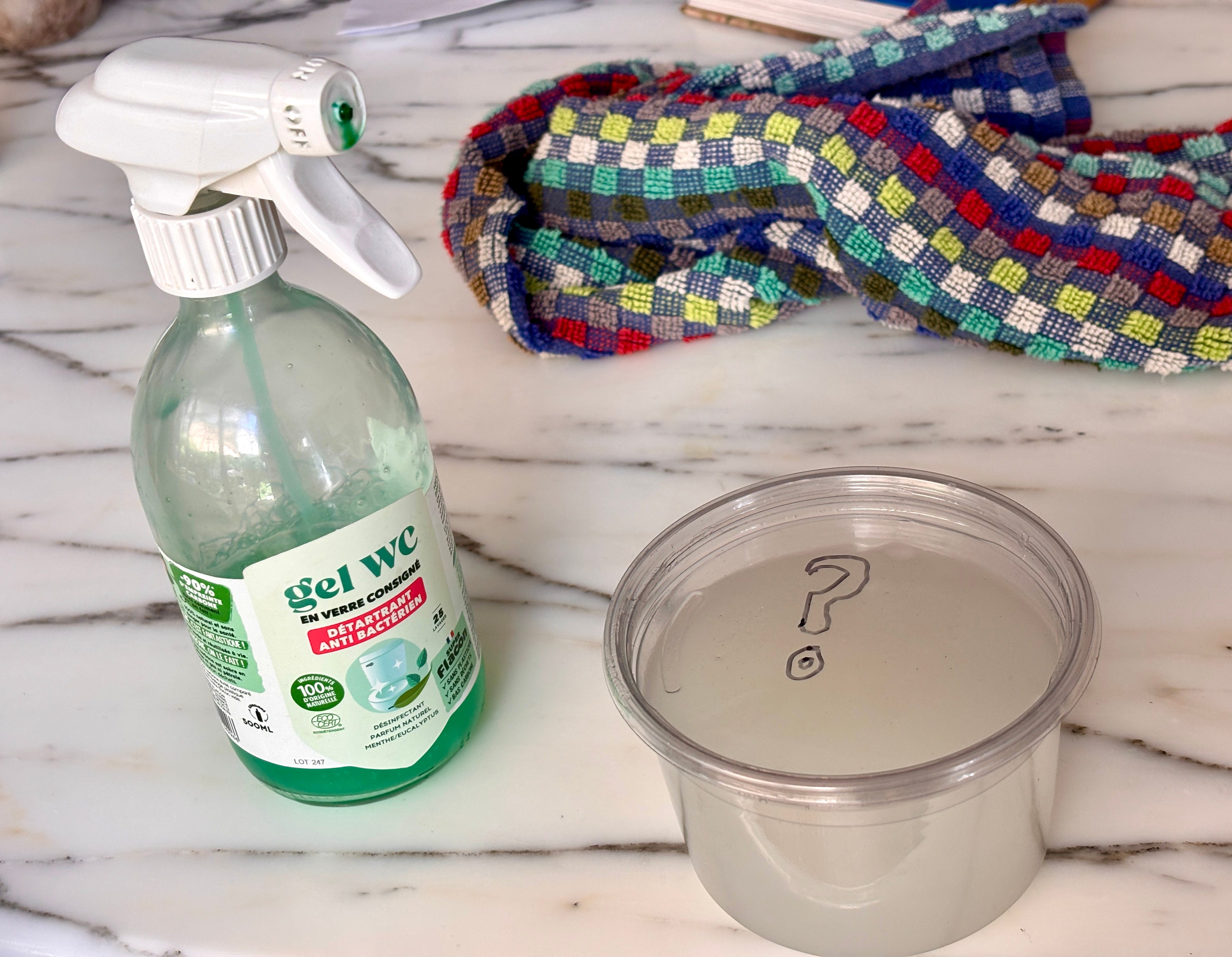
I was bowled over by the turnout at my events and my only wish was that I could have done more, although it’s hard to be away from home longer than three weeks, and it takes the better part of the week after you return to get over the jet lag and catch up on everything that happened while you were away. Such as somehow in my absence, something smelling like industrial-strength mint syrup (or cleaner?) was put into the refillable spray bottle of locally made, eco-friendly bathroom cleaner that we use, and no one knows what it is or how it got there.
If anyone has a clue, kindly tell me. I don’t know whether to clean the bathroom with it, or mix it with sparkling water.
As anyone who’s traveled lately knows, things have become a lot more challenging both on the ground and in the air. I give a lot of credit to people who work in airports and on airplanes, as well as travelers who can handle the rigors of travel.
Well, except for the guy next to me on the flight from SFO to LAX, who loudly used his phone just until the last nanosecond when we took off, then continuing the conversation, equally as loud, timed exactly at the moment the wheels of our plane touched ground.
All of us in rows 12-22 (but especially me) got to hear all about how Carol wasn’t in on the meeting but Bill and Warren were, and Pam doesn’t know about it but they’ve got to get the files to the branch in Tennessee, although if they don’t make it there, Tom is going to have a meltdown, and Bill and Howard in other branch offices are going to have to cover for them. I learned that Susan may have to be looped in for the meeting about it, but not to tell Carol. I don’t know what that guy does, but it must be important enough to interrupt the lives of everyone around him.
I’ve always found this post about what authors should do, and shouldn’t do, on book tours pretty spot-on. I think I followed most of them, although I’m waiting for someone to write one about how not to behave on airplanes, which people should have to sign a paper stating that they read it and agree to its terms.
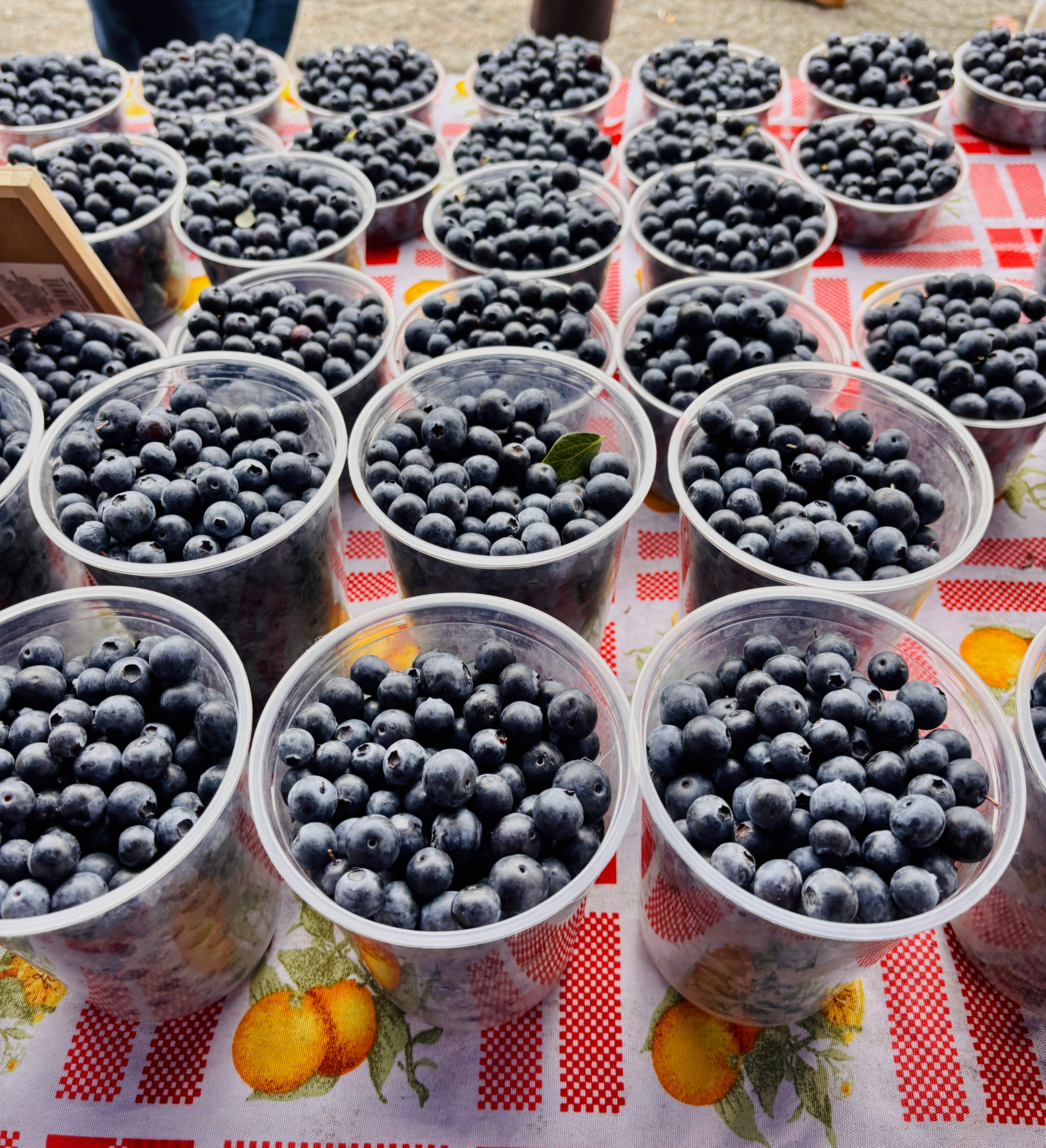
Blueberries at the greenmarket in San Francisco.
I tried to use my downtime wisely, to keep my energy high for meeting everyone. But one thing I recommend that everyone do on the road is to eat well. It can be hard to get your fruits and vegetables in when you’re traveling, which, curiously, is one of the things that American visitors tell me they miss when they’re in France. (If you want fruits and vegetables, rather than looking in cafés and restaurants, it’s best to go to the markets to pick them up.) Maybe our reputation precedes us, but when I come across a salad bar when I’m traveling, in spite of the Debbie Downers about them, it feels really good to have a big bowl (or box) of spinach, cherry tomatoes, tofu, florets of broccoli, grated raw carrots, some proteins, and even alfalfa sprouts, which Pee-wee Herman said, look and taste like hair.
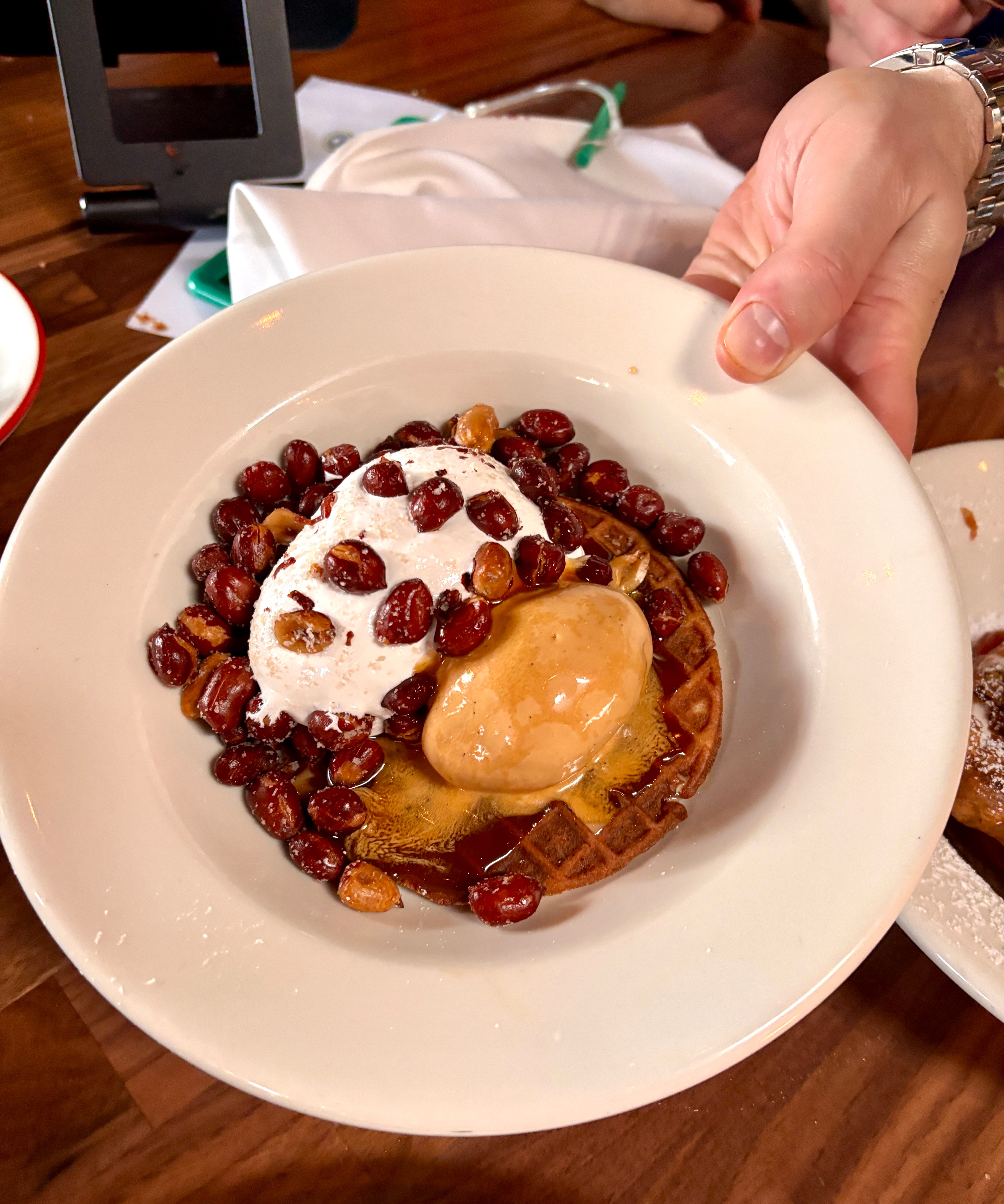
It’s nice to eat “healthy” whenever you can….so you can indulge when something extra-delicious crosses your path, such as this incredible Tin Roof Sundae…
The Tin Roof Sundae with caramel gelato, marshmallow sauce, and salted Spanish peanuts on a crisp waffle cookie, at Mozza, was one of the best desserts I’ve ever eaten.
How could I resist?
I also got to indulge in slices of pepperoni pizza, uber-dark brownies at Hani’s, and marshmallowy S’Mores at a.o.c., as well as Mexican, Chinese, and Thai food. I wrote roundups of what and where I ate in Notes from the Road (San Francisco) and NYC Eats x Book Tour. Apparently I said a few controversial things in New York while being interviewed by on the Taste podcast, which was recorded at my first book tour stop atRizzoli bookstore. The crowd was so nice and welcoming, it was hard not to get personal with everyone who came to the sold-out event, but I guess a few things I said were controversial.
I haven’t listened to it, but I try to steer clear of trouble when being interviewed, since I’m sure some of the things I’ve said over the years have me teetering on the edge of being cancelled. But there’s soooo much to talk about, and I can never resist a challenging interviewer’s question. Talking face-to-face is different than via the internet, where things can be misunderstood or misconstrued. Clearly I need to get out more.
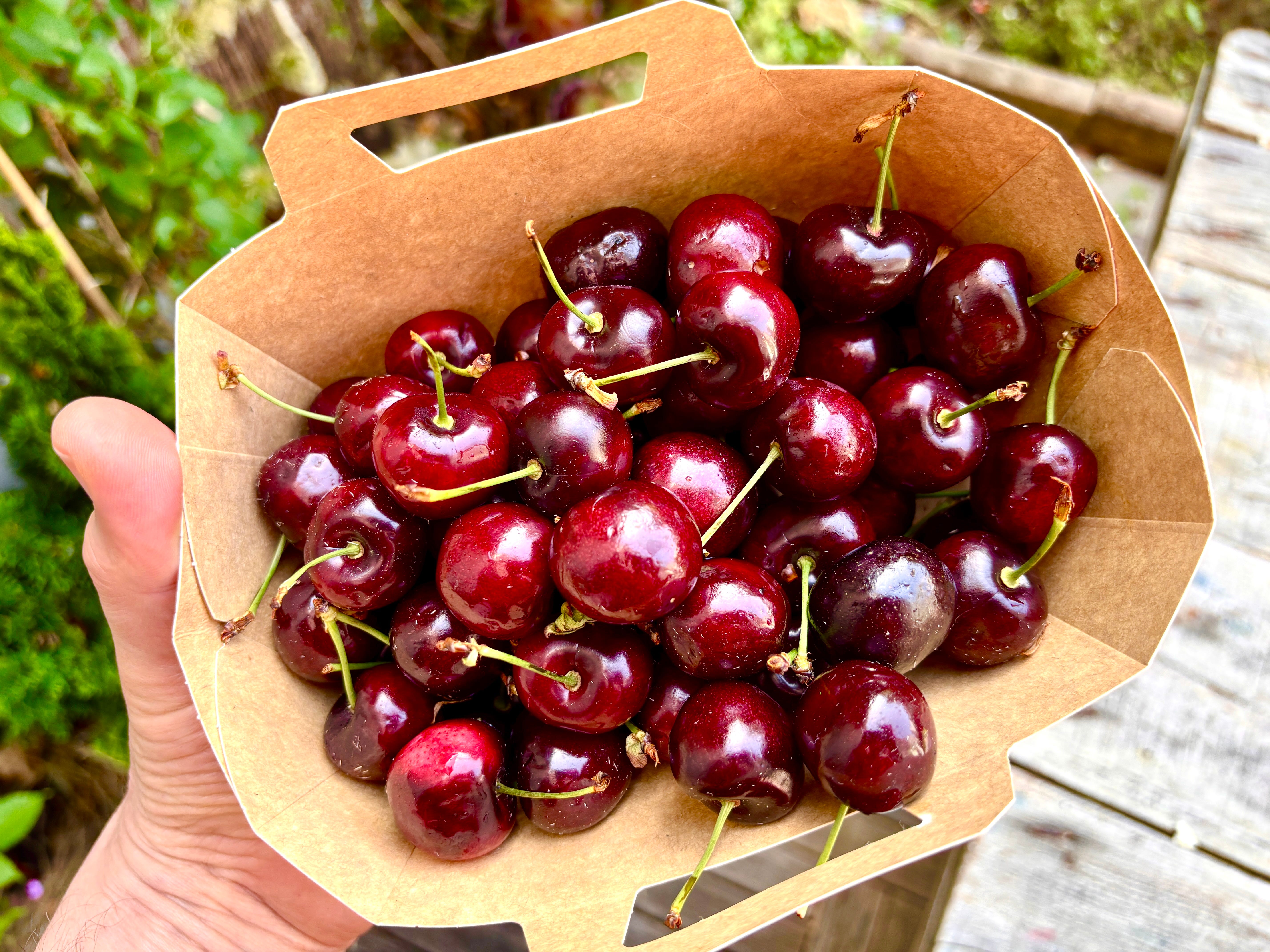
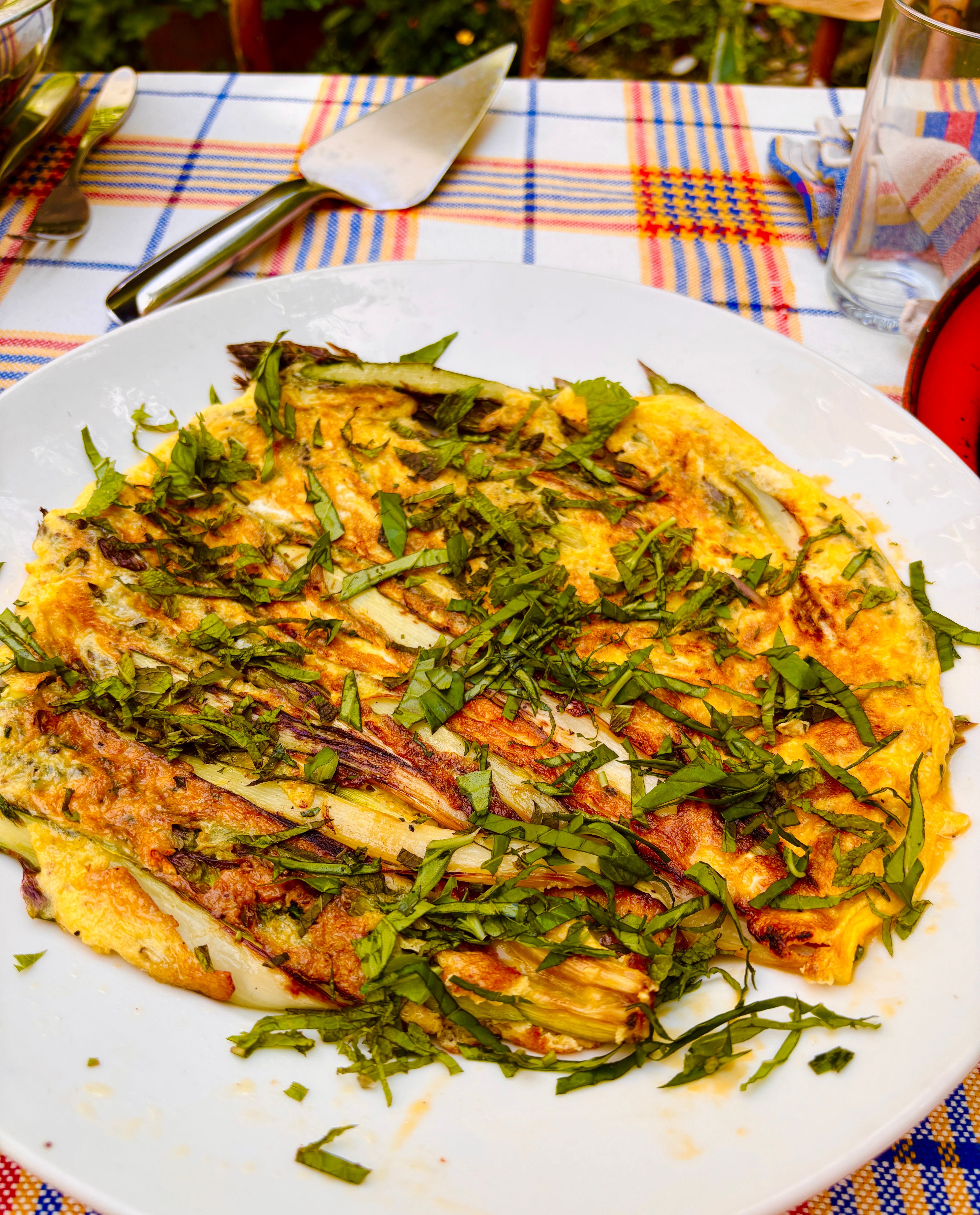
I did get out to the produce stores near where we live when I got home and picked up baskets of fresh cherries and apricots as well as the last asparagus spears at Le Pari Local. I’d bookmarked the Easy, Springy Frittata in Jenna Helwig’s must-read newsletter, Cookbookery Collective, which was adapted from ’s new book, Vegetables the Italian Way…
…and gave it a go. But first, I had to explain to Romain that it wasn’t an omelette because it was fried, hence the name frittata, and wasn’t folded up but served open face, which was when things started to get complicated. So I served it, and hoped for the best. (French people can be quite literal. If you don’t believe me, you should see some of the messages that I get, not to mention the hoops I have to jump through at home.)
I went a bit rogue with the frittata, oven-roasting the asparagus first and adding chopped basil to the eggs, plus a chiffonade of leaves on top. I snuck in an extra egg white since I have a few in the frigo. Mine wasn’t as neat as Jenna’s, but now Romain knows what a frittata is…even though I’ve made them before.
I’m going to go a bit here, who recounts what he’s been watching and reading in his newsletter:
I finally finished The Comeback, which became one of my all-time favorite TV series. It took a few episodes to get into it — season 2 came out ten years after the first season, and the final season, season 3, came out a decade later — but the evolution of Valerie Cherish, the main character (pitch-perfectly played by Lisa Kudrow, who also co-wrote the series), was a tour de force and often very touching. What, on the surface was a superficial character, evolved into something and someone completely different and unexpected.
On the 11-hour plane ride back from Los Angeles, I finished Beef, season 2, which had a bit of The White Lotus vibes but ended up being a deep dive into a group of very complicated humans that, like The White Lotus, cross socio-economic classes. I tried to get into Rooster but not much was happening, kind of Emily in Paris, where the characters end up just circling around each other over and over, with little character progression. I tuned into Margo’s Got Money Troubles, mostly because who doesn’t want to watch anything with Michelle Pfeiffer? Both she and Elle Fanning are excellent actors but like some mini-series (I’m looks at you, Rooster and Your Friends & Neighbors), it could have been half as long. The story plodded a bit, then got much better as it reached its final two episodes. Wanda Sykes has a new comedy special on Netflix, and as usual, she’s hilarious. And some folks may be sad to learn that Emily in Paris is finally saying adieu, and coming to an end.
As for reading, I wrote what I’m currently reading in the links below, but I brought three books back from the States, which was the maximum that my luggage allowance allowed.
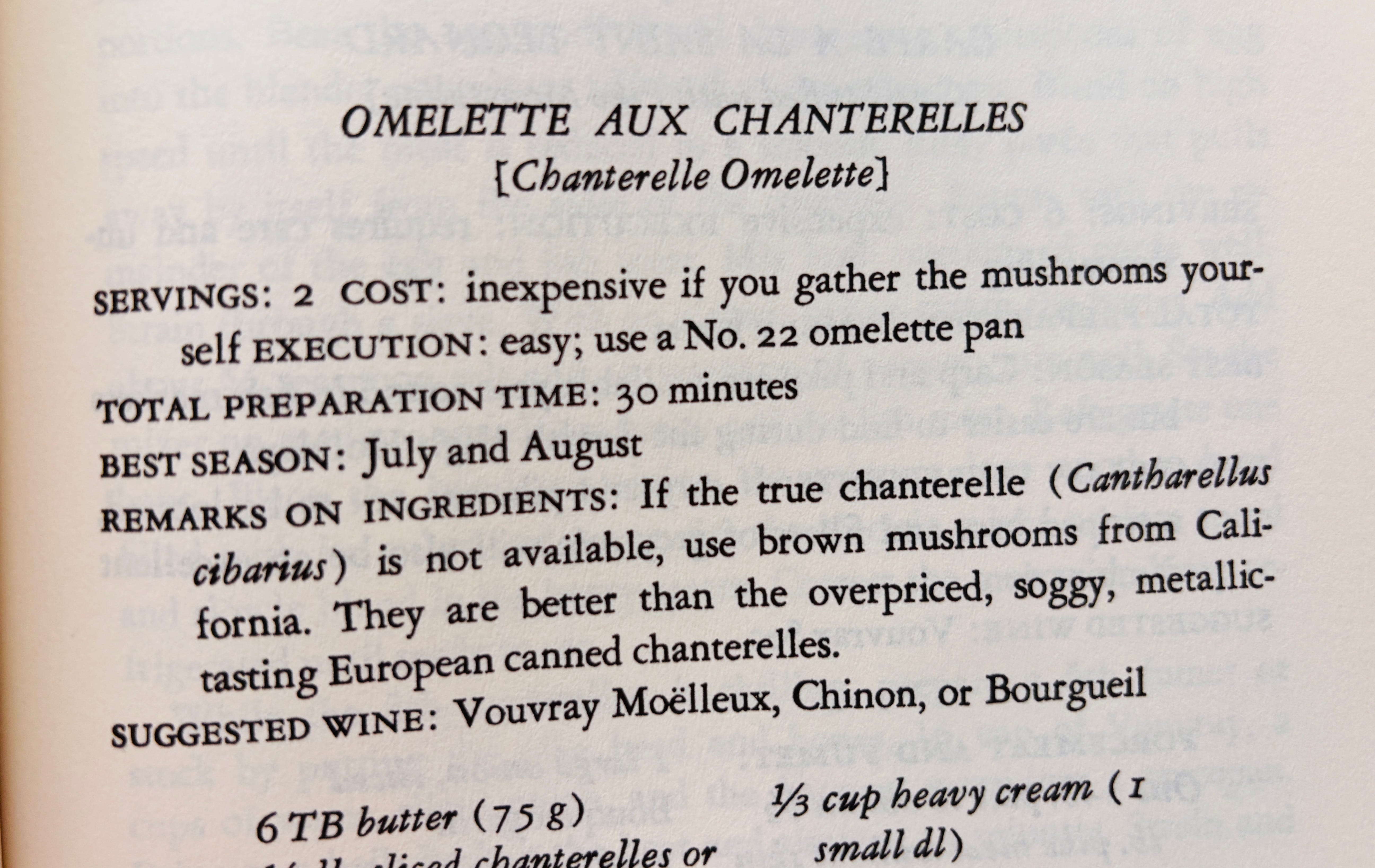
My friend, cookbook author, and collaborator Kate Leahy told me that Company was one of the best-written cookbooks she’d come across, so I picked up a copy. I also bought More than Sweet, a new baking book that “breaks down the boundaries between sweet and savory with confidence,” as well as a copy of When French Women Cook by Madeleine Kamman, one of the most important and influential cooks of our generation.
I love that Madeleine Kamman included how much a recipe costs to make. Some recipes in her classic book are listed as “reasonable” and “affordable,” and this one is classified as “inexpensive if you gather the mushrooms yourself.” 😀
As I write this, we are at the tail end of another heat wave in Paris, with the hottest days on record. (Europe is heating up faster than the rest of the world, and not everyone makes it through.) No one was expecting the heat waves to start as soon as May, but here we are.
During the heat waves, people swelter, and some businesses close due to the heat. Tourists wonder why there are no fans or AC or ice in drinks. Once heat waves are over, people forget about them, so solutions evolve slowly. Sixty percent of the roofs in Paris are zinc, and I lived in a top floor apartment where the temperature would hit 110ºF (43ºC) inside. Painting them white or coating them with something reflective would be an effective solution, but with the city seeking to make the zinc roofs protected as UNESCO cultural heritage, it’s doubtful that that’s going to happen.
If you plan to come to Paris, or anywhere in Western Europe, check the weather forecast and bring light clothing, sunscreen, and a refillable water bottle to beat the heat. You might want to cross “waiting in lines outside to get into museums” off your list. And it’s not recommended that you ignore the advice of city officials and jump into the canals to cool down:
So lieu of that, we’re heading to Copenhagen and Norway this month, where it’s cooler.
In the meantime, I’ve been mixing up glasses of Chocolate Frappés from Drinking French, made by vigorously shaking up 1/2 cup (125ml) whole, low-fat, or plant-based milk, 2 tablespoons best-quality Dutch-process cocoa powder, a tablespoon of sugar, and 3 ice cubes in a cocktail shaker. That gets poured into a glass (it’s okay to add any ice chunks to the glass, too). You can top it with whipped cream and chocolate shavings, or just serve as is. I recommend drinking one of these frappés over the water in the canal.
-David
If you’re in Paris and missed my book event, La Trésorierie (48 rue de Grenelle, 7th) has signed copies of my books.
While I was on book tour, one thing people told me about was how much they enjoyed their trips to Paris, thanking me for restaurant suggestions and other tips I post here and there. It makes me happy when people come to Paris and have a good time, and eat well.
After I flew back to Paris last month and collected my luggage, I did what I usually do: I headed to the taxi stand. The airport has affixed large signs on the floor of baggage claim, which you can follow all the way outside to the official taxi stand. (I’ve also seen young people in official vests, guiding and leading people from the baggage claim area, all the way to the official taxi stand.)
On my way, I was asked by at least a dozen men, who whispered almost under their breath, if I needed a taxi. I kept walking but one guy told me I was going the wrong way, and to go to a different doorway, presumably where his car was waiting.
Most of us are zonked after flying into a foreign city, but whatever you do, never, ever take a non-official taxi from the airport in Paris. Always follow the signs for the official taxi stand, where there will be a person in a vest, organizing the taxis and passengers. Getting into an unofficial taxi means you may be paying more than you should or what was originally quoted to you. In one extreme case, a driver tried to charge some tourists €247($288) for the trip. This does happen in other airports, but Americans tend to be polite when we travel and might say, “Sorry, no thank you.“ Locals will just walk by them without saying anything, which I do, and suggest doing as well.
Official taxi prices to and from airports in Paris are fixed by law (current fares are here) and fares are reasonable.
Pro Tip: To get to and from the airport in Paris, probably the best and most reliable taxi service is G7. You can reserve a taxi online (in French or English) or via their app.
The streets of Paris, and the roads around it, are generally a knot of traffic and official taxis are allowed to use the bus lanes, which are less congested. Drivers for services like Uber and Bolt cannot use them.
When going to the airport, you can reserve a pickup online, which costs a few euros more but comes with more peace of mind. After arriving at the airport, unless you’ve ordered a taxi in advance, you’ll have to take whatever one is available from the queue. But official taxis are obliged to charge the fixed price. All drivers are required to take credit cards, but occasionally one will say the machine is broken, and can you pay cash. I always ask before getting in if I can pay bycarte bleue (credit card), just to confirm.
Tipping is optional but I often add 5%. You can tip up to 10% if you’ve got a lot of luggage or the driver makes an extra effort, but it isn’t required.
In the spring of 2027, a dedicated CDG Express train is set to launch, which’ll take you to and from the Gare de l’Est (as well as other stations), right to the airport for €25 ($29) one-way. The project has been delayed for a number of years but appears to be on track to open then, so to speak.
Some take the RER B train, which goes to CDG airport from several stops in Paris, such as Châtelet, Saint-Michel Notre Dame, and the Gare du Nord. But if you have luggage, you may have to schlep it up and down some stairs, and there are reports of pickpockets on the trains. RER B trains can be crowded and have limited ventilation, and occasionally there may be a problème téchnique or construction that can cause a delay. We once missed a flight because of a colis suspect (suspicious package). Then we spent the day at the airport waiting for the next flight, and got stuck in the middle seats in the last row of the plane, which weren’t the most pleasant eleven hours of my life. That was about ten years ago, but I still haven’t been able to uncramp my legs from that journey.
Hello there! I hesitated to send a Midweek Gem this week because I realized that Substack sends you a lot of emails about the livestreams that I’ve been doing. Moving forward with the livestreams, I’m going to curtail those emails.
That said, I wanted to share some exciting news with you! Something called an “advance copy” of Cooking Thai recently arrived on my doorstep.
The book is still being printed overseas but my publisher gets a handful of copies. Chef Pim and I each got one and we’re totally gobsmacked about holding the actual book baby in our hands!
What’s on the cover? One of our favorite recipes in the book — Massaman Curry, based on a time tested recipe by Pim’s grandmother. Pim’s curry pastes are stellar and we developed recipes for you to make it with meat or meatless. There are tips to tweak the heat level so you don’t have to have a Thai built-in heat shield to enjoy this food!
A number of Cooking Thai recipe testers are also PTFS subscribers. We were overwhelmed by their positive response to the flavors and techniques.
It’s been quite a journey to bring Cooking Thai to print. Lots of thrills and near spills. We’ve built it as a solid guide for your Thai cooking adventures for years to come. That’s how Pim and I intend to use the book so we hope you’ll do the same!
How and when can you get the book?Cooking Thai releases on August 25, 2026. The printer is in Asia but luckily the books won’t be shipped through the Strait of Hormuz!
To get a copy ASAP, pre-order it from your favorite book store, cookbook shop, or a vendor like the ones listed here. Pim is planning the book tour so more news will come as things develop. Thanks for your ongoing interest and support.
Congratulations to for winning the giveaway. She cooks lots of Cantonese food so I’ll be curious to know what she thinks of adding Taiwanese flavor to her recipes.
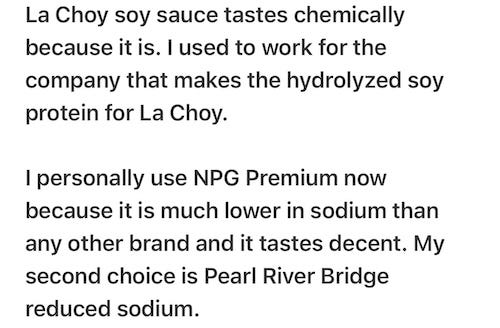
Thanks to all of you who shared your soy sauce brands. And, also to who shed light on La Choy soy sauce and then some.
💎 Focaccia di Recco (one of the best things I’ve ever eaten)
If you live in the Santa Cruz area, get yourself to Mentone in Aptos and order the focaccia di Recco off the specials menu! I’d love for chef David Kinch to permanently add the bedsheet thin flatbread-cracker-quesadilla filled with milky crescenza cheese on the menu. My photo on the right does not do the focaccia justice. 😩
I was so taken by it — a marvel in dough management and manipulation — that I looked up how to make it when we got home from dinner. There are a handful of recipes out there but Janet Fletcher has the scoop from Lidia Bastianich’s recipe. It’s all here on Janet’s website. To get a sense of how it’s made, watch this:
Support Pass the Fish Sauce! Join us for free or upgrade to a become a paid subscriber to enjoy 150+ professionally developed recipes, seed new content, and get future class discounts. Thanks for your enthusiasm!
Coming up for this Sunday Special is a cool noodle dish that Rory and I have been enjoying all week long and we’ve not tired of it.
It’s no secret that one of my favorite places in Paris is G. Detou. In fact, I depend on it so much, for everything from chocolate to vanilla—and lots, lots more. I’ve been quoted as saying that if G. Detou didn’t exist, I couldn’t live in Paris. It’s got everything I need.
Owner Benoît Bourloton is a busy man, spending his days keeping the shop well-stocked with a wide variety of French chocolates, as well as other delicacies. Since we’ve become friends (and what a friend to have!), I asked Benoît if I could stop by and discuss French chocolates, and he gladly invited me into the shop to talk about some of them.
 Login
Login