Sesame chicken is one of the most popular dishes on the menu at any Chinese takeout restaurant or buffet. Deep-fried boneless chicken coated in a savory sweet sauce and topped with toasted sesame seeds? It’s a favorite here in America. That said, there is a lot of subpar sesame chicken out there! Too sweet, too […]
Supermarket fish counters in America can often be uninspiring. You see the same usual suspects — salmon and mild white fish fillet such as cod, rockfish, sole, and tilapia. Fish is healthy and delicious but what healthy thing can you do with fish aside from grilling or pan-frying it? It can get b.o.r.i.n.g.
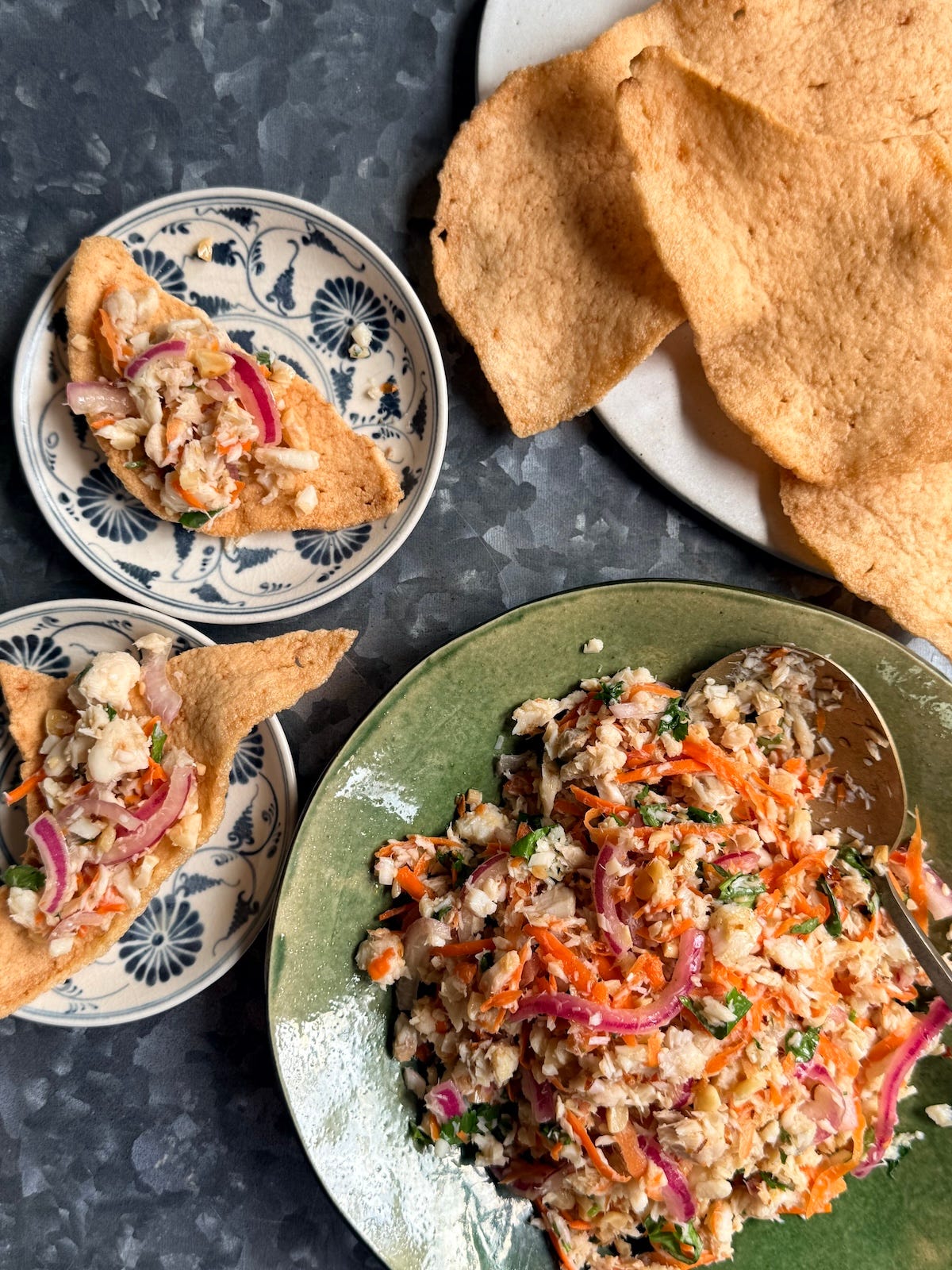
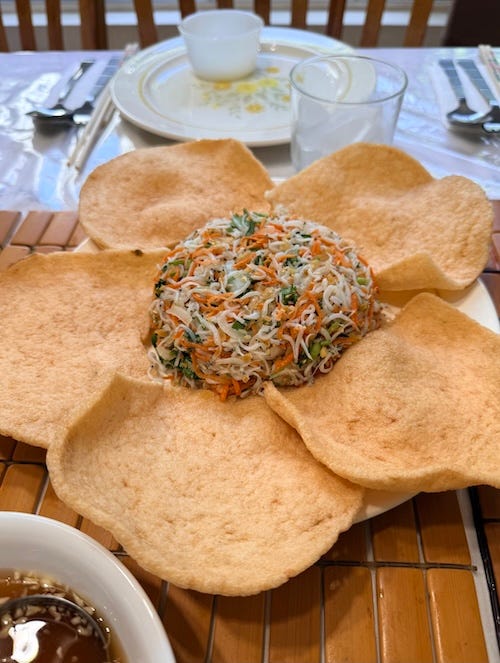
How about turning it into a tangy, garlicky, herbaceous, and slightly spicy Vietnamese fish salad called gỏi cá? It’s a refreshing salad that my family enjoys with crunchy fried shrimp crackers for a classic Viet-style starter or snack.
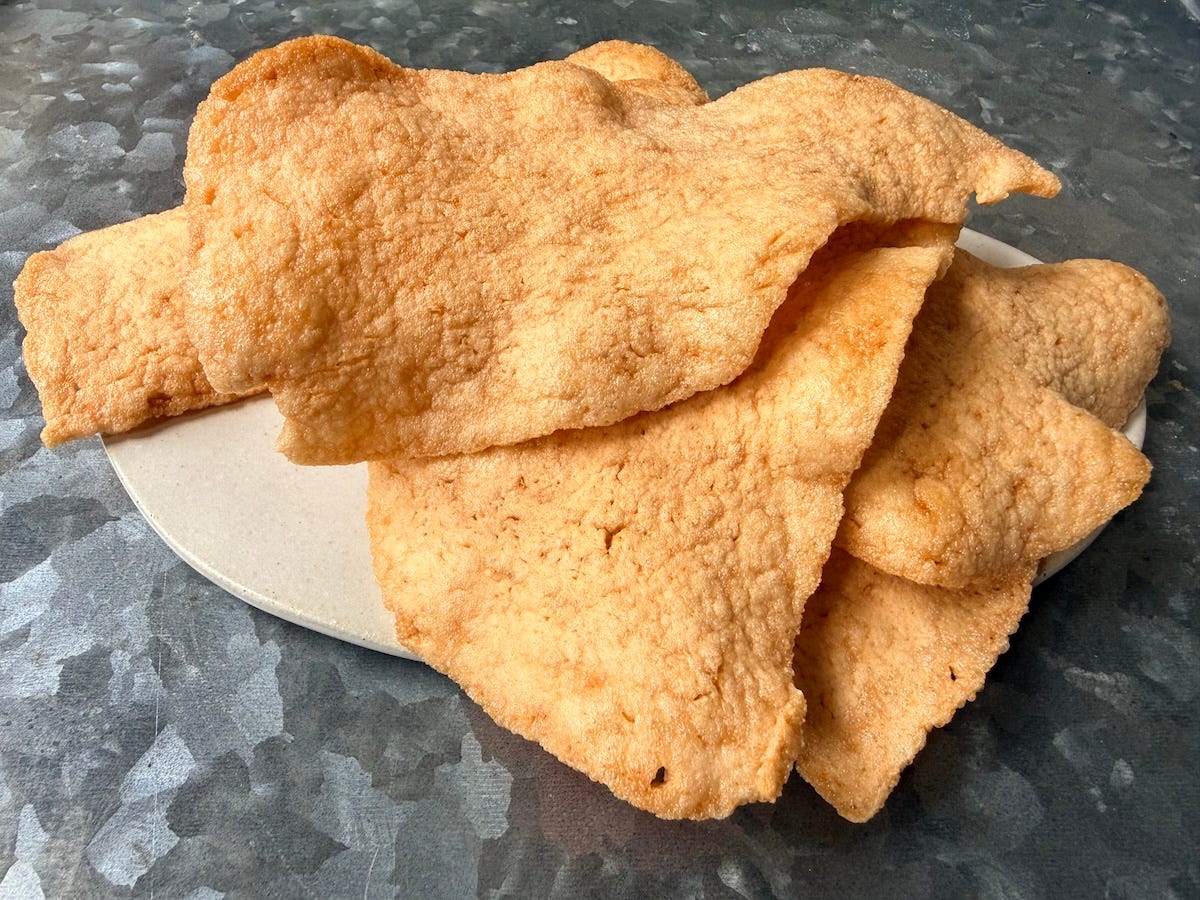
In fact, to eat properly eat many Viet salads, you need the ultimate crunchy scoop: fried shrimp crackers (banh phong tom). If you’ve never made them at home, I just published a guide to buying and frying the best ones on my website. (Don’t want to get the crackers? I suggest substitutes in the recipe below!)
But you don’t have to be traditional with gỏi cá. Let loose your creativity and cravings. Viet salads aren’t usually lettucey affairs BUT that didn’t stop me from serving my fish salad atop a pile of lettuce ribbons (no need for dressing because it’s well seasoned). Rory added tomatoes for a fab plate. You can even put it in a rice paper roll!
Traditional Vietnamese Fish Salads
But first, let me explain what Viet fish salads are about. In Vietnam, there are many regional kinds of gỏi cá (pronounced “goy KAH?”) that feature raw super fresh fish. For instance, cooks on Phu Quoc island prepare gỏi cá with freshly caught sardine filets, which you can buy from the ladies who expertly fillet the fish at the daily outdoor market.
Given the freshness of the fish and other ingredients, please don’t ask me to replicate what I’ve eaten there. It’s a specialty best left to the island folk.
What my family enjoys as gỏi cá is a lightly cooked version created by my aunt Bác Hàng. She came to America in the 1980s, married my dad’s older brother, and became a nail artist and breadwinner for her family. She also cooks very well. She’s a superwoman in many ways.
For about 30 years, my mom made Bác Hàng’s fish salad like her sister-in-law did — with tiny slender frozen silverfish (aka icefish or noodlefish) that’s sold froen at Chinese and Vietnamese markets. My family’s gỏi cá composition of the miniature white fish accented by fried garlic oil, shredded orange carrot slivers, pickled red onion, and chopped fresh herbs. Lime juice and vinegar lends the salad a bright ceviche-ish quality but the fish is fully cooked. It looks special too.
My sister Tasha adores the salad so my mom, even at 92, still makes extra to pack up for her daughter to take home. My husband Rory adores the salad but gets creeped out at all the little eyes staring back at him in every bite. (You can’t see them in the photo below but they’re there.)
August 1, 2026. For her 92 birthday bash, Mom made the fish salad with silverfish. That. may be the last time, now that I’ve got this recipes!
What I didn’t realize was this:My mom has long wondered if the salad can be made without her having to shop at a little Saigon market. “It’s too much trouble to go all the way there for the fish,” she said. Silverfish have little flavor on their own, but they readily absorb the flavors of other ingredients, which are nothing special. They’re loaded with water so removing excess moisture is laborious and the yield is not much — a waste of money!
Earlier this week, standing at the fish counter and eyeing a glistening, very fresh fillet of cod, I had a revelation: What if I used cod as a Silverfish substitute? My mom’s reaction to my newfangled method, “If you can make the salad with supermarket fish I would be relieved. It would be much easier!”
I’m here to report that I did it! It only took one try to get this gỏi cá exactly where I wanted it. All the intriguing textures and flavors are there. Compared to the silverfish version, this evolved gỏi cá version 2.0 tastes more vibrant because the fish is fresh, allowing all the other elements to shine brighter and create excellent flavor.
With this new recipe, my mom and sister will be happier, and so will Rory! More importantly, Bác Hàng’s awesome fish salad can now be enjoyed by you and many other people! Make it whenever you want, with whatever kind of mild, white-flesh fish you find at the market or catch!
The ultimate crunch: How to fry perfect shrimp crackers
What are Asian shrimp crackers? The Viet version is called bánh phồng tôm, and they are a legendary snack and salad accompaniment.
A quick warning: Resist the temptation to microwave them! While it’s a common hack to make them puff up, they just turn out hard and tasteless. For the real deal, buy the dried discs and shallow fry them at home—they are leagues better than any pre-bagged shrimp chips you’ll buy at the store.
Want to master the perfect puff? Check out my step-by-step guide to buying and frying the best shrimp crackers on my website (it’s 🆓 and includes a quick how-to video!).
With the shrimp crackers and fish salad on hand, you can enjoy them many ways.
And I nearly forgot this — leftover fish salad tastes nearly as good as fresh. The salad keeps well so take it on the road, make it for a party, share it at a potluck.
This Vietnamese fish salad is ridiculously easy and versatile. Below, you’ll get the (1) full recipe in text and downloadable PDF, (2) process shots to guide you to success, and (3) many other pointers.
Curious cooks, readers and eaters fuel this newsletter. Paid subscribers sponsor PTFS and this gỏi cá recipe is designed for them. Join us as a paid subscriber for the whole shebang, fully use the recipe index + save 25% on future cooking classes! Thank you!
We are all obsessed with this Toum, or Lebanese garlic sauce. It is spectacularly garlicky, creamy, and a little bit tangy thanks to lemon juice. It’s absolutely addictive with lamb chops, salmon, chicken, potatoes, and is one of those sauces that makes anything better! The Non-Traditional Difference: Egg White Toum is traditionally made with four […]
There are two things I need to tell you about these cookies.
One is that they’re crazy-good. And the other is that they’re huge. The recipe makes just five cookies but each one is so packed with flavor, that you’ll be glad you can have one all to yourself. Your other four friends or guests will be delighted as well. (But they’re quite generous, so it’s okay to share…)
What makes these cookies extra special is their slightly savory, umami note, due to walnuts glazed with white miso. Miso is fermented soybean paste that can be purchased in Asian markets, but has become so popular, you can often find it in grocery stores. In these cookies, it adds a little je ne sais quoi, since it adds a subtle, yet complex note of flavors. Umami is often described as a flavor that’s craveable, and it certainly makes a compelling case for that description in these cookies.
If you don’t have white miso, or don’t want to make the candied walnuts, no problem. Just use toasted walnuts. Pecans, or another favorite nut will also work. You can also leave the nuts out, or swap in dried fruit for them. Do-ahead tip: The walnuts can be made a few days in advance and kept in an airtight container. The glaze will get a little sticky, but the walnuts are perfectly fine to use in these cookies.
Another “secret” to these cookies is to incorporate large chunks of chocolate into the dough. While it may be tempting to use chocolate chips, they’re really best if you chop up chocolate from a bar of good-quality chocolate. I leave the pieces quite rough and irregular, which – when baked – create large pockets and bites of dark chocolate.
I’ve adapted the recipe from SIFT: The Elements of Great Baking by Nicola Lamb. Her book explains many of the hows and whys of baking, as well as offering an array of creative recipes. Some are completely original and others are riffs on classics, and it’s a book that I refer to often and these cookies are a big hit whenever I bake them. I hope you enjoy these cookies as much as I do!
Adapted from SIFT by Nicola LambWhen you form the five mounds of dough, avoid compacting them too tight. You want to form them into loose balls rather than rolling them in your hands into smooth rounds. They're best when you chop the chocolate from bars of good-quality dark chocolate, and I leave the pieces fairly large – about the size of almonds, but you can use store-bought chocolate chunks if you wish.I baked my batch of cookies for 15 to 16 minutes, although the original recipe says 18 minutes. All ovens are different, but they're done when they're light brown across the top. The cookies shown in the post were baked on a cloudy day, so may look a bit dark. You want to err on the side of underbaking rather than overbaking. Another tip is that you can sprinkle extra flaky salt on top of each cookie when they come out of the oven. These cookies are best enjoyed the day they’re made but are delicious the next day as well. Store them in an airtight container at room temperature.
6tablespoons (90g)unsalted butterat room temperature
6tablespoons (85g)light brown sugar
6tablespoons (85g)granulated sugar
1largeeggat room temperature
1 3/4cups (220g)all-purpose flour
1/2teaspoonbaking soda
1 1/4teaspoons flaky sea saltor 1 teaspoon Diamond Crystal kosher salt, plus more for sprinkling (optional)
9ounces (255g)bittersweet or semisweet chocolatechopped in large chunks
Instructions
To make the miso walnuts, in a medium saucepan or skillet over moderate heat, warm the mirin, the granulated sugar, and the miso, stirring to incorporate and smooth out the ingredients. When the mixture starts to boil, add the walnuts and cook, stirring frequently, until the walnuts are completely coated and the miso mixture has almost all been absorbed by the walnuts, which will take a couple of minutes. They're done when there's only about a tablespoon of the miso syrup in the pan. Remove from heat and let cool, giving them a stir a few times as they cool.
To make the cookies, preheat the oven to 375ºF (190ºC). Line a baking sheet with parchment paper.
In the bowl of a stand mixer fitted with the paddle attachment on low speed, or by hand, cream the butter and sugars until well-incorporated for about 1 minute. Do not beat the mixture until it's too light or overly fluffy, which can cause the cookies to spread too much during baking.
Mix in the egg. Sift the flour and baking soda together in a small bowl, then mix that into the dough along with the salt.
Break or cut the walnuts up a little, but not too much, and stir them into the dough, then stir in the chunks of chocolate. You may need to get your hands in there to get everything thoroughly combined, but don't overmix. The dough can be somewhat irregular.
Shape the dough into 5 equal mounds on the baking sheet, each about 6 ounces (180g), placing them evenly spaced apart. Bake the cookies for 15-18 minutes, sprinkling them with additional flaky sea salt after they come out of the oven, if you wish. The cookies are done when they are light golden brown across the top. Err on the side of underbaking rather than overbaking.
Notes
Mirin is a sweet rice wine, available in Asian markets and well-stocked supermarkets. There are some substitutes for mirin here.
Consider this your new go-to marinade for grilled lamb chops. While our choice of spices borrows from Sichuan and Northern Chinese flavors, they have a chameleon-like quality and don’t read “Chinese” at all. They just season the lamb so well, and go with a wide variety of other flavors and side dishes! Pure Umami If […]
If you’re one of those people who gets irritated by the specter of pumpkin spice — or, gasp, Halloween decor — on an 85-degree week in September; if you understand that there are what will feel like infinite months left to spend shivering and longing for stew, and there’s no reason to beckon them any sooner; if you find yourself gritting out “but there’s another week of summer!” at your screen when confronted with ads for wool coats and other things you simply refuse to acknowledge before you must, come sit down. You’re among friends.
Perhaps you’ve heard about les Grands Buffets, the buffet in the south of France that’s à volonté. The all-you-can-eat restaurant is so popular, tables are booked months and months in advance. Like a number of things in France, what’s generally a straightforward process can become…a process.
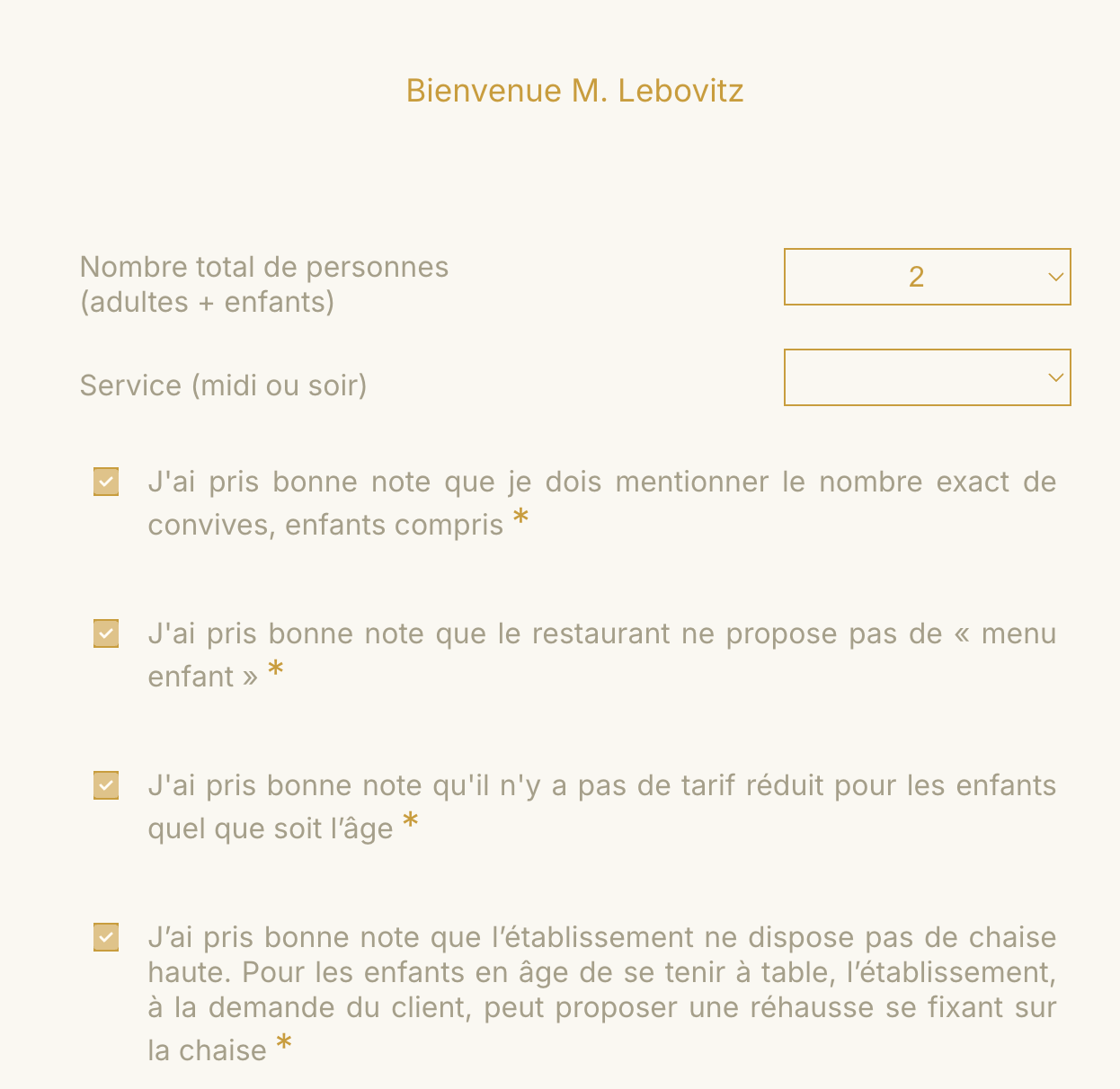
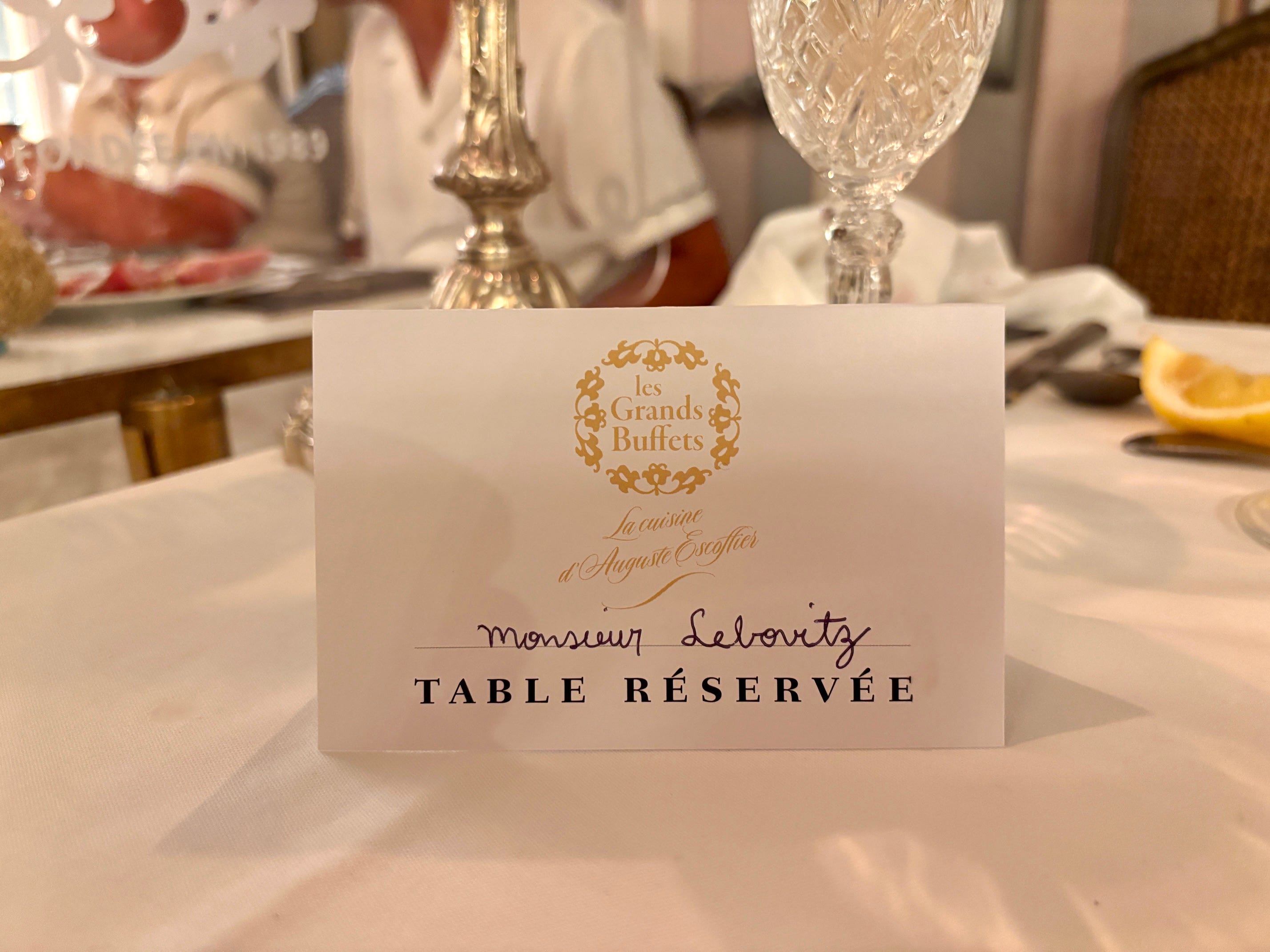
When booking your table, there are multiple screens to pass through, with a lot of boxes to check, making sure that you agree to everything…
You need to confirm that you understand the reservation is for the exact number of people you are asking for (you can’t change it later), that there is no children’s menu or special price for them, and there are no high chairs.
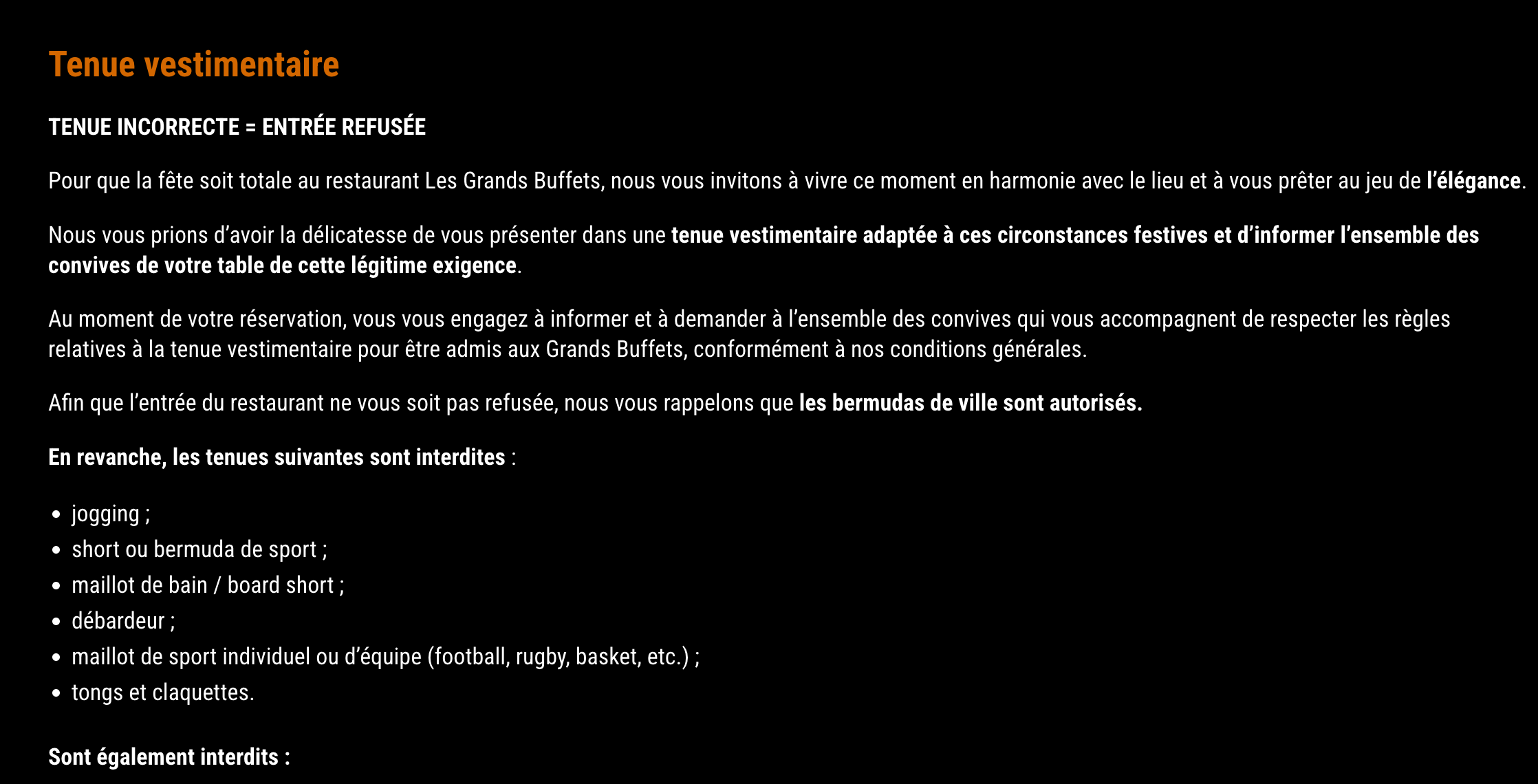
… including a strict schedule of deposits and payments. As someone who loves rules, and who lives in a country where rules are often considered for other people but not for you, I understand why. So they make everything very clear, including the dress code, with entrée refusée if wear athletic clothes, tank tops, flip-flops, or baseball caps:
For men, les bermudas de ville (chino-style shorts) are authorized, since this is, after all, the south of France where people are generally more relaxed. But just to be on the safe side, I wore linen pants. I didn’t want to get there and be refusé at the door.
I don’t think they want to police people, but in France you’re often sized-up on how you present yourself. Romain once got into a verbal tussle with a waiter at a restaurant in the French Alps because he was wearing a baseball cap and didn’t want to take it off. The idea, I think, is that they realize les Grands Buffets is a special experience (the night we went, a few women were wearing evening gowns), and they want people to be respectful of that. As long as I don’t have to wear a tie and jacket, I’m fine with whatever.
They’re also strict about seating times, and guests are booked and seated at 15-minute intervals, so everyone isn’t seated (or hits the buffets) all at the same time.
Les Grands Buffets isn’t in the center of town, but is part of a public building adjacent to the zone industrielle of Narbonne.
Recently I had on my podcast, and we had a great chat that included talking about her excellent article in the New Yorker, The Hottest Restaurant in France is an All-You-Can-Eat Buffet (possible paywall), which put the place on the map for many people who didn’t know about it.
The restaurant was founded in 1989. The city of Narbonne was looking for someone to open a restaurant in a municipal sports center, which Louis Privat did. Currently the restaurant feeds over a thousand people a day at lunch and dinner. There are hundreds of dishes presented, prepared, and served by close to two hundred employees, and the price is €65,90 per person.
According to the BBC, the restaurant grosses €30 million ($35 million) and is the highest-grossing restaurant in France, and 86% of the customers are French. A lot of guests are Spanish since Narbonne is close to the Spanish border…and Spanish people like to eat. Privat has resisted opening another restaurant, even though he frequently is presented with opportunities in other cities. (And likely, in other countries.)
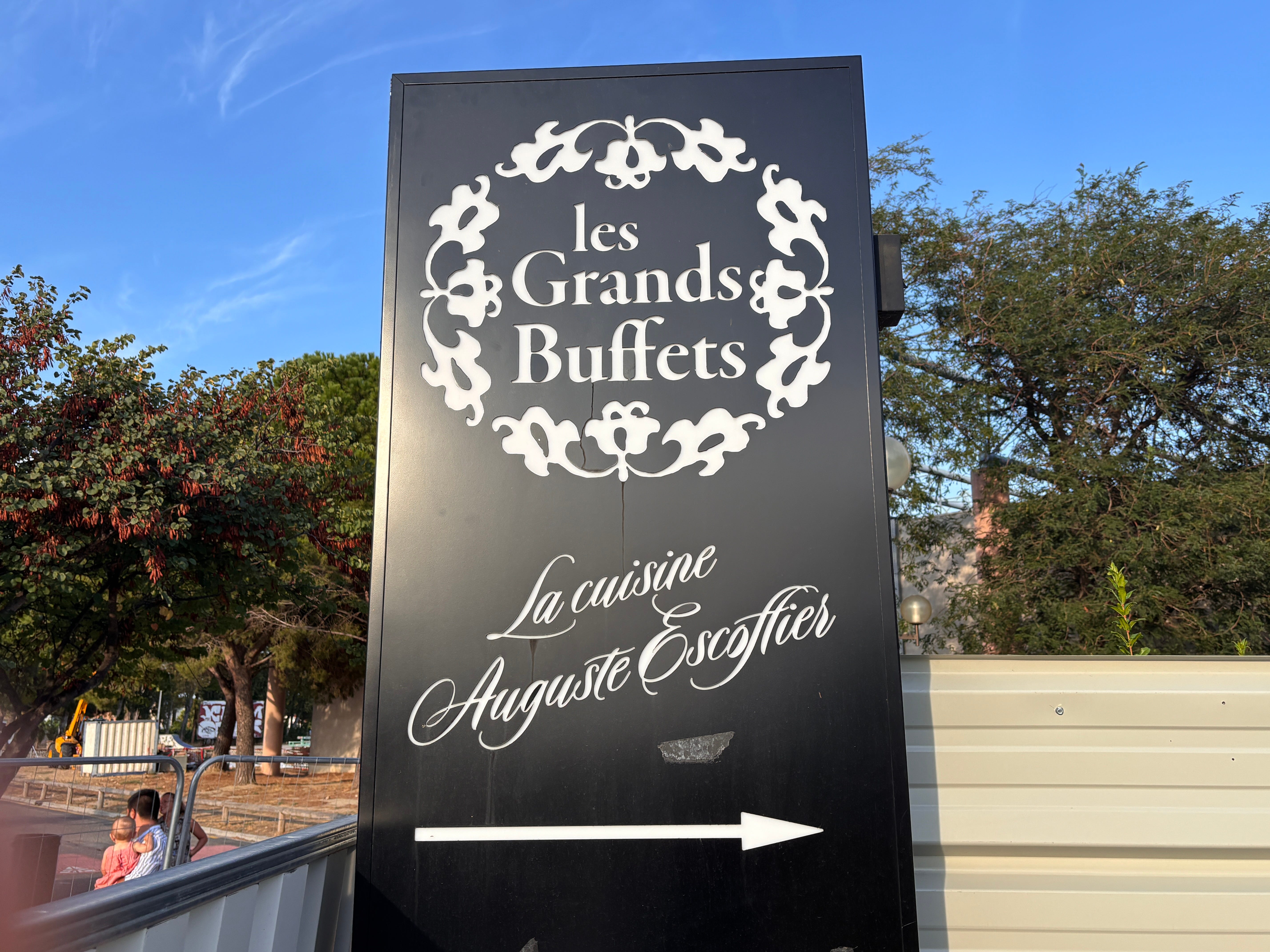
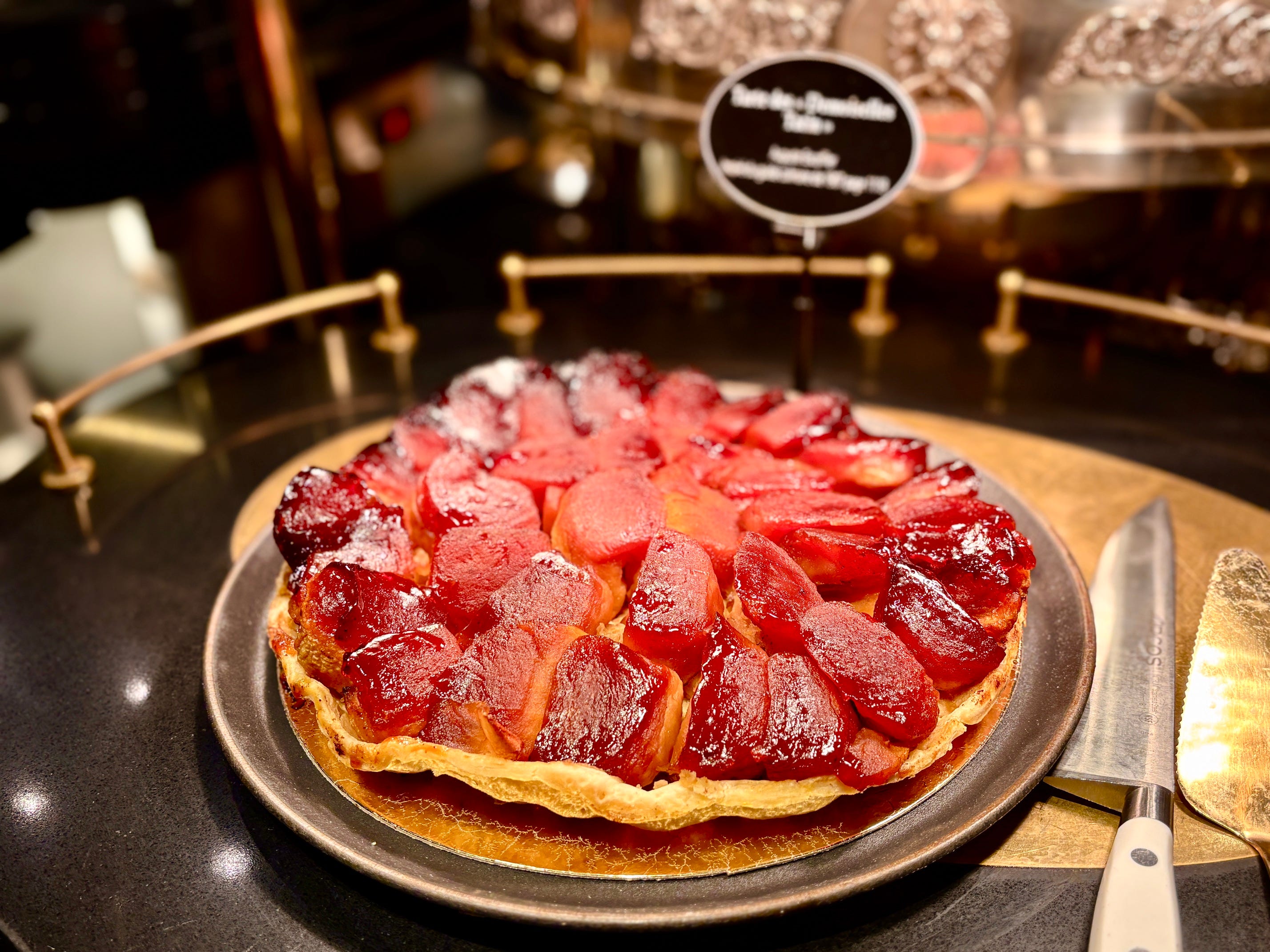
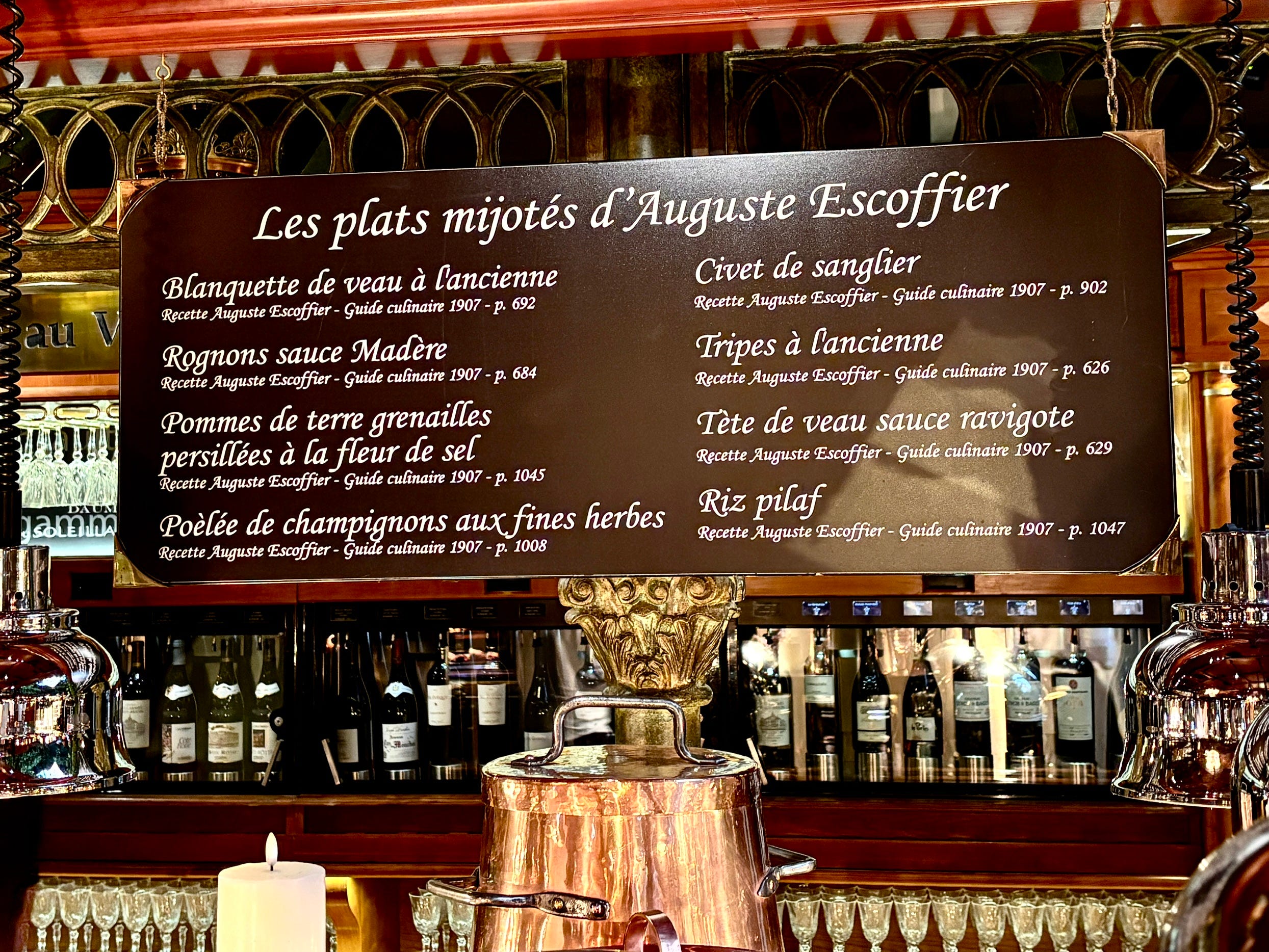
The main mission of the restaurant (aside from being a business) is to preserve French cuisine and traditions, set forth by Chef Auguste Escoffier, who wrote what’s considered the seminal book on French cuisine, Le Guide Culinaire, with instructions for preparing over five thousand French dishes. In it, you’ll find recipes for frog’s legs, snails, and tripe, which have fallen out of favor but are offered at the restaurant to keep those foods, as well as others, alive. My favorite quote from Privat was in Lauren’s article, “Why would you put a tarte Tatin in a shot glass?”
True to his word, thankfully, they don’t.
My own experience with Escoffier was when I was a line cook in San Francisco and ran across the street to the store to get an ingredient that we were out of. When I came back, the head chef wasn’t amused that I wore my chef’s coat to run the errand. “What would Escoffier say?” he admonished me. “I don’t know,” smart aleck me replied. “He’s dead.”
I didn’t see any staff members in chef’s coats running out the door, but a very nice woman named Elodie greeted us as we walked towards the door fifteen minutes early. In a very organized fashion, she made a note that we were there and directed us to their bar, which was next door, by the bowling alley. Knowing how rules about lines in France can be one of those things that are “for other people,” she said that when we came back, if there’s a line, just head to the front of it and ask for her.
The bar that looked out over the bowling alley was hopping, and I had a glass of Suze, a bitter French apéritif that’s particularly appealing in the summer. To accompany your drinks, there are help-yourself appetizers, such as this DIY Tête de moine cheese machine, which produces perfectly scraped ruffles of cheese with a push of a lever:
The cheese is named after a monk’s tête (head) and one theory goes that it was a symbolic way to get revenge on the monks, who people had to pay rent to hundreds of years ago, for using the land. A few othertheories are out there, but as the head of Chartreuse told me when I asked him to fact-check what I wrote in Drinking French about the Carthusian monks, who now make Chartreuse, whose history dates back a thousand years, he replied, “It’s hard to know what happened then…we weren’t there.”
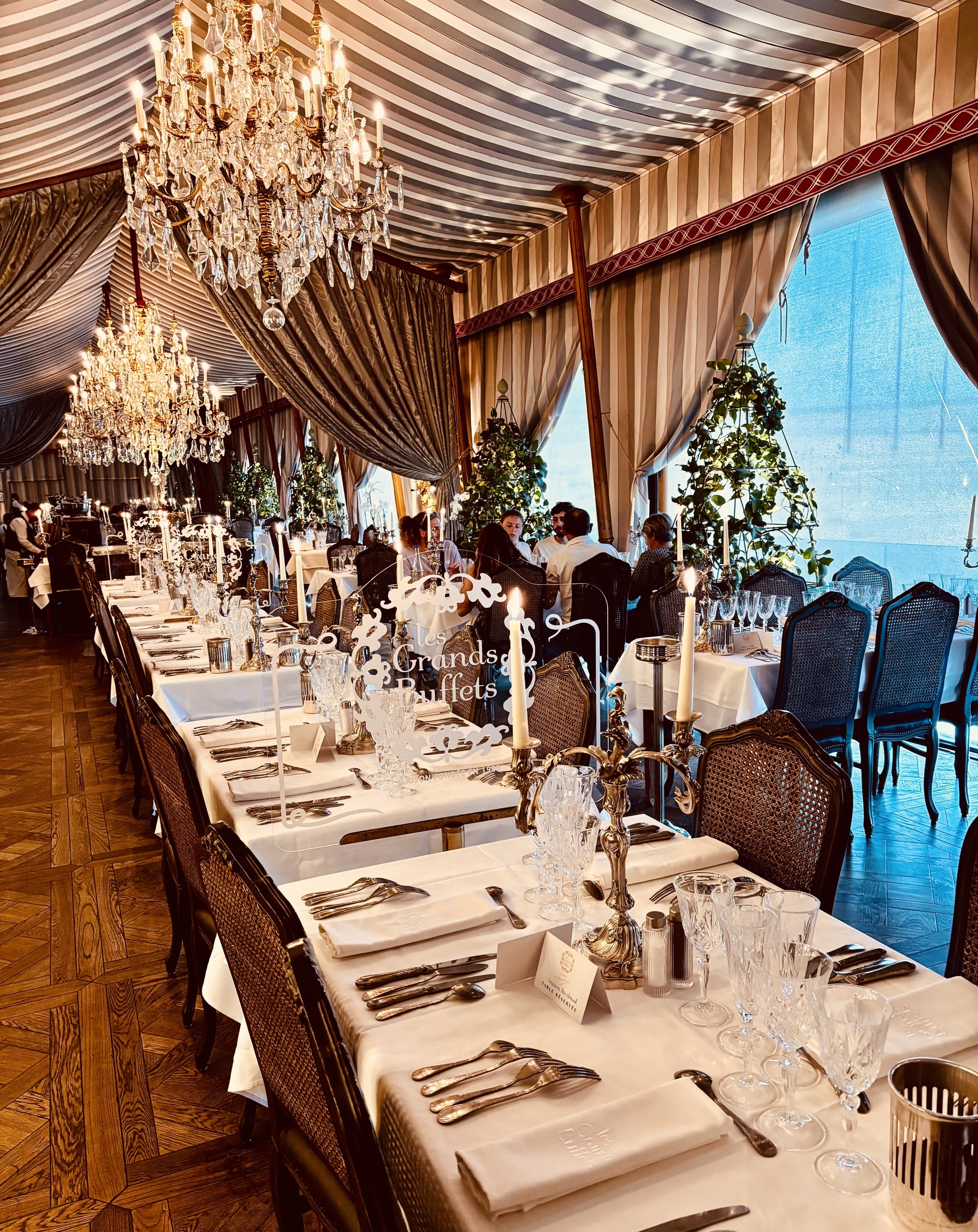
The dining room of les Grands Buffets is a surprisingly elegant affair, and you might feel like you’re attending a wedding or a gala event when you enter the room.
We kicked things off with a bottle of Heidsieck & Co Monopole champagne. Part of the restaurant’s philosophy is to charge close to retail prices for wines, rather than jacking them up. So the wine list is remarkably affordable and many producers from the region are featured in a section marked “Autour de Narbonne” — wines from around Narbonne. A majority of the wines are in the €20-25 ($23-29) per bottle range, which included that champagne.
There are various strategies for tackling les Grands Buffets. Unlike Las Vegas buffets, which a friend noted was likely the inspiration for this restaurant, there wasn’t any shoving or elbowing others out of the way, which also was because the restaurant is in the south of France, not in Paris. Diners lined up politely and waited their turn for their food.
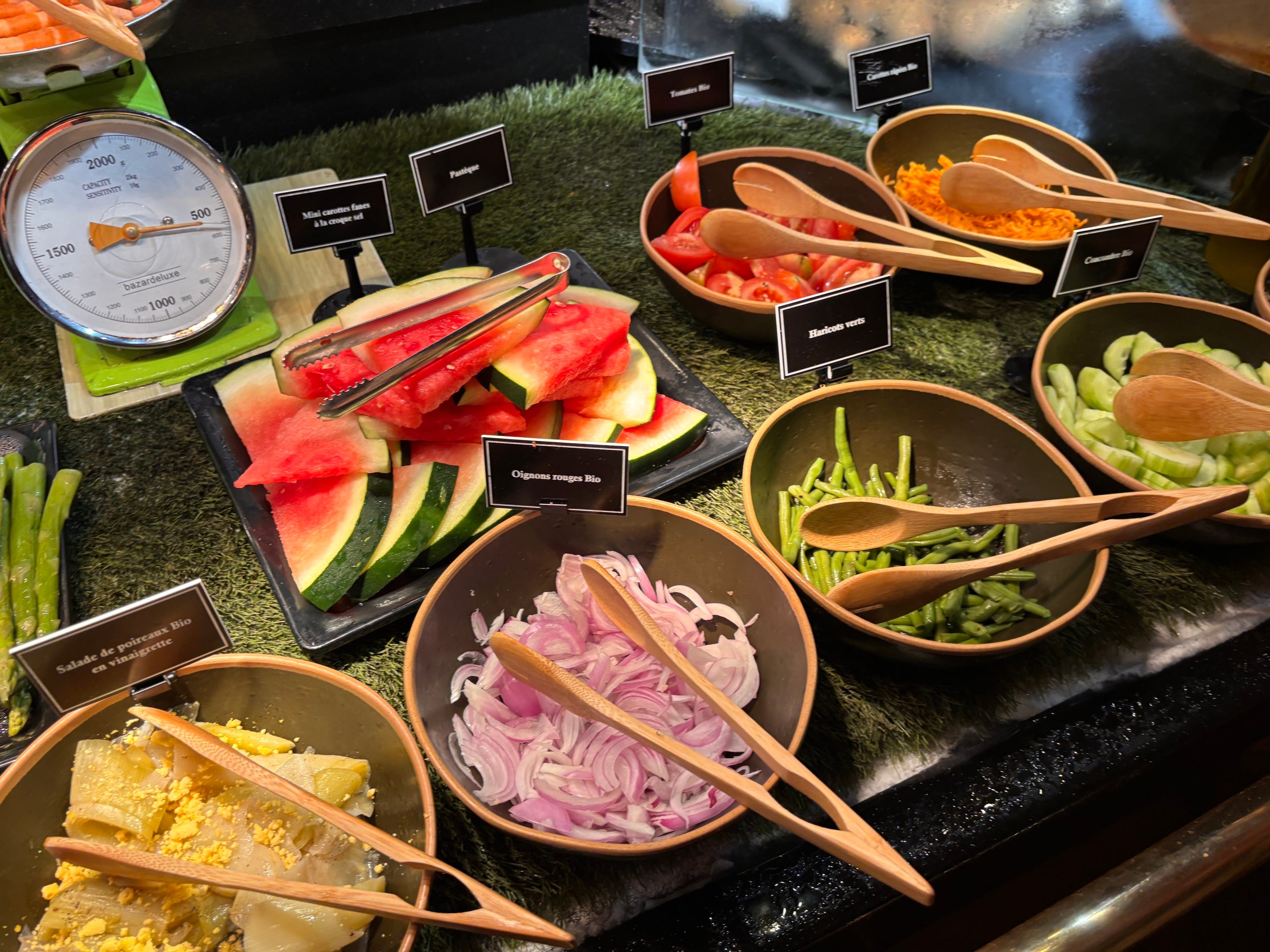
It’s best not to fill up on bread or vegetables, and I noticed most of them went untouched. Another strategy that I read was not to skip lunch if you were going there for dinner, since you’re going to be starving upon arrival and probably fill up on carbs.
I made the truffle station my first stop, where they don’t skimp on truffles. And yes, they’re the real ones. Not “summer” truffles. There wasn’t a whiff of phony truffle oil in sight, nor a smell.
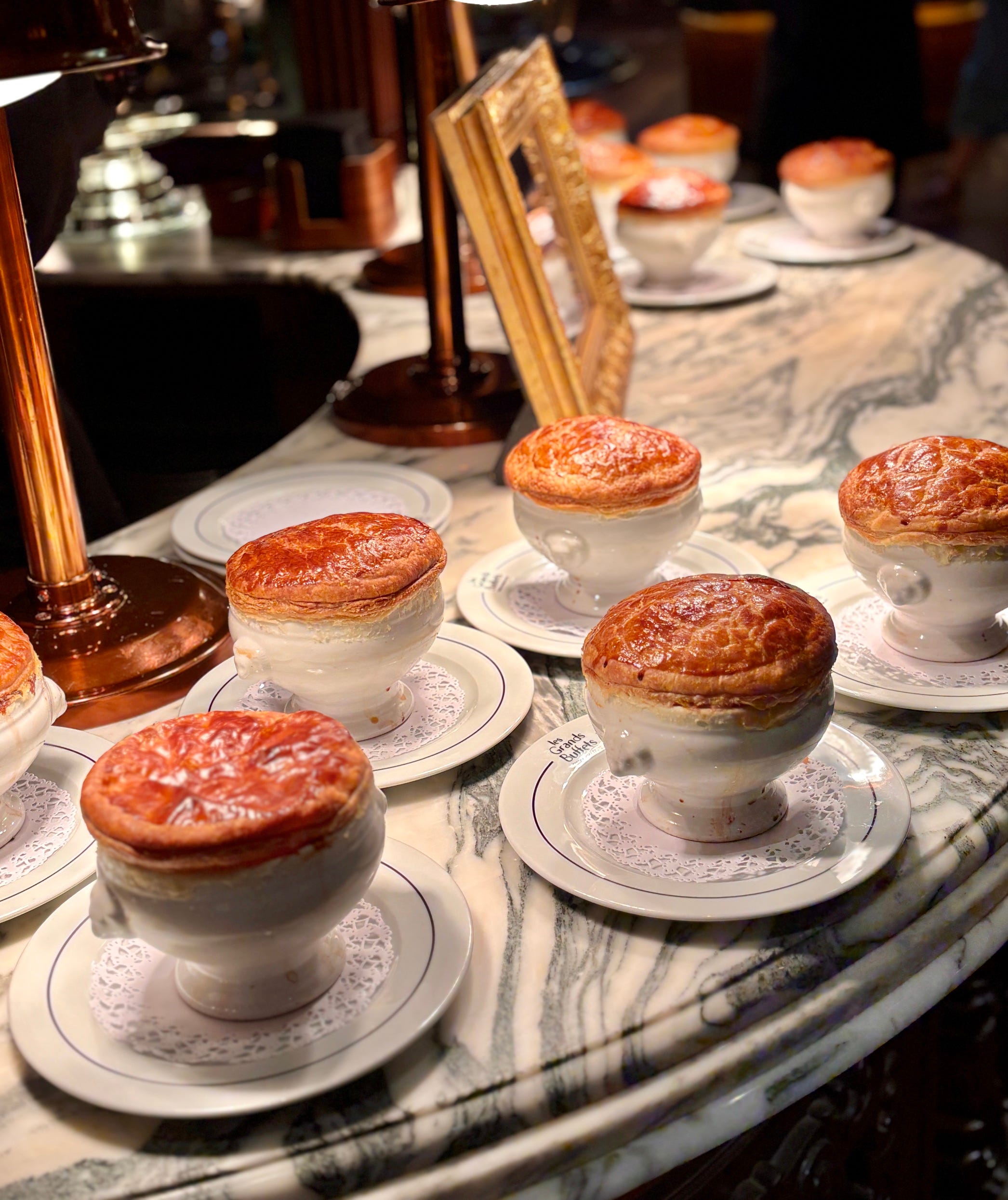
One offering was a soup made with black truffles and foie gras under a cap of feuilletage, buttery puff pastry.
Since I was skipping carbs, I skipped that, but the woman seated at the neighboring table took the soup, lifted the cap off, and ate it like a cookie. I admired her creativity.
I went for the brouillade, a mound of freshly made scrambled eggs, which were scrambled with a lot of minced truffles inside and topped with shaved black truffles.
I was never a big truffle fan. When I worked in restaurants, I would occasionally get to eat them for free (ditto with caviar), so it’s hard for me to pay for truffles and I was never gaga for them. However, years ago, I went on a truffle hunt in France and was in a room with hundreds and hundreds of truffles. Every course at dinner that night was loaded with truffles, and I was hooked. Still, I didn’t go back for the soup but moved on to the charcuterie.
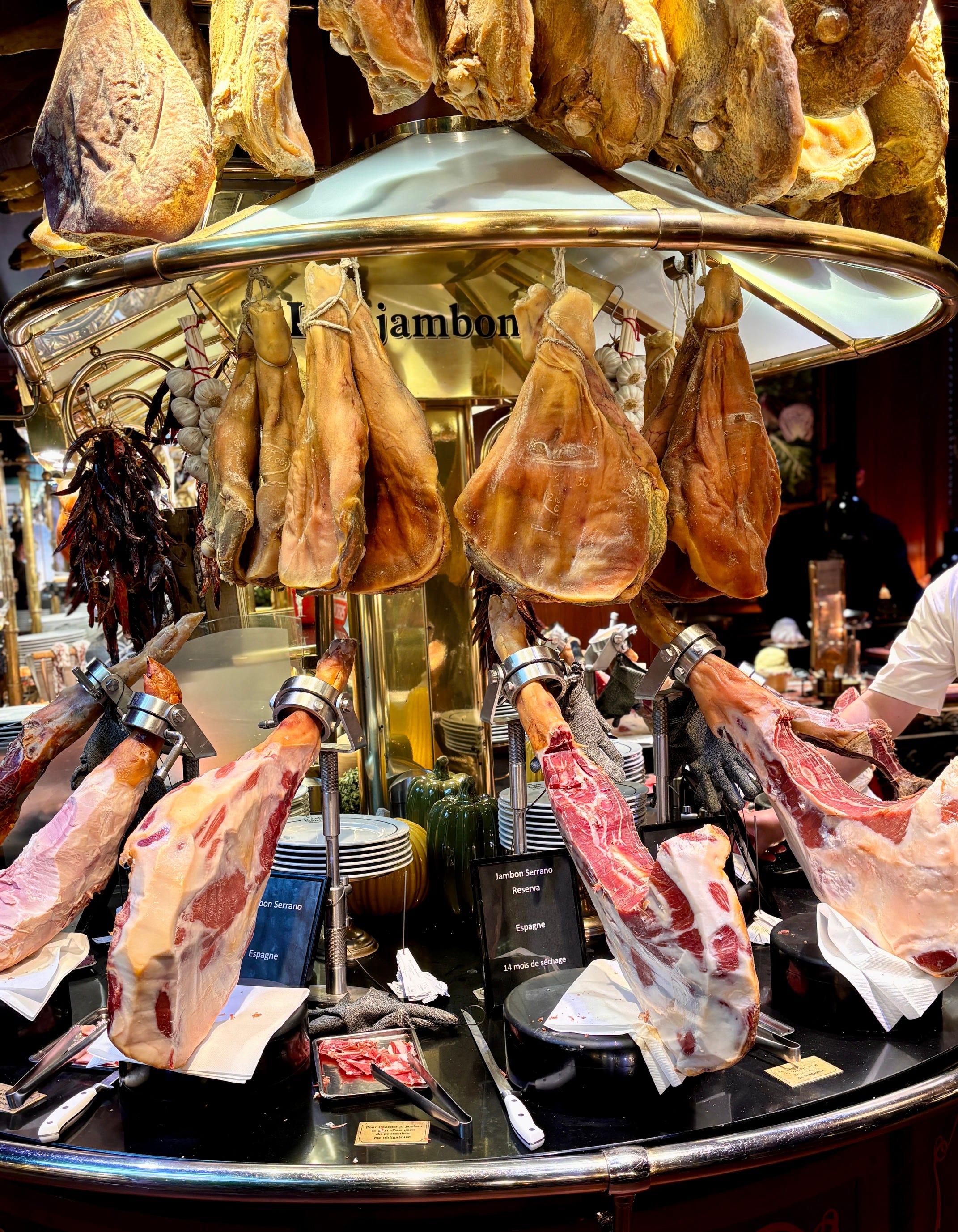
The pièce de résistance in that department was a station of hams, sliced to order. Each one listed its provenance and in France, they tend to slice ham thicker than they do in Spain and Italy, which makes it a little tougher to eat. Romain once told me to tell the person at the charcuterie that I wanted my ham “as thin as cigarette paper.”
I tried that and the guy deadpanned back to me, “Monsieur…je ne fume pas…” I don’t smoke.
Personally, I think it’s a strategy to sell more ham since when something’s sold by weight, ten thick slices weigh a lot more than ten cigarette paper-thin slices. The lone slicer at les Grands Buffets was doing his best to keep up with all the customers, and the hams. So it was hard to fault him for the thickness of the slices. But maybe he wasn’t a smoker either.
While I was on vacation, I posted a few pictures from the restaurant. Someone made a comment wondering aloud how there could be so much food, when others have so little? It’s definitely true that most of us have access to food that’s sadly, not available to everyone. Narbonne is not a wealthy city and most people earn less than the national average. Unemployment is around 18%, which is over double the national average (8%) in France.
While researching her article, told me that some people save up all year just to have dinner at les Grands Buffets, that it’s their special night out. After thirty years, the restaurant has figured out how much food they’ll go through each night so there’s very little food waste, and whatever is left over is served at the staff meal. Being in a municipal building, the restaurant is a strong supporter of the local community, which also includes winemakers and other producers, in addition to supporting a staff of hundreds of people.
It’s hard to size up people by how they look and are dressed, but the people eating at les Grands Buffets seemed to be “everyday” people. (I didn’t see any fancy cars in the parking lot.) Judging from their accents, it sounded like there were many locals. Folks in this part of France have what’s referred to as an accent du midi and pronounce certain words, such as wine (vin), as ving, with a bit of a nasal twang on the final “g.” And unlike the buffets of Las Vegas, this restaurant isn’t a palace of gluttony. People weren’t loading their plates up as full as possible, overindulging in whatever they could. It was all quite civilized.
I suppose you can criticize people eating at restaurants when others can’t. But not sure how one draws the line. At least the price point here is not too far from the price of a 3-course dinner at a mid-range restaurant in Paris.
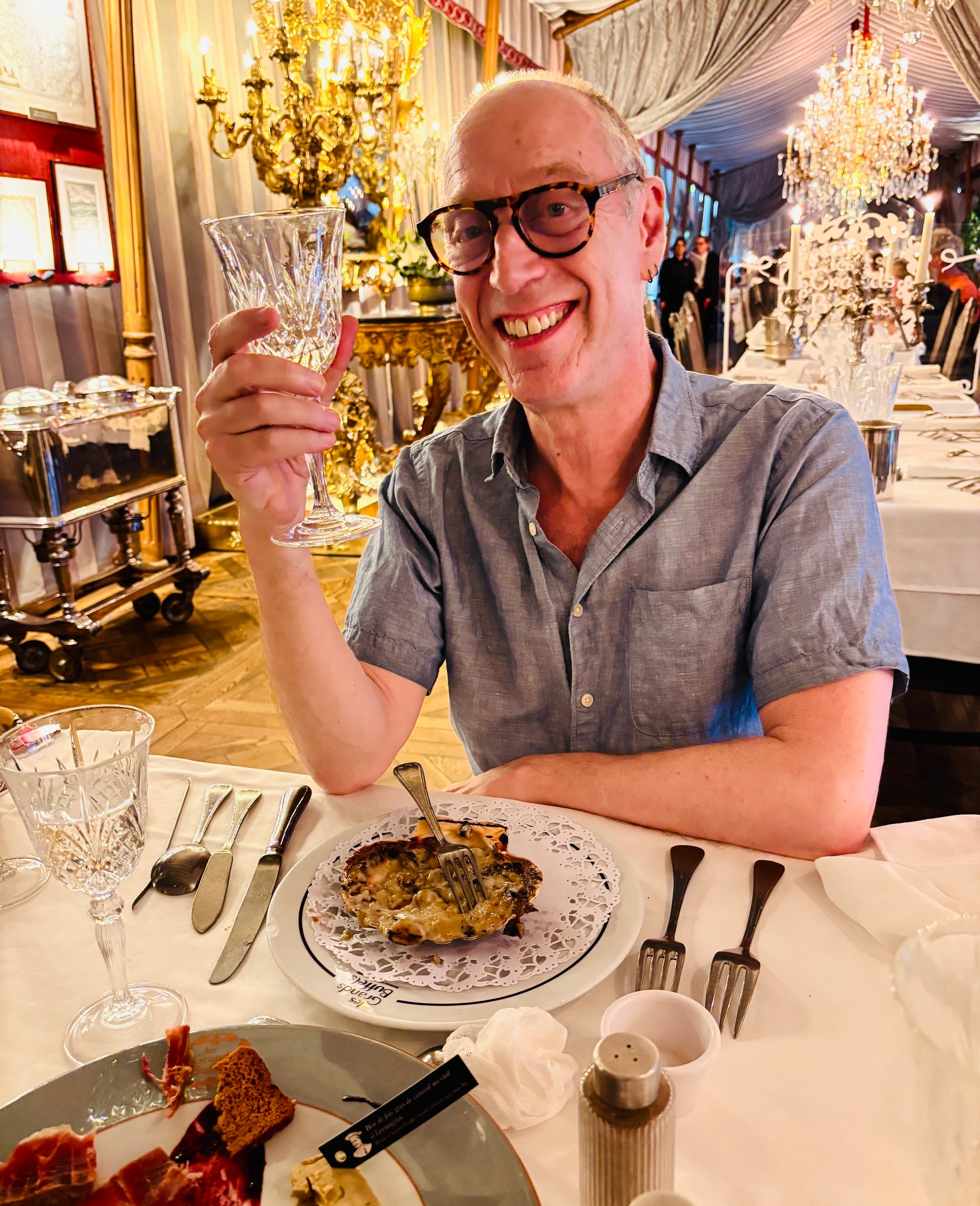
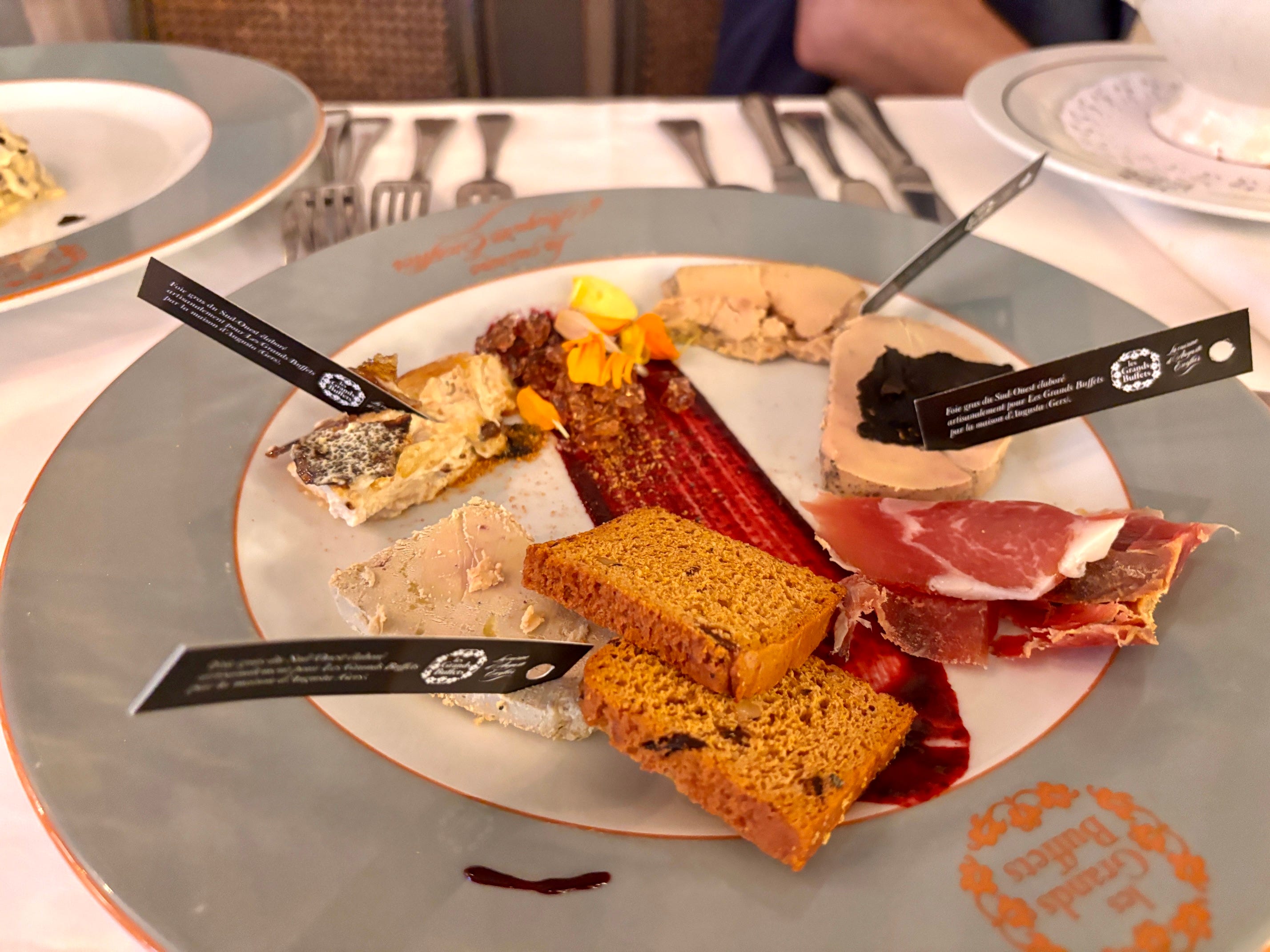
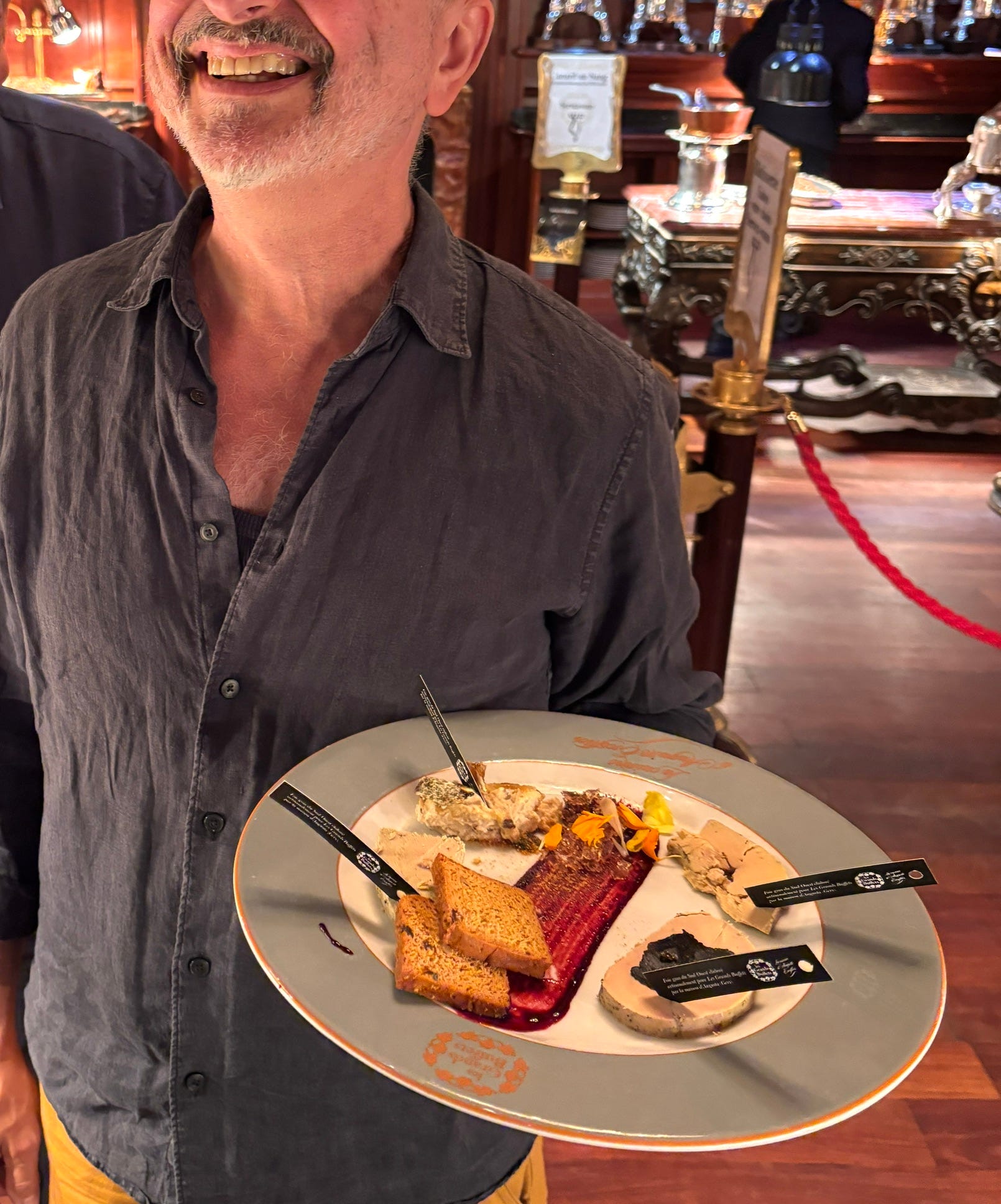
Four presentations of foie gras, with little explanations attached: Lightly smoked, with truffles, mi-cuit (partially cooked) with Armagnac, and in the style of crème brûlée, with port wine.
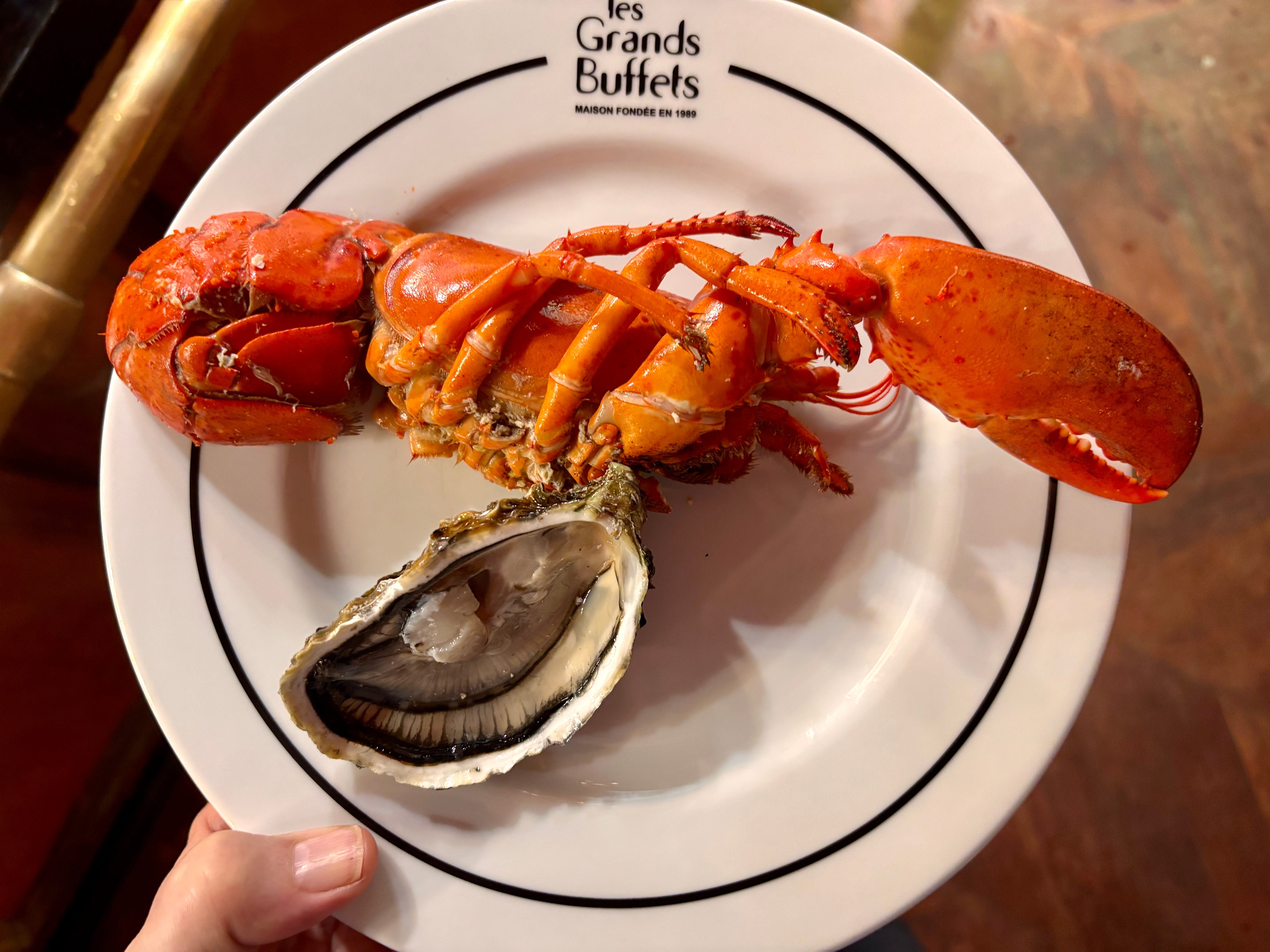
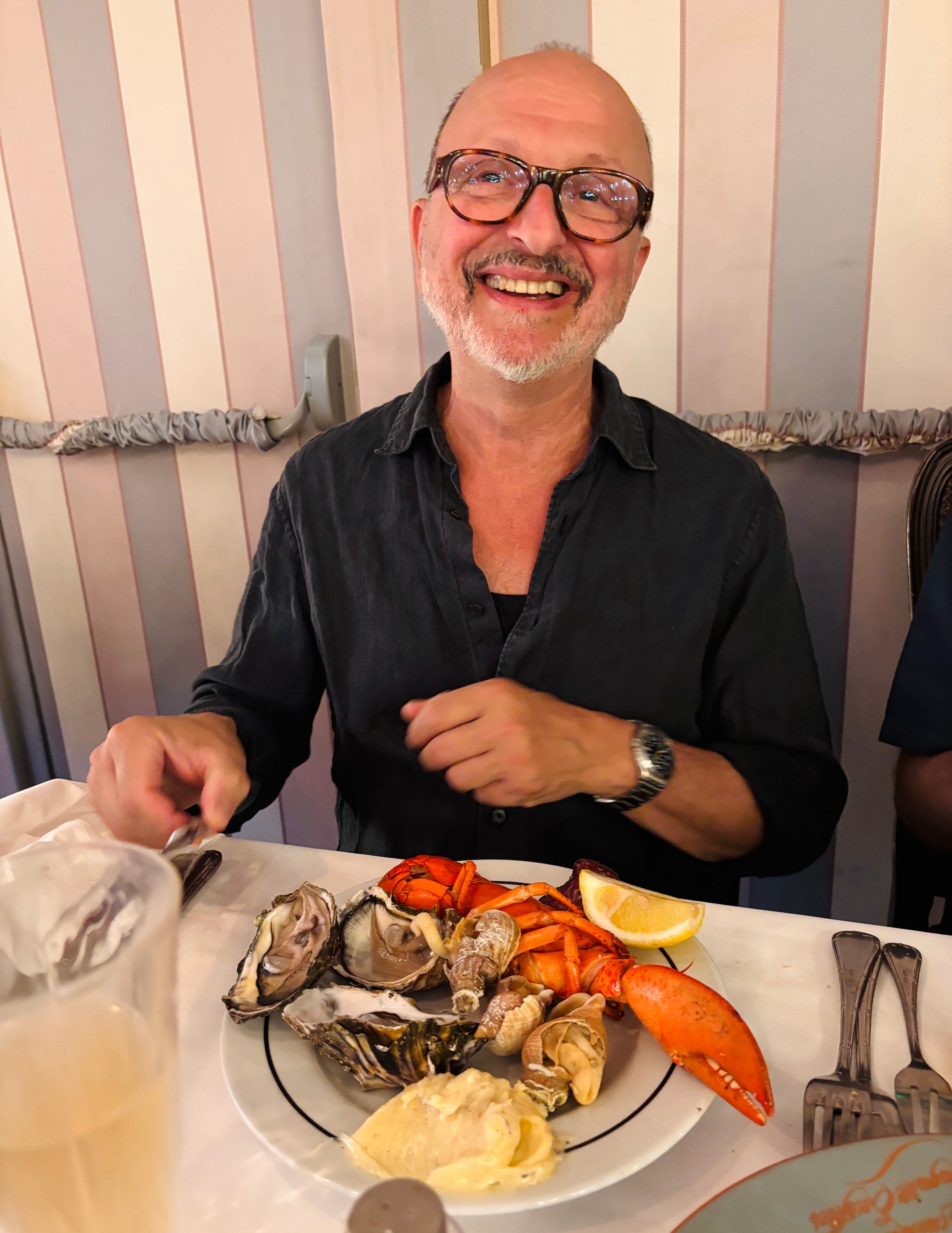
It’s true that the lobster tower could be considered a little over the top, but as a winemaker in the region told me once, “People who live here know how to cook, so they don’t go out for the food. They go out for the experience.” And the lobster tower is giving it to them.
As mentioned, one objective of the restaurant is to guard the heritage of Auguste Escoffier and la cuisine française. They adhere so closely to his recipes that the page numbers from his book, Le Guide Culinaire, are listed on the menus.
Subscribe to my newsletter to get new posts, Paris dining tips, recipes, and more, sent right to your Inbox. Sign up here!
An undeniable part of French culinary heritage is foie gras. It’s a controversial ingredient, even in France, and is not something we eat often. When we do, I try to make sure that it’s produced in France, not just “packaged” or “transformed” in France, as some jars and cans say, which means the foie gras can be produced elsewhere.
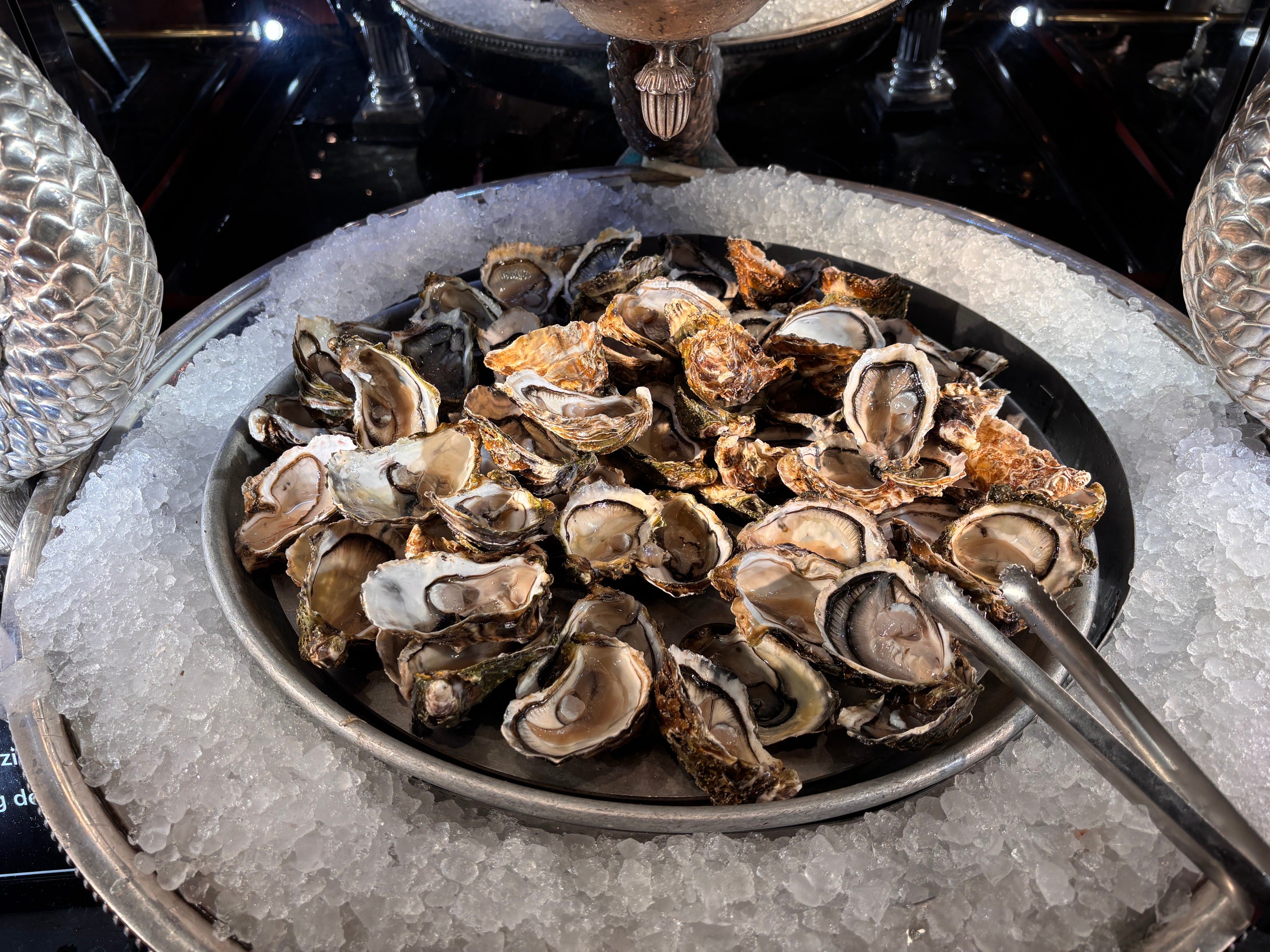
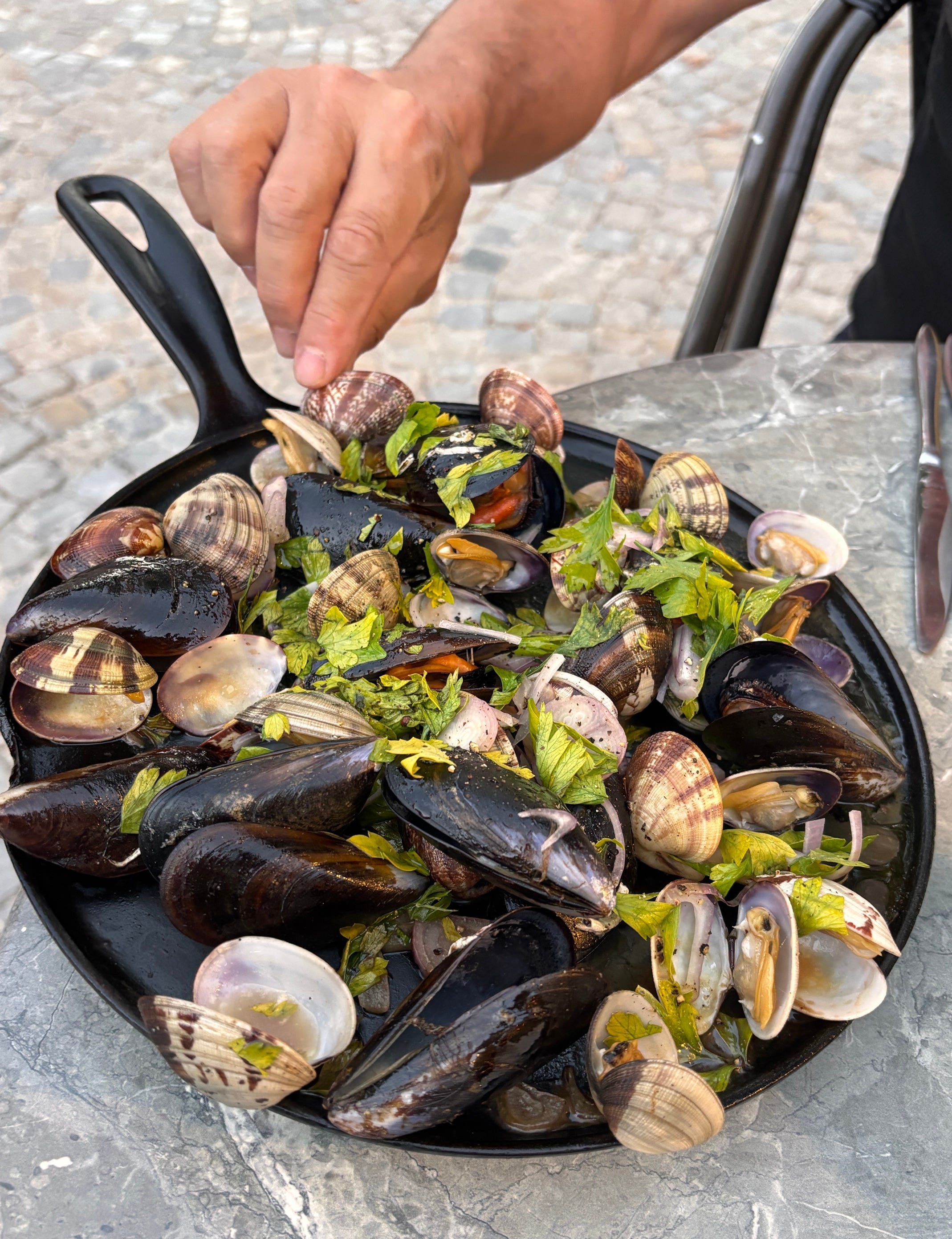
After nibbling around that plate of richness, we headed to the seafood section and loaded up on oysters. They also had mussels, bulots (sea whelks), and smoked salmon, heaped up on ice, all for the taking.
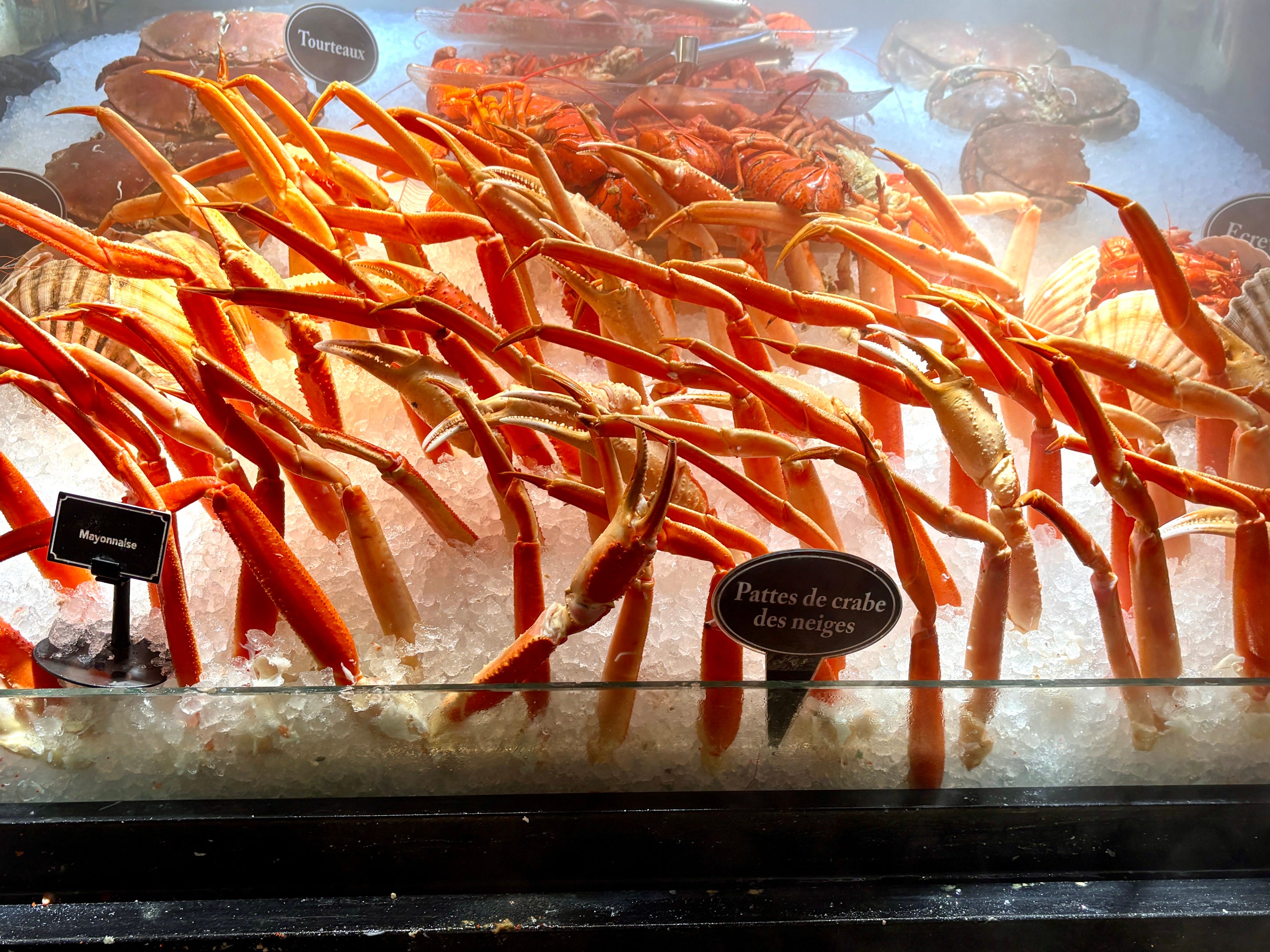
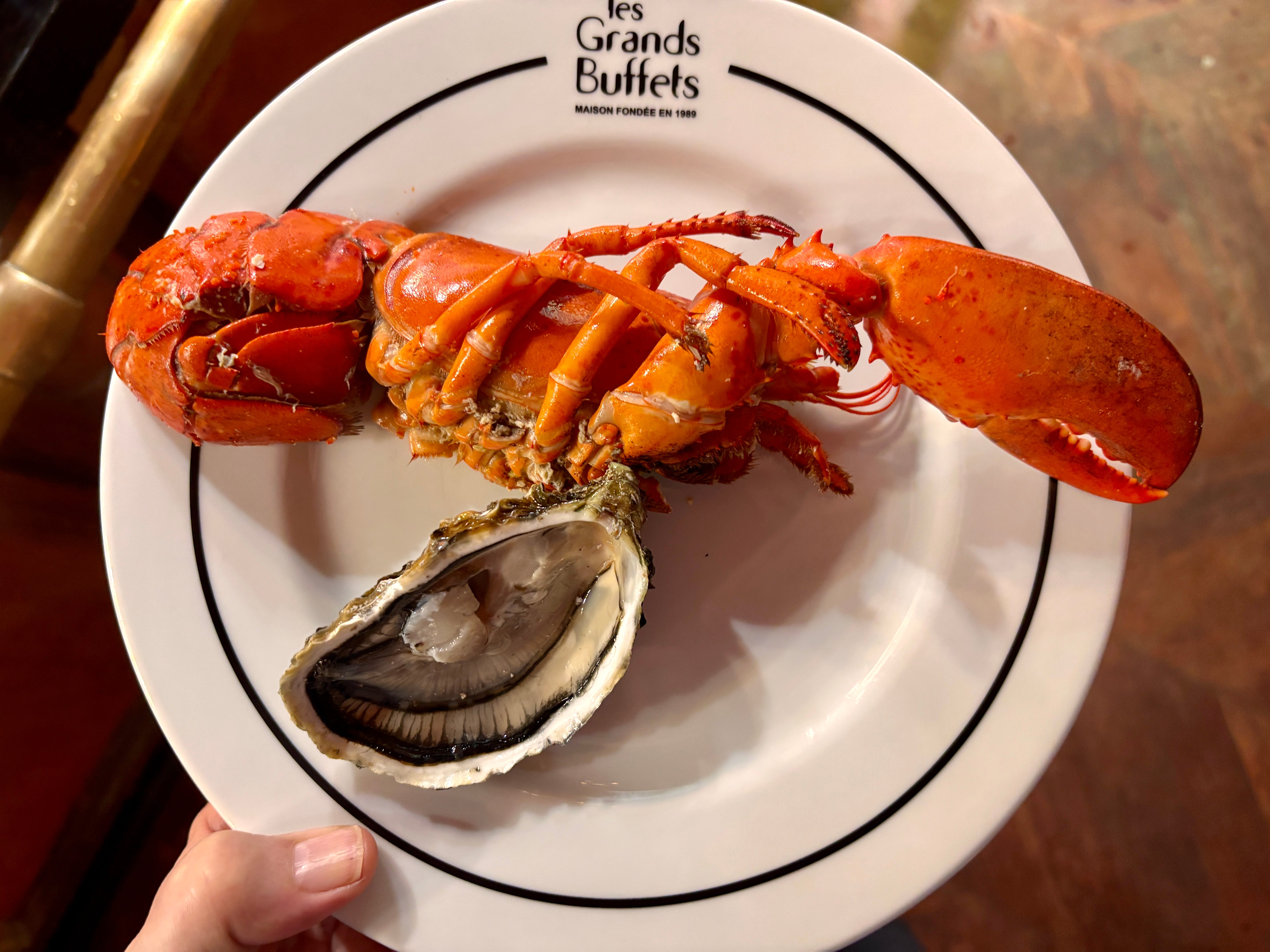
I didn’t try the crab claws, below, which a reader told me was better than the lobsters. As a New Englander, I’m pretty partial to Maine and Canadian lobster. Lobsters from France are twice as expensive are they are in the States, and a pricey indulgence.
I was wondering if the restaurant would haveFrench lobsters, which they didn’t. I guess they blow their budget on black truffles. So if you go, grab a claw or two, or three, and let me know what you think.
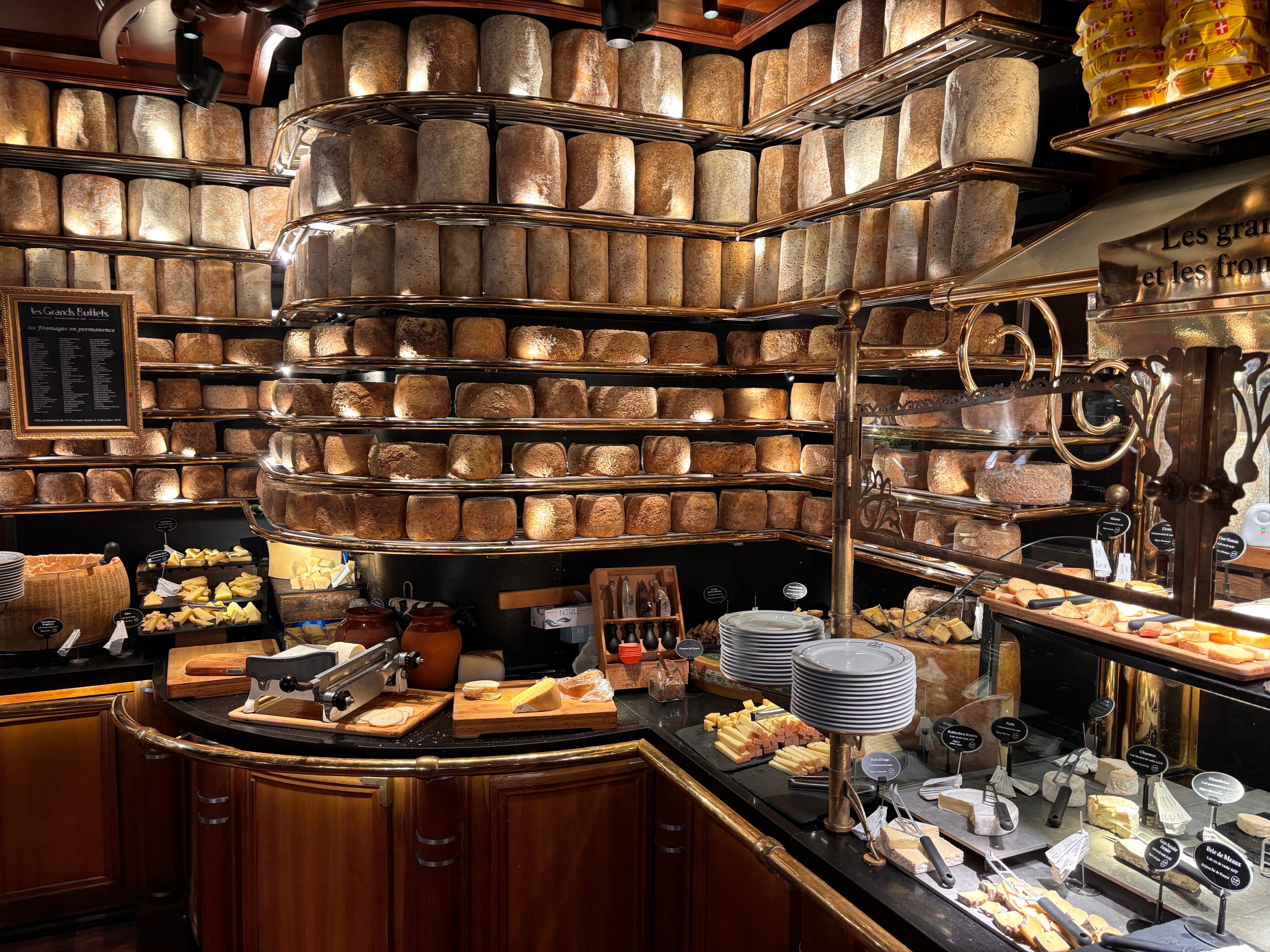
Stay tuned for part 2 — main courses, the cheese course from the largest selection of cheeses in the world, and, of course, dessert(s).
This creamy chipotle sauce is bold and punchy! It’s the kind of sauce that takes your meal to the next level, and brings together component-based dishes like tacos and burrito bowls. You can also serve it as an irresistible dipping sauce. It offers a thicker drizzle than chipotle mayonnaise and tastes better, too.
To make this chipotle sauce recipe, you’ll need a few basic ingredients. Start with a base of sour cream (use Greek yogurt if you prefer), chipotle peppers in adobo sauce (more on those below), a dollop of mayonnaise for a silky texture, dried garlic granules for intrigue, and salt and pepper.
Chipotle sauce should be somewhat spicy at minimum, but youcontrol the spice level when you make it yourself. I’ve written the recipe below with a range of chipotle peppers. Start with the lowest amount, then taste, and blend in more if you’d like.
If you live in California, this week was a corker. We nearly melted when temps hit 100 degrees Fahrenheit in Santa Cruz. As we chugged iced water, Rory and I laughed at how he grew up in the blazing hot San Fernando Valley and I was born in tropical Saigon. After living in the Monterey Bay area for nearly thirty years, we’ve become hot weather wimps!
In our town, going out mostly means heavy food options — pizza, burritos, pasta, and burgers. We wanted light fare to keep us cool and refreshed. I didn’t want to turn on the oven for lengthy bakes or grill outdoors under the blazing hot sun. So, I focused on easy cooking — little things that I could do quickly without breaking a literal sweat and then use later on in many ways. I looked in the fridge at my vegetable bins and started tinkering.
With Thai cooking on my mind these days, I revisited a favorite recipe Thai-style watermelon salad. It’s got garlic, dried shrimp, lime leaf and other ingredients to turn watermelon into a salty, sweet, spicy refreshing salad. The 🆓 watermelon salad recipe is at my website, along with watermelon selection tips.
Feeling refreshed and energized, I experimented to create 3 solid recipes, plus a combo of two of them to make yet another 1/2 recipe, to share with you today:
Cheater’s Confit Tomatoes preserves tomatoes with umami depth in as little as 10 minutes.
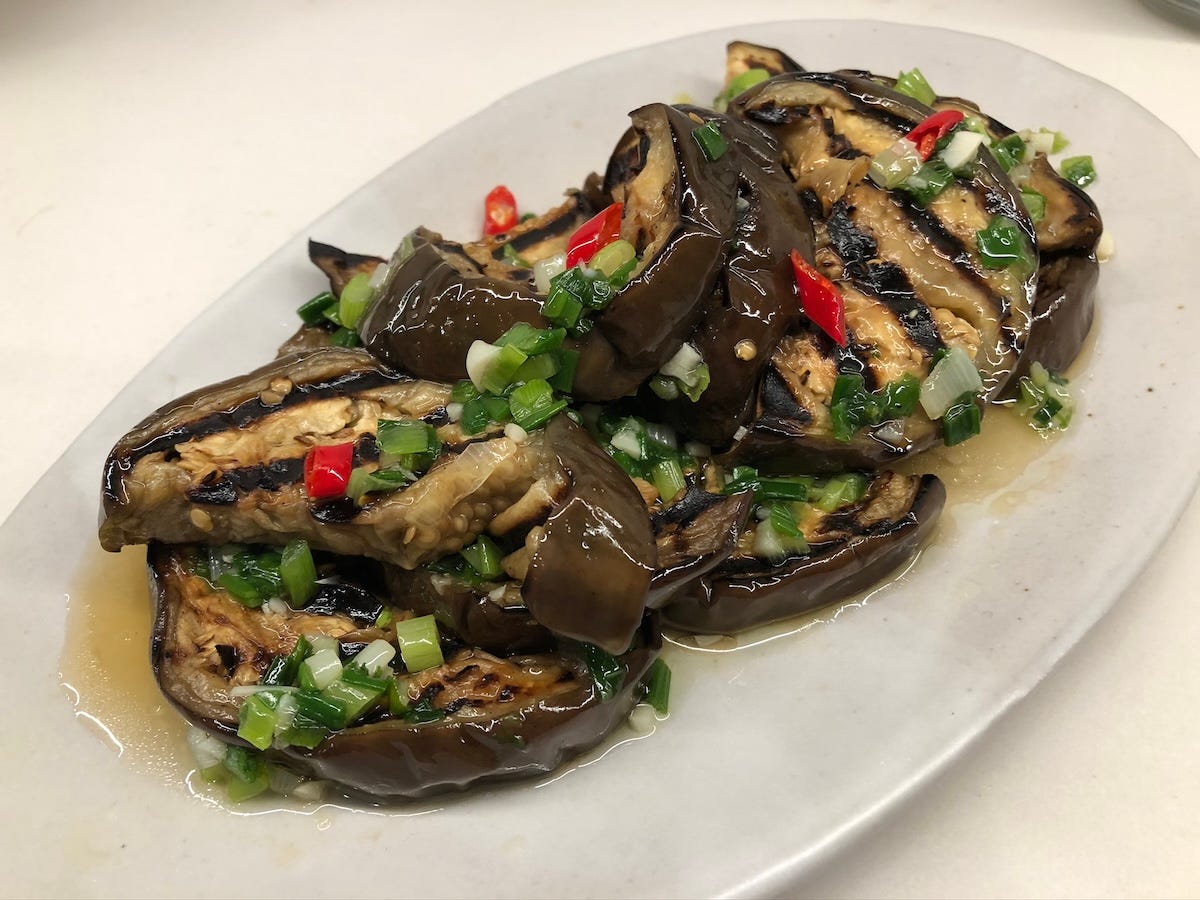
Viet Grilled Eggplant and Garlicky Green Onion Sizzle (yields plush rich-tasting eggplant that evokes fatty pork. Use it with the confit tomatoes for what I describe as an Grilled Eggplant “Bonanza” Platter (that’s the combo I mentioned).
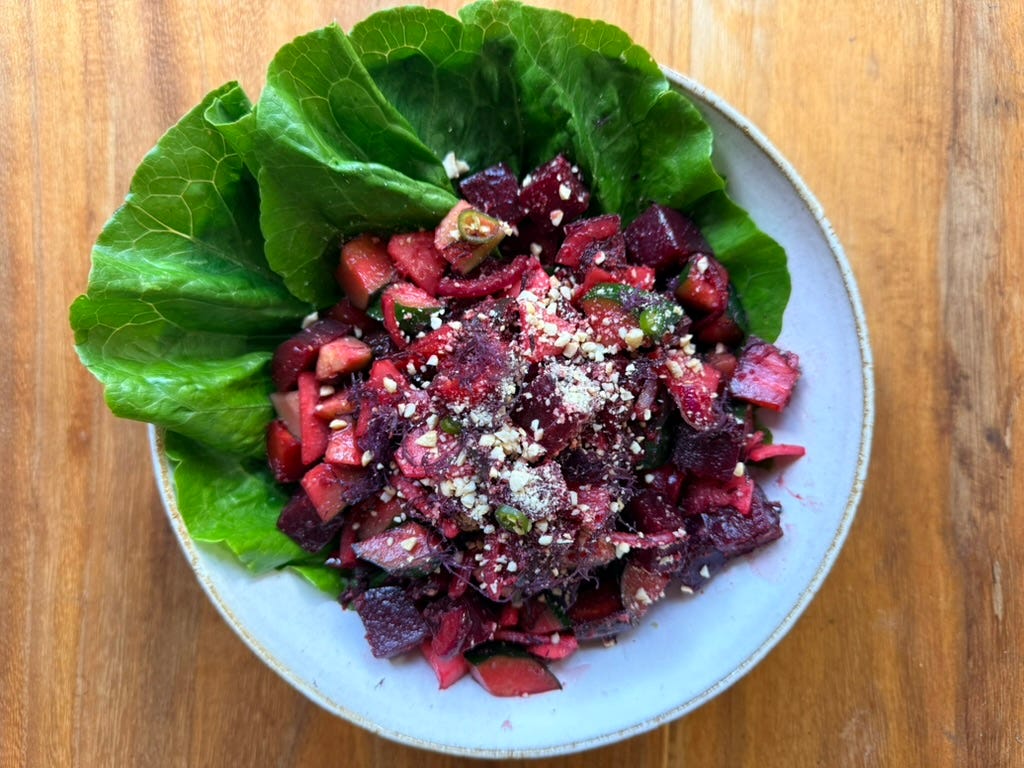
Roasted Vegetable Poke is nontraditional and remarkably good. The veggies are great as is and even better dressed up as poke.
Viet grilled garlic and garlicky green onion sizzle!
Depending on how you serve the poke, it can be Carmen Miranda-ish!
Moreover, I realized that a good recipe is the draw, but what makes it highly valuable is any enterprising cooking techniques held inside it. Those culinary takeaways you come across will enhance your cooking skills and life.
This week’s recipes are loaded with mini building blocks for you to make healthy, tasty food fast. Having building blocks around is how a chef or a restaurant effortlessly puts deliciousness on the table for their guests. They’re back-of-the-pocket small recipe that you can whip out as you need them.
Think of these three recipes like a three-piece suit that you can mix and match, plug and play with. They take little time to prep and prepare. The varied flavors, colors, and textures are joyful, to boot.
Above are two lunches we had this week. They each took about 15 minutes to prepare because I had the building blocks around. Soon, you will too!
Curious cooks, readers and eaters fuel this newsletter. Paid subscribers sponsor PTFS and this dispatch is designed exclusively for them. Join us as a paid subscriber for the whole shebang, fully use the recipe index + save 25% on future cooking classes!
This may or may not happen to you, but sometimes when I’m a guest in someone’s home, where everyone pitches in to make dinner, all eyes (or just the host’s eyes) fall on me to make dessert. Gulp. I happy to pitch in with the cooking or bringing along a few baked goodies for the weekend, but I’m not always prepared to bake on the spot.
If you’re lucky, there may be a scale, a cake pan, a sharp knife, and hopefully sugar, butter, eggs, and flour. If you’re really lucky, there might be a whisk and a spatula, too. But if you’ve ever tried to peel a dozen apples with a steak knife because it’s the only one that’s even close to sharp, or eyeball 1 cup/140g) of flour, you know what I’m talking about. I once did a post on Things I Bring When I’m a Guest for the Weekend, which raised the ire of some, but I require a minimum of a knife, a spatula, a bowl, and a cake pan if I’m going to bake something, like a cake.
You’re likely familiar with the Moelleux au chocolat, the soft warm individual melting cakes that everybody loves. (If you have the kind of friends that have six to eight ramekins, well, that’s great.) I recently saw French food writer and journalist François-Régis Gaudy (his book, Let’s Eat France, translated into English, is a lot of fun and pretty amazing) make a Moelleux à la abricot on his Instagram page, which didn’t require a mixer or any special equipment. Not even a whisk!
His Apricot Cake was a very casual affair, baked in a rectangular mold on a sheet of parchment paper, and came out of the oven rather free-form, looking exactly like something that would come out of a French home cook’s kitchen, when baking dessert for friends. I’m fine with that but didn’t know if you were, so I thought I’d tinker with it and make it in a cake pan, which is easier to slice. I also fiddled around with the ingredients, as well as putting the brown granulated sugar on top (rather than underneath), to give the moelleux a nice sheen.
I used a springform cake pan but you can use any similar-sized vessel; an 8-, 9- or 10-square or round cake pan would work, or even a baking dish. The baking time will vary but if your experience with using a variety of ovens in other people’s homes is anything like mine, you’ll find that each one is different, and what one says is 350ºF/180ºC will be different than another whose dial says 350ºF/180ºC. I don’t travel with an oven thermometer but may add that to things I bring when I’m staying with people.
Tip: If you’re staying in someone’s place for the weekend, you can mix the dry ingredients in a container or zip-top bag then put the dessert together when you get there.
I made one cake with apricots first, which was sensational, but knowing fresh apricots are harder to come by elsewhere, I made another one with plums, which came out great as well. It would work with other summer fruits and berries but I really like the tanginess of apricots or plums against the moist cake layer, so stuck with those two. A handful of berries wouldn’t hurt either, but I do recommend keeping it simple.
Inspired by a recipe from French food writer and journalist François-Régis GaudryThe ground almonds are really delicious in the dessert, but if you can't get ground almonds (sometimes called almond meal or almond flour), you can use 1 1/4 cups (175g) of all-purpose flour in place of the mix. The picture in the post of the batter shows 3 eggs being added, and I took that photo when I first tested the recipe, which I did a few more times after that. The final recipe that I came up with, below, uses 2 eggs.
Course Dessert
Servings 8servings
Ingredients
1 1/2pounds (680g)apricots or plums(or another summer fruit, see headnote)
1 1/2tablespoonscoarse granulated brown sugarsuch as tubinado sugar (or granulated white sugar)
Instructions
Halve the fruit and remove the pits. Slice the fruit into 3/4- to 1-inch (2-3cm) wedges. Set aside. Preheat the oven to 350ºF (180ºC.) Grease a 9-inch (23cm) springform pan very well with butter or non-stick spray. (If you don't have a springform pan, you can use another cake pan but it may be harder to get the cake out so you may want to also line the bottom with parchment paper.)
In a medium mixing bowl, stir together the almond flour, all-purpose flour, baking powder, salt, and sugar. (My preferred tool to use for this step is a silicone spatula.) Add the soft butter and mix it in with the spatula until it's broken up into little pieces, roughly the size of kernels of corn. Stir in the eggs and vanilla extract, until it's almost smooth. It's fine if there are small pieces of butter visible.
Scrape the batter into the prepared pan and smooth the top. Arrange the wedges of fruit on their sides in concentric circles over the batter, snugly placing the wedges against each other, pressing them gently into the batter as you go. Avoid putting them right up against the sides of the pan. It's best to leave some room for the batter to rise between the fruit and the pan, to avoid juices from the fruit adhering to the sides of the pan as the moelleux bakes. (It's unavoidable - and natural - if using juicy fruits, like plums, to have juice run out. But placing the slices not right up against the sides of the pan will help you get the cake out of the pan later.)
Sprinkle the coarse sugar over the top and bake until the center just feels set; a toothpick inserted into the center should come out free of cake crumbs stuck to it, about 1 hour. Remove from the oven and set on a cooling rack. If any fruit juices have bubbled up and stuck to the sides of the pan, run a knife around the outside of the cake, which will help it release later.
Notes
Notes: If you want to make this gluten-free, I'd go with the almond flour rendition, and use a gluten-free flour substitute in place of the wheat flour. If you want to reduce the sugar in the recipe, you could cut it by 6 tablespoons/75g and skip the sugar on top, although I wouldn't.
This recipe, from The Great Book of Chocolate, is one of my favorite recipes in the book. It’s a deep-dark chocolate spread that’s just as welcome on the breakfast table with warm croissants or toast, as it is as an afternoon snack, swiped on a slice of baguette.
The recipe comes from my friend Deb Perelman, of Smitten Kitchen, who came to Paris and made it in my kitchen with me. You can watch the full video here.
Since you’re making it at home, unlike store-bought spreads, you know what’s in this delectable. This recipe uses olive oil, which is healthy and delicious with the dark chocolate. I like to use one that’s fruity, which compliments the chocolate perfectly.
Depending on the type of chocolate you use, and it’s percentage of cacao solids, as well as the ambient temperature of your kitchen, the spread can be a bit firm, or soft, at room temperature. If it’s too firm, you can zap it for a few seconds in the microwave to make it more spreadable. If it’s too soft, it can be chilled briefly. In my kitchen, it’s perfect just as it is at room temperature…and I think you’ll love it too.
A delicious dark chocolate spread with olive oil that you're whole family will enjoy. The recipe is adapted from my book, The Great Book of Chocolate – now available!
Course Breakfast, Snack
Keyword chocolate, olive oil, spread
Servings 8
Ingredients
1/2cup (70g)powdered sugar
1/4cup (25g)unsweetened cocoa powderpreferably Dutch process
4ounces (115g)bittersweet or semisweet chocolatechopped
1/2cup (125ml)olive oil
Flaky sea saltsuch as Maldon or fleur de sel
Instructions
Sift together the powdered sugar and cocoa powder in a small bowl.
Warm the chopped chocolate and olive oil over low heat in a medium saucepan, stirring until the chocolate is melted and smooth. With a whisk, stir in the powdered sugar and cocoa powder mixture.
Transfer the mixture to small bowl and refrigerate until it's spreadable, which can take 2 to 3 hours. Check it every 15 minutes until it's the consistency of chocolate pudding. Scrape the mixture into a jar and store at room temperature until ready to serve.
Notes
The spread can be stored at room temperature for up to two weeks. It can be refrigerated for up to one month. Let it come to room temperature before serving. For more information about cocoa powder, check out my Cocoa powder FAQs.
Margot Lecarpentier is one of the best bartenders in Paris. At her bar, Combat, she shakes and stirs up cocktails – with and without alcohol – that are some of the best in the city. One a warm summer day, Margot stopped by to make an Affogato for us to enjoy in my backyard.
In Italian, affogato means “drowned,” and the typical affogato is a scoop of ice cream drowned in espresso, which is delicious. But Margot ramps things up a notch using a blend of rum, coffee liqueur, and amaro, which gives the dessert a lively kick. While you could use vanilla ice cream, Margot likes chocolate as much as I do, so I churned up a batch of chocolate sorbet, which also happens to be dairy-free, and she used that. Feel free to use your favorite flavor.
A delicious dessert with ice cream drowned in coffee liqueur, rum, and amaro
Course Drinks
Cuisine Italian
Keyword affogato, amaro, coffee liqueur, ice cream, rum
Servings 2
Ingredients
3/4 ounce (20ml)dark rum
3/4 ounce (20ml)amaro
3/4ounce (20ml)coffee liqueur
Ice cream or sorbet
2shotsespresso(cooled slightly)
Instructions
In a small pitcher or measuring cup, mix together the rum, amaro, and coffee liqueur.
Put one generous scoop, or several smaller scoops, of ice cream or sorbet into two ice cream dishes or small bowls. Douse each serving with the mix of liqueurs.
Add a shot of espresso to each portion and serve.
Notes
You can use your favorite brands of liqueur here. In this recipe, Margot used Rabarbaro Nardini amaro, but others, such as Fernet-Branca or Ramazzotti, would work.Nowadays there are non-alcoholic versions of most liqueurs, including the ones used here. If you’re avoiding alcohol, you can use non-alcoholic alternatives. For serving, feel free to shave some dark chocolate over the top of each affogato.
These Steamed Chicken Legs are an easy-to-make comfort food. Marinated with shallots, garlic, fresh ginger, sand ginger powder, and chicken bouillon, the result is tender, perfectly silky chicken with a delicious aroma and concentrated chicken flavor. Another reason to try this recipe? Chicken drumsticks or leg quarters are by far the most affordable cut of […]
It’s no secret that summer vacation is sacred in France. When I moved here, I found it curious that everyone went away en masse, at the same time. Bakeries, restaurants, eyeglass stores, market vendors, and almost every other business take time off for lescongés annuels, their yearly break.
But twenty-five years later, I get it. At the beginning of August, things start to slow down, and while I like the relative quiet of Paris during that month, I want to head to the beach and drink rosé and jump in some waves, rather than stay in sticky-hot Paris.
It took me a few years to unwind, and now I’m more low-key than my French friends and family, and am simply content to sit in a lounge chair and read for a few weeks on a beach or by a pool, while they’re scrolling through their telephones. I forgot to set a vacation notice for my email so I had to answer some messages. I think I’ll set it now for next year, so I don’t forget.
Romain tried to get me to visit museums, and he managed to get me in a few churches; if you live in France and have a French partner, the main attraction in any city is the church, whether they’re religious or not. As a good sport, I try to get in some culture on vacation. For example, I loved the Louisiana museum when we went to Copenhagen, even though it cut into my cardamom bun time. (Admittedly, there were no beaches nearby.)
This year I tried to deflect, that I’m an ouvrier, someone who works with his hands (not so much his brain), which got me mostly off the hook.
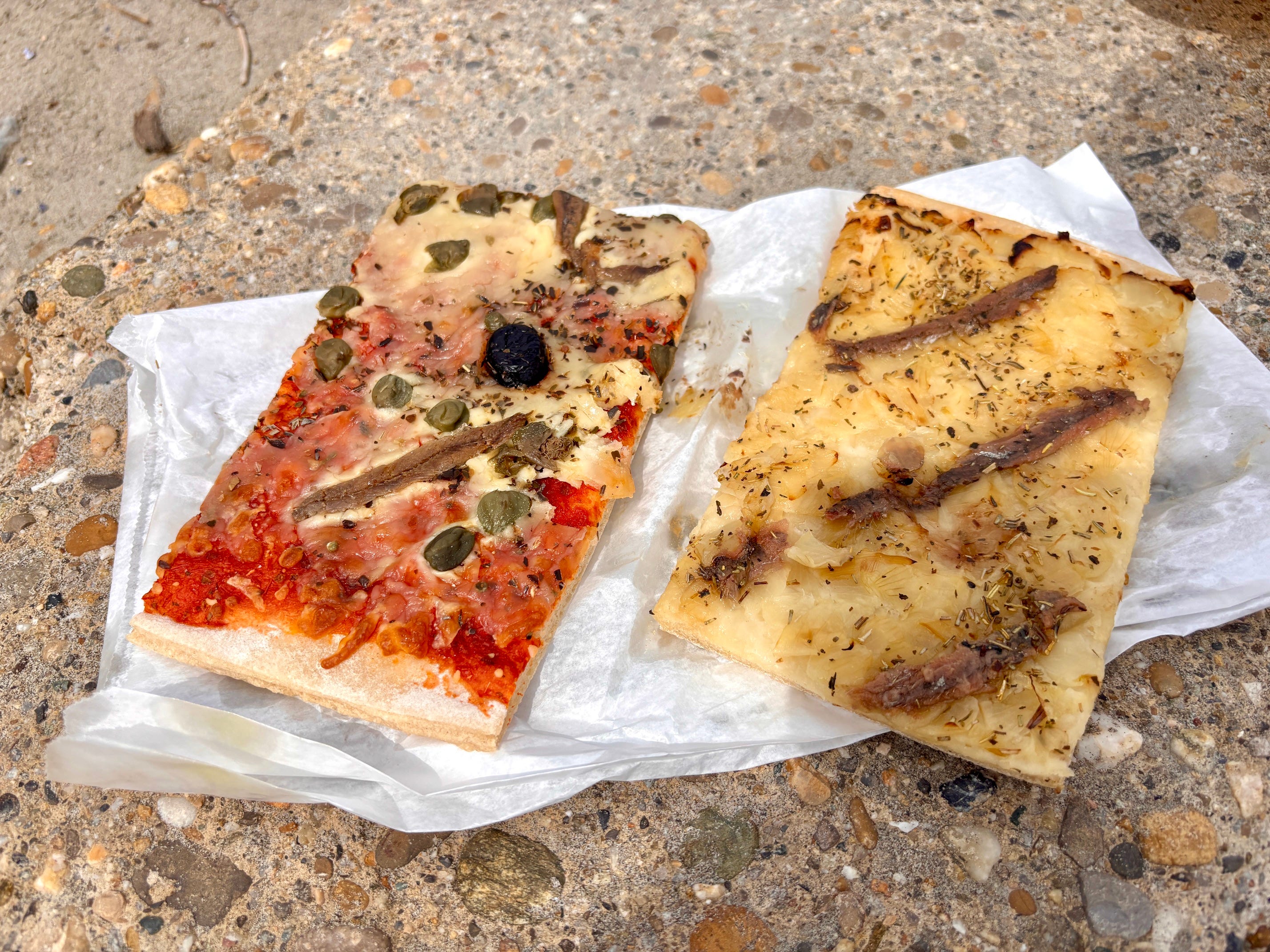
Pizza and pissaladière on the beach.
Happily, I’ve been able to coerceRomain into going to the south of France in the summer. We used to go to Brittany in the summer, a popular destination for Parisians. But sitting on the beach there, even in August, can require a down jacket and a scarf, and my idea of vacation is not to wear anything but a T-shirt, shorts, and sandals.
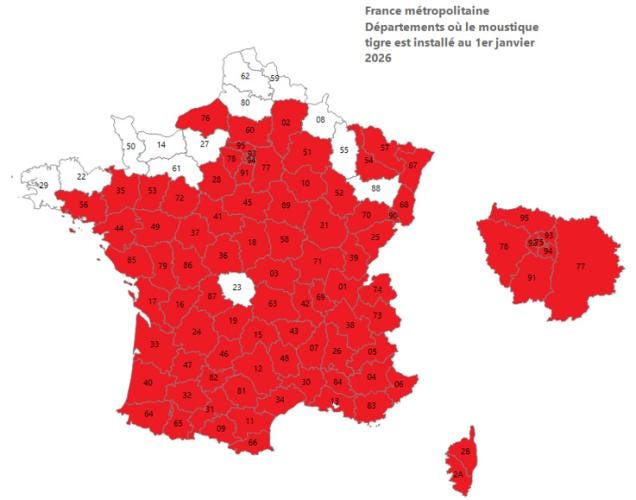
Aside from the five — or was it six? — heatwaves we had in France this year, the second big topic was the mosquitos, which have taken over the country, save for onesmall region…
…and that’s where I want to go next summer.
Mosquitos aren’t as compelling of a story as, say, the lack of air-conditioning in France, which was analyzed to death by magazines and newspapers in and out of France. By early summer, we couldn’t go in our backyard, which seemed to be the breeding ground for the entire country.
I did find two effective things to ward them off. One was Off! Clean Feel, which is unscented and doesn’t leave a greasy film; friends from the States bring it to me, even though I’m not keen on slathering it on my skin. On the natural side, I found the anti-mosquito stick made by Comme Avant pretty effective, in spite of its waxy feel.
So much of our summer was spent swatting and itching. I was surprised when I visited a friend who lives in the Ardèche and found they’d installed screens on all their windows, which are as common as unicorns in France, and I hope the idea catches on. We did get a bid to put one (1) on our sole bedroom window, which was an astounding €900 ($1045), so it’s no wonder people are reluctant to install them.
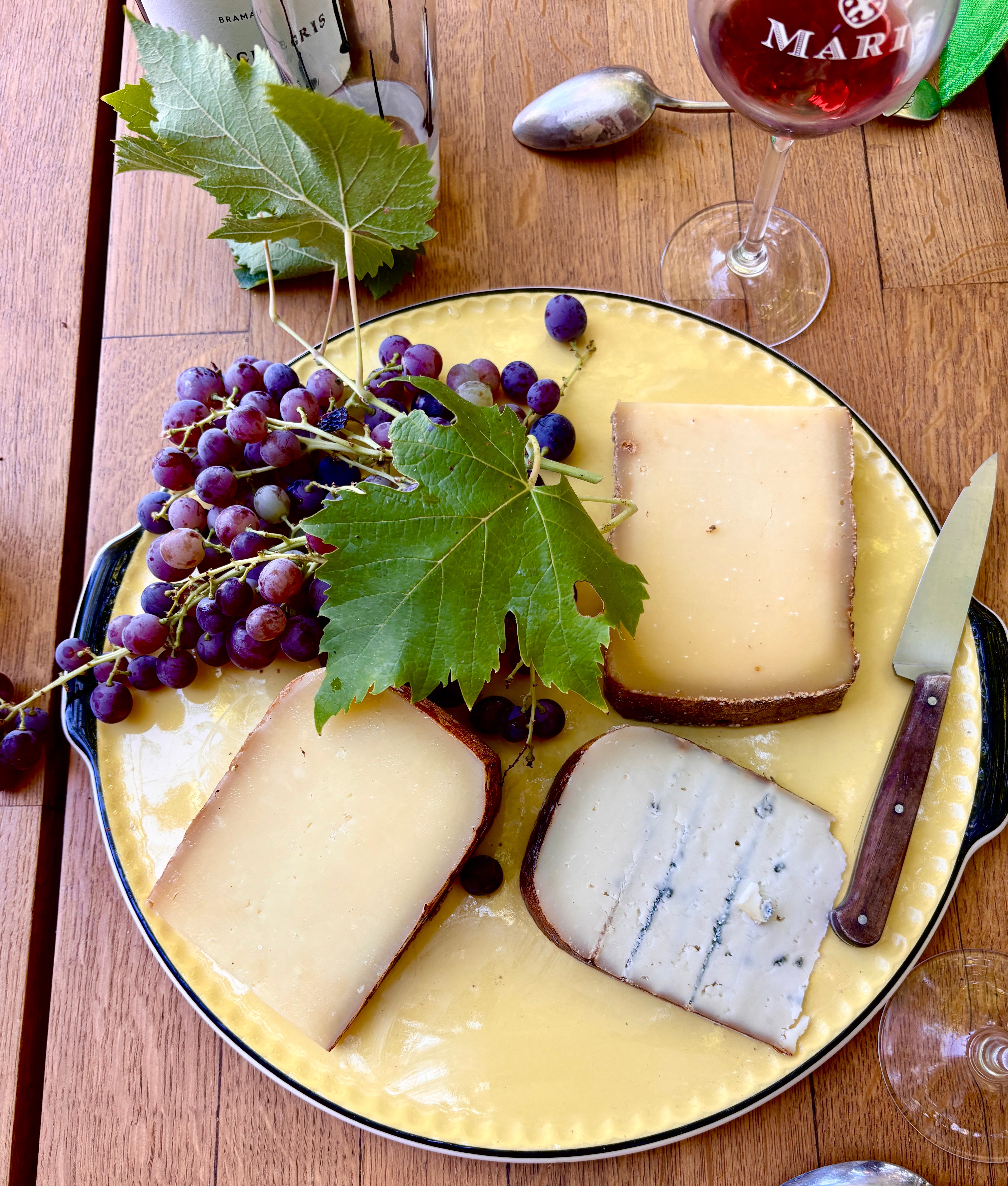
A beautiful cheese plate at lunch with my friends Kat and her husband, winemaker Benjamin Darnault.
The first part of our vacation was spent in the Languedoc, a region in the south of France that’s known for growing grapes. Winemaker Benjamin Darnault told me it was the largest winemaking region in the world.
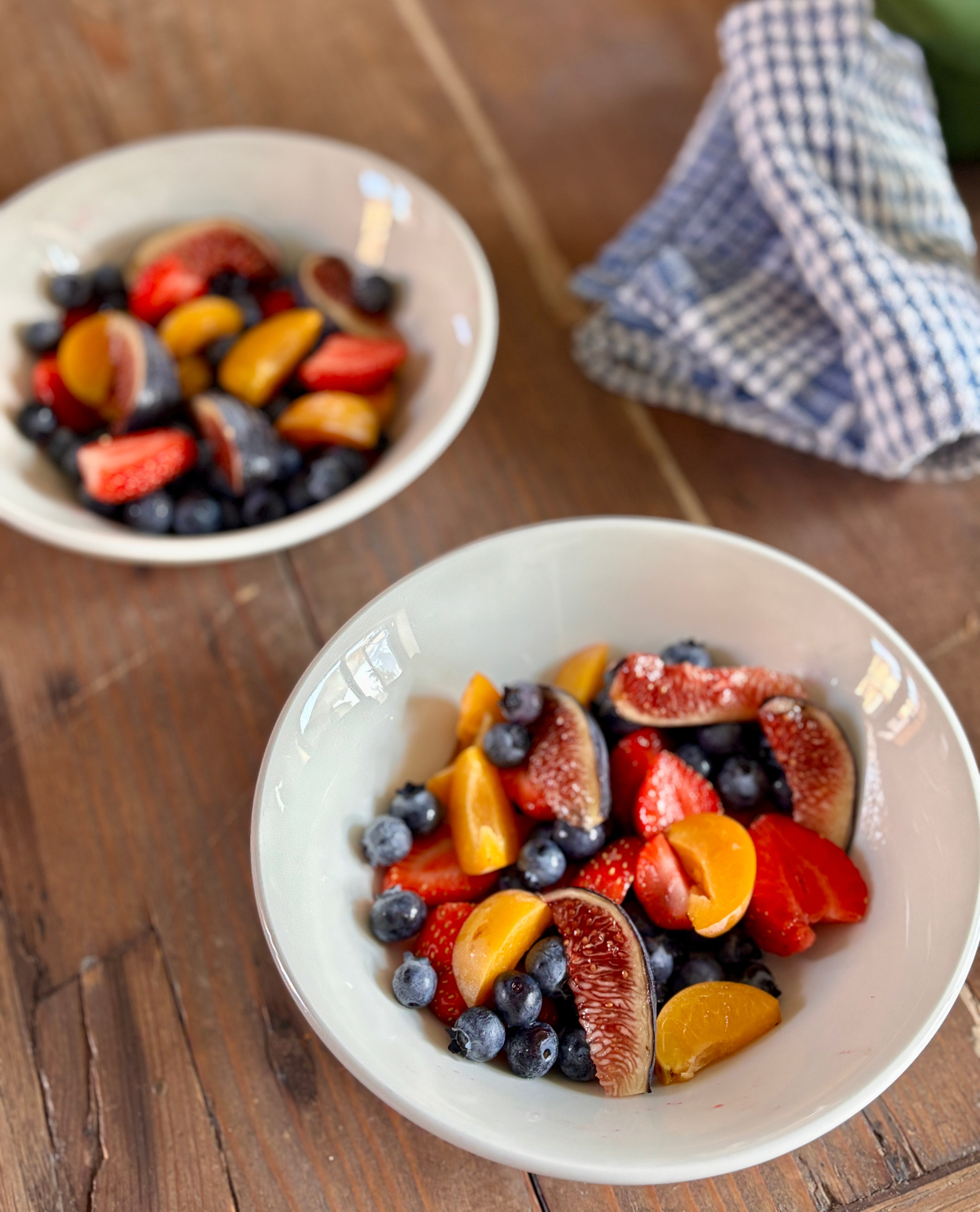
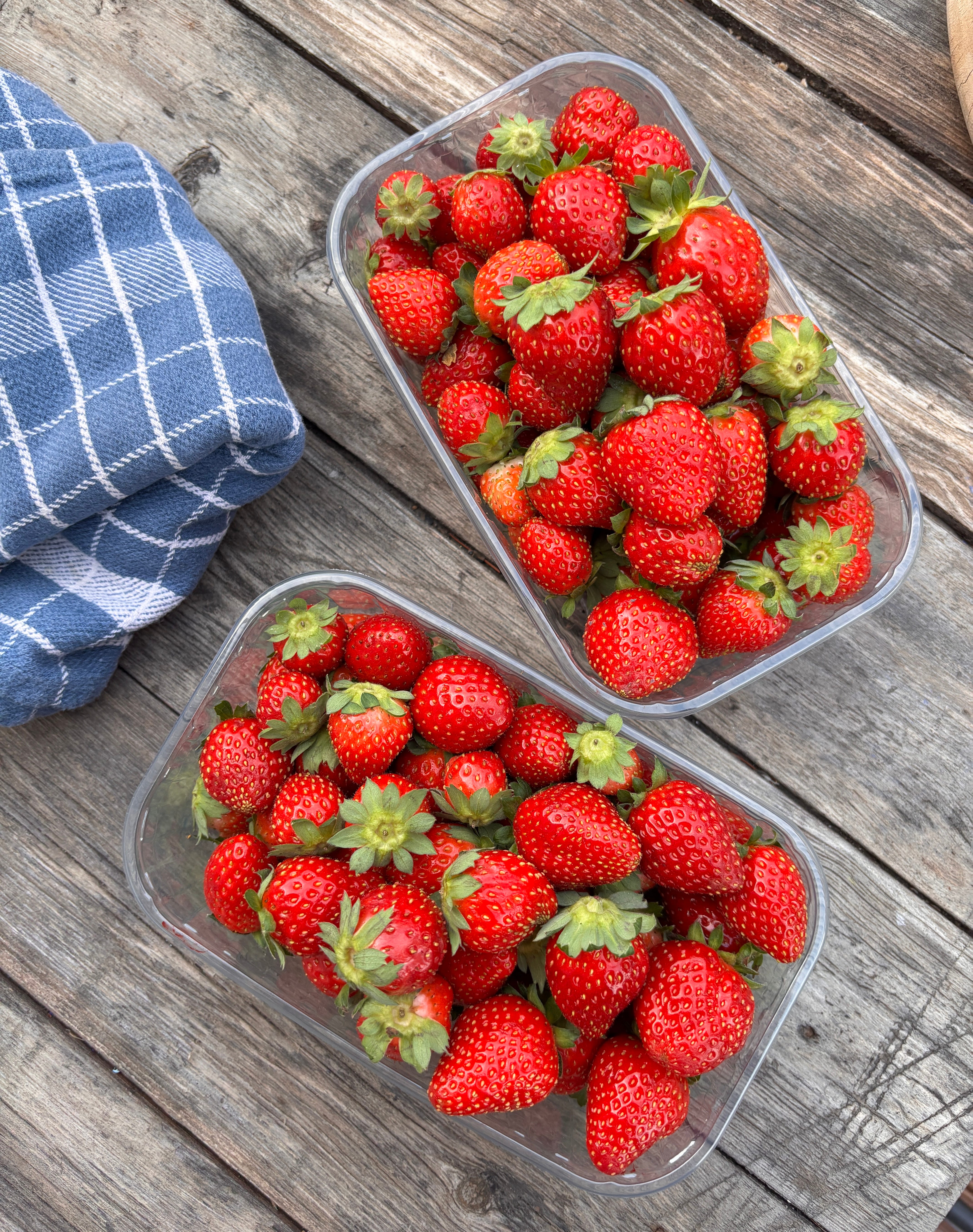
We also visited the Olonzac market, which has the most beautiful fruits and berries you can imagine. Every morning we treated ourselves to a big bowl of fruit, and while I do pretty well getting very good fruit in Paris, the fruits in the south of France are even more delicious.
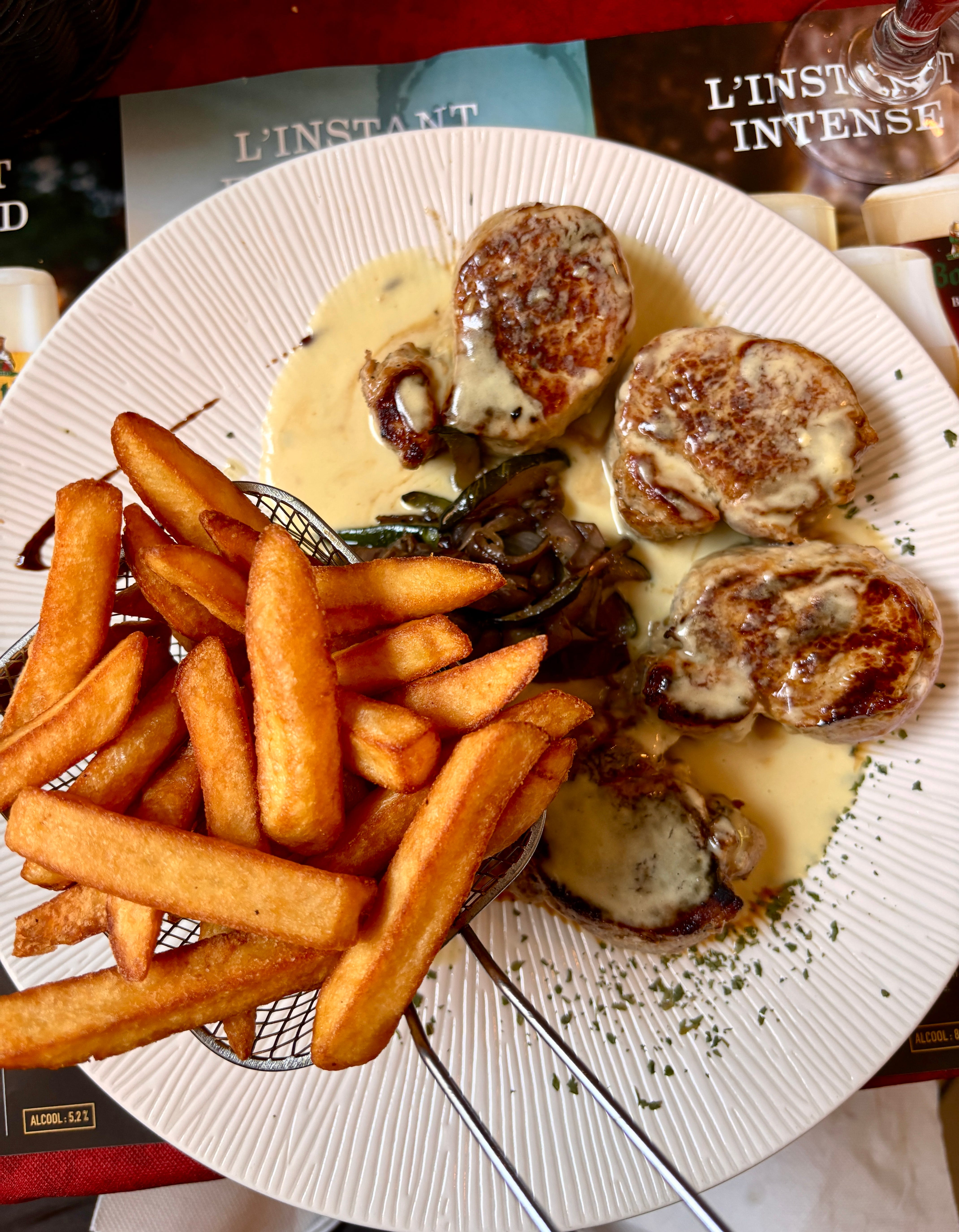
I’m not sure where people got the idea that French people practice portion control. If anyone thinks that, they haven’t eaten at a restaurant like Les Trois Petits Cochons.
That, above, was almost a whole pork loin on my plate. A local friend I was dining with ordered a salad, thinking it would be a healthier, or at least lighter, option. She was startled when the waiter set down a plate the size of a child’s umbrella in front of her: a bed of lettuce topped with several giant bundles of deep-fried filo dough. Inside of each was a slice of toasted bread with melted cheese on it. There was enough food on her plate to feed two. An upside of Covid was that it gave us doggy bags, and if you ask nicely, you can take uneaten food home with you. One place did charge me €1 for the container, though.
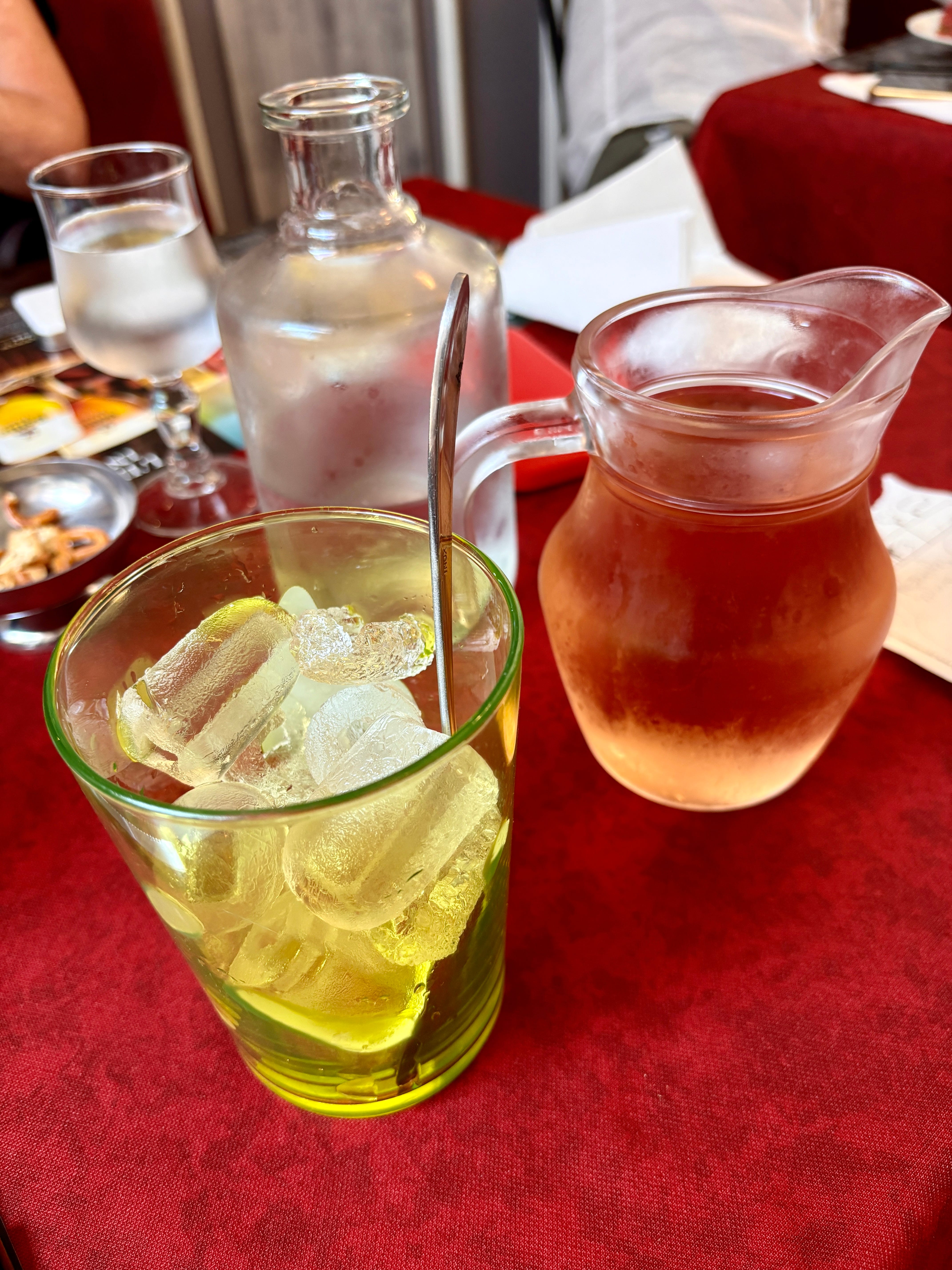
In addition to doggy bags, which used to be a rarity, for those who think (or know) that ice is tough to find in France, it seems all of it is being hoarded in the south. And unlike elsewhere in the country, you won’t hear people telling you it’ll give you pneumonia or freeze your stomach, as I’ve had people tell me. For the record, I’ve enjoyed plenty of iced drinks and so far haven’t had either.
When I asked for a few ice cubes for our rosé, the waiter replied, “Bien sûr, monsieur.C’est obligatoire!” and brought over a glass that was almost as big as the carafe of wine.
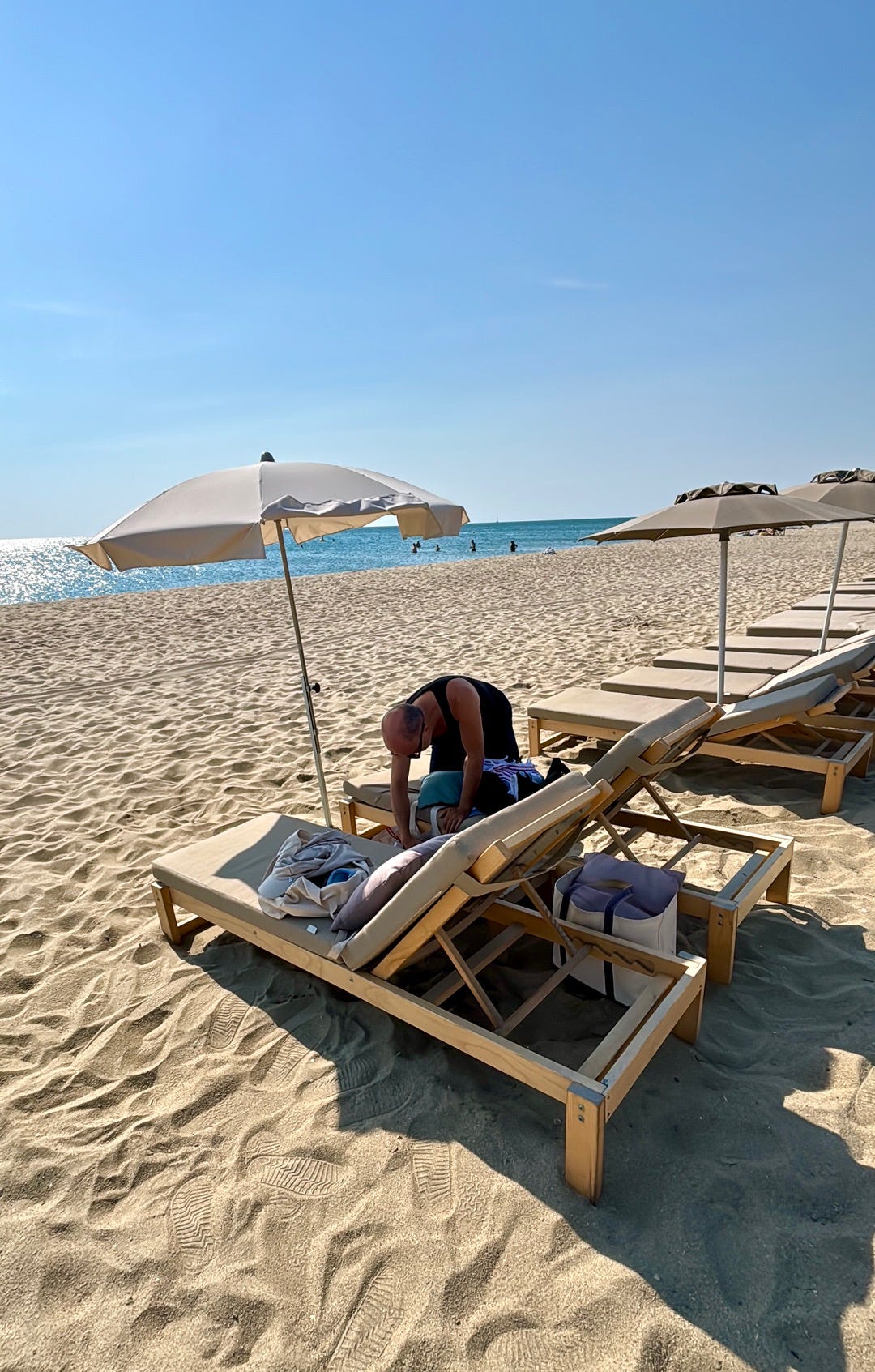
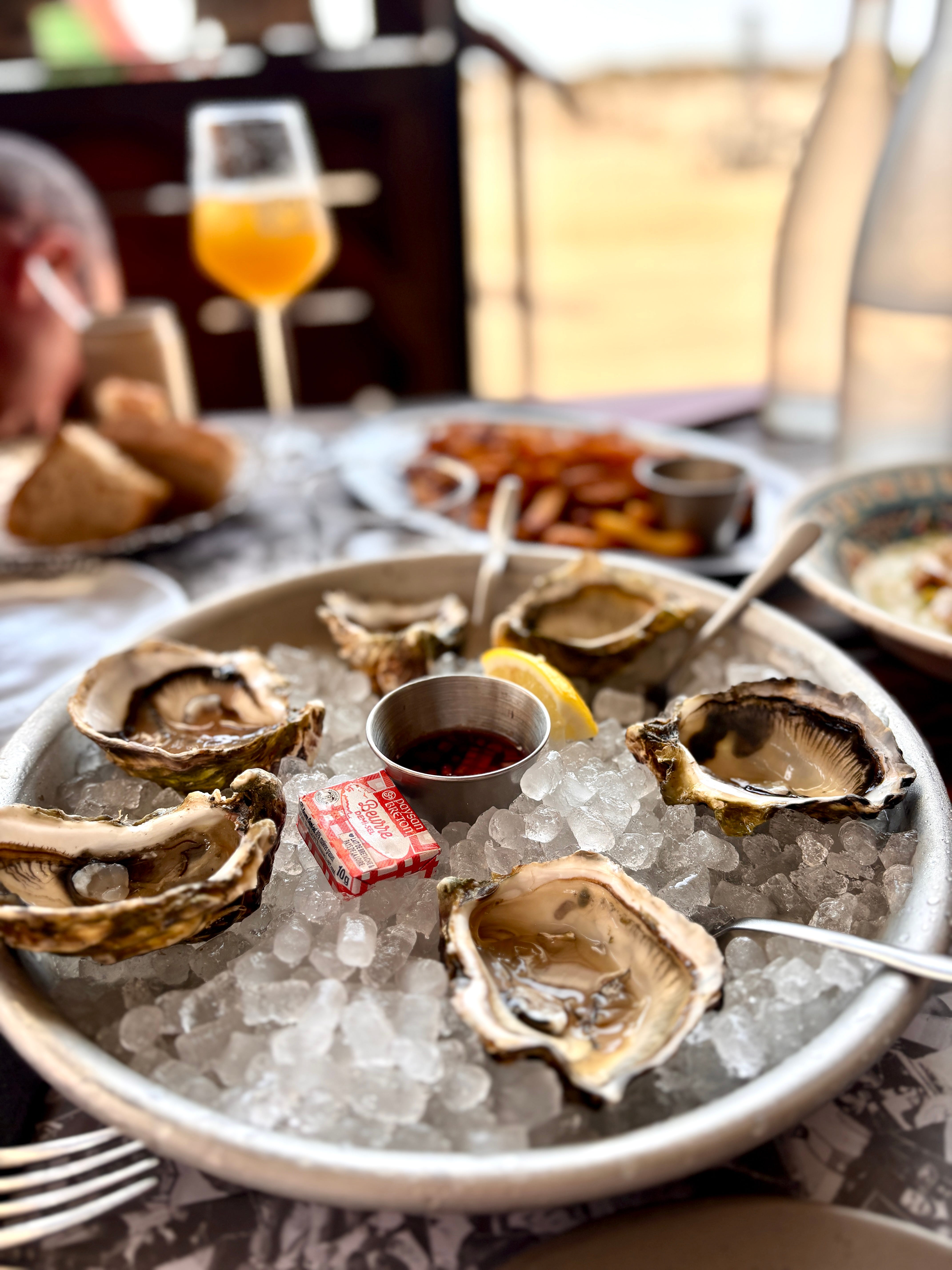
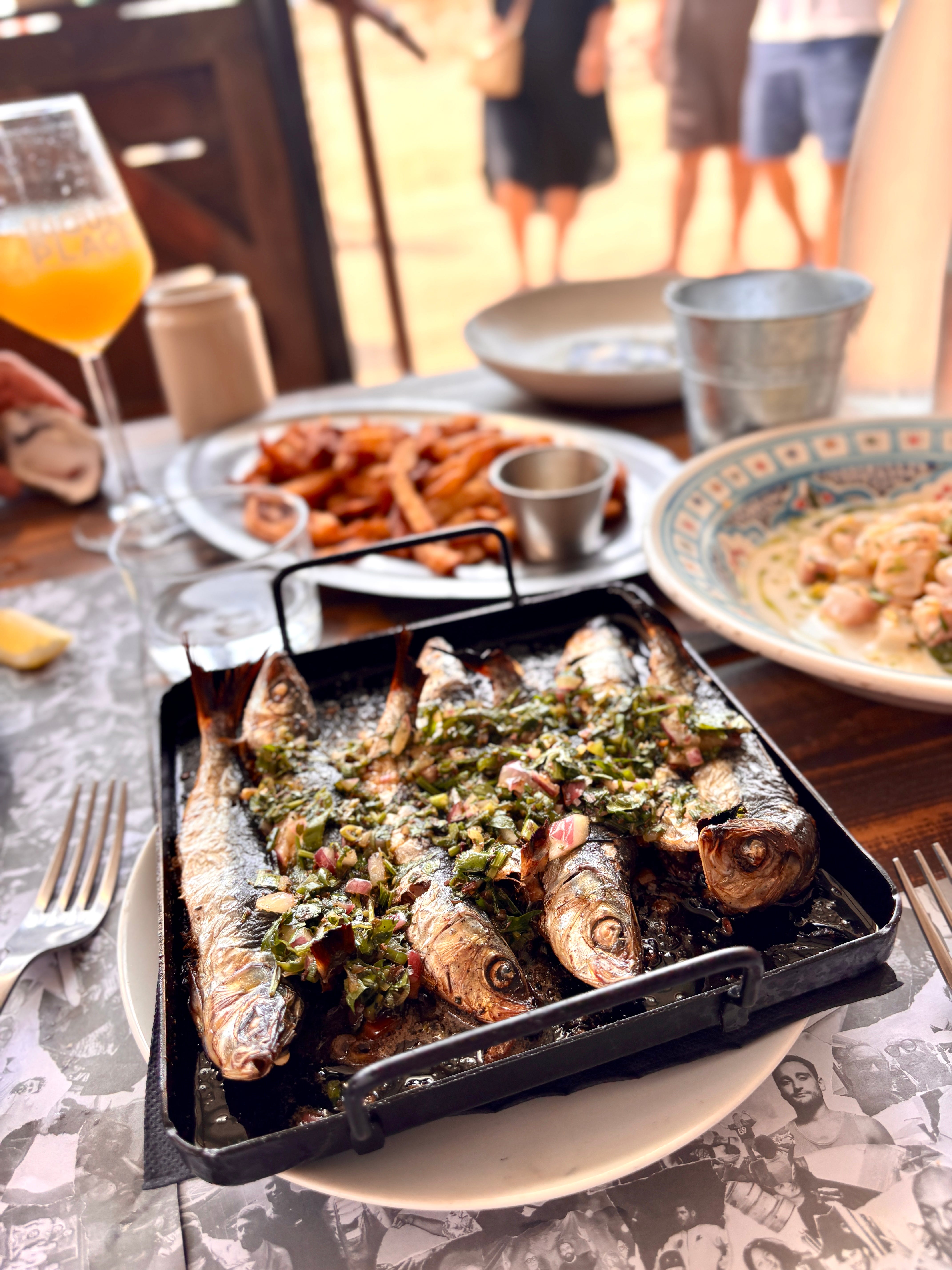
Being close to the southern coast, there’s no shortage of seafood or shellfish. During a lazy day at Biquet Plage, we had grilled sardines, oysters, and French fries. The restaurant on the beach folds up at the end of August, when everything comes down: the walls, the floors, the bar, and the dining room, and is packed away until the following year. It’s an easygoing place to spend the day since you can rent a chair and large beach umbrella, and you just need to bring a towel and swimsuit, as well as a book, and you’re all set.
In the evening, apparently the place turns into a big beach party with a lot of people arriving, a DJ blasting music, people enjoying lots of drinks, and whatever else people indulge in at rave-like parties, so we’re generally out of there by 5pm.
Grilled sardines and frites with aïoli at Biquet Plage.
We stopped at a farm stand that we visit every summer. Last year we arrived at the end of the morning, after all the customers had left, and just about all of the produce was gone. We ended up talking to the owner for a good thirty minutes before waving goodbye.
This year when we showed up, during the rush, she was thrilled to see us and began our discussion with, “I think last year we decided to tutoyer each other…right?” It was fine with me since 98% of my life is tutoyer-ing people, and some of those longer, more formal verb tenses that use vous in French can require oral acrobatics for me. Invariably I end up tutoyer-ing someone I should vouvoyez, but I get a pass because people hear my accent. Someone once said that you don’t want to speak French too well because you want to be treated like a foreigner. I’d say that’s pretty true.
Last year, the owner of the stand gave me a big box of unsold chili peppers, and this year, she perhaps assumed I was coming back and gifted me a big bag of dried chilis. I think I’m going to grind them up and use the pepper powder to season food. She gave me so many that I‘m pretty sure I’ve got enough to last me until next year.
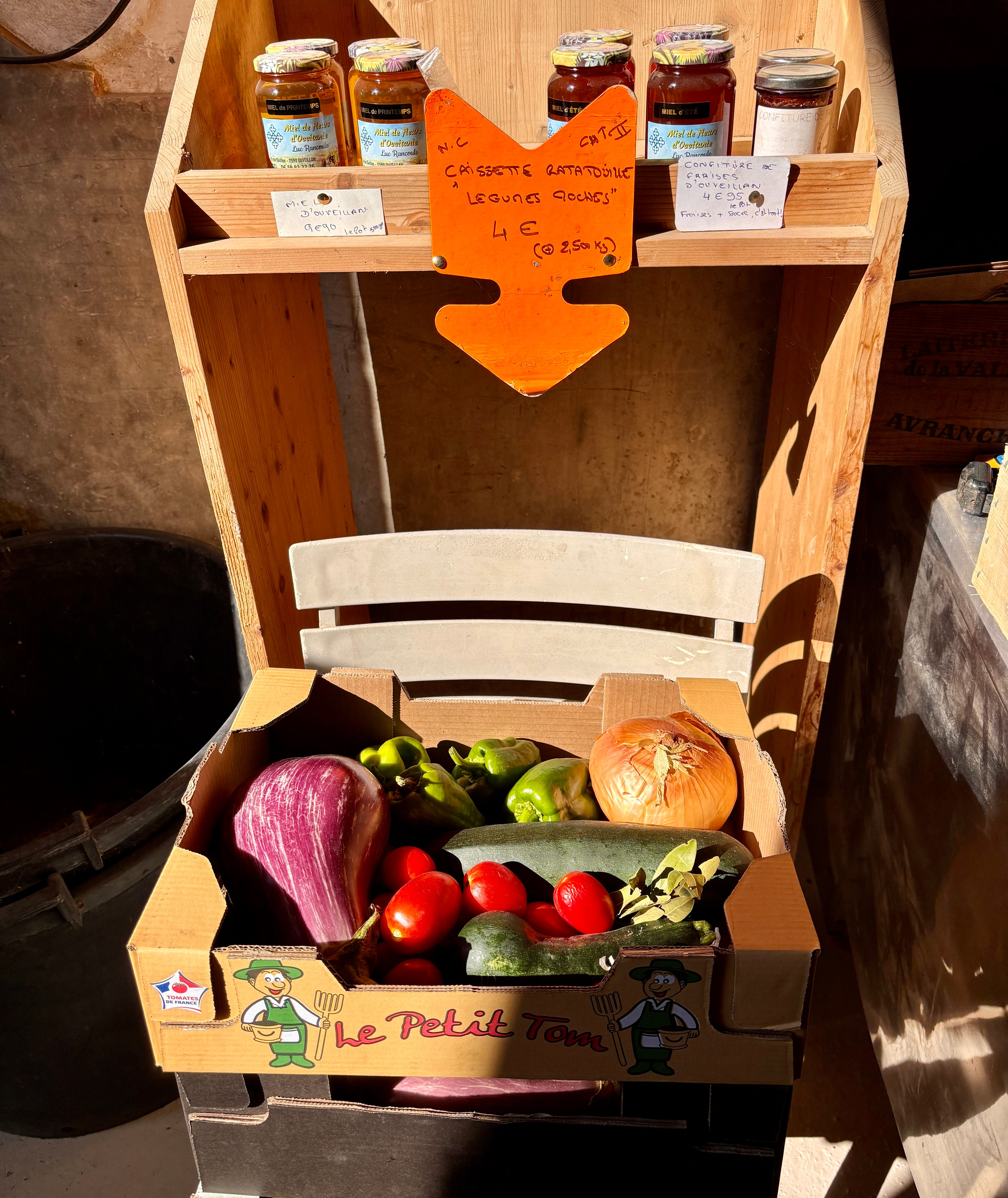
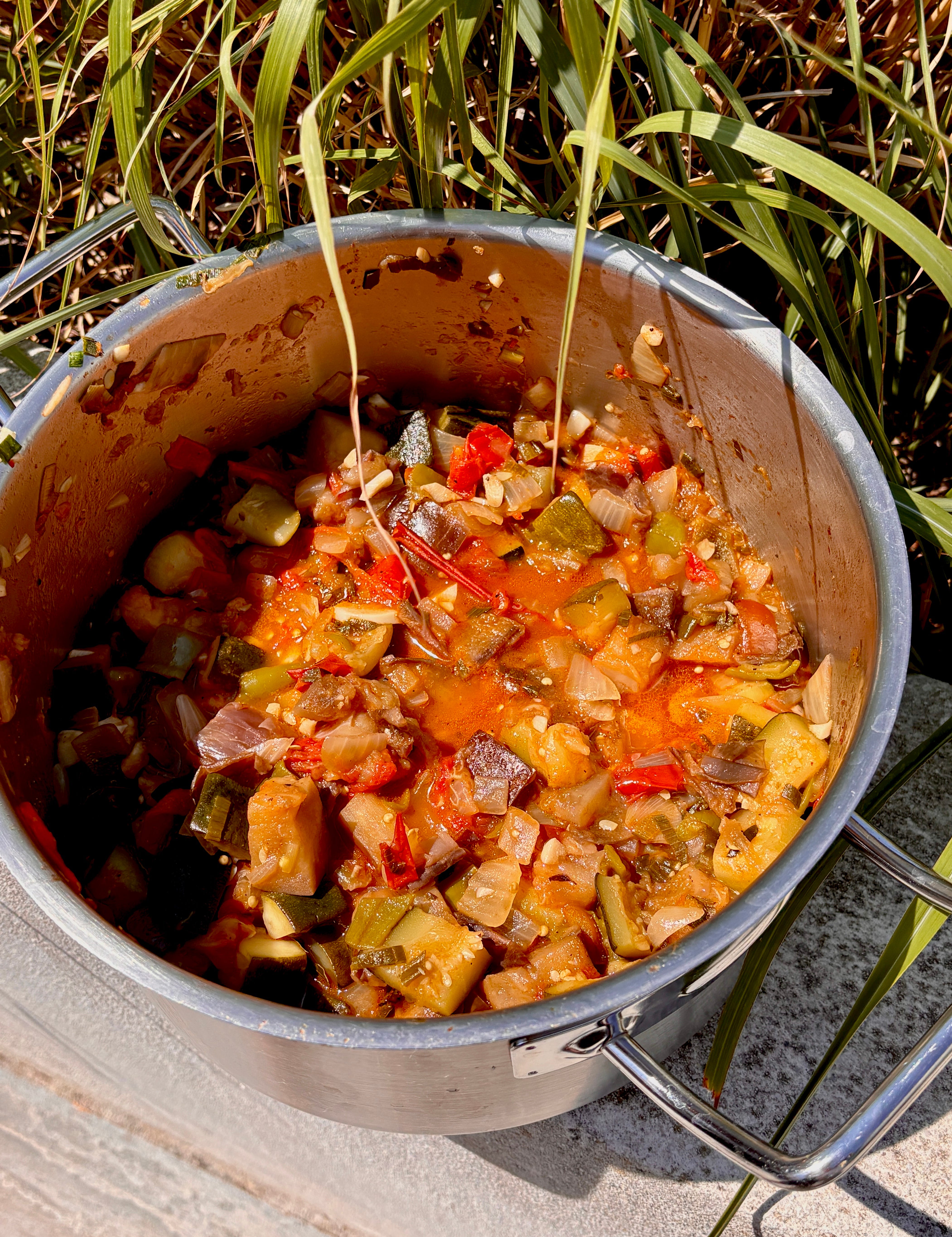
This year she was offering a special box of vegetables for ratatouille, a dish I’ve never made. I’m not a fan of bell peppers and so many versions seem to feature them. But the smaller peppers grown by farmers in the south don’t have the same flavor that bell peppers do, which overtakes everything else in a dish and when raw, are as unpleasant as biting into a dried-out wicker basket.
Since I can’t resist a bargain, nor can I resist beautiful produce, I bought a box (Romain likes bargains too, and was insisting we buy two boxes, but I shut that idea down as I didn’t want to spend my whole vacation chopping vegetables). I looked at a few recipes online. Some said to cook the vegetables for just a few minutes, and another said to cook the dish up to 1 1/2 hours. My friend sent me her recipe for Ratatouille Niçoise from her book, Niçoise, which called for some optional hot chile powder. I also looked at Alice Waters’ recipe for inspiration, then decided to just wing it with what was in the box.
In the end (Warning: Unpopular opinion incoming…), I don’t think I love ratatouille. Mine, above, tasted more like leftovers rather than a delightful pot of freshly cooked vegetables. When you have beautiful fresh vegetables, why cook them up into a stew?
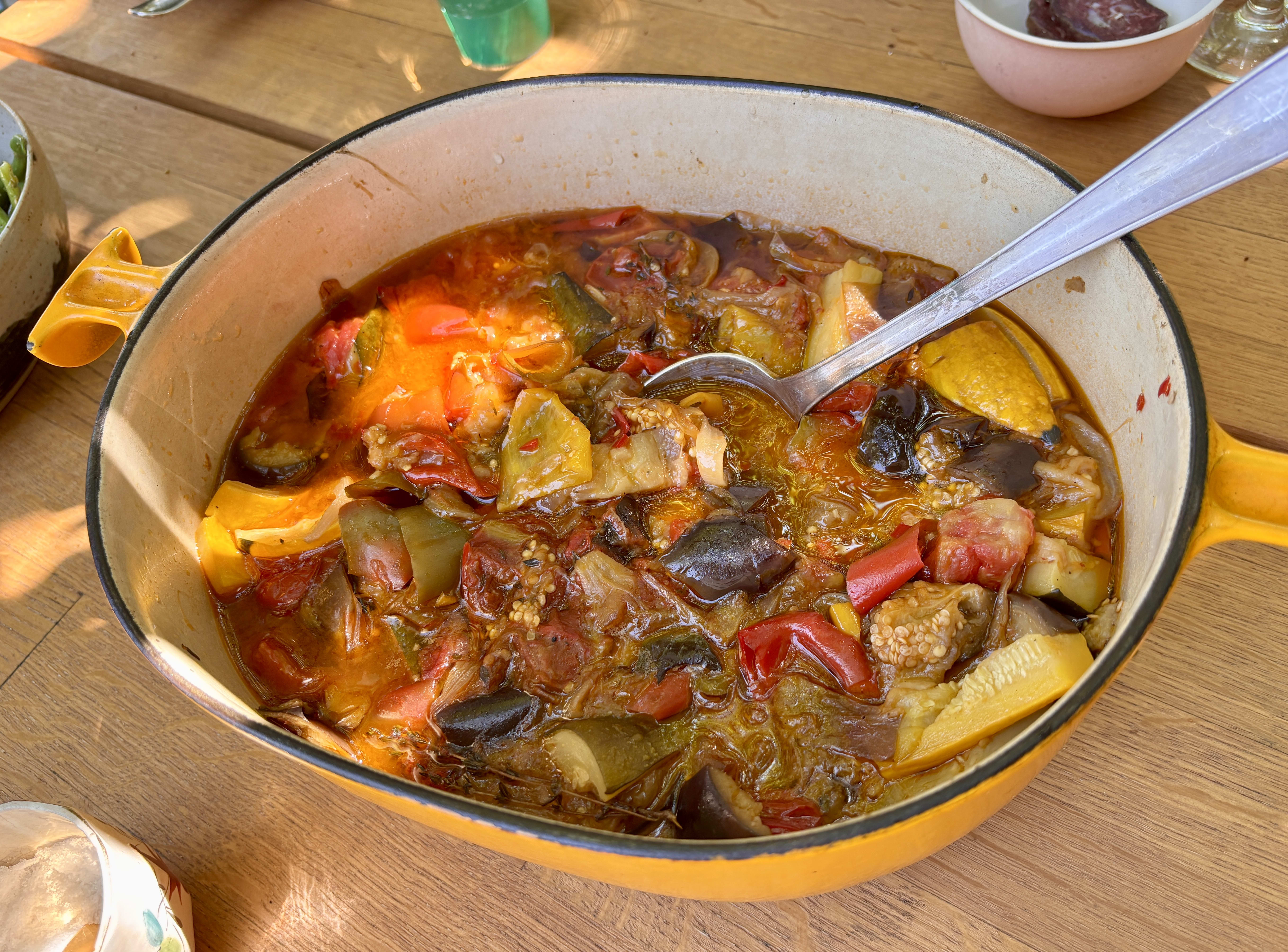
I was ready to give up on ratatouille forever until my friend Kat invited us for the aforementioned lunch and as part of it, brought out a big vintage casserole dish of…ratatouille. It was so delicious that I started changing my tune about ratatouille.
Perhaps it’s just something I don’t have the touch for, or it’s something you have to live in the south of France to get it right. And if that’s the case, I’ll need help convincing Romain that we need to move to the south of France. I’ve convinced him to go on vacation there, but not sure how far he’s willing to go down that route with me.
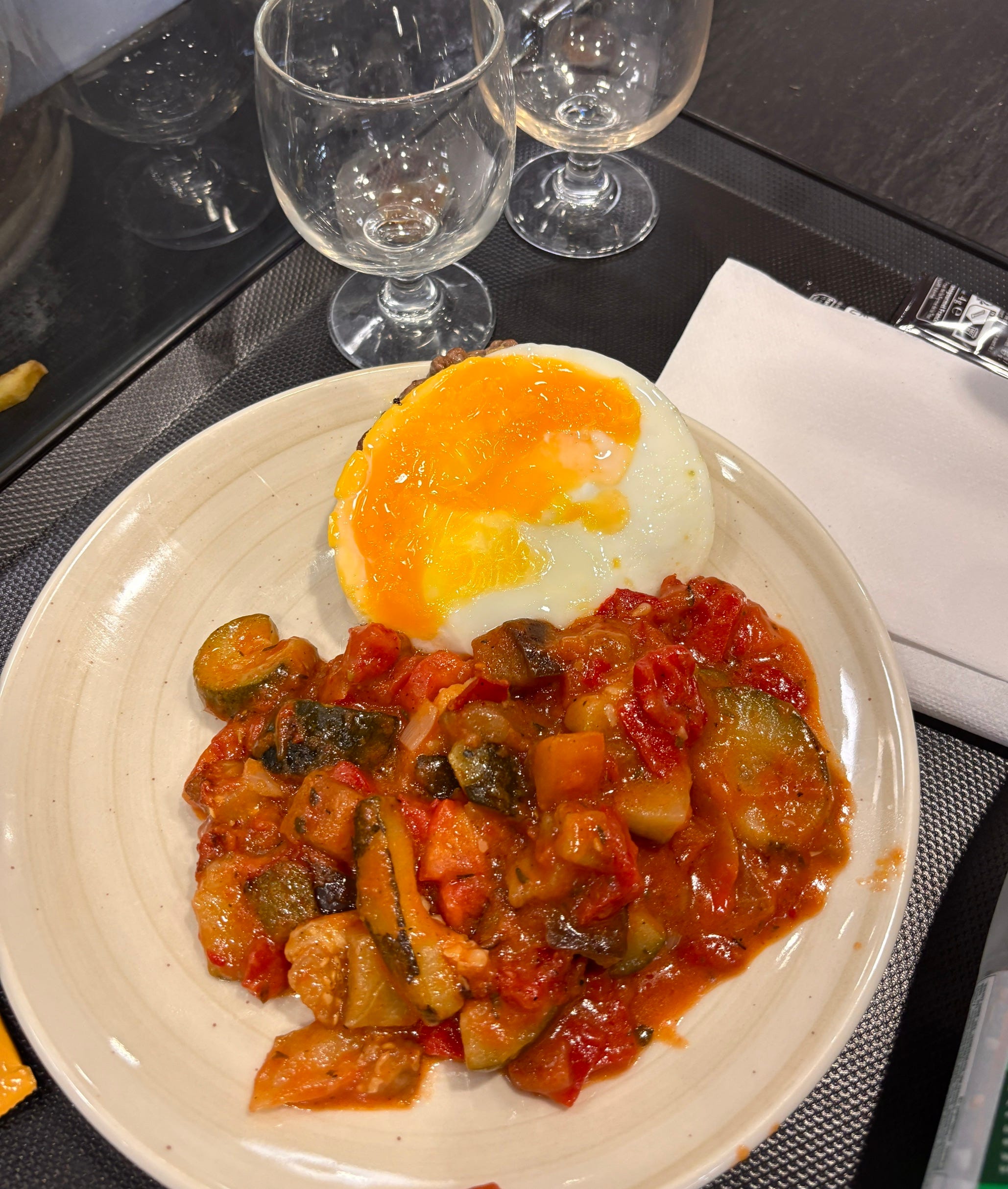
And just when I thought my ratatouille wasn’t up to par, we stopped at an Autogrill at a highway rest stop and below was their ratatouille, which they served alongside a steak à cheval:
Steak à cheval isn’t a burger made of horse meat (cheval) - whew! It refers to the egg riding “horseback” on top of a ground beef patty.
As a former restaurant cook, my inclination if I was cooking for a customer, was that if I broke an egg, I’d cook another one. But since the burgers were taken directly out of the freezer and placed on the grill, I wasn’t expecting the best meal of our vacation.
Romain’s brother said, “C’est pas trop mal pour le déjeuner d’autoroute” - “It’s not so bad for lunch on the autoroute.” While the cook was frying our patties, she asked how we wanted them cooked. The burger ended up being bien cuit, well-done, or à la semelle, as they say in French: like the sole of a shoe. The other option at the rest stop was Burger King and, like moving to the south of France, that was a pretty hard non when I half-jokingly suggested it to Romain.
Subscribe to my newsletter to get recipes, videos, stories, and more…sent right to your inbox!
One notable place where we ate in the south of France was Les Grands Buffets, an all-you-can-eat buffet that proudly features the food of Escoffier. It’s one of the most…if not the most popular restaurants in France, and I was a little wary of (over)eating there, especially in the heat of summer, but it was quite an experience.
I’m going to write about it in another post since there’s a lot more to share than I have the space for here. Stay tuned…
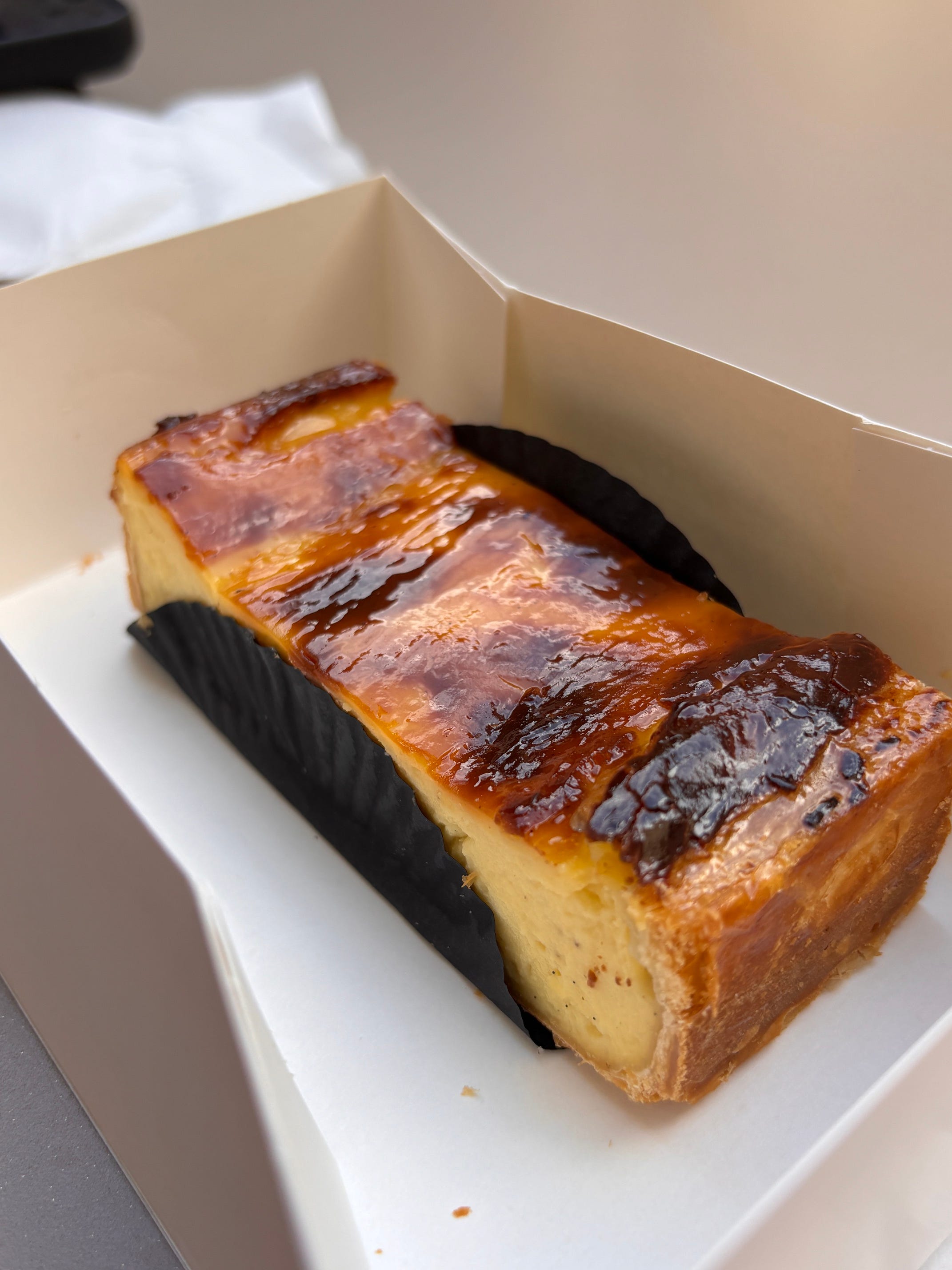
One of the best flans I’ve ever had, at Augusta bakery in Villeneuve-lès-Avignon, after the Saturday morning flea market.
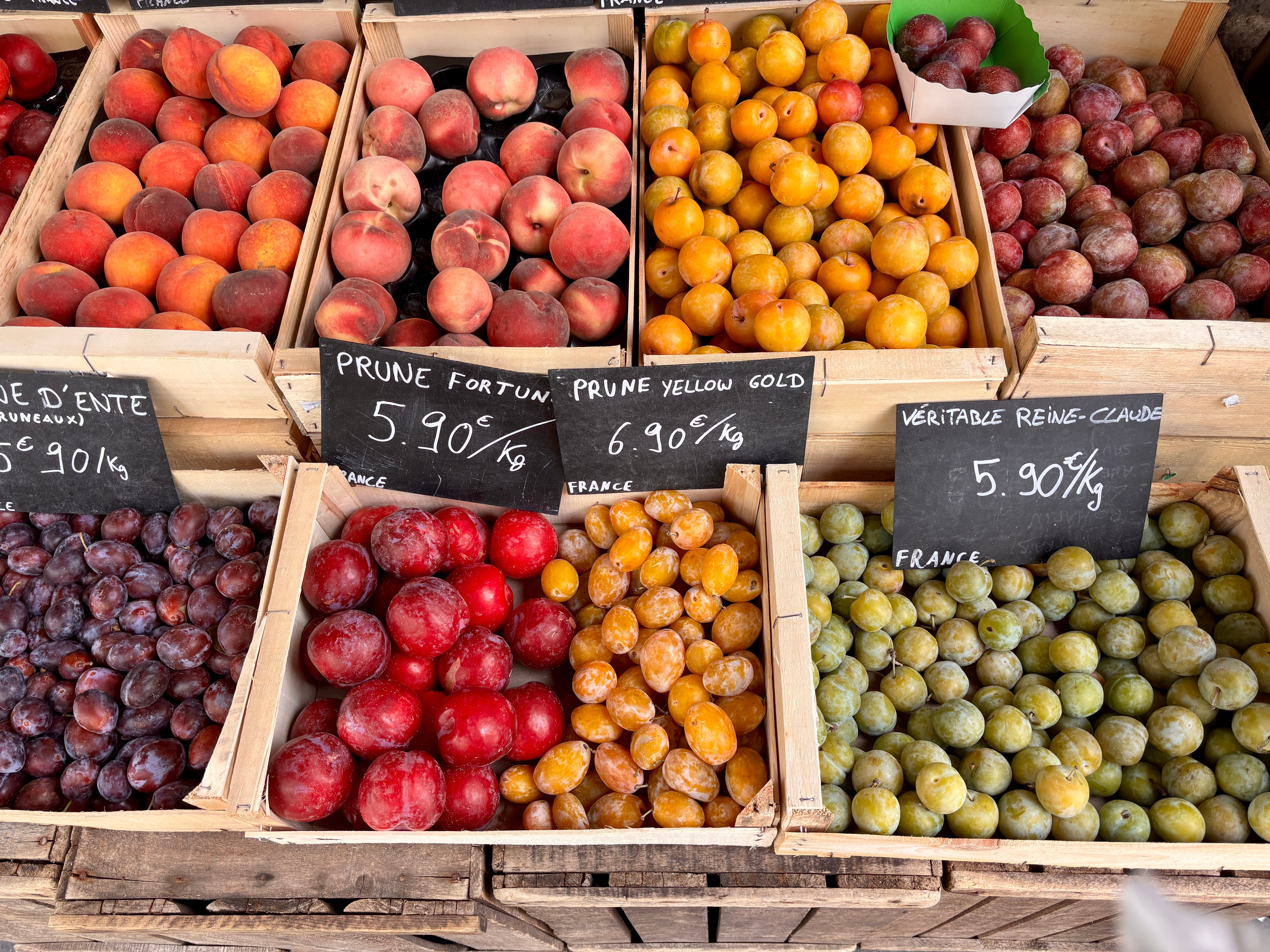
Beautiful plums in Paris.
Now that we’re back and well into September, I remember being told by someone, in no uncertain terms, that I shouldn’t mention when I’m busy. So I won’t mention it, but rather, let’s just say there’s a lot going on around here this month.
Those of you who’ve been with me for a while know I have a website, formerly my blog, with 700+ recipes on it. The technology and all the software and annoying SEO stuff you have to do for a blog finally got to me, and I said, “Game over,” and moved here. But some of my favorite recipes are archived there and I’m shooting short videos to accompany the most popular ones. I’m going to start uploading those this month.
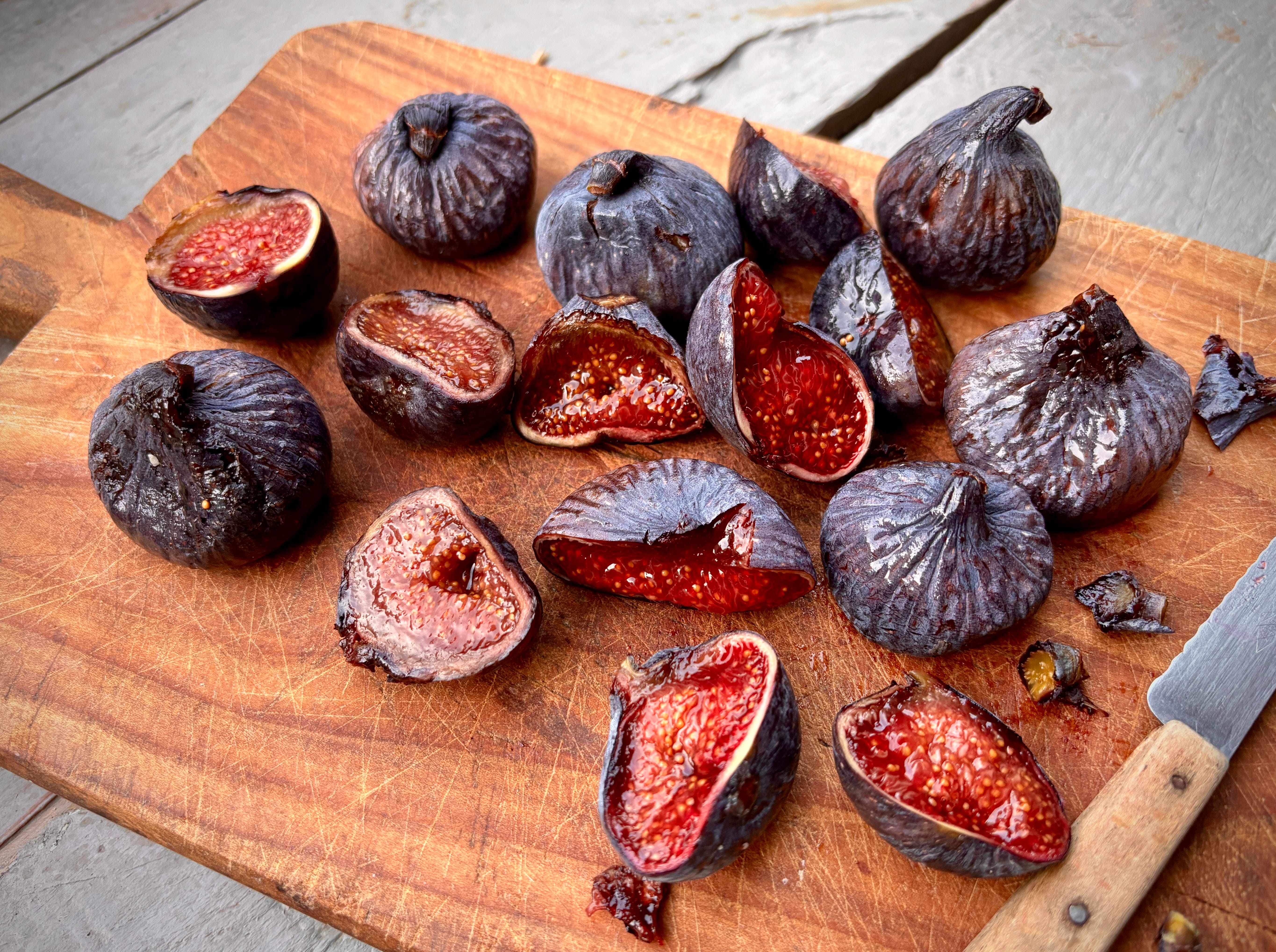
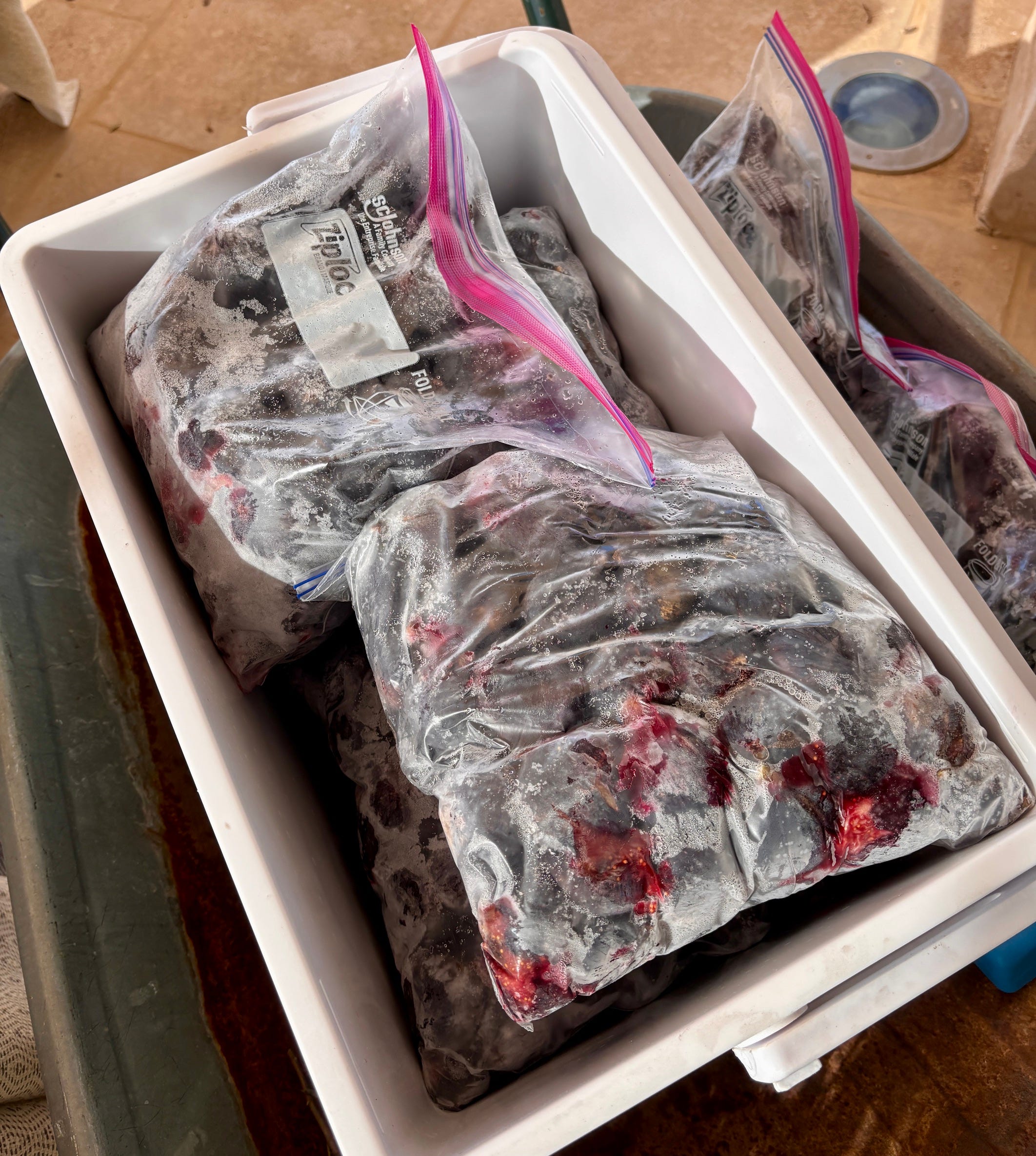
The final stop during our vacation was in Provence, which had a magnificent fig tree right outside our room that was loaded with the most delicious figs I’ve ever tasted. I’ve tasted a lot of figs and each one could barely hold in the sticky-sweet interior, which was ruby-red and already close to being jam. The owners of the property don’t eat them so most go into the compost bin.
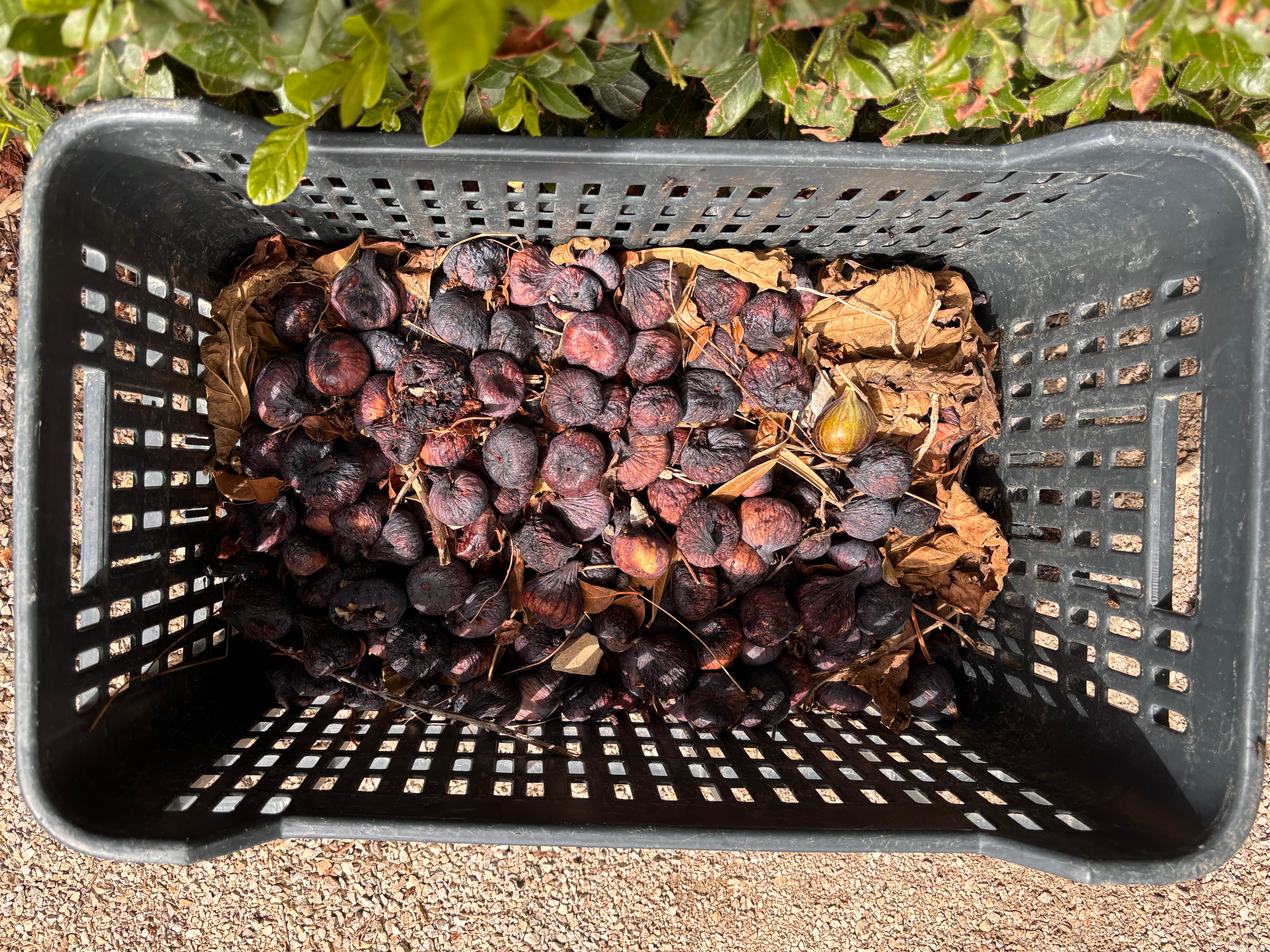
Destined for compost…
We furiously picked as many as we could and snagged one of the last coolers in the south of France, to transport them back to Paris. I felt a little guilty taking all their figs, but they said we were doing them a favor as it saved them from having to rake up the figs and haul them over to the compost bin. One man’s trash is certainly a treasure to me, and I can’t believe how many we picked.
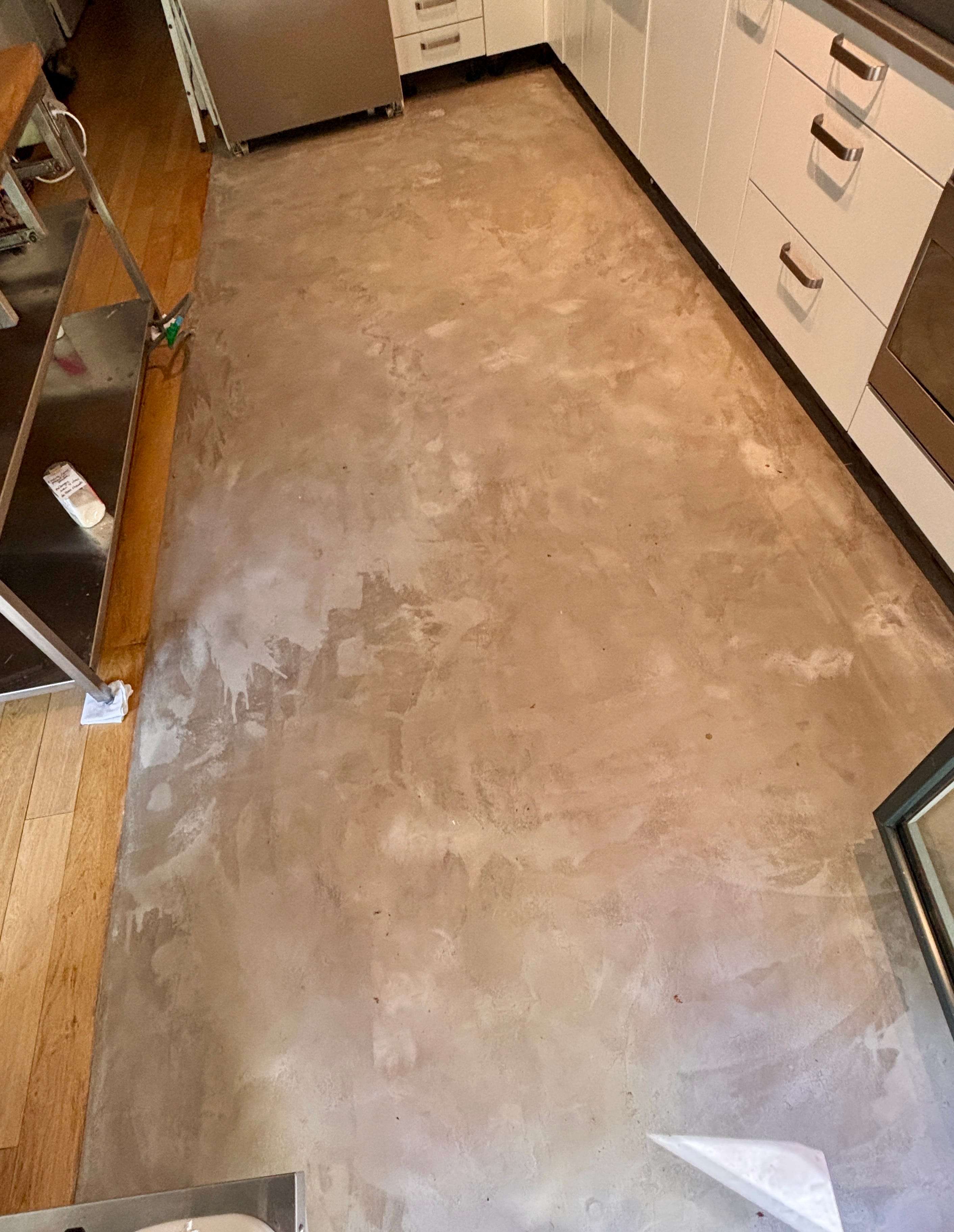
The morning after we got home,I found myself with ten 1-gallon bags full of very ripe figs that needed to be tended to, pronto. Before we left, I cleared out my main kitchen island (which was loaded with pottery and baking dishes and pots and pans and other stuff), where I do all my cooking, because the polished concrete kitchen floor needed to be sealed. The guy who originally laid the floor forgot that step. Oops.
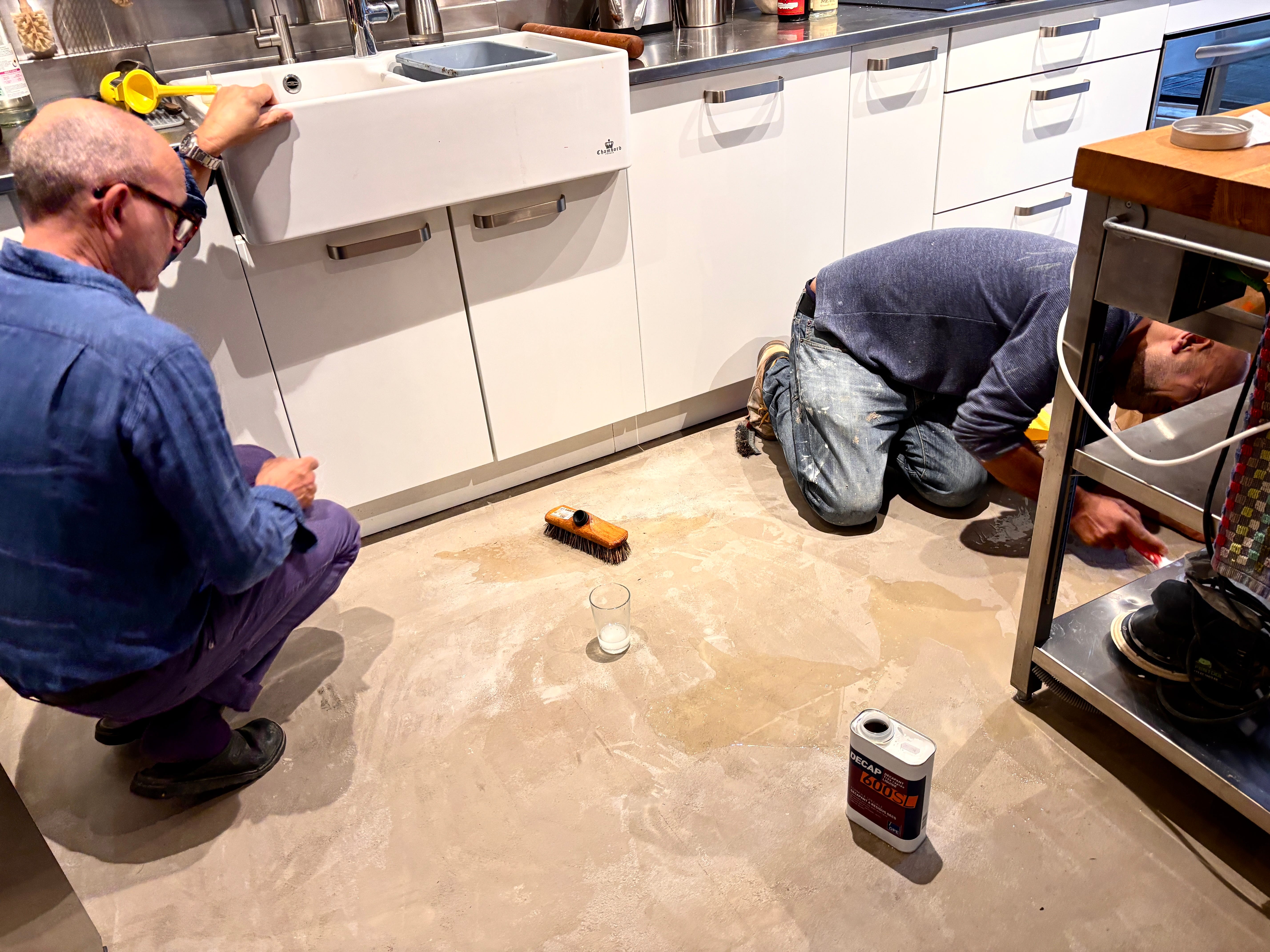
Kitchen floors get a lot of wear and tear and ours got really grimy, which required plenty of elbow grease to scrub, and we were never able to get it really clean. So we finally got someone to come over to seal it properly, which was a several-day process.
I won’t get into the details but when we came home, the new sealant had been applied over the grimy floor - the grime so was embedded in the floor that it couldn’t be cleaned and the sealant just made it look worse. So the floor needs to be re-scraped and completely redone.
That started at the end of last week and will be continuing all through this week, until the weekend. While it’s being redone, we can’t go into, or use, the kitchen. So no cooking or baking for me until it’s finished.
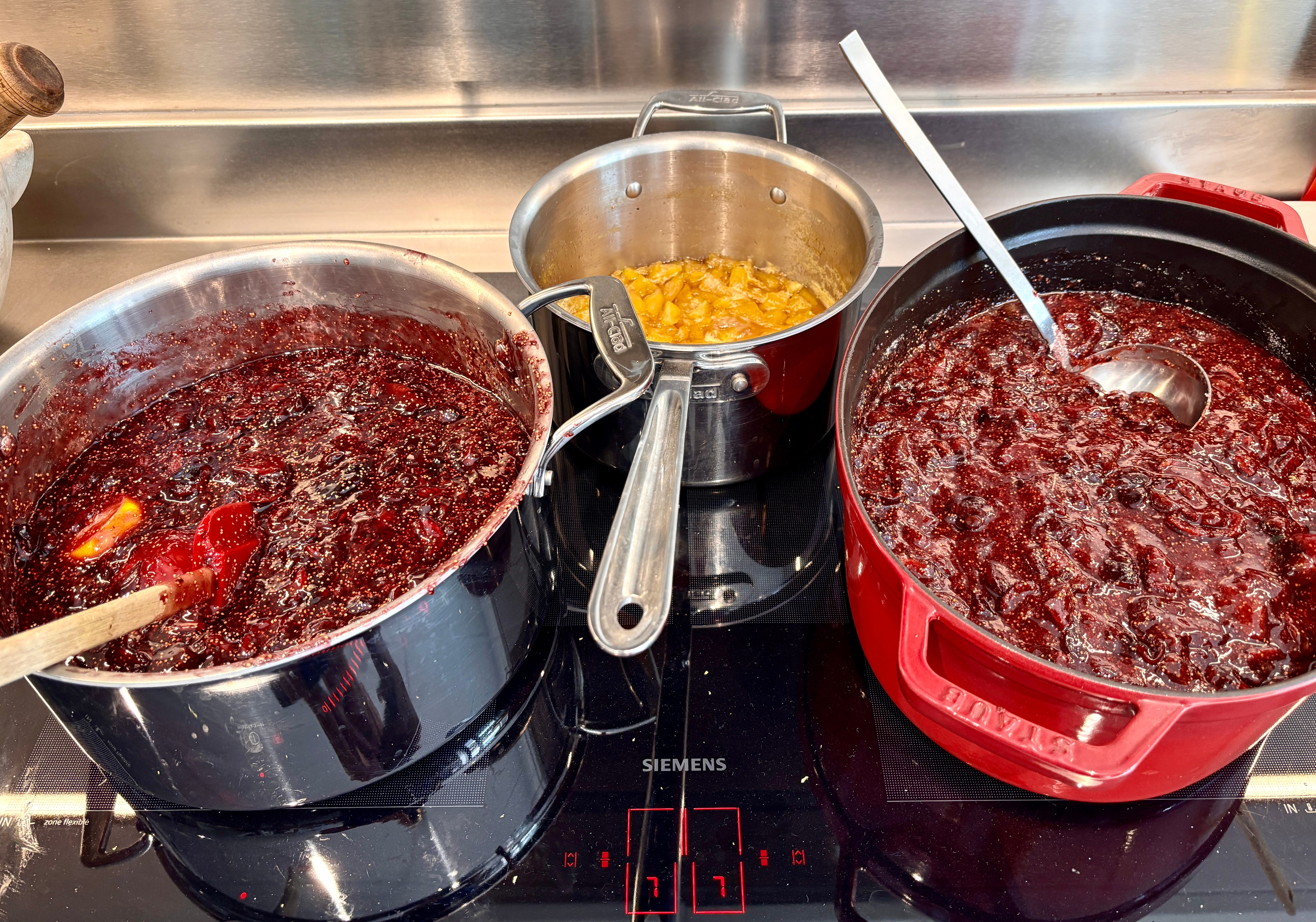
Double pots of jam going. This is about 20% of all the figs I picked and brought home.
Fortunately I already took care of a few bags of my figs, making Fig Jam and Fig-Pineapple Jam, ending up with nearly thirty jars. The rest will have to wait a few more days until I’ve got my kitchen (and my sanity) back.
A balanced lifestyle combines a little naughty with lots of nice and healthy. With that in mind this week, I have three (3!) recipes for you.
The first is a delicate, fluffy vegan whipped cream topping that’s remarkably sturdy. It keeps for days, if not for a good week in the fridge. It’s texturally lighter than the vegan frosting I developed for the vegan strawberry and cream cake because you want something ethereal when you’re aiming for a whipped cream topping. That said, you also do not want it to deflate!
Why would you make a vegan whipped cream topping? Because the commercial plant-based options for whipping cream are inconsistent and not widely distributed.
If you’re following a vegan diet, the recipe is for your dessert pleasure! Dip fresh fruit in for a simple treat. Spoon it onto a cake or pie for a rich garnish.
If you’re lactose challenged or a curious cook who likes to have a few tricks in your back pocket for emergencies -- the vegan whipped topping recipe is a great fallback for when you need a whipped topping but don’t have regular whipping cream handy.
To counterbalance my forays into the land of whipped cream topping, I made some light meals this week. I had a little poke festival. We’ve got our minds on Hawaii with hurricane Lowell bearing down on it. We hope all our friends there are safe.
At the same time, I’ve thought about our grocery trips to the Foodland at the Ala Moana shopping center in Honolulu. It’s one of the fanciest markets I’ve been to on the islands. The poke bar dazzles with so many freshly made, incredible options. And they’re not all made from ahi tuna, as we think poke is chiefly is.
The word “poke” means “section” or “to slice or cut”. Hawaiians have been poke-ing various kinds of fish for centuries — long before Captain Cook arrived in the 1700s to ‘discover’ the islands.
Using reef-caught fish, locals would cut or scrape the flesh from the fish bones (this scraping is a technique that’s common in Southeast Asia to make fresh fish pastes). The Hawaiians would flavor the fish with sea salt, umami-laden fresh seaweed (limu), and ‘inamona, a seasoning mixture of salt and pounded candlenuts (candlenuts are also used in Indonesian, Malaysian, and Peranakan (Nyonya) cuisines).
Think about the shared Asian Pacific cooking techniques and ingredients and you realize how seafaring people exchanged ideas across the oceans over time. The concepts are simple yet brilliant for putting fresh food on the table.
Obviously, poke evolved over time and purists love the Hawaiian-style poke prepared with seaweed and ‘inamona. But the prevailing poke nowadays, as chef Sheldon Simeon writes about in his book, Cook Real Hawai’i — is shoyu poke, poke seasoned with soy sauce and a myriad of other ingredients, depending on your taste and mood.
Learning to poke from a local
I learned to make poke from Kiki Aranita, a Hong Kong and Hawaii-raised chef who now lives in Philly. She’s known for smartly adapting island flavors on the mainland.
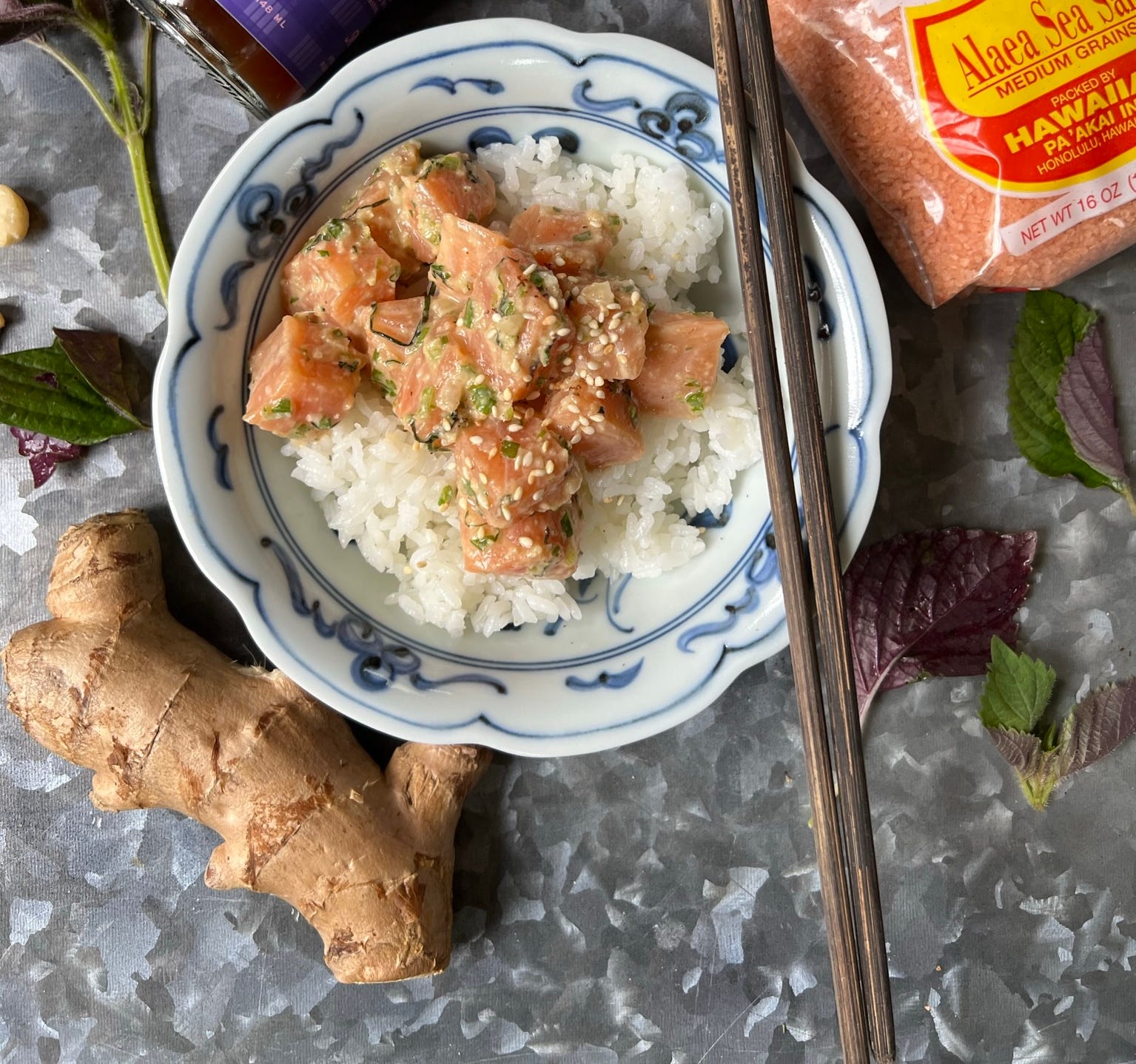
We chatted for a Food & Wine article years ago and she taught me her basic framework for making poke and shared her recipe for a delicious ponzu and ginger salmon poke seasoned with a bit of shiso. Vietnamese shiso (tia to) is totally fine, Kiki told me. It’s easy to find at Vietnamese markets and is affordable.
Kiki’s ginger-ponzu salmon poke. Recipe below!
And, there are many ways to enjoy poke. For a casual wine and snacks get together, my friend Lori, a PTFS subscriber and Kauai native, served poke as a pupu (appetizer, small bite). She distributed chopsticks and we noshed on her poke selection, shelled and nibbled edamame, drank lots of wine and caught up! Or, you can have poke as a rice bowl. I like to make poke lettuce wraps too. How do you like to eat poke?
This week’s poke exploration yielded three renditions — I’m not ready to premiere one of them quite yet. Look for my roasted vegetable recipe coming soon! The two quickies are:
Kiki’s Ginger Ponzu Salmon Poke
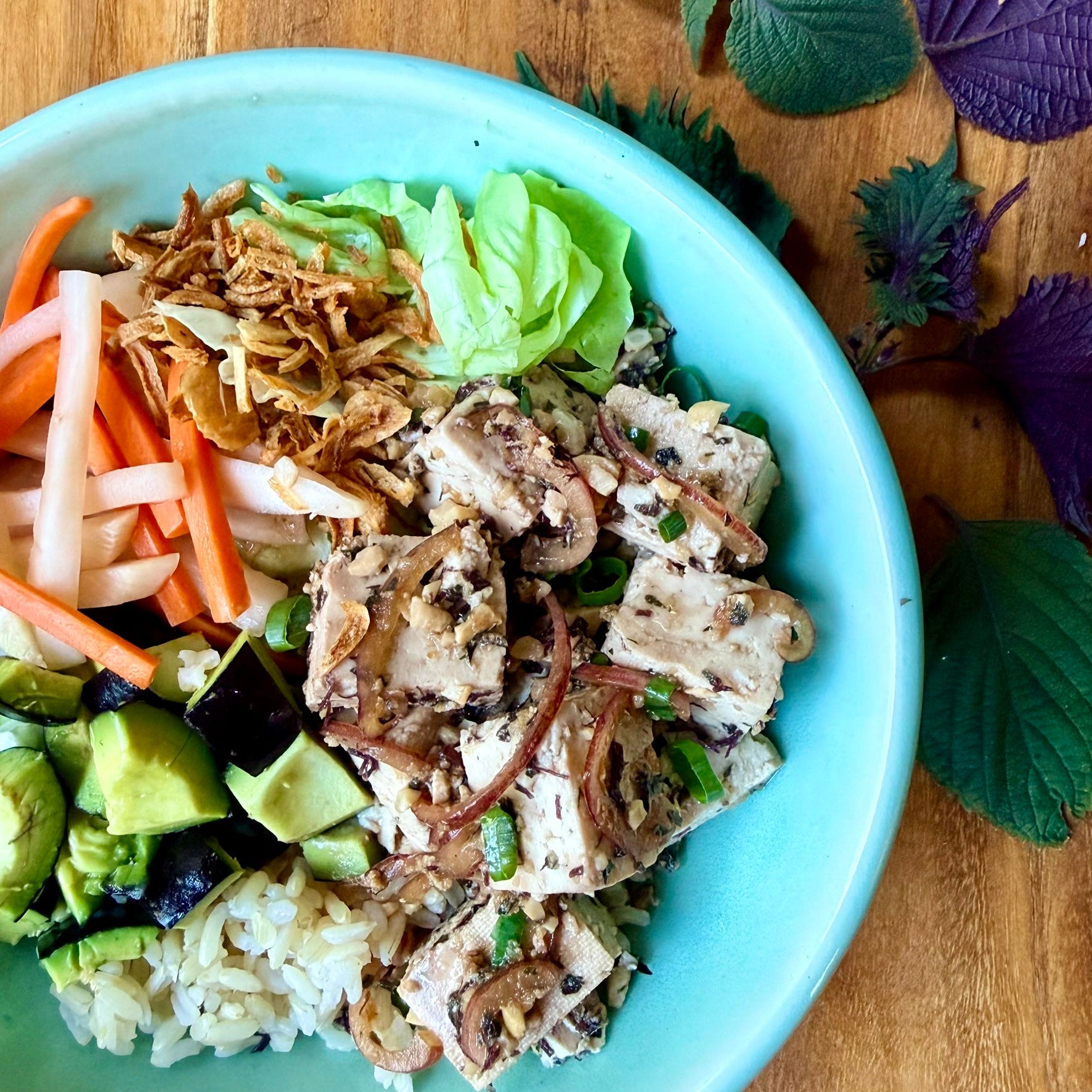
Andrea’s Tofu Poke
Poke is fresh tasting, healthful, and casual. When made with tofu or a cooked ingredient, it keeps well in the fridge too, for meal prep and snacks. Below you’ll find discussions on
Basic parameters for making and serving poke
The two recipes in full text and downloadable pdf
Ingredient sourcing plus substitutions (Do you need Hawaiian seaweed and candlenuts? How to buy salmon that’s safe to eat raw?!)
Variation suggestions
Let’s unleash your poke-mania!
Curious cooks, readers and eaters fuel this newsletter. Paid subscribers sponsor PTFS and this poke filled dispatch is exclusively for them. To get both recipes, fully use the recipe index + save 25% on my cooking classes, become a paid subscriber! Your support makes a big impact.
We’ve collected a bunch of back to school recipes, with tons of meal ideas to help you get into the swing of the school year hustle. Summer may be ending, but we hope you can find some ideas—from on-the-go breakfasts to packed lunches and busy weeknight dinners—to soften the blow! Delicious weeknight and school lunch […]
This blackberry cobbler recipe is a summertime delight! It features jammy blackberries underneath a tender, golden, scone-like topping. I’m quite smitten with this recipe—something borderline magical happens when you bake blackberries. The heat of the oven seems to enhance their floral undertones and make them taste extra special.
This is a simple dessert that you’ll want to make over and over again. Lemon zest, a touch of cinnamon, and a dab of tangy Greek yogurt add some flavor intrigue. Your guests might ask, “Why is this so good?”
It also happens to be gluten free, since I used almond flour in the topping instead of conventional all-purpose flour. Almond flour is very easy to work with and offers a subtle almond flavor that pairs beautifully with berries. If you’ve tried my peach cobbler or blueberry cobbler, you’re already familiar with it. I hope you’ll give this one a try!
I have a knack for saying things that many people think and few dare to voice openly. Airing dirty laundry has gotten me in trouble a few times with my family but in the past week, in talking to people about Cooking Thai, I’ve had private conversations with folks who quietly say, “You know, such and such Thai restaurant is not very good.” My sister Linh and I have the same conversation about Vietnamese restaurants.
So I have to admit to you that a lot of Thai and Vietnamese restaurants are not great. Many offer the same menus and flavors. To borrow from the New York Times food critic Ligaya Mishan, “We’re in an epidemic of sameness.”
I empathize with the restauranteurs.
If you’re a Viet or Thai restaurant owner, you’ve got financial goals to meet and are looking to fill seats and sell food. You cannot afford to spend too much time to labor to make food that’s going to be as good as homemade. You’ve got to cater to a broad swath of customers. As a result, your menu may be huge and your flavors can easily become diluted.
But, you as the diner — if you’re armed with cooking knowledge, you can make good food yourself to satisfy your palate, save money, and learn. Perhaps you’ll eventually engage with local restaurant owners so they know you have a high level of appreciation of their craft. Maybe they’ll feel more open to try new dishes and offer bolder flavors.
Cooking at home and eating out are not mutually exclusive. I love the healthy and relaxed aspects of home cooking but I want someone else to plan my meal and wash the dishes once in a while!
So, that’s why I write cookbooks and teach cooking — so you can understand how foods are prepared, make them yourself, and be a more informed diner! It’s a Nguyen-win if all that happens. A girl has to maintain and manifest her dreams!
💎 Nampla prik — a 1 minute Thai Wonder Sauce
A few months ago, someone asked about nampla prik, whether or not Pim had a recipe for it. Yes she does, and it’s tucked away in a recipe Note (always read recipe endnotes in the book to unmask little hidden gems!).
Nampla prik literally means fish sauce with chilies spiked with lime juice. I’d had it before at restaurants where it was lackluster, but Pim adds thinly sliced shallot and the sauce dazzles with complex flavor. You can have it as you like — with or without chilies — as much as you like, sometimes with garlic. Add extra lime juice to boost the tanginess for your taste.
How does Thai nampla prik compare to Viet nuoc cham?
Nampla prik is more intensely tart, salty, spicy and pungent. There’s no sugar and no water involved like what’s in my nuoc cham recipes. Also, nampla prik is enjoyed in relatively small, yet potent, quantities. You stir together it together and serve with a small spoon like you see in these photos from Cooking Thai.
Nampla prik isn’t super multipurpose like nuoc cham. In the book, we present it as a Thai “serving sauce” to accompany dishes like the holy basil stir-fries, salted egg yolk-shrimp fried rice and northern curry and mushroom fried rice. But ubiquitous holy basil stir fries (pad gaprao) can be made with practically any kind of meat or tofu so you’re apt to see the same sauce on many tables.
How to make Pim’s nampla prik
Nampla prik brightens and enlivens anything it touches. Use a small spoon to sprinkle the sauce onto your food at the table.
In a small bowl, mix together 1½ Tbsp lime juice, 1½ Tbsp fish sauce (or Thai thin soy sauce), and 1 Tbsp chopped fresh Thai chilies. If you like, stir in 1 Tbsp very thinly sliced shallot. Makes about 1/4 cup to serve 4.
I always pack my tablespoon with the shallot because it tastes really good after sitting in the lime juice and fish sauce. For a primer on Thai fish sauce, check page 22 of the book or visit this page on my website for a 🆓 guide to salty, spicy Thai condiments and seasonings.
Pass the Fish Sauce is a reader-supported publication. To receive new posts, mine the 150+ recipe index, and get 25% off class sign-ups, become a paid subscriber. I welcome your support at all levels!
💎 Take this life expectancy quiz. I got an “F”.
Getting only four out of ten questions right underscored the marvelous facts I didn’t know about living longer! Rory happily said that he may live past 100 so I better get ready to take care of him in his dotage. 🫡
Take the life expectancy quiz via my free gift link. You may have to click through some pitch to subscribe but you should get there. There are good explainers and statistics at the end.
💎 Coming up . . .
In this coming Sunday Special, you’ll see some easy, light recipes that have recently impressed me more than I expected.
This Fried Eggplant is dangerously easy to eat. Crispy sticks of eggplant are cooked til tender and seasoned with a universally loved savory blend of salt, white pepper, and five spice powder! This recipe is best as one of multiple dishes in a meal, or as a delicious appetizer / finger food with an ice […]
These stuffed poblano peppers are boldly flavored and legitimately hearty, boasting 20 grams of protein per pepper. They’re stuffed with soft, blended black beans followed by two kinds of cheese. The cheese turns gloriously golden in the oven while the chili peppers become nicely tender and caramelized.
Two layers of red salsa, one underneath and one drizzled on top, bring this crowd-pleasing vegetarian main dish together. Consider it a simpler alternative to enchiladas or layered casseroles that’s just as satisfying.
This recipe will be perfect for game days and casual home get-togethers as the temperatures drop. I hope you’ll make them again and again this fall—I’m already looking forward to my next batch.

 Login
Login
 Sesame chicken is one of the most popular dishes on the menu at any Chinese takeout restaurant or buffet. Deep-fried boneless chicken coated in a savory sweet sauce and topped with toasted sesame seeds? It’s a favorite here in America. That said, there is a lot of subpar sesame chicken out there! Too sweet, too […]