❌

Normal view

strawberry chiffon shortcake, perfected

By: deb
17 June 2026 at 18:02

In 2007, when this website was still in its infancy, I shared a recipe for a layered strawberry chiffon shortcake. I’d never made a chiffon cake before, but I brought it to a friend’s rooftop birthday BBQ, correctly assuming that no one would be unhappy with a towering, featherweight cake sandwiched with whipped cream and fresh strawberries, however inexpertly made.

Read more »

Strawberry Jam

By: David
17 June 2026 at 08:22

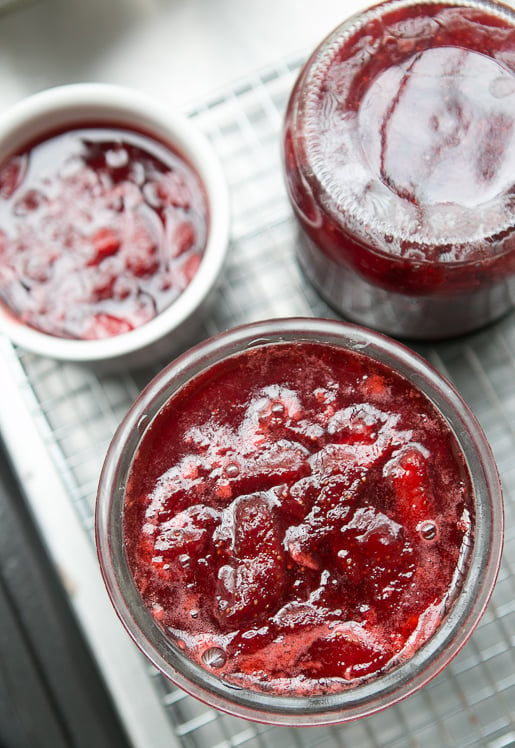
Strawberry Jam recipe

I was recently gifted an overload of strawberries: I bought four baskets from a vendor at the market, whose booth I shop at often, and he threw in two extra baskets for free, the equivalent of a carte de fidelité (loyalty card) in Paris. So I’ve spent the past few days washing, hulling, cutting and cooking my unexpected bounty.

I’ve been making a number of things with the gorgeous strawberries. But I also realized that while I have a Strawberry-Rhubarb Jam recipe on the site, I didn’t have a strawberry jam. So here it is.
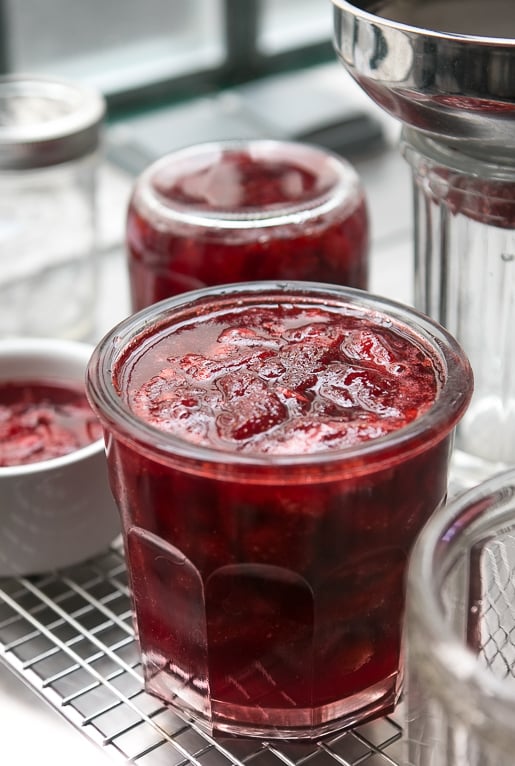
Strawberry Jam recipe

Although I’m giving you a recipe for the amount of strawberries that I used, you can use the same proportions if you have just a basket…or a bushel. You’ll just need to do a slight amount of math. Only the cooking time will change, so keep an eye on things.

Jam-making is not something you walk away from and you need to rely more on look and feel, rather than exact times. Another thing about jam-making is that fruit and berry jams are always better made in small batches; the shorter the cooking time, the better the flavor. So if you have more than 2-pounds (900g) of strawberries, consider making jam in a couple of batches rather than one big one.

Frozen zabaglione recipe

Print

Strawberry Jam

Many traditional recipes use an equal amount of sugar to fruit, by weight, but I find it’s okay to decrease it to these proportions. Sugar is both a thickener and a preservation agent. If you reduce it too much more, your jam may not thicken and won’t keep for a long time. (Which is okay if you want thinner jam, you keep it in the refrigerator, and eat it relatively quickly.) This recipe can be scaled up or down, depending on how many strawberries you have. But if you want to make a lot more, best to make it in a couple of batches. To prepare the jars, pour boiling water into them, as well as into the lids. Let them sit 5-10 minutes, then carefully pour out the hot water and set them upside down on a cooling rack until ready to fill. Since I keep my jams in the refrigerator, I don’t put them up them in a traditional sense. I usually just overturn the jars and let them cool, which provides a reasonable seal, then refrigerate them. I find my jams keep well this way for up to one year. Check the National Center for Home Food Preservation website for instructions on how to can fruit jams. Note: Last season strawberries tend to have less natural pectin than ones that arrive earlier. So your jam may be less jelled. One strategy is the finely grate a green apple into the strawberries before cooking them, which adds pectin. (There are guidelines here for using liquid and powdered pectin.) I don’t mind the slightly runnier jam and it’s terrific on yogurt or served with fresh goat cheese for dessert.

Ingredients

  • 2 pounds (900g) strawberries
  • 1 1/4 pounds (2 2/3 cups, 580g) sugar
  • one lemon organic or unsprayed
  • optional: kirsch (or eau-de-vie, or crème de cassis)

Instructions

  • Wash and hull the strawberries and cut them into quarters. If some are larger or smaller, just make sure the pieces all about the same size.
  • 2. Toss them in a large pot, such as a Dutch oven casserole made of a nonreactive material, with the sugar. Cut the lemon in half, squeeze the juice into the pot, and add the lemon halves to the berries. Stir well, cover, and let sit a couple of hours (up to 8 hours) at room temperature, stirring one or two times while they marinate.
  • Put a small plate in the freezer. Turn the heat on under the strawberries to medium-high and cook the strawberries, stirring occasionally, as they reduce and the juices thicken. If a lot of foam rises to the surface, skim it away. When the syrup is the consistency of warm maple syrup – it will take about 10 to 15 minutes or so, depending on the pot and berries, turn off the heat and put a spoonful of the jam on the frozen plate and return the plate to the freezer. Check it in a few minutes; if it wrinkles when you nudge it, it’s done. If not, return the plate to the freezer and cook the jam a little more, testing it again. It may take a few times before you get it to the right consistency.
  • When the strawberry jam is done, remove the lemon and stir in a few drops of kirsch, if using, then ladle the jam into the prepared jars.

Related Recipes and Links

Apricot Jam

No-Recipe Cherry Jam

Pickled Strawberries

Easy Jam Tart

Eggplant Jam

Baking Ingredients and Substitutions

snow pea salad with avocado

By: deb
3 June 2026 at 22:05

One of my most exasperating traits — or, perhaps one that makes me ideally suited for this space I invented, coincidentally, to suit my collection of traits — is that I have a terrific amount of random ingredient preparation ideas in the overflowing file cabinet of my brain that will spill into conversations the second I hear the triggering keyword.

Read more »

chicken salad for celery enthusiasts

By: deb
20 May 2026 at 17:22

I’m not sure if this is a sign of hitting a certain age — like a sudden interest in bird feeders (check, and please tell me about yours), or beekeeping (well, in the TikTok sense, not sorry), and animated conversations on the best pillows (I hate mine) — but I’ve found over the last year that I have very strong opinions on chicken salad and the correct way to make it, which, naturally, is my way. I hope I’m in the right place to release them into the world.

Read more »

Abalone Pot Rice

Learn how to clean abalone and make abalone sotbap, a nourishing Korean stone pot rice dish with tender abalone, miyeok, garlic, and crispy scorched rice at the bottom.

raspberry swirl cheesecake bars

By: deb
8 May 2026 at 18:46

While I’m not from a cheesecake family — it is never unwelcome, but we are more deeply devoted to things like pastry creams, chocolate pudding, and stellar coffee cakes — I married into one, which means that even though this site’s cheesecake archives are very well-populated, not a single peep of protest could be heard as far as my apartment walls reach (to be fair, a short distance) as I tinkered with these bars over the last few weeks.

Read more »

sidecar

By: deb
24 April 2026 at 19:56

If there’s anything that’s been consistent about this site in its near-20 years of beaming (babbling?) hypertext to servers and back to you, it’s that I’m very bossy when I get into something new, especially cocktails. When I fell in love with Porch Swings, I wanted you to as well. Ditto for Blood Orange Margaritas (but only when in season), a Perfect Manhattan era that spanned over a decade, Boulevardier that has been woven into almost every year since, and a Slushy Paper Plane phase last year. This past winter and spring still, it’s been Sidecars, 1920s-era cocktails with about as many conflicting stories as my kids regale us with when they didn’t do their homework.

Read more »

braised leeks and lentils with arugula and yogurt

By: deb
16 April 2026 at 22:48

I’ve been pining for a springy way to combine leeks and lentils in an unfussy, one-pot, weeknight-friendly meal but would get stuck on one thing: how annoying leeks are — and I say this from a place of adoration! I think leeks are one of the most stunning vegetables, an ombre of chromatic ringlets from buttery yellow to pea green and back to a pale shade of lima. They look exactly like spring (even though it’s climatically July outside but will be March again next week), and taste even better: Oniony but not harsh and silky, wonderful, and a little sweet when braised. They should be everywhere, but first we need to address the fact that if you go to the store or market for a bundle of leeks right now, you have no idea how much leek you’re getting.

Read more »

Broiled Whole Branzino recipe

Since leaving Korea and living abroad for many years, I’ve come across a few fish that were unfamiliar to me when I lived in Korea. Two of them are whiting and branzino, and I found that they can be especially delicious when cooked with Korean flavors. In a previous recipe, I used whiting to make […]

black bean confetti salad 2.0

By: deb
13 March 2026 at 13:38

I was in Paris* last week — no, I cannot believe I get to utter sentences like that so casually, either, pinch me — and it was really, truly, and surprisingly spring. The magnolia trees at the Jardin du Palais Royal supplied us with a lace curtain of fluttering pink shadows, the daffodils and hyacinth were popping up from the ground like they’d missed us, and everyone was outside and stayed out until after midnight and this energy climbed inside me, evicted all of the seasonal malaise (turned out I was just cold!), and I did my best to bring all of this warmth and joy back to NYC with me. And despite the fact that my grouchy (sorry, “weathered”) friends tried to warn me that we were experiencing a “false spring” and “don’t fall for it,” la la la, I said, it is spring in my heart now — and in my kitchen, and busted out a warm weather salad. Which is to say: I’m sorry, this sudden cold spell might be my fault.

Read more »

Seville Orange Marmalade

By: David
11 March 2026 at 09:02

This time of year brings Seville oranges to the markets in Paris. For the past few years, I kept wondering why they were so hard to find since it’s perhaps my favorite of all jams and jellies to make, and eat. But lately, they’ve been everywhere.  And I found myself busy making a lot of marmalade, which was easier since I came up with a brand-new, revolutionary technique which I couldn’t wait to share.

Since Seville oranges are rife with seeds, which makes slicing them difficult since you have to keep moving the seeds around with your slippery fingers, while trying to cut the oranges, then finding more, and fishing around deeper inside to extract more, plucking them out, etc… Each Seville orange has perhaps twenty to thirty inside.

So I thought, what if I was to squeeze the juice and seeds out first, strain them, then pour the juice back in? The seeds are precious commodities in jam-making, and get saved and used since they’re so high in pectin.

They’re wrapped in a sack and cooked with the marmalade giving the marmalade gets a suave, jellied texture. And this simple method, featured in my book Ready for Dessert, makes the whole process much easier.

You might be interested to know that Seville Orange Marmalade was created because of an error. Apparently, an Englishwoman in 1700, the wife of a grocer, was stuck with some sour oranges that were bought cheaply from a boat that was carrying them from Seville.

Since there was a storm, they wanted to get rid of their stock or oranges quickly, so the grocer bought them. But they were inedibly sour so his wife decided to try making jam from them, and viola!…Seville Orange Marmalade was invented.

Print

Seville Orange Marmalade

Adapted from Ready for Dessert (Ten Speed)
In my book, I advise letting the cooked oranges and the seeds rest overnight. That's an optional step. If you want to go ahead and finish the marmalade the same day you start it, you can.
Course Breakfast
Keyword confiture, jam, marmalade, orange

Ingredients

  • 6 Seville oranges (see Note)
  • 1 navel orange
  • 10 cups (2.5L) water
  • pinch of salt
  • 8 cups (1.6 kg) sugar
  • 1 tablespoon Scotch (optional)

Instructions

  • Wash oranges and wipe them dry. Cut each Seville orange in half, crosswise around the equator. Set a non-reactive mesh strainer over a bowl and squeeze the orange halves to remove the seeds, assisting with your fingers to remove any stubborn ones tucked deep within.
  • Tie the seeds up in cheesecloth or muslin very securely.
  • Cut each rind into 3 pieces and use a sharp chef’s knife to cut the rinds into slices or cubes as thin as possible. Each piece shouldn’t be too large (no more than a centimeter, or 1/3-inch in length.) Cut the navel orange into similar-sized pieces.
  • In a large (10-12 quart/liter) stockpot, add the orange slices, seed pouch, water, and salt, as well as the juice from the Seville oranges from step #1. Bring to a boil, then reduce to a simmer, and cook until the peels are translucent, about 20 to 30 minutes. (At this point, sometimes I’ll remove it from the heat after cooking them and let the mixture stand overnight, to help the seeds release any additional pectin. But it's not imperative.)
  • Stir the sugar into the mixture and bring the mixture to a full boil again, then reduce heat to a gentle boil. Stir occasionally while cooking to make sure it does not burn on the bottom. Midway during cooking, remove the seed pouch and discard.
  • Continue cooking until it has reached the jelling point, about 218ºF degrees (103ºC), if using a candy thermometer. I cook this slightly less than other jams and marmalades because the high amount of pectin helps the marmalade set up more stiffly. To test the marmalade, turn off the heat and put a small amount on a plate that has been chilled in the freezer and briefly return it to the freezer. Check it in a few minutes; it should be slightly jelled and will wrinkle just a bit when you slide your finger through it. If not, continue to cook until it is.
  • Remove from heat, then stir in the Scotch (if using), and ladle the mixture into clean jars. Sometimes I bury a piece of vanilla bean in each jar. (Which is a great way to recycle previously-used or dried-out vanilla beans.)

Notes

I don’t process my jams, since I store them in the refrigerator. But if you wish to preserve them by canning, you can read more about the process here.
Note: Sour or Seville oranges are called in French oranges amères and are available mid-winter in many other countries around the world as well.

banana chocolate chip cake

By: deb
23 February 2026 at 19:33

Somehow, despite how impossible it seems (to me, a person who has neither aged nor matured a day), it’s been almost twenty years since I first told you about my family’s favorite coffee cake. It’s tall, plush, crisp with a flaky layer of cinnamon sugar on top, studded with a quilt of chocolate chips and is downright, well, adorable when cut into cubes because they’re a little wobbly. When one tumbles, it shakes off a little pfft of cinnamon sugar, like a pup coming in from today’s blizzard. It’s perfect. It needs no changes or updates.

Read more »

miso chicken and rice

By: deb
10 February 2026 at 21:18

How do you cook when your kitchen isn’t available for kitchen-ing? On a Sunday last April, I awoke at the crack of dawn jet-lagged from an (excellent) trip to Amsterdam* to an email from my apartment building that ConEd had found a gas leak in the main line to the building and had shut down service for safety. With this, I was indoctrinated into a society of New Yorkers I previously hadn’t known existed, as NYC is apparently riddled with tales of people who lived without gas for (what seemed like the minimum of) 6 months and up to 18 months while their building trudged at a snail’s pace through rounds of repairs and inspections.

Read more »

simple crispy pan pizza

By: deb
20 January 2026 at 18:12

If you want a homemade pizza that requires no kneading, no special flour, or long wait time (because who among us has ever said “what I really crave is pizza that will be ready 1 to 3 days from now”), you should really, really be making more pan pizzas at home. You might even consider it a worthwhile addition to your 2026 cooking bucket list.

Read more »

Orange-Glazed Polenta Cake

By: David
9 January 2026 at 16:28

Orange-glazed polenta cake

Apparently I’m not the only one who loves polenta cake. The Italians like it so much that it’s called Amor Polenta. Which means “Polenta Love.”

Well, at least that’s what I thought it meant, because amour in French means “love.” And I assumed that it was the same in Italian. (Another reason for finally getting on that life-long ambition to live in Italy and learn Italian.) But for now, checking in an Italian dictionary, I found out that “amor” means “sake.” (As in, for the purpose of.) So I’m not sure how it got its name, but this cake makes a pretty good argument for the sake of whisking polenta into a cake.

Orange-glazed polenta cake

I’m one of those people who is completely crazy for anything with cornmeal, from corn bread to even a kind of kooky polenta ice cream that I’m sure no one else has ever made, because I used a completely obscure polenta that very, very few people can get their hands on. But I felt compelled to make it, for the sake of using up a little bag of that polenta that I had.

Orange-glazed polenta cake

Fortunately, polenta is available just about anywhere. I like to buy stone-ground polenta, which has a crunchier flavor. But you could use instant polenta for this cake, normally something I avoid. But I found myself with a bag of it and was looking for ways to use it up. And here’s where the rest of it landed.

Like many Italian cakes, which are unlike American cakes, this is not a buttery bomb of richness. True, there is butter and a few eggs in there. But the great flavor comes from ground almonds, which tend to make the cake much moister the following day as the nut oils soak the crumb, which is one of those baking terms (unlike amor) that pretty much seems to be what it is talking about. The polenta adds a bit of a savory quality to desserts, which draws me to use it a lot when baking.

Orange-glazed polenta cake

This cake is a great snacking cake and I tend to walk around my apartment several times during the day, somehow landing frequently near the cake, where a serrated knife just happens to be stationed alongside. Ready and waiting to lop a slice off.

Orange-glazed polenta cake

In addition to a collection of polentas, I found myself with a collection of eaux-de-vie on hand. Some were gifts, others were picked up on my travels. A few are anise-based, which pair nicely with polenta, and chocolate. I have a ginger one that is great when summer fruits are in season, like peaches, nectarines, and apricots. And the long bottle in the front right, the eau-de-vie of lees that I got in Switzerland, after I found out how good raisins in lie (eau-de-vie made from leftover grape yeast, and other stuff that falls to the bottom of wine vats post fermentation) was, after gorging on cauldrons of fondue.

As astute readers can see from the fill line of the bottle, that project never came to fruition. (I’m too busy trying organize my polentas and eaux-de-vie. And plotting a way to live in both Italy, and France.) But I did add a few shots of orange liqueur (not shown), which gave it a little boost of flavor. Not enough to be perceptible. But like that bag of instant polenta I’ve had for a few months, I was always conscious that it was there. You can use any kind of liqueur that you want – maraschino, limoncello, absinthe, kirsch, or even anise liqueur.

As much as I like this as a snacking cake, it can be dressed up with a fruit compote. I sectioned some tangerines, navel oranges, and pink grapefruits, drizzled a little honey over them, and served them alongside the cake. I had planned to spoon some warm sabayon over the cake and fruit, but decided that I had too many other things to do. Namely, get cracking on using some of those bottles of liqueur that I’ve been hoarding.
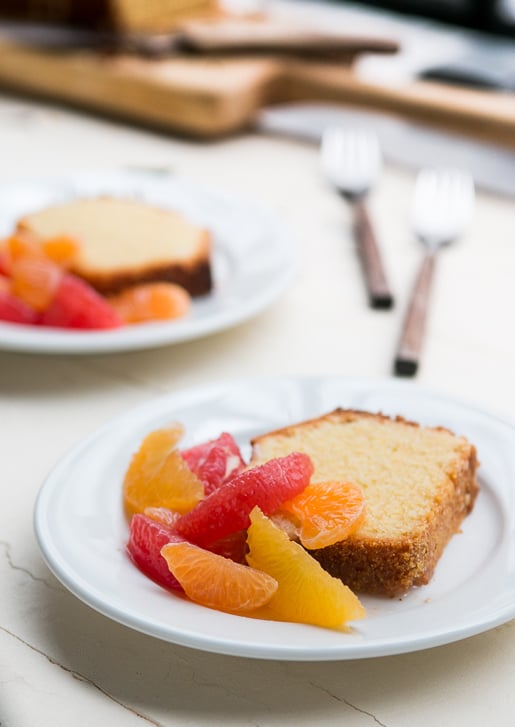
Polenta cake recipe

Print

Orange-Glazed Polenta Cake

For this cake, using fine-ground polenta or instant polenta will result in the smoothest texture, although whatever is available will work. I’ve made it with coarse polenta too, and enjoy the crunch. Almond flour is available at specialty stores, Trader Joe’s, and online. If you can’t find it, grind 7 1/2 ounces (215 grams) sliced blanched almonds in a food processor with the flour until the almonds are pulverized. Although cakes like this don’t always need adornment, I did glaze it with a dribbly orange glaze that firms up and gives the top a citrus-scented fruity crunch. For those wanting to skip the liqueur in the cake, you can leave it out and increase the almond extract to 1 1/4 teaspoon. For the glaze, you replace the liqueur with orange juice.

Ingredients

For the cake

  • 8 ounces (225g) unsalted butter cubed, at room temperature
  • scant 1 cup (180g) sugar
  • zest of 1 lemon
  • 3 large eggs at room temperature
  • 2 tablespoons liqueur or eau-de-vie such as orange liqueur (Grand Marnier or Cointreau), kirsch or grappa
  • 3/4 teaspoon pure almond extract
  • 3/4 cup (125g) finely ground polenta plus additional for preparing the pan
  • 2 cups (215g) almond flour
  • 6 tablespoons (55g) all-purpose flour
  • 1 1/2 teaspoons baking powder preferably aluminium-free
  • 1/2 teaspoon salt

For the glaze

  • 1 1/4 cups (170g) powdered sugar
  • 1 tablespoon orange juice
  • 4 teaspoons orange liqueur (such as Grand Marnier or Cointreau)

Instructions

  • Butter a 9-inch (23cm) loaf pan. Dust the inside with polenta, and tap out any excess. (Note: The pan I used has a nonstick finish. If you want to make sure the cake comes out nicely you may want to cut a rectangle of parchment paper and fit it into the bottom of the pan after you prepare it, especially if using an unfinished loaf pan.) Preheat the oven to 350ºF (180ºC).
  • In the bowl of a stand mixer fitted with the paddle attachment, beat the butter, sugar and lemon zest at medium-high speed, until it’s light and fluffy, about 3 minutes. (You can also make this in a large bowl, beating the butter and sugar by hand.)
  • Add the eggs one at a time, stopping the mixer after each addition to scrape down the sides of the bowl. Mix in the liqueur and almond extract.
  • In a medium bowl, whisk together the polenta, ground almonds, flour, baking powder, and salt, until there are no lumps. Gradually mix the dry ingredients into the creamed butter mixture, just until well-combined. Do not overmix.
  • Scrape the batter into the pan, smooth the top, and bake the cake until it is golden brown on top and a toothpick inserted into the center comes out almost clean, perhaps with just a few crumbs attached, 45 to 50 minutes. Let cool on a rack for about 30 minutes, then run a knife along the outside of the cake to loosen it from the pan and tip the cake onto the rack. Let the cake cool completely before icing.
  • To glaze the cake, mix the powdered sugar with the orange juice and orange liqueur until the glaze is thick, but still runny – not too watery, but as thick as a milkshake. If necessary, add a bit more sugar if it’s too thin, or add a bit more liquid if it’s too thick. You can try smoothing a bit over the cake to see if it’s the right consistency for drizzling and dripping down the sides before glazing the entire cake.
  • Spoon the glaze over the cake, encouraging the glaze to run down the sides by nudging it towards the edges with the back of the spoon or a metal spatula.

Notes

Serving: When the glaze has firmed up, serve slices of the cake with a favorite fruit compote, such as fresh citrus segments, caramelized pineapple, poached pears, or sliced and sugared peach slices (peeled) or nectarines.
Storage: The cake will keep for up to five days, if well wrapped, at room temperature. The cake will be noticeably moister the day after baking due to the oil in the nuts. It can be frozen for up to two months.

Related Recipes and Posts

Baking Ingredients and Substitutions

Cornbread with Harissa Butter

Polenta Crisp Topping

Simple Polenta

Cornmeal Cookies

Cornmeal Biscotti

crunchy brown butter baked carrots

By: deb
18 November 2025 at 23:34

My strongest opinion on Thanksgiving sides is that whenever possible, they should come in a casserole dish (or its chic French cousin, a gratin). I don’t mean that your sides should be limited to things that swim in cream, cheese, butter, or a happy combination of all three — although one dish in this category is highly welcome on my table — I simply mean that sides like this, that is baked in dishes with walls, tend to excel at holding up to resting times, reheat well, and stay warm longer.

Read more »

baked potatoes with crispy broccoli and bacon

By: deb
30 October 2025 at 19:44

Unless you’re living your life better than me (probably!), I bet it’s been way too long since you last had a baked potato for dinner — or, as they’re more charmingly called across the pond, “jacket potato.” And it’s a crime because they’re so cozy and uncomplicated to make, we could fix this right now.

Read more »

brown butter snickerdoodles

By: deb
21 October 2025 at 21:21

Friends, it’s snickerdoodle season. If you didn’t know that snickerdoodles had a season, let me paint a picture for you: you’re coming inside on a blustery and colder-than-you’d-expected October day so you hadn’t dressed for it and you can’t wait to announce what my kids always laugh at me for saying when I walk through the door: “Well, that’s enough doing things for me today!” and forswear things like “being outside” and “hard pants” for the rest of the evening but what is this! What is this god-like aroma of buttery baked cinnamon sugar warmth that has permeated your senses? Is it a scented candle, i.e. the idea, but not the substance of a thing you love? No, it’s snickerdoodles. And you’re about to eat a warm one, which feels like climbing inside It’s The Great Pumpkin, Charlie Brown while also, simultaneously, getting to be this dog. I’m not saying you cannot experience this sensory transcendency on a day in January or June, but it hits on a different, worldview-shifting, level when cold air is still a novel thing.

Read more »

❌