 Login
Login
salted caramel peach crisp
5 August 2024 at 22:36


It’s summer! Whether you’re in or outdoors, hopefully for all of you there are beautiful summer fruits and berries to be had, and I hope that you’re able to get your hands on as many of them as you can. I am loading (actually, overloading…) myself up at the market. While a good portion on the fresh fruit gets eaten just as-is, some of it goes into the following dessert recipes that I continue to make year after year. Others go into jam, which is a great way to preserve all those summer fruits and berries, and make them last through fall and winter.
Cherry season is behind most of us (sniff…sniff…), but if they are still lingering where you live, you can type “cherry” or “cherries” into the search engine at the top right corner of the page to find cherry recipes. (And we don’t get a bountiful array of fresh raspberries and blackberries here, so I don’t have many recipes that use them on the blog.) But for nectarines, strawberries, peaches, plums and other summer fruits, here are some of my favorite recipes on the blog…
Summer Fruit Galette with Frangipane
I’ve seen so many galettes this year on social media, that it’s tempting to already call galettes The Dessert of the Year. (Okay, there were plenty of Banana Breads as well. And it’s hard to knock Banana Bread, even my low(er) fat one.) But for the bang-for-the-buck, it’s hard to beat the silly-easy galette, made with a fail-safe dough that gets rolled out, topped with fresh fruit, and baked until ripe ‘n ready. Mine has a layer of frangipane under the fruit to keep some of those juices away from the bottom crust, so it stays crisp. It also tastes good, too! Apricots work especially well in this one but you can use nectarines, plums, peaches, or…
…rhubarb and strawberries! Yes, the classic combo works well as a galette, too. But don’t let tradition stand in the way of deliciousness and you can swap out cherries, raspberries, or blackberries for the strawberries.
When I was a cook in upstate New York back in the 1980s (!) I remember someone brought us a (as in 1) basket of fresh apricots from California, which I’d never seen before. I made a simple tart with them and only eight lucky customers could get a taste of it. (Or maybe I cut it into ten?) Fast-forward to today, summer brings a cavalcade of fresh apricots to the markets and toward the end of the season, I don’t have time to shed any tears as I’m piling apricot jam into pots, to save them for the coming months. It’s Romain’s favorite jam so I make sure there’s enough to keep him happy, because I’ve learned what happens when I don’t : 0
Summer Fruit Tart (with frangipane)
Another summer fruit favorite, yes, with more almond cream than the galettes above, this is that classic French tart that you’ll find in many pastry shops all year round, using everything from pears to pineapple. Don’t love almonds, or want to take it in a different direction? Replace the almonds with hazelnuts for a special treat.
While apricots are Romain’s favorite for jam, I am 100% on team plum. The luscious tang of juicy plum, and the high natural pectin content, makes this one of the easiest jams to make. And it’s not too difficult to eat, either.
While I miss the purple Santa Rose and Elephant Heart plums we got in California, France has its own special selection of delectable plums, including Mirabelles, quetsches, and even wild plums. While the wild plum trees that we used to pick/glean from have been pruned by the absentee owners (phooey!) we found another source last summer. And the only thing better than free plums is free wild plums, which come in an array of snazzy colors and are extra tangy, perfect for those of us that like some pucker in our pastries.
The cousin of clafoutis, this flaugnarde features a jumble of plums baked in a silky custard. They’re so pretty I almost hate to bake them. But then, when I pull it out of the oven, I’m happy to have a beautiful baked gratin dish of custardy plums for dessert on a warm summer night.
Two tart fruits come together, baked under a buttery blanket of streusel. If these two bedfellows are available at the same time where you live, you’re doubly lucky!
The elusive Mirabelle plums have a cult-like following and while some mistakenly think they aren’t available in the U.S. (they were briefly banned a few years ago), if you’re lucky, you can indeed find them. They’re intensely flavored and sweeter than other plums, and make a wonderful confiture with jewel-like fruits suspended in a shimmering jelly, which are lovely heaped on toast in the morning. (If you want to get a taste of Mirabelles but can’t find them, Bonne Maman makes a golden plum Mirabelle jam that’s exported from France.)
While I wasn’t a fan of Angel Food Cake growing up, which my mother usually made to accompany strawberries, I became a convert as a grown-up. Perhaps it had to do with writing an ice cream book and having an overload of egg whites to use up. (And Angel Food Cake is an express route to doing that.) Nevertheless it’s a treat along with summer fruits and berries, either baked as a compote or fresh, tossed in a little sugar and perhaps a dash of crème de cassis. The spongy cake is an ideal way to make sure you get every drop of the fruit syrup that’s surrounding the airy slab. It’s French cousin, Gâteau de savoie, is equally enjoyable, and doesn’t require an Angel Food Cake pan.
Roasted Strawberry Miso Ice Cream
Roasting strawberries is lesser-known way of coaxing out their flavor, but works well when making ice cream as it concentrates them and reduced the water, so the ice cream stays creamier. Adding a touch of salty miso provides a curious contrast to the berries juicy sweetness, and a little umami to boot.
Once you make the (very) easy base for this Strawberry Spritz, you can use it to make Strawberry Margaritas, too. (And if you’ve got a hankering for a classic Spritz, I’ve got you covered there, too.) But this Spritz is a great, light apéritif to enjoy all season long. I was drinking lots of these a few weeks ago when strawberries were at their peak. If they available where you live, go infuse some in vermouth blanc for a great spring/summer sipper.
Spiced Plum Cake with Toffee Glaze
Toffee glaze is one of those things you could put on an old sneaker, and it would make those dilapidated Reeboks taste great. Even better (and more recommended) is this spiced plum cake, which isn’t too rich or too sweet. Crunchy toasted almonds on top are a nice contrast to the buttery glaze.
Peach Shortcakes with Butterscotch Sauce
Speaking of buttery sauces, butterscotch with peaches is a natural. Grammar-correct keeps asking me: A natural what? But I think you can figure that out. If not, give them a try together and you’ll see what I’m talking about.
If you’re fortunate enough to have a peach tree or can get some of the leaves, they lend a delicate almond-like flavor to this intriguing apéritif wine. I try to make a few bottles every year and serve chilled glasses as the season’s change, reminding me of summer, and reminding me that the light almond flavor of peach leaves in wine is something to put on my calendar for the following year.
Peaches and bourbon are natural partners, and they don’t mind sharing space in a tumbler with the classic French apéritif, Bonal. But not to worry if you don’t have it; I offer some substitutes that you might already have on your liquor shelf. This cocktail isn’t just pretty, it’s also a pretty effective way to beat the heat. (Yup, nectarines or plums could replace the peaches, if you’re so inclined.)
A vintage metal popsicle mold that was a find at a flea market prompted these summer ‘sicles. You can load ’em up with berries and since I used white nectarines, the popsicles were extra-pretty in pink. But anyone would say “yes” to them in yellow, if you go with standard nectarines.
Mixed berry anything automatically makes something my favorite dessert. I love, love, love the juicy tumble of strawberries, blueberries, blackberries, red currants, or whatever else you’ve got. Bring the berries on!
While I am nostalgic for the overload of blueberries that I grew up with New England, when I do find myrtilles, I try to keep them as close to their pure state as possible. Topped with crumbly drop biscuits, all that’s needed is a scoop of vanilla ice cream to complete the picture, but white chocolate-fresh ginger ice cream would also be welcome…and appreciated, on this cobbler.
Mango Frozen Yogurt with Blueberry Compote
While everyone’s mind is on peaches and nectarines, don’t forget mangoes, their tropical counterpart, which go just as well with summer berries. Blueberries particularly come to mind but raspberries and strawberries could fill in for them.
With pretty swirls of crispy meringue, this tangy frozen yogurt can be part of a composed dessert, which I like to serve in the summer, being generous with the fresh fruit…and filling in the blanks with frozen yogurt and meringues.
Blueberry Buckle with Lemon Syrup
I don’t know if blueberries get any better than in this buckle, which do indeed “buckle” under the weight of almost too many blueberries…if that’s even possible. A dousing with tart lemon syrup keeps things moist and tangy. You can skip the cream with this one. It’s great on its own.
I’ve been featuring some new and revisited favorite restaurants in Paris, writing them up in my newsletter. You can find a list of my Favorite Restaurants in Paris on my website but here are links to the posts in my newsletter of places I’ve eaten at lately…
To get more Paris tips (and stories and recipes) sent right to your Inbox, subscribe to my newsletter here:
I think I have something wrong with me. I seem to be afflicted with a particular malady that forces me to buy way too many summer fruits when they’re in season. It gets particularly dire when faced with apricots and cherries, two fruits whose seasons are much shorter than the others. The first fresh apricots I saw were back in upstate New York, around the 1980s, and I’d never seen them before. Someone brought us a basket of the tender, squishy little orange fruits to the restaurant that I worked at, and I remember being completely taken off guard, as the only apricots I’d ever seen were the dried ones. And while I loved the crinkly dried specimens, those fresh beauties with a red blush were a whole other taste entirely.
Then, when I moved to California, I discovered how abundant fresh apricots are (or can be), as they are in France. But no matter how abundant – or not – cherries are when the season is in full swing, I always consider them extra-special fruits and give a prominent place in my kitchen. At the beginning of the season, they’re incredibly expensive and rarely good. Then, as the season moves along, they start showing up in larger mounds at the market, and the prices get gentler, coaxing me to buy as many as I can heft.
This week, I was helpless when faced with an overload of summer fruits at the market. And in addition to a giant bag of apricots, two bulging sacks of tomatoes, and eight white nectarines, I bought 2 kilos (about 4 1/2 pounds, give or take a few cherries) of fresh cherries — and from the looks of the other shoppers, it was more than any normal person would buy. (Although I think I made the vendor’s day.) But I couldn’t help it. They were Burlat cherries and I’d bought a small bag from the same vendor last week at the market, and there he was again, tempting me with more. Once I got home, I got my cherry pitter out, and pitted half of them, saving the others to eat fresh. (Except I almost polished off the fresh ones I was reserving as I was pitting these!)
Fresh cherries are, of course, great fresh. But cooking them can deepen, and even improve their flavor, especially nice if you get home and find yourself with a bag of rather wan ones. Or ones that you might snag at the end of the market, when the vendors are trying to get rid of any extras that might not keep until the next market day.
In addition to being the answer to what the heck you (or I) are going to do with all those cherries, this recipe also deftly answers that age-old question: Can I freeze that? And the answer is a big, resounding, “Heck, yeah!” Once the compote has cooled, it freezes perfectly in zip-top freezer bags or other containers that you prefer to use, and will last up to a year. (You can also freeze pitted fresh cherries on their own as well.)
And let me tell you, it’s great to stumble upon a bag of cherry compote that may have moved to an unfavorable position in your freezer as summer shifted into fall – or winter, when they can become quickly forgotten. Once defrosted, and perhaps rewarmed, they’re terrific served with vanilla ice cream, plain yogurt, or alongside a cake, such as almond cake, gâteau de savoie, or angel food cake.
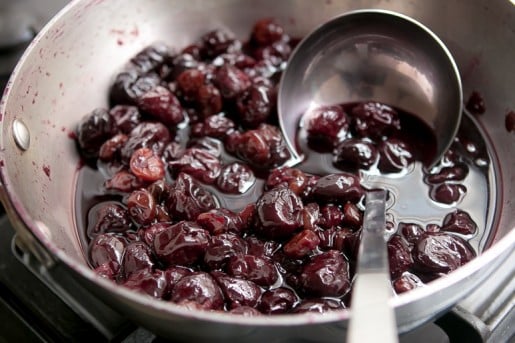
I like to boost their flavor with a handful of dried sour cherries, added midway during cooking, so they plump up and absorb the cherry juices, which add another dimension of cherry flavor. A shot of kirsch also dials up the flavor nicely.
Related Recipes
Many people tell me this is one of their favorite recipes from my cookbook, Ready For Dessert. In addition to these fantastic Coconut-Dipped Chocolate Macaroons in it, you’ll find the much-loved recipe for Fresh Ginger Cake, which makes a fantastic dessert served with sliced, juicy peaches or flavorful strawberries and raspberries in the summer, or tangy lemon cream in the winter, as well as my other most frequently requested recipes.
I’m often asked about the different between Parisian macarons and American-style macaroons, like these. Both are egg white-based, however the European version (which was invented in Italy) uses almonds whereas the American ones use coconut. There’s some dispute about how the American ones came to be made of coconut; one theory is that European immigrants who came to the United States couldn’t get almonds, or they were too expensive, so they used coconut.
Another theory is that European companies wanted to ship their macarons over longer distances, so swapped out coconut for the spoilage-prone nuts. Others credit Franklin Baker, an American flour miller, who found the then-exotic shredded coconut more interesting (and less-expensive) to use than nuts. Either way, I like all kinds of macaroons…or macarons.
The French do make coconut cookies, which are called Congolais or Rochers à la noix de coco, usually shortened to Rochers coco, or coconut “rocks.” I’ve not seen them dipped in chocolate in any French bakery – but why not?
I’ve tweaked this recipe over the years and tested them with flour alternatives, which I’ve noted in the headnote in the recipe, and they come out great. You can even skip swiping the bottoms in bittersweet chocolate if you wish. No matter how you make them, I hope they become one of your favorite cookies, too.
Recently I started reaching for my bottle of Vermouth Blanc more and more. I had opened it to make an El Presidente cocktail, but during an interview on my IG Live channel with Pierre-Olivier Rousseaux, owner of Dolin distillery in France, he remarked that their Chambéryzette apéritif, made in the French alps, could be made at home, anywhere, with fresh strawberries and white vermouth. So I took the plunge and made a batch myself.
It’s very easy to make. Just slice or quarter a few fresh strawberries and within 24 hours, you can be enjoying your very own batch of strawberry apéritif!
White vermouth (vermouth blanc) is different than dry vermouth. For one thing, the botanicals used are different. Dry vermouth leans into its bitterness with wormwood, quinine, or other flavorings that keep it decidedly dry. White vermouth celebrates its sparkling-clear color with floral aromas, which can include elderflowers and citrus. While you could make this with dry vermouth, I do prefer it with the white vermouth, which in Italy is referred to as vermouth bianco.
When I took a sip of the strawberry-infused vermouth the next day, it seemed like it’d be a perfect candidate for a summery Spritz. So I mixed it with a splash of tonic water, and found it was just perfect as-is, with a handful of ice and some berries and maybe a slice of citrus in it. If you want to go full-on summer, you could replace the citrus with a slice of peach or nectarine, or maybe a few other types of berries.
Tonic water has become more of a topic of conversation lately. Brands like Schweppes are popular and readily available (and you can make your own tonic water, too), but some like to fine-tune their cocktails and apéritifs with a premium brand of tonic water. Fever-Tree, Q, and Fentimen’s are popular, but I kept mine French using Archibald, which uses gentian in place of quinine, to keep it resolutely Made in France. (Quinine doesn’t grow in France, but gentian does.) As far as I know, it’s not available outside of the country but feel free to find your own favorite where you live, and use that.
Whenever I’m looking through a new cookbook, what never fails to make me bookmark a recipe is when I come across something that has caramelized nuts on it, or in it. Whether it be Honey-Almond Squares or Swedish Almond Cake, you can be sure you’ll find me in my kitchen within the next 24 hours, and baking it. This Caramelized Peanut Cake that takes very little effort to make, but yields big rewards. Big, crunchy, peanutty ones, with a bonus of moist, buttery cake underneath, holding it all together.
The good thing about this cake (aside from it being covered with a generous pile of caramelized salted peanuts, as if it can get any better than that) is that you likely have most of the ingredients already on hand. That was my case, so I was able to make it right away. The only ‘technique’ you need to master is boiling butter, honey, cream and sugar, then stirring in the roasted peanuts. The topping couldn’t be easier.
This recipe is adapted from The Joys of Baking, an unabashedly sweet ode to baking by Samantha Seneviratne that riffs off stories and situations in her life, ones that inspired the recipes. Gingered Cashew Nut Brittle showered with sesame seeds, a Roasted Plum Cloud Cake topped with swirls of snowy meringue, bittersweet Amaro Stracciatella Ice Cream, and Salted Chocolate-Covered Chocolate Caramels are the kinds of things that I’d agree are a joy to bake, and to eat.
So how could I resist cake topped with SALTED CARAMELIZED PEANUTS? Sorry for shouting, but this cake is something to shout about. I mean, just look at it…
The only difficulty you might encounter is getting the cake neatly out of the pan. Mine got a little dark around the edges (why, oh why, wasn’t I born a food stylist, to make mine as neat as the one in the photo in the book?) I found that letting the cake rest for about 5 to 10 minutes after it comes out to the oven, then using a sharp paring or utility knife that’s either sprayed with a bit of non-stick spray, or lightly greased, to separate the sides from the cake pan while it’s still warm, is your best bet for easy (or easier) removal of the ring of the springform pan. Any pieces that fall off can be reaffixed to the cake.
Or let them cool…and eat them yourself.
Which is what I did with the missing chunk in the photo, above. (Why, oh why, wasn’t I born with photo editing skills?) But honesty is the best policy, and I hope you’ll trust me when I say this cake is as good as it looks. And if a few pieces go missing, here and there, well – you only have yourself to blame. But unlike me, you don’t have to tell anyone about it.
